🍷 Beyond the Beer
Beer rightly dominates the Czech drinking story — but it isn't the whole story. Tucked into South Moravia's rolling hills is a genuine, centuries-old wine tradition producing some of Central Europe's most underrated whites, and Bohemia's spa towns and Moravian orchards gave rise to two spirits — one herbal, one fruit-based — that carry real history rather than novelty. This page covers what's actually worth seeking out beyond the pivo.
🍇 Moravian Wine — 96% of the Country's Vineyards
Almost all Czech wine comes from South Moravia, which is why locals simply call it "Moravian wine" — Bohemia has a handful of vineyards, but they're a rounding error by comparison. The tradition genuinely dates back to Roman times: the Legio X Gemina, stationed near what's now the village of Pasohlávky, is linked to the region's earliest viticulture, and around 278 CE, Emperor Marcus Aurelius Probus formally lifted the ban on planting vines north of the Alps — a decision that let systematic winemaking take root here. Modern archaeological digs near the old Roman outpost have turned up vine-pruning knives to back up the story.
The region splits into four officially recognized subregions, each with a distinct character. Znojmo, hugging the Austrian border, is aromatic-white territory — Grüner Veltliner (Veltlínské zelené) is king here, backed by Müller-Thurgau, Sauvignon Blanc, and Riesling, grown on loess soils south of the historic town, itself honeycombed with a medieval underground cellar network. Mikulov, centered on the dramatic limestone cliffs of the Pálava hills (a UNESCO biosphere reserve), is the oldest and most famous subregion, built on Welschriesling and the indigenous Pálava grape. Velké Pavlovice is where the reds live — Frankovka (Blaufränkisch) and Svatovavřinecké (Saint Laurent) thrive on the warm plains between Brno and Břeclav. Slovácko, the largest by vineyard count with 418 individual sites, grows the widest spread of varieties, from Riesling to Moravian Muscat.
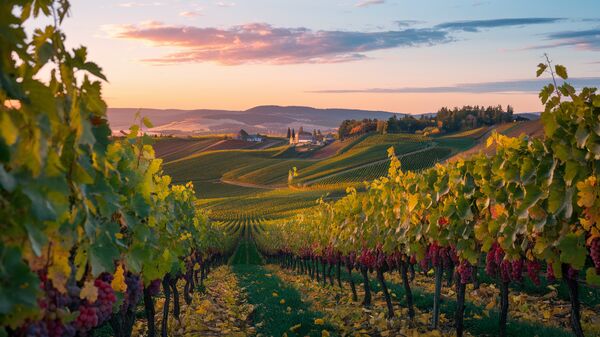
South Moravia
Rolling vineyard hills between Znojmo and Mikulov, often nicknamed "Moravian Tuscany"
🌾 Pálava — the One Grape That's Genuinely Czech
If there's a single wine to actually seek out, it's Pálava — the country's own invention, bred in 1953 by researcher Josef Veverka as a cross of Gewürztraminer and Müller-Thurgau, named after the limestone hills it grows on. It's golden-yellow, full-bodied, aromatic, and typically semi-sweet, with floral and honeyed notes that don't really resemble anything else on a European wine list. Nearly half of all Pálava vines in the country grow around Mikulov, where the grape originated. Labels can be confusing to newcomers: terms like kabinet, pozdní sběr (late harvest), and výběr z hroznů (selection of grapes) — borrowed from the German/Austrian system — describe ripeness at harvest, not final sweetness, so a "late harvest" Pálava can still finish bone dry. Wine cellars here are called sklepy, and entire "cellar streets" (sklepní uličky) of stone-vaulted tasting rooms are a genuine regional attraction, particularly around Mikulov, Velké Bílovice, and Šatov. Valtice Castle, part of the Lednice-Valtice UNESCO landscape, hosts the National Wine Salon of the Czech Republic — a year-round tasting exhibition of the country's top-rated bottles, held in cellars dating to 1430.
🌿 Becherovka — the 13th Spring of Karlovy Vary
The country's most famous spirit has a genuinely dramatic backstory. In 1807, pharmacist Josef Vitus Becher began selling a bitter herbal tonic in the spa town of Karlovy Vary, based on a recipe he'd adapted from Dr. Christian Frobrig, personal physician to a visiting Prussian prince — originally sold as a stomach remedy for the spa's wealthy clientele. The recipe — a blend of roughly 20 to 32 herbs and spices, depending on who's counting, macerated in Karlovy Vary's own soft spring water — has stayed secret for over two centuries. To this day, only two employees know the exact formula; they meet just once a week to weigh out the herb mixture by hand, and two physical copies of the recipe exist: one in a safe in Karlovy Vary, the other in Pernod Ricard's vault in Paris.
The recipe survived a genuinely dark chapter. In the 1940s, Czechoslovakia's new communist government forced Hedda Becher — the last family member who knew the formula — to disclose it before nationalizing the company; she fled to West Germany and began producing a nearly identical liqueur there, which eventually became the Underberg-owned brand Bittner. The original Czech company wasn't reprivatized until the late 1990s, after nearly sixty years of state ownership, and is now owned by French spirits group Pernod Ricard. Today around 8 million liters are produced annually and exported to roughly 40 countries. The classic way to drink it is icy cold as a shot, or as "Beton" — Becherovka mixed with tonic and a twist of lemon, first served at Montreal's Expo 67 and officially declared the Czech national cocktail in 2019.
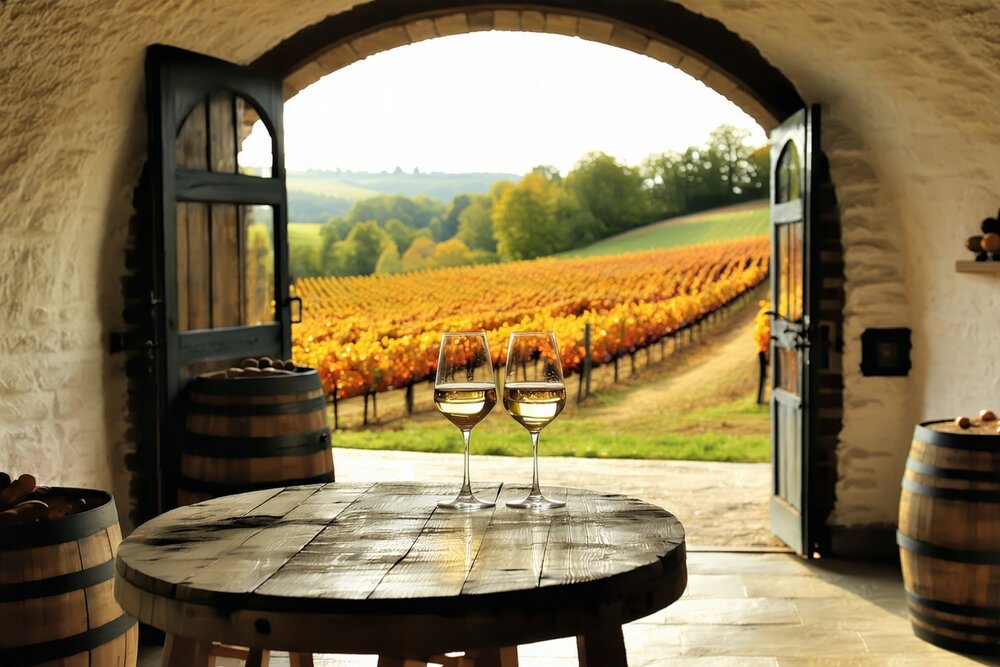
Cellar streets
Stone-vaulted sklepy around Mikulov open directly onto the vines — a genuine regional attraction
🍑 Slivovice — Moravia's Orchard Spirit
Where Becherovka belongs to Bohemian spa culture, slivovice belongs to Moravian orchards — a clear, high-proof brandy distilled from fermented damson plums (the name comes from slíva, plum), with its deepest roots in the Wallachia region of eastern Moravia. Traditionally home-distilled from family orchard trees — a skilled maker picks only fully ripe fruit still on the branch, never windfalls — genuine home production has become rarer as regulation tightened, though village "cook-your-own" distilleries still operate under license. It's poured in small shot glasses called štamprle or panák, and it isn't really a casual drink: slivovice shows up at weddings, the pre-Lent Fašank carnival, the traditional pig-slaughter feast zabíjačka, harvest celebrations, and even, in some villages, as a graveside toast during All Souls' commemorations. Seasonal tasting events called košt let neighboring villages compare that year's bottlings — provenance and vintage genuinely matter to people who take this seriously. Traditional folk belief holds it wards off colds and settles an upset stomach; nobody claims it's medically proven, but the ritual is real.
📋 A Few More Worth Knowing
🥃 Beyond the Big Two
- Fernet StockA bitter herbal digestif dating to the late 19th century, similarly secret-recipe, served neat or on ice
- TuzemákA rum-style spirit (not true rum — Czech-made from sugar beet), classically mixed into hot winter tea with lemon as "grog"
- HruškoviceSlivovice's gentler cousin — pear brandy, smoother and more aromatic
- BurčákYoung, partially fermented wine sold only during the autumn harvest — cloudy, low-alcohol, and genuinely fun; drink it fast, it doesn't keep
- MedovinaCzech mead — fermented honey and water, often spiced, sold at markets and medieval-themed events
