💎 Beyond Prague and Český Krumlov
Every guidebook sends you to Prague Castle, Karlštejn, and Český Krumlov — deservedly. But the Czech Republic has roughly two thousand castles, chateaux, and ruins packed into a country the size of South Carolina, and most American visitors never see more than five of them. This page collects five places that rarely make the standard itinerary but genuinely reward the detour: an Italian baroque villa that hosted the diplomacy behind the Bosnian annexation crisis, a windmill with a genuinely strange second act, one of only two surviving Chinese pavilions in the country, a castle-and-chateau complex tied directly to the most dramatic figure of the Thirty Years' War, and a "wolf's pit" that turns out to have nothing to do with wolves at all.
🏛️ Buchlovice — An Italian Villa in Moravia
Buchlovice Chateau, near Uherské Hradiště in Moravia, is one of the purest examples of Italian Baroque villa architecture anywhere outside Italy — and its existence is usually explained with a charming legend that turns out to be only partly true. As the story goes, Count Jan Dětřich of Petřvald built it around 1700 for his second wife, Anežka Eleonora of the Italian Colonna-Fels family, because the nearby medieval castle of Buchlov was too cold and uncomfortable for a woman raised in the Italian sun. It's a nice story, but modern historians treat it as legend rather than documented fact — the more prosaic truth is that Buchlov, like most medieval castles, had simply become impractical for genteel 18th-century living, and building a fashionable new residence nearby was the era's standard solution.
What isn't legend is the architecture itself: two mirror-image, horseshoe-shaped buildings — the ceremonial Lower Château and the utilitarian Upper Château, nicknamed Flora — face each other across a shared courtyard, built to designs attributed to the Italian architect Domenico Martinelli. It was the first building of its specific type in the Czech lands. The estate passed to the Berchtold family in 1800, who held it until 1945, and it's under their ownership that Buchlovice had its most consequential moment: on September 15–16, 1908, Austro-Hungarian Foreign Minister Alois Lexa von Aehrenthal met his Russian counterpart Alexander Izvolsky here for secret talks that became known as the "Buchlau Agreement" — a diplomatic bargain over the Balkans that unraveled almost immediately and fed directly into the Bosnian Annexation Crisis, one of the chain of events that made the outbreak of World War I six years later that much more likely. It's a strange thing to contemplate while admiring the peacocks that still wander the grounds — a nod to the Petřvald family crest — but it's genuinely part of the property's history.
The gardens are worth the visit on their own merits: an Italian terraced garden transitions into a French parterre and then an English landscape park, and the greenhouses hold one of Central Europe's most significant fuchsia collections — around 1,200 varieties, a tradition dating to 1970. The whole complex is wheelchair-accessible, a rarity among Czech chateaux of this age.
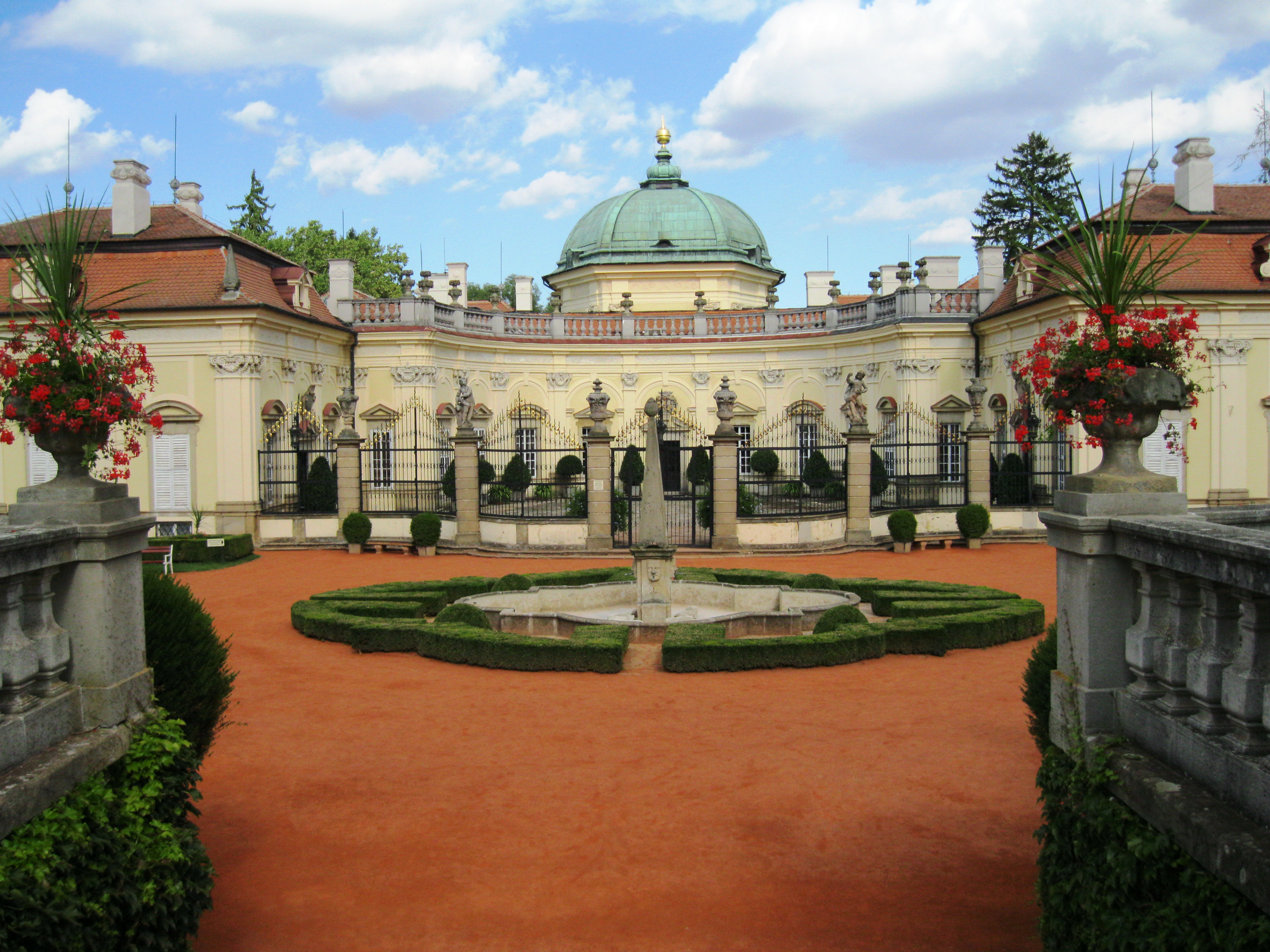
Buchlovice Chateau
The horseshoe-shaped Lower Château and its French parterre garden — where a 1908 secret meeting helped set Europe on course for war
🌬️ The Vrátno Windmill — From Flour to Bone Meal to Airbnb
Standing alone in a field northeast of the village of Vrátno in Central Bohemia, this 1870 Dutch-style windmill has had one of the stranger biographies of any building in the country. Local landowner Václav Mareček built it to grind grain from his own fields, using sandstone cut by master mason Medonos of Mšeno — a solid, four-story tower topped with an unusually tall, steep conical roof punctuated with dormer windows, reaching about 18 meters. Eight years later, in 1878, Mareček added a second building next door housing something you won't find at most windmills anywhere: a bone-crushing works, powered by a drive shaft running off the mill itself. Mareček bought animal bones from local butchers, crushed them into meal, and used it to fertilize his fields — an early, resourceful version of what we'd now call a closed-loop farming system.
The mill was worked in its early years by Mareček himself with the help of a local woman remembered only as "old maid Terezka," then rented out — one tenant, Václav Petr, became locally famous as a mill repairman during his 1913–1921 lease. Abandoned in 1923, it suffered the fate of most rural ruins: a period account describes strangers stripping it "piece by piece," tramps sleeping inside and burning whatever remained. By 1934, only bare walls stood. It sat that way, deteriorating further, for most of the 20th century.
The mill's improbable rescue came in 2015, when entrepreneur Aleš Křemen — who happens to manufacture propellers for a living, based in Odolena Voda — bought the partially restored structure with his partner Lucie Kozelská. Using his own professional expertise in blade mechanics, he had the mill's rotating mechanism rebuilt from scratch, and by 2017 the windmill had actual functioning sails again, turning with the wind for the first time since 1923. Today it's a private vacation retreat sleeping up to twelve people, fitted with solar power, a heat pump, and its own wastewater treatment — genuinely modern infrastructure inside a 19th-century sandstone shell. It's not open to the public, but it's easily viewed from the road, and weddings are occasionally held by the small adjacent pond.
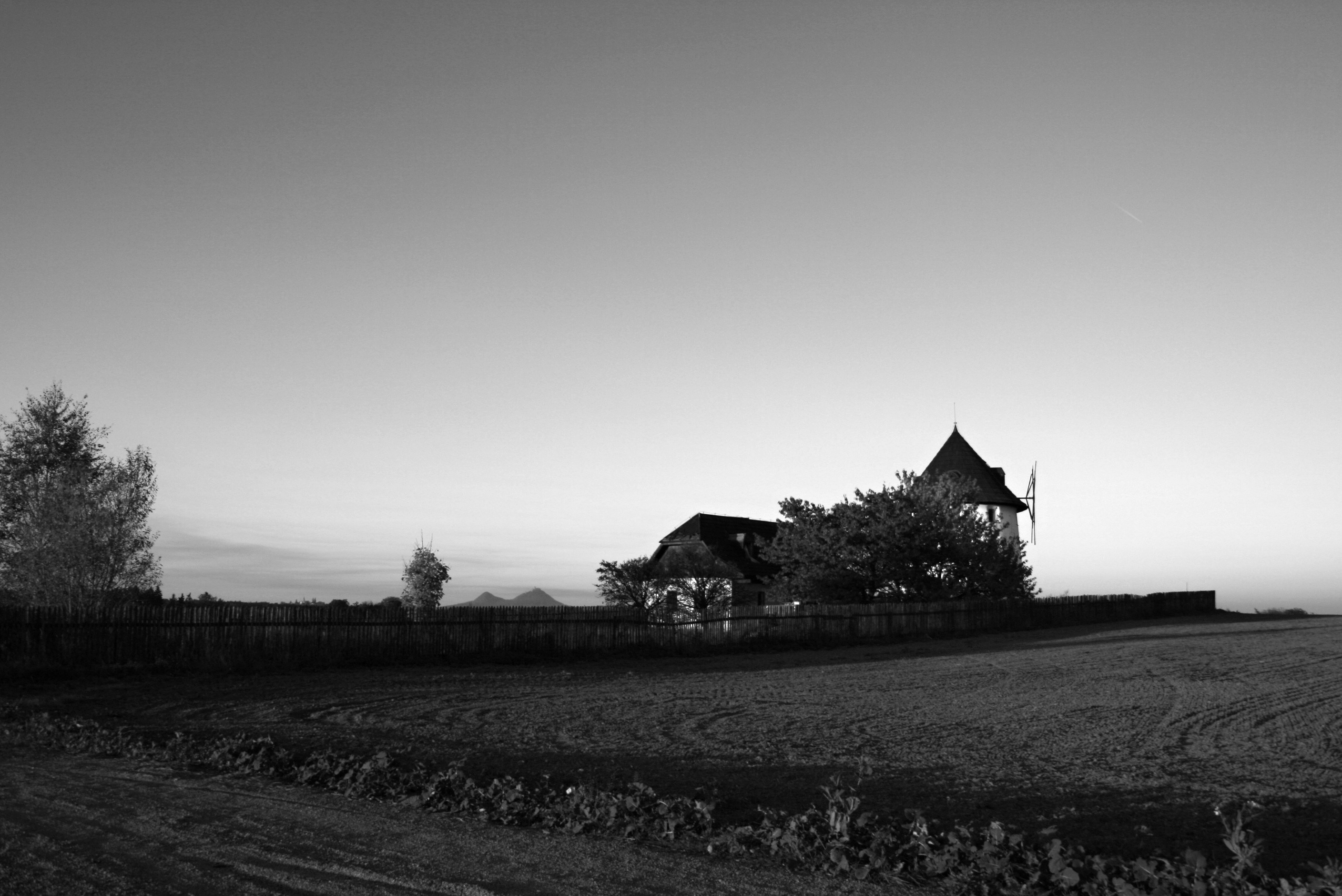
The Vrátno Windmill
Standing alone in the fields near Mšeno — restored, fittingly, by a professional propeller manufacturer
🏯 Vlašim Chateau Park — A Chinese Pagoda in the Bohemian Countryside
At 75 hectares, Vlašim's chateau park is among the largest in Central Europe, and when the topographer J. Schaller surveyed the Kingdom of Bohemia in 1788, he singled it out as surpassing nearly every other park in the country in beauty. Founded in 1775 by Karel Josef, 5th Prince of Auersperg, and his wife Marie Josefa (née Countess Trautson), on the site of a former royal game preserve in the valley of the Blanice River, it became one of the very first English-style landscape parks in Bohemia — romantic, irregular, built around the natural terrain rather than imposed on top of it.
The park's single most remarkable survivor is its Chinese Pavilion, built around 1780 and one of only two such structures left standing in the entire Czech Republic. It's an octagonal pagoda rising in tiers above a colonnaded ground floor, its bells still ringing gently in the wind, restored with EU funding and reopened in 2008. It originally anchored a much larger "Chinese" complex — aviaries for exotic birds, a billiard pavilion, a musicians' gallery — almost none of which survives; a companion piece, the pseudo-Gothic "Old Castle" (Starý hrad), remains, complete with a quirky 19th-century party trick: press a hidden button and furniture would rise up out of the floor on a concealed mechanism, then vanish back beneath it.
Three neo-Gothic gates — Vlašimská, Znosimská, and Domašínská, all built around 1846 — mark the park's main entrances; the Vlašimská gate has become something of a town symbol and now houses a regional art gallery. Inside the park proper, 300-year-old English oaks with trunks over 5 meters in circumference stand alongside genuinely exotic plantings — tulip trees, sequoias, cork oaks — planted by owners with evidently serious horticultural ambitions. The chateau itself, now home to the Podblanicko Museum, has its own quietly interesting local-industry connection: an exhibition on firearms history ties directly to Sellier & Bellot, the ammunition manufacturer still headquartered in Vlašim today. The whole park is free and open year-round; a 16-stop nature trail, maintained by the Czech Union for Nature Conservation, loops through the grounds.
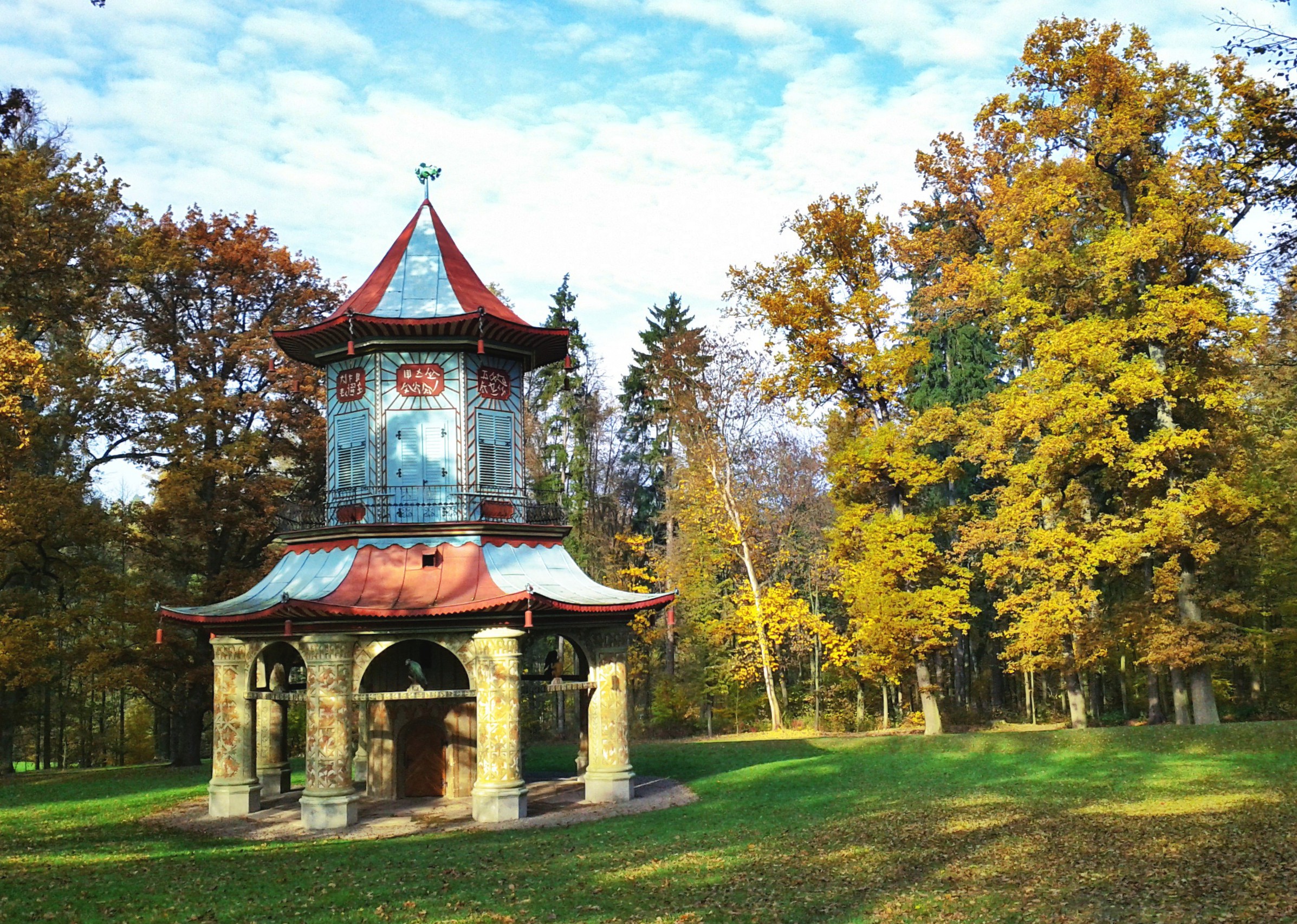
The Chinese Pavilion, Vlašim
One of only two surviving 18th-century Chinese pavilions in the Czech Republic, built around 1780
🏰 Frýdlant — Wallenstein's "Happy Land"
Frýdlant, perched on a basalt outcrop above the Smědá River in northern Bohemia's Jizera Mountains, is genuinely two buildings fused into one: a mid-13th-century Gothic castle, built by the Biberštejn family to guard a trade route near the modern Polish border, fused to an elegant Renaissance chateau added in the 1580s–1602 by Melchior of Redern, a field marshal and president of the imperial war council, and his wife Kateřina. You enter across a drawbridge that has served the same purpose for roughly two hundred years.
The property's single most famous owner bought it in 1622 for 150,000 guilders: Albrecht von Wallenstein (Albrecht z Valdštejna), the Bohemian military entrepreneur and Generalissimo of Imperial forces who became one of the Thirty Years' War's most consequential — and eventually most feared — figures. Wallenstein made Frýdlant the nominal seat of his new Duchy of Friedland, though he actually governed from the more strategically convenient Jičín and stayed at Frýdlant only briefly, in 1627, 1628, and 1630. Under his rule, the surrounding Frýdlant region earned the nickname "Terra felix" — the Happy Land — because while the Thirty Years' War devastated the rest of Bohemia, Wallenstein's own estates were spared, since they existed specifically to supply his army. After Wallenstein's assassination in 1634 (orchestrated in part by his own eventual successor here, Matthias Gallas, rewarded by the emperor for his role in the plot), the property passed through the Gallas and then Clam-Gallas families, who held it until 1945 — and who were, in an unexpected footnote, patrons of Ludwig van Beethoven.
The Clam-Gallas family's most lasting contribution wasn't architectural — it was cultural: in 1801, they opened part of the castle to paying visitors, with its collections already installed for viewing. That makes Frýdlant the first castle museum in Central Europe, predating the more famous house-museum movement elsewhere in Europe by decades. Today's visit covers both the medieval castle (Wallenstein's study, a knights' hall hung with Gallas and Clam-Gallas family portraits, an armory spanning Hussite-era weapons through the 19th century, and a genuinely unusual pipe collection) and the Renaissance chateau wing, plus the Chapel of St. Anne connecting the two. A large formal park, dating to the 18th century, surrounds the whole complex.
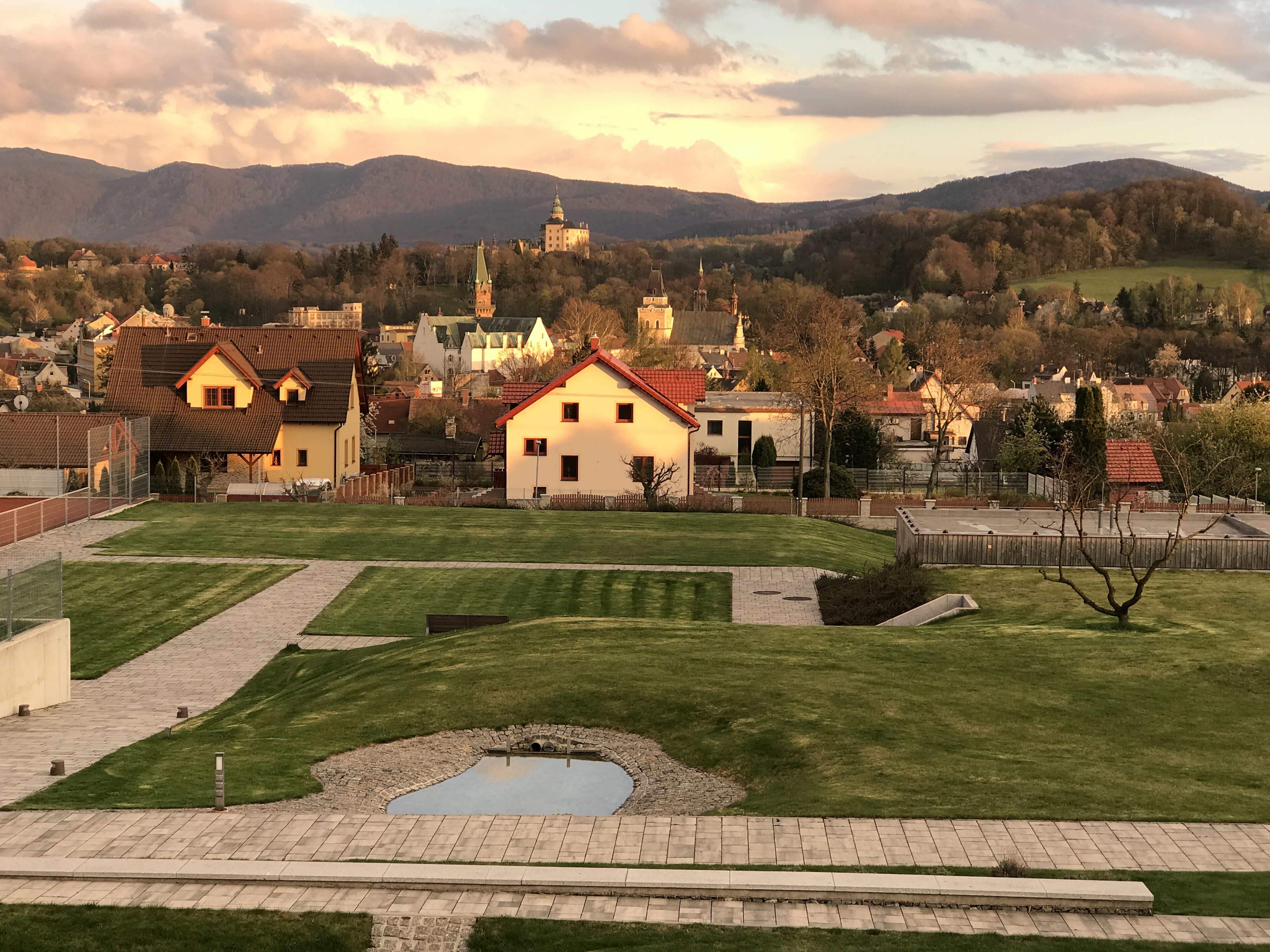
Frýdlant
The castle tower rises over the town — Central Europe's first-ever castle museum, opened to visitors in 1801
🐺 Vlčí jámy — The "Wolf Pits" That Aren't About Wolves
Here's a genuine case of a name leading you astray. "Vlčí jámy" translates literally as "wolf pits," and historic wolf-trapping pits really were a documented feature of the Czech countryside for centuries — regulated, banned, and re-permitted by various royal hunting ordinances between the 1500s and 1700s. But the specific, famous Vlčí jámy in the Ore Mountains (Krušné hory), near the old mining town of Horní Blatná, have nothing to do with wolf hunting at all. They're the collapsed remains of a 16th-century tin mine called Wolfgang — and "Wolf's Pit" is simply what people started calling the resulting crater once the mine's name got folded into local legend.
Horní Blatná was founded in 1532 specifically as a tin-mining settlement, and the Wolfgang vein, worked from the surface down to roughly 35 meters in the 16th century and eventually 60–80 meters by the 18th, was one of the district's richest. When the mine's roof chambers eventually collapsed, they left a genuinely dramatic scar: a jagged rock ravine over 120 meters long, up to 40 meters wide, and 20–25 meters deep, with the remains of old collapsed galleries still visible cut into the rock walls. A short distance uphill sits its smaller sibling, the Ledová jáma ("Ice Pit") — the remnant of a separate mine on the narrower Jiří (George) vein, only 1–2 meters wide but nearly 20 meters deep. Because the narrow crevice barely allows any air circulation, it creates its own stable, cold microclimate — cave ice forms and survives at the bottom of the pit year-round, even through the height of summer.
That ice wasn't just a curiosity. In 1813, following the Battle of Leipzig against Napoleon, ice from this exact pit was transported to help treat wounded soldiers — a genuinely striking historical footnote for what's essentially a natural refrigerator hidden in a Bohemian forest. The phenomenon has become more fragile in recent decades: a 2005 incident saw a group of German visitors illegally haul away nearly two tons of the pit's snow and ice to build an oversized snowman for a competition, and severe drought years from 2017–2019, combined with windstorm damage that stripped away shading tree cover, caused the cave ice to disappear for extended periods. Both pits have been a protected natural monument since 1975, and — for real safety reasons this time, given ongoing rockfall risk — entry into either pit is strictly forbidden. A roughly 4-kilometer educational trail loops out from Horní Blatná's town square, past both pits and up to the 1913 stone lookout tower on the summit of Blatenský vrch, with safe, fenced viewing points along the way.
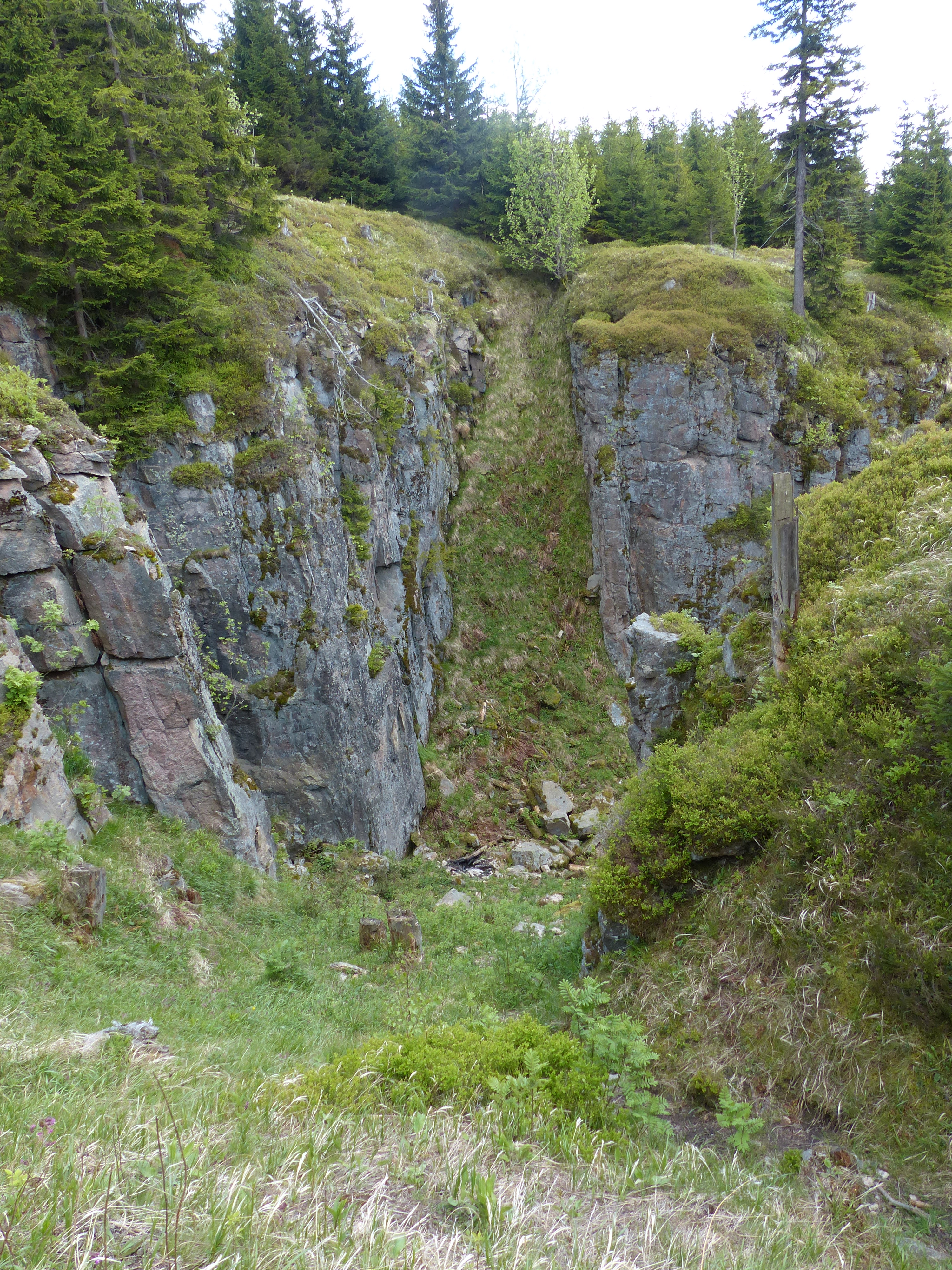
Vlčí jáma
Not a wolf trap — the collapsed gallery of a 16th-century tin mine called Wolfgang, in the Ore Mountains
📝 More to Come
This page collects hidden gems as they're identified rather than trying to be exhaustive from day one — expect it to grow. If there's a specific castle, ruin, or curiosity you'd like covered here, it's easy to add.
