👂 The National Monument to Eavesdropping
In a pair of flooded granite quarries near Lipnice nad Sázavou — the small town where Jaroslav Hašek wrote much of The Good Soldier Švejk and where he's buried — a group of stonemasons carved something genuinely unusual between 2005 and 2007: a set of monumental sculptures collectively known as the Národní památník odposlechu (National Monument to Eavesdropping). The first and best-known piece, Bretschneiderovo ucho ("Bretschneider's Ear"), is a three-meter granite ear named after the secret policeman who opens Hašek's novel by trying to provoke Švejk into treasonous remarks over a beer. A year later came Ústa pravdy ("Mouth of Truth"), directly modeled on Rome's famous Bocca della Verità, and the set was eventually rounded out with a pair of golden eyes ("Zlaté oči").
The whole installation reads as a quiet, literary protest against surveillance and informing — practices with a long, ugly history under 20th-century totalitarian rule in Czechoslovakia — using Hašek's satirical creation as the framing device. It's a short, easy walk between quarries on marked yellow trails, reflected in the still water of the flooded pits, and it's the kind of place that rewards knowing the backstory before you arrive rather than after.
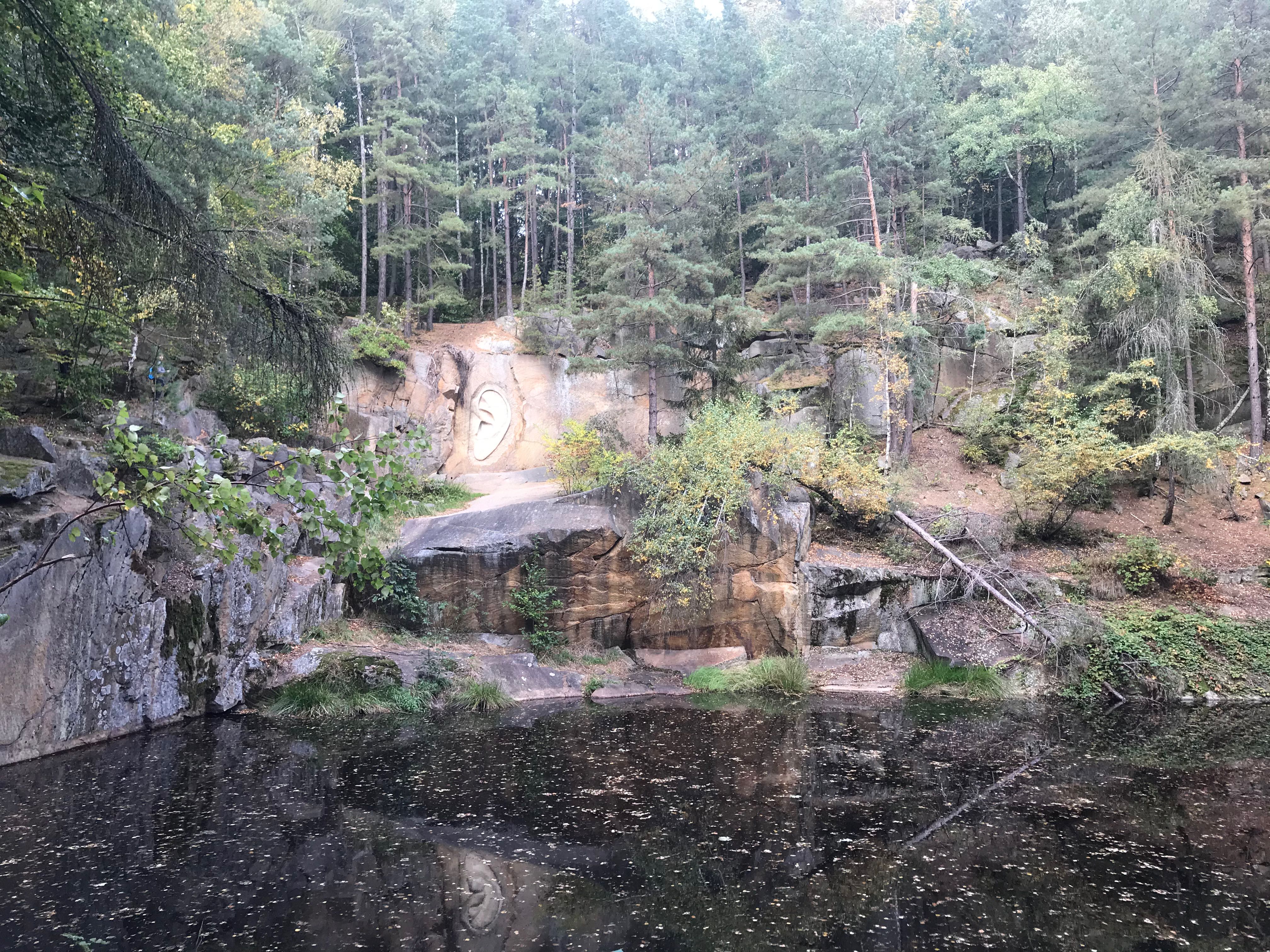
Bretschneiderovo ucho
A three-meter granite ear carved above a flooded quarry, named for Hašek's secret policeman
🏰 Tolštejn — The Rilke Ruin
The best-preserved castle ruin in the Lužické hory (Lusatian Mountains), perched on a volcanic rock outcrop above Jiřetín pod Jedlovou near the German and Polish borders. Built around 1337 to guard the trade route between Bohemia and Lusatia, Tolštejn (German: Tollenstein, "Jackdaw Rock") burned during the Thirty Years' War in 1642 and was never rebuilt as a residence — but in 1865, the Münzberg family opened a mountain restaurant inside the ruins that operated for three generations, right up until 1977, and reopened again in 2002. That restaurant's guest book reads like a minor who's-who of early-20th-century Central Europe: the poet Rainer Maria Rilke visited, along with painter Josef Vogel and Habsburg royal Ferdinand.
A paid viewing platform on the ruined tower's summit — reached via a somewhat vertiginous iron staircase — gives one of the better panoramas in the Lusatian range: on a clear day you can pick out multiple lookout towers, the Czech-Saxon border hills, and, according to a local legend that's pure legend and nothing more, a spring below the castle that once supposedly washed up flecks of real gold.
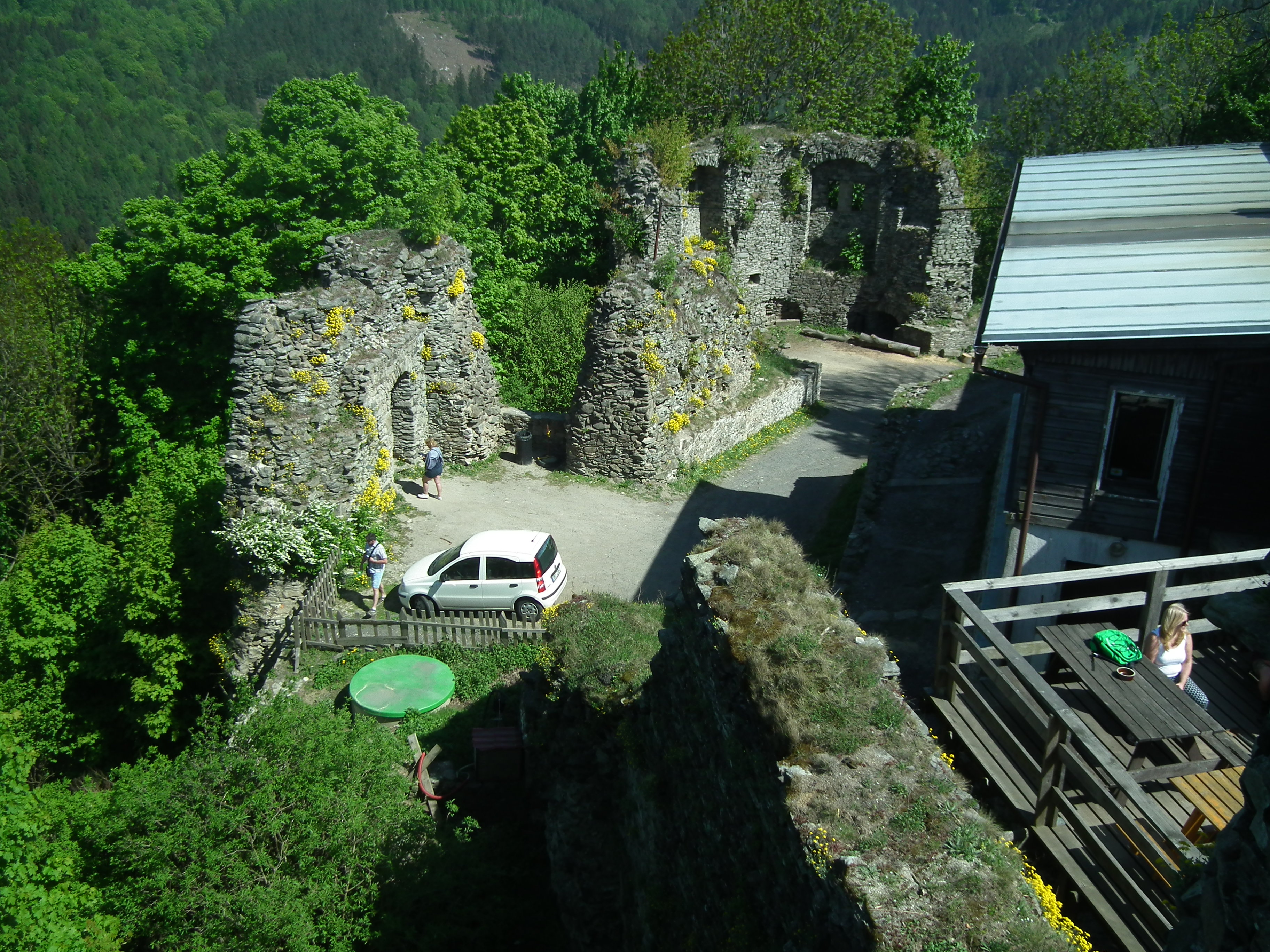
Tolštejn
Rilke once stayed at the mountain restaurant built inside this ruin in 1865
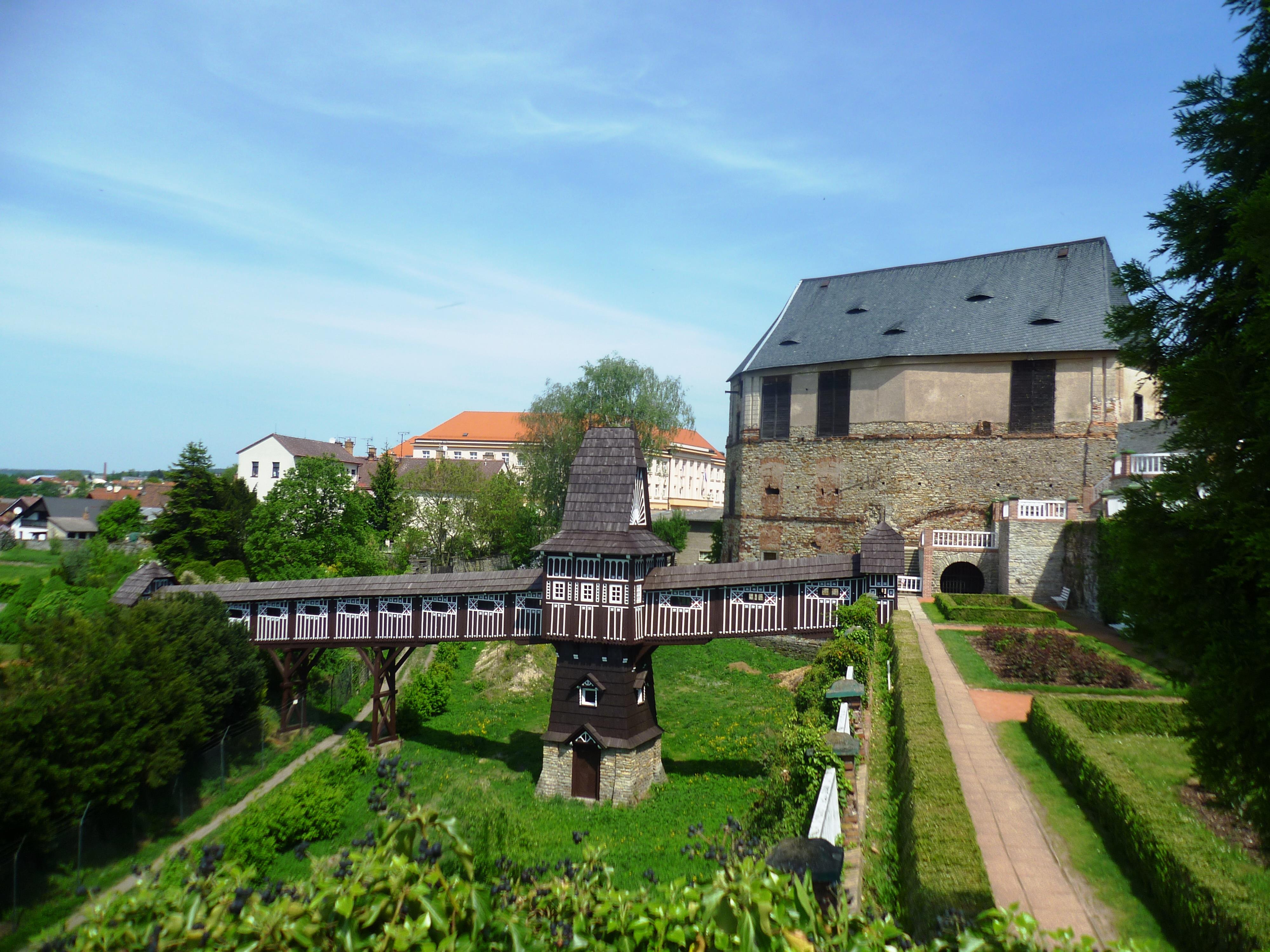
Jurkovič Bridge
A covered wooden bridge that crosses no river — built purely to connect a chateau terrace to its flower garden
🌉 A Bridge That Crosses Nothing
Tucked inside the chateau gardens of Nové Město nad Metují, in the Hradec Králové region, sits one of the more quietly strange structures in the country: a 38-meter covered wooden bridge that spans no river, no ravine, nothing at all — it simply connects an upper terrace to a flower garden below. Built in 1911 by the celebrated Slovak architect Dušan Jurkovič (better known for the iconic Pustevny mountain lodges), the bridge is textbook Jurkovič: folk-inspired woodwork drawn from Moravian Wallachian building traditions, a distinctive 12-meter central tower, and a shingled roof that turns a simple garden path into a genuine architectural destination. Only 25 people are allowed on it at once. The rest of Jurkovič's chateau renovation is worth the visit too — including a striking black-and-white Art Nouveau kitchen where meals were once prepared for President T. G. Masaryk.
🏭 A Mill Modeled on the Gates of Babylon
On the bank of the Chrudimka River in Pardubice stands the first building the legendary Czech architect Josef Gočár ever designed — completed in 1910, when he was just 28 — and it's a genuinely startling structure for a flour mill: dark and light brick laid in a pattern deliberately modeled on Babylon's ancient Ishtar Gate. The Winternitz brothers, Egon and Karel, Jewish industrialists who commissioned it, ran the mill for decades; many members of their family were later murdered in Nazi concentration camps during the Holocaust, and the Winternitz name itself was quietly removed from the building's facade in 1938 as the threat from Germany grew, replaced by the more anonymous "Automatic Mills."
The mill operated continuously — genuinely remarkable — for over a century, finally closing in 2013. Rather than let it decay, a Pardubice couple, architect Lukáš Smetana and his wife Mariana, bought the entire complex in 2016 and spent seven years converting it into a cultural quarter that reopened in 2023: a regional art gallery, a city contemporary-art space, an educational science and craft center, and Pardubice's tourist information office, all inside Gočár's century-old brick shell.
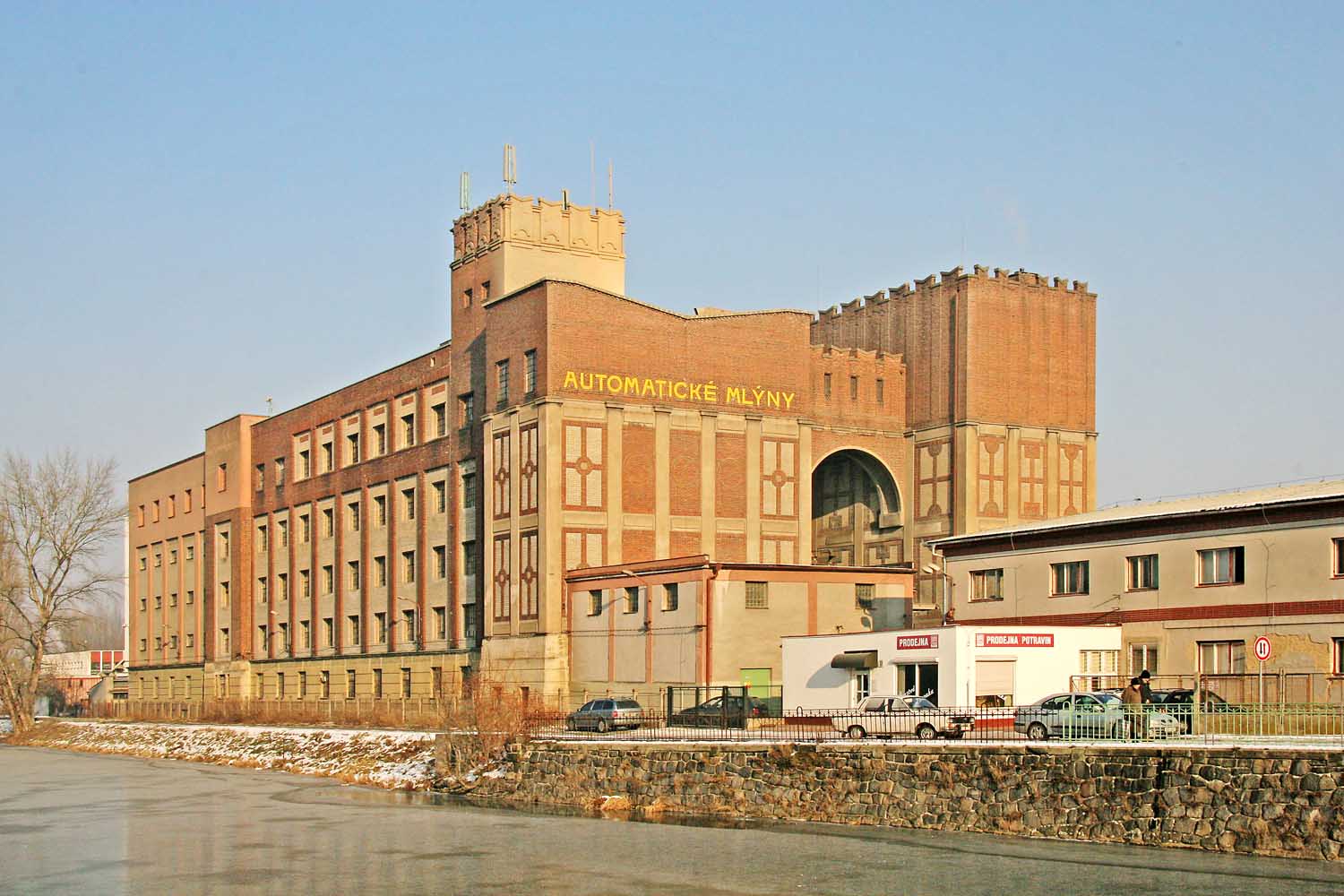
Automatické mlýny
Gočár's Babylon-inspired facade, now a cultural quarter in Pardubice
⚰️ A Tomb Built Below Water Level
On the shore of the Svět fishpond just outside Třeboň in South Bohemia sits the Schwarzenberg family tomb — a neo-Gothic mausoleum commissioned in 1874 by Prince Jan Adolf II von Schwarzenberg at his wife Eleonora's urging, after the family's previous burial church became too small and, by 19th-century hygiene standards, unsuitable. What makes it a genuine feat of engineering rather than just an elegant building: the burial chamber itself sits below the surrounding terrain, at points below the actual water level of the adjacent pond, and stays dry only because of a purpose-built 60cm-wide, 2-meter-deep air-and-drainage channel that rings the entire structure. Twenty-six members of the Schwarzenberg family are interred inside, and the tomb's chapel — acoustically excellent, by all accounts — still hosts occasional concerts in the summer months.
🕍 Prague's Grandest Private Synagogue
Built 1590–92 in Prague's Jewish Town, the Maisel Synagogue was, unusually, a private place of worship — commissioned by Mordechai Maisel, mayor of the Jewish Town and one of the wealthiest men in the Kingdom of Bohemia, who personally financed a sweeping Renaissance rebuilding of the entire ghetto around it. It was, in its day, the largest synagogue the Jewish Town had ever had. A 1689 fire gutted the original building, and what stands today is largely the result of a dramatic neo-Gothic reconstruction completed in 1905. It now serves as one of the core exhibition spaces of the Jewish Museum in Prague, holding the museum's collection of synagogue silver, historic textiles, and ceremonial art — a single-building survey of a millennium of Bohemian Jewish craftsmanship.
🚪 Prachatice's Last Surviving Gate
Prachatice, the handsome South Bohemian border town once nicknamed the "Gateway to Šumava," was fully walled by the 14th century and originally had two gates: the Pasovská (Upper) Gate, torn down in 1859, and the Dolní or Písecká (Lower/Sand) Gate, which survives intact and remains the town's most photographed landmark. Its Gothic inner structure dates to the late 15th century, with a Renaissance-era four-sided crenellated tower added around 1527; the gate's street-facing wall carries a striking painted frieze of a mounted rider alongside decorative rose motifs and rustication, restored in 2007. Since 1985, the gate's outer chamber has doubled as the Galerie Dolní brána, a working art gallery that has hosted exhibitions by, among others, illustrator and writer Josef Lada — creator of the visual style most Czechs still picture when they think of Hašek's Švejk.
😂 Czech Humor
Czech humor runs deadpan and absurdist, closer to British wit than slapstick, with a soft spot for the surreal and the low-budget. TV Jamrtál's sketch series Maringotka is a fair introduction — self-aware, very online, and impossible to fully explain to a non-Czech speaker (subtitles won't save the wordplay, but the delivery carries it anyway). For the fuller story — the Jára Cimrman Theatre and Hašek's Good Soldier Švejk — see our dedicated Czech Humor page →.
📝 More to Come
This page, like our Hidden Gems collection, grows as new tips come in — a handful of sites (a few smaller lookouts, quarries, and a railway viaduct or two) are still being researched properly rather than rushed onto the page. Check back, or ask.
