

🇫🇰 Falkland Islands at a Glance
🌏 Overview — Why Visit the Falkland Islands
An archipelago of 778 islands in the South Atlantic, 500 km east of Patagonia, with about 3,660 residents and something like half a million sheep. It is a British Overseas Territory, it is claimed by Argentina, and two countries fought a war over it in 1982. It is also one of the best places on Earth to stand very close to an enormous number of wild animals that have no particular interest in you.
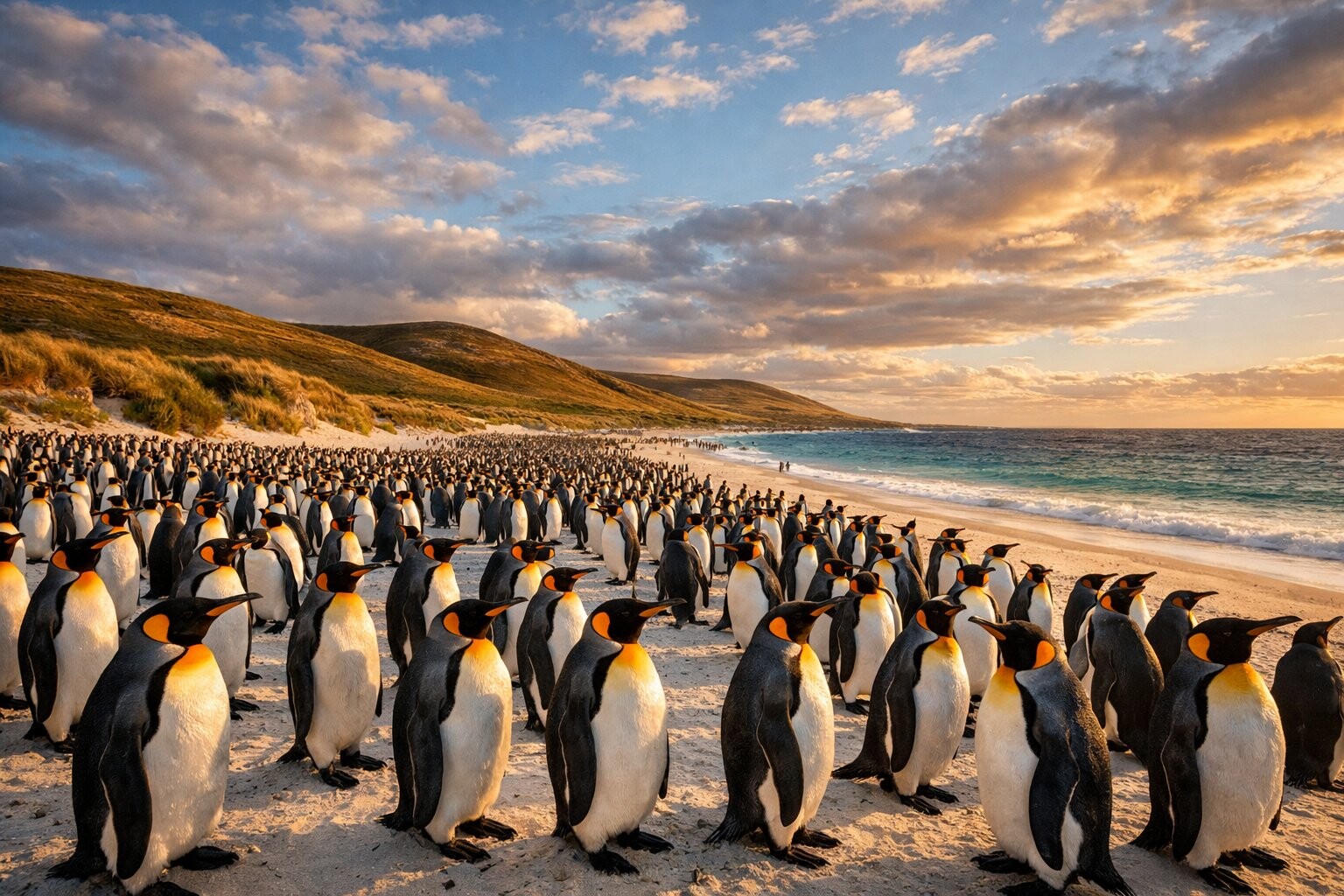
The wildlife is the reason to come and it is world-class. Five species of penguin breed here — king, gentoo, Magellanic, southern rockhopper and a handful of macaroni. The islands hold roughly two-thirds of the world's black-browed albatrosses, and Steeple Jason has the largest colony of them anywhere. There are elephant seals, sea lions, fur seals, Commerson's and Peale's dolphins, and orca that hunt seal pups in the shallows at Sea Lion Island. Almost none of it is afraid of people, and there are no land predators to have taught it otherwise.
The human side is stranger and, in its way, just as interesting. Outside Stanley there is "camp" — from the Spanish campo — a landscape of peat, tussac and sheep where settlements are single farms, the light aircraft schedule is announced on the radio the night before, and everybody knows everybody. It is the closest thing left to a nineteenth-century sheep-farming frontier that also has fibre broadband.
And there is 1982. The war lasted 74 days, killed 649 Argentine and 255 British service personnel and three Falkland Islanders, and it is still the organising fact of the islands' politics. Battlefields, memorials and a very direct local view of the sovereignty question are all part of a visit. This page treats that honestly rather than tiptoeing around it — it is impossible to understand the place otherwise.
🏷️ Names & the Sovereignty Question
This is the one thing to understand before you arrive. The islands are administered by the United Kingdom as a self-governing Overseas Territory and are claimed by Argentina as the Islas Malvinas. Both positions have long histories, and the people who live there have a clear and consistently expressed view of their own.
The names
"Falkland" comes from Falkland Sound, named in 1690 for Viscount Falkland, then Treasurer of the Navy. "Malvinas" comes via Spanish from the French Îles Malouines, after the sailors of Saint-Malo who settled Port Louis in 1764. Both names are about three centuries old.
Which to use
In the islands, use Falklands. "Malvinas" is understood as a political statement and will be received as one. In Argentina the reverse applies. This is not pedantry — it is the most loaded vocabulary choice you can make in the South Atlantic.
The British position
Britain has administered the islands continuously since 1833 and rests its case on that administration, on the absence of an indigenous population, and above all on the self-determination of the residents.
The Argentine position
Argentina holds that it inherited Spanish title on independence, that a settlement was expelled by Britain in 1833, and that the population is an implanted one whose wishes cannot override territorial integrity. The claim is written into the Argentine constitution.
The 2013 referendum
Islanders voted on whether to remain a British Overseas Territory. Turnout was 92%, and the result was 1,513 to 3 — 99.8% in favour. Britain and the islanders treat this as decisive; Argentina does not recognise it.
As a visitor
Islanders will talk about it openly and with feeling if you ask politely, and there is no reason not to ask. Do not arrive with a settled opinion you intend to share. Note also that Argentina restricts links to the islands, which affects flights.
🗺️ Geography & Landscape
Two large islands — East Falkland and West Falkland — separated by Falkland Sound, plus 776 smaller ones, totalling 12,173 km², roughly the size of Northern Ireland or a sixth of the Czech Republic. There are no trees. The wind is the defining feature of the landscape and of daily life.
East Falkland
The larger island, holding Stanley, Mount Pleasant airport, Darwin, Goose Green and the Lafonia peninsula in the south. Mount Usborne at 705 m is the highest point in the territory.
West Falkland
Emptier, hillier and with fewer roads — Port Howard, Fox Bay, Hill Cove and Port Stephens, with Mount Adam at 700 m. Reached by FIGAS aircraft or the vehicle ferry across the Sound.
The stone runs
"Rivers of stone" — long streams of angular quartzite blocks flowing down the valleys, formed by freeze-thaw in periglacial conditions. Darwin puzzled over them in 1833 and they remain among the finest examples anywhere.
Tussac and peat
Native tussac grass grows in metre-high pedestals and once ringed the coasts; sheep and burning removed most of it, and restoration is a major conservation project. Underneath is peat, which was the islands' fuel for a century and a half.
No trees
There are no native trees. The wind and thin acidic soil see to it. Every tree in Stanley was planted and sheltered, and they are noticeably stunted.
The outer islands
Carcass, Saunders, Pebble, West Point, Bleaker, Sea Lion and Weddell — mostly single-family sheep farms, several with small lodges, and where most of the wildlife actually is.
📍 Map of the Falkland Islands
Stanley is on the east coast of East Falkland; Mount Pleasant airport is 55 km south-west of it and is where all international flights land. Everything else is reached by 4x4 across camp, by the small FIGAS aircraft, or by boat.
Mount Pleasant → Stanley
55 km on the islands' only significant stretch of tarmac, about 45 minutes. A shuttle bus meets the international flight.
Stanley → Volunteer Point
About 55 km but two to two and a half hours, because the last third is off-road across peat bog and only experienced local drivers attempt it. It is a full day out and it is worth every hour.
Stanley → Darwin and Goose Green
About 90 km south-west on gravel, roughly two hours. The 1982 battlefield sites and the Argentine military cemetery.
FIGAS
The Falkland Islands Government Air Service flies eight-seat Britten-Norman Islanders to grass strips across the archipelago. The next day's schedule is announced on the radio the evening before, and it depends on who else is flying. This is not a complaint; it is the system and it works.
The Sound
A vehicle ferry connects New Haven on East Falkland with Port Howard on West Falkland, weather permitting.
Cruise ships
A large share of visitors arrive by expedition cruise, usually on Antarctic or South Georgia itineraries, and see Stanley plus one landing. It is a very different trip from staying.
📜 History — Sighting, Settlement, Sheep
There is no evidence of any indigenous population. The islands were probably first sighted in the sixteenth century — the credit is disputed between Dutch, English and Spanish navigators — and John Strong made the first recorded landing in 1690, naming the sound between the two main islands after Viscount Falkland.
The first settlement was French: Port Louis, founded by Bougainville in 1764, which gave the islands the name Malouines and then Malvinas. Britain founded Port Egmont on Saunders Island in 1765, apparently unaware of the French. Spain bought out the French claim in 1767, expelled the British in 1770, and a near-war was settled diplomatically; Britain returned briefly and withdrew in 1774, leaving a plaque asserting its claim.
After Spanish America's independence, the United Provinces of the Río de la Plata asserted a claim and appointed Luis Vernet as governor in 1829. His seizure of American sealing vessels brought the USS Lexington, which sacked the settlement in 1831. In January 1833 Britain returned and required the small Argentine garrison to leave. That date is the pivot of the entire dispute: Britain calls it a reassertion of a prior claim, Argentina calls it an expulsion.
What followed was sheep. The Falkland Islands Company was chartered in 1851, and by the 1870s wool was the economy — great single-family stations across camp, a life of shepherding, peat cutting and radio. Stanley served the sailing ships rounding Cape Horn, and the hulks in its harbour are the wrecks of that trade. The Battle of the Falkland Islands in December 1914 saw a British squadron destroy von Spee's German cruisers offshore.
🎖️ 1982
On 2 April 1982 Argentine forces invaded, and the ruling military junta — economically failing and politically desperate — presented it as the recovery of the Malvinas. Britain assembled a naval task force and sailed 12,000 km. The war lasted 74 days and ended with the Argentine surrender at Stanley on 14 June.
The cost
649 Argentine and 255 British service personnel died, along with three Falkland Islander women killed by British shellfire in Stanley. Many of the Argentine dead were young conscripts.
Goose Green
The first major land battle, 28–29 May, where 2 Para took a much larger defending force. Lieutenant Colonel H. Jones was killed and posthumously awarded the Victoria Cross. The site is marked and visitable.
The mountains
The final assaults on Mount Longdon, Two Sisters, Mount Harriet, Tumbledown and Wireless Ridge, in freezing conditions, decided the war. Several are within reach of Stanley and are walked with a guide.
The Belgrano and the Sheffield
The sinking of the ARA General Belgrano with 323 dead, and of HMS Sheffield by an Exocet, remain the war's most argued-over episodes on both sides.
The consequences
In Argentina the defeat destroyed the junta and brought democracy back within eighteen months. In Britain it secured Margaret Thatcher's 1983 election. In the islands it brought the 1983 grant of full British citizenship, the fisheries licensing regime, and prosperity.
Memorials
The Liberation Monument in Stanley, the British memorial at San Carlos, and the Argentine military cemetery at Darwin, which is maintained and where Argentine families visit. Visit all three; the Darwin cemetery in particular is a quiet and necessary corrective to any triumphalism.
🏘️ Stanley
The capital, and home to about 2,500 of the territory's 3,660 people — which makes it comfortably the smallest capital in the world by some measures and one of the most immediately likeable. Brightly painted metal roofs, Land Rovers, a cathedral with an arch made of whale jaws, and a harbour full of nineteenth-century shipwrecks.
Christ Church Cathedral
The southernmost Anglican cathedral in the world, consecrated 1892, with the Whalebone Arch outside it — built in 1933 from the jawbones of two blue whales to mark a century of British administration.
The Historic Dockyard Museum
Genuinely excellent for a town this size: natural history, the sailing-ship trade, camp life, the 1982 war and the Antarctic connection, in several restored buildings. Allow half a day.
The wrecks
Stanley Harbour is a graveyard of Cape Horn sailing ships that limped in and never left — the Lady Elizabeth in Whalebone Cove and the Jhelum among them. It is one of the world's great concentrations of nineteenth-century iron hulls.
Government House
The governor's residence since 1845, and the building the Royal Marines defended on 2 April 1982. The garden has some of the few substantial trees in the islands.
The pubs
The Victory, the Globe and the Narrows Bar — proper British pubs with South Atlantic weather outside, and the fastest way to meet people. The Victory does a decent Sunday roast.
Getting around
Walk. Stanley is a couple of kilometres end to end along the waterfront, and the wind will make it feel longer.
🐧 Volunteer Point
The single best wildlife experience in the Falklands and one of the best in the world: a colony of well over a thousand breeding pairs of king penguins on a white sand beach, with gentoos and Magellanics alongside, and a rope line you stand behind that the penguins routinely ignore by walking straight past you.
Getting there
About 55 km from Stanley but two to two and a half hours each way, because the last stretch is unmarked off-road driving across peat bog and soft ground. Go with an experienced local driver — this is the one place where doing it yourself is a genuinely bad idea.
The kings
The largest king penguin colony in the Falklands and one of the most accessible anywhere on Earth. Chicks in brown down — "oakum boys" — are present most of the year, because the king penguin breeding cycle takes over a year.
The other two
Gentoos nest in noisy colonies just inland, and Magellanic penguins burrow into the tussac slopes. Three species in one afternoon, on foot, is not a thing you can do in many places.
The rules
Stay 6 m from the birds and behind the marked line — but if a penguin walks up to you, stand still and let it. Do not block their route to the sea. Numbers are capped and vehicles are limited.
The cost
A day trip with a licensed driver runs to roughly £150–200 per person, shared. It is one of the largest single expenses of a Falklands trip and nobody who has done it regrets it.
Timing
November to February for chicks and best weather. Book before you arrive — the driver capacity is genuinely limited and cruise days fill it.
🐦 Penguins & Birds
The Falklands hold around a million breeding penguins across five species, and roughly two-thirds of the world population of black-browed albatross. For a birder this is one of the highest-value archipelagos on the planet, and almost all of it is approachable on foot.
King penguin
The big one, nearly a metre tall. Volunteer Point is the main colony, with smaller groups elsewhere. Breeding takes 14–16 months, so there are chicks at almost any time of year.
Gentoo
The most numerous Falklands penguin, in large inland colonies that they walk to and from across surprising distances. Orange bill, white eye-flash, and the fastest swimming bird in the world.
Magellanic
Locally called jackass penguins for the braying call. They nest in burrows in the tussac and peat, and the call at dusk is one of the sounds of the islands.
Southern rockhopper
Small, yellow-crested, ferociously determined — they come ashore through surf onto rock and then hop up cliffs to their colonies. Saunders Island, Pebble and West Point are the classic sites.
Black-browed albatross
Around 500,000 breeding pairs, roughly two-thirds of the world total. Steeple Jason holds the largest colony anywhere; the accessible one is at West Point Island, where the albatross and rockhoppers nest together in the tussac.
The endemics
The Cobb's wren and the Falkland steamer duck — a flightless duck that thrashes across the water — are found nowhere else. Striated caracaras, called "Johnny rooks", are inquisitive, rare and will try to steal your gloves.
🦭 Seals, Sea Lions & Orca
The marine mammals are as good as the birds, and at one site in particular the interaction between them is the reason people come back.
Sea Lion Island
The southernmost inhabited island, a National Nature Reserve, and the best place in the Falklands for everything at once: a large southern elephant seal breeding beach, sea lions, five penguin species and — the speciality — orca hunting seal pups in the shallows in October and November.
Elephant seals
Bulls reach four tonnes and arrive in September to fight for beaches. Pupping peaks in October. You watch from a few metres away on foot, which is startling the first time.
Southern sea lions
Colonies around the coasts, particularly on the outer islands. Less numerous than they were — the population crashed in the twentieth century and has only partly recovered.
Dolphins
Commerson's dolphins — small, black and white, and extremely playful — regularly bow-ride boats and come into Stanley Harbour. Peale's dolphins are the other common species.
Whales
Sei and southern right whales pass offshore, with sightings increasing as populations recover. Berkeley Sound has become a reliable sei whale area in summer.
Watching responsibly
Keep 6 m from wildlife, more from elephant seals in the breeding season, and never get between an animal and the sea. Falklands Conservation publishes the codes and the lodges enforce them.
🏝️ The Outer Islands
The islands are where the Falklands trip actually happens. Most are working sheep farms of one or two families with a small lodge attached, reached by FIGAS Islander onto a grass strip, and you stay two or three nights on each.
Carcass Island
No cats or rats have ever been introduced, so it is full of small birds — Cobb's wrens, tussac birds, black-throated finches — that are absent elsewhere. Famous for the afternoon tea, which is not a joke: the spread at Carcass is a Falklands institution.
Saunders Island
The Neck is one of the great wildlife sites of the South Atlantic: king, gentoo, Magellanic and rockhopper penguins plus black-browed albatross on one narrow isthmus. Also the site of Port Egmont, the first British settlement.
West Point Island
The Devil's Nose cliffs, where black-browed albatross and rockhoppers nest together in dense tussac. A short walk from the settlement and, again, afternoon tea.
Pebble Island
Rockhoppers, a large pond system for waterfowl, and the site of the 1982 SAS raid that destroyed eleven Argentine aircraft.
Bleaker Island
Quiet, flat and excellent for gentoos, rockhoppers and imperial shags, with good walking and very few other people.
How it works
You book a circuit through a Stanley operator, with FIGAS legs between islands. Baggage is limited — usually 14 kg — and the schedule shifts with weather. Build slack in and do not book a tight international connection at the end.
🐑 Camp
Camp — from the Spanish campo, a survival of the gaucho era — is everything outside Stanley. Around a thousand people live in it, on sheep stations that can run to tens of thousands of hectares, and it is a way of life that has almost vanished elsewhere.
Sheep
Roughly half a million of them, about 140 per person, producing fine wool that is the islands' oldest export. Shearing runs from November to February and shearing gangs still move between settlements.
Settlements
Not villages — a "settlement" is a farm: a house, sheds, a shearing shed, a generator, sometimes a schoolhouse. Goose Green, Port Howard, Hill Cove, Fox Bay, Darwin, North Arm.
Smoko
The tea break, taken seriously, twice a day. It is also the general word for a spread of cakes and scones put in front of a visitor, which happens constantly and cannot be declined.
The travelling teacher
Children in camp are taught by radio and internet and by teachers who travel out to stay at each farm in turn for a fortnight. It is one of the more remarkable education systems anywhere.
Peat
Cut and dried for fuel for a century and a half, and still burned in some houses. The smell of a peat fire is the smell of an old camp kitchen.
Visiting
Camp hospitality is genuine and enormous, and the lodges are family homes. Take the mud off your boots, accept the cake, and expect to be asked more questions than you ask.
👥 People & Culture
Around 3,660 people, plus roughly 1,200 military and contractors at Mount Pleasant who live largely separately. The resident population is descended mainly from nineteenth-century British and especially Scottish settlers, with a substantial and growing Chilean and Saint Helenian community.
Kelpers
The old nickname for Falkland Islanders, from the kelp beds around the coasts. Some use it affectionately, some do not care for it — "Islanders" is safe.
The Chilean community
Several hundred people, the largest minority, working across fishing, construction and services. Chilean Spanish is the second language you will hear in Stanley.
Saint Helenians
"Saints" from St Helena, 6,000 km north, form another significant part of the workforce — a small-island diaspora connecting two of the remotest British territories.
Citizenship
Islanders were granted full British citizenship in 1983, after 1982 exposed the fact that the 1981 Nationality Act had left many of them without it.
Government
Fully self-governing in internal affairs, with an elected Legislative Assembly and a UK-appointed Governor responsible for defence and foreign affairs. The islands are financially self-sufficient apart from defence.
Social life
Everyone knows everyone, the Globe and Victory are the social hubs, and the Falkland Islands Radio Service announcements — flight schedules, birthdays, notices — are the community's noticeboard. Expect to be recognised by your second day.
🗣️ Language
English, in a variety with a distinct accent — closest to a rural Southern English or New Zealand sound to most ears — and a working vocabulary shaped by sheep, weather and a nineteenth-century gaucho inheritance.
Camp
From Spanish campo. Everything outside Stanley. "Going out to camp" is the fundamental Falklands phrase.
Smoko
The tea break, and by extension the cake and scones served at it. You will be given smoko whether or not you want it.
Gaucho words
Corral, and various riding and stock terms, survive from the South American cattle era before sheep took over.
Two-nickers and Johnny rooks
A two-nicker is a Magellanic penguin; a Johnny rook is a striated caracara. Local bird names diverge sharply from the field guides.
Spanish
Widely heard because of the Chilean community, and useful. Bear in mind the political charge around Argentine Spanish and place names, which does not extend to Chileans.
Radio
FIRS broadcasts the FIGAS flight schedule each evening, along with notices and messages to camp. Listening to it is the single most useful thing you can do to understand how the islands run.
🍽️ Falklands Food
Mutton, fish, seabird eggs when the season and the law allow, and a great deal of baking. It is British home cooking adapted to a place where everything not raised locally arrives by ship every few weeks, and where the freezer is a strategic asset.
What to eat
Mutton
"365" is the old joke — mutton every day of the year. Falklands sheep are grass-fed on unimproved camp and the meat is excellent. Roast, stewed, or as a leg cooked all afternoon.
Squid
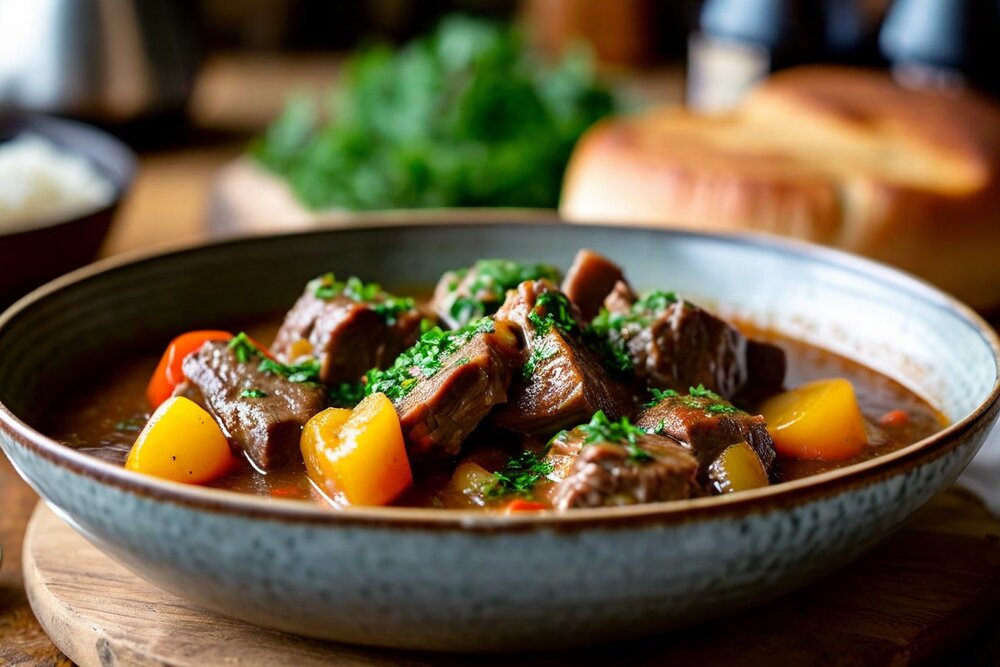
Loligo and Illex squid are the economic foundation of the territory and, unsurprisingly, appear on every menu — fried, in salads and grilled.
Toothfish and mullet
Patagonian toothfish from the licensed fishery, and Falklands mullet from the harbours and creeks, smoked or fried.
Diddle-dee
Empetrum rubrum, a low red heath berry that covers the camp. Picked in autumn and made into a sharp jam that is the single most Falklands thing on a breakfast table.
Baking
Scones, cakes and biscuits at a volume that has to be experienced. Every camp lodge and every farmhouse produces a smoko spread; refusing is not really available to you.
Where to eat
In Stanley the pubs, the Malvina House Hotel and a handful of cafés. In camp you eat what the lodge cooks, which is generally very good and always more than you can manage.
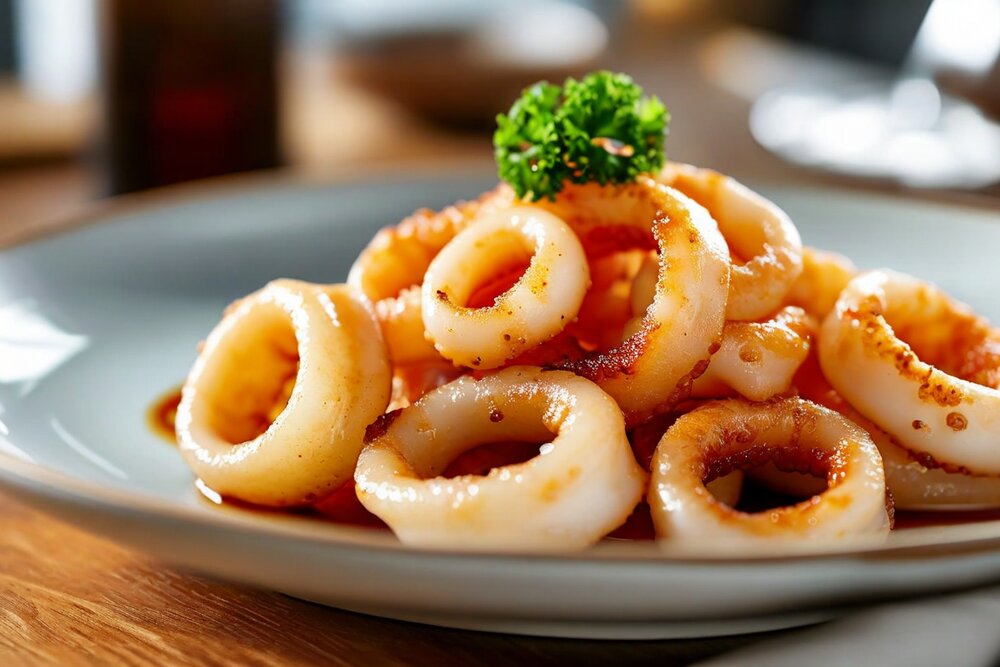
Falklands mutton stew
Slow-cooked mutton · serves 6 · 3 hours
Ingredients: 1.5 kg mutton shoulder or neck on the bone, cut into large pieces; 3 onions, sliced; 4 carrots; 6 potatoes, halved; 2 turnips or swede, chunked; 2 tbsp flour; 1 litre stock or water; a bay leaf, thyme, salt and plenty of black pepper; dripping or oil.
Method: Brown the mutton hard in batches in a heavy pot and set aside — this is where the flavour comes from, so do not crowd the pan. Soften the onions in the same fat, stir in the flour, then return the meat with the stock, bay and thyme. Simmer covered, very gently, for two hours. Add the root vegetables and cook another 45 minutes until everything is soft and the liquid has thickened around the bones.
💡 Mutton, not lamb — older meat, more flavour, and it needs the time. Skim the fat if you like; a Falklands cook generally would not.
Diddle-dee jam
Falklands berry preserve · 4 small jars · 1 hour
Ingredients: 1 kg diddle-dee berries (Empetrum rubrum; redcurrants or lingonberries are the closest substitutes); 800 g sugar; juice of 1 lemon; 100 ml water.
Method: Pick over the berries and simmer with the water for 15 minutes until they burst and soften. Add the sugar and lemon juice, stir until fully dissolved, then boil hard for 10–15 minutes until it reaches setting point — a spoonful on a cold plate should wrinkle when pushed. Pot into sterilised jars while hot.
💡 Sharp, dark and slightly resinous — closer to lingonberry than to any garden fruit. It goes on toast, with mutton, and into cakes.
Smoko scones
Falklands tea-break scones · makes 12 · 30 minutes
Ingredients: 450 g self-raising flour; 100 g cold butter, cubed; 50 g sugar; 1 tsp baking powder; a pinch of salt; 250 ml milk; 1 egg for glazing.
Method: Rub the butter into the flour, baking powder and salt until it looks like breadcrumbs, then stir in the sugar. Add the milk quickly and bring together with a knife — handle it as little as possible. Pat out to 3 cm thick, cut with a floured cutter without twisting, brush with egg, and bake at 220 °C for 12–14 minutes until risen and golden.
💡 Serve warm with butter and diddle-dee jam. Twelve is not too many; smoko happens twice a day and there will be visitors.
🍺 What Islanders Drink
Tea by the gallon, imported beer, and a small but genuine local drinks industry. Everything alcoholic other than the local products arrives by ship, which shapes both the range and the price.

Falkland Beerworks
A microbrewery in Stanley producing ales and lagers with local names. Available in the pubs and worth choosing over the imports.
Rock Hopper vodka and Fitzroy gin
The Falkland Islands Distillery makes small-batch spirits, including a gin flavoured with local botanicals such as diddle-dee. They are the standard thing to take home.
Beer in the pubs
The Victory, the Globe and the Narrows Bar all keep proper draught. Prices are higher than in Britain because of freight, not tax.
Tea
The genuine national drink. Smoko happens twice a day and it is not optional, either in camp or in an office.
Wine
All imported, mostly Chilean and Argentine, and priced accordingly. There is no local viticulture and the climate rules it out permanently.
Practicalities
The supermarket in Stanley (the West Store) sells alcohol; camp lodges are usually licensed or will let you bring your own. Stock up in Stanley before flying out to the islands.
🌿 Conservation & the Mines
The Falklands have two conservation stories running at once: a serious, well-funded effort to restore what two centuries of sheep and introduced predators damaged, and a landmine legacy that was cleared entirely and against most expectations.
Landmine-free since 2020
Argentina laid an estimated 30,000 mines in 1982, fencing off beaches and headlands for a generation. Clearance was completed in November 2020, largely by Zimbabwean deminers, and the Falklands became one of the first territories to declare itself entirely mine-free. Yorke Bay's beach reopened, and the penguins that had been safely living in the minefields carried on regardless.
Rat and cat eradication
Introduced rats and cats devastated ground-nesting birds. A long-running eradication programme has cleared many islands, and the results — Cobb's wrens and tussac birds returning — are visible.
Tussac restoration
Native tussac grass once ringed the coasts and was almost eliminated by grazing and burning. Replanting is now a major landowner-led effort and is bringing back both the birds and the coastal soil.
Falklands Conservation
The territory's main NGO, running species monitoring, the important bird areas programme and the wildlife codes of conduct that visitors and lodges follow.
The fishery
Squid licensing funds the government, and the fishery is managed with an annual closed season and scientific quotas. It is well regarded, though the wider South Atlantic beyond the zone is not.
Bird flu
Highly pathogenic avian influenza reached the South Atlantic in 2023–24 and has affected some colonies. Follow biosecurity instructions exactly — boot washing, no gear from other colonies, keeping to paths. This is the current reason some sites close at short notice.
🦑 Squid, Wool & Oil
The Falklands are financially self-sufficient, which surprises people. The territory pays for everything except its own defence, and it does so mainly by selling fishing licences.
Fishing
Licences for Illex and Loligo squid, and for finfish, generate the majority of government revenue. The 200-mile zone declared in 1986 is what transformed the islands' finances after 1982.
Wool
The oldest industry and still the identity of camp, though a much smaller share of the economy than it was. Falklands wool is fine and largely exported to the UK and Europe.
Tourism
Roughly 60,000 cruise passengers in a good season plus a few thousand land-based visitors. Land-based tourism is worth far more per head and is what the lodges depend on.
Oil
Commercial reserves have been confirmed in the North Falkland Basin, and the Sea Lion field has moved slowly toward development for well over a decade. Whether and when it produces is one of the territory's open questions, economically and politically.
Cost of living
Everything imported arrives by ship every few weeks or by air at a premium. Fresh produce is expensive and sometimes simply absent; islanders grow a lot in polytunnels.
What this means for visitors
It is an expensive destination not because it is exploiting you but because freight, fuel and a 3,600-person market make it so. Budget accordingly and do not expect bargains.
🌦️ Climate & When to Go
Cool, windy and far less extreme than the latitude suggests. The Falklands sit at 51–52° South — the mirror of London — and the ocean keeps temperatures within a narrow band: roughly 2 °C in July and 9 °C in January as monthly means, with summer highs around 15–20 °C. What defines the climate is not cold but wind.
The season
October to March, the southern summer, is when the wildlife is breeding, the lodges are open and the flights run. Outside it most camp accommodation closes and there is very little reason to be there.
The wind
Averages around 25–30 km/h and gusts far higher, almost constantly, from the west. It is the single thing that most surprises visitors. A proper windproof shell matters more than a thick coat.
Four seasons in an hour
Sun, squall, hail and sun again is a normal morning. Nothing lasts. Wait twenty minutes and photograph what you came for.
Rain
Surprisingly little — Stanley gets around 600 mm a year, less than London. It arrives horizontally, which is why it feels like more.
Daylight
Around 17 hours in December and about 8 in June. Summer evenings are extremely long and good for photography until very late.
What to pack
Windproof and waterproof outer layers, warm mid-layers, a hat that will stay on, gloves, waterproof walking boots for peat and tussac, and sunglasses. The UV is stronger than you expect under the ozone-thinned southern sky.
🗓️ Wildlife Calendar
Timing matters more here than in most destinations, because almost everything you have come to see is on a breeding schedule. The broad rule: November to January is the peak for most species, and each month has its own speciality.
September–October
Elephant seals hauling out and fighting on the beaches; penguins returning to colonies; rockhoppers arriving. Cold, windy, few other visitors.
October–November
Orca hunting elephant seal pups at Sea Lion Island — the most dramatic wildlife event in the Falklands calendar. Also albatross returning and courting.
November–December
The peak. Penguin eggs and first chicks, albatross incubating, everything active and the weather at its best. Also the busiest for accommodation — book many months ahead.
December–January
Chicks everywhere: gentoo, rockhopper, Magellanic. Longest daylight. King penguin chicks in brown down at Volunteer Point, as they are for most of the year.
February–March
Fledging and moulting; adults ashore looking bedraggled. Fewer visitors, still very good, and dolphins and whales are active offshore.
April–September
Winter. Most camp lodges close, FIGAS runs a reduced service and the wildlife has largely gone to sea. King penguins remain at Volunteer Point, which is the one winter draw.
✈️ Getting There
This is the hard part, and it shapes everything about a Falklands trip. There are essentially two air routes, both infrequent, and no regular passenger shipping. Getting to the Falklands is genuinely more difficult than getting to most of Antarctica's gateway towns.
The LATAM flight
The civilian route: Santiago de Chile to Mount Pleasant, once a week on Saturdays, with a stop at Punta Arenas. Once or twice a month the flight also calls at Río Gallegos in Argentina. This is how most independent visitors arrive.
The airbridge
The UK Ministry of Defence operates flights from RAF Brize Norton via Ascension Island, roughly twice weekly and around 18 hours of flying. Seats are sold to civilians when available but priority goes to military and residents, and booking is through a designated agent.
Mount Pleasant
The airport is a military complex 55 km from Stanley. Immigration is straightforward but thorough — have your accommodation booked, your onward ticket, and travel insurance details ready, because they are checked.
Cruise ships
Expedition ships on Antarctic and South Georgia routes call at Stanley and often at one outer island. It is by far the easiest way to see the Falklands and by far the shallowest — usually a single day.
Booking reality
One flight a week means a missed connection costs you seven days. Build a buffer of at least a day either side in Santiago or Punta Arenas, and take insurance that covers it.
Inside the islands
FIGAS Islanders to grass strips, with a 14 kg baggage limit and a schedule announced the previous evening. Book internal legs at the same time as everything else, through your Stanley operator.
🇨🇿 From the Czech Republic
There is no short version. From Prague you are looking at 30 to 40 hours of travel and at least two nights in transit, because the only civilian flight leaves Santiago once a week.
The routing
Prague to Madrid, Paris, Frankfurt or London; then a long-haul to Santiago de Chile (typically via Madrid with Iberia or LATAM, or via São Paulo); then the Saturday LATAM flight to Mount Pleasant. Plan to overnight in Santiago before it.
Via Punta Arenas
The Mount Pleasant flight calls at Punta Arenas, so you can fly Santiago–Punta Arenas separately and join there. Punta Arenas is also a far more interesting place to be stuck than Santiago airport.
Time and cost
Budget 25,000–45,000 Kč return Prague–Santiago depending on season, plus roughly £900–1,300 for the Santiago–Mount Pleasant return. The flights alone are a substantial part of the trip cost.
Entry
Czech citizens do not need a visa for a tourist visit; a visitor permit is issued on arrival, normally for up to four weeks. You must show a passport valid well beyond your stay, confirmed accommodation for the whole trip, an onward ticket and medical insurance — this is checked and enforced at Mount Pleasant.
Czech consular cover
There is no Czech representation in the Falklands. As a British Overseas Territory, consular matters are handled through the Czech Embassy in London. Register with DROZD before you travel — with one flight a week, being on a list matters.
MZV advice
The Czech Ministry of Foreign Affairs treats the Falklands as a safe destination with no travel restrictions; the practical warnings are about weather, remoteness and medical evacuation, not security. Check the current entry at mzv.cz before departure.
🧭 Practical Falklands
Easy in the ways that matter — English-speaking, safe, orderly, and with better internet than you expect — and demanding in logistics. Everything has to be booked before you arrive, and "we'll sort it there" does not work in a territory of 3,660 people.
Money
The Falkland Islands pound (FKP), pegged 1:1 to sterling, and GBP is accepted everywhere. FKP is worthless once you leave, so spend it. Cards work in Stanley and at the larger lodges; carry cash for camp, and note there is one bank.
Book everything first
Accommodation, FIGAS legs, the Volunteer Point trip and any guiding must be arranged before you fly. Lodge capacity across the whole archipelago is a few dozen beds, and November to January sells out many months ahead.
Connectivity
Sure South Atlantic provides mobile and internet; a fibre link has improved things dramatically in Stanley. Camp coverage is patchy to absent. Buy a data voucher on arrival.
Electricity
240 V, UK three-pin plugs. Bring a UK adapter, not a European one.
Health
The King Edward VII Memorial Hospital in Stanley is good for its size but small. Anything serious means medical evacuation to Chile or the UK, which is why proof of insurance is required at immigration. Take a policy that explicitly covers it.
Driving
Left-hand side. Outside Stanley and the MPA road it is gravel and then track. 4x4 essential, tell someone your route, carry food and water, and do not drive across camp without knowing the ground — bogging a vehicle is routine and being stuck overnight is unpleasant.
💰 Costs
Expensive, and there is no budget version. A remote territory of 3,660 people with everything shipped in and one flight a week does not produce cheap travel, and pretending otherwise would waste your time.
Flights
Santiago–Mount Pleasant return roughly £900–1,300 (26,000–38,000 Kč), plus getting to Santiago from Europe. This is usually the largest single item.
Accommodation
Stanley guesthouse or B&B £70–120 a night; Malvina House Hotel more. Camp lodges are typically full board at £120–200 per person per night, which is fair given they cook everything and fly it in.
FIGAS
Internal flights roughly £80–160 per leg depending on distance. A three-island circuit adds up quickly.
Volunteer Point
£150–200 per person for the shared 4x4 day trip. Non-negotiable, and worth it.
Food and drink
Pub meal £15–25. Pint £5–7. Supermarket prices well above UK levels for anything fresh.
Realistic budget
A land-based week with two camp islands, FIGAS legs and Volunteer Point runs to £2,000–3,000 per person on the ground, before international flights. A cruise call costs you nothing extra and gives you a day.
🛡️ Safety
One of the safest places you can travel. Crime is close to non-existent, there is no political violence, and the islands are landmine-free. The risks here are weather, terrain, driving and distance from a hospital — in that order.
Crime
Effectively nil. People leave houses and cars unlocked. The main police concern is drink-driving and the occasional Saturday night in Stanley.
Weather
The real hazard. Conditions change in minutes and there is no shelter in camp. Always carry windproof layers, food and water, tell someone your route, and turn back earlier than you would at home.
Driving off-road
Bogging a 4x4 in peat is routine and getting out alone often is not. Do not drive across camp without local knowledge, never drive on soft ground after rain, and carry a shovel and a tow rope.
Cliffs and surf
Rockhopper colonies sit above sheer drops in a constant wind, and the South Atlantic swell is unforgiving. Stay well back from edges — the gusts genuinely can move you.
Medical
The Stanley hospital handles most things; anything major is an evacuation to Chile or the UK, which takes time and costs a great deal. Insurance covering medical evacuation is a condition of entry, not a suggestion.
Former minefields
Cleared and declared mine-free in November 2020. Some fencing and signage remains in places; if you see a warning sign, obey it, but the beaches are open again.
🎖️ Visiting the 1982 Sites
The battlefields are close to Stanley, well documented and visited respectfully by people from both countries. A good local guide, several of whom lived through the occupation, turns a set of hillsides into something you will think about for a long time afterwards.
Mount Longdon, Two Sisters, Tumbledown
The mountains west of Stanley, taken in the final night assaults. Walkable with a guide from town; positions, fighting holes and memorials are still visible on the ground.
Goose Green and Darwin
Ninety kilometres from Stanley. The battle site, the memorial to H. Jones, and the school and hall where islanders were held during the occupation.
Argentine Cemetery, Darwin
The graves of 237 Argentine servicemen, many long marked "Argentine soldier known only unto God" until DNA work from 2017 identified most of them. Maintained, dignified and visited by Argentine families. Go, and go quietly.
San Carlos
"Bomb Alley", where the British landing took place, with the British military cemetery above the water. The setting is beautiful and the contrast is the point.
Stanley memorials
The Liberation Monument on the seafront, the 1914 battle memorial, and the graves in the town cemetery of the three islanders killed.
How to behave
This is recent history with living participants on both sides, and islanders were occupied in their own homes. Ask before photographing memorials with people at them, do not treat it as a curiosity, and remember that Argentine visitors at Darwin are mourning family.
🏨 Where to Stay
Stanley hotels
The Malvina House Hotel is the established option with a restaurant and harbour views. The Waterfront Hotel is the other main choice, and both are comfortable and small.
Stanley guesthouses and B&Bs
A handful of family-run places, generally excellent value by local standards and the best way to actually talk to islanders. Self-catering flats are also available and useful for a longer stay.
Sea Lion Lodge
On Sea Lion Island, full board, and the base for elephant seals, orca and five penguin species. The most wildlife per step of anywhere in the Falklands.
Pebble Island Lodge and Bleaker Island
Comfortable full-board lodges on working farms, both with excellent walking and colonies within reach on foot.
Carcass, Saunders and West Point
Simpler — self-catering cottages at Saunders and The Neck, family accommodation at Carcass, day visits to West Point. The Neck cabin puts you alone with four penguin species overnight, which is remarkable.
Booking
There are a few dozen beds in the whole of camp. For November to January, book six to twelve months out, through a Stanley-based operator who will also arrange your FIGAS legs.
🗺️ Suggested Itineraries
A Falklands trip is built around the weekly flight and the FIGAS schedule, so it comes in units of roughly a week. Here is what actually fits.
One day (cruise call)
Stanley: the museum, the cathedral and Whalebone Arch, the harbour wrecks, a pub lunch. Or trade all of that for the Volunteer Point trip, which will occupy the whole day and is the better choice if the weather holds.
Seven days
Two nights Stanley (museum, battlefields, Volunteer Point), three nights on one camp island — Sea Lion or Saunders — and back to Stanley for the return flight. One island done properly beats two rushed.
Ten to twelve days
Stanley plus two camp islands, typically Sea Lion for the marine mammals and Saunders or Carcass for the birds, with FIGAS between. This is the trip most people should aim for.
Two weeks
Add West Falkland — Port Howard or Pebble — and time for weather delays. With FIGAS, spare days are not padding; they are the plan.
Combining with South Georgia
Most South Georgia itineraries are expedition cruises out of Stanley or Ushuaia. If you are coming this far and can afford it, the combination is the trip of a lifetime and South Georgia is, by common agreement, even better.
Combining with Patagonia
Since you transit Chile anyway, Torres del Paine or Punta Arenas adds little to the airfare and a great deal to the trip. Build a few days in either side of the Saturday flight.
🧭 Visiting Responsibly
The Falklands take wildlife protocol seriously, and with a resident population of 3,660 and colonies that see thousands of visitors a season, the rules are the reason it still works.
Distance
Stay at least 6 m from penguins, seals and albatross, and further from elephant seals and sea lions in the breeding season. If an animal changes what it is doing because of you, you are too close.
Let them come to you
Penguins are curious and will approach. Sit or crouch, stay still, and let it happen — that is the good version. Chasing one for a photograph is not.
Never block the path to the sea
Penguins commute daily between colony and water on set routes. Standing on one causes real harm to birds that are feeding chicks.
Biosecurity
Clean and disinfect boots between colonies and islands, and follow instructions exactly — avian influenza reached the region in 2023–24 and colonies can close at short notice. Do not bring soil, seeds or feathers between sites.
Drones
Effectively banned around wildlife and requiring permission generally. Do not bring one expecting to fly it.
Where your money goes
Camp lodges are family farms diversifying away from wool, and they are the reason the outer islands are still inhabited and their wildlife protected. Staying two nights in camp does more for Falklands conservation than any donation you could make.
🎉 The Falklands Year
For 3,660 people the calendar is remarkably full, and the events are the real thing rather than anything staged for visitors — which is exactly why they are worth attending.
Liberation Day · 14 June
The anniversary of the 1982 Argentine surrender, and the biggest date in the islands' year: a parade, a service at the Liberation Monument and a public holiday. Midwinter, so dress for it.
Sports Week · late February
The camp sports meetings — horse racing, sheepdog trials, steer riding, shearing and a great deal of socialising — rotating between West Falkland settlements. The most authentic thing you can see in the islands.
Stanley Sports · 26–28 December
The town's version, over the Christmas period: horse racing on the racecourse, athletics and the associated dances. Everyone attends.
Falklands Day · 14 August
Marking John Davis's 1592 sighting, celebrated modestly.
Battle Day · 8 December
The anniversary of the 1914 naval Battle of the Falkland Islands, with a service at the memorial in Stanley.
Shearing season · November–February
Not a festival but the rhythm of camp life, and the season when the settlements are busiest and most sociable.
📷 Photography
One of the most rewarding wildlife destinations anywhere for a photographer, with the twin problems of extraordinary access and appalling weather in equal measure.
The light
Long summer days mean golden light from very early to very late, and the low sun angle at 51° South is flattering for hours rather than minutes. Overcast days are often better for penguin plumage than harsh sun.
Lenses
You will need less reach than you think — a 24–70 and a 70–200 cover most of it, because you can get close legally. A wide angle for colonies in landscape is more useful than a 600 mm.
The wind
The main technical problem. Tripods are near-useless in a 50 km/h gust; shoot handheld at higher shutter speeds, brace against rocks, and keep a lens cloth for salt spray.
Protection
Sand at Volunteer Point and the beaches gets everywhere. Change lenses inside a bag, and bring more cleaning kit than you would elsewhere.
Batteries and cards
Cold drains batteries and camp has limited power. Bring double what you need and a power bank; some lodges run generators only part of the day.
Ethics
The 6 m rule applies to photographers exactly as much as to everyone else, and it is the shot you do not take by crowding a bird that marks you out. Long lens, patience, low angle, sit down.
🤯 Fascinating Facts
More sheep than people, by 140 to 1
Roughly half a million sheep and 3,660 residents. The wool clip, not the penguins, built the place.
Landmine-free since 2020
Around 30,000 mines laid in 1982 were cleared by 2020, largely by Zimbabwean deminers. Penguins had been living safely inside the minefields for decades, being too light to detonate them.
No native trees
Not one. Every tree in the islands was planted, and most are stunted and leaning east.
The southernmost Anglican cathedral
Christ Church Cathedral in Stanley, with an arch outside made from the jawbones of two blue whales.
Two-thirds of the world's black-browed albatross
Around 500,000 breeding pairs, with the largest single colony anywhere on Steeple Jason.
The clocks never change
The Falklands stopped observing seasonal time changes in 2010 and stay on UTC−3 all year, which is the same as Buenos Aires — an irony nobody there dwells on.
A referendum of 1,513 to 3
In 2013, 99.8% of voters on a 92% turnout chose to remain a British Overseas Territory.
Darwin was here
HMS Beagle called in 1833 and again in 1834, and Darwin was baffled by the stone runs and fascinated by the extinct warrah, the islands' only native land mammal — a fox-like canid, wiped out by 1876.
Financially self-sufficient
The territory pays for everything except its own defence, mostly out of squid fishing licences.
👤 Notable Figures
Louis Vernet (1791–1871)
German-born merchant appointed governor by Buenos Aires in 1829, whose settlement at Port Louis and seizure of American sealers set off the chain of events leading to 1833.
Charles Darwin (1809–1882)
Visited on the Beagle in 1833 and 1834, puzzled over the stone runs, and described the warrah — the Falkland Islands wolf — which was extinct within four decades of his visit.
Sir Rex Hunt (1926–2012)
Governor in 1982, who surrendered Stanley after the Marines were overwhelmed and returned in June to a reception that is still remembered. Stanley's airport is named after him.
Lt Col H. Jones VC (1940–1982)
Commanding officer of 2 Para, killed leading the attack at Goose Green and posthumously awarded the Victoria Cross.
Sgt Ian McKay VC (1953–1982)
Killed on Mount Longdon, and the other posthumous Victoria Cross of the war.
Terry Peck (1938–2006)
A Falkland Islander and former police chief who escaped Stanley during the occupation, gathered intelligence on Argentine positions and guided 3 Para on Mount Longdon — the islanders' war in one biography.
Sukey Cameron
The Falkland Islands Government Representative in London for many years and the territory's most visible international advocate.
Ian Strange (1926–2018)
Naturalist, artist and conservationist who settled on New Island, campaigned for Falklands wildlife for half a century and largely created the modern conservation movement here.
Roger Lorenzo and the camp families
Not one person but the point: the Falklands' character is made by a few hundred farming families who have run the outer islands for six generations and now run the lodges you stay in.
🧊 South Georgia — the Add-On
Administered from Stanley as a separate territory, South Georgia and the South Sandwich Islands lies 1,400 km east-south-east and has no permanent population beyond a handful of government and museum staff. If you can reach it, it is one of the greatest wildlife spectacles on the planet.
What is there
Beaches with hundreds of thousands of king penguins at St Andrews Bay and Salisbury Plain, elephant seals in tens of thousands, fur seals so numerous you have to negotiate around them, and glaciated mountains above all of it.
Grytviken
The restored whaling station, the museum, the church, and Shackleton's grave — where visitors traditionally drink a toast. The Endurance story ends here, with his 1916 crossing of the island.
How to go
By expedition ship only, from Stanley or Ushuaia, on voyages of 10–20 days. There is no airstrip and no independent access.
The rat eradication
Completed in 2018 after eight years and around £10 million, the largest rodent eradication ever attempted, and the burrowing seabirds are returning in numbers.
Cost
Expedition voyages including South Georgia run from roughly £10,000 per person upward. It is a serious expense and it is the single most recommended thing on this page for anyone who can manage it.
Biosecurity
The strictest anywhere: boots, bags and Velcro are inspected before every landing. Comply exactly — the whole ecosystem's recovery depends on it.
✍️ Author's Note
The Falklands are one of the hardest places in this book to reach and one of the easiest to love once you do. It is a week of travel and a serious amount of money to visit an archipelago the size of Northern Ireland with a population smaller than a Prague apartment block. And then you sit down on a beach at Volunteer Point and a king penguin walks up to within a metre of you, looks at you with what is unmistakably curiosity, and carries on past, and the arithmetic stops mattering.
The thing nobody tells you is how good the human side is. Everyone in camp will feed you cake, everyone in Stanley will talk to you, and the whole territory operates at a scale where a stranger is still an event. Stay in camp rather than only in Stanley — two nights on Sea Lion or at The Neck on Saunders is what the trip is for, and the lodges are family farms where you eat with the people who run them.
On 1982: go to the battlefields, and go to the Argentine cemetery at Darwin. The islanders' view of the war is direct and unsentimental and they will tell you about it if you ask. So is the fact that 649 Argentine servicemen died here, most of them conscripts younger than the war they were sent to, and that their families still come. Holding both of those in your head at once is the honest way to visit this place, and the islanders manage it better than most outsiders do.
Go in November or December, book a year out, take a windproof jacket you actually trust, and give it ten days rather than seven. And if there is any chance at all of adding South Georgia, take it.
— Radim Kaufmann
Support This Project 🌍
This World Travel Factbook is a labor of love – free to use for all travelers. If you find it helpful, consider supporting its continued development.