


🇪🇨 Galápagos Islands at a Glance
🌍 Overview — Why the Galápagos
The Galápagos are not a country. They are a province of Ecuador — officially the Archipiélago de Colón — sitting about 1,000 km off the South American coast on the equator, and they have the ordinary machinery of an Ecuadorian province: a governor, a currency (the US dollar), schools and a hospital.
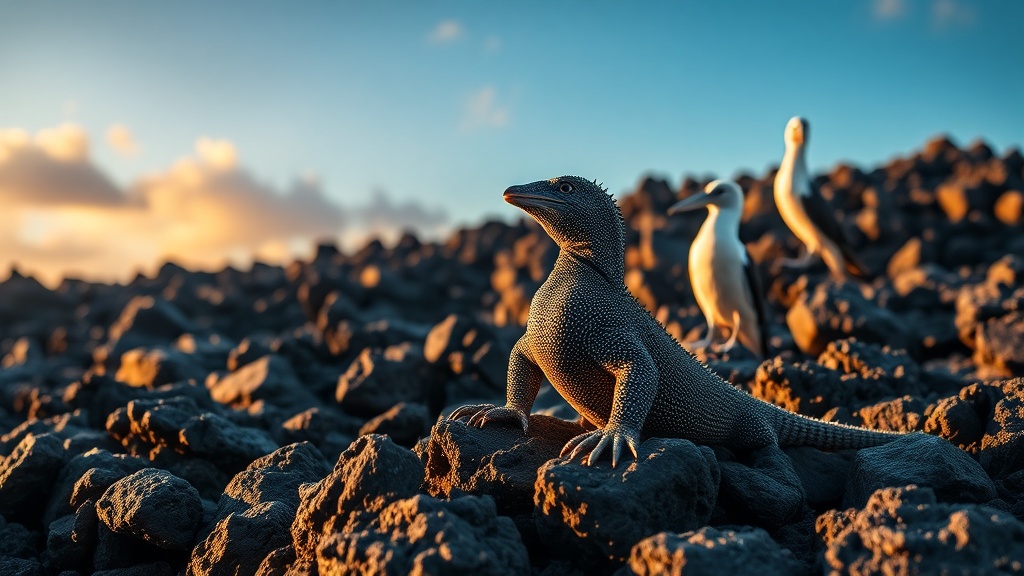
What makes them extraordinary is that 97% of the land is national park and has been since 1959, that the archipelago was UNESCO's very first World Heritage site in 1978, and that most of the animals genuinely do not run away. No large land predator ever reached these islands, so nothing evolved a flight response. A sea lion will look at you and go back to sleep.
That tameness is the whole visitor proposition and also the reason the rules are what they are. You cannot walk on most of the archipelago alone. Visitor sites have marked trails, mandatory certified guides, group-size limits and time slots, and the whole thing runs on a permit system that determines which boat is at which bay on which morning.
It is also expensive and getting busier. Around 270,000 visitors a year now come to islands with 33,000 residents, and UNESCO has repeatedly warned about tourism pressure, invasive species and illegal fishing. Ecuador doubled the park entry fee to $200 in 2024 in response.
Best for
Anyone who wants to see wild animals at arm's length: tortoises, marine iguanas, sea lions, boobies, penguins on the equator, and snorkelling that is genuinely world class.
Not so good for
Beach holidays, nightlife, or budget travel. Also anyone who dislikes structure — almost nothing here is spontaneous and that is deliberate.
The big decision
Cruise or land-based. It shapes the cost, the islands you can reach and the kind of trip you have, and it is worth understanding before you book anything.
Language
Spanish. Guides speak English and often German or French; the towns are Ecuadorian and Spanish helps a great deal.
🏷️ Names and Status
The Spanish named them after the tortoises — galápago was an old word for a saddle, and for the saddle-shaped shells of the giant tortoises they found. The official Ecuadorian name is Archipiélago de Colón, after Columbus, and almost nobody uses it.
A province of Ecuador
Annexed by Ecuador in 1832, three years before Darwin arrived. It is one of Ecuador's 24 provinces, with three cantons — Santa Cruz, San Cristóbal and Isabela — and its own governing council.
Two sets of names
Almost every island has an English name from British navigators and a Spanish one: Isabela/Albemarle, Santa Cruz/Indefatigable, San Cristóbal/Chatham, Floreana/Charles, Española/Hood. Both are still in use and it causes constant confusion.
The dollar
Ecuador abandoned its own currency in 2000 and uses the US dollar. Prices in the Galápagos are quoted in dollars and are noticeably higher than on the mainland.
Who may live there
Residency is restricted. You cannot simply move to the Galápagos from mainland Ecuador; there is a special residency regime intended to limit population growth, and it is one of the more unusual internal migration controls anywhere.
Special Law of 1998
The legal framework that created the marine reserve, restricted residency and fishing, and set the terms under which tourism operates. Almost everything about how a visit works descends from it.
Time zone
The Galápagos run one hour behind mainland Ecuador — GMT−6 — which surprises people connecting through Quito.
🌋 Geography and Geology
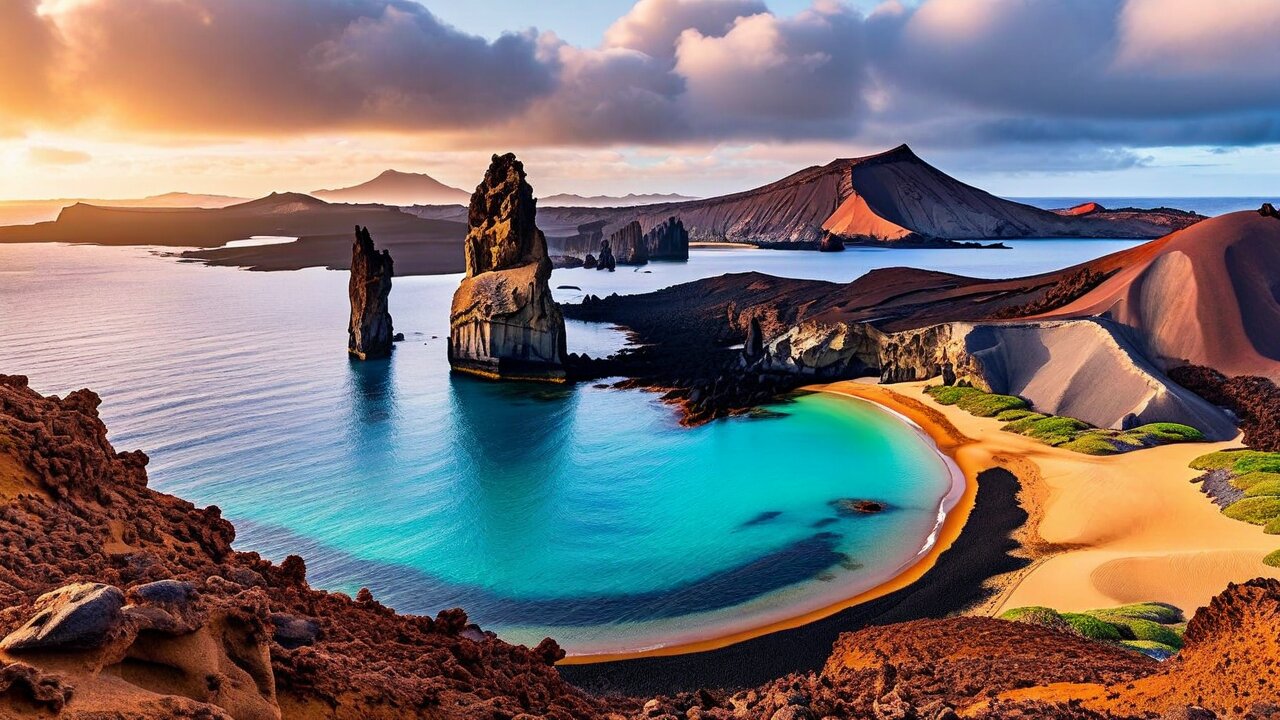
Nineteen main islands and over a hundred islets and rocks, 7,880 km² of land scattered across 45,000 km² of ocean, all of it volcanic and none of it ever connected to a continent. Everything living here arrived across a thousand kilometres of open Pacific — by wind, by current, or on a raft of vegetation.
The hotspot
The islands sit over a mantle plume while the Nazca Plate moves east-south-east above it. The result is a conveyor: the eastern islands are the oldest — San Cristóbal and Española at 3–4 million years — and the western ones are still being built.
Still erupting
Fernandina is one of the most active volcanoes on Earth and erupts every few years; Isabela's Wolf, Sierra Negra and Cerro Azul all erupt regularly. Sierra Negra has one of the largest volcanic calderas in the world, about 10 km across.
Wolf Volcano
At 1,707 m on northern Isabela, the archipelago's high point, and the only place where pink land iguanas live — a species not recognised until 2009.
Isabela
Seahorse-shaped and by far the largest island — 4,588 km², more than half the land area of the whole archipelago — formed from six volcanoes that grew together.
The currents
The cold Humboldt and Cromwell currents bring nutrient-rich water up from the deep and from the south. They are why penguins and fur seals live on the equator, why the water is cold, and why the marine life is what it is.
Zones
Arid coastal lowlands of cactus and lava, a transition zone, and green humid highlands with Scalesia forest above about 400 m. The change between them, over a few kilometres of road, is startling.
🗺️ Map of the Galápagos
Two airports serve the archipelago — Baltra (GPS) for Santa Cruz and San Cristóbal (SCY) — and everything else moves by boat. The inhabited islands are Santa Cruz, San Cristóbal, Isabela and Floreana; everything else can be visited only on a day trip or a cruise.
Baltra → Puerto Ayora
Bus, ferry across the Itabaca Channel, then bus again — about 45 minutes to an hour in total, and included in most packages.
Santa Cruz → Isabela
Two hours by public speedboat, twice daily, and a rough crossing. Around $30–35 each way.
Santa Cruz → San Cristóbal
Two hours by speedboat, or a short flight on the inter-island air service.
The far islands
Genovesa, Fernandina, Española and Darwin and Wolf can only be reached on a multi-day cruise. There are no day trips.
📜 History — Pirates, Whalers and Tortoises
The Galápagos were found by accident, used as a larder for two centuries, and settled reluctantly. Almost every human use of these islands before 1959 involved eating the wildlife.
Discovery · 1535
Fray Tomás de Berlanga, Bishop of Panama, was blown off course en route to Peru and drifted into the islands. He reported that they were barren, that his crew nearly died of thirst, and that the tortoises were remarkable.
Pirates · 1600s–1700s
English buccaneers used the islands as a hideout for raiding the Spanish Pacific coast. They left the first crude charts, the English island names, and the practice of taking tortoises aboard.
The whalers
From the 1790s, and catastrophic. Tortoises could survive a year in a ship's hold without food or water, which made them perfect fresh meat. Estimates of the total taken by whalers and sealers run to 100,000 to 200,000 animals — and it is why several tortoise populations are extinct.
Post Office Bay
On Floreana, whalers left a barrel where outbound ships posted letters for homebound ones to carry. It still works: visitors leave unstamped postcards and take any addressed near home to deliver by hand.
Ecuadorian annexation · 1832
Ecuador claimed the islands and established a penal colony on Floreana. Successive settlement attempts — Floreana, San Cristóbal, Isabela — were penal, brutal, and mostly failed.
The Floreana affair · 1930s
A handful of European settlers — a self-styled baroness, a nudist doctor with steel teeth, a German family — produced disappearances, deaths and a mystery never solved. It is the strangest episode in the archipelago's history and there is a documentary about it.
🕰️ Beagle, Park and Tourists
The modern Galápagos was created twice: once in 1835 by a five-week visit that changed biology, and once in 1959 when Ecuador turned 97% of the land into a national park on the centenary of the book that visit produced.
The Beagle · 1835
Charles Darwin spent five weeks in the archipelago, visiting four islands and going ashore for about nineteen days. He did not have his idea here; he had it years later in London, working through the specimens.
The Second World War
The United States built an air base on Baltra to defend the Panama Canal. Its runway is still the archipelago's main airport, and the base's personnel shot a great deal of wildlife for sport before anyone stopped them.
National park · 1959
Declared on the centenary of On the Origin of Species, covering 97% of the land. The Charles Darwin Research Station opened on Santa Cruz in 1964.
UNESCO · 1978
The Galápagos were on the very first World Heritage list. The marine reserve — 133,000 km², one of the largest in the world — followed in 1998, and was extended by a further 60,000 km² in the Hermandad reserve in 2022.
Lonesome George · died 2012
The last Pinta Island tortoise, found in 1971, kept at the research station for forty years and never successfully bred. His death ended his subspecies. He is now on display, taxidermied, at the station.
The tourism problem
Visitor numbers went from around 40,000 in 1990 to roughly 270,000 today, and the resident population has grown with them. UNESCO put the site on its danger list from 2007 to 2010 and the underlying pressures have not gone away.
🔬 Darwin, and What Actually Happened
The story everyone knows — Darwin arrives, sees the finches, works out evolution — is wrong in almost every detail, and the true version is more interesting.
Five weeks, not a revelation
He was 26, the Beagle's unpaid naturalist and the captain's dining companion, and he spent nineteen days ashore across four islands. He left thinking about geology as much as biology.
He mislabelled the finches
Darwin did not record which island most of his finch specimens came from, and initially took several of them for different families of bird entirely — blackbirds, grosbeaks, wrens. The ornithologist John Gould worked out in London in 1837 that they were all closely related finches.
The mockingbirds mattered more
Darwin did label his mockingbirds by island, noticed they differed, and it was that — not the finches — that first made him write down a doubt about species being fixed.
The tortoise remark
The vice-governor, Nicholas Lawson, told him he could tell which island a tortoise came from by its shell. Darwin recorded it and did not take it seriously at the time.
Twenty-four years
On the Origin of Species was published in 1859, twenty-four years after the visit, and the Galápagos occupy only a few pages of it. The idea was assembled slowly in England from many sources.
Why it still matters
Because the archipelago turned out to be a natural laboratory anyway: Peter and Rosemary Grant spent forty years on Daphne Major measuring finch beaks and watched natural selection happen within single generations after droughts. That is the finch story that actually holds up.
🧬 Evolution and Endemism
Around 80% of the land birds, 97% of the reptiles and land mammals, and more than 30% of the plants are found nowhere else on Earth. On some islands the figures are higher still. The archipelago is young enough that you can see the process rather than only the result.
How anything got here
By flight, by wind, and by rafting on vegetation mats washed out of South American rivers. That filter explains what is missing: no native amphibians, almost no native land mammals except rice rats and two bats, and no large predators.
Adaptive radiation
One arriving ancestor, many islands, different conditions. Thirteen to eighteen species of Darwin's finch descend from one colonist and differ mainly in beak shape — from a heavy seed-cracker to a warbler-thin insect probe.
The vampire finch
On Wolf and Darwin islands, one finch population has taken to pecking the base of booby wing feathers and drinking the blood. It is the most extreme thing any of the finches does and it evolved within the last few hundred thousand years.
The flightless cormorant
The only cormorant on Earth that cannot fly. With no land predators and rich cold water directly offshore, wings became a cost rather than a benefit — a textbook case of use-it-or-lose-it evolution.
Tameness
Not friendliness — an absence of fear that never had to evolve. It is the single most striking thing about being here and also the most fragile: it is why introduced dogs, cats and rats are so devastating.
Species still being found
The pink land iguana of Wolf Volcano was described in 2009; a new giant tortoise species on Santa Cruz was separated in 2015. This is not a finished inventory.
🐢 Giant Tortoises
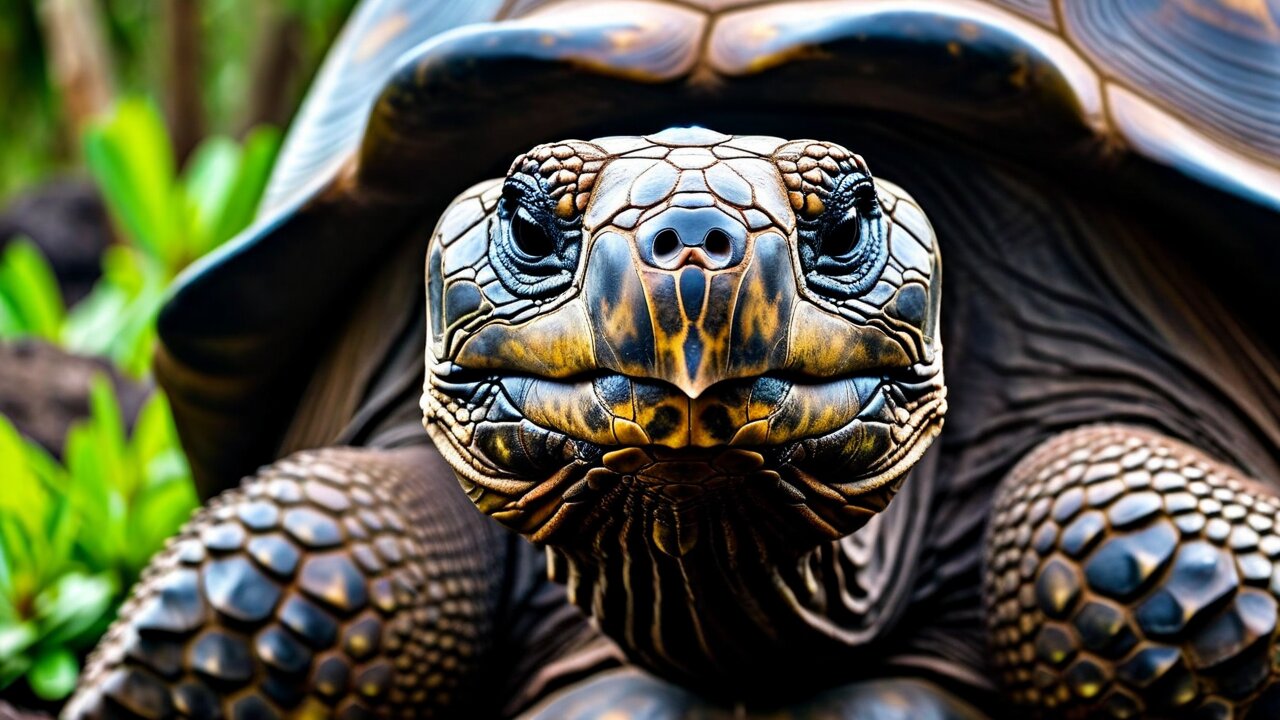
The animals that named the islands. Fifteen species are recognised, of which three are extinct and the rest are endangered. Perhaps 60,000 survive today against a pre-whaling population thought to have been in the hundreds of thousands.
How long they live
Well over a hundred years, and the record for a Galápagos tortoise in captivity is around 170. They reach breeding age at 20 to 25 and a large male weighs over 250 kg.
Domed and saddle-backed
The shell shape tracks the island's vegetation, and it was the difference Lawson pointed out to Darwin. Saddle-backed forms — Española, Pinta — evolved on the driest islands where feeding requires reaching upward.
The Española recovery
By the 1960s just fourteen Española tortoises remained, scattered across the island and unable to find each other. A captive breeding programme centred on one male, Diego, produced over 2,000 offspring; the species was declared self-sustaining and Diego retired to Española in 2020 at over 100 years old.
Lonesome George
The last Pinta tortoise, found in 1971 and dead in 2012 despite forty years of attempts to breed him. His body is on display at the research station and he is the global symbol of extinction as a thing that happens to individuals.
Where to see them wild
The Santa Cruz highlands — El Chato and the private ranches — where tortoises wander freely and you walk among them. Also the Isabela and San Cristóbal breeding centres, and the Charles Darwin Station on Santa Cruz.
The two-metre rule
Keep two metres from every animal, tortoises included. A tortoise that pulls into its shell has been disturbed and stops feeding, and on a hot day that matters.
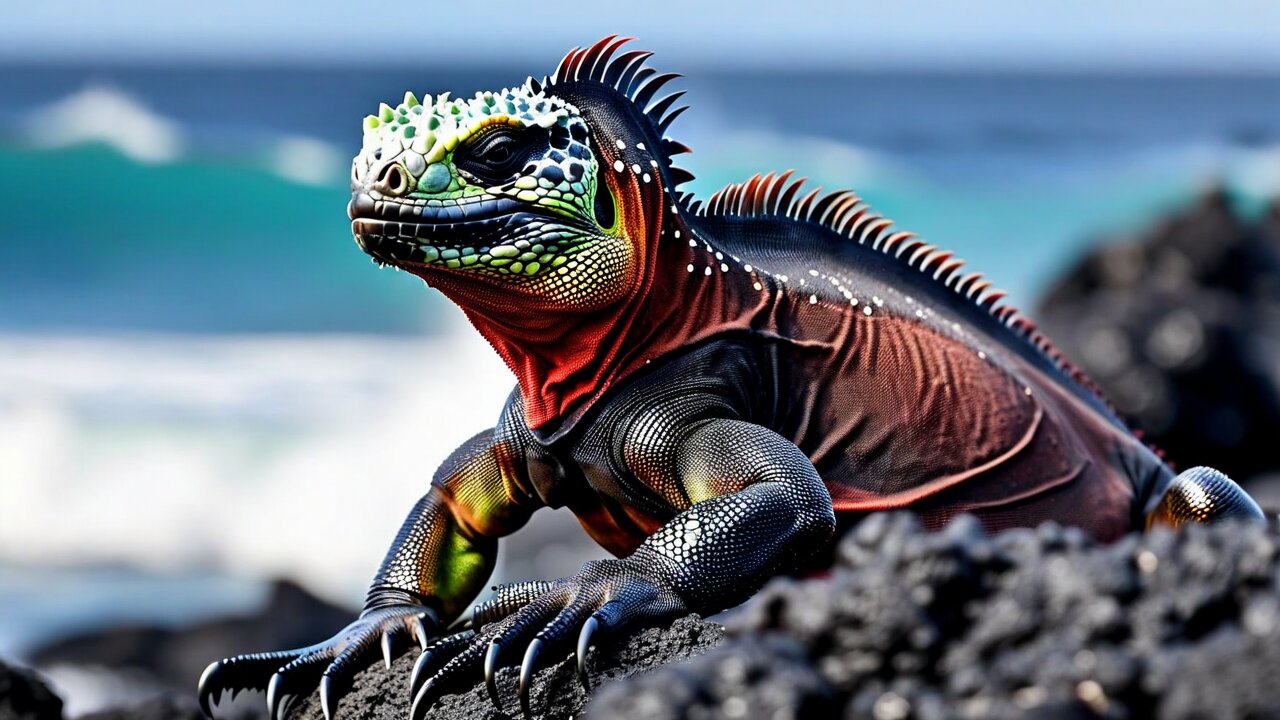
🦎 Marine Iguanas and Their Relatives
The only lizard on Earth that feeds in the sea. Darwin called them "imps of darkness" and disliked them; they are now among the most-studied reptiles anywhere and one of the strangest animals you will ever stand next to.
How they feed
They graze algae off submerged rock, diving to 10 m or more and staying down for up to half an hour by dropping their heart rate. Only large males dive; females and juveniles feed in the intertidal zone.
The salt problem
Seawater means swallowing salt, which they expel through specialised nasal glands by sneezing. The white crust on their heads is their own dried salt, and being sneezed on is a normal part of a Galápagos visit.
They shrink
In El Niño years, when warm water kills the algae, marine iguanas reabsorb their own bone and become up to 20% shorter, then grow back when food returns. No other vertebrate is known to do this.
Land iguanas
A separate lineage, yellow-brown, feeding on cactus. And on Wolf Volcano a pink species, described only in 2009, with a population of a few hundred — one of the rarest reptiles on Earth.
Hybrids
On South Plaza, male marine iguanas occasionally mate with female land iguanas, producing a sterile hybrid that can climb cactus and swim. Fewer than a handful have ever been recorded.
Watching them
They are everywhere on the coast, they will not move, and you must go around them. Do not step over one, do not use flash, and never move an animal off a path for a photograph.
🐦 The Birds
Around 56 resident bird species, of which 45 are endemic, plus the seabird colonies that make the archipelago globally important. Most of them will let you within a couple of metres.
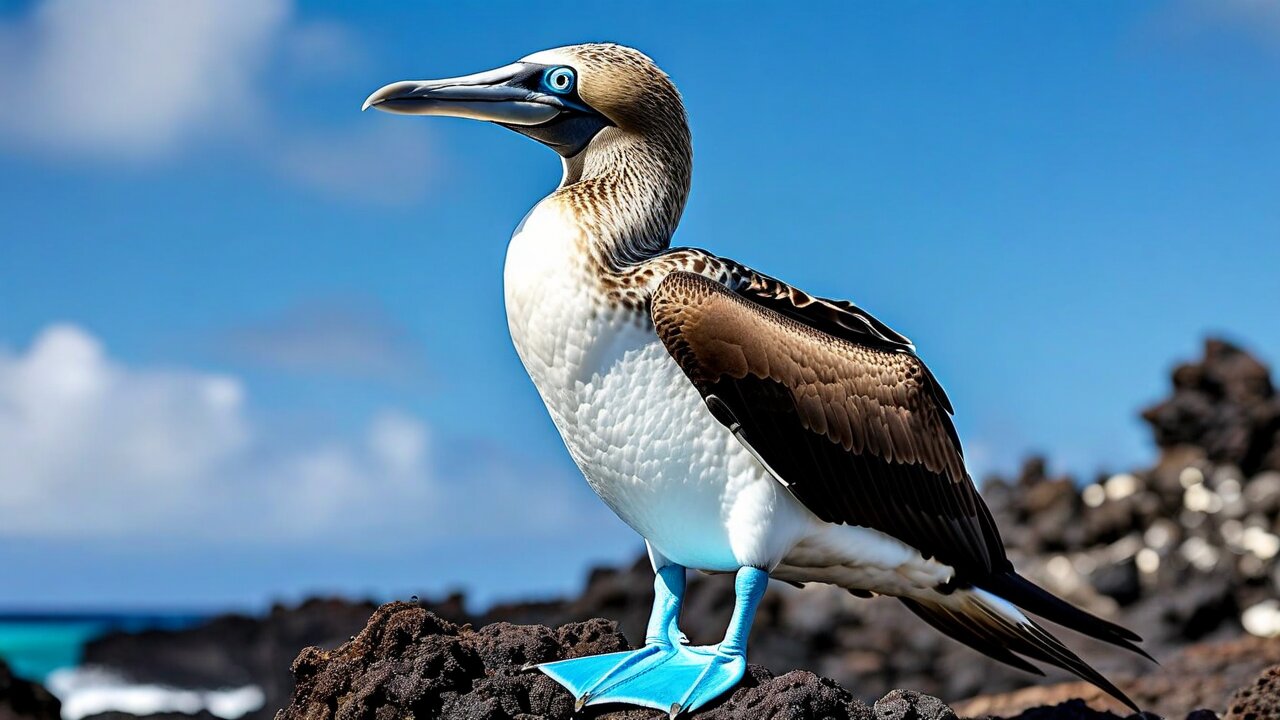
Blue-footed boobies
The famous ones, with a courtship dance of high-stepping and sky-pointing. Best at Española, North Seymour and Punta Pitt. Around half the world population breeds here.
Nazca and red-footed boobies
Nazca are larger and white with a dark mask, and practise obligate siblicide — the first chick kills the second. Red-footed boobies nest in trees and are best seen at Genovesa.
Frigatebirds
Two species, with the males inflating a scarlet throat pouch for weeks in display. They cannot land on water despite living at sea, and steal much of their food from other birds.
Waved albatross
Almost the entire world population breeds on Española, and nowhere else. Present roughly April to December, with a long, clattering courtship dance. They leave the island completely for the rest of the year.
Galápagos penguin
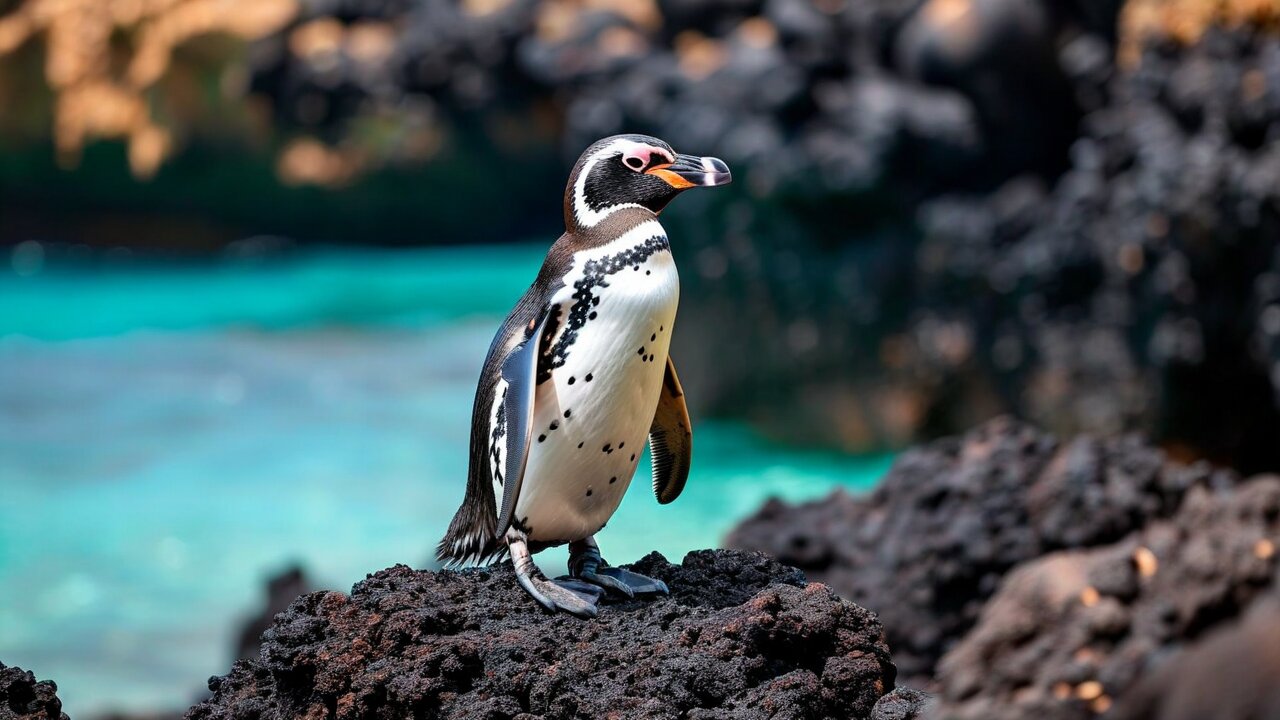
Around 1,200 to 2,000 birds, the second-smallest penguin, and the only one breeding at the equator. Punta Vicente Roca, Bartolomé and Isabela's western shore.
The finches and the mockingbirds
Small, brown and easy to overlook — and the reason anyone knows the archipelago's name. Watch beaks rather than plumage: it is the only reliable way to tell the species apart, and it is the whole point.
🐠 In the Water
Three ocean currents meet here and the water is cold, green and full of food. That is the opposite of a warm coral paradise and it is why the Galápagos is one of the great diving destinations on Earth — but you should know what you are getting.
The conditions
Water of 16–26 °C depending on season and site, often with limited visibility and strong current. A wetsuit is essential, and several sites are for experienced divers only. This is not warm reef diving.
Darwin and Wolf
The far northern islands, reachable only by liveaboard, where hammerhead sharks school in the hundreds and whale sharks — mostly large pregnant females — pass through between June and November. Consistently ranked among the best dive sites in the world.
Snorkelling
Just as good and available to everyone. Sea lions that play with swimmers, marine iguanas grazing underwater, penguins, turtles and rays — all of it in water you can enter from a beach or a panga.
Sea lions
Galápagos sea lions are everywhere, on benches and boats and beaches, and juveniles will swim circles around snorkellers. Keep away from bulls, which are territorial and bite.
The marine reserve
133,000 km² since 1998, plus the 60,000 km² Hermandad corridor added in 2022 to link the Galápagos with Cocos Island. Illegal industrial fishing on the boundary — much of it distant-water fleets — is the main enforcement problem.
El Niño
Warm-water years devastate this ecosystem: algae die, marine iguanas starve and shrink, penguins and cormorants fail to breed, and sea lion pups die. The 1982–83 and 1997–98 events killed a large share of several populations.
🏘️ Santa Cruz and Puerto Ayora
The centre of everything. Puerto Ayora has about 18,000 people, most of the archipelago's hotels and restaurants, the research station, and the boats. If you are doing a land-based trip, you will be based here.
Charles Darwin Research Station
Free, at the edge of town, with the tortoise breeding centre, Lonesome George on display, and the clearest explanation anywhere of what conservation here actually involves. Go on your first morning.
The highlands
Twenty minutes uphill and a different world: green, misty Scalesia forest, lava tunnels you can walk through, and the ranches at El Chato where wild giant tortoises wander among the cattle. The single best tortoise experience in the archipelago.
Tortuga Bay
A 2.5 km paved trail from town to a long white beach with marine iguanas, sharks in the shallows and a calm lagoon at the far end. Free, no guide needed, and one of the few places you can walk alone.
Las Grietas
A water-filled fissure between lava walls, reached by water taxi and a short walk. Cold, deep, clear and popular.
The fish market
On the waterfront in the morning, with pelicans and sea lions queuing at the counter alongside the customers. It is the most photographed everyday scene in the islands and it is completely genuine.
Day trips from here
Bartolomé, North Seymour, Santa Fé, Plazas, Isabela, Floreana and Pinzón — all doable as long days by speedboat, at $100–250 each.
🌋 Isabela and Fernandina
The young, volcanic west. Isabela is more than half the land area of the archipelago and has the most relaxed town in it; Fernandina is the youngest island, has never had an introduced species established, and is one of the most pristine islands on Earth.
Puerto Villamil
Sand streets, about 3,000 people, a long beach and no hurry. Most visitors who stay a night wish they had stayed three. Two hours by speedboat from Santa Cruz and a genuinely rough crossing.
Sierra Negra
A 16 km round-trip hike to the rim of one of the world's largest calderas — roughly 10 km across — with a further walk to the Volcán Chico fumaroles. Guided, muddy, and worth it.
Las Tintoreras
A short boat ride from town to a lava islet where whitetip reef sharks rest in a narrow channel, penguins loaf on the rocks and the snorkelling is excellent.
Concha de Perla and the wetlands
A free lagoon walk from the pier with sea lions and turtles, plus flamingo lagoons and a tortoise breeding centre reachable on foot.
Fernandina
Cruise-only. Punta Espinosa has the largest marine iguana colonies in the archipelago, flightless cormorants nesting, and lava so young that almost nothing grows on it. No rats, no goats, no cats — ever.
The western circuit
Boats that go west — Isabela's Bolívar Channel and Fernandina — get the cold upwelling wildlife: penguins, cormorants, whales and mola mola. It is a different trip from the eastern and central circuits.
🏝️ The Other Islands
San Cristóbal
The provincial capital, Puerto Baquerizo Moreno, with an airport, a sea lion colony sprawled across the town beach, the Interpretation Centre, and Kicker Rock offshore for snorkelling with hammerheads.
Española
The oldest island and, for many visitors, the best single landing: waved albatrosses from April to December, a blowhole, huge marine iguana colonies and boobies nesting beside the trail. Cruise-only.
Genovesa
The far north-east, a drowned caldera you sail into, and a seabird island — red-footed boobies, Nazca boobies, frigatebirds and storm petrels in enormous numbers. Cruise-only.
Floreana
The most human history: the post barrel, the pirate caves, the 1930s mystery, and around 100 residents. Reachable as a day trip or on a cruise.
Bartolomé and Santiago
Bartolomé for Pinnacle Rock and the classic view; Santiago for lava fields at Sullivan Bay, fur seals and the wreck of a nineteenth-century salt mine.
Santa Fé, Plazas and North Seymour
Day-trip islands from Santa Cruz: land iguanas, sea lion colonies, frigatebird and booby nesting, and short well-made trails.
🎫 How Visiting Actually Works
This is the part people misunderstand, and getting it wrong wastes money. The Galápagos is a permit system with a national park attached, and almost nothing about a visit is free-form.
The two fees
A $20 transit control card bought at the mainland airport before you fly, and the national park entrance fee of $200 for non-Ecuadorian adults, paid in cash on arrival. The park fee doubled in August 2024 and is not negotiable.
Guides are compulsory
Every national park visitor site — which is most of the archipelago — requires a certified naturalist guide and a group of at most 16 people. You cannot hire a car and drive to a landing site.
Where you can go alone
A short list, and worth knowing: Tortuga Bay and the research station on Santa Cruz, the town beaches and Concha de Perla on Isabela, La Lobería and the Interpretation Centre on San Cristóbal, and the towns themselves.
Fixed itineraries
Every cruise boat has a park-approved fourteen-day rotation specifying which site it visits on which morning. Boats cannot swap. This is why choosing the right itinerary matters more than choosing the right boat.
Biosecurity
Bags are inspected at the mainland airport and again on arrival. No fresh food, seeds, plants or animal products. Clean your boots and Velcro before you fly — a seed in a shoe tread is exactly how invasive plants arrive.
The rules on site
Two metres from all animals, stay on the marked trail, no flash, no drones, no feeding, no touching, nothing taken and nothing left. Guides enforce these and can and do report visitors.
🚢 Cruise or Land-Based?
The single decision that shapes everything else. Neither is wrong, they suit different people, and the difference is not mainly about money.
What a cruise gets you
The outer islands — Genovesa, Española, Fernandina, Darwin and Wolf — which cannot be reached any other way. You sail overnight and wake up somewhere new, get two guided landings a day, and see far more wildlife per day.
What a cruise costs
$250–600 per person per night on a mid-range boat, more on luxury vessels, for a 4-, 5- or 8-night itinerary. Boats carry 16 to 100 passengers; the smaller ones reach more sites and feel less like a hotel.
What land-based gets you
Hotels in the towns and day trips out. Cheaper — $120–250 a day all in — more flexible, better food, and you meet Galapagueños rather than only other tourists. You also get evenings on land, which many people prefer.
What land-based costs you
The outer islands. Day trips reach a limited set of sites, involve a lot of boat time, and the seas between islands are rough. You will see less wildlife per day and spend more of it travelling.
The honest recommendation
First visit and a real budget: take a cruise, ideally 5 or 8 nights, on a small boat, and check the itinerary rather than the brochure. Tighter budget or prone to seasickness: land-based on Santa Cruz and Isabela with three or four day trips.
Booking
Last-minute deals in Puerto Ayora exist and can be half price, but require flexibility and a week of waiting. Booking from home costs more and guarantees the itinerary you want.
🌿 Conservation and Its Problems
The Galápagos is simultaneously one of the best-protected places on the planet and one of the most visibly stressed. Both things are true and the tension between them defines the archipelago's politics.
Invasive species
The biggest threat by a wide margin. Goats, rats, cats, fire ants, blackberry and quinine have all done enormous damage. Goat eradication on Isabela and Santiago removed around 140,000 animals in one of the largest such operations ever attempted — and it worked.
Philornis downsi
An introduced parasitic fly whose larvae feed on nestlings' blood. It is now the leading cause of chick mortality in Darwin's finches and has pushed the mangrove finch — down to a few dozen birds — close to extinction.
Population growth
About 33,000 residents now against roughly 6,000 in 1980, and the growth is driven by tourism jobs. Water, waste and energy on the inhabited islands are all under strain.
Illegal fishing
Distant-water fleets — a Chinese fleet of some 300 vessels drew international attention in 2020 — work the edge of the reserve. Sea cucumber and shark-fin poaching inside it has been a recurring problem for thirty years.
Plastic
Currents deliver plastic from the mainland and from fishing fleets onto uninhabited beaches that nobody lives near. Volunteer clean-ups remove tonnes a year from islands with no residents at all.
What actually helps
Paying the fee without complaint, following the rules exactly, choosing operators with real environmental credentials, and not buying anything made from black coral, shell or shark. The tameness that makes this place extraordinary is also what makes it defenceless.
👥 The People Who Live Here
About 33,000 residents on four islands, almost all of them descended from twentieth-century migrants from mainland Ecuador rather than from any older population. There were no indigenous inhabitants: the Galápagos are among the very few significant island groups on Earth that humans never settled before Europeans arrived.
Where they live
Puerto Ayora on Santa Cruz (about 18,000), Puerto Baquerizo Moreno on San Cristóbal (about 7,000), Puerto Villamil on Isabela (about 3,000) and roughly 100 people on Floreana.
What they do
Tourism, directly or indirectly, for the large majority. Then artisanal fishing, small-scale farming in the highlands, and the public sector — park, navy, schools, hospital.
Restricted residency
You cannot move here freely from mainland Ecuador. Permanent residency is limited by law and mainland Ecuadorians work on temporary permits — an unusual internal migration control designed to cap population growth.
The cost of living
Everything except fish and some highland vegetables arrives by cargo ship from Guayaquil. Prices are far above mainland Ecuador and residents feel it as sharply as visitors do.
The fishing question
Artisanal fishers are a small, politically significant group whose interests have repeatedly collided with the reserve's rules — the sea cucumber conflicts of the 1990s and 2000s included protests and occupations of the research station.
Local culture
Ecuadorian, coastal, and young. Football on the plaza in the evening, reggaeton, and a strong local identity as Galapagueños rather than as mainlanders.
🍽️ Food in the Galápagos
Ecuadorian coastal cooking with excellent fish and expensive everything else. There is no distinct Galápagos cuisine, and the good news is that Ecuadorian coastal food is very good.
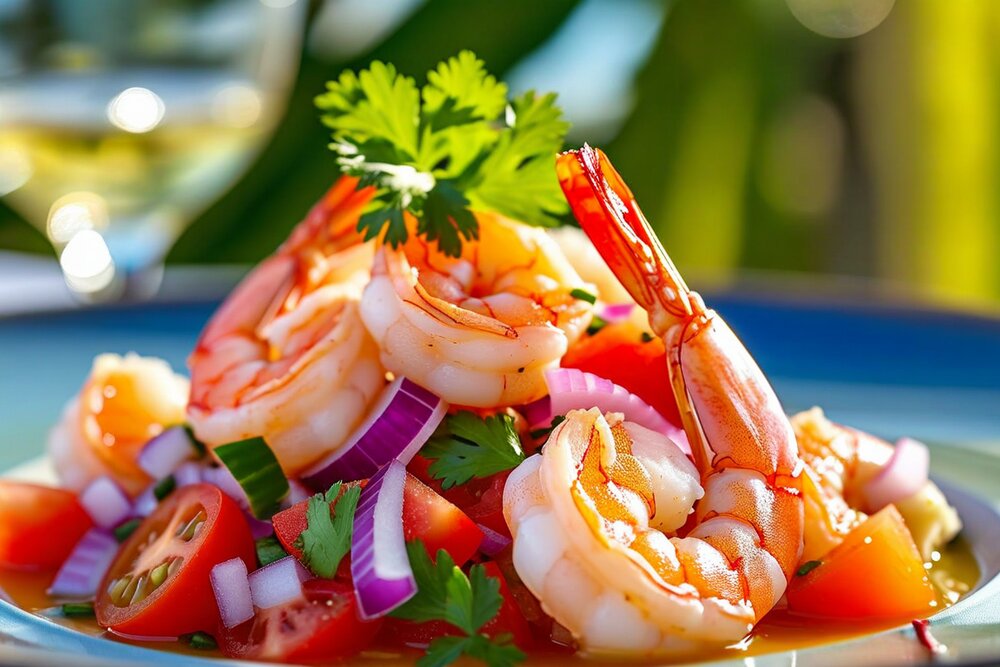
Ceviche
The staple. Prawn, fish or mixed, in a citrus and tomato broth, served cold with popcorn and plantain crisps. Ordering it with popcorn on the side and adding it yourself is the local way.
Encebollado
Ecuador's national hangover cure: albacore tuna, yuca and pickled red onion in a cumin-scented broth. Eaten for breakfast, and better than that description sounds.
Fish of the day
Wahoo, grouper, tuna and brujo, grilled or in a coconut sauce. The fish here is excellent and it is the one thing that is not overpriced.
Lobster
In season roughly September to December only — the closed season is enforced and eating it outside those months means it was taken illegally. Ask, and if the answer is vague, order something else.
Los Kioscos
Calle Charles Binford in Puerto Ayora: a street of open-air grills where the town eats. Half the price of the waterfront restaurants and considerably better. Go at 19:00.
Almuerzo
The set lunch — soup, a main, juice — for $5–8 at simple places, and by far the best value in the islands. This is what residents eat and it is how to make a land-based trip affordable.
Ceviche de camarón
Ecuadorian prawn ceviche · serves 4 · 30 minutes
Ingredients: 600 g raw prawns, peeled and deveined (shells kept); juice of 8 limes; 2 oranges, juiced; 3 tomatoes; 1 large red onion, sliced very thin; 1 bunch coriander; 2 tbsp tomato ketchup; 1 tbsp oil; salt, pepper. To serve: popcorn and chifles.
Method: Simmer the prawn shells in 300 ml water for 15 minutes and strain — this broth is what distinguishes an Ecuadorian ceviche. Poach the prawns in the same liquid for 2 minutes only, then cool them immediately. Rinse the sliced onion in salted water and drain. Blend or finely chop the tomato, mix with the lime and orange juice, the reserved broth, the ketchup and the oil, then fold in the prawns, onion and coriander. Chill 20 minutes. Serve very cold with popcorn.
💡 The prawns are cooked, not cured — this is not Peruvian ceviche. Two minutes and no more, and stop the cooking in cold water or they turn to rubber.
Encebollado
Tuna and yuca soup · serves 4 · 45 minutes
Ingredients: 600 g fresh albacore or bonito, in large pieces; 500 g yuca (cassava), peeled and cut; 2 tomatoes; 1 onion; 1 tsp ground cumin; 1 tsp achiote; 1 bay leaf; 1.5 l water; oil; salt. To pickle: 1 red onion sliced thin, juice of 2 limes, salt, coriander.
Method: Soften the chopped onion and tomato in oil with cumin and achiote, add the water, bay leaf and salt, and bring to a simmer. Add the fish and poach 15 minutes, then lift out and flake, discarding any bones. Cook the yuca in the same broth until tender, about 25 minutes. Meanwhile toss the sliced red onion with lime juice, salt and coriander and leave to pickle. Return the fish to the pot, check the seasoning, and serve topped with the pickled onion.
💡 The pickled onion on top is not a garnish — it is half the dish. Serve with chifles and a bottle of chilli sauce on the table.
🍺 What People Drink
Pilsener and Club
The two Ecuadorian lagers, and the default order everywhere. Pilsener in the big bottle is what the fishermen drink.
Canelazo
Warm aguardiente with cinnamon and naranjilla — a highland Ecuadorian drink that turns up here more as a novelty than a habit, because it is 25 °C at night.
Juices
Naranjilla, tree tomato, maracuyá, guanábana. Ecuadorian fruit juice is one of the country's underrated pleasures and it is everywhere.
Coffee
Grown in the Santa Cruz and San Cristóbal highlands in small quantities, and genuinely good. The farms sell direct and it is the best souvenir available.
Water
Do not drink the tap water on any island — desalinated or brackish, and not treated to drinking standard. Refill stations exist in the towns; bring a bottle rather than buying dozens.
Prices and rules
A beer $3–5, a cocktail $8–12. Legal age 18. Alcohol sales are restricted on election days in Ecuador, which catches people out.
🌦️ Climate and When to Go
On the equator, but cooled by the Humboldt Current — so the Galápagos are far cooler and drier than their latitude implies. There are two seasons, they are genuinely different, and neither is bad.
Warm/wet season · December–May
Air 25–30 °C, water 22–26 °C, sunny mornings with short heavy afternoon showers, calm seas. Best for snorkelling and for anyone prone to seasickness, and the islands are green.
Cool/dry season · June–November
Air 19–26 °C, water 16–22 °C, overcast garúa mist, rougher seas — and much richer marine life because the upwelling is strong. Whale sharks at Darwin and Wolf, and the most active seabird colonies.
Wildlife by month
Waved albatross on Española April–December. Green turtles nesting January–March. Blue-footed booby courtship mainly June–August. Giant tortoise nesting June–December. Whale sharks June–November. There is no wrong month.
El Niño years
Warm water shuts down the upwelling and the food chain collapses. Marine iguanas shrink, penguins and cormorants stop breeding and sea lion pups die. Check whether an El Niño is forecast before booking a marine-heavy trip.
Crowds
Busiest mid-June to August and mid-December to mid-January. The quietest and cheapest months are May, September and early November.
What to pack
Reef-safe sunscreen and a hat — the equatorial UV is severe even under cloud — a wetsuit or rash vest, water shoes for wet landings, a light rain layer, binoculars, and dry bags. Nothing new with Velcro that has not been cleaned.
🇨🇿 From the Czech Republic
A long way and a two-stage journey: Prague to Ecuador, then Ecuador to the islands. Total travel time is 20 to 28 hours to Quito or Guayaquil and a further day to reach the archipelago. The time difference is 7 hours behind Czech winter time on the mainland and 8 hours in the Galápagos.
To Ecuador
Prague to Quito (UIO) or Guayaquil (GYE) via Madrid (Iberia), Amsterdam (KLM), Paris (Air France) or Bogotá (Avianca). Returns typically 25,000–45,000 Kč.
To the islands
Avianca, LATAM and Aequs fly from Quito and Guayaquil to Baltra (GPS) or San Cristóbal (SCY), about 2 h from Guayaquil and 3 h from Quito with a stop. Return fares $350–550, and they are not included in most cruise prices — check.
The fees
$20 transit card at the mainland airport plus $200 park entrance in cash on arrival. Bring clean US dollars; cards are not accepted for the park fee.
Visa
Czech citizens need no visa for Ecuador for stays up to 90 days. A passport valid six months beyond entry and proof of onward travel are required.
Health
No yellow fever requirement for the Galápagos or Quito, though a certificate may be asked for if you have been in an endemic country. No malaria in the islands. Altitude is the real issue if you stop in Quito at 2,850 m — take the first day gently.
Czech consular cover
There is no Czech embassy in Ecuador; the accrediting mission is the Czech Embassy in Bogotá, Colombia, with an honorary consulate in Quito. Register in DROZD before travelling.
💰 Costs
Expensive, unavoidably. Everything except fish is shipped 1,000 km, the park fee is fixed, and the flights are effectively a monopoly route. Budgeting honestly matters more here than in most places.
The fixed costs
Park fee $200, transit card $20, mainland–islands flight $350–550 return. That is roughly 15,000 Kč before you have slept anywhere.
Cruises
Budget/tourist class $250–350 per person per night; first class $400–600; luxury $700 and up. Four, five and eight-night itineraries are standard. Small boats reach more sites than big ones.
Land-based accommodation
Hostel or simple hotel in Puerto Ayora $40–80 a night, mid-range $100–180, top end $250+. Isabela is slightly cheaper and quieter.
Land-based day trips
$100–250 per person per day depending on the island. Bartolomé and North Seymour are at the top end; Isabela's Tintoreras and Los Gemelos are much cheaper.
Food
Almuerzo set lunch $5–8. Kiosk dinner $10–15. Waterfront restaurant $25–40. Beer $3–5. Inter-island speedboat $30–35 each way.
Realistic totals
Land-based, careful: $150–220 a day (3,700–5,500 Kč) plus the fixed costs. Mid-range cruise: $350–500 a day all in. A week for one person rarely comes in under about 55,000 Kč including flights from Prague, and easily reaches double.
🧭 Practical Galápagos
Money
The US dollar. ATMs exist in Puerto Ayora and Puerto Baquerizo Moreno and run out; Isabela's are unreliable and Floreana has none. Bring cash, including clean notes for the $200 park fee, and small bills for taxis and kiosks.
Getting between islands
Public speedboats twice daily between Santa Cruz and Isabela or San Cristóbal, two hours, $30–35, and genuinely rough. Emetrans and small airlines fly between the three main islands for $150–250.
On the islands
White pick-up taxis, a flat $1–3 within town and $20–30 to the highlands. Water taxis in the harbours cost $1. Bicycles rent for $10–15 a day.
Connectivity
Slow. Claro and Movistar work in the towns; expect little or nothing at visitor sites and none at sea. Hotel wifi is often barely usable. This is a good place to be offline.
Electricity
110 V, 60 Hz, US-style flat two-pin plugs. Czech visitors need both an adapter and, for anything without a universal supply, a voltage check.
Health
A hospital in Puerto Ayora and clinics elsewhere; serious cases are flown to Guayaquil. There is no hyperbaric chamber on Isabela — the recompression facility is on Santa Cruz — which matters if you dive. Take insurance with evacuation cover and, for divers, DAN or equivalent.
🛡️ Safety
One of the safest places in Latin America. Crime against visitors is rare, the towns are small, and the risks here are almost entirely to do with sun, sea and animals.
Crime
Minimal — opportunistic theft from beaches and unlocked rooms is the realistic risk. This is markedly safer than mainland Ecuador, where security has deteriorated significantly in recent years.
Mainland Ecuador
Worth separating: Guayaquil and parts of the coast have serious organised-crime violence and your ministry's advice for the mainland does not describe the islands. Take normal precautions in transit and do not linger in Guayaquil unnecessarily.
Sun
Equatorial UV, often under cloud, reflecting off water and pale sand. It burns people who never burn. Reef-safe sunscreen, a hat and a rash vest while snorkelling.
The sea
Currents at some snorkelling sites are strong and landings are frequently wet, onto slippery rock from a moving panga. Listen to the guide, and do not swim off unmarked beaches alone.
Animals
Nothing hunts you, but a sea lion bull will charge and bite, and they are fast on land. Keep two metres, never come between a bull and his harem, and do not swim into a colony.
Seasickness
The most common actual problem. The June–November season has rougher seas and the Santa Cruz–Isabela speedboat is notorious. Take medication before boarding, not after.
🏨 Where to Stay
Puerto Ayora
The widest choice, from $30 hostels to $300 boutique hotels, and the base for most land-based trips. Staying a few streets back from the waterfront is cheaper and quieter.
Puerto Villamil, Isabela
Beachfront hotels and small posadas, sand streets, and the most relaxed place to stay in the archipelago. Fewer options and they fill in high season.
Puerto Baquerizo Moreno, San Cristóbal
The provincial capital, quieter than Santa Cruz, with sea lions on the town beach and a good range of mid-range hotels.
Floreana
A handful of family-run guesthouses and about 100 residents. Two nights here is the closest the Galápagos comes to staying in a village.
Cruise cabins
Your accommodation on a cruise. Lower-deck cabins are cheaper and roll less; upper decks have windows and more motion. Small boats mean smaller cabins and better access to sites.
Camping
Not permitted anywhere in the national park. There is no wild camping option here at all.
🗺️ Suggested Itineraries
Five days, land-based
Two nights Santa Cruz — research station, highlands, Tortuga Bay — then two nights Isabela for Sierra Negra and Las Tintoreras. The best short trip that does not involve a boat cabin.
Eight days, cruise
The standard week: a western itinerary for Isabela and Fernandina (penguins, cormorants, cold-water life) or an eastern one for Española and Genovesa (albatross and seabirds). You cannot have both in one week.
Ten days, combined
A 4- or 5-night cruise for the outer islands, then three or four nights land-based on Santa Cruz and Isabela. The best overall shape and what I would book.
Two weeks
Add San Cristóbal and Floreana, or a second cruise leg covering the opposite half of the archipelago. Also allows time in Quito or the Ecuadorian Andes on the way through.
For divers
A liveaboard to Darwin and Wolf, 7–8 nights, advanced certification and 50+ logged dives usually required. Around $5,000–7,000. Nothing else in the world dives like it.
With children
Land-based on Santa Cruz and Isabela: short boat rides, tortoises they can walk among, shallow snorkelling with sea lions, and a bed that does not move.
🤯 Fascinating Facts
UNESCO's first site
The Galápagos were inscribed in 1978 on the very first World Heritage list, alongside eleven others.
Ninety-seven per cent park
Only 3% of the land is available for settlement and agriculture, and residency is legally restricted — you cannot simply move here even from mainland Ecuador.
Penguins on the equator
The Galápagos penguin is the only penguin whose range crosses into the northern hemisphere, and it lives here only because cold currents reach the equator.
Marine iguanas shrink
In El Niño years they reabsorb bone and lose up to 20% of their length, then grow back. No other vertebrate is known to do it.
Darwin didn't label the finches
He failed to record which island most of his finch specimens came from and had to reconstruct it from other crew members' collections. John Gould identified them as finches after the voyage.
Diego the tortoise
A single Española male fathered over 2,000 offspring in a captive breeding programme that brought his species back from fourteen animals, and was returned to the wild in 2020 aged over 100.
The post barrel still works
The whalers' mail barrel at Post Office Bay on Floreana has operated since the 1790s. Visitors leave unstamped postcards and hand-deliver ones addressed near home.
A vampire finch
On Wolf Island, one finch population drinks the blood of nesting boobies, pecking at the base of their wing feathers. The boobies largely tolerate it.
Fernandina has never been invaded
One of the largest islands on Earth with no introduced species ever established — no rats, no goats, no cats. It is a genuine baseline for what these islands were.
👤 Notable Figures
Charles Darwin (1809–1882)
Spent five weeks here in 1835 as a 26-year-old and published the book that used the visit twenty-four years later. The archipelago's entire modern identity descends from those nineteen days ashore.
Fray Tomás de Berlanga (1487–1551)
Bishop of Panama, blown off course in 1535, and the first European to see the islands. His letter to the King of Spain is the earliest description of them.
John Gould (1804–1881)
The ornithologist who examined Darwin's specimens in London and established that the assorted birds were all finches — the identification that made the story possible.
Peter and Rosemary Grant (b. 1936 and 1936)
Spent more than forty years measuring finches on Daphne Major and documented natural selection acting within single generations. The most important long-term evolutionary study ever conducted.
Lonesome George (c. 1910–2012)
The last Pinta Island tortoise. Found in 1971, never bred, and on his death an entire subspecies ended. The most famous individual animal of the last half-century.
Diego (c. 1910s–)
The Española tortoise who fathered over 2,000 descendants and saved his species, then went home. The counterweight to George's story and much less well known.
Margret Wittmer (1904–2000)
One of the Floreana settlers of the 1930s, who lived through the disappearances and deaths of the affair, wrote a memoir about it, and stayed on the island until she died. Her family still runs a guesthouse there.
Herman Melville (1819–1891)
Visited as a whaler and wrote The Encantadas, ten sketches of the islands as a burnt, cursed place — the exact opposite of the modern image, and worth reading before you go.
🧭 Visiting Responsibly
This is a place where the rules are not suggestions, and where a visitor doing the wrong thing does measurable harm. The animals have no fear response and cannot protect themselves from you.
Two metres, always
From every animal, including the ones asleep on the path. If an animal moves because of you, you were too close. Long lenses and phone zoom exist for this reason.
Stay on the trail
Marked with black and white posts. The ground either side is nesting habitat, and burrows collapse under a footstep — that is a dead petrel chick, not an inconvenience.
No flash, no drones, no touching
All prohibited. Drones are banned throughout the national park and confiscated.
Biosecurity is on you
Clean boots, bags and Velcro before flying. Never move organic material between islands. The single greatest threat here is a seed or an insect in someone's luggage.
Reef-safe sunscreen
Bring it from home; it is expensive and inconsistently available locally. Better still, wear a rash vest and use less.
Choose operators carefully
Ask what a boat does with waste and water, whether guides are Galápagos residents, and how many passengers it carries. Smaller boats with local naturalist guides put more of the money into the archipelago and less strain on the sites.
❓ Common Misconceptions
"It's a country"
It is a province of Ecuador, uses the US dollar, and votes in Ecuadorian elections. There is no separate immigration procedure beyond the transit card.
"Darwin had his idea there"
He had it in London, years later, working through specimens — several of which he had failed to label properly. The Galápagos supplied evidence he only understood in retrospect.
"You can just turn up and explore"
You cannot. Most of the archipelago requires a certified guide, a permit and a fixed group. Independent walking is limited to a short list of sites in and near the towns.
"It's warm tropical diving"
It is cold, often 16–20 °C, with strong currents and limited visibility. A wetsuit is not optional and several sites are for experienced divers only.
"A cruise is always better"
A cruise reaches islands land trips cannot, and costs two to three times as much. For a lot of travellers a land-based trip with day trips is a better use of the same money.
"The wildlife is tame so it's fine to get close"
The tameness is exactly why the two-metre rule exists. An animal that will not flee cannot protect itself from disturbance, disease or a dropped foot.
📚 Reading and Watching
The Voyage of the Beagle · Darwin
Readable, funny in places, and the Galápagos chapter is much shorter and less certain than people expect. Worth reading precisely for that.
The Beak of the Finch · Jonathan Weiner
Pulitzer-winning account of the Grants' forty years on Daphne Major, and the best single book on evolution as a thing that happens now rather than in the past.
Galápagos · Kurt Vonnegut
A novel in which the islands are where humanity survives and then devolves. Not a guidebook, and the strangest thing written about the place.
The Encantadas · Herman Melville
Ten short sketches from a whaler's perspective, describing the islands as burnt, cursed and haunted. A useful corrective to the brochure.
The Galapagos Affair (2013)
Documentary on the 1930s Floreana disappearances, built from the settlers' own diaries and letters. Genuinely unsettling.
Charles Darwin Foundation
The research station's own publications are open, current and readable, and they will tell you more about what is actually happening here than any travel article.
📅 Wildlife Month by Month
January–March
Green turtles nesting; land birds nesting after the first rains; marine iguanas in breeding colour on Española; warm calm seas and the best water clarity.
April–May
Waved albatrosses arrive on Española and begin their courtship dance; green turtle eggs hatch; giant tortoise eggs hatch. Arguably the best all-round months.
June–August
Cool season begins; blue-footed booby courtship; whale sharks start at Darwin and Wolf; humpback whales possible; seas rougher and water colder.
September–November
Peak upwelling and peak marine activity — sea lion pupping, penguins and cormorants most active, whale sharks continuing. The best months for divers and the worst for calm crossings.
December
The warm season returns, seas calm, giant tortoise hatchlings emerge, and the albatrosses leave Española. Busy from mid-month.
The honest summary
There is no bad month. Choose warm and calm (December–May) or cold and rich (June–November) according to whether you care more about comfort or about what is in the water.
✍️ Author's Note
Everyone arrives in the Galápagos with the same expectation and it is the wrong one. You picture yourself discovering something. What actually happens is that you walk in a line of sixteen people behind a guide with a clipboard, along a trail marked with black and white posts, for exactly the length of time the permit allows — and then a sea lion rolls over on the path in front of you and refuses to move, and you understand what the rules are protecting.
It is the most managed wilderness on the planet and it has to be. Two hundred and seventy thousand people a year visit islands where the animals never learned to be afraid. The two-metre rule, the guides, the fixed itineraries, the boot inspections — all of it exists because the thing that makes this place remarkable is also the thing that makes it defenceless.
Two pieces of advice. First, go to Isabela and stay. Most itineraries give it a day and it deserves three. Sand streets, flamingos in a lagoon behind the town, the walk to the wall of tears, and a volcano rim you can stand on. Second, read the Grants before you go, not Darwin. The finches are a bad photograph and the most interesting thing in the archipelago, and you will only see it if you know what to look at.
And pay the two hundred dollars without complaining about it. It went up in 2024 because the islands need it, and against what the flights and the boat cost it is the cheapest line on the invoice — and the only one that goes to the place itself.
— Radim Kaufmann
Support This Project 🌍
This World Travel Factbook is a labor of love – free to use for all travelers. If you find it helpful, consider supporting its continued development.