


🇪🇹 Ethiopia at a Glance
🌏 Overview — Why Visit Ethiopia
Ethiopia is the one African country that was never colonised, the second-oldest officially Christian state in the world, the place where coffee comes from, and the home of the oldest human ancestors ever found. It runs on its own calendar, seven to eight years behind yours, with thirteen months, and on its own clock, which starts counting at dawn. Nothing here is a version of anywhere else.
The headline sights are extraordinary by any standard. Lalibela: eleven churches cut down into the bedrock, still in daily use, still full of pilgrims. Aksum: the stelae of an empire that traded with Rome and India and that Ethiopians say holds the Ark of the Covenant. Gondar: seventeenth-century castles in the highlands. The Simien Mountains: 4,000 m escarpments with troops of gelada, a primate found nowhere else. The Danakil: the hottest inhabited place on the planet, with an accessible lava lake and acid pools the colour of egg yolk.
The honest counterweight is that Ethiopia has been through a very hard decade. The Tigray war of 2020–22 killed an estimated several hundred thousand people; the Pretoria agreement ended it but the conflicts in Amhara and Oromia have not resolved, and the security map changes. Several of the classic northern sites sit inside or beside affected regions. This does not mean you cannot go — it means the itinerary you can actually do depends on the month you go, and you must check current advice rather than a guidebook.
Go anyway, if the security picture allows the route you want. There is nowhere else remotely like it, the people are among the most hospitable you will meet, it is cheap, and the sheer historical depth — 3.2-million-year-old Lucy in a museum case in Addis, and a liturgy in a language nobody has spoken conversationally for a thousand years — is not something you can get anywhere else on Earth.
🏷️ Name & Identity
Ethiopia comes from the Greek Aithiopia, "land of the burned faces", used by Homer and Herodotus for the lands south of Egypt. Ethiopians call the country ኢትዮጵያ (Ityopia), and there is a national tradition deriving it from a legendary figure Ityopis. The old European name Abyssinia, from the Arabic Habasha, is now considered dated and is not used domestically.
Never colonised
The single most important fact about Ethiopian identity. Ethiopia defeated Italy at Adwa in 1896, the first decisive victory of an African army over a European colonial power, and kept its independence. Italy occupied the country from 1936 to 1941 but never established a recognised colony.
A symbol for a continent
Because of Adwa and of Haile Selassie's 1936 speech to the League of Nations, Ethiopia became the emblem of African independence. Its green-yellow-red were adopted by most independent African states, and the OAU and now the African Union are headquartered in Addis Ababa.
Not one nation
Ethiopia has more than eighty ethnic groups. The Oromo are the largest at around a third of the population, the Amhara around a quarter, then Somali, Tigrayan, Sidama and many more. This plurality is the central fact of Ethiopian politics.
Ethnic federalism
Since 1995 the country has been a federation of regional states drawn on ethno-linguistic lines, with a constitutional right of secession. It was designed to hold a diverse country together and is blamed by many for the opposite.
The flag
Green, yellow and red horizontal bands — the original pan-African colours — with a blue disc and gold star added in 1996. The plain tricolour without the emblem is politically loaded, so do not assume it is neutral.
Rastafari
Haile Selassie, crowned Ras Tafari Makonnen in 1930, is venerated as divine by the Rastafari movement in Jamaica — a religion he neither founded nor endorsed. There is a Rastafari settlement at Shashamane, on land he granted in 1948.
🗺️ Geography
Ethiopia is a high plateau split by the Great Rift Valley, ringed by lowlands, with a range of altitude that is genuinely extreme: from 4,550 m at Ras Dashen to 125 m below sea level in the Danakil. It is landlocked — it lost its coast when Eritrea became independent in 1993 — and it is the second most populous country in Africa.
The highlands
Most Ethiopians live above 1,500 m, and Addis Ababa at 2,355 m is one of the highest capitals in the world. The altitude is why a country this close to the equator is temperate, and why so many of its runners win.
The Rift Valley
The Great Rift runs diagonally across the country, with a chain of lakes — Ziway, Langano, Abijatta, Shalla, Awasa, Abaya, Chamo — and the volcanic activity that goes with a continent tearing apart.
The Danakil
The Afar Depression in the north-east, where three tectonic plates meet, is one of the lowest and hottest places on Earth. It holds Erta Ale's lava lake, the Dallol hydrothermal field and salt flats worked by Afar caravans.
The Simien and Bale
Two ranges of Afroalpine highland, both national parks, both with endemic wildlife. The Simien in the north has the escarpment and the geladas; Bale in the south-east has the Sanetti plateau and the Ethiopian wolf.
The Blue Nile
Rises from Lake Tana, loops through a gorge sometimes called Africa's Grand Canyon, and supplies most of the Nile's water. The Grand Ethiopian Renaissance Dam on it is the largest hydroelectric project in Africa and a standing diplomatic crisis with Egypt.
The lowlands
The Somali region in the east, Gambella and Benishangul in the west, and the Omo valley in the south — hot, sparsely populated, pastoralist, and mostly restricted or difficult for visitors.
📍 Map of Ethiopia
The classic route is the northern historic circuit — Addis, Bahir Dar, Gondar, the Simiens, Aksum, Lalibela — traditionally flown between with Ethiopian Airlines. The Danakil is a separate expedition from Mekele or Semera; Harar is east; Bale and the Omo are south. Distances are large and roads are slow.
Addis → Lalibela
About 640 km by road and two long days, or roughly an hour by air. Almost everyone flies.
Addis → Bahir Dar → Gondar
560 km to Bahir Dar on Lake Tana, then 180 km north to Gondar. Both served by air; the road is reasonable when the region is open.
Gondar → Simien
About 100 km to Debark, the park headquarters, two to three hours. Trekking starts there.
Mekele → Danakil
The traditional launch point for Danakil expeditions. Access has depended entirely on the security situation in Tigray and Afar; Semera has been used as an alternative. Confirm before planning.
Addis → Harar
About 520 km east, nine to ten hours by road, or a short flight to Dire Dawa and an hour on from there.
Addis → Bale
About 400 km south-east to Dinsho, seven to eight hours. The Bale route continues to the Sanetti plateau and the Harenna forest.
📜 History — Lucy, Aksum, Lalibela
Ethiopia's story starts earlier than almost anywhere. Lucy — Dinkinesh, "you are marvellous" — is a 3.2-million-year-old Australopithecus afarensis found in the Afar in 1974, and for decades the most famous hominin fossil in the world. Older finds have since come from the same region. This is, in a real sense, where people come from.
From around the fourth century BCE the kingdom of D'mt and then the Aksumite empire ruled the northern highlands. Aksum minted its own coinage, traded with Rome, Arabia and India, wrote in Ge'ez, and was described by a third-century Persian writer as one of the four great powers of the world alongside Rome, Persia and China. Around 330 CE King Ezana converted to Christianity, making Ethiopia the second state after Armenia to adopt it officially.
Islam arrived within the Prophet's lifetime: in 615 the first Muslim emigrants fled Mecca and were given refuge by the Aksumite king, an event Muslims call the First Hijra and Ethiopians cite constantly as the founding fact of their religious coexistence. Harar later became a major centre of Islamic learning, and the country has been roughly two-thirds Christian and one-third Muslim for centuries.
The Zagwe dynasty ruled from the tenth century and built Lalibela, intended as a New Jerusalem. In 1270 the Solomonic dynasty claimed descent from Menelik I, son of Solomon and the Queen of Sheba, and ruled — with interruptions — until 1974. That claim is set out in the Kebra Nagast and is not a folk story here; it was written into the twentieth-century constitution.
🕯️ Adwa, Selassie, the Derg
Menelik II unified and expanded the modern state and, on 1 March 1896 at Adwa, destroyed an invading Italian army — the first time an African state decisively defeated a European colonial power, and the reason Ethiopia was the only African member of the League of Nations.
Haile Selassie
Crowned emperor in 1930, exiled by Mussolini's 1936 invasion, restored by British and Ethiopian forces in 1941, and ruler until 1974. His 1936 address to the League of Nations — "It is us today. It will be you tomorrow" — is one of the twentieth century's great speeches, and it was ignored.
The Italian occupation
1936–41. Not a colony in law and never recognised by most of the world, but brutal — the Yekatit 12 massacre in Addis in 1937 killed thousands. Italy also built roads that are still in use.
The Derg
A Marxist military junta under Mengistu Haile Mariam overthrew Selassie in 1974 and ruled until 1991. The Red Terror of 1977–78 killed tens of thousands; the emperor died in custody; the regime's policies deepened the 1983–85 famine that killed hundreds of thousands and produced Live Aid.
1991 and the EPRDF
The Derg fell to a Tigrayan-led coalition. Eritrea seceded in 1993, leaving Ethiopia landlocked. The EPRDF built two decades of rapid growth and an increasingly closed political system.
Abiy Ahmed
Prime Minister since 2018, initially a reformer who freed prisoners, opened the press, made peace with Eritrea and won the 2019 Nobel Peace Prize.
Tigray, 2020–22
War between the federal government, allied with Eritrea and Amhara forces, and the Tigray authorities. Estimates of the dead run to several hundred thousand, and it was accompanied by siege, famine and mass atrocity documented by the UN. The Pretoria agreement of November 2022 ended the fighting; the aftermath is unresolved.
🏛️ Ethiopia Today
This section exists because you cannot plan an Ethiopian itinerary without it. The country is not at peace, the affected regions include places on the classic tourist route, and the picture changes month to month. Treat everything below as orientation and check your foreign ministry's current advice before you book anything.
Tigray
The 2020–22 war ended with the Pretoria agreement, but the region's status, its interim administration and the presence of Eritrean forces in border areas remain contested. Aksum is in Tigray, and access has fluctuated from impossible to workable and back.
Amhara
Conflict between federal forces and Fano militia has run since 2023, with repeated states of emergency, road closures and drone strikes. Gondar, Lalibela and the Simien Mountains are all in or adjacent to Amhara. This is currently the single biggest constraint on the northern circuit.
Oromia
A long-running insurgency by the Oromo Liberation Army affects rural areas of the largest region, including some roads south and west of Addis. Main highways and the airport corridor have generally functioned.
Addis Ababa
The capital has remained calm and normal through all of it, and the airport is a major continental hub. Most visitors' experience of Ethiopia is entirely uneventful.
What this means practically
Fly rather than drive between northern cities where flights are running. Use a reputable Ethiopian operator who knows this week's picture, not last year's. Build flexibility into the plan. Do not travel overland at night anywhere.
Communications
Internet and mobile shutdowns have been used repeatedly as a conflict measure, sometimes for months and sometimes region-wide. Assume you may be uncontactable and tell people at home so.
✝️ Faith
Ethiopia is around two-thirds Christian and a third Muslim, and religion here is not a private matter but the organising rhythm of the week, the year and the plate. The Ethiopian Orthodox Tewahedo Church is one of the oldest in the world and one of the most distinctive.
Tewahedo
Miaphysite — holding Christ's divinity and humanity to be united in one nature — and therefore separate from both Catholic and Eastern Orthodox traditions since the Council of Chalcedon in 451. Liturgy is in Ge'ez, a language no longer spoken outside the church.
Fasting
Observant Orthodox Ethiopians fast around 180 to 250 days a year, eating no animal products at all. This is why Ethiopian food has one of the world's great vegan traditions — and why Wednesday and Friday menus are different.
The tabot
Every church holds a tabot, a replica of the Ark's tablets, which is what makes the building a church. It is carried in procession at Timket and is never seen unveiled by laypeople.
The Ark of the Covenant
Ethiopians hold that the original Ark is in the Chapel of the Tablet at Aksum, guarded by a single monk who never leaves and who alone may see it. Nobody else has ever been permitted to verify this, which is rather the point.
Islam
Around a third of the population, concentrated in the east, south-east and lowlands. Harar is described as the fourth holiest city of Islam by some traditions and has 82 mosques inside its walls. The First Hijra of 615 gives Ethiopian Islam a foundation story older than Mecca's own conquest.
Beta Israel
Ethiopian Jews, most of whom were airlifted to Israel in Operations Moses (1984) and Solomon (1991). A small community remains, largely around Gondar.
📅 The Calendar & the Clock
Ethiopia keeps its own time in two separate ways, and both will affect your trip. The Ethiopian calendar is seven to eight years behind the Gregorian one, and the Ethiopian clock starts at dawn. Confirm every appointment in both systems.
Thirteen months
Twelve months of thirty days plus Pagume, a short thirteenth month of five days (six in leap years). The tourism slogan "thirteen months of sunshine" is literal.
Seven years behind
The Ethiopian year is currently seven to eight years behind the Gregorian, because the Ethiopian church calculates the Annunciation differently. Ethiopia celebrated the millennium in September 2007.
New Year in September
Enkutatash falls on 11 September (12 in leap years), at the end of the rains when the highlands turn yellow with Meskel daisies. It is the biggest secular date of the year.
The clock
Ethiopian time starts at 6 a.m. Gregorian, so 7 a.m. is "one o'clock" and noon is "six o'clock". Hotels and airlines use international time; buses, markets and people generally do not. Always ask "Ethiopian or European time?"
Why
Both systems make sense at this latitude — twelve hours of daylight and twelve of dark, year round, so counting from dawn is the natural thing to do. It is the rest of the world that is arbitrary.
Practical
Write dates down. Confirm departure times twice. Note that some businesses will helpfully convert for you and some will not, and that the ones who convert do not always say so.
⛪ Lalibela
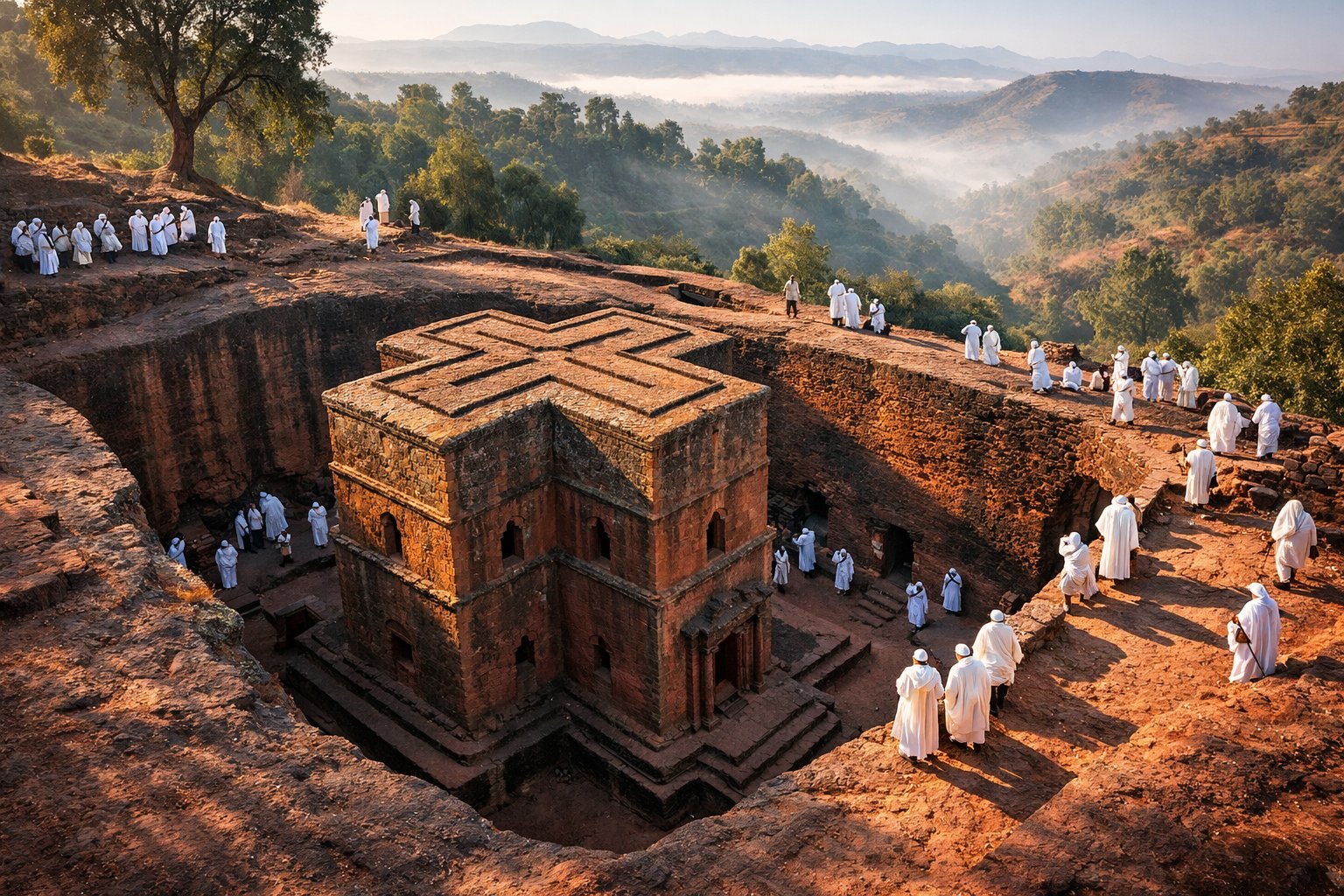
Eleven churches carved downward out of solid volcanic rock in the twelfth and thirteenth centuries — not built, not hollowed into a cliff, but cut down from the surface and then excavated from within, leaving free-standing buildings sitting in pits. King Gebre Meskel Lalibela intended a New Jerusalem after Saladin's capture of the original in 1187. It is a UNESCO site and, far more importantly, still a working place of worship.
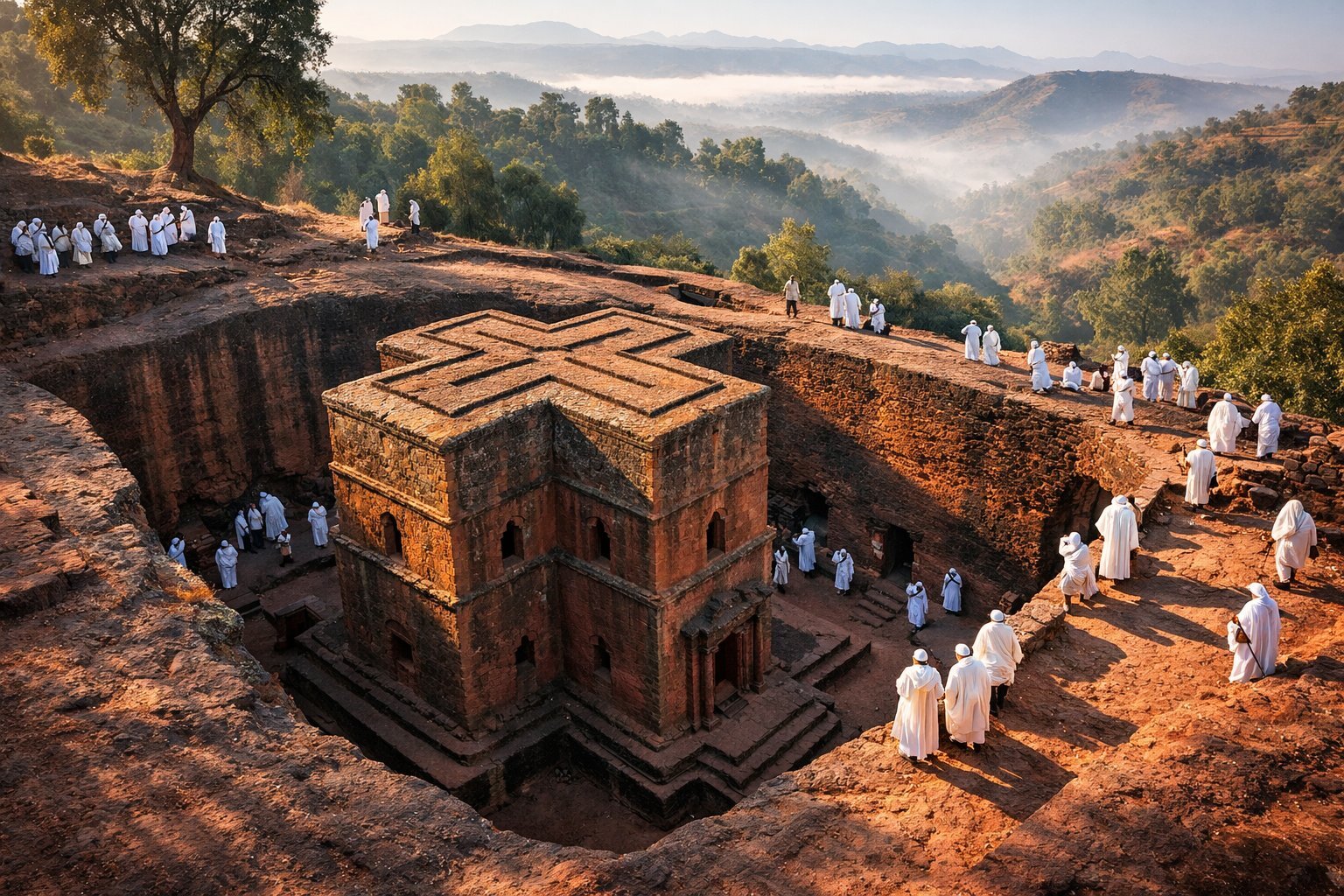
Bete Giyorgis
The most famous: a perfect cross-shaped monolith in its own pit, approached down a trench. It is the image of Ethiopia and it deserves to be.
The northern group
Bete Medhane Alem — the largest monolithic rock church in the world — plus Bete Maryam, Bete Golgotha and others, connected by trenches and tunnels.
The eastern group
Bete Gabriel-Rufael, Bete Amanuel and Bete Merkorios, reached through a pitch-dark tunnel you walk with your hand on the wall — deliberately, as a passage through hell.
Still in use
This is the crucial thing. Priests live here, services run daily, and pilgrims in white netela fill the trenches. You are a guest in a church, not a visitor to a ruin.
Genna · 7 January
Ethiopian Christmas at Lalibela draws tens of thousands of pilgrims, many walking for days. It is one of the great religious gatherings on Earth and accommodation is booked out a year ahead.
Practical
Remove shoes at every church — bring socks, the rock is cold and rough. One ticket covers all the churches for several days. A guide is worth it and is effectively expected. UNESCO shelters over four churches spoil the photographs and are keeping the churches standing.
🗿 Aksum
The capital of an empire that ran the Red Sea trade from roughly the first to the seventh century, minted gold coins, and left a field of carved granite stelae — grave markers of extraordinary ambition, the largest of which would have stood 33 m and weighed over 500 tonnes had it not fallen, probably during erection.
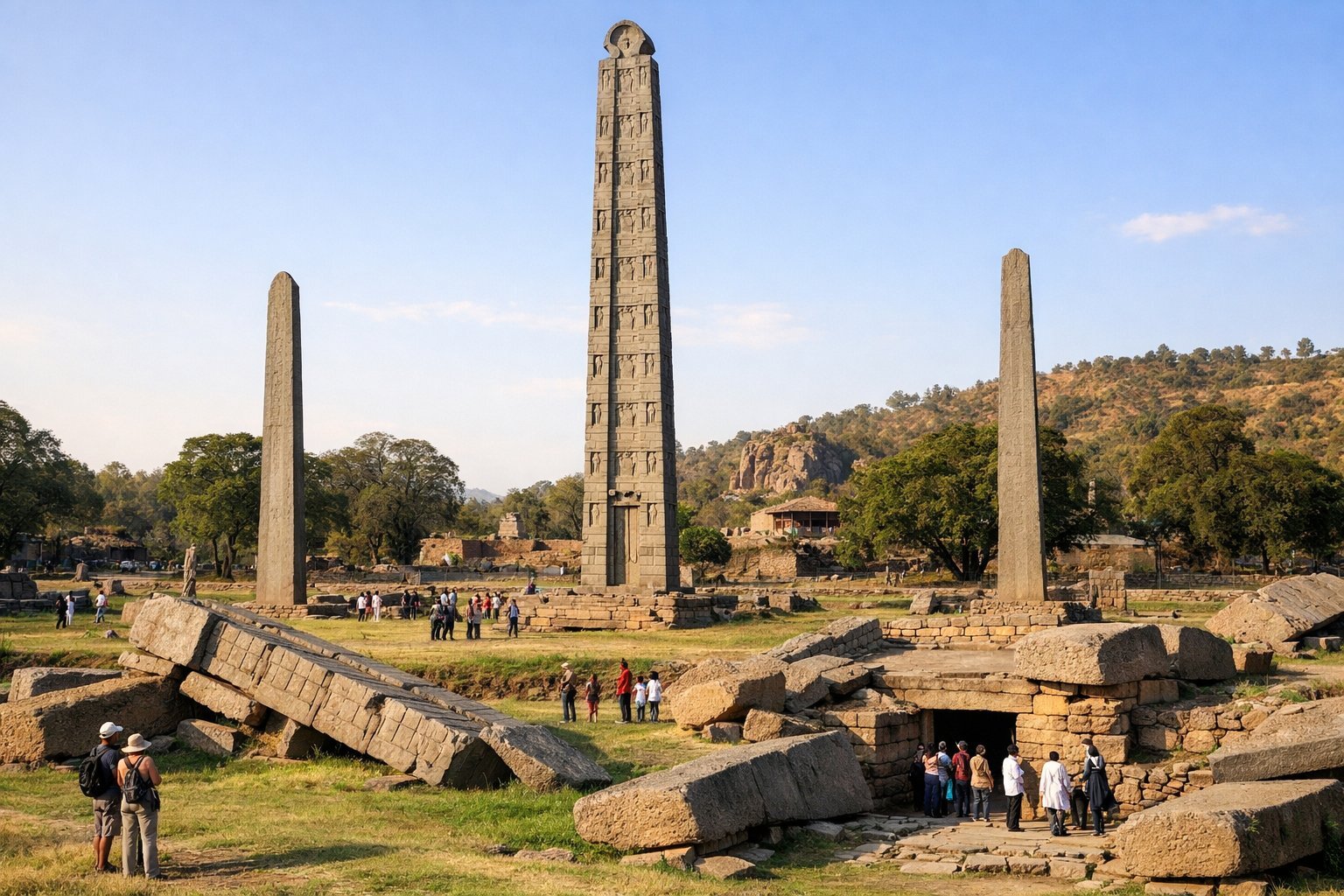
The stelae
Carved to look like multi-storey buildings, with false doors and windows and beam-ends. The Obelisk of Aksum was looted by Italy in 1937, stood in Rome for 68 years, and was returned and re-erected in 2008.
The Ark
The Chapel of the Tablet beside St Mary of Zion holds what Ethiopians believe is the Ark of the Covenant, brought by Menelik I. A single guardian monk, appointed for life, is the only person permitted to see it.
St Mary of Zion
The old church, rebuilt by Fasilides in the seventeenth century, is where emperors were crowned. Women may not enter the older building — the newer one is open to everybody.
The tombs and palaces
Underground tombs of Kaleb and Gebre Meskel, the so-called Queen of Sheba's bath and palace at Dungur, and the Ezana Stone with its trilingual inscription in Ge'ez, Sabaean and Greek.
Ge'ez
Aksum wrote in Ge'ez in its own script — the ancestor of Amharic and Tigrinya writing, and one of very few alphabets in the world invented independently.
Access
Aksum is in Tigray. Access was cut entirely during the war and has been intermittent since. Check the current position before you build a trip around it; it is the site most likely to be unavailable.
🏰 Gondar & Lake Tana
Gondar was the imperial capital from 1636 to the mid-nineteenth century, and its rulers built something no one expects in the Ethiopian highlands: a walled compound of stone castles, with battlements, towers and balconies, in a style that mixes Ethiopian, Portuguese, Indian and Arab influence.
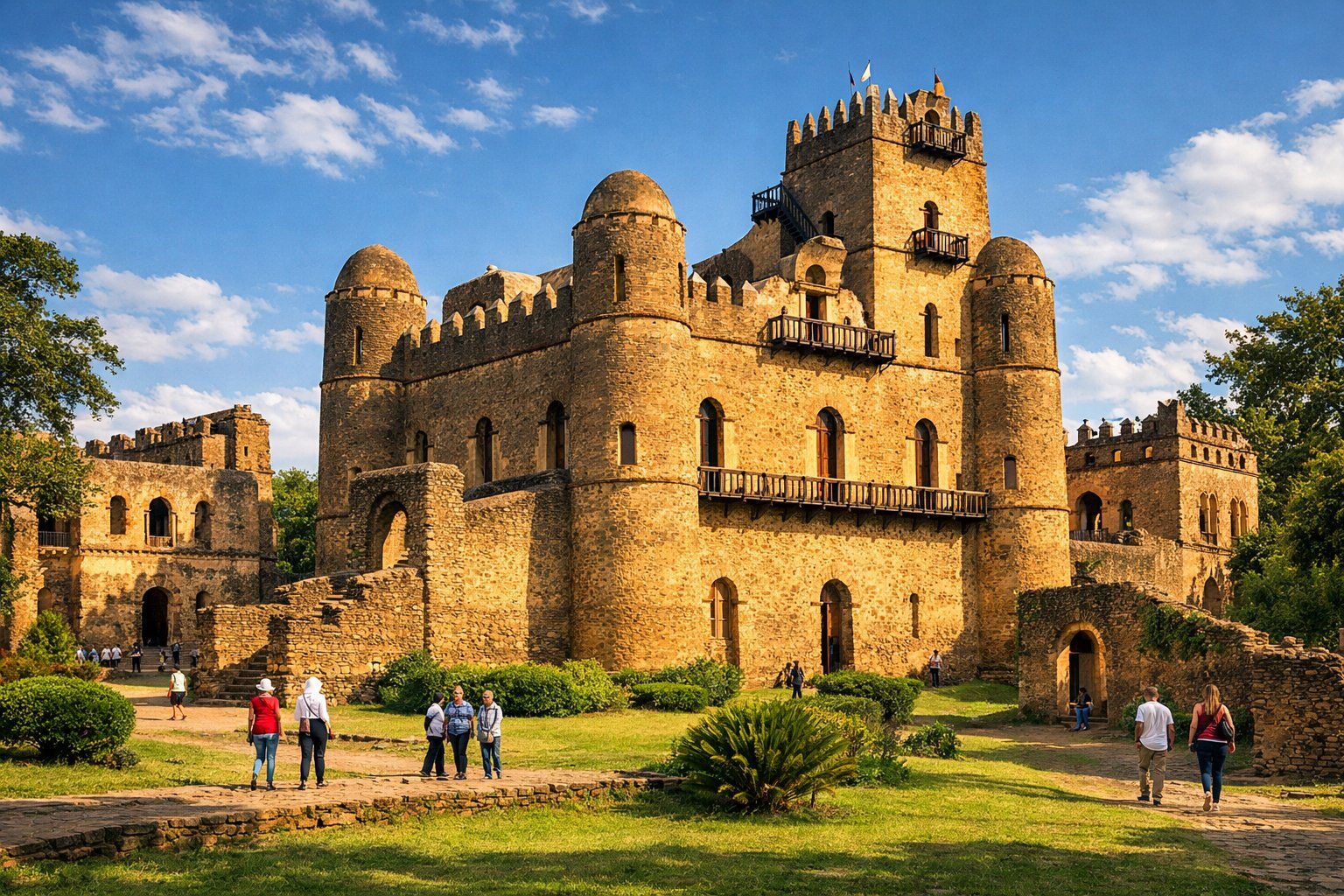
Fasil Ghebbi
The royal enclosure — six castles and assorted halls, libraries and stables in 70,000 m² of walled compound, on the UNESCO list since 1979.
Debre Berhan Selassie
A small church whose ceiling is covered with about 100 painted winged angel faces looking down at you. It is the single most photographed interior in Ethiopia and it earns it.
Fasilides' Bath
A stone pool and pavilion, filled once a year for Timket, when thousands leap into the water. Empty and root-strangled the rest of the time, and lovely.
Lake Tana
Ethiopia's largest lake and the source of the Blue Nile, dotted with island monasteries — Ura Kidane Mehret, Azwa Maryam, Narga Selassie — reached by boat from Bahir Dar and full of vivid mural painting. Some admit only men.
Blue Nile Falls
Tis Issat, "smoking water", 30 km from Bahir Dar. Much reduced by upstream hydro diversion — impressive in the rains, modest the rest of the year. Manage expectations.
Tankwa and papyrus
Lake Tana is still worked from papyrus reed boats of a design that has not changed in millennia, which is a strange thing to watch from a motorboat.
🐒 The Simien Mountains
A UNESCO World Heritage site since 1978 and one of the great trekking landscapes on Earth: an eroded volcanic plateau whose edge falls away in a 1,500 m escarpment of pinnacles and buttresses, with Ras Dashen at 4,550 m, Ethiopia's highest point, at the far end of it.
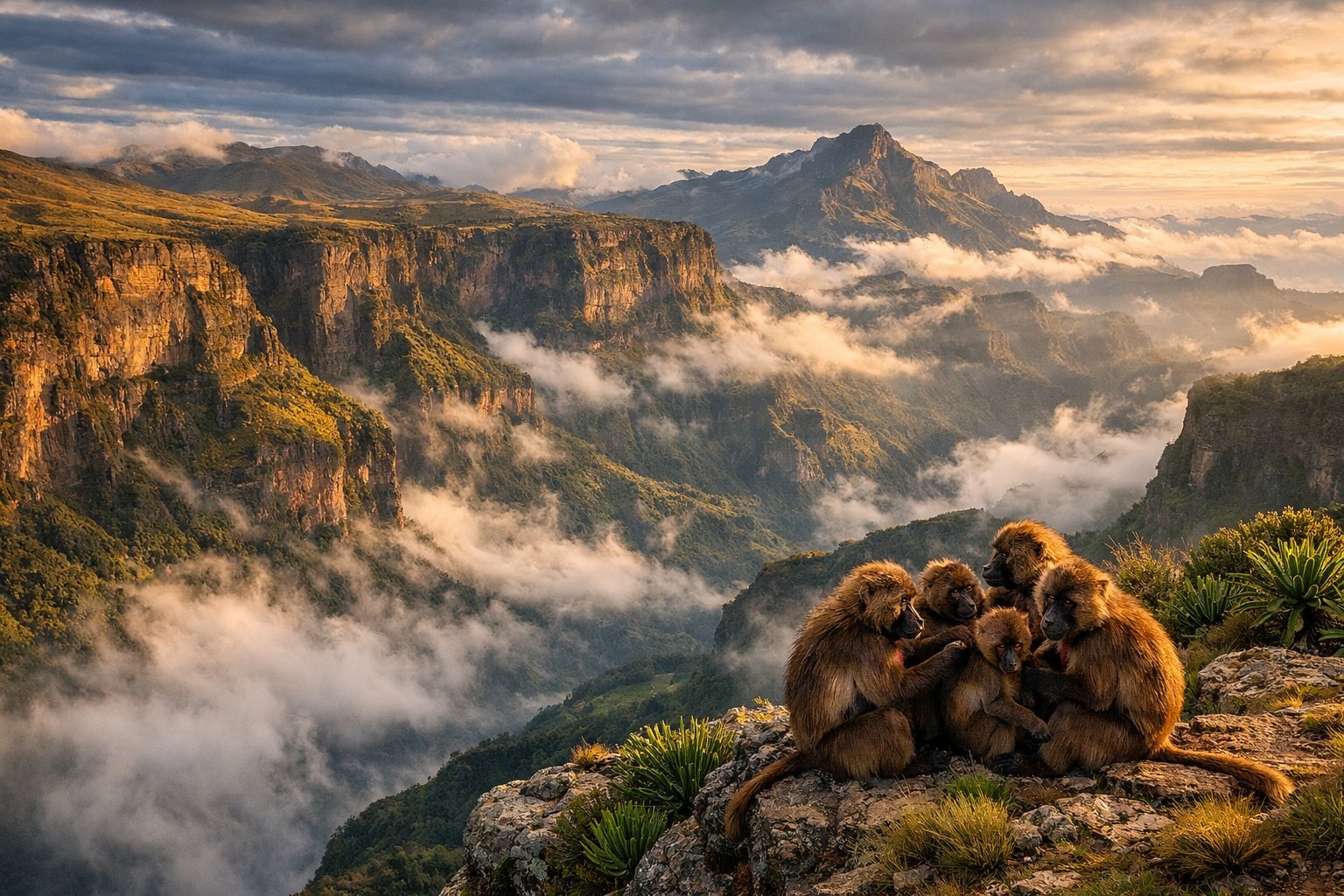
Gelada
Often called bleeding-heart baboons for the red patch on the chest, though they are not baboons. The only surviving grazing primate, in troops that can run to hundreds, and entirely relaxed around people. Sitting among them is the reason to come.
Walia ibex
A wild goat found only in the Simien, down to a few hundred animals in the 1990s and slowly recovering. Chennek is the usual place to see them.
Ethiopian wolf
The rarest canid in the world, with a few hundred left in total. A handful survive in the Simien; Bale is the better bet.
Trekking
From two days to two weeks. The classic is Debark–Sankaber–Geech–Chennek, along the escarpment. Ras Dashen adds several days. A scout is compulsory, guides and mules are arranged at Debark, and it is high — acclimatise.
The lodges
Simien Lodge above Sankaber claims to be the highest hotel in Africa at 3,260 m. Community campsites at Sankaber, Geech and Chennek are basic, cold and fine.
Access
The park is in Amhara, entered from Debark near Gondar. Access has been repeatedly interrupted by the regional conflict. Confirm before committing — this is not a place to arrive at hopefully.
🔥 The Danakil Depression
The hottest inhabited place on the planet — average annual temperatures around 35 °C, summer daytime highs above 50 °C, and much of it below sea level. Three tectonic plates are pulling apart underneath it, and the result looks like a different planet: sulphur springs the colour of egg yolk, salt flats to the horizon, and an open lava lake.
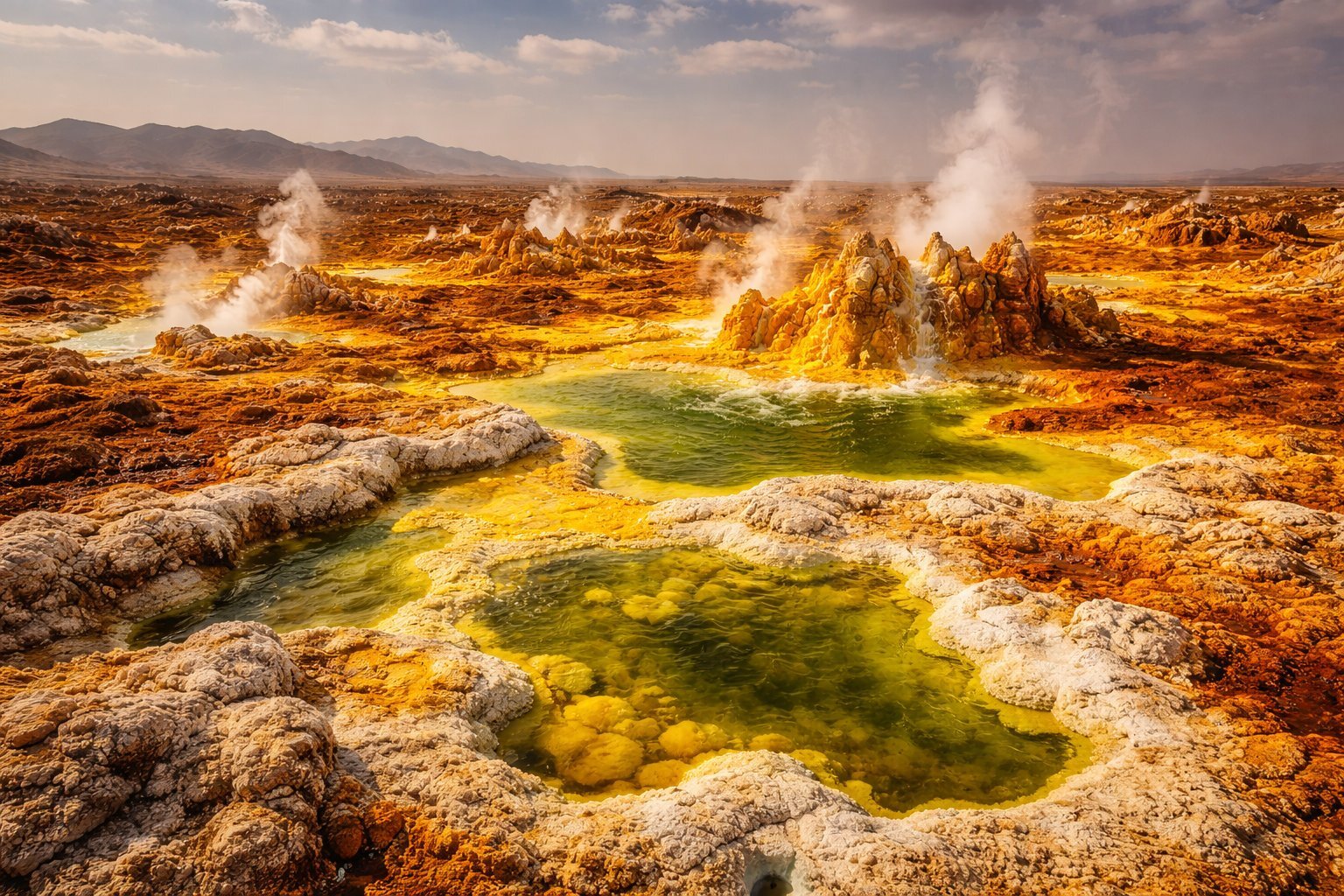
Dallol
A hydrothermal field on a salt dome about 45 m below sea level, with acid springs, salt chimneys and mineral terraces in yellow, orange and green. Some of the pools are among the most extreme environments on Earth in which anything is known to live.
Lake Asale and the salt caravans
Salt is still cut by hand into slabs and carried out by camel caravan by the Afar, as it has been for centuries — though trucks are steadily taking over. Watching a caravan load at dawn is worth the whole trip.
Lake Afrera and Lake Karum
Hypersaline lakes where you float like the Dead Sea, with hot springs at the edges.
How you go
Only on an organised multi-day expedition with a licensed operator: 4x4 convoy, armed escort, camping on cots in the open, and no infrastructure. Independent travel is not permitted and would not be sensible.
When
November to February only. Outside those months the heat is genuinely dangerous, and most operators do not run.
Security
Afar has seen conflict spillover and there is a history of attacks on tourist groups in the region, most notoriously in 2012. Escorts are standard for that reason. Check current advice; this is the itinerary most sensitive to the security picture.
🌋 Erta Ale
A shield volcano in the Danakil with one of the very few persistent lava lakes on Earth — molten rock, open to the sky, that has been there since at least 1906. You walk to it at night across black basalt and stand on the crater rim looking down at the planet's interior.
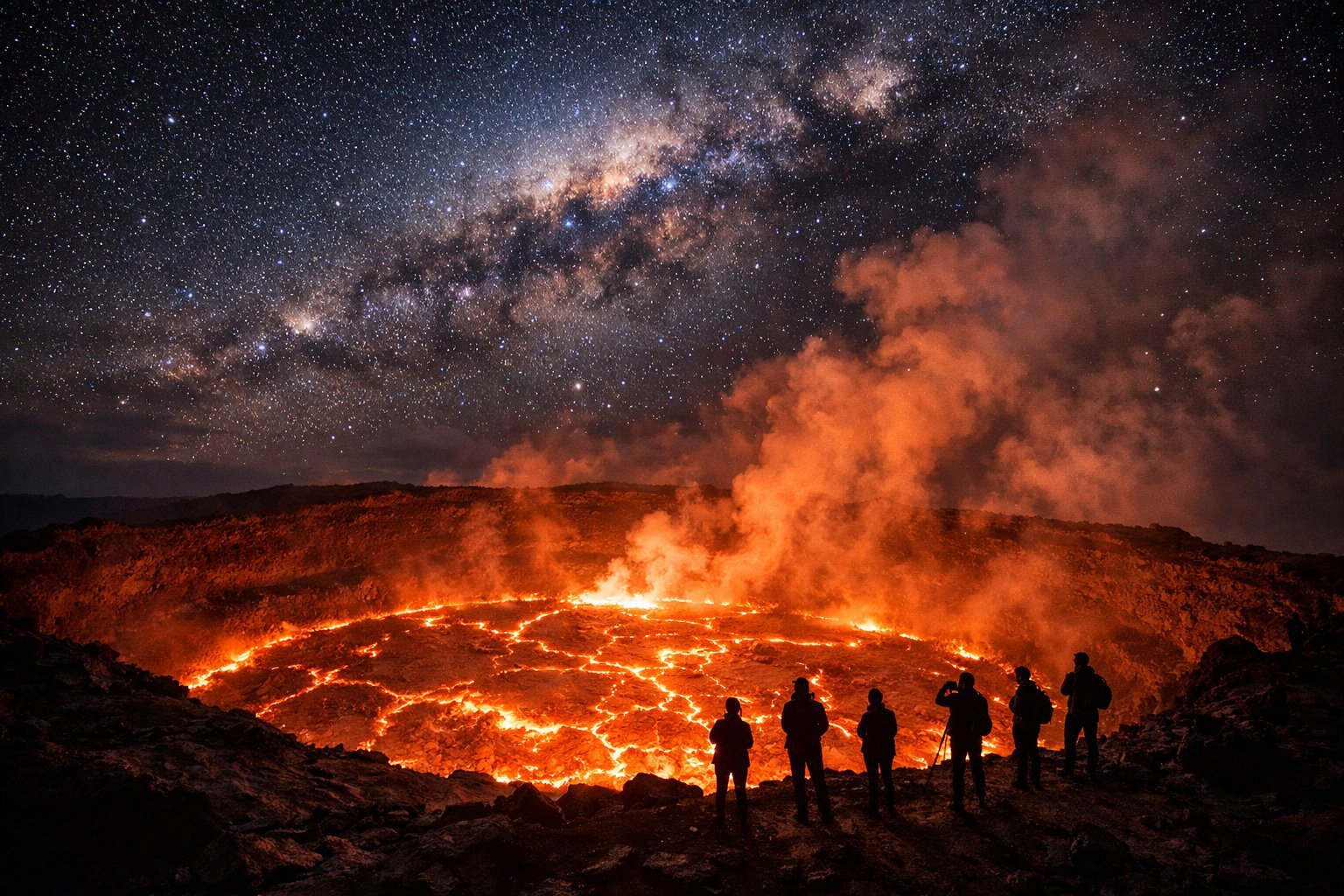
The walk
About three hours over rough lava from the base camp, done at night to avoid the heat, usually starting around 8 p.m. Camels carry the mattresses. It is not technical but it is hot, dark and sharp underfoot.
Sleeping on the rim
You sleep on a mattress on the crater rim in the open, which is exactly as extraordinary as it sounds, and get up before dawn for the second look.
It changes
Erta Ale is a live volcano. The 2017 fissure eruption drained and reshaped the crater, and the lava lake has drained and refilled since. What you see is not guaranteed — ask your operator what is currently visible.
What to bring
More water than you think, a headtorch, a dust mask or buff for the fumes, closed shoes with a solid sole, and a camera you do not mind exposing to sulphur.
The Afar
The volcano is on Afar land and the local community provides escorts, camels and permission. This is their arrangement, not a formality.
Combining
Almost everyone does Erta Ale and Dallol as one four-day expedition. Doing only one is possible and slightly wasteful given how hard the access is.
🐺 Bale, the Omo & the South
The south is a completely different Ethiopia — Afroalpine moorland, cloud forest, Rift Valley lakes and the pastoralist cultures of the lower Omo. It is less visited than the northern circuit and, in parts, harder to reach.
Bale Mountains
The Sanetti plateau at 4,000 m is the largest area of Afroalpine habitat in Africa and the best place on Earth to see the Ethiopian wolf, of which fewer than 500 survive. Also mountain nyala, giant molerats and superb endemic birding.
Harenna forest
Down the southern escarpment from Sanetti into cloud forest, where coffee grows wild and lions are occasionally recorded. The drive from moorland to jungle in an hour is remarkable.
The Rift Valley lakes
Ziway, Langano, Abijatta-Shalla, Awasa, Abaya and Chamo, strung along the road south — birding, hippos and crocodiles, and the fish market at Awasa in the early morning.
The Omo Valley
Home to the Mursi, Hamar, Karo, Dassanech and others, with distinctive body decoration and ceremonies including Hamar bull-jumping. It is also the most ethically fraught destination in the country.
The Omo problem
Photograph-for-payment tourism has distorted communities badly, and the Gibe III dam and sugar plantations have transformed the river's flood cycle and the livelihoods that depended on it. If you go, go with an operator that has long-term community relationships, agree terms before photographing anyone, and be honest with yourself about what you are participating in.
Konso
Terraced cultural landscape on the UNESCO list, with walled towns and generational marker stones. Less visited than the lower Omo and far less compromised.
🕌 Harar
A walled city in the east, a UNESCO World Heritage site, and one of the most atmospheric places in the Horn of Africa. Harar Jugol has 82 mosques and over 100 shrines inside walls barely a kilometre across, and by some Islamic traditions is counted the fourth holiest city after Mecca, Medina and Jerusalem.
The old town
A maze of narrow lanes and painted houses in five colours, with traditional Harari interiors — raised platforms, wall niches, hung baskets — that you can visit at a couple of house museums.
The hyena men
Every night, outside the walls, men feed wild spotted hyenas by hand and from sticks held in their teeth. This has gone on for generations and is not staged for tourists, although tourists now watch it. The hyenas are wild and they come in from the hills.
Rimbaud
Arthur Rimbaud lived in Harar in the 1880s as a coffee and arms trader, having given up poetry entirely. The house museum named for him is not actually his, and it is still worth visiting for the building and the photographs.
Coffee and khat
Harar is a famous coffee origin — Harar beans are dry-processed and distinctively fruity. It is also the centre of Ethiopia's khat trade, which is legal, ubiquitous, economically enormous and socially contested.
Getting there
Fly to Dire Dawa and drive an hour, or take the long road from Addis. Harar sits in the east, away from the northern conflict areas, which has made it comparatively accessible in recent years.
Etiquette
This is a conservative Muslim city. Dress modestly, ask before photographing, and be aware that some shrines are closed to non-Muslims.
🏙️ Addis Ababa
"New Flower", founded in 1886, at 2,355 m — one of the highest capitals in the world, home to around five million people, and the diplomatic centre of Africa as headquarters of the African Union. It is a construction site, a traffic jam and a genuinely good city to spend two days in.
The National Museum
Where Lucy is — or rather a cast of her, with the original in the vault. Also Selam, an even older child skeleton, and Ethiopian art and regalia. Modest, crowded and unmissable.
Ethnological Museum
In Haile Selassie's former palace at Addis Ababa University — the emperor's bedroom and bathroom preserved, plus the best collection of Ethiopian material culture and church painting in the country.
Merkato
Reputedly the largest open-air market in Africa, and overwhelming. Go with someone who knows it, watch your pockets, and do not attempt it on your first morning.
Holy Trinity Cathedral
Where Haile Selassie and Empress Menen are buried, along with victims of the Red Terror. The Ethiopian nationalist church at its grandest.
Mount Entoto
The forested ridge above the city at 3,200 m, with Menelik's first palace, eucalyptus, and a view over the whole basin. The new Entoto Park has made it an easy half-day.
Eating and drinking
The best Ethiopian food in the country and a serious coffee scene — Tomoca has been roasting since 1953. The jazz clubs, and the Fendika cultural centre in Kazanchis, are the other reason to stay a night.
👥 People & Culture
Around 132 million people — the second most populous country in Africa — in more than eighty ethnic groups speaking as many languages. No group is a majority, which is both the country's richness and the fault line running under its politics.
Oromo
The largest group at roughly a third of the population, across the centre and south, with the gadaa system of generational governance that UNESCO lists as intangible heritage. Historically marginalised in a state built around Amharic-speaking institutions, which is the root of a great deal of current politics.
Amhara
Around a quarter, in the northern highlands. Amharic was the sole official working language for most of the twentieth century, and the imperial state was largely Amhara-shaped — a legacy that is now contested.
Tigrayan
About 6%, in the north, with a long Aksumite inheritance and a dominant role in the state between 1991 and 2018. The 2020–22 war has left the region's relationship with the federation unresolved.
Somali, Afar, Sidama and more
The Somali region in the east, the Afar in the north-east, the Sidama and dozens of southern peoples, plus the Omo groups. The south alone holds more linguistic diversity than most continents.
Hospitality
Guests are treated seriously here. Expect to be fed, expect the coffee ceremony, and expect gursha — being hand-fed a mouthful by your host, which is an act of affection and should be accepted.
Etiquette
Eat with the right hand only. Greet before anything else, with a handshake and often a shoulder bump between friends. Remove shoes entering churches and homes. Dress modestly, cover shoulders and knees at religious sites.
🗣️ Language
Amharic is the federal working language, written in the Ge'ez script — an abugida of over 200 characters, each a consonant-vowel syllable, and one of very few writing systems in the world invented independently rather than borrowed.
The languages
Amharic and Oromo are the two largest, followed by Somali, Tigrinya, Sidama, Wolaytta and Afar. Since 2020 Ethiopia has had five federal working languages: Amharic, Oromo, Tigrinya, Somali and Afar.
Ge'ez
The liturgical language of the Orthodox church, no longer spoken conversationally, and the ancestor of the script used for Amharic and Tigrinya. Church services are still conducted in it.
English
Widely spoken in Addis, in the tourism sector and by anyone who finished secondary school, since secondary and higher education are in English. Outside the towns, much less so.
Useful Amharic
Selam — hello. Tena yistilign — formal hello. Ameseginalehu — thank you. Awo / aydelem — yes / no. Sint new? — how much? Ishi — OK, the most useful word in the language.
Numbers on signs
Ge'ez numerals appear on some signage and older documents alongside Arabic numerals. Prices are almost always in Arabic numerals.
Names
Ethiopians use a given name followed by the father's given name; there are no inherited surnames. Address people by their first name, with Ato for a man and Woizero for a married woman.
☕ Coffee
Coffee is Ethiopian. Coffea arabica grows wild in the forests of Kaffa in the south-west, which is where the word comes from, and every arabica plant in the world descends from Ethiopian stock. It is the country's largest export and the centre of its social life.
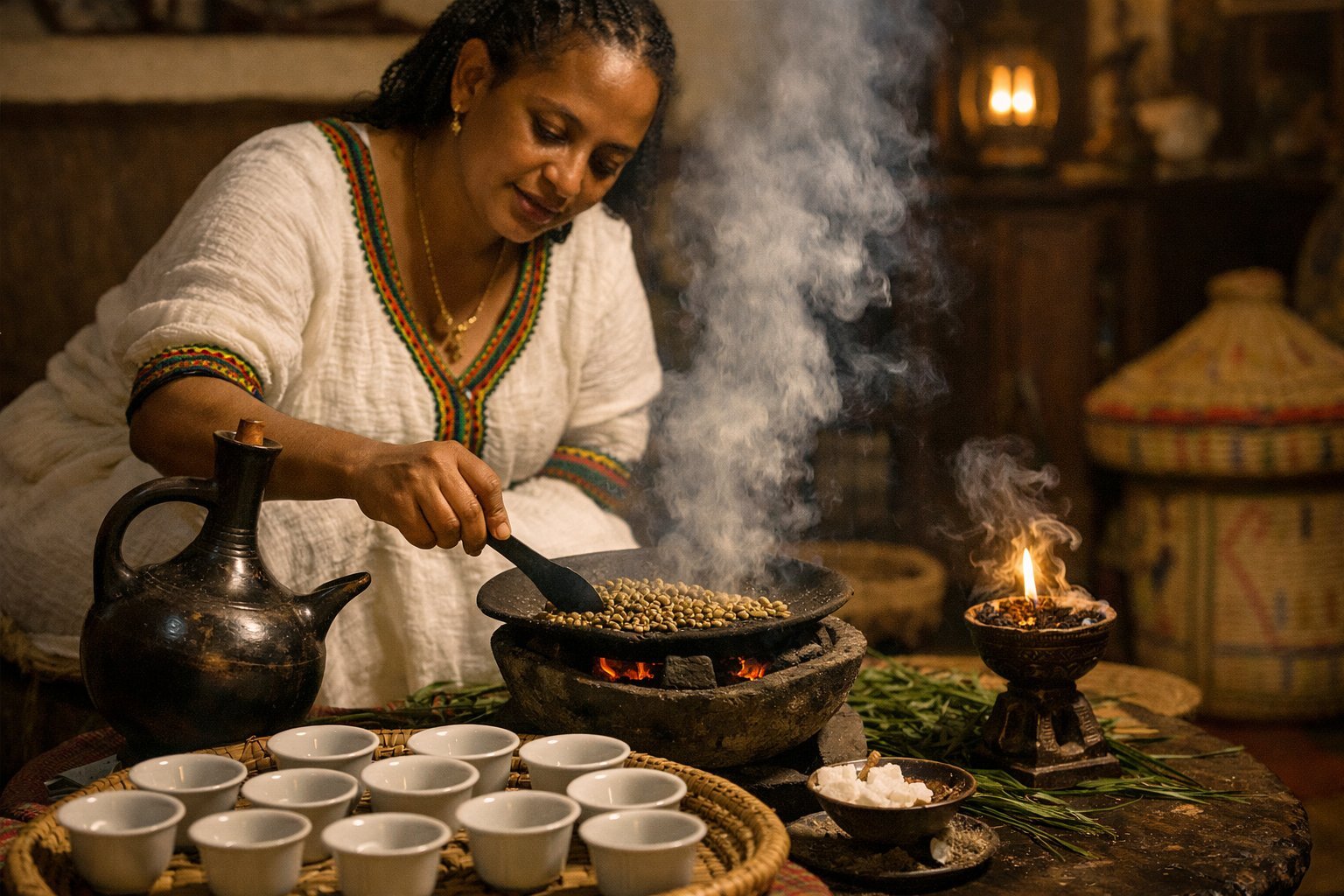
The legend
A goatherd called Kaldi noticed his goats dancing after eating red berries from a bush. A monk threw the berries on a fire, smelled what happened, and the rest followed. There is no evidence for it and everyone tells it anyway.
The ceremony
An hour or more. Beans washed, roasted over coals in front of you, the pan carried round for everyone to take the smoke, ground in a mortar, brewed in the jebena. Frankincense burns throughout and fresh grass is strewn on the floor.
Three rounds
Abol, tona, baraka — first, second and blessing. Each weaker than the last, and you stay for all three. Leaving after one is a genuine discourtesy.
The origins
Yirgacheffe for floral and citric; Sidamo for balance and berry; Harar for dry-processed blueberry and wine notes; Limu, Jimma, Guji and Kaffa besides. Ethiopia is not one coffee, it is dozens.
Buna and beyond
Also drunk as buna bekele with salt or butter in some regions, and as spris, layered with tea. Tomoca in Addis, roasting since 1953, is the classic city cup.
Buying it
Green or roasted beans from Addis or from any origin town, at a fraction of European prices. Check your airline's baggage rules; there is no export restriction on reasonable quantities.
🍽️ Ethiopian Food
One of the world's genuinely distinctive cuisines, and one of its great vegan traditions — because observant Orthodox Ethiopians fast from all animal products for something like 180 to 250 days a year, and the cooking had to be good enough to survive that.
The essentials
Injera
A large, thin, spongy sourdough pancake of fermented teff — a tiny highland grain grown almost nowhere else, gluten-free and iron-rich. It is the plate, the bread and the cutlery, and it is sour in a way that takes a couple of meals.
Berbere
The red spice mix that defines the cuisine: chilli, ginger, garlic, fenugreek, korarima, ajwain, rue seed and a dozen more. Aromatic before it is hot.
Doro wat
Chicken slow-cooked in berbere and niter kibbeh spiced butter, with a whole hard-boiled egg per portion. The celebration dish, and the one to judge a kitchen by.
Beyaynetu
The fasting platter: a wheel of six or eight vegan dishes — shiro, misir wat, gomen, atkilt, fosolia, timatim salata — served on injera. Cheap, enormous and the best introduction to the cuisine.
Kitfo and tere siga
Minced raw beef with spiced butter and mitmita, and raw beef eaten at butcher-restaurants. Both are genuinely traditional and both carry real parasite risk — leb leb (lightly warmed) is the compromise.
Tibs and shiro
Sautéed cubed meat with onion and rosemary, and the ground-chickpea purée that is everyday food across the country. Order shiro anywhere and it will be good.
Doro wat
Chicken in berbere · serves 4–6 · 3 hours
Ingredients: 1 chicken jointed into 8–12 pieces, skinned; 6 large onions, very finely chopped; 5 tbsp berbere; 4 tbsp niter kibbeh (clarified butter warmed with garlic, ginger, cardamom, fenugreek and korarima); 4 garlic cloves and a thumb of ginger, crushed; 2 tbsp tomato paste; 6 hard-boiled eggs; juice of 1 lemon; salt.
Method: Rinse the chicken in lemon and salt water and set aside. Cook the onions dry in a heavy pot over low heat, stirring, for 30–40 minutes until they collapse to a golden paste — no fat yet, and no shortcuts. Add the niter kibbeh, garlic and ginger, then the berbere, and fry gently 5 minutes. Add tomato paste and a little water and cook to a thick dark sauce. Add the chicken, turn to coat, cover and simmer 45 minutes, adding water sparingly. Score the peeled eggs lightly and add for the last 15 minutes.
💡 The onion stage is the whole dish. Serve on injera with fresh ayib cheese to cut the heat, and give each person an egg.
Shiro wat
Chickpea purée · serves 4 · 30 minutes
Ingredients: 200 g shiro powder (finely milled roasted chickpea with berbere and spice, from any Ethiopian grocer); 1 large onion, finely chopped; 3 tbsp niter kibbeh or oil; 2 garlic cloves; 1 tomato, grated; 750 ml water; salt.
Method: Soften the onion in the fat for 10 minutes, add garlic, then the tomato. Whisk the shiro powder into the cold water in a separate jug so it does not lump, then pour it in. Simmer, stirring often, 15–20 minutes until it thickens to a loose purée and stops tasting floury. Season.
💡 The everyday dish of Ethiopia, vegan by default, and better than almost anything you can make in half an hour. Serve bubbling in its clay dish on injera.
Injera
Teff sourdough pancake · makes 6–8 · 3 days fermentation
Ingredients: 500 g teff flour (ivory or brown); 750 ml water, plus more; a spoonful of an earlier batch or a little sourdough starter to begin; salt.
Method: Mix teff and water to a thin batter, cover loosely and leave at room temperature for 2–3 days, stirring once a day. It will bubble and smell sharply sour, and a dark liquid will rise — pour that off. Thin the batter to single-cream consistency and salt it. Heat a wide non-stick pan or mitad dry and hot, pour the batter in a spiral from the outside in, cover immediately, and cook 2–3 minutes until the surface is covered in small even holes (eyes) and the edges lift. Do not turn it. Cool on a cloth.
💡 The eyes are the test: even holes across the whole surface mean the fermentation and heat were right. A first attempt with 100% teff usually tears; many home cooks cut it with a little barley or wheat flour until they have the knack.
🍯 What Ethiopians Drink
Honey wine, barley beer, a serious commercial brewing industry, and — in a country where a third of the population is Muslim and much of the rest fasts half the year — a more complicated relationship with alcohol than the beer lists suggest.
Tej
Honey wine fermented with gesho (buckthorn) leaves, amber, sweet-sour and considerably stronger than it tastes — typically 7–14%. Served in a round-bellied flask called a berele, in dedicated tej bets. The national drink.
Tella
Home-brewed barley or sorghum beer, cloudy, sour and low in alcohol. The village and household drink, made in every region with local variations.
Beer
A genuinely good industrial brewing scene: St George (Giorgis), Habesha, Walia, Bedele, Dashen and Harar. Draught in Addis is cheap and cold.
Areke
Distilled grain spirit, clear, rough and strong, drunk in the countryside and at celebrations. Approach with respect.
Wine
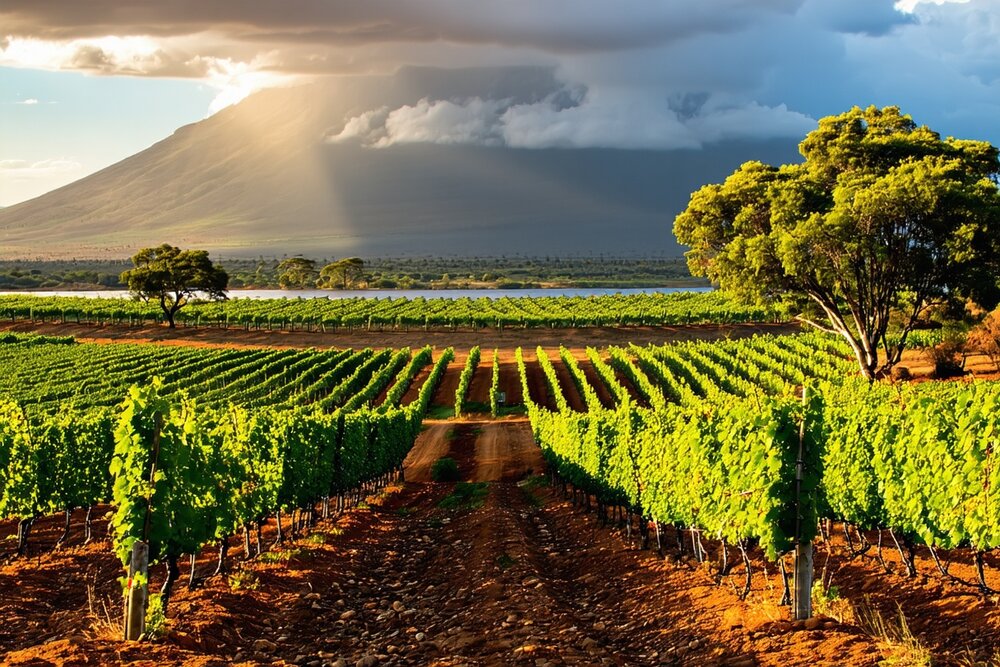
The Rift Valley south of Addis has a small modern wine industry — Castel's Rift Valley label from vineyards near Ziway is the best known, and there is older production at Awash. Perfectly drinkable and improving.
Khat
Not a drink but part of the same social picture: a mildly stimulant leaf, legal, chewed in the afternoons especially in the east and among Muslim communities, and one of Ethiopia's largest export earners. Harar and Dire Dawa run on it.
🎉 The Ethiopian Year
Ethiopian festivals are among the most spectacular religious gatherings anywhere, and they run on the Ethiopian calendar — so the Gregorian dates shift and are worth confirming. If your trip can be built around one, build it around one.
Timket · 19 January
Orthodox Epiphany and the biggest festival of the year. The tabot of each church is carried in procession under embroidered umbrellas, spends the night at a pool, and the crowd is blessed with water at dawn. Gondar's Fasilides' Bath is the most spectacular version, with thousands leaping into the filled pool.
Genna · 7 January
Ethiopian Christmas. At Lalibela tens of thousands of pilgrims fill the trenches around the churches, many having walked for days. It is extraordinary, and beds are booked a year out.
Meskel · 27 September
The Finding of the True Cross, marked with the Demera — a huge bonfire of bundled branches lit in Meskel Square in Addis and in every town. UNESCO-listed, and the yellow Meskel daisies cover the highlands at the same moment.
Enkutatash · 11 September
Ethiopian New Year, at the end of the long rains, with the country suddenly green and yellow. Children sing door to door with bunches of flowers.
Fasika
Orthodox Easter, after a 55-day fast during which observant households eat no animal products at all. The midnight service and the meal that breaks the fast are the emotional centre of the Christian year.
Irreecha and the Eids
Irreecha is the Oromo thanksgiving festival at Lake Hora Arsedi in Bishoftu, drawing enormous crowds — and it has been politically charged in recent years. Eid al-Fitr and Eid al-Adha are public holidays observed across the country.
🌦️ Climate & When to Go
Ethiopia is close to the equator and mostly high, so the climate is governed by altitude and rainfall rather than by season in the European sense. Ethiopians divide the year into bega (dry, October–February), belg (small rains, March–May) and kiremt (big rains, June–September).
October to February
The season. Dry, clear, comfortable in the highlands (10–25 °C), and the only workable window for the Danakil. It also holds Meskel, Genna and Timket. Book ahead.
June to September
The main rains. Roads deteriorate, some become impassable, trekking is muddy, and the Danakil is out of the question. It is also when the highlands are greenest and the Blue Nile Falls actually impressive.
Highlands
Addis at 2,355 m runs 10–25 °C year round with cold nights. The Simien and Bale go below freezing at night. Altitude sickness is a genuine consideration above 3,000 m.
Lowlands
The Danakil, the Omo and the Somali region are hot to extreme. The Danakil averages around 35 °C annually and exceeds 50 °C in summer.
Sun
At this altitude and latitude the UV is severe even when the air is cool. Sunburn at 3,500 m in the Simien happens quickly and catches people out.
What to pack
Layers, a proper warm jacket for the highlands at night, sun protection, sturdy shoes, socks for church floors, and modest clothing for religious sites. A head torch for the Lalibela tunnels and for Erta Ale.
✈️ Getting There
Addis Ababa Bole (ADD) is the largest aviation hub in Africa, and Ethiopian Airlines is the continent's biggest and best-regarded carrier — a Star Alliance member with a genuinely global network. Getting to Ethiopia is easy; the constraint is what you can do once inside.
Ethiopian Airlines
Flies to most of Europe, Asia, the Americas and around 60 African destinations. If you fly in with them, domestic flights are sold at a substantially reduced resident-style fare — this is worth several hundred euros on a northern circuit and is the single best-value trick in Ethiopian travel.
From Europe
Direct from Frankfurt, Vienna, Paris, Brussels, Madrid, Rome, London, Stockholm and others. Flight time from central Europe is around six to seven hours.
Domestic flights
Ethiopian's domestic network serves Lalibela, Gondar, Bahir Dar, Aksum, Mekele, Dire Dawa, Jinka and more. Routes are suspended and resumed according to the security situation, so confirm rather than assume.
Land borders
Djibouti and Kenya (Moyale) function; the Eritrean border reopened in 2018 and closed again; Sudan and Somalia are not sensible options. Overland entry is possible but not the way most people come.
The railway
The Chinese-built Addis Ababa–Djibouti electric railway carries passengers as well as freight — a long, cheap and interesting alternative to flying to the coast.
Transit
Ethiopian offers free or discounted hotel stopovers in Addis on long connections. If you have a layover over eight hours, ask — it is a free day in the city.
🇨🇿 From the Czech Republic
From Prague there is no direct flight, but the connection is straightforward: one stop with Ethiopian Airlines via Frankfurt, Vienna, Brussels or Paris, or with a Gulf carrier via Dubai or Doha. Total travel time is 10 to 14 hours, and the time difference is only two hours in Czech summer, one in winter.
Best routing
Prague to Vienna or Frankfurt, then Ethiopian Airlines direct to Addis. Booking the whole thing on one Ethiopian ticket also unlocks the discounted domestic fares, which matters a lot on a northern circuit.
Visa
Czech citizens need a visa, obtained as an e-visa online before travel at the official Ethiopian e-visa portal. It is quick and inexpensive — typically around 82 USD for 30 days — but apply only through the official site, since there are many overpriced imitations.
Vaccinations
Yellow fever certificate is required if arriving from an endemic country and is often asked for regardless. Hepatitis A, typhoid and rabies are recommended; malaria prophylaxis for lowlands below about 2,000 m. Addis and the highlands are not malarial.
Czech consular cover
The Czech Republic maintains an embassy in Addis Ababa, which also covers several neighbouring countries. Register with DROZD before departure — in Ethiopia this is not a formality, given how quickly regional situations change.
MZV advice
The Czech Ministry of Foreign Affairs advises against travel to several Ethiopian regions and recommends caution elsewhere. The specific regions listed change; read the current entry at mzv.cz shortly before departure and again before you set an itinerary.
Money and prices
The birr has devalued sharply since the 2024 float, which has made Ethiopia cheap in euro terms and expensive for Ethiopians. A restaurant meal runs 150–500 ETB, roughly 60–200 Kč; a mid-range hotel 1,500–4,000 ETB, roughly 600–1,600 Kč.
🧭 Practical Ethiopia
Ethiopia is rewarding and it is not easy. Distances are large, infrastructure is patchy, the bureaucracy has its own logic, and the two calendars and two clocks will catch you out at least once. A good local operator is worth what they cost.
Money
The birr (ETB), floated in 2024 and much weaker since. Cash is king; international cards work only at some Addis hotels and a handful of ATMs, and they fail often. Bring euros or dollars in clean notes and change at banks, not on the street.
Getting around
Fly between the northern cities where flights run. Buses (Selam, Sky, Golden) connect the main towns and are cheap and slow. A car with driver is the flexible option and is how most organised trips work. Do not drive yourself intercity.
Connectivity
Ethio Telecom and Safaricom sell SIMs on production of a passport. Coverage is good in towns and absent in the mountains and the Danakil. Shutdowns happen — regional internet blackouts have lasted months. Do not plan around being online.
Electricity
220 V, European two-pin. Power cuts are routine everywhere including Addis. Bring a battery pack and a head torch.
Water and food
Do not drink the tap water; bottled is universally available. Be careful with raw meat dishes however traditional — tere siga and kitfo carry real tapeworm risk. Cooked food is generally fine.
Photography and permits
Never photograph military, police, government buildings, the airport or bridges. Ask before photographing people, and expect to be asked for money in the Omo. Some churches charge camera fees. Drones are effectively prohibited without permits that are almost never granted.
💰 Costs
Cheap by international standards, especially since the 2024 devaluation, with two significant exceptions: domestic flights (unless you fly in on Ethiopian) and Danakil expeditions, which are the single largest line in most budgets.
Accommodation
Basic hotel 500–1,500 ETB (200–600 Kč). Mid-range in Addis or on the circuit 2,000–5,000 ETB (800–2,000 Kč). Good hotels and lodges 6,000–15,000 ETB. Simien camping is a few hundred birr plus park fees.
Food
A beyaynetu platter 150–300 ETB. Restaurant main 250–600 ETB. A macchiato 30–60 ETB. Eating well in Ethiopia costs almost nothing.
Domestic flights
Roughly 60–120 USD a leg at foreign rates — but a fraction of that if you flew into Ethiopia on Ethiopian Airlines. Book domestic segments on the same booking or at an Ethiopian office with your international ticket.
Danakil
A four-day Danakil and Erta Ale expedition runs 500–900 USD per person including 4x4, escort, food and camping. It is the most expensive thing most visitors do here and there is no cheap version.
Guides and entry
Lalibela entry around 50 USD for several days. Simien park fees, scout and guide add up to 30–60 USD a day. Guides in the historic towns 500–1,500 ETB a day and worth every birr.
Daily budget
Backpacking 30–45 USD a day. Mid-range with a driver and domestic flights 90–150 USD. Add the Danakil separately. Ethiopia is one of the best-value destinations on the continent if you avoid the flight trap.
🛡️ Safety
Ethiopia is a country where crime against visitors is low and armed conflict is the real risk, and the two get confused. Addis is safer to walk in than most large cities. Several regions are, at various times, genuinely off limits.
Check first, book second
The conflict map has changed repeatedly since 2020. Amhara, Tigray, parts of Oromia, Afar and the Somali region have all been subject to advisories. Read your foreign ministry's current entry before committing money, and again before you travel.
Crime
Pickpocketing in Merkato and on Addis minibuses; occasional bag-snatching. Violent crime against foreigners is rare. Do not walk alone at night in unlit areas, and use ride-hailing (Ride, Feres) rather than flagging taxis.
Roads
Statistically the most dangerous thing you will do. Livestock, pedestrians, overloaded vehicles and no lighting. Never travel intercity after dark, and choose your operator on their driving as much as their itinerary.
Altitude
Addis is at 2,355 m and the Simien and Bale go above 4,000 m. Take the first two days easy, hydrate, and treat any headache and breathlessness seriously. Do not fly straight to a high trek.
Health
Malaria below 2,000 m; rabies is present and dogs are everywhere; typhoid and hepatitis are worth vaccinating against. Medical facilities outside Addis are limited — insurance with air evacuation cover is essential, not optional.
Protests and shutdowns
Demonstrations can escalate quickly and internet shutdowns are used as a control measure. Avoid crowds, do not photograph them, and tell people at home you may be uncontactable for days.
🏃 The Running Country
Ethiopia and Kenya have between them dominated long-distance running for sixty years, and Ethiopia started it. Abebe Bikila won the Olympic marathon in Rome in 1960 running barefoot, becoming the first Black African Olympic champion, and won again in Tokyo four years later — six weeks after an appendectomy.
Why they are fast
Altitude. Addis is at 2,355 m and the training camps at Bekoji, Sululta and Entoto are higher. A whole population grows up at an elevation European athletes pay to visit, in a culture where running is a plausible way out.
Haile Gebrselassie
Two Olympic golds, eight world titles, 27 world records, and the first man under 2:04 for the marathon. Now a businessman and a national figure of unusual affection.
Kenenisa Bekele
The greatest distance runner of all time by most measures: world record holder at 5,000 m and 10,000 m for well over a decade, and three Olympic golds.
Tirunesh Dibaba and Almaz Ayana
Dibaba won three Olympic golds and is one of the finest track runners of any era. Ayana's 2016 Olympic 10,000 m — 29:17, taking 14 seconds off a 23-year-old record — was one of the most astonishing runs ever seen.
Tigist Assefa
Set a women's marathon world record in Berlin in 2023 that rewrote the event, and has continued to dominate. Ethiopian women's distance running is currently the strongest in the world.
Running yourself
The Great Ethiopian Run in Addis each November is a 10 km road race with tens of thousands of entrants and a carnival atmosphere. Sululta and Entoto have training camps that take visiting runners. Expect to be humbled by the altitude.
🏨 Where to Stay
Addis Ababa
Everything from backpacker guesthouses in Piassa to the Sheraton and Hyatt. Bole is convenient for the airport, Kazanchis for the AU and the jazz clubs, Piassa for the old city. Rooms are good value since the devaluation.
Lalibela
A range from simple pilgrim guesthouses to the Maribela and Sora Lodge on the ridge, most with views over the valley. Book a year ahead for Genna.
Gondar and Bahir Dar
Solid mid-range options in both; Bahir Dar's lakeside hotels are the pleasanter of the two, with jacaranda and hippos.
Simien
Simien Lodge above Sankaber at 3,260 m, or the community campsites at Sankaber, Geech and Chennek — tents, cold nights and a cook shelter. Sleeping bags rated properly for freezing.
Danakil
You sleep on a cot in the open at Hamed Ela and on a mattress on the crater rim at Erta Ale. That is the accommodation and it is part of the experience.
Bale and Harar
Bale Mountain Lodge in the Harenna forest is genuinely excellent; Dinsho has simpler options. In Harar, stay inside the walls in a converted Harari house — small, atmospheric and the right way to do it.
🤯 Fascinating Facts
Never colonised
The only African country never to be colonised. Ethiopia defeated an Italian invasion at Adwa in 1896, and the 1936–41 occupation was never internationally recognised as a colony.
Seven years behind
The Ethiopian calendar is seven to eight years behind the Gregorian one and has thirteen months. Ethiopia celebrated the year 2000 in September 2007.
The clock starts at dawn
Ethiopian time counts from 6 a.m., so what you call 7 a.m. is one o'clock. Both systems are in daily use and neither is labelled.
Coffee is from here
Coffea arabica is native to the Ethiopian south-west, and the word derives from Kaffa. Every arabica plant on Earth traces back to this country.
Lucy
The 3.2-million-year-old Australopithecus afarensis skeleton found in the Afar in 1974 and named after the Beatles song playing in camp. Ethiopians call her Dinkinesh — "you are marvellous".
Churches cut downward
Lalibela's eleven churches were carved down from the surface of the bedrock, not built up from it — the largest, Bete Medhane Alem, is the biggest monolithic rock church in the world.
Its own alphabet
The Ge'ez script is one of very few writing systems in the world invented independently rather than adapted from another, and it has over 200 characters.
A barefoot Olympic champion
Abebe Bikila ran the 1960 Rome Olympic marathon barefoot because no shoes fitted, won it, and set a world record.
Below sea level and on fire
The Danakil holds one of the planet's few permanent lava lakes, at Erta Ale, and terrain 125 m below sea level. Three tectonic plates are separating underneath it.
👤 Notable Ethiopians
Haile Selassie (1892–1975)
Emperor from 1930 to 1974, whose address to the League of Nations in 1936 warned the world what appeasement would cost. Venerated as divine by the Rastafari movement, deposed by the Derg and killed in captivity.
Menelik II (1844–1913)
Unified the modern state and destroyed an Italian army at Adwa in 1896, preserving Ethiopian independence and making the country a symbol across Africa.
Abebe Bikila (1932–1973)
Won the Olympic marathon barefoot in Rome in 1960 and again in Tokyo in 1964. Paralysed in a car accident in 1969, he took up archery and competed at the Paralympics.
Haile Gebrselassie (b. 1973)
Two Olympic golds, eight world championships and 27 world records — for many the greatest distance runner of all time, and now one of Ethiopia's best-known businessmen.
Kenenisa Bekele (b. 1982)
Held the 5,000 m and 10,000 m world records simultaneously for more than a decade, with three Olympic golds and five world cross-country titles.
Tirunesh Dibaba (b. 1985)
Three Olympic golds and five world titles, from a family of extraordinary runners, and one of the finest track athletes of any nationality.
Emahoy Tsege Mariam Gebru (1923–2023)
Nun, pianist and composer whose spare, Ethiopian-modal piano music was rediscovered internationally in her eighties and is now widely loved. She lived in a Jerusalem monastery for decades.
Mulatu Astatke (b. 1943)
The father of Ethio-jazz, who fused Ethiopian pentatonic scales with jazz and Latin music in the 1960s and 70s, and whose work reached a global audience through the Ethiopiques series and Jim Jarmusch's Broken Flowers.
Abiy Ahmed (b. 1976)
Prime Minister since 2018, awarded the Nobel Peace Prize in 2019 for the peace agreement with Eritrea, and the leader who prosecuted the Tigray war a year later.
✍️ Author's Note
Ethiopia is the most extraordinary country I know, and it is also the one I would give the most careful advice about. Nothing here is derivative of anywhere else. The alphabet was invented here, the calendar is its own, the church is a branch that separated in 451, the food is unlike any other cuisine, and the coffee is literally where coffee comes from. You do not arrive in a variation on a theme; you arrive somewhere with three thousand years of its own argument going on.
The thing that stays with me is Lalibela at six in the morning — priests in the trenches, pilgrims arriving in white after walking for two days, the smell of incense and beeswax coming out of the rock, and the fact that none of it is for you. It has been going on since the thirteenth century and it will continue after you leave. Very few World Heritage sites are still doing the job they were built for. This one is.
And be honest about the last few years. Several hundred thousand people are estimated to have died in Tigray between 2020 and 2022, and the conflicts in Amhara and Oromia have not ended. Some of what is on this page has been inaccessible for long stretches, and may be again. Nobody can write you a guidebook that stays true for a year. Read the current advisories, hire an Ethiopian operator who knows this month rather than last year, keep the plan loose, and be prepared to swap the north for Harar, Bale and the south.
If the route you want is open, go. Ethiopians are among the most generous hosts anywhere, the country is astonishingly cheap right now, and there is nothing else on Earth like it. Just do not go on the assumption that it will be simple.
— Radim Kaufmann
Support This Project 🌍
This World Travel Factbook is a labor of love – free to use for all travelers. If you find it helpful, consider supporting its continued development.