
⚡ Madagascar — The Eighth Continent at a Glance
🌟 Overview
Madagascar is not merely a large island — it is a separate world. When the Indian Ocean closed the Mozambique Channel approximately 88 million years ago, Madagascar drifted away from the African continent carrying its own cargo of wildlife that would evolve in isolation for nearly 90 million years. The result is the most extraordinary concentration of endemic biodiversity on the planet: 90% of Madagascar’s wildlife is found nowhere else on Earth. The lemurs — primates that arrived on the island on natural rafts of vegetation some 60 million years ago — radiated into over 100 species ranging from the mouse lemur (the world’s smallest primate) to the indri (the largest, whose haunting territorial calls carry for kilometers through the rainforest). The baobab trees that store water in their massive trunks, the chameleons (more species than the rest of the world combined), the bizarre-looking sifakas that dance sideways across open ground — all of these are Madagascar.
For travelers, Madagascar is one of the most genuinely rewarding destinations in the world, and also one of the most logistically demanding. Infrastructure is poor, distances are vast, roads are often impassable in the rainy season, and the endemic poverty of most of the population creates a complex ethical context for tourism. Yet the rewards — a ring-tailed lemur sitting 2 meters away studying you with amber eyes, the sunrise turning the baobabs of Morondava gold, the alien limestone spires of Tsingy de Bemaraha rising from the forest — are unlike anything available anywhere else on Earth. There is a reason serious wildlife travelers return to Madagascar again and again.
📚 History
Madagascar was uninhabited until surprisingly recently — the island was first settled by Austronesian seafarers from Borneo and the Indonesian archipelago between approximately 350 BCE and 550 CE, arriving in outrigger canoes across the Indian Ocean. This extraordinary seafaring colonization gave Madagascar its distinctive culture: Malagasy language is more closely related to Malay than to any African language, and traditional Malagasy customs, music, and agricultural practices reflect Southeast Asian roots as much as African ones.
Arab and Bantu African settlers arrived later, and from the 15th century onward, Portuguese, Dutch, and English traders used the island as a supply stop. The 18th century saw Madagascar become a major base for pirates operating across the Indian Ocean trade routes — the pirate republic of Libertatia (though its historical existence remains debated) is associated with Madagascar. By the early 19th century, the Merina Kingdom (from the central highlands) had unified much of the island under a sophisticated monarchy. France colonized Madagascar in 1896 after two Franco-Merina Wars. The independence movement culminated in March 29, 1947 — a massive uprising against French rule that was brutally suppressed, with casualty estimates ranging from 11,000 to 100,000. Madagascar gained full independence in June 1960.
🗺️ Geography & Regions
Madagascar is the fourth-largest island in the world (after Greenland, New Guinea, and Borneo) at 587,041 km² — slightly larger than France. Its spine is a high central plateau running north-south, reaching 2,876 meters at Maromokotro in the north. The eastern coast is wet and forested (the last remnants of the original eastern rainforest that once covered much of the island). The western coast is drier, with dry deciduous forests. The south and southwest are arid to semi-arid, home to the spiny thicket ecosystem. The west coast and north have the beaches and islands that attract most sun-seeking visitors (Nosy Be, Ile Sainte-Marie).
🗺️ Map
🦔 Wildlife — The Eighth Continent
Biologists sometimes call Madagascar the “eighth continent” because of its extraordinary endemism. The numbers are staggering: over 100 lemur species; approximately 300 species of birds (more than 100 endemic); over 300 reptile species (more than 200 endemic); more than 14,000 plant species (approximately 90% endemic); over 100 chameleon species — more than the rest of the world combined. This concentration of unique life evolved because Madagascar broke away from Africa before most modern mammal groups evolved, leaving its ecological niches to be filled by whatever survived the crossing and then diversified in isolation.
The most iconic wildlife experiences:
- Ring-tailed lemur (Lemur catta): The most recognizable species, easily seen at Berenty Private Reserve and Isalo National Park. Bold, inquisitive, and remarkably comfortable around humans.
- Indri: The largest living lemur, with territorial calls audible for kilometers. Found in Andasibe-Mantadia National Park, accessible from Antananarivo. The ‘singing’ sessions at dawn are extraordinary.
- Aye-aye: The most alien-looking lemur — a nocturnal species with bat-like ears, rodent teeth, and an elongated middle finger for extracting insect larvae from bark. Difficult to find but unforgettable when seen.
- Fossa: Madagascar’s apex predator, a cat-like carnivore related to the mongoose. Seen occasionally at Kirindy Forest.
- Panther chameleon: Males display extraordinary color changes. Found throughout the north and northwest; easiest to see at Nosy Be.
- Whale watching: Humpback whales give birth in the waters around Ile Sainte-Marie, July–September. Boat trips from the island offer close encounters.
The Ring-Tailed Lemur — Madagascar’s Icon
Lemur catta is Madagascar’s most charismatic species — bold, social, and comfortable around humans at Berenty and Isalo. Over 100 lemur species survive on the island, all found nowhere else on Earth.
🌳 Avenue of the Baobabs
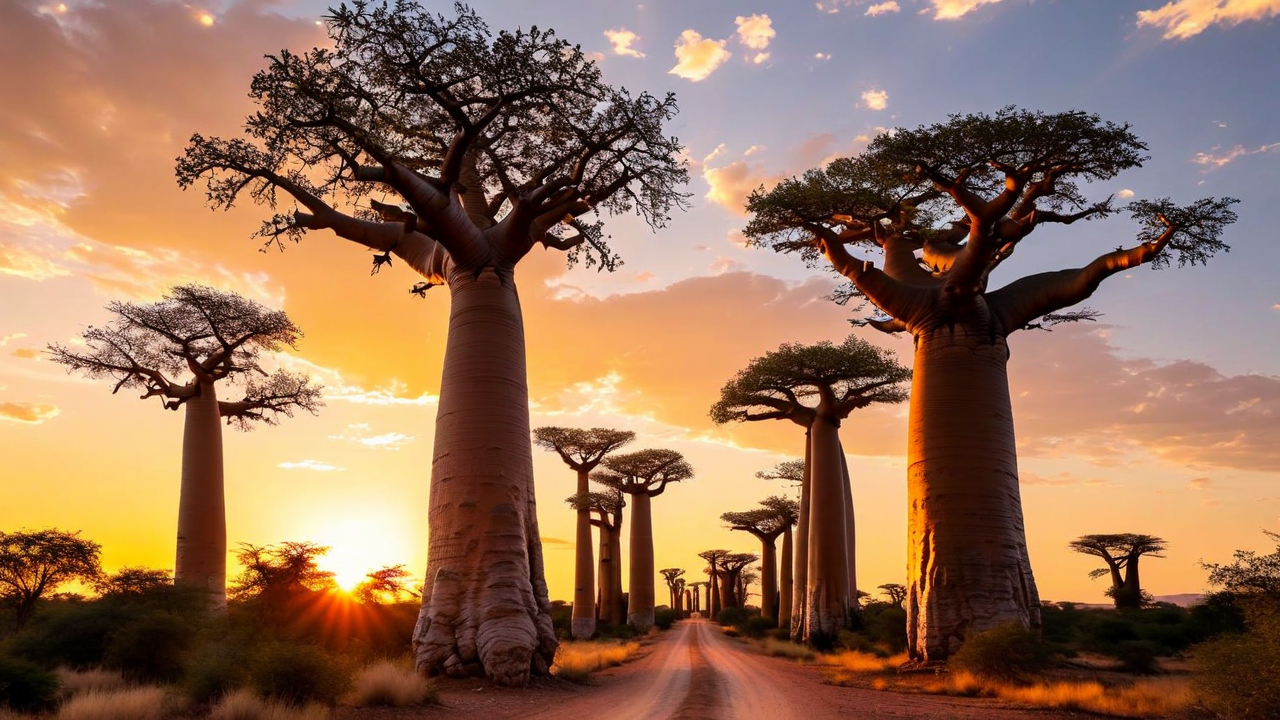
On a dirt road near Morondava on the western coast, six kilometers of ancient Grandidier’s baobabs (Adansonia grandidieri) line both sides of the track, their massive trunks — up to 30 meters tall and 3 meters in diameter — rising from the red laterite soil like a procession of giants. The Avenue of the Baobabs is not a national park — it is a road through agricultural land that happens to pass through the remnants of a forest that once covered this part of Madagascar. The baobabs survived because local communities considered them sacred.
The famous photograph of the avenue is taken at sunrise or sunset, when the flat golden light makes the trunks glow amber and the silhouettes are reflected in the seasonal pond that sometimes forms in the wet season. Getting there from Morondava is a 45-minute drive on a rough road, manageable in any vehicle in the dry season (May–October). The sacred baobabs and the baobab lovers’ site (two ancient trees whose trunks are intertwined) are nearby. This is one of Africa’s great landscape photographs, and unlike most great landscapes, it is accessible and reliably beautiful.

Avenue of the Baobabs — Near Morondava
Ancient Grandidier’s baobabs line a dirt road on the western coast. Come at sunrise or sunset. The trees are sacred to local communities and have survived while the surrounding forest was cleared.
⛰️ Tsingy de Bemaraha — The Stone Forest
In the remote Melaky region of western Madagascar, a vast plateau of Jurassic limestone has been dissolved and carved by water into a forest of razor-sharp stone spires called tsingy — the Malagasy word means approximately “where one cannot walk barefoot.” The Grand Tsingy rises up to 120 meters above the forest floor; the network of spires, canyons, ravines, and arches is so dense and disorienting that the only way to explore it is along suspended rope bridges and via ferrata routes installed by the park authorities.
Tsingy de Bemaraha is also a UNESCO World Heritage Site (1990), recognized for both its geological formations and the extraordinary range of endemic wildlife found within its canyons — lemurs, birds, reptiles, and plant species that have evolved in the unique microhabitats created by the karst. Getting there is an adventure: from Morondava, the road to Bekopaka (the access village) takes 6–12 hours depending on the season and recent rainfall, covering roughly 200 km much of it on rough track. The effort is absolutely worth it.
Tsingy de Bemaraha — UNESCO 1990
Razor-sharp limestone spires rising 120 meters, accessible only via rope bridges and via ferrata. The name means ‘where one cannot walk barefoot.’ One of the world’s great geological spectacles.
🏖️ Nosy Be — The Main Beach Destination
Nosy Be (Big Island in Malagasy) is the principal beach resort destination in Madagascar — a 320 km² island off the northwestern coast with warm, clear water, coral reefs, ylang-ylang plantations that scent the air, and a relaxed French Creole resort atmosphere. It is the easiest entry point to Madagascar for sun-and-sea travelers: regular flights from Paris (Air Madagascar, Air France seasonal), Antananarivo, and connections from Nairobi and Addis Ababa.
The diving and snorkeling are among the Indian Ocean’s finest — manta rays, whale sharks (seasonal), sea turtles, and vibrant coral in clear water. The surrounding small islands (Nosy Komba, Nosy Tanikely, Nosy Iranja) are day-trip destinations. The resort infrastructure on Nosy Be is the best in Madagascar: genuine luxury hotels at the top end (Constance Tsarabanjina, Miavana by Time + Tide), solid mid-range options in Hell-Ville (the main town), and backpacker accommodation in the main beach areas.
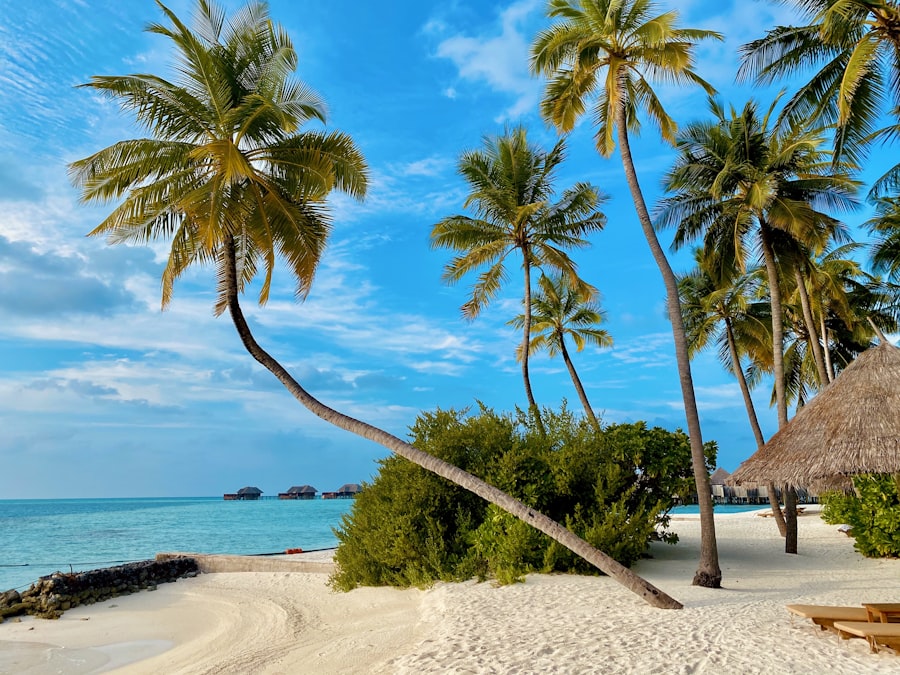
Nosy Be — Madagascar’s Beach Capital
Warm clear Indian Ocean water, coral reefs, manta rays, and ylang-ylang plantations scenting the air. The best-connected beach destination in Madagascar, with direct flights from Antananarivo and Paris.
🏔️ Isalo National Park — The Malagasy Grand Canyon
In the south-central highlands, the Ihorombe Plateau has been carved by wind and water into a landscape of extraordinary sandstone formations — canyons, natural rock pools, arches, and isolated massifs that rise abruptly from the flat surrounding plain. Isalo National Park protects 815 km² of this terrain and is the single most visited national park in Madagascar. The famous natural swimming pools — Piscine Naturelle — are spring-fed rock pools of crystal-clear water surrounded by the sandstone cliffs. Ring-tailed and Verreaux’s sifaka lemurs are reliably seen. Hiking trails range from 2-hour circuits to multi-day wilderness routes. The nearby town of Ranohira is the access point; basic hotels available, better accommodation in the park lodges.
🏛️ Antananarivo — The Capital
“Tana” (as everyone calls it) sprawls across 12 hills at 1,276 meters elevation on the central plateau — a city of steep streets, rice terraces visible from many neighborhoods, crumbling French colonial architecture, and the bustling Analakely and Zoma markets. The Rova of Antananarivo (the royal palace complex of the Merina monarchy on the highest hill) overlooks the city; it was largely destroyed by fire in 1995 but has been partially restored and remains the most important historic site in the city. The Musée de la Photo de Madagascar and the Musée d’Art et d’Archéologie document Malagasy history and material culture.
Most visitors spend 1–2 days in Tana before dispersing to their primary Madagascar destinations. The city is chaotic, the traffic is terrible (the ‘taxi-brousse’ share taxis that radiate from the main gare routière are the primary long-distance transport for most Malagasies), and the air quality in the dry season is poor from burning. But the hillside neighborhoods have genuine character, the restaurants are surprisingly good, and the warm Malagasy hospitality is immediately apparent.
Antananarivo (Tana) — City of 12 Hills
The capital spreads across 12 hills at 1,276m elevation. Rice terraces visible from many neighborhoods. The Rova royal palace complex crowns the highest hill. Most visitors use Tana as a gateway rather than a destination.
🍜 Cuisine
Malagasy cuisine is modest and rice-centered: vary (rice) three times a day, with ro (sauce or stew), romazava (meat and greens broth), zebu meat grilled or stewed, and the extraordinary street food of vanilla, coconut, and tropical fruit. The full guide covers every dish, the French colonial restaurant tradition still alive in Tana, and where to eat well on a tight budget.
🍺 Drinks
Madagascar produces one genuinely excellent product for drinkers: rum. Rhum arrangé — rum infused with local fruits, vanilla, spices, and sometimes lemur-berry — is the signature drink. Three Horses Beer (THB) is the ubiquitous local lager. Wine is imported (mostly French); the Three Horses label also produces a rosé and a white from Malagasy grapes. The full guide covers everything from roadside rum stalls to the wine lists of Tana’s best restaurants.
🏛️ UNESCO
Madagascar has three UNESCO World Heritage Sites: Tsingy de Bemaraha (1990, natural — the limestone karst ‘stone forest’), the Royal Hill of Ambohimanga (2001, cultural — the sacred Merina royal city), and the Rainforests of Atsinanana (2007, natural — six rainforest parks on the eastern escarpment). The full guide covers each site and how to plan a UNESCO circuit.
🌡️ Climate & Best Time
Madagascar has a tropical climate with strong regional variation. The wet season (November–April) sees the risk of cyclones along the eastern coast and makes western roads impassable. The dry season (May–October) is the recommended travel window for most destinations.
✈️ Getting There from the US
No direct flights from the US to Madagascar. The main hubs: Paris (CDG) — Air Madagascar and Air France serve Antananarivo (TNR) and Nosy Be (NOS) from Paris. From the US, fly to Paris (Air France, Delta, United from multiple gateways), then connect — total travel time 18–22 hours. Nairobi (NBO) — Kenya Airways connects Nairobi to Antananarivo and is convenient for those combining Madagascar with East African safari. Ethiopian Airlines via Addis Ababa is another option. Total trip cost including flights: expect $1,800–$3,500 roundtrip from the US depending on routing and season.
📋 Practical Information
Americans receive a visa on arrival at Antananarivo (TNR), Nosy Be (NOS), and other international entry points — valid for 30 days, extendable to 60 days at immigration offices. Fee approximately €40. Ensure your passport has 6+ months validity and carry proof of onward travel and accommodation booking.
Currency: Malagasy Ariary (MGA). Euros and USD accepted in tourist areas; local currency essential for rural areas. ATMs in Tana and Nosy Be (BFV-SG and Bank of Africa most reliable). Credit cards at major hotels only — carry cash. Budget: $50–$120/day is comfortable for mid-range travel.
Yellow fever vaccination recommended if arriving from endemic country. Malaria prophylaxis essential — malaria is present throughout Madagascar except the central plateau above 2,000m. Hepatitis A and Typhoid recommended. Medical facilities are very limited outside Tana and Nosy Be — bring a comprehensive first aid kit and all prescription medications.
Madagascar has significant economic insecurity — petty theft and opportunistic crime occur in cities. The US State Department is currently at Level 2 (Exercise Increased Caution). No US Embassy in Madagascar; nearest US Embassy is in Mauritius (also serves Madagascar). In Tana: US Embassy presence at +261 20 23 480 00.
Transport is challenging — roads are often in poor condition. A 4WD with driver is essential for most routes outside the RN7 (National Route 7, the main road from Tana to Tulear). Taxi-brousses (shared minibuses) cover long routes cheaply but slowly. Domestic flights on Air Madagascar and Tsaradia (the domestic subsidiary) are the practical way to cover large distances quickly.
Mobile coverage is patchy outside cities. Airtel and Telma are the main operators; buy a SIM at the airport. Internet in hotels. Power: 220V, Type C/E/J — carry a universal adapter.
🏷️ Name & Identity
“Madagascar” is almost certainly a mistake. When Marco Polo described a wealthy island off the east African coast in 1290, he called it “Madeigascar” — a garbled version of Mogadishu, the Somali city he had heard about but confused with the island. Portuguese explorers subsequently applied the name to the island, and it stuck. The Malagasy people call their island Madagasikara and themselves Malagasy — derived from the Malay-Polynesian word for “strong” or “great.” There is a quiet dignity in the way Malagasy people describe themselves: from a great seafaring tradition, living on an island that is itself extraordinary.
💰 Costs
Madagascar is affordable by international standards — one of the less expensive destinations on the continent for food, accommodation, and local transport. The main costs are getting there (expensive international flights) and park entry fees.
🏠 Accommodation
Accommodation ranges from basic rooms at local guest houses (bungalows in Malagasy-French terminology) at $10–$30/night to genuine luxury at Nosy Be’s island resorts. Constance Tsarabanjina and Miavana by Time + Tide on private islands near Nosy Be are among the Indian Ocean’s finest properties — and priced accordingly ($800–$3,000+/night). In Tana: the Colbert Hotel is the long-established mid-range standard; the Louvre Hôtel is a newer quality option. Along the RN7: gîtes and small lodges at every major stop, quality variable but generally acceptable.
🎭 Festivals
Famadihana (Turning of the Bones, June–September): The most distinctive Malagasy cultural practice — the bones of deceased ancestors are exhumed from their tombs, wrapped in fresh silk shrouds, and carried in a joyful family celebration. Far from morbid, Famadihana is a celebration of the connection between the living and the dead. Tourists are sometimes invited; if offered the opportunity, accept respectfully. Donia Festival (Nosy Be, late May–early June): The largest music festival in Madagascar, gathering artists from across the island and the Indian Ocean world for 5 days of outdoor concerts.
💼 Business
Madagascar is among the poorest countries on Earth (GDP per capita approximately $500) — but it holds significant natural resource wealth: sapphires, chromite, ilmenite, nickel, cobalt. Vanilla (Madagascar supplies 80% of global natural vanilla) and artisanal fishing are the main licit export earners. Company formation, the mining sector, and the honest context for foreign business are all covered in the full business guide.
🎠 Packing Tips
- Malaria prophylaxis: Start before departure; discuss options (Malarone, Doxycycline) with your travel doctor.
- High-DEET repellent: Essential; bring plenty from home.
- Light, quick-dry clothing: Humidity in coastal areas is intense. Bright colors for wildlife photography.
- Sturdy hiking boots: Tsingy, Isalo, and Ranomafana all involve serious walking on rough terrain.
- Cash (euros or USD): In mixed denominations; ATMs exist but are unreliable outside Tana and Nosy Be.
- Universal adapter: Types C, E, J — same as France.
- First aid kit: Including oral rehydration salts, antihistamines, and any prescription medications. Pharmacies in rural areas are minimal.
- Rain jacket and dry bags: Even in the dry season, afternoon rain is possible at altitude. Protect electronics.
- Binoculars: Essential for wildlife. Lemur sightings are close but birds require optics.
🌐 Resources
- US Embassy (covers Madagascar): US Embassy Mauritius — +230 202-4400
- STEP enrollment: step.state.gov
- Madagascar National Parks (MNP): parcs-madagascar.com — park entry fees, permits
- Air Madagascar / Tsaradia: airmadagascar.com
- CDC Madagascar: wwwnc.cdc.gov
📚 Reading
The Eighth Continent — Peter Tyson (2000): The definitive popular science account of Madagascar’s biodiversity — how the island evolved, what it contains, and why it matters. Essential background for any serious wildlife traveler.
Lords and Lemurs — Alison Jolly (2004): A memoir by one of the pioneers of lemur research, covering decades of fieldwork in Madagascar and the complex relationships between conservation, poverty, and wildlife. Honest and moving.
A Little Tour in France... wrong title: Nosy Be Confidential — for current practical information, the forums at Madagascar-based travel operators (Mad Cameleon, Boogie Pilgrim, Cortez Expeditions) are more useful than any published guidebook.
🎥 Videos
Search YouTube for: “Madagascar BBC Earth” (the BBC’s Madagascar series with David Attenborough is the finest wildlife documentary about the island); “Avenue of the Baobabs drone” (multiple excellent aerial shots of the famous avenue at sunrise); “Tsingy de Bemaraha via ferrata” (first-person videos of crossing the stone forest on rope bridges); “indri lemur singing” (the haunting territorial calls of Madagascar’s largest lemur, best experienced at Andasibe).
🔬 Fascinating Facts
- Madagascar broke away from the African continent approximately 88 million years ago, and from India about 88 million years ago — giving its wildlife 88 million years of isolated evolution.
- 90% of Madagascar’s wildlife is found nowhere else on Earth — a higher proportion of endemism than any other island of comparable size.
- Madagascar supplies approximately 80% of the world’s natural vanilla, yet Malagasy vanilla farmers receive very little of the value — most of the premium goes to exporters and brands.
- The Avenue of the Baobabs was briefly (2007–2015) a protected natural monument by government decree — a protection that has since lapsed, leaving the trees legally unprotected despite being Madagascar’s most photographed landscape.
- Madagascar has more chameleon species than the rest of the world combined — approximately 100 of the world’s roughly 170 chameleon species are endemic to Madagascar.
- The Malagasy language is most closely related to the Ma’anyan language of the Barito region of Borneo, reflecting the extraordinary seafaring migration that brought Madagascar’s first inhabitants across the Indian Ocean approximately 1,500 years ago.
⭐ Notable People
Queen Ranavalona I (c. 1788–1861): The Queen of the Merina Kingdom who expelled European missionaries and traders, executed converts to Christianity, and maintained Malagasy sovereignty against European pressure for 33 years. Vilified by Victorian-era Europeans; remembered in Madagascar as a fierce defender of independence.
Jean de Flacourt (1607–1660): French governor of Madagascar whose 1658 natural history of the island contains the first European description of lemurs, and possibly the first description of the now-extinct Aepyornis (elephant bird). A foundational document of natural history.
Marc Ravalomanana (b. 1950): Dairy entrepreneur who became President of Madagascar 2002–2009; deposed in a military coup. His story is a case study in how African development narratives can unravel.
⚽️ Sports
Football (soccer): The most popular sport; the national team (Barea) had a remarkable run at the 2019 Africa Cup of Nations, reaching the quarter-finals as a rank outsider in their first-ever AFCON appearance. Rugby: Growing in popularity, particularly in the highland regions. Traditional sports: Savika (traditional bull-catching, similar to bull-running) is practised in the highland villages and considered a rite of passage.
📰 Media & Press Freedom
Madagascar’s media landscape is diverse but economically fragile. The RSF Press Freedom Index 2025 ranks Madagascar 52nd out of 180 — relatively free by regional standards, reflecting a genuine diversity of private radio and television stations and the absence of systematic government censorship. However, economic pressures (most outlets depend on government advertising) create self-censorship, and physical violence against journalists during political crises (Madagascar has had four coups or contested transitions since independence) has established a chilling pattern. The main newspapers: L’Express de Madagascar and Tribune de Madagascar (French-language); Tariky (Malagasy-language).
📷 Gallery
Found only in Madagascar
Ancient giants near Morondava
UNESCO natural wonder
Indian Ocean paradise
City of 12 Hills
The eighth continent
✍️ Author’s Note
Madagascar asks something of you that other destinations don’t: patience with difficulty, and a willingness to accept that the infrastructure will fail you, the road will be worse than expected, and the destination will be worth it anyway. I have sat in a broken taxi-brousse on a red dirt road in the central highlands for three hours waiting for the tire to be changed by hand, watching rice terraces step down to a valley floor in the golden afternoon light, a sifaka lemur dancing sideways across the road ahead of us, and thought: this is still one of the best moments of my life.
Go. It will be harder than you think and better than you can imagine.
