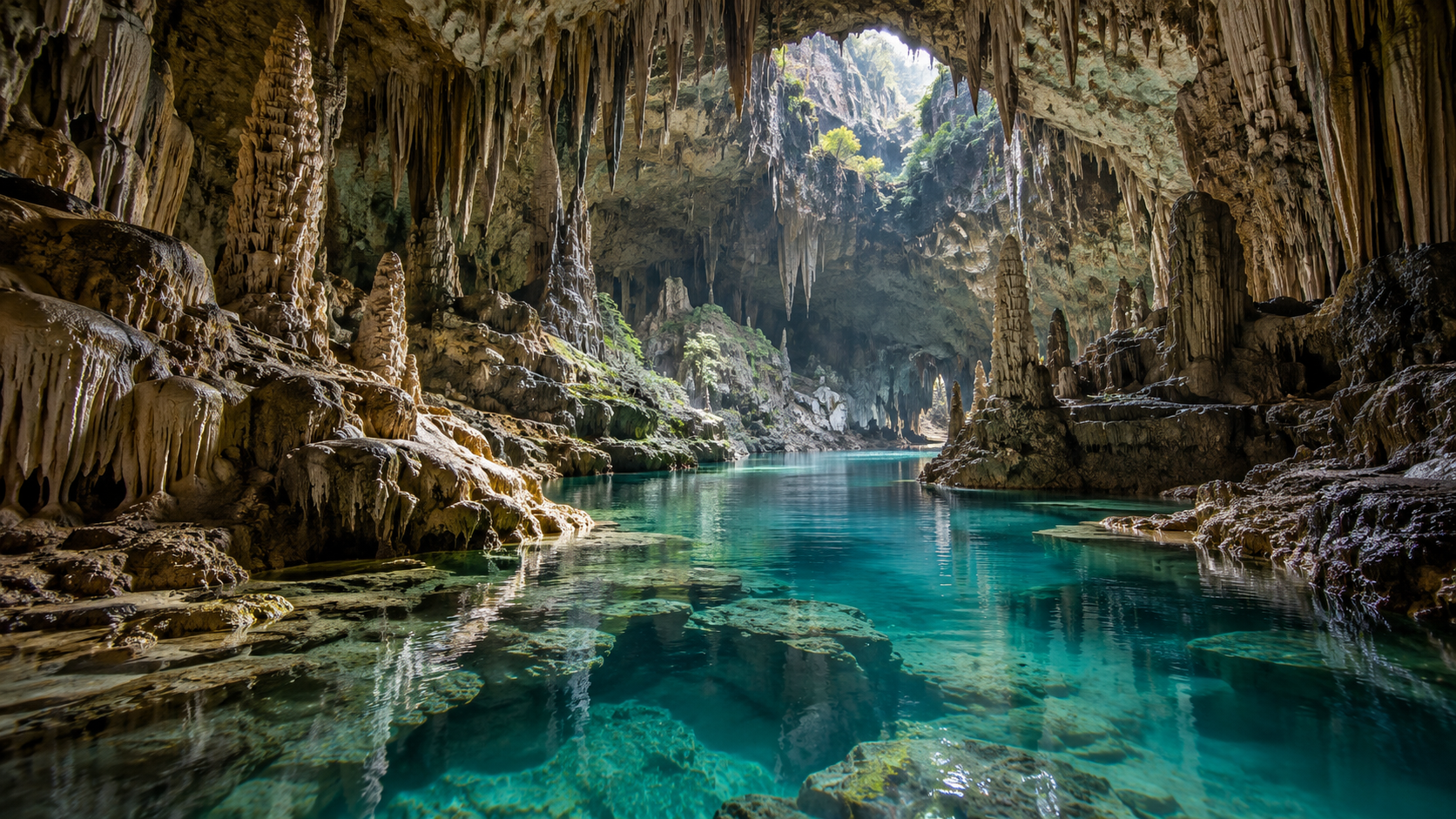
AI-generated cave illustration created for Kaufmann World Travel Factbook.
Beneath the surface of our planet lies a hidden world of cathedral-sized chambers, underground rivers, and geological formations millions of years in the making. Some are accessible to casual tourists; others require weeks of expedition. All offer a perspective on Earth that no surface landscape can match.
Voronya Cave, Abkhazia — The Deepest on Earth
Hidden in the Arabika Massif of 🏴 Abkhazia, Voronya Cave (also called Krubera-Voronya) plunges 2,197 meters into the Earth — deeper than any other known cave on the planet. To put this in perspective, the descent is equivalent to stacking nearly five Eiffel Towers. Ukrainian diver Gennadiy Samokhin reached the ultimate depth in 2012 by diving through a terminal sump in complete darkness. The cave hosts unique ecosystems, including the deepest-dwelling creatures ever found — springtails living 2,000 meters below sunlight. This is not a tourist cave — reaching the bottom requires weeks of expedition and extreme technical skill.
Hang Son Doong, Vietnam — The World's Largest
Discovered by a local farmer in 1991 but not explored until 2009, Hang Son Doong in 🇻🇳 Vietnam's Phong Nha-Ke Bang National Park is the world's largest cave by volume. Its main passage is over 5 kilometers long, 200 meters high, and 150 meters wide — large enough to fly a Boeing 747 through. Two massive sinkholes in the roof allow sunlight to penetrate, creating underground jungles complete with their own weather systems. Organized expeditions (limited to 1,000 permits per year) cost approximately $3,000 for a 4-day trek — expensive, but genuinely once-in-a-lifetime.
New Athos Cave, Abkhazia — Underground Metro
Soviet engineers built a 1.3-kilometer railway inside this massive cave system in 🏴 Abkhazia, creating the world's only underground metro in a natural cave. Visitors descend via electric train into chambers reaching 100 meters high, where stalactites and stalagmites have grown for millions of years. Underground lakes reflect cave lights, and the temperature holds steady at 14°C regardless of the subtropical heat above. Entry costs approximately 500 RUB ($6) — one of the world's great travel bargains.
Waitomo Glowworm Caves, New Zealand
Thousands of bioluminescent glowworms (Arachnocampa luminosa) create a living planetarium on the ceiling of these limestone caves in 🇳🇿 New Zealand's North Island. Silent boat rides through the main grotto pass beneath constellations of blue-green light — an experience that photographs cannot adequately capture. The worms are actually larvae of a fungus gnat, using their glow to attract prey into sticky silk threads. Beautiful and slightly disturbing in equal measure.
Eisriesenwelt, Austria — The Ice Giant's World
The world's largest ice cave extends over 42 kilometers inside the Tennengebirge mountains near Salzburg in 🇦🇹 Austria. The first kilometer is open to visitors who climb 1,400 steps through chambers filled with massive ice formations — frozen waterfalls, ice columns, and crystalline walls that have accumulated over thousands of years. The cave's name translates as "World of the Ice Giants," and the scale of the formations justifies it.
Jeita Grotto, Lebanon
Regarded by many speleologists as the most beautiful cave on Earth, Jeita Grotto in 🇱🇧 Lebanon features two interconnected limestone caves spanning nearly 9 kilometers. The upper gallery contains some of the world's largest stalactites — one measuring 8.2 meters. The lower gallery is accessible only by boat, gliding silently across an underground river through chambers of extraordinary acoustic quality. Jeita was a finalist in the New 7 Wonders of Nature competition.
💡 Cave Safety
Tourist caves are professionally managed with lighting, paths, and guides. Adventure caving (spelunking) requires proper training, equipment, and experienced guides. Never enter wild caves alone. Hypothermia is the primary danger — caves maintain temperatures of 10-15°C regardless of surface weather. Wear appropriate clothing and sturdy footwear even in tourist caves.
