Guide contents
Japan at a Glance
🌍 Overview
Japan is an archipelago of 14,125 islands — the official count was revised upwards in 2023 when the Geospatial Information Authority recounted using digital mapping — of which four carry almost everyone: Honshu, Hokkaido, Kyushu and Shikoku. Total land area is 377,975 km², about five Czechias, and the population is roughly 123 million and falling fast.
Two facts organise everything else. The first is that about three-quarters of the country is mountain, so 123 million people are compressed onto the remaining quarter, which is why Japanese cities are dense, vertical and unusually well served by rail. The second is that the archipelago sits on the junction of four tectonic plates, which gives it roughly a fifth of the world's largest earthquakes, 111 active volcanoes, and a building code and civic temperament shaped by both.
The state
A constitutional monarchy with a parliamentary government. The Emperor — Naruhito, enthroned in 2019, opening the Reiwa era — is defined by the 1947 constitution as "the symbol of the State and of the unity of the People" with no governmental powers at all. Real power sits with the Prime Minister and the bicameral Diet. Article 9 of that constitution renounces war and the maintenance of war potential, a clause reinterpreted repeatedly and never amended.
The people
About 123 million, roughly 30% of them over 65 — the oldest large population on Earth. In 2025 there were 705,809 births, the tenth consecutive record low since comparable records began in 1899, against a natural decrease of 899,845: deaths have outnumbered births for nineteen straight years. Births edged up 0.8% in the first half of 2026, the first such rise in eleven years. Foreign residents are now around 3% and rising quickly, which is a live political subject.
The economy
The world's fourth-largest economy by nominal GDP, after the United States, China and Germany, having held second place from 1968 to 2010. Cars (Toyota is usually the world's largest manufacturer), machine tools, robotics, semiconductor materials, chemicals, gaming and precision optics. Public debt is the highest in the developed world at roughly 250% of GDP, almost all of it held domestically, and the yen has been historically weak against the euro and dollar since 2022 — which makes Japan cheaper for a visitor than it has been in decades.
What visiting is like
Extraordinarily easy and quietly demanding at once. Everything works, the trains are to the minute, crime is negligible and the food is superb at every price. What takes adjustment is the density of unwritten rules, the very low level of English outside the tourist track, and the sheer volume of other visitors: Japan took a record 42.68 million foreign visitors in 2025, up 15.8%, and the pressure on Kyoto, Fuji and central Tokyo is now a national policy problem. The last section is about that.
🗺️ Geography — A Long Thin Country
Japan runs about 3,000 km from north-east to south-west, from the sub-arctic tip of Hokkaido at 45°N to the subtropical Yaeyama Islands at 24°N, closer to Taipei than to Tokyo. That span produces a climate range from Siberian winters to coral reefs, and the whole country is only about 300 km wide at its broadest.
The four main islands
Honshu (228,000 km²), the seventh-largest island in the world, holds Tokyo, Kyoto, Osaka and about 80% of the population. Hokkaido in the north is a fifth of the land with 4% of the people — cold, agricultural, and the last part of the country to be colonised by the Japanese state. Kyushu in the south-west is volcanic and was Japan's door to the outside world for centuries. Shikoku, the smallest, is the quietest and holds the 88-temple pilgrimage.
The mountain spine
The Japanese Alps — the Hida, Kiso and Akaishi ranges — run down central Honshu with more than twenty peaks over 3,000 m. Beyond them the terrain is relentlessly folded: rivers are short and steep, flat land is scarce and expensive, and almost every city sits on a coastal plain or a mountain basin. Roughly 67–73% of Japan is forested, one of the highest proportions in the developed world, largely because the mountains were never worth clearing.
The megalopolis
The Taiheiyō Belt along the Pacific coast from Tokyo through Nagoya and Osaka to northern Kyushu holds a large majority of the population and industry on a narrow strip of plain. Greater Tokyo alone, at around 37 million, is the largest metropolitan area on Earth by a wide margin. This is also exactly where the subduction zones are, which is the central problem of Japanese civil engineering.
Seas and neighbours
The Pacific to the east and the Sea of Japan to the west — a name South Korea disputes, preferring "East Sea". Nearest neighbours are South Korea (about 200 km at the closest), China, Taiwan and Russia. Territorial disputes are live with all of Russia (the Northern Territories / southern Kurils, held by Russia since 1945), China and Taiwan (the Senkaku / Diaoyu islands) and South Korea (Takeshima / Dokdo).
Water and weather
Japan is wet: most of the country gets 1,000–2,500 mm of rain a year, and the western side of Honshu facing the Sea of Japan gets some of the heaviest snowfall on Earth at that latitude, because Siberian air picks up moisture crossing the sea. Places like Sukayu in Aomori average over 15 m of snow a season. The tsuyu rainy season runs roughly June to mid-July, and the typhoon season peaks August–September.
Nature
Around 30% of the land is under some protection, in 35 national parks. Distinctive wildlife includes the Japanese macaque (the northernmost non-human primate in the world), the Japanese serow, the red-crowned crane of Hokkaido, and the Iriomote cat, of which perhaps a hundred remain on a single southern island. Hokkaido has around 12,000 brown bears, and encounters have risen sharply in recent years as villages empty.
🌋 Living on Four Plates
The Pacific, Philippine Sea, Eurasian and North American plates all converge beneath Japan. The country occupies about 0.25% of the world's land and records something like 18% of the planet's magnitude-6-and-above earthquakes. This is not a footnote to Japanese life; it is a structuring fact of it.
Earthquakes
Around 1,500 are felt each year. The Great Kantō earthquake of 1 September 1923 destroyed Tokyo and Yokohama and killed over 105,000, most in the firestorm that followed; the date is still National Disaster Prevention Day. The Kobe earthquake of 1995 killed 6,434 and forced a wholesale rethinking of seismic codes. The Tōhoku earthquake of 11 March 2011, magnitude 9.0–9.1, was the largest ever recorded in Japan.
3.11 and Fukushima
The 2011 quake generated a tsunami reaching over 40 m in places and travelling up to 10 km inland. Around 18,500 people died or went missing. Flooding of the emergency generators at Fukushima Daiichi caused meltdowns in three reactors and the evacuation of about 165,000 people. Almost all of Japan's nuclear fleet was shut down; restarts have been slow, contested in the courts, and are now government policy again on energy-security grounds.
How Japan copes
Building codes that are among the strictest anywhere, with base isolation and mass dampers in tall buildings. An earthquake early-warning system that pushes an alert to every phone and stops the Shinkansen seconds before the shaking arrives. Annual drills in every school and workplace. As a visitor you will feel a tremor if you stay long enough; the correct response is to stay put, get away from windows, and follow whatever the staff do.
Volcanoes and typhoons
111 active volcanoes, about a tenth of the world's total. Sakurajima above Kagoshima erupts almost daily; Aso has one of the largest calderas in the world; Ontake killed 63 hikers in a sudden 2014 eruption with no warning. Volcanic activity is also the reason for the 27,000-odd hot springs that make onsen culture possible. Typhoons — roughly 11 approach and 3 make landfall in an average year — bring the practical risk a visitor is most likely to meet: cancelled trains and flights.
🏷️ The Name, and What It Means
Japanese people call the country Nihon or Nippon — the same two characters, 日本, read two ways. They mean "sun origin", the place the sun comes from, which is a description written from the point of view of China. The phrase appears in a letter said to have been sent to the Sui emperor around 607: "from the sovereign of the land of the rising sun to the sovereign of the land of the setting sun", which reportedly did not go down well.
Why "Japan" in English
Not from Japanese at all. Marco Polo recorded the country as Cipangu from a southern Chinese pronunciation of 日本國, and Portuguese traders picked up a Malay form, Jepang. Every European language's name descends from that chain — including Czech Japonsko. Nobody in Japan says anything resembling it.
Nippon or Nihon
Both are correct and neither is official. Nippon is the harder, more formal reading — it is on the banknotes, the stamps and the national team's shirts. Nihon is what people say in ordinary conversation. A 2009 government attempt to standardise one of them was abandoned.
Wa and Yamato
The earliest Chinese records call the people Wa (倭), written with a character that can be read as "dwarf" or "submissive" — so in the eighth century the Japanese court swapped it for a homophone meaning "harmony" (和), which is still used in compounds for anything traditionally Japanese: washoku (food), washitsu (a tatami room), wagyu (beef). Yamato is the older name of the polity around Nara.
The flag and the anthem
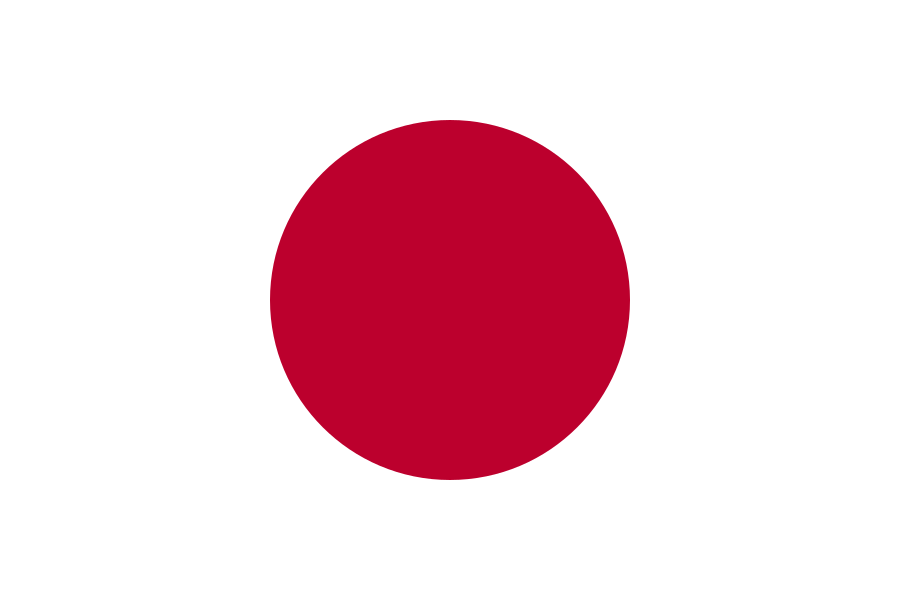
The Hinomaru, a red disc on white, was used by shoguns and merchant ships for centuries and only became legally the national flag in 1999 — together with Kimigayo, whose lyrics are a waka poem from the tenth century, making it the oldest national anthem text in the world. Both remain politically sensitive at home because of their association with the pre-1945 empire.
📜 From the Jomon to the Court at Heian
Jomon (c. 14,000–300 BC)
One of the longest-lasting cultures known, named for the cord-marked pottery its people made — among the oldest pottery in the world, dating back some 16,000 years. They were hunter-gatherers who lived in settled villages, which is unusual, and the flame-shaped vessels of the middle Jomon are extraordinary objects. Sites in northern Tohoku and Hokkaido were inscribed by UNESCO in 2021.
Yayoi and Kofun (300 BC–AD 538)
Wet-rice agriculture, bronze and iron arrive from the Asian mainland with migration from the Korean peninsula, and the population and social hierarchy both jump. From the third century, enormous keyhole-shaped burial mounds — kofun — are built for rulers; the largest, attributed to Emperor Nintoku at Sakai, is about 486 m long and one of the biggest tombs on Earth by area. Most remain closed to archaeologists because they are managed as imperial graves.
Asuka and Nara (538–794)
Buddhism arrives from Korea in the sixth century and is adopted by the court after a factional struggle. Prince Shōtoku's reforms, the Chinese-modelled Taihō legal code of 701, and the first permanent capital at Nara in 710. Tōdai-ji, completed in 752, houses a 15-metre bronze Buddha whose casting nearly bankrupted the state; its Great Buddha Hall is still one of the largest wooden buildings in the world. Japan's two oldest chronicles, the Kojiki (712) and Nihon Shoki (720), are written here.
Heian (794–1185)
The capital moves to Heian-kyō — Kyoto — where it stays for over a thousand years. Contact with China lapses, and a distinctly Japanese court culture develops: the kana syllabaries, which made writing in Japanese practical; poetry as a social obligation; an aesthetic of refined melancholy called mono no aware. Around 1010 a lady-in-waiting known as Murasaki Shikibu writes The Tale of Genji, widely considered the world's first novel — a psychological one, 54 chapters, still read.
Meanwhile, outside the court
The Heian aristocracy's world was a few thousand people. Outside it, provincial landowners were building private estates and arming themselves, and the court's tax and conscription systems were quietly failing. Two warrior clans, the Taira and the Minamoto, emerged from that vacuum, fought the Genpei War of 1180–85, and ended the aristocratic era altogether.
The imperial line
Japan's monarchy is the oldest continuous hereditary one in the world; the traditional count makes Naruhito the 126th emperor, though the first dozens are legendary. Its remarkable feature is that for most of its history it did not rule: from the ninth century onwards real power lay with regents, then retired emperors, then shoguns, then oligarchs, then an elected government. Emperors survived by being the source of legitimacy rather than the holder of power.
⚔️ Shoguns, Warring States and 250 Years of Closure
The first shogunate (1185–1333)
Minamoto no Yoritomo won the Genpei War and had himself named shōgun in 1192, setting up a military government at Kamakura, 400 km from the emperor in Kyoto. The pattern — a sovereign in Kyoto who reigns, a warrior in the east who rules — held, on and off, for nearly seven centuries. Kamakura also survived two Mongol invasions, in 1274 and 1281, both broken by storms that were later called kamikaze, the divine wind.
Sengoku (1467–1600)
The Ōnin War wrecked Kyoto and central authority collapsed into a century and a half of war between provincial lords. It is the period that produced most of what the word "samurai" evokes, the great hilltop castles, and — after Portuguese traders landed at Tanegashima in 1543 — the matchlock musket, which Japan then manufactured better and in greater numbers than anyone in Europe. Three men ended it: Oda Nobunaga, Toyotomi Hideyoshi and Tokugawa Ieyasu, who won at Sekigahara in 1600.
Edo (1603–1868)
Ieyasu's shogunate governed from Edo — the future Tokyo — and produced two and a half centuries without a significant war. It did so by freezing society: four hereditary classes, a ban on peasants owning swords, and sankin-kōtai, which obliged every lord to spend alternate years in Edo and leave his family there permanently as hostages. That single rule built the highway network, the inns along it, and much of the merchant economy.
Sakoku, the closed country
From the 1630s the shogunate expelled the Europeans, banned Christianity after the Shimabara rebellion, and made it a capital offence for a Japanese subject to leave or return. For over two hundred years the only Western contact was a Dutch trading post on Dejima, an artificial island in Nagasaki harbour about the size of a football pitch. It was not total isolation — trade with China, Korea and the Ryukyus continued — but it was close.
What closure produced
A remarkable urban culture with no external reference point. Edo passed a million people, probably the largest city in the world in the eighteenth century. Ukiyo-e woodblock prints — Hokusai's Great Wave is from about 1831 — kabuki, bunraku puppet theatre, haiku under Bashō, the tea ceremony's codification, sushi as fast food sold from street stalls. Literacy rates by 1850 were probably higher than in most of Europe.
The black ships
In July 1853 Commodore Matthew Perry of the United States Navy sailed four warships into Edo Bay and demanded a treaty. He returned in 1854 with nine. The shogunate, unable to resist and unable to refuse without war, signed — and its authority never recovered. Fourteen years of factional crisis and short civil war ended with its abolition and the Meiji Restoration of 1868.
🏭 Meiji: Forty Years From Swords to Dreadnoughts
The transformation Japan carried out between 1868 and 1912 has no real parallel. A country that had banned foreign travel within living memory built railways, a conscript army, a modern navy, a banking system, universal primary education and a written constitution, and defeated a European great power — inside a single reign.
The programme
The slogan was fukoku kyōhei — rich country, strong army. The government abolished the domains and the samurai class outright, sent the Iwakura Mission (1871–73) round the world for eighteen months to study Western institutions, hired thousands of foreign advisers on enormous salaries and dismissed them as soon as Japanese could do the job, and built state model factories then sold them cheaply to the merchant families who became the zaibatsu — Mitsui, Mitsubishi, Sumitomo, Yasuda.
The cost of it
Not painless. The abolition of samurai stipends and the ban on wearing swords provoked revolts, the largest being the Satsuma Rebellion of 1877, in which the conscript army defeated Saigō Takamori's samurai — the historical event behind a great deal of later mythology. Rural taxation funded industrialisation, and conditions in the silk and textile mills that earned the foreign currency were brutal, with a largely female workforce.
Constitution and empire
The Meiji Constitution of 1889, modelled on Prussia's, created a parliament with limited powers and a sovereign emperor. Then expansion: victory over China in 1894–95 took Taiwan; victory over Russia in 1904–05 — the first defeat of a European power by an Asian one in modern times — took southern Sakhalin and a free hand in Korea, annexed outright in 1910. Japan had gone from potential colony to coloniser in one generation.
Taishō and the turn
The 1910s and 20s brought party government, mass newspapers, a women's movement, jazz and the moga "modern girl" — a genuinely liberal moment usually called Taishō democracy. It did not survive the 1923 earthquake, the Depression, and a military that increasingly acted on its own. Officers assassinated two prime ministers in the 1930s and were treated leniently; by 1936 the army effectively held a veto over cabinets.
💥 War, Hiroshima and Occupation
The road to war
Japan seized Manchuria in 1931 on a pretext staged by its own officers, left the League of Nations, and invaded China proper in 1937. That war — including the Nanjing Massacre, whose death toll is disputed but which is not in serious historical doubt — bogged down and led to American oil and steel embargoes. Japan attacked Pearl Harbor on 7 December 1941 and swept through South-East Asia within months.
Total defeat
From mid-1942 the war turned. American firebombing destroyed most Japanese cities; the raid on Tokyo of 9–10 March 1945 killed perhaps 100,000 people in a night, more than either atomic bomb. Hiroshima was bombed on 6 August 1945 and Nagasaki on 9 August; estimates of the immediate and end-of-year death tolls run to roughly 140,000 and 74,000 respectively. The Soviet Union declared war on 8 August. Japan surrendered on 15 August.
Occupation
Seven years under General MacArthur's administration. The armed forces were dissolved, the zaibatsu partly broken up, land redistributed to tenant farmers, women given the vote, and a new constitution — drafted in about a week by American staff officers and adopted in 1947 — imposed with the war-renouncing Article 9. The emperor publicly renounced his divinity and was not prosecuted, a decision still argued about. Sovereignty returned in 1952; Okinawa remained under American administration until 1972.
Memory, and the argument about it
How Japan remembers this period is a permanent point of friction with China and South Korea. The disputes centre on school textbooks, the treatment of the "comfort women" forced into military brothels, forced wartime labour, and ministerial visits to Yasukuni Shrine, which enshrines the war dead including convicted war criminals. Japan has issued repeated official apologies; whether they are accepted, and whether later statements undercut them, is exactly what the argument is about. A visitor is not required to resolve it, but should know it is there.
Hiroshima today
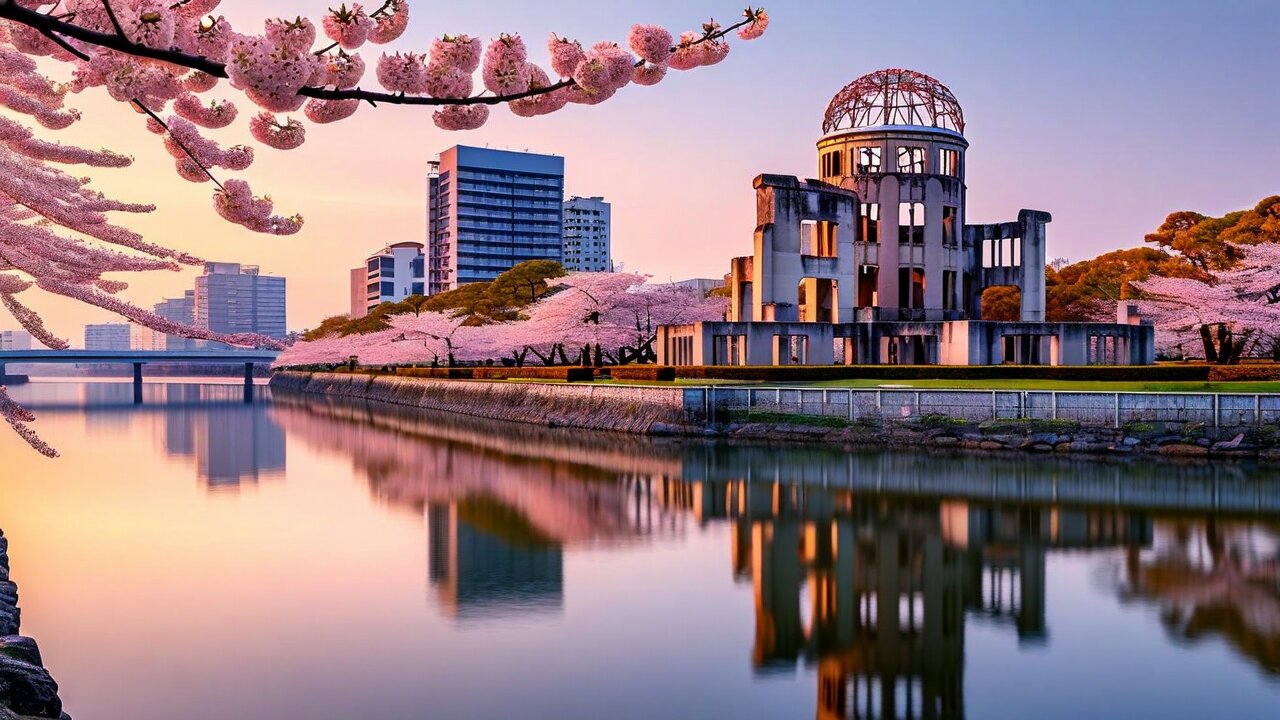
A city of 1.2 million with a rebuilt centre, excellent food, and the Peace Memorial Museum, which is unsentimental, extremely hard to walk through, and the reason to come. The Peace Park holds the cenotaph, the Children's Peace Monument with its paper cranes, and the dome above. Give it a full day and do not plan anything demanding for the evening.
📈 The Miracle, the Bubble and the Lost Decades
The miracle (1955–1973)
Growth averaging close to 10% a year for nearly two decades. Japan passed West Germany to become the world's second-largest economy in 1968. The Tokyo Olympics of 1964 announced the recovery and opened the first Shinkansen line days before the ceremony. Sony, Honda, Toyota, Panasonic and Nintendo all became global names in this period, and "Made in Japan" went from a joke about cheap goods to a byword for quality within twenty years.
The bubble
In the late 1980s asset prices reached numbers that still sound invented: at the peak, the grounds of the Imperial Palace in Tokyo were said to be worth more than the entire state of California, and the Nikkei hit 38,915 on 29 December 1989. It then fell by more than 80% over the following years and did not regain that level until 2024 — thirty-four years later.
The lost decades
What followed was not collapse but a long deflationary stagnation: near-zero growth, falling prices, zero and then negative interest rates, and an enormous public works programme that left rural Japan very well supplied with concrete. Unemployment stayed low, inequality stayed comparatively low, and life stayed comfortable — which is why the period is better understood as a slow, orderly decline in relative weight than as a crisis.
Where things are now
Inflation returned after 2022 for the first time in a generation, wages have started to move, and the Bank of Japan has ended its negative-rate policy. The persistent problems are demographic rather than financial: a shrinking workforce, a care burden that is already large, and the political difficulty of immigration as a remedy. Japan slipped to fourth-largest economy behind Germany in 2023, mostly a currency effect, and remains a technological leader in materials, robotics and precision manufacturing.
🏛️ Japan Today — 6 September 2026
📅 Checked 6 September 2026. The politics and the regional tension in this section move faster than anything else on the page.
The government
Sanae Takaichi became prime minister on 21 October 2025, the first woman to hold the office, after Shigeru Ishiba resigned and she won the LDP leadership. She called an early general election for 8 February 2026 and won it decisively: the LDP took 316 of 465 seats, a two-thirds supermajority no postwar party had achieved, and with coalition partner Nippon Ishin no Kai holds 352. The opposition Centrist Reform Alliance formed by the Constitutional Democrats and Kōmeitō fell from 172 seats to 49.
What that means
A government with the numbers to legislate essentially at will, led by a politician on the hard-conservative wing of her party. Constitutional revision — specifically Article 9 — is now arithmetically possible for the first time, though it would still require a referendum. Defence spending, energy policy including nuclear restarts, and immigration rules are the areas where the majority is most likely to be used.
Relations with China
Tense. In November 2025 Takaichi told the Diet that a Chinese attack on Taiwan could constitute "a situation threatening Japan's survival" — language that in Japanese security law implies the possibility of military response — and Beijing reacted sharply. Chinese travel to Japan fell substantially in the aftermath, and since China was Japan's second-largest source market with over nine million visitors in 2025, that alone is expected to reduce 2026 arrivals by a few percent.
The demographic problem
The central domestic issue, and one no government has solved. The working-age population peaked in the mid-1990s. Rural depopulation has left an estimated nine million akiya — abandoned houses — and whole villages with no residents under sixty. The responses so far are automation, raising the retirement age, more women in the workforce, and cautiously more foreign labour; the last of these is where the political friction is.
Safety and society
Japan has among the lowest homicide rates in the world and violent crime is genuinely rare. The visible social problems are different ones: overwork, with a word — karōshi — for death from it; a high suicide rate by developed-country standards, though it has fallen substantially since 2003; and social withdrawal, hikikomori, affecting an estimated one to one and a half million people. None of this touches a visitor, but it is part of an honest picture.
The Olympics and Expo
Tokyo hosted the delayed 2020 Olympics in 2021, without spectators, at a cost that became a scandal. Expo 2025 ran in Osaka on the artificial island of Yumeshima from April to October 2025 — the Grand Ring around it was the largest wooden structure ever built. Both left infrastructure behind; neither left much public enthusiasm for hosting another.
💴 The Economy and What It Makes
The industrial base
Cars above all — Toyota, Honda, Nissan, Suzuki, Mazda, Subaru — plus motorcycles, where Honda, Yamaha, Kawasaki and Suzuki hold most of the world market. Then machine tools and industrial robotics, where FANUC and Yaskawa lead; semiconductor materials and equipment, an area where Japan is a genuine chokepoint in the global supply chain; optics (Canon, Nikon, Sony sensors); and chemicals and specialty materials that end up inside everyone else's products without ever carrying a Japanese name.
Culture as export
Anime, manga, video games and characters are a substantial industry in their own right. Nintendo, Sony's PlayStation, Capcom, Square Enix; Studio Ghibli, whose Spirited Away won an Academy Award in 2003; and licensing empires around Pokémon and Hello Kitty. The government's "Cool Japan" policy tried to formalise this and mostly demonstrated that the soft power was arriving perfectly well on its own.
The corporate world
Lifetime employment and seniority pay were never universal — they applied mainly to men at large firms — and have eroded, but the culture they produced persists: long hours, group decision-making by consensus, and a sharp divide between seishain regular employees and a large pool of irregular workers on worse terms, who are disproportionately women. Reform has been slow but real; overtime caps came in from 2019.
Prices and the yen
The weak yen since 2022 has made Japan strikingly cheap for European visitors — a bowl of first-rate ramen for around ¥1,000, a business hotel for ¥8,000–12,000, a full-day city transport pass for the price of a Prague lunch. For Japanese consumers the same currency move has meant imported inflation and the first real cost-of-living debate in thirty years. Check the rate before you budget; it has been volatile.
⛩️ Shinto, Buddhism and What People Actually Do
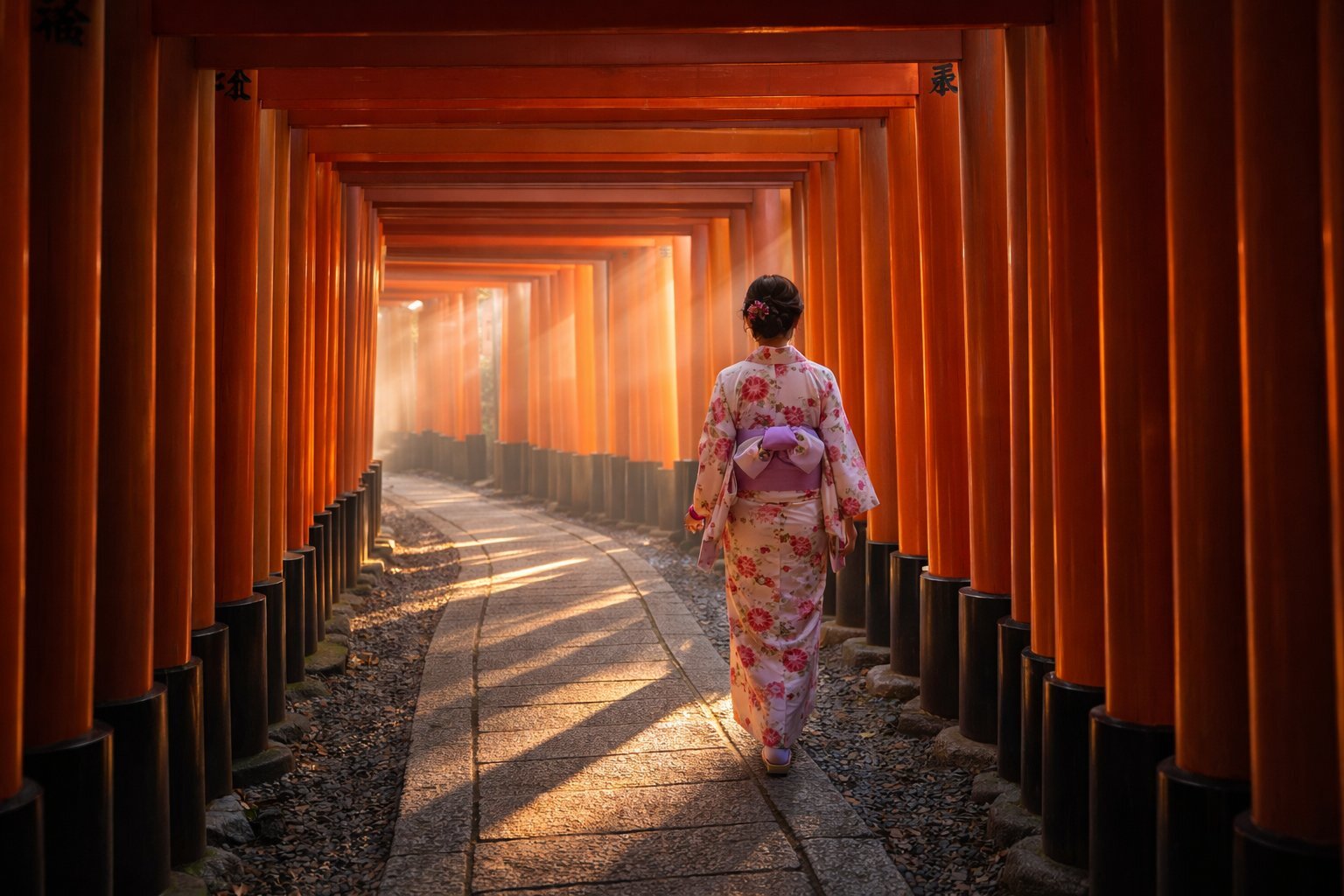
Surveys regularly find that most Japanese people describe themselves as having no religion, and the same surveys find that most of them visit a shrine at New Year. The apparent contradiction dissolves once you understand that Shinto and Buddhism function as practice rather than as belief, and that a person can perfectly well use both without either being their "religion" in the Western sense.
Shinto
The indigenous tradition: reverence for kami, spirits or presences associated with places, natural features, ancestors and occasionally people. It has no founder, no scripture, and no doctrine of an afterlife. Its concerns are purification, gratitude and the renewal of things — which is why the great shrine at Ise has been demolished and rebuilt on an adjacent plot every twenty years for over 1,300 years, most recently in 2013. A shrine is a jinja and is marked by a torii gate.
Buddhism
Arrived in the sixth century and layered on top rather than replacing. The major schools are Zen (Rinzai and Sōtō), Pure Land — much the largest by adherents — Nichiren, and the esoteric Shingon. Buddhism took charge of death: most Japanese funerals are Buddhist, most graves are at temples, and family Buddhist altars are common. A temple is a tera or -ji, and its gate has no torii.
How they divide the year
The convention is that Shinto handles life and Buddhism handles death. Babies are taken to a shrine; weddings may be Shinto or, very often now, in a chapel with a hired officiant; New Year means hatsumōde, the first shrine visit, made by tens of millions of people in three days. Obon in August is Buddhist, when the ancestors are said to return and much of the country travels to its home town. Christmas is a commercial romantic occasion with no religious content at all.
Visiting properly
At a shrine: bow once at the torii, walk to the side of the path rather than down the middle, rinse left hand then right then rinse your mouth from your left hand at the water basin. At the hall, toss a coin, bow twice, clap twice, bow once. At a temple you do not clap — you put your hands together silently. Photography is usually fine outside and often forbidden inside; look for the sign. Nobody will correct you, and getting it roughly right is noticed.
Omamori, ema and omikuji
The omamori amulets sold at shrines are for specific purposes — traffic safety, exams, childbirth, a difficult year — and are conventionally returned to be burned after a year. Ema are the small wooden plaques people write wishes on and hang up. Omikuji are paper fortunes; if you draw a bad one, you tie it to the rack provided and leave it behind. All three are cheap, and all three are real practice rather than souvenirs, so buy them in that spirit.
New religions and the shadow
Japan has hundreds of shinshūkyō, new religious movements, some very large. Two are widely known abroad for bad reasons: Aum Shinrikyō, which released sarin on the Tokyo subway in 1995 killing 14 and injuring thousands, and the Unification Church, whose political entanglements resurfaced after the assassination of former prime minister Shinzo Abe in July 2022 and brought down ministers. Neither is something a visitor encounters.
🏙️ Tokyo
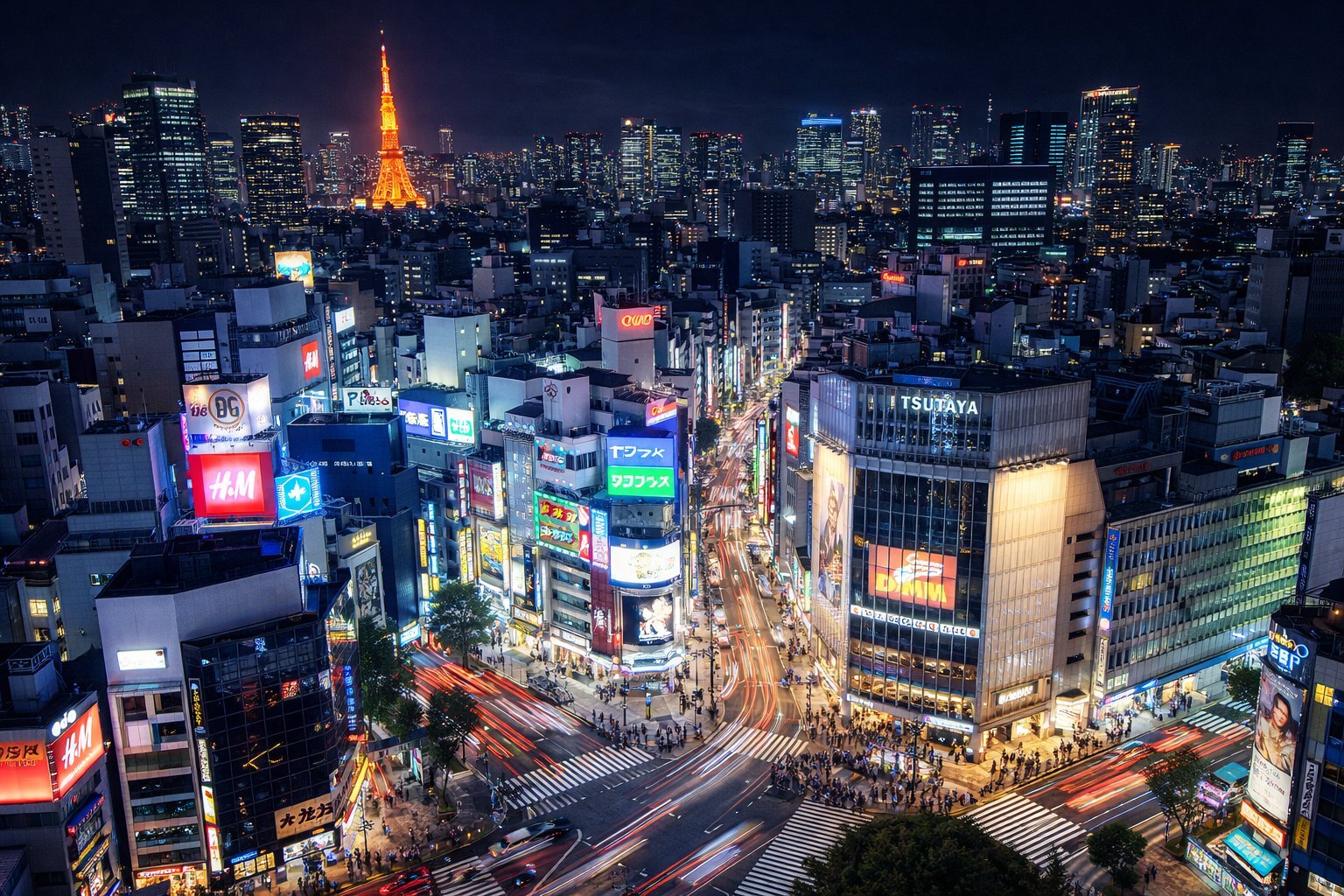
Not a city so much as a federation of them. Tokyo is a metropolitan prefecture of 23 special wards plus cities and towns to the west, with about 14 million people in the prefecture and some 37 million in the wider metropolitan area — the largest urban agglomeration in the world. It has no single centre, because it grew as a ring of towns around the shogun's castle and then fused; each major station is a downtown in its own right.
How to think about it
Learn the Yamanote line, the loop that strings together most of the hubs, and treat each stop as a separate town. Tokyo Station and Marunouchi for business and the Imperial Palace grounds; Shinjuku for the world's busiest station and the government skyscrapers; Shibuya for youth retail; Ueno for museums and the park; Asakusa for the old low city. Everything is signposted in English on the rail network and almost nowhere else.
The essentials
Sensō-ji in Asakusa, Tokyo's oldest temple, founded 645, approached through the Kaminarimon gate and a shopping street that has been there for centuries. Meiji Jingū, a shrine to the Meiji emperor set in a 70-hectare forest that was entirely planted, tree by tree, by volunteers in the 1920s. The Tokyo National Museum in Ueno, which holds the national collection and is underrated by visitors. The Imperial Palace East Gardens, free, on the foundations of Edo Castle.
Views
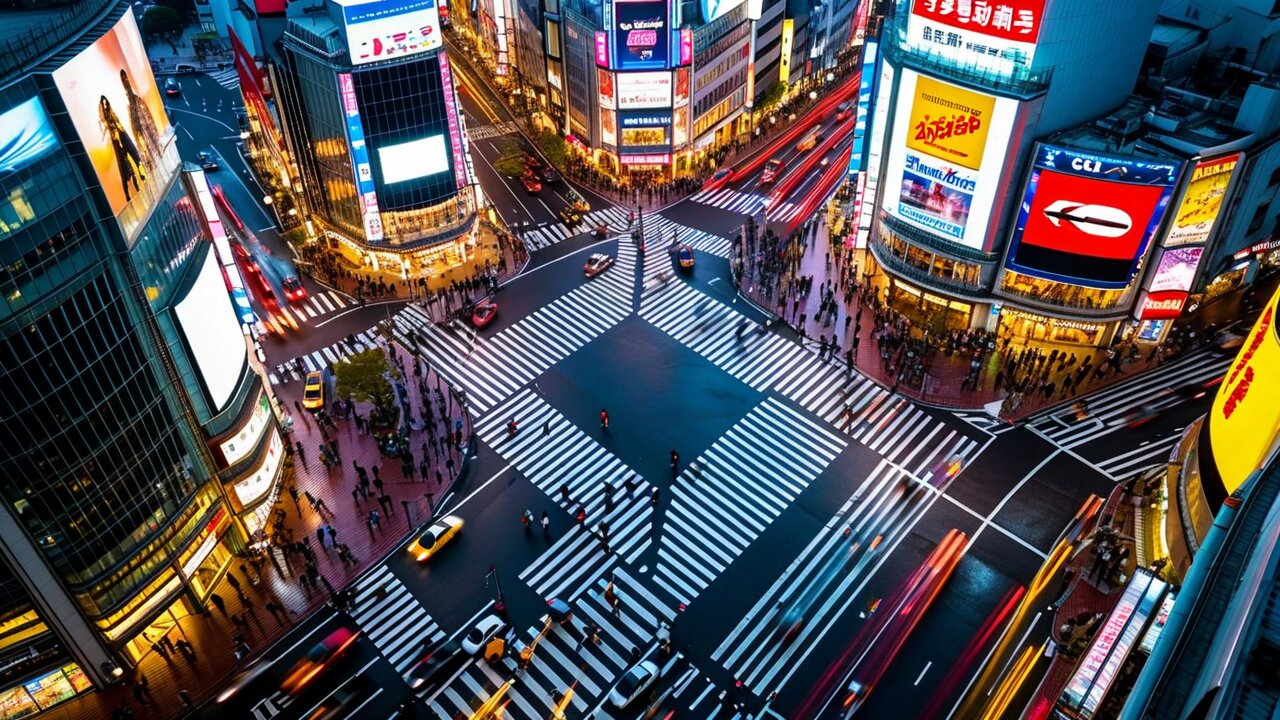
The Tokyo Metropolitan Government Building in Shinjuku has two free observation decks at 202 m and is the best value in the city. Shibuya Sky is the dramatic one, open-air at 229 m over the crossing, and needs booking. Tokyo Skytree is the highest and the furthest from anything else. On a clear winter morning all three show Fuji.
Eating
Tokyo has more Michelin stars than any city on Earth, and that is the least interesting thing about it. The real strength is the depth of ordinary places: a counter with six seats where a man has made one dish for thirty years. Department store depachika food halls in the basements of Isetan or Mitsukoshi are astonishing and cheap. Toyosu replaced the old Tsukiji market in 2018 for the wholesale trade, but the Tsukiji outer market still trades and is where you actually want to eat.
Day trips
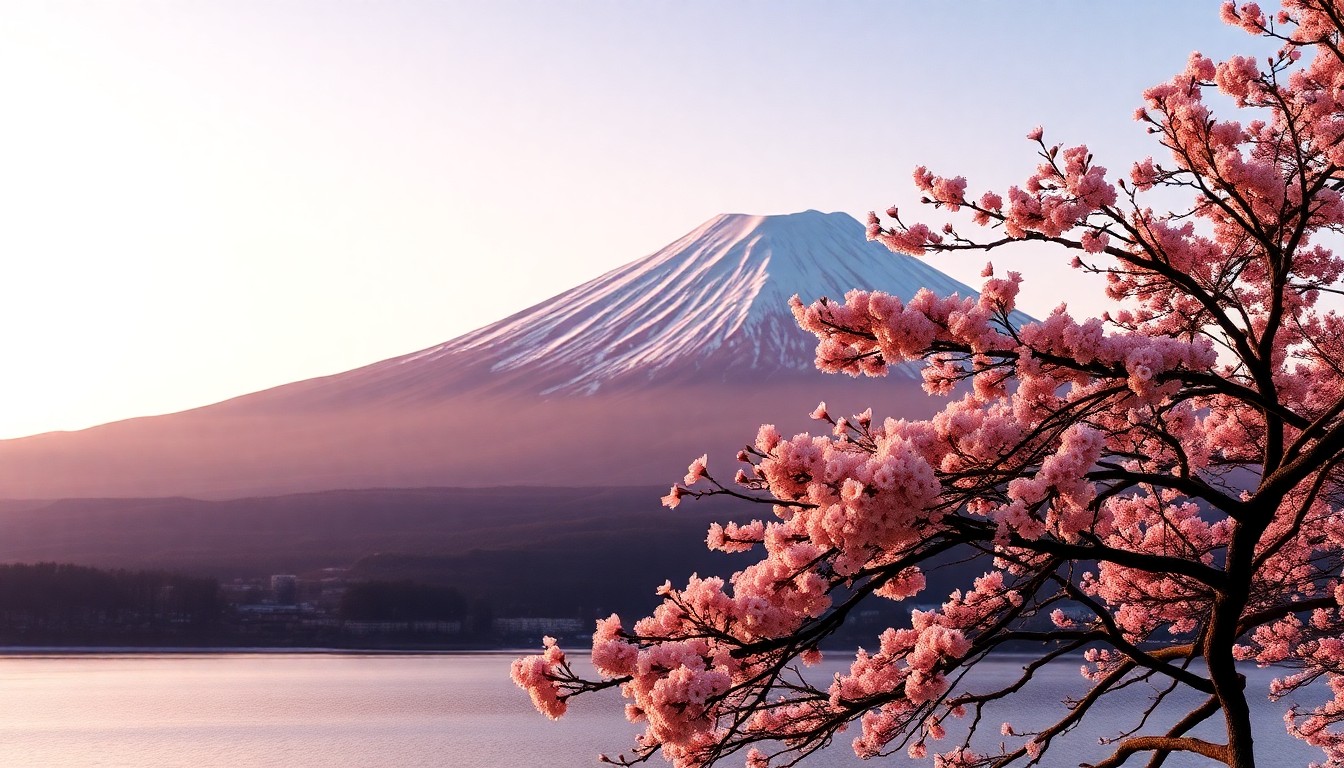
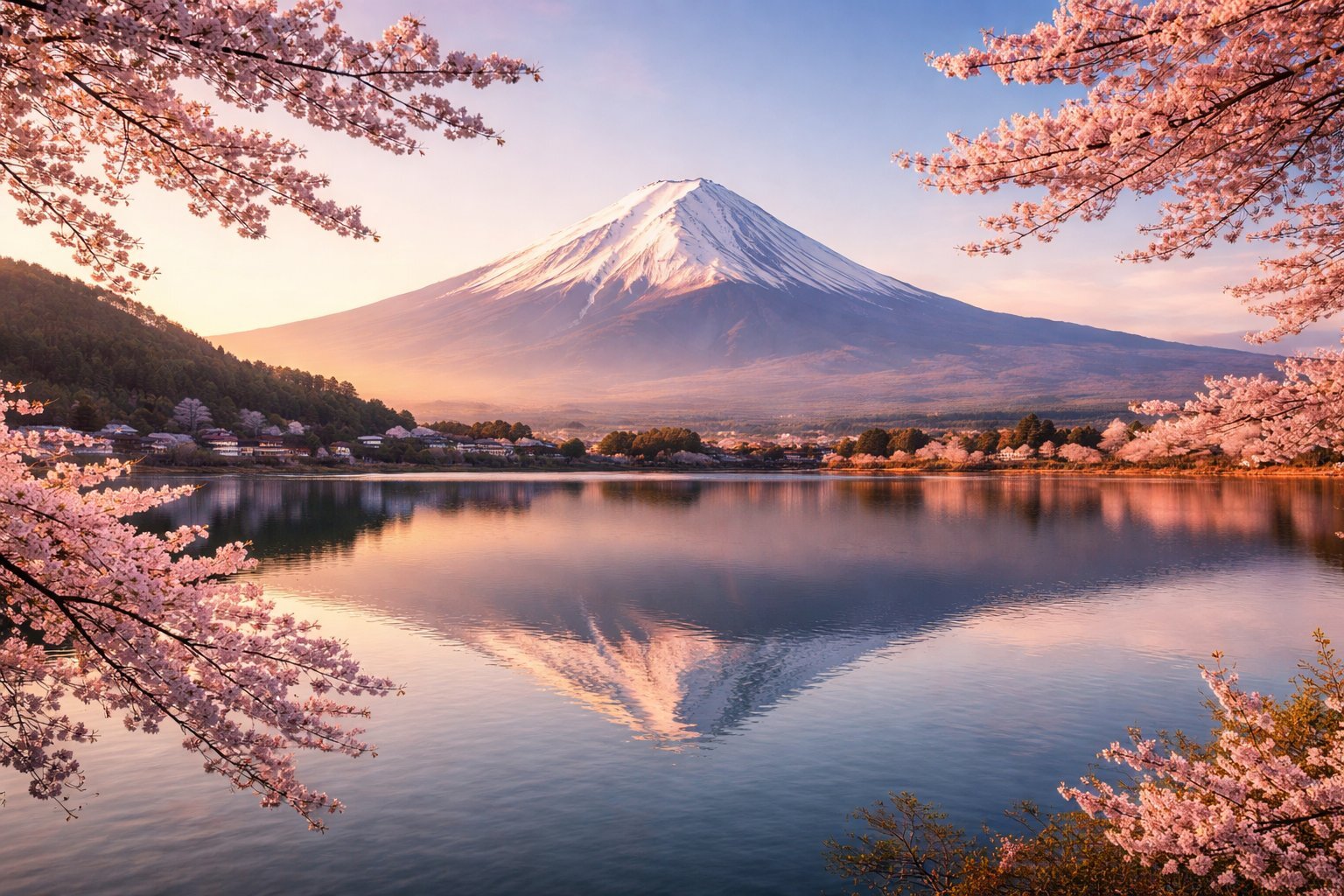
Kamakura, an hour south — the first shogunal capital, with the Great Buddha and a coastline. Nikkō, two hours north, for the extravagantly carved Tōshō-gū mausoleum of Ieyasu and the mountains behind. Hakone for onsen and, on a good day, Fuji across Lake Ashi. The Fuji Five Lakes for the view at the top of this page. All are doable in a day and better with a night.
The other Tokyo
Yanaka, a low-rise neighbourhood that escaped both the 1923 earthquake and the 1945 firebombing and still looks like prewar Tokyo. Shimokitazawa for second-hand clothes and live music. Kōenji and Kichijōji for the same at a lower temperature. Odaiba for reclaimed-island architecture. And the yokochō alleys of tiny bars — Omoide Yokochō by Shinjuku station, Nonbei Yokochō in Shibuya — where some places seat six and some have a cover charge you should ask about first.
🚦 Tokyo at Street Level
Convenience stores
The konbini — 7-Eleven, FamilyMart, Lawson — are a genuine feature of Japanese life rather than a poor substitute for shops. They have ATMs that take foreign cards (7-Eleven's are the reliable ones), clean toilets, printers, ticket machines, parcel drop-off, and food that is actually good: onigiri, egg sandwiches, oden in winter, and coffee for around ¥120. There are about 56,000 of them.
Vending machines
Roughly four million, one for every thirty people, in places where no shop could survive — mountain trailheads, empty streets at 3 a.m. They work because vandalism and theft are so rare that the economics hold. Hot drinks in winter are marked with red, cold with blue.
Toilets
Genuinely a highlight. Public toilets are everywhere, free and clean, including at every station and konbini. The heated washlet seats with control panels are standard even in modest places. Tokyo's Tokyo Toilet project commissioned sixteen public toilets in Shibuya from architects including Tadao Ando and Shigeru Ban, and the transparent ones in Yoyogi Fukamachi that frost over when locked are worth a detour.
Rubbish, and the lack of bins
There are almost no public bins — a security measure after the 1995 sarin attack that simply stuck. People carry their rubbish home. Do the same; konbini bins are for konbini purchases. Recycling separation is taken seriously and varies by municipality.
Quiet
Trains are near-silent. Phone calls on public transport are not done, and the announcements ask you not to. Talking loudly in a group in a carriage, on a bus or in a residential street at night reads as a genuine imposition rather than as high spirits. This is the single easiest way for a visitor to be either invisible or conspicuous.
Cash and cards
Cards work in most city businesses now, and IC cards (Suica, PASMO, ICOCA) work for trains, buses, konbini and vending machines — you can add them to a phone. But small restaurants, shrines, markets, rural buses and older ryokan are still cash-only, and shrine offerings and coin lockers need actual coins. Carry ¥10,000–20,000 in notes.
⛩️ Kyoto
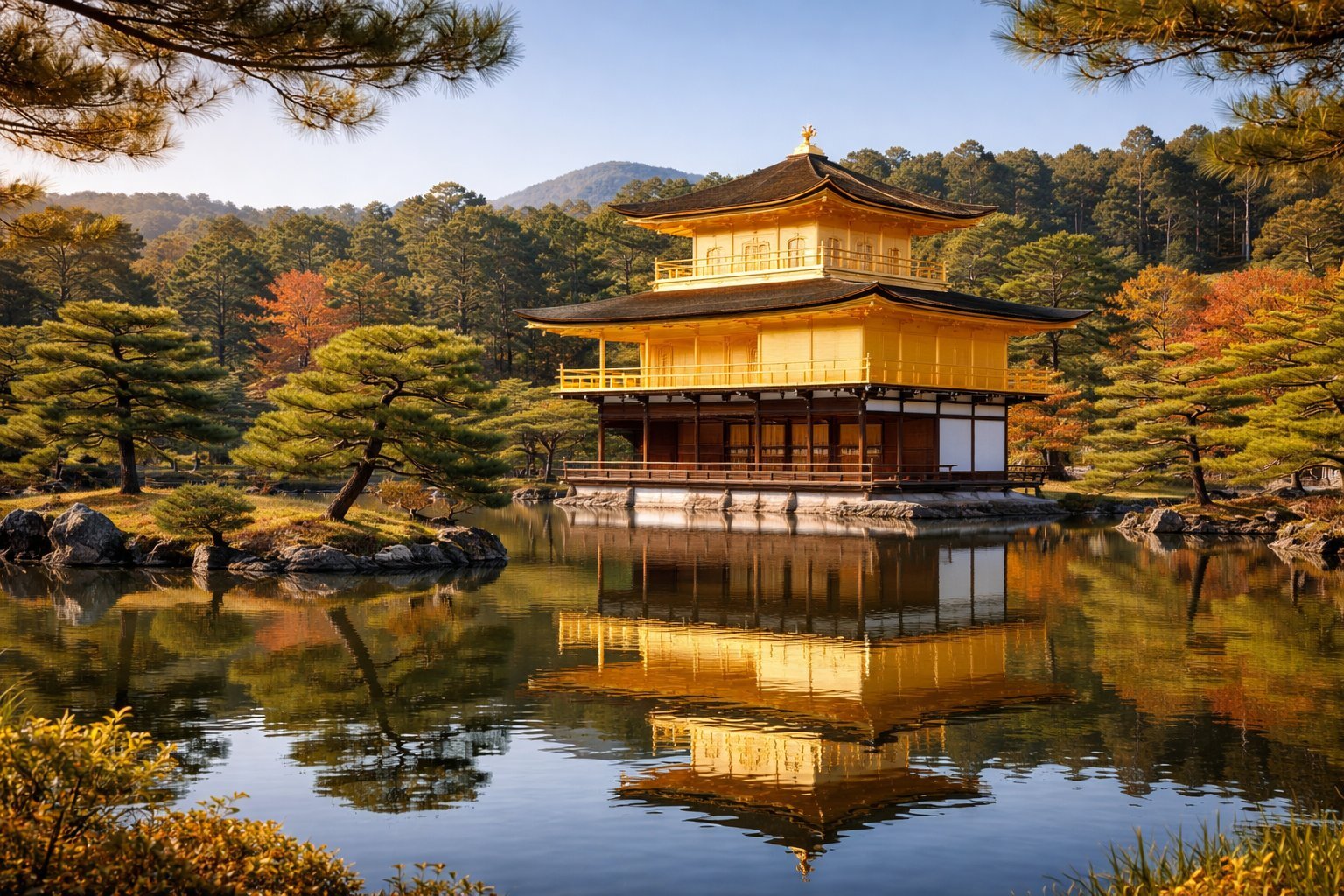
The imperial capital from 794 to 1868, spared the American firebombing, and holder of seventeen properties in a single UNESCO listing. Kyoto has about 1.4 million residents, some 1,600 Buddhist temples and 400 Shinto shrines, and a tourism load that its narrow grid and its bus network are visibly failing to absorb.
The unmissable ones
Kiyomizu-dera, whose vast wooden veranda is built out over the hillside on 139 pillars without a single nail. Ginkaku-ji, the Silver Pavilion, which was never silvered, with the finest dry-sand garden in Japan. Ryōan-ji, fifteen rocks in raked gravel, of which you can never see all fifteen at once from any position on the veranda. Sanjūsangen-dō, a 120-metre hall containing 1,001 gilded statues of Kannon, each face individually carved.
Doing it without hating it
Kyoto's crowds are worst 10:00–16:00 at maybe eight sites. Start at 06:30. Fushimi Inari and the Arashiyama bamboo grove are open around the clock and are transformed before eight. Use the subway and the JR lines rather than the buses, which are the pinch point and where the friction with residents is. Consider staying in Osaka or Uji and commuting in. Go in January, February or late November after the maples drop.
Beyond the checklist
Tōfuku-ji and its modernist 1939 gardens. Daitoku-ji, a walled complex of two dozen sub-temples of which a handful are open and almost empty. Nanzen-ji with a brick aqueduct running through it. The Philosopher's Path early. Nishiki Market, five blocks of food stalls, where eating while walking is now discouraged by signs — buy and stand still. And the Kyoto National Museum, which almost nobody visits.
Uji and Ohara
Half an hour south, Uji has Japan's best green tea, the Byōdō-in Phoenix Hall of 1053 — the building on the ¥10 coin — and a fraction of the crowds. An hour north, Ōhara is a valley of moss-garden temples, and Kurama and Kibune offer a two-hour walk over a wooded ridge between two shrines with an onsen at the end.
Where Kyoto came from
The city was laid out in 794 on a Chinese grid copied from Chang'an, which is why the streets still run true north–south and east–west and why addresses can be given as intersections. It survived as the imperial seat for over a thousand years while political power sat elsewhere, which is precisely why so much of the aesthetic tradition — tea, noh, garden design, kaiseki, textiles — is Kyoto's.
🎍 Arashiyama, Gion and the Geisha Question
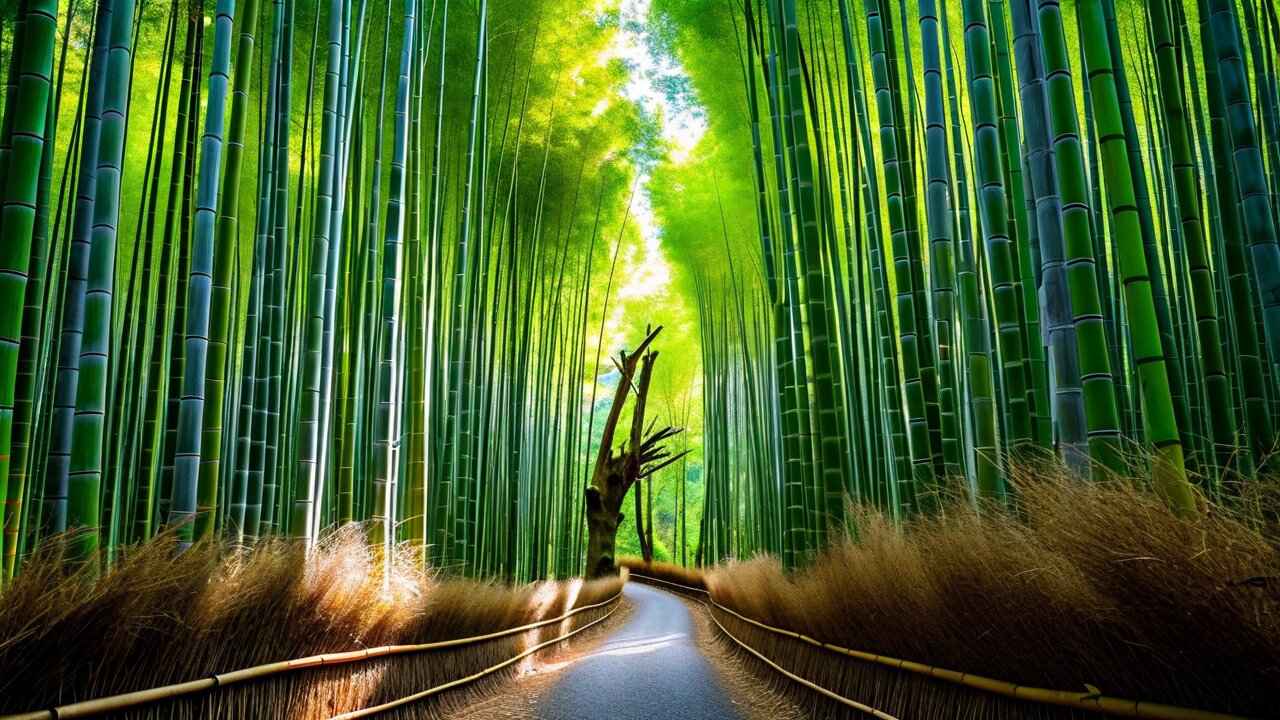
Arashiyama
Beyond the grove: Tenryū-ji, a Zen temple whose fourteenth-century garden by Musō Soseki is the oldest in Japan to survive in its original design, and which "borrows" the mountains behind as part of the composition. The Togetsukyō bridge over the Katsura. Ōkōchi Sansō, a film star's villa and garden at the top of the grove, with an entry fee that keeps it quiet and includes tea. And the Iwatayama monkey park, a stiff twenty-minute climb, where the macaques are wild and the humans are the ones in the cage.
Gion
The best-known of Kyoto's five hanamachi — geisha districts. The architecture is the point: machiya townhouses, narrow-fronted because they were taxed on street frontage, running deep back with internal courtyards. Hanami-kōji and Shirakawa lane are the photogenic stretches. Pontochō, across the river, is a single alley of restaurants and is arguably better in the evening.
Geiko and maiko, accurately
Kyoto says geiko, not geisha, and the apprentices are maiko. They are professional performing artists — dance, shamisen, song, conversation — trained for years, and there are now only a few hundred left. Almost everyone you see in full costume on a Gion street in daylight is a paying customer at a henshin dress-up studio. The differences are learnable: a real maiko wears the darari obi hanging almost to the floor, tall wooden okobo clogs, and walks quickly because she is going to work.
The photography rules
From 2019 photography has been banned in Gion's private lanes, with signs and a fine of ¥10,000; from April 2024 the private alleys off Hanami-kōji have been closed to tourists altogether after repeated incidents of geiko being surrounded, grabbed and followed. The public streets remain open. Do not photograph a geiko or maiko without being invited to, and do not step into her path. This is the one piece of etiquette in Kyoto that has actually produced local anger.
Seeing a performance properly
You cannot walk into a teahouse — the system is introduction-only. What you can do: the public dances, Miyako Odori in Gion each April and Kamogawa Odori in Pontochō in May, with tickets sold openly; the Gion Corner cultural show; or a booked dinner with a maiko through a hotel or a specialist agency, which is expensive but real.
🏯 Osaka, Nara and Kansai
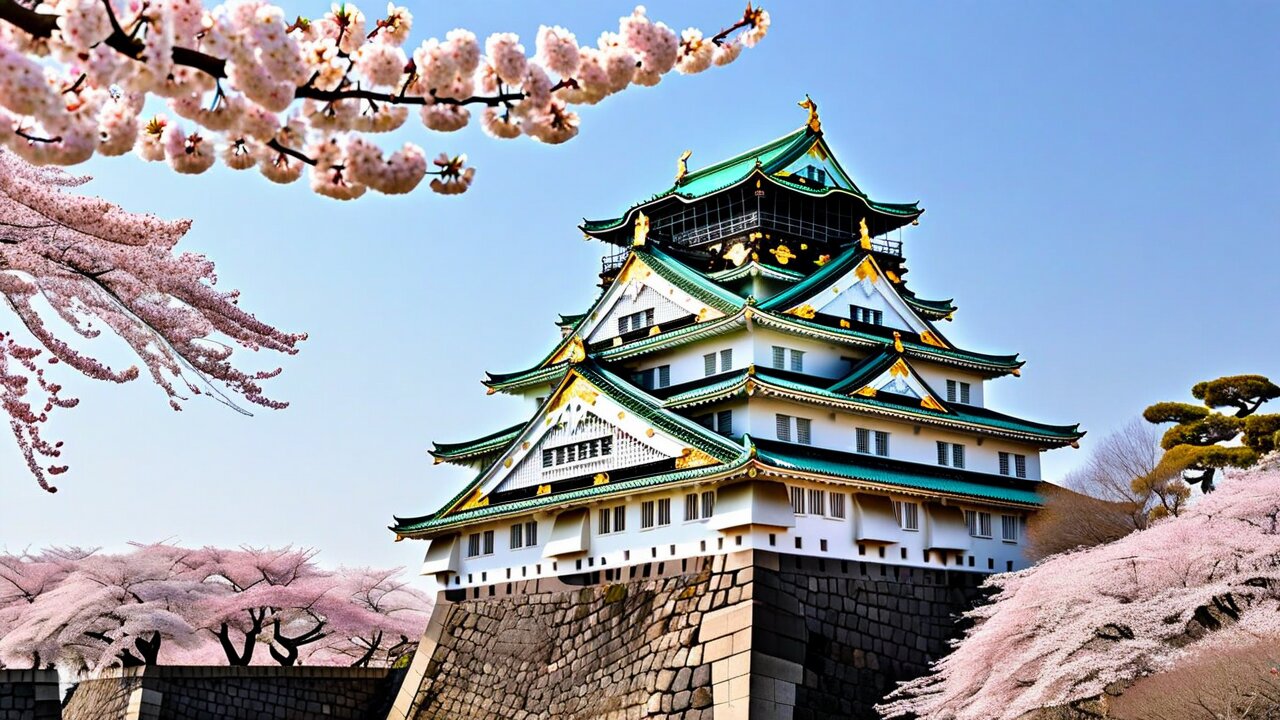
Osaka
Japan's third city and its most direct: Osakans have a reputation for being loud, funny, commercially minded and uninterested in Tokyo's reserve. The local greeting is reportedly mōkarimakka — "are you making money?". Food is the reason to come. Dōtonbori for the neon and the Glico running man, Kuromon Ichiba market, and the standing bars of Shinsekai under the Tsūtenkaku tower. The city's motto is kuidaore, roughly "eat yourself bankrupt".
Osaka food
Takoyaki, octopus balls from a griddle, molten inside — wait. Okonomiyaki, a cabbage-heavy savoury pancake, cooked in front of you; the Hiroshima version layers noodles in and is a different dish. Kushikatsu, deep-fried skewers, with the single most important rule in Osaka dining: no double-dipping in the communal sauce. And kitsune udon, which was invented here.
Nara
Japan's capital before Kyoto and a comfortable day trip from either. Tōdai-ji's Great Buddha Hall holds a 15 m bronze Buddha cast in 752; the current hall, rebuilt in 1709, is two-thirds the width of the original and is still among the largest wooden structures on Earth. Kasuga Taisha is approached through a forest hung with three thousand stone and bronze lanterns. Hōryū-ji, a few stops away, contains what are generally accepted as the oldest surviving wooden buildings in the world, from around 700.
The Nara deer
Around 1,200 sika deer roam the park, historically protected as messengers of the gods — killing one was a capital offence until 1637. They will bow to you, which is learned behaviour to get the ¥200 crackers sold on site, and they will also headbutt, bite and chase you if you tease them or hold food back. Feed with the crackers only, feed promptly, and show empty hands when you are done.
Kobe, Wakayama and the rest
Kobe, rebuilt after 1995, for the beef, the port and Mount Rokkō. Kōyasan in Wakayama, the mountaintop headquarters of Shingon Buddhism founded by Kūkai in 816, where you can stay in a temple (shukubō), eat vegetarian monastic food and attend the 06:00 service — one of the best things in Japan. And the Kumano Kodō, a network of pilgrimage trails through the Kii peninsula, UNESCO-listed and walkable in stages.
Getting around Kansai
The private railways here are often faster and cheaper than JR, and are not covered by the Japan Rail Pass — Kintetsu to Nara and Ise, Hankyu and Keihan between Osaka and Kyoto, Nankai to Kansai airport and Kōyasan. An ICOCA card covers all of them. Kyoto–Osaka is under half an hour; Kyoto–Nara about 45 minutes.
🗾 Hiroshima, the West and the North
Himeji
The finest surviving castle in Japan and a UNESCO site — an original, never destroyed, never rebuilt in concrete, and a National Treasure. The white plaster and the layered gables earned it the name Shirasagi-jō, the White Heron Castle. The interior is a working defensive maze of blind turns, stone-drop chutes and steep ladders, and the climb to the top floor is genuinely demanding. It is 15 minutes' walk from a Shinkansen station, so it works as a stop between Osaka and Hiroshima.
Miyajima
The island in the Inland Sea whose Itsukushima Shrine is built on stilts over the water so that pilgrims did not have to set foot on sacred ground. The great vermilion torii offshore stands on its own weight rather than being sunk into the seabed, and is walkable at low tide. There are wild deer, an unusual maple-leaf-shaped cake called momiji manjū, and a cable car and hike up Mount Misen. A small visitor levy applies to arrivals.
Kyushu
Volcanic, subtropical at its southern end, and Japan's historic point of contact with the outside world. Fukuoka for the yatai street food stalls and Hakata ramen. Nagasaki for Dejima, the hidden-Christian history, and its own atomic memorial. Beppu and Yufuin for onsen — Beppu produces more hot spring water than anywhere in Japan bar Yellowstone worldwide. Kumamoto's castle, badly damaged in the 2016 earthquake and still under a long restoration. Yakushima, a UNESCO island of cedar forest where it rains "35 days a month".
Shikoku
The least-visited main island. The 88-temple pilgrimage associated with Kūkai runs about 1,200 km around it and takes 40–60 days on foot; most people now do sections, and pilgrims in white are a normal sight. Also: the Iya Valley with its vine bridges, Naoshima and its neighbours in the Inland Sea, which have been turned into a permanent contemporary art project with Tadao Ando museums, and Dōgo Onsen in Matsuyama, one of the oldest hot springs in the country.
Tōhoku
Northern Honshu, thinly populated, mountainous, and the region hit by the 2011 tsunami — which has made it, perversely, one of the more rewarding places to travel now: infrastructure is new, crowds are absent, and the summer festival season (Nebuta in Aomori, Kantō in Akita, Tanabata in Sendai, all in early August) is among the best in Japan. Also the Dewa Sanzan mountains, the cedar avenue and 2,446 steps to Haguro-san, and some of the deepest snow anywhere.
Hokkaido
Cold, empty and completely unlike the rest. Colonised by the Japanese state only from the 1870s, which is why the towns are on grids and the farms have silos. Sapporo for the February Snow Festival and the beer. Furano and Biei for lavender and rolling farmland. Daisetsuzan and Shiretoko national parks for genuine wilderness with brown bears in it. Niseko for what is widely reckoned the best powder snow on Earth. And the Ainu, Hokkaido's indigenous people, recognised as such by Japanese law only in 2019; the Upopoy national museum at Shiraoi opened in 2020.
🏔️ The Japanese Alps and Central Honshu
The middle of Honshu is the part most itineraries skip and the part that most changes people's idea of Japan. Three ranges of 3,000-metre mountains, valleys that were cut off by snow for half the year until living memory, and a set of towns that preserved their timber architecture because they were too poor and too remote to rebuild.
Takayama and the Hida valleys
Takayama's Sanmachi Suji district is three streets of dark-timbered Edo merchant houses, several of them sake breweries you can taste in — look for the cedar ball hung over the door, which browns as the new season's sake matures. The Takayama Festival in April and October brings out enormous seventeenth-century floats with working karakuri puppets. Nearby Hida-Furukawa is smaller and quieter.
Shirakawa-go and Gokayama
A UNESCO site of gasshō-zukuri farmhouses — steep thatched roofs pitched at about 60° like praying hands, built without nails, some of them three hundred years old and four storeys inside, where silkworms were raised in the attics. Snow loads here can reach three metres. The village is heavily visited by coach in daylight; stay the night in one of the houses and it empties completely.
Kanazawa
On the Sea of Japan coast and reachable from Tokyo by Shinkansen in about two and a half hours. It escaped bombing, so the Higashi Chaya teahouse district and the Nagamachi samurai quarter survive intact. Kenroku-en is one of the three great gardens of Japan, and the 21st Century Museum of Contemporary Art is a circular glass building by SANAA that is worth the trip on its own. Kanazawa produces almost all of Japan's gold leaf.
The mountains themselves
Kamikōchi is a flat-bottomed valley at 1,500 m under the Hotaka range, closed to private cars, open roughly mid-April to mid-November, and the classic introduction to the Northern Alps. The Tateyama Kurobe Alpine Route crosses the range by cable car, trolley bus and ropeway; in April and May it runs between snow walls up to 20 m high. Nagano hosted the 1998 Winter Olympics and Zenkō-ji temple predates the split of Japanese Buddhism into sects, so all of them may worship there.
The snow monkeys
Jigokudani Yaen-kōen near Yamanouchi, where a troop of Japanese macaques bathes in a hot pool. They started doing it in 1963 after watching people, and the park now heats the pool for them. It is a 1.6 km walk in through forest from the car park, it is best in deep winter, and — worth knowing before you go — the pool sits in a narrow steep-sided gorge rather than in the open alpine setting the photographs suggest.
Nagoya and Ise
Nagoya is Japan's fourth city, the centre of Toyota country, and largely a working industrial place — but the Toyota Commemorative Museum is excellent and the local food (miso katsu, hitsumabushi eel, tebasaki wings) is a distinct regional cuisine. Two hours south, Ise Jingū is the holiest site in Shinto, rebuilt every twenty years since the seventh century, set in a forest of thousand-year-old cryptomeria, and quietly one of the most impressive places in the country even though there is almost nothing to look at.
🏛️ UNESCO World Heritage
Japan has around twenty-six World Heritage properties, split roughly five to one between cultural and natural. Press counts drift by one or two because the list changes each session; UNESCO's own list is the figure worth quoting.
The Buddhist monuments
Hōryū-ji near Nara (1993, one of Japan's first two inscriptions) contains the oldest surviving wooden buildings in the world. The Historic Monuments of Ancient Nara cover Tōdai-ji, Kasuga Taisha and the Kasugayama primeval forest. Kyoto's listing is a single entry covering seventeen temples, shrines and a castle. Nikkō's shrines and temples take in the almost baroque Tōshō-gū.
Castles and sacred landscapes
Himeji Castle (1993). Itsukushima Shrine at Miyajima. The Sacred Sites and Pilgrimage Routes in the Kii Mountain Range — Kōyasan, Kumano and Yoshino, and the trails linking them, one of only two pilgrimage routes on the World Heritage list along with the Camino. And Mount Fuji, inscribed in 2013 as a cultural site.
Industry and the modern era
The Meiji Industrial Revolution sites (2015) — shipyards, mines and steelworks across Kyushu and western Honshu — a listing that has been contested by South Korea because some sites used Korean forced labour, and where Japan committed to explaining that history at the interpretation centre. Also Tomioka Silk Mill, the Hiroshima Peace Memorial and Le Corbusier's National Museum of Western Art in Tokyo, part of a transnational listing.
Prehistory and the far south
The Jōmon Prehistoric Sites in Northern Japan (2021), including the large settlement at Sannai Maruyama. The Gusuku sites of the Ryukyu Kingdom in Okinawa, castles of a state that was independent until 1879 and looks culturally distinct from Japan proper. And Sado Island's gold mines, inscribed in 2024 after a similar dispute over the wartime labour record.
The natural sites
Yakushima, an island of ancient cedar rainforest south of Kyushu. Shirakami-Sanchi in Tōhoku, the last large virgin beech forest in East Asia. Shiretoko in eastern Hokkaido, where drift ice arrives in winter and brown bears are common. The Ogasawara Islands, a thousand kilometres south of Tokyo, reachable only by a 24-hour ferry, with an endemic biology that has them called the Galápagos of the Orient. And Amami-Ōshima, Tokunoshima, northern Okinawa and Iriomote (2021), home of the Iriomote cat and the Amami rabbit.
Intangible heritage
Separately: washoku, traditional Japanese dietary culture (2013); noh, kabuki and bunraku theatre; washi papermaking; yamahoko festival floats; sake brewing with kōji mould, added in 2024; and traditional timber construction skills.
🍜 Food
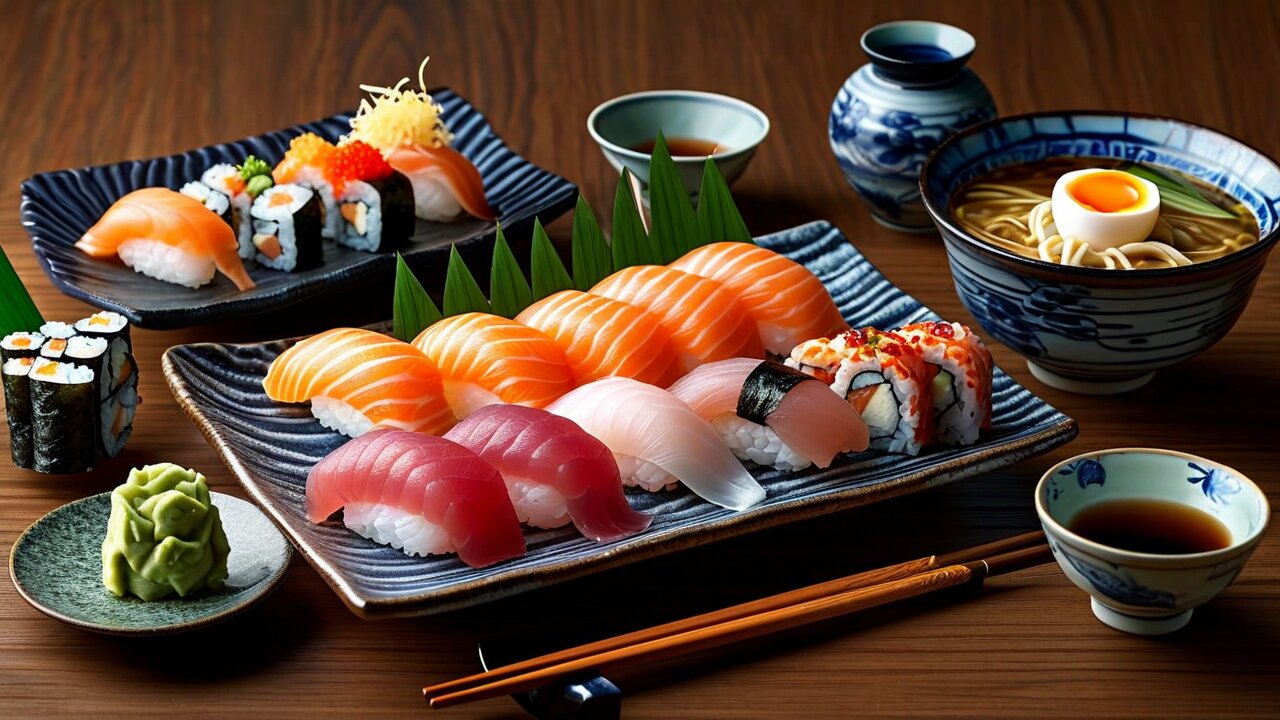
Japanese cooking is built on a small number of ideas applied with unusual rigour: dashi, the stock of kombu kelp and dried bonito that carries almost everything savoury; seasonality taken literally, so that a menu changes several times within a single month; and an aesthetic that treats the plate, the bowl and the arrangement as part of the dish. Washoku went onto UNESCO's intangible heritage list in 2013.
The shape of a meal
The traditional pattern is ichijū-sansai: rice, one soup, three dishes, plus pickles. Kaiseki is the formal multi-course version, developed alongside the tea ceremony, and is the single most expensive and most rewarding meal in Japan. At the other end, a teishoku set lunch — main, rice, miso soup, pickles — costs ¥900–1,500 almost anywhere and is reliably good.
Sushi, honestly
Sushi means the vinegared rice, not the fish. Nigiri is the hand-pressed form invented in Edo around the 1820s as street food; sashimi is raw fish with no rice and is not sushi at all. At a counter, eat nigiri in one bite, dip fish side into the soy so the rice does not disintegrate, and use ginger as a palate cleanser between pieces rather than as a topping. Kaitenzushi conveyor-belt chains are cheap, good and completely unintimidating — start there.
Noodles
Ramen is Chinese in origin, Japanese in development, and fiercely regional: Sapporo miso, Hakata tonkotsu, Tokyo shōyu, Kitakata. Soba, buckwheat, is eaten hot or cold and slurped — audibly, which is correct and aerates the noodle. Udon, thick wheat, is at its best in Kagawa on Shikoku, where self-service udon shops are a local institution. Sōmen, very thin and served cold, is a summer dish.
The rest of it
Tempura, introduced by the Portuguese in the sixteenth century and refined out of recognition. Yakitori, grilled chicken by the skewer, part by part. Tonkatsu, a breaded pork cutlet. Okonomiyaki and takoyaki from Osaka. Curry rice, which arrived via the British Navy and is now a national comfort food. Onigiri from any konbini. Wagyu beef — Kobe is one of several appellations, not a synonym — graded up to A5 and best eaten in small quantities.
Practical dining
Many restaurants specialise in one thing. Ticket-vending machines at the door are common in noodle shops: press the picture, take the ticket, hand it over. Plastic food models in the window are accurate and you may point. Tipping is not done anywhere and attempting it causes confusion. Say itadakimasu before eating and gochisōsama deshita when you leave — both are automatic and both are noticed if you use them.
If you have dietary restrictions
Be prepared: this is the hardest part of Japan for many visitors. Dashi contains fish, so a vegetable dish is very often not vegetarian, and the concept translates poorly. Soy sauce contains wheat. Shōjin ryōri, the Buddhist temple cuisine served at Kōyasan and some Kyoto temples, is genuinely vegan and excellent. Carry a written card in Japanese naming what you cannot eat, and treat allergy information as something to confirm rather than assume.
👨🍳 Three Recipes
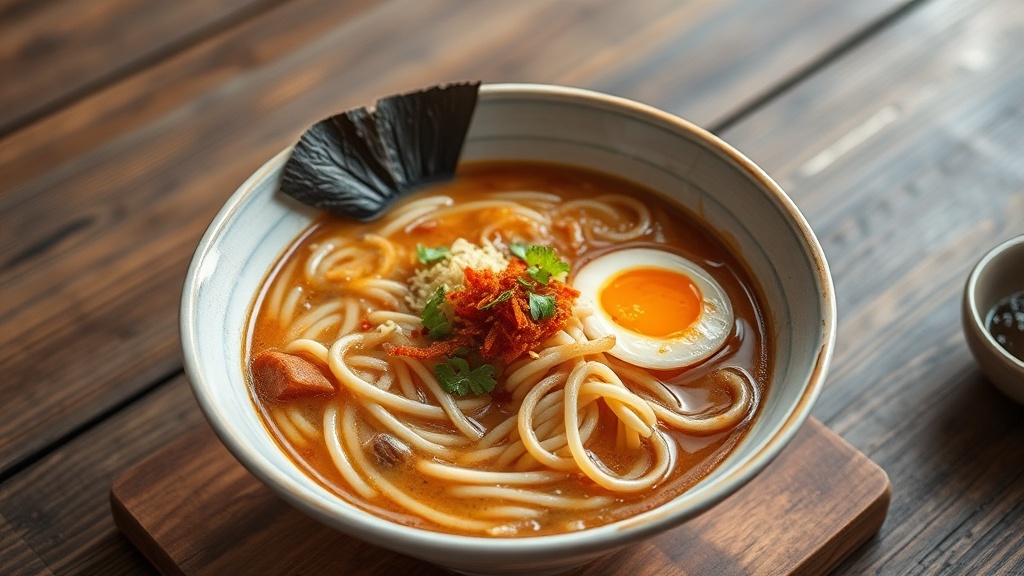
Shōyu Ramen
Tokyo · 2 bowls · broth 3 hours, assembly 10 minutes · the broth is the whole job
Ingredients: Broth: 1.5 l water · 1 chicken carcass · 1 piece kombu (10 cm) · 20 g dried shiitake · 1 spring onion top · 3 slices ginger · 2 garlic cloves. Tare (the seasoning base, per bowl): 2 tbsp Japanese soy sauce · 1 tsp mirin · 1 tsp sake · ½ tsp sugar. Toppings: 200 g fresh ramen noodles · 4 slices rolled pork belly or shoulder simmered in soy and mirin · 2 ajitama eggs · menma · thinly sliced spring onion · 2 sheets nori · a few drops of sesame oil.
Method: Soak the kombu and shiitake in the cold water for at least an hour, then heat slowly and remove the kombu just before it boils — boiled kombu turns slimy and bitter. Add the carcass, aromatics and shiitake and simmer gently, never at a rolling boil, for 2–3 hours, skimming. Strain. For the eggs: boil exactly 6½ minutes from cold-shocked fridge eggs, cool in ice water, peel, and marinate 4–24 hours in equal soy and mirin with a splash of water. To serve, put the tare in the bottom of a hot bowl, pour in 350 ml of very hot broth, cook the noodles for the time on the packet, drain hard, lift them into the bowl and fold them into a wave, then arrange the toppings and lean the nori against the rim.
💡 Two things separate a good bowl from a flat one: the broth must never boil hard, or it goes cloudy and greasy; and the bowl must be scalding, because ramen loses its heat in a minute. Warm the bowl with hot water while the noodles cook.
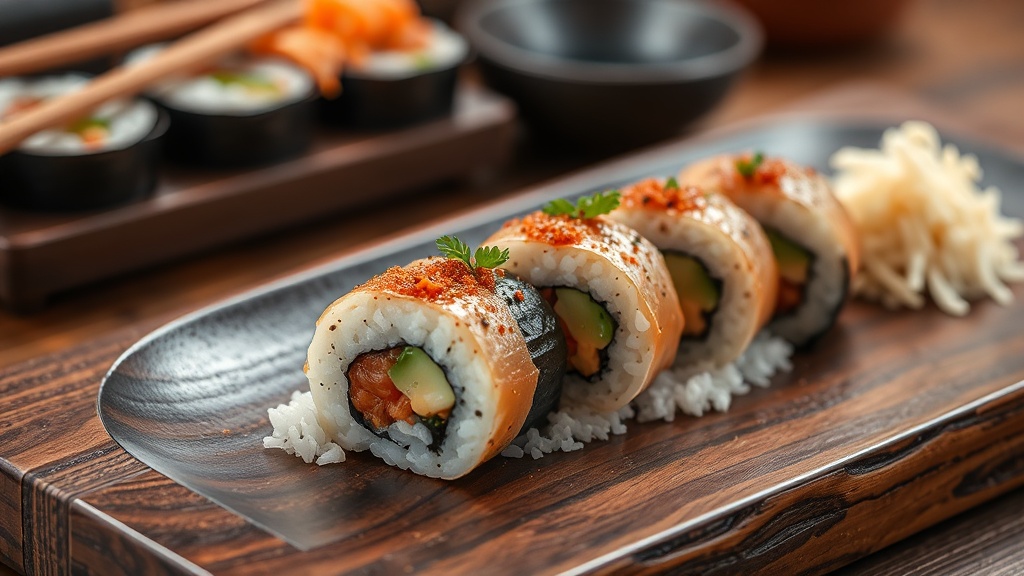
Maki-zushi
Edo · makes 4 rolls, 24 pieces · 45 minutes plus rice cooling · a bamboo mat helps
Ingredients: 300 g Japanese short-grain rice · 360 ml water · Vinegar seasoning: 60 ml rice vinegar · 25 g sugar · 5 g salt. 4 sheets nori · fillings: cucumber batons, avocado, or sashimi-grade tuna or salmon (ask a fishmonger explicitly for sashimi grade — supermarket fillets are not) · Japanese soy sauce, pickled ginger, wasabi to serve.
Method: Wash the rice in several changes of water until it runs nearly clear, drain 30 minutes, then cook. Warm the vinegar, sugar and salt until dissolved, tip the hot rice into a wide non-metal bowl, pour the seasoning over a spatula so it spreads, and cut it through the rice with slicing strokes rather than stirring, fanning as you go, until it is glossy and at body temperature. Lay a nori sheet shiny side down on the mat, spread rice over about three-quarters of it in a thin even layer with wet hands, lay the filling in a line a third of the way up, and roll away from you, pulling the mat back as you go so the roll tightens. Seal the bare strip of nori with a wet finger. Cut with a very sharp wet knife: halve the roll, then each half into three.
💡 Never refrigerate finished sushi — cold turns the rice hard and chalky, which is exactly what has gone wrong with most supermarket sushi. Wipe and re-wet the knife between every cut, or the rice drags and the roll tears.
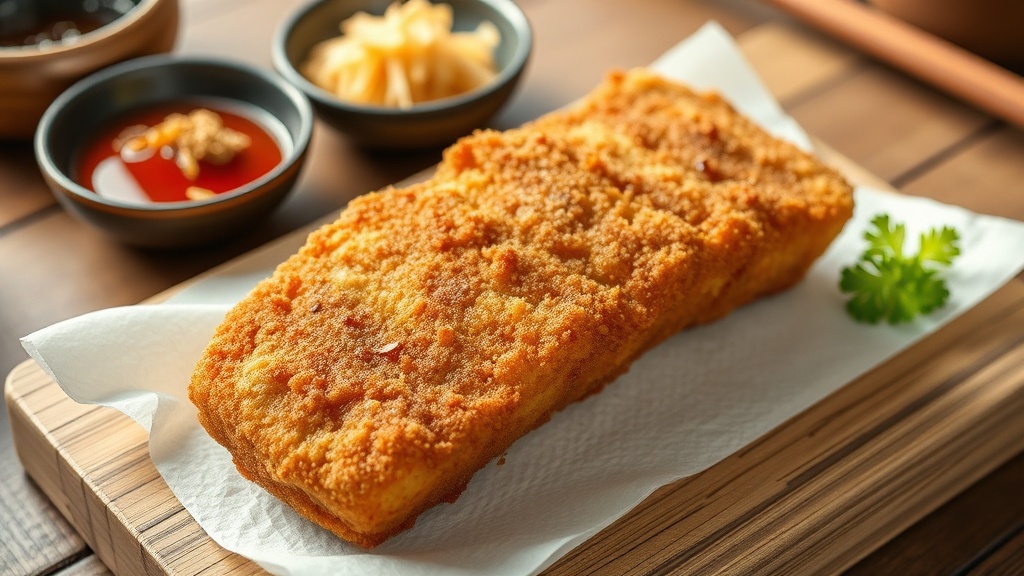
Tonkatsu
Tokyo · 2 people · 30 minutes · the frying temperature is the only difficult part
Ingredients: 2 pork loin chops, 2–2.5 cm thick, fat rim scored · salt and pepper · plain flour · 1 beaten egg with 1 tsp water · 80 g panko (the coarse Japanese crumb — ordinary breadcrumbs give a dense crust) · neutral oil for deep frying · to serve: a quarter of a white cabbage shredded as finely as you can manage, tonkatsu sauce, hot rice, miso soup, Japanese mustard.
Method: Snip through the membrane between meat and fat every couple of centimetres so the chop does not curl. Season, then flour, egg and panko, pressing the crumb on firmly without compacting it. Rest 10 minutes. Heat the oil to 170 °C, lower the cutlets in and fry 5–6 minutes, turning once, until deep gold; then lift them out, raise the oil to 190 °C and return them for 40 seconds to crisp. Drain standing on end so the crust does not steam. Rest 3 minutes, then slice across into strips and reassemble on the plate.
💡 The double fry is what gives the shattering crust — one temperature gives you either a pale cutlet or a burnt one. Shred the cabbage as thinly as possible and soak it in ice water for ten minutes; it is not a garnish, it is what makes the dish possible to finish.
🍶 Sake, Whisky, Beer and Wine
Sake
Brewed, not distilled, from rice, water, yeast and kōji mould, in a process where saccharification and fermentation happen simultaneously — which is technically unusual and is why sake reaches 15–20% alcohol. The word sake in Japan means alcohol in general; the drink is nihonshu. Grades depend on how much of each rice grain is polished away: junmai (no added alcohol), ginjō (at least 40% polished off), daiginjō (at least 50%). Good sake is usually served chilled; hot serving suits robust styles and hides flaws in cheap ones. Kōji brewing joined UNESCO's intangible list in 2024.
Shōchū and awamori
Distilled, and drunk far more than sake in the south. Shōchū is made from barley, sweet potato, rice or buckwheat, typically 25%, and served with hot or cold water or on the rocks. Awamori is Okinawa's version, made from long-grain Thai rice with black kōji, and the aged form — kūsu — is a serious drink. Ask for imo shōchū if you want the earthy sweet-potato one.
Whisky
Japanese whisky began in 1923 when Masataka Taketsuru, who had studied chemistry in Glasgow and apprenticed in Scottish distilleries, built Yamazaki for Suntory before founding Nikka. It spent eighty years as a domestic product and then won every award going, after which the aged stock ran out — which is why 18-year-old bottles now cost what they do. Note that until labelling rules tightened in 2021 a great deal of "Japanese whisky" was imported bulk spirit; look for a named distillery. In a bar, a highball — whisky and soda, ice, a lemon twist — is the national way to drink it.
Beer and the rest
Four big brewers — Asahi, Kirin, Sapporo, Suntory — making crisp pale lagers, plus a real craft scene since the licensing rules loosened in 1994. Happōshu and "new genre" beers are lower-malt products engineered around the beer tax and are cheaper. Also: umeshu, plum liqueur, often homemade; chūhai, canned shōchū highballs in every flavour imaginable; and green tea, which deserves its own paragraph — sencha everyday, gyokuro shade-grown and expensive, matcha stone-ground and whisked, hōjicha roasted and caffeine-light.
Wine
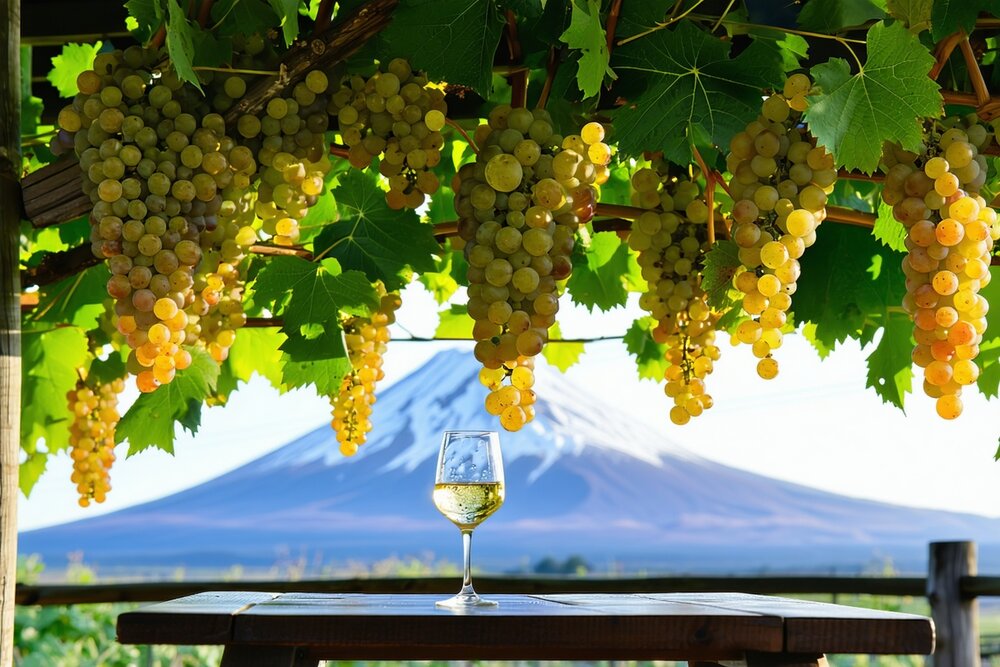
A small industry with a long history. Yamanashi prefecture at the foot of Fuji makes about a third of it, mostly from Koshu — a pale, low-alcohol, delicate white that suits raw fish better than almost any European wine and which has been sold in London since 2010. Hokkaido is the growth area, with cool-climate Pinot Noir and Kerner. Look for the Nihon Wine label, which since 2018 legally means made in Japan from Japanese grapes; anything else may be bottled imported bulk.
Drinking culture
Never pour your own — you fill your neighbour's glass and they fill yours, which is the whole point. Wait for kanpai before the first sip. The izakaya is the standard venue: small plates, long sessions, an otōshi seating charge of a few hundred yen that arrives as a small dish and is not optional. Nomikai work drinking parties have a formalised social role, and a second and third venue — nijikai, sanjikai — are normal. Public drinking is legal and common; public drunkenness is tolerated to a degree that surprises visitors, but loud drunkenness from a foreigner is not.
🚄 Getting Around
The Shinkansen
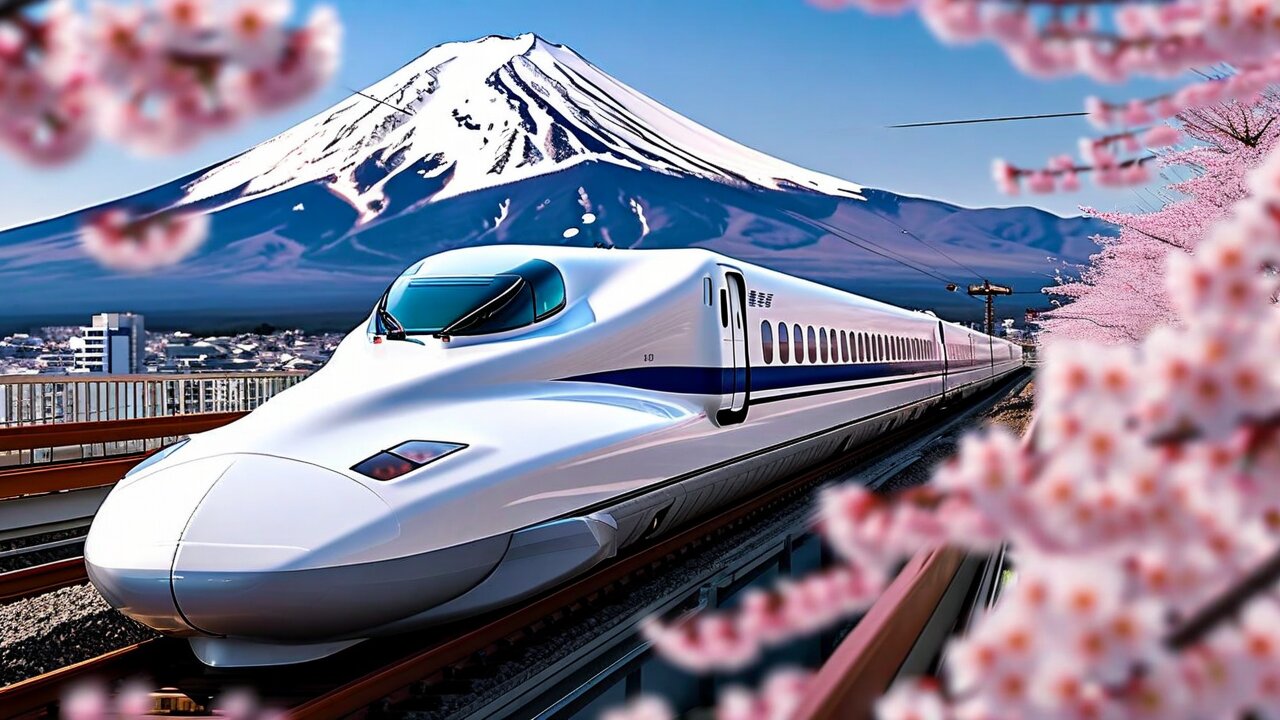
Nine lines radiating from Tokyo. Tokyo–Kyoto is 2h15 and Tokyo–Hiroshima about 4h, both faster door to door than flying. Reserved and non-reserved cars are separate; non-reserved is fine outside peak travel weeks. There is a luggage rule on the Tōkaidō, Sanyō and Kyushu lines: bags over 160 cm combined dimensions need a free reservation for the space behind the last row, and turning up without one attracts a charge. Buy an ekiben station lunchbox before boarding; it is part of the experience.
The Japan Rail Pass
Prices rose sharply in October 2023 — roughly 65–70% — and the pass is no longer the automatic buy it was. It now makes sense mainly for genuinely long itineraries: as a rough rule, a 7-day national pass pays for itself at about a Tokyo–Kyoto–Hiroshima–Tokyo run and not much less. For most two-week trips the regional passes (JR East, JR West Kansai-Hiroshima, JR Kyushu) or simply buying tickets are cheaper. Do the arithmetic on your actual route before buying.
IC cards
Suica, PASMO, ICOCA and their regional siblings are interchangeable across almost the whole country and work for trains, subways, buses, konbini, vending machines and many lockers. Adding a Suica to an iPhone or Android wallet and topping it up by card is the simplest option and avoids the physical-card shortages that have affected Tokyo since 2023. Welcome Suica and Welcome ICOCA are visitor versions with no deposit.
City transport
Tokyo's rail network is run by JR, Tokyo Metro, Toei and several private railways, which is why a single journey can require two gates and why an IC card is essential. Buses in Kyoto and rural Japan are usually boarded at the rear, paid at the front on exit, with a ticket you take on entry showing your fare stage. Taxis are excellent, expensive, and their rear doors open automatically — do not touch them.
Flying, ferries and driving
Domestic flights are competitive for Tokyo–Sapporo and Tokyo–Okinawa, where the train does not compete; ANA and JAL sell discounted visitor fares. Long-distance ferries serve Hokkaido, Kyushu, Shikoku and the Inland Sea islands and are cheap and comfortable. Driving is on the left, requires an International Driving Permit alongside your Czech licence, and is only worth it for Hokkaido, rural Kyushu, Shikoku or the Noto peninsula. Expressway tolls are very high.
Luggage forwarding
The single best trick in Japanese travel: takkyūbin. Hand your suitcase to a hotel front desk or a konbini, and it arrives at your next hotel the following day for around ¥2,000–2,500. This means you cross the country with a day bag instead of dragging a case up station stairs. Yamato Transport (the black cat logo) is the usual carrier. Allow two days for Hokkaido and Okinawa.
🗣️ The Language and Three Writing Systems
Japanese is spoken by about 125 million people and is related to no major language — the only established relatives are the Ryukyuan languages of Okinawa. Its grammar is regular and its pronunciation is genuinely easy for a Czech speaker; the writing system is the obstacle, and it is a considerable one.
Three scripts, used together
Hiragana (46 characters) for grammar and native words. Katakana (46 more, matching sounds) for foreign loanwords, onomatopoeia and emphasis. Kanji, Chinese characters, for the roots of most nouns and verbs — the official list for general use runs to 2,136, and Japanese children learn them across nine years of schooling. A normal sentence mixes all three, plus Latin letters and Arabic numerals. There is no word spacing.
Why kanji are hard
Each character generally has at least two readings: the on'yomi, a Japanese approximation of the Chinese pronunciation, and the kun'yomi, the native word. Which one applies depends on the compound, and there are exceptions. The character 生, for instance, has more than ten readings. Learning to read katakana is a genuinely worthwhile two-hour investment for a visitor, because it unlocks menus: コーヒー is kōhī, ビール is bīru.
What is easy
Pronunciation: five pure vowels, almost exactly the Czech ones, and a small consonant set with no tones. No grammatical gender, no articles, no plural, and verbs do not change for person or number. The traps are the r, a single flap between Czech r and l; long vowels, which change meaning (obasan aunt, obāsan grandmother); and the doubled consonants written with a small っ.
Politeness levels
The genuinely difficult part. Japanese encodes social relationship in the verb: plain form, polite -masu form, humble language and honorific language, chosen by who you are speaking to and about. A visitor needs only the polite form and will be forgiven everything. What matters more is that the language leaves a great deal unsaid and expects the listener to complete it — which is why direct refusals are rare and chotto…, "a little…", trailing off, means no.
Twelve phrases
Sumimasen — excuse me, sorry, and thank you, the single most useful word in the language. Arigatō gozaimasu — thank you. Onegaishimasu — please, when asking for something. Kudasai — please give me. Hai / iie. Wakarimasen — I don't understand. Eigo ga hanasemasu ka — do you speak English? Ikura desu ka — how much? Toire wa doko desu ka — where is the toilet? Oishii — delicious. Daijōbu desu — it's fine / no thank you. Ohayō gozaimasu / konnichiwa / konbanwa.
Getting by without it
Easier than it was. Station and airport signage is bilingual, major museums have English, and Google Translate's camera mode handles menus adequately. English competence among staff is thin but effort is universal — people will walk you to where you are going rather than explain. Write your destination in Japanese to show a taxi driver; hotels will do this for you.
💡 Etiquette That Actually Matters
Most of what circulates about Japanese etiquette is either exaggerated or applies to business contexts a tourist will never enter. The list below is the short version of what genuinely registers, and the general principle behind all of it is meiwaku — not causing trouble to the people around you.
Shoes
Off at the entrance of any home, most ryokan, many temples, some restaurants, and any place with a raised step and a shoe rack at the door. Slippers are usually provided; separate toilet slippers wait inside the toilet and must stay there — walking back into a tatami room in them is the classic visitor mistake. Never step on tatami in shoes or slippers, socks only.
Chopsticks
Two prohibitions matter, both because they mirror funeral rites: never stand chopsticks upright in a bowl of rice, and never pass food chopstick-to-chopstick. Otherwise: do not point with them, do not spear food, and rest them on the holder or across the bowl. Slurping noodles is fine and expected; blowing your nose at the table is not, and should be done in the toilet.
Onsen
Wash thoroughly at the seated shower stations before entering — the bath is for soaking, not cleaning. No swimwear, no towel in the water (fold the small one on your head, which is what everybody does), tie long hair up. Baths are usually sex-segregated. Tattoos remain a real problem: many onsen still refuse entry because of the yakuza association, though attitudes are softening and some places allow covering patches or have private kashikiri baths. Check before you travel rather than at the door.
In public
Do not eat while walking — this is now signposted in Kyoto and Kamakura. Do not talk on the phone on a train. Queue where the platform markings say to, let people off first. Blowing your nose in public is considered mildly disgusting; sniffing is not. Do not tip. Point with an open hand, not a finger. Take rubbish with you.
Money and giving
Cash is handed over on the small tray at the till, not into the hand. Business cards and gifts are given and received with both hands and looked at. Gifts are opened later, not in front of the giver. If someone helps you, a small wrapped gift from your own country is disproportionately appreciated — this is a country that runs on omiyage, souvenirs brought back for colleagues.
What is forgiven
Almost everything. Nobody expects a visitor to know the rules, and mistakes are met with amusement rather than offence. The two things that genuinely irritate are noise and photographing people without permission — especially in Kyoto's geisha districts, where it escalated far enough for lanes to be closed. Get those two right and the rest is detail.
♨️ Onsen, Ryokan and Where to Sleep
Ryokan
A traditional inn: tatami rooms, futon laid out on the floor while you are at dinner, yukata robes to wear around the building, and an elaborate multi-course dinner and breakfast included. It is not cheap — ¥15,000–50,000 per person per night with meals — and it is the single most memorable accommodation experience in Japan. One or two nights in a good one is worth reorganising a trip around. Kaga, Hakone, Kinosaki, Kurokawa and Beppu are the classic onsen towns.
Onsen towns
Kinosaki in Hyōgo is the ideal introduction: guests walk between seven public bathhouses in yukata and wooden geta, and the whole town is the hotel. Kurokawa in Kyushu is the prettiest. Nozawa Onsen in Nagano combines skiing with free public baths. Beppu is the largest and most industrial. A rotenburo is an outdoor bath, and one in falling snow is the reason people come back.
Everything else
Business hotels — Toyoko Inn, APA, Dormy Inn — are small, spotless, ¥8,000–14,000, and often have a communal bath on the top floor; Dormy Inn in particular is far better than the price suggests. Capsule hotels are clean, cheap and fine for a night. Minshuku are family-run guesthouses. Shukubō temple lodgings at Kōyasan give you vegetarian monastic food and a 06:00 service. Hostels are excellent and often beautifully designed.
Booking and rules
Book early for cherry blossom (late March–early April), Golden Week (29 April–5 May), Obon (mid-August) and New Year, when the whole country moves and prices double. Many ryokan want to know your arrival time because dinner is served at a set hour. Japanese hotel rooms are small by European standards and this is not a complaint anyone will entertain. An accommodation tax of a few hundred yen per night applies in Tokyo, Kyoto, Osaka and several other cities.
🎮 Anime, Manga and the Rest of It
For a large share of visitors under forty this is the reason they came, and it deserves better than being treated as a curiosity. Manga accounts for a substantial share of all printed matter sold in Japan, anime is a major export industry, and the aesthetic has been feeding back into global culture for thirty years.
Where it came from
Osamu Tezuka (1928–89) is the founding figure — Astro Boy, Black Jack, Phoenix — who imported cinematic panel layouts into comics and then invented the economics of television animation. Manga's roots run back through Meiji political cartooning to Edo woodblock books and, arguably, to the twelfth-century Chōjū-jinbutsu-giga animal scrolls kept at Kōzan-ji in Kyoto.
Studio Ghibli
Hayao Miyazaki and Isao Takahata's studio, founded 1985. Spirited Away won the Academy Award for Best Animated Feature in 2003 and was for nearly two decades the highest-grossing film in Japanese history. The Ghibli Museum in Mitaka, western Tokyo, sells tickets by advance lottery only and does not sell at the door; Ghibli Park near Nagoya opened in 2022 and also needs booking well ahead.
Where to go
Akihabara in Tokyo for electronics, anime retail and arcades — much changed and much more commercial than its reputation, but Super Potato for retro games and the multi-storey Mandarake are still worth it. Nakano Broadway is the collectors' version and better. Ikebukuro's Otome Road is the counterpart aimed at women. In Osaka, Den Den Town. The Kyoto International Manga Museum is a converted school with 300,000 volumes you may sit and read.
Games and arcades
Nintendo, Sony, Sega, Capcom, Konami, Square Enix, FromSoftware. Game centres are still everywhere and still busy: rhythm games, fighting games taken extremely seriously, and floors of UFO catcher claw machines. Purikura photo booths are a rite of passage. Super Nintendo World at Universal Studios Japan in Osaka, and the Nintendo Museum in Uji, which opened in 2024 and requires a lottery booking.
Other Japanese pop
J-pop and its idol industry; city pop from the 1980s, which the internet rediscovered around 2018; karaoke, invented here in the 1970s and done in private rooms rather than in front of a bar, charged by the hour and often with unlimited drinks. And baseball, which is genuinely the national sport — a Hanshin Tigers game at Kōshien in Osaka, with its organised chanting and balloon release, is one of the best live sporting atmospheres anywhere.
Sumo
Six 15-day tournaments a year — Tokyo in January, May and September, Osaka in March, Nagoya in July, Fukuoka in November. Tickets sell out for the good days and go on sale about a month ahead. If there is no tournament, some Tokyo stables allow visitors to watch morning training, usually through a guide and always with strict silence. The ritual — the salt, the stamping, the referee's fan — is Shinto and is most of what you are watching.
📅 When to Visit
Cherry blossom (late March – mid April)
The sakura zensen, the blossom front, moves north from Kyushu in late March to Hokkaido in early May; Tokyo and Kyoto usually peak in the last days of March or the first week of April and full bloom lasts about a week, less if it rains. The forecasts are published from January and are taken seriously. It is beautiful and it is the single busiest, most expensive week of the year: book six months ahead or accept what is left.
Golden Week (29 April – 5 May)
Four public holidays in a row and the one period to avoid outright. The entire country travels at once, Shinkansen reserved seats sell out weeks ahead, hotel prices double and every famous place is at capacity. The same applies to Obon in mid-August and the New Year period from about 29 December to 3 January, when many businesses close entirely.
May and June
May after Golden Week is one of the best windows of the year — warm, green, clear, and comparatively quiet. Then the tsuyu rainy season arrives, roughly early June to mid-July in most of the country, three weeks earlier in Okinawa and skipping Hokkaido entirely. It is not constant rain, hydrangea season is lovely, and prices are low — but humidity is high and mountain visibility is poor.
July and August
Hot and very humid — Tokyo regularly sits at 33–36 °C with high humidity, and heatstroke is a real risk. It is also festival season, which is a genuine reason to come: Kyoto's month-long Gion Matsuri with its float processions on 17 and 24 July, Aomori's Nebuta and Akita's Kantō in early August, fireworks (hanabi) nearly every weekend. Head for Hokkaido or the Alps if you want to be comfortable. Typhoon season begins.
Autumn colour (October – early December)
Koyo. The front moves the opposite way to the blossom, from Hokkaido in late September to Kyushu in early December; Kyoto peaks around mid to late November. Weather is stable and clear, temperatures are ideal, and it is now nearly as busy as the blossom in the famous places. Nikkō, the Japanese Alps and Tōhoku are spectacular and much less crowded than Kyoto.
Winter (December – February)
Underrated. Cold and dry on the Pacific side with a good chance of a clear Fuji; enormous snow on the Sea of Japan side, and world-class skiing in Hokkaido and Nagano. Kyoto in January and February is as close to empty as it ever gets. Illuminations run through December, the Sapporo Snow Festival is in early February, and this is the season for onsen, hotpot and the best sake.
📋 Practical Information
Entry
Czech citizens and nationals of some 70 other countries enter visa-free for up to 90 days as tourists. There is currently no electronic authorisation to apply for. Japan passed the law creating JESTA, its own ESTA-style pre-screening system, on 29 May 2026, but the system launches no later than March 2029 — so it does not apply to travel in 2026 or 2027, and anything selling you a Japanese travel authorisation today is a scam. Fingerprints and a photograph are taken at immigration, and the arrival and customs forms are best done in advance through the Visit Japan Web site, which gives you QR codes.
Health
No vaccinations are required and Japan is medically excellent. The EHIC does not apply — Japan is not in the EU or the EEA and there is no Czech–Japanese healthcare agreement — so commercial travel insurance is essential, and should cover repatriation. Treatment is expensive without it. Bring enough of any prescription medicine for the trip with the prescription; note that some drugs ordinary in Europe, including pseudoephedrine decongestants and certain ADHD medications, are outright prohibited, and codeine above a threshold needs advance permission (yakkan shōmei). Check before you pack. Emergency numbers: 119 ambulance and fire, 110 police.
Connectivity
Free public wifi is patchy. Buy a data eSIM before you fly or rent a pocket wifi at the airport — both are cheap and both work. Japanese addresses are not sequential along streets but numbered by block within a district, so navigation apps are near-essential; Google Maps works very well for Japanese public transport, and Navitime or Japan Travel are better for rail specifics.
Money
The yen. Cards are widely but not universally accepted; convenience-store ATMs — 7-Eleven and Japan Post — reliably take foreign cards, and many bank ATMs do not. Carry cash for temples, small restaurants, markets and rural transport. Tax-free shopping is available to visitors over ¥5,000 in participating shops with your passport, though the government has been considering reducing the refund and using the difference for tourism management. There is a ¥1,000 international tourist tax included in your departure ticket price, and proposals to raise it are live.
Safety
One of the safest countries in the world. Lost wallets are routinely handed in with the cash still in them, and it is normal to leave a bag on a café table to reserve it. The real hazards are natural: earthquakes, typhoons in late summer, and heat in July and August. Download the Safety Tips app from the Japan Tourism Agency, which pushes earthquake, tsunami and weather warnings in English. Women travelling alone report Japan as among the easiest destinations anywhere, with the qualification that groping on crowded commuter trains is a known problem, which is why some lines run women-only cars at rush hour.
Climbing Fuji, if you plan to
The season is short and the rules tightened in 2026. All four trails now charge a mandatory ¥4,000 per climber, payable online at registration or in cash at the gate, and the Yoshida trail has a daily cap of 4,000 climbers with its gate shut from 14:00 to 03:00 for anyone without a mountain hut booking. Huts are separate and must be reserved and paid for on their own. In 2026 the Yoshida and Subashiri trails opened on 1 July, Fujinomiya and Gotemba on 10 July, and all closed on 10 September. You will be asked to show boots, rain gear and warm clothing. Outside the season the mountain is genuinely dangerous and the huts are shut.
💰 What It Costs
Japan has a reputation for being ruinously expensive that is about thirty years out of date. The weak yen since 2022 has made it, for a European visitor, comparable to or cheaper than western Europe for everything except long-distance transport and top-end accommodation. Rates move; check before budgeting.
Eating
A bowl of very good ramen ¥900–1,300. A teishoku set lunch ¥900–1,500. Conveyor sushi ¥100–300 a plate. A konbini breakfast ¥400. A solid izakaya dinner with drinks ¥3,000–5,000 a head. Department-store food halls after 19:00 discount aggressively. At the other end, a Michelin-starred kaiseki dinner runs ¥20,000–50,000 and the top sushi counters more, usually by introduction.
Sleeping
Hostel dorm ¥3,000–4,500. Capsule ¥4,000–6,000. Business hotel double ¥10,000–18,000. Mid-range city hotel ¥18,000–30,000. Ryokan with two meals ¥15,000–50,000 per person. Prices in Kyoto during blossom and autumn colour, and everywhere during Golden Week, run well above these.
Moving
Tokyo subway single ¥180–330. Shinkansen Tokyo–Kyoto ¥14,170 reserved. A 7-day national JR Pass ¥50,000. Airport transfer from Narita ¥1,000 by bus to ¥3,070 by Skyliner. Taxi flagfall around ¥500 and it climbs fast. Bicycle hire ¥1,000–1,500 a day, and Kyoto, Kanazawa and Kamakura are all good on a bike.
A realistic daily budget
Backpacking with hostels, konbini and local trains: ¥8,000–11,000 a day. Comfortable mid-range with business hotels, restaurant meals and some long-distance travel: ¥18,000–28,000. Comfortable-plus with the occasional ryokan and kaiseki: ¥40,000 and up. At roughly ¥1 ≈ 0.15 Kč — verify the current rate — the mid-range figure is about 2,700–4,200 Kč a day. Entry to most temples and shrines is ¥300–600 and museums ¥500–1,500, so sightseeing itself is cheap.
🇨🇿 Getting There, and Notes for Czech Travellers
Flights from Prague
There is no direct flight from Prague to Japan. Realistic one-stop routings go via the Gulf (Qatar Airways through Doha, Emirates through Dubai, Etihad through Abu Dhabi), via Istanbul with Turkish, or via a European hub — Helsinki, Frankfurt, Munich, Paris, Amsterdam, Vienna, Warsaw with LOT. Total journey time is typically 14–18 hours. Since 2022 most carriers avoid Russian airspace, which has added roughly two to three hours to the northern European routings and made the Gulf hubs relatively more attractive. Tokyo has two airports — Haneda is far closer to the city than Narita — and Osaka's Kansai is often the better arrival point for a Kansai-first trip.
Open-jaw and the trip shape
Because Japan is long and the Shinkansen is fast, the standard advice is to fly into Tokyo and out of Osaka (or the reverse), which costs little more and saves a whole day of backtracking. A first trip of two weeks that works: Tokyo 4 nights, a night in Hakone or the Fuji lakes, Takayama or Kanazawa 2 nights, Kyoto 4 nights, Osaka 2 nights with day trips to Nara and Himeji, out of Kansai.
Money and prices in Czech terms
The yen. At recent rates around ¥1 ≈ 0.15 Kč, so ¥1,000 is roughly 150 Kč — a bowl of excellent ramen for the price of a Prague lunch menu, a business hotel double for about 1,800–2,700 Kč, and a Tokyo–Kyoto Shinkansen ticket for about 2,100 Kč. Verify the rate before you go; the yen has moved a great deal. Exchange in Japan is fine, but withdrawing from a 7-Eleven ATM with a card is usually better than carrying euros.
MZV ČR, DROZD and the embassy
The Czech Embassy is in Tokyo (Hiroo 2-16-14, Shibuya-ku), with honorary consulates elsewhere. Register in DROZD before you go — for Japan this is not a formality, because it is exactly the mechanism through which the ministry would contact you after an earthquake or a typhoon. Check current advice at mzv.gov.cz. The EHIC does not apply in Japan; commercial insurance is not optional.
Czech traces in Japan
More than most people expect. The Hiroshima A-Bomb Dome was designed by the Czech architect Jan Letzel (1880–1925), who worked in Japan for over a decade and built several dozen buildings there; the fact that a Czech building became the world's best-known monument to nuclear war is a strange piece of shared history. Karel Čapek's word robot arrived in Japanese as ロボット and the country then took the concept further than anyone. Czech puppetry, glass and Bohemian crystal have a following, Japanese audiences take Dvořák and Janáček seriously, and Czech beer is a recognised category in the Japanese craft scene.
What surprises Czechs most
Three things. That the trains are not merely punctual but that a twenty-second delay produces an announcement and an apology. That nothing is negotiable — prices, rules, opening hours and portion sizes are simply what they are, and asking for a modification is a genuine imposition rather than normal customer behaviour. And that a country this orderly is also this strange: the vending machines, the mascot characters attached to every prefecture and police station, and the willingness to take something apparently trivial and pursue it to an extreme are all the same national trait as the punctuality.
⚖️ Overtourism, and Travelling Better
Japan took a record 42,683,600 foreign visitors in 2025, up 15.8% on 2024 — from about 8.6 million in 2010. The largest source markets were South Korea (9.46M), China (9.10M), Taiwan (6.76M), the United States (3.31M) and Hong Kong (2.52M). The 2026 figure is forecast to come in slightly lower, around 41 million, mainly because of the drop in Chinese travel after the November 2025 diplomatic row.
Where the pressure actually is
Not evenly spread. It concentrates on Kyoto, central Tokyo, the Fuji area, and a short list of individual sites. Kyoto's specific complaint is the city buses, where residents cannot board because they are full of visitors with luggage; the city has raised bus fares, restricted large suitcases on some routes and pushed people onto the subway. Kamakura has a level crossing made famous by an anime opening where crowds stand in the road. Fujikawaguchiko put up a barrier in 2024 to stop people photographing Fuji over a convenience store from the middle of a street.
What is being done
A visitor levy at Miyajima; the Fuji climbing fee and daily cap described above; the Gion alley closures and the ¥10,000 photography fine; accommodation taxes in Tokyo, Kyoto and Osaka; and government proposals to raise the departure tax and cut the tax-free shopping refund, using the difference for crowd management. From 2026 Japan is also rolling out AI crowd forecasting with live alerts, so that visitors can see where the pressure is and go elsewhere.
The easy fixes
Go early. Fushimi Inari at 06:30, the bamboo grove at 07:00 and Kiyomizu-dera at opening are different places from the same sites at noon. Go in winter. Kyoto in late January is quiet, cheap and clear. Use the subway and JR, not the Kyoto buses. Forward your luggage rather than dragging it onto commuter trains. And spend two nights somewhere instead of one, which changes what a place earns from you and what you get from it.
Go somewhere else
Japan has 47 prefectures and the pressure is on about five. Instead of Kyoto's temple queue, Kanazawa, Kamakura midweek, or Uji. Instead of the Golden Route, Tōhoku — the festivals are better and nobody is there. Instead of Hakone, Kinosaki or Nozawa. Instead of Nara's deer, Hōryū-ji half an hour away with the world's oldest wooden buildings and empty halls. Shikoku, the San'in coast, the Noto peninsula and the Inland Sea islands are all first-rank and all lightly visited.
Behave like a resident, briefly
Almost all the friction reported by Japanese municipalities comes down to a short list: noise in residential streets at night, eating while walking, blocking pavements and level crossings to take photographs, luggage on rush-hour trains, photographing people without asking, and treating shrines as backdrops rather than as working religious sites. None of these is hard to avoid, and avoiding them is the whole of what is being asked.
And go
Tourism is a policy priority in Japan and rural regions in particular actively want visitors — many towns are shrinking so fast that a guesthouse full of foreigners is the difference between a functioning main street and a shuttered one. The problem is distribution, not volume. Two weeks spent in Tōhoku or Kyushu will cost less, show you more, and be more welcome than the same fortnight on the Tokyo–Kyoto–Osaka corridor.
📸 Photo Gallery
Every photograph in this archive was opened and checked before it was captioned. Where an image diverges from the real thing, the caption says so rather than letting the picture stand as the record.
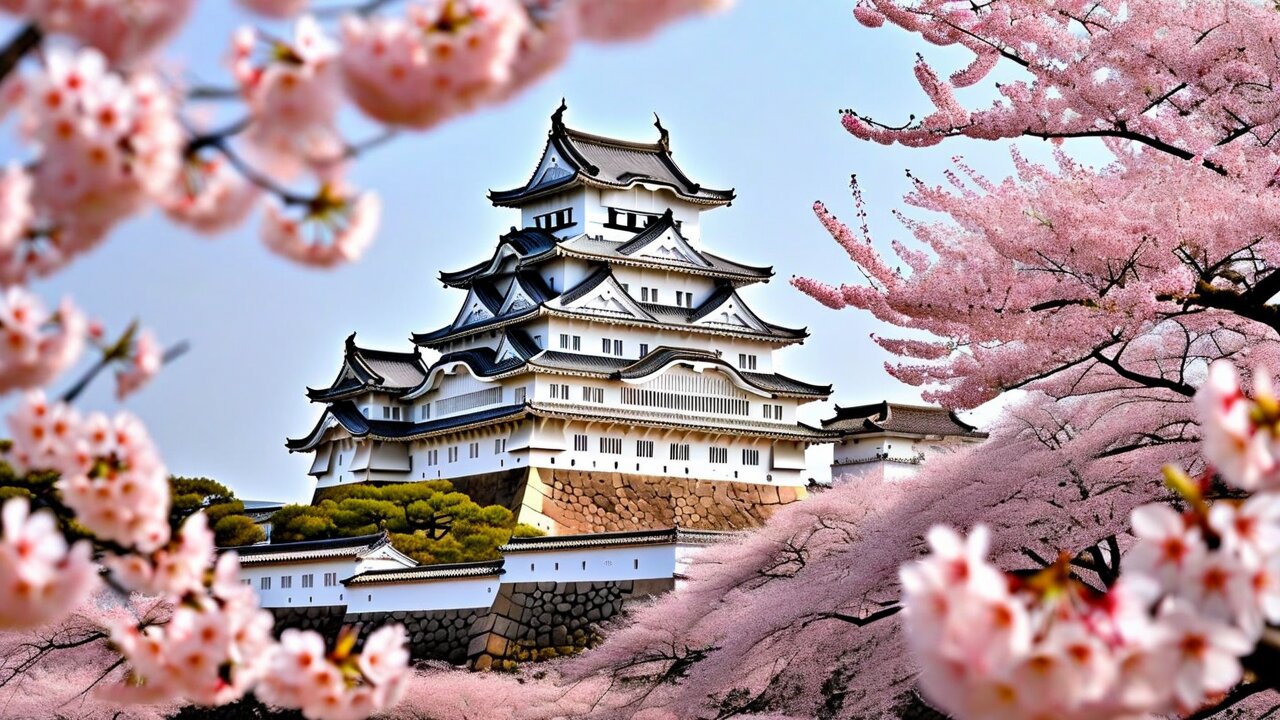
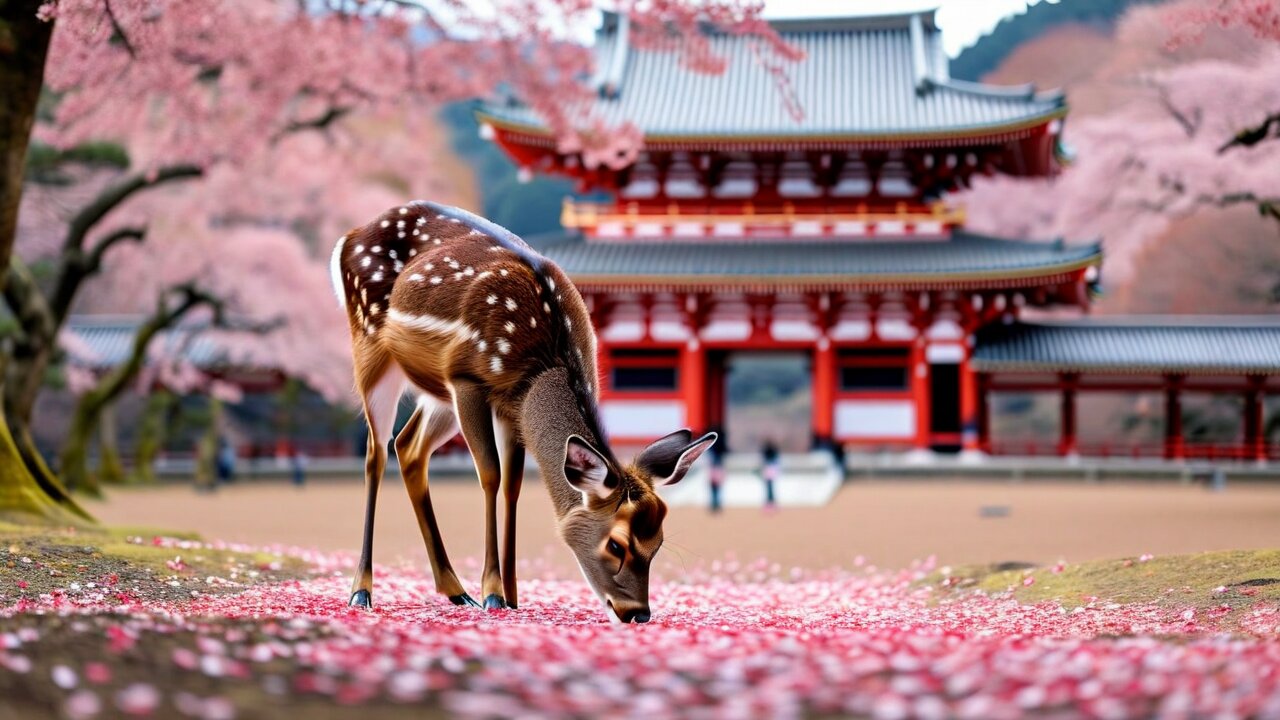
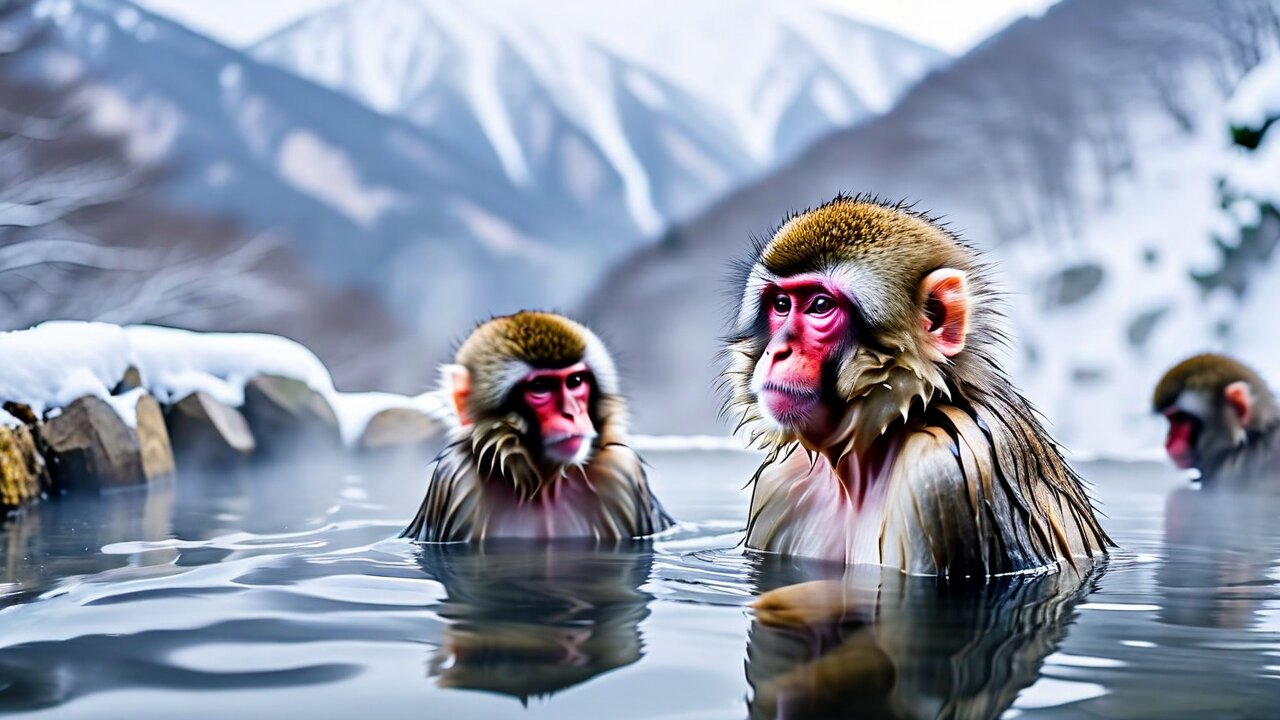
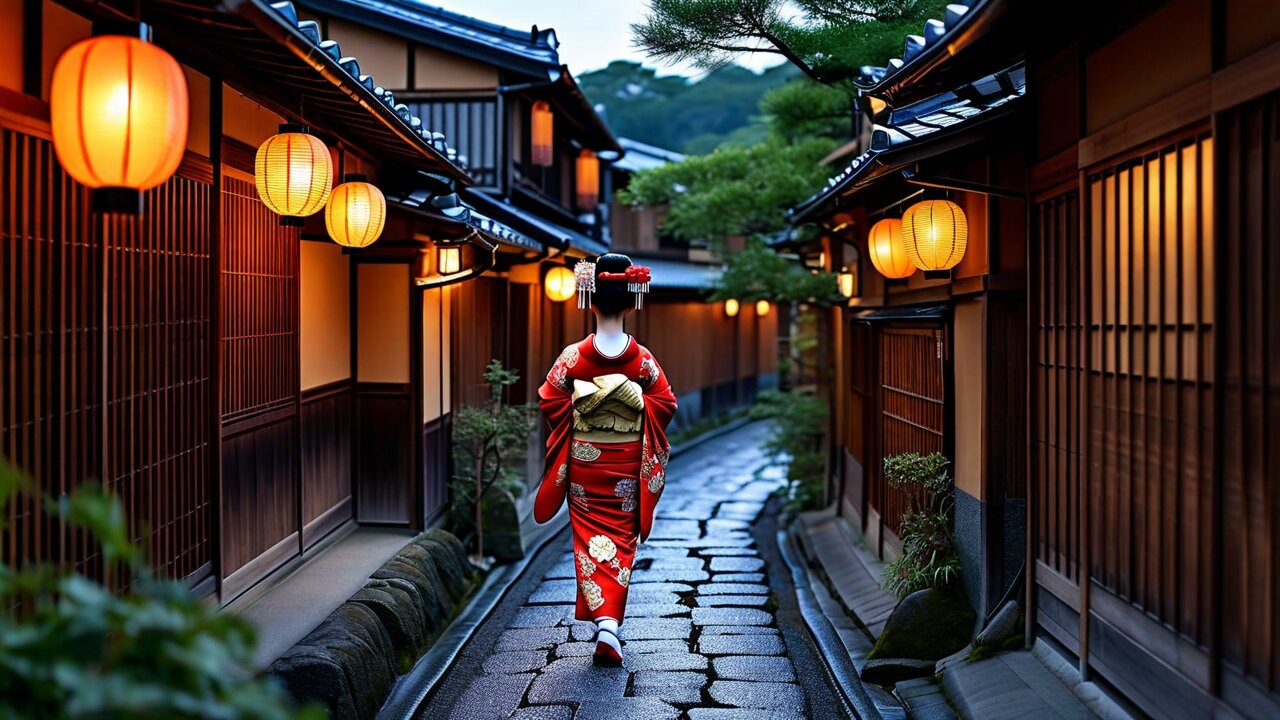
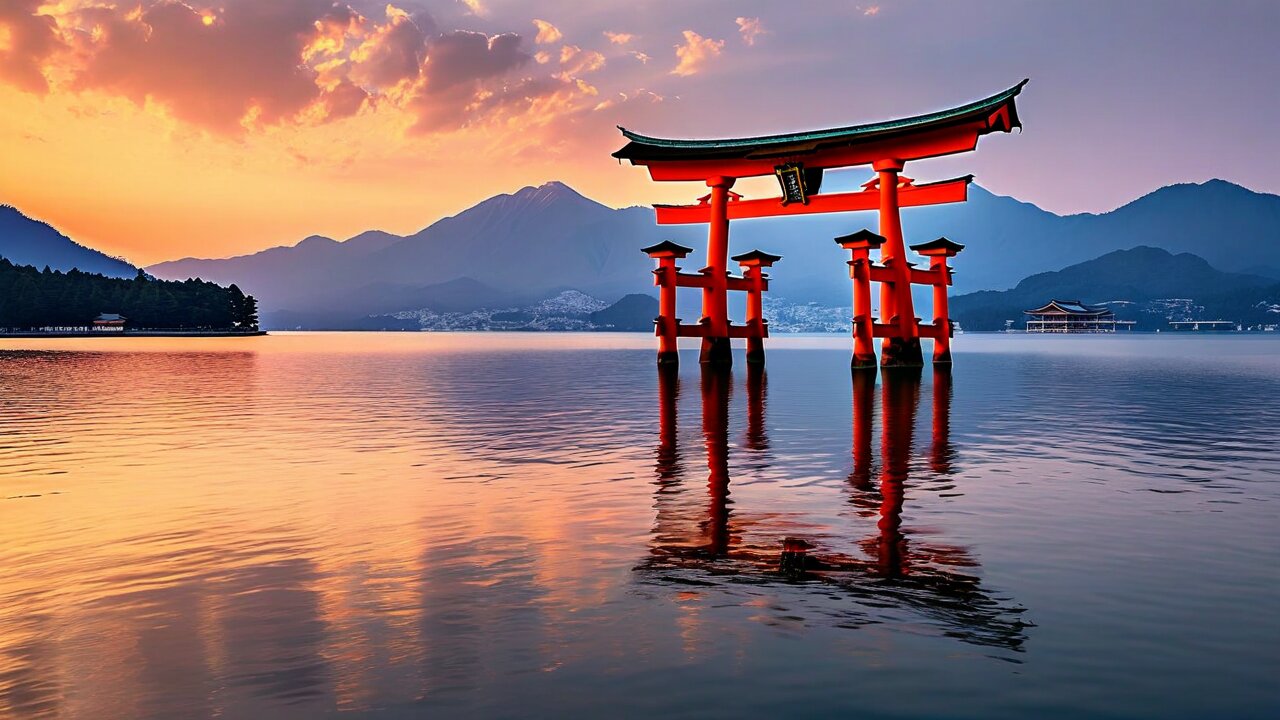
Support This Project 🌍
This World Travel Factbook is a labor of love – free to use for all travelers. If you find it helpful, consider supporting its continued development.