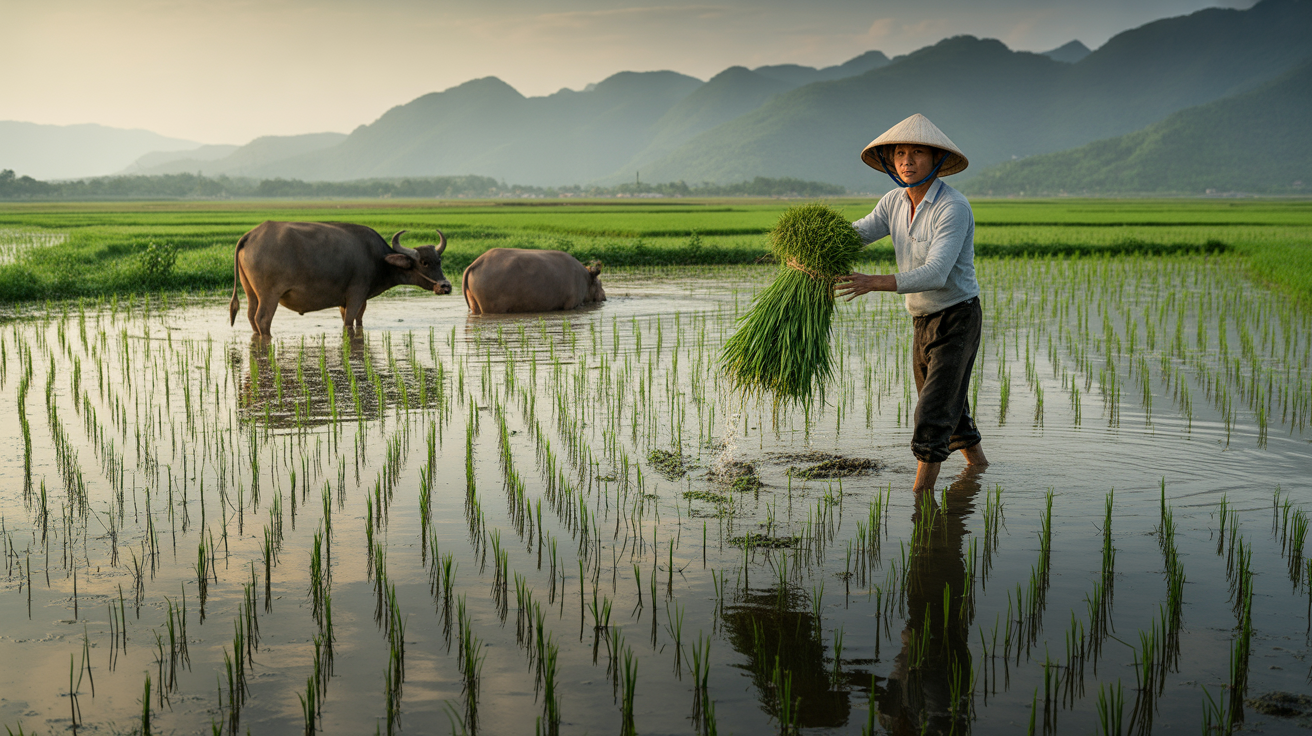
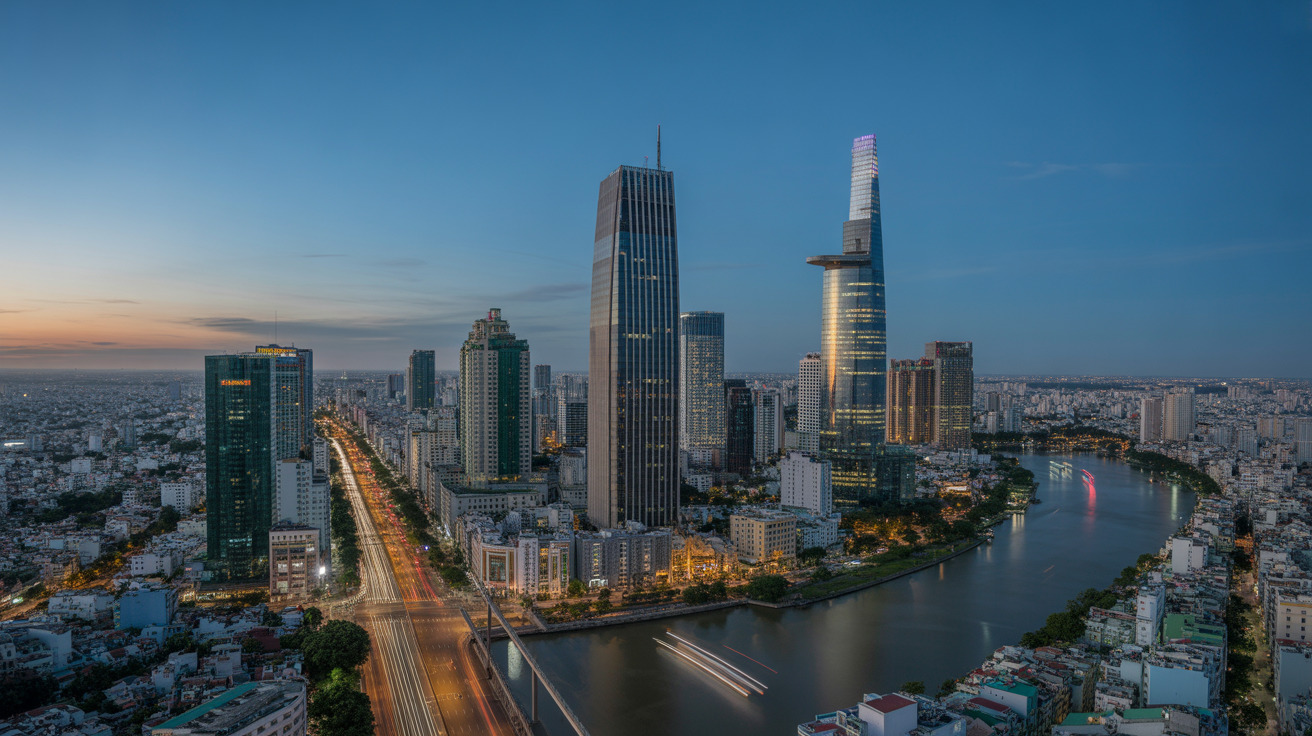
Rice fields beside the railway, pagodas behind city streets, limestone rising from the sea: Vietnam changes character repeatedly along its long north–south axis. The pleasure lies in the transitions. A journey can move from the lanes of Hanoi to mountain markets, from the imperial landscape of Huế to the merchant houses of Hội An, and from Ho Chi Minh City to the waterways of the Mekong Delta.
Vietnam is shaped, as a familiar geographical metaphor has it, like a carrying pole balancing two rice baskets. The Red River Delta and the Mekong Delta are the baskets; the narrow central region connects them. This is a useful starting point, but mountains, islands, cities and the Central Highlands make the country much more varied than a single coastal itinerary suggests.
02
A country best understood slowly — Details and context
Allow time for ordinary streets as well as celebrated landmarks. Breakfast stalls, a neighborhood market, a coffee stop and a walk around a lake reveal different rhythms from an organized excursion. Regional differences in weather and travel time matter: a two-week visit works better with a few well-chosen bases than with a new hotel every night. Separate pages develop food, wine, heritage, business and video topics.
Vietnam rewards regional thinking: the Red River Delta, the central coast, the Central Highlands, the southeast and the Mekong Delta have distinct rhythms, cuisines and travel conditions. Building an itinerary around two or three connected regions usually reveals more than treating the country as a checklist from north to south.
03
Names, language and identity
Việt Nam did not first become an official name in 1945. It was adopted under Emperor Gia Long in 1804; Đại Việt and Đại Nam belong to other periods in the country's naming history. Văn Lang and the Hùng kings occupy an important place in national tradition, but legendary chronology should not be read as a modern, documented state timeline.
The present state is the Socialist Republic of Viet Nam, established after formal reunification in 1976. The end of the war in April 1975 and the creation of the reunified republic the following year are related but distinct events. National identity also includes the experiences of communities whose histories cross today's borders, and of Vietnamese people living overseas.
04
Names, language and identity — Details and context
Vietnamese uses the Latin-based quốc ngữ writing system. Diacritics carry meaning: accents are part of a name, not decoration. Tone systems differ by dialect, so the familiar description of six tones refers particularly to standard northern Vietnamese. Useful beginnings are xin chào, cảm ơn and xin lỗi. Address terms depend on age, relationship and setting; listening to how a host addresses you is often more helpful than assuming a single word always means “you.”
Vietnamese uses a Latin-based script enriched with diacritics that mark both vowel quality and tone. Learning to preserve those marks in names is a small but important courtesy, because removing them can change pronunciation and meaning.
05
Deltas, coast and highlands
The Red River Delta around Hanoi is a landscape of settlements, farming and river engineering. Farther north and northwest, routes climb into terraced valleys and limestone uplands. Sa Pa and the Hà Giang area offer very different journeys: neither is simply a scenic extension of an urban day trip. Mountain weather, road conditions and the wishes of the communities you visit deserve room in the itinerary.
Central Vietnam contains a narrow coastal corridor, lagoons, beaches and mountain passes. Huế, Đà Nẵng and Hội An are close enough to combine, yet their histories are distinct. Inland lie the Annamite mountain chain and the Central Highlands, where coffee production, forests, farming and the cultural life of many ethnic communities overlap.
In the south, Ho Chi Minh City is a major commercial center and transport base. The Mekong Delta stretches beyond it through orchards, canals, farming settlements and coastal mangroves. Phú Quốc lies in the Gulf of Thailand; the Côn Đảo archipelago offers a different combination of island nature and prison history. Vietnam also borders China, Laos and Cambodia. The sea east of the mainland is internationally called the South China Sea and is known in Vietnamese as Biển Đông.
06
Map of Vietnam
15 destination markers. Mouse-wheel zoom is disabled; use the map controls.
07
History: evidence, memory and perspective
The Hùng kings are honored in Vietnamese tradition; their legendary dates are not equivalent to securely dated political history. Archaeology, inscriptions and later chronicles provide different kinds of evidence. Chinese dynasties ruled much of what is now northern Vietnam during substantial periods between 111 BCE and the tenth century, interrupted by resistance and episodes of autonomy. This was not a thousand years of one unchanged province covering today's entire country.
Ngô Quyền's victory at Bạch Đằng in 938 marks a major turning point. Subsequent dynasties, including the Lý, Trần and Lê, developed independent states, institutions and artistic traditions. Southward expansion brought conflict and exchange with Champa and Khmer communities; the history of modern Vietnam cannot be reduced to a single ethnic narrative. The Nguyễn dynasty established its capital at Huế after Gia Long's unification in 1802.
08
History: evidence, memory and perspective — Details and context
French military intervention began in 1858 and colonial rule developed over subsequent decades. The territories of Tonkin, Annam and Cochinchina had different administrative arrangements within French Indochina. Japanese occupation during the Second World War, Hồ Chí Minh's independence declaration in 1945 and the returning French led into the First Indochina War. The French defeat at Điện Biên Phủ and the Geneva agreements in 1954 changed the political landscape.
The later conflict is commonly called the Vietnam War in the United States and the resistance war against America in official Vietnamese accounts. These names reflect perspectives rather than identical descriptions of every participant's experience. North and South Vietnamese, civilians, ethnic minorities, neighboring countries and overseas communities carry different memories of the war. Saigon fell on 30 April 1975; formal reunification followed in 1976. The Đổi Mới reforms, launched in 1986, expanded market mechanisms while Communist Party rule continued. Museums are essential places to visit, but reading more than one historical perspective adds context to their displays.
Museums and memorial sites often present events through particular institutional or family memories. Comparing labels, dates, objects and testimony across several places produces a more honest picture than expecting one exhibition to settle every historical dispute.
09
People, customs and everyday life
Vietnam officially recognizes 54 ethnic groups: the Kinh majority and 53 minority groups. Tày, Thái, Mường, Hmông, Dao, Khmer, Chăm and many other communities have distinct languages and histories. No short account of “Vietnamese culture” can stand in for all of them. In the highlands, a community-run visit or a locally arranged guide can provide a more grounded encounter than treating a village as a backdrop for photographs.
The religious landscape is complex. Ancestor veneration, Buddhist practice, Christianity, folk traditions, Cao Đài and other beliefs coexist in different ways. Formal religious affiliation does not reliably describe every household's rituals. At temples and family altars, follow the host's guidance, dress respectfully and ask before photographing a ceremony. A market or place of worship is also somebody's workplace or community space.
10
People, customs and everyday life — Details and context
Daily culture is often visible on the sidewalk: breakfast served from a small stall, coffee beside passing traffic, friends gathering at low tables. This outdoor life is part of the appeal of urban travel, but it does not mean every resident shares the same routines or welcomes an intrusive camera. Ask before making a portrait, pay the agreed price for work and guiding, and avoid giving sweets or money directly to children.
Keep a few practical phrases available: bao nhiêu tiền? asks the price; không cay asks for a dish without chili heat; ngon quá expresses enjoyment of food. For an allergy, a precise written explanation is much safer than relying on a memorized phrase. An offline map and your accommodation address in Vietnamese can also make an ordinary journey easier.
Courtesy is expressed through context as much as vocabulary: age, family role and professional position influence forms of address. Visitors do not need to master the entire kinship-based system, but attentive listening and a respectful greeting go a long way.
11
Hanoi: layers around the lakes
Hanoi's imperial identity is associated with Lý Thái Tổ's move to Thăng Long in 1010. Its archaeological history is older and more layered than that date alone suggests. The citadel, colonial architecture, monuments of the modern state and contemporary neighborhoods make the capital a place to explore over several days.
The Old Quarter is the historic commercial heart, a network of streets whose names often recall trades and goods. Hoàn Kiếm Lake provides an orientation point and a place to slow down between visits. South of the lake, broader streets and the Opera House introduce a different urban scale. Ba Đình, the Hồ Chí Minh memorial complex, the Temple of Literature and the Imperial Citadel each tell a different part of the city's story.
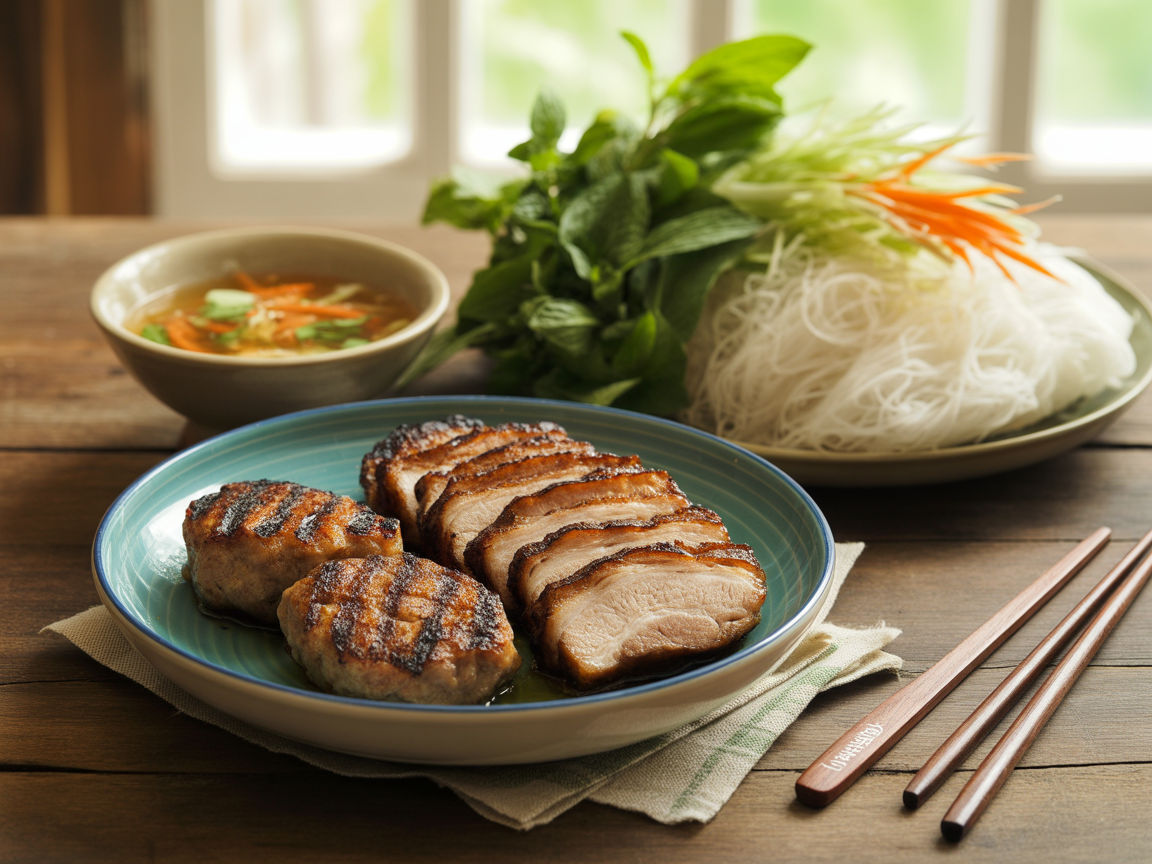
Hanoi rewards slow exploration. Spend a morning with the collections of the Vietnam Museum of Ethnology, leave time for a water-puppet performance and compare a bowl of bún chả with a breakfast of phở. Egg coffee is a distinctive local café tradition. Check the venue's own hours before visiting, especially for museums and memorial sites; a published general itinerary is not a promise that every building is open that day. Never enter an active railway corridor to obtain a photograph.
12
Hạ Long Bay and Cát Bà
Limestone islands rising from the water make Hạ Long Bay one of Vietnam's defining landscapes. The legend of a descending dragon belongs to the cultural story of the bay; weathering, tectonic history and changing sea levels belong to its geological explanation. These are different ways of understanding the same setting, not interchangeable evidence.
The UNESCO property now bears the name Ha Long Bay – Cat Ba Archipelago. It was first inscribed in 1994, with further recognition in 2000 and an extension in 2023. Cát Bà and the surrounding waters should therefore not be described as an unrelated addition outside the heritage story. Different cruises use different departure points and routes, so compare the actual itinerary instead of assuming every “Ha Long” excursion visits the same places.
13
Hạ Long Bay and Cát Bà — Details and context
A night aboard can provide quiet moments between busy excursion stops, but the boat's operating record, life jackets, emergency briefing and cancellation policy matter more than the photographs in a sales listing. Storms can suspend sailings. Build flexibility into onward travel, do not accept an unsafe departure to protect a booking, and distinguish an advertised cabin price from a total including transfers, meals and activities.
The wider limestone seascape extends beyond the busiest cruise corridors. Route, vessel size, season and time ashore materially change the experience, so compare itineraries rather than choosing only by cabin photograph or headline price.
14
Sa Pa and the northern mountains
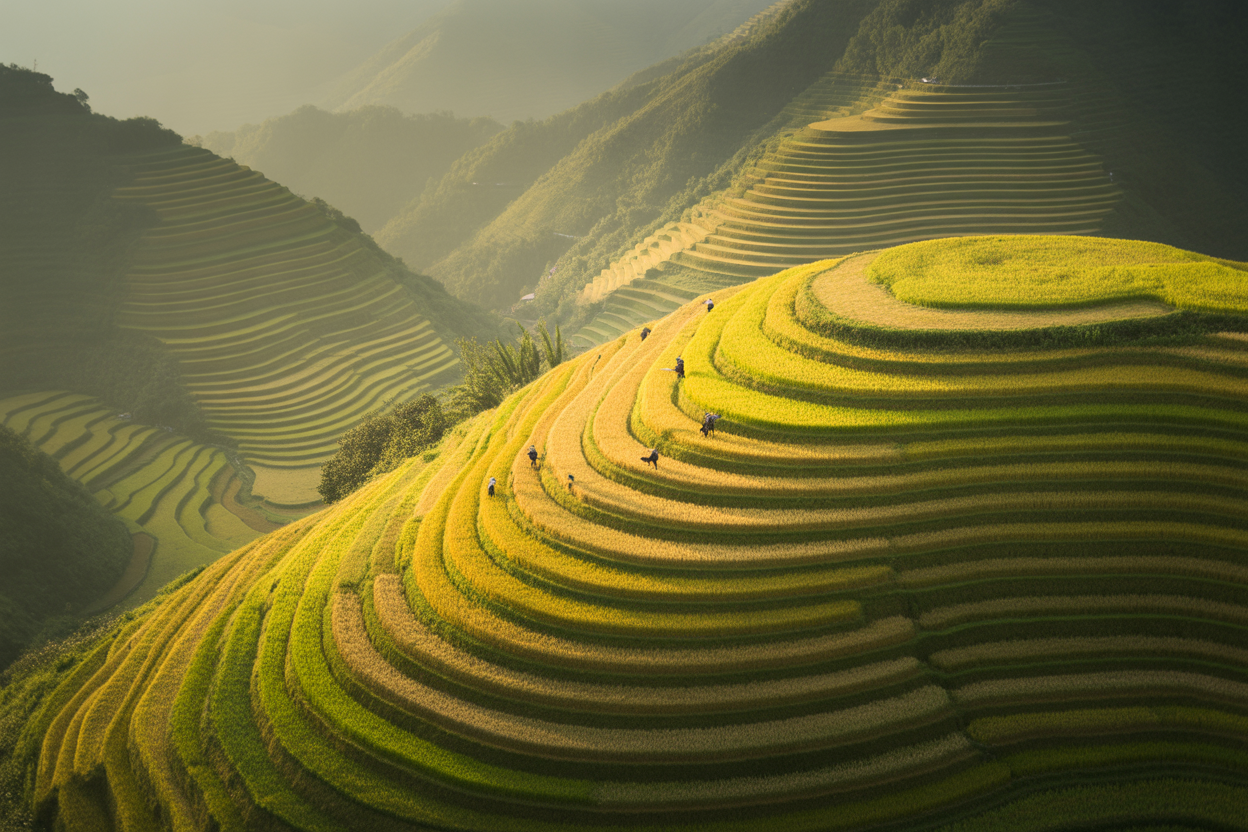
Sa Pa is a gateway to the Hoàng Liên mountain landscape, rice terraces and settlements connected with Hmông, Dao, Giáy, Tày and other communities. The terraces are working agricultural land. Their appearance changes with planting, irrigation, harvest and local farming decisions; a photograph of golden fields is not a promise about the week you arrive.
A village stay is most rewarding when the arrangements are clear: who guides the walk, who hosts the night, what meals are included, and how the household benefits. Ask permission before entering fields or homes. Weather can close views or make trails slippery, and winter conditions in the mountains differ sharply from beach weather in southern Vietnam.
Fansipan can be approached through organized visitor infrastructure or more demanding mountain travel. Check current access and weather with the operator; do not treat a high-altitude excursion as an ordinary city walk. Farther northeast, the Hà Giang area and Đồng Văn plateau offer limestone scenery and long road journeys. These roads are not a sensible place to learn to ride a motorcycle. A qualified driver, suitable vehicle and realistic daily distances are useful choices even for experienced travelers.
15
Huế and Hội An: imperial and trading histories
Huế was the Nguyễn capital from 1802 to 1945. The Imperial City, surrounding citadel, river landscape and royal tombs form a connected historical setting. Wartime damage and successive restoration campaigns are part of what visitors see today. Avoid assuming that every reconstructed building is untouched original fabric, or that the whole complex can be understood in a hurried stop.
The Ngọ Môn Gate and Thái Hòa Palace introduce the ceremonial center. Beyond it, the tomb complexes of Minh Mạng, Tự Đức and Khải Định show different approaches to landscape and royal commemoration. The Perfume River links many of these places geographically, but transfers still take time. Combining the citadel with one or two tombs is often more satisfying than treating every monument as a box to tick.
16
Huế and Hội An: imperial and trading histories — Details and context
Hội An's character is mercantile rather than imperial. Its surviving street pattern, wooden houses, assembly halls and Japanese Covered Bridge reflect a port shaped by international exchange. UNESCO inscribed the Ancient Town in 1999. The lantern-lit streets attract crowds, so an early walk and a return after dark reveal different aspects of the town.
Tailoring remains a familiar part of a visit. Bring a clear specification, examine fabric and seams, and allow time for fittings rather than expecting a rushed order to work perfectly. Around the old town, cycling, nearby beaches and craft visits can extend a stay. In wet weather, follow local flood warnings; riverfront charm does not remove the practical consequences of heavy rain.
Huế and Hội An are best read together but not treated as interchangeable heritage towns. One is shaped by imperial institutions and the Perfume River; the other by maritime commerce, migration and repeated adaptation to floods and tourism.
17
Đà Nẵng and the central coast
Đà Nẵng combines a working port, urban neighborhoods, the Hàn River and a long beachfront. The Dragon Bridge is a modern city landmark; performance schedules can change, so check a current local notice before arranging an evening around it. The city's administrative area expanded in the 2025 reorganization. Older population figures and former provincial boundaries should not be compared directly with the enlarged municipality.
The Marble Mountains, Ngũ Hành Sơn, contain caves, shrines and viewpoints. Steps and surfaces can be steep or slippery, and a lift does not make every part of the site accessible. The Museum of Cham Sculpture adds useful context before a visit to Mỹ Sơn. Together, these places show why a stay here can be more than a beach break between Huế and Hội An.
The Hải Vân Pass is a scenic route across a mountain spur north of the city. Allow for weather, traffic and stops rather than treating it as a racing route. Bà Nà Hills and the Golden Bridge offer a contemporary resort attraction with a different character from historical monuments. Inland, Mỹ Sơn is a religious and architectural landscape of Champa: it deserves attention on its own terms, without being reduced to a smaller version of another country's landmark.
18
Ho Chi Minh City and the name Saigon
Officially renamed Ho Chi Minh City in 1976, the city is still widely called Saigon in everyday and commercial usage. Its historic center, growing transport network, riverfront and industrial connections make it a major economic hub. The expanded administrative boundary after the 2025 merger is much larger than the former city; this guide avoids attaching a single unsourced population figure to those different geographies.
The central area includes the Notre-Dame Cathedral, Central Post Office, Reunification Palace and War Remnants Museum. Restoration or operating restrictions can affect access. The museum's displays are often emotionally difficult and are presented from a Vietnamese perspective; visitors benefit from reading accompanying context and taking time between exhibits. The post office should not be casually attributed to Gustave Eiffel, an often-repeated claim unsupported by its actual architectural history.
19
Ho Chi Minh City and the name Saigon — Details and context
Markets and neighborhoods reward walking beyond a single landmark route. Bến Thành is familiar to visitors; Tân Định and Chợ Lớn offer other settings for food, shopping and religious life. Cơm tấm, hủ tiếu, bánh xèo and noodle dishes with roots elsewhere in Vietnam are all part of the city's food landscape. Former district names remain common in travel descriptions, but verify the current address when booking accommodation or transport.
Củ Chi's preserved tunnel sites bring the wartime landscape into focus. Narrow, enclosed passages may be unsuitable for some visitors; there is no obligation to crawl underground to learn from the site. Tây Ninh and the Cao Đài Holy See offer a different excursion. Combining distant stops in one day creates substantial travel time, so compare a tour's hours on the road with the time actually spent at each place.
The metropolitan experience reaches far beyond the historic core. Markets, apartment compounds, canal corridors and newer districts show how migration and rapid development continue to reshape the city, while the coexistence of both names reflects history and everyday usage.
20
The Mekong Delta: a lived-in waterscape
The Mekong Delta is a landscape of channels, orchards, rice fields, towns and coastal wetlands. Boats matter, but it is not a region outside modern life: roads, bridges, processing industries and changing trade patterns also shape its settlements. The Vietnamese name Đồng bằng sông Cửu Long evokes the Nine Dragons, a cultural-geographical expression rather than a guarantee that every historic river mouth remains unchanged.
Cần Thơ is a useful urban base. Cái Răng's floating market is associated with early trading, yet activity changes with commercial conditions and weather. Ask a local operator what will actually be operating that morning. A respectful visit follows the market's working rhythm and does not require approaching people at close range for photographs.
21
The Mekong Delta: a lived-in waterscape — Details and context
Bến Tre is associated with coconut cultivation and canal landscapes; Cái Bè offers another base for rural stays and river excursions. Châu Đốc lies near the Cambodian border, while the Cà Mau area brings mangroves and coastal ecology into the journey. Book cross-border boat travel only after checking the operator, crossing and entry documents for your own itinerary.
The delta faces pressures from salinity, subsidence, altered sediment flows and climate change. These are serious issues for residents and agriculture, not a reason for a “visit before it disappears” sales pitch. Choose operators who handle waste responsibly and explain local conditions without turning people's livelihoods into a spectacle.
The delta is an agricultural region, transport network and home rather than a scenic backdrop. Saltwater intrusion, river engineering, subsidence and changing livelihoods affect communities differently, so responsible travel begins with listening to local explanations.
22
Phú Quốc: beaches, forests and island products
Phú Quốc lies in the Gulf of Thailand. Resorts, urban development, fishing, forested areas and agricultural production all form part of the island; it is neither uniformly undeveloped nor solely a beach resort. Travel descriptions may still use the former Kiên Giang provincial name. Check the current address rather than assuming an old map or booking form reflects the post-2025 administrative structure.
Bãi Sao and Bãi Khem are well-known beach areas. The west coast is popular for sunsets; beach conditions, construction and access vary by location. An Thới excursions introduce smaller islands to the south. Before a boat outing, check sea conditions and the operator's safety arrangements, and avoid damaging coral or purchasing wildlife souvenirs.
23
Phú Quốc: beaches, forests and island products — Details and context
Fish sauce is one of Phú Quốc's signature products. A producer visit can introduce fermentation, wooden barrels and the relationship between ingredients and place. Rượu sim is associated with local rose-myrtle fruit and should not be confused with grape wine. For food products carried home, check airline packaging requirements and the destination country's import rules.
Phú Quốc has a conditional exemption allowing some foreign visitors to stay on the island for up to 30 days. It is not an automatic permission to continue to mainland Vietnam. Route, documents and onward travel matter; check the immigration authority and carrier for the particular journey before booking.
Island development has transformed access and accommodation quickly, but infrastructure and environmental pressures do not disappear behind a resort boundary. Check the location of a property carefully and make time for landscapes and working communities beyond its beach.
24
Weather and choosing a route
There is no single perfect season for all of Vietnam. Northern winters can be cool and damp, with much colder conditions in the mountains. The central coast has a different rainfall pattern from the south, and tropical storms can disrupt transport and excursions. Southern Vietnam generally has a more pronounced wet–dry seasonal rhythm, but a seasonal average does not predict an individual day.
Plan around the activities that matter most. A mountain walk, a bay cruise, a heritage-city visit and an island beach stay each respond differently to rain, heat and wind. Rice terraces follow a farming calendar as well as a weather calendar. Avoid treating one month as universally safe or dismissing an entire season as unusable.
25
Weather and choosing a route — Details and context
Check the National Center for Hydro-Meteorological Forecasting before and during the trip. Leave flexibility around flights, boats and long road transfers, especially when a storm is approaching. The central coast can still face heavy rain in November, so the earlier claim that it has generally “recovered from most typhoons” by then is not a reliable planning rule.
Monthly averages cannot predict a particular journey. Elevation, monsoon timing, tropical storms and urban heat create local differences, so consult short-range forecasts for every stage and keep at least one flexible day in weather-sensitive itineraries.
26
Getting there and moving around
Hanoi's Nội Bài (HAN), Ho Chi Minh City's Tân Sơn Nhất (SGN) and Đà Nẵng (DAD) are familiar entry points; Cam Ranh (CXR) and Phú Quốc (PQC) may suit a regional itinerary. Choose flights using the airline's current schedule, airport code and operating carrier. A route advertised in an old article may be seasonal, changed or no longer offered.
Vietnam Airlines moved most of its domestic Tân Sơn Nhất operations to Terminal 3 in 2025, with specified exceptions. Read the terminal on the current ticket. Long Thành's government-announced target is commercial operation in the fourth quarter of 2026; that target is not evidence that a particular flight has moved there. Verify the actual airport on the booking.
27
Getting there and moving around — Details and context
Rail journeys offer a different pace from domestic flights. The north–south line links major cities, but timetables, berth classes and disruptions must be checked for the chosen date. Long-distance buses vary widely in comfort and safety. Avoid a plan that depends on an overnight road trip arriving exactly in time for an international flight.
Land and river crossings connect Vietnam with neighboring countries, but not every crossing accepts every entry document. Check the permitted port on the official e-visa system and the service with its operator. Do not infer that an airport procedure also applies identically to a cruise port, railway crossing or river arrival.
Distances that look modest on a map can require a full travel day. Compare the complete door-to-door journey—including station access, check-in, rest stops and onward transfers—before assuming a flight, train or sleeper bus is the quickest choice.
28
Entry documents and arrival information
Checked 26 September 2026. An official Vietnamese e-visa may be issued for up to 90 days, with single or multiple entry. The granted dates and conditions control your stay. Use the Immigration Department's official portal and confirm the authorized entry point before paying for transport.
Czech citizens are covered by the government's 45-day visa exemption under Resolution 229, effective 15 August 2025 through 14 August 2028, subject to the legal entry conditions. This later arrangement should not be confused with the earlier 2025 organized-tour program. Travelers of other nationalities should check their own category rather than assume the Czech rule applies.
29
Entry documents and arrival information — Details and context
The official pre-arrival portal is operating. Vietnam Airlines currently identifies Nội Bài, Đà Nẵng, Cam Ranh and Tân Sơn Nhất in its arrival-information guidance. Complete the applicable declaration and check your carrier's instructions. The available evidence does not justify the former blanket “all foreigners, every border, within 72 hours, no QR means no boarding” claim.
Entry rules depend on nationality, passport type, purpose and length of stay. Use the Vietnamese immigration authority and the carrier operating the journey as final checks, and verify that names, passport numbers and dates match before payment.
30
Money, connectivity and practical preparation
The currency is the Vietnamese đồng, VND. Compare the exchange rate and fees shown at the time of the transaction; a fixed conversion copied from an old guide quickly becomes misleading. Keep some smaller notes for local purchases, and check the total on a card terminal before confirming. Use authorized exchange services and keep receipts for significant transactions.
Mobile coverage and payment acceptance vary by place and provider. Buy a SIM or eSIM from an identifiable seller, check device compatibility and registration requirements, and confirm the data allowance and expiry date. Download an offline map and save your hotel address in Vietnamese. A messaging app is useful, but it does not replace a working emergency contact or travel insurance documentation.
Vietnam uses UTC+7 throughout the year. Check electrical compatibility and bring a suitable adapter; a plug that physically fits does not establish that an appliance supports the local voltage. For accommodation, confirm check-in arrangements, access after hours, stairs or lifts, and the exact room type. These practical details matter more than an unverified star rating.
31
Government, safety and health
Vietnam is a socialist republic with a single-party political system. Institutions, the governing party and the country's population are not interchangeable concepts. Administrative reform in 2025 changed provincial boundaries and the local-government structure. This guide uses familiar destination names while asking travelers to verify current addresses; it does not recycle old city-population figures as if boundaries had stayed fixed.
Travel advice should be read for your nationality and itinerary. The UK government's guidance highlights road risks, theft, political-expression restrictions, unexploded ordnance in former conflict areas and severe penalties for illegal drugs. Avoid demonstrations and restricted military areas. Do not assume that internet access or a VPN makes an activity lawful. Drone permissions require checking the competent Vietnamese authorities before flying.
32
Government, safety and health — Details and context
Obtain itinerary-specific health advice before departure and appropriate insurance. Carry prescribed medicines in their labeled packaging and check import restrictions. For illness or injury, seek qualified care. This page does not recommend self-prescribed antibiotics. Food and water precautions, mosquito-bite prevention and access to medical help are particularly relevant when traveling away from major cities.
Practical caution includes traffic awareness, heat, food hygiene, insurance and respect for local law. Political institutions and public expression operate differently from many visitors’ home countries; curiosity should be paired with discretion and reliable sources.
33
Building a realistic budget
Compare costs by the actual trip rather than by a single national daily allowance. Accommodation, intercity transfers, meals, entrance fees, guiding, insurance and a contingency belong in the calculation. A low advertised room price may exclude breakfast or have a restrictive cancellation policy; a cruise quote may omit transfers or activities.
Use Vietnamese đồng for local comparisons and record the date of a quote. For flights, compare the final price with baggage and airport transfers. For a guided excursion, ask about group size, transport, meals and admission charges. A personal spending target is not a verified market price.
During major holidays, both availability and pricing can differ sharply from ordinary weekdays. Reserve essential transport early, keep some budget uncommitted for disruption, and distinguish a personal spending target from a verified market price.
34
Choosing a place to stay
A room's location often matters more than its category. Hanoi's Old Quarter places visitors close to historic streets and food, but noise and vehicle access vary. A beach hotel near Đà Nẵng is a different base from a hotel beside the Hàn River. In Hội An, staying inside, beside or well outside the old town changes the daily journey.
Family guesthouses, hostels, city hotels, resorts and village stays serve different needs. Read recent details about the specific property, including room windows, construction nearby, accessibility, air-conditioning, bathroom arrangements and cancellation terms. A “homestay” label alone does not describe who owns the business or how much contact there will be with a host family.
For a northern mountain stay, ask about warm bedding, hot water, trail access and transport in bad weather. For an island or river stay, verify boat connections and the consequences of a canceled crossing. During Tết and other busy periods, reconfirm arrival times directly with the property. This guide does not promise a universal price advantage or recommend a named hotel without a current check.
35
Festivals and the calendar
Tết Nguyên Đán is a major family holiday governed by the lunar calendar. Flower markets, household preparations, return journeys and closures all affect a visit. The exact statutory leave period is announced separately from the lunar new-year date. Do not rely on an unverified future holiday schedule when buying inflexible tickets.
Tết Trung Thu, on the fifteenth day of the eighth lunar month, is associated with lanterns, mooncakes and activities for children. The Hùng Kings commemoration falls on the tenth day of the third lunar month. Reunification Day on 30 April, Labor Day on 1 May and National Day on 2 September are further dates to consider when planning transport and accommodation.
Huế's festival programs, Hội An's lantern evenings, pilgrimage festivals and local fishing-community celebrations offer different kinds of experience. Confirm the organizer's current program and respect areas reserved for worship or community participation. A ceremony is not automatically a public performance, and photography may need permission.
36
Beyond the main north–south route
Ninh Bình offers limestone scenery, waterways and the historical landscape around Hoa Lư. Tràng An's World Heritage status includes cultural as well as natural values; it is more than a convenient “Hạ Long on land” comparison. Staying overnight gives more flexibility than trying to fit every boat route and viewpoint into a rushed excursion from Hanoi.
Phong Nha is a base for a broad range of cave experiences, from managed visitor routes to demanding guided expeditions. They differ in physical requirements, equipment, conditions and permissions. A famous cave's published dimensions do not tell you whether its tour suits your mobility or experience. Obtain the operator's current description and cancellation terms.
37
Beyond the main north–south route — Details and context
The Côn Đảo islands bring together protected nature and sites of incarceration under colonial and wartime regimes. Beach time and prison history belong to the same place and deserve different kinds of attention. Follow national-park guidance for wildlife encounters and do not assume turtle-viewing opportunities are available on demand.
Mai Châu and other valley destinations provide opportunities for village stays, cycling and textile traditions. In the Đồng Văn plateau, longer journeys reward careful planning rather than a race around a motorbike loop. “Hidden” is a travel-writing label, not a fact about how communities understand their home or how many visitors they receive.
Less-promoted places are not empty spaces waiting to be discovered. Travel slowly, use locally run services where appropriate, ask before photographing people and avoid publishing precise locations for fragile natural or cultural sites.
38
Packing for several climates
Bring breathable clothing, a rain layer, comfortable footwear and clothing appropriate for religious sites. Add warm layers for northern mountains or cool-season travel. A small daypack, reusable water bottle filled from a safe source, sun protection and suitable insect repellent are useful; choose health products and medicines with professional advice where needed.
Keep copies of your passport, visa or exemption evidence, bookings and insurance, with an offline backup accessible if your phone is lost. Carry essential medicines in original packaging. If driving is part of the plan, confirm the required license, permit, vehicle category and insurance before departure; simply carrying an international permit does not establish entitlement for every traveler or vehicle.
Pack for the chosen itinerary rather than every possible activity. Check current import restrictions for medicines, tobacco-related products, drones and food. Leave room in the schedule as well as the bag: laundry, weather changes and an extra night often solve more problems than additional equipment.
39
Reading Vietnam through several voices
Distinguish fiction, memoir and history when choosing your reading. Christopher Goscha's Vietnam: A New History and Fredrik Logevall's Embers of War approach political and military history. Neil Sheehan's A Bright Shining Lie examines the American war through John Paul Vann. None should be read as the sole voice of everyone who lived through those periods.
Andrew X. Pham's Catfish and Mandala is a travel memoir. Viet Thanh Nguyen's The Sympathizer is a novel, not a work of nonfiction. Graham Greene's The Quiet American, Bảo Ninh's The Sorrow of War, Nguyễn Phan Quế Mai's The Mountains Sing, Vũ Trọng Phụng's Dumb Luck and Dương Thu Hương's Paradise of the Blind provide different literary viewpoints. Translation, edition and historical context affect the reading experience.
For contemporary reporting, compare Vietnamese outlets with international coverage and distinguish a reported fact from commentary. English-language material is only part of the public conversation. Publication dates matter, especially for infrastructure, politics, regulations and administrative geography.
40
People who open different windows on Vietnam
Hồ Chí Minh and Võ Nguyên Giáp are central figures in the history of independence and war. The Trưng sisters occupy a much earlier place in historical memory; accounts of their deaths include legendary elements and should not be presented as certain eyewitness history. Learning why a street, temple or memorial bears a name can make a city walk more meaningful.
Culture and scholarship offer other starting points: the writing of Bảo Ninh and Viet Thanh Nguyen, the mathematics of Ngô Bảo Châu, the music of Đặng Thái Sơn and the Buddhist teaching of Thích Nhất Hạnh. Vietnamese identity also includes diasporic and mixed-heritage lives. A selection of names is an invitation to learn, not a ranking of importance.
Contemporary music and online culture change quickly. Rather than repeating unverified celebrity rankings or criminal allegations, explore the work itself through an artist's official channel and read reporting in context. This avoids turning a country guide into a stale list of reputations.
41
Sports in everyday public life
Football draws strong public attention, from neighborhood pitches to national-team matches. Parks and public spaces also host exercise groups, badminton and games of cờ tướng. Martial arts, including Vovinam, form another part of the sporting landscape. These everyday scenes can be more accessible to a visitor than a major ticketed event.
Check a competition organizer or club for a current fixture and authorized ticket sale. Historical enthusiasm does not establish a current result or schedule.
If attending a match or joining a public activity, follow local instructions and give participants space. Celebrations can affect traffic, so plan the journey back to your accommodation. Participation is an opportunity for ordinary social contact, not an obligation to turn every scene into a photograph.
42
Reading the news and understanding its context
Vietnam's media operate within a politically restricted environment. Local newspapers, official announcements, overseas reporting and independent commentary have different roles and constraints. A tourism campaign is useful for identifying destinations, but it is not a substitute for immigration rules, statistical definitions or independent historical analysis.
Read a source's date, publisher and evidence before relying on it. An administrative merger can make an old population statistic misleading without changing the number itself; a planned airport opening is not the same as a working flight schedule. Precise evidence matters more than a confident tone.
For practical decisions, go to the relevant authority or operator. For interpretation, compare perspectives and separate reported events from opinion. The source links on these pages are part of that process; the review date records when they were checked, not a guarantee that policies will remain unchanged.
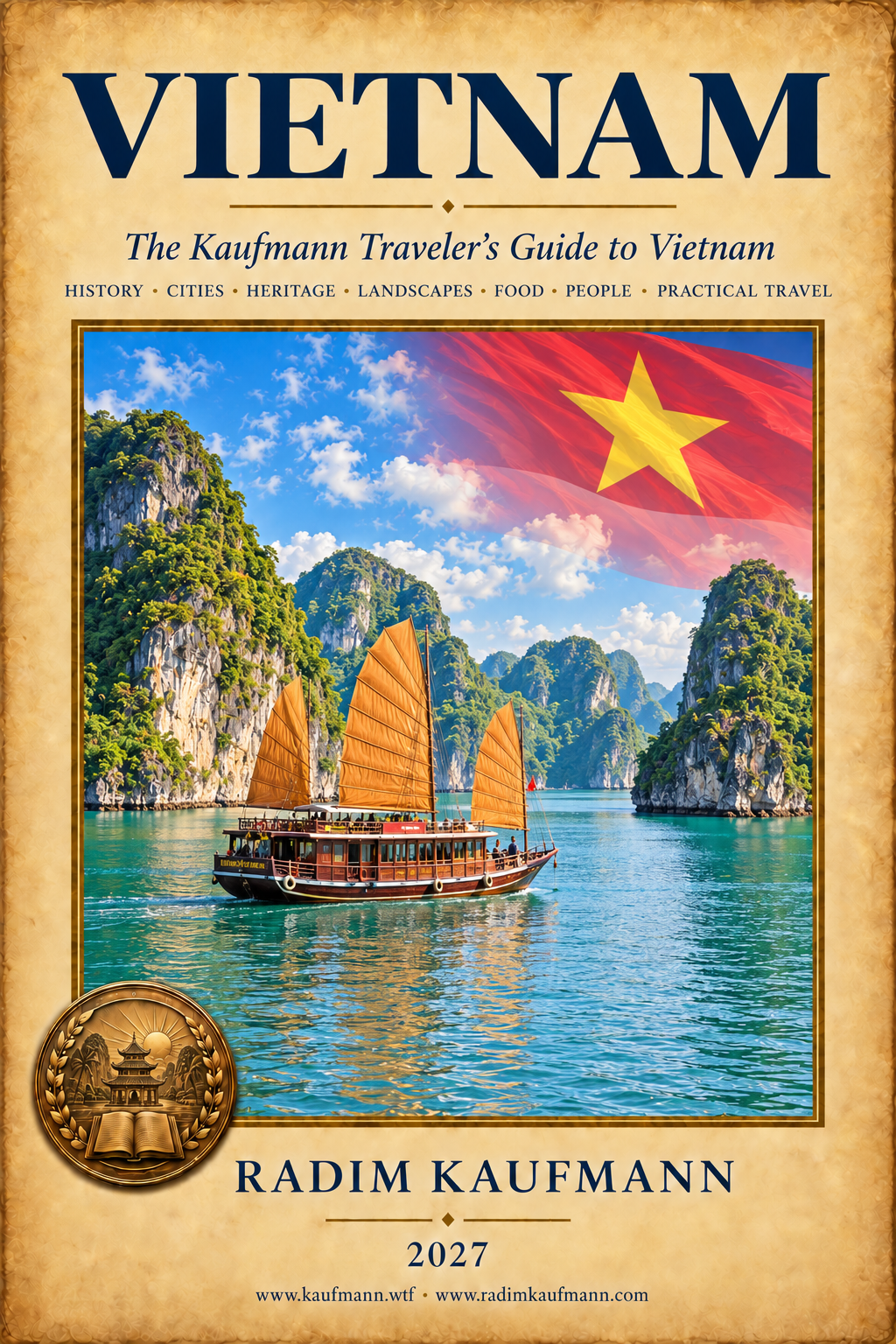
Covers are project assets. The landscape and food pictures used here are existing AI-generated project illustrations, not documentary photographs. OpenStreetMap is a separate interactive map service.