
🇦🇹 Austria at a Glance
🌍 Overview
Austria punches far above its weight. This landlocked nation of roughly 9.2 million people has shaped European history, culture, and music to a degree disproportionate to its modest size. For six centuries, the Habsburg dynasty ruled from Vienna, at times controlling an empire stretching from the Netherlands to Transylvania.
For travelers, Austria offers a compelling blend of cultural magnificence and alpine splendor. Vienna's palaces, coffeehouses, and concert halls preserve the legacy of Mozart, Beethoven, and Freud. Salzburg's baroque churches rise beneath fortress walls. The Alps sweep through the country's west and south, offering world-class skiing in winter and hiking in summer.
With 12 UNESCO World Heritage Sites spanning baroque architecture, pioneering railways, prehistoric settlements, and primeval forests, Austria condenses an extraordinary cultural heritage into accessible distances. You can breakfast in Vienna, lunch in Salzburg, and dine in the Alps — few countries reward a short trip with this much concentrated variety.
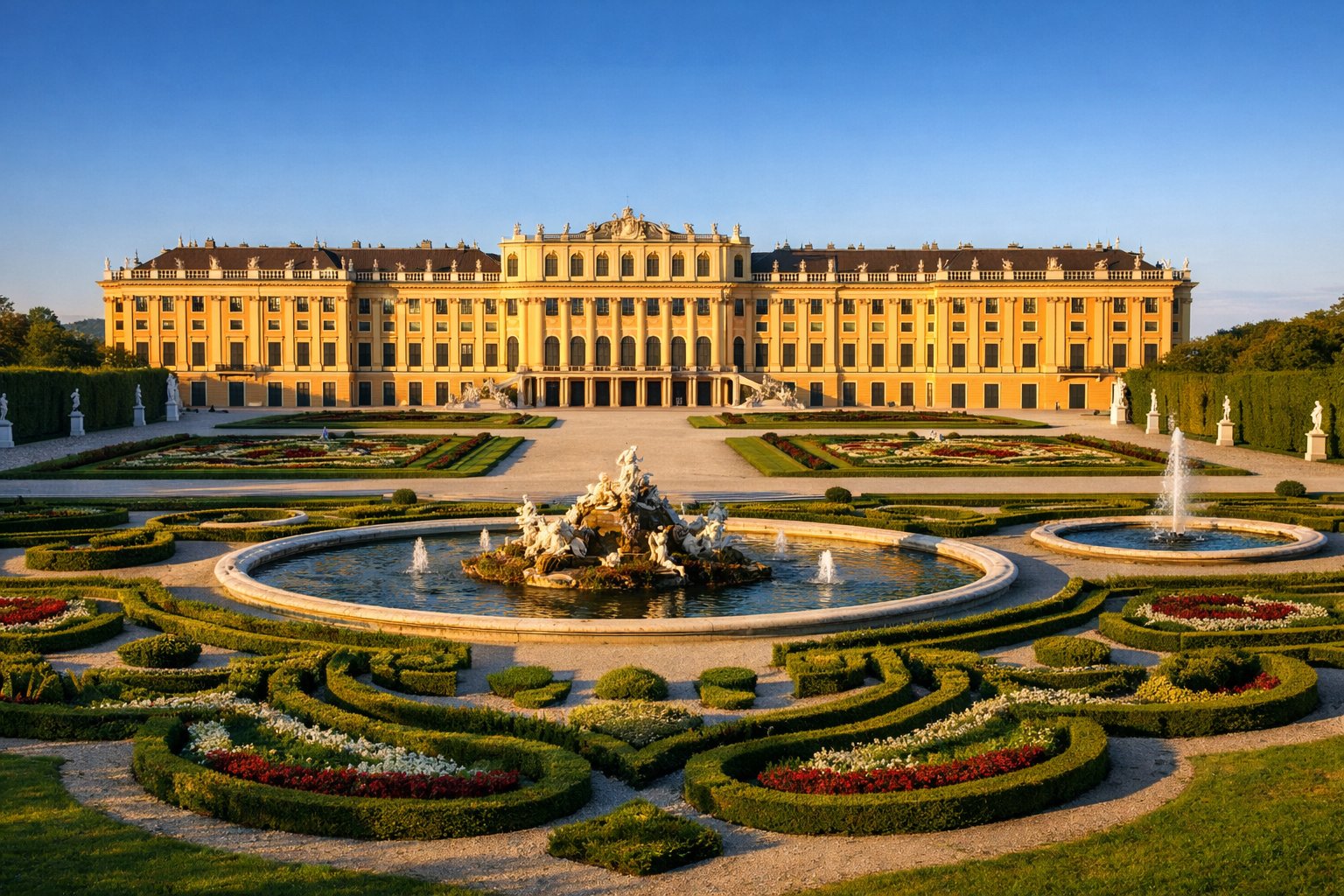
Schönbrunn Palace
The 1,441-room summer residence of the Habsburg rulers, featuring the world's oldest continuously operating zoo (1752) and magnificent baroque gardens
🏷️ Name & Identity
The name "Austria" derives from the Old High German Ostarrîchi, meaning "eastern realm," first documented in 996 AD. The German name Österreich preserves this etymology directly.
The red-white-red flag is one of the world's oldest national flags, with origins traced to the 13th century. Legend attributes it to Duke Leopold V, whose white surcoat became soaked with blood during the Siege of Acre (1191), leaving only a white stripe where his belt had been — a good story, though like many flag origin legends, one historians treat with some caution rather than as settled fact.
Today, Austrians maintain a distinct identity characterized by Gemütlichkeit (coziness, conviviality), a love of tradition, and pride in their cultural heritage — while remaining thoroughly modern, EU-integrated Europeans.
🗺️ Geography
Austria is landlocked, sharing borders with eight nations: Germany and Czech Republic to the north, Slovakia and Hungary to the east, Slovenia and Italy to the south, Switzerland and Liechtenstein to the west.
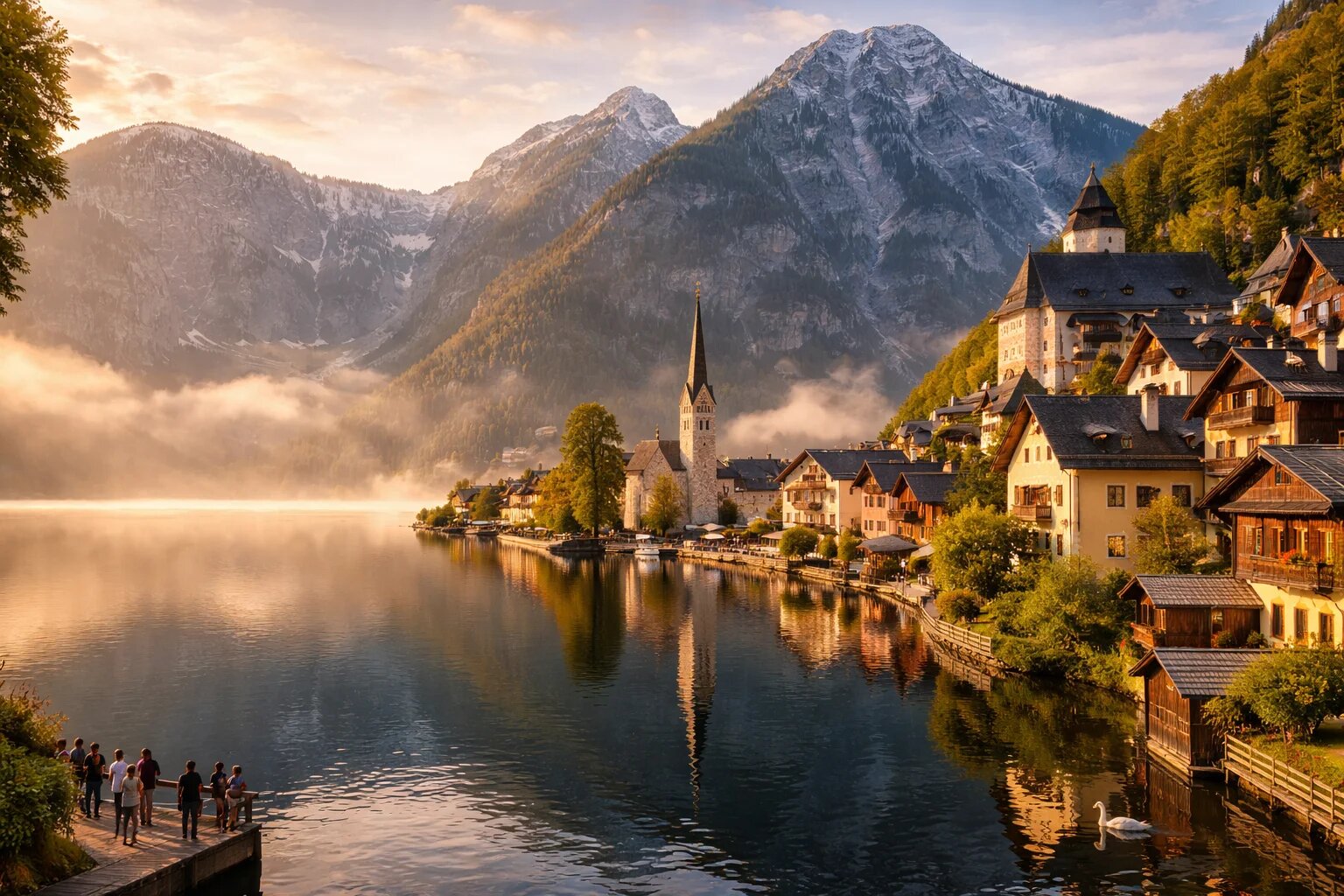
Vienna and the East: the Danube plains hold the capital and stretch toward Hungary. Wine country — the Wachau Valley, Burgenland — produces renowned Grüner Veltliner and Riesling. The Alps: roughly two-thirds of Austria is mountainous. The Eastern Alps dominate from Vorarlberg through Tyrol, Salzburg, Carinthia, and Styria; the highest peak, Grossglockner, rises to 3,798 meters. Salzkammergut: over 70 lakes dot this landscape around Salzburg, including the famous Hallstättersee with its picture-perfect village.
🗺️ Map of Austria
🌡️ Climate
Vienna and the East: continental climate with hot summers (up to 35°C) and cold winters (often below 0°C); rainfall is moderate throughout the year. Alpine Regions: mountain climate with cooler temperatures, higher precipitation, and 2–4 meters of snow annually at higher elevations. Southern Austria: Carinthia and southern Styria enjoy Mediterranean influence with milder winters, warmer summers, and more sunshine.
📜 History
Early History: the Venus of Willendorf, a roughly 30,000-year-old figurine, was discovered near the Danube. Celtic peoples established the kingdom of Noricum around 400 BC. Romans arrived around 15 BC, founding Vindobona (Vienna) and Iuvavum (Salzburg).
The Habsburgs (1278–1918): Rudolf I began 640 years of Habsburg rule. Through strategic marriages — "Let others wage wars; you, happy Austria, marry" — they accumulated an extraordinary empire spanning continents. Imperial Vienna: Emperor Franz Joseph I ruled for 68 years (1848–1916), transforming Vienna into a glittering capital; the Ringstrasse, Opera, and major museums date from this golden age.
Collapse, Annexation, and Reckoning: the empire dissolved after World War I, leaving a small, uncertain republic. In 1938, Nazi Germany annexed Austria in the Anschluss — an event long presented, under a convenient postwar narrative, as something simply done to Austria by an outside power. The fuller picture is more complicated: crowds in Vienna greeted the annexation with genuine enthusiasm, and Austrians went on to serve in the Nazi apparatus, including its camp system, in numbers disproportionate to Austria's small population. Austria's official acknowledgment of this shared responsibility, rather than pure victimhood, only deepened from the 1990s onward.
Modern Austria: the postwar State Treaty of 1955 restored full sovereignty in exchange for permanent neutrality, a status that shaped Austrian identity throughout the Cold War. Austria joined the EU in 1995 and adopted the euro in 2002, cementing its place as a small, prosperous, thoroughly integrated European state.
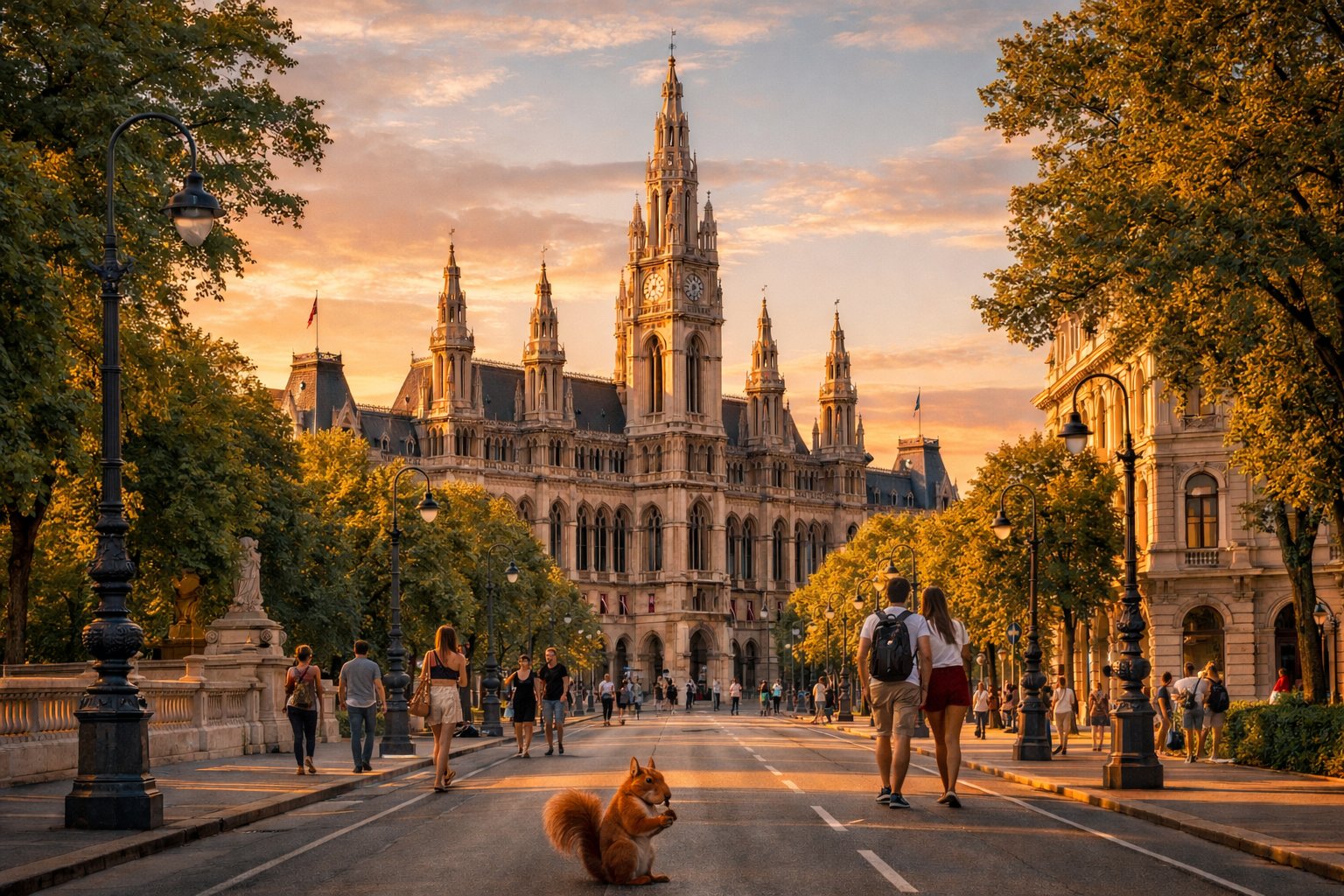
Vienna Ringstrasse
The magnificent circular boulevard with neo-gothic City Hall, built during Franz Joseph's reign
👥 People & Culture
Austria's roughly 9.2 million people are predominantly German-speaking, with about 30% of Vienna's residents having a foreign background. Austrians value Gemütlichkeit — coziness and conviviality — and are often described, not always fairly, as more relaxed than their German neighbors.
Social Customs: Austrians value formality and titles; the distinction between Sie (formal) and Du (informal) matters more than it does in many neighboring countries. Greetings differ by region: Grüß Gott in most areas, Servus among friends. The Arts: Austria's cultural contribution is extraordinary — Mozart, Schubert, Strauss, and Mahler in music; Klimt and Schiele in art; Freud in psychology. This heritage pervades daily life, from opera houses to wine taverns, in a way few countries manage to sustain outside museum walls.
🏛️ Government & Politics
Austria is a federal parliamentary republic of nine states (Bundesländer), each with its own parliament and a genuine appetite for using it — which is why shop opening hours, school holidays, and even the rules on where you may park a campervan shift as you cross from Tyrol into Salzburg. The head of state is Federal President Alexander Van der Bellen, a former Green party leader and economics professor first elected in 2016 and re-elected in October 2022 for a second term running to 2029. The office is often described as ceremonial, but the Austrian presidency retains unusually sharp reserve powers on paper, including the right to dismiss the government outright.
Executive power rests with the Federal Chancellor, Christian Stocker (Austrian People's Party, ÖVP), sworn in on 3 March 2025 at the head of a three-party coalition with the Social Democrats (SPÖ) and the liberal NEOS — Austria's first tripartite federal government since 1949. Andreas Babler (SPÖ) serves as Vice-Chancellor. The coalition emerged from five months of deadlock after the parliamentary election of 29 September 2024, in which the right-wing Freedom Party (FPÖ) topped a national poll for the first time in its history with roughly 29% before failing to assemble a majority. In early September 2026 the coalition announced plans for a constitutional ban on "political Islam", the government's most contested initiative to date.
The 183-seat National Council (Nationalrat) is elected by proportional representation with a 4% threshold; the Federal Council (Bundesrat) represents the states. The defining constitutional fact for outsiders is permanent neutrality, adopted by constitutional law on 26 October 1955 in the wake of the State Treaty that ended Allied occupation — the date is now the national holiday. Austria joined the European Union in 1995, uses the euro, and is a full Schengen member, but has never joined NATO, and Vienna's neutral status is why the city hosts the IAEA, OPEC, and one of the four major United Nations office complexes.
🏰 Vienna
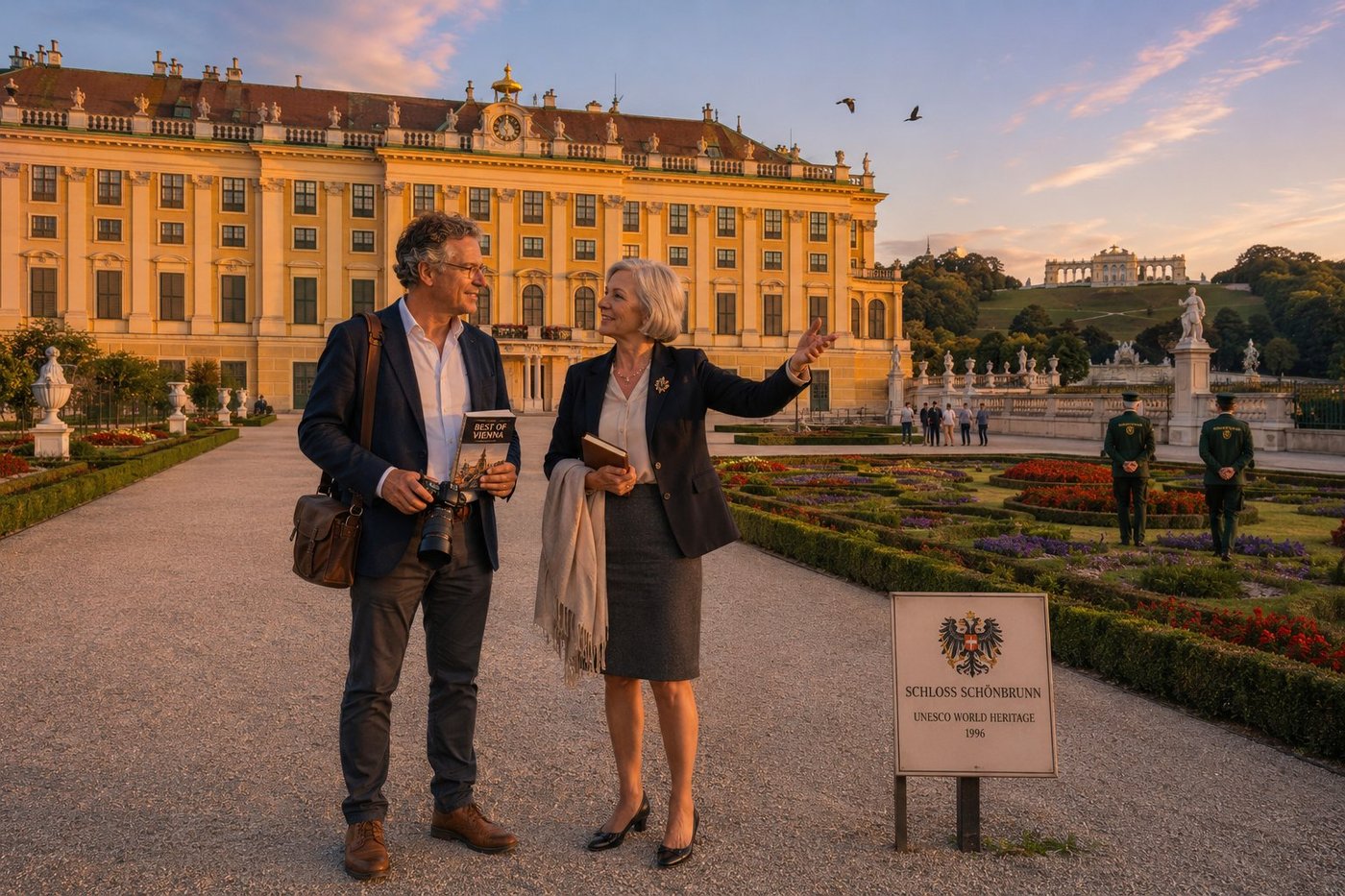
Schönbrunn Palace: Austria's most-visited attraction. The 1,441-room baroque palace includes the world's oldest continuously operating zoo (founded 1752), gardens, a maze, and the Gloriette viewpoint. St. Stephen's Cathedral: the gothic masterpiece features a roof of 230,000 glazed tiles — climb 343 steps for panoramic views or descend to the catacombs.
Coffee House Culture: listed since 2011 in Austria's national inventory of intangible cultural heritage (kept by the Austrian UNESCO Commission — not one of UNESCO's international lists). Historic establishments like Café Central have served as living rooms for the city for over 300 years — order a Melange and stay for hours; nobody will rush you. Music: Vienna was home to Mozart, Beethoven, Brahms, and Schubert. Standing-room tickets at the State Opera cost €13–18 (2025/26 season: balcony €13, gallery €15, parterre €18) — 567 are sold per performance, online from 10:00 on the day, and they remain one of the world's great cultural bargains for anyone willing to stand.
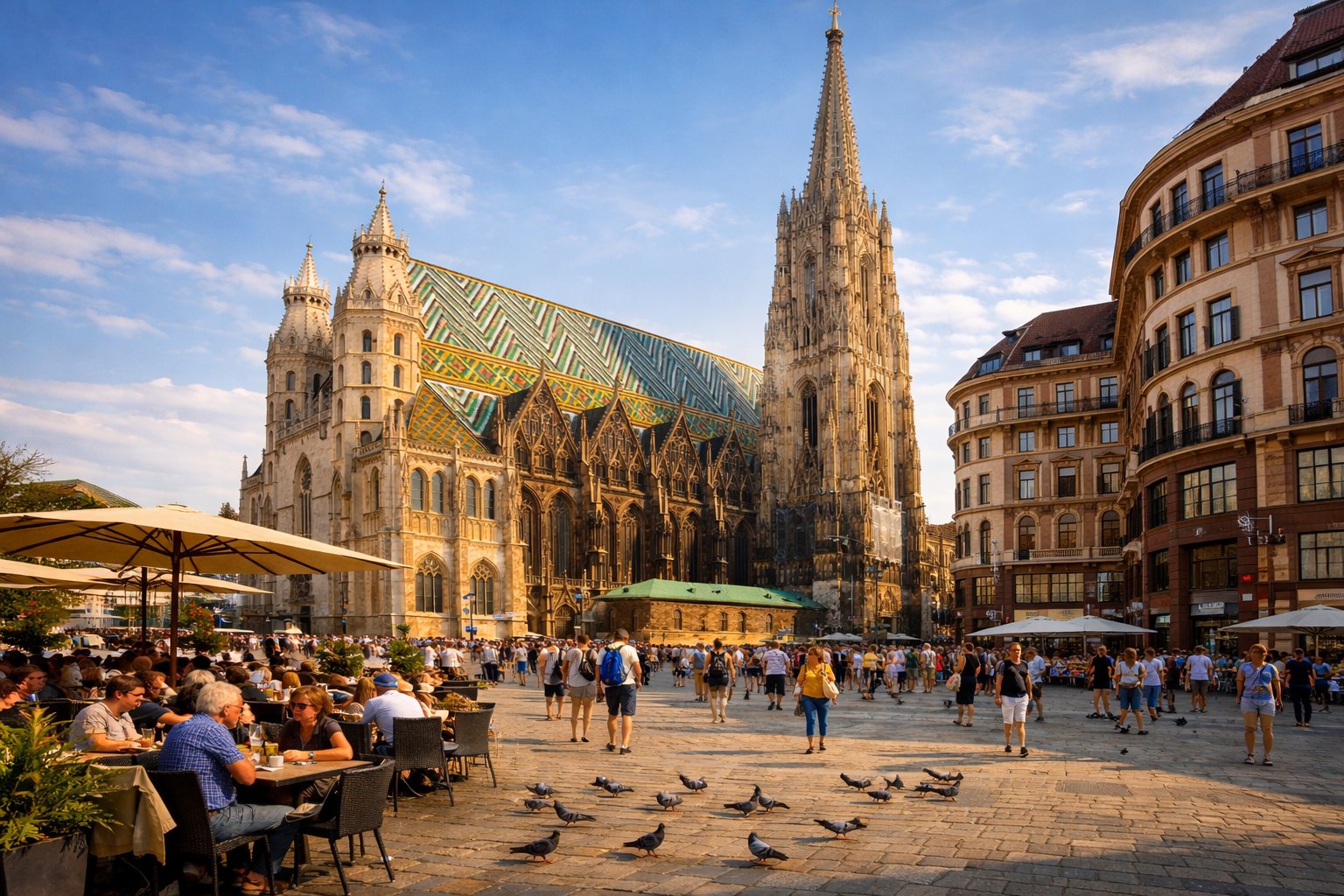
St. Stephen's Cathedral
Vienna's iconic gothic masterpiece with its colorful glazed tile roof — Stephansplatz is the heart of the city
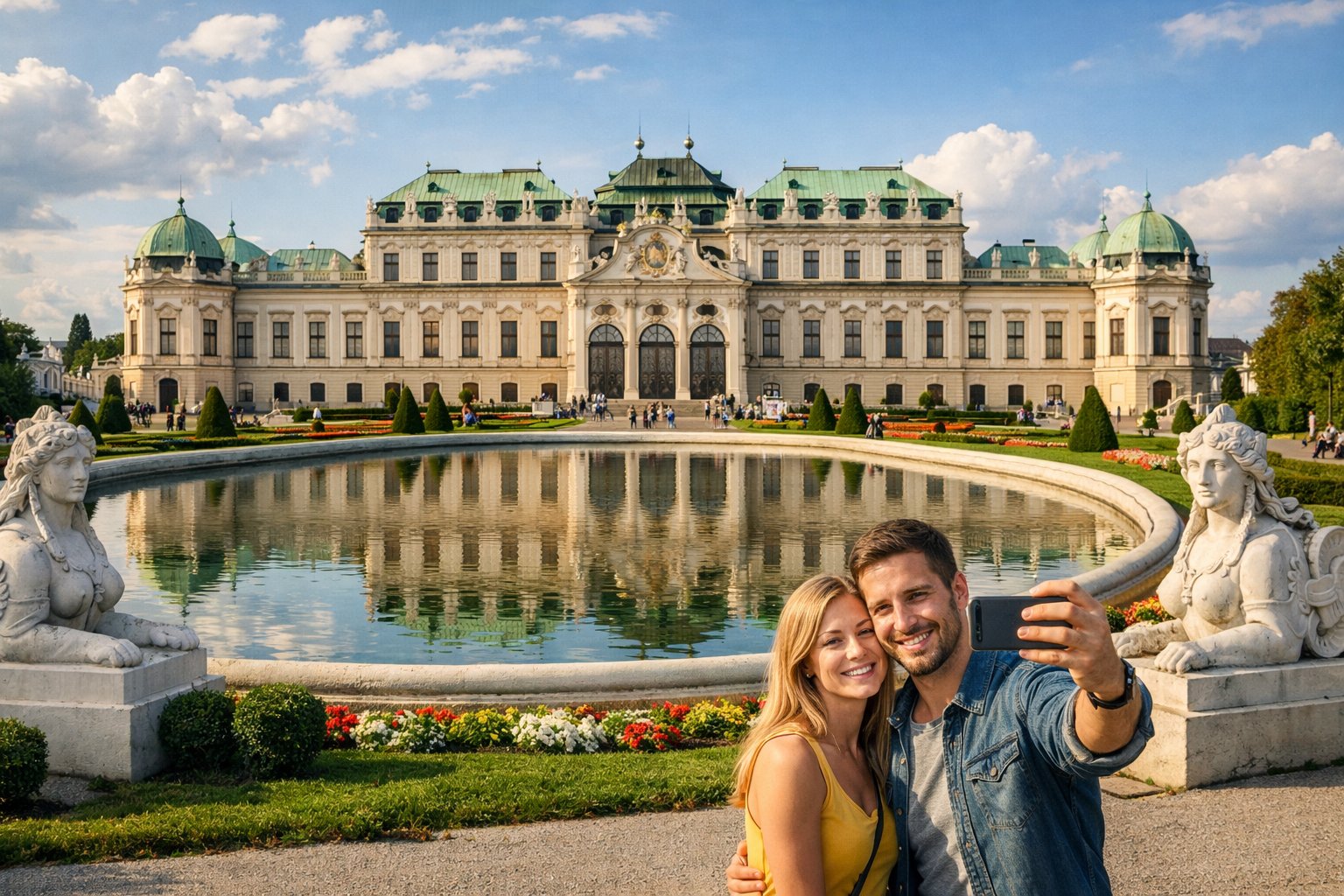
Belvedere Palace
Baroque palace housing Austria's finest art collection, including Klimt's "The Kiss"
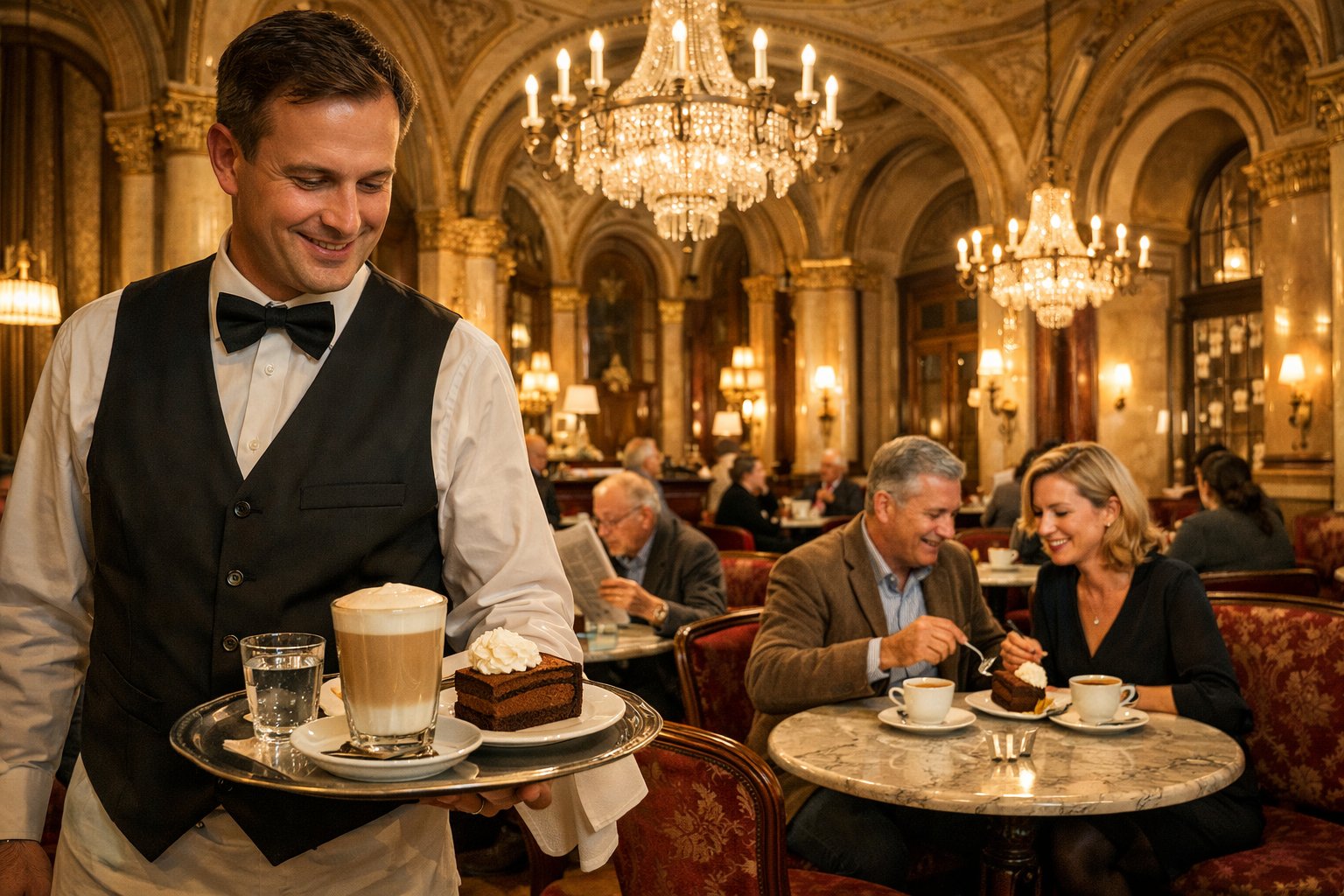
Viennese Coffee House
On Austria's national intangible-heritage inventory since 2011 — crystal chandeliers, marble tables, and unhurried service dating back centuries
🎵 Salzburg
Hohensalzburg Fortress: built in 1077, one of Europe's largest fully preserved medieval fortresses, and one never taken by force — take the funicular for commanding views over the old town. Mozart's Birthplace: Wolfgang Amadeus Mozart was born here on January 27, 1756; the museum displays his first violin, used at age 3–4.
Mirabell Gardens: The Sound of Music's "Do-Re-Mi" sequence was filmed here — baroque gardens with perfect fortress views, and a magnet for fans of the film even generations later. Salzburg Festival: running since 1920, Austria's most prestigious cultural event brings opera, classical music, and theater to the city each July–August. Book months ahead if you want a seat.
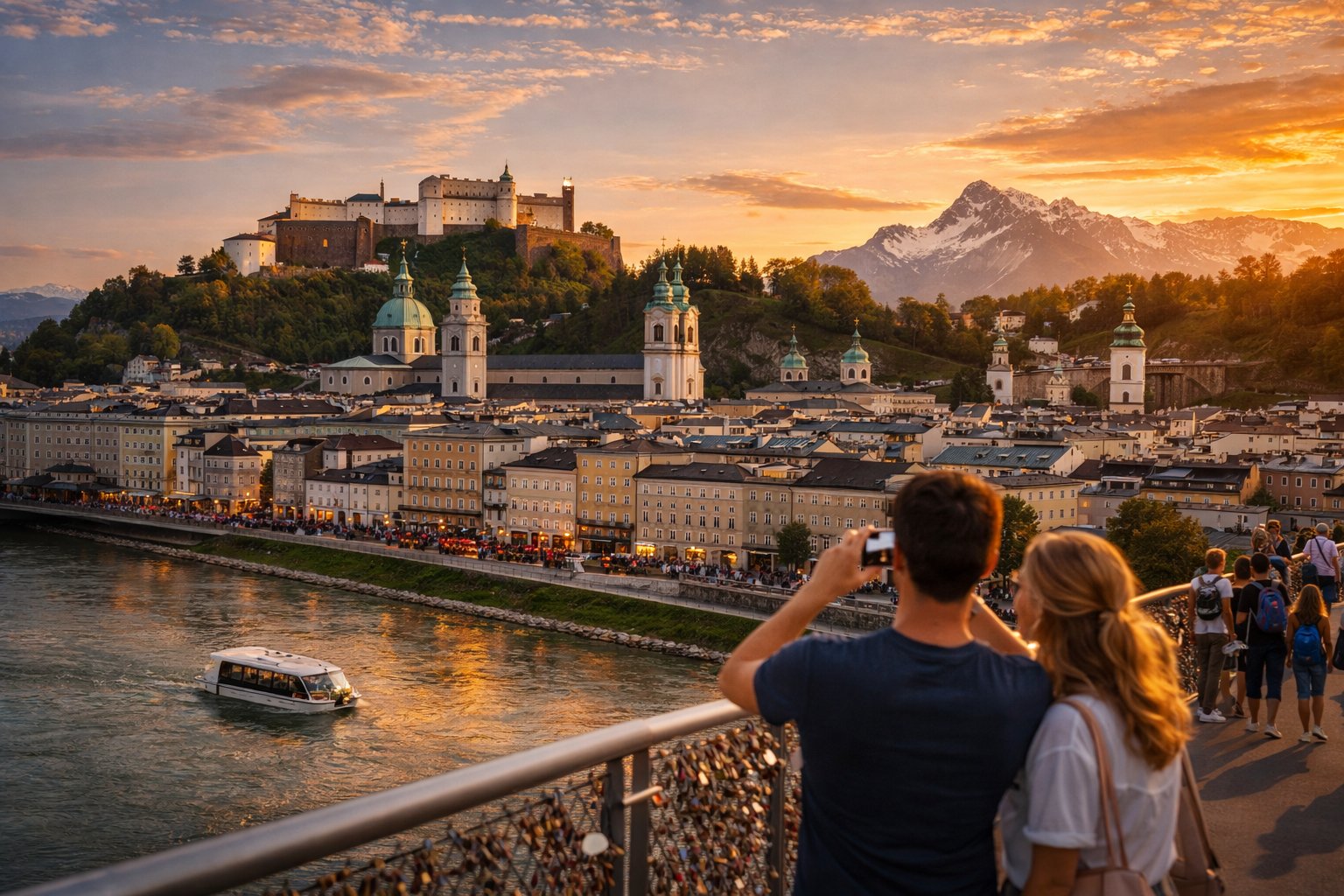
Salzburg at Sunset
The baroque old town along the Salzach River, crowned by Europe's largest fully preserved medieval fortress
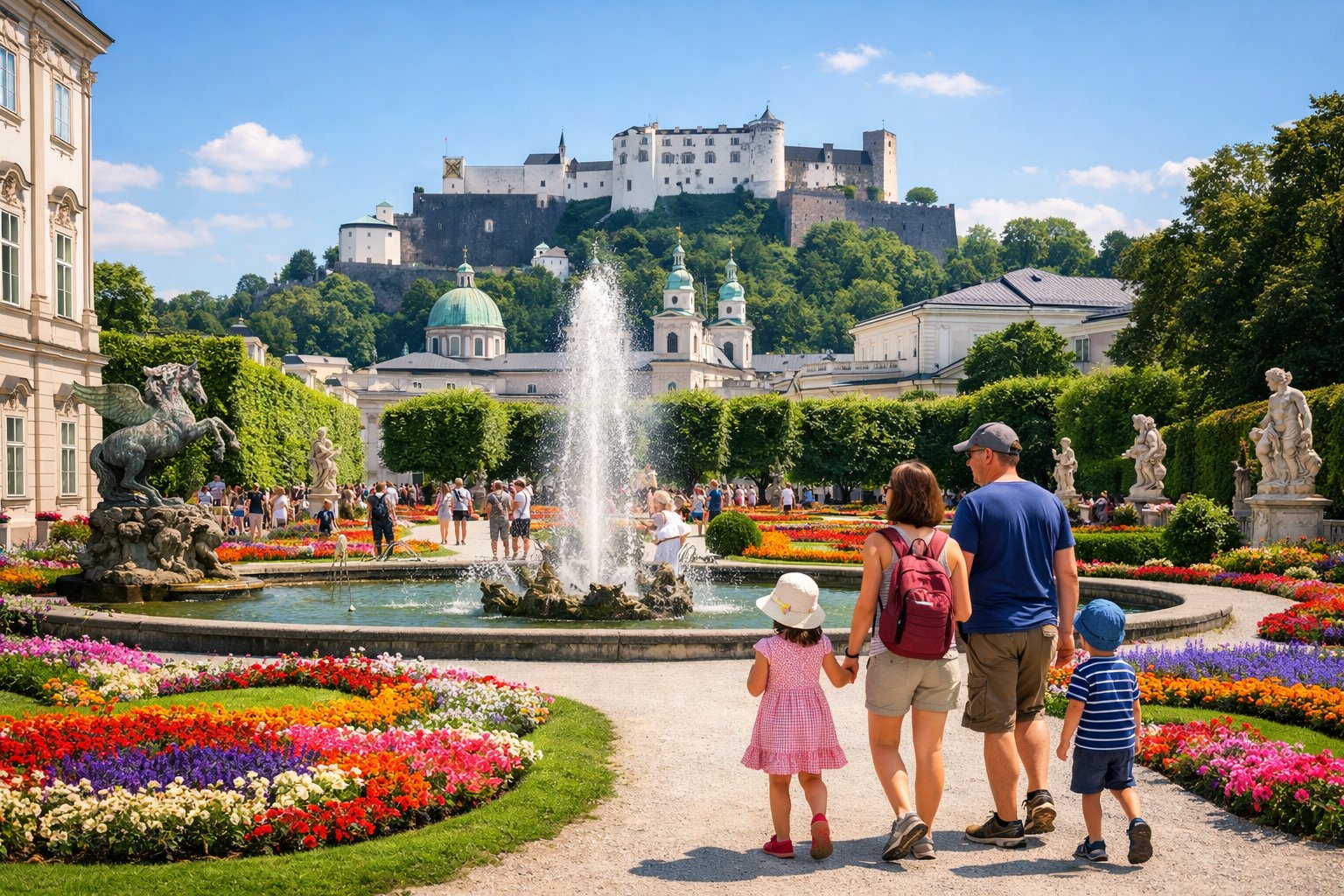
Mirabell Gardens
The famous Sound of Music filming location — colorful flower beds with the fortress in the background
🎿 Innsbruck & Tyrol
Innsbruck: twice host of the Winter Olympics (1964, 1976). The Golden Roof, with 2,657 fire-gilded copper tiles, marks the old town's heart, with snow-capped Alps rising directly behind medieval streets. Grossglockner: Austria's highest peak at 3,798m; the High Alpine Road is one of Europe's most spectacular drives, with 36 hairpin turns.
St. Anton and Arlberg: the birthplace of alpine skiing since 1901, with over 300 km of interconnected pistes and a legendary après-ski culture. 400+ Ski Resorts: Austria is a genuine skiing superpower, with resorts ranging from family-friendly to extreme, and a national team that has won more World Cup medals than any other country.
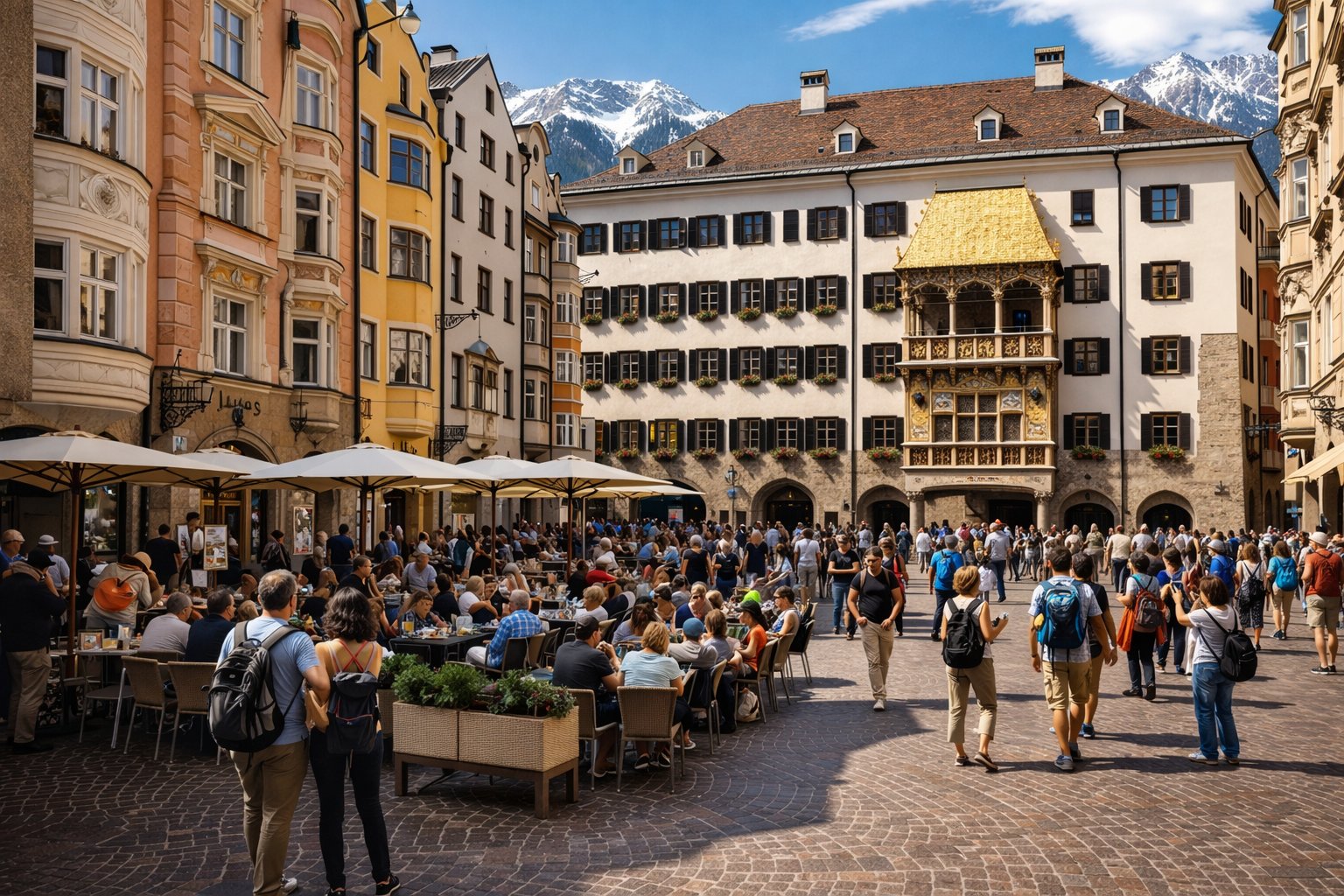
Innsbruck Old Town
The famous Golden Roof with 2,657 gilded copper tiles, cafés beneath snow-capped Alps
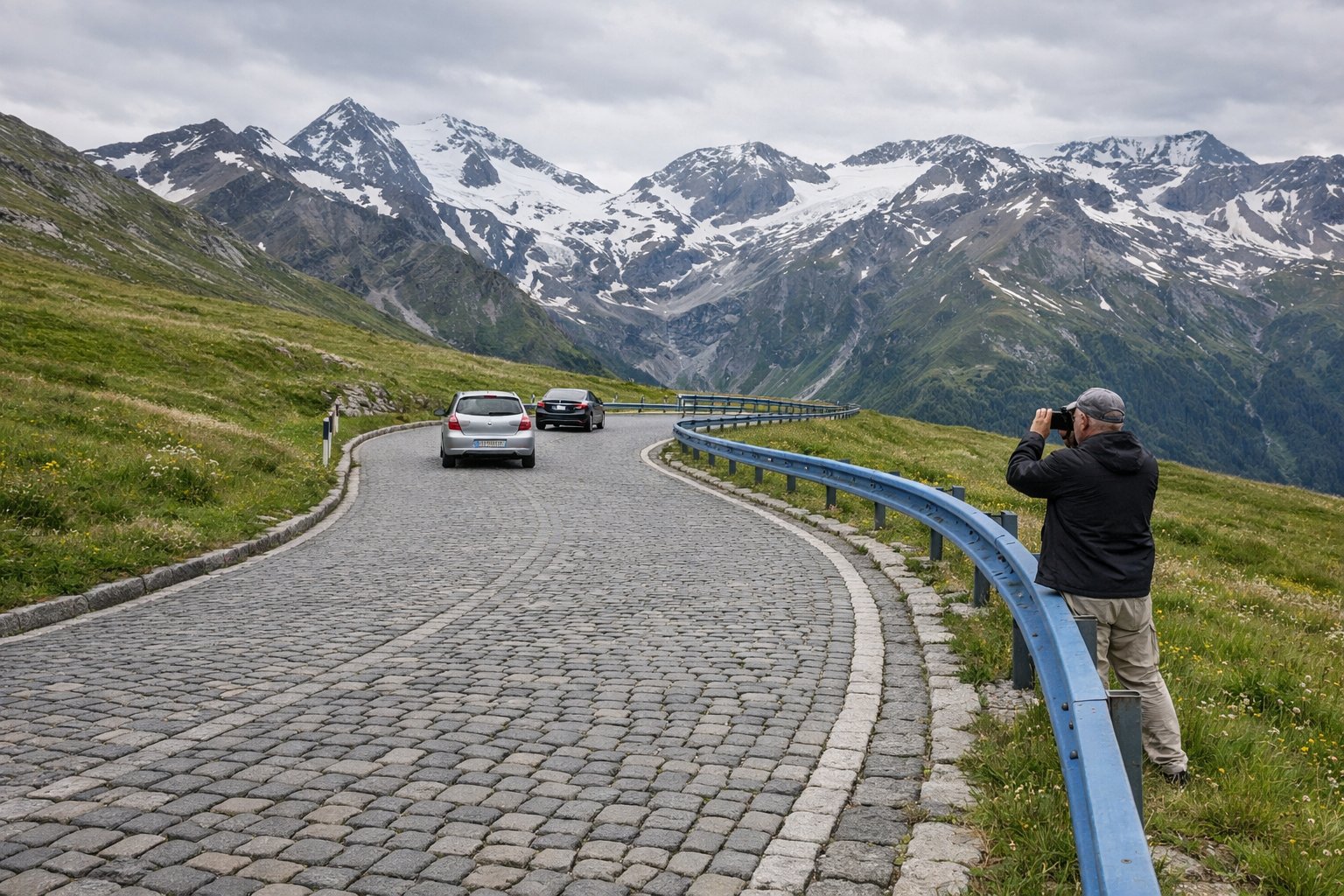
Grossglockner High Alpine Road
One of Europe's most spectacular mountain roads, winding through alpine meadows
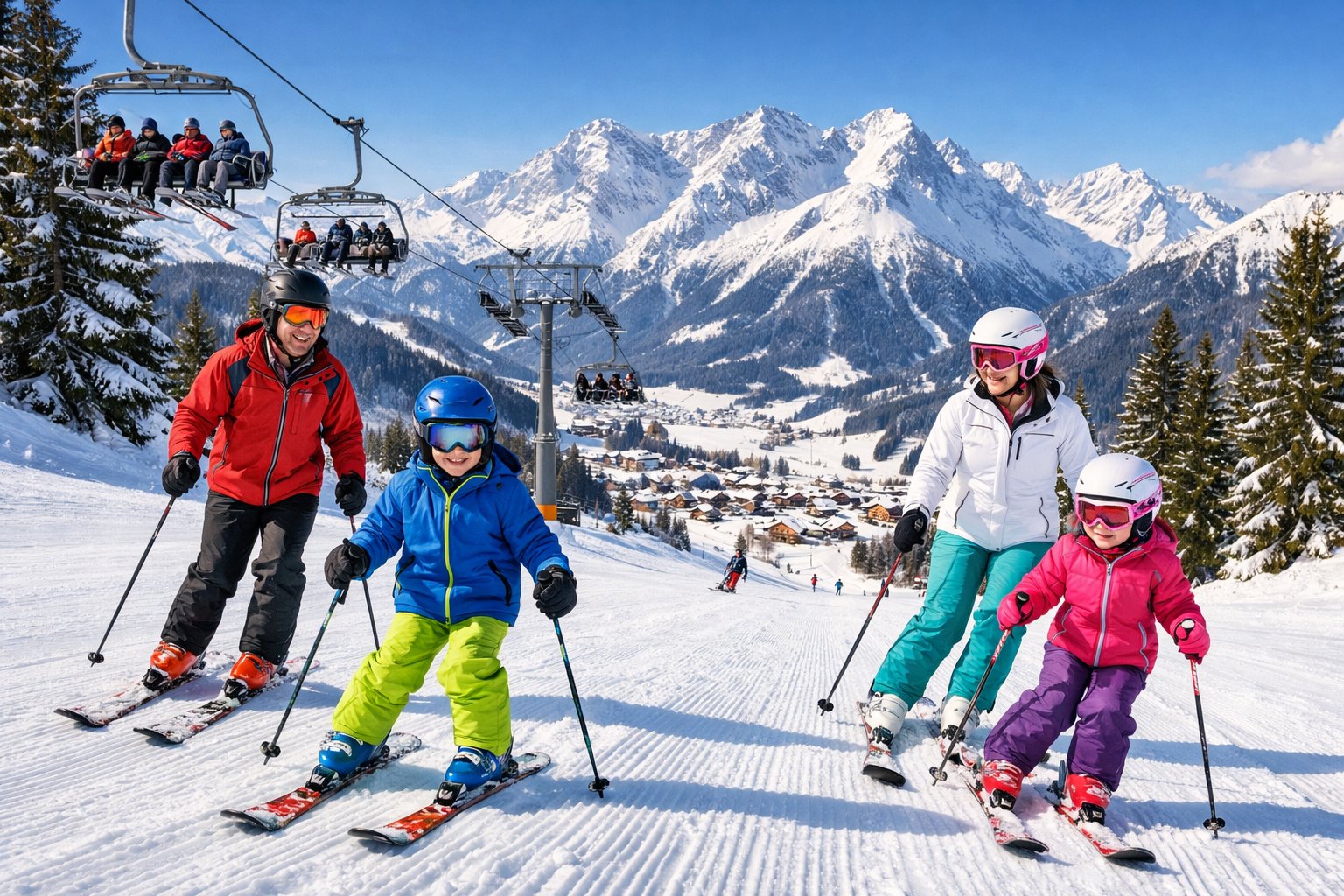
Austrian Alpine Skiing
World-class winter sports for all ages — 400+ ski resorts offer something for everyone
🏛️ Graz
Austria's second city combines Italian flair with Austrian sophistication; its historic center and Eggenberg Palace are UNESCO World Heritage Sites. Schlossberg: the iconic Uhrturm clock tower has kept time since 1712 — climb 260 steps or take the glass lift for sweeping views. Student City: universities give Graz youthful energy, with lively bars and restaurants, noticeably lower prices than Vienna, and a slower pace overall.
10 June 2025: Graz suffered the deadliest school shooting in Austrian history when a 21-year-old former pupil killed ten people at the BORG Dreierschützengasse before taking his own life. Three days of national mourning followed, and within weeks parliament tightened the gun law (Waffengesetz 2025: minimum age 25 for pistols and semi-automatics, stricter psychological screening, a cooling-off period). A memorial stands in the playground beside the school.
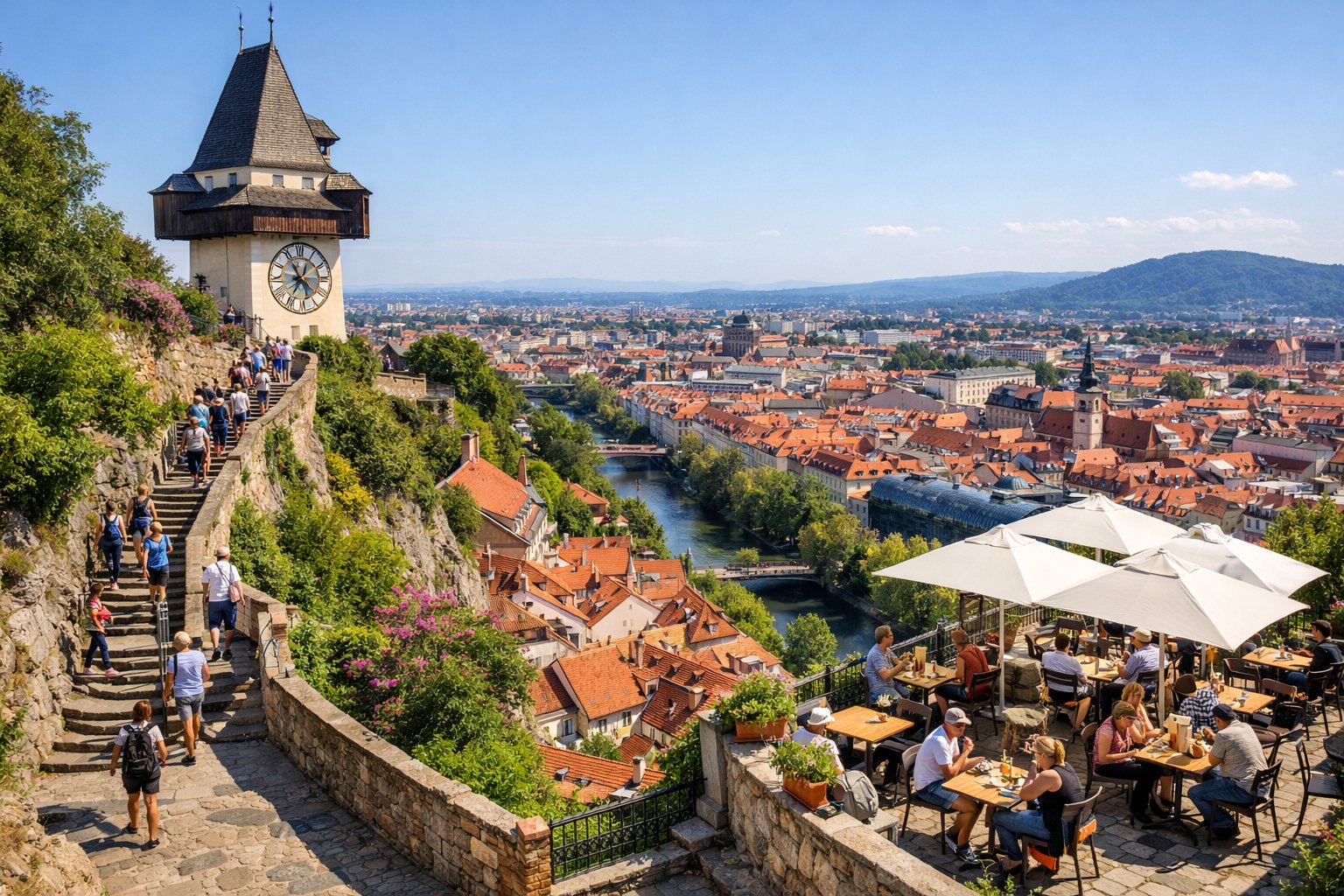
Graz Schlossberg
The famous Uhrturm clock tower overlooks Austria's second city
💎 Hallstatt & the Lakes
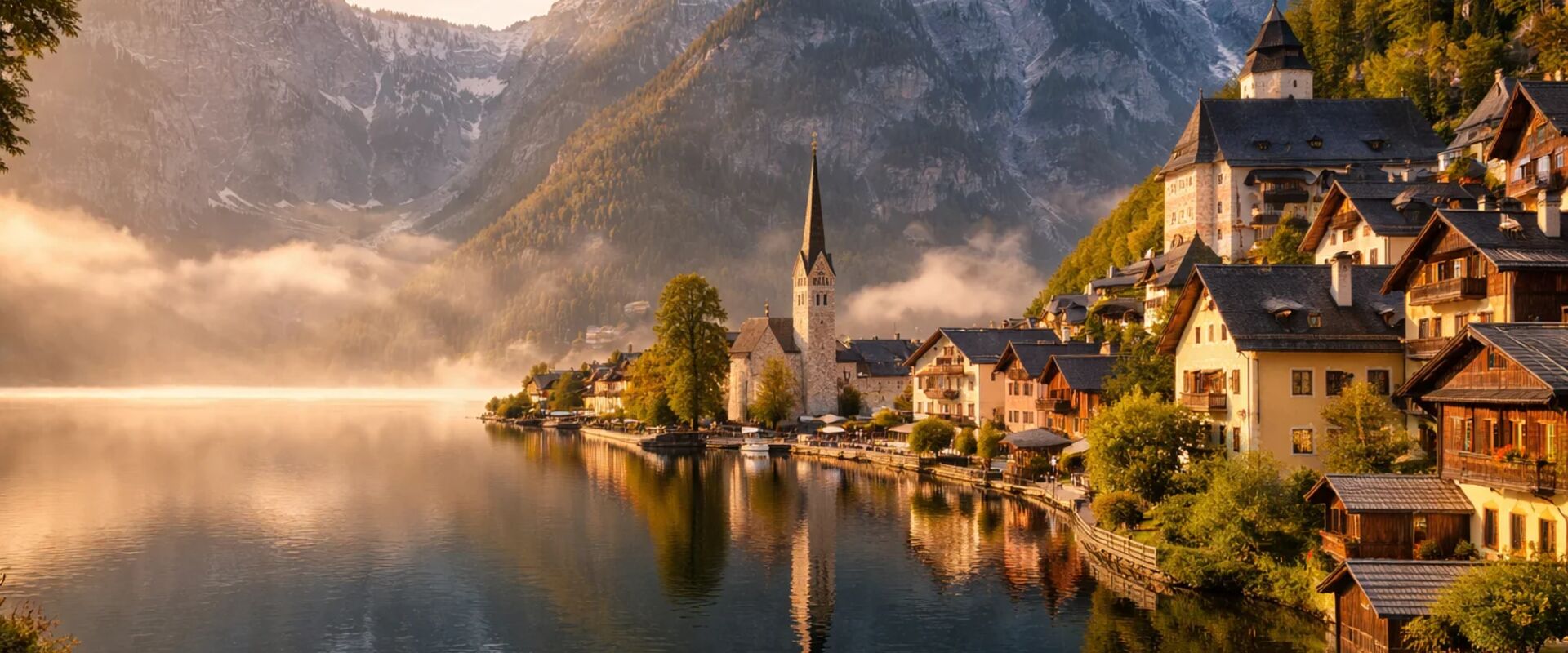
Hallstatt: perhaps the most photographed village in Austria, representing some 7,000 years of salt extraction — the world's oldest known salt mine — — so significant that the Hallstatt archaeological period (roughly 800–450 BC) was named for discoveries made here. Salt Mines: among the world's oldest salt mines, offering underground tours via miners' slides and a subterranean lake.
The Lakes: over 70 lakes dot the Salzkammergut. Wolfgangsee has steamer cruises, Mondsee's church featured in The Sound of Music, and the warmer Wörthersee reaches around 25°C in summer — genuinely swimmable by Alpine standards. Hallstatt itself now manages its fame: tour coaches need pre-booked slots, and in August 2023 the village briefly put up a wooden fence to block the most-photographed viewpoint before taking it down again after an outcry.
🍇 Wachau Valley
A UNESCO World Heritage cultural landscape along the Danube between Melk and Krems, the Wachau is Austria's most celebrated wine region — its winemaking covered in depth below. Terraced Vineyards: steep hillsides cultivated since Roman times produce world-class Grüner Veltliner and Riesling. Dürnstein: a picturesque village where Richard the Lionheart was imprisoned (1192–1193), its blue baroque church tower an iconic sight from the river. Melk Abbey: the enormous baroque Benedictine monastery dominates a rocky outcrop, its library and church representing Austrian baroque at its most spectacular.
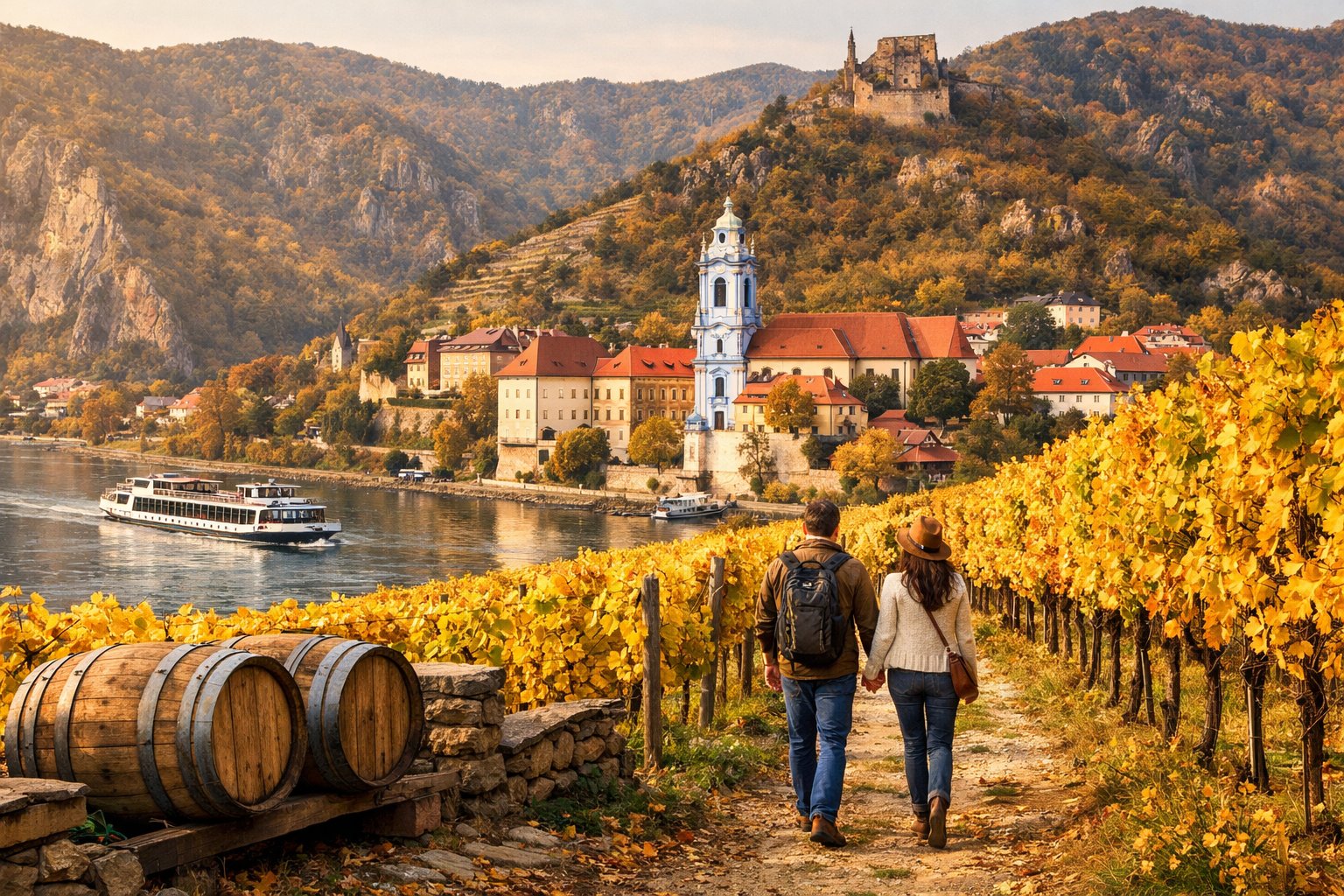
Wachau Valley
UNESCO World Heritage landscape — golden autumn vineyards, the blue tower of Dürnstein, and river cruise boats on the Danube
🍽️ Cuisine
Wiener Schnitzel: the national dish — a breaded, shallow-fried veal cutlet that should be thin, crispy, and larger than the plate, served with potato salad and lingonberry jam. Tafelspitz: Emperor Franz Joseph's favorite, prime boiled beef with root vegetables and apple-horseradish sauce. Sachertorte: the chocolate cake that sparked a genuine legal battle over the "original" recipe — two layers of apricot jam beneath a chocolate glaze, served with unsweetened whipped cream. Apfelstrudel: paper-thin pastry filled with spiced apples and raisins; the authentic version uses dough so thin you can read through it.
Wiener Schnitzel
The Golden Veal Cutlet
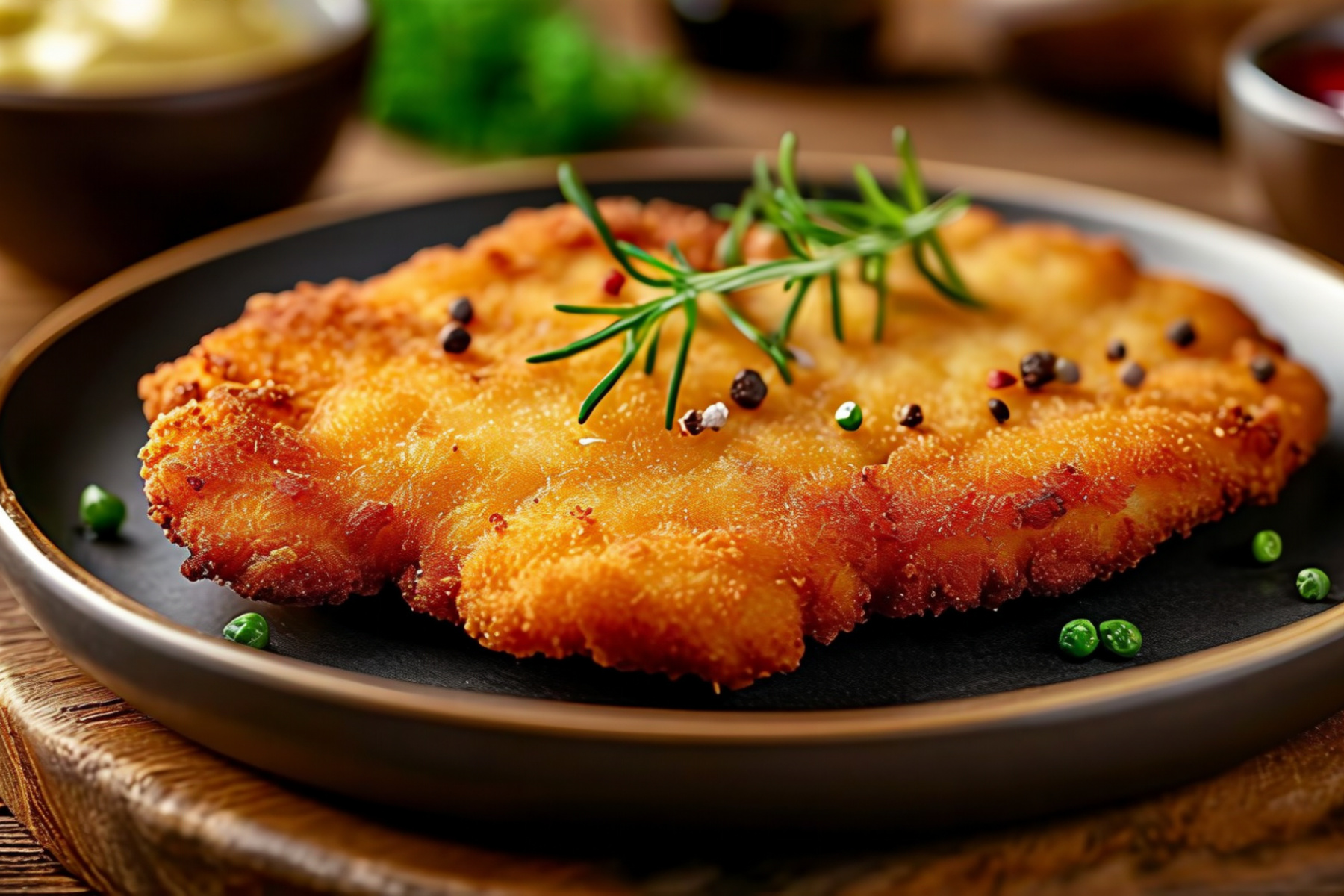
Thin veal cutlet pounded, breaded, and fried to golden perfection — Austria's most famous dish.
Ingredients: 4 veal cutlets (150g each) · 100g flour · 2 eggs, beaten · 200g fine breadcrumbs · clarified butter for frying · lemon wedges · salt
Preparation: pound the cutlets to 4mm thickness between plastic wrap and season with salt. Dredge in flour, dip in egg, coat in breadcrumbs. Heat clarified butter to 170°C — deep enough for the schnitzel to "swim" — and fry 2–3 minutes per side, swirling the pan for a wavy coating. Drain on paper and serve immediately with lemon.
💡 The schnitzel must swim in butter and the coating should puff and wave — that's the mark of authenticity. Never press it flat.
Apfelstrudel
Viennese Apple Strudel
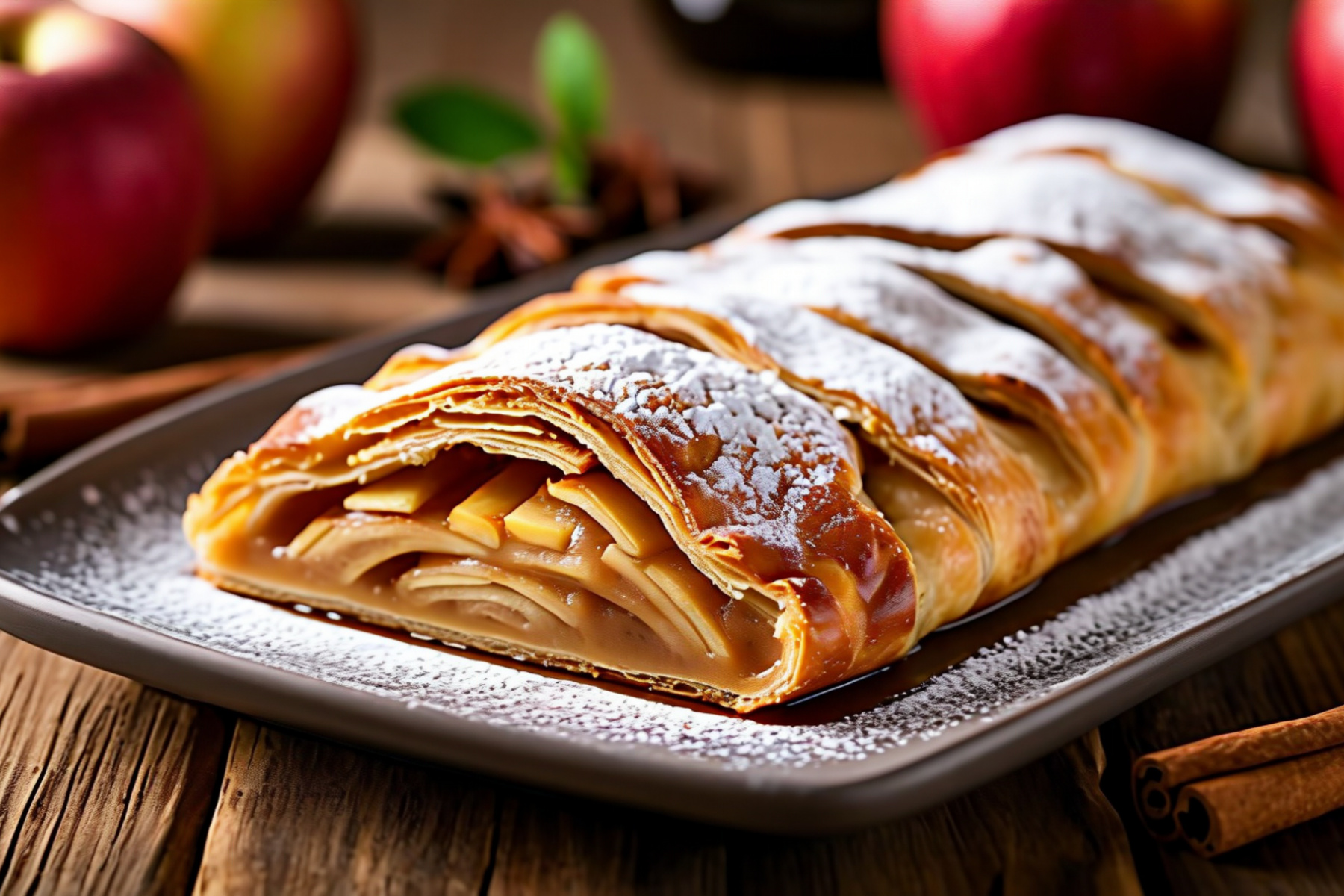
Paper-thin pastry wrapped around spiced apples, raisins, and breadcrumbs — a coffeehouse classic.
Ingredients: 250g flour · 1 egg · 30ml oil · pinch of salt · 1kg tart apples · 100g raisins · 100g breadcrumbs, toasted · 80g sugar · cinnamon · 50g melted butter
Preparation: make the dough from flour, egg, oil, salt, and water; knead until smooth and rest 30 minutes. Stretch on a floured cloth until paper-thin (you should be able to read newsprint through it). Brush with melted butter, spread breadcrumbs then the apple mixture, and roll using the cloth. Transfer to a baking sheet, brush with butter, and bake at 180°C (356°F) for 40–45 minutes. Dust with powdered sugar and serve warm with vanilla sauce.
💡 Stretch from the center outward using the backs of your hands — never pull from the edges, or it will tear.
Sachertorte
The Legendary Chocolate Cake
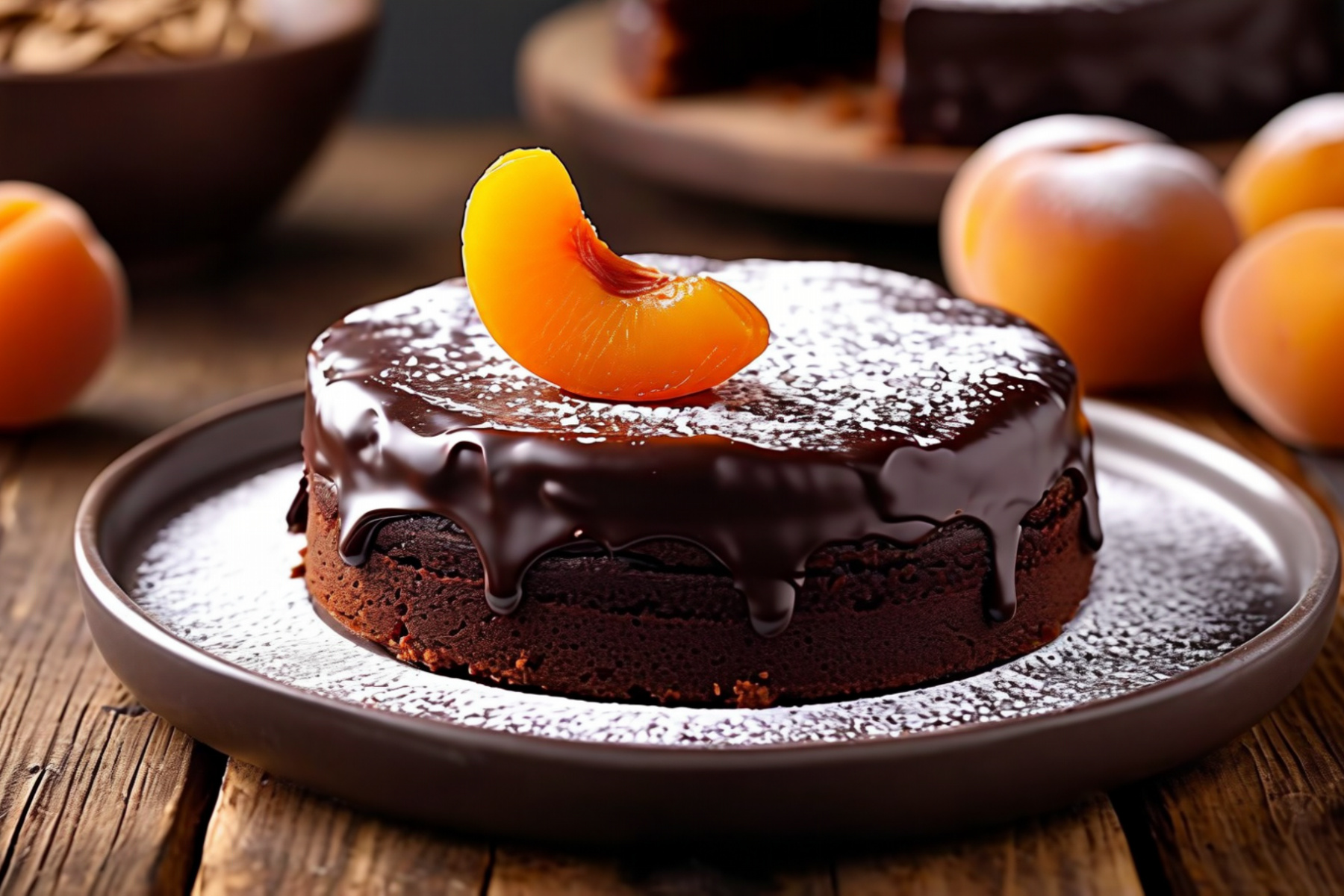
Dense chocolate cake with apricot jam and glossy ganache, created in 1832 for Prince Metternich's household.
Ingredients: 150g dark chocolate · 150g butter · 150g sugar · 6 eggs, separated · 150g flour · 200g apricot jam · 200g chocolate (glaze) · 100ml cream (glaze)
Preparation: melt the chocolate and cool slightly. Cream butter with half the sugar, add yolks one by one. Beat whites with remaining sugar to stiff peaks. Fold chocolate into the butter mixture, then flour, then whites. Bake at 170°C (338°F) for 50–60 minutes. Cool, slice horizontally, spread with jam, and reassemble. Pour warm chocolate glaze over the entire cake and let set completely before serving with schlagobers (whipped cream).
💡 Serve at room temperature — never refrigerate before serving, or the glaze will dull.
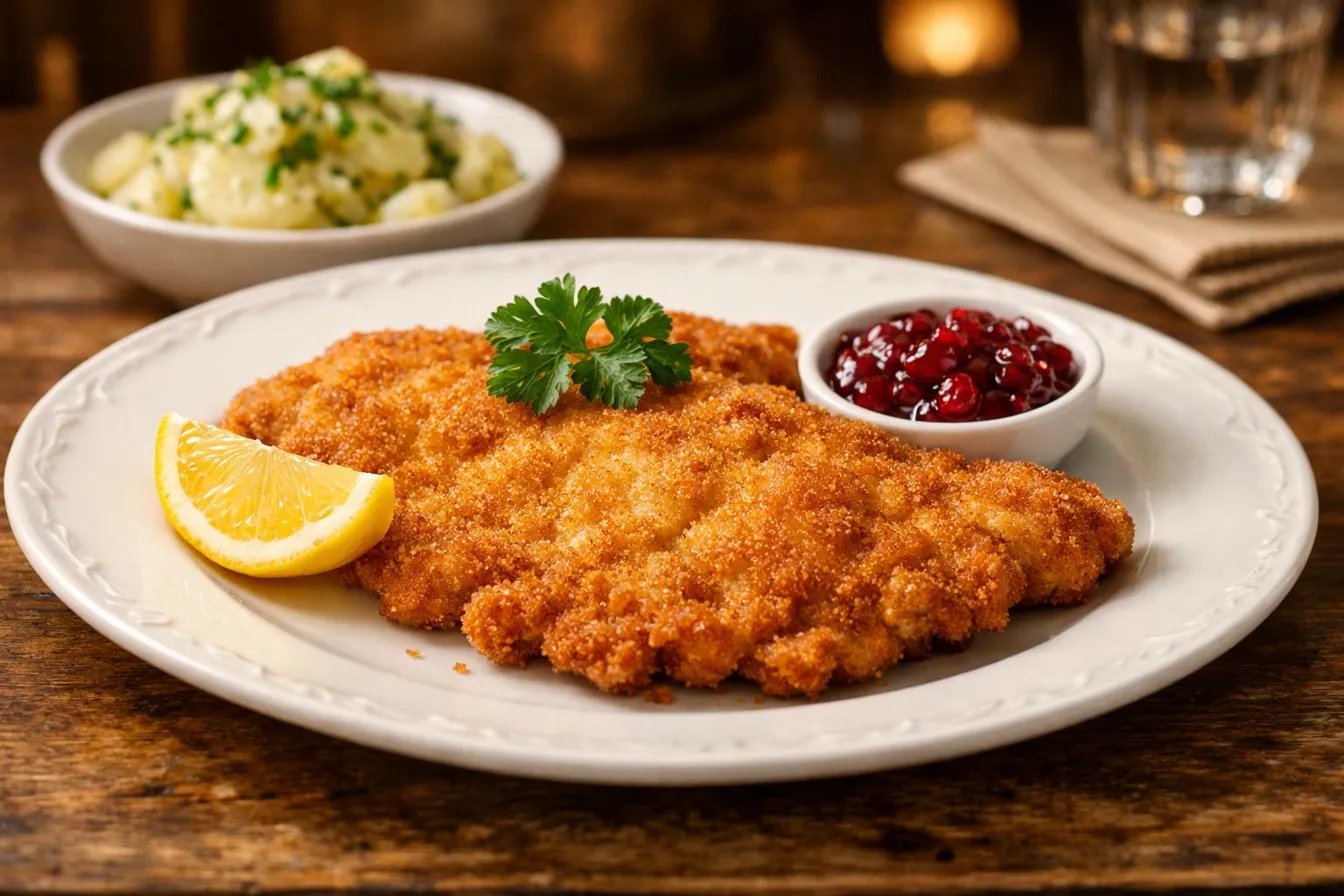
Wiener Schnitzel
Austria's most iconic dish: golden-fried veal with lemon, lingonberry jam, and potato salad
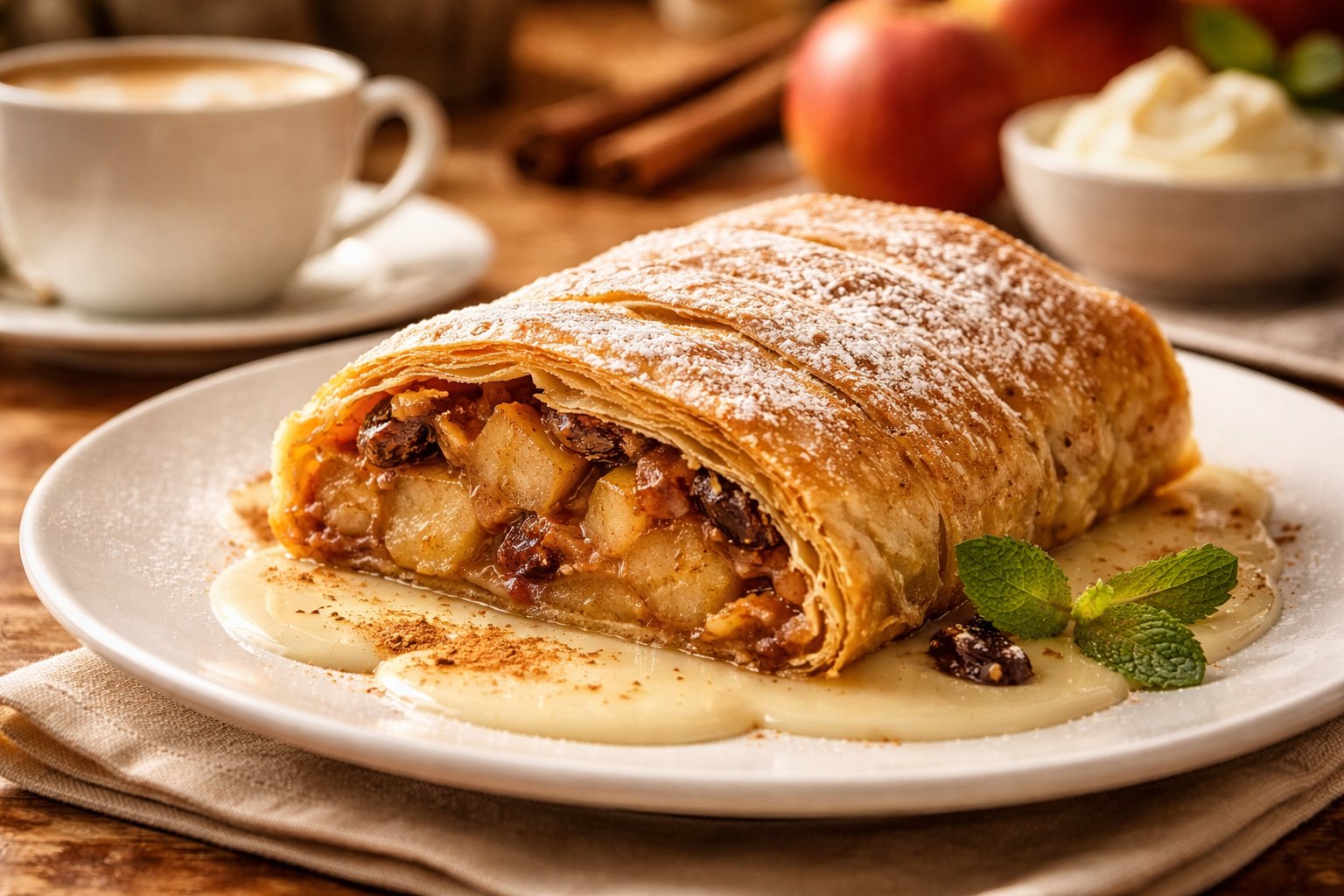
Apfelstrudel
Paper-thin pastry with spiced apples, served warm with vanilla sauce — a coffeehouse essential
🍸 Cocktails & Mixed Drinks
Austria's drinks culture spans elegant Viennese coffeehouses (on Austria's national intangible-heritage inventory), alpine Heurigen wine taverns, Christmas market Glühwein, and summer spritzes along the Donaukanal.
Wiener Melange
Vienna's Coffee Cathedral
The heart of Viennese civilisation — espresso, steamed milk, and a foam cap, traditionally served under crystal chandeliers at marble tables.
🥃 Porcelain cup · 🔨 Extract & steam
Ingredients: single espresso · 150ml steamed milk · cocoa powder
Preparation: pull the espresso into a warm porcelain cup. Steam the milk and pour over the espresso with a foam cap. Dust with cocoa.
💡 Vienna's coffee-house culture has been on Austria's national intangible-heritage inventory since 2011. At Café Central, Trotsky once played chess, and the waiters remain magnificently indifferent.
Glühwein
Christmas Market Magic
Austria's beloved mulled wine — red wine simmered with cinnamon, cloves, star anise, and orange.
🥃 Ceramic mug · 🔨 Simmer
Ingredients: 250ml red wine · cinnamon · cloves · star anise · orange juice · honey · dash of rum
Preparation: gently heat the wine with spices and honey, without boiling. Simmer 10 minutes and strain into a ceramic mug.
💡 The collectible ceramic mugs change design every year — locals prefer Spittelberg and Am Hof markets over the tourist-packed Rathausplatz.
Hugo Spritz
The Alpine Aperitivo
Invented in South Tyrol around 2005 — elderflower, Prosecco, mint, and soda, the Alpine aperitif that conquered Austria in a single summer.
🥃 Wine glass · 🔨 Build
Ingredients: 90ml Prosecco · 30ml elderflower syrup · soda water · fresh mint · lime slice
Preparation: fill a wine glass with ice, pour Prosecco and elderflower syrup, and top with soda. Garnish with mint and lime.
💡 Originally made with lemon balm syrup — Hugo bridges traditional Heuriger wine culture and modern aperitivo.
Almdudler Spritzer
Alpine Herbal Soda
Austria's beloved herbal soda, made from 32 alpine herbs, mixed with white wine — the quintessential summer refresher.
🥃 Wine glass · 🔨 Build
Ingredients: 150ml Almdudler · 100ml Grüner Veltliner · ice · lemon slice · thyme sprig
Preparation: fill a glass with ice, pour in the wine, then the Almdudler, and stir gently. Garnish with lemon and thyme.
💡 Almdudler has been Austria's answer to Coca-Cola since 1957 — the dancing-couple label is as Austrian as The Sound of Music, but rather more authentic.
Aperol Spritz
Vienna's Aperitivo Obsession
Born in Italy, but the Aperol Spritz became Vienna's unofficial summer drink — every Donaukanal Schanigarten glows orange by early evening.
🥃 Wine glass · 🔨 Build
Ingredients: 90ml Prosecco · 60ml Aperol · 30ml soda · ice · orange slice
Preparation: fill a wine glass with ice, pour Prosecco, Aperol, and soda, and stir gently. Garnish with an orange slice.
💡 Austrians reportedly drink more Aperol Spritz per capita than Italians do — the Donaukanal in summer is one long Aperol party.
Kaufmann Drinks Score (KDS)
| Drink | Style | KDS |
|---|---|---|
| Wiener Melange | Vienna's Coffee Cathedral | 76 |
| Glühwein | Christmas Market Magic | 83 |
| Hugo Spritz | The Alpine Aperitivo | 86 |
| Almdudler Spritzer | Alpine Herbal Soda | 79 |
| Aperol Spritz | Vienna's Aperitivo Obsession | 85 |
✦ Coffeehouse Note — Radim Kaufmann
Vienna teaches you that civilisation is best measured in coffee. At Café Central, where Trotsky once played chess and Freud pondered the unconscious, I ordered a Wiener Melange and a slice of Sachertorte. The waiter — impeccably dressed, magnificently indifferent — placed the cup with surgical precision. "Herr Ober," I asked, "what makes Viennese coffee special?" He paused, considering whether I deserved an answer. "Time," he said finally. "We do not hurry. That is the point."
🍷 Wine, Spirits & Drinking Culture
Austria is one of Europe's most underrated wine countries — and one of its most fascinating. For centuries overshadowed by its neighbours France, Italy, and Germany, Austrian wine endured a catastrophic scandal in 1985 when some producers were caught adulterating wine with diethylene glycol (antifreeze). The scandal devastated exports overnight. But it also triggered the most rigorous wine quality revolution in European history: Austria enacted the continent's strictest wine laws, established a classification system rivalling Burgundy's, and within two decades emerged as one of the world's most respected producers of white wine.
Today, Austrian wine is a connoisseur's paradise. The country's roughly 45,000 hectares of vineyard — mostly along the Danube and in eastern Burgenland — produce wines of crystalline purity, mineral precision, and food-friendly elegance that are utterly distinctive. Vienna is the world's only capital city with significant commercial vineyards within its borders, and Viennese Heuriger wine-tavern culture has been on Austria's national inventory of intangible cultural heritage since 2019.
📜 The 1985 Scandal — From Disgrace to Renaissance
The "antifreeze scandal" of 1985 is the defining event in Austrian wine history. A handful of producers in Burgenland were adding diethylene glycol — an ingredient in antifreeze — to bulk wines to make them seem sweeter and more full-bodied. When discovered, the scandal made international headlines and destroyed Austria's wine export market overnight. Entire warehouses of Austrian wine were pulled from shelves worldwide.
The response was extraordinary. Austria passed the Austrian Wine Law of 1985, the strictest in Europe. Every bottle now carries a government-issued banderole (seal). Quality control became obsessive. And the next generation of winemakers — Willi Bründlmayer, F.X. Pichler, Alois Kracher, Emmerich Knoll — channeled the national humiliation into a fanatical pursuit of quality. Within 20 years, Austrian wine went from global pariah to critical darling. The lesson: sometimes disaster is the best thing that can happen to a wine country.
🏔️ The Wine Regions
🏞️ Wachau — The Danube Masterpiece
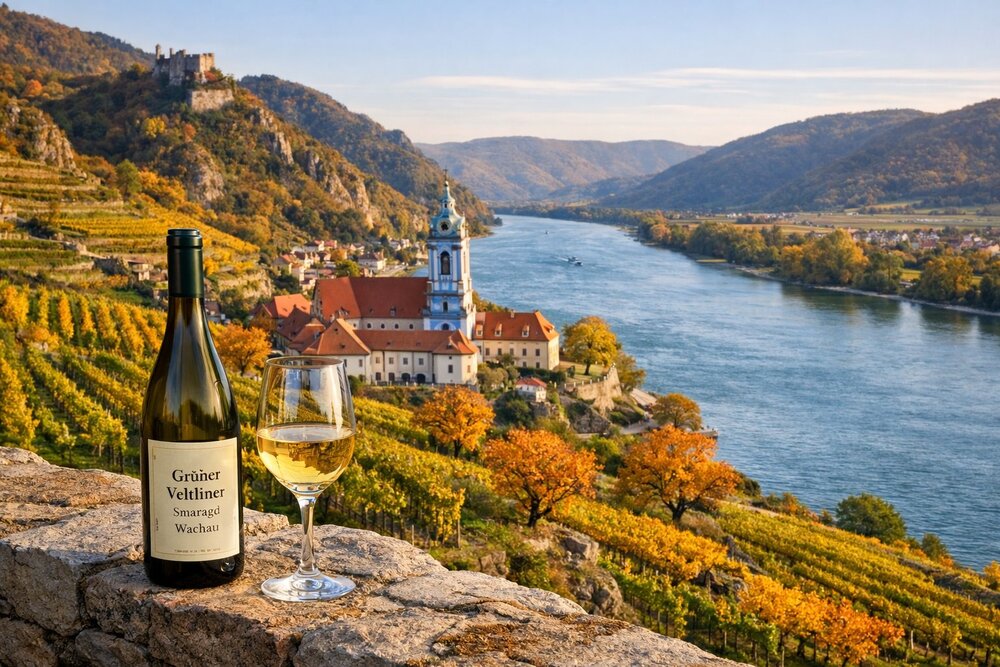
The 36-kilometre stretch of the Danube between Melk and Krems is Austria's most prestigious wine region and a UNESCO World Heritage Site. Steep, terraced vineyards carved into granite and gneiss cliffs above the river produce Grüner Veltliner and Riesling of breathtaking purity. The Wachau has its own unique classification system: Steinfeder (light, under 11.5% alcohol, named after a local grass), Federspiel (medium, 11.5–12.5%, named after the falconry tradition), and Smaragd (rich, 12.5%+, named after the emerald lizards sunning on the terraces). F.X. Pichler, Emmerich Knoll, Domäne Wachau, and Rudi Pichler are among the world's greatest white wine producers.
🌅 Burgenland — Red Wine & Sweet Wine Country
Eastern Austria's warmest region, bordering Hungary, wraps around the shallow, reed-fringed Neusiedlersee — Europe's second-largest steppe lake. The autumnal mists from the lake create perfect conditions for noble rot (botrytis), and the late Alois Kracher made dessert wines here that rivalled the finest Sauternes. The sub-region of Mittelburgenland is Austria's red wine heartland, producing deep, complex Blaufränkisch from iron-rich soils — think Pinot Noir's structure with Syrah's dark fruit. Moric, founded by Roland Velich, has become one of Europe's most celebrated small producers.
🌿 Kamptal, Kremstal & Weinviertel — The Grüner Heartland
The regions surrounding the Wachau produce the bulk of Austria's Grüner Veltliner. Kamptal, centred on the medieval town of Langenlois, is home to Willi Bründlmayer — whose Grüner Veltliner Alte Reben (old vines) is arguably Austria's single finest white wine. Kremstal bridges the power of Wachau with the accessibility of Kamptal. Weinviertel ("wine quarter"), Austria's largest region, produces lighter, peppery Grüner Veltliner for everyday drinking — and pioneered the DAC (Districtus Austriae Controllatus) quality classification in 2003.
🏔️ Steiermark (Styria) — Austria's Cool South
Southeastern Austria, bordering Slovenia, produces Austria's most vibrant and aromatic whites. Sauvignon Blanc from the steep slopes of Südsteiermark rivals Loire Valley and Marlborough. Volcanic soils in Vulkanland Steiermark add mineral complexity. The Buschenschank tradition (Styria's version of the Heuriger) offers cold platters of Brettljause (charcuterie boards), pumpkin seed oil, and stunning hillside views. Tement and Gross are Styria's leading producers.
🏛️ Vienna — The Urban Vineyard
700 hectares of vineyard within a capital city — nowhere else in the world. Vineyards on the slopes of Kahlenberg, Nussberg, and Bisamberg overlook the city, and the wine produced is mostly Gemischter Satz (field blend): multiple grape varieties planted, harvested, and fermented together, as has been done for centuries. In 2013, Wiener Gemischter Satz received DAC status. The best producers — Wieninger, Christ, Mayer am Pfarrplatz (the house where Beethoven composed parts of his 9th Symphony) — make wines of surprising complexity.
🍇 The Key Grapes
🥂 Grüner Veltliner — The National Grape · KWS 91
Austria's flagship · roughly 30% of all plantings · Wachau, Kamptal, Kremstal, Weinviertel
White pepper, green apple, citrus zest, and a distinctive mineral crunch. At its simplest, Grüner Veltliner is one of the world's most food-friendly white wines — try it with Wiener Schnitzel or Asian cuisine and it matches almost everything. At its finest — Smaragd-level Wachau or Bründlmayer's Alte Reben — it's a wine of power, depth, and 15-year ageing potential that can rival great white Burgundy at a fraction of the price. The "Grüner revolution" swept New York and London sommeliers in the 2000s, and the grape has never looked back.
🥂 Riesling — The Alpine Expression · KWS 90
Wachau, Kamptal · Drier than German Riesling
Austrian Riesling is drier and more mineral-driven than German Riesling — bone-dry, with peach, apricot, and a distinctive smoky flintiness from the granite terraces of the Wachau. F.X. Pichler's Kellerberg and Unendlich ("infinite") are among the world's greatest dry Rieslings. The warm Wachau terraces give Austrian Riesling more body than Mosel or Alsatian versions — these are serious, gastronomic wines.
🍷 Blaufränkisch — The Noble Red · KWS 86
Burgenland, Mittelburgenland · Known as Kékfrankos in Hungary, Lemberger in Germany
Austria's finest red grape — dark cherry, blackberry, spice, and a firm tannic backbone that ages beautifully. Roland Velich's Moric winery has single-handedly elevated Blaufränkisch to world-class status, with single-vineyard wines from Neckenmarkt and Lutzmannsburg that show Pinot-like elegance and terroir transparency. At $20–35, these are among Europe's most undervalued fine red wines.
🥂 Zweigelt — The People's Red · KWS 79
Austria's most planted red · created 1922 by Dr. Fritz Zweigelt
A cross between Blaufränkisch and St. Laurent, created by Dr. Fritz Zweigelt in 1922 at the Klosterneuburg research station. Produces soft, cherry-fruited, easy-drinking reds — Austria's everyday red wine, served slightly chilled in Heurigen across Vienna. The grape's name has become a live subject of debate: Dr. Zweigelt's Nazi-era activities have prompted calls to rename it, with "Rotburger" proposed as an alternative — a small but telling example of how Austria continues to work through this period of its history in unexpected corners of public life.
🍻 The Heuriger Tradition
The Heuriger (plural: Heurigen) is Austria's most beloved drinking institution — a wine tavern serving the current year's vintage ("heurig" means "this year's"). The tradition dates to a 1784 decree by Emperor Joseph II that permitted winegrowers to sell their own wine and food on their premises. A Föhrenbusch (pine branch) hung above the door signals that the Heuriger is open — "ausg'steckt" (hung out) in Viennese dialect.
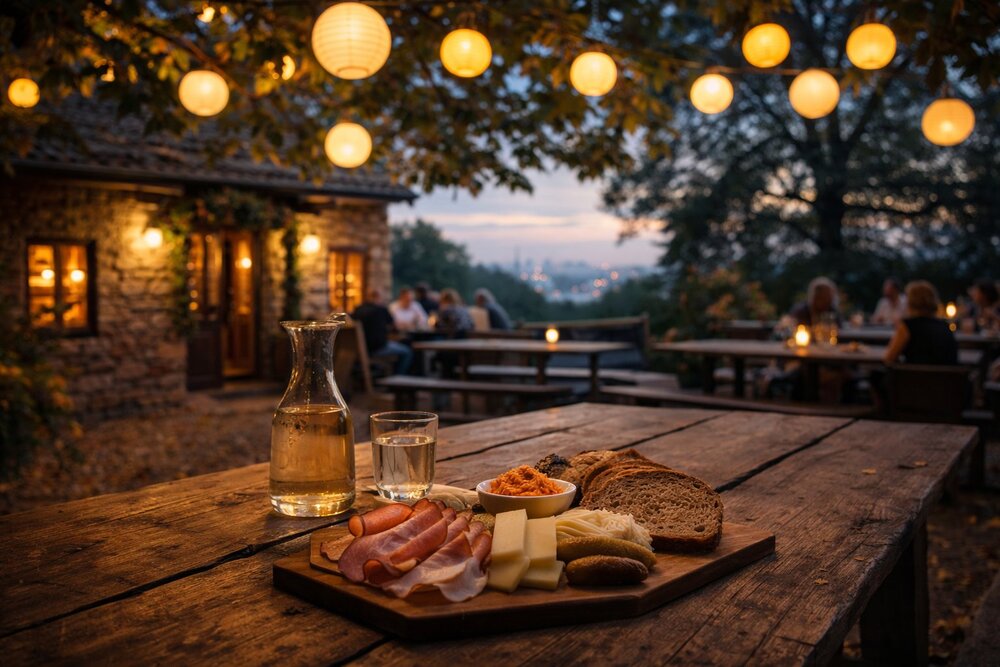
The classic Heuriger experience: a garden table under chestnut trees, a quarter-litre of young white wine (a "Viertel"), a cold buffet of Liptauer (paprika cheese spread), Brettljause (charcuterie board with smoked meats, Emmentaler, horseradish, gherkins, dark bread), and Schmalzbrot (bread with pork dripping). In autumn, the new wine is a milky, semi-fermented Sturm — mildly alcoholic, sweet, and treacherously easy to drink. The greatest concentration of Heurigen is in Vienna's 19th district — Grinzing, Neustift am Walde, and Nussdorf — but the most atmospheric are found in the Wachau villages of Dürnstein and Spitz. Since 2019, Wiener Heurigenkultur has been on Austria's national inventory of intangible cultural heritage — the register kept by the Austrian UNESCO Commission, distinct from UNESCO's international lists — recognition that these aren't just wine taverns, but a living social tradition that defines Austrian communal life.
🥃 Schnapps & Spirits
Schnaps (fruit brandy) is Austria's traditional spirit — distilled from apricots (Marillenschnaps, the most prized, especially from the Wachau), pears (Williamsbirne), plums (Zwetschke), or gentian root (Enzianschnaps). Every Austrian valley has its own Brenner (distiller), and sampling the local Schnaps is close to obligatory after a mountain hike. Freihof in Lustenau and Gölles in Styria are among the country's finest artisanal distillers.
Punschkrapfen, that pink-iced rum cake found in every Viennese bakery, hints at Austria's deeper spirit culture: the Kaffeehauskultur (coffee house culture), also on the national inventory, where an Einspänner (espresso with whipped cream) or Fiaker (coffee with rum and cream, named after Vienna's horse-cab drivers) is as much a drinking tradition as any wine.
🏆 Kaufmann Wine Score — Austria
Rated on four criteria: Aroma (/25), Taste (/30), Finish (/20), Value (/25) — Total /100
| Wine | 🔴 Aroma | 🟡 Taste | 🟢 Finish | 🔵 Value | Total |
|---|---|---|---|---|---|
| 🥂 Grüner Veltliner (Wachau Smaragd / Kamptal Alte Reben) | 23 | 27 | 17 | 24 | 91 |
| 🥂 Riesling (Wachau) | 23 | 27 | 18 | 22 | 90 |
| 🍷 Blaufränkisch (Mittelburgenland) | 21 | 25 | 16 | 24 | 86 |
| 🥂 Wiener Gemischter Satz DAC | 20 | 24 | 15 | 23 | 82 |
| 🍷 Zweigelt | 18 | 22 | 14 | 25 | 79 |
95–100 Legendary · 90–94 Outstanding · 85–89 Very Good · 80–84 Good · 75–79 Average · <75 Below Average
📅 When to Visit
Spring (Apr–May): blooming landscapes, Wachau apricot blossoms, fewer crowds, Easter markets. Summer (Jun–Aug): peak season, outdoor festivals, lake swimming, the Salzburg Festival. Autumn (Sep–Oct): wine harvest, mild weather, colorful foliage, excellent for hiking. Winter (Dec–Mar): skiing, Christmas markets, ball season — cold but magical.
✈️ Getting There
Vienna Airport (VIE): the main hub, handling over 30 million passengers annually; the CAT train reaches the city center in 16 minutes. By Train: high-speed connections to Munich (4h), Zurich (8h), Prague (4h), and Budapest (2.5h); Nightjet sleeper trains serve many cities across the continent. By Car: well-maintained highways, though a vignette (toll sticker) is required on motorways.
🚆 Getting Around
Rail: ÖBB operates one of Europe's best networks — Vienna to Salzburg takes 2.5 hours, and booking online usually brings savings. Vienna: excellent U-Bahn, trams, and buses; a 24-hour pass is €9.70 in the WienMobil app (€10.20 on paper) and a 7-day pass from about €25 — the January 2026 tariff reform raised prices roughly 20% and scrapped the 48- and 72-hour tickets. Driving: well-maintained roads but expensive city parking, and winter tires are mandatory from November 1 to April 15.
ℹ️ Practical Info
Money: Euro (EUR); credit cards widely accepted; tip 5–10% at restaurants. Language: German, with English widely spoken — "Grüß Gott" (hello), "Danke" (thanks), "Prost!" (cheers) will get you far. Visa: Schengen Area rules apply — US, UK, Canadian, and Australian citizens enter visa-free for up to 90 days in any 180; since 10 April 2026 the EU Entry/Exit System biometrically registers non-EU arrivals at the external Schengen border (see Travel Advisory below). Electricity: 230V, Type C/F plugs — UK and US visitors need adapters. Safety: a very safe country overall; normal precautions against pickpockets apply in busy tourist areas.
⚠️ Travel Advisory & Health
🟢 Level 1 — Exercise Normal Precautions
The U.S. Department of State places Austria at Level 1, its lowest advisory tier, in an advisory reissued on 21 August 2026. The UK FCDO and Canada's Global Affairs carry comparably relaxed guidance. Austria is among the safest countries in Europe by any measure — the real hazards here are alpine and meteorological, not criminal.
Borders and paperwork. Austria is in the Schengen Area, so most arrivals land at an external Schengen border elsewhere. The EU's Entry/Exit System (EES) has been fully operational at all Schengen external borders since 10 April 2026: non-EU travelers are now biometrically registered — face and fingerprints — on first entry, replacing passport stamping, and should budget extra time on that first crossing. ETIAS, the separate €20 travel authorisation, has slipped repeatedly and is not yet in force; the 2026 target was quietly dropped in July 2026 and a 2027 launch is now the likeliest outcome. Until it goes live, visa-exempt visitors (US, UK, Canada, Australia and others) need nothing beyond a passport valid three months past departure, for stays up to 90 days in any 180.
Ticks are the underrated risk. Austria is one of Europe's genuine hotspots for tick-borne encephalitis (FSME), endemic in forested areas across almost the entire country up to roughly 1,500 m. The vaccine is routine for Austrians and worth discussing with a travel clinic if you plan serious hiking between spring and autumn; Lyme disease is also present and is not vaccine-preventable. Check yourself after woodland walks.
Mountain safety and rescue costs. Alpine rescue in Austria is not free, and a helicopter evacuation can run into five figures in euros. Standard travel insurance frequently excludes off-piste skiing, via ferrata, and high-altitude hiking — check the wording, or take a season's membership of the Österreichischer Alpenverein, which bundles worldwide rescue and repatriation cover for a modest annual fee and is what most locals do. Avalanche bulletins are published daily in winter by each state's warning service; the European avalanche danger scale runs 1–5, and level 3 already accounts for the majority of fatalities.
Health care and emergencies. Standards are excellent and pharmacies (Apotheke) are everywhere, with a rotating after-hours duty roster posted on the door. EU/EEA and Swiss citizens should carry the European Health Insurance Card; UK visitors the GHIC. Emergency numbers: 112 (general European emergency), 144 (ambulance), 140 (mountain rescue), 133 (police). Tap water is superb — Vienna's arrives by gravity-fed aqueduct from Alpine springs and is treated as a point of civic pride.
💸 Cost of Living
Accommodation: hostel €25–40, budget hotel €70–100, mid-range €120–200, luxury €250+. Food: coffee €4–6, beer €4–5, schnitzel €15–25, restaurant meal €20–35. Transport: single metro ticket €3.00 in the app (€3.20 paper), 24-hour pass €9.70 (€10.20 paper) — 2026 tariff, train Vienna–Salzburg €30–60. Activities: museum €10–18, opera standing room €13–18, ski day pass €50–70. Daily Budgets: backpacker €60–90, mid-range €150–250, comfortable €300–450.
🏨 Accommodation
Vienna: the 1st district is central but comes at premium prices — districts 4–9 offer better value while staying close to the center. Alpine: half-board (breakfast plus dinner) is standard and good value; mountain huts offer basic accommodation for hikers. Unique Options: castle hotels, farm stays, wine estate guesthouses, and 500+ ÖAV mountain huts for anyone wanting to sleep properly in the Alps.
🎭 Festivals & Events
Vienna New Year's Concert (Jan 1): the Vienna Philharmonic's televised concert reaches millions worldwide — tickets are effectively lottery-only. Salzburg Festival (Jul–Aug): Austria's most prestigious cultural event, running since 1920. Ball Season (Nov–Feb): over 450 balls across the country, culminating in the legendary Vienna Opera Ball. Christmas Markets (late Nov–Dec): Vienna's Rathausplatz, Schönbrunn, and Salzburg fill with mulled wine, roasted chestnuts, and handcrafted gifts. Donauinselfest (June): one of Europe's largest open-air music festivals — free admission. Eurovision 2026: after JJ won the 2025 contest with "Wasted Love", Vienna hosted the 70th Eurovision Song Contest at the Wiener Stadthalle on 12–16 May 2026 (its third time, after 1967 and 2015); Bulgaria won with "Bangaranga".
🏛️ UNESCO World Heritage
Austria has 12 UNESCO World Heritage Sites: Historic Cities — Vienna (2001), Salzburg (1996), Graz with Eggenberg (1999/2010). Palaces — Schönbrunn (1996). Cultural Landscapes — Hallstatt-Dachstein (1997), Wachau (2000), Fertő/Neusiedlersee (2001). Technical Heritage — the Semmering Railway (1998), Europe's first standard-gauge mountain railway (1854). Others — prehistoric pile dwellings, the Great Spa Towns of Europe (Baden), the Roman Danube Limes, and primeval beech forests.
2026 update: at its 48th session in Busan (July 2026) the World Heritage Committee removed the Historic Centre of Vienna from the List of World Heritage in Danger, where it had sat since 2017 over the Heumarkt high-rise project — the redesign was scaled back enough to satisfy the Committee. Austria's tentative list holds two candidates: the Iron Trail with the Erzberg and the old town of Steyr (2002) and the Grossglockner High Alpine Road (2016). Salzburg's historic centre and the Neusiedlersee landscape remain under regular state-of-conservation reporting.
🎒 Packing Tips
Year-Round: comfortable walking shoes (cobblestones are everywhere), layers, a rain jacket, and a Type C/F adapter. Winter: a warm waterproof coat, hat, gloves, waterproof boots, and ski gear — or rent locally, which is easy and common. Summer: light clothing, sun protection, swimwear, hiking boots, and a light jacket for cool evenings. Cultural Events: smart casual works for most venues; formal attire is expected for opera premieres and balls.
🔗 Resources
Tourism: austria.info, wien.info, salzburg.info, innsbruck.info. Transport: oebb.at (trains), wienerlinien.at (Vienna public transport). Culture: wiener-staatsoper.at (State Opera), salzburgfestival.at (Salzburg Festival). Apps: ÖBB Scotty (trains), Wiener Linien (Vienna transit), bergfex (hiking and skiing conditions).
📖 Reading
History: "The Habsburgs: To Rule the World" by Martyn Rady; "The World of Yesterday" by Stefan Zweig. Fiction: "The Third Man" by Graham Greene; "The Piano Teacher" by Elfriede Jelinek. Music: "Mozart: A Life" by Maynard Solomon.
🎬 Videos
Films: The Sound of Music (1965), The Third Man (1949), Before Sunrise (1995). Documentaries: "Vienna: Empire, Dynasty and Dream" (BBC), Rick Steves' Europe: Austria.
❓ Fascinating Facts
1. Popular legend credits Vienna with the croissant — as the crescent-shaped Kipferl, supposedly created to celebrate victory over the besieging Ottomans in 1683. It's a great story and worth knowing, but food historians note that kipferl-type pastries existed in Austria well before 1683, so treat the siege-victory origin as beloved folklore rather than settled history.
2. Schönbrunn Zoo (1752) is the world's oldest continuously operating zoo.
3. Red Bull is Austrian — the company was founded in 1984 and the first can sold in 1987, now selling billions of cans annually worldwide.
4. The postcard originated in Austria — the Correspondenz-Karte was introduced in 1869.
5. The snow globe was invented in Vienna, reportedly by accident, around 1900.
6. Austria has 8 neighboring countries — Germany, Czech Republic, Slovakia, Hungary, Slovenia, Italy, Switzerland, and Liechtenstein, a notably high number for a country of its size.
7. An early sewing machine was patented by an Austrian — Josef Madersperger, in 1814 — though, as with many inventions, several other inventors in different countries have competing claims to "the first" practical sewing machine.
👤 Notable People
Composers: Mozart, Schubert, Johann Strauss II, Mahler, Schoenberg. Artists: Gustav Klimt, Egon Schiele, Friedensreich Hundertwasser. Thinkers: Sigmund Freud, Ludwig Wittgenstein, Friedrich Hayek. Nobel laureates: Elfriede Jelinek (Literature 2004), Peter Handke (Literature 2019), Anton Zeilinger (Physics 2022). Modern: Arnold Schwarzenegger, Niki Lauda, Christoph Waltz.
⚽ Sports
Skiing: Austria is a genuine skiing superpower — legends include Toni Sailer, Franz Klammer, Hermann Maier, and Marcel Hirscher (8 overall World Cup titles). Football: Red Bull Salzburg dominates domestically; David Alaba, the national-team captain, is the country's most famous football export — his five years at Real Madrid ended in June 2026 and he was still a free agent at the start of September 2026. Motorsport: Niki Lauda won three F1 championships, and the Red Bull Ring hosts the Austrian Grand Prix. Tennis: Dominic Thiem won the 2020 US Open and retired in October 2024.
Recent results: Ralf Rangnick's national team reached the Euro 2024 round of 16 and then qualified for the 2026 World Cup — Austria's first since 1998 — where it beat Jordan 3–1, lost 0–2 to Argentina, drew 3–3 with Algeria, and went out 0–3 to eventual champions Spain in the round of 32 on 2 July 2026. Saalbach-Hinterglemm hosted the 2025 Alpine World Ski Championships, and at the Milano Cortina 2026 Winter Olympics Austria finished ninth in the medal table with 18 medals (5 gold, 8 silver, 5 bronze).
📰 Media & Press Freedom
Austria ranks 19th of 180 countries in the 2026 RSF World Press Freedom Index with a score of 79.43, having climbed three places in a year when the global average fell to a 25-year low. That is a solidly free environment — but a small one, and Austrians will readily tell you that the country's media problem is concentration rather than censorship.
The ORF is the dominant public broadcaster, funded since January 2024 by a universal household levy (the ORF-Beitrag) that replaced the old device-based licence fee; its supervisory bodies have long been criticised as a spoils system for whichever parties are in government. On the print side, the tabloid Kronen Zeitung commands one of the highest per-capita readerships of any newspaper in the world, giving a single title extraordinary agenda-setting power in a country of nine million. Quality journalism is nonetheless in good health: Der Standard, Die Presse, Kurier, Salzburger Nachrichten, and the sharp Viennese weekly Falter all do serious investigative work — much of it, in recent years, aimed squarely at the political establishment that funds the government advertising on which many outlets depend.
For a visitor the practical takeaway is simple: English-language news is easy to find, ORF's Ö1 radio and the ORF weather and avalanche bulletins are genuinely useful travel tools, and free Wi-Fi with unrestricted access is standard in cafés, trains, and stations.
📸 Gallery
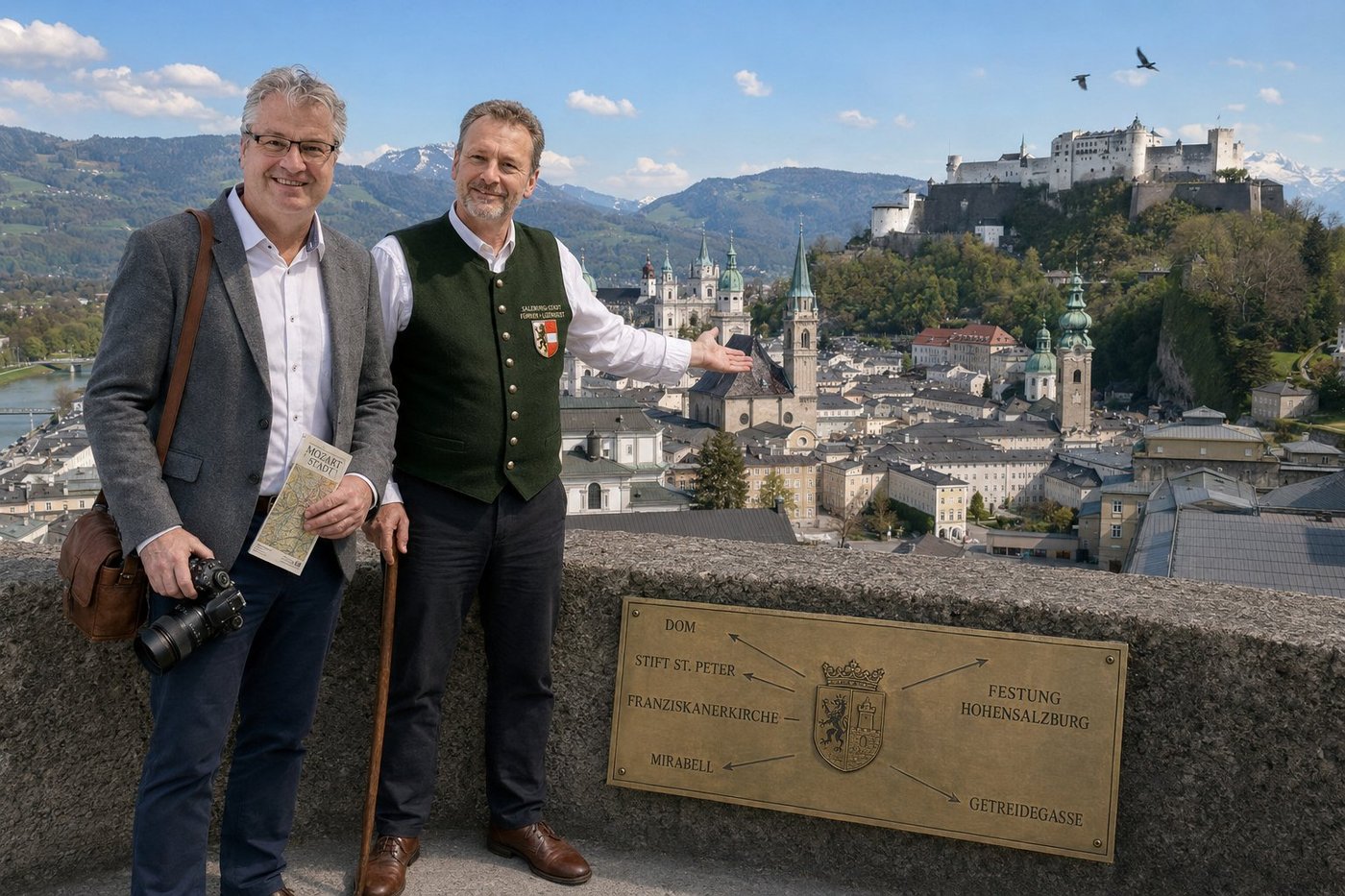
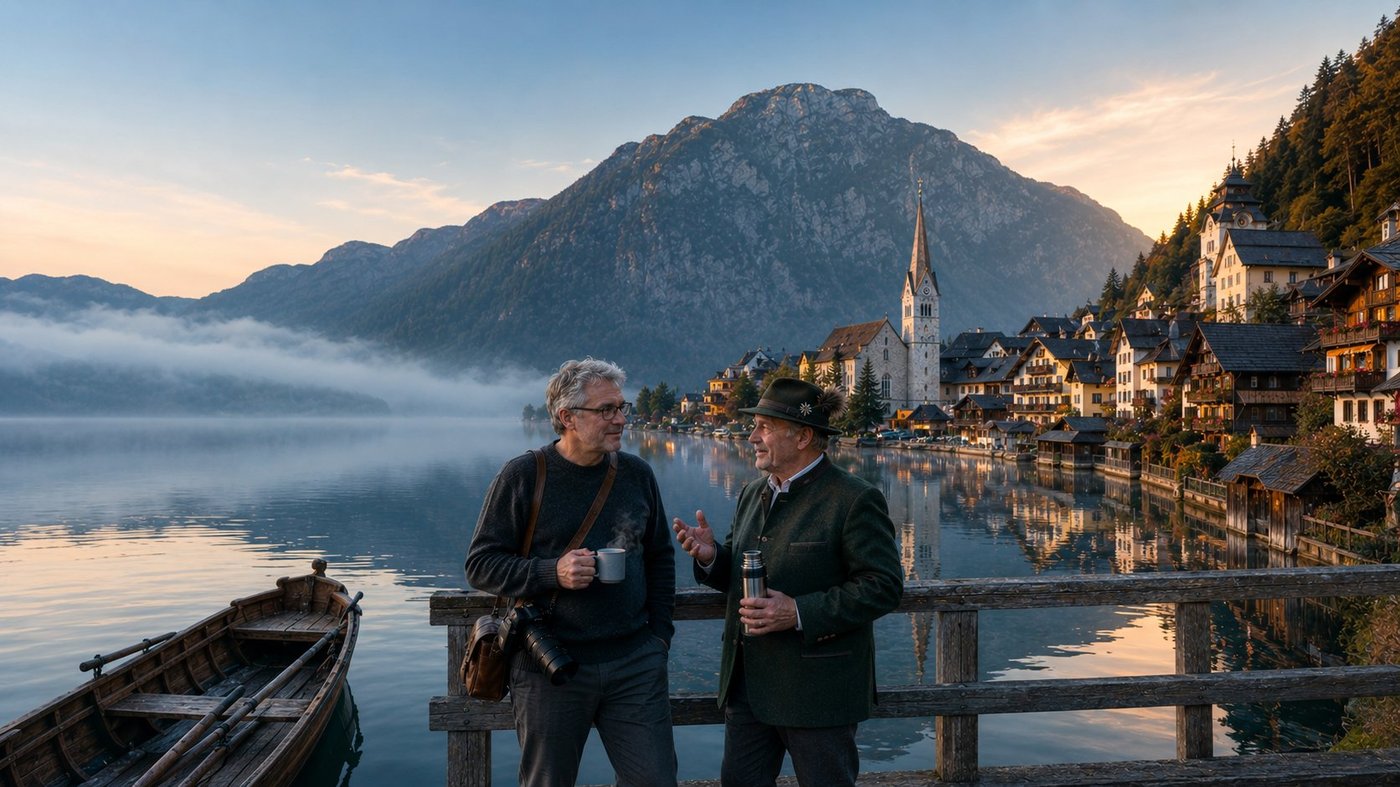
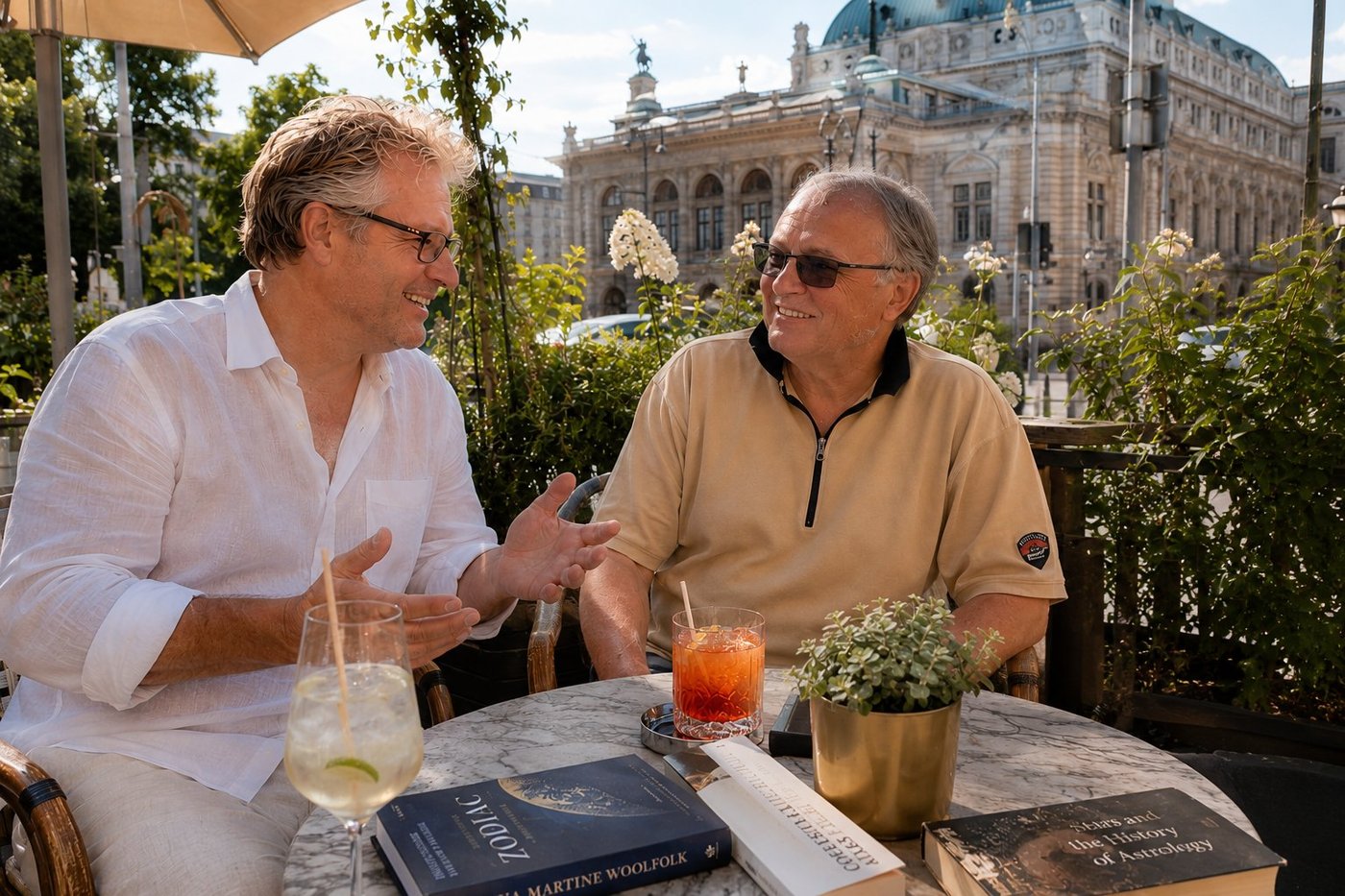
Share your Austria photos! Send to photos@kaufmann.wtf to be featured.
📊 Tourism Statistics 2024–2025
✍️ Author's Note
Austria occupies a special place in European travel. It's a country where the past is visibly, tangibly present — in Schönbrunn's 1,441 rooms, in the Musikverein where Brahms conducted, in coffeehouses where Freud pondered the unconscious. Yet it's thoroughly modern, prosperous, and welcoming.
The key to appreciating Austria is to embrace its pace. Linger over coffee for two hours as Viennese have done for centuries. Stay for the encore at the opera. Let the train wind through alpine valleys instead of rushing by car. Austria rewards those who take their time.
The Habsburgs may be gone, but their legacy created one of Europe's most culturally rich small nations. From the palaces of Vienna to the peaks of Tyrol, from Mozart's birthplace to Klimt's gold-leafed canvases, Austria offers concentrated magnificence — a small country carrying an outsized memory, still working out what to keep from that memory and what to leave behind. Visit once, and you'll understand why it was the heart of an empire, and why it remains, in its own quieter way, a heart of European culture still.
„Servus und auf Wiedersehen!"
—Radim Kaufmann, 2026
Support This Project 🌍
This World Travel Factbook is a labor of love – free to use for all travelers. If you find it helpful, consider supporting its continued development.
