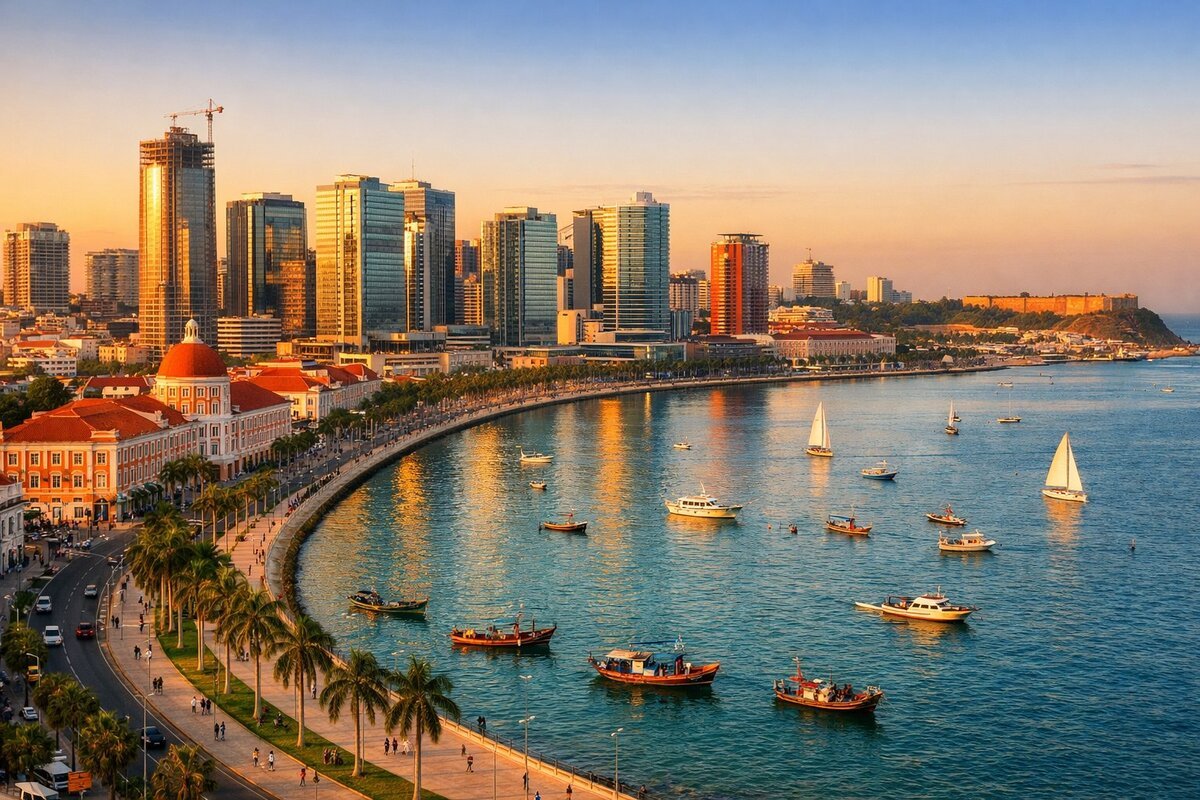
There is a moment, flying into Luanda at dusk, when the Atlantic catches the last light and turns the bay into hammered copper. Below, a skyline of glass towers and construction cranes rises from a city that two decades ago was defined by landmines and civil war, and is now defined by ambition. Angola has the jarring quality of a place moving so fast it has not yet decided what it wants to become. That tension — between old and new, between extraordinary natural wealth and entrenched poverty, between a war-scarred interior and a jet-setting capital — is precisely what makes it one of Africa’s most compelling destinations.
The seventh-largest country in Africa, Angola is a place of staggering physical variety. Its Atlantic coast stretches for nearly 1,650 kilometers, from the Congo border in the north to the Namibian frontier in the south. Inland, the central plateau rises to cool, coffee-growing highlands. To the south, the Namibe Desert — one of the oldest deserts on Earth, predating the Sahara — rolls to the Namibian border in landscapes of otherworldly desolation. The Kalandula Falls, hidden in the Malanje province, rank among the largest waterfalls in Africa by volume, yet remain virtually unknown to international travelers. Kissama National Park, once decimated by war, has been restocked with elephants, zebras, wildebeest and other large mammals in a difficult postwar conservation recovery.
American travelers have barely discovered Angola. No direct flights connect the US and Luanda and the State Department advisory has historically kept cautious travelers away — though since late 2023 Americans need no visa at all, which quietly removed the single biggest barrier. But for those willing to do the groundwork, Angola rewards handsomely: genuine frontier travel, extraordinary scenery, a warm and resilient people forged by centuries of Portuguese colonialism and decades of brutal civil conflict, and a Portuguese-African culture that has produced some of the most infectious music in the world. The country is expensive by African standards — Luanda regularly features on lists of the world’s priciest cities — but it is opening, and it is extraordinary.
02
🏷️ Name & Identity
From title to country
NgolaRoyal title
AngolaCountry name
1975Independence
The name “Angola” derives from the title Ngola, the royal title of the kings of the Ndongo kingdom of the Mbundu people, which Portuguese traders and administrators encountered in the 16th century. The Portuguese misinterpreted the title as a place name, and it stuck. The country’s full official name is the República de Angola — the Republic of Angola — though locals and expatriates alike simply say “Angola” or colloquially “Ngola” when speaking Kimbundu.
The national motto is Virtus Unita Fortior — “United Virtue is Stronger” — but culturally, Angolans identify far more with the informal concept of Angolanidade: a specifically Angolan identity forged from the mixing of Bantu African traditions with Portuguese colonial culture and language, producing something genuinely distinct from either parent civilization. This identity finds its purest expression in kizomba and semba music, in the Mussulo beach culture outside Luanda, and in the remarkable cuisine that blends West African cooking techniques with Portuguese ingredients.
Angola’s flag — half red, half black, with a central emblem of a machete, a cog-wheel, and a yellow star — speaks directly to the Marxist revolutionary government that took power in 1975 after Portugal’s sudden withdrawal. The MPLA (People’s Movement for the Liberation of Angola) has governed Angola continuously since independence, and the flag has never been changed, a visible reminder that the revolutionary era is not entirely past.
Angola is enormous — at 1,246,700 square kilometers, it is roughly twice the size of Texas. It shares borders with the Democratic Republic of Congo to the north and northeast, Zambia to the east, Namibia to the south, and the Atlantic Ocean to the west. The country also encompasses the exclave of Cabinda, a small, oil-rich territory separated from the main body of Angola by a strip of DRC territory.
The geography divides into several distinct zones. The narrow coastal strip is low-lying and often arid or semi-arid, particularly in the south where the Benguela Current keeps the coast cool and dry. Moving inland, the terrain rises dramatically to the central plateau (Planalto), which averages 1,500–2,000 meters elevation, with peaks reaching 2,620 meters at Mount Moco, Angola’s highest point. The plateau is temperate and was once famous for coffee production. Further east and north, the land drops into tropical lowlands bordering the Congo Basin. The Okavango River rises in Angola’s southeastern highlands before flowing into Botswana’s famous delta.
Region
Key Cities
Character
Luanda Province
Luanda
Capital, commerce, oil HQ, beach life
Central Plateau
Huambo, Bié
Cool highlands, coffee, civil war heartland
Huíla Province
Lubango
Dramatic escarpments, Cristo Rei, Mwila culture
Namibe Province
Namibe (Mocâmedes)
Desert coast, ancient geology, sea turtle nesting
Malanje Province
Malanje
Kalandula Falls, Pungo Andongo rocks
Cabinda
Cabinda city
Exclave, oil wealth, tropical forest
04
🗺️ Map
Angola borders the DRC to the north, Zambia to the east, and Namibia to the south. Luanda sits on the Atlantic coast in the northwest. The Cabinda exclave (not shown at this scale) lies north of the Congo River mouth. Distances are vast — Luanda to Lubango is approximately 900 km by road.
05
📜 History
A long historical arc
14th c.Kongo state
1575Luanda founded
2002Civil war ends
Long before the Portuguese arrived, the territory of present-day Angola was home to ancient San hunter-gatherers, later displaced by successive waves of Bantu-speaking migrants arriving from Central Africa around 1,000 CE. By the 15th century, several sophisticated kingdoms dominated the region: the Kingdom of Kongo in the north (one of the largest and most powerful states in sub-Saharan African history), the Ndongo kingdom of the Mbundu people in the central-west, and the Ovimbundu kingdoms of the central plateau.
Portuguese explorer Diógo Cão first reached the Congo River mouth in 1482, and within decades Portugal had established a trading presence that would grow into one of history’s most destructive enterprises. Angola became the primary source of enslaved people transported to Brazil — an estimated 5 million people, more than any other region on Earth, were shipped across the Atlantic from Angolan ports over four centuries. Luanda was the world’s largest slave-exporting port. The scars of this history are visible everywhere: in the demographic distribution of Angolans and Afro-Brazilians, in the shared Portuguese language, and in the cultural hybrids — music, food, religion — that emerged from forced migration.
Colonial rule lasted until 1975, when Portugal, exhausted by anti-colonial wars in Angola, Mozambique, and Guinea-Bissau, suddenly withdrew following the Carnation Revolution in Lisbon. Independence immediately triggered a catastrophic civil war between three liberation movements: the MPLA (backed by Cuba and the Soviet Union), UNITA (backed by the US and South Africa), and the FNLA. The Cold War turned Angola into a proxy battlefield. Jonas Savimbi’s UNITA and the Marxist MPLA fought for 27 years in one of Africa’s longest and most brutal conflicts, killing an estimated 500,000 people and displacing four million more.
The war ended abruptly and completely on February 22, 2002, when Savimbi was killed in an ambush in Moxico province. Within weeks, UNITA and the government signed a ceasefire. The speed of the transition from war to peace was stunning. Angola has been at peace ever since — a peace built on oil revenues, MPLA political dominance, and the sheer exhaustion of a generation that had known nothing but war.
06
👑 The Kingdom of Kongo
Kongo political world
Mbanza KongoCapital
ManikongoRuler
2017UNESCO listing
Before a border called Angola existed, the north belonged to the political world of the Kingdom of Kongo. From the late fourteenth century, its ruler, the manikongo, governed through provincial elites, tribute networks and a capital at Mbanza Kongo. The kingdom reached across territory now divided among Angola, both Congos and Gabon. It was neither an isolated village society nor a European creation: Portuguese visitors arriving in the 1480s encountered a centralized African state with diplomacy, taxation, markets and a sophisticated court.
Contact with Portugal initially produced an unusually direct exchange between sovereigns. King Nzinga a Nkuwu accepted Christianity in 1491, taking the name João I, and his son Afonso I developed a Christian court, corresponded with European rulers and tried to control the new Atlantic trade. The relationship soon became unequal. Portuguese merchants increasingly pursued captives, while Kongo's rulers protested that kidnapping and unauthorized enslavement were hollowing out their kingdom.
Mbanza Kongo remains a living city rather than a frozen archaeological park. The royal court, sacred tree, burial grounds and ruins of early churches preserve overlapping Kongo and Christian traditions. UNESCO inscribed the historic center in 2017, recognizing a place where Central African statecraft, Christianity and Atlantic commerce met with consequences that transformed several continents.
Queen Njinga Mbande — also written Nzinga, Jinga or Ana de Sousa Nzinga — is Angola's most enduring political figure. Born around 1582 into the Ndongo royal family, she first entered the written record as a diplomat. In 1622 she negotiated with the Portuguese governor in Luanda, famously insisting on equal status during the meeting. The often-repeated story that an attendant knelt to serve as her chair is part history, part political legend; what is certain is that Njinga understood ceremony as power.
She became ruler of Ndongo in 1624 and later established her authority in Matamba. Across four decades she alternated warfare, negotiation, conversion to Christianity and alliances with Dutch forces to resist Portuguese expansion and the slave-raiding economy surrounding it. Her state accepted refugees and incorporated warriors displaced by conflict, while her diplomacy reached from African neighbors to Rome. She could be pragmatic and ruthless, but reducing her either to saint or villain misses the scale of her achievement: a woman preserved sovereign authority in a violent seventeenth-century political world designed to erase it.
Today Njinga appears on banknotes, in monuments, literature and national memory. The Pedras Negras de Pungo Andongo are associated with her campaigns, and oral tradition points to impressions in the rock as her footprints. Those stories matter less as literal evidence than as proof that Angolans have kept her presence attached to the landscape.
08
⛓️ Angola & the Atlantic Slave Trade
Forced Atlantic connection
LuandaMajor port
BenguelaMajor port
BrazilPrimary destination
No honest account of Angola can treat the Atlantic slave trade as a footnote. From the sixteenth through the nineteenth centuries, ports including Luanda and Benguela became major departure points for captive Africans sent overwhelmingly to Brazil. The traffic connected warfare and political competition inland with merchants, credit and shipping on the coast. People from Kongo, Ndongo and the central highlands carried languages, religious ideas, foodways and music across the ocean under conditions of extreme violence.
Exact totals vary by database and by the geographic definition used, but Angola and the neighboring Congo region supplied one of the largest shares of all Africans forcibly transported to the Americas. The cultural relationship between Angola and Brazil is therefore not a picturesque colonial legacy. It was built through forced migration. Forms associated with capoeira, samba, religious practice and Brazilian Portuguese contain Central African continuities whose history begins here.
Sites around Luanda, Benguela and Mbanza Kongo offer fragments rather than a single comprehensive memorial landscape. Visitors should resist turning that absence into silence. Museums, churches, forts and old routes need to be read together with the testimony preserved in archives and in communities on both sides of the Atlantic.
Portugal claimed Angola for centuries, but effective colonial control over the entire modern territory came late. Coastal enclaves and trading routes were established early; much of the interior remained under African polities until military campaigns in the nineteenth and early twentieth centuries. After the formal end of slavery, coercion did not disappear. Forced labor, compulsory cultivation and racial hierarchies supported plantations, mines and infrastructure.
Twentieth-century colonial Angola developed railways from Luanda, Benguela and Moçâmedes toward the interior, new settler towns and export agriculture, especially coffee. The system also limited political rights and access to education for most Africans. Portugal's legal category of assimilado promised limited status to people who adopted Portuguese language and culture, but only a small minority could meet its conditions.
Armed anti-colonial struggle began in 1961. The MPLA, FNLA and later UNITA drew support from different regions and political networks, and Portugal fought to retain its colonies until the 1974 Carnation Revolution in Lisbon ended the dictatorship. Angola became independent on November 11, 1975, but the liberation movements' rivalry and foreign intervention immediately pushed the country into civil war.
10
🕊️ Independence & the Civil War
War and peace
1975Independence
1992Failed settlement
2002Ceasefire
Angola's independence opened not with a stable transfer of power but with a three-sided struggle among the MPLA, FNLA and UNITA. The conflict became one of the Cold War's most internationalized battlefields. Cuba deployed troops in support of the MPLA government; the Soviet Union supplied weapons; South Africa intervened against the MPLA; and the United States supported anti-government forces at different stages. Regional struggles over Namibia and apartheid became inseparable from Angola's war.
The FNLA declined, leaving the MPLA government and Jonas Savimbi's UNITA as the principal rivals. A 1991 peace agreement and the 1992 election failed to end the conflict. Fighting resumed and reached cities that had previously been spared, producing siege, displacement and hunger. Landmines and unexploded ordnance remained scattered across roads, bridges and rural areas long after front lines moved.
Savimbi was killed in Moxico Province on February 22, 2002. A ceasefire followed weeks later, ending twenty-seven years of civil war. Estimates of the human cost differ, but hundreds of thousands died and millions were displaced. The war explains the country's demographic concentration in Luanda, damaged transport networks and the caution still necessary on remote, unverified tracks.
11
🗳️ Peace, Power & Politics Since 2002
Political framework
MPLAGoverning party
UNITAMain opposition
5 yearsElection cycle
Peace after 2002 was real and transformative. Roads reopened, displaced families returned, cities expanded and a generation grew up without nationwide war. Reconstruction was financed by oil and often executed at extraordinary speed. Yet the political settlement also consolidated the dominance of the MPLA, which has governed since independence. José Eduardo dos Santos served as president from 1979 to 2017; João Lourenço succeeded him and launched a public campaign against corruption while preserving the same governing party.
Angola's constitution concentrates substantial authority in the presidency. Elections are competitive but take place on an uneven field, and civil-society groups continue to debate electoral administration, media access and the limits placed on demonstrations. The strongest opposition party remains UNITA, transformed from an armed movement into a parliamentary force.
For visitors, politics is not an abstract background. Demonstrations can disrupt movement, criticism of officials can carry legal risk, and photographing government buildings, military sites, airports, bridges and other infrastructure can lead to detention. Respect local guidance, avoid crowds and separate curiosity from intrusive photography.
Oil made postwar reconstruction possible and made Angola vulnerable. Offshore production supplies roughly one fifth of GDP, around three fifths of government revenue and the overwhelming majority of exports. That concentration means a change in global oil prices can quickly reshape public spending, the exchange rate and the cost of imported goods. Diamonds add another major export, while agriculture, fisheries, logistics and manufacturing remain central to diversification plans.
The 2024 economy grew strongly after years of stagnation, but growth has not been evenly shared. High inflation, limited formal employment and weak access to finance still shape daily life. Luanda contains modern banks, towers and corporate headquarters; many rural communities remain outside formal banking networks. Mobile payments and better links along the Lobito Corridor could help connect smaller businesses to wider markets.
Travelers experience the same dual economy. International hotels and specialist transport can be expensive, while markets and local restaurants operate at very different price levels. Carry backup payment methods, because international cards are not universally accepted and ATMs can be unreliable. The kwanza is the legal currency; exchanging money outside authorized channels is risky.
Angola is home to over 100 ethnic groups, though three dominate: the Ovimbundu (approximately 37% of the population, concentrated on the central plateau and historically UNITA’s base), the Mbundu (25%, in Luanda and the northwest, historically MPLA’s urban base), and the Bakongo (13%, in the northwest and Cabinda). The remainder includes dozens of smaller groups, among them the Mwila women of Huíla province, known for their extraordinary jewelry and elaborate hair decorated with butter and red ochre — one of the most visually striking traditional cultures on the continent.
Portuguese is the official language and the lingua franca of urban Angola, but most Angolans speak at least one Bantu language as their mother tongue. Kimbundu, Kikongo, and Umbundu are the most widely spoken. English proficiency is growing rapidly among the educated urban class but remains very limited outside Luanda.
Angolan music is a gift to the world that the world has barely received. Semba — the precursor of Brazilian samba — originated in Luanda and carries centuries of African polyrhythm filtered through Portuguese melodic sensibility. Kizomba, which emerged in Luanda in the 1980s from semba, zouk, and Cape Verdean influences, has since conquered Europe’s dance floors. Kuduro, the aggressive electronic dance music born in the war’s chaos, is the sound of contemporary Luanda. At night in Luanda’s outdoor bars — the quitandas — live bands play until dawn, and the dancing never seems to stop.
Queen Nzinga Mbande (c. 1583–1663): Warrior queen of the Ndongo and Matamba kingdoms, who led remarkable diplomatic and military resistance against Portuguese colonialism for decades. She is remembered as one of the most formidable political and military leaders of 17th-century Africa and is a towering figure of Angolan national identity. Her statue stands prominently in Luanda’s Largo do Kinaxixi square.
Agostinho Neto (1922–1979): Physician, poet, and revolutionary — the first President of Angola following independence in 1975 and the founding father of the MPLA. His poetry, written while imprisoned by the Portuguese, is considered some of the finest in Lusophone literature.
José Eduardo Agualusa (b. 1960): Angola’s most internationally celebrated novelist, writing in Portuguese and widely translated. His novels blend magical realism, colonial history, and post-war identity. Winner of multiple international literary prizes.
Paulo Flores (b. 1967): Luanda’s most beloved musician — singer, guitarist, and composer who has defined the modern urban semba sound. If you hear live music in Luanda, you will likely hear his songs.
14
🗣️ Portuguese & Angola's National Languages
Languages in daily life
PortugueseOfficial
UmbunduCentral highlands
KimbunduLuanda & northwest
Portuguese is Angola's official language and, unlike in several other former colonies, it is spoken as a first or shared household language by a large and growing share of the population. Luanda's Portuguese has its own rhythm, vocabulary and syntax, shaped by centuries of contact with African languages. It connects Angola to Brazil, Portugal, Mozambique, Cabo Verde, Guinea-Bissau, São Tomé and Príncipe, Timor-Leste and wider Lusophone networks.
National languages remain essential. Umbundu is associated especially with the central highlands; Kimbundu with Luanda and the northwest; Kikongo with the north; Cokwe with the east; and Nyaneka, Kwanyama and other languages with southern communities. Multilingualism is normal, and language can signal family history, region and urban or rural experience.
Visitors should learn a little Portuguese. Bom dia, por favor, obrigado/obrigada and com licença open doors. English works in some hotels and corporate settings but should not be assumed elsewhere. Asking before photographing people is both polite and necessary: Posso tirar uma fotografia?
15
⛪ Religion, Ancestors & Community
Layered faith
CatholicHistoric presence
ProtestantMajor communities
AncestorsLiving traditions
Christianity is the majority faith, with Catholic and Protestant churches deeply embedded in education, community life and political history. Catholicism arrived through the Kingdom of Kongo in the late fifteenth century, creating one of sub-Saharan Africa's earliest sustained Christian court traditions. Protestant missions later became influential in different regions, and church networks played important roles during war and displacement.
Religious life is more layered than census categories suggest. Ideas about ancestors, healing, protection and the moral power of land continue within and alongside Christian practice. Independent African churches combine biblical teaching with local forms of music, prophecy and communal care. Urban Luanda also includes smaller Muslim communities and people with no formal religious affiliation.
Visitors are often welcome at services when they dress respectfully and follow local cues. Music can be central and services may be long. Do not treat ceremonies, healers or sacred places as spectacle; ask permission before entering, recording or photographing.
Angola's modern identity is audible before it is visible. Semba developed in urban social spaces from older Angolan rhythms and partner dances; its elastic guitar lines and conversational pulse influenced later popular music and are often discussed in relation to Brazilian samba. The words share a historical root, but the genres followed distinct paths on opposite sides of the Atlantic.
Kizomba emerged in the late twentieth century as Angolan musicians absorbed Caribbean zouk and slowed the rhythmic language of semba into a close partner dance. It spread through Lusophone Africa and Portugal before becoming a global social-dance form. Kuduro, faster and electronic, grew from Luanda's postwar neighborhoods: hard beats, athletic movement and lyrics that turned improvisation into urban reportage.
A good night in Luanda may move across all three styles. Watch first, accept correction with humor and remember that social dancing is communication rather than performance for tourists. Live-music calendars change quickly, so ask local hosts rather than relying on an old online listing.
Luanda is a city of radical contradictions. For several years running it was measured as one of the most expensive cities on Earth for expatriates — a decent apartment costs more than Manhattan, a meal in a mid-range restaurant can exceed $50 per person — while millions of Angolans live in sprawling musseques (informal settlements) without running water or reliable electricity. Between these extremes, the city roars with energy: a construction boom, new highways, gleaming new museums, and a nightlife that is among the most vibrant on the continent.
The historic core centers on the Fortaleza de São Miguel, built in 1576 and one of the oldest and best-preserved Portuguese fortresses in sub-Saharan Africa. From its ramparts, you see the entire bay — the curve of the Ilha do Mussolo in the foreground, oil tankers anchored offshore, the modern city spreading inland. Inside, the Armed Forces Museum is more fascinating than it sounds: its collection traces four centuries of Portuguese colonialism and the three-faction civil war with an honesty unusual for a government museum.
The Marginal (Avenida 4 de Fevereiro) is Luanda’s seafront promenade, recently renovated into a pleasant palm-lined boulevard where families walk in the evening breeze. The Museu Nacional de Antropologia on Rua Friedrich Engels holds the finest collection of Angolan traditional art and artifacts in the country — masks, textiles, royal regalia, and material culture from all of Angola’s major ethnic groups. The Iron Palace (Palácio de Ferro), often attributed to Gustave Eiffel’s workshop (though the attribution is disputed), is a prefabricated iron building shipped from Portugal in the 19th century and reassembled in Luanda.
For beaches, Angolans head to the Ilha do Mussolo, a long, narrow sandbar peninsula closing off Luanda Bay, reachable by a short boat ride or the long road bridge. On weekends it is packed; on weekdays it is almost empty. The seafood restaurants on the Ilha — grilling camarão (prawns) and peixe frito (fried fish) over charcoal — are among Luanda’s best food experiences at a fraction of the hotel restaurant prices.
Luanda's public face is the curve of the Marginal, the renovated waterfront avenue running beneath the old fortress and modern skyline. Early morning brings runners and fishing boats; after sunset, families gather where Atlantic air softens the city's heat. The promenade is one of the easiest places to understand Luanda's geography, but visitors should still use ordinary urban caution and arrange transport after dark.
The Ilha de Luanda is a narrow spit protecting the bay, historically associated with the Axi-luanda fishing community and the shell currency called zimbo. Today its beach clubs, restaurants and informal grills make it the capital's leisure district. The contrast between expensive venues and simple charcoal fish stalls is part of the city's social texture.
Mussulo lies farther south and is often called an island, though it is a long sandbar peninsula and lagoon system. Boats depart from several points around Luanda. Weekdays are quiet; weekends are social and crowded. Confirm return transport before leaving the mainland, protect yourself from the sun and do not assume every stretch of water is safe for swimming.
19
🏘️ Benguela — History on the Atlantic
Atlantic city
1617Founded
FishingCoastal economy
UmbunduRegional language
Benguela was founded by the Portuguese in 1617 and became a major Atlantic port connected to trade routes reaching deep into the central plateau. The modern city is calmer than Luanda, with broad streets, faded colonial buildings, churches and access to some of Angola's most attractive coastline. Its historic role cannot be separated from the forced movement of people through the Atlantic slave trade.
South of the city, Baía Azul and Baía Farta combine cliffs, bright water and a working fishing economy. Northward, the coast continues toward Lobito. Benguela's appeal is not a checklist of monuments but its scale: it is possible to move slowly, visit the market, eat grilled fish and see how a major Angolan city functions away from the capital's intensity.
The Benguela region also anchors a wider cultural landscape associated with Umbundu-speaking communities of the highlands. Rail and road connections link the coast to Huambo and Bié, though journey times should always be checked locally.
20
🚆 Lobito & the Corridor to the Interior
Coast-to-interior route
LobitoAtlantic port
HuamboHighland hub
DRC & ZambiaCopperbelt links
Lobito sits around one of Africa's finest natural harbors. Its curved sand spit, the Restinga, shelters a deep-water port and gives the city an unusual maritime shape. Beaches and old villas share the shoreline with cranes, freight yards and the western terminus of the Benguela Railway.
The railway crosses Angola through Huambo and Luau before connecting toward the copper-producing regions of the Democratic Republic of Congo and Zambia. This route — now promoted as the Lobito Corridor — is receiving major international investment intended to speed mineral exports and stimulate agriculture, logistics and regional trade. Whether those benefits reach communities beyond the transport spine will be one of the country's defining development questions.
For travelers, the line offers a geographic lesson even when schedules make a complete rail journey impractical. Lobito is a useful base with a very different rhythm from Luanda, but port and railway installations are sensitive infrastructure: follow signs and never photograph restricted areas.
Lubango, capital of Huíla province, sits at 1,760 meters elevation on the central plateau, making it one of Angola’s highest and most pleasant cities. Founded by settlers from Madeira and the Azores in the 1880s, it retains a distinctly Portuguese atmosphere — wide boulevards, tile-roofed colonial buildings, a central praça with a bandstand. The climate is springlike year-round. Portuguese is mixed on the streets with Nyaneka-Humbe and Umbundu. The city’s markets — particularly the Mercado do São Paulo — are among Angola’s best for traditional crafts, textiles, and the extraordinary jewelry worn by Mwila women.
Overlooking Lubango from a hilltop to the east stands the Cristo Rei — a 30-meter-tall statue of Christ the King, modeled on the famous statue above Lisbon. Built in 1957 during the colonial era, it survived the civil war intact and remains the city’s most visible landmark. The hillside below offers panoramic views over Lubango and, on clear days, toward the escarpment beyond. At sunset, when the red light of the plateau sky silhouettes the statue, it is one of Angola’s most photographed views.
Near Lubango, the road south to Namibe passes through the Serra da Leba, a series of serpentine switchbacks cut into the face of the escarpment in the 1970s. The drive down the Serra da Leba — through morning cloud, past waterfalls, with the coastal desert spreading below — is one of Southern Africa’s great road journeys.
22
🌾 Huambo, Bié & the Central Highlands
Highland profile
≈1,700 mHuambo elevation
2,620 mMount Moco
RailBenguela line
The central plateau is Angola's cool interior heartland. Huambo, founded as Nova Lisboa during Portuguese rule, lies at roughly 1,700 meters and was designed as a colonial administrative and railway center. War damaged the city heavily, but broad avenues, a cathedral and rebuilt civic spaces now sit within a landscape of farms and rolling highland horizons.
Bié Province to the east occupies terrain associated with the sources and upper catchments of several major rivers. The plateau was a center of Ovimbundu states, caravan trade and later UNITA support; its communities paid an enormous price during the civil war. Visitors should treat war remains and local memories with care rather than turning them into adventure scenery.
Mount Moco, Angola's highest point at 2,620 meters, rises west of Huambo. The surrounding highland forest patches shelter endemic birds but have been reduced by agriculture and fuelwood collection. Hiking requires local knowledge, permission and a guide who understands both routes and community boundaries.
23
🌳 Cabinda — The Northern Exclave
Separated province
AtlanticCoast
MaiombeForest
OilStrategic sector
Cabinda is Angola's detached northern province, separated from the rest of the country by a narrow corridor of the Democratic Republic of Congo. Dense forest, an Atlantic coast and offshore oil fields give it a character and strategic importance out of proportion to its size. The enclave's borders emerged from nineteenth-century colonial agreements rather than from a simple natural division.
Oil production made Cabinda central to the national economy. It also intensified debate over how revenue, environmental costs and political power are shared. A separatist movement has operated in the province for decades, and security conditions outside Cabinda city can change. Travelers must obtain current local advice before planning overland movement.
The Maiombe forest extends across borders into both Congos and Gabon, forming part of a biologically rich Central African ecosystem. Tourism infrastructure is limited; forest travel is not a casual independent excursion. When access is appropriate, local guides and conservation organizations are essential.
24
🪨 Malanje & the Black Rocks
Malanje circuit
KalandulaWaterfall
Pedras NegrasRock formations
NjingaHistoric memory
Malanje is the gateway to a landscape where rivers, savanna and dramatic geology meet. The city's broad avenues make a practical base for Kalandula Falls and the Pedras Negras de Pungo Andongo, giant dark rock formations rising abruptly from the surrounding plain. Their weathered towers look almost architectural from a distance.
Pungo Andongo is tied to Mbundu history and to the memory of Queen Njinga. Oral traditions identify footprints in the rock and recall the formation as a place of refuge and resistance. The landscape therefore deserves more than a quick photograph: it is both geology and a national historical symbol.
Road conditions vary by season. Start early, carry water and fuel, and use a driver who knows the current route. Rock surfaces can become dangerously slick during rain, and viewpoints often lack barriers. Local guides add context that no roadside sign can supply.
If Victoria Falls is the most famous waterfall in Africa, Kalandula is the best-kept secret. Located on the Lucala River in Malanje province, approximately 360 kilometers from Luanda, Kalandula plunges 105 meters over a basalt cliff face nearly 400 meters wide — making it one of the largest waterfalls on the continent by volume and width. During the rainy season (November through April), the falls are a roaring curtain of water so powerful it generates a permanent mist cloud visible from kilometers away. Even in the dry season, the flow is extraordinary.
What is remarkable about Kalandula is its near-total absence from the international travel circuit. No cruise ship passengers on day trips. No souvenir hawkers blocking the viewpoint. No selfie stick vendors. In 2026, you may be one of a handful of foreign visitors present — a situation so increasingly rare in Africa as to be genuinely precious. The local guesthouse infrastructure is basic but improving. The road from Luanda is mostly paved but can be rough in sections; a 4WD is recommended in the wet season.
Nearby, the Pedras Negras de Pungo Andongo (Black Rocks of Pungo Andongo) are a geological wonder: massive black basalt monoliths rising from the savanna floor near the Cuanza River, reaching heights of up to 600 meters. According to Mbundu oral tradition, the great 17th-century warrior queen Nzinga Mbande used the rocks as her fortress. Traditions hold that one of the rocks bears her footprint.
Forty kilometers west of Lubango, the central plateau simply ends. The Tundavala Fissure is a dramatic escarpment where the land drops more than 1,000 meters in near-vertical cliffs to the coastal lowlands below. Standing at the edge on a clear morning, you can see all the way to the Atlantic horizon. Clouds boil up from below and sometimes pour over the rim like a slow-motion waterfall of mist. The silence is immense.
Geologically, the fissure is a series of fault-line cracks running along the edge of the escarpment, with massive chunks of rock leaning outward in various stages of slow collapse — giving it the “fissure” name. Local legend holds that the god Tundavala threw a young man over the edge for seducing his daughter; the young man’s cries can still be heard in the wind. Whether you find the legend or the geology more compelling, the view is among the finest in Africa.
The road to Tundavala from Lubango is good tarmac for most of the way, becoming a rough track for the final few kilometers. There is a small entry fee (payable at an informal checkpoint). Come early — clouds typically roll in by late morning. The nearby Fenda da Tundavala viewpoint at km 38 on the Humpata road is slightly less dramatic but easier to access and equally impressive.
During the civil war, Kissama National Park was devastated. Soldiers ate the wildlife. Equipment was stolen. The rangers fled. By 2000, its large-mammal populations had been devastated and the park had been reduced to a ghost of its former self. What happened next is one of conservation’s most extraordinary stories.
In 2000, with peace barely holding, a joint Angolan-South African-American team launched “Operation Noah’s Ark” — airlifting 33 elephants by helicopter from Zimbabwe and Botswana into Kissama. It was a major inter-country elephant translocation. They were followed by zebras, wildebeest, buffalo and eland, beginning a long recovery whose wildlife densities remain modest by East African standards. The separate giant-sable recovery is centered in Cangandala National Park and the Luando Strict Nature Reserve, not in Kissama.
The park lies 70 kilometers south of Luanda and is easily accessible on good roads. Game viewing is best from June to September (dry season) when animals concentrate around water sources. The park’s accommodation ranges from basic campsites to the comfortable Palanca Safaris lodge. Kissama is one of the easiest protected areas to reach from Luanda, making it a practical introduction for travelers with limited time.
28
🏜️ Iona National Park
Desert conservation
LargestNational park
NamibDesert biome
4×4Essential access
Iona National Park protects the southern edge of Angola between the Atlantic and the Namibian border. It is the country's largest national park and part of the wider Namib desert system, with gravel plains, dunes, dry riverbeds and mountains shaped by fog and extreme aridity. Springbok, oryx, ostrich and smaller desert specialists are returning to landscapes emptied during decades of war and uncontrolled hunting.
Conservation here is a long project rather than a finished safari product. Park management, community partnerships and wildlife restoration have improved, but distances are severe and services sparse. This is not the place to improvise with a normal rental car. Travel requires fuel planning, water, communications, recovery equipment and an experienced operator.
The park also lies near pastoral communities whose knowledge of water, grazing and movement predates formal conservation boundaries. Responsible visits should support local employment and avoid presenting an inhabited cultural landscape as empty wilderness.
The Namibe (or Namib) Desert of southwestern Angola is not merely old — it is ancient beyond comprehension. Geologists estimate the Namib has existed for between 55 and 80 million years, making it the oldest desert on Earth, predating the Sahara by tens of millions of years. Its landscape reflects this antiquity: the rocks are Precambrian, the dunes have been shifted by the same wind patterns for millennia, and its most extraordinary inhabitant — the Welwitschia mirabilis plant — is essentially a living fossil.
The Welwitschia, found only in the Namib Desert of Angola and Namibia, consists of just two leaves that grow continuously throughout the plant’s life but become increasingly split and shredded by wind and time. Individual Welwitschia plants in Angola’s desert have been radiocarbon-dated to over 1,500 years old. They survive entirely on coastal fog. Looking at them — prostrate, alien, impossibly ancient — is like looking at a creature from another geological era.
The coast near Namibe city (also called Mocâmedes) features spectacular dunes rolling directly to the Atlantic, deserted beaches where sea turtles nest (leatherback and loggerhead turtles), and dense colonies of Cape fur seals. The fishing town of Namibe itself has a pleasant colonial center, a good fish market, and excellent access to the desert. The Iona National Park, Angola’s largest protected area, covers most of the southern desert and extends to the Namibian border — it remains largely undeveloped and is truly frontier territory.
30
💦 The Okavango Headwaters
Water beyond borders
CubangoHeadwater river
CuitoHeadwater river
2025UNESCO tentative listing
The rivers that feed Botswana's famous Okavango Delta begin in Angola. In the rainy highlands of Bié and Moxico, the Cubango and Cuito gather water that moves slowly southeast through wetlands, floodplains and channels before reaching the Kalahari. Protecting those headwaters is essential to communities and wildlife far beyond Angola's borders.
Southeastern Angola remained difficult to study during the civil war, leaving large landscapes scientifically under-documented. Recent expeditions have recorded peatlands, fish, birds and intact river systems while also identifying pressures from fire, settlement, infrastructure and possible water extraction. UNESCO added the Angolan headwater catchments to the country's Tentative List in 2025 as a proposed extension connected to the Okavango Delta.
Tourism here is expeditionary. Distances are immense, roads seasonal and emergency support limited. The reward is not a conventional lodge circuit but an understanding of how a continental wetland begins — in clear Angolan rivers flowing through sand.
Mbanza Kongo stands on a plateau in Zaire Province and preserves the ceremonial center of the former Kingdom of Kongo. Before Portuguese arrival it was already the capital of a large African state. The royal residence, customary court, sacred tree and burial places formed a political and spiritual landscape built largely in local materials.
From the late fifteenth century, stone churches and other European-style buildings were added to the existing city. Christianity became part of court life without erasing Kongo customs. The ruins known as Kulumbimbi are associated with an early cathedral, while the modern museum and surviving ritual spaces help explain a history that connects Angola, the two Congos, Portugal, Brazil and the Vatican.
UNESCO inscribed Mbanza Kongo in 2017 as Angola's first World Heritage property. Its importance is not limited to surviving masonry. The city has maintained sacred and symbolic functions across centuries, and customary authorities still carry living traditions. Visit with time for the museum and local interpretation rather than treating the site as a single ruin.
Angolan cooking is the most under-rated national cuisine in Africa, and the reason is arithmetic: five centuries of Portuguese contact laid onto a Bantu foundation, then routed through the Atlantic trade that carried cassava, maize, chilli and peanuts into Africa from the Americas and carried Angolan cooks out to Brazil. What came back is a kitchen that tastes simultaneously West African and Iberian — slow stews, bay leaf and garlic, but built on red palm oil rather than olive oil.
Red palm oil (óleo de dendêm): The defining ingredient. Unrefined, thick, orange, faintly floral and earthy — it colours half the national repertoire and is nothing like the industrial palm oil of supermarket labels. If a dish is orange in Angola, dendêm did it.
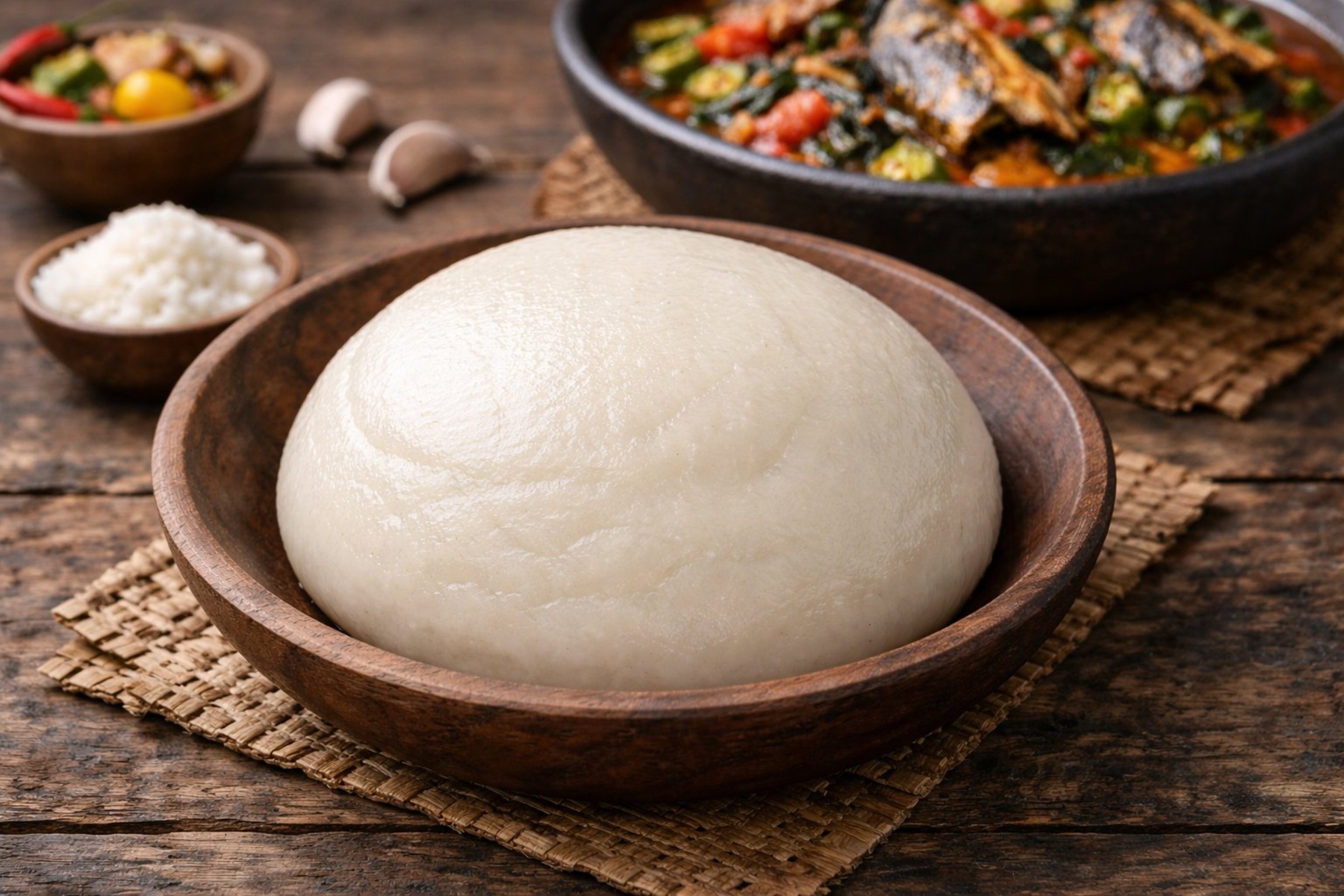
Funge (funje): The staple. A stiff, glossy porridge of cassava flour (bombo) in the north or maize flour (funge de milho) in the south, served with every stew. Eaten by hand: pinch, roll, dent with the thumb, scoop.
Gindungo: The chilli condiment on every table — small fiery peppers crushed with garlic, onion and palm oil, sometimes with lemon. Served alongside, never cooked in. Angolan food is aromatic rather than hot; you bring your own heat.
Coastal vs. planalto: Luanda and Benguela eat fish — grilled corvina, garoupa, and the whole ritual of mufete. The central highlands eat maize, beans, goat and the pounded cassava leaf (kizaca) that gives calulu its dark, mineral depth.
Portuguese survivals: Pastel de nata in Luanda cafés, bacalhau at Christmas, crusty pão, and a bread-and-coffee breakfast culture no other Southern African country shares. Angola drinks its coffee the way Lisbon does, which is unsurprising — before 1975 it was one of the world’s largest robusta exporters.
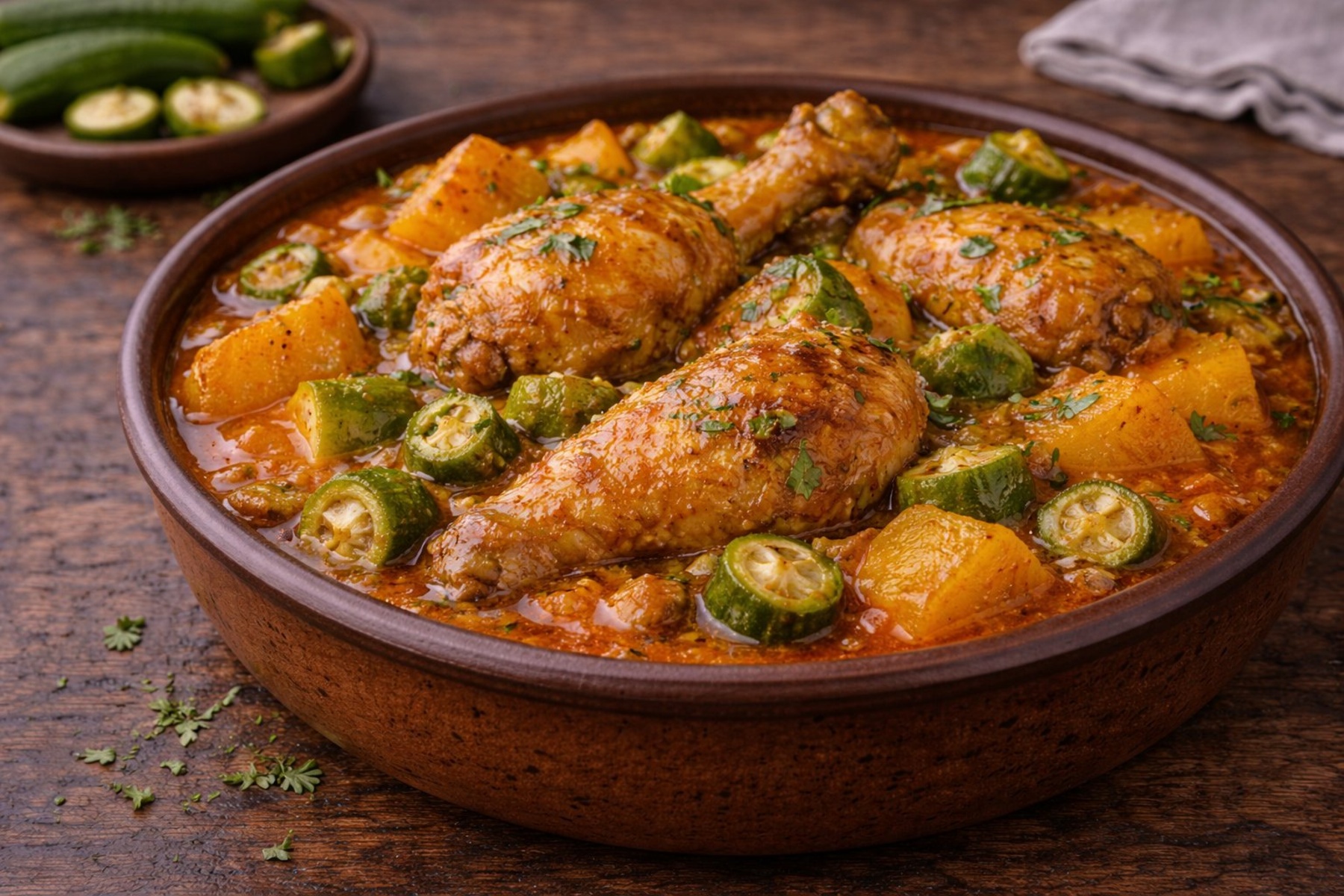
Muamba de Galinha
Chicken Muamba — the national dish
Chicken braised in red palm oil with okra and squash. The dish Angolans abroad cook when they are homesick.
Ingredients: 1 whole chicken, jointed; 4 tbsp red palm oil (óleo de dendêm); 4 garlic cloves, crushed; 2 onions, chopped; 3 tomatoes, chopped; 250 g okra, trimmed; 400 g pumpkin or butternut, cubed; 1–2 gindungo (bird’s-eye) chillies; juice of 1 lemon; salt.
Preparation: Marinate the chicken in lemon, garlic and salt for at least an hour. Then heat the palm oil gently — it must not smoke — and brown the chicken in batches. Add onion and tomato and cook down to a paste. After that, return the chicken with a little water, cover and simmer 30 minutes. Add the pumpkin, simmer 10 minutes, then the okra for a final 8–10 minutes so it stays firm. Finally, adjust salt and serve with funge, with gindungo on the side.
💡 Never boil palm oil hard — high heat kills its floral note and leaves only grease.
Funge de Bombo
Cassava Porridge — the everyday staple
The plate under everything else. Bland by design: it is the vehicle, not the flavour.
Ingredients: 500 ml cassava flour (farinha de bombo); 1 litre water; pinch of salt.
Preparation: Bring most of the water to a boil, holding back a cup. Meanwhile, slake the flour in the reserved cold water to a smooth slurry. Then pour the slurry into the boiling water while stirring hard with a wooden spoon. Keep stirring — this is genuinely a workout — for 10–15 minutes until the mass pulls cleanly away from the pot. Finally, wet a bowl, pack the funge in, and turn it out as a smooth dome.
💡 If it tastes raw and chalky it is undercooked; funge needs longer on the heat than instinct suggests.
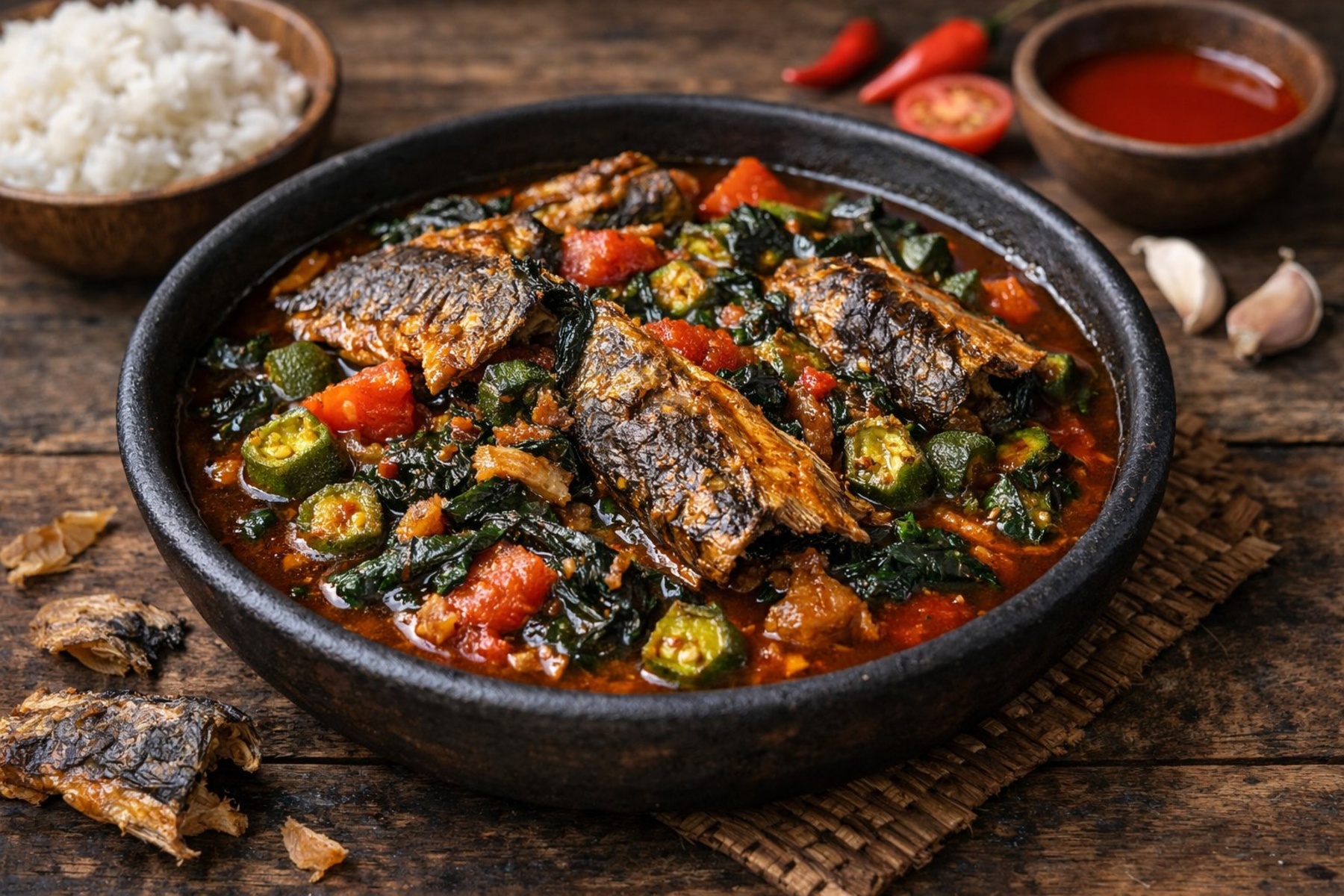
Calulu de Peixe
Dried Fish & Greens Stew
Layered smoked and fresh fish with sweet-potato leaves and okra. Dark, smoky, and deeply Angolan.
Ingredients: 300 g dried/smoked fish, soaked overnight; 400 g fresh firm fish; 1 large bunch sweet-potato leaves (or spinach); 200 g okra; 2 aubergines, cubed; 3 tomatoes; 2 onions; 4 tbsp red palm oil; garlic; bay leaf; salt.
Preparation: Soak and flake the dried fish, discarding bones. Then layer in a heavy pot — onion, tomato, dried fish, aubergine, greens, okra — without stirring. Pour over the palm oil, garlic, bay leaf and a splash of water. After that, cover and cook 25 minutes on low so the layers steam rather than fry. Add the fresh fish on top for the last 10 minutes. Finally, fold once, gently, and serve with funge.
💡 Layering, not stirring, is the whole technique — break it up early and you get fish soup.
Mufete
Grilled Fish, Ilha-style
Sunday lunch on the Ilha do Cabo in Luanda: charcoal-grilled whole fish with a full platter of sides.
Ingredients: 2 whole fish (corvina, snapper or tilapia), scaled; 300 g red beans cooked in palm oil (feijão de óleo de palma); 2 sweet potatoes; 1 cassava root; 2 ripe plantains; 2 onions, sliced; 2 tomatoes; palm oil; vinegar; lemon; salt.
Preparation: Salt the fish and grill whole over charcoal, turning once, until the skin blisters. Meanwhile, boil the sweet potato and cassava and fry the plantain. Then dress the raw onion and tomato with vinegar, palm oil, lemon and salt to make the molho cru. Finally, serve everything at once on one big platter — mufete is a spread, not a plate.
💡 Let the onion salsa sit 20 minutes before serving so the vinegar tames the onion.
Cocada Amarela
Yellow Coconut Pudding
The Portuguese-Angolan dessert — a rich egg-yolk and coconut pudding scented with cinnamon and clove.
Ingredients: 400 g sugar; 250 ml water; 200 g grated coconut; 12 egg yolks; 6 cloves; 1 cinnamon stick; ground cinnamon to finish.
Preparation: Boil the sugar, water and cloves to a light syrup. Then add the coconut and simmer 10 minutes until thick, and cool slightly off the heat. After that, temper the beaten yolks with a spoonful of the hot mixture, then stir them in over the lowest possible heat, never letting it boil. Finally, pour into a dish, chill, and dust heavily with cinnamon.
💡 If the yolks scramble, the heat was too high — a bain-marie is the safe route for a first attempt.
Angola does not make wine — and it drinks an enormous amount of it. The country sits almost entirely inside the tropics, which rules out commercial viticulture, but four centuries of Portuguese rule left a wine culture without a wine industry. Angola has for years been one of the largest export markets on earth for Portuguese wine, and a Luanda supermarket shelf can carry more Douro and Alentejo labels than most European cities. Sparkling wine at weddings, vinho verde with grilled fish, tawny port after dinner: the rituals are Portuguese, the setting is Atlantic Africa.
Beer is the real national drink.Cuca, brewed since 1957, is so dominant that the neighbourhood bar itself is called a cuca shop across much of Southern Africa. N’gola (Lubango), Eka (Dondo) and Nocal complete the domestic line-up, and Angola is now one of sub-Saharan Africa’s largest beer producers by volume — a deliberate policy of import substitution after the 2015 oil crash made foreign brands unaffordable.
Maruvo is the drink worth crossing the country for. Palm wine, tapped from the raffia or oil palm and fermenting from the moment it leaves the tree, goes from lightly sweet at breakfast to sharp and cidery by mid-afternoon and vinegar by evening. In Uíge, Zaire and Cabinda provinces it is sold in plastic jerrycans at roadside stalls and never travels far, because it cannot. Caporroto (also aguardente de cana) is the sugarcane distillate of the interior — copper-pot, unaged, agricultural in the best and worst senses. Kissangua, fermented maize with a sour edge and barely any alcohol, is closer to a food than a drink and is central to Huíla and Huambo social life. Ngonguenha — toasted cassava flour stirred into water or milk — is the non-alcoholic cousin.
The whisky economy. During the oil boom, Angola became one of the world’s conspicuous per-capita consumers of premium Scotch, and a bottle of Johnnie Walker Blue on a Luanda table is a status statement rather than a drink. That culture has cooled with the kwanza but has not disappeared — and it sits oddly, deliberately, alongside the jerrycan of maruvo two provinces inland.
Practical notes: The legal drinking age is 18. Alcohol is sold freely in shops and bars and there is no religious restriction. Public drunkenness is socially frowned upon. Drink-driving enforcement is inconsistent but penalties are real, and Angolan traffic is not forgiving.
🏆 Kaufmann Wine Score — Angola
Rated on four criteria: Aroma (/25), Taste (/30), Finish (/20), Value (/25) — Total /100. Angola has no commercial grape-wine industry, so the scale is applied here to the country’s indigenous ferments, cane spirit and brewing — the same approach used for Zambia, Uganda and Tanzania.
Drink
🔴 Aroma
🟡 Taste
🟢 Finish
🔵 Value
Total
Maruvo Fresco — Uíge palm wine, drunk same-day
20
24
15
23
82
N’gola Reserva — Lubango lager
18
22
15
22
77
Cuca Original — the national lager since 1957
17
22
14
23
76
Caporroto Artesanal — Malanje cane spirit
17
21
15
22
75
Kissangua — Huíla fermented maize, low-alcohol
16
19
12
24
71
95–100 Legendary · 90–94 Outstanding · 85–89 Very Good · 80–84 Good · 75–79 Average · <75 Below Average
🍸 Cocktails & Mixed Drinks
Luanda’s bar scene is Brazilian in accent — caipirinhas everywhere — but the good ones use Angolan fruit rather than lime alone.
Caipirinha de Múcua
Baobab Caipirinha — the Luanda house pour
Múcua is the chalky, citric pulp of the baobab fruit. Soaked and strained it makes a cloudy, tart, faintly yoghurt-like base that takes cane spirit beautifully.
Ingredients: 50 ml cachaça or caporroto; 3 tbsp múcua (baobab) pulp soaked 2 hours in 60 ml water and strained; 2 tsp sugar; ½ lime; crushed ice.
Method: Muddle the lime and sugar in a heavy tumbler. Then add the strained baobab liquid and stir to dissolve. After that, fill with crushed ice, add the spirit, and churn with a bar spoon until the glass frosts. Finally, top with more ice.
💡 Baobab pulp never fully dissolves — the cloudiness is correct, not a fault.
Maruvo Punch
Palm Wine Punch — Uíge style
Fresh palm wine cut with pineapple and a squeeze of lime. Served the same morning it is tapped, because there is no other option.
Ingredients: 150 ml fresh maruvo (palm wine); 60 ml pineapple juice; juice of ½ lime; 1 tsp honey; grated nutmeg; ice.
Method: Stir the honey into the lime juice until it dissolves. Then add the pineapple juice and the palm wine and stir once — gently, as maruvo is still actively fermenting and will foam. Finally, pour over ice and grate nutmeg over the top.
💡 Outside Angola, substitute unpasteurised cider with a splash of coconut water — not the same, but the closest honest approximation.
Kalandula Sunset
Kaufmann house pour
Not a traditional drink — my own, mixed after an afternoon at the falls, when the spray turns gold about an hour before dark.
Ingredients: 40 ml caporroto (or white rum); 20 ml tamarind syrup; 15 ml lime juice; 60 ml chilled Cuca or other pale lager; 1 dash gindungo tincture (one bird’s-eye chilli steeped a week in cane spirit).
Method: Shake the spirit, tamarind and lime hard with ice. Then strain into a chilled highball over one large cube. After that, top slowly with the lager so the head holds. Finally, add a single dash of the chilli tincture over the foam.
💡 One dash of the tincture only. Two is a dare, not a drink.
The full drinking-culture guide — brands, bars, import quirks and prices — lives on the Angola Wine & Spirits page →
34
🌡️ Climate & Best Time to Visit
When to travel
May–SepDry season
Nov–AprRainier season
CoolerCentral plateau
Angola’s climate varies dramatically by region, altitude, and proximity to the cold Benguela Current. Broadly, there are two seasons: the dry season (Cacimbo, May–October), characterized by cool temperatures, grey coastal skies, and excellent road conditions; and the rainy season (Chuva, November–April), with warm temperatures, afternoon thunderstorms, and sometimes difficult road conditions in the interior.
Region
Best Time
Notes
Luanda / Coast
Jun–Sep
Cool & dry; less humid. Nov–Apr hot and sometimes stormy.
Kissama Park
Jun–Oct
Dry season concentrates wildlife at waterholes
Lubango / Plateau
Year-round
Temperate at 1,760m; May–Aug slightly cooler nights
Kalandula Falls
Nov–Apr
Wet season means maximum water flow; roads can be rough
For most American visitors combining Luanda, Kissama, and the southern circuit (Lubango, Tundavala, Namibe), the optimal window is June through September — the heart of the dry season. Roads are dry, game viewing is best, temperatures are pleasant, and the coastal grey skies of the Cacimbo season lift to blue by mid-morning. If Kalandula Falls is a priority, go in January or February when the falls are at maximum volume and drama, but plan for rough roads and pack accordingly.
35
✈️ How to Get There
Entry essentials
30 daysVisa-free per trip
90 daysAnnual visa-free total
1 pagePassport blank page
There are no nonstop passenger flights from the United States to Luanda, so American travelers connect through Europe, Africa or the Gulf. TAAG completed the transfer of its international operation to Dr. António Agostinho Neto International Airport in October 2025; always use the airport printed on the ticket because domestic arrangements can differ. The journey typically takes 16–22 hours total travel time depending on the connection.
Best connections from the US:
TAP Air Portugal (Lisbon): The most popular and often best-priced option. Fly from JFK, EWR, BOS, MIA, IAD, SFO, LAX, or ORD to Lisbon, then Lisbon to Luanda (approximately 7 hours). Frequency and fares change; verify the operating airport and connection on the final booking.
KLM (Amsterdam): Strong option from major US hubs, connecting in Amsterdam to Luanda (approximately 9 hours). Good service, reliable connections.
Ethiopian Airlines (Addis Ababa): Good for those on the West Coast or wanting to combine Angola with other African destinations. Longer travel time but competitively priced.
Air France (Paris): Via CDG. Good from the Northeast and Midwest. Luanda flight approximately 8 hours from Paris.
Lufthansa (Frankfurt): Via FRA. Strong from Chicago, Houston, and the Northeast.
💋 Booking Tip for Americans
Book at least 6–8 weeks in advance. Luanda is a major oil industry hub and business travel keeps fares elevated. Flying into Luanda on weekdays (Tuesday–Thursday) tends to be cheaper. Check whether TAP’s Stop program offers a free Lisbon stopover — it often does, allowing a 2–5 day visit to Portugal at no extra airfare cost.
Within Angola, travel between major cities is possible by domestic flights (TAAG Angola Airlines serves Luanda, Lubango, Namibe, Malanje, Huambo, Benguela, and Cabinda) or by road. Road conditions outside the main highways can be challenging. Renting a 4WD with a driver through a Luanda tour operator is strongly recommended for travel to Kalandula, Kissama, or the southern circuit.
Angola's scale changes every itinerary. Domestic flights save time between Luanda, Cabinda, Lubango, Huambo and other provincial centers, but schedules can change. Confirm airport and terminal details carefully: international operations moved to Dr. António Agostinho Neto International Airport in 2025, while domestic arrangements should still be checked on the ticket.
Long-distance buses and shared minibuses connect cities at lower cost, though comfort and departure times vary. The rehabilitated railways from Luanda, Lobito and Namibe offer striking journeys, but passenger timetables are not always designed around short tourist visits. Book locally and allow a full buffer day.
Self-driving is demanding. Main highways have improved, secondary roads may deteriorate sharply, fuel stations can be widely spaced and night driving adds risks from unlit vehicles, pedestrians and road damage. Landmines and unexploded ordnance remain a reason never to leave established roads in remote former conflict zones without reliable local guidance.
Americans no longer need a visa for tourism. Under Presidential Decree 189/23 (in force since late 2023) Angola abolished tourist visas for citizens of 98 countries, including the United States. US passport holders enter visa-free for up to 30 days per entry, capped at 90 days total per calendar year. At immigration you must show a passport valid at least six months beyond your stay, a return or onward ticket, and proof of accommodation. The exemption covers tourism only — work, paid activity and residency are excluded and still require a visa through the Serviço de Migração e Estrangeiros portal at smevisa.gov.ao. A yellow fever vaccination certificate remains mandatory.
Advisory: the US State Department places Angola at Level 2 — Exercise Increased Caution (reissued 5 March 2026) for crime, health, civil unrest and residual landmines, with a higher warning for greater metropolitan Luanda. Verify before booking.
💋 Health & Vaccinations
Yellow fever vaccination is mandatory — you will need to show your yellow card at entry. Recommended vaccinations: Hepatitis A and B, Typhoid, Meningitis, Rabies (if going into wildlife areas), and ensure routine vaccinations are up to date. Malaria prophylaxis is essential for all areas except Lubango (too high altitude). Bring a generous supply of your prescription medications — availability is limited outside Luanda.
💰 Money & Payments
Currency: Angolan Kwanza (AOA). USD is not officially accepted but is widely used for informal transactions. Bring USD in clean, unfolded bills (post-2006 preferred). ATMs exist in Luanda but are often out of cash or restricted to local cards. Change money at banks or official bureaux de change. Credit cards accepted at major hotels, supermarkets, and restaurants in Luanda; elsewhere, cash only. Angola is very expensive — budget accordingly.
📱 Connectivity
Mobile coverage: Good in Luanda and major cities; patchy in rural areas. Main operators: Unitel and Movicel. Buy a local SIM at the airport (bring your unlocked phone). Unitel has the best coverage. International roaming is very expensive. Wi-Fi available in hotels; quality varies. VPN recommended if using public Wi-Fi. Power: 220V, Type C/F plugs (European). Bring a universal adapter.
🚕 Getting Around
Luanda: Taxis (agree on price before entering, or use Txalane app — Angola’s Uber equivalent). Candongueiros (shared minibuses) are cheap but crowded and disorienting for first-timers. Between cities: book through a tour operator or rent 4WD with driver. Domestic flights on TAAG are reasonably reliable. Avoid driving yourself unless experienced with African road conditions and comfortable with occasional police checkpoints.
🚾 Photography
Angola is sensitive about photography. Never photograph government buildings, military installations, police, airports, or infrastructure without explicit permission. Cameras have been confiscated for photographing the port or presidential palace. Always ask permission before photographing people. In most cases, Angolans are warm and happy to be photographed — asking first transforms the interaction. The Mwila people in Huíla province typically welcome photography but expect a small contribution.
Angola is one of the most expensive countries in Africa for travelers. This is primarily a consequence of the oil economy: international oil workers on generous expense accounts have set the price floor for hotels, restaurants, and services in Luanda. Prices have moderated somewhat since oil prices dropped in 2015–2016, but Angola remains substantially more expensive than neighboring countries.
Category
Budget
Mid-Range
Upscale
Hotel / night (Luanda)
$80–$150
$200–$350
$350–$600+
Restaurant meal
$15–$30
$35–$70
$80–$150
Cuca beer (bar)
$2–$4
$4–$7
$8–$15
Domestic flight
—
$150–$300
—
Car + driver / day
—
$200–$350
$350+
Kissama safari / day
—
$150–$250
$400+
Realistic daily budget: A careful budget traveler using guesthouses and local restaurants can manage $100–$150/day in Luanda. A comfortable mid-range trip budgets $300–$450/day including accommodation, meals, transport, and activities. A 10-day Angola trip (Luanda + southern circuit) including international airfare realistically costs $4,000–$7,000 for one person traveling at a mid-range level.
39
🛏️ Accommodation
Where beds are found
LuandaBroadest choice
Provincial citiesLimited range
ParksPre-book
Luanda’s hotel market was dominated for years by international five-star chains catering to oil executives on generous per diems. The landscape has diversified as oil revenues declined and the government pushed tourism development. Options now range from basic but clean guesthouses in residential neighborhoods to internationally-branded luxury properties.
Recommended in Luanda: The Epic Sana Luanda (five-star, Miramar district, city views, excellent service) represents the pinnacle of the market. The Alvalade Hotel (four-star, near the center, reliable) is a longtime expat favorite with good value for the category. The Hotel Okuia (mid-range, Talatona district, modern) works well for business travelers south of the city. For budget travelers, a small number of guesthouses in Maianga and Ingombota offer acceptable rooms for $80–$120 — ask recent travelers in Angola travel forums for current recommendations as the market shifts fast.
Outside Luanda: Lubango has several comfortable hotels including the Hotel Lubango and a handful of Portuguese-owned pensões with character. Namibe has basic but clean accommodation. Kissama Park is served by the Palanca Safaris tented camp (comfortable, well-run) and basic camping. In Malanje near Kalandula, accommodation is limited and basic — book ahead and arrive with low expectations, high curiosity.
40
🎭 Festivals & Events
Calendar anchors
Feb/MarCarnival
Sep 17National Heroes Day
Nov 11Independence Day
Independence Day — November 11: Angola’s most important public holiday, marking independence from Portugal in 1975. Celebrated with military parades, concerts, and national pride. Luanda becomes festive and sometimes chaotic. Worth experiencing but book accommodation well in advance.
Carnival (February/March): Angola’s pre-Lent carnival rivals those of Brazil in color and music, if not in scale. Luanda’s neighborhoods compete fiercely with elaborate costumes, kizomba and semba bands, and street dancing that continues through the night. The towns of Benguela and São Tomé (in São Tomé and Príncipe, Angola’s neighbor) also hold impressive carnivals.
Luanda International Jazz Festival: Held annually (typically September), this growing festival brings international jazz artists alongside Angolan musicians to outdoor venues across Luanda. A sign of the city’s cultural ambitions.
Mwila Cultural Festival (Húila Province): An increasingly promoted celebration of the traditional Mwila culture — their extraordinary jewelry, ceremonies, and music. Dates vary; contact the Húila Provincial Tourism Directorate for current scheduling.
Football (Soccer): Angola is football-mad. The national team (the Palancas Negras — Black Sable Antelopes) competed in the 2006 World Cup. Attending a Petro de Luanda or Primeiro de Agosto match at the Estádio 11 de Novembro in Luanda is a thrilling local experience, though the stadium’s 50,000+ capacity can feel overwhelming for solo travelers.
41
🏛️ UNESCO & World Heritage
World Heritage
1Inscribed property
4Tentative properties
1991Convention ratified
Angola has one inscribed World Heritage Site — a remarkably small number for a country this size and this old, and a direct consequence of twenty-seven years of civil war that made survey, conservation and dossier-writing impossible. Angola ratified the World Heritage Convention in 1991 and did not achieve an inscription until 2017. Four properties currently sit on the Tentative List.
Mbanza Kongo, Vestiges of the Capital of the Former Kingdom of Kongo
Inscribed 2017 · Cultural · Criteria (iii)(iv) · Zaire Province
On a plateau at 570 metres in the far north, Mbanza Kongo was the political and spiritual capital of the Kingdom of Kongo — one of the largest and most sophisticated states in sub-Saharan Africa from the 14th to the 19th century, with its own diplomacy, a literate elite, and ambassadors in Lisbon and Rome. When the Portuguese arrived in 1483 the king converted; the city was renamed São Salvador and the Cathedral of the Holy Saviour — known locally as Kulumbimbi and claimed as the oldest church in sub-Saharan Africa — rose in the early 16th century. Its roofless stone walls still stand.
The inscribed area also covers the royal residence and court complex, the sacred Yala Nkuwu tree under which the king held judgement, the royal burial ground, and the museum. Much of the pre-colonial city was built in mud and timber and has left little above ground, which is precisely why UNESCO recognised the site as much for its intangible weight — the Kongo kingdom’s conversion, its literacy, and its central and tragic role in the Atlantic slave trade — as for its ruins.
Visiting: Mbanza Kongo lies roughly 550 km north of Luanda near the DRC border. TAAG serves M’banza Congo airport on a limited schedule and the road drive is long. Allow a full day on site. A local guide is close to essential — the significance here is layered into ground that looks, to an unbriefed visitor, like an ordinary provincial town.
On the Tentative List
Four Angolan properties are currently on the Tentative List. They are:
Corredor do Kwanza — Cultural Landscape (submitted 2017): the Kwanza river corridor with its Portuguese forts, slave-route infrastructure and the Ndongo kingdom’s heartland — the landscape of Queen Njinga.
Tchitundu-Hulu Archaeological Site (2017): rock art in the Namibe hinterland, engraved and painted panels of considerable antiquity on isolated inselbergs.
Cuito Cuanavale — Site of Liberation and Independence (2017): the 1987–88 battlefield in Cuando Cubango, the largest land engagement in Africa since the Second World War and a turning point for the whole region.
Okavango Delta — Angolan headwaters (submitted 2025): the Cubango and Cuito source-lakes of the Angolan highlands that generate the water for the entire Okavango system downstream — a transboundary extension of Botswana’s existing site.
Beyond the World Heritage List: Angola has no inscriptions yet on the Representative List of Intangible Cultural Heritage. A national dossier for semba — the Luanda dance and song form from which Brazilian samba is widely held to descend — has been in preparation, and would be an obvious first entry.
Current UNESCO snapshot: Angola has one inscribed World Heritage property, Mbanza Kongo, and four properties on its Tentative List, including the Cubango–Okavango headwater catchments added in 2025.
Benguela and the Lobito Lagoon: Angola’s second-largest city is a colonial gem largely overlooked by visitors focused on Luanda. Its pastel-painted colonial center, fish market, and the magnificent Restinga — a sandbar enclosing the Lobito Bay — make it one of the most pleasant cities in southern Africa. The Benguela railway, a trans-continental line connecting the Atlantic to Zambia, is being restored and could once again become one of Africa’s great railway journeys.
The Mwila Women of Serra da Leba: Near Chibia in Húila province, the Mwila (also called Mumuhuila) people maintain one of Africa’s most extraordinary living traditional cultures. Mwila women wear elaborate necklaces of bundled plant stems and animal hair stacked 20–30 centimeters high, red ochre-rubbed skin, elaborate hairstyles decorated with butter, and iron jewelry. The necklace system conveys marital status — the number of rings tells a woman’s story. Visiting Mwila villages through a responsible local guide is one of Angola’s most genuinely unique cultural experiences.
Cabo Ledo surf break: Approximately 80 km south of Luanda, Cabo Ledo is an outstanding right-hand point break that attracted a small international surf community even during the civil war. When the swell is running (typically April–September), the waves can be world-class. The surrounding area — wild coastline, no hotels, camping on the beach — is as close as Angola gets to a backpacker scene.
Miradouro da Lua (Moon Viewpoint): Just 40 km south of Luanda, wind and water erosion over millions of years have carved the coastal cliffs into a series of dramatic ochre-and-white formations resembling a lunar landscape. Easy day trip from Luanda, usually combined with Kissama. At sunset the light on the sculpted clay is extraordinary.
43
🎒 Packing Tips
Pack for range
SunCoast & desert
LayerCool highlands
CashOutside major hotels
Prescriptions + Yellow Fever Card: Bring more medication than you need (pharmacies in Angola are poorly stocked) and keep your International Certificate of Vaccination (yellow card) accessible — it is checked at entry and sometimes at domestic flights.
Malaria prophylaxis: Start before departure. Malarone, Doxycycline, or Lariam — discuss with your travel medicine doctor. Angola’s malaria is drug-resistant in some areas.
DEET insect repellent: 30–50% DEET. Pack plenty — good repellent is expensive and sometimes unavailable locally.
Long sleeves and lightweight trousers: For evenings (mosquito protection) and for visiting villages and churches. Shorts are fine in beach areas but dress conservatively elsewhere.
Cash in USD (clean bills): Post-2006, $50 and $100 bills preferred. Have a mix of denominations for tips and small purchases.
Universal power adapter + surge protector: Power fluctuates; a surge protector for electronics is wise.
4WD-appropriate gear: If heading to Kalandula, Kissama, or the desert — sturdy boots, a basic first aid kit, extra water capacity, road food.
Camera gear: Angola is intensely photogenic but sensitive. Keep cameras discreet in urban areas and never photograph military or government installations.
Portuguese phrasebook / offline app: English is limited outside Luanda hotels. Even a few Portuguese phrases transform interactions dramatically.
Sunscreen and lip balm: The equatorial sun in northern Angola and UV at altitude on the plateau are intense. SPF 50 minimum.
44
🤝 Responsible Travel
Travel with care
AskBefore photographs
StayOn verified routes
SupportLocal guides
Responsible travel in Angola begins with patience. Tourism infrastructure is uneven, and forcing an itinerary to behave like a mature resort circuit creates pressure on drivers, guides and communities. Build spare time into every transfer, pay agreed prices promptly and choose locally owned services where standards meet your needs.
Never enter abandoned buildings, fields or roadside areas in former war zones merely for a photograph. Unexploded ordnance can remain outside marked locations. Ask before photographing people, markets, ceremonies or homes, and avoid government buildings, bridges, airports, ports, military facilities and other infrastructure where photography may be illegal.
Water is scarce in the south and waste systems are limited in remote areas. Refill where safe, remove batteries and plastics, and do not disturb Welwitschia plants or drive across fragile desert surfaces. Wildlife encounters should support conservation rather than close pursuit. The most valuable guide is often the person who knows when not to continue.
TAAG Angola Airlines:taag.com — Domestic and international flights
Txalane app: Angola’s main ride-hailing service in Luanda (download before arrival)
A General Theory of Oblivion — José Eduardo Agualusa (2012): The most celebrated contemporary Angolan novel in English translation. Set during the 1975 transition and civil war, it follows a Portuguese woman who bricks herself into her Luanda apartment for 28 years. Magical realist, devastating, and funny. A masterpiece of Lusophone literature and essential reading before any Angola trip.
The Book of Chameleons — José Eduardo Agualusa (2004): A Luanda-set literary mystery narrated by a gecko, exploring identity, memory, and Angola’s post-war reckoning. Won the Independent Foreign Fiction Prize.
Queen Nzinga: The Most Powerful Woman in African History — Various authors: Multiple accessible works cover the 17th-century warrior queen who resisted Portuguese colonialism for decades. Essential context for understanding Angolan identity and pride.
Angola: The Weight of History — Patrick Chabal (2011): The most comprehensive academic history in English, covering from pre-colonial kingdoms through the civil war to the oil boom. Dense but authoritative.
Savimbi’s War — Fred Bridgland (1986): The biography of UNITA leader Jonas Savimbi, written when the author admired him. Now fascinating as a document of Cold War proxy politics and how easily Western journalists were manipulated. Bridgland later deeply regretted his portrayal.
Angola remains almost entirely absent from mainstream travel video content — one reason why independent travelers who go report feeling like genuine explorers. The following channels have produced worthwhile content:
DW Documentary — Angola: German public broadcaster DW has produced several strong Angola documentaries on oil politics, development, and Chinese investment. Search “DW Angola” on YouTube.
Evan Hadfield (Canadian traveler): One of the few Anglophone YouTubers with substantial Angola content including Luanda street food, Kalandula, and the southern circuit.
Kalandula Falls drone footage: Multiple short clips on YouTube document the falls at different water levels. Searching “Kalandula Quedas Cachoeira drone” yields Portuguese-language content with excellent imagery.
Bispo Angola: Angolan YouTuber documenting Luanda street life, food, and culture from a local perspective — invaluable for understanding the city beyond the hotel district.
Football (Soccer): The dominant sport by an enormous margin. Angola qualified for the 2006 FIFA World Cup — the national team’s finest hour — appearing in Germany and losing narrowly 0–1 to Portugal in their opening group game. The Girabola league (Angola’s top division) is fiercely followed. Petro de Luanda and Primeiro de Agosto (the army club) are the dominant sides. Watching a Clássico between them at the Estádio 11 de Novembro is an unforgettable experience.
Basketball: Angola is, remarkably, one of Africa’s basketball powerhouses. The national team has won the AfroBasket championship eleven times and has qualified for the Olympic Games multiple times — a remarkable achievement for a country of its size and development level. The game is widely played in Luanda’s neighborhoods.
Capoeira Angola: Angola claims to be the ancestral home of capoeira, the Afro-Brazilian martial art/dance that enslaved Angolans brought to Brazil and disguised as dance. “Capoeira Angola” — the original, more ritualistic form — has a small but passionate following in Luanda, with its roots explicitly acknowledged.
Surfing: The Atlantic coast, particularly around Cabo Ledo and the beaches south of Luanda, has world-class waves largely unknown to the international surf community. A small Angolan surf scene has emerged and a few international surfers make the pilgrimage.
47
📰 Media & Press Freedom
Information landscape
RadioWide reach
PortugueseMain media language
VerifySensitive reporting
Angola’s media environment is partially controlled by the state. The MPLA government, which has governed since 1975, owns or controls all major terrestrial broadcasters (TPA television, RNA radio) and the country’s largest newspaper (Jornal de Angola). Self-censorship is widespread among journalists who depend on government-adjacent advertising revenue. Critical reporting on the presidency, the military, or the ruling party’s inner circle carries real professional and sometimes legal risk.
In the Reporters Without Borders (RSF) World Press Freedom Index 2025, Angola ranked 97th out of 180 countries — an improvement over previous years driven by reforms introduced under President João Lourenço (who took power from 37-year ruler José Eduardo dos Santos in 2017 and has introduced some liberalization). Several independent digital outlets — including Maka Angola, which has done important investigative reporting on corruption — operate and publish critical reporting despite occasional harassment.
For American travelers: social media is freely accessible in Angola and Angolans use WhatsApp and Facebook widely. There is no internet censorship. However, visitors should exercise discretion about posting images of government buildings, military facilities, or politically sensitive subjects on social media while in-country.
48
🔬 Fascinating Facts
Angola in numbers
1,246,700 km²Area
1,600+ kmCoastline
2,620 mHighest point
Angola shipped more enslaved people across the Atlantic than any other region on Earth — an estimated 5 million people over four centuries. Brazilian Portuguese retains dozens of Kimbundu words as a direct result.
The Namibe Desert is 55–80 million years old, making it the oldest desert on Earth. The Sahara is a geological newcomer by comparison.
Angola has one of the world’s highest percentages of citizens who have been affected by landmines. The country inherited an estimated 15–20 million landmines from its civil war — though extensive de-mining has made most traveled routes safe.
The Welwitschia mirabilis plant, found only in the Namib Desert of Angola and Namibia, is the longest-living land plant in the world. Individual plants have been dated to over 1,500 years old and some are believed to be 2,000 years old. The plant has only two leaves, which grow continuously throughout its life.
Angola has one of Africa’s fastest-growing economies, driven by oil exports (Angola is sub-Saharan Africa’s second-largest oil producer after Nigeria). But its Human Development Index remains very low, a gap driven by extreme inequality.
Kizomba — the romantic partner dance now ubiquitous in European dance studios — was born in Luanda in the 1980s. Millions of Europeans now dance Angolan music without knowing it.
Cuba sent 50,000 soldiers to fight for the MPLA during Angola’s civil war — the largest deployment of Cuban forces outside Cuba in history. Many Cubans who served in Angola later described it as a formative national experience. Fidel Castro considered it one of the most important acts of his government.
The giant sable antelope (palanca negra gigante) — Angola’s national symbol — has horns that can reach 1.6 meters long and sweep backward in a dramatic arc. It exists nowhere else on Earth. By 2002, fewer than 200 were believed to survive. Conservation efforts have brought the population back from the edge.
Angola is a leading theory behind the origins of capoeira, the Brazilian martial art disguised as dance. Enslaved Angolans transported to Brazil are widely credited with carrying the tradition across the Atlantic, and one entire lineage of the art is still taught today under the name “Capoeira Angola” in direct homage.
49
📸 Photo Gallery
The gallery moves from Luanda and Mussulo to Kalandula, Kissama and the Huíla highlands. Open any image for a larger, uncropped view.
Angola is the hardest kind of travel destination to write about fairly — a place of such extreme contradictions that any honest account risks being simultaneously too grim and too enthusiastic. The traffic jams of Luanda where a taxi ride can take three hours. The extraordinary warmth of ordinary Angolans who have survived things that would break most of us. The waterfalls that rank among Africa’s finest but are almost impossible to find on a list of things to see. The cuisine that Brazil effectively inherited and made its own. The music that moved from Luanda across the Atlantic and became samba.
What I keep returning to is the quality of the surprise. Angola surprises constantly. You expect the chaos of a post-war petro-state and you find a sophisticated city where people are intensely engaged with literature, music, and the project of rebuilding their country. You expect a depleted environment and you find some of the most extraordinary landscapes in Africa. You expect a closed, suspicious country and you find people who are almost immediately curious about who you are and why you came.
Go soon. The window of genuine frontier travel — before the tour operators arrive, before TripAdvisor discovers Kalandula, before Luanda becomes just another African city on the Instagram circuit — will not stay open forever.
— Radim Kaufmann, 2026
Support This Project 🌍
This World Travel Factbook is a labor of love — free to use for all travelers. If you find it helpful, consider supporting its continued development.