Zimbabwe stretches from the wooded highveld around Harare to the Zambezi Valley and the dry south-west. Victoria Falls supplies its most famous image, but the country’s identity is equally rooted in Great Zimbabwe, wildlife landscapes and urban cultures shaped by Shona, Ndebele and many smaller communities.
Zimbabwe rewards slow travel: distances are substantial, road conditions change quickly, and the richest experiences often come from combining one celebrated landmark with smaller museums, community projects and locally guided walks. The country is neither only a safari destination nor only a chapter of political history; its identity is built equally from living Shona and Ndebele cultures, scholarship, farming, art and an exceptionally varied plateau landscape.
Great Zimbabwe flourished between the eleventh and fifteenth centuries as the centre of a trading state linked to the Indian Ocean. Later states included the Mutapa and Rozvi polities. Colonial rule under the British South Africa Company and Rhodesia was followed by a long liberation war; internationally recognised independence came in 1980.
The national story reaches far beyond the colonial period. Stone-building states connected the interior to Indian Ocean commerce; Portuguese, Rozvi, Ndebele and British power then reshaped the region before the liberation war and independence in 1980. Visitors should treat archaeological sites, liberation memorials and family memories as related but distinct forms of evidence, and avoid reducing a complex past to a single heroic narrative.
Harare is the political and commercial capital, known for jacaranda avenues, galleries and lively markets. Bulawayo is a gateway to Matobo and preserves a distinctive architectural and cultural character. Along the eastern border, Nyanga, Bvumba and Chimanimani offer cooler mountains, forests and long walking routes.
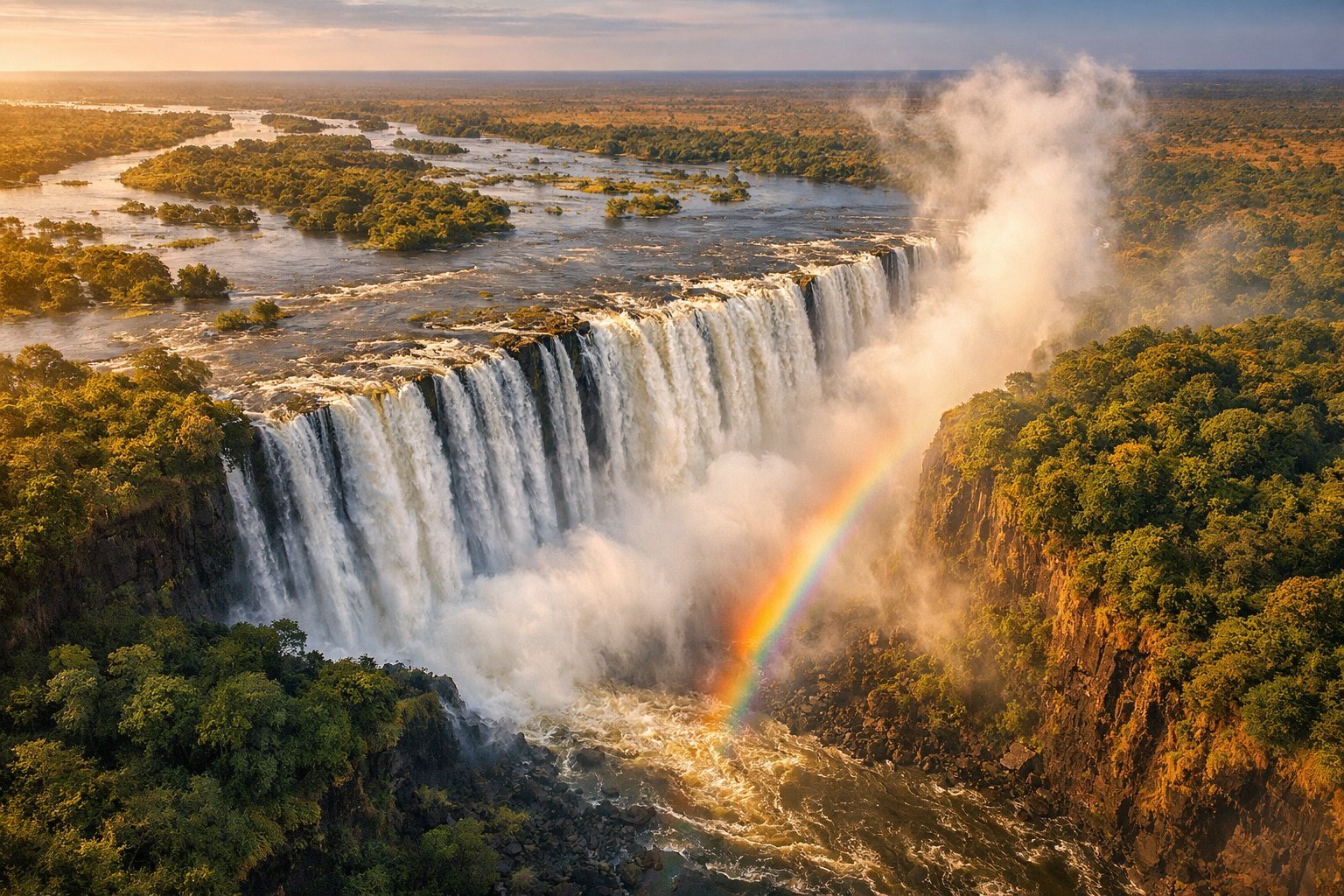
The Zambezi plunges into a narrow basalt gorge at Victoria Falls, known in Kololo and Lozi as Mosi-oa-Tunya, “the smoke that thunders.” Spray, water volume and visibility vary sharply by season. The rainforest paths on the Zimbabwean side connect a sequence of viewpoints; waterproof protection is useful when the river is high.
Water volume changes dramatically through the year. High flow creates the famous wall of spray and can obscure parts of the gorge; lower water reveals the basalt structure and makes individual cataracts easier to read. The Zimbabwean rainforest path provides a long sequence of viewpoints, but visitors need rain protection, secure footwear and care near slippery edges.
Hwange National Park is Zimbabwe’s largest protected area and is especially known for elephants and dry-season waterholes. Mana Pools combines floodplain woodland, the Zambezi and exceptional walking and canoe safaris. Matobo protects granite landscapes, rock art and important populations of black and white rhino.
Zimbabwe’s conservation areas differ sharply: Hwange is a vast dry-season wildlife stronghold, Mana Pools is shaped by the Zambezi floodplain, and Matobo joins granite ecology with a profound cultural landscape. Ethical operators keep distance from animals, respect park instructions, employ qualified guides and explain how tourism revenue connects with conservation and neighbouring communities.
The stone enclosures of Great Zimbabwe are the most extensive ancient structures south of the Sahara and gave the modern country its name. Zimbabwe’s UNESCO list also includes Khami, Matobo Hills, Mana Pools and the transboundary Victoria Falls property. Visit with a trained guide to understand the architecture beyond the Great Enclosure.
Zimbabwe has five World Heritage properties: Great Zimbabwe, Khami, Matobo Hills, Mosi-oa-Tunya/Victoria Falls, and Mana Pools with the Sapi and Chewore safari areas. Together they show why heritage here cannot be separated into “nature” and “culture”: trade, sacred geography, wildlife, geology and political memory overlap continually.
Zimbabwe recognises sixteen official languages. Shona is spoken by the majority, while Northern Ndebele is prominent in the south-west and English remains important in administration and tourism. Mbira music, stone sculpture and oral storytelling remain influential. Sadza, leafy relishes, peanuts, beans and grilled meat anchor everyday meals.
Shona is spoken by most citizens, Ndebele has a major presence in the southwest, and English is widely used in administration and education; Zimbabwe also constitutionally recognizes additional languages. Courtesy matters: greetings normally precede business, permission should be requested before photographing people, and a few words in the language of the place change the tone of an encounter.
International gateways include Harare and Victoria Falls. Entry rules, payment systems, fuel availability and park fees can change, so verify them shortly before travel. US dollars are widely used, but smaller notes are useful. Book reputable guides, follow park instructions and never approach wildlife for a photograph.
Plan with margins rather than a minute-by-minute schedule. Fuel, power, mobile coverage and card acceptance can be inconsistent outside major centres, so carry lawful backup payment options, drinking water, offline maps and copies of essential documents. Confirm every border, visa, park-fee and health requirement shortly before departure because practical rules can change faster than printed guides.
The cool dry season from roughly May to August offers comfortable days and strong wildlife viewing. September and October can be very hot, especially in the Zambezi Valley. Summer rains usually arrive from November to March, turning the landscape green and bringing dramatic skies, birds and occasional road disruption.
The broad pattern is a warm wet season from roughly November to March and a cooler dry season from about May to August, with hot conditions building before the rains. Altitude moderates Harare and the Eastern Highlands, while the Zambezi and Lowveld can be much hotter. Wildlife visibility, waterfall volume, road access and birdlife peak at different times, so there is no single best month for every itinerary.
Zimbabwe is a landlocked country on a high plateau between the Zambezi and Limpopo river systems. The central watershed separates rivers flowing north toward the Zambezi from those draining south toward the Limpopo.
The central highveld forms Zimbabwe’s populated spine, descending toward the hotter lowveld and the Zambezi and Limpopo basins. Granite kopjes, miombo woodland, mopane country and eastern mountain forest create striking ecological contrasts within a landlocked state.
Harare lies in the north-east, Bulawayo in the south-west and Victoria Falls at the country’s north-western corner. Most main routes radiate between these cities and the principal parks.
The main visitor triangle links Harare, Bulawayo and Victoria Falls, but the country’s heritage and landscapes extend well beyond it. Distances should be measured in realistic driving hours rather than kilometres alone.
Shona-speaking communities form the majority, while Ndebele culture is especially influential around Bulawayo and Matabeleland. Tonga, Kalanga, Venda, Nambya, Shangani and other peoples add distinct histories and traditions.
Zimbabwean society is urban and rural, multilingual and shaped by extensive regional and global migration. Family networks, churches, schools, markets and diaspora connections are central to everyday life and should not be flattened into ethnic labels.
Harare combines government institutions, universities, markets, modern suburbs and a growing arts scene. The National Gallery, Mbare markets and jacaranda-lined avenues reveal very different layers of the city.
Harare is best understood through several neighbourhoods rather than a single monumental centre. The National Gallery, botanical spaces, markets, contemporary restaurants and nearby balancing-rock landscapes reveal different layers of the capital.
Zimbabwe’s second city is known for broad streets, railway heritage and institutions such as the Natural History Museum. It is the practical base for Khami and Matobo National Park.
Bulawayo’s broad avenues, railway history and museum collections make it the cultural gateway to western Zimbabwe. It is also the practical base for Matobo and Khami, and a major centre of Ndebele history and contemporary creativity.
The Hill Complex, Great Enclosure and Valley Ruins record several centuries of architectural development. Dry-stone walls were assembled without mortar and formed part of a powerful political and trading centre.
The site flourished principally between the eleventh and fifteenth centuries and covered nearly eighty hectares. Its dry-stone walls, imported goods and spatial organisation testify to an African trading and political centre, not a mysterious construction by outsiders.
Khami succeeded Great Zimbabwe as an important regional capital. Its decorated retaining walls and terraced platforms demonstrate a related but distinctive architectural tradition.
Khami developed after Great Zimbabwe and used terraced retaining walls decorated with distinctive stone patterns. Reading it as part of a connected sequence of southern African states gives the ruins their proper historical depth.
Balanced granite formations, caves and wooded valleys give Matobo one of southern Africa’s most recognisable landscapes. The hills hold extensive rock art and remain spiritually important to local communities.
Matobo’s granite landforms shelter one of southern Africa’s richest concentrations of rock art and remain spiritually important to local communities. The hills are also habitat for notable wildlife, so cultural respect and ecological care belong to the same visit.
Hwange’s mosaic of woodland and open pans supports elephants, lions, wild dogs and more than four hundred bird species. Wildlife gathers around pumped waterholes during the driest months.
Zimbabwe’s largest national park is especially celebrated for elephants and waterhole viewing in the dry season. Its scale makes an experienced guide, patient observation and more than a hurried overnight stay particularly valuable.
Seasonal pools and floodplain forests along the Zambezi create exceptional wildlife habitat. Guided walking and canoe activities demand strict attention to professional instructions.
On the Zambezi floodplain, seasonal pools, alluvial forest and wildlife movement create an unusually dynamic safari landscape. Walking and canoe activities require licensed professional guidance and strict attention to animal behaviour.
The “place of elephants” protects remote south-eastern wilderness and the red sandstone Chilojo Cliffs. It forms part of the wider Great Limpopo Transfrontier conservation landscape.
Gonarezhou’s sandstone cliffs, rivers and elephant country anchor the Zimbabwean part of the Great Limpopo transfrontier landscape. Its remoteness is an attraction, but it also increases the importance of preparation and competent local logistics.
The immense reservoir behind Kariba Dam is shared with Zambia. Houseboats, fishing and wildlife viewing are popular, while the engineering and ecological history of the lake deserve equal attention.
Kariba is both a vast reservoir and a lived landscape of fishing, tourism, power generation and difficult environmental history. Weather can change quickly on open water, and boat journeys should use reputable operators with proper safety equipment.
The Zambezi shapes Zimbabwe’s northern frontier and links Victoria Falls, Kariba and Mana Pools. Water levels govern scenery, river activities and wildlife movements throughout the year.
The Zambezi links waterfalls, floodplains, reservoirs, wildlife corridors and communities across several countries. Travellers see only fragments of a river system whose seasonal pulse determines livelihoods and ecosystems far beyond any single attraction.
Nyanga, Bvumba and Chimanimani offer forest, granite peaks, waterfalls and cooler temperatures. Conditions can change rapidly, and longer walks require preparation.
The eastern borderlands offer cooler air, montane forest, tea country, waterfalls and long views toward Mozambique. They provide a contrasting itinerary to the western safari circuit and reward hikers who plan for mist, rain and changing mountain conditions.
Nyanga National Park combines grassland, trout streams, archaeological remains and Zimbabwe’s highest mountain. Mist and sudden weather changes make local guidance valuable.
Nyanga combines high grasslands, archaeological traces, waterfalls and Mount Nyangani, Zimbabwe’s highest summit. Mountain weather and route finding deserve respect; local advice is more reliable than assuming a short distance means an easy walk.
The Chimanimani range attracts experienced hikers with rugged ridges and caves. Trails near the border require current local information and respect for protected areas.
Chimanimani is a rugged hiking region of quartzite peaks, valleys and cross-border ecology. Recovery from severe cyclones remains part of the region’s recent story, making locally managed tourism and sensitivity to affected communities especially important.
Zimbabwe has a demanding professional-guide tradition built around field knowledge, tracking and safety. Choose licensed operators and treat instructions around animals as non-negotiable.
Zimbabwe’s professional-guide tradition is widely respected because qualification demands deep knowledge, field judgement and safety discipline. A good guide does more than identify animals: they read tracks, explain habitats, manage risk and place each sighting within a wider conservation story.
From miombo woodland to Zambezi wetlands, Zimbabwe supports rich bird diversity. The rainy season brings migrants and breeding activity, while the dry season concentrates birds near water.
Zimbabwe’s range from wetlands and miombo woodland to mountains and dry lowveld supports exceptional bird diversity. Birding is strongest with a local specialist who recognises calls, habitats and seasonal movements rather than pursuing a checklist alone.
Sadza is commonly served with vegetables, beans, meat or fish. Regional food also includes maputi, peanut-based sauces, mopane worms and dishes shaped by farming and seasonal availability.
A Zimbabwean table may centre on sadza with vegetables, beans, meat or fish, but regional produce and household methods create wide variation. Markets and family-run restaurants are the best places to learn how maize, millet, peanuts, leafy greens and seasonal ingredients fit everyday life.
Commercial lagers are widespread, while mahewu and traditional beers have long social histories. Small-scale wine production exists in the Eastern Highlands, though Zimbabwe is not a major wine country.
Tea, coffee, commercial and craft beer, traditional opaque beer and non-alcoholic drinks all have a place in Zimbabwean social life. Drink water carefully, ask before photographing brewing traditions, and treat locally produced beverages as culture rather than novelty.
The mbira is central to important musical and spiritual traditions. Contemporary Zimbabwean music also includes sungura, chimurenga, gospel, jazz and urban styles.
The mbira, hosho rattles, drums, choral traditions, sungura and contemporary urban genres demonstrate a musical culture that is both rooted and inventive. Performances should be approached as living art, with proper admission, credit and permission for recording.
Modern Zimbabwean stone sculpture gained international recognition through artists working in serpentine and other local stone. Galleries and workshops around Harare remain important places to encounter the tradition.
Zimbabwean stone sculpture achieved international recognition, but it belongs within a broader field of textiles, ceramics, painting, photography and new media. Buy directly from artists or transparent galleries, request provenance and avoid treating every carving as interchangeable “airport art.”
Zimbabwean writing moves between Shona, Ndebele and English and addresses memory, colonialism, independence, migration and everyday life. Oral storytelling continues alongside published literature.
Zimbabwe’s writers have explored colonialism, liberation, gender, migration, urban life and the tensions of the post-independence state in English, Shona and Ndebele. Reading local fiction and memoir before arrival gives the landscape voices that a conventional guidebook cannot supply.
The Harare International Festival of the Arts and local music, film and cultural events animate the calendar. Dates and programmes should be checked directly before travel.
Festival calendars change, but arts gatherings, book events, agricultural shows, music programmes and local commemorations offer routes beyond sightseeing. Verify dates with organisers, reserve accommodation early and distinguish public cultural events from ceremonies that require invitation.
The central highveld is generally milder than the Zambezi and Limpopo valleys. Altitude creates strong local differences, and drought or heavy rain can alter travel conditions.
Harare’s altitude produces cooler nights than many visitors expect, the Eastern Highlands can be wet and misty, and the Zambezi Valley can be intensely hot. Pack by region and activity, not by a single national forecast.
International services connect principally through Harare and Victoria Falls, with regional links to major southern African hubs. Overland border procedures and operating hours can change.
Most international itineraries use Harare or Victoria Falls, with regional connections through southern African hubs. Direct routes and schedules change, so confirm the operating airline, baggage conditions and onward ground transfer rather than relying on an old timetable.
Long-distance buses, private transfers, rental vehicles and domestic flights connect major destinations. Road conditions vary, and night driving carries added risks from animals, pedestrians and limited lighting.
Long-distance buses, private transfers, rental cars and domestic flights serve different budgets and routes. Night driving is generally best avoided because of livestock, pedestrians, limited lighting, road hazards and reduced access to help.
Visa eligibility depends on nationality and may involve visa-free entry, visa on arrival or advance application. Confirm passport validity, fees and entry rules with an official source before departure.
Nationality determines whether entry is visa-free, visa on arrival or requires prior authorisation. Passport validity, blank-page, fee, proof-of-funds and onward-travel rules should be checked against official sources immediately before travel.
Zimbabwe has experienced repeated currency changes. Travellers should carry more than one payment method, confirm which currencies are accepted and keep smaller notes for everyday transactions.
Zimbabwe’s monetary environment has changed repeatedly, and accepted currencies, exchange rules and electronic-payment reliability require current confirmation. Use authorised channels, keep small denominations, retain receipts and never assume one payment method will work everywhere.
Malaria risk is higher in lower and warmer regions, particularly seasonally. Obtain personal medical advice, use bite prevention and carry insurance that includes evacuation from remote areas.
Travel insurance should cover the planned activities and evacuation, especially for remote parks. Seek professional advice on routine vaccines, malaria risk, food and water precautions, heat, sun and any yellow-fever certificate requirement linked to the journey’s origin.
Most visits are trouble-free, but political sensitivity, road conditions, wildlife and changing economic circumstances require awareness. Avoid demonstrations and follow current local guidance.
The current U.S. advisory remains Level 2, citing crime, unrest and official harassment; the UK advice was updated in July 2026 and should also be checked. Avoid demonstrations, protect valuables, do not photograph sensitive government or security sites, and follow local guidance.
Use locally owned services where possible, ask before photographing people and avoid souvenirs made from protected wildlife. Water and energy are scarce in some regions, especially during drought.
Choose locally owned services where possible, ask how staff and communities benefit, minimise water and plastic use, and obey wildlife-viewing limits. Cultural respect includes consent for photographs, fair payment for creative work and restraint around sacred or commemorative places.
Options range from city hotels and guesthouses to safari lodges and camps. Remote properties may operate seasonally and often require advance transfers or charter arrangements.
The range extends from urban guesthouses and historic hotels to campsites, safari camps and remote lodges. Compare location, generator or solar provision, water, communications, park transfers and cancellation terms—not star labels alone.
Use official park information, UNESCO records, reputable guidebooks and current travel advisories together. No single source captures Zimbabwe’s rapidly changing practical conditions.
Prioritise archaeological scholarship, Zimbabwean historians and writers, UNESCO documentation, park authorities and regularly updated official travel advice. Political and economic claims date quickly, so record the publication date and distinguish evidence from opinion.
Zimbabwe’s economy combines mining, agriculture, manufacturing, tourism, services and a large informal sector. Gold, platinum-group metals, tobacco and other exports matter, while currency instability and infrastructure constraints shape daily decisions. Visitors understand more by looking beyond national statistics to workshops, farms, markets, technology businesses and diaspora-supported investment.
Economic information ages quickly. Prices, currency practice, taxes and business rules must be checked against current official or professional sources; travellers should never treat street exchange rates or anecdotal advice as reliable financial guidance.
Football has the widest popular reach, cricket carries major national visibility, and rugby, athletics, swimming, golf and school sport all have strong communities. Matches and local clubs provide a social window that wildlife itineraries often miss.
Ask before photographing players or children, buy tickets through official channels and remember that sport in Zimbabwe is tied to schools, neighbourhood identity, diaspora pride and debates about access to facilities.
Zimbabwe’s international story includes writers such as Tsitsi Dangarembga and Dambudzo Marechera, musicians including Oliver Mtukudzi and Thomas Mapfumo, sculptors, scientists, athletes and political figures. No short list can represent the country’s diversity.
Use biographies as doors into movements and institutions rather than as celebrity decoration. Credit living creators accurately and seek work published or performed in Zimbabwe, not only careers validated abroad.
Zimbabwe has public and private newspapers, radio, television and a rapidly evolving digital sphere. Journalism operates within political, legal and economic pressures, while social media expands access but also accelerates rumour.
Travellers should compare several reputable sources, protect the privacy of people they meet and never assume that a casual political conversation can safely be photographed, recorded or posted online.
Beyond the headline circuit, possibilities include the stone landscapes around Mutoko, the archaeological sequence at Ziwa, quiet corners of the Eastern Highlands, community conservancies and smaller museums in Harare and Bulawayo. Access and visitor readiness vary.
A “hidden gem” is not an invitation to arrive unannounced. Contact local custodians, hire local expertise, respect sacred and private land, and leave fragile places exactly as found.
49
Zimbabwe in photographs
The gallery follows the country from Victoria Falls and the Zambezi to wildlife country, ancient stone architecture and the highlands.
The strongest Zimbabwe photographs show scale without erasing people: spray above the falls, patterned stonework, elephant paths, granite hills, market colour and ordinary urban life. Every image should carry an accurate place caption and a transparent source or creator credit.
50
Author’s Note
Zimbabwe rewards time and context. Its celebrated landscapes are only one layer of a country whose history, languages and creative life deserve the same patient attention.
— Radim Kaufmann, 2026
Zimbabwe resists the hurried gaze. Its stone walls ask for historical patience, its rivers demand respect for scale, and its guides teach the discipline of watching before speaking. The most memorable journey is one that leaves room for local voices and refuses to turn either beauty or difficulty into a stereotype.
Support This Project 🌍
This World Travel Factbook is free to use. If you find it helpful, consider supporting its continued development.