


🇲🇿 Mozambique at a Glance
🌍 Overview — Long, Thin and Facing East
Mozambique is 801,590 km² — France and Germany combined — stretched down the south-east African coast with 2,500 km of Indian Ocean on one side and six neighbours on the other. About 36.6 million people live there, and the median age is under eighteen.
It is one of the most beautiful and least-visited coastlines on earth, and it is also a country in three different situations at once: a peaceful and welcoming south, a recovering centre, and an insurgency in the far north that has displaced hundreds of thousands of people and stopped, then restarted, a $20 billion gas project.
Where it is
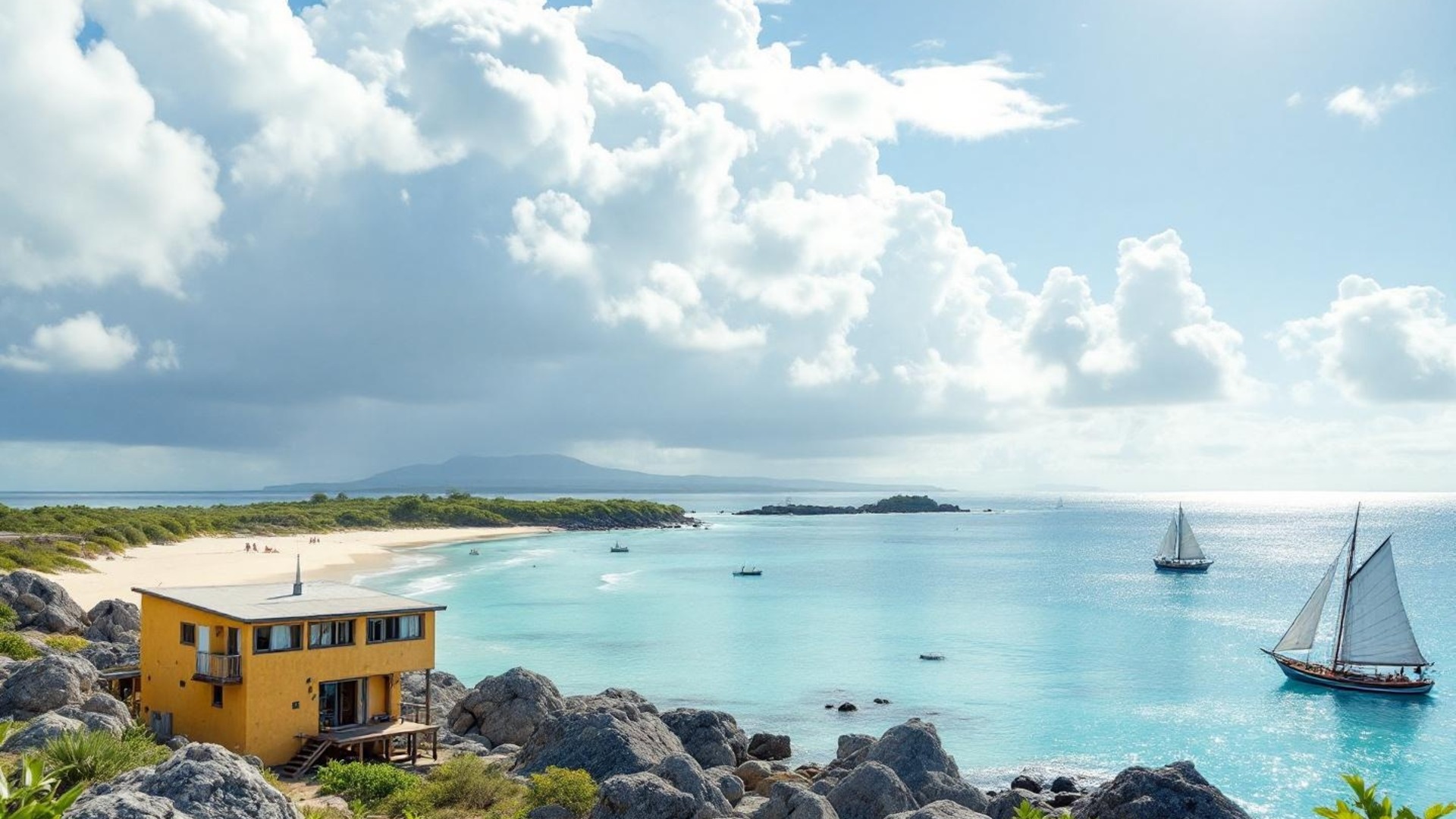
On the Indian Ocean, facing Madagascar across the Mozambique Channel, with Tanzania to the north, Malawi, Zambia and Zimbabwe inland, and South Africa and Eswatini to the south. Maputo, the capital, is in the extreme south — closer to Johannesburg than to most of its own country.
The shape of the problem
Mozambique is 2,000 km long and the capital is at one end of it. Pemba, in the far north, is a two-and-a-half-hour flight from Maputo and a very long way from anything the government does easily. That geography explains a great deal about why the north is where the trouble is.
Language
Portuguese is the sole official language and the language of the state, but it is the mother tongue of only a small minority. Most Mozambicans grow up speaking one of around forty Bantu languages — Makhuwa in the north, Sena and Ndau in the centre, Changana in the south — and learn Portuguese at school if they get that far.
How it is governed
A presidential republic. Daniel Chapo of Frelimo has been president since 15 January 2025, after an October 2024 election that the opposition and a large part of the population reject as rigged. Frelimo has governed continuously since independence in 1975 — one of the longest unbroken party runs in Africa.
The economy in one line
Coal, aluminium, gas, cashews, prawns and remittances from South Africa, on top of a large subsistence agriculture sector. GDP contracted about 0.5% in 2025 after the post-election unrest and is projected to grow around 2.1% in 2026. The Mozal aluminium smelter closed in March 2026, which was a serious blow.
2026 in one line
The Mozambique LNG project restarted fully on 29 January 2026 after four and a half years of force majeure; a national dialogue between government and opposition is running to November 2026; and Cabo Delgado saw a renewed wave of attacks in the second half of 2025.
🏷️ The Name, the Flag and the Rifle
Where the name comes from
From Mussa Bin Bique (or Musa al-Biq), an Arab or Swahili trader and sheikh who controlled the island the Portuguese first settled. They took his name for the island, then for the whole colony. Mozambique is therefore named after a man — and specifically after one of the Muslim traders the Portuguese arrived to displace.
The flag with an AK-47
Mozambique is the only country in the world whose national flag carries a modern assault rifle. The emblem is an AK-47 crossed with a hoe, over an open book, on a star. It stands for the armed struggle, agriculture and education, and there have been repeated parliamentary attempts to change it. Frelimo has blocked them all.
The Commonwealth anomaly
Mozambique joined the Commonwealth in 1995 and was the first member that had never been part of the British Empire. It was admitted essentially as thanks for the price it paid supporting the liberation struggles in Rhodesia and South Africa. Rwanda, Gabon and Togo followed the same route much later.
Portuguese, and who speaks it
Roughly half the population can speak Portuguese to some degree and only a small minority speak it at home — but the share is rising fast with schooling and urbanisation, and Mozambican Portuguese is developing its own vocabulary and rhythm. In a Maputo bar you will hear Portuguese; in a village in Niassa you very likely will not.
Graça Machel
Worth knowing because the fact is genuinely unique. Graça Machel was married to Samora Machel, Mozambique's first president, and after his death to Nelson Mandela — making her the only person to have been first lady of two different countries. She is a serious figure in her own right in children's rights and education.
What Mozambicans call it
Moçambique, and colloquially Moz. The demonym is moçambicano. The country is also, in tourism marketing and with some justification, called the "land of smiles" — a phrase that is doing marketing work but which most visitors end up repeating unprompted.
🗺️ From the Delta to the Highlands
The coastal plain
Nearly half the country is low coastal plain, widest in the south and narrowing northwards. It is hot, humid, and cut by the mouths of some of Africa's great rivers. This is where most Mozambicans live and where every cyclone lands.
The Zambezi
The Zambezi crosses the country from Zimbabwe to a vast delta on the Indian Ocean, and it is dammed at Cahora Bassa — one of Africa's largest hydroelectric schemes, built by the Portuguese in the 1970s and now supplying much of southern Africa. The delta itself is a huge wetland and a serious flood risk in a wet year.
The highlands
The land rises inland to the Chimanimani mountains on the Zimbabwean border, the Angónia and Lichinga plateaus, and Mozambique's high point at Monte Binga, 2,436 m. The northern plateaus around Lake Niassa are cool, green and almost entirely unvisited.
Lake Niassa
The Mozambican third of Lake Malawi — the same lake, three names, three countries. It is one of the world's deepest and most biologically remarkable lakes, with several hundred endemic cichlid species, and the Mozambican shore has a handful of lodges and almost no other visitors.
Climate
Tropical, with a hot wet season from November to March and a cooler dry season from April to October. The south is drier and more seasonal; the north is properly tropical. Coastal temperatures run 25–32 °C with high humidity in the wet months.
Cyclones
The central and northern coasts are among the most cyclone-exposed places on earth. Idai in March 2019 devastated Beira and killed hundreds; Kenneth followed weeks later; Freddy hit twice in 2023; Chido struck Cabo Delgado in December 2024, then Dikeledi and Jude in 2025. This is not a background risk — it is a recurring national emergency.
📜 Swahili Coast, Portugal, and Five Centuries
Before Portugal
The coast was part of the Swahili trading world — Bantu-speaking, Muslim, literate, connected by dhow to Arabia, Persia, India and China. Sofala was a major gold port for the inland Mutapa kingdom, and Kilwa to the north controlled the trade. This was a wealthy, cosmopolitan coast long before Vasco da Gama.
1498 and after
Vasco da Gama reached the coast in 1498, and Portugal spent the next four centuries with a foothold rather than a colony: trading forts, the prazo estates along the Zambezi held by half-Portuguese warlord families, and a slave trade that intensified sharply in the nineteenth century as other markets closed.
The chartered companies
For decades around 1900 Portugal did not administer much of Mozambique itself: it leased huge territories to the Mozambique Company and the Niassa Company, private concerns that governed, taxed and coerced labour. The system's brutality is one reason the liberation movement found ready recruits.
Forced labour and migration
Under the chibalo system Mozambicans were conscripted into unpaid labour, and Portugal ran a formal arrangement supplying miners to South Africa's gold mines in exchange for gold payments and railway traffic. Labour migration to South Africa remains one of the country's defining economic facts.
Ilha de Moçambique
The capital until 1898: a coral-stone island city with a fort, a hospital, a cathedral and the oldest European building in the southern hemisphere, the Chapel of Nossa Senhora do Baluarte (1522). It is a UNESCO World Heritage site and one of the most extraordinary and least-visited historic towns in Africa.
Why 1975 came late
Portugal was the last European power to leave Africa, and it left only because its own dictatorship fell. The Carnation Revolution in Lisbon in April 1974 ended the colonial wars, and Mozambique became independent on 25 June 1975 — twelve years after Kenya and fifteen after most of French Africa.
🕊️ Independence, Civil War and 1992
Mozambique had ten years of independence and then sixteen years of war. Understanding the country requires holding both: the liberation struggle that made it, and the civil war that nearly destroyed it and whose lines are still visible in every election result.
Frelimo and the struggle
The Frente de Libertação de Moçambique launched an armed struggle in 1964 under Eduardo Mondlane, who was assassinated by parcel bomb in 1969. Samora Machel took over and became the first president in 1975. Frelimo was Marxist-Leninist, ambitious and, on education and health, initially very effective.
Renamo and the war
Renamo was created by Rhodesian intelligence and then sponsored by apartheid South Africa to destabilise a state that was hosting the ANC and ZANU. The war ran from 1977 to 1992, killed around a million people directly and through famine, displaced five million, and destroyed most of the country's schools, clinics and railways.
Samora Machel's death
On 19 October 1986 Machel's aircraft crashed into a hillside at Mbuzini just inside South Africa, killing him and 33 others. The official inquiry blamed pilot error; many Mozambicans and South Africans have never accepted that, and the suspicion of apartheid involvement has never been resolved. He remains a genuinely revered figure.
The Rome accords
The war ended with the General Peace Agreement signed in Rome on 4 October 1992, brokered by the Catholic Sant'Egidio community. Renamo became a political party, elections followed in 1994, and the transition held — a genuine and underappreciated success in a decade when most such settlements failed.
Landmines
Mozambique was one of the most heavily mined countries on earth. A twenty-year clearance effort — much of it using the famous HeroRATs, giant African pouched rats trained to detect explosives — ended when Mozambique was declared free of known landmines in 2015. It is one of the great quiet achievements of the post-war period.
Why it still matters
Renamo's old areas in the centre — Sofala, Manica, Zambézia — still vote against Frelimo, and low-level Renamo violence flared again as recently as 2013–2019 before a further peace deal. The 2024 election crisis is a new phenomenon, but it is happening in a country with a very recent memory of what political breakdown costs.
🏖️ The Coast — 2,500 Kilometres of It
This is the reason most visitors come. Mozambique has one of the longest and least-developed tropical coastlines in the world: dune-backed beaches, coral reefs, mangrove creeks, offshore archipelagos and a marine ecosystem that is in far better condition than most of the Indian Ocean.
Bazaruto Archipelago
Five islands off Vilanculos, protected as a national park since 1971: enormous sand dunes, freshwater lakes on the islands, and the last viable population of dugongs in the western Indian Ocean. Access is by dhow or boat from Vilanculos, and the lodges range from simple to extremely expensive.
Tofo and Inhambane
The backpacker and diver capital. Tofo is a long beach with a village behind it and a reputation built on whale sharks and manta rays, which are present year-round with a peak from October to March. Inhambane, 20 km away, is a lovely old Portuguese-Swahili town with a cathedral and a dhow harbour.
Ponta do Ouro
In the far south on the South African border, reached on a sand road: dolphins you can swim with under regulated conditions, good diving on the reefs, and a weekend crowd from Johannesburg and Durban. It is the most accessible piece of Mozambican coast for anyone driving from South Africa.
The Quirimbas
Thirty-odd islands off the far north from Pemba, part national park, part private lodges, with Ibo Island — a decayed Swahili-Portuguese trading town of coral-stone mansions, silversmiths and a star-shaped fort — as the cultural centre. Check current security advice for Cabo Delgado before planning anything here.
The reefs
Mozambique's reefs are among the healthiest in the western Indian Ocean, with high coral cover in the protected areas and an unusual abundance of large animals. Diving is the country's strongest tourism product and the one thing on which it genuinely competes with anywhere in the world.
What it is not
It is not a polished resort coast. Roads to the beaches are often sand, electricity is intermittent, and the gap between a $600-a-night island lodge and a $25 beach hut is filled by very little. That is the appeal for some travellers and the deterrent for others; be honest with yourself about which you are.
🏛️ Politics — An Election Half the Country Rejects
Mozambique held a presidential and parliamentary election on 9 October 2024. The result gave Daniel Chapo of Frelimo 65.2% and the independent challenger Venâncio Mondlane 24.2%. Mondlane rejected it as rigged, and what followed was the most serious political crisis since the civil war.
What happened after
Months of protests, strikes and road blockades across the country, met with a violent security-force response. Hundreds of people were killed, thousands arrested, and the economy went backwards — the post-election unrest is the main reason GDP contracted by about 0.5% in 2025. Two of Mondlane's close associates were shot dead in Maputo days after the election.
Daniel Chapo
Inaugurated on 15 January 2025. He is the first Mozambican president born after independence, a former provincial governor and law lecturer, and he took office with a mandate that a very large share of the population does not accept. His position has been described, accurately, as precarious.
Venâncio Mondlane
A former Renamo MP who ran as an independent backed by the small PODEMOS party and became, unexpectedly, the vehicle for a generation of angry young urban Mozambicans. He spent months outside the country, returned, and has since moved between confrontation and negotiation. He remains the central figure of the opposition.
The national dialogue
In September 2025 Chapo launched a formal national dialogue process, running to November 2026, bringing together government, opposition, civil society and religious bodies. It is the most serious attempt to settle the crisis politically, and its credibility depends on whether it produces anything binding on Frelimo.
Frelimo
In power without interruption since 1975. It is a liberation movement turned governing party turned patronage system, and its dominance of the state, the security services and much of the economy is the underlying fact of Mozambican politics. Every election since 1994 has been contested and every one has been won by Frelimo.
What this means for a visitor
In practice, very little in the south and on the tourist coast — the protests were concentrated in cities and on main roads and have largely subsided. But check current advice before travelling: demonstrations can close the N1, the country's single north–south artery, at no notice, and that can strand you for a day or more.
⚠️ Cabo Delgado — the Insurgency
Since October 2017 the far-northern province of Cabo Delgado has been fighting an insurgency by a group locally called al-Shabaab (no relation to the Somali organisation) and recognised internationally as Islamic State–Mozambique. It is a serious conflict and it is the single most important thing to understand before planning travel in the north.
What it is
A local insurgency with roots in the marginalisation of a Muslim-majority province that produces rubies and gas and sees very little of the proceeds, which then attached itself to the Islamic State network. It has been marked by extreme violence against civilians, including beheadings and the burning of villages.
The scale
Something over a million people have been displaced at the peak, and thousands have been killed since 2017. The March 2021 attack on Palma, next to the gas project, killed dozens including foreign contractors and forced TotalEnergies to declare force majeure and evacuate.
Who is fighting it
The Mozambican armed forces, a Rwandan deployment sent in July 2021 that proved considerably more effective than anything else tried, and until its withdrawal in 2024 a Southern African Development Community mission, SAMIM. Rwandan forces remain and are central to the security of the gas district.
Where it stands
Better than 2021, not resolved. A wave of attacks between late July and August 2025 hit civilian infrastructure and military checkpoints, and violence has continued into 2026 alongside the LNG restart. The pattern is of dispersed small-unit attacks rather than the seizure of towns.
Travel implications — read this
Cabo Delgado province, including Pemba and the Quirimbas, requires current, specific security advice. Conditions vary sharply by district and change month to month. Do not rely on a guidebook, a blog or this page for the current position: check your foreign ministry's advice and speak to an operator with people on the ground. The rest of Mozambique is a different situation entirely.
The uncomfortable connection
The insurgency is in the province with the gas. Whether the LNG money reaches Cabo Delgado's population or repeats the pattern that helped produce the insurgency is the central political question of Mozambique's next decade, and everyone involved knows it.
💼 The Economy — Resources and Very Little Else
The shape
A large subsistence agriculture sector employing most people, a capital-intensive extractive sector generating most export revenue and few jobs, and not much in between. GDP is around $22–25 billion for 36.6 million people, which puts Mozambique among the lower-income countries despite its resource endowment.
What it exports
Coal from Tete, aluminium from the Mozal smelter, gas from Coral Sul, heavy mineral sands from Moma, plus prawns, tobacco, timber and cashews. Most of it leaves through the ports of Maputo, Beira and Nacala, which also serve as outlets for landlocked Malawi, Zambia and Zimbabwe.
The Mozal closure
The Mozal aluminium smelter outside Maputo — for two decades the country's largest single industrial operation and a huge share of its exports — closed in March 2026 after a failure to agree electricity terms. It is a severe blow to export earnings and to a large workforce, and it is the main reason growth forecasts for 2026 are modest.
The hidden debts
Between 2013 and 2016 Mozambican state companies secretly borrowed around $2 billion from Credit Suisse and VTB, guaranteed by the government and concealed from parliament and the IMF, nominally for a tuna fleet and maritime security. When it surfaced, donors froze support, the currency collapsed and the country defaulted. Manuel Chang, the former finance minister, was convicted in a US court in 2024.
Cashews
Mozambique was once the world's largest cashew producer and processor. Liberalisation in the 1990s, pushed as a condition of World Bank lending, removed the export tax on raw nuts; processing moved to India and dozens of Mozambican factories closed. It is one of the most-cited case studies in the structural-adjustment literature and it is still a sore subject.
What ordinary life costs
Average incomes are low, urban unemployment among young people is very high, and the metical has lost roughly half its value against the dollar over a decade. Remittances from Mozambicans working in South Africa — a pattern more than a century old — remain a major source of household income.
⛽ The Gas — a $20 Billion Project Restarted
Off Cabo Delgado lies one of the largest natural gas discoveries of this century, in the Rovuma Basin. It has the potential to transform Mozambique's public finances, and it has spent most of the last five years shut down.
Mozambique LNG
The TotalEnergies-led onshore project at Afungi in Palma district — roughly $20 billion, the largest private investment ever made in Africa. Construction began in 2019 and stopped in April 2021, when force majeure was declared after the Palma attack.
The restart
Force majeure was lifted on 7 November 2025, and on 29 January 2026 TotalEnergies chief executive Patrick Pouyanné met President Chapo in Maputo to announce the full restart of activities onshore and offshore. The project is roughly 40% complete and first LNG is expected in 2029.
Coral Sul
The one part that never stopped. Eni's floating LNG vessel Coral Sul FLNG, moored offshore and therefore beyond the reach of a land insurgency, has been producing since 2022. It is proof that the gas can be monetised, and a second floating unit is in development.
Rovuma LNG
The ExxonMobil-led project, larger again than Total's, also lifted its force majeure as the security outlook improved and is moving towards a final investment decision. If both onshore projects proceed, Mozambique becomes a top-tier global LNG exporter in the 2030s.
The argument against
Campaigners and some economists argue the projects carry enormous risk for Mozambique — debt guarantees, security costs borne locally, displaced communities at Afungi with unresolved compensation, and a bet on gas demand in the 2030s and 2040s. The counter-argument is that a country this poor cannot decline the single largest investment available to it.
What to watch
Whether revenue reaches Cabo Delgado. Mozambique has a sovereign wealth fund framework and a very recent memory of what happened the last time large sums arrived unaccountably. The hidden-debts scandal is the reason nobody in Maputo can simply promise that this time will be different.
🏙️ Maputo — Jacarandas and Concrete
Maputo is one of the more likeable capitals in Africa: a grid of broad avenues laid out under the Portuguese, lined with jacaranda and flame trees, running down to a bay. It is hot, loud, a little ragged, and much safer and more relaxed than its reputation.
The street names
Maputo's grid is a museum of twentieth-century socialism: Avenida Karl Marx, Avenida Vladimir Lenine, Avenida Mao Tsé Tung, Avenida Kim Il Sung, Avenida Julius Nyerere, Avenida Salvador Allende. They were renamed after 1975 and have never been changed back, which makes navigating the city an unexpected ideological experience.
The railway station
Estação Central dos Caminhos de Ferro, completed in 1916, is regularly named one of the most beautiful railway stations in the world: a pale-green dome, wrought-iron verandas and a marble hall. The dome is often attributed to Gustave Eiffel; that attribution is not supported by evidence, and the architects were Alfredo Augusto Lisboa de Lima and colleagues. Go anyway — there is a bar in it.
Casa de Ferro
The Iron House, a prefabricated metal residence shipped out in the 1890s and this time genuinely from Eiffel's company. It was intended as the governor's residence and proved, predictably, uninhabitable in tropical heat. It stands as a monument to colonial planning that did not include a thermometer.
The markets
The Mercado Central on Av. 25 de Setembro for fish, fruit and noise; the Mercado do Peixe at Costa do Sol, where you buy prawns and crab from the stalls and take them to an adjacent kitchen to be cooked; and FEIMA in Polana for craft and art. The fish market is the best meal in the city and one of the best in Africa.
Art and buildings
The Núcleo de Arte, a long-running artists' collective famous for the Transformação de Armas em Enxadas project turning decommissioned weapons into sculpture; the Museu de História Natural in a Manueline palace, with a genuinely unique collection of elephant foetuses; the Fortaleza; and the brutalist and late-modernist buildings that make Maputo a minor pilgrimage site for architecture enthusiasts.
Getting around
Chapas — shared minibuses — cover the city cheaply and chaotically. Taxis and ride apps operate in the centre. The Katembe bridge, opened in 2018 and the longest suspension bridge in Africa, crosses the bay and has opened up the southern coast road to Ponta do Ouro.
🏝️ Ilha de Moçambique and the Old North
The island
Ilha de Moçambique is three kilometres long, a few hundred metres wide, joined to the mainland by a single-lane bridge, and was the capital of Portuguese East Africa until 1898. It is a UNESCO World Heritage site and one of the most remarkable places in Africa — and it receives a tiny fraction of the visitors it deserves.
Stone Town and Macuti Town
The northern half is Cidade de Pedra e Cal — stone-and-lime, a decaying grid of Portuguese and Swahili merchant houses, churches, a hospital and the fortress. The southern half is Cidade de Macuti, densely populated, built of reed and palm thatch, and home to most of the island's people. Both are part of the listing.
The Fort of São Sebastião
Begun in 1558 and one of the largest and best-preserved Portuguese fortifications anywhere, it held off Dutch sieges and controlled the Indian Ocean route for two centuries. Inside its walls is the Chapel of Nossa Senhora do Baluarte (1522) — the oldest European building in the southern hemisphere.
Nampula and Nacala
Nampula is the north's largest city and its transport hub, with the country's best ethnographic museum. Nacala has one of the finest deep-water harbours on the African east coast and a railway to Malawi. Neither is a tourist destination, and both are how you reach the ones that are.
Getting there
Fly to Nampula and drive about three hours, or take the long road north. The island has guesthouses in restored merchant houses and a couple of good small hotels, and it is entirely walkable. Nampula and Nacala are outside Cabo Delgado — a distinction worth making, because the north is often written about as if it were all one place.
Why it is under-visited
Because it is a very long way from anywhere, because the north has an image problem the insurgency has made worse, and because Mozambique's tourism marketing is almost entirely about beaches. Ilha is the best cultural site in the country by a wide margin and most people who come to Mozambique never see it.
🤿 Where to Get in the Water
Tofo — whale sharks
The best-known dive base, near Inhambane. Whale sharks and manta rays are the draw, with a research station on the beach and a long-running tagging programme. Manta cleaning stations at Manta Reef and Giants Castle are the signature dives. Ocean safaris and snorkelling trips run daily in season.
Vilanculos and Bazaruto
The gateway to the archipelago. Dhow safaris to the islands, snorkelling at Two Mile Reef, dune walks on Bazaruto itself and — with luck and a good guide — dugong sightings. Accommodation runs from backpacker to some of the most expensive lodges in Africa, with little between.
Ponta do Ouro and Ponta Malongane
The far south, an easy drive from South Africa. Regulated swim-with-dolphins operations with resident bottlenose pods, good reef diving, and a whale-watching season from July to October when humpbacks pass close inshore on their migration.
Pemba and the Quirimbas
Pemba sits on one of the world's largest natural bays with a reef a short swim from the shore, and it is the jumping-off point for the Quirimbas. Security advice for Cabo Delgado applies and must be checked currently; when conditions allow, this is the most beautiful and least developed part of the coast.
Practical diving notes
Water is 24–29 °C; a 3 mm suit is enough most of the year. Visibility is best from April to September in the south. Many dive sites are launched from the beach through surf in rigid inflatables, which is exhilarating and occasionally alarming — say so if you are not comfortable with it. There is no recompression chamber in most of the country: dive conservatively and carry insurance that covers evacuation.
Turtles and seasons
Five turtle species nest on Mozambican beaches, with loggerhead and leatherback nesting from November to February in the south. Humpback whales pass July to October. Whale sharks are year-round at Tofo with a summer peak. Plan around the animal you actually want to see.
🐘 Gorongosa — the Great Restoration
Mozambique's civil war did not spare its wildlife. Gorongosa National Park lost something on the order of 95% of its large animals between 1977 and 1992 — elephants killed for ivory to buy weapons, everything else eaten. What has happened since is one of the most ambitious ecological restorations attempted anywhere.
The restoration
From 2004 the American philanthropist Greg Carr entered a long-term partnership with the Mozambican government, initially for twenty years and since extended. Animals were reintroduced, poaching was brought under control, and populations rebuilt from remnant groups. Elephant, buffalo, wildebeest, zebra and hippo numbers are now a large multiple of the post-war low.
Why it is unusual
Gorongosa spends a very large share of its budget on human development in the buffer zone — schools, clinics, a girls' education programme, coffee and cashew agroforestry on Mount Gorongosa. The explicit argument is that a park surrounded by hungry people cannot be defended, and the model is now studied and copied elsewhere.
The elephants
Gorongosa's elephants are famous among biologists for an unhappy reason: the intense ivory poaching of the war years left an unusually high proportion of tuskless females, a documented case of rapid human-driven evolutionary selection. It is one of the clearest examples of the phenomenon anywhere.
Visiting
The park is open roughly April to December and closed in the height of the rains. There is a comfortable camp at Chitengo and a walking-safari operation. It is not the Serengeti and does not pretend to be — game densities are lower and the appeal is the story, the landscape and the near-total absence of other vehicles.
Niassa
In the far north, the Niassa Special Reserve is one of the largest protected areas in Africa — around 42,000 km², bigger than Switzerland — with elephant, wild dog, lion and sable in genuinely wild country. It is remote, hard to reach, expensive, and among the least-visited major reserves on the continent.
Maputo National Park
Formed in 2021 by merging the Maputo Special Reserve with a marine reserve, it runs from the elephant-holding coastal forest to the sea, an easy drive from the capital. It is the most accessible wildlife in the country and it protects a population of elephants that survived the war in the coastal thickets.
🧭 Three Countries in One
The south
Maputo, Gaza and Inhambane provinces. Closest to South Africa, most connected to the regional economy, with the best roads and the most tourism infrastructure. Changana and Ronga are the main local languages, and a large share of families have somebody working across the border. This is the Mozambique most visitors see.
The centre
Sofala, Manica, Tete, Zambézia. The old Renamo heartland and the part most damaged by both the war and the cyclones. Beira, the second city and a critical port for Zimbabwe and Malawi, was devastated by Cyclone Idai in 2019 and is rebuilding with an explicit climate-adaptation plan. Tete has the coal.
The north
Nampula, Niassa, Cabo Delgado. The most populous province is Nampula; the culture is Makhuwa and strongly Muslim on the coast; Portuguese is least spoken here. It holds Ilha de Moçambique, the Quirimbas, Niassa reserve and the gas — and the insurgency. It is also the poorest part of the country by most measures.
The road that joins them
The EN1 runs the length of Mozambique and is the country's spine. Long stretches have been rebuilt and long stretches have not; the Zambezi is crossed at Caia by a bridge opened in 2009 that replaced a ferry. Driving Maputo to Pemba is a serious multi-day undertaking, not a road trip.
Why the difference matters
Election results, language, religion, wealth and security all break along the same north–centre–south lines, and generalising about "Mozambique" without saying which part usually produces something wrong. A traveller in Tofo and a traveller in Mocímboa da Praia are in the same country in name only.
Religion
Roughly a quarter to a third Catholic, a quarter to a third Muslim — concentrated heavily on the northern coast — and a large and growing share of Protestant and independent churches, alongside widespread traditional belief practised in parallel with all of them. The coastal Muslim communities are Swahili in origin and were established centuries before the Portuguese arrived.
👥 Daily Life
Young
The median age is under eighteen and roughly 45% of the population is under fifteen. That shapes everything — schooling, unemployment, the electorate, and the fact that the people who filled the streets after the 2024 election were overwhelmingly young and had no memory of the civil war.
Urbanisation
Maputo and Matola together hold a few million people, Nampula and Beira are large cities, and everything else is small towns and villages. Around two thirds of Mozambicans still live rurally, mostly farming, and rural electrification and water supply remain limited.
Languages in practice
You will get by in Portuguese in cities and tourist areas, English in the diving and lodge business and near the South African border, and neither in a village. A little Portuguese transforms the trip — Mozambicans are generous with beginners and visibly pleased that you tried.
Money and prices
The metical, which has been relatively stable recently after a long slide. Cash matters outside the cities; card acceptance is patchy and ATMs run out. Mobile money (M-Pesa, e-Mola) is widely used and is often the easiest way to pay for small things.
Manners
Greet before you transact — bom dia, boa tarde — and expect a handshake and a question about your health first. Dress modestly away from the beach, particularly in the Muslim north. Ask before photographing people, and do not photograph bridges, ports, airports, government buildings or police.
The atmosphere
Mozambique's reputation for friendliness is unusually well earned, and most visitors comment on it before anything else. It coexists with real poverty, visible inequality and a political crisis, and it would be patronising to write about the smiles without the rest — but the warmth is not a marketing invention.
🎭 Marrabenta, Makonde and Mia Couto
Marrabenta
The national popular music: a southern Mozambican style from the 1950s built on guitar, with Portuguese and Changana lyrics and a rhythm derived from local dances. The name comes from the Portuguese rebentar, to break — after the home-made guitars that broke under hard playing. Fany Pfumo, Wazimbo and Ghorwane are the names to look for.
Timbila
The Chopi xylophone orchestras of Inhambane province, on the UNESCO intangible heritage list. Up to thirty players on tuned wooden slat instruments with gourd resonators, performing composed multi-movement pieces with dancers, and traditionally including satirical verses about local authority. It is one of the most sophisticated musical traditions in Africa.
Makonde carving
The Makonde people of the far north and southern Tanzania produce hardwood sculpture of international standing — the interlocking ujamaa family-tree columns and the spirit figures known as shetani. Real pieces are expensive and worth it; there is also a very large market in tourist-grade copies.
Malangatana
Malangatana Ngwenya (1936–2011) is Mozambique's best-known painter and one of Africa's major twentieth-century artists: crowded, violent, brightly coloured canvases full of teeth and eyes, made during and after a war. His murals are around Maputo and his work is in museums worldwide.
The writers
Mia Couto, whose novels rebuild Portuguese with Mozambican syntax and invented words and who has been a perennial Nobel candidate; Paulina Chiziane, the first Mozambican woman to publish a novel and winner of the Camões Prize in 2021; and the poet José Craveirinha. Mozambican literature in translation is one of the best ways into the country before you go.
Capulana
The printed cotton cloth worn as a wrap, used as a baby carrier, a bag, a curtain and a gift, and sold in every market. Patterns commemorate anniversaries, politicians and football teams. Buying one and having a tailor make something from it is the standard and genuinely good Mozambican souvenir.
🍽️ Piri-Piri, Coconut and the Best Prawns in Africa
Mozambican food is what happens when a Bantu coastal cuisine meets Portugal, India and the Indian Ocean spice trade: coconut milk, cassava leaves, groundnuts, chilli, garlic and lime, applied to some of the best seafood on the continent, with maize porridge or bread alongside.

Piri-piri
The small hot chilli, and the sauce made from it with garlic, lemon or lime, oil and salt. Piri-piri is not a brand and not a Portuguese invention — the chilli came from the Americas via Portuguese ships and became a Mozambican and Angolan staple, and the sauce went back to Portugal from here. Every household and restaurant has its own version and they vary enormously in heat.
Matapa
The national dish and the one to try. Cassava leaves pounded and stewed slowly with coconut milk, ground peanuts, garlic and onion, usually with prawns or crab, served with rice or xima. It is dark green, rich and nutty, and it tastes like nothing else. Recipe below.
Xima
Stiff maize porridge, the staple starch of most of the country, eaten with the hand and used to scoop stew. Known as xima or chima in Mozambique and by a dozen other names across the region. In the north, cassava does the same job.
Galinha à zambeziana
Chicken from Zambézia province: grilled and finished in a sauce of coconut milk, piri-piri, garlic and lime. It is the inland cousin of the famous grilled chicken that Portuguese-Mozambican emigrants took to South Africa and, eventually, to every high street in the world. Recipe below.
The Portuguese layer
Real bread — pão — baked fresh daily and better than anywhere else in the region; prego steak rolls; pastéis de nata; and coffee served properly. Mozambique's Portuguese inheritance is at its most obvious and most enjoyable at breakfast.
Cashews and coconuts
Roasted cashews sold in bottles at every roadside; green coconuts opened with a machete for the water; matapa, caril curries and countless dishes built on coconut milk. The northern coast in particular cooks with coconut in a way that is closer to Kerala or Zanzibar than to southern Africa.
👨🍳 Two Mozambican Recipes

Matapa — Cassava Leaves with Coconut and Peanuts
Serves 4 · 1 hour 15 min · Slow-simmered
Ingredients: 500 g cassava leaves (frozen, from an African or Asian grocer; young spinach or collard greens are the usual substitute), 400 ml coconut milk, 100 g raw peanuts ground to a coarse flour, 1 onion, 4 cloves garlic, 300 g raw prawns, peeled, 2 tbsp oil, salt, 1 piri-piri chilli, optionally a small crab or some crabmeat.
Method: If using cassava leaves, they must be thoroughly cooked — raw cassava leaf contains cyanogenic compounds and needs at least 45 minutes of boiling; this is not optional. Pound or blitz the leaves as finely as you can. Soften the finely chopped onion and garlic in oil, add the leaves and enough water to cover, and simmer for 45 minutes, adding water as needed. Stir in the ground peanuts and cook 10 minutes more — the mixture will thicken noticeably. Add the coconut milk and the whole chilli and simmer gently for another 10 minutes. Finally add the prawns and cook just until they turn pink, 3–4 minutes. Season with salt.
💡 Two points. Never shortcut the cooking time on cassava leaves. And do not let it boil hard after the coconut milk goes in, or it splits. Serve with rice or xima. If you use spinach instead, cut the initial simmer to fifteen minutes — it is a different dish, but a good one.

Galinha à Zambeziana — Chicken in Coconut and Piri-Piri
Serves 4 · 1 hour plus marinating · Grilled and simmered
Ingredients: 1 chicken, spatchcocked or jointed, 400 ml coconut milk, 6 cloves garlic, 2–4 piri-piri chillies, juice of 3 limes, 2 tbsp butter, 1 tsp paprika, 1 onion, salt, black pepper, coriander to finish.
Method: Blend the garlic, chillies, lime juice, paprika and a good pinch of salt into a paste and rub it into the chicken, getting under the skin. Marinate for at least two hours, ideally overnight. Grill the chicken over charcoal or under a hot grill, turning, until the skin is well coloured and it is nearly cooked — about 25–30 minutes. Meanwhile soften the sliced onion in the butter, add any remaining marinade, cook it out, then pour in the coconut milk and simmer until it thickens slightly. Put the chicken into the sauce and simmer 10–15 minutes to finish cooking and take up the flavour. Finish with lime juice and coriander.
💡 The order matters: char first, sauce second. Chicken poached in coconut milk from raw is a perfectly nice dish and it is not this one. Serve with rice, xima or chips, and a bowl of extra piri-piri for people who want it hotter — and somebody always does.
🍺 2M, R&R and a Bowl of Cashews
2M and Laurentina
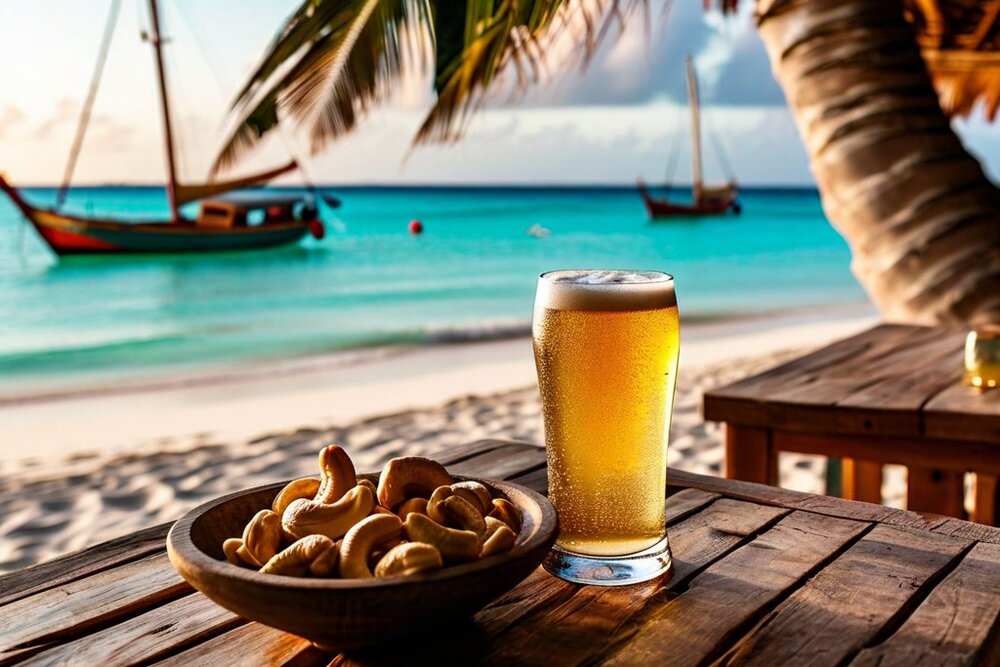
2M (pronounced dosh-em) is the national lager and the default order everywhere. Laurentina comes in Clara, Preta and Premium — the Preta is a dark, malty beer that is genuinely good and unusual for the region. Both are brewed in Mozambique and both are cheap.
R&R
Rum and Raspberry: Tipo Tinto rum with raspberry cordial, over ice, drunk in enormous quantities on the southern beaches and firmly associated with South African visitors. It tastes like a soft drink and is not one. Treat it with suspicion.
Tipo Tinto
The local overproof rum, sold in tall bottles and used in R&R and in everything else. It is not a sipping rum and it is not pretending to be. Vodka Txilar and various cane spirits fill the same niche.
What people actually drink
In villages: sura or ucanhe, fermented palm sap and marula wine respectively, made seasonally and drunk fresh. Marula is the fruit that also gives the world Amarula; the local version is entirely different and much less sweet.
Coffee and tea
Portuguese-style espresso, properly made, in any city café — one of the more reliable pleasures of Maputo. Mozambique grows some coffee on Mount Gorongosa as part of the park's restoration project, and buying it is one of the more direct ways to support that work. Tea comes from Gurué in Zambézia.
Water
Do not drink the tap water. Bottled water is cheap and universal; in remote areas carry more than you expect to need. Ice in reputable bars and restaurants is generally made from treated water, but if you are being careful, skip it outside the cities.
🏛️ Heritage — One World Heritage Site and a Lot of Ruins
Ilha de Moçambique
Mozambique's only UNESCO World Heritage site, inscribed in 1991: the whole island, stone town and reed town together, as an exceptionally complete example of a Swahili-Portuguese trading settlement. Much of it is in poor condition and restoration is slow and underfunded.
The tentative list
Mozambique has proposed several more, including the Quirimbas, Manyikeni and Chibuene — a stone-walled site related to Great Zimbabwe and an ancient Indian Ocean trading port — and the Vumba mountain rock art. None has yet been inscribed, largely for want of the documentation and management capacity that inscription requires.
Timbila and intangible heritage
The Chopi timbila tradition was one of the first entries on the UNESCO intangible heritage list, in 2005 — recognition that arrived just as the number of master builders and players was falling sharply. The tradition survives, with difficulty.
Colonial architecture
Maputo, Beira, Inhambane, Quelimane and Nampula all hold substantial Portuguese-era building stock — art deco, modernist and late-colonial — much of it deteriorating. The Grande Hotel da Beira, a vast abandoned 1950s luxury hotel now housing thousands of squatters, is the most extreme example and a subject of documentaries.
Rock art
Northern and central Mozambique hold significant rock-art sites, notably around Vumba in Manica, painted by ancestors of San and later Bantu-speaking peoples. They are poorly protected, poorly documented and almost never visited.
What war and cyclones took
It is worth being explicit: sixteen years of civil war destroyed archives, churches, museums and infrastructure, and successive cyclones have taken more since. Mozambique's short heritage list reflects the cost of its recent history, not a lack of history.
📅 When to Go — and When Not To
Mozambique has two seasons and the difference between them is large. The dry season runs roughly May to October and is when almost everybody goes; the wet season runs November to April and brings the cyclones.
May to October — the dry season
Cooler, dry, low humidity, reliable roads and the best diving visibility of the year. Daytime highs in Maputo around 25–27 °C, and it can be genuinely cool at night in June and July, especially inland and on a boat. This is the season to book, and it is also when prices and occupancy are highest.
November to April — the wet season
Hot and humid, with heavy afternoon rain, and inland roads that turn to mud. Highs of 30–35 °C with high humidity on the coast. Some lodges close entirely. Against that: it is green, empty and much cheaper, and it is the best time for manta rays at Tofo.
Cyclones
December to March is cyclone season and Mozambique is one of the most cyclone-exposed countries on Earth. Idai (March 2019) destroyed most of Beira and killed more than a thousand people; Kenneth hit Cabo Delgado six weeks later; Freddy (2023) was the longest-lived tropical cyclone ever recorded and struck twice. Storms are forecast several days ahead, so the risk to a traveller is disruption rather than danger — but insurance and flexible bookings matter here more than in most places.
Whale sharks and mantas
Whale sharks are seen off Tofo year-round with a peak from October to March; manta rays are best in the wet season when plankton is thickest. Humpback whales migrate along the coast from July to October and are frequently seen from the beach.
Turtles
Leatherback and loggerhead turtles nest on the southern beaches from October to February, with hatchlings from January. Ponta do Ouro and the Bazaruto beaches run guided night walks in season; go with a licensed guide and nobody else.
The short answer
June to September if you want reliable weather and are diving or driving. October and November as the sweet spot: warm sea, whale sharks, fewer people, rain not yet serious. Avoid January to March unless you have a specific reason and a flexible ticket.
✈️ Getting There
The airports
Maputo (MPM) is the main international gateway, with a Chinese-built terminal and a modest route network. Vilanculos (VNX) serves Bazaruto, Inhambane (INH) serves Tofo, Beira (BEW), Nampula (APL) and Pemba (POL) serve the centre and north. Most visitors fly to Maputo or straight to Vilanculos.
How you actually get here
Almost everybody connects through Johannesburg — it is an hour's flight and there are several a day. The other realistic hubs are Addis Ababa with Ethiopian Airlines, Nairobi with Kenya Airways, Doha with Qatar Airways, and Lisbon with TAP, which is the historic route and often the cheapest from Europe.
LAM
Linhas Aéreas de Moçambique, the national carrier, operates the domestic network and some regional routes. It has a long history of financial trouble, cancellations and fleet problems, It was banned from EU airspace from 2011 until 2017, when the European Commission cleared all Mozambican carriers from the list. Domestic flying in Mozambique is often the only practical option for long distances, but do not build a tight connection around a LAM flight.
Overland from South Africa
The most common arrival for regional visitors. The Lebombo/Ressano Garcia crossing on the N4 from Johannesburg and Nelspruit is a good tolled road and takes about six hours from Johannesburg. Kosi Bay in the far south leads to Ponta do Ouro and needs a 4x4. Expect queues at the border, particularly on South African holiday weekends.
Other land borders
From Eswatini (Namaacha, quick and easy), Zimbabwe (Machipanda, on the Beira corridor), Malawi (Zóbuè and others), Zambia and Tanzania (Negomano and the Unity Bridge over the Rovuma — check the security situation in Cabo Delgado before considering this one).
Visas — get this right
Everyone needs authorisation in advance and the rules changed during 2026. A new portal, run with VFS Global, launched on 11 February 2026; commercial sources say around 29 nationalities now enter visa-free with an electronic travel authorisation (ETA), while official sources including several foreign ministries still list an e-visa at evisa.gov.mz, normally issued for 30 days, dual entry. Check evisa.gov.mz yourself, at least two weeks out, and print whatever you are granted. Visa on arrival exists at several crossings and airports but has been unreliable, with reports of refusals and long waits — do not plan on the border sorting it out for you. A yellow fever certificate is required if you are arriving from an endemic country.
🚌 Getting Around
The N1
The single north–south road, running from Maputo to the Rovuma. It is a real road for most of its length and a poor one in places, and it is 2,600 km end to end. Driving the whole country is a serious undertaking that most visitors sensibly break up with a domestic flight.
Chapas
The minibus taxis that move the country. Cheap, ubiquitous, crowded, and driven fast. They leave when full, not on a schedule, and they are how you travel if you are travelling like a Mozambican. For a visitor they are fine for short hops and tiring for long ones.
Driving yourself
Popular with South African visitors and entirely doable in the south. Drive on the left. You need an international driving permit, and a 4x4 for anything sandy, which is most beach access roads. Do not drive at night outside towns — unlit vehicles, pedestrians, livestock and potholes make it genuinely dangerous.
Police checkpoints
Frequent, especially on the N1 and around Maputo. Most are routine. Requests for informal payments over invented infractions have been a long-running complaint; the standard advice is to keep documents in order, stay polite, ask for a written fine, and not to hand over your original licence. Carry the mandatory kit: two warning triangles and a reflective vest.
Trains and boats
The Ressano Garcia line and the Nacala and Sena corridors carry mostly freight, with limited and slow passenger services — the Nampula–Cuamba train is a genuinely enjoyable ride for people with time. Coastal dhows and small ferries connect the islands; they are picturesque, unregulated and occasionally dangerous, so use an operator's boat where one exists.
Domestic flights
LAM, and the smaller CFA and charter operators, connect Maputo with Vilanculos, Beira, Nampula, Pemba, Tete and Quelimane. Expensive by regional standards and unreliable in schedule, but a two-hour flight replaces two days of driving. Book flexible fares and leave a night's margin before an international connection.
🩺 Safety and Health
Mozambique needs more health preparation than most beach destinations, and its security picture varies enormously by region. Neither point should stop you going; both should shape how you plan.
Malaria — the important one
Mozambique is high-risk for malaria across the entire country, all year, including the beach resorts and Maputo. This is not a formality. Take prophylaxis prescribed by a travel clinic, use repellent with DEET at dusk and after dark, sleep under a net or in air conditioning, and treat any fever within three months of return as malaria until a test says otherwise. Falciparum malaria kills quickly and it is the single largest health risk of a Mozambican holiday.
Vaccinations
A travel clinic will normally want hepatitis A and B, typhoid, tetanus and, depending on your plans, rabies and cholera. A yellow fever certificate is required only if you are arriving from an endemic country, but carrying proof avoids arguments at the border.
Water, food and sun
Do not drink tap water. Bottled water is cheap and universal. Street food is generally fine when hot and freshly cooked; be more careful with salads, ice and shellfish outside the good restaurants. The sun on this coast is fierce even in the dry season.
Medical care
Limited. Maputo has private clinics of reasonable standard; outside the capital, facilities are basic to non-existent. Take insurance that explicitly covers medical evacuation to South Africa, which is where any serious case will go. Bring your own supply of anything you take regularly — pharmacies outside Maputo are unpredictable.
Crime
Petty theft, bag-snatching and mugging happen in Maputo and Beira, and carjacking is a real if uncommon risk on some roads. The usual precautions cover most of it: no visible valuables, taxis or a lift after dark rather than walking, nothing left in a parked car. Rural areas and the beach towns are generally calm.
The regional split — read this
Cabo Delgado is an active conflict zone and most foreign ministries advise against travel there, with the same or a lesser warning extending to northern Nampula and parts of Niassa. The south and centre — Maputo, Inhambane, Tofo, Vilanculos, Bazaruto, Gorongosa — are a completely different situation and are visited normally by thousands of people every year. Check your own foreign ministry's current advice before booking anything north of Nampula city.
📋 Practicalities
Money
The metical (MZN), written MT. Cards work in Maputo hotels, better restaurants and supermarkets, and nowhere else you can rely on. ATMs exist in every provincial capital — Millennium BIM and Standard Bank are the most reliable — and dispense meticais with modest withdrawal limits. Carry cash, in small notes, for everything outside the cities. South African rand is accepted informally in the far south.
Mobile and internet
Vodacom, Tmcel and Movitel; Movitel has the widest rural coverage and Vodacom the best data in the cities. A local SIM with data is cheap and you need your passport to register it. Coverage on the beaches and islands is patchy to absent, which many people count as a feature.
Electricity
220 V, and a genuine mix of plugs: South African type M (the large three-round-pin) is common, alongside European type C/F and occasionally type D. Bring a universal adaptor. Power cuts are frequent outside Maputo; the good lodges have generators and the cheap ones have candles.
Language
Portuguese is the official language and the one that works everywhere, but it is a first language for only about a sixth of the population. English is widely understood in tourist areas in the south and much less so elsewhere. A little Portuguese goes a very long way here, and Mozambicans are notably generous about bad attempts at it.
What to bring
Repellent, prophylaxis and a good torch. Sunscreen and any specific medication, because both are expensive and unreliable to source locally. Cash in small denominations. A dry bag if you are going anywhere by dhow. And a modest amount of clothing — outside Maputo, a beach town in Mozambique needs very little.
Etiquette
Greet people before asking anything — bom dia, a handshake, a moment of conversation; going straight to the question reads as rude. Ask before photographing people, and never photograph bridges, ports, airports, police or military installations, which causes real trouble. Dress modestly away from the beach, particularly in the Muslim north.
💰 What It Costs
Mozambique is not the cheap African beach destination its neighbours' prices might lead you to expect. Food, transport and local guesthouses are inexpensive; anything imported, anything on an island and anything involving a boat is not.
Accommodation
A backpacker dorm or basic beach room in Tofo or Vilanculos runs $15–35; a decent mid-range guesthouse $60–120; a Maputo business hotel $100–200. Island lodges in Bazaruto and the Quirimbas start around $400 a night and reach well past $1,500 all-inclusive. There is very little between the backpacker tier and the luxury tier, and that gap is the defining fact of Mozambican travel budgeting.
Food and drink
A plate of grilled fish or chicken with rice at a local place, $4–8; a good seafood dinner in Maputo or Tofo with prawns, $20–35. A 2M beer costs about $1–2 in a bar and less in a shop. Bread, fruit and market vegetables are very cheap. Imported wine and spirits are not.
Diving and activities
A two-tank dive at Tofo, roughly $90–120; an ocean safari or whale-shark snorkelling trip, $45–70; a dhow day trip to the Bazaruto islands, $60–100 per person. National park entry at Gorongosa is around $20 plus vehicle and guide fees. Diving here is not cheap, and the quality generally justifies it.
Transport
A chapa between towns costs a couple of dollars for a few hours. Car hire from $60 a day for a small car and $100–150 for the 4x4 you actually need, plus fuel at around $1.30 a litre. A domestic LAM flight typically runs $150–300 one way, which is a lot but buys back two days.
Daily budgets
Backpacking on chapas and in dorms: $40–55 a day. Comfortable mid-range with a hire car, guesthouses and restaurant meals: $120–180. Island lodges with flights and diving: $500+, easily. Mozambique punishes the middle of the market and rewards the two ends of it.
Tipping and haggling
Tip around 10% in restaurants where service is not included, and tip guides, dive staff and lodge crews properly — wages are low and it matters. Haggle in markets, politely and without much expectation of a large discount; prices in shops and restaurants are fixed.
🇨🇿 Notes for Czech Visitors
Getting there
No direct flight and there never has been. Realistically Prague → Lisbon → Maputo with TAP, which is the historic route and often the cheapest at around 16,500 Kč return, or via Doha, Istanbul, Addis Ababa or Johannesburg at 22,000–26,000 Kč. Total journey time 16–24 hours.
Documents
The entry rules moved during 2026 and the sources disagree; see the Getting There section. Either way you need something arranged online before you fly — an e-visa or an ETA from evisa.gov.mz — a passport with six months' validity and free pages, and proof of accommodation and onward travel.
Insurance and health
The paragraph that matters. Malaria is present across the whole country all year, so see a travel-medicine clinic six weeks out. The European health card is worthless here, medical facilities outside Maputo are minimal, and anything serious means an air ambulance to South Africa. Take a policy that explicitly covers medical evacuation with a limit well above 5 million Kč.
DROZD and consular help
There is no Czech embassy in Mozambique. The accredited mission is in Pretoria; Maputo has only an honorary consulate, which cannot issue travel documents. Register in DROZD at drozd.mzv.gov.cz — between the cyclones, the north, and the absence of any Czech office in the country, this is one of the destinations the register exists for.
Czech connections
Thin but real. Czechoslovakia recognised the People's Republic of Mozambique on 10 October 1975, weeks after independence, opened diplomatic relations in November 1976 and signed long-term trade and scientific-technical cooperation agreements in Maputo in 1978. Mozambican students studied in Czechoslovakia through the socialist period. (The famous labour-migration story of that era belongs to East Germany, whose returned Mozambican workers — the Madgermanes — still demonstrate in Maputo over withheld wages; Czechoslovakia's programme was much smaller and much less documented.) For reading: Mia Couto's Náměsíčná země came out in Czech from BB art in 2003.
Is it worth it from Prague?
Yes, if you want the coast and are willing to fly a long way for it and to accept that Mozambique is not a cheap country once you leave the mainland. Two weeks minimum, ideally three. The obvious first trip is Maputo, then Tofo or Vilanculos, then an island; the obvious combination is with Kruger and Johannesburg, which is how most Europeans reach it anyway.
🎲 Curiosities
The rifle on the flag
Mozambique is the only country in the world whose national flag carries a modern firearm — a Kalashnikov, crossed with a hoe over an open book, on a red triangle. Parliament has debated changing it several times, most seriously in 2005, and has kept it every time. The argument for keeping it is that the rifle is a historical fact of how the country came into being; the argument against is everything else.
The Commonwealth exception
Mozambique joined the Commonwealth in 1995 as the first member with no historical constitutional link to Britain at all. It was admitted because of its role as a front-line state against apartheid and Rhodesia, and it broke the rule that the club was for former British territories. Rwanda, Gabon and Togo followed later.
Africa's longest suspension bridge
The Maputo–Katembe bridge, opened 10 November 2018, has a main span of 680 metres and is the longest suspension bridge in Africa. It was built by the China Road and Bridge Corporation, it cost around $785 million in a country that could not obviously afford it, and it replaced a ferry.
The name
The country is named after Mussa Bin Bique, an Arab or Swahili trader and sultan who ruled the island the Portuguese later called Ilha de Moçambique. The Portuguese applied the island's name to the whole territory. It is one of very few African countries named after an individual person rather than a river, a kingdom or a colonial invention.
Time zones and driving
Mozambique keeps Central Africa Time (UTC+2) all year, so from late March to late October it is the same time as Prague and in the Czech winter it is an hour ahead. It drives on the left, like its anglophone neighbours and unlike Portugal — a legacy of being surrounded by British colonies rather than of its own colonial ruler.
The rat heroes
The demining of Mozambique was carried out partly by African giant pouched rats, trained by the Belgian-Tanzanian organisation APOPO to detect TNT by smell. They are too light to set off a mine, they work faster than a human with a detector, and they are the reason Mozambique was declared free of known minefields in 2015. One of them, Magawa, received an animal bravery medal.
🔮 What Happens Next
The dialogue
The national dialogue launched in September 2025 runs to November 2026 and is the country's main political question. If it produces genuine constitutional change — decentralisation, an electoral commission Frelimo does not control — the 2024 crisis will have bought something. If it produces a communiqué, the next election will be worse than the last one.
The gas timetable
Mozambique LNG is around 40% built and targeting first cargoes in 2029; Rovuma LNG is moving towards a final investment decision; Coral Sul is already producing and a second floating unit is planned. On paper this makes Mozambique a major gas exporter in the 2030s. On the ground it requires Cabo Delgado to stay quiet enough for five more years of construction.
The Mozal hole
The smelter's closure in March 2026 removed a large chunk of exports and a large employer at exactly the wrong moment, and the electricity that fed it is now looking for a customer. Whether that power goes to new industry inside Mozambique or is exported to South Africa is a live argument with real consequences for jobs.
Cabo Delgado
The pattern since 2021 has been of a contained but unfinished insurgency: Rwandan forces holding the gas district, dispersed attacks elsewhere, and hundreds of thousands of people still unable to go home. Nobody serious expects a decisive military end. The realistic question is whether the province gets development money fast enough to make the insurgency less attractive.
Climate
Mozambique is among the countries most exposed to climate change on earth: cyclones intensifying, the Zambezi and Limpopo flooding, sea-level rise on a 2,500 km coast, and drought inland. It contributes almost nothing to the problem and receives a fraction of the adaptation finance it needs. Every long-term plan the country makes has to survive this.
Tourism
Arrivals reached 1.27 million in 2025, up about 15%, and cross-border movements rose a further 18% in the first five months of 2026, overwhelmingly from South Africa. The new digital visa portal launched on 11 February 2026 is the government's main lever for growing it. The ceiling is not demand — it is roads, flights, electricity and the security picture in the north.
🧳 Tourism — Small, Uneven, and Mostly South African
The scale
About 1.27 million arrivals in 2025 for a country of 36.6 million with 2,500 km of coast. Compare that with Tanzania or Kenya, let alone Thailand. Mozambique is one of the genuinely under-visited coastlines of the world, and that is both its appeal and a symptom of its problems.
Who comes
Overwhelmingly South Africans and Zimbabweans, driving in for the beaches, particularly at Ponta do Ouro, Bilene, Tofo and Vilanculos. Then divers from Europe, a small number of high-end island guests, and a slowly growing safari trade at Gorongosa. Very few visitors see the north, and almost none see Cabo Delgado now.
What works
Diving and marine wildlife — whale sharks, mantas, dugongs, humpbacks and healthy reefs — is Mozambique's world-class product. The Bazaruto and Quirimbas island lodges compete with anywhere in the Indian Ocean. Gorongosa is one of the best conservation stories in Africa and increasingly a serious safari destination.
What does not
The middle of the market. There is very little between a beach shack and a $600 lodge, domestic flights are expensive and unreliable, and roads to the good places are often sand. A visitor who wants a comfortable, easy, mid-priced beach holiday is generally better served in Zanzibar or Mauritius, and Mozambique knows it.
The north problem
Pemba and the Quirimbas were the coming destination of the 2010s and the insurgency ended that. Lodges closed, staff left, and the recovery depends entirely on security. Check current advice: some Quirimbas lodges have reopened under specific conditions, and the wider province remains subject to travel warnings.
Doing it well
Use local operators and guides, stay in Mozambican-owned places where you can, buy the cashews and the capulanas and the Gorongosa coffee, and pay the park fees without complaining about them. In a country where tourism money is one of the few things that reaches ordinary people directly, where you spend it makes a measurable difference.
📸 Gallery — Nine Files, Six Used, Three Rejected
The image inventory for this country comes from an authoritative ListObjectsV2 listing of the bucket, not from guessing filenames. There are nine files relating to Mozambique. Every one was downloaded and looked at. Six are used on this page; three were rejected and the reasons are given below.
The other three used files
countries/images/mozambique/hero.jpg — a turquoise bay with dhows under sail, used at the top of the overview and a better picture of the country than the hero. And three accurate recipe photographs: recipes/mozambique-matapa.jpg, recipes/mozambique-camarao-piri-piri.jpg and recipes/mozambique-galinha-zambeziana.jpg. All three food images match the dishes they are named for, which is not something that can be taken for granted in this collection.
The three rejected files
mozambique-mosambik-mozambique-flatbread.jpg, mozambique-mosambik-mozambique-sweet-treat.jpg and mozambique-traditional-mosambik-mozambique-stew.jpg. All three were opened and inspected. The 'stew' is a generic goulash-like dish with bread; the 'sweet treat' is a plain sponge cake; the 'flatbread' is a flatbread. None of them is Mozambican in any identifiable way, so none of them appears on this page.
What the filenames reveal
The doubled slug — mozambique-mosambik-mozambique- — is a template artefact: the country slug, plus the page title slugified ("Mosambik / Mozambique"), plus a generic noun. The same pattern turned up in Mongolia and Montserrat. It marks files that were generated to fill a slot rather than photographed or sourced, and in every case so far the contents have been generic. It is a useful thing to grep the bucket for.
Format mismatches
images/mozambique/01-hero.jpg is a WebP file with a .jpg extension. Browsers cope, because they sniff the content rather than trusting the name, but it is wrong and it is one of many across this bucket — the same fault appears in Monaco, Mongolia, Montenegro and Montserrat. A magic-bytes audit of the whole bucket is on the list.
What is missing
There is no picture of Maputo, none of Ilha de Moçambique, none of Gorongosa or its wildlife, none of a market, and none of a person. For a country whose main draws are a Portuguese-modernist capital, a UNESCO island and a famous conservation project, the image set covers none of them. The text has to do that work alone, and it should be read knowing that.
Method
Nothing appears on this page that was not opened and looked at first. Where a picture is good it is used and said to be good; where it diverges from the dish or place it is named for, the caption says so; where it actively misinforms, it is rejected and the rejection is recorded here rather than quietly dropped. That is the standard applied across this series.
Support This Project 🌍
This World Travel Factbook is a labor of love – free to use for all travelers. If you find it helpful, consider supporting its continued development.