🇿🇦 South Africa at a Glance
🌍 Overview — Two Countries in One Border
South Africa is a middle-income country with first-world infrastructure, third-world inequality and a functioning constitutional democracy holding all of it together — usually.
⭐ The shape of the place
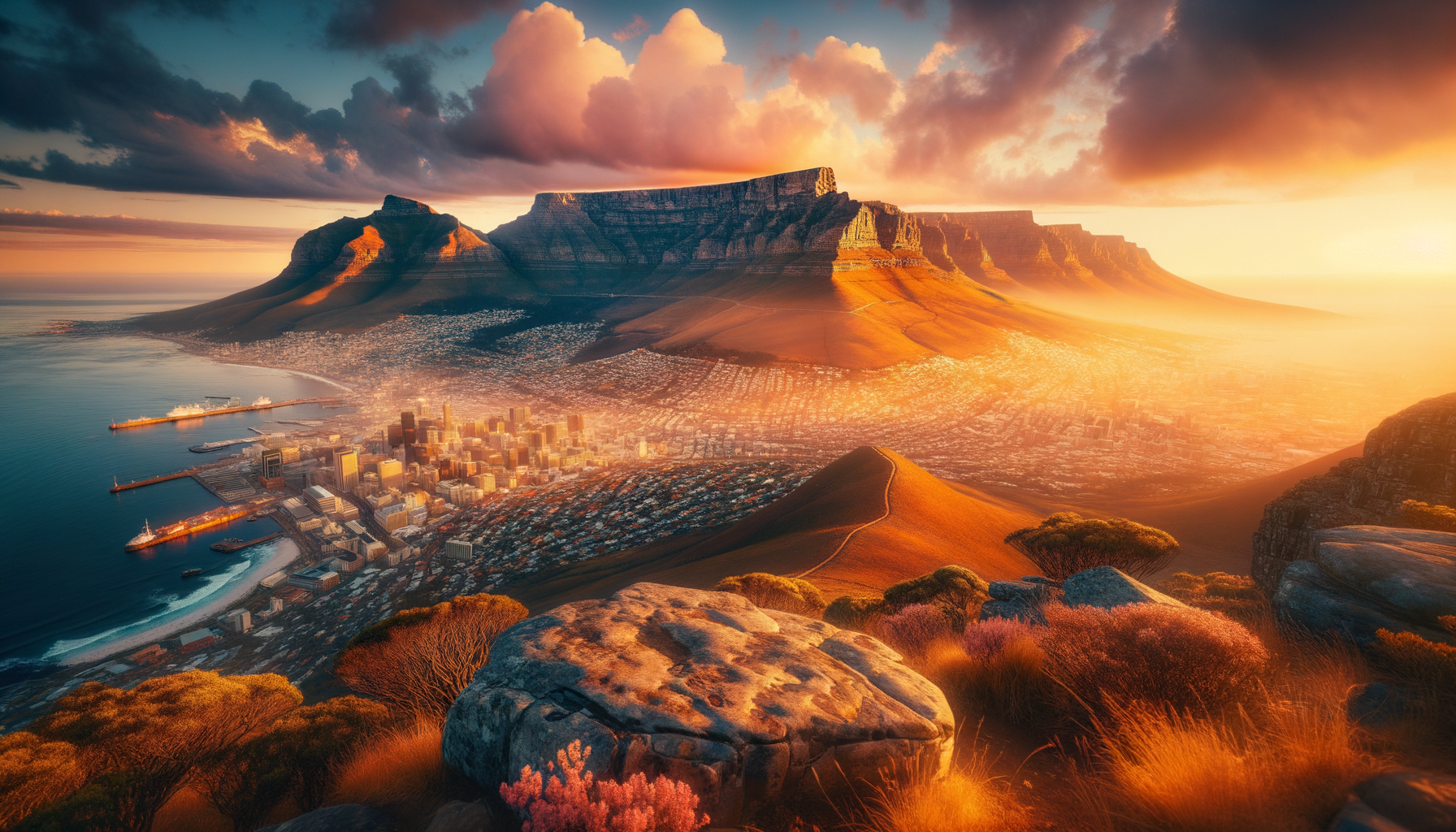
A high interior plateau, the Highveld, ringed by an escarpment that drops to a narrow coastal belt on three sides. Almost everything — the climate, the cities, the wine, the game parks — follows from that one piece of geology.
Three capitals
Pretoria is the executive capital, Cape Town the legislative, Bloemfontein the judicial. It is not a quirk; it is the 1910 compromise that held the Union together, and it is still being paid for in air fares.
⭐ Twelve official languages
isiZulu, isiXhosa, Afrikaans, English, Sepedi, Setswana, Sesotho, Xitsonga, siSwati, Tshivenda, isiNdebele — and since 2023, South African Sign Language. English is the language of business and is nobody's first language in most of the country.
⚠️ The inequality
South Africa has the highest measured Gini coefficient of any country that measures it. Unemployment ran at 33,6 per cent in the second quarter of 2026, over eight million people, and the broad measure is worse.
⭐ The lights came back on
After a decade in which scheduled national blackouts became a fact of daily life, load shedding was suspended in May 2025 and Eskom counted 441 consecutive days without it by 4 August 2026. Nothing has changed the national mood more.
Why people come
Big game at a price no East African park matches, wine at a quality no New World rival matches for the money, a coastline of two oceans, and cities that are genuinely interesting rather than merely pleasant.
The honest framing of this country is that it is two economies inside one border, and that almost every argument about it is really an argument about which of the two you are describing. There is a South Africa of good hospitals, fibre internet, wine estates and gated suburbs, and a South Africa of informal settlements, 33 per cent unemployment and municipal water that has stopped arriving; the same person can commute between them in forty minutes. A visitor spends almost all their time in the first one and should know that this is what they are doing.
🗺️ Geography
A plateau, an escarpment and a coastal strip — repeated around three sides of the country, and explaining nearly everything.
⭐ The Highveld
The interior plateau sits at 1 200 to 1 800 m, which is why Johannesburg at 1 753 m has cool nights in midsummer and why the Highveld thunderstorm is one of the great meteorological spectacles.
⭐ The Great Escarpment
The plateau ends in a wall that runs in an arc from the Cape to Limpopo, reaching its highest and most dramatic in the Drakensberg, where it tops 3 400 m. Everything east of it is warm and green; everything west of it is not.
The Karoo
A vast semi-desert filling the interior south, thin-soiled, sheep-farmed, geologically extraordinary and emptier than almost anywhere in Europe. It is also where the country's fossil record of the Permian extinction is written.
The lowveld
The hot, low, bushveld strip between the escarpment and Mozambique, running from about 150 to 600 m. This is where Kruger is, and the altitude is the reason the game is there and the people historically were not.
The Cape fold mountains
Parallel sandstone ranges in the south-west, folded some 250 million years ago, which create the valleys that hold the winelands and the rain shadow that makes the Karoo.
⚠️ Water
South Africa is a dry country — about half the world average rainfall — and the cities are mostly not near the rivers. Cape Town nearly ran out in 2018 and municipal supply failures are now a regular feature of life in parts of Gauteng.
The single most useful thing to understand about South African geography is the escarpment, because it explains the country's whole settlement pattern. The plateau behind it is high, dry and grassy, which suited cattle and later gold and coal; the strip in front of it is warm, wet and malarial, which suited game and not people; and the south-western corner has a Mediterranean climate found nowhere else on the continent, which is why the Dutch stopped there in 1652 and why the wine is there now. Four hundred years of history follow from one line of cliffs.
🏛️ The Three Capitals
Pretoria governs, Cape Town legislates, Bloemfontein judges — a compromise from 1910 that nobody would design today and nobody can undo.
Pretoria (Tshwane)
The executive capital: the Union Buildings, the presidency, the departments and the diplomatic corps. A jacaranda-shaded city of about 2,5 million on the Highveld, an hour north of Johannesburg and a world away in temperament.
Cape Town
The legislative capital: parliament sits here, which means ministers and civil servants fly 1 400 km each way for sessions. The 2022 fire that gutted the National Assembly chamber added a rebuilding project to an already awkward arrangement.
Bloemfontein
The judicial capital, home of the Supreme Court of Appeal — though the Constitutional Court, which outranks it, sits in Johannesburg, so even the judicial capital is only partly the judicial capital.
⭐ Why
The Union of 1910 merged four territories — the Cape, Natal, the Transvaal and the Orange Free State — and none would accept another's city as capital. Splitting the functions was the price of agreement.
What it costs
Two parliamentary villages, two ministerial housing stocks and a permanent air bridge. Every few years someone proposes consolidating in Pretoria, and every few years the Western Cape points out what that would cost Cape Town.
And Johannesburg
Is not a capital of anything and is the largest city, the financial centre, the seat of the Constitutional Court and the place where most of the money is. The formal capitals and the real one are not the same city.
The three-capital arrangement is the most quietly revealing thing about South Africa, because it is a hundred-and-sixteen-year-old monument to distrust that everyone has decided to live with. It was not a clever federal design; it was four governments that could not agree, and the compromise was to give each of them a piece so that none of them had all of it. The country has been doing versions of that ever since — in 1994, in the constitution, and in the coalition currently governing it.
☀️ Climate
Southern hemisphere seasons, two entirely different rainfall regimes, and a country where the best time to visit depends on which half you mean.
⭐ The seasons are inverted
Summer is December to February, winter June to August. Czech summer holidays fall in South African winter, which is excellent for game viewing and poor for the Cape beaches.
⭐ Two rainfall regimes
The Western Cape has a Mediterranean climate with winter rain; the rest of the country has summer rain. This is why the same month is peak season in one place and low season in the other.
Cape Town
Dry, warm and windy from November to March, with the south-easter that locals call the Cape Doctor. Wet and cool from May to August, though cold means about 8 °C at night, not Czech cold.
The Highveld
Warm days and spectacular afternoon thunderstorms in summer; cold, brilliantly clear, bone-dry days in winter with night frost. Johannesburg gets about 2 500 hours of sunshine a year.
⭐ The lowveld and game viewing
Winter, May to September, is the game-viewing season: the bush thins, the animals concentrate at water, the days are warm and the malaria risk drops. It is also when Europeans are free, which is convenient.
The best compromise
September and October, or March and April. Shoulder months give you decent game viewing, workable Cape weather, the wine harvest in February and March, and prices that are not August prices.
For a Czech traveller the climate question resolves neatly and is worth planning around rather than fighting. If you want Kruger, come in our summer — July and August are the driest, easiest game-viewing months of the South African year, and the bush is open. If you want Cape Town, the winelands and the coast, come in our winter — their December to March is warm, dry and long-evening, though it is also their peak domestic holiday and prices show it.
🌊 The Two Oceans
Cold Atlantic on one side, warm Indian on the other, and the meeting of the two is the reason the marine life here is extraordinary.
⭐ The Benguela current
Cold water welling up the west coast, about 12–14 °C, nutrient-rich and spectacularly productive. It feeds the fishery, the seals, the penguins and the great whites, and it makes swimming on the Atlantic side genuinely painful.
⭐ The Agulhas current
Warm water running down the east coast at 22–26 °C, which is why Durban swims like the tropics and why the KwaZulu-Natal coast has coral at its northern end.
Where they meet
Not at Cape Point, whatever the signs say, but around Cape Agulhas, the true southern tip of Africa, 170 km further east. The overlap zone is one of the richest temperate marine ecosystems on earth.
⭐ The sardine run
Every June and July, billions of sardines move north up the east coast with dolphins, sharks, gannets and whales following. It is the largest biomass migration on the planet after the Serengeti and far fewer people have heard of it.
Whales
Southern right whales calve in the bays of the southern Cape from June to November, and Hermanus is one of the best land-based whale-watching places in the world. No boat required.
⚠️ The water is not gentle
Rip currents, cold shock on the Atlantic side and a real if statistically small shark risk on parts of the east coast. Swim where there are lifeguards and shark nets, and take local advice literally.
The sardine run deserves to be as famous as the wildebeest migration and is not, which tells you something about how wildlife tourism is marketed. It happens in the Czech summer, it is visible from the beach at Port St Johns and along the Wild Coast, and the accompanying feeding frenzy of common dolphins, bronze whalers, Cape gannets and humpbacks is the densest concentration of large marine predators anywhere. It is also unpredictable, which is presumably why no tour operator has managed to package it into a reliable product.
⚠️ Safety — The Honest Version
This is the section every guide fudges, so here it is plainly: the crime statistics are genuinely bad, they are improving, and the risk to a sensible visitor is far lower than the numbers suggest — but not zero, and not evenly distributed.
⚠️ The numbers
Police recorded 5 181 murders between January and March 2026 and 5 427 between April and June. That is roughly 60 a day in a country of 63 million, and it is a rate many times the European average.
⭐ They are falling
The January–March figure was down about 20 per cent on the same quarter of 2024, and the April–June figure down 5,9 per cent year on year. Two years of consistent decline is the first good news in this column for a decade.
⭐ Where it happens
Overwhelmingly in specific townships and informal settlements, overwhelmingly between people who know each other, and heavily concentrated in argument, domestic violence, gang and organised-crime killings. Tourist areas are not where the murder rate lives.
⚠️ What does affect visitors
Mugging, smash-and-grab at traffic lights, car hijacking and hotel-room theft. These are opportunistic, they respond to ordinary precautions, and they are concentrated in a small number of predictable situations.
⭐ The rules that actually work
Don't walk at night, anywhere, including nice suburbs. Drive with windows up and doors locked and leave nothing visible on the seat. Use Uber or Bolt rather than street taxis. Don't display a phone in traffic. And never resist a robbery.
⚠️ Townships and hiking
Visit townships with a local guide, not alone, and not because a video made it look fine. On Table Mountain and Lion's Head walk in groups and on the main routes; solo hikers have been robbed in daylight.
The way to hold both halves of this in your head is to separate the national statistic from your personal exposure, because they are measuring different things. The murder rate is a real emergency and it is overwhelmingly a tragedy of poor South Africans in poor places, not of tourists in Camps Bay; a visitor who takes the precautions above is statistically safer here than the headline suggests and less safe than they would be in Prague. What South Africans themselves do is a better guide than any advisory: they lock their cars, they don't walk at night, they know which streets change at dusk, and they go about their lives.
One more thing that surprises people: the Czech Ministry of Foreign Affairs has no warning or advisory in force for South Africa at all, so standard Czech travel insurance is valid here. It flags high crime, particularly in the centres of larger cities, and advises travelling in groups — but it does not advise against going. That is a meaningful difference from most of the places covered elsewhere on this site, and it is worth stating because the crime figures lead people to assume otherwise.
🏺 The First People
The oldest continuous human story anywhere, and the deepest genetic lineage in our species — both of them here, and both routinely skipped in a paragraph.
⭐ The San and the Khoekhoe
The San were hunter-gatherers across southern Africa for tens of thousands of years; the Khoekhoe were herders who arrived with sheep and cattle around two thousand years ago. Together they are often called Khoisan, which is a linguists' convenience rather than a name either group chose.
⭐ The genetic depth
Khoisan populations carry the deepest branch of the human family tree, diverging from other lineages perhaps 200 000 years ago. In the most literal sense available to genetics, everyone else is a descendant of the people who left.
The archaeology
Blombos Cave on the southern Cape coast produced engraved ochre and shell beads dated to around 75 000 years ago — among the earliest known symbolic objects made by humans anywhere.
The rock art
Tens of thousands of painted and engraved sites, concentrated in the Drakensberg and the Cederberg, most of them made by San painters and many still not recorded. The Drakensberg alone holds an estimated 40 000 images.
The Bantu migrations
Iron-working, cattle-keeping, crop-growing Bantu-speaking peoples moved south over roughly the first millennium AD, reaching the eastern half of what is now South Africa well before any European arrived.
⚠️ What happened to them
The Cape San and Khoekhoe were destroyed by smallpox, dispossession and organised commando raids within about 150 years of Dutch settlement. Their languages are nearly all extinct and the survivors' descendants were classified as 'coloured' under apartheid.
The most important correction this page can make to the story most visitors arrive with is that South Africa was not empty, and the two-race framing of its history is wrong in both directions. By 1652 the interior east of the escarpment held established Bantu-speaking kingdoms with iron, cattle and trade networks reaching the Indian Ocean, and the Cape held Khoekhoe herders who had been managing the same pastures for two millennia. The colonial claim that the land was unoccupied was a legal convenience invented later, and it is still doing damage in arguments about land today.
⛵ The Cape Colony
A vegetable garden for passing ships that turned into a settler colony almost by accident, and set the pattern for everything after.
1652
Jan van Riebeeck landed for the Dutch East India Company to grow vegetables and supply ships on the run to Batavia. It was explicitly not meant to be a colony, which lasted about five years.
⚠️ Slavery
The Cape imported enslaved people from Madagascar, Mozambique, India and Indonesia from 1658; by 1800 the enslaved outnumbered the free burghers. Cape Malay culture, Afrikaans itself and much of Cape cuisine come from this, which is rarely said plainly.
The trekboers
Dutch-descended farmers pushed inland with cattle and guns from the late 1600s, colliding first with the Khoekhoe and then, at the Fish River, with Xhosa polities. Nine frontier wars followed over a century.
The British
Britain took the Cape in 1795, returned it, took it again in 1806 and kept it, bringing the 1820 settlers, English law and — in 1834 — the abolition of slavery.
⭐ The Great Trek
From 1836 some 12 000 Boers left the Cape for the interior, partly over British rule and partly over abolition and the compensation terms. It founded the Boer republics and became the central myth of Afrikaner nationalism.
Language
Afrikaans grew at the Cape out of Dutch simplified and reshaped in the mouths of slaves, Khoekhoe workers and settlers together. It was first written in Arabic script, by Cape Muslims, decades before it was written in Latin letters.
The detail that reframes Afrikaans for most readers is that it was a creole of the enslaved before it was the language of the state that oppressed them. It took shape in kitchens, on wagons and in the Bo-Kaap, its earliest surviving texts are Islamic religious instruction written in Arabic script in the 1840s, and today more coloured South Africans speak it as a first language than white ones. Apartheid made it a symbol of the oppressor and the 1976 Soweto uprising began over a decree forcing it on black schools — but the language itself was never only that, and the current argument about its place is much older and stranger than it looks.
🛡️ The Mfecane and the Zulu Kingdom
The great upheaval of the 1820s, in which an African state-building revolution reshaped the subcontinent — and which European accounts spent a century explaining away.
⭐ Shaka
Shaka kaSenzangakhona built the Zulu kingdom in the 1810s and 1820s out of a small chiefdom, reorganising regiments by age rather than clan and centralising cattle and command.
The mfecane
The wars and displacements that followed — the isiZulu word means roughly 'the crushing' — emptied and refilled large parts of the interior within a generation.
What it produced
Not just destruction: the Sotho kingdom under Moshoeshoe, the Ndebele state in what is now Zimbabwe, the Gaza empire in Mozambique and the Swazi kingdom all took shape in these decades.
⚠️ The convenient version
Settler historiography used the mfecane to argue the interior was 'empty' when the trekkers arrived and that African violence, not colonial expansion, had emptied it. Historians have been dismantling that since the 1980s.
⭐ Isandlwana
On 22 January 1879 a Zulu army destroyed a British column at Isandlwana, killing about 1 300 men — the worst defeat a modern European army had suffered at the hands of an indigenous force. Rorke's Drift, celebrated ever since, happened the same day and was a footnote by comparison.
And then
Britain won the war within six months, broke the kingdom into thirteen chiefdoms and set the pattern. The Zulu monarchy survives today as a constitutionally recognised traditional institution.
Isandlwana is worth visiting and worth understanding, because the way it is remembered says more than the battle did. The British public absorbed the disaster by making Rorke's Drift — a successful defence of a supply depot by about 150 men, which produced eleven Victoria Crosses — the story instead, and a film in 1964 fixed that permanently. The battlefield at Isandlwana today is a hillside of white cairns marking where British dead were buried, and it is one of the few colonial sites in the country where the African victory is the thing being commemorated.
💥 Gold, Diamonds and the Boer Wars
Two minerals rewrote the country's economy, politics and demography in thirty years, and then Britain fought the twentieth century's first modern war to control them.
Diamonds, 1867
Found near the Orange and Vaal rivers, and by the 1870s Kimberley was the largest hole ever dug by hand. It produced Cecil Rhodes, De Beers and the migrant labour compound system that later underpinned apartheid.
⭐ Gold, 1886
The Witwatersrand reef turned out to be the largest gold deposit ever found, and a mining camp on it became Johannesburg — a city of 100 000 people within a decade of being open veld.
Why it meant war
The gold was inside the independent South African Republic, governed by Boers who taxed the mining houses and refused the vote to the foreign miners. Britain decided that was intolerable.
⚠️ The Second Boer War, 1899–1902
Britain committed nearly half a million troops against perhaps 60 000 Boer fighters and still needed two and a half years. The Boers invented modern mobile guerrilla warfare in the process.
⚠️ The camps
Britain answered the guerrilla phase by burning farms and interning civilians: about 28 000 Boer women and children died in the camps, and at least 20 000 black South Africans died in separate camps that went largely uncounted for a century.
The Union, 1910
Britain won the war and then handed political power to the defeated, uniting the four territories under a white franchise. Black South Africans, who had fought and laboured on both sides, were excluded from the settlement entirely.
The 1910 settlement is the hinge of the whole story and is less well known than it should be, because it is where the actual decision was made. Britain, having spent a fortune and its reputation defeating the Boer republics, then conceded the thing the war had supposedly not been about: it let the new Union set its own franchise, and the Union set it white. Everything from the 1913 Natives Land Act — which reserved 7 per cent of the country for two-thirds of its people — to the formal apartheid laws of 1948 runs through that door, and it was opened by the winners.
⚠️ Apartheid
Forty-six years of racial classification enforced by law, ended by negotiation rather than defeat, and still the single largest fact about daily life here.
1948
The National Party won a whites-only election on the word apartheid, 'separateness', and began converting long-standing segregation into a comprehensive legal system.
⚠️ The machinery
The Population Registration Act classified every person by race; the Group Areas Act assigned each race its residential zones; the pass laws controlled black movement; the Bantu Education Act deliberately limited black schooling. It was bureaucratic, meticulous and total.
⚠️ Forced removals
Some 3,5 million people were moved from land declared white. District Six in Cape Town and Sophiatown in Johannesburg were demolished outright; the sites of both are still partly empty, which is itself a kind of monument.
Sharpeville and Soweto
Police killed 69 protesters at Sharpeville on 21 March 1960, after which the ANC and PAC were banned and turned to armed struggle. On 16 June 1976 police fired on Soweto schoolchildren protesting compulsory Afrikaans instruction, and the uprising that followed never really stopped.
Mandela
Convicted at the Rivonia Trial in 1964 and imprisoned for 27 years, 18 of them on Robben Island. He was released on 11 February 1990 and became president four years later.
⭐ Why it ended
Not by military defeat: by sanctions, capital flight, ungovernable townships, the end of the Cold War removing the anti-communist argument, and a National Party leadership that concluded it could not win.
The thing visitors most often get wrong is imagining apartheid as a long time ago, and it is worth being precise about the arithmetic. The pass laws were repealed in 1986, the last apartheid statutes in 1991, and the first free election was held in 1994 — which means a South African aged fifty today was an adult under it, and every single person over thirty-two was born into a country where their address, school and legal status were fixed by a racial classification on a card. Thirty-two years is not long enough to undo that, and nobody here pretends otherwise.
🕊️ The Transition
Four years of negotiation that everyone expected to end in civil war and did not — and a constitution that came out of it which is still the country's best argument for itself.
1990–1994
De Klerk unbanned the liberation movements in February 1990, Mandela walked out nine days later, and the CODESA talks ground through deadlock, walkouts and killings for four years.
⚠️ How close it came
Around 14 000 people died in political violence between 1990 and 1994, more than in the preceding decade of apartheid rule. The assassination of Chris Hani in April 1993 came nearest to ending the process entirely.
⭐ 27 April 1994
The first election in which every adult could vote, with queues that ran for kilometres and voting extended to a third day. The ANC took 62,6 per cent and Mandela was inaugurated on 10 May.
⭐ The constitution
Adopted in 1996 and widely regarded as the most advanced of its century: justiciable socio-economic rights, the first constitution anywhere to prohibit discrimination on grounds of sexual orientation, and a Constitutional Court with real teeth.
The TRC
The Truth and Reconciliation Commission, chaired by Desmond Tutu from 1996, traded amnesty for full public disclosure. It is admired abroad and judged more harshly at home, where the reparations were small and most perpetrators were never prosecuted.
⚠️ What was not settled
The economy. Political power transferred and ownership largely did not, which is the unfinished business underneath every South African argument since — land, mining, employment equity and the rest.
The negotiated settlement is simultaneously the country's greatest achievement and its most contested inheritance, and both readings are defensible. It avoided a race war that serious analysts thought unavoidable, produced a constitution that courts still use to strike down government action, and handed over power without a shot fired at the handover itself. It also left land, capital and corporate ownership almost untouched, and a generation born after 1994 has grown up free, equal before the law and, in millions of cases, as poor as their grandparents — which is the argument South Africa is now having with itself.
🏛️ Government
A parliamentary republic with a president who is not directly elected, nine provinces with real but limited powers, and a Constitutional Court that has repeatedly told the government no.
How the president is chosen
Voters elect the National Assembly by proportional representation, and the Assembly elects the president from among its members. There is no separate presidential ballot, which is why coalition arithmetic decides who governs.
Parliament
A National Assembly of 400 seats and a National Council of Provinces of 90, sitting in Cape Town. The 2022 fire destroyed the Assembly chamber and the House has been sitting in temporary quarters since.
⭐ The Constitutional Court
Eleven judges in Johannesburg with the final word on constitutional matters, and an unusual willingness to use it. It has struck down the death penalty, ordered the state to provide antiretrovirals and ruled a sitting president in breach of his oath.
Nine provinces
Gauteng, KwaZulu-Natal, Western Cape, Eastern Cape, Limpopo, Mpumalanga, North West, Free State and Northern Cape, each with a premier and legislature. The Western Cape has been governed by the opposition DA since 2009.
⚠️ Local government
The weakest link by a distance: 257 municipalities, many effectively insolvent, and a national audit picture in which fully clean audits are the minority. Most day-to-day failures citizens experience are municipal.
Traditional leadership
The constitution recognises traditional authorities, and about 17 million people live on land under traditional tenure. How that sits with constitutional rights is one of the country's live legal arguments.
The feature of South African government that most surprises outsiders is how often the courts win. The Constitutional Court ordered the state to roll out mother-to-child HIV treatment it did not want to provide, found that President Zuma had failed to uphold the constitution over his private residence, ordered parliament to hold him to account, and has repeatedly voided executive appointments. A judiciary that a governing party with a two-thirds majority could not tame is the strongest single piece of evidence that the 1996 settlement worked.
🤝 The Government of National Unity
In May 2024 the ANC lost the majority it had held for thirty years, and what followed was the most consequential political experiment in the country since 1994.
⭐ What happened
The ANC fell to about 40 per cent, well short of a majority, in an election nobody disputed. A party that had governed alone since 1994 had to choose a partner, and it chose its main opposition.
Who is in it
Ten parties: the ANC and the Democratic Alliance, plus the Patriotic Alliance, the IFP, GOOD, the PAC, the Freedom Front Plus, the UDM, Al Jama-ah and Rise Mzansi. The DA holds six ministries.
Who is not
The EFF and Jacob Zuma's MK Party, the two parties to the ANC's left, which together took a substantial share of the vote and form the opposition.
⚠️ How it actually works
Badly, loudly and so far without breaking. The ANC dares the DA to walk out, the DA dares the ANC to expel it, and neither wants to be blamed for ending it — which is, in practice, the glue.
⭐ What it has delivered
Two years without the national blackouts that defined the previous decade, a currency and bond market that stopped pricing in collapse, and an end to the assumption that the ANC governs by right.
⚠️ What it has not
Unemployment at 33,6 per cent in the second quarter of 2026 and a GDP that shrank 0,2 per cent quarter on quarter in the same period. The politics stabilised faster than the economy.
Whatever else it is, the GNU is a demonstration that the constitutional system does what it was built to do, and that deserves saying before the criticism. A liberation movement that had governed for thirty years lost its majority in a clean election, accepted the result, and formed a government with the party it had spent three decades calling the voice of white privilege — without a coup, a constitutional crisis or a disputed count. Very few countries with South Africa's history have managed that on the first attempt.
🗳️ The November 2026 Elections
Municipal elections on 4 November 2026 are the first national test of the coalition era, and every party in the GNU has a reason to hurt its partners.
The date
4 November 2026, with the current municipal councils' term expiring on 1 November. Voter registration weekends ran on 20 and 21 June 2026.
⭐ Why they matter nationally
Local government is where citizens actually meet the state — water, refuse, roads, electricity billing — and it is where the ANC's decline has been steepest. Johannesburg has had a revolving door of mayors for years.
⚠️ The strain on the coalition
GNU partners must campaign against each other to keep their own voters, then govern together the following morning. The local results will be read immediately as a verdict on the national arrangement.
The metros to watch
Johannesburg, Tshwane, Ekurhuleni and Nelson Mandela Bay — all hung, all unstable, all governed by shifting coalitions since 2016. Cape Town, run outright by the DA, is the exception that everyone cites.
What comes after
A DA leadership contest in 2026 and an ANC elective conference in 2027 at which Ramaphosa is replaced as party leader. Both will reshape the coalition regardless of what voters do in November.
For a visitor
Election periods bring rallies, road closures and occasional localised unrest, mostly in townships and mostly brief. They do not meaningfully affect travel in tourist areas, and the country has run seven national elections without serious violence.
The municipal elections matter more than their formal importance suggests, because South Africa's real crisis is not national but local. The national state, whatever its faults, still produces credible statistics, pays its debts, runs elections and loses court cases; a large share of the 257 municipalities cannot reliably deliver water, maintain a sewage works or produce an unqualified audit. The gap between a functioning constitutional state and a failing local one is where most South Africans actually live, and 4 November is when they get to say so.
⚠️ The Police Crisis
In July 2025 a provincial police commissioner went on television and accused the political leadership of the police service of protecting criminal syndicates — and everything that followed suggests he was right.
⭐ 6 July 2025
Lieutenant-General Nhlanhla Mkhwanazi, KwaZulu-Natal's police commissioner, held a press conference alleging political interference in investigations and criminal infiltration of the justice system. Serving generals do not normally do this.
The commission
Ramaphosa appointed a commission of inquiry under retired Constitutional Court justice Mbuyiseli Madlanga later that month. Its first interim report went to the president on 17 December 2025 and the second on 29 May 2026.
⚠️ What it found
Referrals for criminality, corruption, fraud, murder and perjury by serving officers and officials. A year after the press conference, 13 police officers faced criminal charges — including the national commissioner, General Fannie Masemola — and 15 more faced disciplinary proceedings.
The minister
Police minister Senzo Mchunu was placed on leave and testified before the commission in December 2025; Firoz Cachalia has been serving as acting minister.
⭐ Why it is not only bad news
The allegations were made publicly by a serving officer, investigated by an independent judge, reported to the president and acted on with arrests. In a great many countries the first step alone would have ended a career quietly.
⚠️ What it means on the ground
A police service whose own leadership is under criminal investigation is not a service the public trusts, and low trust is itself a driver of vigilantism and private security. South Africa has more than twice as many private security guards as police officers.
The Madlanga commission belongs in a travel guide because it explains something visitors notice and misread within a day of arriving: the sheer visible density of private security. Armed response signs on every suburban wall, guards at every shopping centre entrance, escort vehicles at petrol stations — this is not theatre, it is a market filling a gap, and the gap is a police service that large parts of the public do not rely on. Understanding that makes the country legible in a way that crime statistics alone do not.
💰 Economy
Africa's most industrialised economy, growing too slowly to absorb its own workforce, and currently taking a direct hit from Washington.
The numbers
GDP grew 1,1 per cent in 2025 with 2026 forecasts of 1,2 to 1,5 per cent — and then output fell 0,2 per cent quarter on quarter in the second quarter of 2026. The economy is not keeping pace with the population.
⚠️ Unemployment
32,4 per cent on average in 2025, rising to 33,6 per cent in the second quarter of 2026: more than eight million people, and far worse for the young. This is the central fact of South African economic life.
⭐ Electricity
Load shedding suspended since May 2025, with Eskom counting 441 straight days without it by 4 August 2026. Estimates of what the blackout decade cost run into hundreds of billions of rand of foregone output.
⚠️ The US tariff
A 30 per cent tariff on South African goods entering the United States took effect in August, hitting citrus, wine, autos and steel. Industry estimates of the job losses run to tens of thousands.
AGOA
The African Growth and Opportunity Act was extended to 31 December 2026, retroactive to 30 September 2025, and signed into law on 3 February. A bill has been tabled that would exclude South Africa from any further extension.
What it actually sells
Platinum group metals, gold, coal, iron ore, cars built for export, citrus, wine and a large financial services sector. It is far more diversified than a typical resource economy and still moves with commodity prices.
For a visitor the economic situation shows up mainly as favourable prices, and it is worth understanding why rather than simply enjoying it. The rand has weakened over years against the euro and the koruna because of slow growth, political risk and commodity cycles, which makes a South African holiday extraordinarily good value for a Czech wallet — and makes imported goods, fuel and international flights punishing for South Africans. The restaurant meal that costs a Czech visitor 300 crowns represents a very different share of income at the next table.
👥 Society
Sixty-three million people, the most unequal income distribution ever recorded, and a public culture far more argumentative and self-aware than outsiders expect.
The population
About 63 million: roughly 81 per cent black African, 8 per cent coloured, 8 per cent white and 2,5 per cent Indian or Asian in the census categories, which are apartheid's categories still used to measure redress.
⚠️ Inequality
A Gini coefficient around 0,63, the highest measured anywhere, and wealth inequality worse still. The top 10 per cent hold more than half of national income.
Urbanisation and migration
About two-thirds of South Africans live in cities, and the country hosts several million migrants from Zimbabwe, Mozambique, Lesotho and further afield. Periodic xenophobic violence is a real and ugly feature of the last two decades.
⭐ The constitution and social change
South Africa legalised same-sex marriage in 2006, the fifth country in the world and the first in Africa, on the Constitutional Court's instruction. Attitudes lag the law considerably, which is also true elsewhere.
⚠️ HIV
About 7,5 million people live with HIV, the largest number of any country, and South Africa runs the world's largest antiretroviral programme. Life expectancy has recovered from 53 in 2005 to around 65 today, which is one of the great public health turnarounds.
The public conversation
Loud, literate and unusually unsparing: a large free press, satirists who go straight at the president, talk radio that is genuinely national, and a population that argues about race in public with a directness Europeans find startling.
The thing that most surprises European visitors is how openly South Africans discuss race, and how quickly they will include a stranger in it. Thirty years of official reckoning — a truth commission, employment equity law, land debates, a curriculum that teaches apartheid explicitly — has produced a society where the subject is not avoided but worked over continuously, in taxis, on radio phone-ins and across dinner tables. A visitor who expects delicate silence will find something closer to an argument already in progress, and will usually be invited into it.
🗣️ Language
Twelve official languages, none spoken as a first language by more than a quarter of the country, and English carrying an authority its speaker numbers do not justify.
The twelve
isiZulu, isiXhosa, Afrikaans, English, Sepedi, Setswana, Sesotho, Xitsonga, siSwati, Tshivenda, isiNdebele and, since 2023, South African Sign Language. The last of those made South Africa one of very few countries to give a sign language full official status.
Who speaks what
isiZulu is the largest first language at roughly a quarter of the population, then isiXhosa and Afrikaans. English is first language to under a tenth and is the default of business, courts, universities and road signs.
⭐ Code-switching
Most South Africans use several languages daily and switch mid-sentence without noticing. A Johannesburg conversation can carry English grammar, isiZulu vocabulary and Afrikaans discourse markers in one breath.
The clicks
isiXhosa has three click consonants, written c, x and q, borrowed from Khoisan languages centuries ago. They are consonants like any other and are not decorative — Xhosa itself begins with one.
English as spoken here
Distinct vocabulary and rhythm: robot for traffic light, bakkie for pickup, now-now meaning soon but not immediately, just now meaning later than that, and shame as a general expression of sympathy or affection.
What a visitor needs
English, everywhere. Learning sawubona (hello, isiZulu), dankie (thanks, Afrikaans) and enkosi (thanks, isiXhosa) costs nothing and is received far more warmly than it deserves.
The most instructive single word in South African English is now, because its three forms carry a whole approach to time. Now means at some unspecified point; now-now means soon, probably within the hour; and just now means later today, possibly not at all — which is the reverse of what a European ear expects from the word 'just'. Visitors who arrange to be collected 'just now' have been known to wait a long time.
⛪ Religion
Overwhelmingly Christian, with a large independent African church tradition that most outsiders have never heard of and that outnumbers every imported denomination.
The numbers
Around 80 per cent Christian, with small Muslim, Hindu, Jewish and traditionalist minorities and a growing group reporting no affiliation.
⭐ The Zion Christian Church
The largest church in the country, founded at Moria in Limpopo in 1910, blending Christianity with African practice. Its Easter gathering draws well over a million people and is one of the largest annual religious assemblies on earth.
The Dutch Reformed Church
The church of Afrikaner nationalism, which provided theological cover for apartheid and formally repudiated it in 1986. It remains substantial and has been shrinking and arguing with itself ever since.
Islam at the Cape
Brought by enslaved and exiled people from the Indonesian archipelago from the late 1600s, centred on the Bo-Kaap. Cape Malay Muslims are among the oldest continuous communities in the country.
Traditional belief
Ancestral practice runs alongside Christianity rather than instead of it for a great many people, and the sangoma (diviner) and inyanga (herbalist) are working professions, not folklore.
Desmond Tutu
Anglican archbishop, Nobel laureate, chair of the Truth and Reconciliation Commission and the moral voice of the transition. He coined 'the Rainbow Nation', and later spent years criticising the government he helped bring in.
The thing worth knowing about South African religion is that syncretism is the norm and is not treated as a contradiction. A person may attend a Zionist service on Sunday, consult a sangoma about an illness, slaughter a beast for the ancestors at a family event and describe themselves without hesitation as a Christian. European visitors who expect these to be alternatives are applying a distinction that most of the country does not use.
🎷 Culture
A literature that produced two Nobel laureates under censorship, a music tradition that went around the world twice, and an art scene that is currently the most interesting on the continent.
⭐ Literature
Nadine Gordimer and J. M. Coetzee both won the Nobel Prize; Alan Paton, Es'kia Mphahlele, Bessie Head, Zakes Mda and Damon Galgut, who won the Booker in 2021, sit around them. Much of it was written under a censorship regime that banned books by the thousand.
⭐ Music
Marabi and kwela from the townships, Hugh Masekela and Miriam Makeba in exile, Ladysmith Black Mambazo carried worldwide by Paul Simon's Graceland, kwaito after 1994 and amapiano since 2019. Amapiano is the first South African genre to conquer the continent from a standing start.
Art
William Kentridge's charcoal animations, Zanele Muholi's photographic portraiture and Esther Mahlangu's Ndebele geometry are shown in major museums worldwide. The Zeitz MOCAA in Cape Town, built inside a grain silo, is the largest museum of contemporary African art anywhere.
Film and comedy
Tsotsi won the foreign-language Oscar in 2006, District 9 made science fiction out of Johannesburg, and Trevor Noah went from Soweto stand-up to the Daily Show.
Beadwork and craft
Zulu and Ndebele beadwork carry meaning in colour and pattern rather than being decorative, and Ndebele house painting is a recognised art form with named practitioners.
Braai as culture
The braai is not a barbecue with a different name; it is a social form with its own etiquette, its own public holiday on 24 September and an unwritten rule that the fire is wood, not gas.
Amapiano is the cultural story of the last few years and is worth listening for while you are here, because it is happening now rather than being remembered. It grew out of Pretoria and southern Johannesburg townships around 2019, built on deep house and kwaito with the log-drum bassline that gives it its signature, and it spread across Africa and into European clubs without a record label deciding anything. It plays from minibus taxis, petrol stations and shopping centres everywhere, and it is the sound of the country in 2026 in the same way kwaito was in 1996.
🏉 Sport
A country where sport was a weapon of apartheid, a tool of reconciliation and is now simply the thing that most reliably unites it.
⭐ Rugby
The Springboks have won the World Cup four times — 1995, 2007, 2019 and 2023 — more than any other nation. Siya Kolisi became the first black captain in 2018 and lifted the trophy twice.
⭐ 1995
Mandela walked onto the field at Ellis Park in a Springbok jersey — the emblem of Afrikaner sport — and handed the World Cup to François Pienaar. It remains the most effective single act of political theatre in the country's history.
Football
By far the most widely played and watched sport, with Kaizer Chiefs and Orlando Pirates the great Soweto rivalry. Bafana Bafana won the Africa Cup of Nations in 1996 and South Africa hosted the World Cup in 2010.
Cricket
A major cricketing nation with a long-standing reputation for losing knockout matches it should win, and a transformation debate that has been unusually public and unusually bitter.
The boycott years
South Africa was excluded from the Olympics from 1964 to 1992 and from most international sport, which mattered enormously to a sports-obsessed white public and was one of the sanctions that visibly worked.
Going to a match
Rugby at Loftus, Newlands or Ellis Park and football at Soweto derbies are both worth doing, cheap by European standards and safe within the normal precautions. Buy through official channels and go with locals if you can.
The 2019 and 2023 World Cup wins did something the 1995 one could not, and South Africans will tell you so if asked. In 1995 a black president handed the trophy to a white captain and the symbolism was entirely about reconciliation between two groups; in 2019 and 2023 a black captain from a Zwide township lifted it himself, leading a team that looked like the country, and the symbolism was about the thing having actually happened. Kolisi's statement that the Springboks were playing for people who had nothing was not a slogan — he grew up as one of them.
🐮 Wildlife
The Big Five in accessible parks at prices no other African country matches, plus an endemic flora so extraordinary it has its own floral kingdom.
⭐ The Big Five
Lion, leopard, elephant, rhinoceros and buffalo — a term invented by hunters for the five most dangerous animals to shoot on foot, now repurposed as a checklist. All five are in Kruger and several smaller reserves.
⭐ The Cape Floral Kingdom
The smallest and richest of the world's six floral kingdoms, with about 9 000 plant species of which some 70 per cent grow nowhere else. Table Mountain alone holds more plant species than the whole of the British Isles.
Marine life
Southern right and humpback whales, great whites, Cape fur seals, African penguins at Boulders Beach and the sardine run off the east coast. Two oceans meeting produces a species list few temperate coasts match.
⚠️ Rhino poaching
South Africa holds most of the world's remaining rhinos and has lost thousands to poaching since 2008. Numbers killed have fallen from the 2014 peak, partly through dehorning programmes that are themselves contested.
Birds
Around 850 recorded species, from the Cape sugarbird and orange-breasted sunbird in fynbos to the enormous kori bustard and the ground hornbill in the bushveld.
Malaria
Kruger and the far north-east carry a seasonal risk, highest in the wet summer. Many private reserves in the Eastern Cape and the whole Cape region are malaria-free, which matters if you are travelling with small children.
The fynbos is the thing most visitors walk straight past, and it is arguably more remarkable than the elephants. The shrubland covering the Cape mountains contains around 9 000 plant species in an area smaller than Ireland, most of them found nowhere else on earth, and it depends on fire: many species will not germinate until they have been burnt. A blackened hillside in the Cape is not a disaster, it is the ecosystem working — and visitors who complain about it on hiking forums every summer are watching a 60-million-year-old process do its job.
🌿 Conservation
A sophisticated and well-funded conservation estate, an uncomfortable dependence on hunting and private ownership, and arguments that outsiders find hard to follow.
The parks
Nineteen national parks under SANParks plus provincial reserves, covering a wide spread of biomes. Kruger alone is roughly the size of Wales and a quarter the size of Czechia.
⭐ Private reserves
A large share of South African wildlife lives on private land, on reserves that dropped their fences with the national parks and on game farms. Private conservation here works at a scale it does almost nowhere else.
⚠️ Trophy hunting
Legal, large and the economic basis of much private conservation — and a subject on which South Africans and European visitors rarely agree. Captive-bred lion hunting, a separate and indefensible industry, is being phased out after a government review.
World Heritage
Ten sites, including the Cape Floral Region, iSimangaliso Wetland Park, the Drakensberg, the Cradle of Humankind, Robben Island and the Richtersveld.
Rewilding successes
The southern white rhino was brought back from perhaps fifty animals in the early 1900s, and the bontebok and Cape mountain zebra from similar edges. South African conservation science is genuinely world-class.
⚠️ The pressures
Poaching, water abstraction, invasive alien trees drinking the fynbos catchments dry, mining applications on park boundaries, and the fact that parks occupy land some communities were removed from.
The land question runs under every conservation argument here and is the part most visitors never hear about. Several major parks occupy ground from which people were removed, sometimes within living memory; the Makuleke community were forced out of northern Kruger in 1969 and won their land back in 1998, choosing to keep it as a conservation area and run tourism on it themselves. That model — community title with conservation use — is the most hopeful thing in South African conservation and it is still the exception rather than the rule.
🏙️ Cape Town
A city wrapped around a mountain between two oceans, routinely called the most beautiful in the world, and carrying the country's inequality in a form you can see from a cable car.
⭐ Table Mountain
A flat-topped sandstone massif rising 1 086 m directly above the city, reached by a rotating cable car or on foot up Platteklip Gorge in two to three hard hours. It holds more plant species than the British Isles.
The city bowl and the Waterfront
The centre sits in an amphitheatre between the mountain and the harbour, with the V&A Waterfront — a working port turned into the country's most visited attraction — at the bottom.
⭐ Robben Island
Mandela's prison for eighteen years, reached by ferry from the Waterfront and guided by former political prisoners. Book well ahead; the ferry is weather-dependent and cancellations are common.
Bo-Kaap and District Six
The Cape Malay quarter with its painted houses and its 300-year-old Muslim community, and the District Six Museum a few streets away, which documents the neighbourhood the apartheid state demolished.
The peninsula
Chapman's Peak Drive, the penguins at Boulders Beach, Cape Point and the Kirstenbosch botanical garden on the mountain's eastern slope. A full day, and one of the great coastal drives anywhere.
⚠️ The two cities
Camps Bay and Khayelitsha are twenty kilometres and an entire economy apart. The Cape Flats, where most Capetonians live, are invisible from every postcard and hold the city's gang violence.
Cape Town is the most beautiful city in Africa and the most segregated, and the two facts are the same fact. The Group Areas Act moved coloured and black residents out of the city bowl and onto the sandy plain behind the mountain, where the wind blows and the transport takes ninety minutes, and thirty years of democracy have barely shifted that geography. Visitors see the amphitheatre; most of the city's people live behind the mountain and commute into the view.
🍷 The Winelands
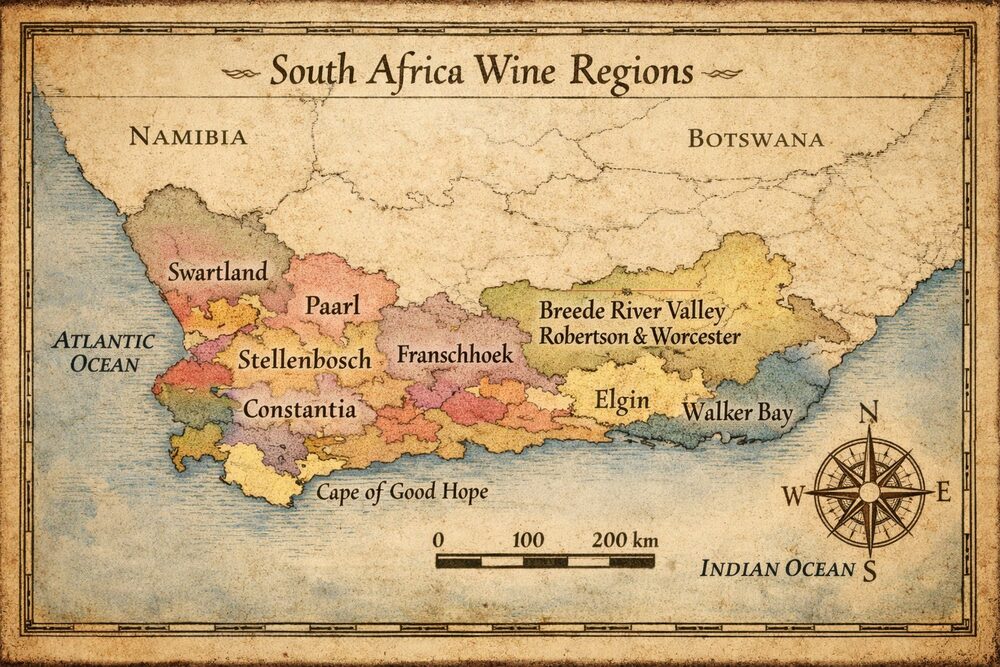
Three hundred and seventy years of winemaking in the most beautiful vineyard landscape outside Piedmont, at prices that make European visitors check the bill twice.
⭐ Stellenbosch
The centre of South African wine: oak-lined streets, Cape Dutch gables, a university and several hundred producers within half an hour. Tastings run around 100–250 rand, roughly 130–330 crowns, often refunded against a purchase.
Franschhoek
Settled by Huguenots in 1688, a narrow valley of restaurants and estates with a tram that loops the vineyards and removes the driving problem entirely.
Constantia
The oldest wine region in the southern hemisphere, planted in 1685 within today's Cape Town. Its sweet Vin de Constance was drunk by Napoleon in exile and by half the courts of Europe.
⭐ Chenin blanc
South Africa has more chenin blanc than France, much of it old bush vines, and the best of it is among the most undervalued white wine in the world. Locally it is still called steen.
Pinotage
A 1925 Stellenbosch crossing of pinot noir and cinsaut, unique to South Africa, capable of being either very good or aggressively burnt-rubber bad. Ask before committing to a bottle.
Beyond the classics
Swartland for syrah and chenin from dry-farmed old vines, Hemel-en-Aarde near Hermanus for cool-climate pinot noir and chardonnay, and Elgin for riesling.

The reason South African wine is such good value has an uncomfortable explanation, and the honest version is worth having before the third tasting. Quality rose sharply after 1994 when export markets reopened and producers could finally sell abroad, but prices stayed low because the rand is weak and because farm labour in the Western Cape is cheap — a legacy that includes the dop system, under which workers were paid partly in wine until it was outlawed, with consequences for foetal alcohol syndrome rates in the region that are among the highest recorded anywhere. Several estates now carry fair-trade certification, and asking about it is a reasonable thing for a visitor to do.
🛣️ The Garden Route
Seven hundred kilometres of coast between Cape Town and Port Elizabeth that is the easiest, safest and most popular road trip in the country — and deserves the reputation.
The shape of it
The N2 runs between the Outeniqua mountains and the Indian Ocean through forest, lagoon and cliff, with the classic stretch from Mossel Bay to Storms River taking three to five days at a sensible pace.
⭐ Knysna and Plettenberg Bay
A lagoon town between two sandstone headlands and a beach resort twenty minutes on, both comfortable, both busy in December and quiet the rest of the year.
⭐ Tsitsikamma
Indigenous forest running down to a rocky coast, with the suspension bridge over the Storms River mouth, the start of the five-day Otter Trail and the world's highest commercial bungee at Bloukrans, 216 m.
Oudtshoorn and the Cango Caves
Inland over the pass into the Little Karoo: ostrich farms left from the Victorian feather boom and a large limestone cave system. The contrast between wet coast and dry interior takes forty minutes to cross.
Whales and Hermanus
Not strictly the Garden Route but on the way: southern right whales calve in Walker Bay between June and November and are watched from the cliff path.
Driving it
Good roads, ordinary hire car, no four-wheel drive needed, and the only real hazards are distance and other drivers. Do not drive it at night, for animals as much as anything else.
The Garden Route is the answer to the question most first-time visitors are actually asking, which is how to see South Africa without being frightened of it. It is a self-drive through small towns and national parks where the risks are ordinary road risks, the accommodation is good and cheap, and the scenery changes every hour. It is also, precisely because it is easy, the least representative part of the country a person can spend a week in — which is fine, as long as nobody goes home believing they have seen South Africa.
🏢 Johannesburg and Pretoria
The largest city in southern Africa, built on gold, feared by tourists, and the place where the country's present is actually being decided.
Johannesburg
Founded 1886, now around six million people in a metropolitan sprawl with no coast, no river and no reason to exist except the reef beneath it. It is the economic capital of the continent south of Cairo.
⭐ The Apartheid Museum
The best museum in the country and one of the best history museums anywhere; it issues you a ticket classifying you as white or non-white and makes you enter through the corresponding door. Allow three hours.
⭐ Soweto
A city of well over a million in its own right, with the Hector Pieterson Memorial, Mandela's house on Vilakazi Street and a restaurant and bar scene worth the trip. Go with a guide the first time.
Maboneng and Braamfontein
Regenerated inner-city districts with galleries, markets and rooftop bars, which are genuinely good and which local advice will tell you to treat with care after dark.
The Cradle of Humankind
An hour north-west: limestone caves that have produced Australopithecus africanus, Homo naledi and around a third of all known early hominin fossils. Sterkfontein and the Maropeng visitor centre make a full day.
Pretoria
An hour north, jacaranda-lined, calmer, with the Union Buildings, the Voortrekker Monument and Freedom Park facing each other across the city — two irreconcilable memorials in sight of one another.
Skipping Johannesburg is the most common mistake visitors make, and it is usually made on advice from people who have not been recently. The city has the country's best museum, its best contemporary art, its most interesting food and the only urban energy in South Africa that feels entirely unmanaged for tourists — and it requires the same precautions as the rest of the country, applied slightly more consistently. Cape Town is the more beautiful city and Johannesburg is the more interesting one, and a week in the country with none of it in Gauteng is a week spent looking at the scenery of a place rather than the place.
🐯 Kruger and the Lowveld
Two million hectares of bushveld, the Big Five, and the only major African game park you can drive yourself around in a hire car for the price of a museum ticket.
⭐ The park
Kruger runs 360 km north to south along the Mozambique border, roughly the size of Wales, with tarred roads, rest camps, shops and fuel. Daily conservation fee for international visitors is around 570 rand, about 750 crowns.
⭐ Self-drive
You can enter in an ordinary hire car, drive yourself and stay in a rest camp, which almost no other flagship African park allows. Gates open at sunrise and close at sunset, and the times are enforced with fines.
Private reserves
Sabi Sand, Timbavati and Manyeleti share unfenced boundaries with Kruger and offer guided off-road drives, far better leopard sightings and prices an order of magnitude higher.
How to actually see animals
Be at the gate at opening, drive slowly, stop at waterholes and sit, and use the sightings boards in camp. Winter, May to September, is dramatically better: thin bush, concentrated game, no mud.
The Panorama Route
On the escarpment above the park: the Blyde River Canyon, God's Window, Bourke's Luck Potholes and the old gold town of Pilgrim's Rest. Worth a day on the way in or out.
⚠️ Malaria and rules
Seasonal malaria risk, highest in summer — take prophylaxis advice from a travel clinic. Stay in the car except in designated areas, keep your distance from elephants, and never feed anything.
The self-drive option is what makes Kruger genuinely different, and it changes the economics of an African safari completely. A Czech couple can hire a car in Johannesburg, drive five hours, pay the conservation fee, sleep in a camp bungalow for the price of a Prague hotel room and spend three days finding their own animals — for perhaps a fifth of what a guided Kenyan or Tanzanian safari costs. The guided private reserves see more leopards and offer a better bed, and the self-drive gives you something they cannot: the long, slow, unaccompanied hour at a waterhole where nothing happens and then everything does.
⛰️ The Drakensberg and the Karoo
The country's mountains and its emptiness — the two landscapes South Africans themselves drive to, and the two that almost no foreign itinerary includes.
⭐ The Drakensberg
A 1 000 km escarpment topping 3 400 m, with the Amphitheatre — a five-kilometre rock wall — and the Tugela Falls dropping 948 m down it. A World Heritage site for both landscape and rock art.
⭐ The San paintings
An estimated 40 000 images in some 600 shelters, the largest concentration of rock art in Africa, much of it accessible on day walks from the main camps. Some of it is 3 000 years old and the paint is still bright.
Walking there
Day hikes from Royal Natal, Cathedral Peak, Giant's Castle and Monk's Cowl, plus serious multi-day traverses on the escarpment top. The weather changes fast and people die of exposure most years.
The Karoo
Semi-desert filling the interior: sheep, windmills, dolerite koppies, small towns with Victorian architecture and a silence that European visitors find physically surprising.
Karoo towns
Graaff-Reinet inside a nature reserve, Prince Albert under the Swartberg Pass, Nieu-Bethesda with the Owl House — one woman's decades-long sculpture garden of glass and cement.
⭐ The night sky
The Karoo has some of the darkest skies on earth, which is why the SKA radio telescope array is being built near Carnarvon and why Sutherland hosts South Africa's largest optical telescope.
If you have a third week, spend it in the Karoo, and expect to be the only foreigner doing it. The scale is the point: you drive for an hour and the view changes by one hill, the towns are eighty kilometres apart, the light at either end of the day is extraordinary, and the sky at night is the thing people photograph and fail to convey. It is also the cheapest part of the country, the safest, and the part where you will actually talk to South Africans rather than to people employed to look after you.
🗺️ Itineraries
Four routes that work, arranged by how much time you have, with the honest note that the classic two-week version misses most of the country.
Ten days — Cape and Garden Route
Four nights Cape Town with the peninsula and Robben Island, two in the winelands, then the N2 east through Hermanus to Knysna and Tsitsikamma, flying home from Port Elizabeth. No domestic flight needed except the return.
⭐ Two weeks — the classic
The above plus a flight to Johannesburg, a night in the city for the Apartheid Museum and Soweto, then three or four nights in Kruger or a private reserve. This is what most operators sell and it works.
⭐ Three weeks — the honest version
Add the Drakensberg between Johannesburg and Kruger, and either the Wild Coast or the Karoo. This is the first itinerary that shows you the country rather than its highlights.
One week — pick one
Cape Town and the winelands, or Johannesburg and Kruger. Trying to do both in seven days means two internal flights and a great deal of airport.
Getting between them
Domestic flights are frequent and cheap — Cape Town to Johannesburg from around 1 200 crowns — and hire cars are inexpensive with good roads between major centres. Long-distance rail is scenic but unreliable except for the luxury trains.
⚠️ What to avoid planning
Night driving between towns. December in the Cape without booking months ahead. Kruger in February expecting to see much. And any itinerary that puts Johannesburg down as a transit airport only.
The single best structural decision for a two-week trip is to fly one way and drive the other, which most people work out too late. Flying into Cape Town and out of Johannesburg — or the reverse — costs little more than a return to one of them, removes a long backtrack and lets the whole trip run in one direction. Every operator can do it, few first-time visitors ask, and the ones who do get an extra two days of country instead of two days of the same road.
🍲 Cuisine
Four cooking traditions on one plate — Dutch, Malay, Indian and African — plus a national obsession with cooking meat over wood.
⭐ Braai
Wood fire, never gas, and a social occasion rather than a meal. Boerewors — a coiled, coriander-scented farmer's sausage — goes on first, then lamb chops, steak and sosaties, the Cape Malay marinated skewers.
⭐ Bobotie
The Cape Malay national dish: curried mince with dried fruit and almonds under a savoury baked egg custard, with bay leaves standing in the top and yellow rice alongside. Sweet, spiced and nothing like a European mince dish.
Pap and chakalaka
Stiff maize porridge, the staple for most of the country, eaten with a spicy vegetable relish of onion, carrot, beans and chilli. It is what actually gets eaten at most braais.
Biltong and droëwors
Air-dried spiced meat, cured with vinegar and coriander rather than smoked, and not the same thing as jerky in any respect that matters. It is sold in supermarkets by the kilo.
The Indian inheritance
Durban has the largest Indian population outside India and gave the world bunny chow — a hollowed half-loaf filled with curry, invented as a takeaway for workers barred from restaurants.
Potjiekos and snoek
A three-legged cast-iron pot stewed slowly over coals and never stirred; and on the Cape coast, smoked or braaied snoek, a long-jawed fish with a following bordering on religious.

The one word worth learning before you arrive is braai, and the one thing worth understanding is that it is not a barbecue. It is wood, not gas or briquettes; the fire is built well before anything is cooked and someone stands at it throughout; the tongs are not handed over lightly; and there is a national public holiday on 24 September, officially Heritage Day, that most of the country calls National Braai Day. An invitation to one is an invitation to spend four hours, and turning up with gas equipment would be a memorable social error.
🍳 Recipes
Three dishes for a Czech kitchen, all of them buildable from a normal supermarket.
Bobotie
Serves 6 · 90 minutes · The Cape Malay national dish
Ingredients: 800 g minced beef or lamb · 2 onions, finely chopped · 2 cloves garlic · 2 tbsp mild curry powder · 1 tsp turmeric · 2 tsp ground coriander · 1 slice white bread · 300 ml milk · 2 tbsp apricot jam · 2 tbsp fruit chutney · 2 tbsp lemon juice · 75 g raisins or chopped dried apricots · 50 g flaked almonds · 3 eggs · 6 bay leaves · salt and pepper · oil
Method: Heat the oven to 180 °C. Soak the bread in 100 ml of the milk. Fry the onions in oil until soft and golden, add the garlic and all the spices and cook for a minute until fragrant. Add the meat and brown it properly, breaking it up. Squeeze the bread out, reserving the milk, and crumble it into the meat with the jam, chutney, lemon juice, dried fruit, most of the almonds, salt and plenty of pepper. Press the mixture into a greased ovenproof dish, flattening the top. Beat the eggs with the remaining 200 ml of milk plus the reserved soaking milk and pour it over. Stand the bay leaves upright in the custard, scatter the last almonds and bake uncovered for 40–45 minutes until the top is just set and lightly browned. Rest ten minutes before cutting.
💡 The custard is the dish — it must set into a distinct pale layer, not soak in, so do not stir it and do not overbake it. Serve with yellow rice (basmati cooked with a cinnamon stick, a teaspoon of turmeric and a handful of raisins) and more chutney. Apricot jam and Mrs Ball's chutney are the authentic pairing; any fruit chutney works.
Sosaties
Serves 4 · 30 minutes plus overnight marinade · Cape Malay skewers
Ingredients: 800 g lamb shoulder or leg, cut into 3 cm cubes · 2 onions, one sliced into wedges · 2 cloves garlic · 2 tbsp mild curry powder · 1 tsp turmeric · 2 tbsp apricot jam · 2 tbsp white wine vinegar · 1 tbsp brown sugar · 12 dried apricots · 2 bay leaves · oil · skewers
Method: Fry the chopped onion in oil until soft, add the garlic, curry powder and turmeric and cook for a minute. Add the vinegar, jam, sugar, bay leaves and 100 ml water and simmer five minutes into a thick marinade. Cool it completely. Put the lamb in the cold marinade, cover and leave in the fridge overnight, or at least six hours. Soak wooden skewers in water. Thread the meat with the onion wedges and the dried apricots, alternating. Grill over hot coals or under a very hot grill for about ten minutes, turning and basting with the leftover marinade, until the outside is caramelised and the inside is still pink.
💡 The word comes from the Malay sate and the Afrikaans saus — skewers in sauce — and the dried apricot is not a garnish, it is the point of the dish. Pork works but lamb is traditional. Do not skip the overnight marinade, which is where the curry and vinegar do the work.
Koeksisters
Makes about 20 · 60 minutes plus chilling · The syrup plait
Ingredients: For the syrup: 750 g sugar · 375 ml water · 1 tbsp lemon juice · 1 cinnamon stick · 2 cm fresh ginger, sliced · For the dough: 480 g plain flour · 4 tsp baking powder · ½ tsp salt · 60 g butter · 1 egg · 250 ml milk · oil for deep frying
Method: Make the syrup first: dissolve the sugar in the water with the lemon, cinnamon and ginger, boil for five minutes, then chill it in the fridge until properly cold — this is non-negotiable and is easiest done the night before. For the dough, rub the butter into the flour, baking powder and salt, beat the egg with the milk and bring it together into a soft dough. Knead briefly, cover and rest for an hour. Roll out to about 5 mm, cut into strips 8 cm by 3 cm, slit each strip twice lengthways leaving one end joined, and plait the three strands. Deep fry at 180 °C for about two minutes a side until deep golden. Lift straight out of the oil and plunge immediately into the ice-cold syrup for about thirty seconds. Remove to a rack.
💡 Hot dough into cold syrup is the whole technique: the temperature difference drives syrup into the plait while the crust stays crisp, which is why a koeksister is glassy and wet outside and dry-crumbed inside. Work in small batches and keep the syrup in the fridge between them. Do not confuse these with koesisters, the spiced Cape Malay version rolled in coconut — related name, different cake.
A note on what the archive photographs show, because two of the three are not the dishes named. The koeksister image on this site shows glazed knots of bread dough scattered with what reads as coarse salt — no plait, no syrup, none of the glassy wet surface that defines the thing — and the braai image shows lacquered skewers on a small metal grid that look more like yakitori than anything that has been over a South African wood fire. The recipes above are the dishes; the pictures are a reminder to read captions on this site rather than trusting filenames.
🍷 Drinks
Serious wine at unserious prices, a lager monoculture with a craft rebellion underneath it, and the only tea in the world that comes from fynbos.
⭐ Wine
Chenin blanc, cabernet, syrah, pinotage and increasingly excellent cool-climate chardonnay and pinot noir. A very good bottle in a restaurant runs 300–600 rand, roughly 400–800 crowns, and a decent one in a shop under 150.
⭐ Rooibos
Made from a fynbos bush that grows only in the Cederberg, naturally caffeine-free, drunk everywhere and exported worldwide. Honeybush is its less famous and slightly sweeter cousin.
Beer
Castle and Black Label dominate absolutely, and a craft scene centred on Cape Town and Johannesburg has been quietly good for a decade. A beer in an ordinary bar is 30–50 rand, about 40–65 crowns.
Amarula and brandy
Amarula is a cream liqueur from the marula fruit that elephants are reputed to get drunk on, which is a myth. South African potstill brandy is genuinely good and wins international awards nobody at home mentions.
Umqombothi
Traditional maize and sorghum beer, thick, sour, low in alcohol and brewed by women for ceremonies and ancestors. It is drunk from a shared clay pot and is not sold in bottle stores.
⚠️ Practicalities
Tap water is safe to drink in the major cities, though not everywhere in rural areas. Drink-driving limits are low and enforced with roadblocks, and the wine route problem has an easy answer: hire a driver, which costs very little.
Rooibos is the one thing to bring home and the one drink with a genuinely South African legal story behind it. It grows only in the Cederberg mountains north of Cape Town, was granted protected designation of origin status by the European Union in 2021 — the first African product to receive it — and in 2019 the industry signed a benefit-sharing agreement with the San and Khoi peoples, formally recognising that the knowledge of the plant was theirs. That agreement is the first of its kind anywhere and it is why a packet of rooibos is a slightly better souvenir than it looks.
💵 Costs
What two weeks in South Africa costs a Czech traveller, in crowns, for a country that offers first-world infrastructure at roughly half European prices.
Flights
No direct flight from Prague. Return fares run roughly CZK 18 000–32 000 via Istanbul, Doha, Dubai, Addis Ababa or a European hub, with 14–20 hours of travel each way. Open-jaw into Cape Town and out of Johannesburg costs little more.
Accommodation
Guesthouse or good B&B CZK 900–2 000 a night for two. Mid-range hotel CZK 1 500–3 000. Kruger rest camp bungalow CZK 1 200–2 200. Private game reserve CZK 12 000–40 000 a night, all inclusive.
Food and drink
A good restaurant main course CZK 200–400. A very good bottle of wine in a restaurant CZK 400–800. A braai's worth of meat from a supermarket for four, CZK 400. Coffee CZK 50.
Getting around
Hire car from CZK 600–900 a day including insurance, fuel around CZK 1 200 per full tank. Domestic flight Cape Town–Johannesburg from CZK 1 200. Uber in cities CZK 80–200 a ride.
Entry and park fees
Kruger daily conservation fee about CZK 750 per person; Table Mountain cable car about CZK 550 return; Robben Island about CZK 800; the Apartheid Museum about CZK 250.
⭐ Two weeks, realistically
Flights aside, a self-drive fortnight with guesthouses, a hire car, Kruger and eating well runs CZK 30 000–50 000 per person. With flights, budget CZK 55 000–80 000 — and a single night in a top private reserve can add a tenth of that.
The structural point about South African prices is that the things that are cheap are the things that are locally produced, and the things that hurt are imported. Food, wine, accommodation, restaurant meals, domestic labour and park entry are all a fraction of Czech equivalents; electronics, imported wine, international flights and anything with a foreign brand on it cost more than they do in Prague. A visitor spends almost entirely in the first category, which is why the country feels so inexpensive — and it is worth remembering that the same prices are not cheap on a South African salary.
🧳 Practical
Eight things that make the difference between a smooth trip and an irritating one, none of which are about crime.
Visa and entry
Czech citizens do not need a visa for stays up to 90 days. Your passport must have at least two entirely blank facing pages and be valid 30 days beyond departure, and this is enforced at check-in, not on arrival.
⚠️ Travelling with children
South Africa requires an unabridged birth certificate for minors, and consent from any non-travelling parent. Rules have loosened but airlines still apply them inconsistently — check with the carrier before booking.
Driving
Left-hand side, good main roads, an EU licence is accepted for short stays. Watch for potholes off the main routes, pedestrians and animals on rural roads, and minibus taxis, which stop anywhere without warning.
Money
Cards work almost everywhere including small towns, ATMs are plentiful, and tipping is expected: 10–15 per cent in restaurants and a few rand to the informal car guard who watches your car.
Health
No compulsory vaccinations from Europe. Recommended: tetanus, hepatitis A and B, typhoid. Malaria prophylaxis for Kruger and the far north-east, and private hospitals in the cities are excellent and expensive.
Power, SIM and plugs
The plug is the unusual three-round-pin type M — bring an adapter, though many hotels now also fit European sockets. A local SIM needs your passport and proof of address; eSIMs avoid the whole problem.
The one bureaucratic detail that catches Czech travellers is the passport page requirement, and it is worth checking tonight rather than at the airport. South Africa requires two completely blank facing pages for entry and exit stamps, not two pages with something already on them, and airlines have refused boarding over it. Combined with the 30-day validity margin after your planned departure, it is the sort of thing that is trivial to fix six weeks out and impossible to fix at check-in.
🇨🇿 For Czech Travellers
One of the few long-haul destinations where a Czech traveller gets genuinely more for their money than at home — with an embassy, valid insurance and no travel warning.
⭐ The advisory situation
The Czech Ministry of Foreign Affairs has no warning or advisory in force for South Africa. It notes high crime, especially in city centres, and advises travelling in groups — but it does not advise against going, which means standard Czech travel insurance is valid.
The embassy
The Czech Republic has an embassy in Pretoria and honorary consuls elsewhere. The consular emergency line is +27 82 416 0016 — write it down on paper, not only in a phone that can be stolen.
DROZD
Register the trip in the ministry's DROZD system before departure. It takes five minutes and is what allows the embassy to reach you in an emergency.
Getting there from Prague
Turkish via Istanbul, Qatar via Doha, Emirates via Dubai, Ethiopian via Addis Ababa or Lufthansa and KLM via their hubs, with fares from around CZK 18 000 return and 14–20 hours each way.
When to go
Our summer, July and August, for Kruger and the game parks — their dry winter and the best viewing of the year. Our winter, December to March, for Cape Town and the coast, though that is their peak season and prices reflect it.
⭐ Why it suits Czech travellers particularly
Self-drive works, which suits people used to driving their own holidays; costs are European-quality at half the price; English is universal; and the game parks are reachable without a guided tour.
The honest comparison for a Czech reader is with Kenya or Tanzania, because that is the choice most people are actually making. East Africa has the migration and the classic Serengeti image; South Africa has better roads, cheaper flights, self-drive parks, wine country, two cities worth several days each, and a total cost that can be half. The trade is that South Africa asks for more care about where you walk after dark, and gives back a country you can explore under your own steam rather than from inside somebody else's itinerary.
And the practical summary: no visa, two blank passport pages, insurance that is valid for once, a hire car, July–August for Kruger or December–March for the Cape, DROZD registered, the consular number on paper, and no night driving between towns. Do that and this is one of the best-value long-haul trips available from Prague.
✍️ Author's Note
How this page was written, what the archive images actually show, and what it deliberately leaves out.
The sources
Written in September 2026 from South African Treasury and Statistics SA figures, SAPS quarterly crime releases, Eskom and SANParks published data, reporting on the Madlanga commission, and the Czech foreign ministry's own country pages. The current figures were checked rather than remembered.
⭐ The hero image is right
On a site whose defect log runs to dozens of wrong-place photographs, this one is Cape Town, photographed from where everyone photographs it. It is a PNG saved under a .jpg extension, which is a file defect rather than a content one.
⚠️ Two images are not their dishes
The file named for koeksisters shows glazed knots of bread dough with coarse salt — no plait and no syrup — and the one named for bobotie shows individual browned domes with no custard layer. Both are captioned for what they are.
⚠️ An invented wine label
The Stellenbosch photograph carries a bottle labelled CANON above an illegible line of characters. No South African estate of that name exists, so it is an invented mark rather than a copied one — which is the only reason it is reproduced here at all.
Two bottles that could have been worse
Two files are named after real estates — Hamilton Russell and Klein Constantia — and both show unlabelled bottles. Had they carried those producers' marks they would not appear on this page, under a rule this site applies to forged trademarks.
What this page underplays
The land reform debate, which deserves its own treatment; the detail of provincial politics; the Eastern Cape and the Wild Coast; Lesotho and Eswatini as add-ons; and the specifics of township tourism, where the ethics are genuinely contested.
A word about how this page handles crime, because it is the thing readers will judge it on. The temptation is either to lead with the murder statistics and frighten people out of a trip that hundreds of thousands of Europeans take safely every year, or to wave it away as media exaggeration — and both are dishonest. What this page tries to do instead is give the actual numbers, say plainly where the violence falls and on whom, list the precautions that South Africans themselves take, and let the reader decide; anyone who wants the comfortable version will find it easily elsewhere.
Corrections are welcome, particularly from South Africans, on current conditions, on prices, on anything about the coalition or the municipal elections that has moved since September 2026, and on the sections about race and land, where a foreign writer is most likely to get the emphasis wrong.
Support This Project 🌍
This World Travel Factbook is a labor of love – free to use for all travelers. If you find it helpful, consider supporting its continued development.
