Wallis and Futuna is a French overseas collectivity in the western Pacific, made up of three main islands: Wallis (Uvea), Futuna, and the uninhabited Alofi. Together they cover 142.42 square kilometres and, at the 2023 census, held 11,151 residents — 8,088 on Wallis and 3,063 on Futuna. It is the least-visited inhabited territory in the French Republic and one of the most obscure inhabited places on Earth.
A note on geography that trips up almost every description of the place: Wallis and Futuna is not part of French Polynesia. They are two entirely separate French collectivities, roughly 3,000 kilometres apart, with different statutes, different institutions and different currencies-in-practice (both use the CFP franc, but nothing else is shared). Wallis sits about 370 kilometres from the nearest Samoan island and around 840 kilometres northeast of Nadi in Fiji — not the 400 kilometres often quoted.
What makes the territory genuinely singular is its constitutional arrangement. Alongside the French administrateur supérieur (prefect) sit three customary kingdoms — Uvea on Wallis, and Alo and Sigave on Futuna — whose kings hold recognised authority under the 1961 statute. The Catholic Church, arriving with Marist missionaries in 1837, is woven just as deeply into daily life: nearly every village has a church built on a scale that looks absurd against its population, and Sunday is genuinely observed.
The territory's defining modern fact is depopulation. The resident population has fallen more than a quarter in twenty years, and roughly twice as many Wallisians and Futunians now live in New Caledonia as live in the islands themselves. Futuna has lost 37% of its people since 2003. Almost every family here is also a family somewhere else.
02
🏷 Name & Identity
The islands carry two sets of names, and the difference matters locally. Wallis is an exonym: the island's own name is Uvea (sometimes 'Uvea), and the British navigator Samuel Wallis merely passed by in 1767, having recently become the first European to reach Tahiti. Islanders call themselves Wallisians in French and Uveans in their own language. To avoid confusion with Ouvéa in New Caledonia's Loyalty Islands — itself settled from here — Uvea is sometimes distinguished as Uvea mo Futuna.
Futuna and Alofi were sighted in 1616 by the Dutch navigators Willem Schouten and Jacob Le Maire, who named them the Hoorn Islands (Îles Horn) after their home port of Hoorn — the same voyage that gave Cape Horn its name. That name still appears on charts and in French administrative texts.
Two Polynesian languages are spoken and they are not dialects of each other. Wallisian (Faka'uvea) is closely related to Tongan, a legacy of the Tu'i Tonga conquests; Futunan (Fakafutuna) sits closer to Samoan. French is the language of administration and school. Both Polynesian languages are actively spoken at home, though the census records the usual pressure from French among the young.
The flag — a red field with a white-outlined red saltire on a blue canton, the French tricolour in the corner — is unofficial in the strict sense: like the territory's other emblems it has no formal legal adoption, since the only official flag of the collectivity is that of the French Republic.
03
🌎 Geography
The territory is two island groups separated by roughly 230 kilometres of open ocean — far enough that Wallis and Futuna share almost no daily life, and that a single small aircraft is the only routine link. The land breaks down as Wallis (Uvea) 77.9 km², Futuna 46.3 km² and Alofi 17.8 km², with the lagoon islets making up the balance of the official 142.42 km².
Beware a figure that circulates widely: Futuna 64 km². That is the total of the Horn Islands — Futuna plus Alofi — not Futuna alone. Adding it to Wallis and Alofi double-counts Alofi and inflates the territory to a non-existent 160 km².
Wallis is a low volcanic island, gently rolling rather than dramatic, rising to 151 metres at Mont Lulu Fakahega. Its defining feature is the barrier reef that rings it at a distance, enclosing a broad, shallow lagoon studded with small islets (motu). Sources disagree on how many — counts run from about fifteen to twenty-two depending on what is counted as an islet — so treat any precise number with suspicion. Four passes cut the reef; only Honikulu, in the south, is deep enough for cargo ships.
The island's interior holds a set of crater lakes that are its real geological signature. Lake Lalolalo is the famous one: a near-perfect circle roughly 400–450 metres across, walled by sheer vertical cliffs dropping straight into water some 80 metres deep, with no beach and no shallows. It connects to the sea through underground faults, which leaves the water stratified by salinity. Lakes Lanutavake, Lanutuli and Kikila complete the set.
Futuna is a different world: steep, mountainous and reef-less, with waves breaking directly on the shore. It rises to 524 metres at Mont Puke (also called Mont Singavi), the highest point of the whole territory. Villages cling to a narrow coastal shelf; the interior is forest and near-vertical slope. Alofi, separated from Futuna by the 1.8-kilometre Vasa strait, reaches 417 metres at Mont Kolofau and has no permanent population.
The islands are seismically live. Futuna sits close to the boundary where the Pacific and Australian plates meet, and the territory has a documented history of destructive earthquakes — most notoriously the 1993 Futuna quake. Against 142 km² of land, the collectivity holds an exclusive economic zone of 256,745 km² and shares five maritime boundaries — with Fiji, Samoa, Tonga, Tuvalu and New Zealand (Tokelau) — more than any other French overseas territory, though the Samoa boundary remains undelimited.
04
🗺 Map of Wallis and Futuna
Two island groups, 230 kilometres apart. Wallis and its lagoon lie to the northeast; Futuna and Alofi to the southwest. Zoom out to see how much ocean separates them — and how far they sit from everywhere else.
Markers: settlements, airports, crater lakes, archaeological sites and the summits. Scroll-wheel zoom is disabled — use the +/− controls or drag.
05
🏛 History
Lapita people reached these islands in the first millennium BCE, and Futuna in particular has yielded some of the region's important early pottery. For most of the following two thousand years Uvea and Futuna developed as separate Polynesian chiefdoms with their own languages and hierarchies.
The decisive external event was the arrival of Tongan power. From roughly the 15th century the Tu'i Tonga empire pushed into Uvea, installing a Tongan chiefly system and reshaping the language so thoroughly that Wallisian is now closer to Tongan than to its neighbour Futunan. The fortress of Talietumu, built around 1450 near Halalo, was the last Tongan stronghold on the island before they were finally defeated. Futuna, further away and harder to hold, kept its Samoan-leaning character.
Europeans came late and lightly. Schouten and Le Maire sighted Futuna in 1616; Samuel Wallis passed Uvea in 1767. Nothing much followed until 1837, when Marist missionaries landed and set about converting the islands. Their success was total and fast — and on Futuna it was also violent. On 28 April 1841 Father Pierre Chanel was clubbed to death at Poi on the orders of King Niuliki of Alo, whose own son had sought baptism and whose authority as both king and high priest was threatened by the new faith. Within a few years the whole island was Catholic. Chanel was canonised in 1954 as the protomartyr of Oceania.
Bishop Pierre Bataillon wrote Wallis's first written law code, the Tohi Fono o Uvea, adopted on 20 June 1870 — effectively a missionary theocracy operating through the customary kings. France formalised its position by treaty: the Queen of Uvea signed a protectorate agreement on 5 April 1887, and the kings of Sigave and Alo followed on 16 February 1888. French administration remained astonishingly thin — for decades, a resident, a chancellor and a radio operator, all on Wallis.
The Second World War changed more than the previous century had. A United States base operated on Wallis from 1942 to 1944, bringing thousands of servicemen, cash, machinery and roads to an island of a few thousand people. It destabilised chiefly authority, gave a generation a taste of wage labour, and set off the migration to New Caledonia's nickel industry that continues to define the territory's demography. American loanwords survive in Wallisian to this day.
In 1959 the three kings petitioned de Gaulle for a change of status. A referendum on 27 December 1959 passed with over 94% in favour — and 100% on Wallis. The French parliament ratified it as Loi n° 61-814 of 29 July 1961, making Wallis and Futuna an overseas territory and, unusually, writing the customary kingdoms into the republican structure. That date is still celebrated as Territory Day. The 2003 constitutional reform reclassified it as a collectivité d'outre-mer, but the 1961 statute — now well past its sixtieth year and widely described locally as overdue for revision — remains the governing text.
06
👥 People & Culture
The 2023 census counted 11,151 residents (11,620 including people counted elsewhere), down from 14,944 in 2003 — a fall of 25.4% in twenty years. The decline is not evenly shared: Wallis lost 19.7%, Futuna 37.1%. The median age rose from 23 to 38 in the same period, and the fertility rate fell from 2.7 to 1.7. Meanwhile the Wallisian and Futunian community in New Caledonia numbered around 22,500 at its 2019 census — roughly double the population of the islands. The diaspora is the larger nation.
Society is organised around three overlapping authorities that mostly cooperate and occasionally collide: the customary hierarchy of kings, ministers and village chiefs; the Catholic Church, which runs most primary education under a long-standing agreement; and the French state. A visitor notices the first two long before the third.
The great social institution is the katoaga, the customary feast. It is not a party but a redistribution: pigs, baskets of yams and taro, woven mats, tapa barkcloth and envelopes of banknotes are presented, and then reallocated according to the rank of each recipient. A katoaga follows a strict order — Mass, then the meal, then the kava ceremony, then dances, then the redistribution — and mobilises whole villages or districts for weeks or months of preparation. Weddings, first communions, funerals, the enthronement of a king and the visit of a bishop all call for one.
Craft survives as living practice rather than souvenir production. Women make tapa (beaten barkcloth) and weave fine mats; men carve wooden bowls and turtles and prepare kava. On Wallis — and only on Wallis — the ta'ovala, a waist-wrapper of woven pandanus worn over ordinary clothes, is put on for customary and religious occasions and whenever one is presented to the king. Dance is central: the soamako and the introductory song hiva lausiva mark public occasions, and the three weeks before All Saints' Day are filled with hiva mate, funeral songs, broadcast on local radio.
A Wallisian creation story explains the lagoon rather beautifully. The god Tagaloa cast his net into the sea and hauled up not a fish but an island. He trampled it flat — which is why Uvea is low — and left his net behind. The net became the barrier reef.
07
⛪ Mata-Utu & the Island of Uvea
Mata-Utu is the territorial capital and, with something over a thousand people, one of the smallest capitals anywhere. It is a village with institutions: the prefecture, the Territorial Assembly, the hospital, the wharf, a handful of shops. There is no centre in the urban sense — the settlement strings along the east coast road.
Its landmark is the Cathedral of Our Lady of Good Hope, a massive twin-towered basalt church that would not look out of place in a French provincial town of fifty thousand people. Beside it stands the royal palace of the Lavelua, a low open structure where customary business is conducted. The pairing — cathedral and palace, side by side, both functioning — is the clearest single image of how this territory works.
Uvea is small enough to circle by car in an afternoon on a single ring road, and that is the standard way to see it. The island is green, low and densely planted: taro terraces, coconut, breadfruit, banana, and pigs everywhere. Villages announce themselves with a church and a fale fono (meeting house). North of Mata-Utu the road runs to Hihifo and the airport; south it reaches Mua district and the archaeological sites.
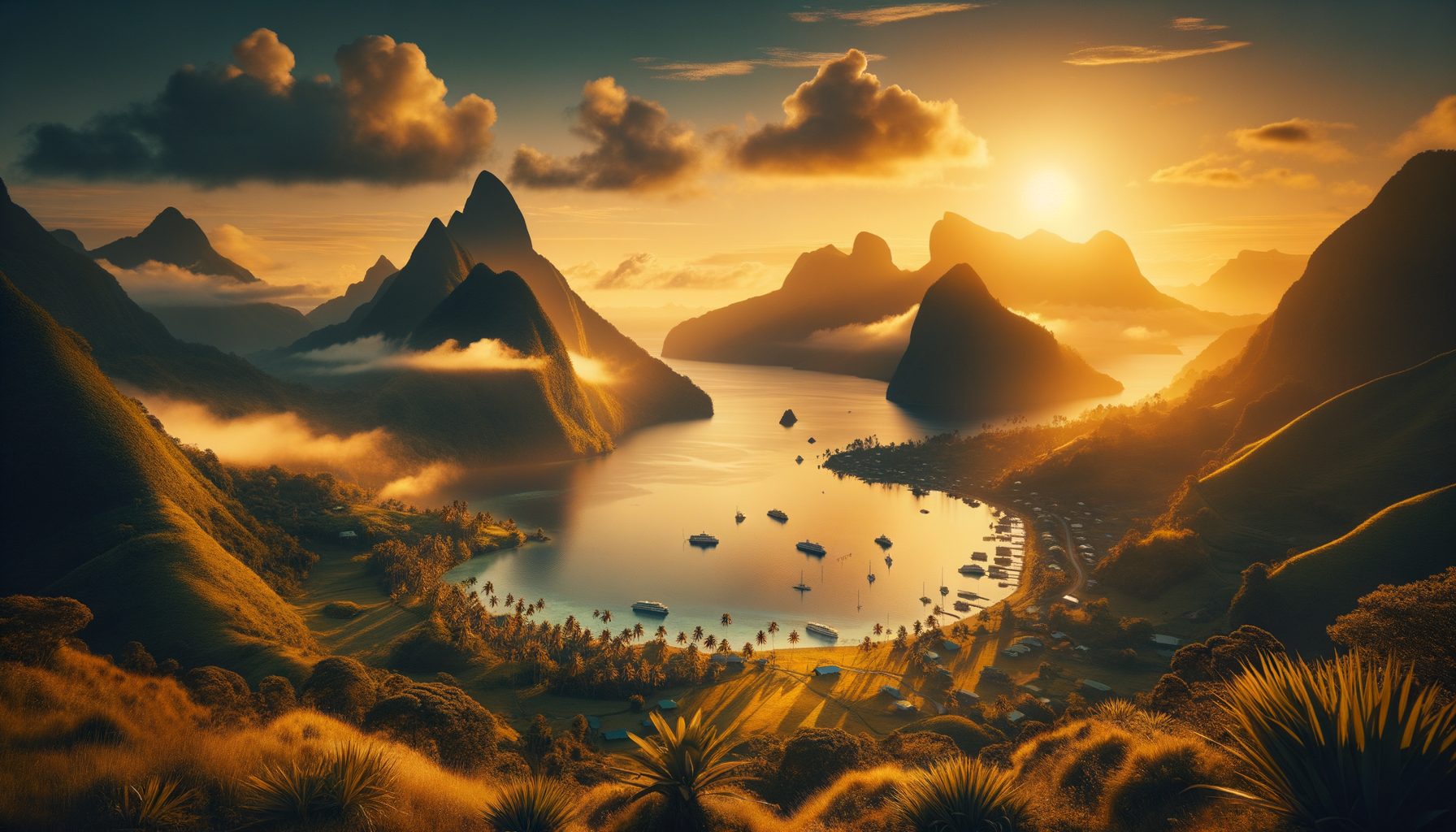
The reef-enclosed lagoon of Uvea — the calm water that defines life on Wallis.
08
🌊 The Lagoon, the Crater Lakes & Talietumu
The lagoon is the reason to come to Wallis. Enclosed by a barrier reef standing well offshore, it is warm, clear and almost always flat, and it is dotted with uninhabited motu. Nukuatea, Nukuhione, Nukuhifala and Faioa are the ones boats usually head for — white sand, shade, and nobody else. Getting out there means arranging a boat locally; there is no organised tour operation and no schedule.
Lake Lalolalo is the island's other set-piece and one of the strangest bodies of water in the Pacific. A near-perfect circle roughly 400–450 metres across, it is bounded on every side by sheer cliffs falling straight into water around 80 metres deep. There is no shore. You stand at the rim and look down. The surrounding forest, va'o tapu, is sacred ground under the Lavelua's authority, and the lake carries a heavy load of story — including the entirely factual detail that departing American forces dumped surplus equipment into it in 1944. Nearby Lake Lanutavake is gentler and swimmable.
South of Mata-Utu in Mua district lies Talietumu, also called Kolo Nui — the best-preserved archaeological site in the territory and the reason the Tongan chapter of Uvea's history is legible at all. It is a fortified settlement of around 1450: a basalt defensive wall with several gates, a raised central ceremonial platform (mala'e) about five metres high and eighty metres long, and paved walkways radiating outward. It was restored in the 1990s by CNRS archaeologists using original techniques. A second Tongan-era site, Tonga Toto, sits near Lake Lanutavake.
One thing to be clear about: none of this is a UNESCO World Heritage Site, and none of it is even on France's Tentative List. Talietumu is unprotected by any international designation. See the Heritage section below.
09
🏔 Futuna: Alo & Sigave
Futuna is the harder, older-feeling half of the territory, and the half that is emptying fastest. Forty-six square kilometres of steep volcanic mountain with no lagoon and no reef, it rises to 524 metres at Mont Puke and drops to a coast where the swell arrives unbroken. Villages occupy the thin coastal shelf; a single road runs most of the way round.
Two kingdoms divide the island. Sigave occupies the west, with its main village at Leava, where the wharf is. Alo holds the east and south, along with Alofi. Each has its own king, its own chiefly hierarchy and its own customary calendar, and the distinction is taken seriously. The Futunan language is spoken throughout and is closer to Samoan than to Wallisian.
The island's great pilgrimage site is the Basilica of Saint-Pierre-Chanel at Poi, on the north coast, built over the place where the missionary was killed in 1841 and holding his relics. The first church on the site was consecrated in 1843; the present basilica was blessed on 16 July 1986, and the relics were returned from France aboard a French Navy vessel in 1977. It is a minor basilica — a rank almost comically disproportionate to an island of three thousand people, and entirely justified by what happened there. Chanel's killer, Musumusu, later converted and asked to be buried at the site so that pilgrims would walk over his grave.
Futuna's agriculture is its quiet distinction. Pakanuku water taro — grown only in the village of Nuku, in flooded terraces fed by diverted streams — is locally famous; elsewhere on the island the same crop is talo vusiga. Coconut crabs and lobster are Futunan specialities. The tourism board's claim that Nuku holds the largest taro plantation in the Pacific is worth enjoying but not repeating as fact.
10
🌴 Alofi: The Empty Island
Alofi lies 1.8 kilometres across the Vasa strait from Futuna — visible from the road, reachable in minutes by boat, and permanently uninhabited. Seventeen point eight square kilometres, rising to 417 metres at Mont Kolofau, with good soil, forest and no people. Futunans cross daily to tend plantations, hunt and fish, and return before dark.
The reason for its emptiness is the territory's most repeated story: that in the 19th century Futunan warriors raided the island and ate its entire population. The tale is old, widely told locally, and impossible to verify. It is worth knowing that researchers have also pointed to a prosaic alternative — Alofi has very little permanent surface fresh water, which makes year-round settlement genuinely difficult. Both explanations may be doing some work. Treat the cannibal raid as tradition rather than established history.
A day trip to Alofi is the best excursion in the territory: arrange it through a guesthouse on Futuna, bring your own water, and expect empty beaches and the ruins of an abandoned church at Alofitai.
11
👑 The Three Kingdoms & Government
This is the part of Wallis and Futuna that everyone repeats and almost everyone gets wrong. The standard line — "three kings rule alongside the French administrator" — describes the constitutional design, not the situation on the ground. As of September 2026, only one of the three thrones is uncontested.
Sigave (Futuna) — filled. Eufenio Takala was enthroned in March 2016. He reigns under the title Keleta'ona, not Tu'i Sigave: the Sigave title alternates between the two according to which clan holds it, and prefecture listings name him accordingly.
Alo (Futuna) — vacant. The Tu'i Agaifo throne has stood empty since the resignation of Lino Leleivai in October 2022, and the delay in enthroning a successor has been a running story in the territory ever since.
Uvea (Wallis) — disputed. Two rival Lavelua have claimed the throne since 2016: Patalione Kanimoa (customary name Takumasiva 'Aisake), recognised by the French state, and Vaimu'a Halagahu (Ma'utamakia), enthroned by a competing group of royal families. Uvea has effectively had two chiefdoms and two royal households ever since, with separate ceremonies still being held in 2026. The dispute has roots reaching back to the crisis over Tomasi Kulimoetoke II's succession in 2005.
The wider history is turbulent. Tomasi Kulimoetoke II reigned for nearly half a century until his death in 2007; Kapeliele Faupala was crowned in 2008 and deposed in 2014, and died in August 2026. The French state's position is deliberately awkward: the prefect must respect a customary system he has no authority to arbitrate, while also needing someone to sign the deliberations that make the Territorial Council function.
On the republican side, the arrangement is more legible. The administrateur supérieur (prefect) is Jean-François de Manheulle, appointed by decree on 22 October 2025 and in post since 18 November 2025. The Territorial Assembly has 20 members elected for five years — last at the territorial election of 20 March 2022, with the next due in 2027 — and is presided over by Munipoese Muli'aka'aka, in the chair since March 2022 and re-elected annually since. There are no communes and no municipal elections; the three customary districts do that work instead.
In Paris, Wallis and Futuna sends one deputy to the National Assembly — Mikaele Seo, re-elected in the first round on 30 June 2024 with 62% — and one senator, Mikaele Kulimoetoke, in post since 2020. That seat falls in the série 2 renewal of 27 September 2026, so the senator named here may change within weeks of your reading it. Head of state is the President of the French Republic, Emmanuel Macron, whose second term runs to May 2027; the Prime Minister is Sébastien Lecornu, appointed October 2025.
12
🍲 Cuisine
Wallisian and Futunan cooking is western Polynesian: root crops, coconut, pig, reef fish, and slow cooking in the ground. What distinguishes it from Tonga or Samoa is less the dishes than the context — almost every significant meal is attached to a customary or religious occasion — and a genuine French overlay that arrived with the administration and never left. It is entirely normal to eat leaf-wrapped taro on Saturday and duck breast on Sunday.
One structural fact worth knowing: no fertilisers or pesticides are imported into the territory, so local produce is organic by default, and a formal certification process has been under way. Local staples carry Wallisian names — niu (coconut), talo (taro), ufi (yam), mei (breadfruit), fusi (banana), manioka (cassava). Gathering shellfish at low tide, fagota, is done mainly by women and children.
A note on the recipes below: there is no canonical published cookbook for these islands and quantities are not standardised — every family cooks by eye. What follows are workable home versions built on documented ingredients and methods, not fixed formulas. Several of these dishes are shared across western Polynesia rather than unique to Wallis and Futuna, and are marked where that is so.
🔥 Umu — the Earth Oven
The most traditional speciality of the territory. The word umu means the oven, the technique and the food that comes out of it.
You need: a pit; a load of dense volcanic stones; hardwood; banana leaves and palm fronds; suckling pig or pork shoulder; taro, yam, kapé (giant taro) and breadfruit; coconut cream; shellfish or reef fish.
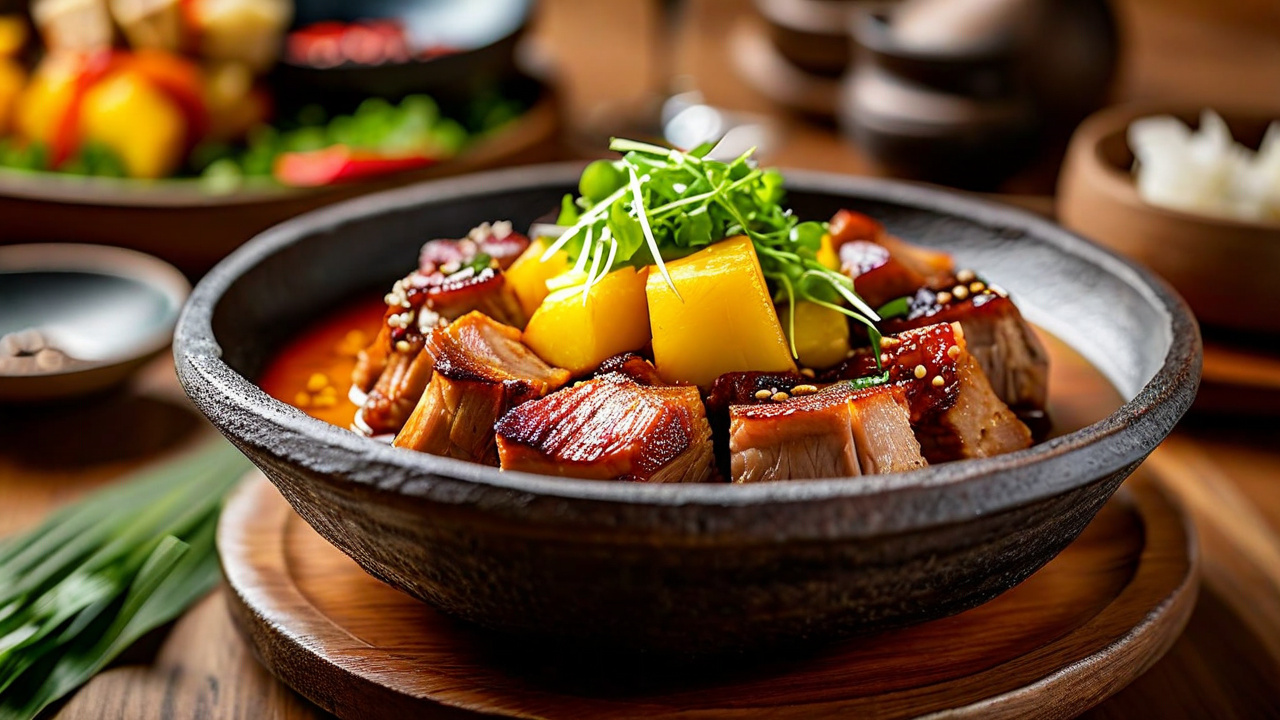
Method. Burn a hardwood fire over the stones in the pit for two to three hours, until the stones glow and the wood is spent. Rake out the embers and level the hot stones. Wrap each component separately in banana leaves — meat in one parcel, root vegetables in others, fish and shellfish in coconut cream in their own. Lay them on the stones, heaviest and slowest first. Cover with more leaves, then palm fronds, then earth, sealing the pit completely so no steam escapes. Leave it. Pork and taro need three to four hours; fish parcels can go in later on top. Open it in front of everyone — that moment is the point of the dish.
Home version: line a heavy casserole with banana leaves, layer the same ingredients, add a splash of water and coconut cream, seal with foil and a lid, and bake at 150 °C for three hours. It is not the same, but it is recognisably the dish.
🥫 Lu Pulu — Taro Leaves with Corned Beef
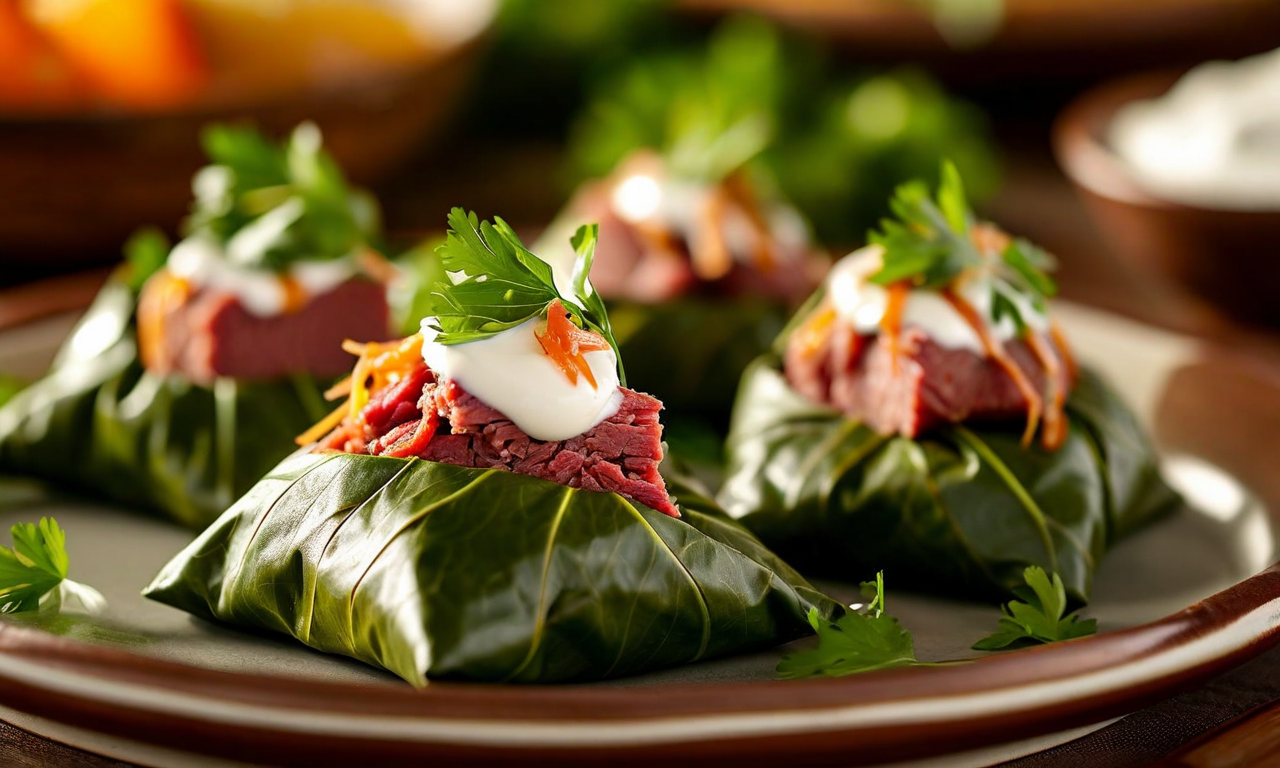
Shared across western Polynesia and documented above all as Tonga's national dish; eaten routinely in both Wallis and Futuna. Lu means the leaf parcel; pulu is the beef. Serves 4–6.
Ingredients: about 30 young taro leaves (spinach or chard at a pinch); 340 g tin of corned beef; 1 large onion, finely diced; 400 ml thick coconut cream; 1 tomato, chopped; salt; banana leaves or foil for wrapping.
Method. Wash the taro leaves and cut out the thick central stems — they hold the calcium oxalate that makes raw taro leaf burn the throat, and thorough cooking deals with the rest. Break up the corned beef with the onion and tomato. Stack five or six leaves in your palm, spoon in a portion of the beef mixture, pour over a good spoonful of coconut cream, and fold the leaves into a tight parcel. Wrap each parcel in banana leaf or foil. Bake at 180 °C for 1½–2 hours, or set them in an umu. The leaves collapse to a dark, silky, slightly bitter mass under a coconut sauce. Never undercook taro leaf.
🍣 Marinated Raw Fish in Coconut Milk
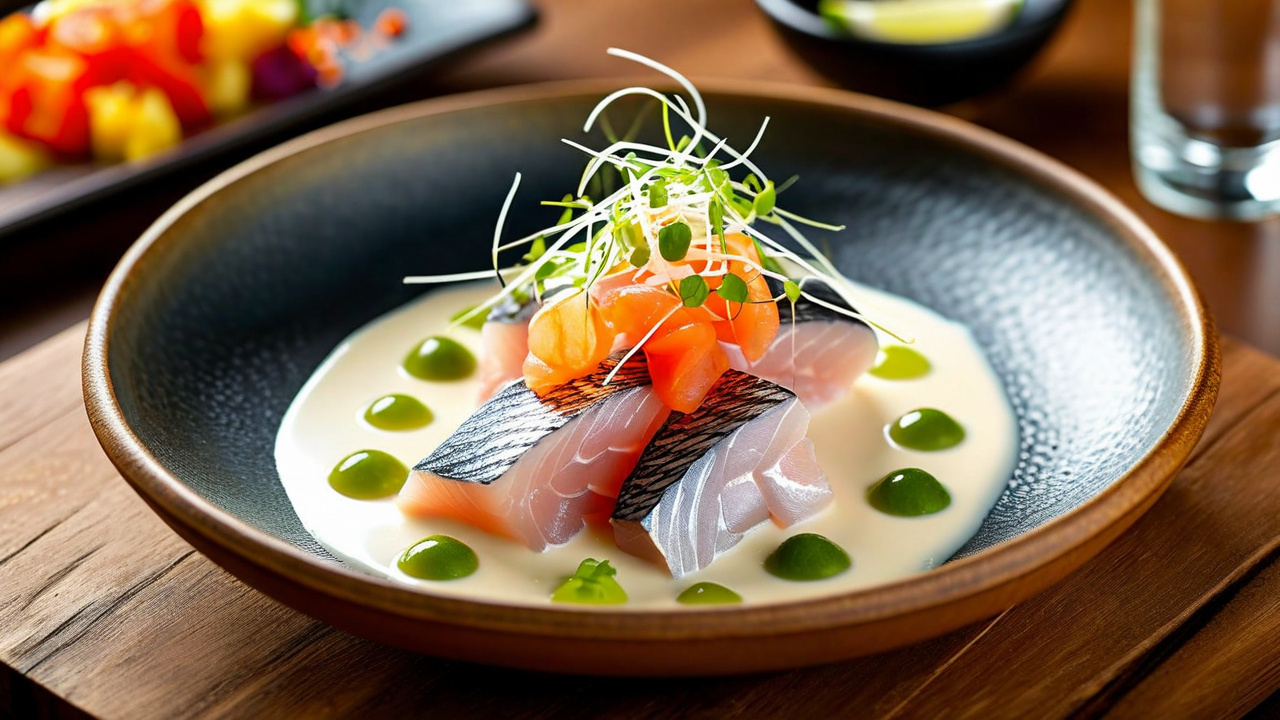
The territorial tourism board describes this simply as marinated raw fish salad with coconut milk, and notes that every family has its own recipe. The labels ota ika and poisson cru are Samoan and Tahitian glosses rather than local names. Serves 4.
Ingredients: 500 g sashimi-grade tuna or bonito, diced to 1.5 cm; juice of 6–8 limes; 300 ml coconut milk; 1 cucumber, diced; 2 tomatoes, seeded and diced; 1 small onion, sliced paper-thin; 1 spring onion; salt.
Method. Toss the fish with the lime juice and a good pinch of salt, and leave 10–20 minutes — long enough for the surface to turn opaque, short enough that the centre stays soft. Drain off most of the juice or the coconut milk will split and the fish will turn chalky. Fold in the vegetables, then the coconut milk. Serve cold, immediately. Tuna and bonito sashimi, served plain, is a local speciality in its own right.
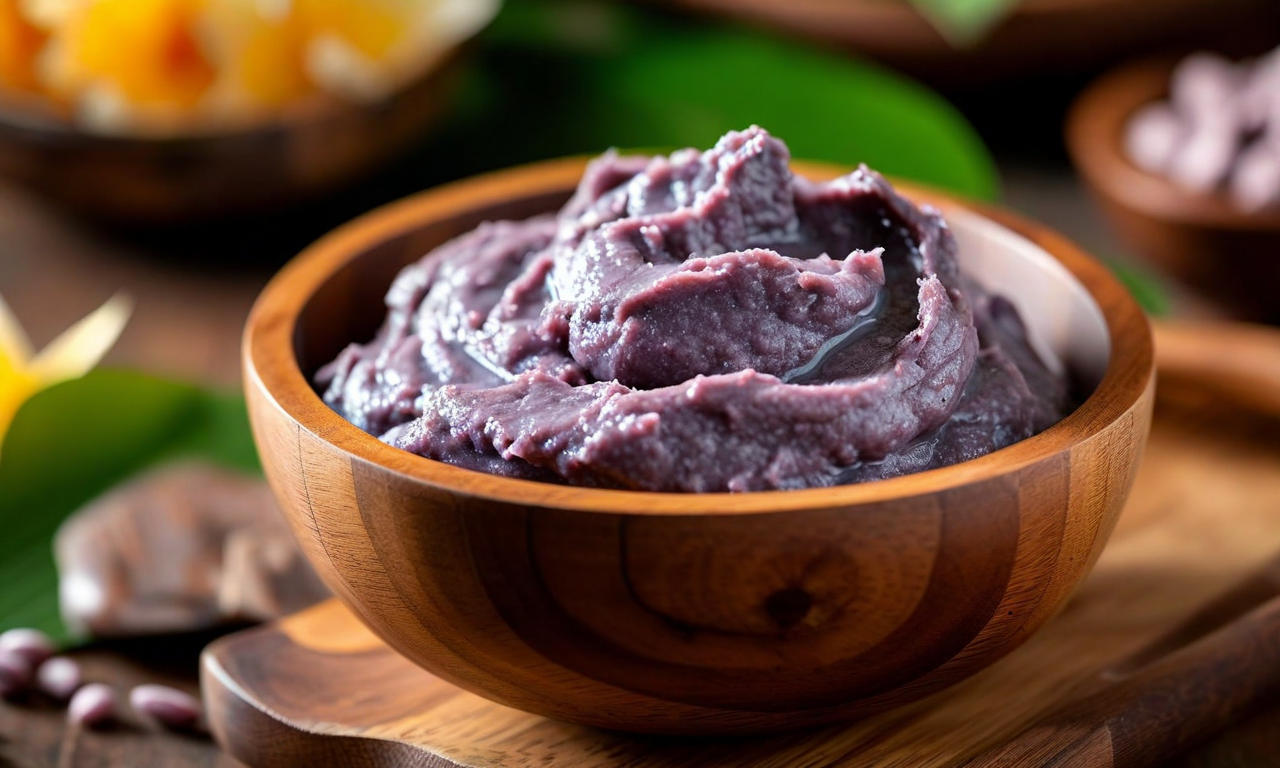
🧁 Faikai — Coconut & Root-Starch Pudding
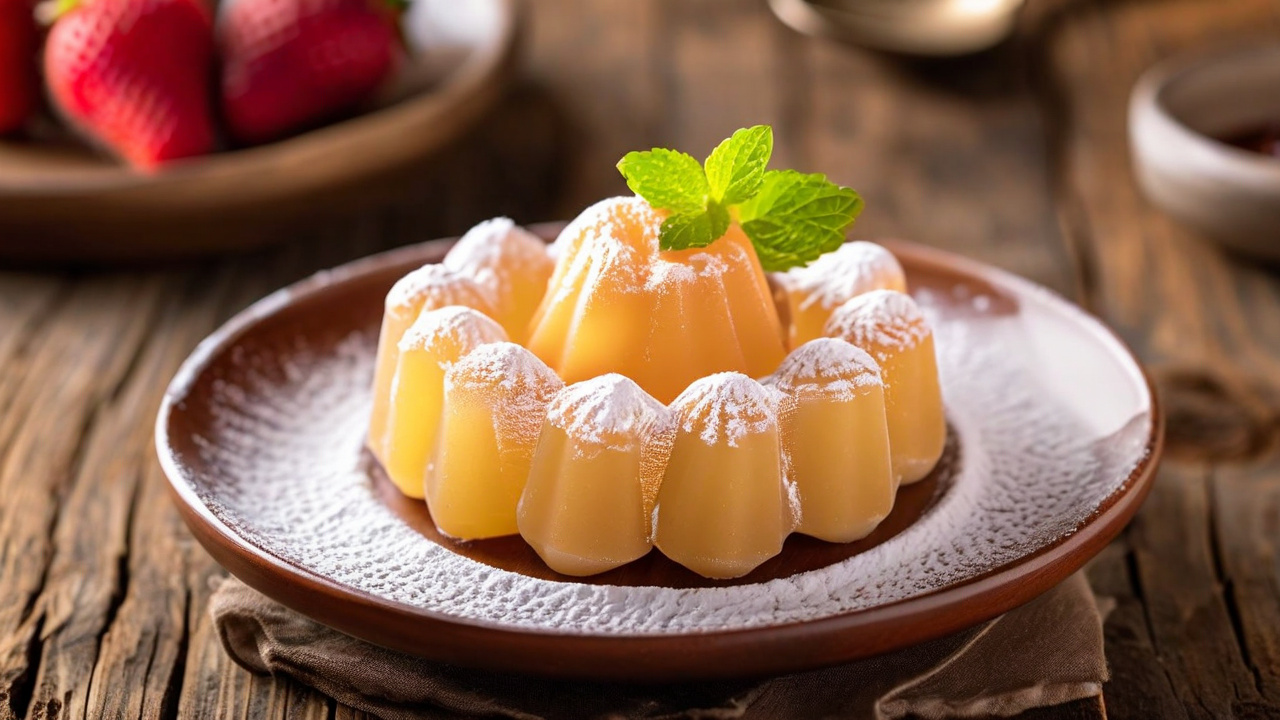
The local dessert, made from cassava or taro and sugar. The variant faikai malaulau uses grated yam or cassava with coconut milk, leaf-wrapped and baked firm. Serves 6–8.
Ingredients: 1 kg cassava or taro, peeled and finely grated; 400 ml thick coconut cream; 120–150 g sugar; a pinch of salt; banana leaves.
Method. Squeeze some of the liquid from the grated root, then mix it with the coconut cream, sugar and salt to a thick batter. Spread 3–4 cm deep in a banana-leaf-lined tin, fold the leaves over, and bake at 180 °C for about an hour until set and lightly caramelised at the edges. Cool before cutting — it firms as it cools. Serve in squares, warm or at room temperature. A close relative, sofesofe, does the same job with banana or papaya in coconut milk.
Other things you will meet: breadfruit (mei) cooked over open fire, puréed, or cut into chips and croquettes; povi masima, salted beef, a staple of the imported-protein economy across the region; stuffed clams, rock oysters and tiny bivalves cooked in coconut milk; coconut crab and lobster on Futuna. And in the restaurants of Mata-Utu, without irony, seared duck breast, tournedos Rossini, couscous, French cheese and charcuterie. The tourism board notes there are more pigs in the territory than people — a claim entirely consistent with what you see from the road.
13
🍺 Kava, Wine & Spirits
Wallis and Futuna produces no wine. There is no viticulture, no distillery and no brewery of any scale — 142 square kilometres of tropical volcanic island in the deep Pacific is not wine country, and nobody has pretended otherwise. For that reason there is no Kaufmann Wine Score for this territory; scoring imported bottles would tell you about a French supply chain, not about a place. What the territory does have is one of the most institutionally important kava cultures in Polynesia.
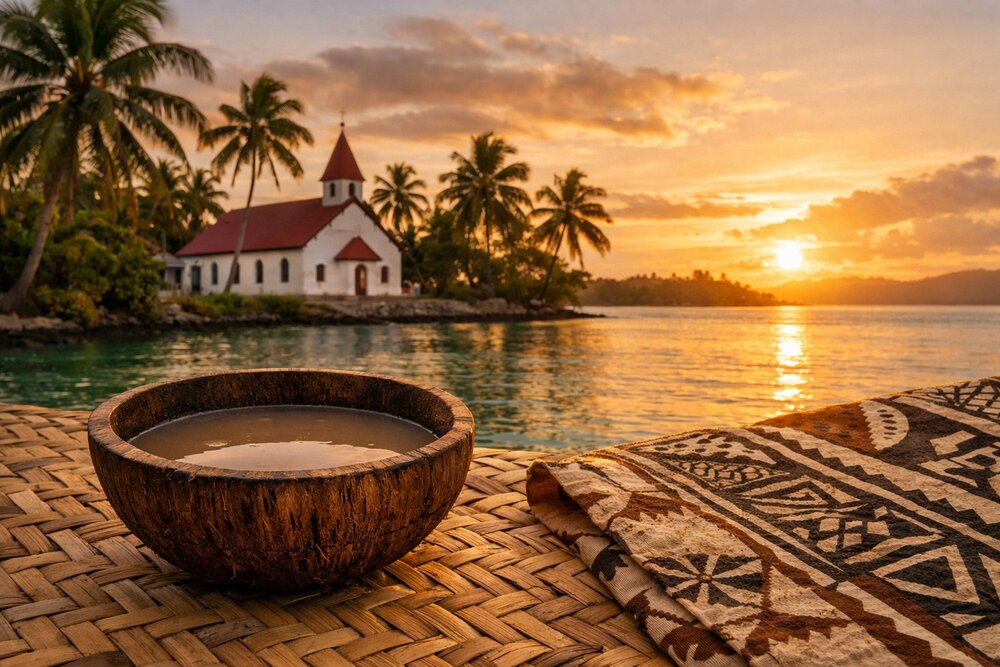
Kava and tapa barkcloth — the two materials without which no customary occasion happens.
The local word is simply kava, for both the plant (Piper methysticum, a pepper) and the drink. Men alone grow it and prepare it. The roots are pounded to a pulp and strained with water through cotton-tree fibre into a carved wooden bowl, the tanoa. The result is earthy, peppery, mildly numbing on the tongue, and calming rather than intoxicating.
What sets Wallis and Futuna apart is not the preparation — that is much as in Fiji or Tonga — but what the ceremony does. Here kava is constitutive of authority. It is always performed at the enthronement of a customary king and his chiefs; on Futuna, the title of 'aliki is conferred through a rite that is literally called the kava rite. It opens the katoaga, it precedes negotiations, and the night before a kilikiti match both teams hold a kava ceremony called kava ka hui. In Futuna everyone present claps when the king drinks his bowl.
The order of the cups carries meaning. By tradition the first two go to matapule, members of the king's personal guard, who once served as poison-testers; the king takes the third, and the last cup returns to him. The origin story is grim and beautiful: a destitute couple on a barren island, visited by their king and having nothing to offer, killed and cooked their leprous daughter with their only kapé plant. The horrified king ordered her buried and the grave watched. From it grew a shrub no one had seen before — the kava. It is understood as the gift the people give their king.
Alongside kava: French wine, champagne and spirits are imported and drunk, mostly by the administrative community and at celebrations; beer comes in from Fiji, New Caledonia and Australia. Alcohol duties raised 233 million XPF in 2024, a real line in a territory with no income tax. If you are offered kava, accept, clap when others clap, and drink the bowl in one.
14
🍸 Cocktails & Mixed Drinks
There is no cocktail tradition here in the bar-culture sense — no distillery, a handful of licensed venues, and a social life organised around kava and the church. What follows are drinks built honestly from what the islands actually have: coconut, lime, tropical fruit, imported French spirits and, in one case, kava itself.
Lalolalo
A dark, still drink named for the crater lake. 50 ml aged rum, 25 ml fresh lime, 20 ml coconut cream, 10 ml cane syrup, a pinch of salt. Shake hard with ice, strain into a chilled coupe, and float a few drops of dark rum on the surface so it sits like the cliff shadow on the water.
Tanoa
The one that uses kava, and the one to approach carefully. 60 ml strained kava, 20 ml coconut cream, 15 ml lime, 10 ml honey syrup, a grating of nutmeg. Stir, do not shake. Earthy, faintly numbing, not remotely a party drink. Kava interacts with alcohol and with a number of medications, and has been associated with liver injury; do not combine the two and skip this one entirely if you take anything regularly.
Mei Royale
The French half of the territory in a glass. 20 ml breadfruit-and-vanilla syrup (simmer roasted breadfruit with sugar, water and a split vanilla pod, then strain), topped with cold champagne or dry sparkling wine. Twist of lime peel.
Honikulu (no alcohol)
Named for the one navigable pass through the reef. 100 ml young coconut water, 40 ml passionfruit pulp, 15 ml lime, 5 ml ginger syrup, soda to top. Long glass, plenty of ice, mint. The correct drink for the middle of a Wallisian afternoon.
15
🌤 Climate
Tropical maritime, hot and humid year-round, with daytime temperatures sitting between about 26 and 32 °C and very little seasonal variation. What changes is the rain and the wind.
The wet season runs November to April, bringing heavy rainfall, high humidity and the cyclone risk; the drier, cooler and windier season runs May to October, driven by the southeast trades, and is much the better time to visit. Annual rainfall is high — comfortably over 2,500 mm on Wallis and higher again on Futuna's mountainous terrain, which wrings more water out of the same air.
The official cyclone season is 1 November to 30 April, and it is not theoretical. Recent seasons brought Cyclone Tino in January 2024, tropical depression Pita in early January 2025, and tropical depression RAE on 24 February 2025, which hit Futuna hard — island-wide loss of water, power and telephone service, a landslide at Fiua that cut a water main, and structural damage that closed the school at Sausau indefinitely. Futuna's steep terrain makes landslides the primary hazard; Wallis, low and reef-protected, suffers more from flooding and storm surge.
When to go: June to September. Driest, least humid, lowest cyclone risk, and it brackets both Bastille Day and Territory Day, which are the best weeks of the year to see customary life in the open.
16
✈ Getting There & Getting Around
Getting to Wallis and Futuna is the single hardest part of visiting it, and the reason so few people do. There is one international gateway, one airline serving it, and a handful of flights a week.
International.Hihifo Airport (WLS) on Wallis is served by Aircalin (Air Calédonie International) alone, flying an A320neo from Nouméa, New Caledonia — about 2,100 kilometres and three hours. For the 2026/27 austral summer the schedule runs three flights a week. Crucially, and contrary to the common claim that Wallis connects to nowhere else, several of those weekly sectors route via Nadi, Fiji, which gives a genuine second point of entry and a much wider set of onward connections. There is no scheduled service to Samoa, despite Samoa being the nearest neighbour — a standing oddity of Pacific aviation.
Traffic collapsed during the 2024 New Caledonia riots, when the closure of La Tontouta cut external flights from 290 to 220 and airport traffic fell 11.3%. It has more than recovered: 46,141 passengers in 2025, an all-time record. Hihifo is in the middle of a major upgrade — a new control tower operational in 2026, and a €23 million resurfacing of more than 115,000 m² of runway and taxiway begun in mid-2026, worked at night specifically so flights are not interrupted. The aggregate for it was barged in from Tasmania via Fiji.
Wallis to Futuna. This is where most published guidance is out of date. The inter-island route is no longer flown by Aircalin, which held it from 1987 until the end of 2023. Since 1 January 2024 the public-service route has been operated by Air Oceania — the New Caledonian carrier formerly called Air Loyauté, which took the new name in May 2025. The aircraft is a 19-seat DHC-6 Twin Otter, contracted for two rotations a day, six days a week, with extra services in school holidays; it flew 793 rotations in 2025 against 750 contracted.
Expect cancellations. Pointe Vélé (FUT) on Futuna sits on a shelf between sea and cliff, and northerly crosswinds above roughly 20 knots ground the aircraft regardless of type. The carrier says so publicly. If you are connecting onward from Futuna, build in slack of a day or more — this is the single most common way a trip here goes wrong.
Sea. Cargo ships call at Mata-Utu through the Honikulu pass and at Leava on Futuna, but there is no passenger ferry between the two islands and no cruise traffic to speak of. A new deep-water quay at Leava — a 62 × 18 metre concrete platform — is a flagship project for the territory, because Futuna's supply line depends on it.
On the islands. There is no public transport, no taxi rank you can rely on, and no international car-rental desk. Wallis has a ring road and a handful of local hire operators; guesthouses will usually arrange a vehicle or a driver, and this should be organised before arrival rather than on the day. Roads are paved on the main routes and rough elsewhere. Distances are trivial — you can drive round Uvea in an afternoon.
17
📋 Practical Information
✅ Travel Advisory — no specific warning
The US State Department issues no advisory specific to Wallis and Futuna. It lists French Polynesia and New Caledonia as separate destinations but not this territory, which therefore falls under the advisory for the French Republic: Level 2, Exercise Increased Caution (issued 28 May 2025, for civil unrest and terrorism) — risk factors that relate to metropolitan France and have no local application here. The UK FCDO does publish a dedicated Wallis and Futuna page (last content update 10 December 2025) and advises against travel in no part of the territory. Australians are served by the consulate-general in Nouméa. In practical terms this is one of the safest places you can go; crime against visitors is close to non-existent.
⚠ Active health alert — dengue, 2026
A dengue epidemic was declared in mid-May 2026 and is still running. The first locally acquired case was recorded on Futuna on 22 April 2026; the outbreak has since grown to roughly 225 cases, and the latest reporting has transmission slowing on Futuna but rising on Wallis. It sits within a wider Pacific dengue wave affecting Samoa, the Cook Islands and New Caledonia. Bring and use repellent, cover up at dawn and dusk, and check the current situation with the Agence de santé before you travel.
Entry. Wallis and Futuna is French territory but outside the Schengen area, so Schengen rules do not automatically apply. EU citizens enter with an identity card or passport. Nationals of many countries, including the UK, US, Canada, Australia, New Zealand and Japan, do not need a visa for short stays; others need a visa specifically valid for Wallis and Futuna, which a Schengen visa alone does not provide. Check with a French consulate, and note that you will very likely transit New Caledonia or Fiji, each with its own rules.
Money. The CFP franc (XPF), fixed to the euro since 1 January 1999 at €1 = 119.33 XPF — a peg unchanged for more than a quarter of a century, so there is no exchange-rate risk against the euro at all. Periodic proposals to adopt the euro outright have gone nowhere and any changeover would take years. There is no income tax; the territory runs on French transfers and customs duties. Card acceptance is limited and ATMs are few — bring cash, and more of it than you think.
Health. There is a hospital at Sia on Wallis and a smaller facility on Futuna. Serious cases are evacuated to Nouméa. There is no malaria. Take out insurance that explicitly covers medical evacuation from a remote Pacific territory — it is the one piece of paperwork that genuinely matters here.
Connectivity. Better than the isolation suggests. The territory was connected to the Tui-Samoa submarine cable in 2018 — the cable ship worked Leava Bay in November 2017 and both islands have branches, Futuna included. The effect is measurable in the census: household internet access went from 37.0% in 2018 to 72.5% in 2023, and mobile phone ownership from 69.5% to 89.2%, though Futuna (59.9%) still lags Wallis (77.2%). Because the whole territory hung off a single cable, Orange announced the Nuanua project in January 2025, adding satellite redundancy via SES O3b mPOWER. Fibre rollout across Wallis continues. Calling code +681; time zone UTC+12.
Etiquette, which here is not optional. Sunday is genuinely observed — no work, no shopping, and swimming at public beaches is frowned on. Dress modestly away from the beach; shoulders and knees covered in villages and always in church. Ask before photographing people, ceremonies or the royal palace. If you are received by a king or a chief, follow whatever your host tells you, remove your hat, sit when others sit, and accept the kava. Land is customarily owned and access is a matter of permission, not right — ask before crossing or swimming anywhere that looks like someone's ground. A gift for a host is expected rather than optional.
Languages. French is administrative; Wallisian and Futunan are the languages of daily life. English is rarely spoken. A little French goes a very long way; two words of Wallisian — malo (thank you) and malo te ma'uli (hello) — go further.
18
💵 Cost of Living & Travel Budget
Wallis and Futuna is expensive, and not because it is a luxury destination. Almost everything is imported — 10.6 billion XPF of imports in 2024 against essentially no exports — and it arrives by ship or by a thrice-weekly A320. Metropolitan France supplies 27% of imports, Singapore 14%, New Caledonia 13%, New Zealand and Fiji 8% each.
The territory has an official measure of this problem. The Bouclier Qualité Prix caps a basket of essential goods at a negotiated total: in 2025 it covered 88 products for 114,780 XPF (about €962), up from just 11 products when the scheme began in 2013. Inflation averaged 2.9% in 2024, down from 4.9% in 2023, with electricity up 8.2% and fuel down 2.6%.
Item
XPF
approx. €
Guesthouse room, per night
6,000–9,000
50–75
Hotel room, per night
10,000–18,000
84–150
Meal at a small restaurant
2,000–3,500
17–29
Snack bar / plate lunch
900–1,500
8–13
Car hire, per day
6,000–9,000
50–75
Wallis–Futuna return flight
25,000–35,000
210–295
Nouméa–Wallis return
85,000–145,000
710–1,215
Boat charter to the motu, half day
10,000–20,000
84–168
Prices are indicative ranges for 2026, converted at the fixed peg of 119.33 XPF to the euro. The airfare is the budget; everything else is a rounding error against it.
For context on the local economy: the most recent GDP estimate is 2019 — 22.6 billion XPF, roughly €189 million, or about €16,400 per head, some 45% of the metropolitan French level. There has been no newer estimate, which is itself telling. Unemployment was 8.2% at the 2023 census but 29.9% among under-25s, and 52.9% of all jobs are public sector. A record 433 people were banned from banking in 2024, up 47% in a year.
19
🏨 Accommodation
Here is a correction to something almost every description of Wallis and Futuna repeats: the claim that there are "no hotels in the conventional sense" is false. The territorial tourism board currently lists around sixteen properties across the two islands, several of them purpose-built hotels with restaurants, pools and air conditioning. What the territory has no trace of is international chains and resorts — which is a different statement entirely.
On Wallis:Hôtel Lomipeau, the largest, about 8 km from the airport and 800 m from Mata-Utu, with restaurant, pool, jacuzzi and gym; Hôtel Moana Hou at Aka'aka, on the water below Lomipeau, with 22 rooms plus studios and bungalows; Hôtel Ulukula in central Mata-Utu; Hôtel Albatros beside the airport at Alele; the Auberge Tanoa in Mata-Utu for dormitory beds; plus guesthouses including Gîte Océania, Chambres d'hôtes Lausikula, Motu Location and KF Logement.
On Futuna:Hôtel Fiafia at Nuku, Somalama Park Hôtel at Toloke (8 rooms), the beachfront Hôtel Afiafi, the Motel du Motu and Siale Logement at Leava, and MMF Hébergement at Kolia in Alo.
Book before you fly. Capacity across the whole territory is a few dozen rooms, and a single official delegation or a large family occasion can absorb most of it. There is no meaningful online booking infrastructure — expect to email or telephone, in French, and to confirm again closer to the date. Guesthouses will normally organise airport transfers, a hire car and boat trips, and they are the practical way to arrange anything on these islands.
20
🎉 Festivals & Events
The calendar here is Catholic and customary in roughly equal measure, with two republican dates bolted on. The events that matter most are not scheduled tourist attractions — they are village obligations, and visitors attend as guests.
28 April — Saint Peter Chanel Day. A public holiday across the territory and the single biggest day in the Futunan year, centred on the basilica at Poi where he was martyred in 1841. On 27 April the faithful of Alo and Sigave process with his relics from Tamana to the basilica.
14 July — Bastille Day. Marked with official ceremony and, more interestingly, with traditional sports: pa ulutoa and pa sika javelin throwing, kilikiti matches and soamako dancing.
29 July — Fête du Territoire (Territory Day). The territory's own national day, commemorating the statute of 29 July 1961 that created the collectivity and wrote the three kingdoms into French law. Official, customary and festive ceremonies run together — the best single day to be here.
15 August — Assumption, and the Feast of the Sacred Heart, both major village occasions.
1 November — All Saints. Preceded by three weeks of hiva mate, funeral songs, broadcast on local radio — one of the most distinctive sounds of the Wallisian year.
Katoaga — not a fixed date but the real centre of the calendar. Village and district feasts held for saints' days, enthronements, weddings, communions and funerals, prepared over weeks or months.
Two more worth knowing: the enthronement of a king or the induction of a bishop triggers the largest ceremonies the territory produces, and the 2013 Pacific Mini Games — held at Mata-Utu in September 2013, the only international multi-sport event ever staged here — is still a reference point in local memory.
21
🏛 UNESCO & Heritage
Wallis and Futuna has no UNESCO World Heritage Sites. Zero. This is not an omission in this guide — it is the settled fact, and it is worth stating plainly because so many country pages quietly imply otherwise.
France is the State Party, having accepted the Convention on 27 June 1975, and holds 56 inscribed properties. None is in Wallis and Futuna. Nor is there anything from the territory on France's Tentative List — the roughly thirty sites France has formally flagged as future candidates — which was checked against the World Heritage Committee's own itemised tentative-list document. France's one Pacific inscription, Te Henua Enata — The Marquesas Islands (2024), is in French Polynesia, a different collectivity entirely, and is regularly and wrongly attributed to this one.
The same is true of the Intangible Cultural Heritage list — a separate register that is frequently confused with World Heritage. France has inscribed elements from Guadeloupe (gwoka, 2014), Réunion (maloya, 2009) and Martinique (yole boats, 2020). Nothing from Wallis and Futuna appears on it either. If you see kava, tapa, katoaga or kilikiti described as UNESCO-recognised, that is wrong.
What the territory does have is unprotected heritage of real quality, which is arguably the more interesting story. Talietumu (c. 1450), the restored Tongan fortress at Mua, is among the most substantial pre-European monuments in western Polynesia and carries no international designation at all. So do Tonga Toto, the crater-lake sacred forests held under customary authority, the Basilica of Saint-Pierre-Chanel at Poi, and the extraordinary village churches of Uvea. Protection here rests on custom and the Church, not on a plaque.
22
💎 Hidden Gems
Lake Lalolalo at first light. Get there before the wind picks up, when the surface is glass and the cliffs are still in shadow. Nobody else will be there.
Alofi for a day. An entire uninhabited island, twenty minutes across the Vasa strait, with empty beaches and the ruins of the church at Alofitai. Arrange it through a Futuna guesthouse.
The village churches of Uvea. Drive the ring road and stop at every one. They are enormous, ornate, individually decorated, and almost never mentioned in anything written about the Pacific.
Talietumu at Mua. A 15th-century fortress you will very likely have entirely to yourself.
A kilikiti match. Polynesian cricket, village against village, with conch shells, drums and whistling. Played in front of the church at Malaefo'ou, on the football field at Fuga'uvea, and in front of the royal palace.
The motu of the lagoon. Nukuatea, Nukuhione, Nukuhifala, Faioa — ask a boat owner in Mata-Utu, bring your own water and food, and have them come back for you.
Mont Puke on Futuna. A genuine climb to 524 metres with the whole territory's best view from the top.
The wreck-strewn floor of Lalolalo. Not divable, but the story is real: departing American forces dumped surplus jeeps and equipment over the cliffs in 1944.
Sunday morning anywhere. Mass, in Wallisian, with unaccompanied harmony singing that will stop you in the doorway.
23
🎒 Packing Tips
Cash in XPF. Card acceptance is patchy and ATMs are scarce. This is the single most common practical mistake.
Modest clothing. Shoulders and knees covered for villages and churches; a light long-sleeved shirt and a wrap or long skirt earn goodwill everywhere.
Serious insect repellent — with a dengue epidemic running in 2026 this is not a comfort item. Plus long sleeves for dawn and dusk.
Reef shoes. The lagoon floor is coral, not sand.
Any medication you take, in quantity, in its original packaging. Pharmacy stock is limited and resupply is by ship.
Reef-safe sun protection and a wide-brimmed hat — you are 13° from the equator.
A dry bag for boat trips to the motu, and for the wet season generally.
Gifts for hosts. Something from home is expected if you are received by a family or a chief.
A French phrasebook, and offline maps downloaded before you arrive.
Travel insurance covering medical evacuation from a remote Pacific territory. Check the wording specifically.
Slack in your itinerary. The Futuna flight cancels for wind more often than anyone likes.
Frédéric Angleviel, Les missions à Wallis et Futuna au XIXe siècle — the standard scholarly account of the missionary period and how the theocracy actually worked.
Christophe Sand, « Empires maritimes préhistoriques dans le Pacifique », Journal de la Société des Océanistes 108 (1999) — the key paper on the Tongan colonisation of Uvea and the archaeology behind Talietumu.
Daniel Frimigacci and colleagues — the CNRS excavation and restoration reports on Talietumu and Uvea's fortifications.
Hugh Laracy, Marists and Melanesians and his essays on Chanel — the best English-language treatment of the mission and the martyrdom.
Sophie Chave-Dartoen, Royauté, chefferie et sacré à Wallis — anthropology of the customary system, and essential for understanding why the Uvea succession dispute is so intractable.
IEOM, Rapport annuel économique Wallis-et-Futuna — published yearly and freely available; dry, and by far the most useful current source on the territory.
INSEE Première no. 2021 (December 2025) — the analysis of the 2023 census and the depopulation story.
26
🎥 Video & Watching
Very little film exists about Wallis and Futuna, which is itself part of the point. Rather than link to channels that may vanish, here is what is worth searching for:
Wallis-et-Futuna La 1ère — the public broadcaster's own reports and archive, the richest video record of the territory anywhere, mostly in French and Wallisian.
« Katoaga » and « kava Wallis » — ceremony footage posted by local families and parishes; more honest than any documentary.
2013 Pacific Mini Games, Mata-Utu — the only substantial international broadcast footage ever shot here.
Aircalin Hihifo landing — cockpit and cabin videos of the approach, which give a better sense of the island's shape than any map.
« Lac Lalolalo » — drone footage; the only way most people will ever see the full circle of it.
27
✨ Fascinating Facts
More Wallisians and Futunians live in New Caledonia than in Wallis and Futuna — roughly 22,500 against 11,151. The diaspora is about double the homeland.
It is the only part of France with reigning kings — and as of 2026, one throne is vacant and another has two claimants.
There is no income tax, and no communes either. The territory has no municipal government at all; customary districts do the job.
142 square kilometres of land command an exclusive economic zone of 256,745 square kilometres — a ratio of about 1,800 to 1.
It shares five maritime boundaries, more than any other French overseas territory, and one of them — with Samoa, its nearest neighbour — has never been delimited.
Wallis is not in French Polynesia, despite being described that way constantly. The two collectivities are about 3,000 km apart.
Lake Lalolalo has no shore. Vertical cliffs drop straight into roughly 80 metres of water, and American forces used it as a dump in 1944.
The island's name for itself is Uvea; Samuel Wallis, whose name it carries, was mainly famous for reaching Tahiti.
The territory is outside the Schengen area even though it is fully French, so a Schengen visa does not get you in.
The CFP franc has been pegged at 119.33 to the euro since 1999 — more than a quarter of a century without a move.
Household internet access nearly doubled in five years, from 37% to 72.5%, after a single submarine cable arrived in 2018.
Futuna's airstrip closes for wind whenever northerly crosswinds exceed about 20 knots — a routine event, and the reason no itinerary here should be tight.
Saint Peter Chanel's murderer converted, and asked to be buried at the site so that pilgrims would walk over his grave.
There are more pigs than people, according to the territory's own tourism board.
No fertilisers or pesticides are imported, making the territory's produce organic by default.
28
⭐ Notable People
Saint Peter Chanel (1803–1841) — French Marist priest, clubbed to death at Poi on Futuna on 28 April 1841 on the orders of King Niuliki, beatified 1889 and canonised 12 June 1954. The protomartyr and patron saint of Oceania, and the reason a minor basilica stands on an island of three thousand people.
Manaé Feleu (b. 2000) — captain of the France women's rugby union team, and the most prominent person alive with a Futunan upbringing. She grew up on Futuna, where her parents were the island's only PE teachers and founded rugby at the school. She captained France at the 2025 Rugby World Cup. Her sister Teani Feleu also plays for France.
Nivaleta Iloai — retired schoolteacher and politician, and the first woman to preside over the Territorial Assembly, serving in 2013 and again from November 2020 to March 2022. She led the Assembly through COVID-19 and a dengue epidemic and hosted President Macron's visit in July 2021.
Tomasi Kulimoetoke II (reigned 1959–2007) — Lavelua for almost half a century, whose death opened the succession crisis that has never fully closed.
Bishop Pierre Bataillon (1810–1877) — Marist who converted Uvea and wrote its first written law code, the Tohi Fono o Uvea, adopted 20 June 1870.
The Taofifénua family — Romain and Sébastien Taofifénua, France rugby internationals; their father Willy came from Wallis and Futuna and played in France.
Sébastien Vahaamahina, Yoram Moefana, Peato Mauvaka, Christian Tolofua, Vincent Pelo and the Lakafia brothers — French professional rugby players of Wallisian and Futunian descent, most from the New Caledonian community.
Mikaele Seo — deputy for Wallis and Futuna in the French National Assembly, re-elected in the first round on 30 June 2024 with 62% of the vote.
Munipoese Muli'aka'aka — President of the Territorial Assembly since March 2022.
Queen Aloisia Brial — Lavelua of Uvea until her abdication on 12 September 1958, one of the few reigning queens in the territory's modern history.
A note on the rugby claim you will see everywhere: that Wallis and Futuna produces more professional rugby players per head of population than anywhere on Earth. It is a media assertion rather than an audited statistic, and it is usually calculated on a stale population figure of 13,000 rather than the 2023 census figure of 11,151. Which, if anything, makes it stronger — but it remains a claim, not a measurement.
29
🏉 Sports
For a territory of eleven thousand people, Wallis and Futuna punches implausibly hard — though mostly through its diaspora, and mostly in rugby.
The recent high point is 2023. At the Pacific Games in Honiara, Solomon Islands, the Wallis and Futuna women's rugby sevens team won bronze, beating Tonga in the third-place play-off on 25 November 2023 — in the team's first ever appearance at the Games. They lost their opener to Fiji, then beat the Cook Islands 22–12 on the way through. The organisers' own headline called it a surprise. It is the most significant sporting result the territory has ever recorded and is routinely left out of descriptions of the place.
The territory has also hosted. The IX Pacific Mini Games were held at Mata-Utu from 2 to 12 September 2013 — 22 nations, eight sports and 99 gold-medal events, staged at the Stade de Mata-Utu, Kafika Hall, the Bay of Gahi for va'a, Tekaviki island for sailing, and Kolopelu on Futuna for beach volleyball. The motto was Le Pacifique Autrement, Le Pacifique Simplement. Wallis and Futuna won gold in both taekwondo and athletics as hosts. Published medal tallies for those Games conflict with each other and the official results omit the sailing events entirely, so this guide does not state a total.
Rugby is the national sport in everything but name. The territory is governed as a comité territorial of the French Rugby Federation rather than as an independent union, which is why its players appear in French shirts rather than their own; it is an associate member of the Federation of Oceania Rugby Unions. Its first fifteen-a-side international was at the 1966 South Pacific Games, and the modern focus is sevens.
Football tells the opposite story. Wallis and Futuna is not a member of FIFA and not a member of the OFC, so it cannot enter the World Cup or the OFC Nations Cup. Its national team has played just 24 internationals in its history — all at the South Pacific Games between 1966 and 1995, for a record of 5 wins and 19 losses — and has not played for decades.
Va'a (outrigger canoe racing) is the other serious competitive sport, and the traditional race has its own names: fakatete in Wallisian, kumete in Futunan. And then there is kilikiti, Polynesian cricket, which the tourism board calls uniquely Wallisian — oral tradition traces it to the village of Vailla, brought by Tongans north of Hihifo in the early 19th century. It is played village against village, with a squad size set by the hosts, amid conch shells, drums, whistles and foot-beating. Each team picks a sea, a luck-bringer, usually a dignitary; the night before, both sides hold a kava ceremony called kava ka hui. Traditional javelin — pa ulutoa and the lighter pa sika — comes out for Bastille Day and Territory Day.
The next Pacific Games are in Pirae, Tahiti, from 24 July to 7 August 2027.
30
📰 Media & Press Freedom
The media landscape is essentially one organisation. Wallis-et-Futuna La 1ère, part of France Télévisions' overseas network, provides radio, television and online news, and is fairly described locally as the historic and unique medium of the fenua. It began as an FR3 regional station broadcasting radio from 31 March 1979, created after consultation between the French state and King Tomasi Kulimoetoke II. There is no independent newspaper and no commercial broadcaster of scale; social media and the parish network carry much of what circulates.
On press freedom, the honest answer is that Reporters Without Borders does not rank Wallis and Futuna separately — nor New Caledonia, nor French Polynesia. The territory falls under France, which in the 2026 World Press Freedom Index ranks 25th of 180 with a score of 76.68, unchanged in rank from 2025 (76.62). Within that, France's economic indicator worsened over the year, from 63.13 to 61.43, while its security score improved sharply. Any source that quotes a specific press-freedom ranking for Wallis and Futuna has invented it.
In practice the constraint here is not censorship but scale and distance: a single newsroom serving eleven thousand people across two islands 230 kilometres apart, in three languages, dependent until 2018 on satellite and since then on a single submarine cable.
31
📸 Photo Gallery
Click any image to enlarge. Photographs of Wallis and Futuna are genuinely scarce — if you have been, we would like to see yours: photos@kaufmann.wtf
Fakaʻuvea & Fakafutuna — Two Living Polynesian Languages
Wallisian and Futunan are distinct Polynesian languages, not interchangeable dialects. Fakaʻuvea carries strong Tongan influence, while Fakafutuna is closer to Samoan. French dominates administration and formal education, but local languages remain central to family life, ceremony and identity.
Fakaʻuvea and Fakafutuna belong to the Polynesian branch of the Austronesian language family, yet they are not interchangeable. French dominates administration and schooling, while the two island languages carry genealogy, customary rank, humour and oral memory; their vitality depends on families using them across generations as well as on teaching and broadcasting.
33
Lapita Origins — The First Navigators
Archaeological finds connect the islands to the Lapita expansion that carried skilled navigators, horticulture and decorated pottery across Remote Oceania. This deep past places Uvea and Futuna within one of humanity’s most remarkable traditions of open-ocean settlement.
Lapita history connects these islands to a vast archaeological horizon stretching across Remote Oceania. Pottery fragments, settlement traces and comparative linguistics help reconstruct movement, exchange and adaptation, but they do not reduce modern islanders to a single migration story: later Tongan influence and locally rooted political traditions also shaped the societies encountered today.
34
Talietumu — Fortress of the Tongan Era
Near Halalo, the stone ruins of Talietumu preserve the memory of Tongan influence over Uvea. Defensive walls, platforms and pathways reveal a political landscape far more complex than the modern image of an isolated tropical island.
The earthworks at Talietumu are best understood as a cultural landscape rather than an isolated ruin. Defensive walls, raised platforms and the surrounding paths point to an organised centre associated with the period of Tongan power; visitors should stay on established routes and avoid treating archaeological stonework as seating or a source of souvenirs.
35
Lake Lalolalo — The Blue Crater
Lalolalo is the most dramatic of Wallis’s volcanic crater lakes: a near-circular basin edged by steep forested walls. Its depth and dark-blue water have inspired local stories, while the surrounding vegetation offers one of the island’s most memorable landscapes.
Lalolalo is one of several volcanic crater lakes that reveal the geological origins of Uvea. Its steep forested rim and dark water create a dramatic view, but access and safe vantage points can change with vegetation and weather. The lake is not a swimming attraction, and local guidance should take priority over photographs shared online.
36
Saint Peter Chanel & Poi
The basilica at Poi commemorates Pierre Chanel, the Marist missionary killed on Futuna in 1841 and later canonized as Oceania’s first Catholic saint. The story remains inseparable from Futuna’s conversion, colonial encounter and modern pilgrimage culture.
Pierre Chanel was killed on Futuna in 1841 and canonised in 1954, becoming the first martyr and patron saint of Oceania in the Catholic tradition. The sanctuary at Poi is therefore both a pilgrimage destination and part of a living local religious landscape; dress, photography and behaviour should reflect that distinction.
37
Alo & Sigave — One Island, Two Kingdoms
Futuna is divided between the customary kingdoms of Alo and Sigave. Their boundaries, chiefly titles and ceremonial obligations remain socially meaningful, creating a political geography that coexists with the institutions of the French Republic.
Alo and Sigave divide Futuna into two customary kingdoms whose boundaries, titles and village relationships remain socially meaningful. Their coexistence illustrates why Wallis and Futuna cannot be described simply as a small French administrative unit: customary authority works alongside republican institutions and the Catholic Church in everyday public life.
38
The New Caledonian Diaspora
More Wallisians and Futunians live in New Caledonia than in the home islands. Migration provides education, work and family connections, but it also accelerates depopulation and makes nearly every household part of a wider trans-Pacific network.
New Caledonia is central to the territory's modern demographic story. Education, employment and family networks have drawn generations away from the home islands, while remittances, visits and ceremonial obligations keep the archipelago connected. Population decline is therefore not only a statistic but a recurring negotiation over language, land and who can return.
39
Economy, Public Service & Remittances
Public administration is the largest formal employer, while household agriculture, fishing, transfers from France and remittances support daily life. Distance, a small market and high freight costs limit private-sector growth, making economic resilience a central challenge.
Public administration, household transfers and imported goods dominate economic life, while geographic isolation raises transport and energy costs. Small-scale agriculture, fishing, construction and services remain important locally. Any investment claim should be tested against shipping frequency, workforce availability, customary land arrangements and the limited size of the resident market.
40
Digital Connectivity & Island Distance
A submarine cable improved internet access, yet geography still shapes communications. Wallis and Futuna spans two island groups separated by roughly 230 kilometres, so transport interruptions affect government, healthcare, education and family contact.
Distance is experienced digitally as well as physically. Mobile and internet services have improved, but performance, coverage and pricing may differ sharply from mainland France and can be disrupted by weather or infrastructure faults. Travellers who require reliable access should confirm current options and keep offline copies of essential documents and maps.
41
Reefs, Forests & Environmental Pressure
Coral reefs, lagoons and coastal forests sustain food systems and protect settlements. Waste management, shoreline pressure, invasive species and warming seas are increasingly visible concerns, especially where small land area leaves little room for infrastructure.
The lagoon, reefs, freshwater systems and remaining forest are closely linked to food security and cultural practice. Waste disposal, invasive species, shoreline development and pressure on fisheries require local solutions rather than visitor assumptions. Reduce packaging before arrival, avoid touching coral and follow community rules for fishing grounds and sensitive sites.
42
Climate Change & Coastal Resilience
Sea-level rise, stronger rainfall extremes and coral stress add new risks to communities already exposed to cyclones and supply disruption. Adaptation depends on local knowledge as much as engineering: protecting water, gardens, reefs and safe building sites together.
Sea-level rise is only one part of climate risk. Coastal erosion, saltwater intrusion, coral stress, intense rainfall and cyclone damage interact with limited land, expensive construction and outward migration. Resilience therefore includes both physical protection and the preservation of local knowledge, social networks and routes for emergency supply.
43
Responsible Travel
Visitors should ask before photographing ceremonies or people, dress respectfully around churches, avoid walking across cultivated land and never remove coral or archaeological material. Limited services reward preparation, patience and direct support for locally owned businesses.
Responsible travel here is unusually personal because visitor numbers are small and communities are close-knit. Ask before photographing people or ceremonies, dress conservatively around churches, do not enter customary land without permission and avoid presenting ordinary village life as an untouched spectacle. Spending with locally run services keeps more value on the islands.
44
Business & Investment Outlook
Opportunities are narrow but real in renewable energy, sustainable fisheries, digital services, waste reduction and culturally responsible tourism. Any project must account for customary land tenure, small scale, freight costs and the authority of village and kingdom structures.
Commercial opportunity exists, but scale and logistics must be stated honestly. Renewable energy, communications, repair services, food processing and carefully managed tourism may answer real needs, yet projects must work with customary landholders and French regulation. A proposal built only on remoteness or exotic branding is unlikely to earn durable trust.
45
Wallis & Futuna in the Pacific
The territory is neither French Polynesia nor New Caledonia. Its closest cultural relationships reach toward Tonga, Samoa and Fiji, while its legal and financial framework remains French. Understanding that double orientation is the key to reading the islands accurately.
In regional terms, Wallis and Futuna sits between Melanesian and Polynesian networks while remaining institutionally tied to France and economically connected to New Caledonia. That combination explains its distinctive currency, migration patterns and diplomacy. Comparing it with Samoa, Tonga or French Polynesia is useful only when the important legal and historical differences remain visible.
46
Author's Note
Wallis and Futuna resists the usual shorthand of a tropical destination. Its lagoon, crater lakes and volcanic mountains are beautiful, but the territory’s real distinction lies in the way three Polynesian kingdoms, the Catholic Church and the French Republic continue to share the same small political and cultural space.
The islands should be approached without treating distance as emptiness. Uvea, Futuna and Alofi hold living languages, genealogies and obligations that extend far beyond their shores. To travel here responsibly is to notice those relationships—and to accept that visitors enter a society, not simply a landscape.
— Radim Kaufmann, 2026
Wallis and Futuna resists the usual travel narrative of discovery. Its value lies in relationships among land, church, kingdom, family and diaspora, not in a list of attractions. A careful visitor leaves with fewer sweeping claims, more respect for the islands' own names and a clearer sense of how distance shapes everyday choices.
Support This Project 🌍
This World Travel Factbook is a labor of love — free to use for all travelers. If you find it helpful, consider supporting its continued development.
Share your own photograph of Wallis and Futuna. Attach it to your email and include the location and your preferred credit. Send only photographs you own.
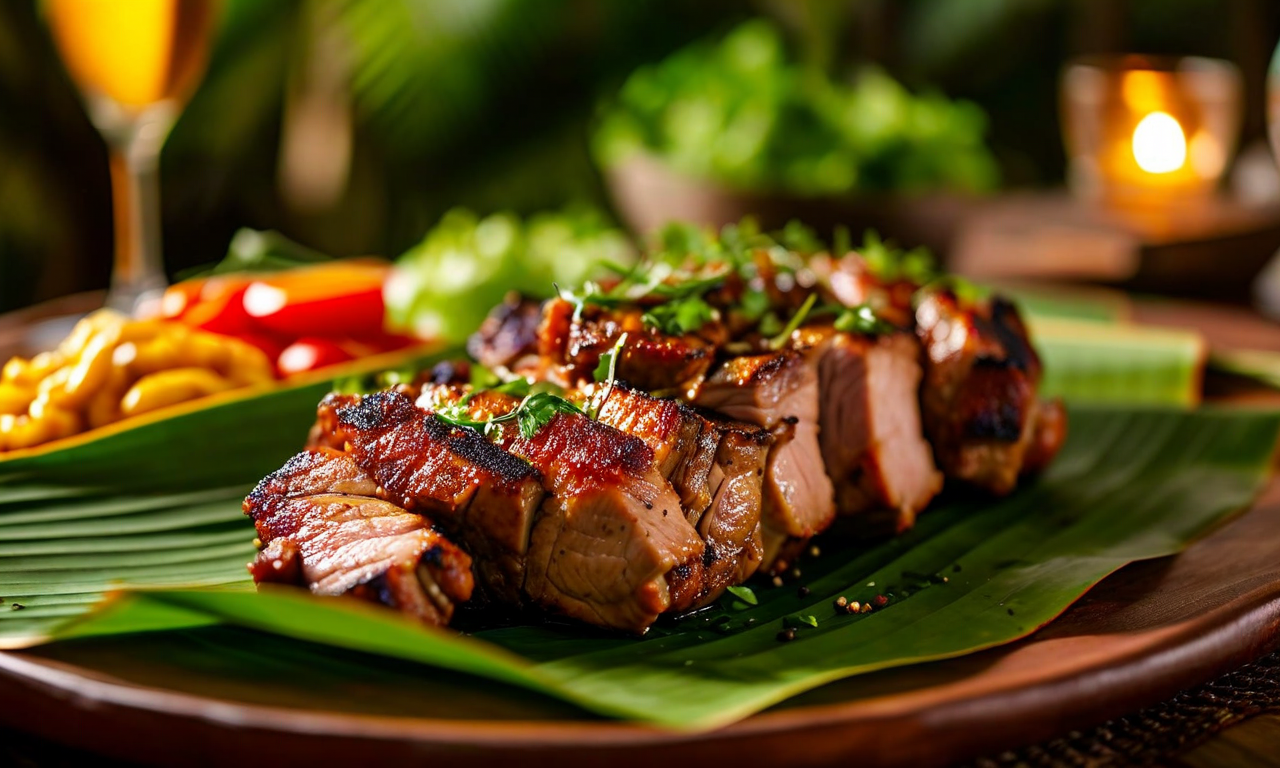 The Umu Feast
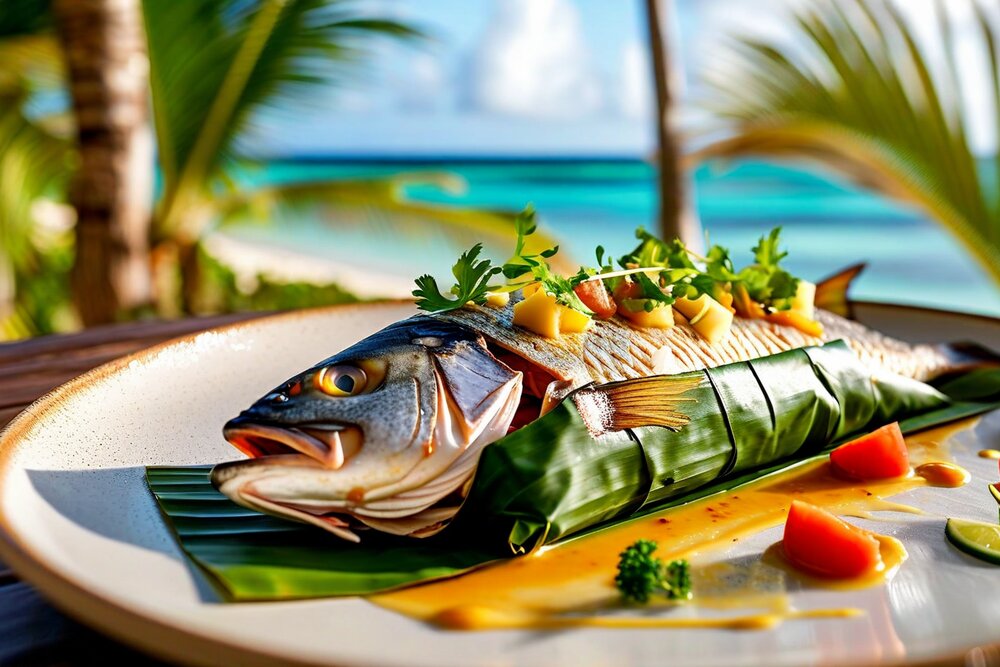 Fish from the Umu
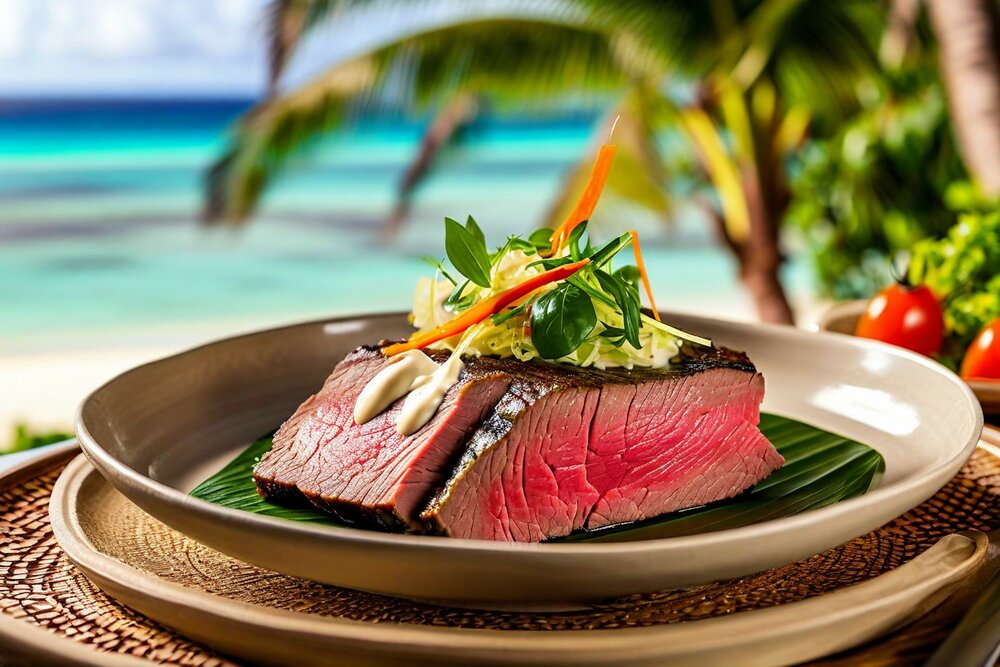 Povi Masima
 Pounded Starch Pudding
 Bread
Bread Island Cocoa
 Island Stew