Yemen is the Arabian Peninsula's hidden treasure โ a land the ancient Romans called "Arabia Felix" (Fortunate Arabia) for its legendary wealth from frankincense and myrrh. This is where the Queen of Sheba once ruled, where the world's first skyscrapers rose from desert wadis, and where one of Earth's most alien landscapes โ the island of Socotra โ harbors species found nowhere else on the planet.
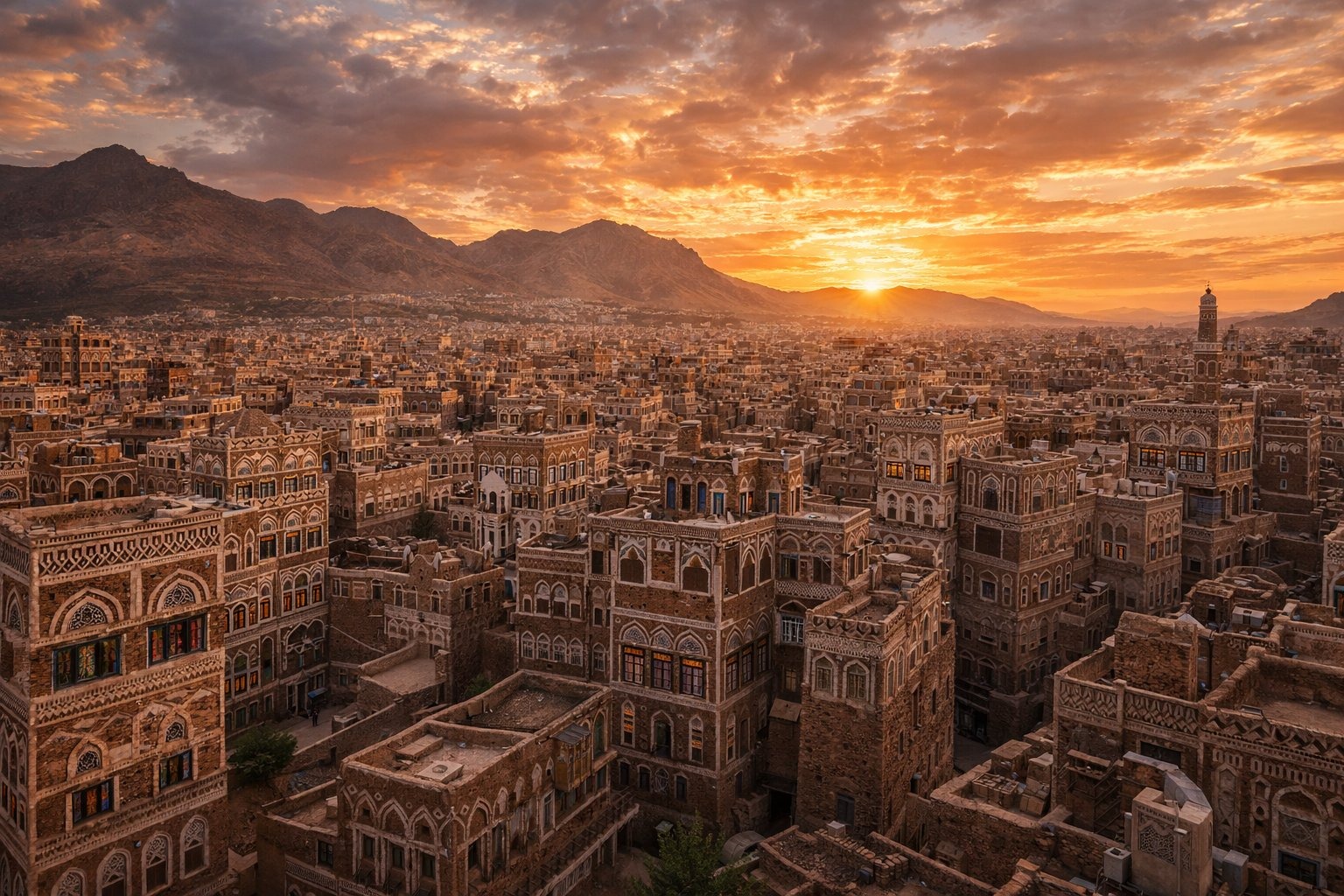
Sana'a's Old City, a UNESCO World Heritage Site, features tower houses that have stood for over a thousand years, their intricate gingerbread facades and stained-glass windows creating one of the world's most extraordinary urban landscapes. In Shibam, the "Manhattan of the Desert," 16th-century mud-brick skyscrapers rise dramatically from the Hadramaut valley floor. Yemen's landscapes range from the terraced mountains where coffee was first cultivated to the volcanic lunar scapes of Socotra's dragon blood trees.
โ ๏ธ Current Travel Advisory
United States: Level 4 โ Do Not Travel (reissued 19 December 2025, no change to the risk indicators: terrorism, civil unrest, crime, health, kidnapping, armed conflict and landmines). The UK, Australia, Canada and most EU states carry equivalent warnings, and Western embassies in Sana'a have been closed since 2015. Yemen has been at war since 2014 and is partitioned between two authorities: the internationally recognised government, run by an eight-member Presidential Leadership Council chaired by Rashad al-Alimi (since April 2022) and seated in Aden, and the Houthi movement (Ansar Allah), which holds Sana'a, the northern highlands and the Red Sea port of Hodeidah. The recognised government's prime minister is Shaya Mohsen al-Zindani, who also holds the foreign ministry, named on 15 January 2026 and sworn in on 6 February 2026. This guide is offered for education, and for the day conditions permit travel again.
02
๐ท๏ธ Name & Identity
The name "Yemen" (ุงููู ู, al-Yaman) likely derives from the Arabic root meaning "right" or "south" โ as Yemen lies to the right when facing east from Mecca. Another theory connects it to "yumn" meaning "blessed" or "fortunate." The ancient Sabaean, Minaean, and Himyarite kingdoms that flourished here controlled the lucrative incense trade routes, making southern Arabia fabulously wealthy.
Yemenis maintain a distinct identity shaped by their ancient heritage. The northern highlands were never colonized, preserving tribal traditions and unique architecture. The south, centered on Aden, experienced British rule (1839-1967) and later became the only Marxist state in the Arab world. North and South Yemen unified in 1990, though regional tensions persist.
03
๐บ๏ธ Geography & Regions
Yemen occupies the southwestern corner of the Arabian Peninsula, bordered by Saudi Arabia and Oman. Its diverse geography includes the dramatic western highlands rising to over 3,600 meters, the arid Rub' al Khali (Empty Quarter) desert in the east, fertile coastal plains along the Red Sea (Tihama), and the spectacular Hadramaut valley system in the south.
The island of Socotra, 350 km off the mainland, is a UNESCO World Heritage Site often called the "Galรกpagos of the Indian Ocean." Cut off from Africa for roughly six million years โ and from the Arabian mainland for perhaps twenty โ that isolation created extraordinary endemic species including the iconic dragon blood tree (Dracaena cinnabari) and bizarre cucumber trees. Over a third of Socotra's plant species exist nowhere else on Earth.
03b
๐บ๏ธ Map
04
๐ History โ Kingdoms of Incense
Yemen's history stretches back over 3,000 years to the great incense kingdoms of antiquity. The Sabaean Kingdom (1200 BCE - 275 CE), associated with the legendary Queen of Sheba (Bilqis), built the engineering marvel of the Marib Dam and controlled the lucrative frankincense trade. The Romans paid vast sums for Arabian incense used in temples, funerals, and perfumes throughout the ancient world.
Islam arrived in 630 CE during Prophet Muhammad's lifetime. Yemen subsequently fragmented into competing dynasties and tribal territories. The Rasulid Dynasty (1229-1454) brought a golden age, establishing Yemen's coffee trade through the port of Mocha (al-Mukha) โ the origin of the word "mocha." The Ottoman Empire controlled the coast while the Zaidi imamate ruled the highlands until 1962.
The 20th century saw Yemen divided: the British-controlled South achieved independence in 1967, becoming the People's Democratic Republic of Yemen (the Arab world's only Marxist state), while the North remained under republican rule after a civil war. Unification in 1990 proved unstable, and conflict has devastated the country since 2014.
05
๐๏ธ Sana'a โ The Eternal City
Sana'a's Old City is one of the world's oldest continuously inhabited places, with roots stretching back over 2,500 years. According to legend, it was founded by Shem, son of Noah. The UNESCO World Heritage Site contains over 6,000 traditional tower houses, their distinctive brown and white facades decorated with intricate geometric patterns and crowned with stained-glass fanlights called "qamariyya" that flood interiors with colored light.
The tower houses rise 5-9 stories, an extraordinary feat of mud-brick architecture. Each floor served a specific purpose: stables and storage below, then living quarters, guest rooms (mafraj) with the best views at top. The Great Mosque of Sana'a, founded during Prophet Muhammad's lifetime, contains ancient manuscripts and architectural elements from pre-Islamic temples.
At 2,300 meters elevation, Sana'a enjoys a temperate climate unusual for Arabia. The souqs of Bab al-Yemen offer silver daggers (jambiya), spices, frankincense, and qat โ the mildly stimulant leaf Yemenis chew socially each afternoon.
06
๐๏ธ Shibam โ Manhattan of the Desert
Rising from the floor of the Hadramaut Valley, the walled city of Shibam presents an astonishing silhouette: approximately 500 mud-brick tower houses reaching up to 11 stories, creating the world's oldest example of vertical urban planning. Dating primarily from the 16th century, these "world's first skyscrapers" earned Shibam its UNESCO World Heritage status and the nickname "Manhattan of the Desert."
The towers were built closely together for defense and to minimize sun exposure. Constructed entirely of sun-dried mud bricks, they require constant maintenance โ whitewashing the upper stories reflects sunlight while the lower portions remain natural brown. The engineering that allowed such heights in mud brick represents remarkable building knowledge passed down through generations.
07
๐ด Socotra โ The Alien Island
Socotra is Earth's most otherworldly landscape. Separated from mainland Africa 6 million years ago, this UNESCO World Heritage Site evolved in isolation, creating flora and fauna found nowhere else. The iconic dragon blood tree (Dracaena cinnabari), with its umbrella-shaped canopy and blood-red sap used since ancient times for medicine and dye, has become a symbol of the island's uniqueness.
Over 700 species are endemic to Socotra, including the grotesque-looking cucumber tree, the rare Socotran pomegranate, and frankincense trees. The island's white sand beaches, towering limestone cliffs, and turquoise lagoons add spectacular natural beauty to its botanical wonders. The indigenous Socotri people speak a language so ancient it preserves words from long-dead South Arabian tongues.
08
โ Aden โ Gateway to Arabia
Aden occupies one of the world's most dramatic natural harbors, formed within the crater of an extinct volcano. For millennia, this strategic port controlled maritime trade between the Mediterranean, Africa, and Asia. The British made it a Crown Colony in 1839, transforming it into one of the world's busiest ports โ by the 1950s, Aden was second only to New York in shipping traffic.
The city sprawls across volcanic peninsulas and ancient lava fields. Key landmarks include the Cisterns of Tawila โ 53 ancient water tanks carved into rock, possibly dating to the 1st century CE โ and the historic Crater district with its crumbling colonial architecture. The beaches of Gold Mohur and Elephant Bay once drew tourists, while Steamer Point served ocean liners on the Europe-Asia route.
09
๐ฝ๏ธ Yemeni Cuisine
Yemeni cuisine reflects the country's position at the crossroads of ancient trade routes. Dishes are hearty, aromatic, and meant for sharing. The national dish is saltah โ a meat stew topped with fenugreek froth (hulba) served in a stone pot, eaten communally with flatbread.
๐ Mandi
Slow-cooked rice and meat dish, originally from Hadramaut. The meat is cooked in a tandoor oven, infusing the rice with rich flavor.
๐ซ Malawah
Flaky layered flatbread, similar to paratha, often served with honey and ghee for breakfast or with savory dishes.
โ Qahwa
Yemeni coffee is legendary โ the port of Mocha gave the world "mocha" coffee. Often spiced with ginger, cardamom, or cinnamon.
๐ฏ Bint al-Sahn
"Daughter of the Plate" โ layered honey cake served with melted butter and honey, the quintessential Yemeni dessert.
Saltah
National Dish
Meat stew topped with fenugreek foamโeaten with flatbread.
Preparation: Brown lamb with onions. After that, add tomatoes and hawaij spice. Simmer until meat tender. Then add zhug for heat. Top with hulba foam. Last, serve in stone pot with bread.
๐ก Saltah is served bubbling in stone potโscoop with bread.
Mandi
Smoked Rice
Rice and meat slow-cooked with smokeโYemeni celebration dish.
Ingredients: 480ml basmati rice, 500g lamb or chicken, Hawaij spice, Onions, tomatoes, Charcoal for smoking, Ghee.
Preparation: Season meat with hawaij, slow cook until tender. Cook rice in meat broth. Add hot charcoal in small pot to finished dish. Then cover tightly to smoke. Smoke for 10-15 minutes. Finally, serve rice mounded with meat on top.
๐ก The smoking at the end gives mandi its distinctive flavor.
Ingredients: 480ml flour, Water, Butter or margarine, Salt, sugar.
Preparation: Make soft dough, rest overnight. Then divide into balls. Flatten, spread with butter. Fold into layers repeatedly. Then roll out again. To finish, pan-fry until golden and crispy.
๐ก The layers come from folding and butteringโpatience pays off.
10
๐ฅ Culture & Traditions
Yemeni culture preserves ancient Arabian traditions largely unchanged. The jambiya โ a curved dagger worn on a decorated belt โ remains essential male attire, signifying tribal identity and honor. Men gather each afternoon for qat chewing sessions, where the mildly stimulating leaves are chewed while discussing politics, poetry, and business.
Yemen has a rich poetic tradition dating back millennia. The Yemeni song "Qahwat al-Sabah" (Morning Coffee) and distinctive folk music accompany weddings and festivals. Traditional architecture, silverwork, and textile weaving represent skills passed through generations. Hospitality is sacred โ guests are treated with elaborate generosity.
11
๐ท Wine, Spirits & Drinking Culture
Yemen has no wine production and alcohol is strictly prohibited. The country โ deeply conservative, predominantly Muslim, and devastated by ongoing civil conflict โ has no legal alcohol production, import, or consumption.
Yemen's most profound contribution to global beverage culture is coffee. The port of Mocha (Al Mokha) on the Red Sea coast gave its name to the coffee drink and was, for centuries, the world's most important coffee trading port. Yemeni coffee โ grown on ancient terraces in the highlands around Haraz, Bani Mattar, and Yafe โ is among the world's rarest and most prized, with distinctive fruity, wine-like characteristics. The qishr (coffee husk tea, a lighter, spiced infusion from the coffee cherry skin) is Yemen's everyday hot drink, far more commonly consumed than brewed coffee. Qat (khat) โ the mildly stimulant leaf chewed by most Yemeni men during the afternoon takhzin session โ is the country's most important social drug, occupying the cultural space that alcohol fills elsewhere.
โ Qishr
The everyday cup. Simmer coffee husks (not beans) with crushed ginger and a little cinnamon for 10 minutes, sweeten heavily, strain. Lighter and spicier than coffee, and far more widely drunk.
๐ซ Shai Adeni
Aden-style milk tea: black tea boiled with evaporated milk, cardamom and sugar โ a legacy of the port's Indian Ocean trade.
๐ฅญ Aseer
Thick fresh juices โ mango, guava, avocado with honey โ sold from street stands across Sana'a and Aden.
โ On Yemeni Coffee
Yemen gave the world coffee โ the drink that powers modern civilization. Every cappuccino, every espresso, every flat white traces its lineage to the ancient terraces of the Yemeni highlands, where Sufi mystics first brewed the bean to sustain their midnight prayers. The irony is vast: the country that launched the world's favourite beverage is now among its most tormented, ravaged by conflict that threatens the very terraces where coffee was born. Yemeni coffee, when you can find it, tastes of dried fruit, chocolate, and an ancient, irreplaceable complexity. It is liquid history, and it must be preserved.
12
๐ Practical Information
โ ๏ธ Important Notice
Due to ongoing conflict, tourism to mainland Yemen is not possible. Socotra remains technically accessible via charter flights from UAE, though conditions change frequently. Check current advisories before any travel planning.
๐ฐ Currency
Yemeni Rial (YER). The currency has experienced severe inflation due to the conflict.
๐ฃ๏ธ Language
Arabic. Yemeni Arabic dialect differs from Gulf or Levantine Arabic. English is limited outside major cities.
๐ก๏ธ Climate
Varies by region: hot and humid on coast, temperate in highlands (Sana'a), extremely hot in eastern deserts.
๐ Religion
Islam (Sunni and Zaydi Shia). Yemen is a conservative society; modest dress is essential.
13
๐ก๏ธ Climate & Best Time to Visit
Yemen's climate varies dramatically by region due to its diverse topography. The highland areas around Sana'a enjoy a temperate climate with cool nights year-round, while coastal areas experience tropical heat and humidity. The eastern deserts are among the hottest places on Earth.
๐ธ
Spring (Mar-May)
Pleasant in highlands, wildflowers bloom
โ๏ธ
Summer (Jun-Aug)
Monsoon in Socotra, hot elsewhere
๐
Autumn (Sep-Nov)
Best time for Socotra visits
โ๏ธ
Winter (Dec-Feb)
Cool in highlands, warm on coast
14
โ๏ธ Getting There
โ ๏ธ Current Situation
Yemen is not open to ordinary tourism, and the routes in and out change from month to month. Sana'a International Airport is not permanently closed: it reopened to limited commercial traffic in May 2022 under the UN-brokered truce, was disabled by Israeli airstrikes in December 2024 and again in May 2025, and has since been repaired and reopened by the de facto authorities โ but it runs only a handful of routes, and it was struck again in July 2026. Aden and Seiyun airports operate under the recognised government. Treat any schedule you are quoted as provisional.
Socotra access โ the route changed in January 2026. The Abu DhabiโSocotra flight that carried almost every visitor for years is no longer operating. Since 7 January 2026 the main service is Yemenia's direct JeddahโSocotra flight from Saudi Arabia; the alternative is CairoโAdenโSocotra, which involves a layover of around twelve hours in Aden on the mainland and therefore a mainland Yemen visa in addition to the island permit.
Neither route can be booked on Skyscanner or any consumer flight site. Seats are released to licensed Socotra tour operators, who handle permit, flight and ground logistics as one package; independent travel to the island is not permitted. The Socotra permit costs about โฌ200 and covers the archipelago only โ it does not admit you to mainland Yemen. Capacity is small and flights sell out, so book two to three months ahead for the OctoberโApril season.
15
๐ฐ Costs & Budget
Pre-conflict Yemen was one of the most affordable destinations in the Middle East. Today, Socotra tours are the only viable option, with costs significantly higher due to logistics.
Socotra Tour Costs (Estimated)
7-day all-inclusive tour: $2,500-4,000 per person
Includes: flights, accommodation, meals, guide, transport
Camping equipment usually provided
Tips for guides and drivers: $50-100
16
๐จ Accommodation
On Socotra, accommodation is basic but atmospheric. Most tours combine camping under the stars with stays in simple guesthouses in Hadibo, the island's main town.
๐๏ธ Beach Camping
Camp on pristine beaches like Detwah Lagoon. Sleeping under dragon blood trees is a unique experience.
๐ Hadibo Guesthouses
Simple rooms with basic amenities. Hot water may be limited. Authentic local hospitality.
17
๐ Festivals & Events
Yemen's rich cultural calendar reflects its Islamic heritage and ancient traditions. While many festivals are currently disrupted by conflict, Socotra maintains some local celebrations.
๐ Eid al-Fitr
End of Ramadan celebrations with family gatherings, special foods, and traditional music.
๐ช Eid al-Adha
Festival of Sacrifice marked with communal prayers and sharing of meat with the poor.
๐ Mawlid al-Nabi
Prophet's Birthday celebrated with poetry recitations, processions, and communal meals.
18
๐๏ธ UNESCO World Heritage
Yemen boasts five UNESCO World Heritage Sites, representing some of humanity's most remarkable architectural and natural achievements. Tragically, several are currently endangered due to conflict.
๐ฐ Old City of Sana'a
6,000+ tower houses over 2,500 years old. UNESCO Danger List since 2015.
๐๏ธ Shibam
"Manhattan of the Desert" - 500 mud-brick towers up to 11 stories. UNESCO Danger List.
๐๏ธ Zabid
Capital of Yemen from the 13th to the 15th century; its university drew scholars from across the Muslim world, and the town held 230+ schools and mosques at its 14th-century peak. On the Danger List since 2000.
๐ณ Socotra Archipelago
Inscribed 2008 for biodiversity: 37% of plant species, 90% of reptiles and 95% of land snails occur nowhere else. The only one of the five not on the Danger List.
๐บ Landmarks of the Ancient Kingdom of Saba, Marib
Yemen's newest site, inscribed in 2023 โ and placed straight onto the Danger List. A serial property of seven archaeological sites, including the Great Dam of Marib and the temples of the Sabaean capital.
19
๐ Hidden Gems
Beyond the famous sites, Yemen holds countless treasures that few travelers have ever witnessed.
๐๏ธ Haraz Mountains
Stone villages perched on cliff faces, ancient terraced agriculture, misty mountain passes.
๐ Detwah Lagoon
Socotra's turquoise paradise, perfect for swimming and camping under the stars.
๐บ Marib
Ancient Sabaean capital, legendary dam ruins, possible palace of Queen of Sheba.
20
๐ Packing Tips
For Socotra trips, packing right is essential as supplies are limited on the island.
๐ Clothing
Modest, lightweight, long sleeves for sun protection
๐ Footwear
Sturdy hiking boots, sandals for beach
โ๏ธ Sun Protection
Strong sunscreen, hat, sunglasses essential
๐ Medical
First aid kit, any prescriptions, anti-malaria
๐ท Gear
Camera, extra batteries, waterproof bag
๐ต Cash
USD accepted, no ATMs on Socotra
21
๐ Resources
๐๏ธ Official
Yemen Embassy websites
Socotra Eco-Tours (official operator)
โ ๏ธ Travel Advisories
US State Department
UK Foreign Office
UNHCR Yemen Updates
22
๐ Recommended Reading
๐ "Yemen: Travels in Dictionary Land"
Tim Mackintosh-Smith's lyrical exploration of Yemen's culture, poetry, and people.
๐ "Socotra: A Natural History"
Comprehensive guide to the archipelago's unique flora and fauna.
๐ "Arabia Felix"
Thorkild Hansen's classic journey through Yemen in the 1960s.
23
๐ฌ Videos
Explore Yemen's wonders through these documentaries and travel videos.
24
๐คฏ Fascinating Facts
โ Coffee Origin: Yemen was the first country to cultivate coffee commercially. The port of Mocha gave the world the word "mocha."
๐๏ธ Skyscraper City: Shibam's mud-brick towers (16th century) are considered the world's first high-rise apartments.
๐ Queen of Sheba: Yemen claims to be home of the legendary Queen of Sheba, who visited King Solomon.
๐ณ Dragon's Blood: The dragon blood tree's red resin has been used since ancient times as dye, medicine, and incense.
๐๏ธ Ancient Dam: The Marib Dam (8th century BC) was one of engineering's greatest ancient achievements.
๐ฆ Endemic Species: 37% of Socotra's plant species exist nowhere else on Earth.
25
๐ฅ Notable People
๐ Queen of Sheba (Bilqis)
Legendary queen mentioned in the Bible, Quran, and Torah. Yemen claims her as their own.
๐ Al-Hamdani (893-945)
Yemeni scholar, poet, and historian. Wrote extensively about Arabian history and geography.
๐๏ธ Tawakkol Karman (b. 1979)
Journalist and Arab Spring organiser who shared the 2011 Nobel Peace Prize with Ellen Johnson Sirleaf and Leymah Gbowee โ the first Yemeni and the first Arab woman to win it, and at 32 the youngest peace laureate until Malala Yousafzai in 2014. Founder of Women Journalists Without Chains; known at home as the "Mother of the Revolution."
๐ค Ayoub Tarish
Legendary Yemeni singer and composer, known as the "Voice of Yemen."
26
โฝ Sports
Football (soccer) is Yemen's most popular sport, with a passionate following despite current challenges.
โฝ Football
Yemen reached the 2019 AFC Asian Cup in the UAE โ the national team's first appearance at any major tournament, secured by beating the Maldives in a play-off and finishing second behind the Philippines in the final qualifying round. Drawn with Iran, Iraq and Vietnam, they lost all three group games. (South Yemen qualified separately in 1976; the AFC counts it as a distinct record.) Domestic league football has been repeatedly suspended by the war.
๐ Traditional Sports
Camel racing and traditional wrestling remain popular in rural areas.
27
๐บ Media
Yemen has a rich tradition of poetry and oral literature, with modern media largely affected by current events.
๐ป Traditional Media
Poetry recitation remains central to Yemeni culture. Traditional music features the oud and drums.
๐๏ธ Press Freedom
Yemen ranks 164th of 180 countries in the 2026 RSF World Press Freedom Index, scoring 27.89 โ a sharp fall from 154th in 2025, with declines across every indicator. Journalists are detained, threatened and prosecuted by all parties to the conflict, and independent outlets have largely relocated abroad or closed. MENA remains the worst-performing region in the index.
28
๐ธ Photo Gallery
Sana'a Old City at Sunset [1]
Shibam โ Manhattan of the Desert [2]
Socotra โ Dragon Blood Trees [3]
Traditional Carved Door with Qamariyya [4]
Traditional Yemeni Cuisine โ Saltah & Mandi [5]
Jambiya โ Traditional Curved Daggers [6]
Mocha Coffee โ The Original [7]
Frankincense & Myrrh Market [8]
Aden โ Historic Port City [9]
Highland Terraces โ Ancient Agriculture [10]
Haraz Mountains โ Stone Village [11]
Marib Dam โ Sabaean Engineering [12]
Qamariyya โ Stained Glass Windows [13]
Socotra โ Pristine Beach Paradise [14]
Qat Market โ Traditional Trade [15]
29
โ๏ธ Author's Note
Yemen represents one of humanity's greatest tragedies and greatest treasures existing simultaneously. The ancient civilization that gave the world coffee, perfected tower architecture millennia before the West, and created poetry that still moves hearts today deserves to be remembered not just for its current suffering, but for its extraordinary contributions to human culture. Socotra remains a beacon of hopeโa place where nature's most alien landscapes coexist with warm Yemeni hospitality. May peace return to this ancient land so future generations can experience what travelers have treasured for millennia: Arabia Felix, the "Happy Arabia" of antiquity.
โ Radim Kaufmann
Support This Project ๐
This World Travel Factbook is a labor of love โ free to use for all travelers. If you find it helpful, consider supporting its continued development.