São Tomé and Príncipe is a volcanic island state in the Gulf of Guinea, close to the Equator and about 250 kilometres off the coast of Central Africa. Its two principal islands, São Tomé and Príncipe, are separated by roughly 145 kilometres; smaller islands and islets extend the archipelago into a compact but varied maritime world.
The country’s appeal is not a single beach or landmark. It is the encounter between rainforest and ocean, a Portuguese-speaking society with African and Creole histories, cocoa-growing landscapes and a travel rhythm that rewards time and preparation. The official tourism portal gives the national area as 991 km² and an approximate population of 213,000; statistics vary by source and year.
The country’s Portuguese name is República Democrática de São Tomé e Príncipe. São Tomé is the larger island and the site of the capital; Príncipe is smaller and has its own autonomous regional government. The name of São Tomé is conventionally associated with the feast day of Saint Thomas, while Príncipe recalls the Portuguese Crown Prince who received revenue from the island’s sugar production.
Portuguese remains the official language. National identity also reflects Forro, Angolares, Principense and other communities whose histories were shaped by settlement, enslavement, forced migration and later labour systems. A travel account should use the country’s full name and avoid treating the islands as interchangeable.
03
Geography and islands
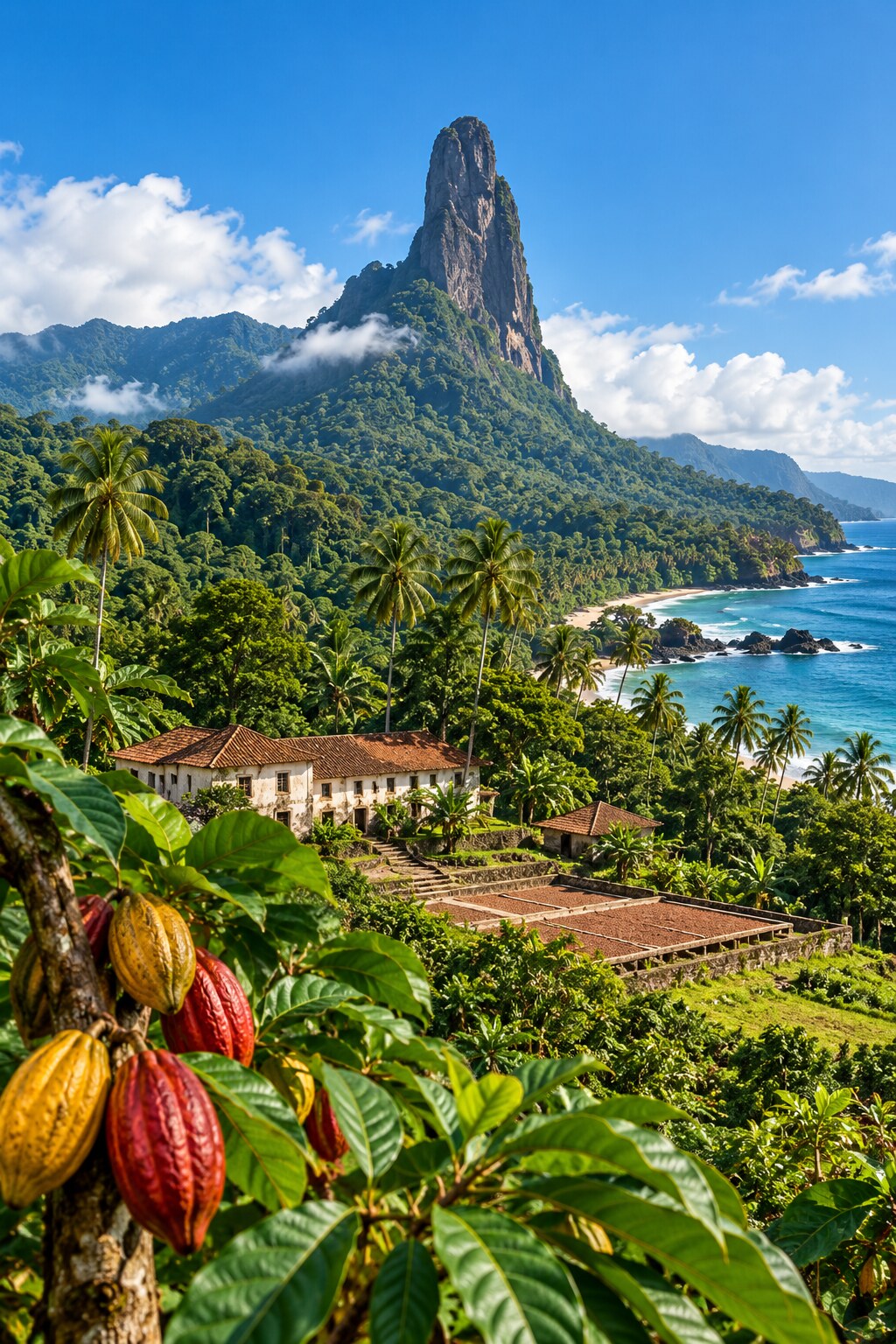
The islands rise steeply from deep Atlantic waters. On São Tomé, coastal lowlands give way to forested uplands and volcanic peaks, including Pico de São Tomé at 2,024 metres. Pico Cão Grande, a striking volcanic plug in the south, is one of the country’s best-known landforms, but its steep, wet terrain is a serious mountaineering environment rather than a casual viewpoint.
Príncipe lies north-east of São Tomé and is more compact, with forest, coastal habitats and small settlements. The islets, including Ilhéu das Rolas near the Equator, add marine and bird habitats. Boat access, road conditions and weather can determine whether an excursion is possible on a particular day.
04
A layered island history
Portuguese navigators reached the uninhabited islands in the late fifteenth century. The early colonial economy depended on sugar plantations and enslaved Africans; after sugar production shifted towards Brazil, the islands’ export economy developed around cacao and coffee. The plantations were connected to Atlantic trade and to a wider system of colonial extraction.
After slavery was formally abolished, plantation production continued to rely on coercive labour and forced migration, including contract workers brought from other African territories. The 1953 Batepá massacre, remembered locally as the massacre of February 3, remains a central national trauma. Independence from Portugal came on 12 July 1975; the country later adopted a multiparty political system.
05
The roças and the 2026 World Heritage inscription
In 2026 UNESCO inscribed “The Roças of Sao Tome and Principe: Colonial Agricultural System and Forced Migration” on the World Heritage List. The serial property comprises six geographically separate estates: Monte Café, Água Izé, Diogo Vaz, São João, Sundy and Belo Monte. Together they show how agricultural land, industrial facilities, housing and social infrastructure were organised around coffee and cacao production.
The inscription is not a simple celebration of plantation architecture. UNESCO’s description identifies forced migration and forced labour, from the late nineteenth to the mid-twentieth century, as foundational to this colonial agro-industrial system. Visitors should approach the sites as places of work, memory and continuing community life, not as picturesque ruins detached from the people who built and inhabited them.
06
People, languages and memory
Portuguese is used in administration, education and public life. Creole languages—including Forro, Angolar and Principense—carry distinct local histories and remain important to cultural expression. Music, dance, storytelling and religious practice vary between communities and islands; no brief checklist can stand in for listening to local voices.
The country’s population is young and concentrated around the capital and other coastal settlements. Courtesy, asking before taking portraits and following local guidance at memorials or religious sites make travel more respectful. Names and historical terms deserve care, particularly when describing coerced labour and the Batepá events.
07
Nature and wildlife
The islands’ isolation and steep ecological gradients support distinctive plant and bird life. Forest habitats range from humid lowlands to cloud-wrapped mountain slopes, while coastal wetlands, mangroves and offshore islets add other ecosystems. Obô Natural Park protects important forest and coastal landscapes; hiking routes can be difficult and should be planned with reliable local guidance.
Sea turtles nest on some beaches, and marine life includes dolphins and migrating cetaceans. Sightings are never guaranteed. Keep distance from wildlife, follow seasonal access rules, avoid disturbing nests and choose operators who explain their conservation practices.
08
São Tomé city and the north
The capital is the country’s main arrival point and service centre. Its waterfront, markets, Portuguese-era buildings and Fortaleza de São Sebastião—now home to the National Museum—offer an introduction to the country’s layered history. The city is best explored on foot in daylight, with time for markets and cafés rather than a rushed checklist.
Beyond the capital, the north and centre connect plantations, agricultural landscapes and the gateway to the mountain forest. Roça Monte Café and the Bom Sucesso Botanical Garden are useful points of departure for learning about coffee, cacao and the Obô landscape. Confirm opening arrangements and transport locally.
09
Príncipe and the smaller islands
Príncipe combines forested interior, small coastal settlements and a long plantation history. Its biosphere-reserve status recognises the relationship between biodiversity and human landscapes. Roça Sundy is associated with plantation heritage and the 1919 solar-eclipse observations that helped test Einstein’s general theory of relativity; visits should be arranged with the site or an authorised local operator.
Praia Banana, Santo António and viewpoints around the island are among the better-known stops, but weather and transport can alter plans. The islands are not linked by a dependable all-day ferry for ordinary visitors; check flights and baggage conditions before building a tight itinerary.
10
Food and everyday hospitality
Island cooking draws on fish, seafood, cassava, plantain, breadfruit, beans, leafy vegetables and tropical fruit. Calúlú is a much-loved, family and ceremonial dish whose ingredients vary; the national tourism portal describes versions using smoked fish or meat, local leaves and herbs, often served with rice, banana, breadfruit or cassava flour.
Príncipe has its own dishes and culinary vocabulary. Ask what is seasonal, how a dish is prepared and whether it contains allergens. Meals may take time, and a small restaurant’s menu can change with the day’s catch. Food is a way into regional identity, not just a stop between excursions.
11
Cacao, coffee and the export landscape
Cacao and coffee connect present-day producers with the plantation economy that reshaped the islands. Visiting a working farm or chocolate maker can explain fermentation, drying and roasting in ways a ruin cannot. Buy directly where possible, ask about origin and production, and remember that a product’s heritage story should not erase the labour history behind it.
Wine is not a defining agricultural tradition of São Tomé and Príncipe. Imported wine may appear in hotels and restaurants, while locally produced cacao, coffee, fruit drinks and other beverages are more closely tied to the islands’ land and food culture. The dedicated wine page therefore focuses on what visitors can actually expect.
12
UNESCO biosphere reserves
UNESCO lists both Príncipe and Ilha de São Tomé as biosphere reserves. São Tomé’s reserve was nominated in 2025; together, the two reserves form the first whole-country biosphere reserve. The designation connects core natural areas with buffer zones and inhabited landscapes, and it is separate from World Heritage inscription.
The 2026 World Heritage property concerns six historic roças; the biosphere reserves concern people, ecosystems and sustainable development across the islands. These labels have different purposes. Respect local access arrangements and avoid presenting protected landscapes as empty wilderness.
13
Climate and seasons
The climate is hot and humid, with the official tourism portal giving typical annual temperatures of roughly 21–29°C and higher local extremes. Rainfall and trail conditions vary across the islands and elevations. The drier gravana period is often favoured for travel, while the wetter season brings fuller rivers and greener forest but can make some roads and paths harder to use.
There is no universal best month for every activity. Birding, turtle watching, hiking and beach conditions each have their own local timing. Check current forecasts and ask local guides about trail closures, sea conditions and rain before setting out.
14
Getting there and moving around
International visitors arrive by air at São Tomé. The national tourism portal describes Lisbon as a principal European gateway and also lists regional connections in Africa; schedules, operators and routings change. Verify flights directly with airlines before booking onward accommodation, and leave generous margins for island transfers.
A small domestic flight connects São Tomé and Príncipe when operating. Roads outside the capital can be slow, uneven or affected by rain; a four-wheel-drive vehicle may be useful for some routes, but local drivers and guides know current conditions. Do not plan a sequence that depends on an unconfirmed connection.
15
Practical information and health
Check current entry rules, passport validity, visa conditions and any tourism tax through official government channels before departure; visa exemptions and payment rules can change. Carry enough local currency for smaller purchases, confirm whether a business accepts cards and agree transport prices before travelling.
For medical preparation, consult a travel-medicine professional and current official health advice for your itinerary. Do not rely on an undated claim about malaria, vaccines or safety. Travel insurance should account for remote hiking and medical evacuation; bring essential medicines and keep a plan for limited connectivity outside towns.
16
Responsible travel
Choose local guides for forest hikes and heritage visits, ask permission before entering working or residential plantation spaces, and pay agreed community fees. At beaches and nesting sites, follow conservation rules, avoid lights or close approaches to turtles, and carry out all waste.
A photograph can turn a living place into a backdrop. Ask before photographing people, especially children and at memorials, and listen when residents explain what a roça means to them. Leave time and income in local businesses rather than treating the islands as a short excursion from elsewhere.
17
Economy and the future
Tourism, agriculture, cacao, coffee, fishing and public services all shape the economy. The country’s small market and island logistics bring constraints, while heritage and biodiversity offer opportunities for locally rooted, lower-impact tourism. Official investment and economic figures should be checked against current government and World Bank data.
Oil exploration in the Gulf of Guinea has been discussed for years, but prospects and commercial outcomes are uncertain. A responsible guide should distinguish exploration, licensing and proven production instead of presenting expected oil revenue as an established fact.
18
🗺️ Map
OpenStreetMap view of the archipelago; confirm local access and routes before travel.
Image credits: Philippe Bourachot, CC BY-SA 3.0; Chuck Moravec, CC BY 2.0.
20
Author’s note
A visit here is measured less by the number of stops than by the attention a visitor gives to them. The roças are beautiful in places, but their beauty is inseparable from forced migration and labour; the forest is extraordinary, but it is also a lived landscape. São Tomé and Príncipe rewards a slower journey that lets residents, guides and historical sources complicate the first impression.
 São Tomé and Príncipe


