Papua New Guinea at a Glance
≈11.8 million
Population · World Bank estimate
Oceania
Region · southwestern Pacific
In this guide
Papua New Guinea is the world's most linguistically diverse nation — hundreds of living languages spoken across a landscape of volcanic highlands, dense rainforest, mighty river systems, and coral-fringed coasts. Occupying the eastern half of New Guinea, the world's second-largest island, plus hundreds of offshore islands, PNG remains one of the last great frontiers of cultural and biological discovery on Earth.
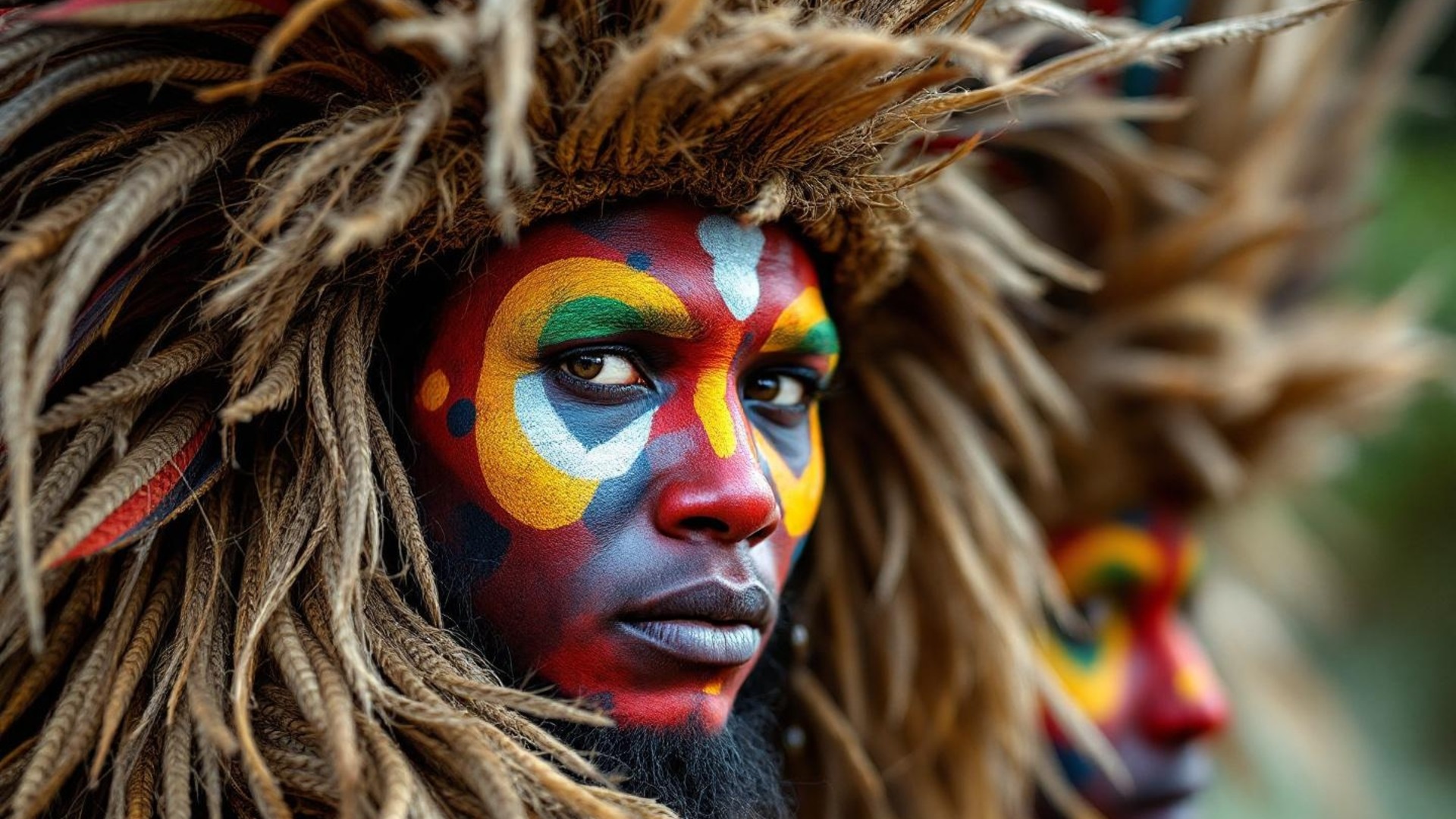
Tribal cultures that had virtually no outside contact until the mid-20th century still practice elaborate sing-sing ceremonies, maintain complex clan structures, and adorn themselves with bird-of-paradise plumes and shell valuables. The Highlands, home to the majority of the population, host annual cultural shows where hundreds of tribal groups gather in spectacular displays of body paint, feathered headdresses, and traditional dance.
For adventurous travelers willing to navigate challenging logistics, PNG offers unparalleled experiences: world-class diving on pristine coral reefs, trekking the legendary Kokoda Track through cloud forest, encountering living cultural traditions, and witnessing wildlife found nowhere else — from Raggiana birds-of-paradise to tree kangaroos.
PNG's terrain is extraordinarily rugged — a central spine of mountains exceeding 4,500 meters bisects the mainland, with Mount Wilhelm (4,509m) the highest peak. These Highlands are dissected by deep valleys and gorges that historically isolated communities from one another, producing the astonishing linguistic diversity. The Sepik River, one of the world's great waterways, meanders 1,126 km through lowland swamp forests rich in crocodiles and traditional stilt villages.
The island provinces — New Britain, New Ireland, Bougainville, and the Trobriand Islands among them — offer volcanic landscapes, active calderas, and some of the finest coral reefs in the Coral Triangle. The Bismarck Sea harbors extraordinary marine biodiversity, while the mainland's lowland rainforests contain species still being catalogued by science.
Human habitation of New Guinea stretches back at least 50,000 years, making it one of the earliest sites of human settlement outside Africa. Highland communities independently developed agriculture around 7,000 years ago, among the earliest instances of farming anywhere on Earth. European contact was limited until the 19th century, when German, British, and Dutch colonial powers divided the island.
World War II brought devastating conflict — the Kokoda Track campaign and battles at Milne Bay, Lae, and Rabaul left deep scars. Australia administered the territory until independence on September 16, 1975. Since then, PNG has navigated the challenges of unifying hundreds of distinct cultural groups into a modern nation while preserving traditional governance structures and managing vast mineral and natural gas resources.
With over 840 languages and thousands of distinct cultural groups, PNG defies generalization. Yet common threads run through most societies: the wantok system of clan obligation, the importance of land and ancestors, elaborate exchange ceremonies (like the Trobriand Islands' Kula ring), and the centrality of the sing-sing — ceremonial gatherings featuring music, dance, and spectacular body decoration.
The Highland shows at Goroka and Mount Hagen are PNG's most accessible cultural experiences, drawing tribal groups who spend months preparing elaborate costumes of feathers, shells, pig tusks, and body paint. Sepik River communities are renowned for their spirit houses (haus tambaran) and carved wooden masks and figures that rank among the Pacific's finest art. Christianity has been widely adopted but is often woven seamlessly into traditional belief systems.
Port Moresby sprawls across hills overlooking Fairfax Harbour and Walter Bay on PNG's southern coast. The National Museum and Art Gallery houses an outstanding collection of traditional artifacts including Sepik carvings, Highland headdresses, and Trobriand craft. The Parliament House, designed in the form of a traditional haus tambaran, features a stunning mosaic facade representing the nation's cultural diversity.
The city's Nature Park provides a gentle introduction to PNG's wildlife — birds-of-paradise, tree kangaroos, and cassowaries in a botanical garden setting. Ela Beach and the Royal Papua Yacht Club offer waterfront relaxation, while the nearby Varirata National Park provides highland forest walks with views across the Owen Stanley Range. Security awareness is important in Port Moresby — stick to known areas and use reliable transport.
The PNG Highlands are the cultural heartland — a world of cool mountain valleys, sweet potato gardens, and tribal communities whose sing-sing traditions represent humanity's most elaborate forms of body adornment. The annual Goroka Show (September) and Mount Hagen Show (August) bring together dozens of tribal groups in competitions of dance, music, and costume that are genuinely breathtaking.
Beyond the shows, the Highlands offer trekking through moss forests to the summit of Mount Wilhelm, visits to traditional villages in the Wahgi Valley, and encounters with a way of life where clan loyalty, pig exchange ceremonies, and ancestral connections still govern daily affairs. The Tari Basin is home to the Huli Wigmen, famous for their elaborate wigs made from their own hair.
PNG offers some of the planet's finest diving — pristine coral reefs in the Coral Triangle biodiversity hotspot, dramatic WWII wrecks, and marine life encounters ranging from pygmy seahorses to manta rays. Kimbe Bay in New Britain, Milne Bay, and the waters around Tufi and Kavieng consistently rank among the world's top dive destinations.
Rabaul, dramatically situated inside a volcanic caldera on New Britain, combines world-class wreck diving with a fascinating wartime history — the Japanese made it a major base, and the surrounding waters hold numerous sunken ships and aircraft. The Trobriand Islands, famous for their unique matrilineal culture and the Kula exchange system documented by anthropologist Bronisław Malinowski, offer both cultural immersion and beautiful reef diving.
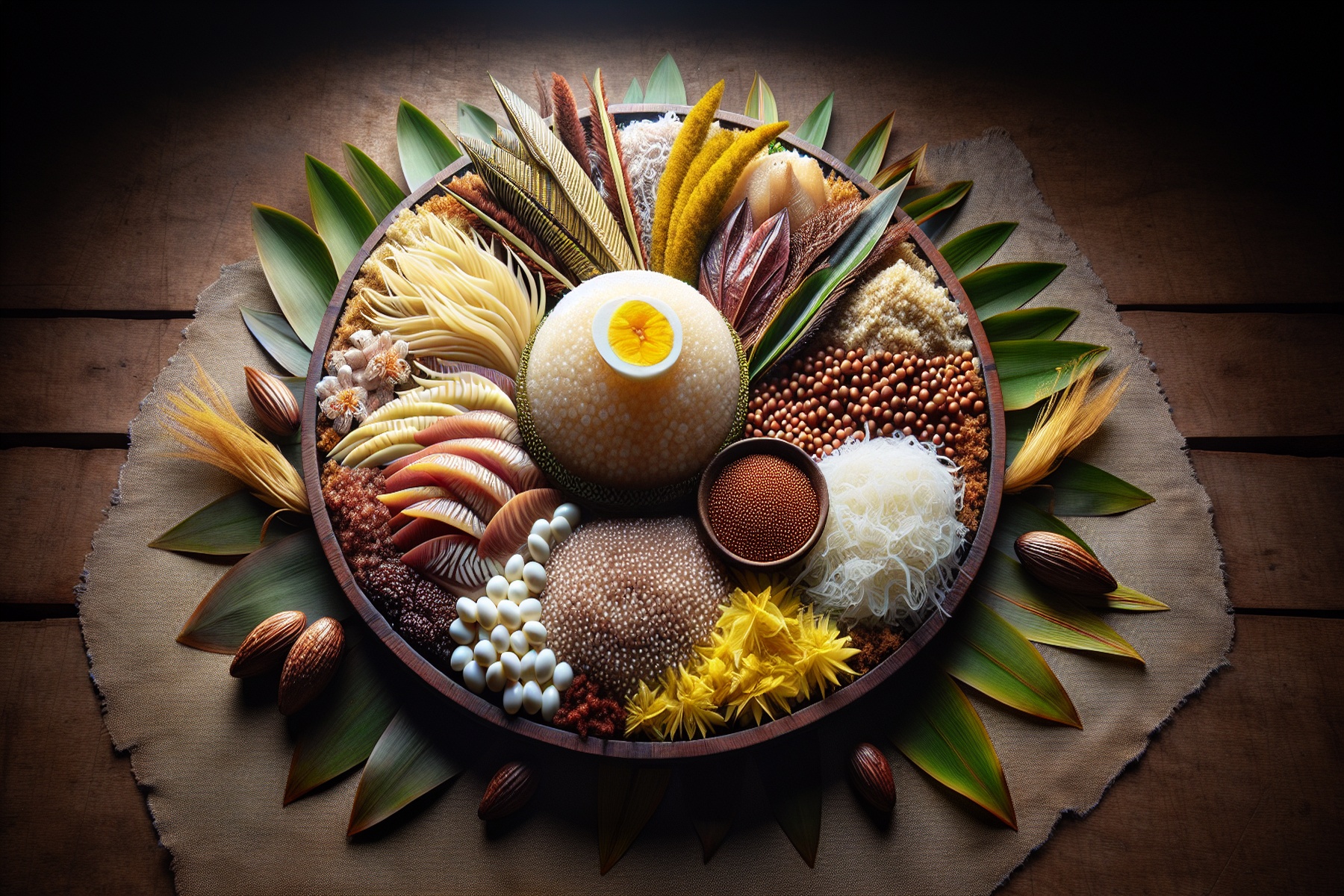
Food traditions vary across Papua New Guinea. Root crops are important in the Highlands, while sago and fish sustain many lowland and river communities; coastal kitchens also make use of coconut.
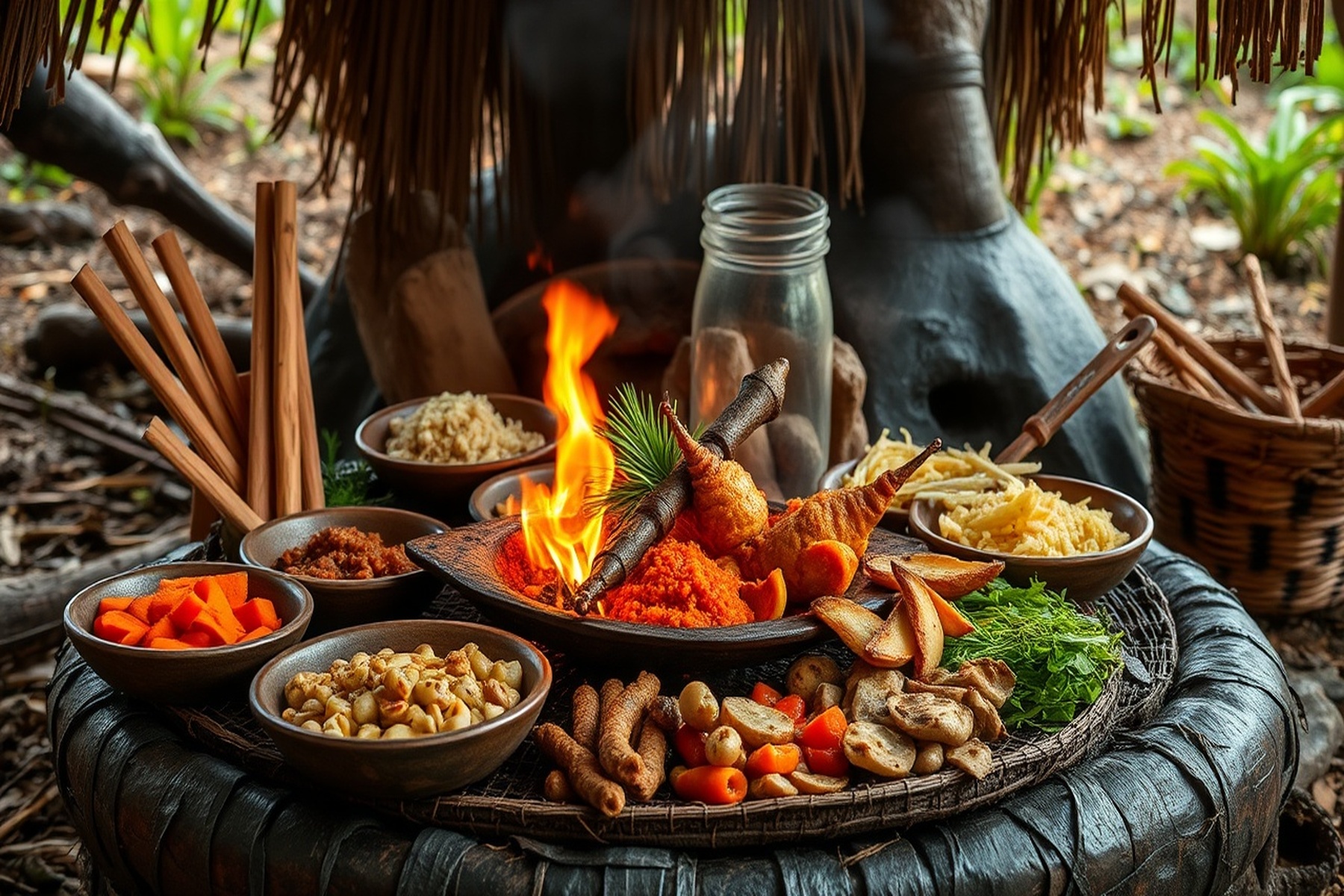
Staples include kaukau (sweet potato), taro, sago and seafood. Mumu is communal earth-oven cooking, with ingredients and methods varying by region.
Drinks include locally grown coffee, coconut water and SP Lager. Betel nut (buai) is chewed as a stimulant; it is not a beverage.
Mumu
Earth Oven Feast
Meat and vegetables cooked in underground oven—celebration cooking.
Ingredients: Pork or chicken, Sweet potato, taro, Banana, greens, Banana leaves, Hot stones.
Preparation: Heat stones in fire. Then line pit with banana leaves. Layer hot stones, meat, vegetables. Cover with more leaves and earth. Then cook 3-4 hours. Unearth and feast together.
💡 Mumu is communal—the cooking and eating bring people together.
Sago
Palm Starch
Starchy paste from sago palm—staple food of lowland PNG.
Ingredients: Sago starch, Hot water, Coconut cream (optional), Fish or meat for serving.
Preparation: Mix sago with hot water. Stir until thick and gluey. Serve immediately. Then eat with fish or meat. Finally, dip in coconut cream.
💡 Sago is bland—the accompaniments provide flavor.
Highland coffee is an important part of Papua New Guinea’s agricultural economy. Coffee, coconut water and locally brewed beer are part of local drinking traditions. Alcohol restrictions vary locally: check with your host before buying or carrying alcohol.
PNG has a tropical climate moderated by altitude in the Highlands, where temperatures can drop to near freezing above 3,000 meters. Coastal areas are hot and humid year-round (25-33°C). The dry season (May to October) is generally the best time to visit, coinciding with the major Highland shows. The wet season (November to April) brings heavy rainfall, particularly on the northern coast.
Regional variation is significant — the southern coast around Port Moresby is drier than the north, while Highland weather can change rapidly. Pack layers for Highland visits and rain gear year-round.
Port Moresby’s Jacksons International Airport is the principal international gateway. Check current routes with Air Niugini before making connections. Domestic flights are often needed between regions that have no continuous road link.
Arrange airport transfers and onward travel with your accommodation or an experienced local operator. Allow spare time for weather and schedule changes. Check current road conditions and security advice before traveling overland.
Entry: Arrange your visa before departure; do not rely on a visa on arrival. Check eligibility and requirements with the PNG Immigration and Citizenship Authority, including its Digital Arrival Card.
Money: The currency is the kina (PGK). Arrange access to cash for places outside the main towns.
Safety: Serious crime and intercommunal violence can affect travel. Advice differs by region; review the current regional advice before finalizing an itinerary. Check Kokoda Track access with your trekking operator.
Health: Discuss destination-specific precautions with a travel-health clinician. Medical facilities are limited; check that your insurance covers the activities you plan and medical evacuation.
Papua New Guinea humbles you. In an age of algorithmic sameness, here is a place where 840 languages still echo through valleys, where a Highland warrior's feathered headdress can take months to assemble, and where the Sepik River still carries stories older than most civilizations. The logistics can be challenging and the security situation requires awareness, but for travelers seeking authentic cultural encounters in landscapes of staggering beauty, PNG is irreplaceable. Watch a hundred painted warriors emerge from morning mist at the Goroka Show and you'll understand — some experiences cannot be replicated or digitized.
Practical information reviewed September 17, 2026. Population: World Bank country overview. Before travel, check PNG Immigration and Smartraveller; conditions can change.