
🇳🇱 Netherlands at a Glance
🌍 Overview — The Only Country That Had to Be Built First
Most countries are a place that people arrived in. The Netherlands is a place that people made, and is still making, every day, with pumps. About 26% of the land lies below sea level and roughly a third would flood without continuous defence; the lowest point, at Nieuwerkerk aan den IJssel, is 6,76 m below the sea. Around 17% of the current land area has been taken from water since the Middle Ages. Nothing else about the country makes sense until you have accepted that one.
Into 41 543 km² — about half the area of Czechia — the Dutch have packed 18,1 million people, making this one of the most densely populated countries on earth, the second-largest agricultural exporter in the world by value after the United States, the busiest port in Europe, and an art collection that is out of all proportion to the size of the place.
Where it is
The delta where the Rhine, Meuse and Scheldt reach the North Sea, with Germany east and Belgium south. That position is the whole story: the country is what three of Europe's great rivers dropped on their way out, which is why it is flat, why the soil is superb, and why whoever holds it controls the trade of a continent's interior.
The name problem
"Holland" is two provinces — North and South Holland, containing Amsterdam, Rotterdam and The Hague — not the country. The country is the Netherlands, "the low lands", and the government formally dropped "Holland" as a promotional brand in 2020. Dutch people from Groningen or Limburg will correct you and they are right to.
How it is governed
A constitutional monarchy under King Willem-Alexander since 2013, with a 150-seat lower house elected by pure proportional representation and no threshold — one seat costs about 0,67% of the vote. That produces fifteen parties in parliament, long coalition formations and, since February 2026, a minority cabinet — see Politics.
The cities
There is no single dominant metropolis. The Randstad is a horseshoe of four cities — Amsterdam (finance, tourism, culture), Rotterdam (the port), The Hague (government, international law) and Utrecht (the rail hub) — each about half an hour from the others, together holding roughly eight million people around a deliberately protected green centre.
The economy
GDP around €1,15 trillion, among the highest per capita in the EU. Rotterdam moves more cargo than any other European port, Schiphol is one of the continent's biggest hubs, Eindhoven's ASML makes the lithography machines without which no advanced chip in the world gets made, and the country exports more food than any nation except the United States from an area you can drive across in three hours.
2026 in one line
A young minority government with 66 of 150 seats, a nitrogen package that is asking thousands of farmers to change what they do or stop, a housing shortage of roughly 400 000 homes, hotel VAT jumped from 9% to 21% on 1 January, and the tulips came up in April exactly as usual.
🏷️ The Name, the Flag, the Orange
Nederland
Literally "the low country", in the singular in Dutch and the plural in English and most other languages — the plural is a fossil of the sixteenth-century Low Countries, the seventeen provinces that included today's Belgium and Luxembourg. English keeps the "the" for the same reason it keeps it in "the Hague": the name was originally a description.
Holland, and why it sticks
The two Holland provinces were the richest and loudest members of the old Republic, so foreigners used the part for the whole — the same way "England" gets used for Britain, and with the same irritation attached. The 2020 rebranding retired the Holland logo from official use. In practice Dutch people abroad often say Holland anyway, because arguing is slower.
Dutch
An English quirk: Dutch and Deutsch are the same word, from Germanic þiudisk, "of the people", which once covered every continental Germanic speaker. English narrowed it to the Netherlanders — the people English sailors and merchants actually met — and the Germans got the Latin name instead. The Dutch call their own language Nederlands.
The flag
Red, white and blue horizontal bands — the oldest tricolour still in use, flown since the 1570s and the direct ancestor of the French and Russian flags and, through them, of much of the world's. The top band was originally orange, for William of Orange, and turned red during the seventeenth century; the reason is disputed between dye-fading and visibility at sea.
Why everything is orange
The royal house is Orange-Nassau, named after the principality of Orange in southern France that William the Silent inherited in 1544 — a town in Provence is the reason the Dutch football team plays in orange and the entire country dresses up on King's Day. The orange pennant flown above the flag on royal occasions is the surviving official use.
The lion and the motto
The coat of arms carries a lion with a sword and arrows and the French motto Je maintiendrai — "I will maintain" — which is William the Silent's and is, for a country whose existence depends on maintaining dykes, an unusually literal national motto.
🗺️ Geography — Flat Is Not the Same as Simple
The highest point in the European Netherlands is the Vaalserberg at 322,4 m, in the far south-east corner where three borders meet, and it is a hill in a wood with a café on it. The highest point in the Kingdom of the Netherlands is Mount Scenery on the Caribbean island of Saba, at 887 m, which is a volcano — the country's geography stopped being simple the moment you look at the whole of it.
The delta
The Rhine arrives from Switzerland and Germany and splits into the Waal, the Nederrijn and the IJssel; the Meuse comes up from France through Belgium; the Scheldt reaches the sea through Zeeland. Everything downstream of those splits is sediment those rivers dropped, which is why the western half of the country is clay and peat and the eastern half is sand.
Polders
A polder is land enclosed by a dyke and kept dry by pumping. There are thousands. The largest project of all, Flevoland, was pumped out of the Zuiderzee between 1942 and 1968 and is now a province of half a million people, farms, a national park and a city, Almere, that did not exist in 1975 and now has more inhabitants than Groningen.
Below the line
The below-sea-level land is the western and northern belt: most of North and South Holland, Flevoland, Zeeland and chunks of Friesland and Groningen. Schiphol airport sits at −4,5 m, on the bed of a lake drained in 1852, which is why its name means "ship's grave" — the Haarlemmermeer had a reputation for drowning boats.
The sand, the peat and the subsidence
Draining peat makes it oxidise and shrink, so much of the west is still sinking, in places by a centimetre a year — the pumping that made the land habitable is also what keeps taking it further down. Parts of Holland are lower now than when the first dykes were built, and the whole hydraulic system has to be re-engineered around that permanently.
The higher, drier east
Behind the delta, the sandy Pleistocene soils of Drenthe, Overijssel, Gelderland and Brabant are a completely different country: heath, forest, dry fields, prehistoric hunebedden dolmens, and the Veluwe, the largest continuous nature area in the Netherlands, with red deer and wild boar in it.
The other kingdom
The Kingdom of the Netherlands is four countries: the Netherlands, Aruba, Curaçao and Sint Maarten. Bonaire, Sint Eustatius and Saba are special municipalities of the Netherlands proper — so the country has territory in the Caribbean, a hurricane season, a coral reef, and, technically, the tallest mountain and the warmest weather in its own statistics.
🌊 Water — The Thousand-Year Public Works Project
Dutch water management is the oldest continuous piece of public administration in Europe. The first waterschappen — water boards, which levy their own taxes and elect their own boards — date to the thirteenth century, which makes them older than the Dutch state, older than the monarchy, and older than parliament. They still exist and you still vote for them.
The 1953 flood
On the night of 31 January–1 February 1953, a North Sea storm surge met a spring tide and broke the dykes of Zeeland and South Holland. 1 836 people died in the Netherlands, 1 365 km² flooded, 200 000 animals drowned. It was the defining national trauma of the twentieth century after the war, and the country's answer was to decide that this must never be possible again — at any cost.
The Delta Works
The answer: a fifty-year programme of dams, barriers and storm surge gates across the Zeeland estuaries, finished in 1997. The Oosterscheldekering is the centrepiece — 9 km of sixty-two steel gates that stay open so the estuary keeps its tides and its oysters, and close only when a surge is forecast. It was hugely more expensive than a solid dam and it was the right call. The American Society of Civil Engineers lists the Delta Works among the Seven Wonders of the Modern World.
The Afsluitdijk
The 32 km dam completed in 1932 that closed off the Zuiderzee, turning a tidal inlet into the freshwater IJsselmeer and enabling the Flevoland polders. Driving it is a strange experience: sea on one side, lake on the other, no land in sight, for twenty minutes. It is being reinforced through the 2020s for sea level rise.
The Maeslantkering
The storm surge barrier on the Nieuwe Waterweg, guarding Rotterdam. Two white steel arms each the length of the Eiffel Tower lying down, floating shut on ball joints when the water is forecast 3 m above normal. It is fully automated — the decision to close it is taken by a computer, not a minister, because the Dutch concluded that a politician might hesitate. It has closed against a real surge twice: 2007 and 2023.
Room for the River
The modern doctrine changed. Instead of only building higher, the Ruimte voor de Rivier programme (2007–2019, thirty-odd projects) gave land back — lowering floodplains, moving dykes inland, digging side channels — so that rivers have somewhere to go in flood. It is the clearest example of Dutch engineering deciding that fighting water absolutely is not always the cheapest way to win.
What is coming
The Delta Programme now plans to a scenario of up to 1 m of sea level rise by 2100 and studies scenarios beyond it. Freshwater supply, not flooding, may be the harder problem: salt water pushing up the rivers in dry summers threatens drinking water and horticulture. The national water authority has begun saying out loud that some low, deep polders may eventually not be worth defending — a sentence with no precedent in Dutch public life.
📜 Before the Republic — Frisians, Counts and the Sea
Batavians and Frisians
The Romans reached the Rhine and made it the frontier; the Batavians on the river islands supplied auxiliary cavalry and revolted in 69 CE under Julius Civilis, a rebellion that nineteenth-century Dutch nationalism adopted as a founding myth and Rembrandt painted enormously. North of the frontier the Frisians were never conquered and their language survives — West Frisian is still the second official language of the Netherlands.
Terpen
Before dykes there were terpen (Frisian terp, mounds): artificial hills raised by hand in the coastal marshes from about 500 BCE, on which people, houses and cattle sat out the tides. Hundreds survive in Friesland and Groningen, some 6 m high and several hectares across, all of it moved in baskets. Dutch water engineering starts here and it starts with a shovel.
Christianisation and the counts
Willibrord and Boniface brought Christianity in the seventh and eighth centuries; Boniface was killed at Dokkum in 754, which the Frisians have never entirely lived down. The land then fragmented into the County of Holland, the Bishopric of Utrecht, Guelders, Brabant, Flanders and Friesland — the medieval patchwork that the Burgundians would spend the fifteenth century collecting.
The first dykes and the first floods
Systematic diking began around 1000 CE and with it the peat drainage that started the subsidence. The St Elizabeth's flood of 1421 drowned dozens of villages and created the Biesbosch; the St Lucia's flood of 1287 killed perhaps 50 000 people and opened the Zuiderzee. Making land and losing it have always been the same process.
Burgundy and Habsburg
The dukes of Burgundy assembled the Seventeen Provinces in the fifteenth century; through marriage they passed to the Habsburgs and then, in 1555, to Philip II of Spain — a Catholic absolutist who inherited the richest, most urbanised and increasingly most Protestant corner of Europe and set about governing it from Madrid.
The Eighty Years' War
From 1568, the northern provinces revolted: over taxation, over the Inquisition, over local privilege. William of Orange led it and was assassinated in Delft in 1584. The Union of Utrecht (1579) bound the seven northern provinces; independence was declared in 1581 and finally recognised at the Peace of Westphalia in 1648. Eighty years, and the state that came out of it was a republic in an age of kings.
💰 The Golden Age — and Why the Dutch Have Stopped Calling It That
For most of the seventeenth century a country of under two million people had the largest merchant fleet in the world, the first stock exchange, the highest wages and literacy in Europe, an army that beat Spain and a navy that sailed up the Medway and towed away the English flagship. It also ran a slave trade. Both of those sentences are the same century and the Dutch are, at last, saying so in the same breath.
The financial inventions
The VOC (1602) was the first company to issue permanently tradeable shares to the public; the Amsterdam exchange was built to trade them, and within decades had short selling, options and futures. The Wisselbank (1609) gave Europe a stable settlement currency. Modern capitalism has a birthplace and it is a few hundred metres of Amsterdam.
How a republic worked
No king. Power sat with the regents of the city councils, the States General of seven provinces, and a stadtholder from the House of Orange who was a military officer rather than a monarch — a permanent constitutional tension that produced periodic crises and, in 1672, the lynching of the brothers De Witt by an Orangist mob in The Hague.
Tolerance, with an asterisk
The Republic was the most tolerant place in Europe and that is a comparative statement. It took in Sephardic Jews from Iberia and Huguenots from France; it let Descartes write, Spinoza think and Locke shelter; it printed the books other countries banned. It also excluded Catholics from public office and drove them into schuilkerken, hidden churches. Tolerance here meant the authorities looking away, not equality — but in that century, looking away was worth crossing a border for.
Tulip mania
In 1636–37 the price of rare bulbs rose absurdly and collapsed in February 1637. It is the standard morality tale about bubbles, and modern historians — Anne Goldgar above all — have shown it was much smaller and less ruinous than the legend: a few hundred traders, mostly wealthy, few bankruptcies, no macroeconomic damage. The story was inflated by contemporaries' moralising pamphlets, which is itself a very good story about how markets get remembered.
The cost, stated plainly
Dutch ships carried an estimated 600 000 people across the Atlantic in slavery, and the WIC and its successors ran plantation colonies in Suriname and the Caribbean where mortality was notorious. In Asia the VOC took the Banda Islands in 1621 by killing or deporting almost the entire population of about 15 000 for a nutmeg monopoly. On 19 December 2022 Prime Minister Rutte apologised for the Dutch state's role in slavery; the King apologised on 1 July 2023, the 160th anniversary of abolition, and a €200 million fund was created.
"Golden Age", retired
In 2019 the Amsterdam Museum stopped using Gouden Eeuw in its displays, preferring "the seventeenth century", on the ground that a label meaning "golden" cannot describe the same decades for everyone in them. The decision was argued about furiously and is now fairly widely followed. This page uses the old term in the heading and the plain dates everywhere else, which is roughly where the Dutch have landed too.
🚢 The VOC — The First Multinational, and What It Did
The Vereenigde Oostindische Compagnie, founded 20 March 1602, was given by the States General a monopoly on Dutch trade east of the Cape of Good Hope together with the right to raise armies, wage war, sign treaties, coin money and execute people. It was a company with foreign policy. For two centuries it was the largest commercial enterprise on earth, and at its peak it was worth, in any sensible inflation-adjusted measure, more than any company alive today.
The scale
Roughly 4 700 voyages, about a million Europeans shipped east, a permanent fleet of hundreds of ships, and trading posts from Cape Town to Nagasaki. For over two hundred years (1641–1853) the VOC's post on Dejima, an artificial island in Nagasaki harbour, was the only European access to a closed Japan — which is why Japanese scholars called Western science rangaku, "Dutch learning".
Banda, 1621
The clearest single case. To secure the world monopoly on nutmeg and mace, Governor-General Jan Pieterszoon Coen took the Banda Islands and effectively destroyed the population of roughly 15 000 by killing, starvation and deportation into slavery; the islands were repopulated with enslaved labour under Dutch planters. Coen's statue still stands in Hoorn and the argument about it is annual.
The Atlantic side
The West India Company (1621) ran the Atlantic: Brazil briefly, the Caribbean, the Gold Coast forts, New Amsterdam — traded to England in 1667 for Suriname, a swap that looked shrewd at the time. Dutch ships carried roughly 600 000 enslaved Africans across the Atlantic, and Suriname's plantation regime was among the deadliest in the Americas.
The Maroons
Enslaved people who escaped into the Suriname interior built independent societies that fought the Dutch to a standstill; the colonial government signed peace treaties with the Ndyuka and Saramaka in the 1760s that recognised their autonomy. Their descendants still live there, and their oral history is one of the few accounts of Dutch colonialism not written by the Dutch.
How it ended
Corruption, war with Britain and the loss of the monopoly finished it: the VOC was dissolved on 31 December 1799 with enormous debts, and its territories became the colonial state of the Dutch East Indies — modern Indonesia — which the Netherlands then governed directly for another 150 years, with the Cultivation System of forced export cropping doing much of the damage that made the VOC's balance sheet look healthy in retrospect.
How it is taught now
The reckoning is recent and real. The Rijksmuseum's Slavery exhibition (2021) was a landmark; the 2022–23 apologies followed; and the canon of Dutch history taught in schools was rewritten to put slavery and the Indies wars in it. The 2022 state-commissioned study of the 1945–49 Indonesian war concluded that Dutch forces used structural extreme violence and that the state, courts and politicians had covered it up — a finding the government accepted.
⚔️ 1795–1839 — French Rule, a Kingdom, and Losing Belgium
The Batavian Republic
In 1795 French revolutionary armies crossed the frozen rivers — the Dutch fleet was famously captured at anchor in the ice — and the Republic fell, replaced by the Batavian Republic, a French client state. It was not merely an occupation: it brought the first written constitution, a unified state in place of seven sovereign provinces, and the abolition of the guilds.
Napoleon's brother
From 1806 the country was the Kingdom of Holland under Louis Bonaparte, who annoyed his brother by going native — he learned Dutch, called himself Lodewijk, and put Dutch interests first often enough that Napoleon annexed the country outright in 1810. The Rijksmuseum and the Royal Palace on the Dam both date from Louis's brief reign.
1815: a kingdom, all of it
After Waterloo the powers created the United Kingdom of the Netherlands under William I — today's Netherlands, Belgium and Luxembourg together — designed as a buffer against France. It lasted fifteen years.
Belgium leaves
In 1830 the southern provinces revolted: Catholic against Protestant rule, French-speaking elite against Dutch language policy, industrialising south against mercantile north. William refused to accept it for nine years, keeping the army mobilised at ruinous cost, and only recognised Belgium in 1839. Luxembourg stayed in personal union with the Dutch crown until 1890, when Dutch succession passed to a woman and Luxembourg's law did not allow it.
The nineteenth century
Quiet, and poorer than the legend suggests: the Netherlands industrialised late, well after Belgium and Britain, and lived substantially off the colonial revenues of the Cultivation System in Java, which at its height supplied around a third of Dutch state income. Domestic reform came with the 1848 constitution, drafted by Thorbecke, which made ministers answerable to parliament and is the foundation of the modern Dutch state.
The water century
It was also the century of the big engineering: the Haarlemmermeer drained by steam in 1852 (Schiphol sits on it), the North Sea Canal opened in 1876 giving Amsterdam a direct sea route, and the Nieuwe Waterweg giving Rotterdam one — the two canals that made both modern ports possible.
🕊️ 1940–1945 — Occupation, Deportation, Hunger
The Netherlands had been neutral in the First World War and expected to be again. On 10 May 1940 Germany invaded; after the bombing of Rotterdam on 14 May killed around 900 people and destroyed the medieval city centre, with Utrecht threatened next, the Dutch surrendered in five days.
The occupation
Unlike France, the Netherlands got a civilian Nazi administration under Arthur Seyss-Inquart rather than a military one, and the existing Dutch civil service was largely left in place and largely kept working. That efficiency had consequences: the Dutch population registry was excellent, and it was used.
The deportations
Of roughly 140 000 Jews in the Netherlands, about 102 000 were murdered — around 73%, the highest proportion in western Europe and far above France or Belgium. The reasons argued over by historians: the flat, open country with no mountains or forests to hide in, the thorough registry, the compliant bureaucracy, and the transit camp at Westerbork from which the trains ran weekly on time. Anne Frank was one of them; the house on the Prinsengracht is the most visited site in the country and the queue is a form of national reckoning.
Resistance and collaboration
Both were real. The February Strike of 1941 — Amsterdam dockers and tram drivers striking against the first round-ups of Jews — was the only mass strike against Jewish deportations anywhere in occupied Europe, and it was crushed in two days. At the same time the NSB had tens of thousands of members and thousands of Dutchmen served in the Waffen-SS. Postwar Dutch memory leaned hard on the resistance story for decades; the historian Loe de Jong and, later, a wave of uncomfortable scholarship pulled it back toward the truth.
The Hunger Winter
After the failure of Operation Market Garden at Arnhem in September 1944 the south was liberated and the west was not. A rail strike, a German embargo and an exceptionally cold winter produced the Hongerwinter of 1944–45: perhaps 20 000 dead of starvation, people eating tulip bulbs and sugar beet, city dwellers walking into the countryside to trade silver for potatoes. Its survivors were later studied for decades and gave the world some of its first evidence that famine in pregnancy marks the next generation's health.
Liberation
The west was freed only in May 1945, partly by Canadian forces — which is why the Netherlands sends 20 000 tulip bulbs to Ottawa every year and why Canadian war cemeteries here are tended by Dutch schoolchildren by name. 4 May is the two-minute national silence; 5 May is Liberation Day.
What it left
A destroyed Rotterdam, a destroyed Jewish community, a national self-image that took forty years to correct, and a foreign policy conclusion that neutrality had failed: the Netherlands was a founding member of NATO in 1949 and of every stage of European integration thereafter, and it has been consistently among the most Atlanticist and most pro-EU states since.
🏛️ Verzuiling — The Country That Organised Itself Into Columns
For most of the twentieth century Dutch society ran on verzuiling, "pillarisation": Catholics, Protestants, socialists and liberals each had their own newspapers, schools, hospitals, trade unions, football clubs, broadcasters, shops and political parties. A Catholic could be born in a Catholic hospital, schooled Catholic, insured Catholic, buried Catholic, and meet a socialist only at the top, where the pillar leaders negotiated.
How it worked
It was a settlement, not an accident. The 1917 Pacification traded universal male suffrage for equal state funding of religious schools — which is why the Netherlands still funds private religious schools on the same basis as public ones, and why about a third of Dutch pupils attend one. The pillars were a way of letting groups that distrusted each other live in one small country without fighting.
Consociational democracy
The political scientist Arend Lijphart made the Dutch case famous in The Politics of Accommodation (1968): elites of mutually hostile blocs cooperating deliberately at the top while their followers stayed separate. It became the standard model for divided societies everywhere from Belgium to Lebanon, and the Netherlands is where it was described.
The broadcasting fossil
Dutch public television still reflects it. Airtime is allocated to member associations — originally Catholic (KRO), Protestant (NCRV, EO), socialist (VARA), general (AVRO) — which have merged and mutated but still exist. A public broadcaster whose channels are shared out among ideological membership clubs is unlike anything else in Europe, and it is pillarisation still standing.
The collapse
It came fast, in the 1960s: television across pillar lines, prosperity, the contraceptive pill, and above all secularisation. The Netherlands went from one of the most religiously observant countries in northern Europe to one of the least in a generation. Today roughly 55–60% of Dutch people report no religion at all, and the Catholic and Protestant parties merged in 1980 into a single CDA that now holds 18 seats.
The polder model
The habit survived the pillars. The poldermodel — endless consultation between government, employers and unions until everyone can live with the outcome — is the direct descendant, institutionalised in the SER and the Stichting van de Arbeid. The Wassenaar Agreement of 1982, in which unions accepted wage restraint for shorter hours, is credited with ending Dutch stagflation and is the model's showpiece.
And the cost
The same machinery that produces stability produces slowness, and its critics — from Pim Fortuyn onward — have made a career of saying that consensus is how the Dutch elite avoids deciding anything. Cabinet formation after the 2021 election took 299 days, a national record. It is genuinely both things: the most impressively consensual democracy in Europe, and a country that can take most of a year to get a government.
🌏 1945–2000 — Losing an Empire, Gaining a Society
Indonesia
Sukarno declared independence on 17 August 1945. The Netherlands fought to prevent it for four years, calling the war "police actions", and only transferred sovereignty in December 1949 under heavy American pressure. Dutch official language maintained until 2005 that the recognised date was 1949; in 2005 the foreign minister accepted 1945 politically, and in 2023 the government accepted it fully. The 2022 research programme's finding of structural extreme violence settled the historical argument.
The returnees
Roughly 300 000 people came from Indonesia to the Netherlands in the 1950s — Dutch colonials, Indo-Europeans of mixed descent, and around 12 500 Moluccans, soldiers of the colonial army and their families, brought over on what they were told was a temporary basis and housed in camps, including a former Nazi transit camp. The promise of a Moluccan republic was never delivered, and in the 1970s a second generation hijacked trains and took hostages over it — the most serious political violence in postwar Dutch history until 2002.
Suriname and the Antilles
Suriname became independent in 1975, and roughly a third of its population moved to the Netherlands before the door closed — which is why there are more Surinamese-heritage people in the Netherlands than in some Surinamese districts, and why the food in Amsterdam is what it is. The Antilles stayed: Aruba, Curaçao and Sint Maarten are now separate countries within the Kingdom, and Bonaire, Saba and Sint Eustatius are Dutch municipalities.
Guest workers
Labour recruitment agreements from the 1960s brought Turkish and Moroccan workers who were expected to leave and did not; family reunification followed. Today around a quarter of the population has a migration background, and the Netherlands is a genuinely multi-ethnic country that spent thirty years insisting it was a temporary arrangement.
Srebrenica
In July 1995 the Dutch UN battalion Dutchbat, lightly armed and denied air support, was unable to prevent the massacre of over 8 000 Bosniak men and boys at the UN safe area it was guarding. The Dutch government's own institute reported in 2002; the entire cabinet of Wim Kok resigned over it, and the Supreme Court later found the state partially liable for a group of the victims. It remains the hardest thing in modern Dutch public memory.
The permissive decades
Meanwhile the country became the world's laboratory for social liberalism: the gedoogbeleid tolerance policy on cannabis from 1976, regulated euthanasia legalised in 2002 after decades of case law, legal prostitution from 2000, and on 1 April 2001 the first same-sex marriages anywhere in the world, in Amsterdam city hall, performed by mayor Job Cohen at midnight.
👑 The House of Orange and King's Day
What the monarch does
Very little, deliberately. Since 2012 the King no longer even appoints the formateur for a new coalition — parliament does. He signs laws, hosts state visits, reads the government's programme from the throne on Prinsjesdag in September, and is expected to say nothing politically interesting. Support for the monarchy has slipped from the eighties to somewhere around 55–60%, which is low by Dutch standards and still a clear majority.
Willem-Alexander
King since 30 April 2013, when his mother Beatrix abdicated — Dutch monarchs abdicate rather than die in office, and have done for three generations. He is a qualified pilot who flew as a volunteer co-pilot on KLM cityhopper flights for over twenty years, mostly unrecognised, which is the single most Dutch fact about any European royal. Queen Máxima is Argentine and more popular than he is.
The queens
The Netherlands had three queens regnant in a row — Wilhelmina (1890–1948), Juliana (1948–1980), Beatrix (1980–2013) — 123 consecutive years without a king. Wilhelmina's wartime broadcasts from London made her the voice of the resistance; Churchill reportedly called her the only real man among the governments in exile.
King's Day
27 April: the entire country dresses in orange and holds the world's largest simultaneous jumble sale. The vrijmarkt — free market — is the one day a year anyone may sell anything on the street without a permit or tax, so children sell their toys on blankets and adults sell their attics. Amsterdam's canals fill with boats. It is genuinely enormous fun and the trains are impossible.
Remembrance and Liberation
4 May, Remembrance Day: at 20:00 the entire country stops for two minutes — trams halt, motorways go quiet, television goes silent. It is the most striking thing a foreigner can witness in the Netherlands. 5 May is Liberation Day, with free festivals in every province, and is a public holiday only every fifth year, which the Dutch periodically argue about.
Sinterklaas and the argument
5 December is the real children's gift festival, not Christmas: Sinterklaas arrives by steamboat from Spain in mid-November, broadcast live, and the family evening involves poems that mock the recipient. It also carries Zwarte Piet, the blackface companion figure, which since about 2013 has been the most bitterly divisive cultural argument in the country. It has largely — not entirely — shifted to roetveegpiet, soot-smudged, in the big cities and on national television, and remains as it was in parts of the countryside.
🏙️ Amsterdam — A City Built on Poles, Now Arguing With Its Visitors
Amsterdam is a city of 930 000 people standing on roughly eleven million wooden piles driven through peat to the sand fifteen metres down. The Royal Palace on the Dam alone sits on 13 659 of them, a number every Dutch schoolchild learns because it is remembered as "the days of the year, plus a one in front and a nine behind".
The canal ring
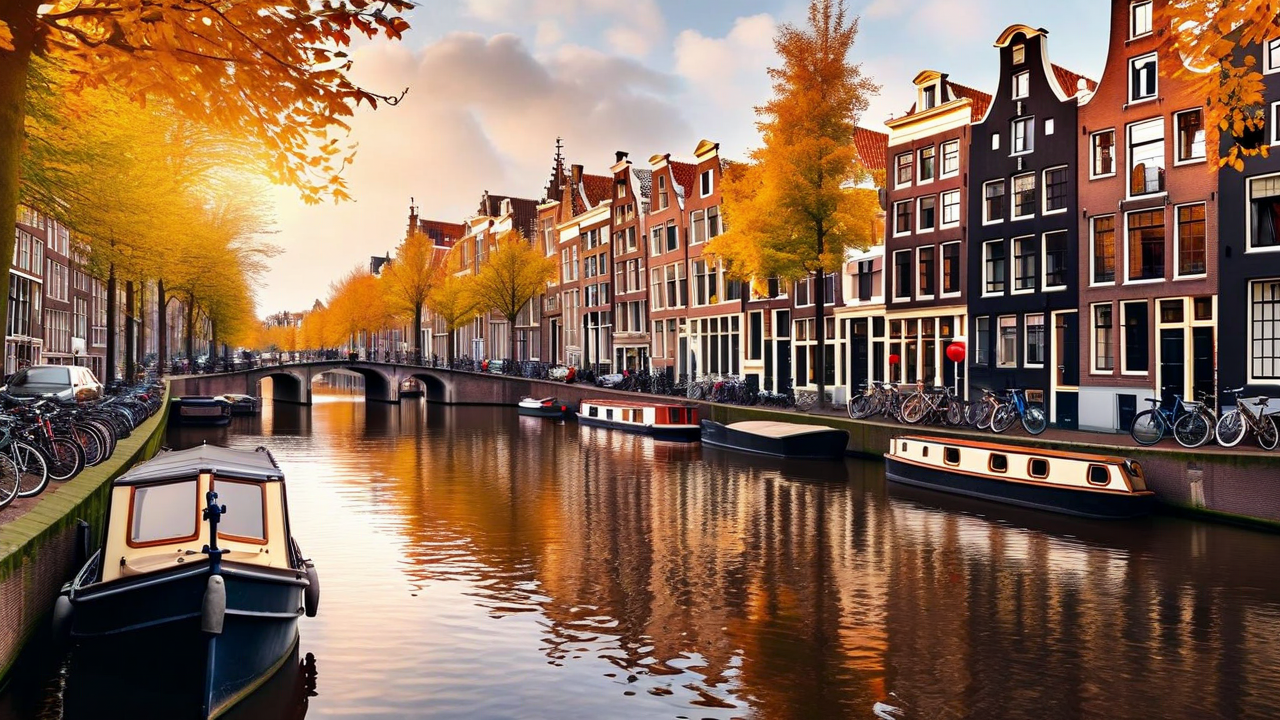
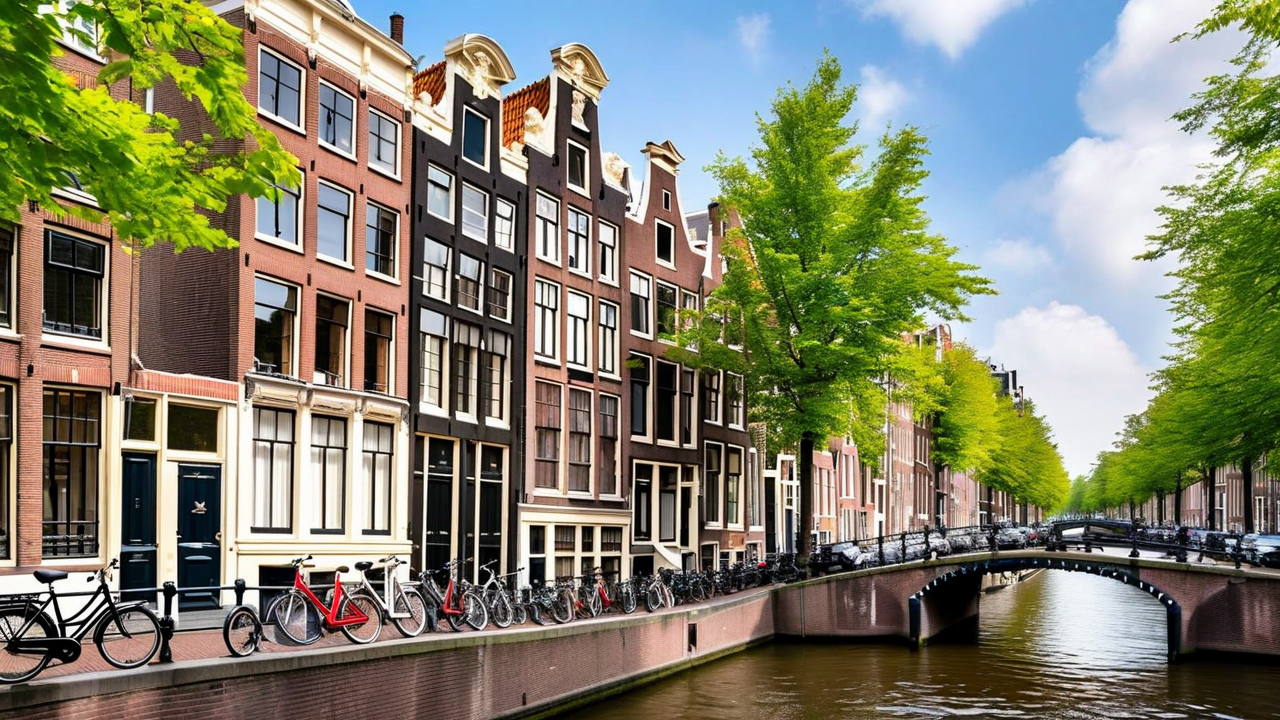
The Grachtengordel — Herengracht, Keizersgracht, Prinsengracht — was dug from 1613 as a single planned expansion, a piece of seventeenth-century urban design that has been continuously inhabited ever since and has been UNESCO World Heritage since 2010. There are 165 canals, about 100 km of them, and 1 281 bridges.
The museums
The Rijksmuseum (Rembrandt's Night Watch, Vermeer, a library, a whole floor of ship models and Delftware); the Van Gogh Museum, the largest collection of his work anywhere, arranged so you can watch him change; the Stedelijk for modern; the Anne Frank House, which sells tickets online only, six weeks ahead, and sells out. The Museumkaart pays for itself on day two if you are serious.
The parts people miss
The Jordaan's side streets on a weekday morning. The Begijnhof, a hidden courtyard with the city's oldest wooden house. Ons' Lieve Heer op Solder, a complete Catholic church hidden in a canal-house attic from the years when Catholic worship was illegal. The Oosterpark and Javastraat for the city people actually live in. And the NDSM wharf across the IJ, free ferry from behind Centraal, for what Amsterdam looks like when it is not performing.
⚠️ The tourism reckoning
Amsterdam recorded about 23,7 million overnight stays in 2025 against a council target of keeping it under 20 million. The response has been the hardest in Europe: no new hotels unless another closes, cruise ship calls being cut, a ban on new tourist shops in the centre, guided tours banned in the Red Light District, the Stay Away advertising campaign aimed at British stag parties, and the highest tourist tax in Europe at 12,5% of the room rate — on top of which national hotel VAT rose from 9% to 21% on 1 January 2026, taking the total tax on a hotel bed to roughly 33,5%.
The rules you can be fined for
Smoking cannabis in the street in the Red Light District (€100). Drinking alcohol in public in the centre. Urinating anywhere (€140 and up). Standing still on a cycle path taking photographs — not a fine, but a genuine hazard. And you cannot buy cannabis unless you can prove residency in some municipalities, though not in Amsterdam, where coffeeshops still serve tourists.
The Red Light District, honestly
De Wallen is the oldest part of the city and a working residential neighbourhood with a primary school in it. Sex work is legal and regulated; window workers rent the window and are self-employed. Photographing a worker is prohibited, enforced, and the quickest way to have a bad evening. The council's long-running plan to move part of the trade to a purpose-built erotic centre elsewhere in the city has been argued about since 2019 and has still not been built.
🏗️ Rotterdam — The City That Was Erased and Answered in Concrete
On 14 May 1940 German bombers destroyed the medieval centre of Rotterdam in about fifteen minutes. Roughly 900 people died, 25 000 homes were gone, and the city was left with a hole where its history had been. Amsterdam preserved; Rotterdam had nothing to preserve, so it decided to build the future instead, and has been doing it ever since.
The port
Europe's largest by a wide margin, about 42 km long from the old city out to Maasvlakte 2, a container terminal built on land reclaimed from the North Sea in 2013 and run by automated cranes and driverless vehicles. It handles around 440 million tonnes a year. The harbour tour is the single best thing to do in Rotterdam and almost no tourist does it.
The architecture
The Erasmusbrug ("the Swan", 1996). Piet Blom's cube houses, tilted 45 degrees, which you can go inside. The Markthal, a horseshoe of flats over a food market with an enormous painted ceiling. Rotterdam Centraal, whose pointed steel canopy is the best railway station built in Europe this century. And the Depot Boijmans Van Beuningen, a mirrored bowl holding the museum's entire collection with the storage open to visitors — the first of its kind anywhere.
Kop van Zuid
The old docks on the south bank, redeveloped into towers. The Hotel New York in the former Holland America Line headquarters is where millions of European emigrants boarded for the United States — including a great many Czechs and Slovaks — and the building has kept that in mind.
The city's temper
Rotterdammers say "geen woorden maar daden" — no words, deeds — and define themselves against Amsterdam's self-regard. It is a working, multi-ethnic port city: roughly half its residents have a migration background, and it elected Ahmed Aboutaleb, Moroccan-born, as mayor in 2009, a fact it is quietly proud of.
Delfshaven
The one piece the bombs missed: a seventeenth-century harbour street with a distillery and gabled houses. The Pilgrim Fathers sailed from here in 1620 on the Speedwell to meet the Mayflower at Southampton — they had been living in Leiden for over a decade, which is a part of the American founding story that American schoolbooks tend to hurry past.
Around it
Kinderdijk's nineteen windmills are a short ride away and are UNESCO-listed. Dordrecht, the oldest city in Holland, is twenty minutes by train. And the Maeslantkering storm barrier at Hoek van Holland has a visitor centre and is worth the trip for anyone who likes machines.
⚖️ The Hague and Delft — Government, Justice and a Colour of Blue
The Hague, which is not the capital
Den Haag holds the parliament, the government, the Supreme Court, the King's working palace and every embassy, and is not the capital — Amsterdam is, by constitution. The reason is historical: The Hague grew as the court seat of the counts of Holland and never received city rights, so the Republic's government sat in what was technically a village, and the arrangement simply never got tidied up.
The Binnenhof
The thirteenth-century complex at the heart of it, with the Ridderzaal where the King reads the speech from the throne. The whole thing has been closed for a full structural renovation since 2021, with parliament sitting in a temporary building nearby, and the works are running long and over budget in a way the Dutch find both infuriating and completely predictable.
City of Peace and Justice
The Peace Palace (1913, Carnegie's money) houses the International Court of Justice; the International Criminal Court is here; so were the Yugoslavia and Rwanda tribunals, and so is the OPCW. That concentration is a deliberate century-long Dutch foreign policy choice — a small country's bid to be indispensable — and it means the words "sent to The Hague" mean something specific in every language.
What to see there
The Mauritshuis is a small, perfect museum: Vermeer's Girl with a Pearl Earring and View of Delft, Rembrandt's Anatomy Lesson, Fabritius's Goldfinch, all in a seventeenth-century house you can walk round in two hours. Panorama Mesdag is a 120 m circular painting of the beach at Scheveningen from 1881, and it works. Scheveningen itself is the Dutch seaside, pier and all.
Delft
Fifteen minutes away and the prettiest small city in the Randstad: a canal-laced centre, two leaning church towers, William the Silent's tomb and the royal crypt in the Nieuwe Kerk, and the house where he was shot in 1584, with the bullet holes still in the wall of the Prinsenhof.
Delftware, and what it really is
Delft Blue is tin-glazed earthenware — the Dutch answer to Chinese porcelain, which the VOC imported until the Ming collapse interrupted supply and Delft's potters filled the gap. It is not porcelain and never was. At its peak there were over thirty potteries; one seventeenth-century house survives, De Porceleyne Fles (Royal Delft), founded 1653. Almost everything sold as Delft Blue in Amsterdam souvenir shops was made in China, which is a joke with several centuries of backspin on it.
🏯 Utrecht, Leiden, Haarlem, Maastricht and the Rest
Utrecht
The fourth city, the country's rail heart — nearly every Dutch train passes through it — and the one many Dutch people say they would live in. The Domtoren at 112 m is the tallest church tower in the Netherlands, and it stands separate from its cathedral because a tornado blew down the nave in 1674 and it was never rebuilt; the gap is still there and paved with stones marking where the church was. Utrecht's canals are unique in having wharf cellars at water level, now cafés.
Leiden
The oldest university in the country (1575, given by William the Silent as a reward for surviving a siege — the town was reputedly offered tax exemption or a university and chose the university). Rembrandt was born here. The Pilgrim Fathers lived here for eleven years before sailing. It is also where Hortus Botanicus planted Carolus Clusius's tulips in 1594 and started everything in the tulip section.
Haarlem
Twenty minutes from Amsterdam and what Amsterdam looks like without the crowds: the Grote Markt, the vast St Bavo church with the organ Mozart played at ten, and the Frans Hals Museum, which is the reason to come. The beach at Zandvoort — and its Formula 1 circuit — is on the same train line.
Maastricht
In the far south, on the Meuse, and barely Dutch in feel: Roman foundations, a Romanesque basilica, Burgundian food, carnival, and the treaty that created the European Union and the euro, signed here on 7 February 1992. The Bookstore Dominicanen in a thirteenth-century Gothic church is routinely called the most beautiful bookshop in the world. Underneath the city are kilometres of marl quarry tunnels, used to hide the Night Watch during the war.
Groningen and the north
A young northern university city with the highest bicycle share in the country, and a region with a grievance: gas extraction from the Groningen field — once Europe's largest — caused thousands of induced earthquakes, damaged tens of thousands of houses, and produced a parliamentary inquiry in 2023 that found the state had systematically put revenue ahead of citizens' safety. Production was ended for good in 2024. Beyond it lie Friesland with its own language and its eleven cities, and the marshes of Groningen.
The Wadden Sea
The UNESCO World Heritage tidal flats behind the northern islands — Texel, Vlieland, Terschelling, Ameland, Schiermonnikoog — the largest unbroken system of intertidal sand and mud flats in the world, and a critical stop for millions of migratory birds. The local sport is wadlopen: walking to an island across the exposed sea bed at low tide, with a licensed guide, through mud up to your thighs. Do not attempt it without one; people have drowned doing so.
🖼️ Dutch Art — Why a Small Country Painted So Much of the World
There is a reason the seventeenth-century Netherlands produced perhaps five million paintings. It had no court and, after the Reformation, no churches commissioning altarpieces — so painting had to be sold on an open market to ordinary prosperous households. That changed what got painted: no more saints and princes, but landscapes, seascapes, interiors, breakfast tables, drunks, and people's own faces. Dutch art invented the everyday as a subject and then sold it to the people in it.
Rembrandt
Rembrandt van Rijn (1606–1669), the miller's son from Leiden who became Amsterdam's fashionable portraitist, went spectacularly bankrupt in 1656, and painted better afterwards. The Night Watch (1642) is not a night scene — it was darkened varnish — and it is a militia group portrait that broke every rule by putting the company in motion. It has been attacked three times and is currently the subject of Operation Night Watch, a years-long restoration carried out in public behind glass at the Rijksmuseum.
Vermeer
Johannes Vermeer (1632–1675) left about 35 paintings and no drawings, worked slowly, died poor with eleven children, and was essentially forgotten for two hundred years until a French critic rediscovered him in the 1860s. The 2023 Rijksmuseum exhibition gathered 28 of them, the most ever shown together, and sold out its entire run before it opened.
Van Gogh
Vincent van Gogh (1853–1890) painted for ten years, sold almost nothing, and wrote about 820 surviving letters that are as good as the paintings. His brother's widow, Jo van Gogh-Bonger, is the reason he is famous: she spent thirty years organising exhibitions and publishing the letters, and the museum's existence is essentially her work, which the museum now says out loud.
The others
Frans Hals, who painted faster and looser than anyone before Manet. Jan Steen, whose chaotic households gave Dutch the phrase een huishouden van Jan Steen. Pieter Saenredam's white church interiors. Jacob van Ruisdael's skies. And earlier, Hieronymus Bosch of 's-Hertogenbosch, whose work has no ancestors and no descendants — his home city has a visitor centre and none of his paintings, all of which are abroad.
The modern line
Piet Mondrian and Theo van Doesburg's De Stijl (1917) reduced painting to horizontals, verticals and three primaries and changed architecture and graphic design worldwide. Gerrit Rietveld's red-blue chair and his Schröder House in Utrecht — UNESCO-listed — are De Stijl you can walk into. M. C. Escher is the other Dutch export, and The Hague has a museum of him in a former royal palace.
Forgery, a Dutch speciality
Han van Meegeren sold a fake Vermeer to Hermann Göring and was arrested after the war for selling national treasures to the enemy — a capital charge. His defence was to confess to forgery instead and prove it by painting another one in prison. He went from traitor to folk hero in a fortnight, and the episode says something permanent about how art authentication actually works.
🏛️ Architecture and Design — Small Country, Disproportionate Influence
The canal house
The defining Dutch building type and a direct product of tax law: plots were narrow because frontage was taxed, so houses went tall, thin and deep, with a hoisting beam at the top because the stairs are too steep to carry anything up. Many lean forward deliberately — a few degrees of overhang so a hoisted wardrobe clears the windows below. The gables are datable: step gables to about 1650, neck gables after, bell gables in the eighteenth century.
Berlage and the Amsterdam School
H. P. Berlage's Beurs van Berlage (1903) is usually called the first modern building in the Netherlands — stripped brick, structure showing, ornament banished. Against it, the Amsterdam School of the 1910s–20s went the other way entirely: expressionist brickwork twisted into waves and horns, best seen in Het Schip, a social housing block in Spaarndammerbuurt that is now a museum. Both were, remarkably, workers' housing.
De Stijl and the functionalists
Rietveld's Schröder House (1924, Utrecht) is the only building fully built to De Stijl principles and is UNESCO-listed; the upper floor has movable partitions so the plan can be changed during the day. Alongside it, Van Nelle Factory in Rotterdam (1931) — glass, steel and daylight for the workers — is also World Heritage and is still in use as offices.
Superdutch
From the 1990s a generation went global: Rem Koolhaas and OMA, MVRDV, UNStudio, Mecanoo, West 8. Their common thread is a willingness to treat a brief as a problem in logic rather than in style, which is arguably just Dutch water engineering applied to buildings. Koolhaas's Delirious New York (1978) is the most influential architecture book of the late twentieth century and was written by a former journalist and screenwriter.
Dutch Design
Droog (1993) put wit and reuse at the centre — Tejo Remy's chest of drawers made of salvaged drawers strapped together — and Dutch Design Week in Eindhoven each October is now the largest design event in northern Europe. The national sensibility is dry, conceptual and slightly amused by its own object, which is recognisably the same temperament as a seventeenth-century still life about vanity.
What they build now
Housing, badly and not enough: the country is short roughly 400 000 homes, planning is slow, nitrogen rules have blocked permits, and a generation cannot buy. The Netherlands, which has the best planning tradition in Europe and invented the modern social housing block, is currently failing at the thing it is famous for — and every party in the 2025 election ran on it.
🌷 Tulips — A Turkish Flower, a Dutch Industry
The tulip is not Dutch. It is a Central Asian mountain flower, cultivated by the Ottomans, sent from Constantinople to Vienna and from there to Leiden, where the botanist Carolus Clusius planted bulbs in the university's Hortus in 1593–94 and refused to sell any. People broke into the garden and stole them, and the Dutch bulb industry began with a burglary.
The numbers
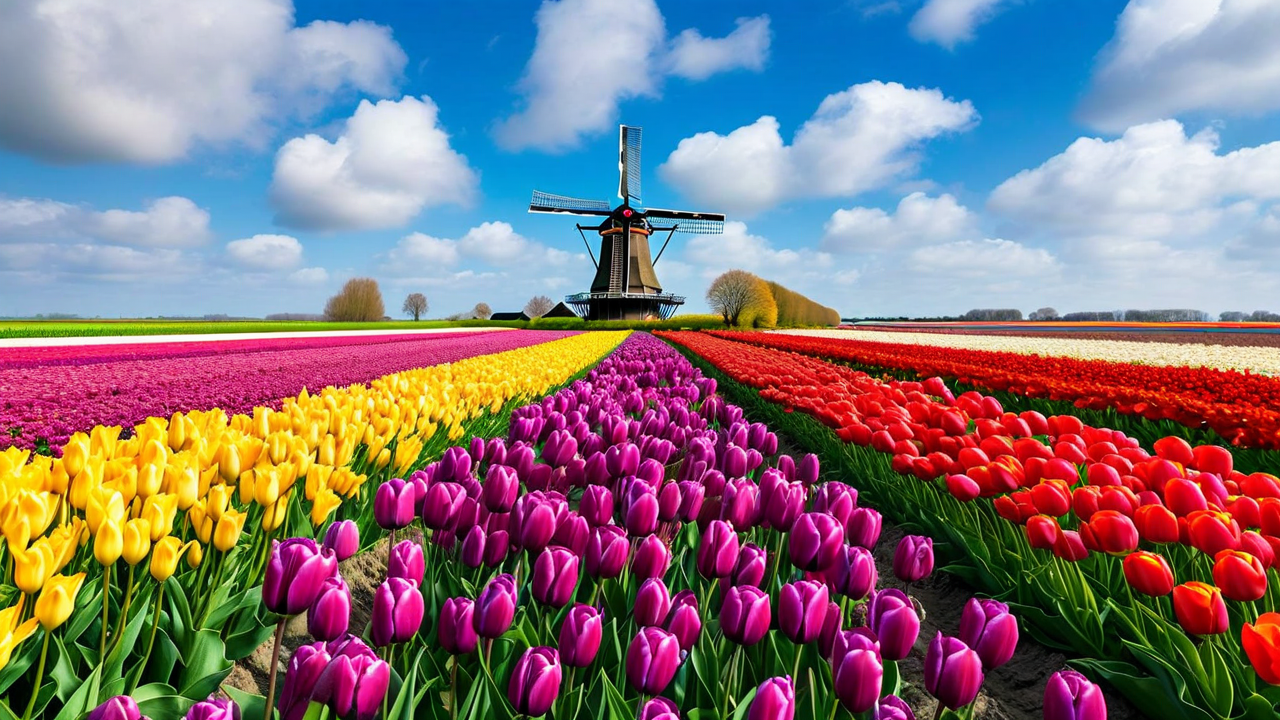
The Netherlands grows roughly two billion tulip bulbs a year and supplies something near 90% of world trade in them, on about 13 000 hectares. The Royal FloraHolland auction at Aalsmeer is one of the largest commercial buildings on earth by floor area and moves tens of millions of flowers a day by Dutch auction — price starts high and falls until someone bids, which is why it is called a Dutch auction.
Where and when
The Bollenstreek between Haarlem and Leiden, the Noordoostpolder in Flevoland, and parts of North Holland. Peak colour is roughly mid-April, with daffodils from late March and hyacinths in between; it moves a fortnight either way with the weather and the growers publish a bloom map. Rent a bike at Hillegom or Lisse — the fields are private property and walking into them is both rude and a genuine disease-transmission risk.
Keukenhof
Open about eight weeks a year, from late March, and displaying seven million bulbs planted by hand each autumn. It is a shop window built by the bulb industry to show buyers what the varieties do, and that is not a criticism: it is the most spectacular flower garden on earth. Book a timed ticket, go on the first bus, and be out by eleven.
What tulip mania actually was
Between about 1634 and February 1637 the futures price of rare bulbs — particularly the flame-streaked Semper Augustus — rose steeply and then collapsed. Modern research, notably by Anne Goldgar, finds a few hundred participants, most of them already rich, almost no bankruptcies and no detectable effect on the Dutch economy. The moral tale we inherited comes largely from contemporary Calvinist satire and a popular nineteenth-century English book, not the archives.
And the streaks were a virus
The flame patterns that made bulbs precious were caused by the tulip breaking virus, which weakens the plant — so the most valuable bulbs were also the sickest and hardest to propagate, which is exactly why they were scarce. The virus is now eradicated from commercial stock and the striped tulips you buy today are bred, not infected.
The rest of the flower business
Tulips are the famous part; the Netherlands is the hub for cut flowers generally, much of it grown elsewhere — Kenyan roses, Ethiopian carnations — and traded through Aalsmeer within 24 hours. Dutch glasshouse horticulture in the Westland is a landscape of its own, visible from space at night, and is the single biggest reason a country this small is the world's second agricultural exporter.
🍃 Windmills, Polders and the Made Landscape
How many are left
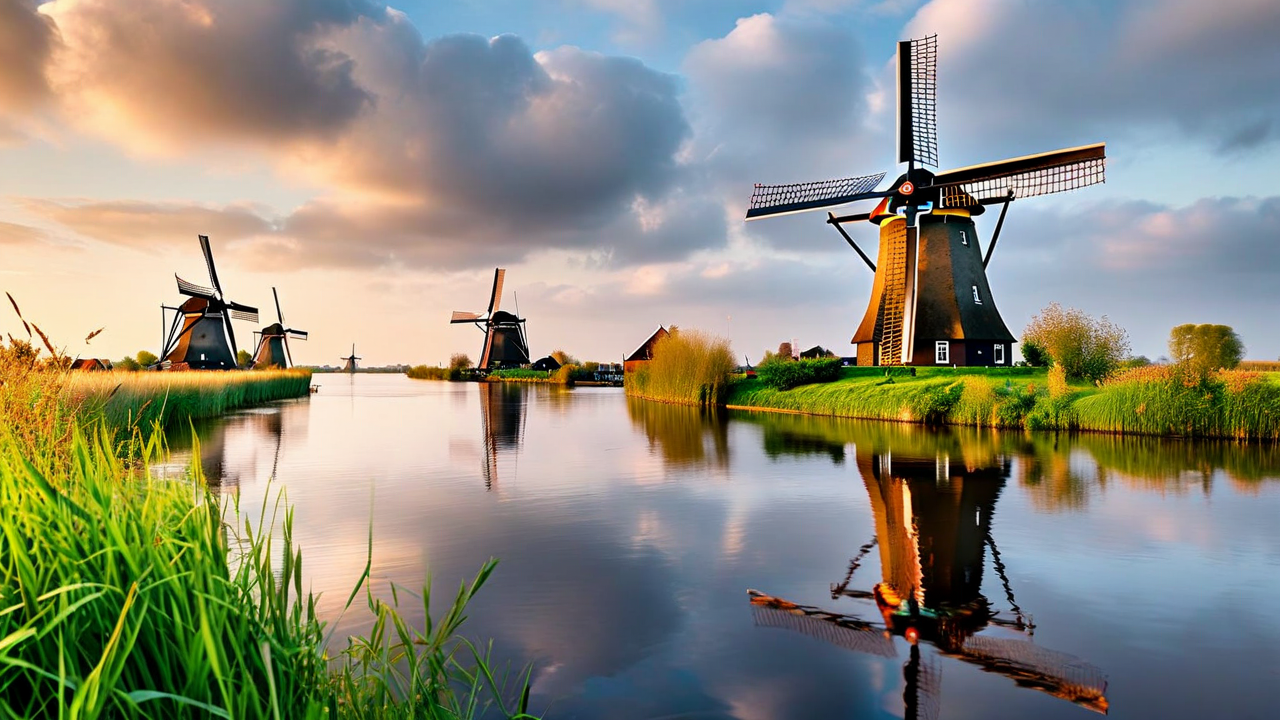
Around 1 000 historic windmills survive of perhaps 10 000 at the peak in the nineteenth century, and the Dutch mill craft is on the UNESCO intangible heritage list. Many still turn: volunteer millers keep them working and the sail positions are a code — set just past vertical for joy, just before it for mourning, and there is a wartime signalling position too.
What they were for
Three jobs. Drainage: the polder mills, lifting water a metre or two at a time up a staircase of them into a ring canal. Industry: sawing timber, grinding grain, pressing oil, making paper and pigment — the Zaanstreek north of Amsterdam had around 600 industrial mills and was arguably the first industrial region in the world, running on wind a century before coal. Grinding grain, in every village.
Kinderdijk
Nineteen mills built 1738–40 to drain the Alblasserwaard, UNESCO-listed since 1997, and the best place to understand the system because you can see the whole staircase at once. Two are open as museums, with the miller's family's beds in cupboards in the wall. Go on a weekday, early, by bike from Rotterdam or by waterbus.
Zaanse Schans
The other famous site, north of Amsterdam: a collection of mills and green wooden houses moved here from around the Zaan region in the 1960s to save them. It is therefore an open-air museum rather than a village, which the Dutch are open about, it is free to walk into, and it is completely overrun by mid-morning — the 08:00 arrival is transformative.
The pumping stations
The mills were replaced by steam and then diesel and then electricity. The Woudagemaal in Friesland (1920) is the largest steam pumping station ever built and still works — it is fired up when the water is high, and it is UNESCO-listed. The whole modern system is run by the water boards, which still levy their own tax on every household and still hold their own elections that almost nobody votes in.
The new windmills
The country that industrialised on wind has come back to it: offshore wind in the North Sea now supplies a large and rising share of Dutch electricity, with huge fields off the Holland coast and more consented. Onshore turbines are far more contentious — in a country this crowded and this flat, every turbine is visible from a great many kitchens, and the planning fights are ferocious.
🚲 Cycling — Infrastructure, Not a Sport
There are roughly 23–24 million bicycles in the Netherlands for 18,1 million people, and about 27% of all trips are made by bike — in Utrecht and Groningen it is closer to half. This is the single most important thing to understand about how the country feels, and the crucial point is that none of it is about sport, fitness or virtue. It is about the bicycle being the fastest and least annoying way to get to work.
It was a policy choice
This was not inherited. By the early 1970s Dutch cities were being rebuilt for cars exactly like everywhere else and road deaths peaked at 3 264 in 1971, including over 400 children. The Stop de Kindermoord campaign — "stop the child murder" — plus the 1973 oil crisis and its car-free Sundays changed national policy. Everything you see now was built deliberately after that, over fifty years.
What "good infrastructure" means
Not painted lines. Physically separated paths with their own kerbs and their own traffic lights; roundabouts where cycles have priority; woonerven, shared streets where cars are guests at walking pace; and above all continuous networks — the path does not stop at the difficult junction, which is where every other country's cycling policy fails.
Liability, and why it matters
In a collision between a car and a cyclist, Dutch law puts presumed liability on the motorist's insurer, with heavier protection for cyclists under 14. It is a civil insurance rule, not an assumption of guilt, and its practical effect on how drivers behave around bikes is enormous.
Riding as a visitor
Ride predictably and to the right; signal with your arm; do not stop on a path to look at your phone. Lights are mandatory after dark and fined (about €70). Locks: use two, one through the frame to something fixed — bike theft is the national petty crime. And do not ride two abreast chatting while a Dutch commuter is behind you, because they will pass you at 30 km/h on an e-bike without comment and you will deserve it.
The OV-fiets
The best-kept secret in Dutch travel: a national rental bike from almost every railway station for a few euros a day, on your public transport card. Train to a small town, take a bike, ride the countryside, drop it back. The country is 41 000 km² and completely flat; you can cross a province in an afternoon.
The routes
The LF long-distance network and the knooppunten junction-numbering system, which is the best cycle wayfinding in the world: every junction has a number, you plan a route as a list of numbers, and you never need a map. Good rides: the Afsluitdijk, the dunes from Haarlem to Leiden, the Hoge Veluwe (with free white bicycles inside the park), and the Vecht between Utrecht and Amsterdam.
👥 Society — Directness, Agendas and the Word Gezellig
Directness
The Dutch will tell you what they think, promptly, including about your work, your plan and your haircut. It is not rudeness and it is not a test; the underlying assumption is that saying the thing is more respectful than letting you continue wrongly. Foreigners usually find it bracing for a month and then prefer it. The corollary: Dutch people assume you mean what you said, so hinting does not work here.
The agenda
Social life is planned. Dropping in unannounced is genuinely unusual; "let me check my agenda" is not a brush-off but a literal statement, and a coffee three weeks out is normal. Related and much-mocked: the birthday party where everyone sits in a circle round the edge of the room congratulating each other on someone else's birthday.
Doe maar gewoon
"Doe maar gewoon, dan doe je al gek genoeg" — just act normally, that's mad enough already. The strongest social norm in the country is against standing out, showing off or taking yourself seriously. It is why a prime minister used to cycle to work, why nobody discusses salaries upward, and why conspicuous wealth is quietly disapproved of even by people who have it.
Gezelligheid
The untranslatable one — it covers cosy, convivial, warm, good company, the right kind of pub, a room with the curtains open and a candle in the window. It is a social quality, not a decorative one: a place is gezellig because of who is in it. Dutch people will tell you it cannot be translated and they are approximately right.
Tall, and why
The Dutch are the tallest people on earth — men average about 1,84 m, women about 1,70 m — having gained roughly 20 cm in 150 years, far faster than genetics alone explains. The usual account is dairy, childhood nutrition, universal healthcare and a fairly equal distribution of all three. Interestingly, the average has now stopped rising and slightly fallen in the youngest cohorts.
Work and family
The Netherlands has the highest rate of part-time work in the world — over half of employed women and around a fifth of men — which is celebrated as work-life balance and criticised, in the same breath and often by the same economists, as a drag on women's earnings and pensions. The average Dutch worker puts in among the fewest hours in the OECD and the country remains among its most productive per hour.
🗳️ Politics — Fifteen Parties, No Threshold, and a Minority Cabinet
The Netherlands has the purest proportional representation in the world: one national constituency, 150 seats, and no electoral threshold — a party needs about 0,67% of the national vote for a seat. The consequence is a parliament of fifteen-odd parties, coalitions of three or four, and formation negotiations measured in months.
The 2025 election
On 29 October 2025, D66 — the social-liberal party, led by Rob Jetten — and Geert Wilders's PVV both took 26 seats, with D66 ahead by 29 668 votes, the narrowest margin since 1956. VVD took 22, GroenLinks-PvdA 20 and CDA 18. Turnout was 78,3%. D66 had gone from 9 seats to 26 in one election; the PVV, which had won in 2023 with 37, lost 11.
The Jetten cabinet
After nearly four months of negotiation, a D66–VVD–CDA cabinet was sworn in on 23 February 2026. It holds 66 of 150 seats — ten short of a majority — making it the first Dutch minority cabinet without a confidence-and-supply agreement since 1918. It must find votes issue by issue. Rob Jetten is 38, the youngest prime minister in Dutch history and the first who is openly gay; the deputy prime ministers are Dilan Yeşilgöz and Bart van den Brink.
What preceded it
The 2023 election was won by the PVV, and after 223 days a four-party right-wing coalition took office under a non-party prime minister, Dick Schoof, with Wilders outside the cabinet. It collapsed in June 2025 when Wilders pulled the PVV out over asylum policy, which is what produced the October election. Between 2010 and 2024 the Netherlands had one prime minister, Mark Rutte — now NATO Secretary General — across four cabinets.
The live arguments
Housing: a shortage of roughly 400 000 homes and a generation locked out. Nitrogen: see below. Asylum and migration, which has broken two governments in a row. Healthcare costs and staffing. And the toeslagenaffaire, the childcare benefits scandal in which the tax office wrongly accused tens of thousands of families of fraud, disproportionately those with dual nationality, forced repayments that ruined them, and in more than a thousand cases contributed to children being taken into care. It brought down a cabinet in January 2021 and compensation is still being paid out.
⚠️ The nitrogen crisis
The defining Dutch policy problem. A 2019 Council of State ruling found the government's permitting system for nitrogen deposition breached EU habitats law, and effectively froze construction permits nationwide — housing, roads, farms. The Netherlands has the highest livestock density in Europe and agriculture is the largest source. In June 2026 the government published a package cutting agricultural nitrogen emissions by up to 46% against 2019 by 2035, transport and industry by 50%, and imposing a national limit of 2,6 cows per hectare. Farmers' organisations called it devastating; tractor protests resumed through the summer.
For a visitor
None of this affects travelling here, with one exception worth knowing: farmer protests occasionally block motorways and distribution centres at short notice, and rail strikes happen. Both are announced in advance in Dutch media and on 9292.nl. Demonstrations in Dutch cities are orderly and heavily policed; you are free to watch and sensible not to join.
💶 The Economy — Ports, Chips, Cows and a Tax Argument
Trade
Rotterdam is Europe's largest port and the entry point for much of Germany's industry; Schiphol is one of the continent's busiest airports and a huge freight hub. A great deal of what the Netherlands "exports" is re-export — goods landed, stored and forwarded — which inflates the headline numbers and is genuinely the business: the country makes its living as the door.
ASML
In Veldhoven near Eindhoven sits the most strategically important company in Europe. ASML is the only manufacturer in the world of extreme ultraviolet lithography machines, which cost well over €150 million each and without which no leading-edge semiconductor can be made. This makes a Dutch company a central object of US–China export control policy, and makes the Netherlands, improbably, a great power in one specific and decisive technology.
Agriculture
The Netherlands is the world's second-largest agricultural exporter by value after the United States, from 41 543 km². The mechanism is intensity: glasshouse horticulture in the Westland with computer-controlled climate and almost no soil, dairy at extraordinary density, seeds and breeding stock, and Wageningen University, which is consistently the world's top-ranked agricultural research institution. It is also the direct cause of the nitrogen problem — the model works spectacularly right up until you count the nitrogen.
Energy
The Groningen gas field, once Europe's largest, was shut permanently in 2024 after induced earthquakes and a parliamentary inquiry that found the state had put revenue over safety. The replacement is offshore wind, on a large scale, plus LNG imports and an unresolved argument about nuclear. Rotterdam is positioning itself as a hydrogen import hub, which may or may not come off.
The tax question
The Netherlands has been repeatedly identified by the EU, the IMF and academic researchers as a conduit jurisdiction: not a classic tax haven but a place through which multinational profits are routed on their way somewhere cheaper. The Dutch Sandwich was standard practice for a decade. Successive governments have closed structures under pressure — withholding taxes on payments to low-tax jurisdictions from 2021 — and the country still hosts an enormous number of letterbox holding companies. It is the least comfortable part of the Dutch self-image and the Dutch argue about it openly.
How people live
High incomes, high housing costs, very high mortgage debt by international standards, and a pension system routinely ranked the best or second-best in the world — now in the middle of a once-in-a-generation reform from guaranteed benefits to collective defined contribution. Unemployment is low, part-time work is ubiquitous, and the state pension (AOW) age is tied to life expectancy, which is why it keeps moving.
⚽ Total Football and Why the Dutch Never Won the World Cup
No country has contributed more ideas to football relative to its size, and no country has a more painful trophy cabinet. The Netherlands has lost three World Cup finals — 1974, 1978, 2010 — and won one European Championship, in 1988. Dutch football's influence on how the game is played everywhere is nonetheless larger than that of almost any nation that has won it.
Totaalvoetbal
Rinus Michels at Ajax and Johan Cruyff on the pitch built a system in which any outfield player could take any other's position, the team squeezed the pitch small when it had the ball and pressed high when it did not. Ajax won three straight European Cups (1971–73); the Netherlands reached the 1974 final playing the best football anyone had seen and lost to West Germany after scoring in the first minute without a German touching the ball.
Cruyff
The most influential figure in modern European football, as player, coach and argumentative philosopher. He took the ideas to Barcelona, built the team that became the model for Guardiola's, and founded La Masia on Ajax's academy model. His aphorisms — "every disadvantage has its advantage", "playing football is very simple, but playing simple football is the hardest thing" — are quoted in Dutch as a kind of secular scripture. Amsterdam's stadium is named after him.
1988
The one they won. Van Basten's volley against the USSR in the final in Munich, from an angle that should not have been possible, is routinely called the greatest goal in any final. Beating West Germany in the semi — in Hamburg — mattered more to the public than the trophy, for reasons the Dutch are perfectly willing to explain at length.
2010, and the argument about it
The Netherlands reached the final in Johannesburg and played a deliberately physical, cynical game, including De Jong's chest-high boot into Xabi Alonso. They lost in extra time. Cruyff publicly disowned the team — "they played anti-football" — and the episode remains a genuine national argument about whether the Dutch would rather lose beautifully than win ugly.
The club game now
Ajax, PSV and Feyenoord dominate the Eredivisie, which has become an export league: it develops players brilliantly and sells them, and its clubs cannot compete financially with England. Ajax's academy remains one of the best in the world. The women's side has risen fast — the Netherlands won the 2017 European Championship at home and reached the 2019 World Cup final.
Everything else
Speed skating is the real national sport, and the Netherlands wins an implausible share of Olympic long-track medals. The Elfstedentocht — a 200 km skating race through eleven Frisian cities on natural ice — has not been held since 1997 because the canals no longer freeze hard enough, and its absence is discussed every winter as a kind of climate obituary. Also: cycling, korfball (invented here), and darts, at which the Dutch are alarmingly good.
🍽️ Food — Plain at Home, and Then the Colonies Arrived
Dutch home cooking has a reputation for being dull and it earned it honestly: Calvinism, a dairy economy and a nineteenth-century domestic-science movement that taught the nation to boil vegetables until they surrendered. But two things save Dutch eating — the snack culture, which is superb, and the Indonesian and Surinamese kitchens, which are not garnish but a genuine part of what the country eats.
🧀 Cheese
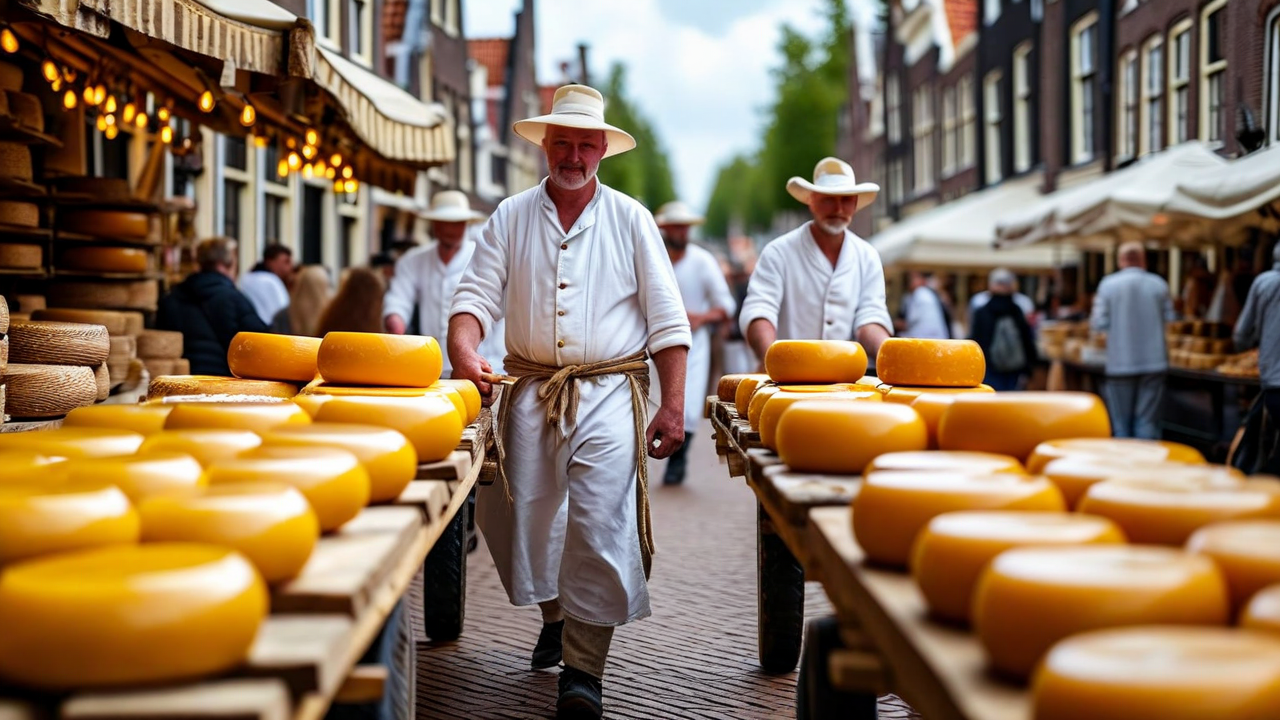
About 60% of Dutch cheese is Gouda, which is a style, not a place-protected name, and which changes completely with age: jong (4 weeks) is mild and rubbery, belegen (4 months) is where it gets interesting, oud (a year) is hard, sharp and studded with crunchy tyrosine crystals, and overjarig (2 years+) is a different food. Also Edam, Leyden with cumin, and the blue-green Old Amsterdam. Buy at a market, ask for oude kaas, and eat it with mustard.
🐟 Haring
The national dish and the one worth being brave about. Hollandse Nieuwe is young herring caught between roughly May and July, gutted except for the pancreas — whose enzymes do the curing — and lightly salted. It is served with raw onion and pickle, and the correct method is to hold it by the tail and lower it in, though every stall will cut it up for you. It is not fishy; it is fatty, mild and slightly sweet, and it is genuinely one of the best street foods in Europe.
🍟 The snack canon
Patat — thick-cut chips, with oorlog ("war": mayonnaise, satay sauce and raw onion) if you are committed. Bitterballen, crisp-crumbed spheres of beef ragout, served with mustard and beer, and the single best thing in a Dutch pub. Kroketten, the same in a cylinder, eaten on a bread roll. Frikandel, a skinless sausage best not examined. And the automatiek — the heated wall of little glass coin-operated doors, FEBO being the famous chain — which is where the real kaassoufflé lives.
🍚 Indonesian
Three and a half centuries of colonial history produced a permanent place in Dutch eating. The rijsttafel — rice with a dozen or twenty small dishes — is itself a colonial Dutch invention, a display of abundance that no Indonesian household would serve, and it is delicious and worth knowing the history of. Satay with peanut sauce, nasi and bami goreng, rendang and sambal are supermarket-normal here in a way they are nowhere else in Europe.
🍛 Surinamese
The other great import and, in Amsterdam, the better everyday food: a Caribbean-Javanese-Hindustani-Chinese-Creole mixture with no equivalent anywhere. Roti — a flatbread with curried chicken, potato, long beans and a boiled egg — is the standard order; broodje pom, bakabana and saoto soup are the others. Eat it on the Albert Cuypstraat or in Bijlmer.
🍩 Sweet
Stroopwafels, best bought hot from a market stall where the syrup is still liquid — a supermarket packet warmed over a mug of tea is the correct home method. Poffertjes, tiny yeasted pancakes with butter and icing sugar. Oliebollen, deep-fried dough eaten at New Year from street vans that appear in December and vanish in January. Speculaas, hagelslag (chocolate sprinkles on buttered bread, eaten by adults, at breakfast, without embarrassment), and drop — salty liquorice, which the Dutch consume more of per head than anyone and which foreigners almost universally cannot.
🍳 Three Dutch Recipes
🥗 Boerenkoolstamppot
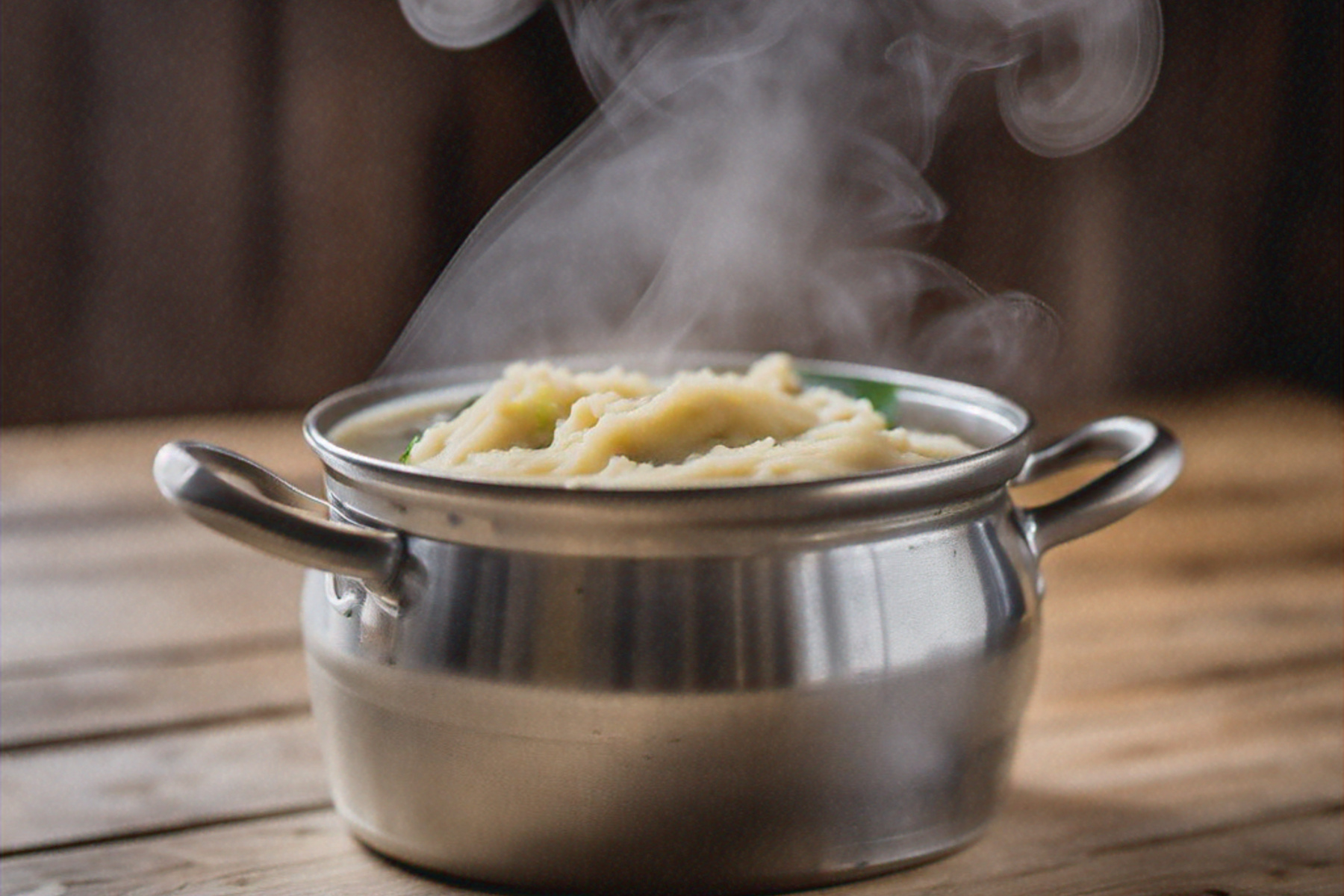
Kale and potato mash with smoked sausage · serves 4 · 45 minutes
Ingredients: 1,2 kg floury potatoes, peeled and chunked · 500 g curly kale, stripped from the stalks and chopped fine (frozen is genuinely fine and is what most Dutch households use) · 150 ml whole milk, warm · 75 g butter · 1 rookworst (smoked sausage) · salt, pepper, a scrape of nutmeg · optional: 150 g smoked bacon lardons, and mustard to serve. Gravy: the bacon fat, 1 tbsp flour, 250 ml beef stock.
Method: Put the potatoes in a large pan with just enough salted water to cover, lay the kale on top of them, bring to the boil and simmer 20–25 minutes with the lid on — the kale steams over the potatoes rather than boiling in the water, which is the whole trick and the reason it keeps its colour. Meanwhile heat the rookworst gently in a separate pan of water just under the boil for about 20 minutes; do not let it burst. Fry the bacon if using. Drain the pan, keeping a little of the water. Add the butter and warm milk and mash everything together until the kale is distributed all through and the mash is green-flecked from top to bottom. Season hard with salt, pepper and nutmeg. Serve in a mound with a well in the middle, the gravy in the well, the sliced sausage on top and mustard on the side.
💡 Two variations worth knowing: hutspot (potato, carrot and onion, eaten on 3 October in Leiden to mark the lifting of the 1574 siege, when the fleeing Spanish reputedly left a pot of it behind) and zuurkoolstamppot with sauerkraut. And it must be a floury potato — a waxy one will not break down.
🐟 Haringsalade and How to Eat a Herring
The national fish, two ways · serves 4 · 20 minutes
Ingredients: To eat it straight: 4 maatjes herring fillets · 1 small onion, diced very fine · sliced gherkins · rye bread or a soft white broodje. Haringsalade: 3 herring fillets, cut in 1 cm pieces · 2 boiled waxy potatoes, diced · 1 cooked beetroot, diced · 1 tart apple, diced · 2 gherkins, chopped · 1 small red onion · 150 ml crème fraîche · 1 tbsp mayonnaise · 1 tsp mustard · white pepper, a squeeze of lemon.
Method: Straight: hold the fillet by the tail, tilt your head back and lower it in, taking a bite with the onion. If that feels like a lot, ask for it op een broodje and no one at any stall in the Netherlands will judge you. Salad: mix the crème fraîche, mayonnaise, mustard, pepper and lemon. Fold in everything else gently, keeping the beetroot until last unless you want the whole bowl pink — which, for the record, is how it is traditionally served, so add it early if you want the classic magenta. Rest it in the fridge for at least two hours and eat it on dark rye with more pepper.
💡 The herring must be proper Dutch-cured maatjes, not pickled rollmops in vinegar — they are completely different products and substituting one wrecks both dishes. Buy from a fishmonger and ask.
🍯 Appeltaart, the Dutch Kind
Deep, spiced, crumb-lidded apple cake · one 24 cm springform · 1 hour 45 minutes
Ingredients: Pastry: 300 g plain flour · 200 g cold butter, cubed · 150 g light brown sugar · 1 egg · 1 tsp cinnamon · pinch of salt. Filling: 1,2 kg tart apples (Goudreinet if you can get them, Bramley otherwise), peeled and sliced thick · 80 g sugar · 2 tsp cinnamon · 75 g raisins soaked in rum or apple juice · 2 tbsp fine breadcrumbs · juice of half a lemon. To serve: unsweetened whipped cream, and no other thing.
Method: Rub the butter into the flour, sugar, cinnamon and salt, then bring together with most of the beaten egg — keep a tablespoon back for glazing. Rest it 30 minutes in the fridge. Press two-thirds into the base and right up the sides of a lined springform: a Dutch appeltaart is tall and steep-sided, not a flat tart. Scatter the breadcrumbs over the base — they absorb the apple juice and stop a soggy bottom. Mix the apples with sugar, cinnamon, lemon and drained raisins and pile them in much higher than looks sensible, pressing down; they collapse by a third. Roll the remaining pastry and cut strips for a lattice, or simply crumble it over. Glaze, and bake at 175 °C for 65–75 minutes until deep gold. Cool completely in the tin before releasing.
💡 It is eaten all day, with coffee, and always met slagroom — unsweetened whipped cream. Warm it slightly and it is better; every Dutch family holds that its own recipe is the correct one and this is close to the common ancestor.
🍺 Genever, Beer and — Genuinely — Dutch Wine
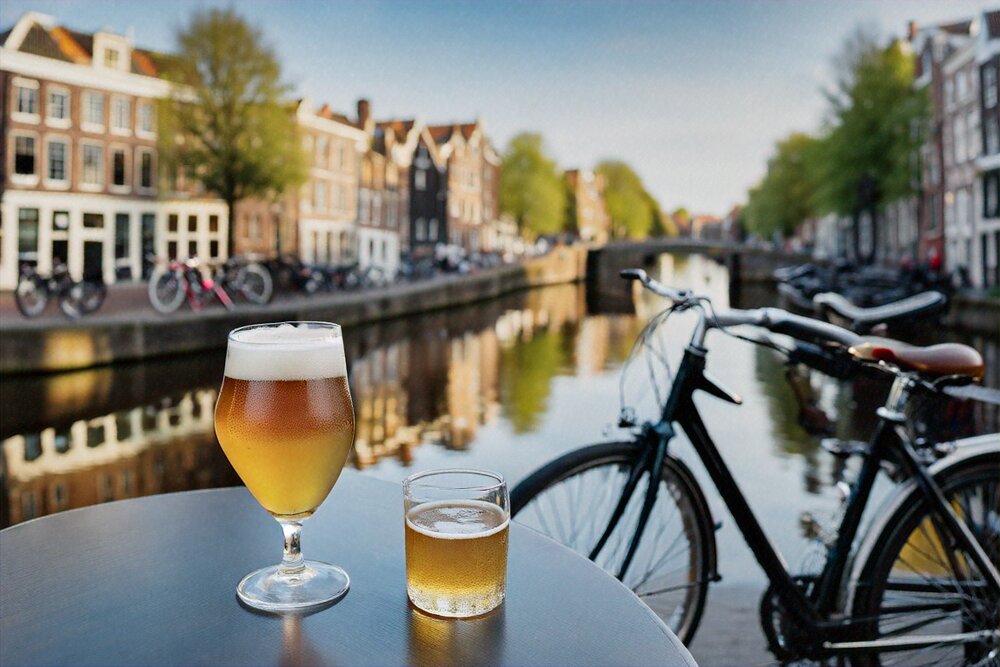
🥂 Genever
The original — gin is descended from it, not the other way round. Genever is made from moutwijn, a malt-wine base distilled from rye, wheat and malted barley, flavoured with juniper: oude (old-style, maltier, often barrel-aged, and "old" means the method not the age) and jonge (lighter, post-1900). The Dutch and Belgian product has EU protected geographical status. Drink it cold, in a tulip glass, with a beer beside it. Schiedam near Rotterdam was the distilling capital and has a museum and the tallest windmills in the world, built tall to catch wind over the warehouses.
🍺 Beer
Heineken is the global face and the Netherlands drinks far more interesting things: Grolsch, Bavaria, Hertog Jan, and a serious craft scene led by Brouwerij 't IJ (in a windmill in Amsterdam), Oedipus, Jopen in a Haarlem church and De Molen. Also the Trappist connection: La Trappe at Koningshoeven in Brabant and Zundert are the only Dutch authentic Trappist breweries. Order a vaasje; ask for a fluitje if you want small.
🍷 Yes, there is Dutch wine
And it is no longer a joke. Warming and better varieties have produced roughly 180 commercial vineyards on something like 350 hectares, concentrated in South Limburg — where Mergelland is a real protected designation on the chalk near Maastricht — plus the Betuwe in Gelderland and parts of North Brabant. Mostly cool-climate whites: Riesling, Auxerrois, Pinot Gris, and the disease-resistant hybrids Solaris, Johanniter and Souvignier Gris. Sparkling wine made by the traditional method is where the quality is highest.
☕ Coffee, and the appointment
The Netherlands drinks among the most coffee per head in the world, and koffie met gebak is a social institution rather than a caffeine delivery system. The standard is filter, strong, with a small biscuit balanced on the saucer. Ask for koffie verkeerd — "wrong coffee" — for what the rest of the world calls a latte.
🌿 Advocaat, and the rest
Advocaat, the thick egg liqueur, eaten with a small spoon and whipped cream rather than drunk. Boerenjongens and boerenmeisjes — "farmer's boys and girls" — raisins and apricots steeped in brandy. Fruit genevers in every flavour, mostly awful and mostly the point. And Oranjebitter, drunk on King's Day for reasons of colour rather than quality.
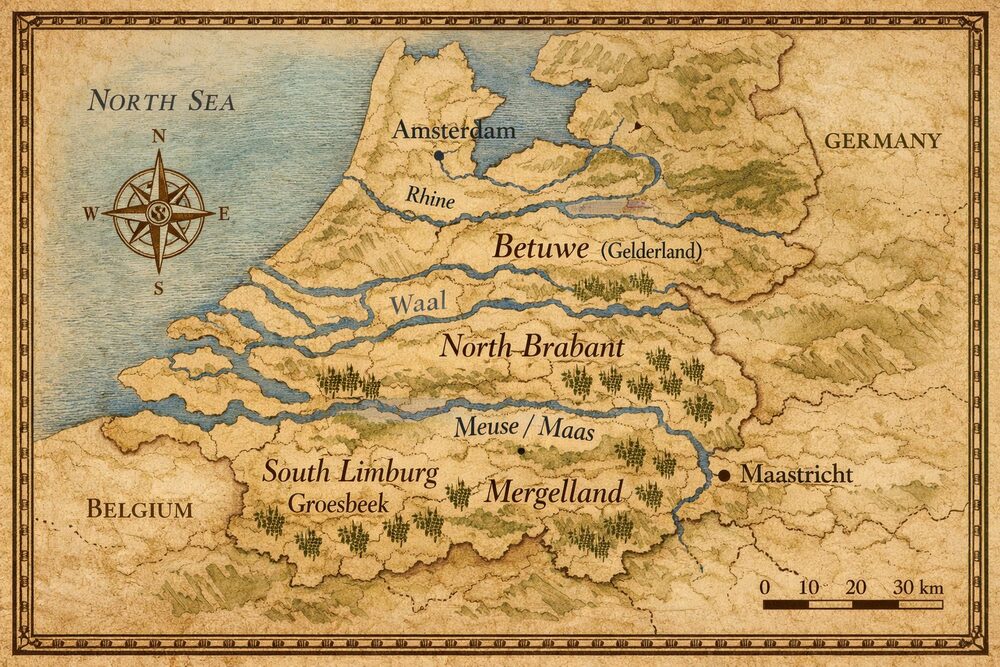
💸 What It Actually Costs — Including the 2026 Tax Jump
The Netherlands was never cheap and it got measurably more expensive on 1 January 2026, when national VAT on hotel accommodation rose from 9% to 21%. In Amsterdam, where the city's tourist tax is 12,5% of the room rate — the highest in Europe — the combined tax on a hotel bed now comes to roughly 33,5%. If you are comparing a 2026 quote against a memory of 2024, that is where the difference went.
🛏️ A bed
Amsterdam hostel dorm €45–75; a decent three-star double €160–260 in season, and considerably more around King's Day, Easter and any conference. The same hotel in Haarlem, Utrecht, Leiden or Rotterdam is routinely €60–100 cheaper a night, and all four are 15–35 minutes from Amsterdam Centraal by train. This is the single largest saving available on a Dutch trip.
🍽️ Eating
Coffee €3,50–4,50. A pub lunch broodje €7–11. Bitterballen with a beer €12–16. A main course in an ordinary restaurant €22–32; a Surinamese roti or a good Indonesian takeaway €12–18 and better value than either. A vaasje of beer €4–6. Supermarkets (Albert Heijn is everywhere, Lidl and Jumbo are cheaper) make a picnic lunch about €6.
🚆 Trains
Amsterdam–Rotterdam €17,60 on the ordinary intercity, about 40 minutes; the high-speed Intercity Direct is 25 minutes with a small supplement. Schiphol–Amsterdam Centraal €5,20, 17 minutes, six an hour. A Dagkaart (all-day national) is about €79, so it pays only on a heavy day; the 40% off-peak discount card pays for itself in about three journeys if you are staying two weeks.
🚲 Bikes
A rental in a city €12–18 a day; the OV-fiets from a station is about €4,55 a day if you have a Dutch public transport card, which is the best deal in the country. Buy the OV-chipkaart or just tap a contactless bank card in and out — OVpay now works on every train, tram, metro and bus, and it ended the old anonymous-card nuisance.
🖼️ Tickets
Rijksmuseum €25, Van Gogh €24, Anne Frank House €16 (online only, released six weeks ahead, gone within hours), Keukenhof €20–23. The Museumkaart is €79,50 for a year and covers over 400 museums including all of the above except Anne Frank — it breaks even on your third major museum, and a tourist can buy it.
📊 Honest daily totals
Hostel, supermarket food, bike, one museum: €75–95 a day. The ordinary version — a mid-range hotel outside Amsterdam, eating out once, trains, museums: €160–220 a day per person. Central Amsterdam hotel and restaurants: €260–400. A week for two, staying in Haarlem and travelling by train, realistically €2 000–2 800 including everything but flights.
🌡️ Climate & When to Go
✅ April–May
The best of it. Tulips peak around mid-April, Keukenhof is open, King's Day is 27 April, days are long and the light is the light the seventeenth century painted. It is also the busiest and dearest stretch of the year, and the weather is genuinely unreliable — pack for 8 °C and rain as readily as 20 °C and sun.
✅ September–early October
The quiet favourite: warm water, thinner crowds, lower prices, terraces still out, and the clearest skies of the year. Late September and the first half of October are, for most purposes, the best time to visit the Netherlands and almost nobody says so.
☀️ June–August
Warmest (average highs 21–23 °C, with genuine heatwaves increasingly common) and busiest. Dutch schools break in July, the cities empty a little and the coast fills. Amsterdam in August is uncomfortable in exactly the way an overcrowded city is; the Wadden islands and the Veluwe are where the Dutch actually go.
🌧️ November–February
Grey, wet, windy and dark by half past four, with average highs around 6 °C and genuine cold snaps rather than deep winter. It is also cheap, museum-shaped and gezellig: this is the season the word is for. December brings Sinterklaas, then Christmas markets, then the oliebollen vans; New Year's Eve fireworks in Dutch cities are extraordinary and semi-legal.
The wind
The real weather here is not temperature, it is wind. There is nothing between you and the North Sea, and a headwind on a bike on an open polder is the authentic Dutch experience: it rains sideways, umbrellas are pointless, and every Dutch person owns a proper raincoat. Rain is frequent rather than heavy — around 130 wet days a year and roughly 800 mm, which is less than most visitors assume.
What is changing
Warmer, wetter winters and drier summers. Two consequences the Dutch talk about: the Elfstedentocht skating race has not been possible since 1997 because the canals no longer freeze hard enough, which functions as a national climate barometer; and summer drought and salt intrusion up the rivers now threaten drinking water and horticulture in a country that spent a thousand years worrying about too much water.
✈️ Getting There & Getting Around
Schiphol
One of Europe's biggest hubs, 17 minutes by train from Amsterdam Centraal with six trains an hour and direct services to Rotterdam, The Hague and Utrecht — the station is under the terminal, which is why nobody sensible takes a taxi. It is also the subject of a long fight over a flight cap for noise and emissions, litigated repeatedly and still not settled; and it sits 4,5 m below sea level on a drained lake.
The other airports
Eindhoven and Rotterdam–The Hague for low-cost carriers; Eindhoven in particular is often much cheaper from central Europe and is 90 minutes by train from Amsterdam. Maastricht and Groningen are small. Also worth knowing: Düsseldorf and Brussels are both realistic arrival points for the south and east of the country.
🚆 Trains
The best way to move around a country this size. NS runs a clock-face timetable — you rarely need to check one — and almost everything is under two hours from everything else. Tap in and out with a contactless card via OVpay, and remember to tap out, because you are charged a deposit fare if you do not. International: Eurostar to Brussels, Paris and London, ICE to Germany, and the European Sleeper night train to Berlin and Prague.
🚲 Bikes and trams
Every city centre is walkable and every city is better by bike — see the cycling section. Amsterdam, Rotterdam, The Hague and Utrecht have trams and metros on the same tap-in system. Ferries across the IJ behind Amsterdam Centraal are free, run all night, and take bikes.
🚗 Driving, and why not to
Roads are excellent and parking is the problem: Amsterdam street parking runs to €7,50 an hour and much of the centre is inaccessible. Use P+R sites on the ring, which are cheap and include transit tickets. Motorways are 100 km/h by day, 130 km/h at night on some stretches. And note the milieuzones — low-emission zones — in a dozen cities, which fine older diesels automatically.
Border hops
Everything is close. Antwerp 1 h, Brussels 1 h 50, Cologne 2 h 40, Paris 3 h 20, Bruges 2 h 30, all by train from Amsterdam or Rotterdam. Adding a couple of Belgian days to a Dutch trip costs almost nothing and doubles what you see.
📋 Practical Information
💶 Money and cards
The euro. The Netherlands is close to cashless and has one specific trap: many shops, supermarkets and market stalls take PIN (Maestro/debit) only and do not accept credit cards, and some refuse cash outright. An ordinary debit card with contactless works nearly everywhere; a credit-card-only wallet will fail at an Albert Heijn self-checkout. Carry a little cash for markets and the toilets.
🗣️ Language
Dutch, with West Frisian co-official in Friesland. English is spoken at a level that embarrasses most of Europe — the Netherlands is regularly ranked first in the world on English proficiency among non-native countries — and nobody will make you struggle. Learning dank je wel, alsjeblieft and lekker is nevertheless noticed and appreciated.
⚕️ Health and safety
An EU country with excellent healthcare; bring your EHIC/EKUZ card. Tap water is excellent. The country is very safe, with two caveats: bicycle theft is endemic and pickpocketing is real on Amsterdam's crowded tram 2 and around Centraal. The biggest actual risk to a tourist in Amsterdam is stepping onto a cycle path without looking, which sends people to hospital every week.
🌿 Cannabis, honestly
It is not legal; it is tolerated under the gedoogbeleid — coffeeshops may sell up to 5 g to an adult without prosecution while the supply chain behind them remained illegal until the current regulated-supply experiment. Some municipalities (Maastricht, Den Bosch) enforce a residents-only rule; Amsterdam does not. Smoking cannabis in the street in Amsterdam's centre is a €100 fine. And the edibles — space cakes — are where visitors get into genuine trouble, because the onset is slow and people take more.
🔌 Practicalities
230 V, plug types C and F — identical to Czech sockets, so no adapter needed. Time CET/CEST, same as Prague. Emergency number 112. Shops are typically closed Sunday morning and often all day Sunday outside the big cities, with a late koopavond on Thursday or Friday. Public toilets are scarce and usually cost €0,50–1.
🙏 Etiquette
Be on time — Dutch punctuality is real and lateness reads as disrespect. Split the bill; "going Dutch" is not a joke about meanness, it is the default and nobody is offended. Tipping is not expected: service is included and rounding up or leaving 5–10% for a good meal is generous. Shake hands and say your own name. Do not be alarmed by directness, do not expect small talk to go anywhere, and never, ever stand still on a cycle path.
🧠 Fifteen Things About the Netherlands That Are True
A quarter of it is below the sea
26% of the land lies below sea level and about a third would flood without defences; the lowest point, at Nieuwerkerk aan den IJssel, is 6,76 m down. Roughly 17% of today's land area was taken from water.
The tallest people on earth
Dutch men average about 1,84 m and women about 1,70 m, having grown roughly 20 cm in 150 years — too fast for genetics alone. Door frames, bed lengths and bicycle saddles in this country are all built for it.
More bikes than people
Roughly 23–24 million bicycles for 18,1 million inhabitants, and about 27% of all journeys made on them. Amsterdam fishes something like 12 000–15 000 bikes a year out of its canals.
The first stock exchange
Amsterdam, 1602, created to trade VOC shares — the first place anywhere with a continuous secondary market in permanent company stock, and within decades with short selling and derivatives too.
First in the world to allow same-sex marriage
On 1 April 2001, four couples were married in Amsterdam city hall shortly after midnight. Every country that has followed, followed this.
The highest mountain is a volcano
The highest point in the Kingdom is Mount Scenery on Saba in the Caribbean, 887 m. The highest point in the European Netherlands is the Vaalserberg, 322,4 m, and there is a café on it.
A province that did not exist
Flevoland was pumped out of the Zuiderzee between 1942 and 1968 and became a province in 1986. Almere, on it, was founded in 1976 and now has more inhabitants than Groningen or Tilburg — the newest large city in Europe, standing on the sea bed.
Second-largest food exporter on earth
After the United States, by value, from an area half the size of Czechia — the result of glasshouses, breeding stock, and an agricultural university that has topped the world rankings for years.
Schiphol means ship's grave
The airport stands on the bed of the Haarlemmermeer, a lake drained by steam in 1852 that had a reputation for swallowing boats. The runways are 4,5 m below sea level.
Orange, because of a town in France
The royal house takes its name from the principality of Orange in Provence, inherited by William the Silent in 1544. A town on the Rhône is the reason the national football team plays in orange.
The carrots were not bred orange for the Dutch
The popular story that Dutch growers bred orange carrots to honour the House of Orange is charming and unsupported. Orange carrots existed before, the Dutch simply selected and popularised them, and no contemporary source mentions the royal motive. It is the best example of a Dutch fact that everyone repeats and nobody can source.
Water boards are older than the country
The first waterschappen date from the thirteenth century — older than the Dutch state, the monarchy and parliament. They levy their own taxes and hold their own elections, which almost nobody votes in.
The tulip is Turkish
A Central Asian mountain flower, cultivated by the Ottomans, sent to Vienna and then to Leiden, where Clusius planted it in 1593–94 and refused to sell. The Dutch bulb industry began when people climbed his garden wall and stole them.
The coffeeshop paradox
Selling cannabis over the counter was tolerated from 1976 while growing and supplying it remained a crime — the famous achterdeurprobleem, "back door problem", in which the front of the shop was legal and the delivery to it was not. A regulated-supply experiment is finally addressing it, fifty years on.
Twenty thousand tulips to Ottawa, every year
Sent annually since 1945, because Canada sheltered the exiled royal family, declared a Ottawa hospital room extraterritorial so Princess Margriet could be born Dutch, and Canadian troops liberated the country. It is the longest-running thank-you note in international relations.
📰 Media, Press Freedom & Resources
The Netherlands sits consistently in the top ten of the RSF press freedom index and its media are strong, well-funded and unusually odd in structure — Dutch public broadcasting is still divided among membership associations inherited from pillarisation, so the channels are shared out among ideological clubs. It works better than it sounds.
What to read in English
DutchNews.nl and NL Times for daily news in English; NRC and de Volkskrant are the serious Dutch dailies (NRC centre-right liberal, Volkskrant centre-left), Trouw the thoughtful former Protestant paper, Het Financieele Dagblad for business and De Telegraaf for the popular right. NOS is the public news broadcaster and its app is what everyone actually reads.
The investigative side
De Correspondent, member-funded and ad-free, is the Dutch contribution to the global argument about how to pay for journalism; Follow the Money does the corporate and public-money digging; and Investico supplies long investigations to the broadsheets. The toeslagenaffaire benefits scandal was broken and sustained by Trouw and RTL Nieuws over years of official denial, which is the best recent argument for the whole apparatus.
The uncomfortable part
Press freedom here is good and not frictionless. The murder of the crime reporter Peter R. de Vries in an Amsterdam street in July 2021, in connection with the Marengo organised-crime trial, was a shock the country has not got over, and journalists covering organised crime now work with protection. Intimidation of reporters at demonstrations led to the creation of PersVeilig, a joint press-police-prosecutor mechanism.
📚 Reading
Simon Schama, The Embarrassment of Riches — the best book in English on how the seventeenth-century Dutch understood themselves. Geert Mak, Amsterdam: A Brief Life of the City and his In Europe; Mak is the Netherlands' great popular historian. Anne Goldgar, Tulipmania, which demolishes the story you think you know. Russell Shorto, Amsterdam. Harry Mulisch, The Assault and Hella Haasse for fiction. And the diary of Anne Frank, which is a better book than its status allows people to notice.
🎬 Watching
Karakter (1997, Oscar for best foreign film), De Aanslag (1986, ditto), Zwartboek (Verhoeven, 2006) on the occupation and its moral mess, and Turkish Delight (1973) if you want to understand how the 1970s Netherlands saw itself. Documentary: anything by Bert Haanstra, and Sherpa-style reportage on the Delta Works is on the Rijkswaterstaat channel and better than it sounds.
Search terms that work
"Delta Works Oosterscheldekering documentary" · "Rijksmuseum Operation Night Watch" · "Dutch cycling infrastructure Stop de Kindermoord" · "toeslagenaffaire explained" · "nitrogen crisis Netherlands farmers 2026" · "Bollenstreek bloom map". And for the honest version of the colonial history, search the Rijksmuseum Slavery exhibition catalogue and the 2022 Indonesia research programme findings rather than general histories.
🇨🇿 For Czech Readers
The Netherlands is one of the easiest foreign countries in the world for a Czech traveller — same plugs, same time zone, same EU rules, direct flights and a bus that leaves Prague in the evening. It is also more expensive than most Czechs expect, and 2026 made it more so.
Getting there from Prague
KLM and Transavia fly Prague–Amsterdam direct, about 1 h 50, typically 2 000–6 000 Kč return if booked ahead and easily double at short notice. Eindhoven is often the cheaper landing (Ryanair/Transavia via Vienna or direct depending on season) and is 90 minutes by train from Amsterdam. Overland: FlixBus Prague–Amsterdam takes 13–15 hours from about 900–1 500 Kč, and the European Sleeper night train Prague–Berlin–Amsterdam is slower, dearer and far pleasanter.
Formalities
None worth the word. Schengen, EU, euro; an ID card is enough, a passport is not required. No visa, no registration, nothing to declare. You can work and study here without a permit, which is why there are tens of thousands of Czechs and Slovaks in Dutch logistics, horticulture and universities — enough that Czech-language recruitment agencies advertise in Brabant.
MZV ČR and DROZD
The Czech Ministry of Foreign Affairs issues no travel warning for the Netherlands — it is among the safest countries in Europe. The Czech Embassy in The Hague (Paleisstraat 4, +31 70 313 00 31) is a full mission with a consular section, and there is an honorary consulate in Rotterdam. Registration in DROZD (drozd.mzv.gov.cz) is optional here and takes two minutes; it is worth doing if you are staying for a season's work rather than a long weekend.
Money in crowns
1 EUR ≈ 24,5 Kč. A coffee is about 90 Kč, a beer 120 Kč, a restaurant main 550–780 Kč, a Rijksmuseum ticket 610 Kč, and a mid-range hotel double in Amsterdam 4 000–6 400 Kč a night. A four-night trip for two, flying, staying in Haarlem and eating out every other day, lands around 28 000–38 000 Kč all in. ⚠️ Remember the debit-card-only problem: bring a Maestro/VISA Debit, not only a credit card.
Health cover
Your Czech EHIC (EKUZ) card covers necessary state healthcare on the same terms as a Dutch resident — which means you will pay the Dutch eigen risico excess, currently €385 a year, on some treatment. Ordinary commercial travel insurance (Allianz, ČSOB, Generali, from roughly 300–600 Kč for a week) covers that gap and repatriation, and unlike the mountains there are no altitude exclusions to read. Cycling accidents are the commonest Czech claim here, so check your policy covers them.
Practical Czech notes
Plugs are type C/F, identical to Czech — no adapter. Time zone is the same as Prague. Roaming is at Czech domestic rates. Driving: a Czech licence is fine, but the dálniční známka has no equivalent — Dutch motorways are free — while parking is savage and the milieuzones will fine an older diesel automatically. And Dutch drivers genuinely do yield to bicycles, which takes a Czech cyclist about two days to believe.
The Czech–Dutch connections. They are older and denser than most people realise. Jan Amos Komenský — Comenius — spent the last fourteen years of his life in Amsterdam, published the Opera Didactica Omnia there in 1657, and is buried at Naarden, east of Amsterdam, in a mausoleum that is Czech state property and is maintained as such; it is a 40-minute trip from Amsterdam and is the single most moving thing a Czech visitor can do in the Netherlands. Dutch Protestant merchants and engineers, in the other direction, drained fishponds and built waterworks across Bohemia and Moravia in the sixteenth and seventeenth centuries. In 1968 the Netherlands took in a significant wave of Czechoslovak emigrants, and Dutch universities kept Czech literature in print through the normalisation years. And more recently the traffic is commercial: Czechia is among the Netherlands' larger central European trade partners, Rotterdam is the port through which a great deal of Czech export cargo actually reaches the sea, and the Dutch agricultural and logistics companies operating in Moravia are the quiet reason so many Czechs know exactly what a stroopwafel tastes like.
📸 Photo Gallery — and a Forged National Geographic Logo
An authoritative listing of the image store on 14 September 2026 found eleven files for this entry: eight in the country folder and three recipe images. Eight are used, each captioned with what it does and does not show; three were rejected. One of those three is not an ordinary mistake and is the reason this section is near the top of the list rather than buried.
🚨 The hero with a forged logo
01-hero.jpg — polder windmills along a canal at sunset, and perfectly pleasant — carries the NATIONAL GEOGRAPHIC logo twice, top left and bottom left, on a picture National Geographic did not take, does not own and has not licensed. That is a forged attribution to a real organisation, and no caption makes it publishable. It is the second confirmed instance in this collection after images/martinique/01-hero.jpg, which means the bucket now needs a deliberate sweep for this watermark rather than a country-by-country notice.
❌ The soufflé that is French
netherlands-kaassouffle.jpg shows a baked cheese soufflé risen in a white ramekin, with parsley and a cream jug. A Dutch kaassoufflé is a flat, breadcrumbed, deep-fried slab of processed cheese pulled out of a coin-operated hatch in the wall of an automatiek. Whoever generated the file read the word as "cheese soufflé". Different dish, different course, arguably different century. Not used.
❌ The stroopwafel with no stroop
netherlands-stroopwafels.jpg is a stack of single thin plain waffle wafers with no syrup layer visible anywhere in it. A stroopwafel is two wafers pressed around caramel syrup, and the stroop is the entire point — it is in the name. What is pictured is the biscuit with the reason for the biscuit left out. Not used.
⚠️ Five PNGs called .jpg
01-hero-amsterdam, 02-tulip-fields, 03-windmills-kinderdijk, 04-amsterdam-canals and 05-dutch-cheese are all PNG files at 1280×720, served with a .jpg extension and Content-Type: image/jpeg, at 1,5–1,9 MB each. Browsers render them; the extension, the stored type and the bytes still disagree, and nearly 9 MB of hero imagery on one page is a performance problem. Fourth country in this defect family after Namibia, Nauru and — as WebP — Nepal.
✅ A wine map that finally works
netherlands-wine-regions-map.jpg is the first wine map in this entire collection that could be published, because the Netherlands genuinely has wine — about 180 commercial vineyards on some 350 hectares — and the named areas are the real ones. It is used in the drinks section with three errors named: Groesbeek is labelled into South Limburg when it is in Gelderland, the scale bar is out by roughly half, and Friesland and Groningen are cropped off entirely.
✅ What else is used, with its caveats
The cheese market picture, with the carriers' wheeled pallets and uniform cream hats named as wrong — at Alkmaar they carry a berrie in pairs and the hats are guild colours. The beer and genever, with the ice and the straight tumbler named as wrong. The stamppot, which is really just mash. And the tulip fields, the Kinderdijk mills and the two Amsterdam canal views, all of which are honest for what they claim.
If you have your own photographs of the Netherlands — the Oosterscheldekering with the gates down, the Wadden at low tide, Rotterdam from the water, a bulb field being topped, a real automatiek wall — this project would be glad to hear from you at photos@kaufmann.wtf.
✍️ Author's Note
The first time I properly understood the Netherlands was on a bicycle on a dyke road in Zeeland, with a field of winter wheat perhaps four metres below the level of the water on my other side, separated from it by the strip of grass I was riding on. Nobody was looking at it. There was no sign, no viewpoint, no plaque. It was simply the arrangement, maintained by a body older than the Dutch state, funded by a tax nobody thinks about, and the farmer whose wheat it was had presumably never spent a minute of his life worrying about it. That is the whole country: an extraordinary thing rendered so completely ordinary that the people living inside it have stopped noticing.
I find the Dutch reckoning with their own past unusually honest, and I want to be precise about why. It is not that the Netherlands has behaved better than its neighbours — the Banda islands, six hundred thousand people carried across the Atlantic, the Indonesian war, a 73% Jewish death rate that the German occupiers could not have achieved without a Dutch registry and a Dutch civil service. It is that over the last fifteen years the Dutch have done the work of saying so institutionally: state apologies for slavery in 2022 and 2023, a commissioned study that concluded Dutch forces used structural extreme violence in Indonesia and that the state covered it up, a museum quietly retiring the phrase "Golden Age" because it cannot be golden for everyone in it. Not all of that was graceful and a lot of it was forced by people who had been shouting for decades. But it happened, on the record, and there are several larger countries where it has not.
The thing I would push back on is the myth of Dutch pragmatism as a kind of moral serenity. The famous tolerance was always partly a business model — the Republic let you print what Paris banned because printing paid — and the modern version of it has produced a country that legalised euthanasia and same-sex marriage before anyone else and also spent a decade as the polite European end of a great deal of tax avoidance. Both things come from the same national instinct, which is to find the arrangement that works and not to ask too loudly what it means. Usually that instinct is admirable. Occasionally it is how the childcare benefits scandal happens: a system optimised for efficiency, ruining thirty thousand families, running for years because everyone in it was following a rule.
What I did not expect to find interesting, and now think is the most important thing on this page, is the water. Dutch flood defence has quietly changed doctrine in the last twenty years from keep it out to give it room — lowering floodplains, moving dykes back, digging side channels, deliberately surrendering land to the river so the river does not take more. The country that built the Delta Works has concluded that fighting water absolutely is not always winning. Every coastal nation on earth is going to need that lesson within the lifetime of anybody reading this, and the Dutch are twenty years ahead in learning it — including the part where their own water authority has started saying out loud that some deep polders may eventually not be worth defending, which is a sentence with no precedent in Dutch public life at all.
For a visitor, my honest advice is to get out of Amsterdam, and not for the reason people usually give. It is not that Amsterdam is ruined — it is a superb city having a very hard argument with its own popularity, and the Rijksmuseum alone justifies the trip. It is that the Netherlands is small, the trains are excellent, and an hour spent in Utrecht, Haarlem, Leiden, Dordrecht or Zeeland shows you the same civilisation with the volume turned down and the price roughly halved. Stay in Haarlem. Take the OV-fiets. Ride somewhere flat with the wind behind you and take the train back when it turns.
I have been to the Netherlands many times and have never lived there, which shows: everything on this page about Dutch working life, housing and politics is read rather than lived, and the Dutch themselves argue about most of it. Where the page is confident, the source is named. Where it sounds certain about what it is like to be Dutch, treat that as a foreigner's impression, cheerfully offered and open to being contradicted — which, if you are Dutch, you will do immediately and without softening it, and I would not have it otherwise.
— Radim Kaufmann, 2026
Support This Project 🌍
This World Travel Factbook is a labor of love – free to use for all travelers. If you find it helpful, consider supporting its continued development.