
🇳🇨 New Caledonia at a Glance
🌍 Overview — A French Territory in Melanesia That Has Not Decided What It Is
New Caledonia is a long, thin, geologically ancient island in the south-west Pacific, 1 200 km east of Australia and 1 500 km north of New Zealand, with a scatter of smaller islands around it. It is legally part of France — Paris runs the defence, the currency, the courts and the passports — and it is also a Melanesian country where the indigenous Kanak have lived for three thousand years and where the process of decolonisation was formally begun in 1998 and has still not finished.
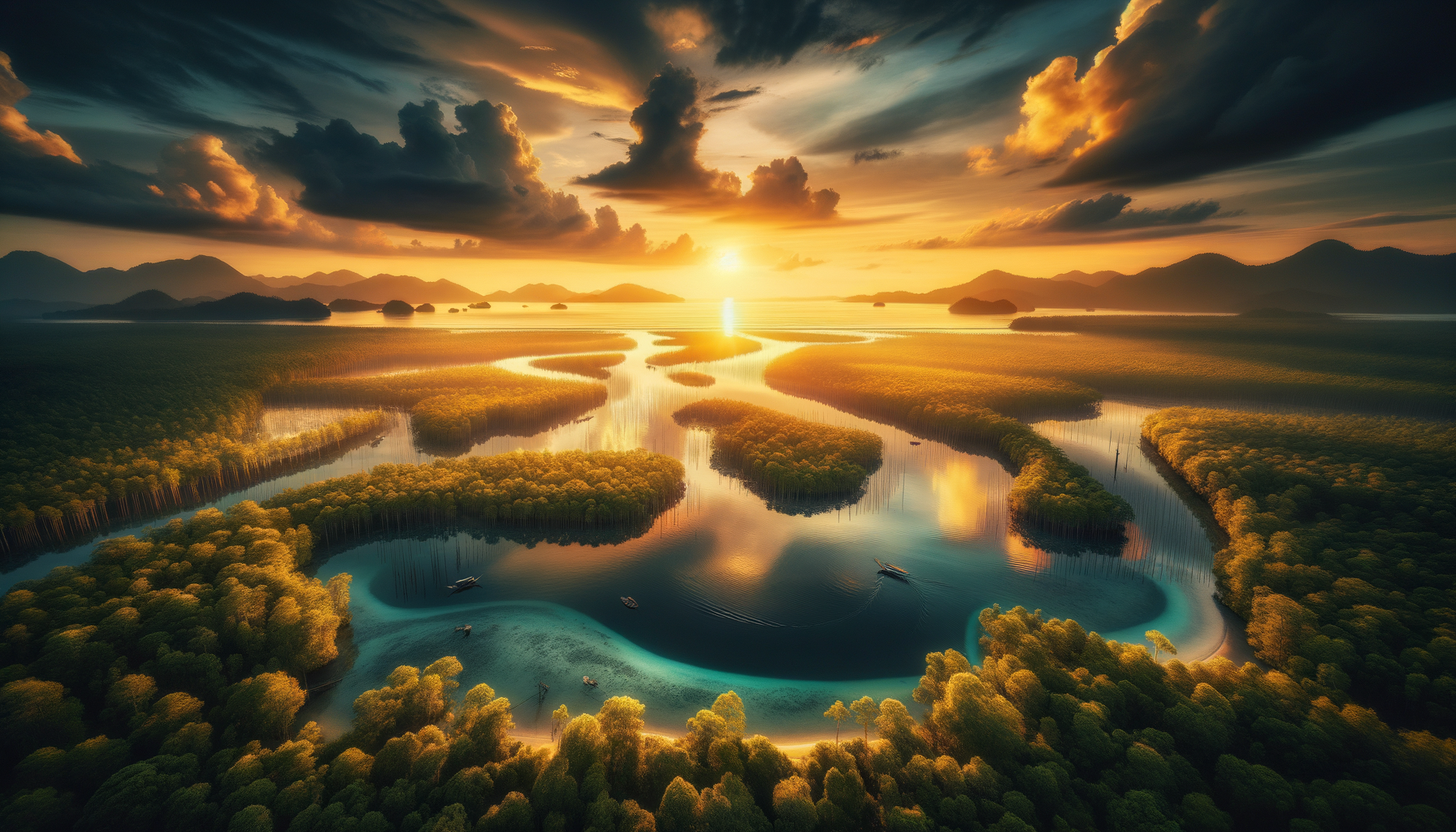
Two numbers explain almost everything that happens here. The first is the lagoon: 24 000 km², enclosed by a barrier reef of about 1 600 km — the largest lagoon on earth, UNESCO World Heritage since 2008, and so large that it is bigger than several European countries. The second is nickel: the island sits on something in the order of a fifth to a quarter of world reserves, which has shaped its politics, its immigration, its landscape and its present crisis.
Where it is
The southern end of Melanesia, on the Tropic of Capricorn — which makes it subtropical rather than truly tropical, and pleasanter for it. Neighbours are Vanuatu to the north-east and Australia to the west. It is a long way from anywhere: the nearest major city is Brisbane, two and a half hours by air, and Paris is 16 700 km and roughly 24 hours away.
What it is made of
Grande Terre, the main island, is 400 km long and about 50–70 km wide, with a mountain spine running its length. Around it: the Loyalty Islands (Lifou, Maré, Ouvéa, Tiga), the Isle of Pines to the south, the Belep islands to the north, and the uninhabited Chesterfield reefs far to the west.
Who lives here
About 268 000 people. Roughly 41 % Kanak, 24 % European (the Caldoches, many descended from convicts and settlers, plus metropolitan French on contract), around 8 % Wallisian and Futunan, plus Tahitian, Indonesian, Vietnamese and ni-Vanuatu communities. The 2019 census also recorded a large and growing group who declined all of those labels and answered "Calédonien".
How it is governed
A collectivité sui generis — a category invented for it alone, written into the French constitution in 1998. It has its own Congress (54 seats), its own government elected by that Congress on a collegial basis, three provinces with real powers, its own flag question, its own citizenship, and a restricted electoral roll. France retains defence, foreign affairs, justice, currency and public order.
The economy
Nickel, which is about 94 % of goods exports and a fifth of private sector employment, plus tourism, and above all transfers from Paris — the French state's annual contribution is the largest single item in the territory's economy. GDP per head used to be among the highest in the Pacific. It fell by 13,5 % in 2024.
2026 in one line
A rebuilt-but-not-recovered Nouméa, one of the three big nickel plants shut and the other two on life support, a constitutional reform that failed in Paris, and provincial elections finally held on 28 June 2026 — the first since 2019 — which returned a Congress almost exactly as divided as the one before it.
🏷️ The Names — Caledonia, Kanaky, and Why Both Are Political
New Caledonia
Named by James Cook on 4 September 1774, because the forested ridges of the north-east reminded him of Scotland — Caledonia being the Roman name for it. Cook's father was a Scot. It is one of the very few places on earth named after a resemblance to somewhere its namer had not been raised in, and Kanak people have been living with a Scottish simile for two hundred and fifty years.
Kanaky
The name used by the independence movement, and increasingly in general speech. Kanak comes, by a long detour, from Hawaiian kanaka, "person", which Pacific traders spread as a generic term for islanders and which then became a French colonial slur, canaque. In the 1970s the independence movement took the insult back, respelled it Kanak, and made it the name of a people. The convention now is that Kanak is invariable — no feminine, no plural s — precisely because French grammar was part of what was being refused.
Kanaky – Nouvelle-Calédonie
The Nouméa Accord of 1998 called for a name, a flag, an anthem, a motto and banknote designs to be agreed as "identity signs". Four of the five were agreed. The name never was. In practice the compound form Kanaky – Nouvelle-Calédonie is used by many institutions, which is a very French solution: when two sides cannot agree on a name, use both and put a dash in it.
Two flags, officially
Since 2010 the territory flies the French tricolour and the Kanak flag — blue, red and green with a yellow disc bearing a flèche faîtière, the carved spire of a Kanak great house — side by side on public buildings. No other part of France does this. Whether the two flags represent a shared future or a frozen argument is, depending on whom you ask, the whole question.
The motto and the anthem
The motto agreed in 2010 is "Terre de parole, terre de partage" — land of speech, land of sharing — which is a translation of a Kanak idea into French rather than the other way round. The anthem, Soyons unis, devenons frères, was written by a group of schoolchildren and has verses in Nengone, a Loyalty Islands language, as well as French.
Caldoche, Zoreille, Broussard
The local vocabulary matters. A Caldoche is a European whose family has been here for generations, often descended from convicts or settlers; a Zoreille (from les oreilles, the ears — they listen without understanding) is a metropolitan French person on a contract; a Broussard is a rural Caldoche from la brousse, the bush. None of these are neutral, and all of them are used daily.
🗺️ Geography — A Piece of a Lost Continent
New Caledonia is not a volcanic island and not a coral atoll. It is a fragment of continental crust — part of the submerged continent of Zealandia — which broke away from Gondwana around 80 million years ago and has been isolated ever since. That single fact is the reason its plants and animals are unlike anywhere else, and the reason it is full of metal.
Grande Terre
400 km long, 50–70 km wide, 16 372 km² — the third-largest island in the Pacific after New Guinea and the two of New Zealand. A mountain chain runs its whole length: Mont Panié (1 629 m) in the north, Mont Humboldt (1 618 m) in the south. The chain splits the island into two completely different countries.
The wet side and the dry side
The east coast takes the trade winds head-on and is wet, steep, green, forested and predominantly Kanak, with rivers running straight into the sea. The west coast sits in the rain shadow and is dry savannah with cattle stations, introduced niaouli paperbark trees and most of the European farming. Same island, 60 km apart, two climates and two societies.
The red earth
The south of Grande Terre is covered in ultramafic rock — peridotite pushed up from the earth's mantle about 34 million years ago and weathered into deep red lateritic soil. It is toxic to most plants: high in nickel, chromium, cobalt and magnesium, very low in the nutrients plants normally need. Everything that grows there had to evolve to tolerate it, which is why the flora is extraordinary — and it is the same rock that makes the nickel.
The lagoon and the reef
A barrier reef of roughly 1 600 km, second in length only to Australia's, enclosing a lagoon of 24 000 km² — see the next section. The reef sits 10–50 km offshore, so from most of the coast you cannot see it; you can see the water change colour where it is.
The other islands
The Loyalty Islands are raised coral atolls — flat, porous limestone with no rivers, so fresh water comes from a lens beneath the island and caves are everywhere. The Isle of Pines is a mixture of coral limestone and ultramafic rock, and it is where the Araucaria columnaris — the columnar pine Cook mistook for basalt columns from a distance — grows in ranks along the shore.
Cyclones and earthquakes
The cyclone season runs November to April and the territory is hit hard every few years. It also sits near the Vanuatu subduction zone, one of the most seismically active places on earth, so tsunami warnings are a routine part of life in the Loyalty Islands even though the big events are rare.
🐠 The Lagoon — 24 000 km² of World Heritage
The Lagoons of New Caledonia were inscribed on the UNESCO World Heritage list in 2008 as six marine clusters covering around 15 700 km² of the whole system. It is one of the three most diverse reef systems on the planet and it has something the other two do not: a very large proportion of it is in near-pristine condition, because so few people live near it.
The numbers
Roughly 1 600 km of barrier reef. A lagoon of 24 000 km² — bigger than Slovenia. Around 1 000 species of fish, over 350 species of coral, and reef structures of every type: barrier, fringing, atoll, double barrier. The double barrier reef off the north-east is one of only a handful anywhere.
The dugongs
The lagoon holds one of the last significant populations of dugong in the Pacific — a few hundred animals, seagrass-grazing, slow, and extremely vulnerable to boat strikes and net entanglement. They are protected, they are also culturally important to Kanak communities with customary fishing rights, and the negotiation between those two things is done locally rather than imposed.
Turtles and whales
Green turtles nest in numbers, with a major rookery at the d'Entrecasteaux reefs in the far north. And from July to September the lagoon and the southern seamounts fill with humpback whales that come here to calve — the New Caledonian population is genetically distinct and unusually studied, and whale watching is regulated with a code of approach that is actually enforced.
Where to get in the water
The Isle of Pines for the piscine naturelle, a natural rock pool. Îlot Amédée, an hour from Nouméa, for the lighthouse and the sea snakes. Lifou for the cliff dives and the clarity. Poé beach near Bourail for kitesurfing. And Ouvéa, whose 25 km beach is so uniformly perfect that it is genuinely hard to photograph convincingly.
⚠️ Sea snakes, and the truth about them
The tricot rayé — the banded sea krait — is everywhere, swims lazily past you, comes ashore to rest and digest, and is one of the most venomous snakes on earth. It is also almost entirely uninterested in people: its mouth is small, it is not aggressive, and serious envenomations of swimmers are vanishingly rare. Do not touch, do not pick up, do not corner. Then leave it alone and it will leave you alone.
What threatens it
Not mass tourism — there is barely any. The pressures are runoff from nickel mining, which pushes red laterite sediment into the lagoon after heavy rain and smothers coral; bleaching events, which have hit the northern reefs; and coastal development around Nouméa. The World Heritage listing has real teeth in the planning process and is one of the few things all political factions here support.
📜 Three Thousand Years Before Cook
The Lapita
The first arrivals came around 1100–1000 BCE, part of the Lapita expansion out of the Bismarck Archipelago — the greatest maritime dispersal in prehistory. They are identified by their pottery, stamped with fine dentate geometric patterns, and the type site that gave the whole culture its name is at Koné on Grande Terre's west coast. The Lapita reached Fiji, Tonga and Samoa in the same push and stopped there for a thousand years.
What they built
The society that developed was not simple. Kanak agriculture built irrigated terraced taro fields on hillsides, with stone-lined channels carrying water for kilometres — thousands of hectares of them, some still visible, representing a colossal investment of collective labour. Yam cultivation was and is the ceremonial centre of the agricultural year.
The clan and the land
Kanak society is organised by clan, and the clan's relationship to a specific piece of land is not ownership in the European sense but identity: the clan is the place, with a founding ancestor, a set of names, a path of migration and a position in a network of alliances. This is precisely what colonial land seizure destroyed, and it is why land questions here are never only economic.
La coutume
Custom is a living legal and social system, not a folklore. It governs land, marriage, disputes, welcome and apology, and it is administered through eight customary areas and a Customary Senate that has a formal place in the institutions. The visitor encounters it as la coutume — a small gift, traditionally a length of cloth, a banknote and a word of respect, offered when entering a tribe's land. It is not a tip. It is an acknowledgement that you are on someone's ground.
Cook, 1774
James Cook sighted the north-east coast on 4 September 1774, landed at Balade, named it New Caledonia and left after nine days. He mistook the columnar pines for basalt formations at a distance. The French navigator d'Entrecasteaux came in 1793, and whalers, sandalwood traders and missionaries followed from the 1840s.
Sandalwood and blackbirding
The first sustained contact was extractive and violent. Sandalwood traders stripped the stands within twenty years. Then came blackbirding — the kidnapping and coerced recruitment of Melanesian labour for Queensland and Fijian plantations — which took people from these islands and brought others here. Introduced disease did the rest: the Kanak population is estimated to have fallen from perhaps 60 000 to around 27 000 by the early twentieth century.
⚓ 1853 — Annexation, and a Colony Built on Prisoners
France took possession on 24 September 1853, when Admiral Febvrier-Despointes raised the flag at Balade. The date is now a public holiday called Citizenship Day, which is either a reconciliation or a provocation depending on who is speaking, and is marked accordingly.
Why France wanted it
Three reasons, in order of honesty: a naval station in a Pacific where Britain was taking everything; a response to Britain's annexation of New Zealand; and, most practically, somewhere to put convicts now that Britain had stopped sending its own to Australia and the model looked proven.
The penal colony, 1864–1897
Around 22 000 convicts were transported here in thirty-odd years. The main sites were on the Isle of Pines, at Nouville in Nouméa harbour and at Prony and Bourail. Conditions were murderous; the ruins are everywhere and are now, uneasily, tourist sites. Convicts who survived their sentence were required to remain as settlers — doublage — which is exactly how the colony was meant to be populated and why a great many Caldoche families can trace a convict ancestor.
The Communards
After the crushing of the Paris Commune in 1871, around 4 000 Communards were deported here, including Louise Michel. She was transported as an insurrectionist, spent seven years on the Isle of Pines and in Nouméa, learned Kanak languages, taught Kanak children, and — almost alone among the deportees — supported the Kanak revolt of 1878 against her fellow Frenchmen. She gave her red scarf to two Kanak insurgents. She is the one figure both sides of this island's politics still admire.
The Algerians
Less well known: after the Mokrani revolt of 1871 in Kabylia, several hundred Algerians were deported here too. Their descendants remain, a small community around Bourail and Nessadiou, Muslim, francophone, Caledonian, and with a history that fits none of the island's usual categories.
Land, taken
The mechanism of dispossession was the cantonnement — the confining of Kanak clans to reservations, beginning in earnest in the 1870s, which moved people off the valleys and coastal flats onto the poorest land and broke the link between clan and place. By the early twentieth century Kanak people held a small fraction of the island and were subject to the code de l'indigénat: a separate legal code, forced labour, a head tax, a curfew and a requirement to carry a pass.
Until when?
This is the part that surprises people. The indigénat was not abolished until 1946. Kanak people did not get full French citizenship until 1946 either, and universal suffrage arrived only in 1957. There are people alive in New Caledonia today who were born without the right to vote in the country their ancestors had lived in for three thousand years.
⛏️ Nickel — The Rock the Whole Argument Sits On
In 1864 the engineer Jules Garnier identified a green nickel ore in the red hills of the south; it is called garnierite after him. Everything that has happened in New Caledonia since is downstream of that discovery. The territory holds something in the order of a fifth to a quarter of world nickel reserves, nickel is around 94 % of its goods exports and about a fifth of private-sector employment, and the mines are the single largest reason France has never let go.
What it is for
Stainless steel, mostly — and, since the 2010s, battery cathodes. That second use is why an obscure Pacific territory became strategically interesting again, and why the French state talks about a "nickel pact" in the language of European industrial sovereignty rather than of colonial administration.
The three plants
SLN at Doniambo, in the middle of Nouméa, running since 1910 and majority-owned by the French group Eramet. Prony Resources (formerly Vale, formerly Goro) in the far south, a hydrometallurgical plant with a long history of acid spills and community protest. And KNS / Koniambo in the north — built deliberately in Kanak-majority territory as a tool of economic rebalancing, with the northern province holding the majority stake.
⚠️ Koniambo, and what its closure meant
Koniambo was the great symbol of the Nouméa Accord: a world-class smelter in the north, majority-owned by Kanak-led provincial interests, intended to move economic power out of Nouméa. It never made money. In February 2024 Glencore idled it and announced it would leave; it closed later that year with about 1 200 jobs gone and the towns around Voh, Koné and Pouembout left hollow. For the independence movement, losing Koniambo was not only an economic blow — it was the failure of the entire rebalancing project.
Why the industry is in trouble
Indonesia. Indonesian production, largely Chinese-financed, has expanded so fast that it now dominates world supply and has driven the nickel price below New Caledonian cost of production. Caledonian nickel is expensive to make: high energy costs, ageing plants, and a workforce paid French wages. The industry has been on state support for years and the arithmetic has not improved.
The environmental cost
Open-cast mining on ultramafic soil strips vegetation that took millennia to adapt and cannot easily return, and the exposed red laterite washes into the lagoon after every heavy rain. Rehabilitation obligations are now serious, and modern operators do restore, but a century of unregulated mining left scars visible from space. The Goro acid spills of 2014 and later triggered some of the largest environmental protests in the territory's history.
The politics of the rock
Almost every political fault line here runs through nickel. Who owns the subsoil. Whether ore should be exported raw or smelted locally. Whether Chinese or Korean buyers are partners or predators. Whether an independent Kanaky could sustain the industry without French subsidy — and whether a dependent New Caledonia can either. When people argue about the future of this territory, they are usually arguing about this.
🔥 1878 and 1917 — Two Revolts and Their Consequences
1878: Ataï
The great revolt. Cattle from settler stations had been destroying Kanak gardens for years and the administration had been steadily confiscating land for more of them. In June 1878 the chief Ataï of the La Foa region led a rising that spread across the centre-west of Grande Terre. It lasted seven months, killed around 200 Europeans and perhaps 1 200 Kanak, and was put down with the help of Kanak auxiliaries from rival clans — a division the administration cultivated deliberately and which Kanak historiography still examines honestly.
Ataï's head
After Ataï was killed his head was severed and sent to Paris, where it entered an anthropological collection and was displayed as a specimen. It was finally returned to his descendants in 2014, 136 years later, in a ceremony that was one of the most charged public events in modern New Caledonian life. If you want a single object that explains the emotional temperature of Kanak politics, it is that skull and the century and a half it spent in a Paris cupboard.
Louise Michel's scarf
The Communard deportee Louise Michel supported the revolt, against the near-unanimous opinion of her fellow exiles, and tore her red scarf in two to give to Kanak insurgents. She wrote afterwards that the Kanak were fighting for the same thing the Commune had fought for. She remains, remarkably, a figure both communities here can name with approval.
1917: Noël
A second rising during the First World War, in the north around Koné and Hienghène, led by the chief Noël of Tiamou. Its immediate cause was forced recruitment for the Western Front — the administration was conscripting men from a population that had no citizenship and no vote to fight a war in a country most had never heard of. It was crushed within a year, and Noël was killed. Around 1 000 Kanak did serve in France, in the bataillon du Pacifique, and a significant number died there.
The Pacific Battalion
In the Second World War New Caledonia rallied to Free France in September 1940, one of the first territories to do so, and the Bataillon du Pacifique — Caledonians and Tahitians together, Kanak among them — fought at Bir Hakeim and up through Italy and France. It is a genuine shared history and both communities claim it.
The Americans
From 1942 New Caledonia became a vast American base: perhaps a million US personnel passed through, the population of Nouméa multiplied several times over, roads and airfields were built, and a poor colonial backwater got a violent introduction to the twentieth century. The social effect was enormous — Kanak workers were paid American wages and treated, by some Americans at least, as equals, which made the return to the indigénat in 1945 intolerable. It was abolished the following year.
🗳️ Les Événements — 1984 to 1988
Between 1984 and 1988 New Caledonia came close to civil war. Nobody here calls it that. They call it les Événements — "the Events" — which is the same kind of euphemism the French used for Algeria, and is used for the same reason.
How it started
Kanak had become a minority in their own country — deliberately: a 1972 letter from Prime Minister Pierre Messmer had recommended immigration as the way to ensure that "the nationalist demand of the indigenous peoples" could never carry a majority. In 1984 the independence parties formed the FLNKS, boycotted territorial elections and set up a provisional government under Jean-Marie Tjibaou.
Hienghène, 1984
On 5 December 1984, ten Kanak men were ambushed and killed at Wanaham near Hienghène by settlers. Two of the dead were Tjibaou's brothers. The men charged were acquitted in 1987 on grounds of self-defence, a verdict that destroyed what was left of Kanak confidence in French justice here. Tjibaou's response — refusing to sanction revenge — is one of the reasons the period did not become much worse.
Éloi Machoro
The FLNKS security minister who famously took an axe to a ballot box at Canala in November 1984, an image that went round the world. He was shot dead by GIGN marksmen in January 1985 during a siege at a farmhouse. Whether it was a legitimate police operation or an assassination is still argued about; he is a martyr figure for the independence movement and his face is on walls everywhere.
⚠️ Ouvéa, 1988
The worst of it. On 22 April 1988, two days before the first round of the French presidential election, Kanak militants attacked the gendarmerie at Fayaoué on Ouvéa, killing four gendarmes, and took hostages into a cave. On 5 May, between the two rounds of the election, French forces stormed the cave. Nineteen Kanak and two soldiers died. Subsequent investigations established that several of the Kanak were killed after capture. An amnesty law in 1988 ensured that no one was ever tried for it.
The Matignon Accords
Out of that came something extraordinary. In June 1988 the new prime minister Michel Rocard brought Jean-Marie Tjibaou and the loyalist leader Jacques Lafleur to Paris, and the two men — whose communities had been killing each other weeks earlier — signed the Matignon Accords: a ten-year truce, three provinces with real autonomy, deliberate economic rebalancing toward the north and the islands, and a referendum on independence in 1998. The handshake between Tjibaou and Lafleur is the founding image of modern New Caledonia.
And then Tjibaou was killed
On 4 May 1989, at a ceremony on Ouvéa marking the first anniversary of the cave assault, Jean-Marie Tjibaou and his deputy Yeiwéné Yeiwéné were shot dead by Djubelly Wéa, a Kanak militant who regarded the Matignon Accords as a betrayal. Wéa was killed immediately by Tjibaou's bodyguard. The leader who had made peace was killed by his own side for making it, and his widow Marie-Claude Tjibaou later took part in the customary reconciliation with Wéa's family — a process that took sixteen years.
🤝 The Nouméa Accord — Decolonisation by Instalments
Signed on 5 May 1998, ten years to the day after the Ouvéa assault, the Nouméa Accord is one of the most unusual constitutional documents in the world. Its preamble begins by acknowledging that colonisation damaged the dignity of the Kanak people and deprived them of their identity — an admission of colonial wrong written into French constitutional law — and it sets out a twenty-year transfer of powers ending in a vote on independence.
What it created
A citizenship of New Caledonia distinct from French nationality. A restricted electoral roll for local elections, frozen to those resident by 1998 and their descendants. A collegial government in which parties are represented proportionally rather than by majority. A Customary Senate. And the principle of irreversible transfers of power from Paris — once a competence moved, it could not move back.
The frozen roll
The most contested provision, and the one that eventually caused the 2024 explosion. Because the roll is frozen, a French citizen who moved here in 1999 still cannot vote in provincial elections a quarter of a century later — by 2024 that was roughly one adult resident in five. Loyalists call it a denial of democracy. Independence parties call it the minimum protection for an indigenous people made a minority by deliberate policy. Both descriptions are accurate, which is exactly why it cannot be solved by argument.
What actually transferred
A great deal: primary and then secondary education, labour law, civil and commercial law, mining, foreign trade, transport, the environment. What did not: defence, foreign affairs, justice, public order, currency — the five "sovereign" competences, which the Accord said would be the subject of the final vote.
The Tjibaou Centre
François Mitterrand's last grand projet, and a condition of the settlement: a cultural centre for Kanak civilisation, designed by Renzo Piano and opened in 1998. Ten curved wooden cases rise along a peninsula like unfinished great houses, ventilated by the trade wind through a passive system developed with wind-tunnel testing. It is one of the finest buildings of the late twentieth century anywhere and it is in a Pacific territory of 268 000 people.
Rebalancing
Real money was moved north and to the islands: infrastructure, schools, health, and above all the Koniambo smelter, with the northern province holding the majority stake. Kanak participation in higher education and the professions rose substantially. It was not enough to close the gap — Nouméa and its white suburbs remained far richer than the north and the islands — but it was not nothing either, and the argument about how much it achieved is ongoing.
Why it worked for twenty years
Because it postponed the question. Everyone signed something that let them believe they would win later: the independence movement got an irreversible process and a guaranteed vote; the loyalists got twenty years of French sovereignty and a demographic clock running in their favour. That is a real achievement and it is also the reason the ending was always going to be hard.
🗳️ Three Referendums — and the One That Broke It
The Nouméa Accord provided for up to three referendums on full sovereignty. All three were held. The first two were legitimate, close and accepted. The third was none of those things, and everything since flows from it.
2018: 43,3 % yes
On 4 November 2018, with turnout of 81 %, independence was rejected by 56,7 % to 43,3 %. The yes vote was far higher than polling had predicted and the result was read by both sides as a signal that the question was genuinely open.
2020: 46,7 % yes
On 4 October 2020, turnout 85,7 %, the no vote fell to 53,3 % against 46,7 % yes. Two thousand more votes would have closed most of the remaining gap. At that trajectory a third vote looked genuinely winnable for the independence side.
⚠️ 2021: the boycott
Then Covid. The Delta wave reached New Caledonia in September 2021 and hit Kanak communities hardest; the customary mourning period for the dead runs a year. The FLNKS asked Paris to postpone the third vote from December 2021 to later in 2022. Paris refused. The independence movement boycotted. On 12 December 2021 the no vote was 96,5 % on a turnout of 43,9 % — meaning the result was produced by roughly the same number of voters who had said no the year before, with almost every yes voter absent.
What that did
France declared the Nouméa process complete and the question settled. The independence movement declared the third referendum void and has never recognised it; the United Nations Special Committee on Decolonisation, which still lists New Caledonia as a non-self-governing territory, noted the dispute. Legally, Paris is correct that three votes were held. Politically, nobody in the territory behaves as though the matter is closed, and the boycott is the reason.
The electoral roll bomb
With the Accord's process declared over, the frozen electoral roll had no legal justification left — the Conseil d'État and the Council of Europe had both flagged it. In 2024 the French government moved a constitutional amendment to unfreeze it, enfranchising anyone resident ten years. To Paris this was correcting an anomaly. To the independence movement it was, in a single stroke, converting a demographic minority into a permanent electoral one. That amendment is what lit the fuse.
Where the law sits now
The amendment passed both chambers in May 2024, was never put to the Congress of Versailles, and was formally withdrawn. The Bougival Accord of 12 July 2025 tried to replace the whole framework with a "State of New Caledonia" inside the Republic; the FLNKS rejected it and the constitutional reform required to enact it failed. That left the territory with no new statute, an old frozen roll, and an obligation to hold elections — see 2026.
🔥 May 2024 — Fourteen Dead and Two Billion Euros
On 13 May 2024, as the French National Assembly debated the electoral roll amendment, New Caledonia erupted. Within days Nouméa's outer suburbs were burning, roadblocks had cut the territory in half, and France had flown in thousands of police and troops and declared a state of emergency. It was the worst violence here since the 1980s and by most measures worse than that.
The toll
Fourteen people died, including two gendarmes; the great majority of the dead were young Kanak men, several shot by residents at roadblocks or by police. Several hundred were injured. The state of emergency ran twelve days, an airport closure lasted almost a month, and TikTok was blocked territory-wide — the first time France had blocked a social network on its own soil.
The damage
Estimated at over €2 billion. Roughly 900 businesses destroyed and several hundred more damaged, 600 vehicles burned, schools and pharmacies gone, and something like 80–90 % of the grocery distribution network hit. Around a quarter of private-sector jobs were affected. GDP fell 13,5 % in a single year — a contraction on the scale of a war.
Who and why
The immediate trigger was the amendment. The fuel underneath it was thirty years of accumulated grievance in the Kanak housing estates of greater Nouméa — Saint-Louis, Rivière-Salée, Montravel — where unemployment among young Kanak runs far above the territorial average and where the benefits of the Nouméa Accord were least visible. The CCAT, a field-mobilisation group linked to the largest independence party, was blamed by the state; the FLNKS leadership had publicly called for calm and largely lost control of the street.
The deportations
In June 2024 seven CCAT activists, including its leader Christian Tein, were flown 17 000 km to mainland France and held in pre-trial detention there — a decision that, whatever its legal basis, landed in a territory where the word deportation has a very specific nineteenth-century meaning. It triggered a second round of unrest. Tein was released under judicial supervision in 2025 and, while still in France, was elected president of the FLNKS.
What it cost the nickel industry
Everything that was already fragile. Ore trucks could not move, the plants could not get supplies, and the crisis arrived on top of the Indonesian price collapse. Koniambo had already been idled in February; it never restarted. SLN and Prony have run on state support and short time since.
Two years on
By 2026 Nouméa has been largely rebuilt and does not look like a disaster zone to a visitor; the suburbs where it started look different. Insurance premiums are punitive or unavailable, several thousand mostly European residents have left for mainland France or Australia, and the tourism industry has not recovered — cruise calls and Australian visitors both collapsed and have come back only partly. The territory is materially poorer, more indebted and more segregated than it was in April 2024.
🏛️ 2026 — Bougival Failed, the Election Happened Anyway
After the fire came two years of negotiation that produced no agreement and one election that changed very little. That sounds like stalemate, and it is, but it is a stalemate nobody can walk away from, which is not the same as nothing happening.
The Bougival Accord, July 2025
On 12 July 2025, after ten days of talks near Paris, the parties signed an outline agreement creating a "State of New Caledonia" inside the French Republic — with its own nationality, a possible seat at the UN, and transferred competences, but with France keeping defence, currency and ultimate sovereignty. It was hailed as historic for about a fortnight.
Why it collapsed
It was a text to be promoted, not a binding accord. The FLNKS formally rejected it — its congress concluded it did not deliver sovereignty and locked the territory permanently inside France — while the loyalist bloc defended it and other parties picked at it. Without the independence movement, the constitutional revision required to enact it had no path, and by spring 2026 the reform had failed outright.
The 28 June 2026 elections
Held under court pressure after repeated postponements, on the old frozen electoral roll, and the first provincial vote since 2019. Result: Les Loyalistes under Sonia Backès became the largest single bloc with 24 of the 54 Congress seats, while the combined pro-independence parties — UC-FLNKS, UNI-Palika and allies — took 26. A loyalist surge, a pro-independence bloc still marginally ahead in seats, and no majority for anyone.
The new Congress
Its inaugural sitting was on 10 July 2026, and it elected Virginie Ruffenach of the loyalist right as President of the Congress. The territorial government remains collegial by law, so it is composed proportionally from a chamber in which the two blocs are almost exactly balanced, which is a recipe for slow government and was intended to be.
What has to happen next
A new statute has to be negotiated, because the Nouméa Accord's mechanism is spent and nothing has replaced it. The frozen roll has to be resolved, because its legal basis is gone. And the money has to be found: the territory is running large deficits, the nickel industry needs restructuring or closing, and the reconstruction bill from 2024 is unpaid. None of these can be settled by one side alone, which is the only genuinely hopeful thing in the paragraph.
For a visitor
New Caledonia is calm in 2026 and normal travel is entirely possible. But check the French government's travel advice and the local prefecture's announcements before booking, keep away from demonstrations and roadblocks, and understand that the situation can change quickly — in May 2024 the airport closed for almost a month and thousands of visitors were stranded. Flexible tickets and travel insurance that covers civil unrest are worth the money here in a way they are not in, say, Fiji.
🏙️ Nouméa — A French Provincial Town on a Melanesian Island
Nouméa holds around 93 000 people, and greater Nouméa — with Dumbéa, Mont-Dore and Païta — holds roughly two thirds of the territory's entire population. It has bakeries, a Carrefour, boules courts, roundabouts with municipal planting, and the specific smell of a French provincial town, sitting under coconut palms at 22 degrees south.
The geography of the city
This matters more than anything else about it. The southern peninsulas — Anse Vata and Baie des Citrons — are the beaches, the hotels, the restaurants and the wealthier, whiter suburbs. The north and east — Montravel, Rivière-Salée, Saint-Louis, and Mont-Dore beyond — are the Kanak, Wallisian and working-class estates. The city is visibly segregated and everyone knows it, and it is where May 2024 started.
The Tjibaou Centre
Renzo Piano's cultural centre on the Tina peninsula, opened 1998: ten curved iroko-wood cases like unfinished Kanak great houses, rising to 28 m, with a passive ventilation system designed with the trade wind. It holds contemporary Pacific art, a Kanak path through indigenous plantings, and a serious programme. It is the single best reason to come to Nouméa and it is twenty minutes from the centre.
The Musée de la Ville and the Maritime Museum
The city museum covers the colonial and convict history without excessive flinching. The Musée Maritime is genuinely good on Lapita navigation, the Lapérouse wrecks at Vanikoro and the American war years. Both are small, cheap and half-empty.
Place des Cocotiers and the market
The colonial-era central square with its bandstand, and, on the waterfront at Port Moselle, the morning market — Tuesday, Thursday, Saturday and Sunday from about 05:00 — which is the one place all of Nouméa's communities are in the same space at the same time. Fish, prawns, Vietnamese bo bun, Kanak vegetables, French cheese, and coffee.
The lookouts and the islets
Ouen Toro for the view over the whole southern lagoon, with two Australian coastal guns still in place from 1940. And the boat to Îlot Maître or Îlot Amédée — the latter with a cast-iron lighthouse shipped from Paris in 1865 and 247 steps to the top.
What it costs
Be ready. Nouméa is one of the most expensive cities in the Pacific: almost everything is imported by sea from France or Australia, tariffs protect a small local industry, and wages are French. A supermarket basket will startle a European and stagger an Australian — see the costs section.
🚗 Grande Terre — the Bush, Two Coasts and the Great North
Almost every visitor stays in Nouméa and takes a boat somewhere. The island itself — 400 km of it — is where the country actually is, and it is best seen by hire car over four or five days, crossing the spine at least twice.
The west coast
Dry, golden savannah with niaouli paperbarks and cattle stations: this is la brousse and the heartland of the Caldoche broussards, with a stock-rearing culture and an annual rodeo at Bourail that is entirely serious. Bourail itself has the Roche Percée arch, the Bonhomme rock and a New Zealand war cemetery. La Foa has a Gustave Eiffel bridge and a film festival.
The east coast
Wet, green, steep and mostly Kanak, with tribes strung along the coast road and waterfalls coming off the range. Hienghène is the set piece: black limestone formations rising out of the bay, one of which is universally known as la Poule couveuse, the brooding hen. It is also Jean-Marie Tjibaou's home region, and its cultural centre is worth the detour.
The far north
Beyond Koumac the island narrows and empties. Poum and the Belep islands feel genuinely remote. Voh is where the mangrove forms the famous Cœur de Voh, the heart-shaped clearing photographed from the air by Yann Arthus-Bertrand and now the territory's most reproduced image — you need a light aircraft, a microlight or a hard walk up the hill behind to see it.
The Grand Sud
The red country south-east of Nouméa: ultramafic laterite, scrubby endemic maquis, artificial lakes and the drowned forest of Yaté, where dead trunks stand in the water of a 1950s hydro reservoir. The Parc de la Rivière Bleue is here and is the best place in the world to see the cagou. It is also where the Prony/Goro nickel plant is, which the same landscape has to accommodate.
Driving it
Roads are good, signposting is French, distances feel longer than they look and fuel is expensive. Nouméa to Hienghène is about 5 hours; a circuit of the island with stops is a comfortable five days. Accommodation in the bush is often gîtes run by tribes, which is the single best way to travel here and requires only that you do la coutume and behave like a guest.
⚠️ One road rule that is not obvious
Driving is on the right, as in France, which surprises Australians and New Zealanders who fly in for a long weekend. Alcohol limits are strict and enforced with roadside checks. And on the east coast expect livestock, deer and children on unlit roads after dark; almost no one drives the bush at night by choice.
🏝️ The Isle of Pines and the Loyalty Islands
Isle of Pines — Île des Pins
Kunié in Kanak, 152 km², twenty minutes by air or two and a half hours by ferry from Nouméa, and the picture everyone has seen: white sand, water of an implausible blue, and the tall thin Araucaria columnaris pines standing along the shore like masts. Around 2 000 people live there, it is governed under strong customary authority, and it has a Kanak-run tourism economy rather than a resort-chain one.
The piscine naturelle
A shallow natural rock pool at Oro Bay, connected to the sea by a narrow channel, ringed by pines and full of fish. You walk in through the forest. It is the most photographed place in New Caledonia and it deserves it — go early, before the day boats.
And the prison ruins
The Isle of Pines was a penal colony: around 3 000 Communard deportees and many more common convicts. The ruins of the Ouro prison and the deportees' cemetery are a few kilometres from the beaches, overgrown and unpoliced, and the contrast between the postcard and the ruin is the most honest thing on the island.
Lifou
The largest of the Loyalty Islands at 1 207 km², a raised coral platform with no rivers, spectacular limestone cliffs and the vanilla plantations of the Wetr. The bays of Jinek — snorkelling over a coral shelf with permission from the tribe and a fee — and Luengoni, with its caves and sacred blue pool, are the reason to come. Lifou is also where you feel customary authority most clearly: land is tribal, access is by permission, and cruise-ship days are managed on the chiefs' terms.
Maré
The wildest of the three, higher and more rugged, with cliffs, natural aquariums and far fewer visitors. The people of Maré speak Nengone, which supplies part of the territorial anthem, and the island has a reputation for independence of mind that its neighbours mention with respect.
Ouvéa
A 25 km atoll beach on one side and a lagoon on the other, so narrow in places that you can see both. It is genuinely one of the most beautiful beaches on earth and it is also the site of the 1988 cave assault: the cave at Gossanah and the memorial to the nineteen dead are part of any honest visit, and local families will talk about it if you ask respectfully and will not if you do not.
🍃 Nature — Eighty Million Years of Being Left Alone
New Caledonia is one of the world's most important biodiversity hotspots and by some measures has the highest proportion of endemic plants of any land area on earth. Roughly 3 400 native vascular plant species, of which around 75 % grow nowhere else. The reason is the combination of ancient isolation and the poisonous ultramafic soil, which forced everything to specialise.
The cagou
The national bird: a grey, flightless, crested forest bird about the size of a chicken, with a call like a barking dog that carries for kilometres, and it is on the coat of arms, the airline tail and the coins. Perhaps 1 000–2 000 survive, nearly all in the Parc de la Rivière Bleue, where they are habituated and will walk up to you. Dogs are their main threat, then cats and pigs.
Amborella
Unremarkable to look at, and one of the most important plants in the world: Amborella trichopoda, a small shrub found only in New Caledonia's wet forest, is the sister lineage to all other flowering plants — the earliest surviving branch of the group that includes every flower, fruit and grain on earth. Its genome was sequenced in 2013 precisely because of that position. It grows on one island and nowhere else.
The pines
Araucaria is the signature: thirteen endemic species, more than anywhere on the planet, including the extraordinarily narrow A. columnaris of the Isle of Pines, which leans — every tree of the species tilts toward the equator, a genuine and still not fully explained phenomenon. Their relatives are the monkey puzzles of Chile and the Wollemi pine of Australia: Gondwanan survivors.
The maquis minier
The scrub that grows on ultramafic soil: hard, small-leaved, slow-growing, extraordinarily rich in endemics, and almost impossible to restore once stripped. Walking in the Grand Sud through waist-high maquis on red gravel is like walking through a botanical garden of things that exist only there, and it is exactly the habitat the mines remove.
What is missing
No native land mammals except bats — including the roussette, the flying fox, which is a customary Kanak food and is now under real pressure from hunting and habitat loss. No snakes on land. What there is instead is an astonishing radiation of geckos and skinks, including Rhacodactylus leachianus, the largest gecko in the world at up to 35 cm.
The threats
Fire above all — deliberate dry-season burning on the west coast destroys forest that does not come back. Then mining, invasive deer and pigs (rusa deer were introduced in 1870 and there are now perhaps more of them than people), and cats and ants. Conservation here is competent and underfunded, and the provinces rather than Paris hold the powers.
🗿 Kanak Culture — Custom, the Great House and the Yam
Kanak culture is not a heritage display; it is a functioning legal and social order that runs in parallel with the French one and, in the tribes and the Loyalty Islands, often takes precedence in practice. A visitor who understands three things — la coutume, the great house and the yam calendar — will understand most of what they see.
La coutume
The gesture that opens everything. On arriving at a tribe, at a gîte, at someone's land, you present a small gift — traditionally a length of cloth (manou), a modest banknote and a few words of respect explaining who you are and why you have come. The gift is not payment and its value is not the point; the act of asking is. It will be accepted with a short speech in return. Refusing to do it, or doing it as a transaction, is the single most reliable way to give offence.
The grande case
The great house: a circular building with a conical thatched roof, a central post that is the chief's lineage made physical, carved doorposts, and a flèche faîtière — a carved spire topped with shells and passed through with shell-money spokes — at the apex. The spire appears on the Kanak flag. The great house is not a dwelling; it is the clan's institution, and its layout encodes the whole social order of the place.
The yam and the taro
The yam is the male, ceremonial, calendar-governing crop; the first yam festival in March or April opens the social year and the exchanges that go with it. Taro, grown in irrigated terraces, is its female counterpart. This is not symbolism bolted onto agriculture — the agricultural calendar is the ritual calendar, and marriage, mourning and alliance are all scheduled against it.
Shell money and exchange
Monnaie kanak — cords of shell beads, fur and woven fibre — is not currency in the market sense but the material of alliance: it is given at marriages, deaths, reconciliations and apologies, and its circulation is what binds clans. A Kanak reconciliation ceremony can take years to prepare and involves exchanges at every stage; the reconciliation between the Tjibaou and Wéa families after the 1989 assassination took sixteen years and is the best-known example.
The pilou and the arts
The pilou is the great collective dance, performed at night, once suppressed by the administration as dangerous and now revived. Kanak carving, in serpentine stone and in wood, is strong and contemporary rather than archaic — the Tjibaou Centre commissions and shows living artists, and the annual Mélanésia 2000 anniversary recalls the 1975 festival that Tjibaou organised and that effectively invented modern Kanak cultural politics.
What to do as a visitor
Ask before photographing people, always. Do la coutume when told to and do not improvise it. Dress modestly in the tribes — this is a conservative, largely Protestant and Catholic society. Do not walk onto land without permission even if there is no fence; there is always an owner. And if you are invited to eat, accept, because refusing food is a bigger thing here than it is at home.
👥 Society — Communities That Share an Island and Not Much Else
New Caledonia's population is small enough that everyone knows everyone and divided enough that many of them do not. It is the only part of the French Republic where the census asks people which community they belong to, and the fact that the question exists tells you most of what you need to know.
The communities
Roughly 41 % Kanak, 24 % European, 8 % Wallisian and Futunan, plus Tahitian, Indonesian (descendants of Javanese indentured labourers), Vietnamese and ni-Vanuatu. The fastest-growing census answer is "Calédonien" or several communities at once — chosen by a substantial and rising share, especially among the young, and treated by both political camps as evidence for their own case.
The gap
It is large and it is measurable. Kanak households have around half the median income of European ones. Kanak young people are far more likely to leave school without qualifications and far more likely to be unemployed. The prison population at Camp-Est is overwhelmingly Kanak. These are not disputed figures; what is disputed is what caused them and what would fix them.
The Wallisians
A community of tens of thousands, brought in from Wallis and Futuna as labour from the 1950s, now often several generations deep and mostly urban. They occupy an awkward position: Pacific islanders like the Kanak, but arrivals whose numbers changed the demographic balance, and politically they have been courted hard by both sides. The Saint-Louis conflicts between Kanak and Wallisian communities in the 2000s were among the most bitter episodes of recent decades.
Religion
Heavily Christian and it matters. Roughly 60 % Catholic, with a strong Protestant minority concentrated among Kanak, especially in the Loyalty Islands where the London Missionary Society arrived first. The churches are deeply involved in community life, and the Protestant church in particular was an incubator of Kanak political leadership — Tjibaou trained as a Catholic priest before leaving the ministry.
Health and the everyday
French social security applies, healthcare is good by regional standards and the Médipôle hospital in Dumbéa is modern. Life expectancy is high. Against that, rates of obesity, diabetes, gout and rheumatic heart disease are severe, alcohol is a serious public health problem, and road deaths per head are far above metropolitan France.
The young
Around a third of the population is under 20 and this is the group that decides what happens next. A great many young Kanak and young Caldoche alike leave for study in France or Australia; a proportion do not come back. The May 2024 unrest was overwhelmingly a young people's event, driven by those for whom the Nouméa Accord was a document signed before they were born that had not visibly changed their suburb.
🗣️ Languages — French, and Twenty-Eight Others
French
The official language, the language of administration, school and business, and spoken by essentially everyone under sixty. Caledonian French has its own vocabulary — le bagnard, la brousse, faire la coutume, un mou for a shellfish — and a slightly slower cadence that metropolitan French speakers notice immediately.
The Kanak languages
Twenty-eight living languages plus several extinct ones, in a population of 268 000 — one of the highest linguistic densities on earth. They are Austronesian, related to each other at a distance and mutually unintelligible; a Kanak from Hienghène and one from Maré have no common language but French. The largest are Drehu (Lifou, ~12 000 speakers), Nengone (Maré), Paicî, Ajië and Xârâcùù.
The orthography
Kanak languages are written with an apparatus of diacritics — â, ê, ö, ù, and the circumflexes and graves — developed largely by missionaries and refined by the Académie des Langues Kanak, which was created under the Nouméa Accord in 2007 and is responsible for standardising them. Seeing Xârâcùù or Nââ numèè written correctly on a road sign is itself a political statement, and a recent one.
In school
Four Kanak languages — Drehu, Nengone, Paicî and Ajië — can be taken at the baccalauréat, and primary teaching in mother tongue has expanded since the transfer of education powers. It remains contested: some parents want more, some want their children's school time spent on French and English, and the resources are thin.
Wallisian, and the rest
Wallisian (Fakaʻuvea) and Futunan have tens of thousands of speakers here — more than in Wallis and Futuna itself. Plus Tahitian, Javanese and Vietnamese among older community members, and Bislama heard from ni-Vanuatu workers.
English
Much less useful than you would expect. This is a French territory a long way from the Anglophone Pacific, and outside the hotels, dive centres and the airport your French will be doing the work. Australians who assume they can get by are the most regularly surprised visitors here; learn some phrases, and know that effort in French is noticed and rewarded.
🏛️ Jean-Marie Tjibaou and the Building That Bears His Name
It is unusual for a political movement to have produced a figure that both sides of a bitter conflict continue to quote approvingly. Jean-Marie Tjibaou (1936–1989) is that figure here, and the building named after him is the best-known piece of architecture in the Pacific.
The man
Born at Tiendanite near Hienghène, trained as a Catholic priest, ordained, then left the ministry to study ethnology and sociology in Lyon and Paris. He returned as a man who could operate in two systems at once: a Kanak of the customary order and a European-trained intellectual. That combination is the whole of his political method.
Mélanésia 2000
In 1975 he organised a vast festival of Kanak culture in Nouméa — dance, sculpture, oratory, the pilou — at a moment when Kanak culture was still semi-suppressed and widely regarded by settlers as backwardness. It was deliberate: he later said the point was that a people who could show what they were could then demand what they were owed. Modern Kanak cultural politics starts there.
What he actually argued
Not a return to a pre-colonial past. His most quoted line is: "Notre identité, elle est devant nous" — our identity is ahead of us, not behind. He argued that Kanak identity was something to be built, that it would necessarily include what colonisation had brought, and that independence was a condition for building it rather than a nostalgia. Both his allies and his opponents tend to quote the half they like.
The handshake
In June 1988, weeks after Ouvéa, he sat down with Jacques Lafleur — the wealthiest man in the territory, the leader of the anti-independence right, and in most respects his exact opposite — and signed the Matignon Accords. Lafleur later wrote that he had expected to hate him. Both men took enormous political risk; one of them was killed for it eleven months later.
The Centre
Renzo Piano won the competition in 1991 and worked with the anthropologist Alban Bensa to understand what he was designing. The result — ten curved cases of iroko and stainless steel, 20 to 28 m high, strung along the Tina peninsula with a Kanak path through the plantings — is deliberately unfinished in form: the cases look like great houses still under construction, which is the building's argument about the culture it houses. Its natural ventilation was modelled in a wind tunnel on the trade wind.
Is it working?
The Centre survived May 2024 undamaged, which given what happened around it says something. It runs a residency programme, a serious contemporary Pacific art collection and a research library, and it is the one institution here that both communities treat as theirs. Whether that makes it a monument to a settlement that failed or the foundation of one that has not happened yet is a question the building rather elegantly declines to answer.
🍽️ Food — Melanesian, French, Vietnamese and Expensive
New Caledonian eating is genuinely interesting because it is three cuisines that never fully merged: Kanak root crops and earth ovens, French restaurant and pâtisserie culture imported wholesale, and the Vietnamese and Javanese food brought by indentured labourers and now completely at home. And on top of it all, a lagoon.
🌿 Bougna
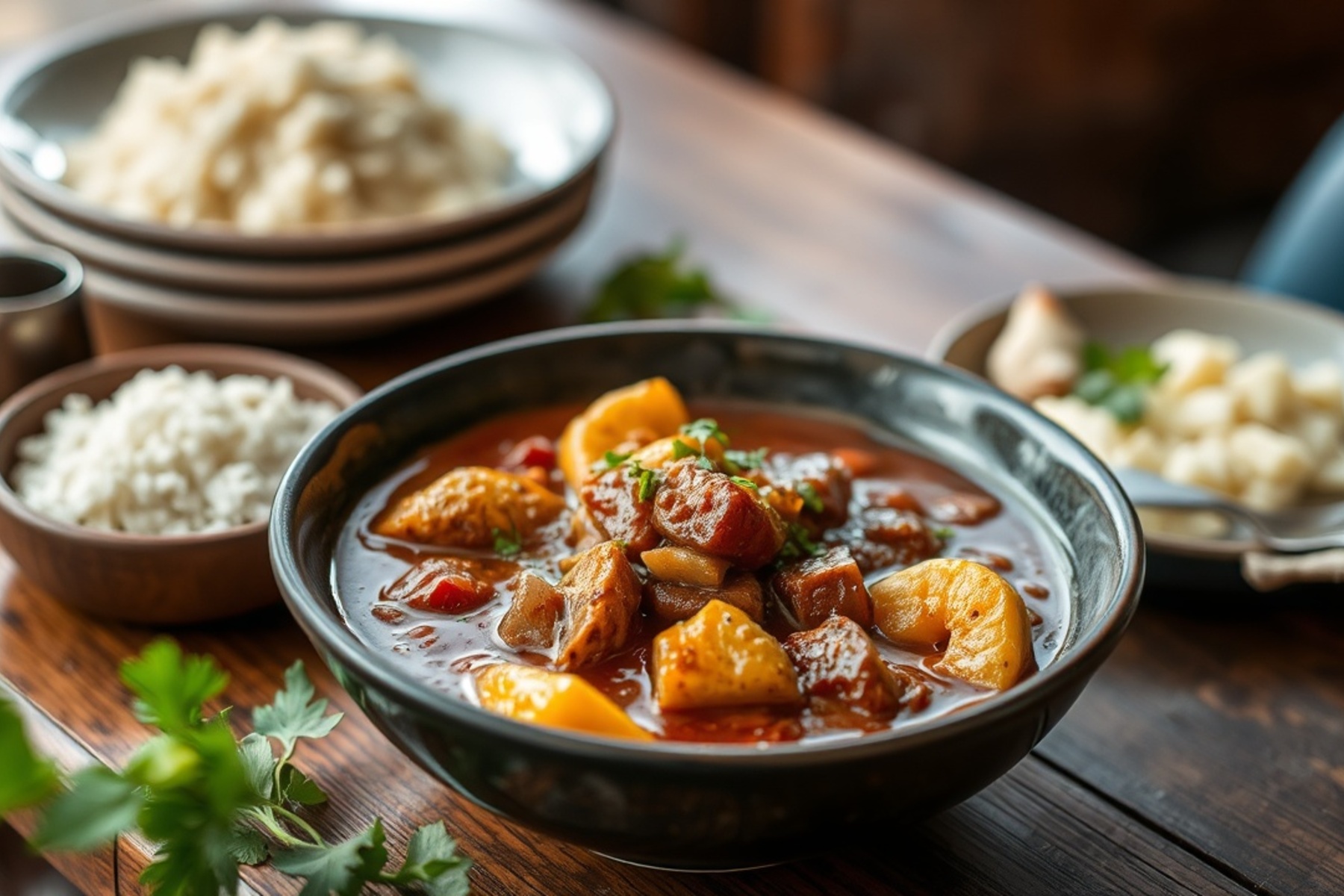
The Kanak dish and the centre of Kanak hospitality: yam, taro, sweet potato and banana with chicken, fish or crab and coconut milk, wrapped in banana leaves, tied, and buried on hot stones in an earth oven for two to three hours. It comes out as a parcel that is opened and shared. You will most likely eat it at a tribal gîte and it is the thing most worth arranging in advance.
🦞 Crevette bleue
The blue prawn of New Caledonia is farmed in the coastal ponds of the west coast, exported to Japan and France at high prices, and is the territory's one genuinely world-class food product. Sweet, firm, faintly blue in the shell before cooking. Eat it simply grilled; anything elaborate done to it is a waste.
🐕 Civet de cerf and roussette
Rusa deer, introduced in 1870, now number in the hundreds of thousands and are both an ecological disaster and the cheapest good meat in the territory — civet de cerf is on every bush menu. Roussette, the flying fox, is a customary Kanak food eaten in a strong stew; it is protected and hunted under season and quota, and it is one of the few dishes where the customary and the conservation arguments are genuinely in tension.
🍜 The Asian layer
Vietnamese and Javanese indentured labourers came to work the mines from the 1890s, and their food stayed. Bo bun — cold noodles, grilled beef, herbs, nuoc cham — is the everyday lunch of Nouméa, sold at the market and in every quarter. Nems, bami and Javanese sate are equally naturalised. It is genuinely good and it is the cheapest decent food on the island.
🥐 The French part
Nouméa has bakeries that would not embarrass a French sous-préfecture, patisserie of a standard that is startling this far from anywhere, and a restaurant culture with prices to match. Ingredients are flown or shipped in, which is why a cheese board here costs what a main course costs in Lyon.
🥥 And what grows here
Coconut, banana, papaya, mango, lychee in season, vanilla from Lifou, and the citrus and squash of the west coast. Kanak market gardens supply yam, taro, sweet potato and green bananas. The territory imports the great majority of what it eats, which is the deep reason everything costs what it does.
🍳 Three New Caledonian Recipes
🌿 Bougna
The Kanak earth-oven parcel · serves 6 · 3–4 hours
Ingredients: 1 kg yam (or, failing that, waxy potato), 500 g taro, 500 g sweet potato, 3 green bananas — all peeled and cut into large pieces · 1 chicken jointed, or 1 kg firm white fish, or 6 crabs · 800 ml thick coconut milk, ideally pressed from 3 grated fresh coconuts · salt · large banana leaves, passed briefly over a flame to soften · string or strips of banana bark. For an oven version: a deep casserole with a tight lid.
Method: Line a large square of banana leaves, overlapping and doubled. Lay the root vegetables in the bottom — they take longest and they insulate — then the meat or fish on top, and the bananas around it. Salt. Pour over the coconut milk so it soaks down through everything; it should be generous, because the milk is the cooking liquid and the sauce. Fold the leaves into a sealed parcel and tie it. Traditionally: dig a pit, burn a fire down to embers, lay hot stones, put the parcel on, cover with more leaves and then earth, and leave it 2–3 hours. At home: put the parcel in a covered casserole at 160 °C for 2½ hours, or in the embers of a barbecue with the lid down. Open it at the table.
💡 The coconut milk must be thick and it must be enough — this is the commonest failure. Do not open the parcel to check; you lose the steam that is doing the work. And it is a dish for a group: bougna made for two people is a contradiction in terms.
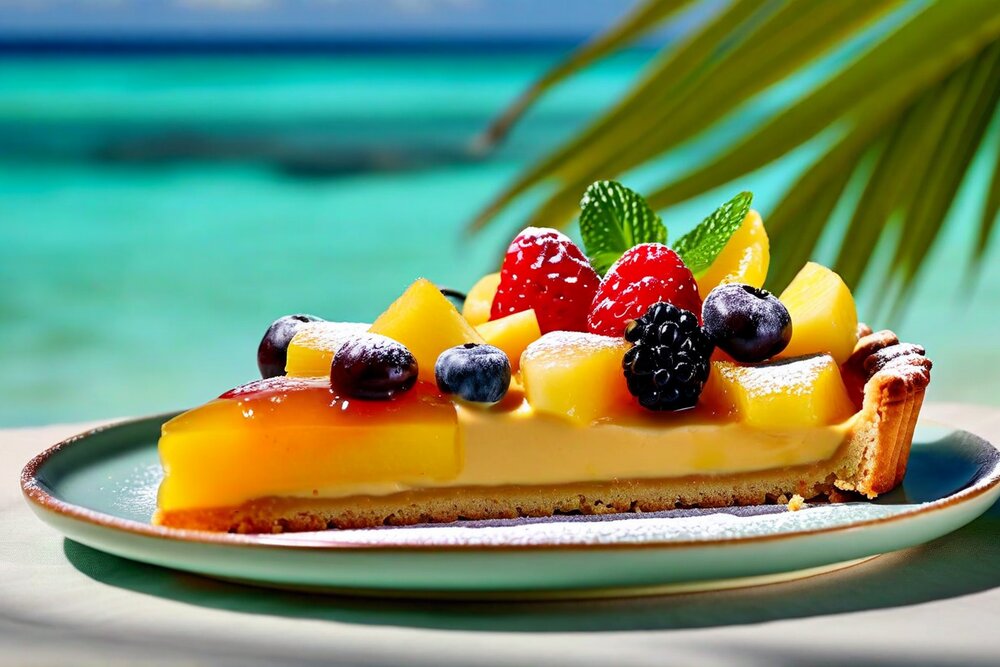
🦞 Crevettes Bleues à la Vanille de Lifou
Blue prawns with vanilla · serves 4 · 30 minutes
Ingredients: 800 g large raw prawns, shell on, heads on if you can get them · 1 vanilla pod (from Lifou if you are there, and it is worth buying) · 200 ml coconut milk · 100 ml dry white wine · 1 shallot, finely chopped · 30 g butter · 1 lime · salt, white pepper · rice to serve.
Method: Split the vanilla pod lengthways and scrape the seeds. Sweat the shallot in the butter until soft without colouring. Add the wine and the scraped pod and seeds and reduce by half. Add the coconut milk and simmer gently until it coats a spoon — do not boil it hard or it will split. Meanwhile sear the prawns in a very hot pan, about 90 seconds a side, until just opaque; take them out the moment they turn. Return them to the sauce for thirty seconds only, off the heat. Finish with lime juice and white pepper. Serve with plain rice and the pod on the plate.
💡 Vanilla with shellfish sounds wrong and is one of the great combinations; the trick is restraint, half a pod rather than a whole one if you are unsure. And undercook the prawns deliberately — they finish in the sauce, and a blue prawn overcooked by a minute is a waste of an expensive animal.
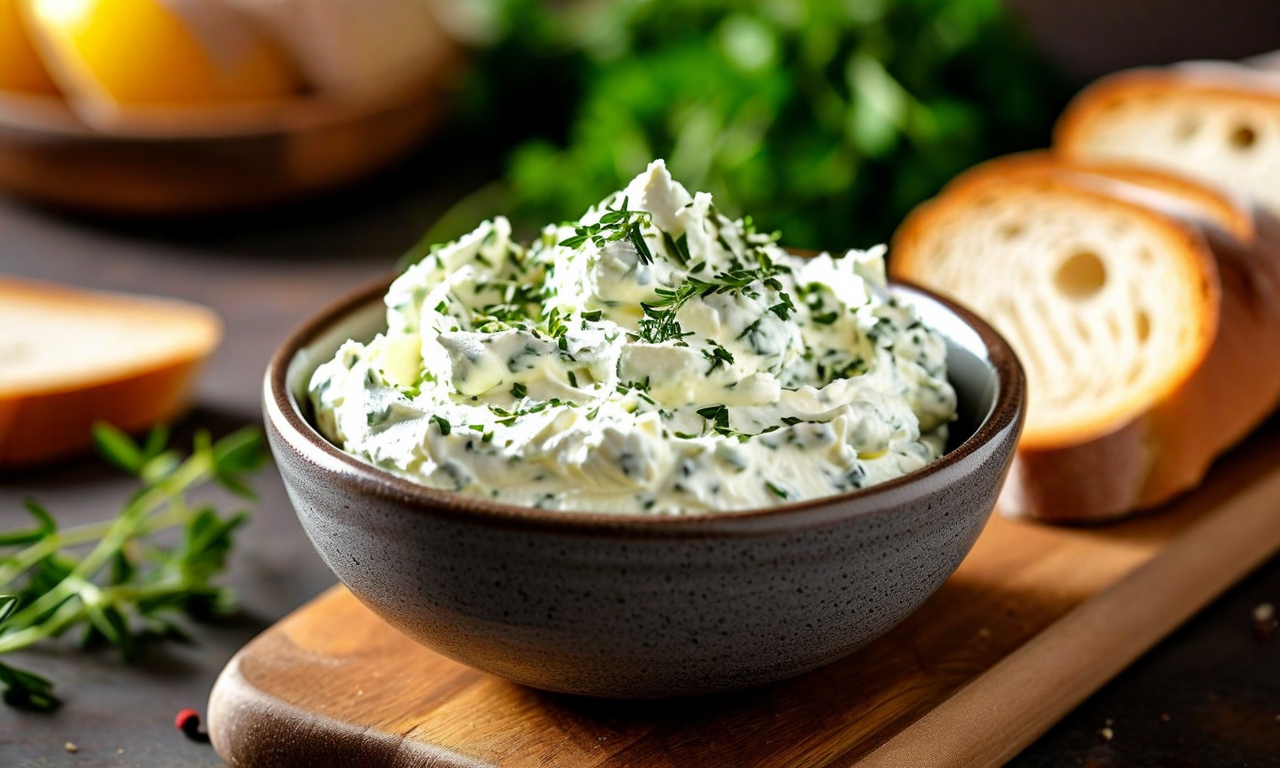
🍺 Drinks — Imported Wine, One Brewery and a Coffee History
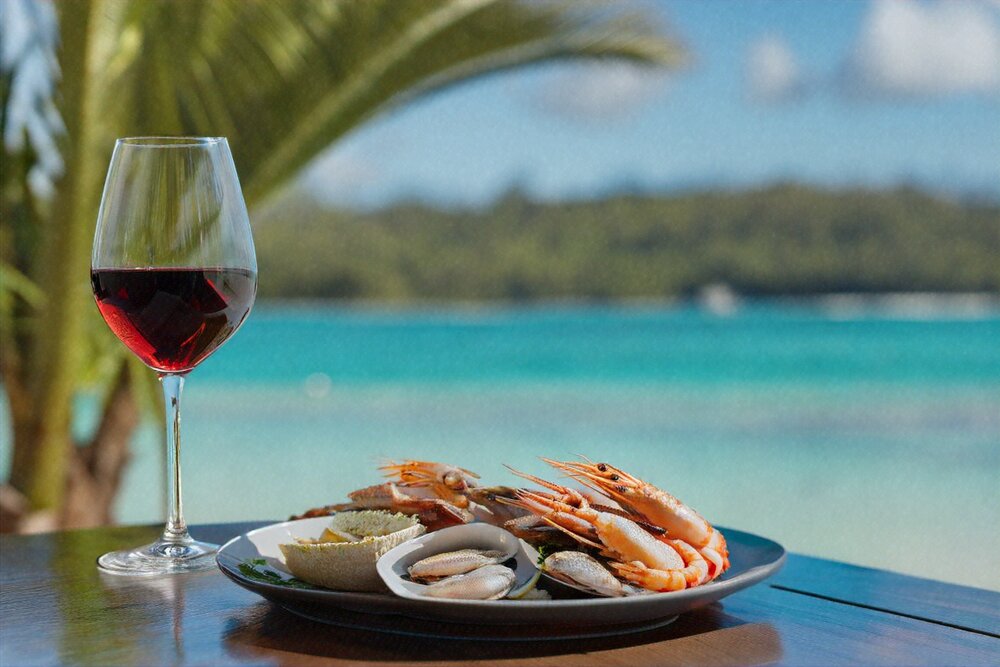
🍷 Wine, all of it imported
There is no viticulture: the climate is wrong, the soil is worse and the land is far too valuable. What there is instead is an excellent and expensive selection of French wine in every supermarket, because this is France and a wine aisle is not optional. Expect to pay roughly double the metropolitan shelf price.
🍻 Number One
The local beer, brewed at Grande Brasserie de Nouvelle-Calédonie in Nouméa since 1974 — a straightforward pale lager, cold, and correct for the climate. Manta is its stablemate. A small craft scene has appeared in Nouméa in the last decade. Imported beer is Australian and costs what imported beer costs.
☕ Coffee, and a forgotten industry
New Caledonia once grew and exported coffee in quantity — arabica and robusta, largely on Kanak smallholdings under a colonial system that required them to plant it. The industry collapsed in the twentieth century under disease, low prices and the pull of mining wages. A small revival exists, particularly around Sarraméa and the Houaïlou valley, and Caledonian coffee is now a curiosity worth buying at the Nouméa market.
🥥 Coconut and the everyday
Fresh coconut water everywhere; lait de coco as the base of most Kanak cooking. Local juices from papaya, passionfruit and pamplemousse. And the Vietnamese and Javanese influence shows up in the iced drinks at the market.
🥂 Kava, and where
Kava is not indigenous to New Caledonia — it is a Vanuatu and Fijian tradition — but ni-Vanuatu migration brought it, and there are now nakamals, kava bars, in and around Nouméa, open at dusk and lit dim by convention. It is legal, cheap and strong. Do not drive afterwards; the effect on reaction time is real even though you feel perfectly clear.
⚠️ Alcohol restrictions
Take these seriously. Alcohol is a significant public health and public order issue here and the authorities respond with sale restrictions: bans on take-away sales at certain hours or on certain days, and outright temporary prohibitions by the provinces or municipalities during tense periods — several were in force in 2024 and 2025. Restrictions are announced locally and change; a supermarket may simply decline to sell you wine on a Saturday afternoon.
🤿 Diving and the Water
This is the reason most people who come here come. The lagoon is huge, protected, warm (22–27 °C), and — unusually for a world-class dive destination — almost empty. You will routinely be one of six people on a site that in Egypt or Thailand would have six boats on it.
What you see
Reef sharks (grey, whitetip, blacktip) in numbers, eagle rays and mantas, turtles, napoleon wrasse, and huge schooling fish on the passes. From July to September, humpback whales in the southern lagoon. Coral cover is good to excellent in the north and on the outer reefs, patchier near Nouméa.
The passes
The Boulari and Dumbéa passes near Nouméa are the classics — drift dives on tidal exchange with sharks stacked in the current. Further out, the Prony Needle, a bizarre 38 m underwater chimney of calcite built by freshwater springs, is unlike anything else and is dived from the Baie de Prony.
The wrecks
The Dieppoise, a minesweeper sunk as an artificial reef in 1988 at 28 m, and the Humboldt, plus several war-era wrecks from the American years. Visibility on the outer sites can exceed 40 m.
Snorkelling, which is enough
You do not need to dive. The piscine naturelle at the Isle of Pines, Jinek Bay at Lifou (permission and a fee to the tribe), Îlot Maître and the coral just off Poé beach are all reachable with a mask. Ouvéa's lagoon is so clear that from the beach you can see fish thirty metres out.
Practicalities
Dive centres in Nouméa, Bourail, Poindimié, the Isle of Pines and Lifou; most operate in French, several in English, and standards are French-regulated and good. Expect roughly 12 000–16 000 XPF (about 100–135 €) for a two-tank day. The nearest recompression chamber is in Nouméa — factor that into your dive planning if you are out at the Loyalty Islands, and do not fly within 24 hours.
Other water
Kitesurfing and windsurfing at Anse Vata and Poé, with reliable trade wind from September to January. Sailing — this is a superb cruising ground and charter yachts leave from Nouméa. And whale watching in season, under a code of approach that is genuinely enforced; go with an operator who observes it.
🌡️ Climate & When to Go
✅ September–November
The best window. The wet season has ended, humidity is low, temperatures sit around 23–27 °C, the trade wind blows steadily and the cyclone risk has gone. September and October are also whale season in the south. It is spring here and it is close to perfect.
✅ May–August
The Caledonian winter: dry, clear, 20–24 °C by day and cool enough at night to want a jumper in the mountains. Water drops to about 22 °C, which is still fine in a shorty. This is the other good season and it is the quietest.
🌧️ December–April
Hot, humid and wet: 27–31 °C, heavy afternoon rain, and the cyclone season. Cyclones reach the territory every few years and near-misses are annual. Roads on the east coast wash out, flights are cancelled and insurance exclusions start to matter. It is also when the lagoon is warmest and the island greenest.
The two coasts
Remember that the mountain spine makes two climates. The east can take 2 000–4 000 mm of rain a year; the west may get a quarter of that and is periodically in drought. A wet week in Hienghène can be a dry week in Bourail, 80 km away.
The trade wind
The alizé blows from the south-east for most of the year and is the reason the climate is bearable. It also means the east coast and the windward side of every island is choppier, and that boat trips to the Isle of Pines and the Loyalties are weather-dependent — the ferry is regularly cancelled and the planes are not.
School holidays
French-territory school holidays and the Australian ones both hit hard, especially December–January (the southern summer) and the July break. Nouméa hotels fill and the Isle of Pines can be booked out months ahead. Shoulder season here means genuinely empty, which is a large part of the appeal.
✈️ Getting There & Getting Around
La Tontouta
The international airport, 45 km north-west of Nouméa — about 50 minutes by shuttle or hire car, and there is no rail. The national carrier is Aircalin, which flies to Sydney, Brisbane, Auckland, Tokyo, Osaka, Singapore, Port Vila, Nadi, Papeete and, seasonally, Paris via a stop. Qantas and others serve the Australian routes.
How you actually get here from Europe
There is no short way. The realistic options are via Tokyo or Osaka (Aircalin's Japanese connections are the shortest total journey from Europe), via Singapore, or via Sydney, Brisbane or Auckland. Total journey time from a European capital is 26–34 hours with one or two stops. Aircalin's Paris service, when it runs, is the sentimental option and not the fast one.
⚠️ The Australian transit trap
This catches people every year. If you route through Australia, you need an Australian visa or ETA even to transit in most cases, depending on nationality and whether you clear immigration. Czech citizens can obtain an eVisitor (subclass 651) free online, and you should do it before you fly. New Zealand similarly requires an NZeTA for transit.
Internal flights
Air Calédonie — the domestic carrier, confusingly similar in name to Aircalin — flies from Magenta airport in Nouméa itself (not Tontouta) to the Isle of Pines, Lifou, Maré, Ouvéa, Touho, Koné and Koumac. Flights are short, small-aircraft and weather-dependent, and the baggage allowance is tight — typically 12 kg — which matters if you have arrived with a diving kit.
Ferries
The Betico runs Nouméa to the Isle of Pines and the Loyalty Islands. It is cheaper than flying, it takes two and a half to five hours depending on destination, and it is cancelled often enough in the trade wind that you should not schedule a flight home the day after it. It is also, in a swell, a memorably unpleasant crossing.
Cars and buses
A hire car is close to essential outside Nouméa; roads are good, driving is on the right, and fuel is expensive. Nouméa has a decent urban bus network (Tanéo) and there are inter-urban coaches (RAI) along the two coasts, slow and cheap. Taxis are scarce and expensive; there is no Uber.
📋 Practical Information
💰 Money
The CFP franc (XPF), also used in French Polynesia and Wallis and Futuna, and pegged to the euro at a fixed rate: 1 000 XPF = 8,38 €, or roughly 119,33 XPF to the euro. It never moves, which makes budgeting easy. Cards are widely accepted in Nouméa and much less so in the tribes and the islands — carry cash outside the capital.
🛂 Entry
New Caledonia is not in the Schengen area even though it is French. EU citizens, including Czechs, do not need a visa and may enter with a passport for stays up to three months; an ID card is not sufficient, unlike in metropolitan France. Other nationalities should check, because the rules are the French overseas ones and differ from both Schengen and mainland France.
⚕️ Health
No malaria and no yellow fever. Dengue outbreaks occur and occasionally are severe, and chikungunya and Zika have appeared — use repellent, especially in the wet season. Healthcare is French-standard and expensive; the Médipôle hospital in Dumbéa is modern. The EHIC does not apply here — this is an overseas collectivity outside the EU health system — so proper travel insurance is not optional.
🌊 In the water
Sea snakes are common and harmless if left alone. Stonefish and cone shells are the real hazards: wear reef shoes, do not pick up pretty shells. Shark attacks have been a genuine recent issue in Nouméa's bays — several serious incidents since 2023 led to bathing bans and a controversial culling programme — so obey local beach signage, which is posted and enforced.
🔌 Practicalities
220 V, plug types C and E/F — identical to Czech, no adapter needed. Time is UTC+11, which is 10 hours ahead of Prague in winter and 9 in summer, and there is no daylight saving. Emergency numbers: 15 ambulance, 17 police, 18 fire, 112 works. Mobile coverage is good on Grande Terre's coasts and patchy inland; the operator is OPT-NC and roaming is expensive.
🙏 Etiquette, and the one that matters
Greet people. In the tribes and outside Nouméa, saying bonjour to everyone you pass is not optional politeness but the minimum. Do la coutume when you enter tribal land or stay at a tribal gîte — a manou, a note, and a sentence about yourself. Ask before photographing. Dress modestly away from the resort beaches. And do not raise the independence question with people you have just met; if they want to discuss it they will, and they often do.
💸 What It Actually Costs — Brace Yourself
New Caledonia is expensive in a way that surprises even people who have been warned. Nearly everything is shipped from France or Australia, protective tariffs keep a small local industry alive, wages are French, and the territory is a long way from anywhere. Supermarket prices routinely run 60–80 % above metropolitan France and can be double.
🛏️ A bed
Nouméa mid-range hotel double: 15 000–25 000 XPF (125–210 €). A resort at Anse Vata or on the Isle of Pines: 30 000–60 000 XPF (250–500 €). The good news: a tribal gîte — a bungalow or a case on tribal land, often on a beach, with dinner included — runs 6 000–12 000 XPF (50–100 €) and is a far better experience than the resorts.
🍽️ Eating
A coffee 300–450 XPF (2,50–3,80 €). A bo bun at the market 1 200–1 600 XPF (10–13 €) and the best value on the island. A restaurant main 2 800–4 500 XPF (23–38 €). A beer 600–900 XPF. A supermarket shop will make a European blink — a modest basket of imported basics is easily 10 000 XPF.
🚗 Getting around
Hire car 5 000–9 000 XPF a day (42–75 €), and you should book ahead because the fleet is small. Petrol around 190 XPF a litre. Internal flight Nouméa–Isle of Pines or Nouméa–Lifou 14 000–22 000 XPF return. The Betico ferry is roughly half that.
🤿 Activities
Two-tank dive day 12 000–16 000 XPF (100–135 €). Day boat to Îlot Amédée with lunch 9 000–13 000 XPF. Tjibaou Centre entry is a modest 1 000 XPF and is the best-value thing in the territory. Whale watching in season 12 000–18 000 XPF.
✈️ The flights, which dominate
This is the real cost. From Europe, return fares are typically 1 400–2 400 € depending on routing and season, and there is no low-cost option. From Australia the territory is genuinely cheap to reach — Brisbane or Sydney return is often under 500 AUD — which is why the Australian market matters so much here and why its collapse after 2024 hurt.
📊 Honest totals
Backpacking is barely possible: even with tribal gîtes and self-catering you are looking at 10 000–14 000 XPF a day (85–120 €). The ordinary version — hotel, hire car, eating out, one or two activities — is 22 000–32 000 XPF a day per person (185–270 €). Ten days for two, excluding flights, realistically 4 500–7 000 €. This is not a cheap Pacific destination and nobody here pretends it is.
💶 The Economy — Nickel, Transfers and What Happens If Both Fail
New Caledonia has, on paper, one of the highest GDPs per head in the Pacific. It also has an economy resting on two pillars, both of which are currently in trouble: nickel, which no longer pays for itself, and transfers from the French state, which pay for a great deal of everything else.
The transfer question
France's annual financial contribution — covering the sovereign functions, the civil service, health, education, pensions and subsidy — is on the order of 1,5 billion euros a year and is somewhere between a fifth and a quarter of the territory's GDP depending on how it is counted. Every serious discussion of independence eventually arrives at this number, and both camps know it: the loyalists treat it as the decisive argument, the independence movement as the definition of dependency.
What nickel is worth now
Little, at current prices. Indonesian supply has restructured the world market, the three Caledonian plants are high-cost, and one of them has closed. The French state's "nickel pact" offered support conditional on restructuring and cheaper energy; the territory's political deadlock has made agreeing to it slow. The realistic outcomes range from a smaller, subsidised industry to a much smaller one.
Tourism, which never grew
New Caledonia gets a fraction of the visitors of Fiji or French Polynesia — historically something like 120 000 air arrivals a year plus cruise passengers, against Fiji's near-million. The reasons are cost, distance, a French-language environment in an Anglophone region, and limited marketing. After 2024 it collapsed and has recovered only partially. It is the sector with the most obvious room to grow and the least capital to do it with.
Public employment
A very large share of formal jobs is public or para-public, and the pay scales carry an overseas index supplement inherited from the colonial administration, which inflates both salaries and prices. It is one of the structural reasons the cost of living is what it is, and reforming it is politically almost impossible.
The prawns, the deer, the coffee
The productive economy beyond nickel is small but real: the crevette bleue aquaculture industry exporting to Japan and France, cattle and venison on the west coast, a revived coffee and vanilla trade, and squash exported to Japan in a narrow seasonal window. None of it is at a scale to replace nickel and all of it is worth more than it is given credit for.
The state of the books in 2026
Bad. The territory is running large deficits, the social security fund has been in crisis for years, the reconstruction bill from 2024 is mostly unmet, insurers have withdrawn or repriced, and several thousand working-age residents have left. Whatever political settlement eventually emerges will have to be paid for out of a smaller economy than the one that existed in April 2024.
🧠 Fifteen Things About New Caledonia That Are True
The lagoon is bigger than Slovenia
24 000 km² of enclosed water behind roughly 1 600 km of barrier reef — the largest lagoon on earth, and second only to Australia's reef in length. UNESCO World Heritage since 2008.
It is a piece of a sunken continent
Not a volcano and not an atoll: a fragment of continental crust from Zealandia, adrift from Gondwana for about 80 million years. Everything strange about its plants, animals and metals follows from that.
Three quarters of its plants grow nowhere else
Around 3 400 native vascular plants, of which roughly 75 % are endemic — one of the highest rates of any land area on the planet, and the direct result of soil so full of nickel and chromium that plants had to evolve around it.
The ancestor of every flower
Amborella trichopoda, a modest shrub found only in New Caledonia's wet forest, is the sister lineage to all other flowering plants — the earliest surviving branch of the family that produced every bloom, fruit and grain on earth.
The trees lean
Every single Araucaria columnaris tilts toward the equator — a consistent, measurable and still not fully explained lean, documented worldwide wherever the species has been planted. New Caledonia has thirteen endemic Araucaria species, more than anywhere.
Cook named it after Scotland
On 4 September 1774, because the north-east ridges reminded him of the Highlands. His father was a Scot. An entire Melanesian country has been carrying a Scottish simile ever since.
The insult became the name
Kanak derives from Hawaiian kanaka, "person", which became the French colonial slur canaque. In the 1970s the independence movement took it back, respelled it, and made it a name. It is deliberately invariable — no plural, no feminine — because French grammar was part of what was being refused.
Two flags fly side by side
Since 2010 public buildings fly both the French tricolour and the Kanak flag. Nowhere else in the French Republic does this.
It was a prison
Around 22 000 convicts were transported here between 1864 and 1897, plus about 4 000 Communards after 1871 — including Louise Michel, who supported the Kanak revolt of 1878 against her own countrymen and gave her red scarf to the insurgents.
Ataï's head spent 136 years in Paris
The chief who led the 1878 revolt was decapitated and his skull sent to a Paris anthropological collection. It was returned to his descendants in 2014.
Nobody has agreed on the name
The 1998 Nouméa Accord required five "identity signs" to be agreed: flag, anthem, motto, banknotes and name. Four were settled. The name was not, which is why institutions write Kanaky – Nouvelle-Calédonie with a dash in the middle.
Twenty-eight languages in 268 000 people
One of the highest linguistic densities on earth. A Kanak from Hienghène and one from Maré have no common language but French.
More deer than people, probably
Rusa deer introduced in 1870 now number in the hundreds of thousands. They are an ecological catastrophe for the endemic forest and, simultaneously, the cheapest good meat in the territory.
Indigenous people could not vote until 1957
The code de l'indigénat — a separate legal code with forced labour, a head tax and a pass requirement — was abolished only in 1946, and universal suffrage arrived in 1957. People are alive today who were born without the vote in a country their ancestors had held for three thousand years.
A World Cup winner is Kanak
Christian Karembeu, born on Lifou, won the 1998 World Cup and the 2000 European Championship with France — and famously refused to sing the Marseillaise, because his great-grandfather had been exhibited at the 1931 Paris Colonial Exposition as a "cannibal". Both halves of that sentence are true and neither is well known in France.
🌟 People Worth Knowing About
Jean-Marie Tjibaou (1936–1989)
Priest, ethnologist, organiser of Mélanésia 2000, founder of the FLNKS, and the man who signed the Matignon Accords with the leader of the other side eleven months before being assassinated by a member of his own movement for doing so. His line — "our identity is ahead of us" — is the most quoted sentence in Caledonian politics. See his section.
Jacques Lafleur (1932–2010)
The other signature on Matignon: the wealthiest man in the territory, a mining heir, deputy for New Caledonia for twenty-seven years and the leader of the anti-independence right. He spent his career opposing everything Tjibaou wanted and then sat down with him, and he took very serious risks with his own base to do it. He wrote afterwards that the two of them had understood each other better than either had understood their own supporters.
Louise Michel (1830–1905)
The Communard, anarchist and teacher deported here in 1873. She spent seven years on the Isle of Pines and in Nouméa, learned Kanak languages, taught Kanak children when that was disapproved of, and supported the 1878 revolt against her own countrymen. She is the rare figure whom the descendants of both convicts and Kanak insurgents still speak of with respect.
Christian Karembeu (b. 1970)
Born on Lifou, World Cup winner with France in 1998, European champion in 2000, and a player for Sampdoria, Real Madrid and Olympiakos. He declined to sing the Marseillaise throughout his international career and explained why: his great-grandfather was displayed in a human zoo at the 1931 Paris Colonial Exposition, billed as a cannibal. He remains one of the most articulate Kanak voices in French public life.
Déwé Gorodé (1949–2022)
Poet, novelist, teacher and politician — the first major Kanak woman writer and, for years, vice-president of the New Caledonian government. She wrote in French about Kanak life, custom and the position of women within it, including its own constraints, which took courage in both directions. L'Épave and Utê Mûrûnû are the places to start.
Marie-Claude Tjibaou (b. 1946)
Jean-Marie's widow, president of the ADCK which runs the Tjibaou Centre, and a central figure in Caledonian public life for three decades in her own right. She took part in the long customary reconciliation with the family of her husband's killer — a process of exchanges that took sixteen years and ended in 2004, and which is the most complete example most people will encounter of what Kanak reconciliation actually involves.
Sonia Backès (b. 1976)
The leading loyalist politician of the current generation: president of the Southern Province, leader of Les Loyalistes, briefly a French government minister, and the figure who drove the loyalist bloc to 24 Congress seats in June 2026. Combative, effective and, to the independence movement, the personification of everything they are against.
Christian Tein (b. 1968)
Leader of the CCAT, the field-mobilisation group blamed by the French state for the May 2024 unrest. He was flown 17 000 km to mainland France and held in pre-trial detention there, and while still in France was elected president of the FLNKS — a choice that was as much a statement about the deportation as about him.
Yvette Conradt and the women's cricket
Not a person so much as a phenomenon, and one of the best things in the Pacific: on the Loyalty Islands, cricket brought by Protestant missionaries in the nineteenth century was taken over by women, rewritten with teams of any size, brilliantly coloured uniforms, chanting and dance, and is now a major social institution played almost entirely by women, on Saturdays, in villages. Missionaries brought it; the islands kept the ball and threw away the rules.
⚽ Sport — Football, Cricket and an Unusual Flag Problem
Football
The dominant sport, and New Caledonia is a full member of the OFC — the Oceania confederation — with its own national team, Les Cagous, despite not being an independent state. They have reached the OFC Nations Cup final and won the Pacific Games repeatedly. Because they play as New Caledonia, Caledonian players face a choice: the local side, or France.
The ones who chose France
Christian Karembeu (1998 World Cup, 2000 Euro) is the great example, and Antoine Kombouaré — born in Nouméa, a long Ligue 1 career at PSG and then a substantial managerial one at PSG, Nantes and elsewhere — is the other. For a territory of 268 000 people to have produced a World Cup winner and a Ligue 1 manager is a remarkable strike rate.
Cricket, rewritten
The Loyalty Islands version deserves its own paragraph. Missionaries introduced cricket in the nineteenth century; Kanak women took it over and reinvented it — teams of a dozen or more a side, hand-sewn uniforms in brilliant colours, songs, chants and dance between overs, and a social function closer to a village festival than a sport. It is played mainly by women, mainly on Saturdays, and it is one of the genuinely joyful things to stumble into on Lifou or Maré.
Rugby and the rest
Rugby union and league both have a following, unsurprisingly given the neighbours, though neither at the level of Fiji or Tonga. Volleyball, athletics and va'a — outrigger canoe racing — are strong. Va'a in particular is a serious competitive sport across the Pacific and Caledonian crews do well at it.
The Pacific Games
New Caledonia hosted the 2011 Pacific Games in Nouméa, built the infrastructure for it, and topped the medal table — which it does regularly. The Games are the main sporting stage for the territory and matter here far more than the Olympics, at which Caledonians compete for France.
The flag question, again
Sport runs into the constitutional problem constantly. Which flag is raised, which anthem is played, and whether a team is "New Caledonia" or a French region varies by sport and by governing body, and each arrangement was negotiated separately. It is a small illustration of the territory's whole situation: no single answer, several workable compromises, and an argument every time.
📰 Media, Press Freedom & Resources
French press law applies, which means the formal framework is strong. The practical reality in a small, polarised territory is more complicated, and the 2024 crisis tested it hard — including the first territory-wide block of a social network on French soil.
What exists
Les Nouvelles Calédoniennes (LNC) is the daily and has been since 1971. NC la 1ère is the public broadcaster, radio and television, part of France Télévisions' overseas network and the most-used news source. Radio Djiido is the independence movement's station, founded in 1985 and named after a Kanak word for a bird whose call warns of danger; Radio Rythme Bleu is its loyalist counterpart. That pairing tells you a great deal about the media landscape.
The TikTok block
During the May 2024 unrest the French government blocked TikTok across the territory under the state of emergency — the first time France had blocked a social network on its own soil. The Conseil d'État declined to suspend it at the time; the decision was later criticised by press freedom and digital rights organisations, and it remains a live precedent that people outside New Caledonia have mostly forgotten about.
Reporting the crisis
Coverage divided along the same lines as everything else, and journalists working in the burning suburbs were threatened from both directions. The most useful outside reporting came from RNZ Pacific, ABC Pacific, Islands Business and Asia Pacific Report, whose Pacific desks have long institutional memory of this territory — and from Mediapart and Le Monde in France, which covered the deportations closely.
📚 Reading
Alban Bensa, Nouvelle-Calédonie: un paradis dans la tourmente — the anthropologist who advised Renzo Piano, and the best single guide to Kanak society. Déwé Gorodé's fiction and poetry for the inside view. Jean-Marie Tjibaou, La présence kanak, his collected writing and interviews. In English, David Chappell, The Kanak Awakening on the rise of the independence movement, and Adrian Muckle on the 1917 revolt.
🎬 Watching
L'Ordre et la Morale (Mathieu Kassovitz, 2011) on the Ouvéa cave assault, told from the point of view of the GIGN negotiator, and controversial here for what it includes and omits — but it is the only major film about the defining event of modern Caledonian history. Yann Arthus-Bertrand's aerial work for the Cœur de Voh. And the documentary material around the return of Ataï's skull.
Search terms that work
"Nouméa Accord 1998 text preamble" · "Ouvéa 1988 cave assault inquiry" · "Koniambo Glencore closure 2024" · "Bougival accord FLNKS rejection" · "New Caledonia provincial elections June 2026 results" · "Amborella trichopoda genome". Read the French and the Pacific-desk Anglophone coverage in pairs; they emphasise very different things and the gap between them is informative.
🇨🇿 For Czech Readers
New Caledonia is one of the harder places on earth for a Czech traveller to reach — not because of paperwork, which is minimal, but because of distance, price and a set of transit rules that catch people out. It is also, for a Czech passport holder, easier than most of the Pacific: no visa, no vaccination requirement, and a plug that fits.
Getting there from Prague
There is no good way and no cheap way. Realistic routings: Prague → Tokyo or Osaka → Nouméa with Aircalin (the shortest total journey), Prague → Singapore → Nouméa, or Prague → Dubai/Doha → Sydney or Brisbane → Nouméa. Total 26–34 hours with one or two stops. Return fares run 34 000–58 000 Kč and there is no low-cost option at any point in the chain.
Formalities — simpler than you expect
New Caledonia is French but not Schengen. Czech citizens need no visa for stays up to three months, but you must travel on a passport — a Czech ID card is not sufficient here, unlike in mainland France. Passport valid for the duration of stay. No vaccination requirements.
⚠️ The transit trap that catches Czechs
If you route via Australia, you need an Australian eVisitor (subclass 651) even to transit in most cases — it is free, it is applied for online, and it takes minutes, but people are turned away at Prague or Dubai for not having it. Via New Zealand you need an NZeTA (about 17 NZD plus the tourism levy). Via Japan or Singapore, Czechs need nothing extra, which is one more argument for the Tokyo routing.
MZV ČR and DROZD
The Czech Ministry of Foreign Affairs classifies New Caledonia under France, and after 2024 there is specific advisory language about civil unrest for the territory — check the current text at mzv.gov.cz before booking, because it has changed several times since May 2024. Register in DROZD (drozd.mzv.gov.cz): for a destination this remote, with an airport that has closed for a month within living memory, that registration is more useful than almost anywhere else you could go.
Consular reality
There is no Czech representation in New Caledonia and nothing close to it. The territory falls under the Czech Embassy in Canberra, Australia — roughly 2 500 km and an international flight away — with the Embassy in Paris relevant for French administrative matters. As an EU citizen you may approach any EU member state's mission, and in practice that means the French authorities themselves, who are the state here. The MZV emergency line is +420 222 264 000.
Money and budget in crowns
The CFP franc is pegged to the euro: 1 000 XPF = 8,38 €, so roughly 1 000 XPF ≈ 205 Kč. A coffee is about 75 Kč, a market bo bun 250–330 Kč, a restaurant main 580–930 Kč, a hire car 1 000–1 850 Kč a day and a mid-range hotel double 3 100–5 100 Kč a night. Ten days for two, excluding flights, lands at 110 000–170 000 Kč. With flights, a realistic trip for two is 180 000–290 000 Kč.
Insurance, and the one clause to check. Your Czech EHIC/EKUZ does not work here — New Caledonia is an overseas collectivity outside the EU health system, so the card that covers you in Marseille covers you for nothing in Nouméa. You need full commercial travel insurance with medical cover and, critically, repatriation: an evacuation from here to Europe is a five-figure euro bill. Check two exclusions specifically: civil unrest, which most standard Czech policies exclude and which is not a theoretical risk in this territory, and diving, which needs to be added explicitly and to the depth you intend. Allianz, ČSOB, Generali and UNIQA all sell suitable extensions; expect 800–2 500 Kč for two weeks with both.
A Czech connection worth knowing. There is no significant Czech community here and never was — but there is a thread. The Novara expedition of 1857–59, the great Austro-Hungarian circumnavigation, called in this region and its Pacific collections went to Vienna, which is where a good deal of Central European knowledge of Melanesia started; parts of that material later found their way into Czech museum and academic collections. The Náprstek Museum in Prague holds Melanesian material of the kind whose provenance European institutions are now being asked to examine — which is precisely the argument that returned Ataï's skull to his descendants in 2014, and it is a live question in Prague as well as in Paris.
📸 Photo Gallery — and the Clearest Proof Yet That the Food Images Are Generated
An authoritative listing of the image store on 14 September 2026 found ten files for this entry: two in the country folder and eight recipe images. Five are used, each captioned with what it does and does not show; three were rejected; and two were left out. One of the rejected files settles a question this project has been circling for four countries.
🚨 The flatbread with the cameras in it
new-caledonia-new-caledonia-flatbread.jpg is the fourth wrong <country>-flatbread file (Namibia: tandoor naan; Nauru: vegetable pizza; Nepal: leavened naan) — and this one settles the argument about where they come from. Besides depicting a flatbread for a territory that has no flatbread tradition whatsoever, the image contains visible generation artefacts baked into it: two malformed cameras showing the scene recursively on garbled screens, a mangled brand mark, nonsense numerals reading "1G I:DP" and "16,0GF", and a disembodied hand. It is not a stock photograph that was mislabelled. It was machine-made, badly, and nobody looked at it.
❌ The bougna that is restaurant food
new-caledonia-bougna.jpg shows a plated golden disc with micro-herbs and dots of oil. Bougna is the Kanak earth-oven dish — yam, taro, sweet potato, banana and meat or fish with coconut milk, wrapped in banana leaves and cooked on hot stones buried in the ground, then opened as a parcel and shared. It is the centre of Kanak hospitality and the most culturally specific thing on these islands, rendered here as anonymous resort cuisine. Not used.
❌ The raw fish that is cooked
new-caledonia-poisson-cru.jpg shows a seared fillet with crisped skin. Cru means raw. Poisson cru is fish cured in lime and coconut milk and is never cooked. The filename and the photograph contradict each other in a single word — the same class of error as Nepal's "dal bhat" with no rice in it, but blunter.
⚠️ Right dish, wrong France
new-caledonia-cervelle-de-canut.jpg is a new kind of error and it is used on this page with the point named. The photograph is entirely correct for its filename — fromage blanc whipped with herbs, exactly as shown. But cervelle de canut is Lyonnais, the signature of Lyon's bouchons, named for the silk workers of the Croix-Rousse, and has nothing to do with New Caledonia. Asked for the food of a French Pacific territory, the image bank reached for metropolitan France and the Melanesian half of the kitchen vanished.
⚠️ Three more PNGs called .jpg
01-hero.jpg (2,96 MB — the largest single offender found anywhere in this collection), cervelle-de-canut (1,55 MB) and tarte-tropicale (1,52 MB) are PNG files served with a .jpg extension and Content-Type: image/jpeg. Fifth country in this defect family after Namibia, Nauru, Nepal (as WebP) and the Netherlands.
✅ What is used, and the hero's honest limit
The hero is a mangrove estuary at sunset. It is used because it claims no named place and is therefore honest — but it is not identifiably New Caledonia: there is not one Araucaria columnaris in it, the columnar pine that is the territory's signature tree and is on its own tourist logo, and the mangrove image the world actually knows from here is the Cœur de Voh, which this is not. Also used: the wine and seafood plate, with the wine's imported status named; the stew, captioned as close to a civet de cerf; and the fruit tart, captioned to say the berries on it are flown in.
Left out as duplicative or generic: tarte-tropicale (a near-copy of the tart already used) and new-caledonia-sweet-treat, the fourth instance of that filename producing something generic — here fruit-jelly squares on shortbread, pleasant and not a Caledonian sweet.
If you have your own photographs of New Caledonia — the Cœur de Voh, the piscine naturelle before the day boats, a bougna being opened, the Tjibaou Centre in the trade wind, women's cricket on Lifou — this project would be glad to hear from you at photos@kaufmann.wtf.
✍️ Author's Note
There is a photograph taken from the air above the west coast of Grande Terre in which the mangrove has grown, entirely by itself, into the shape of a heart. It is called the Cœur de Voh, Yann Arthus-Bertrand put it on the cover of a book that sold three million copies, and it is now the single most reproduced image of New Caledonia in the world. I find it a slightly uncomfortable emblem, because what almost every person who has seen that photograph knows about this territory is that it is beautiful, and what almost none of them know is anything else at all.
The thing that is hardest to hold in your head here is that two completely incompatible descriptions are both accurate. This is a French territory: the roads, the schools, the hospital, the pensions, the baguettes at six in the morning, the administrative forms in triplicate, and a standard of living that is among the highest in the Pacific. It is also a colonised Melanesian country in which the indigenous people were confined to reservations, subjected to a separate legal code with forced labour and a pass requirement until 1946, denied the vote until 1957, made a minority by a deliberately stated immigration policy, and whose leader's severed head sat in a Paris cupboard for 136 years. Neither description cancels the other. Anybody who tells you this is simply a French holiday island, or simply a colony, is telling you half of it.
What I did not expect, reading into it, was how good some of the politics has been. Matignon in 1988 is one of the genuinely impressive acts of statecraft of the late twentieth century: a Melanesian former priest and a white mining millionaire, whose communities had been shooting at each other weeks before, sitting in Paris and building a settlement that held for thirty years. The Nouméa Accord preamble, in which the French Republic writes into its own constitutional order that colonisation damaged the dignity of the Kanak people, has very few parallels anywhere. The customary reconciliation between the Tjibaou and Wéa families — sixteen years of exchanges after an assassination — is a model of a kind that European legal systems have no equivalent for at all.
And then the third referendum. I have gone back and forth on this and I have landed somewhere uncomfortable for both sides. Legally, Paris was entitled to hold the vote in December 2021: the Accord specified the timetable and the government followed it. Politically, holding it during a Covid wave that was killing Kanak people, in the middle of a customary mourning period, after the independence movement had asked for a few months' delay, was a catastrophic choice — it converted a process that both sides had accepted for twenty-three years into one that half the territory regards as void. A 96,5 % no vote on 43,9 % turnout settles nothing and everybody involved knew it would settle nothing. Two and a half years later, fourteen people were dead and two billion euros of the territory had burned.
For a visitor in 2026 the practical position is simple and the moral one is not. It is calm, it is safe, the lagoon is still the best in the world and almost nobody is in it, and a tribal gîte on the east coast for fifty euros a night with dinner included is one of the great travel experiences available anywhere. Go. But go understanding that the beach you are on belongs to a clan, that la coutume is not a quaint local custom but the acknowledgement of that fact, that the ruins next to the postcard are a prison, and that the argument about whose country this is has not finished and is not going to finish quietly.
I have not been to New Caledonia. Everything here is read — from the Accord texts, from Bensa and Chappell, from the Pacific news desks, from the election results of June 2026 — and where the page sounds confident about what it feels like to live between two flags, treat that as a European working from documents. Where it is confident about dates and numbers, the source is named. And the one thing I would say to any Kanak or Caldoche reader who finds this page: if it has got something wrong, I would genuinely like to be told.
— Radim Kaufmann, 2026
Support This Project 🌍
This World Travel Factbook is a labor of love – free to use for all travelers. If you find it helpful, consider supporting its continued development.