
Guide contents
⚡ Key Facts
🌏 Overview
Morocco occupies a singular spot on the map: the northwesternmost tip of Africa, closer to Europe than any other African nation (Spain is visible across the Strait of Gibraltar on a clear day), yet unmistakably its own civilization — Arab, Amazigh (Berber), sub-Saharan, and Andalusian influences layered across three thousand years of trade, dynasty, and empire. It is a country of extraordinary physical range: Mediterranean and Atlantic coastlines, the snow-capped High Atlas, and the beginning of the Sahara, all within a single day's drive of each other.
Morocco is also one of the rare countries in the region never colonized by the Ottomans and never fully absorbed into anyone else's empire for long — it has been ruled by the same Alaouite royal dynasty since the 17th century, longer than almost any ruling house on Earth. That continuity shows in the imperial cities of Fes, Marrakech, and Meknes, each once a capital in its own right, each still humming with the medina life, artisan guilds, and religious scholarship that defined Moroccan civilization for centuries before mass tourism discovered it.
For American travelers, Morocco is refreshingly uncomplicated to visit — no visa required for tourist stays, direct flights from several US cities, English increasingly spoken in tourist areas — while still delivering the full sensory intensity of a genuinely different world: the call to prayer over a medina rooftop, mint tea poured from a height, a Berber rug merchant's opening offer.

The Western Maghreb
Morocco anchors the western edge of the Maghreb, closer to Europe than any other African nation
🏷️ Name & Identity
"Morocco" descends, via Spanish and Portuguese traders, from "Marrakech," the imperial city that once stood in for the whole kingdom in European usage — much as some once used "Holland" for the Netherlands. Moroccans themselves call their country al-Maghrib (المغرب), "the West" or "the place of sunset," reflecting its position as the westernmost extent of the classical Arab-Islamic world.
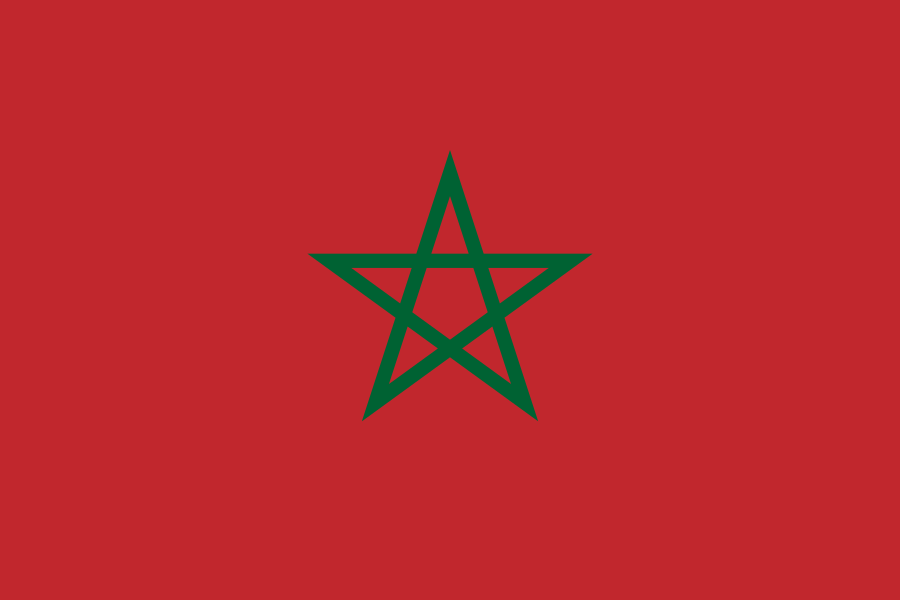
The flag is a simple, striking red field with a green five-pointed pentagram (the Seal of Solomon) at its center, adopted in 1915 — red for the Alaouite dynasty and the sharifian (descended-from-the-Prophet) lineage of the royal family, green for Islam and hope. Arabic and Tamazight (Berber) are both official languages, a constitutional recognition, formalized only in 2011, of Morocco's deep indigenous Amazigh identity that predates the 7th-century Arab conquest by millennia.
Morocco's monarchy is genuinely central to national identity: King Mohammed VI, who has reigned since 1999, holds the religious title Amir al-Mu'minin ("Commander of the Faithful"), and the Alaouite dynasty's claim to descent from the Prophet Muhammad underpins the king's religious as well as political authority — a fusion of crown and faith with few parallels elsewhere in the Muslim world.
🗺️ Geography & Regions
Morocco covers roughly 446,550 square kilometers (excluding the disputed territory of Western Sahara, which Morocco administers and considers its Southern Provinces), bordered by Algeria to the east, the disputed Western Sahara/Mauritania to the south, and both the Atlantic Ocean and Mediterranean Sea to the west and north. The geography is dramatic and varied: a fertile Atlantic coastal plain, the Rif Mountains in the north, the High, Middle, and Anti-Atlas ranges running diagonally across the country (Jebel Toubkal, at 4,167m, is North Africa's highest peak), and the pre-Saharan and Saharan zones stretching toward Algeria and Mauritania.
Four historic imperial cities anchor Moroccan geography and identity: Fes, the spiritual and intellectual capital; Marrakech, gateway to the south; Meknes, the least-visited and most underrated; and Rabat, the modern administrative capital since the French Protectorate era. Casablanca, the largest city and commercial hub, is a 20th-century creation, its Art Deco downtown reflecting the French colonial period (1912–1956) more than any older Moroccan tradition.
🗺️ Map
📜 History
Morocco's history stretches back to Amazigh (Berber) kingdoms predating Rome, followed by Phoenician and Roman coastal settlements (Volubilis, near Meknes, remains one of the best-preserved Roman sites in North Africa). The Arab conquest arrived in the late 7th century, and Idris II founded Fes in 808 CE as the first great Moroccan Islamic capital — the city's Al Quaraouiyine University, founded in 859 CE, is recognized by UNESCO and Guinness World Records as the oldest continuously operating university on Earth.
Successive Amazigh dynasties — Almoravids, Almohads, Marinids, Saadians — built an empire that at its height controlled most of Iberia (Al-Andalus) and stretched deep into West Africa, leaving behind the great mosques, madrasas, and city walls that still define Marrakech, Fes, and Meknes. Unlike its neighbors, Morocco was never absorbed into the Ottoman Empire, preserving a distinct political and cultural trajectory that culminated in the current Alaouite dynasty, which has ruled continuously since 1666.
France and Spain imposed a joint protectorate in 1912, ending in full independence in 1956 under King Mohammed V. His grandson, the current King Mohammed VI, has reigned since 1999, overseeing gradual political liberalization (a new constitution in 2011, following regional Arab Spring pressure), rapid infrastructure development, and Morocco's reintegration into the African Union in 2017 after a 33-year absence. The kingdom faces its next general election on September 23, 2026, with sitting Prime Minister Aziz Akhannouch having announced he will not seek another term amid youth-led protests over healthcare and education — a genuinely live political moment as of this writing.
👥 People & Culture
Morocco's roughly 38 million people are predominantly Arab-Amazigh, with Amazigh (Berber) heritage — Morocco's indigenous population before the Arab conquest — running through the majority of the population to varying degrees, especially in the Atlas Mountains and the south, where Tamazight remains a first language in daily life. Sunni Islam of the Maliki school is the state religion and overwhelming majority faith, though Morocco maintains one of the Arab world's oldest and most storied Jewish communities, with roots predating the Arab conquest and reinforced by waves of Sephardic arrivals after 1492.
Hospitality is a genuine cultural cornerstone, formalized in ritual: mint tea, poured from a height to aerate it, is offered to virtually every guest and refusing it outright can read as impolite. Family structure remains strong and multigenerational, and the medina — the old walled city, with its souks organized by trade guild — remains the living, working heart of Moroccan urban life rather than a preserved-for-tourists museum piece.
🗣️ Useful Phrases
Moroccan Arabic (Darija):
- Salam / Salam alaikum — Hello
- Shukran — Thank you
- Iyeh / La — Yes / No
- Bslama — Goodbye
Good to know:
- French is widely spoken as a second language, a legacy of the Protectorate era
- Tamazight (Berber) is co-official; several regional dialects exist
- English is increasingly common in Marrakech, Fes, and coastal tourist areas
🏛️ Marrakech — The Red City
Founded in 1070 by the Almoravid dynasty, Marrakech takes its nickname from the pinkish-red clay walls and buildings that ring its medina, a color regulated by law to this day. At its heart lies Jemaa el-Fnaa, a UNESCO-recognized "Masterpiece of the Oral and Intangible Heritage of Humanity" — a plaza that functions as market, food court, and open-air theater simultaneously, its character shifting completely between the quiet orange-juice-stall mornings and the drum-and-smoke-filled evenings.
Beyond the square, Marrakech's medina holds the 12th-century Koutoubia Mosque (whose minaret, capped by the same style of gilded orbs found across Almohad North Africa, defines the skyline), the intricately tiled Ben Youssef Madrasa, the Bahia and Badi Palaces, and the Jardin Majorelle, a cobalt-blue garden restored and long owned by designer Yves Saint Laurent, now one of the city's most-visited sites in its own right. Outside the walls, Marrakech has grown into Morocco's tourism and second-home capital, its riads (traditional courtyard houses) converted by the thousands into guesthouses.
🔵 Chefchaouen — The Blue Pearl
Founded in 1471 in the Rif Mountains as a fortress against Portuguese incursions, Chefchaouen became known worldwide for one striking detail: nearly every wall, door, and stairwell in its old medina is washed in shades of blue, a tradition often attributed to Jewish refugees who settled here in the 1930s, for whom blue carried religious significance tied to the sky and the divine. The exact origin is genuinely disputed — other theories point to mosquito-repelling folklore — but the effect, refreshed by residents each spring, is unmistakable and instantly recognizable.
Beyond the photogenic alleys, Chefchaouen is a genuinely relaxed town by Moroccan standards — far less aggressive commercially than Marrakech or Fes — with easy access to hiking in Talassemtane National Park and a laid-back café culture centered on Plaza Uta el-Hammam and its kasbah. Two hours inland from Tangier, it rewards travelers willing to go a little further north than the standard imperial-cities circuit.

A Chefchaouen Courtyard
Blue-washed arches, a marble courtyard, and an orange tree — the quieter side of Morocco's Blue Pearl, away from the postcard alleys. Photo: Wikimedia Commons
🏛️ Fes — The Spiritual Capital
Fes el-Bali, the old walled medina of Fes, is one of the largest car-free urban areas in the world — a UNESCO World Heritage Site of some 9,000 winding lanes, still navigated the way it has been for over a thousand years, by foot and by donkey. Founded in 789 CE and built up as the Idrisid dynasty's capital in the following decades, Fes became the intellectual and religious heart of Morocco, home to Al Quaraouiyine, the world's oldest continuously operating university, and dozens of Quranic schools (madrasas) whose carved cedar and zellige-tile interiors rank among the finest Islamic architecture anywhere.
The medina's other defining industry is leather: the Chouara Tannery, in continuous operation since roughly the 11th century, is where Moroccan hides are still softened in vats of lime, pigeon droppings, and water before being hand-dyed in vivid natural colors — a process so central to the city's economy that the French word maroquinerie ("leather goods") and the term "morocco leather" both derive directly from this city's name. Visitors typically view the tannery from surrounding rooftop terraces, mint sprig in hand against the smell.

The Chouara Tannery
Nearly a thousand years of continuous leatherwork, viewed from the rooftop terraces that surround it. Photo: Wikimedia Commons
🏜️ The Sahara — Erg Chebbi & Merzouga
Morocco's slice of the Sahara begins in earnest near the village of Merzouga, gateway to Erg Chebbi, a sea of orange dunes rising as high as 150 meters, among the most accessible genuine Saharan dune fields anywhere on the continent. The standard experience — a camel trek out to a desert camp, dinner and Berber music around a fire, sunrise over the dunes — has become a well-trodden circuit, but the physical spectacle of the erg at dawn or dusk still delivers on the promise.
The journey there is as much the point as the destination: the route from Marrakech or Fes crosses the High Atlas via the Tizi n'Tichka pass, the palm-lined Draa or Dades valleys, and a string of fortified kasbahs and ksour (fortified villages) that give the pre-Saharan south its own distinct architectural character, built from rammed earth (pisé) rather than the stone of the north.
🏰 Ait Benhaddou & the High Atlas
Ait Benhaddou, a UNESCO-listed ksar (fortified village) of red-clay towers rising from the pre-Saharan hillside, is Morocco's most recognizable piece of vernacular architecture — and, thanks to its dramatic silhouette, one of the most filmed locations in the world, standing in for ancient settings in "Gladiator," "Game of Thrones," and "Lawrence of Arabia" among many others. A handful of families still live within its walls, though most residents have moved to the modern village across the river.
The High Atlas range that shelters routes like this also holds Morocco's serious trekking country: Jebel Toubkal, North Africa's highest peak at 4,167 meters, is climbable by reasonably fit hikers over two days from the village of Imlil, and the valleys around it hold Amazigh mountain villages where daily life — walnut and apple orchards, mud-brick homes, mule transport — has changed only gradually across generations.
⚓ Essaouira — Wind, Waves & Blue Boats
On the Atlantic coast, Essaouira offers a completely different register from the imperial cities: a compact, whitewashed and blue-shuttered 18th-century fortified port town, UNESCO-listed for its blend of European military architecture and North African urban planning, built for the Alaouite sultan by a French engineer. Strong, reliable Atlantic winds that once powered the port's trade now draw windsurfers and kitesurfers from around the world.
Essaouira has a genuine countercultural pedigree — Jimi Hendrix visited in 1969, and the town's laid-back, artist-friendly reputation dates from that era — alongside a working fishing harbor where the day's catch is grilled at portside stalls a few steps from the boats. It's a common, well-earned add-on to a Marrakech trip: three hours by road, and a cooler, calmer counterpoint to the medina's intensity.
Explore More About Morocco
Five deep-dive guides live on their own pages so this one doesn't turn into a wall of text — cuisine and drinking culture, Morocco's UNESCO heritage (with a practical circuit-planning guide), and two subjects most travel guides skip entirely: how the economy actually works, and why your next car might have been built here.
🌡️ Climate & Best Time to Visit
Morocco's climate varies enormously with geography: Mediterranean along the north coast, hot and dry inland during summer, cool and even snowy in the Atlas Mountains in winter, and true desert heat in the south and Sahara. Marrakech and Fes both run brutally hot in July-August (regularly 38-40°C/100-104°F); coastal Essaouira and Casablanca stay far more temperate year-round thanks to Atlantic breezes.
Best Time: Spring (March-May) and fall (September-November) are the sweet spots nationwide — warm days, cool nights, and green Atlas foothills. Winter (December-February) suits desert and coastal trips but brings cold, sometimes snowy nights in the mountains and Sahara. Ramadan's dates shift yearly on the lunar calendar; travel is entirely possible during it, but many restaurants close during daylight hours outside tourist zones.
✈️ How to Get There
Morocco is one of the more accessible long-haul destinations from the US: Royal Air Maroc and several US and European carriers operate direct or one-stop flights to Casablanca's Mohammed V International Airport (CMN), the country's main international gateway, with connections onward to Marrakech, Fes, or Rabat. Marrakech Menara Airport (RAK) also receives some direct European and, seasonally, US charter service, making it a workable direct entry point for a Marrakech-and-south itinerary.
Once in the country, Morocco's rail network (ONCF), including a high-speed line between Tangier and Casablanca, covers the main northern and coastal cities efficiently; the south and desert routes require bus, shared taxi (grand taxi), or private car/driver, which is how most multi-day Atlas-and-Sahara circuits are actually done.
📋 Practical Information
Visa: Not required for US citizens for tourist stays up to 90 days — a passport valid at least six months beyond your arrival date is the main requirement.
Money: Moroccan Dirham (MAD) is a closed currency — it cannot be obtained or exchanged outside Morocco, so plan to withdraw or exchange after arrival (airports and city-center exchange offices/ATMs are plentiful). Cards are accepted in mid-range and upscale establishments; cash is standard in medinas, souks, and rural areas.
Communications: Good mobile coverage nationwide; local SIM cards (Maroc Telecom, Orange, Inwi) are cheap and easy to buy with a passport. Time zone is Western European Time (UTC+0, UTC+1 in summer since Morocco observes DST) — usually the same as the UK, occasionally offset during Ramadan when Morocco has in past years suspended DST.
Getting Around: Trains cover the north and coast well; grand taxis (shared) and private drivers handle everything else. Renting a car works well for the Atlas/desert circuit if you're comfortable with mountain roads and assertive local driving norms.
Safety: Morocco is generally safe and welcoming for tourists, including solo female travelers, though the usual medina-market vigilance (pickpockets, persistent unofficial "guides," overpriced tourist-trap restaurants) applies. Check the current US State Department advisory level before travel, as with any destination.
🇺🇸 For American Travelers
Visa: None needed for tourist visits up to 90 days — just a passport valid six months past your arrival date and a return/onward ticket.
Getting there: Direct and one-stop flights from major US hubs to Casablanca (CMN) are well established via Royal Air Maroc and partner carriers — genuinely one of the more convenient long-haul African/Middle Eastern destinations to reach from the US.
Electrical outlets: Morocco uses European-style Type C/E sockets at 230V — bring a plug adapter; most modern electronics (phone/laptop chargers) handle the voltage automatically, but check before packing older single-voltage devices.
Driving: Morocco drives on the right, same as the US. A US license is usable for short visits; an International Driving Permit is recommended and sometimes requested by rental agencies.
US Embassy: Located in Rabat, with a US Consulate General in Casablanca handling most routine citizen services (passports, notarials) — both maintain active operations and standard consular services for Americans.
💰 Cost of Living
| Item | Cost (USD) |
|---|---|
| Budget riad/guesthouse | $25-45/night |
| Mid-range riad/hotel | $60-120/night |
| Street food meal | $3-6 |
| Sit-down tagine dinner | $10-20 |
| Mint tea | $1-2 |
| Bottle of Moroccan wine | $12-20 |
| Grand taxi (shared, short trip) | $1-3 |
| Private driver, full day | $60-100 |
| Hammam & massage | $15-40 |
Morocco is excellent value by Western European standards — budget travelers can manage comfortably on $35-50/day, mid-range travelers on $80-130/day, with riads and private drivers offering a disproportionate luxury-to-cost ratio compared to Europe just across the strait.
🏨 Accommodation
The riad — a traditional courtyard house turned guesthouse, often just steps inside a medina gate but hidden behind an unmarked door — is Morocco's signature accommodation style, and Marrakech and Fes both have thousands to choose from, ranging from simple family-run guesthouses to opulent restorations with plunge pools and rooftop terraces. Outside the medinas, international chain hotels cluster in Marrakech's Gueliz district, Casablanca, and Agadir's beach resort strip.
Booking Tips: Book riads in advance for anywhere inside a medina — GPS often fails in the narrow lanes, and most riads arrange pickup or send a guide to meet you at a known landmark. Desert camps near Merzouga range from basic shared-tent setups to genuinely luxurious "glamping" operations; both need advance booking during peak season (October-April).
🎭 Festivals & Events
Eid al-Fitr and Eid al-Adha are the major religious holidays, dates shifting yearly with the lunar calendar; expect closures and a different rhythm to daily life. Throne Day (July 30) commemorates King Mohammed VI's accession. The Fes Festival of World Sacred Music (June) draws international performers to the old city for a program built around spiritual and devotional music from many traditions.
Cultural: The Marrakech International Film Festival (December) has become a genuine draw for international cinema. The Rose Festival in Kelaat M'Gouna (May) celebrates the Dades Valley's rose-water harvest, and countless local moussems (saint's-day festivals) happen year-round across rural Morocco, blending religious pilgrimage with market fair and celebration.
🎒 Packing Tips
Essential: Modest clothing for medinas and religious sites (shoulders and knees covered travels better than shorts and tank tops, for any gender), comfortable closed-toe shoes for uneven cobblestones, a scarf or shawl (useful for sun, dust, and quick modesty coverage), and a portable phone charger — medina wandering burns battery fast on GPS.
Seasonal: Layers year-round — desert and mountain nights get cold even when days are hot. Sunscreen and a hat are essential in the south and Sahara. If visiting during winter, pack for genuinely cold nights in the Atlas and desert, where heating is often minimal.
🌐 Useful Resources
Official tourism: visitmorocco.com (Moroccan National Tourist Office). Embassy: US Embassy Rabat (ma.usembassy.gov), US Consulate General Casablanca for routine services. Emergency: 19 (police), 15 (ambulance/fire).
Transport: oncf.ma for train schedules and booking. Maps: Google Maps and Maps.me both work well, though medina GPS accuracy is inconsistent — a paper map or a riad's pickup service solves most of that.
📚 Recommended Reading
Non-Fiction: "The Voices of Marrakesh" by Elias Canetti, a Nobel laureate's spare, vivid travel memoir. "Hideous Kinky" by Esther Freud (also a film), a fictionalized memoir of a 1970s Marrakech childhood. Paul Bowles's Tangier-set fiction and translations of Moroccan storytellers remain the classic English-language gateway into Moroccan literary culture.
Fiction: "The Sand Child" and "This Blinding Absence of Light" by Tahar Ben Jelloun, Morocco's best-known internationally acclaimed novelist. Food: Paula Wolfert's "Couscous and Other Good Food from Morocco" remains, decades on, the standard English-language reference for Moroccan home cooking.
🎬 Videos About Morocco
A starting point for exploring Morocco on screen before you go.
Inside the Red City and its legendary main square
The world's oldest university and the Chouara Tannery
Camel trekking and desert camps at Erg Chebbi
Wandering the Rif Mountains' famous blue medina
How the Atlas Lions became the first African team to reach a World Cup semifinal
The UNESCO ksar that's stood in for ancient worlds on screen
🔬 Fascinating Facts
🎓 The Oldest University on Earth — Founded by a Woman
Al Quaraouiyine University in Fes, founded in 859 CE, holds the Guinness World Record and UNESCO recognition as the oldest continuously operating institution of higher learning in the world — older than Oxford, Bologna, or Al-Azhar. Even more remarkable: it was founded by a woman, Fatima al-Fihri, a wealthy Tunisian-born merchant's daughter, who funded it as a mosque and school using her inheritance.
The institution educated some of the medieval world's leading scholars across mathematics, astronomy, and theology, and remains an active university and mosque today — a rare case of an institution founded in the 9th century still fulfilling its original dual purpose over 1,150 years later.
🌍 Closer to Europe Than Any Other African Nation
Only 14 kilometers of the Strait of Gibraltar separate Morocco from Spain — on a clear day, you can see across.
👑 One of the World's Oldest Ruling Dynasties
The Alaouite dynasty has ruled Morocco continuously since 1666, over 350 years, one of the longest-reigning royal houses anywhere.
⚽ First African Team in a World Cup Semifinal
Morocco's 2022 World Cup run made it the first African and first Arab nation ever to reach the tournament's semifinals.
🌳 A Tree Found Almost Nowhere Else
Argan trees grow wild almost exclusively in southwestern Morocco; the oil pressed from their nuts is a genuine botanical exclusive.
🎨 The Only Country Never Ottoman-Ruled in North Africa
Unlike Algeria, Tunisia, and Libya, Morocco was never incorporated into the Ottoman Empire, giving it a distinct political and architectural trajectory.
🐐 Goats That Climb Trees
In the argan-growing region of southwestern Morocco, goats really do climb argan trees to eat the fruit — a genuinely real, widely photographed phenomenon, not a tourist myth.
⭐ Notable People
King Mohammed VI (b. 1963) — Reigning since 1999, head of state and "Commander of the Faithful," the constitutional and religious center of Moroccan public life. Tahar Ben Jelloun (b. 1944) — Morocco's best-known internationally acclaimed novelist, winner of the Prix Goncourt in 1987. Fatima al-Fihri (c. 800–880) — Founder of the world's oldest continuously operating university in 9th-century Fes.
Achraf Hakimi (b. 1998) — One of the world's top right-backs, a talisman of Morocco's historic 2022 World Cup run. Yves Saint Laurent (1936–2008) — The French designer adopted Marrakech as a second home for decades; his Jardin Majorelle remains one of the city's most visited sites. Hicham El Guerrouj (b. 1974) — Widely regarded as the greatest middle-distance runner in history, holder of world records in the 1500m and mile for over two decades.
⚽ Sports
Football is by far Morocco's most important sport, and the national team's run to the semifinals of the 2022 World Cup — becoming the first African and first Arab nation ever to reach that stage, beating Spain and Portugal along the way — remains one of the proudest moments in Moroccan sporting history, celebrated as a genuinely unifying national event. Morocco is set to co-host the 2030 FIFA World Cup alongside Spain and Portugal, a major milestone for African football infrastructure and investment.
Distance running is Morocco's other great sporting tradition: Hicham El Guerrouj's world records and Olympic golds in the 1500m and mile place him among the greatest middle-distance runners ever, part of a broader Moroccan and North African dominance in distance events. Surfing and kitesurfing have grown rapidly along the Atlantic coast around Taghazout and Essaouira, drawing an increasingly international competitive and recreational scene.
📰 Media & Press Freedom
Morocco's media landscape is diverse by regional standards, with numerous private newspapers, television stations, and a lively online press operating in Arabic, French, and increasingly English. Press freedom, however, remains genuinely constrained: international watchdogs have repeatedly flagged Morocco for prosecuting journalists — often on charges unrelated on paper to their reporting — and certain subjects, above all the monarchy, the Western Sahara dispute, and Islam, remain effectively off-limits to open criticism.
The result is a press environment considerably freer than outright authoritarian states in the region, but well short of the openness found in Europe just across the strait — a genuine, ongoing tension between Morocco's modernizing self-image and the legal and cultural limits still placed on domestic journalism.
📸 Photo Gallery
Share your Morocco photos! Send to photos@kaufmann.wtf to be featured.


✍️ Author's Note
Morocco rewards travelers who let its contradictions sit side by side rather than trying to resolve them: a 1,150-year-old university a few streets from a Tangier auto plant exporting electric city cars to Paris, a mint tea ceremony older than the concept of hospitality tourism itself, offered in a riad with a rooftop wifi router bolted discreetly to the tile.
Give it more than the standard four-city sprint if you can. Sit in Jemaa el-Fnaa twice — once at 11am, once at 11pm — and you'll understand why UNESCO gave the square itself, not a building, a heritage designation. This is a country that has always absorbed influence without losing itself, and a week here tends to leave people already planning the trip back.
—Radim Kaufmann, 2026
Support This Project 🌍
This World Travel Factbook is a labor of love – free to use for all travelers. If you find it helpful, consider supporting its continued development.
