

🇲🇸 Montserrat at a Glance
🌍 Overview — Two Thirds of a Country, Closed
Montserrat is a British Overseas Territory in the Leeward Islands, 102 km² — about a sixth of Prague — with roughly 4,400 people. It is the only country on earth whose capital city was buried by a volcano and simply left there.
Plymouth was overwhelmed by pyroclastic flows in 1997 and remains under metres of ash and rock, inside a closed Exclusion Zone that still covers about two thirds of the island. It is legally the capital. Nobody lives in it. Government sits in the village of Brades in the north, and a replacement town is slowly being built at Little Bay.
Where it is
In the Leeward Islands of the eastern Caribbean, 43 km south-west of Antigua and about the same north-west of Guadeloupe. Antigua is the gateway: a fifteen-minute flight or a ninety-minute ferry. Montserrat is small enough that on a clear day you can see both neighbours from a ridge.
What is left
The habitable north — the Centre Hills and the villages around them, roughly a third of the island. Everything from the middle south, including Plymouth, the old airport and most of the former farmland, is inside the Exclusion Zone. The country did not shrink on the map; it shrank in practice.
Who lives there
About 4,400 people, down from roughly 11,000 before the eruption. Most of those who left went to the United Kingdom — Britain granted them right of abode in 1998 and full British citizenship in 2002 — and to Antigua. The Montserratian diaspora comfortably outnumbers the resident population.
The volcano now
Soufrière Hills has been in a pause since February 2010 with no dome growth and no explosions, but it is not declared extinct. The Montserrat Volcano Observatory runs a hazard-level system that currently sits at Level 1, the lowest — which still means no public access to Zone V, including Plymouth, and daytime-only transit through the maritime zones.
How it is governed
A British Overseas Territory with internal self-government: a Governor appointed by London handles defence, external affairs, security and the public service, and an elected Legislative Assembly of nine members chooses a Premier. Reuben Meade has been Premier since the general election of 24 October 2024 — his third term.
What it is not
It is not a cruise stop, not a resort island and not cheap. There are no chain hotels, no casino, no duty-free strip and, at the time of writing, not a single traffic light. What it has instead is an active volcano you can look into, a buried city, a birdsong-heavy rainforest, extraordinarily good diving and about four hundred visitors a month.
🏷️ The Name, the Shamrock and the Accent
Columbus named it
On his second voyage in 1493 Columbus sailed past and named the island Santa María de Montserrate, after the abbey of Montserrat on the serrated mountain outside Barcelona, which the profile of the island reminded him of. The Catalan name means "serrated mountain". Montserrat is therefore one of very few places in the Americas still carrying, unaltered, a name Columbus gave it.
The Emerald Isle
Montserrat's nickname, and the only place outside Ireland entitled to it with a straight face. The shamrock appears on the flag's coat of arms alongside a woman with a harp — the figure of Erin — and one is stamped into the wall of Government House. The immigration stamp in your passport is shamrock-shaped, which is the single most-photographed thing on the island.
Where the Irish came from
From 1632, Irish Catholics — many of them indentured servants, some transported after Cromwell's campaigns — settled here from St Kitts, because a Protestant English colony had little use for them and Montserrat was tolerant of Catholics. By the late 1600s the island had an Irish-majority European population, which is why the place names read Kinsale, Cork Hill, St Patrick's, Galway's, Blake's, Riley's.
The honest part
Those Irish settlers were, in large numbers, also slave owners. Montserrat's Irish heritage and its African heritage are the same history seen from two ends, and the modern population is overwhelmingly of African descent carrying Irish surnames. The island now tells that story properly rather than sentimentally — see the St Patrick's Festival below.
Language
English, official and universal, spoken in a Montserratian variety of Caribbean English with a lilt that visitors regularly and wrongly describe as Irish. Linguists have argued for decades about whether any actual Hiberno-English influence survives in the local speech; the honest answer is that a little vocabulary probably does and the famous "Irish accent" mostly does not.
What people call themselves
Montserratian, and in local speech "Montserratian" is often shortened to "Serratian". The island is referred to affectionately as the Rock — a word that predates the volcano and has since acquired a second meaning nobody intended.
🗺️ A Small Island in Three Pieces
The shape
A teardrop about 16 km long and 11 km wide, entirely volcanic, built from three separate volcanic centres of different ages running north to south: the Silver Hills (oldest, about 2.5 million years), the Centre Hills, and the Soufrière Hills in the south, which is the only one still alive.
The living end
Soufrière Hills reached 1,050 m at the height of dome growth in 2010 and now stands at roughly 915 m after collapses — the summit height literally changes with the eruption. It is a lava-dome volcano: it does not throw lava fountains, it extrudes a plug of sticky rock that periodically collapses into pyroclastic flows, which is what destroyed Plymouth.
The Centre Hills
The island's green heart and its water supply: about 1,300 hectares of moist and elfin forest rising to around 740 m at Katy Hill, protected as the island's principal reserve. It holds essentially all of Montserrat's endemic wildlife and, since 1997, essentially all of its population lives around the edge of it.
The new land
One thing the eruption gave back. Pyroclastic and lahar deposits pushed the coastline out on the eastern and southern shores, adding a measurable amount of new ground — the old airport runway is now buried inland from a shore that did not exist. Montserrat is one of the few countries to have grown by volcanic accident.
Climate
Tropical maritime and reliably pleasant: 26–30 °C year-round, cooled by the trade winds, with about 1,000–2,000 mm of rain depending on altitude. The hurricane season runs June to November and peaks in September; Hurricane Hugo in September 1989 destroyed or damaged around 90% of the island's buildings six years before the volcano started.
The beaches
Nearly all black or dark grey volcanic sand, which is either a disappointment or the point, depending on temperament. Rendezvous Bay in the far north is the exception — the island's only white-sand beach, reachable by boat or by a hot 45-minute hike over the ridge from Little Bay, and usually empty.
🌋 Soufrière Hills — What Actually Happened
The volcano had been quiet for something like 350 years. On 18 July 1995 it began venting steam and ash. What followed over the next seven years destroyed the southern half of a functioning country and is the best-documented lava-dome eruption in history.
1995 — the warning
Phreatic explosions began in July; Plymouth was evacuated for the first time in August 1995, reoccupied, and evacuated again. A lava dome began growing in the crater in November. For two years the island lived in a slow-motion emergency, with people moving north, back, and north again as the hazard maps were redrawn.
25 June 1997 — the deaths
Pyroclastic flows swept down the Mosquito Ghaut into farmland that people had re-entered to tend crops and animals. Nineteen people were killed — the only deaths of the whole eruption, and all of them in an area that had been ordered evacuated. The airport was destroyed in the same event.
August 1997 — Plymouth
Flows entered Plymouth itself, burning and then burying the town. Later lahars — volcanic mudflows triggered by rain on loose ash — filled it further. The capital of a British territory was abandoned in the space of weeks and has never been recovered.
The later collapses
Major dome collapses followed in 2003 (one of the largest ever recorded, some 210 million cubic metres), 2006 and 2010. The 11 February 2010 collapse sent flows to the sea and buried more of the eastern side. Dome growth stopped after it, and has not resumed.
Where it stands in 2026
Paused, not finished. Since February 2010 there has been no new dome and no explosions, with continuing low seismicity, gas emission and rockfalls broadly consistent with the unrest observed since 2019. The MVO's hazard level is 1 — the lowest on its scale — and scientists are explicit that a pause in a lava-dome eruption is not the same as its end.
The observatory
The Montserrat Volcano Observatory at Flemmings monitors seismicity, deformation, gas and rockfall around the clock and sets the hazard level that governs where anyone may go. It has a public viewing gallery and a film, it is genuinely one of the best small science museums in the Caribbean, and visiting it is the correct first thing to do on arrival.
🏚️ Plymouth — the Buried Capital
Plymouth is the only abandoned capital city in the world, and it is still the de jure capital of Montserrat — the territory has never formally moved it. Roofs, church towers and the tops of clock faces stand above a grey plain of ash and lahar deposits that in places is more than ten metres deep.
What is still visible
The upper storeys of the old Government House, the war memorial clock tower, the roof of the courthouse, the shell of the Montserrat Springs Hotel, and the tops of buildings along what was George Street. Everything else is underneath. From the sea it reads as a grey delta with rectangles poking out of it.
Getting in
Plymouth is in Zone V and is closed to the public. Access is possible only with official permission and an approved guide, arranged in advance through the authorities, and it is granted for specific purposes rather than casual sightseeing. Do not attempt to walk in. People have, and it is both illegal and genuinely dangerous — the ash conceals voids and the ghauts channel any future flow.
Seeing it legally
Two viewpoints do the job well and are freely open. Garibaldi Hill above Isles Bay looks straight down onto Plymouth and the delta — the classic view, and the one most photographs are taken from. Jack Boy Hill on the eastern side overlooks the buried W. H. Bramble Airport and has a telescope and a small picnic area.
From the water
Boat trips along the southern coast, run from Little Bay, give the most complete view of Plymouth, the delta and the flow deposits, and stay outside the closed maritime zone. In good weather this is the single best way to understand the scale of what happened — from land you see a town; from the sea you see how much of the island moved.
The odd afterlife
Sand and aggregate from the volcanic deposits are now Montserrat's largest export, dredged and shipped to construction markets across the Caribbean. The material that destroyed the capital has become the territory's most valuable commodity, which is the kind of fact nobody would put in a novel.
Do not romanticise it
It is easy to write about Plymouth as a photogenic ruin. It was a working town of several thousand people — shops, a hospital, a cricket ground, a botanic garden, houses that families had built — and everyone who lost it is still alive. Montserratians will talk about it readily and with humour; let them raise it first.
📜 Before and After the Volcano
Before Europe
Settled by Saladoid and later Kalinago peoples, who knew the island as Alliouagana — usually glossed as "land of the prickly bush". Archaeological sites at Trants in the east, now inside the Exclusion Zone, produced some of the richest early ceramic-age material in the Lesser Antilles.
1632 — the Irish colony
English and Irish settlers arrived from St Kitts, and Montserrat became a refuge for Catholics in an aggressively Protestant colonial world. Tobacco gave way to sugar, and sugar meant enslaved Africans: by the eighteenth century the enslaved population vastly outnumbered the free, and the island's wealth was built on them.
17 March 1768
Enslaved Montserratians planned a rising for St Patrick's Day, when the planters would be drinking at Government House. The plot was betrayed; nine men were executed and others transported. Montserrat now marks the date as part of its national festival — the same day is both an Irish heritage celebration and a commemoration of a slave rebellion, which is unusual and deliberate.
Emancipation and after
Slavery was abolished in the British colonies in 1834. Montserrat's sugar economy declined, was partly replaced by limes — the Montserrat Company's lime juice was once a British household name — and then by cotton and, in the twentieth century, by remittances, retirees and a quiet villa-and-music economy.
1989 — Hugo
Hurricane Hugo struck on 17 September 1989 and damaged or destroyed around 90% of the island's structures, including AIR Studios, which never reopened. Montserrat had almost finished rebuilding when the volcano woke up six years later. The two disasters together are why the pre-1995 island effectively no longer exists.
1995–2010 and since
The eruption, the evacuation, the exodus and the slow construction of a new north. The last dome collapse was in 2010; the last significant ash venting in 2012. Since then Montserrat has been in a long, underfunded, stubborn reconstruction — a new airport in 2005, a new hospital, a new government complex, and a new town at Little Bay that is still being built.
🏛️ Politics — Nine Seats and a Governor
The constitution
The 2010 constitution gives Montserrat internal self-government. A Governor appointed by the British monarch on the advice of the UK government retains responsibility for defence, external affairs, internal security, the police and the public service. Everything else is run locally.
The Assembly
A Legislative Assembly of nine elected members, chosen at large from a single island-wide constituency, plus two ex-officio members. The leader of the majority becomes Premier. With an electorate in the low thousands, a seat can turn on a few dozen votes and every voter knows every candidate personally.
Who is in office
Reuben Meade, Premier since the general election of 24 October 2024, which his United Alliance won. It is his third spell as head of government — he also led Montserrat through parts of the eruption years — making him the dominant figure of the island's post-volcano politics.
What politics is about here
Not ideology. The arguments are about the port, the airport, housing, the hospital, land in the north and the terms of British budget support. Party labels shift and coalitions form around individuals. It is small-island politics in its purest form: intensely personal, closely watched and impossible to conduct anonymously.
The relationship with London
Cordial and structurally unequal. Britain provides a very large share of the recurrent budget and effectively all capital spending, and in exchange the UK's Foreign, Commonwealth and Development Office has significant influence over how the money is used. Montserratians are British citizens and can live and work in the UK; independence is not a live political question.
The unusual bit
Montserrat is a British territory that also belongs to the Caribbean Community (CARICOM) and the Organisation of Eastern Caribbean States (OECS) in its own right, and uses the OECS's shared currency and central bank. It is simultaneously a piece of the United Kingdom and a full member of a Caribbean regional bloc — a status only a handful of places hold.
💼 An Economy Rebuilt from Nothing
The scale of it
Montserrat's entire economy is smaller than a mid-sized Czech town's. Before 1995 it had tourism, light manufacturing, a rice mill, villa construction and a recording studio; the volcano removed the capital, the port, the airport and most of the arable land in one go. What exists now was largely rebuilt after 1997.
British budget support
The central fact. The United Kingdom funds a very large proportion of public spending, both recurrent and capital, and has done since the eruption. That dependence is the object of continuous local frustration — about how much, how slowly and with what conditions — and it is also the reason the island has a hospital, a school and an airport at all.
Sand and aggregate
The largest goods export, dredged from the volcanic deposits on the eastern coast and shipped across the region. It is a genuine industry with genuine revenue, and it is also the reason a visitor sees loaded barges off a coast with almost no other shipping.
Tourism, such as it is
Small, high-value and deliberately unmassed: on the order of a few thousand visitors a year, many of them day-trippers from Antigua, divers, birders, volcano enthusiasts and returning Montserratians. There is no cruise berth and no all-inclusive. The government's stated strategy is to keep it that way and sell scarcity.
The diaspora economy
Remittances from the UK and the wider Caribbean matter more here than in most places, because the diaspora is larger than the resident population. So does the steady trickle of returnees — people who left in 1997, worked a British career and came back to build a house on family land.
What is being built
The Little Bay Port Development Project — a new 130 m jetty, breakwater, dredging and access road, funded with about £28.3 million from the UK Caribbean Infrastructure Fund — plus the new town around it. It is described locally, without much exaggeration, as the only entirely new capital being built anywhere in the Caribbean. It has run into repeated delays and cost pressure.
🇬🇧 Britain, Citizenship and the 1997 Argument
The evacuation row
In 1997 the British government's handling of the crisis became a serious political controversy. Montserratians felt abandoned; a Secretary of State was reported as complaining that they would soon be asking for "golden elephants", a remark that has never been forgotten on the island. A parliamentary inquiry followed and British policy shifted substantially.
Right of abode, then citizenship
In 1998 Britain granted Montserratians the right to live and work in the UK; in 2002 the British Overseas Territories Act gave full British citizenship to the residents of the territories generally. Several thousand Montserratians moved, mostly to London, Birmingham and Manchester, and many stayed.
What that means today
Every Montserratian is a British citizen with the same rights as someone born in Leeds. That is an unusually strong safety net for a small island, and it is also the reason the population has not recovered: leaving is easy, and the UK has universities, hospitals and jobs that a territory of 4,400 people cannot supply.
The money argument
British support is generous per head and unpredictable in practice, and every capital project — port, hospital, airport, geothermal — runs on a UK approval cycle that Montserratian governments describe as slow. London's counter-argument is about value for money in a jurisdiction with a very small tax base. Both positions are reasonable and the argument recurs every few years.
Geothermal
One of the more hopeful files. Montserrat has drilled geothermal wells with UK funding and has proven a resource capable of covering the island's modest electricity demand, which currently runs on imported diesel. Bringing it fully online has been repeatedly delayed, but it would make one of the Caribbean's smallest economies one of its cleanest.
Not seeking independence
Unlike some Caribbean territories, Montserrat has no meaningful independence movement. The reasons are practical rather than sentimental: a population of 4,400, a live volcano, and a hurricane belt. British citizenship and British money are, on the island's own assessment, worth more than a flag it already flies.
👥 Four Thousand Who Stayed
The numbers
Roughly 11,000 before 1995; roughly 4,400 now. That is not a statistic in the ordinary sense — it is a specific set of families who left, mostly in 1996–98, and mostly did not return. Nearly every household on the island has close relatives in Britain.
Who lives there now
Predominantly Montserratians of African descent, plus a returning-diaspora cohort, a small number of long-term expatriates, and a rotating population of scientists, contractors and UK-funded professionals. The island also hosts medical students, which is a meaningful part of the local economy.
The demographic problem
A population this small struggles to staff a hospital, a school and a public service; specialists are recruited from the region and the UK on contract. Young Montserratians leave for university and often stay away. The island's central long-term question is not the volcano — it is whether enough people come back.
Where everyone lives
In the north: Brades (the seat of government), Salem, St John's, Cudjoe Head, Look Out — a village built after the eruption for displaced families — and the growing settlement at Little Bay. None of them is a town in any ordinary sense; the whole inhabited area can be driven end to end in twenty minutes.
Community
Everyone knows everyone, which cuts both ways. Crime is very low, doors are often unlocked, and a visitor asking directions will frequently be driven to the destination. It is also a place with no anonymity at all, which residents describe with a mixture of affection and exasperation.
The returnees
A slow, steady stream: people in their fifties and sixties who left as young adults, worked in Britain, and have come back to build on family land. They are the main source of new construction outside the government programme, and they are the reason Montserrat's population has stabilised rather than continued to fall.
🚫 The Exclusion Zone — the Rules, Honestly
Montserrat is divided into hazard zones by the Montserrat Volcano Observatory, and the boundaries move with the volcano's behaviour. This is not a formality: the zones are enforced, and the current Hazard Level 1 — the lowest on the scale — still closes a large part of the island.
What is closed
Zone V, including Plymouth, is closed to the public entirely. Entry requires official permission and an approved guide. The maritime zones east and west are daytime transit only, between sunrise and sunset, which is why boat tours run in daylight and do not linger.
What is open
The whole north, the Centre Hills, the villages, Little Bay, Rendezvous Bay, and the viewpoints at Garibaldi Hill and Jack Boy Hill, from which the destroyed area is clearly visible. Under current conditions there is a great deal of the island you can move around freely — just not the famous part.
Why the rules exist
Lava-dome volcanoes do not give long warnings. A dome collapse can generate a pyroclastic flow that reaches the sea in minutes, and the ghauts — the steep ravines running off the volcano — act as chutes. The 19 people who died in 1997 were inside an area that had already been ordered evacuated. That is the whole argument, and it is sufficient.
Check before you go
The hazard level and the zone boundaries change. Check the MVO's current hazard level before planning anything near the south, and take the advice of your guide and of the police without negotiating. Local operators know exactly what is permitted this week; a guidebook printed last year does not.
The drone question
Assume you need permission. Flying a drone over the Exclusion Zone or Plymouth without authorisation is both an offence and a good way to lose the drone — and footage taken illegally is worth nothing, because half the island's photographers can get you the same shot legally.
Do not be that visitor
There is a small but persistent trade in people sneaking into Plymouth for social-media footage. It is illegal, it puts search-and-rescue volunteers at risk if it goes wrong, and Montserratians find it genuinely offensive — this is a town where their families lived. The legal viewpoints give you a better picture anyway.
🏘️ The North — Where the Island Lives Now
Brades
The seat of government since 1998, and a village rather than a city: a strip of offices, the assembly building, a bank, a supermarket and the police headquarters strung along the main road. It is the administrative capital in fact but not in law, which is a distinction Montserratians make with a certain dry pleasure.
Little Bay
The future. A new port is under construction with UK funding, and around it the government is laying out what is intended to become the replacement capital — waterfront, marina, commercial plots, housing. Today it is a beach, a few bars, the ferry berth and a lot of surveyed ground. It is the most interesting building site in the Caribbean.
Salem and Olveston
In the former Zone C, reoccupied as the hazard receded: substantial houses, a few of the island's best-known restaurants and the greenest part of the inhabited island. Some of these areas were evacuated and returned to more than once, which is why you will see abandoned houses next to lived-in ones.
Look Out
A village built from scratch after the eruption to house displaced families in the far north-east. It is worth seeing precisely because it is unremarkable: ordinary bungalows on a grid, an entire community relocated wholesale, and now simply a place where people live.
The Montserrat National Trust
In Salem, with a botanic garden, a small museum and the best bookshop and information point on the island. It runs the oriole conservation work and the Centre Hills trails. If you want to understand what survived rather than what was lost, start here.
Getting around the north
One main road running the length of the inhabited area, steep and winding, with spectacular views and no traffic. Distances are trivial — nothing is more than twenty minutes from anything else — but the gradients are severe and walking in the midday heat is harder than the map suggests.
☘️ St Patrick's — Ten Days, Two Histories
Montserrat is the only place outside Ireland where St Patrick's Day is a public holiday, and the celebration around it runs for about ten days in March. It is not an imported novelty: it is the island's national festival, and it commemorates two things at once.
The two meanings
It marks the island's Irish settler heritage and, at the same time, the slave uprising planned for St Patrick's Day 1768 and betrayed before it began. The festival names and honours the men executed for it. Holding both meanings in the same week is deliberate, and it has been the subject of long and serious debate on the island.
What happens
Freedom Run, a slave-feast re-enactment at Salem, church services, calypso and soca competitions, a masquerade parade, kite-flying, a beach party at Little Bay, and a great deal of food. The masquerade dancers — tall hats with mirrors and ribbons, whips, high-stepping to fife and drum — are the visual signature of the whole event.
Going green
Half the island dresses in green and the other half points out that green was never a Montserratian colour until relatively recently. The diaspora returns in numbers, flights and rooms sell out, and the population roughly doubles for the week. If you want to see Montserrat at full volume, this is the only time it happens.
The shamrock stamp
Immigration stamps arriving passports with a green shamrock. It is a small thing and it is the single most requested souvenir on the island — people fly in specifically to get it. Ask nicely and it is stamped on a clean page.
How Irish is it really?
Genealogically, meaningfully: Montserratian surnames — Farrell, Ryan, Sweeney, Daly, O'Garro, Riley — come from the settler period, and the place names are unambiguous. Culturally, less than the marketing suggests: the music is Caribbean, the food is Caribbean, the language is Caribbean. The Irish layer is real, old and thin, and Montserrat is honest about that.
Practicalities
Book flights, ferries and accommodation for the March festival months ahead — the island's total bed stock is a few hundred rooms and the diaspora fills them. Prices rise, the ferry runs full, and the Antigua connection becomes the bottleneck.
🎸 AIR Studios — the Records Made Here
In 1979 the Beatles' producer George Martin opened AIR Studios Montserrat in the hills above Salem: a residential studio on a tropical island, far from record-company interference, where a band could live and work for weeks. For ten years it was one of the most productive rooms in popular music.
What was recorded
Dire Straits — Brothers in Arms, one of the best-selling albums ever made. The Police — Ghost in the Machine and Synchronicity. Work by Paul McCartney, Elton John, Stevie Wonder, Jimmy Buffett, Duran Duran, Black Sabbath and The Rolling Stones. A remarkable amount of 1980s radio came out of a hillside on a 102 km² island.
Why it worked
Isolation, a genuinely excellent room, and the fact that everyone had to stay put. The studio's own mythology holds that Every Breath You Take and much of Synchronicity were shaped by the Police being trapped together here, which is either a fine story or an accurate account of a band falling apart productively.
What ended it
Hurricane Hugo, September 1989. The studio was wrecked and never reopened; the volcano six years later removed any prospect of rebuilding the tourism that might have supported it. The ruins are on private land above Salem and are not open to visitors — please do not go looking.
The afterlife
George Martin stayed attached to the island. He organised the 1997 Music for Montserrat concert at the Royal Albert Hall — McCartney, Clapton, Elton John, Sting, Mark Knopfler, Phil Collins — to raise money after the eruption, and later funded the Montserrat Cultural Centre at Little Bay, which is the island's main performance venue and carries handprints of the musicians who played.
The local music
Montserrat's own musical export is Arrow — Alphonsus Cassell — whose Hot Hot Hot (1982) is one of the best-selling soca records ever made and is played at sporting events worldwide by people with no idea where it came from. He died in 2010 and is a genuine national figure.
Where to hear music now
The Montserrat Cultural Centre, the St Patrick's Festival, the calypso competitions around Christmas, and any bar in Salem or Little Bay on a Friday. Montserrat has a live music culture wildly out of proportion to its population, which is what happens when a place spends a decade full of visiting musicians.
🦜 The Oriole, the Frog and the Centre Hills
The Montserrat oriole
Icterus oberi, the national bird, black and brilliant yellow, and found nowhere else on earth. The eruption destroyed most of its forest habitat and the population crashed; it survives in the Centre Hills and is classed as threatened, supported by monitoring and a captive-breeding programme run with British zoos. Seeing one is a realistic goal on a guided morning walk.
The mountain chicken
Not a bird — Leptodactylus fallax, one of the world's largest frogs, historically eaten as a delicacy, which is where the name comes from. It is now critically endangered: chytrid fungus, compounded by the eruption, reduced the wild population catastrophically. Eating it is banned. Reintroduction work continues and remains precarious.
The Centre Hills
The core reserve: moist forest, elfin woodland on the ridges, tree ferns, epiphytes and a very high density of birds for its size. Around 1,300 hectares, with maintained trails run through the National Trust, and the source of the island's water. It is one of the least-visited good rainforests in the Caribbean.
What else lives there
The galliwasp, a secretive lizard; the agouti; several endemic-to-the-Lesser-Antilles birds including the bridled quail-dove, forest thrush, purple-throated carib and Antillean crested hummingbird; and the harmless Montserrat racer snake. There is nothing dangerous in the forest apart from the terrain.
Under the water
The volcanic coast gives dramatic diving — walls, pinnacles, black-sand slopes, and reefs that have been effectively unfished and unvisited for thirty years. Ash fall did damage some sites and they have recovered strikingly. There are one or two operators; expect small boats, no queues and no other divers on the site.
Turtles
Hawksbill, green and leatherback turtles nest on Montserrat's dark beaches, monitored by the National Trust with volunteer patrols in season. Nesting runs roughly from May to November. If you are on a beach at night in that period, use no white light and keep well back.
🏝️ Daily Life on a Very Small Island
The pace
Slow, and not performatively so — there are simply not enough people for anything to be busy. Shops close in the afternoon, the ferry dictates the rhythm of the week, and "just now" can mean anything from ten minutes to tomorrow. Visitors who fight this have a bad time; visitors who accept it have a very good one.
Church and cricket
Both matter. Montserrat is strongly Christian — Anglican, Methodist, Roman Catholic, Pentecostal and Seventh-day Adventist congregations are all active — and Sunday is genuinely quiet. Cricket is the sport; Montserratians play for the Leeward Islands and, through them, for the West Indies.
Safety
Very high. Violent crime is close to nonexistent and the visible police presence is minimal because it does not need to be otherwise. Ordinary precautions about valuables apply and nothing more. The real hazards on Montserrat are geological, meteorological and automotive, in that order.
Driving
On the left, on steep narrow roads with blind bends, goats and no barriers. A local driving permit is required and is issued on the spot at the police station for a small fee on production of your own licence. Hire cars are a handful of vehicles from a handful of operators; book ahead.
Utilities and connectivity
Electricity is diesel-generated and expensive; power cuts happen. Water is good and comes from the Centre Hills. Mobile coverage is decent in the inhabited north and mostly absent in the forest and the south. Broadband exists and is adequate; a growing number of remote workers have discovered this.
Manners
Greet people. On Montserrat you say good morning before you say anything else, in a shop, at the roadside, walking past a garden — and failing to do it is read as rudeness rather than shyness. Beyond that: modest dress away from the beach, ask before photographing anyone, and accept that a conversation you started for directions will last twenty minutes.
🎭 Masquerade, Calypso and the String Band
Masquerade
The island's oldest performance tradition and its most striking: dancers in tall mitred hats hung with mirrors and ribbons, wearing masks, carrying whips, high-stepping to fife, kettle drum and bass drum. It descends from enslaved Montserratians parodying European court dance, and it is danced at Christmas and at the St Patrick's Festival.
The string band
Fiddle, guitar, shak-shak, ukulele, triangle and a boom pipe — a length of pipe blown as a bass. It is the sound of the old island, kept going by a small number of players, and it is closer to a Caribbean-Irish crossover than anything else on Montserrat actually is.
Calypso and soca
Taken seriously: there are annual calypso competitions around Christmas and the St Patrick's Festival, judged sharply, with lyrics that are pointedly political. Montserrat's soca giant was Arrow, whose Hot Hot Hot is a global standard, and the island still turns out singers far out of proportion to its size.
The Cultural Centre
The Montserrat Cultural Centre at Little Bay, funded largely through George Martin's efforts, is the island's main auditorium and carries a wall of handprints from the musicians who recorded at AIR and played the 1997 benefit. It hosts everything from calypso finals to public meetings.
Christmas
Montserrat's festive season runs from mid-December into the New Year and is, in effect, the island's carnival: parades, masquerade, calypso finals, a street jump-up. Locals will tell you it is the better festival and the St Patrick's one is for the diaspora and the tourists, which is roughly true.
Craft and the museum
The Montserrat National Trust in Salem runs the museum, the botanic garden and the shop, which is where to find local craft, books about the eruption and the best available maps. There is also a small but real tradition of volcanic-ash pottery — pieces made from the material that buried Plymouth.
🍽️ Goat Water and What Else
Montserratian food is eastern Caribbean: one-pot stews, ground provisions — the family of starchy roots and fruit that includes yam, dasheen, sweet potato, cassava and green banana — salt fish, goat, chicken, and coconut in everything. It is unfussy, slow-cooked and considerably better than the island's tiny restaurant scene would lead you to expect.
Goat water
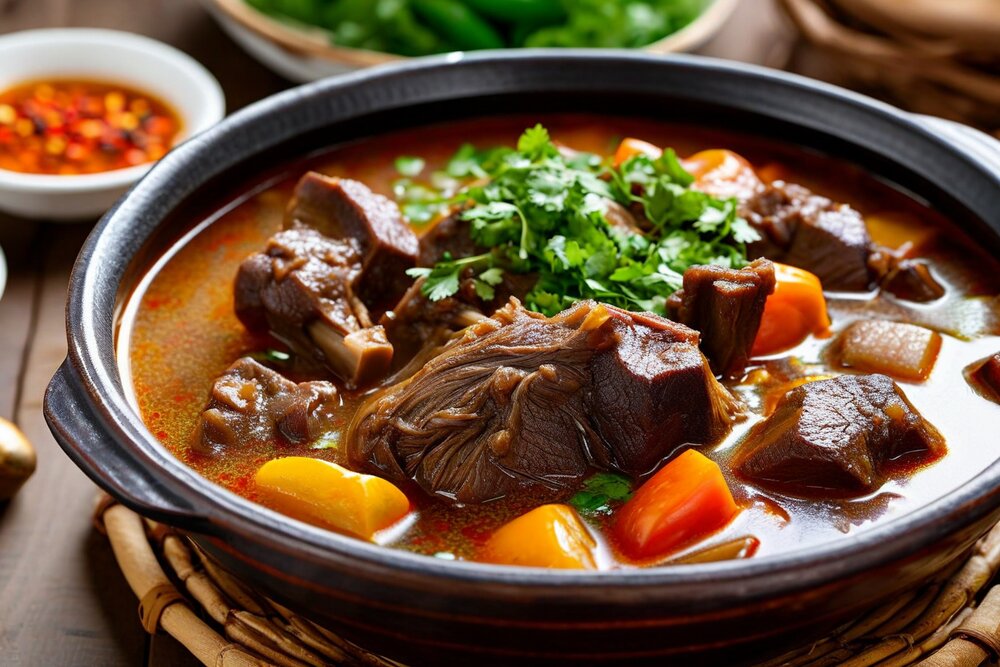
The national dish, and served at every festival, funeral and Sunday worth the name. Goat on the bone, browned and then simmered for hours with onion, thyme, scallion, cloves, chilli and often a slug of rum, thickened, with dumplings and breadfruit. Montserratians will tell you their version differs from the Antiguan and the Kittitian one, and they are right. Recipe below.
Dukuna
A steamed dumpling of grated sweet potato, coconut, flour, sugar and spice, wrapped in a banana leaf and boiled or steamed. It is served alongside salt fish for breakfast, or as a side to a stew. Slightly sweet, dense and very good. Recipe below.
Cassava bread
A flat griddle-baked bread of grated, pressed cassava — a preparation that predates Europe in the Caribbean and comes directly from the Kalinago. It is dry, dense and eaten with butter, salt fish or a stew. Its survival is one of the more genuine bits of continuity on the island.
From the sea
Snapper, mahi-mahi, wahoo, tuna and lobster in season, grilled or in a broth with lime and pepper. Beach bars at Little Bay do fish and chicken over charcoal, and this is where most visitors eat best. Bear in mind that fishing effort collapsed after the eruption, which is one reason the reefs are in such good condition.
What not to eat
The mountain chicken frog, which was a Montserratian delicacy and is now critically endangered and legally protected. It is not on any menu and should not be requested. If someone offers it, decline — the population is measured in individuals.
Where to eat
A handful of restaurants and beach bars, mostly in Salem, Olveston and Little Bay, several of which open only some days or only if you call ahead. Book, or at least telephone. This is an island where turning up unannounced at seven and expecting dinner does not reliably work.
👨🍳 Two Montserratian Recipes
Goat Water — Montserrat's National Stew
Serves 6 · 3 hours · Slow-simmered
Ingredients: 1.5 kg goat on the bone (shoulder, neck and leg, cut across the bone), 2 onions, 4 cloves garlic, a large bunch of thyme, 4 scallions, 6 whole cloves, 1 Scotch bonnet chilli left whole, 2 tbsp tomato paste, 2 tbsp vegetable oil, 1 small breadfruit or 400 g green papaya, peeled and cubed, 2 tbsp flour, a glass of dark rum, salt, black pepper. Dumplings: 200 g flour, ½ tsp salt, about 100 ml water.
Method: Brown the goat hard in the oil in batches — this is where the colour comes from — then set aside. Soften the chopped onion and garlic in the same pot, stir in the tomato paste and cook it out for two minutes. Return the meat, add the thyme, scallions, cloves and the whole, unpierced Scotch bonnet, cover with water and simmer very gently for two to two and a half hours, until the meat is leaving the bone. Meanwhile make a stiff dumpling dough, roll into small fingers and rest. Add the breadfruit or papaya and the dumplings and cook 25 minutes more. Slake the flour in cold water, stir it in and simmer until the broth thickens. Add the rum, taste, and season generously.
💡 Two rules. Do not pierce the chilli — it perfumes the pot and does not set it on fire; fish it out before serving. And do not rush the simmer: goat water is a three-hour dish, and shortcutting it gives you tough goat in thin soup. It is better on the second day, which is why it is festival food.
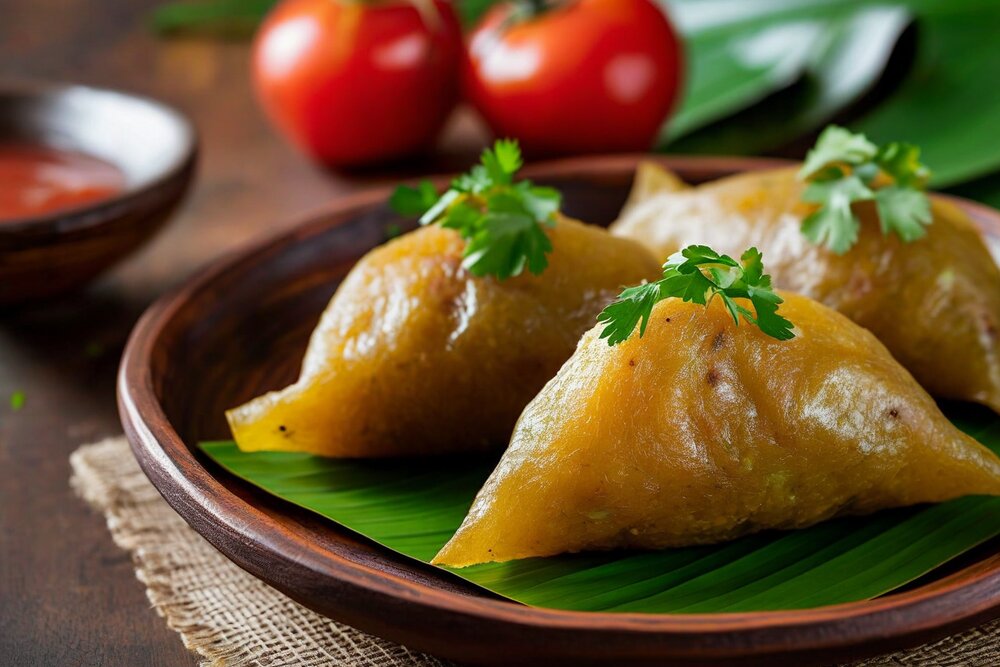
Dukuna — Steamed Sweet Potato and Coconut Dumplings
Makes about 10 · 1 hour · Steamed in banana leaf
Ingredients: 500 g white sweet potato, peeled and finely grated, 150 g fresh coconut, grated (or 100 g desiccated soaked in a little water), 150 g plain flour, 100 g brown sugar, 1 tsp mixed spice or a grating each of nutmeg and cinnamon, ½ tsp salt, about 100 ml coconut milk, banana leaves cut into 20 cm squares and softened over a flame, plus string.
Method: Grate the sweet potato finely and, unlike for most recipes, do not squeeze it dry — the moisture is wanted. Mix with the coconut, flour, sugar, spice and salt, then add coconut milk a little at a time until you have a thick, sticky, spoonable mixture, not a batter. Pass each banana-leaf square briefly over a gas flame or through boiling water until it turns glossy and pliable. Put a generous spoonful in the centre, fold the leaf into a parcel and tie it. Steam or boil the parcels for 45 minutes to an hour. Rest five minutes before opening.
💡 If you cannot get banana leaves, foil works and tastes slightly less good; parchment inside foil is the better compromise. Serve warm as a side to goat water or salt fish, or cold the next morning with butter. The texture should be dense and just short of firm — if it is cakey, there was too much flour.
🥃 Rum, Punch and a Volcano Backdrop
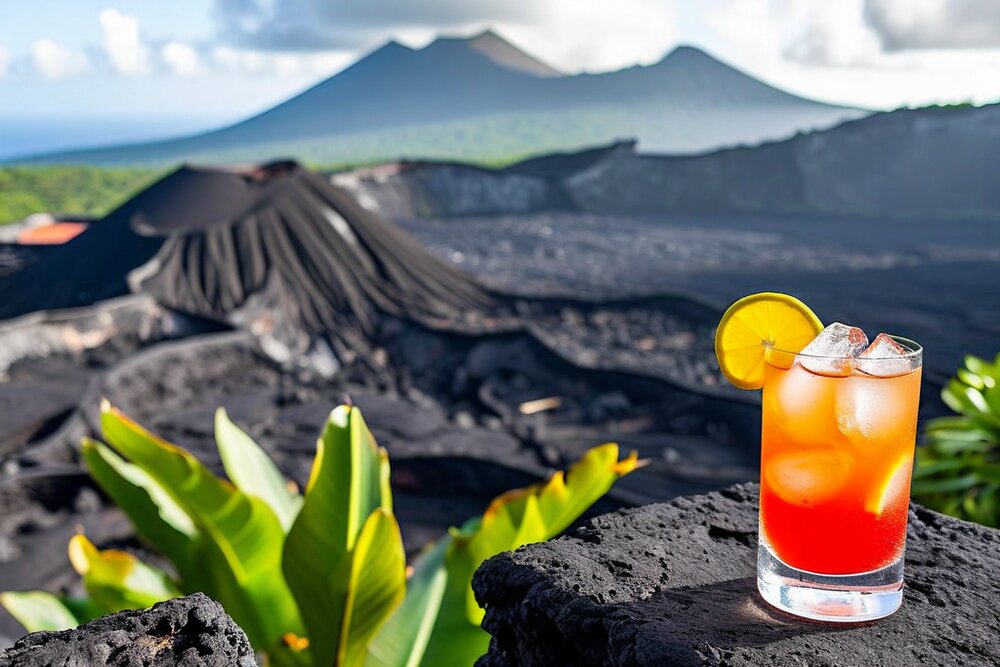
Rum punch
The Caribbean formula holds: one of sour, two of sweet, three of strong, four of weak — lime, sugar syrup, rum, juice or water — over ice with a grating of nutmeg on top. The nutmeg is not optional and it is what distinguishes an eastern Caribbean punch from anything you will be served in Europe.
The rum itself
Montserrat has no significant distillery of its own; what you drink is regional — Antiguan, Kittitian, Barbadian, Guyanese and Trinidadian rum, plus the ubiquitous overproof white that goes into punch and into the bush rums people make at home. Ask in a bar for what the barman drinks rather than what is on the shelf.
Bush rum
Overproof white rum infused at home with bark, roots, herbs and fruit — every family has a jar and an opinion, and most of them are marketed to you as medicinal. Treat it with respect: it is stronger than it tastes and the dose is a small glass, not a tumbler.
Beer and soft drinks
Regional lagers — Carib, Heineken brewed in the Caribbean, Guinness Foreign Extra, which is far stronger and sweeter than the Irish version and is drunk across the eastern Caribbean. Also mauby (bittersweet, made from tree bark), sorrel at Christmas, and fresh juices — tamarind, guava, soursop, passion fruit.
Where to drink
Beach bars at Little Bay, a handful of places in Salem, and whatever is open on the night you are there — which on a Tuesday in September may be one place. Fridays are the social night across the island. Buy a round; you will be talking to half the room within ten minutes.
Water and coffee
Tap water comes from the Centre Hills and is safe to drink, which is not true everywhere in the region and is worth knowing when you are buying supplies. Coffee is ordinary; nobody comes to Montserrat for it.
🏛️ Heritage — Mostly Underneath
No World Heritage site
Montserrat has none, and the reason is blunt: the island's most significant built heritage — the Georgian streets of Plymouth, the sugar works, the churches — is under the ash and inside the Exclusion Zone. What is left above ground is fragmentary and mostly in the north.
Plymouth as a site
Archaeologists and volcanologists have argued for years that buried Plymouth is a site of genuine scientific and heritage importance — a modern Caribbean town preserved in a pyroclastic and lahar sequence, with an exact date. Comparisons with Pompeii are made often, and are not entirely absurd, though nobody died in Plymouth and the town was evacuated in good order.
Galway's estate
A sugar plantation site in the south, with a windmill, boiling house and the surrounding landscape, excavated in the 1980s and now inside the closed zone. It was one of the best-documented plantation archaeology projects in the Caribbean, and access to it ended with the eruption.
What survives in the north
The National Trust museum and botanic garden at Salem; St Peter's church; a handful of eighteenth- and nineteenth-century estate ruins in the Centre Hills; and the pre-Columbian sites, most of which are also now in the Exclusion Zone at Trants.
Intangible heritage
This is where Montserrat's heritage actually lives: masquerade, the string band, calypso, the St Patrick's Festival, goat water and the cassava-bread tradition. None of it needed a building, which is why the eruption did not take it.
The archive problem
A great deal of the island's documentary record — land registries, church records, photographs — was in Plymouth. Reconstructing it has been a long, quiet project by the National Trust and the government, aided substantially by the diaspora sending back what they carried out in 1996 and 1997.
📅 When to Go
December to April — the season
Dry, warm, breezy and reliable: 26–29 °C, low humidity, little rain and no hurricane risk. This is when the ferry runs most dependably, when the restaurants are open and when accommodation needs booking. It is also, correspondingly, the most expensive time.
March — the festival
The St Patrick's Festival around 17 March is the single biggest week of the Montserratian year and the only time the island is genuinely full. The diaspora returns, the flights and the ferry sell out and the rooms go months ahead. Come for it deliberately or avoid it deliberately; do not stumble into it.
May to August
Hot, greener, wetter in short bursts, and much quieter. Prices ease, the sea is warm, and turtle nesting begins. Some restaurants close for part of the summer. If you want the island effectively to yourself and do not mind an afternoon downpour, this is a good and underrated window.
September to November — hurricanes
The peak of the hurricane season, and the reason to check before booking: September is statistically the worst month, Hurricane Hugo arrived on 17 September 1989, and a serious storm shuts the ferry, the airport and the island for days. Travel insurance that covers weather disruption is not optional here.
Christmas
Mid-December to early January is the island's own festive season — masquerade, calypso finals, street parties. Smaller and less diaspora-driven than St Patrick's, and many locals will tell you it is the better one. Book, but not as far ahead as March.
How long to stay
Three to five days covers the volcano observatory, both viewpoints, a boat trip, a Centre Hills walk, Rendezvous Bay and a couple of dives, without hurrying. Day trips from Antigua exist and give you the observatory and a viewpoint — enough to see it, not enough to understand it.
✈️ Getting There — Everything Goes Through Antigua
There are no long-haul flights to Montserrat and there never will be — the runway is too short. Every route runs through Antigua's V. C. Bird International Airport (ANU), and connecting properly is the whole trick of planning this trip.
The flight
John A. Osborne Airport (MNI) at Gerald's in the north, opened in 2005 to replace the airport the volcano destroyed. It takes small aircraft only — nine- to nineteen-seaters — and the hop from Antigua takes about 15 minutes. Baggage allowances are strict and enforced by weight; expect to be weighed with your bag.
The ferry
A passenger ferry runs between Antigua and Little Bay in about 90 minutes, several times a week, and it is cheaper and carries more luggage than the plane. The schedule changes with the season and with maintenance, and it is genuinely rough on a windy day. Check the current timetable before you commit — it is not a daily service.
Connecting to Antigua
From Europe: British Airways and Virgin Atlantic from London, plus seasonal charters. From Prague there is no direct option — realistically Prague → London → Antigua, or via Paris, Frankfurt or Amsterdam to a Caribbean hub. Total journey time from Prague is comfortably 18–24 hours including the Antigua connection.
Leave a night in Antigua
This is the single most useful piece of planning advice for Montserrat. The inter-island flight and the ferry both leave in the morning, transatlantic flights land in the afternoon, and a missed connection means a lost day. Budget a night in Antigua on the way in, and on the way out if your flight home is early.
Entry
Montserrat is a British Overseas Territory but not part of the UK's immigration area — it runs its own. Czech citizens do not need a visa for tourism; you will need a passport valid for the stay, a return or onward ticket, and an address. Ask for the shamrock stamp. Note that transiting Antigua has its own requirements.
Yachts and private boats
Little Bay is the port of entry, and clearance is straightforward. This is how a meaningful share of Montserrat's visitors arrive, because the island sits neatly on the Antigua–Guadeloupe run. The southern maritime zones remain restricted — plan the approach from the north.
🚗 Getting Around
Hire a car
Realistically necessary if you want to move on your own schedule. A handful of local operators rent a small fleet of cars and pickups; book before you arrive, because in high season the whole island's stock can be out. Expect US$45–70 a day.
The driving permit
You need a Montserrat driving permit. It is issued on the spot at the police headquarters in Brades on production of your national or international licence, costs a modest fee, and takes a few minutes. Your rental company will point you to the desk.
Driving conditions
On the left. Steep, narrow, winding roads with blind bends, no crash barriers over some considerable drops, and goats. Distances are tiny; times are longer than they look. Fuel stations are few — fill up when you pass one rather than when you need to.
Taxis and tours
Taxi drivers double as guides and this is the best way to see the island if you are here briefly. A half-day island tour with a driver who lived through the eruption is worth more than any amount of independent driving — many of them will show you the house they left. Agree the price first; rates are conventional rather than metered.
Buses
Informal minibuses run the main road through the inhabited north, cheaply and without a timetable — you flag them down and they stop. They are entirely usable for getting between villages and useless for reaching viewpoints or trailheads.
Walking
Excellent, and harder than it looks. The Centre Hills trails are maintained by the National Trust and range from an easy hour to a hot half-day; the Rendezvous Bay hike from Little Bay is about 45 minutes over a ridge with no shade. Start early, carry more water than you think, and tell someone where you are going.
🤿 Diving, Hiking and the Boat Trip
Why the diving is good
Thirty years of almost no fishing pressure and almost no divers. The sites are volcanic — walls, pinnacles, boulder fields and black-sand slopes — with healthy sponge and coral growth, big schools, turtles and the occasional shark. Rendezvous Bay, Little Redonda and the northern pinnacles are the standard sites.
How it works
One or two small operators, small boats and very small groups; you will frequently be the only diver on a site. Book ahead, because a single operator with one boat can be fully committed. Visibility is generally good, though it drops after heavy rain washes ash into the sea.
The boat trip south
The best half-day on the island: along the western coast to the edge of the maritime exclusion zone, past the deposits, the delta and Plymouth from the sea. It is the only view that makes the scale legible. It runs in daylight only, weather permitting, and it is worth rearranging your itinerary for.
Hiking the Centre Hills
A network of maintained trails through moist forest — Oriole Walkway, Blackwood Allen, Cot, Duck Pond — mostly two to four hours, humid, muddy after rain and very rich in birds. Guides can be arranged through the National Trust and are genuinely worth it if you want to see the oriole rather than just hear it.
The viewpoints
Garibaldi Hill for Plymouth and the delta, reached by a rough track that a normal hire car can just about manage. Jack Boy Hill for the buried airport, with a telescope and shelter. Both are free, both are open, and both are best in the early morning before cloud builds over the volcano.
Rendezvous Bay
The only white-sand beach, in the far north, with no road to it. Walk over the ridge from Little Bay in about 45 minutes, or take a boat or kayak. There are no facilities of any kind — carry water and take everything out with you. On most days you will have it to yourself.
📋 Practical Information
Money
The East Caribbean dollar (XCD), pegged at 2.70 to the US dollar, which makes mental arithmetic easy. US dollars are widely accepted at a slightly worse rate. There are ATMs in Brades; cards are accepted at hotels and larger businesses but carry cash for bars, taxis, market stalls and park fees.
Health
There is a hospital in the north with a limited range of services. Anything serious means evacuation to Antigua, Guadeloupe or Martinique — so travel insurance with medical evacuation cover is essential, not a formality. The EHIC is meaningless here. Bring any prescription medication with you; the pharmacy is small.
Volcanic ash and health
Not an issue at current activity levels for a short visit. If ash venting resumes, follow official advice; the government distributes masks and the guidance is clear and well-practised. People with asthma or serious respiratory conditions should check the MVO's current status before travelling.
Phones and internet
Local SIMs from the regional operators are cheap and work well in the north. Roaming from Czech operators is priced as rest-of-world and can be brutal — check before you land. Wifi is common in accommodation and adequate for work.
Electricity and water
230 V, 60 Hz, with UK three-pin sockets — a Czech visitor needs a UK adapter, and note that the frequency is 60 Hz rather than 50. Tap water is from the Centre Hills and is safe to drink.
MZV ČR and DROZD
The Czech Republic has no representation on Montserrat. Consular matters run through the Czech embassy accredited for the region and, in practice, through the fact that this is British territory. Register in DROZD before travelling — for an island with an active volcano in a hurricane belt, this is exactly the case the register exists for.
💶 What It Costs
Montserrat is not a budget destination, and the reason is not luxury — it is scale. Everything is imported through Antigua, the accommodation stock is a few hundred rooms, and there are no economies of anything. Figures below convert at roughly 2.70 XCD to the US dollar and about 21 Kč to the dollar; check current rates.
Sleeping
Guesthouses and small inns US$80–140 a night (1,700–3,000 Kč); villa and apartment rentals, which are the island's real speciality, US$120–300 depending on size and season. There are no chain hotels and no hostels. Long stays get much better rates — many villas are priced weekly.
Eating
A plate at a local eatery US$10–18 (200–380 Kč); a restaurant dinner US$25–45; a beach-bar fish or chicken plate around US$15. Beer US$3–5, rum punch US$5–8. Self-catering from the supermarkets is possible and not especially cheap, because everything came on a boat.
Getting there
The flight from Antigua runs around US$150–200 return for the fifteen-minute hop; the ferry is roughly US$80–100 return and better value. From Prague, reckon 25,000–40,000 Kč for the long-haul portion via London, plus a night in Antigua at each end.
Getting about
Car hire US$45–70 a day plus the driving permit; petrol is expensive. A half-day taxi island tour US$70–120 for the vehicle, which is excellent value shared between two or three. The volcano observatory charges a small entry fee; the viewpoints are free.
Doing things
Two-tank dive US$110–140. Boat trip along the south coast US$50–90. Guided Centre Hills hike US$40–70. Montserrat Volcano Observatory around US$5–10. National Trust museum and garden, a few dollars.
A realistic week
A week on Montserrat for two — villa, hire car, eating out most days, two dives, the boat trip and a guided walk — runs roughly US$1,800–2,800 excluding international flights, or about 38,000–59,000 Kč. Adding the journey from Prague takes a two-person trip to somewhere around 90,000–140,000 Kč. It is a serious undertaking for a very unusual place.
🇨🇿 Notes for Czech Visitors
Getting there
Realistically Prague → London → Antigua → Montserrat, with a night in Antigua at least on the way in. Total travel time 18–24 hours, and the long-haul portion runs 25,000–40,000 Kč. There is no shorter route and no way to do this as a long weekend.
Documents
A passport, valid for the stay, plus an onward ticket and an address. Czech citizens need no visa for tourism. Montserrat runs its own immigration, separate from the UK's, so your Schengen or UK status is irrelevant here — and check the transit rules for Antigua, which are their own thing.
Insurance
This is the paragraph that matters. The EHIC is worthless, the hospital is small, and anything serious means an air ambulance to Antigua, Guadeloupe or Martinique. Buy insurance with explicit medical evacuation cover and check that it does not exclude travel to areas with volcanic activity — some policies do, and Montserrat is exactly the case they mean.
DROZD
No Czech representation on the island; consular protection runs through the accredited embassy for the region and, in practice, through British authorities. Register in DROZD — active volcano, hurricane belt, one small airport and a ferry. If there is a destination in this whole series that the register was designed for, this is it.
Practical differences
Driving is on the left and requires a local permit obtained at the police station. Sockets are UK three-pin at 230 V but 60 Hz, so bring a UK adapter and be aware that anything with a motor or a clock may behave oddly. Roaming is rest-of-world; buy a local SIM.
Is it worth it from Prague?
Honestly: only as part of a longer Caribbean trip, or if the volcano is the point. Flying 8,000 km for a 102 km² island with four thousand people is hard to justify on its own — but combined with Antigua, Guadeloupe or a sailing itinerary it is the most interesting three days in the eastern Caribbean, and nothing else on earth looks like Plymouth.
🎲 Curiosities
The only abandoned capital
Plymouth is the only capital city of any territory that has been abandoned and left buried. It remains the de jure capital, it appears on maps, it has a postcode, and nobody has lived there since 1997. Governments elsewhere relocate their capitals; Montserrat simply has not got round to formally moving it.
A shamrock in your passport
Montserrat immigration stamps arriving passports with a green shamrock. It is the only shamrock-shaped entry stamp in the world, people genuinely travel for it, and it is the island's most effective piece of marketing by a distance.
St Patrick's Day outside Ireland
Montserrat is the only place outside Ireland where St Patrick's Day is a national public holiday — and the only place anywhere where it commemorates a slave rebellion at the same time.
The island grew
Volcanic deposits extended the coastline on the east and south. Montserrat is one of the very few countries to have gained territory in recent decades, and it did so by having its capital destroyed — which is not a trade anyone would make.
Brothers in Arms was recorded here
So were Synchronicity and Ghost in the Machine. For ten years, an island of 11,000 people hosted a studio that produced a genuinely disproportionate share of what was on the radio, and then a hurricane ended it in a single night in 1989.
Hot Hot Hot
Montserrat's other musical export. Arrow's 1982 soca record is played in stadiums and at weddings worldwide, has been covered endlessly, and is one of the best-selling Caribbean singles ever made. Almost nobody who dances to it could point to Montserrat on a map.
🔮 What Happens Next
The volcano
The honest position: paused since February 2010, not extinct. Lava-dome eruptions have resumed after longer gaps than this. The MVO's monitoring is excellent and the hazard system works — the whole point of Montserrat's post-1997 arrangement is that people live where the science says they can, and move when it says otherwise.
The port
The Little Bay development is the single biggest determinant of the island's next twenty years. A working deep-water port means cargo, cruise calls if the island wants them, and a functioning town. It has been delayed repeatedly and is being built anyway.
Population
The central question. 4,400 people cannot sustain a full public service indefinitely, and Britain will not fund one forever. Montserrat's strategy is to attract returnees, retirees, remote workers and medical students. Whether that adds up to a viable population is genuinely unresolved.
Geothermal
If the geothermal wells are brought fully online, Montserrat replaces imported diesel with domestic clean power and removes one of its largest recurring costs. It is the most consequential unglamorous project on the island and has been almost-finished for years.
Tourism, carefully
The government wants more visitors and not many more — high value, low volume, no cruise mega-berth. Whether a place this expensive to reach can build a viable tourism sector without mass volume is an open question, and Montserrat is one of the few places seriously testing it.
Plymouth's status
Sooner or later Montserrat will have to decide formally what Plymouth is: a permanent memorial, a scientific site, a place to be partially reclaimed, or simply a capital on paper that everyone agrees to leave buried. There is no consensus, and the island is in no hurry to force one.
🧳 Tourism — Very Small, and Meant to Be
Montserrat receives on the order of a few thousand visitors a year — a number some Caribbean islands take before lunch. There is no cruise berth, no all-inclusive resort and no plan to build either. What the island sells is the opposite of volume.
Who comes
Divers, birders, volcano tourists and volcanologists, yacht crews on the Antigua–Guadeloupe run, day-trippers from Antigua, and — the largest group — returning Montserratians and their families, especially in March and at Christmas.
What to do with three days
Day one: the Volcano Observatory, then Garibaldi Hill and Jack Boy Hill. Day two: the boat trip along the south coast in the morning, Rendezvous Bay or a dive in the afternoon. Day three: a Centre Hills walk with a National Trust guide, the museum at Salem, and a long lunch. That is the island, properly done.
Hire a local guide
More strongly here than almost anywhere in this series. Every adult Montserratian over about forty lived through the eruption, and a driver-guide who will show you the road to the house they evacuated turns a set of viewpoints into a story. It also puts money directly into the local economy.
Where your money goes
With no chains and no resorts, almost everything you spend stays on the island — guesthouses, villas, taxi-guides, dive operators, beach bars, the National Trust. This is unusual and worth knowing: on Montserrat, spending money locally is the default rather than an effort.
Respect the zone
It bears repeating because a minority of visitors do not. Do not enter the Exclusion Zone, do not sneak into Plymouth, do not fly a drone over it without permission. The rules exist because nineteen people died inside an evacuated area in 1997, and Montserratians take a very dim view of tourists treating their buried town as a dare.
Ask before photographing
A small island where everyone knows everyone is not a photo-safari. Ask, chat first, and expect to be asked what you think of the place. Montserratians are used to visitors who arrive knowing only that a volcano destroyed something, and they are generous about correcting it.
📸 Gallery — Twelve Files, Listed Properly This Time
The AWS connection was available for this country, so the inventory below comes from an authoritative ListObjectsV2 listing rather than from guessing filenames — the method that under-counted every country in the previous batch. There are twelve files. All twelve were downloaded and looked at; five are used.
The better island image
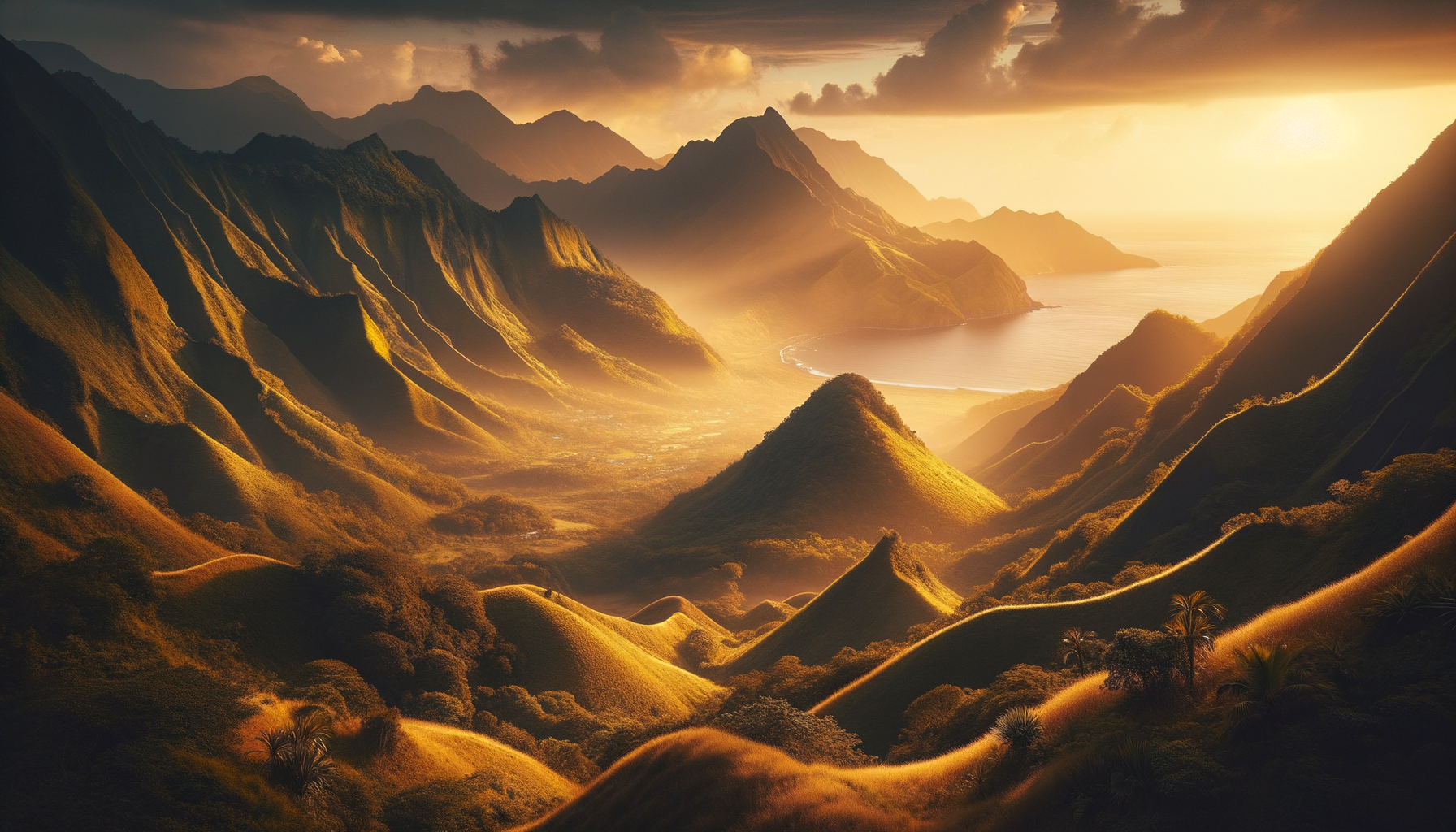
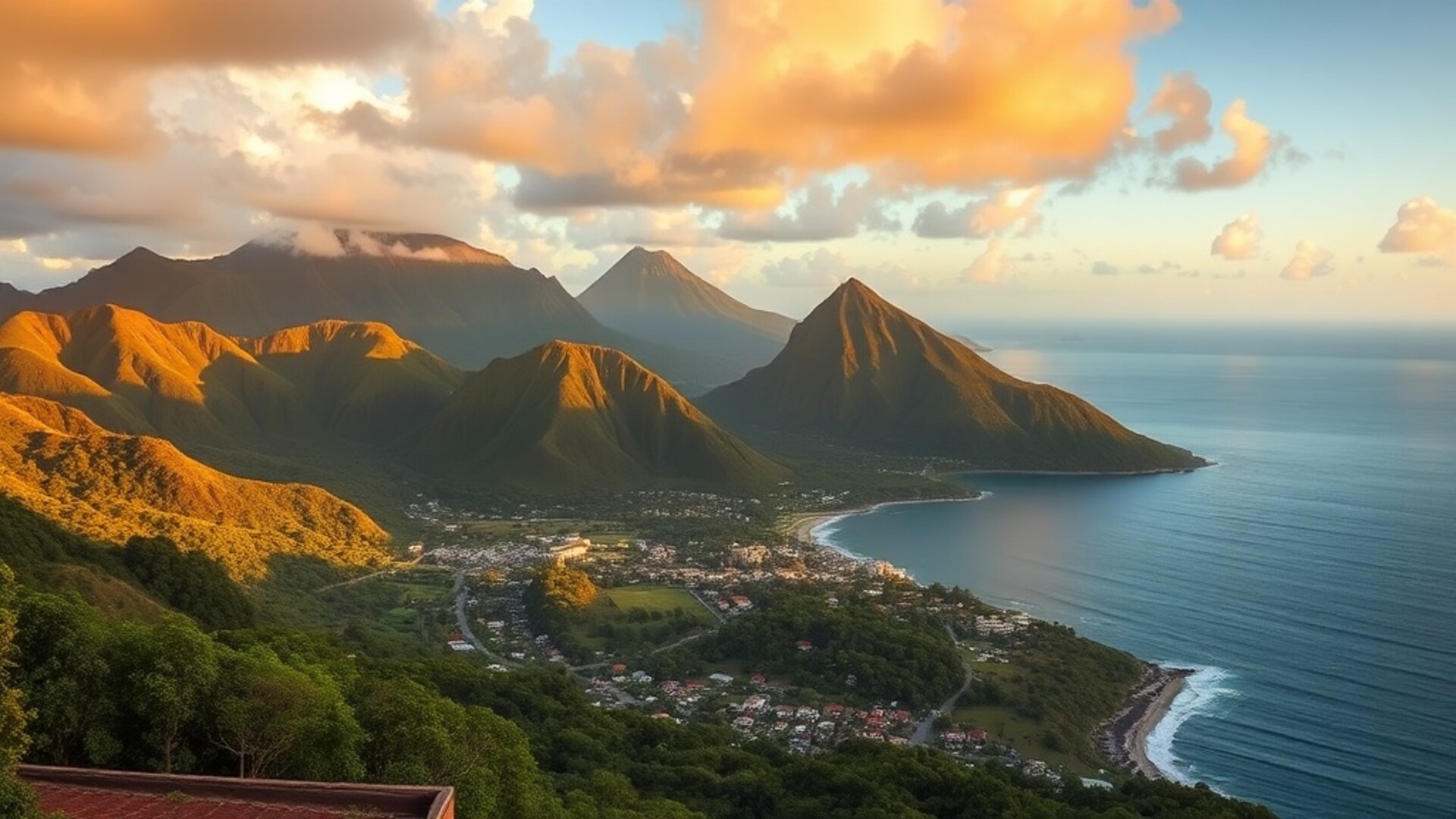
countries/images/montserrat/hero.jpg, used at the top of the overview, is much closer: green volcanic ridges, a peaked interior, a bay, a coastal settlement. Two corrections stated in its caption: the town shown is far larger than any settlement on an island of 4,400 people, and the southern half of the real Montserrat — the ash-covered, closed half — is simply not in the frame.
The one image that admits the volcano
rum-volcano.jpg — a rum punch on black volcanic rock with ash fields and cones behind — is the only picture in the entire set that acknowledges what happened here, which is why it is used in the drinks section. The cones are textbook scoria cones rather than a collapsed lava dome, and the ground is fresh lava where Montserrat's is grey ash, but the idea is right.
The food that is genuinely Montserratian
montserrat-goat-water.jpg is a good likeness of the national dish and is used beside the recipe, with the note that real goat water contains dumplings and breadfruit and is thickened. montserrat-dukuna.jpg is used for the second recipe, with the correction that dukuna is served still tied in its banana leaf. montserrat-cassava-bread.jpg is accurate and is described in the cuisine section.
A new defect: the doubled slug
Three files carry the country name twice: montserrat-montserrat-flatbread.jpg, montserrat-montserrat-sweet-treat.jpg and montserrat-traditional-montserrat-stew.jpg. The same pattern appears in Mongolia. It is the signature of an automated pipeline that concatenated a slug onto a template name without checking.
And what those files contain
Exactly what the template names suggest: generic placeholders with nothing Montserratian about them. The "sweet treat" is a sponge cake dusted with icing sugar. The "traditional stew" is a reddish meat-and-root stew with a slice of bread that would pass for goulash. None of the three is used, because a generic image filed under a country's name is worse than no image at all.
The old page's only photograph was fabricated
The page this one replaces carried a single real photo, hot-linked to upload.wikimedia.org as a file called Soufriere Hills volcano - Montserrat.jpg. The Commons API reports that title as missing — the file does not exist and never did. This is the same fabricated-Wikimedia-URL defect found on Martinique, Réunion, New Caledonia and Mayotte, and it means the old Montserrat page showed a broken image to every visitor.
Support This Project 🌍
This World Travel Factbook is a labor of love – free to use for all travelers. If you find it helpful, consider supporting its continued development.