
🇲🇹 Malta at a Glance
🌍 Overview — Europe's Smallest Country That Is Also Its Densest
Malta is an archipelago of three inhabited islands in the middle of the Mediterranean, 93 km south of Sicily and about 290 km north of Libya. Its total land area is 316 km² — smaller than the city of Prague — and 588,254 people live on it. That works out at roughly 1,860 people per square kilometre, the highest density in the European Union and one of the highest of any sovereign state on earth.
Almost everything interesting about Malta follows from that sentence. A country this small in a position this strategic gets conquered by everyone: Phoenicians, Carthaginians, Romans, Byzantines, Arabs, Normans, Aragonese, the Knights of St John, Napoleon, the British. Each left something. The language is Arabic in its bones with Sicilian and Italian flesh and English clothing. The religion is Roman Catholic and the law was until recently among the most conservative in Europe. The architecture is Baroque, honey-coloured and fortified to a degree that seems paranoid until you learn the history.
And Malta is old — much older than the conquests. The megalithic temples here were built between about 3600 and 2500 BC, which makes them older than Stonehenge and older than the pyramids at Giza. They are the oldest free-standing stone structures known anywhere in the world.
What it is
The Republic of Malta: three inhabited islands — Malta (246 km²), Gozo (67 km²) and Comino (3.5 km²) — plus uninhabited Filfla, Cominotto and St Paul's Islands. A member of the EU since 2004, the eurozone since 2008 and Schengen since 2007, and the smallest state in all three.
How small
You can drive the length of the main island in about 45 minutes if the traffic behaves, which it will not. Nowhere on Malta is more than about 6 km from the sea. Valletta, the capital, has an area of 0.8 km² and roughly 5,000 residents — the smallest capital city in the EU.
Two official languages
Maltese and English, both with full official status, and both used daily. Maltese is the only Semitic language written in the Latin alphabet and the only Semitic language that is an official language of the EU. Italian is widely understood, a legacy of decades of Sicilian television.
Not a Mediterranean cliché
Malta is not a Greek island and not a piece of Italy. It has almost no natural fresh water, very few trees, no rivers or lakes, a native cuisine built around rabbit and bread rather than olive oil and pasta, and an architecture of bastions rather than whitewash. Visitors who arrive expecting the Aegean are always surprised.
The strategic curse
Malta has one of the finest natural deep-water harbours in the Mediterranean, and everyone who wanted to control the sea between Europe and Africa wanted it. That harbour is why the Knights held out in 1565, why the Royal Navy based a fleet here, and why the island was the most bombed place on earth in 1942.
2026 in one line
Labour won a fourth consecutive general election on 30 May 2026; four days into September, a jury acquitted the businessman accused of ordering the murder of Daphne Caruana Galizia; tourism passed four million a year against a resident population of 588,000; and the golden-passport revenue stream was shut down by the European Court of Justice. All four are covered below.
🏷️ The Name, and the Language That Explains the Country
The name most likely comes from the Phoenician Maleth, "a haven" or "a shelter" — which is exactly what the Grand Harbour is. The Greeks and Romans called the island Melite, and a competing etymology derives that from meli, honey: Malta was known in antiquity for a distinctive honey, and honey-gold is still the colour of every building on the island. Both stories are plausible and Maltese people cheerfully tell whichever suits the moment.
Maltese is Arabic, structurally
It descends from Siculo-Arabic, the Arabic dialect spoken in Sicily and Malta after the Arab conquest of 870. The grammar is Semitic — three-consonant roots, broken plurals, the definite article il- assimilating to the following consonant. Kitba (writing), kiteb (he wrote) and ktieb (book) are the same root, exactly as in Arabic.
With Italian flesh
Roughly half the everyday vocabulary is Sicilian and Italian, absorbed over the seven centuries since the Normans. So ktieb is a book but a skola is a school; you say grazzi and skużi. A Maltese sentence routinely runs Semitic grammar over Romance words, and native speakers switch registers without noticing.
And English clothing
160 years of British rule added a third layer, and it is still arriving. Modern spoken Maltese borrows English words wholesale and conjugates them with Semitic morphology — a construction linguists find delightful and purists find alarming. Code-switching mid-sentence is completely normal.
The alphabet
Maltese uses the Latin alphabet with added letters: ċ, ġ, ħ, ż and the digraph għ. The għ is mostly silent but lengthens the vowel around it, a ghost of the Arabic ʿayn. The ħ is a hard breathy H. Standardised only in 1924, which is late for a language this old.
Why it matters
The language is the single strongest argument that Malta is not simply a small piece of Italy. An Arabic speaker from Tunis can follow perhaps a third of a Maltese conversation; an Italian can follow perhaps another third; neither can follow the whole. Malta is genuinely its own thing, and the language proves it.
Who speaks what
Around 97% of residents speak Maltese, about 88% speak English and roughly 66% understand Italian. But with 31% of the population now foreign-born, English is increasingly the working language of Malta's cities — a shift that worries the Maltese-language establishment and is one of the country's live cultural arguments.
🗺️ Rock, Sun and No Water At All
Malta is a piece of limestone that was once part of a land bridge between Sicily and North Africa. The islands tilt: high cliffs on the south-west coast, dropping gradually to the low, harbour-indented north-east where nearly everyone lives. The highest point, Ta' Dmejrek near Dingli, is only 253 m — but it is at the top of a 250-metre sea cliff, which makes it feel considerably more dramatic than the number suggests.
The stone
Two limestones matter. Globigerina is soft, golden, easy to cut with a hand saw and hardens on exposure to air — it is why every Maltese building looks the same colour and why the Baroque carving is so exuberant. Coralline limestone is hard and grey, used for foundations, fortifications and the megalithic temples.
No rivers, no lakes
None. Not one permanent watercourse on any island. Rain falls between October and March, runs off the rock through dry valleys called widien and is gone. Malta has one of the lowest natural freshwater availabilities per person in the world, and it has shaped everything: the terraced fields, the cisterns under every old house, the law that made rainwater collection compulsory.
Water from the sea
Roughly 60% of Malta's drinking water comes from reverse-osmosis desalination plants, the rest from a groundwater lens that is over-extracted and creeping saltier. Desalination is energy-hungry; Malta's water and its electricity bill are the same problem. The tap water is safe but tastes of the process, which is why everyone drinks bottled.
The climate
Textbook Mediterranean, at the hot end. Summers are long, dry and increasingly brutal — 40 °C is now reached most years and August nights often stay above 28 °C. Winters are mild (14–16 °C by day) and wet. The xlokk (sirocco) brings humid Saharan air; the majjistral (mistral) brings the winter storms.
Almost no trees
Malta was wooded once; three thousand years of shipbuilding, firewood and goats removed it. What remains is garrigue and maquis — thyme, rock rose, wild caper, the prickly pear that arrived from Mexico and took over. The national tree is the għargħar, the Sicilian sandarac gum, of which a few hundred wild specimens survive.
The developed island
Around 30% of Malta's total land surface is built over — a proportion matched almost nowhere. Construction is the country's most contentious domestic issue: cranes on every skyline, ODZ (outside development zone) permits granted with depressing regularity, and a planning authority most Maltese regard as an obstacle to nothing.
🗿 Older Than the Pyramids
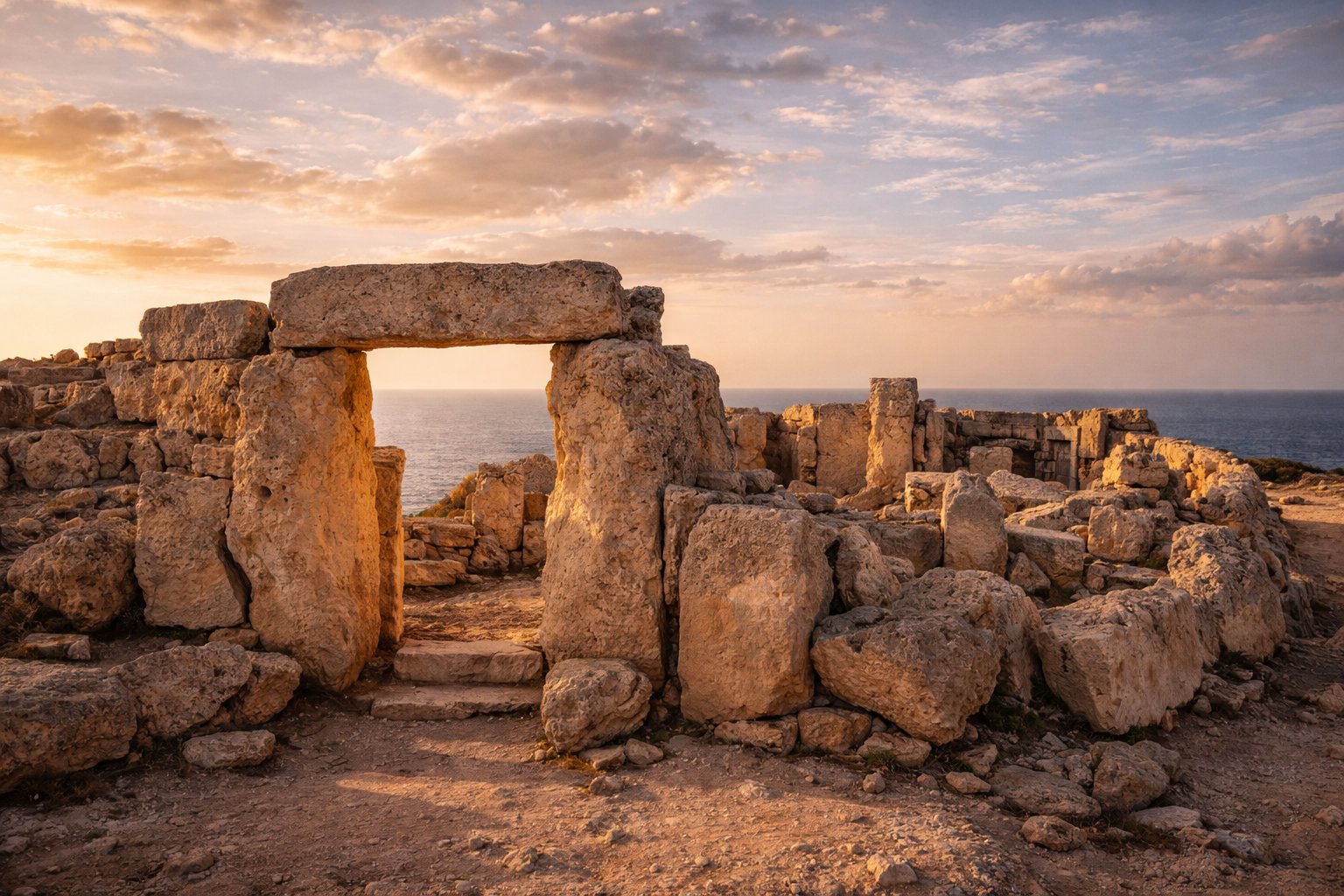
Between roughly 3600 and 2500 BC, a farming population on these islands built about thirty monumental stone structures using blocks weighing up to fifty tonnes, without metal tools, without the wheel, and without a written language. They are the oldest free-standing stone buildings known anywhere on earth — older than Stonehenge by a thousand years, older than the Great Pyramid by about five hundred. Then, around 2500 BC, the temple culture stopped. Abruptly, and nobody knows why.
Ġgantija, Gozo
The oldest, begun about 3600 BC. Two temples inside a single boundary wall, built of coralline blocks up to 5 m long. The name means "of the giantess": Gozitan tradition held that a giantess who lived on beans and honey built it while carrying a child. UNESCO-listed in 1980, the first of the temples to be inscribed.
Ħaġar Qim and Mnajdra
On the south coast above the sea, facing the islet of Filfla. Ħaġar Qim has the largest single stone in any Maltese temple, about 20 tonnes. Mnajdra's lower temple is astronomically aligned: at the equinoxes the sunrise runs straight down the main axis, and at the solstices it strikes the megaliths flanking the passage. Both now stand under protective tent canopies, erected in 2009.
The Hypogeum
Ħal Saflieni is the strangest thing on the islands: a three-level underground complex cut into living rock between about 4000 and 2500 BC, the only known prehistoric subterranean temple in the world. Around 7,000 people were buried in it. The chamber called the Oracle Room has an acoustic resonance that makes a low male voice reverberate through the whole structure.
Booking the Hypogeum
Only 80 visitors per day are admitted, in groups of ten, because human breath was destroying the ochre paintings. Tickets go on sale months ahead and sell out. A small number are released the day before at the National Museum of Archaeology in Valletta. If you want to see it, plan the trip around the ticket, not the other way round.
The Fat Ladies
The temples produced a remarkable body of sculpture: obese seated figures, some sexless, found across the sites, and the Sleeping Lady from the Hypogeum — a 12 cm terracotta of a woman asleep on a couch, made around 3000 BC, and one of the finest small sculptures to survive from the Neolithic anywhere. It is in the National Museum of Archaeology.
The collapse
Around 2500 BC the temples were abandoned and the population appears to have been replaced by Bronze Age arrivals who cremated their dead and lived in fortified settlements. Soil exhaustion, drought, disease and social collapse have all been proposed. Recent sediment work points to a genuine environmental crisis. Nobody knows, and that is honest.
⚓ Phoenicians, Romans, a Shipwrecked Apostle, and the Arabs
Phoenicians and Carthage
Phoenician traders settled from around 800 BC, and Malta became a Carthaginian possession — a useful waystation on the run between Tyre, Carthage and Spain. The two Cippi of Melqart, marble pillars inscribed in both Phoenician and Greek, were found here in the 17th century and gave Jean-Jacques Barthélemy the bilingual key that let him decipher the Phoenician alphabet in 1758.
Rome
Rome took the islands in 218 BC during the Second Punic War. Malta became a municipium, prospered on textiles and honey, and acquired the villas, mosaics and the Domvs Romana at Rabat. Roman Malta was comfortable and unremarkable, which for Malta counts as a golden age.
St Paul, AD 60
Acts 27–28 records that the ship carrying Paul to trial in Rome was wrecked on an island the text calls Melite, that the islanders showed "unusual kindness", and that Paul was bitten by a viper and did not die. Malta has identified with that story ever since. St Paul's Bay, St Paul's Islands, the Grotto at Rabat and the 10 February feast all descend from it, and it underwrites Malta's claim to one of the oldest Christian communities anywhere.
The Arabs, 870
The Aghlabids took Malta in 870 and held it for over two centuries. The archaeological record suggests the islands were substantially depopulated and then resettled, which is the likeliest explanation for the completeness of the linguistic replacement. Arab Malta gave the country its language, its place names (Mdina, Rabat, Marsaxlokk), its irrigation, and cotton and citrus.
Normans and the rest
Count Roger of Sicily took Malta in 1091, and thereafter Malta followed Sicily through Norman, Swabian, Angevin, Aragonese and Castilian hands — usually as an afterthought, granted to whichever nobleman was owed a favour. Christianity returned; the language did not change. The Maltese nobility dates from this period and a few titles survive.
The 1530 handover
In 1530, Emperor Charles V granted Malta, Gozo and Tripoli to the Order of St John, homeless since Suleiman had expelled them from Rhodes in 1522. The rent was one Maltese falcon, payable annually to the Viceroy of Sicily on All Souls' Day. The Knights inspected their new home, found it a barren rock, and accepted anyway. Everything Malta looks like today follows from that decision.
⚔️ The Knights, the Great Siege, and the City Built by a Siege
The Order of St John — Hospitallers, later the Knights of Malta — ruled the islands from 1530 to 1798. They were a sovereign military-religious order of European aristocrats, organised into eight langues (tongues) by nationality, sworn to poverty, chastity and obedience, and in practice one of the wealthiest and most cosmopolitan institutions in the Mediterranean. They also ran a Christian corsair operation that preyed on Ottoman shipping, which is why Suleiman came.
The Great Siege, 1565
In May 1565 an Ottoman force of perhaps 40,000 landed against roughly 6,000 defenders — around 500 knights and the rest Maltese militia and Spanish soldiers — under Grand Master Jean Parisot de Valette, then seventy years old. Fort St Elmo held for 31 days and fell with almost no survivors. The Ottomans then spent the summer failing to take Birgu and Senglea, and withdrew on 11 September 1565.
Why it mattered
Contemporary Europe understood the siege as the moment the Ottoman advance in the western Mediterranean was stopped. Voltaire's line — "nothing is better known than the siege of Malta" — was still true two centuries later. Malta commemorates 8 September as Victory Day, which is also the anniversary of the 1943 Italian armistice, so the date carries two liberations.
Valletta, 1566
The Order concluded that the harbour needed a fortified city on the Sciberras peninsula, and began one the following March. Designed by the papal engineer Francesco Laparelli and finished by his Maltese assistant Girolamo Cassar, it is a rectilinear grid inside vast bastions — one of Europe's first properly planned Renaissance cities, built in about fifteen years. UNESCO calls it "one of the most concentrated historic areas in the world".
Caravaggio, 1607–08
Fleeing a murder charge in Rome, Caravaggio came to Malta, was made a Knight of Obedience, and painted The Beheading of Saint John the Baptist for the oratory of the conventual church. It is his largest canvas and the only work he ever signed — his name written in the blood running from the Baptist's throat. He then wounded a senior knight in a brawl, was imprisoned, escaped, and was expelled from the Order in absentia.
The eight-pointed cross
The Maltese cross has four arms of equal length, each ending in two points, making eight. The eight points are usually explained as the eight langues of the Order, and devotionally as the eight Beatitudes. It is on the euro coins, the tail of every KM Malta aircraft, the airline's logo, and a great deal of tourist silverware.
Napoleon, and then the British
In June 1798, on his way to Egypt, Napoleon took Malta in three days — the Order surrendered almost without a fight. French anticlericalism and the looting of church silver produced a Maltese revolt within months. The Maltese asked Britain for help, blockaded the French into surrender by 1800, and the Treaty of Paris (1814) made Malta British at the Maltese leadership's own request.
🎖️ The British Century, the Second Siege, and a Medal for an Island
Britain held Malta for 164 years, and used it as what a Victorian admiral called "the nurse of the Mediterranean Fleet": a dockyard, a coaling station, a naval hospital and a garrison. The dockyard employed a large share of the male population and made Malta's economy a direct function of British defence policy — which meant that when Britain left, the economy had to be invented from scratch.
The second siege, 1940–42
Italy declared war on 10 June 1940 and bombed Malta the next morning. Over the following two and a half years the islands absorbed roughly 3,000 air raids and some 15,000 tonnes of bombs. In April 1942 alone more tonnage fell on Malta than on London during the entire Blitz. Around 7,000 buildings in the harbour area were destroyed and about 1,500 civilians killed.
Faith, Hope and Charity
The island's air defence in June 1940 consisted of a handful of obsolete Gloster Sea Gladiator biplanes, three of which flew together often enough to be nicknamed Faith, Hope and Charity. The story has been embroidered over the years, but the fuselage of Faith survives in the National War Museum at Fort St Elmo, and the point stands: Malta was defended by almost nothing for months.
The George Cross
On 15 April 1942 King George VI awarded the George Cross — Britain's highest civilian decoration for gallantry — to the whole island of Malta, "to bear witness to a heroism and devotion that will long be famous in history". It is the only time a country has been so decorated. The cross has appeared in the canton of the Maltese flag ever since, and remains there under the republic.
Operation Pedestal
By August 1942 Malta was weeks from starvation. A convoy of fourteen merchant ships escorted by two battleships and four carriers fought its way through; nine merchantmen were sunk. The tanker Ohio, broken-backed, on fire and lashed between two destroyers, was towed into the Grand Harbour on 15 August 1942 — the feast of Santa Marija — and her fuel kept the island fighting. Malta still calls the convoy il-Konvoj ta' Santa Marija.
Independence, in stages
Self-government came and went repeatedly. Full independence arrived on 21 September 1964 with Elizabeth II as Queen of Malta; the country became a republic on 13 December 1974; and the last British forces left on 31 March 1979, celebrated as Freedom Day. Malta therefore has five national days, which is a lot for a country of this size and tells you something about how contested the history still is.
Mintoff and non-alignment
Dom Mintoff, Labour prime minister 1971–84, closed the British base, renegotiated the rent upward at every opportunity, wrote neutrality into the constitution and pursued relationships with Libya, China, the Soviet Union and the non-aligned world. He remains the most divisive figure in Maltese politics: to one half of the country the man who ended colonialism, to the other the man who ran it like a personal fief.
🏛️ The 2026 Election and How Malta Is Governed
Malta is a parliamentary republic with a ceremonial president and a unicameral House of Representatives. Elections use single transferable vote in five-seat districts, which in most countries produces coalitions; in Malta it has produced an almost perfect two-party system, with the Labour Party (PL) and the Nationalist Party (PN) between them taking every seat in every parliament since 1966. Turnout is extraordinary by European standards and party loyalty is close to hereditary.
30 May 2026
Labour won a fourth consecutive general election — the first party in Maltese history to do so. Final standings: Labour 51.77% (158,444 votes) and 42 seats; Nationalist 44.68% (136,723 votes) and 37 seats. Turnout was 87.47%, up 1.8 points and reversing a long decline. The new cabinet was sworn in on 3 June 2026.
What the numbers mean
Labour's vote share fell by about 3.3 points and the gap between the parties narrowed sharply — from roughly 39,000 votes in 2022 to about 22,000. That is still a comfortable win, but it is the first genuine tightening in a decade, and it was achieved by a Nationalist Party under a leader, Alex Borg, who took over only recently and ran a notably more energetic campaign than his predecessors.
Robert Abela
Prime minister since January 2020, when he replaced Joseph Muscat, who resigned amid the protests that followed the arrests in the Caruana Galizia case. Abela is a lawyer, the son of a former president, and has governed on a straightforward formula: keep the economy growing, keep taxes low, keep the energy subsidy in place, and decline to reopen the past.
The seat mechanism
Malta's constitution contains a proportionality correction: if a party wins a majority of first-preference votes but not a majority of seats, extra seats are added until the balance matches. A separate gender-corrective mechanism, introduced in 2021, adds up to twelve seats for the under-represented sex. This is why the final seat totals (42 and 37) exceed the 65 elected in the districts.
Neutrality
Written into the constitution in 1987: Malta is a neutral state "actively pursuing peace, security and social progress among all nations by adhering to a policy of non-alignment and refusing to participate in any military alliance". It is not in NATO, it declines to host foreign bases, and it has kept that position through the entire European rearmament debate — a position with broad domestic support and increasing friction with Brussels.
Small-state politics
In a country of 588,000 with 65 MPs, an MP represents roughly 5,000 voters and most of them by name. Constituency service means personal favours; the boundary between political patronage and ordinary constituency work is thin and everybody knows it. This is the structural reason why Malta's governance problems keep recurring regardless of which party is in office.
🕯️ Daphne Caruana Galizia, and the Verdict of 2 September 2026
On 16 October 2017, the investigative journalist Daphne Caruana Galizia left her house in Bidnija, drove a few hundred metres, and was killed by a bomb placed under the driver's seat of her hired Peugeot. She was 53. She had spent three decades reporting on Maltese corruption, most recently on the Panama Papers and on offshore companies linked to serving ministers and to the prime minister's chief of staff. Her last blog post, published half an hour before she died, ended: "There are crooks everywhere you look now. The situation is desperate."
The case has dominated Maltese public life for nine years, and it reached a decisive and deeply contested point five days before this page was written.
The convictions
Vincent Muscat pleaded guilty in 2021 and was sentenced to 15 years. The brothers Alfred and George Degiorgio pleaded guilty in October 2022, on the first day of their trial, and got 40 years each for planting and detonating the bomb. In 2025, Robert Agius and Jamie Vella were convicted of procuring and supplying the device and sentenced to life imprisonment.
The acquittal
Yorgen Fenech, the businessman prosecutors alleged had paid €150,000 through a middleman to have her killed, was acquitted on 2 September 2026. The jury cleared him of complicity in murder and criminal association by 8 votes to 1 after roughly eight hours of deliberation, at the end of a 55-day trial that began on 1 July. The prosecution has indicated it will appeal.
The middleman
Melvin Theuma, a taxi driver, was arrested in 2019, granted a presidential pardon in exchange for his testimony, and was the prosecution's central witness — he had secretly recorded conversations he said implicated Fenech. The defence attacked his credibility throughout. Whatever else the verdict decided, it is a verdict about how much weight a pardoned witness can carry.
The public inquiry
An independent board of inquiry reported in July 2021 that the Maltese state had to "shoulder responsibility" for the assassination, finding that it had created a culture of impunity from the highest levels of government and had failed to protect her. Its recommendations on media protection and rule-of-law reform have been implemented only partially, which is the family's central complaint.
The reaction
Her family said the acquittal denied her justice and that "nine years after Daphne's brutal assassination, the institutional failures that enabled her murder remain unaddressed and unreformed". Her son called it a terrible decision. Nationalist leader Alex Borg organised a protest, saying Malta still lacks full justice. Press-freedom organisations across Europe issued statements the same week.
Why it belongs on a travel page
Because it is the thing Malta is currently arguing about, because visitors will see the makeshift memorial opposite the Law Courts in Valletta — repeatedly cleared by the authorities and repeatedly rebuilt by citizens — and because a guide that presents Malta as nothing but sunshine and Baroque is not telling the truth about the place. Malta is a functioning European democracy with a serious, unresolved rule-of-law problem, and Maltese people discuss it openly.
💶 Gaming, Finance, Tourism, and the Passports That Stopped
Malta has no meaningful natural resources, very little agriculture and no heavy industry. What it has is EU membership, English, a common-law legal system, a corporate tax structure that returns most of the headline 35% to foreign shareholders, and a regulator willing to write rules for industries other countries had not yet thought about. On that basis it built one of the fastest-growing economies in the European Union — real GDP grew 4.0% in 2025, with roughly 3.7% forecast for 2026, the highest in the EU against a bloc average nearer 1%.
iGaming
Malta was the first EU state to regulate online gambling, in 2004, and the Malta Gaming Authority licence became the industry standard. Several hundred operators are based here; the MGA collected around €65 million in 2025. The sector is a large share of GDP and a very large share of Sliema and St Julian's office rents. Growth has flattened to under 1% a year as other states build their own regimes.
Financial services
Fund administration, insurance, ship registration (Malta's is one of the largest flags in the world) and aircraft leasing. The sector is growing at a modest 2.2% and has spent five years recovering its reputation: Malta was placed on the FATF grey list in June 2021, the only EU member state ever listed, and removed a year later after a compliance overhaul.
Tourism
Over four million arrivals in 2025 against 588,000 residents, and 2.13 million in the first half of 2026 alone — up 18.1% year on year. The government's own target of 4.5 million by 2035 will be met years early. Policy has shifted rhetorically to "quality over quantity", though the arrivals keep rising and the hotel permits keep being granted.
The golden passports, ended
On 29 April 2025 the Court of Justice of the EU ruled in Case C-181/23 that Malta's citizenship-by-investment scheme breached EU law: Union citizenship, the Court held, cannot be the product of a commercial transaction. Malta wound the programme up within three months. It had brought in over €1.4 billion since 2015 and Malta was the last member state still running one.
The labour model
Malta's growth has been achieved almost entirely by importing workers. Employment has expanded far faster than the native workforce could supply, and 31.1% of residents are now foreign nationals. It works economically and it is straining housing, roads, schools, hospitals and the electricity grid — which is the substance of most domestic political argument.
The vulnerabilities
A large share of GDP sits in two sectors — gaming and finance — that depend on regulatory arbitrage other countries can close, plus tourism, which depends on cheap flights. Energy comes through a single interconnector to Sicily and an LNG terminal, and the retail price has been frozen by subsidy since 2021 at a fiscal cost the EU Commission notes regularly.
🏰 Valletta — 0.8 km² and a UNESCO Site Entire
Valletta is a fortified Renaissance grid on a peninsula between two harbours, built by the Knights from 1566, and inscribed on the UNESCO list in its entirety in 1980. It contains 320 monuments in 0.8 km² and about 5,000 permanent residents — a number that has fallen steadily as flats become holiday lets, and one the government has been trying to reverse. It was European Capital of Culture in 2018, which paid for a great deal of restoration.
St John's Co-Cathedral
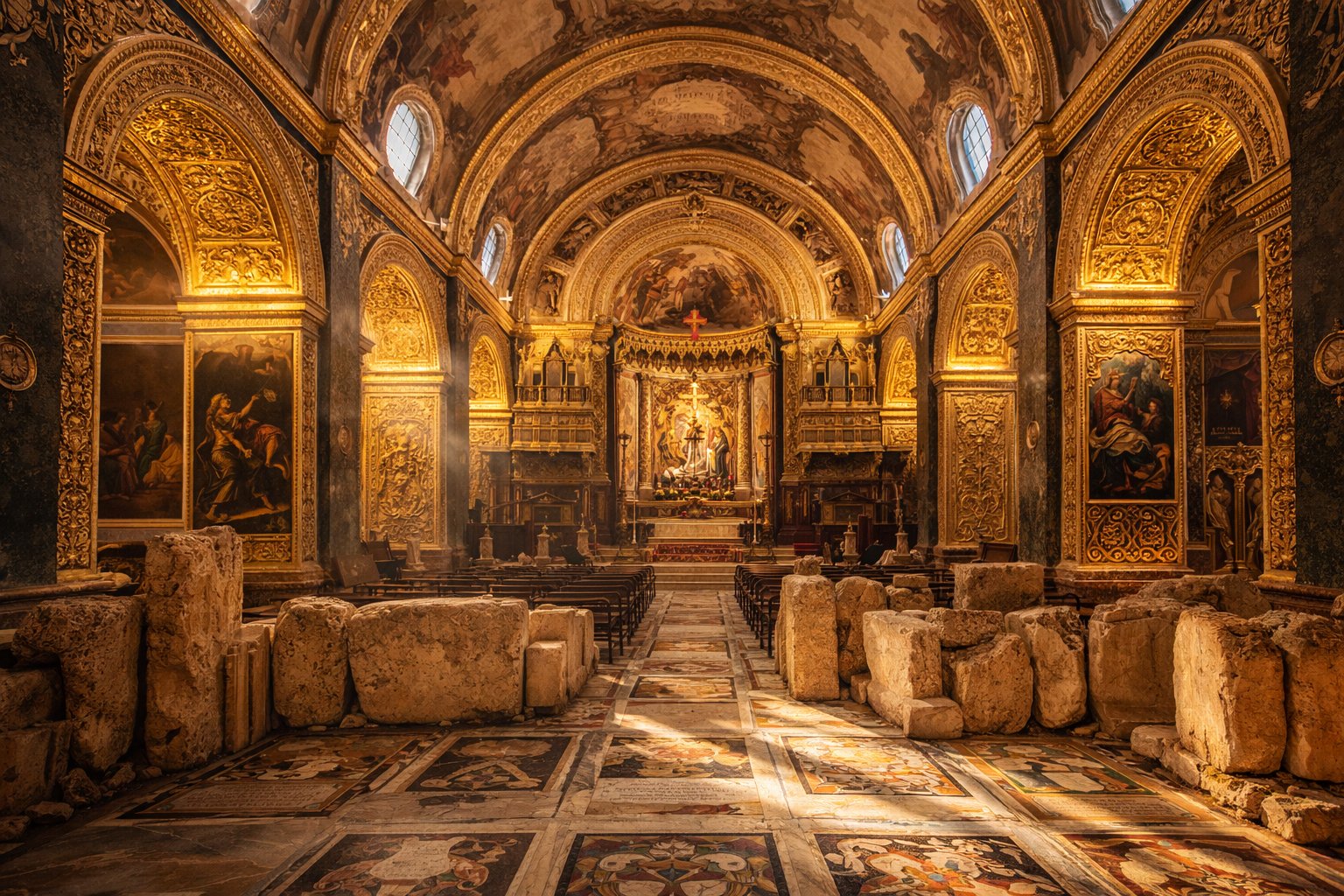
Plain outside, overwhelming inside: every surface carved, gilded and painted, with Mattia Preti's vault frescoes and a floor of about 400 inlaid marble tombstones covering the knights buried beneath. In the oratory hang Caravaggio's Beheading of Saint John the Baptist and Saint Jerome Writing. Modest dress is enforced and stiletto heels are banned to protect the floor.
The Grand Master's Palace
The seat of the Order, then the British governors, then the Maltese parliament, and now the president's office. Reopened in 2024 after a long restoration. The armoury holds one of the largest surviving collections of the Order's arms and armour, including the gilt parade armour of Grand Master Alof de Wignacourt.
The Upper Barrakka Gardens
The best free view in Malta: the whole Grand Harbour, the Three Cities opposite, the dry docks and the breakwater. Below the gardens the Saluting Battery fires at noon and at 16:00 every day, a practice that began as a time signal for shipping and survives as a very good piece of theatre.
The new gate and parliament
Renzo Piano's 2015 reworking of the city entrance — a spare limestone gate, an open-air theatre in the bombed shell of the Royal Opera House, and a parliament building on stone stilts with a deeply pitted sun-shading facade. It was ferociously controversial and has aged into acceptance; the opera house ruin left deliberately unroofed is the best decision in it.
Republic Street and the side streets
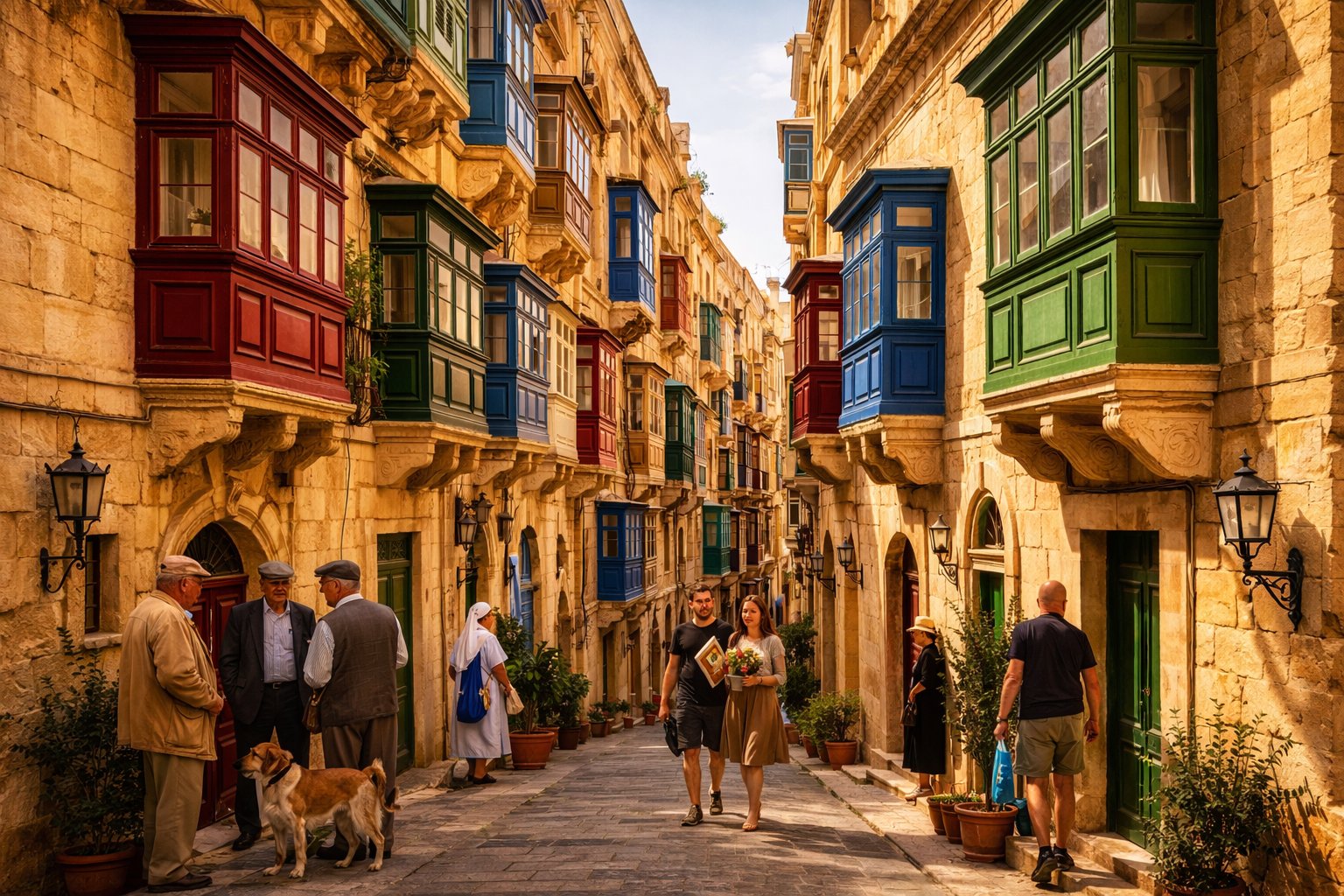
The main axis is pedestrianised, commercial and crowded. Turn off it. The cross streets drop steeply toward both harbours in stepped ramps — the Knights built them as stairs shallow enough for a mounted man — and give you Baroque doorways, wooden balconies and laundry within thirty seconds of the crowds.
A working city, still
Valletta is not a museum: it holds the parliament, the law courts, the president, the main post office and a great many small businesses. It also empties in the evening, which is why the government's push to bring residents back matters. Come early, or stay after the day-trippers leave and the light on the limestone turns.
🛡️ The Three Cities — Where the Siege Was Actually Fought
Across the Grand Harbour from Valletta lie Birgu (Vittoriosa), Senglea (Isla) and Cospicua (Bormla) — the Order's first home, and the place where the Great Siege of 1565 was won. Most visitors never cross the water. They should: the Three Cities are older than Valletta, quieter, still residential, and the harbour crossing by traditional boat takes about eight minutes.
Birgu / Vittoriosa
Where the Knights lived from 1530 until Valletta was ready. The Inquisitor's Palace is one of very few surviving inquisitorial buildings in Europe open to the public, complete with cells and a tribunal room. The Malta Maritime Museum occupies the old naval bakery. The lanes behind the waterfront are the most atmospheric urban fabric in the country.
Fort St Angelo
The point of the peninsula, and the Order's headquarters during the siege. Later a Royal Navy stone frigate, HMS St Angelo. Restored and open; the upper part remains under the sovereignty of the Sovereign Military Order of Malta by a 1998 agreement, which makes it one of the odder pieces of territory in Europe.
Senglea and the Gardjola
The watchtower at the tip of Senglea — the Gardjola — is carved with an eye and an ear, symbols of vigilance, and is on roughly half of all Maltese postcards. The view from it takes in Valletta, Fort St Angelo and the whole harbour in one sweep.
Cospicua and the docks
The largest and least prettified of the three, wrapped in the Cottonera Lines. This was the dockyard town: it took the worst of the 1940–42 bombing because the dry docks were the target. It is now the least gentrified and the most ordinary, in a good way.
The dgħajsa
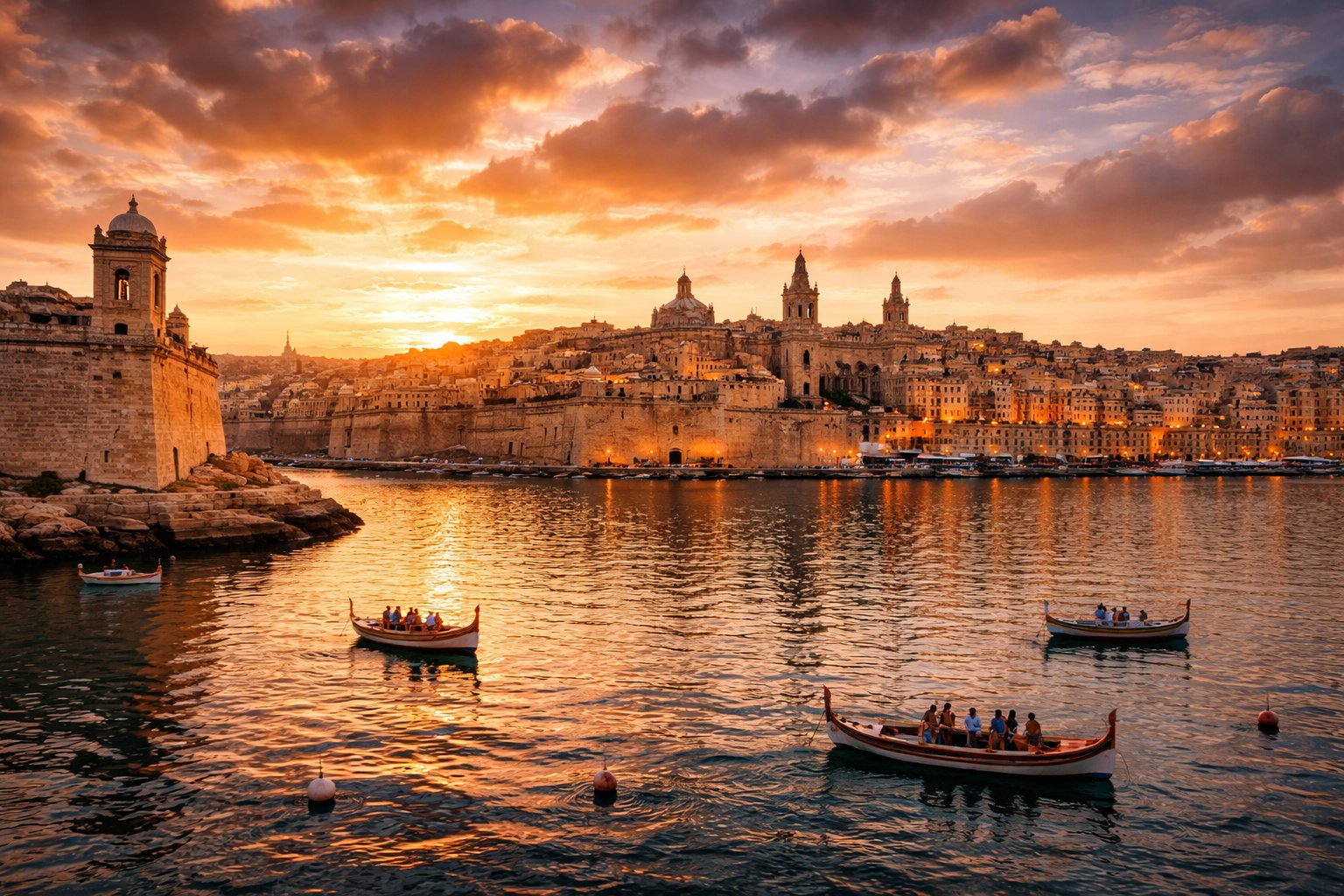
The traditional harbour taxi — high curved prow and stern, brightly painted, historically rowed standing up and facing forward, now almost always with an outboard. Crossing from Valletta's Lascaris Wharf to Birgu costs a couple of euros and is the correct way to arrive. The boats in this page's header image are dgħajjes.
The Birgufest
In October the Three Cities turn off the electric lights for a weekend and light the streets with candles and oil lamps. It is genuinely beautiful, entirely local in origin, and now busy enough that you should arrive before dark.
🤫 Mdina, the Silent City
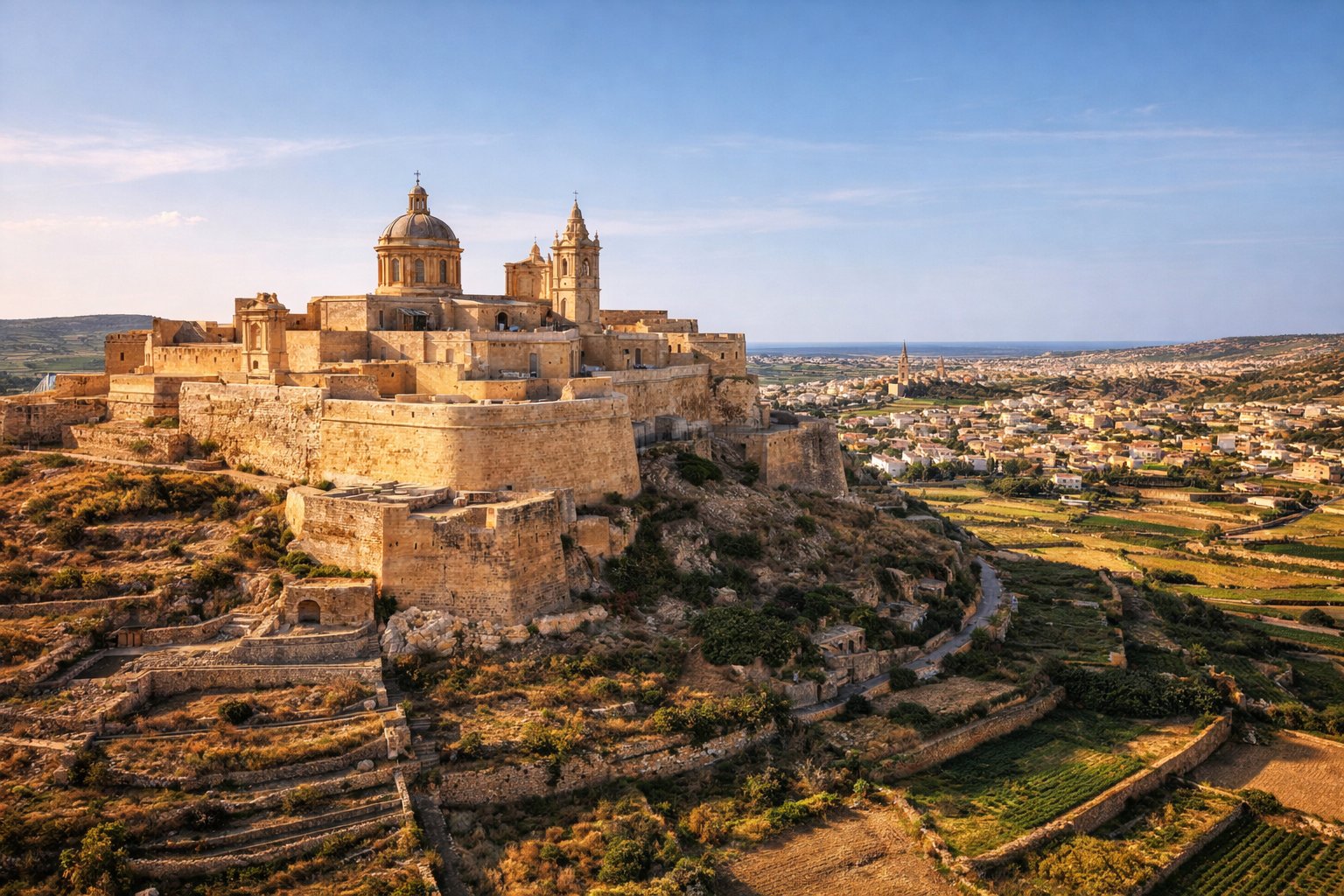
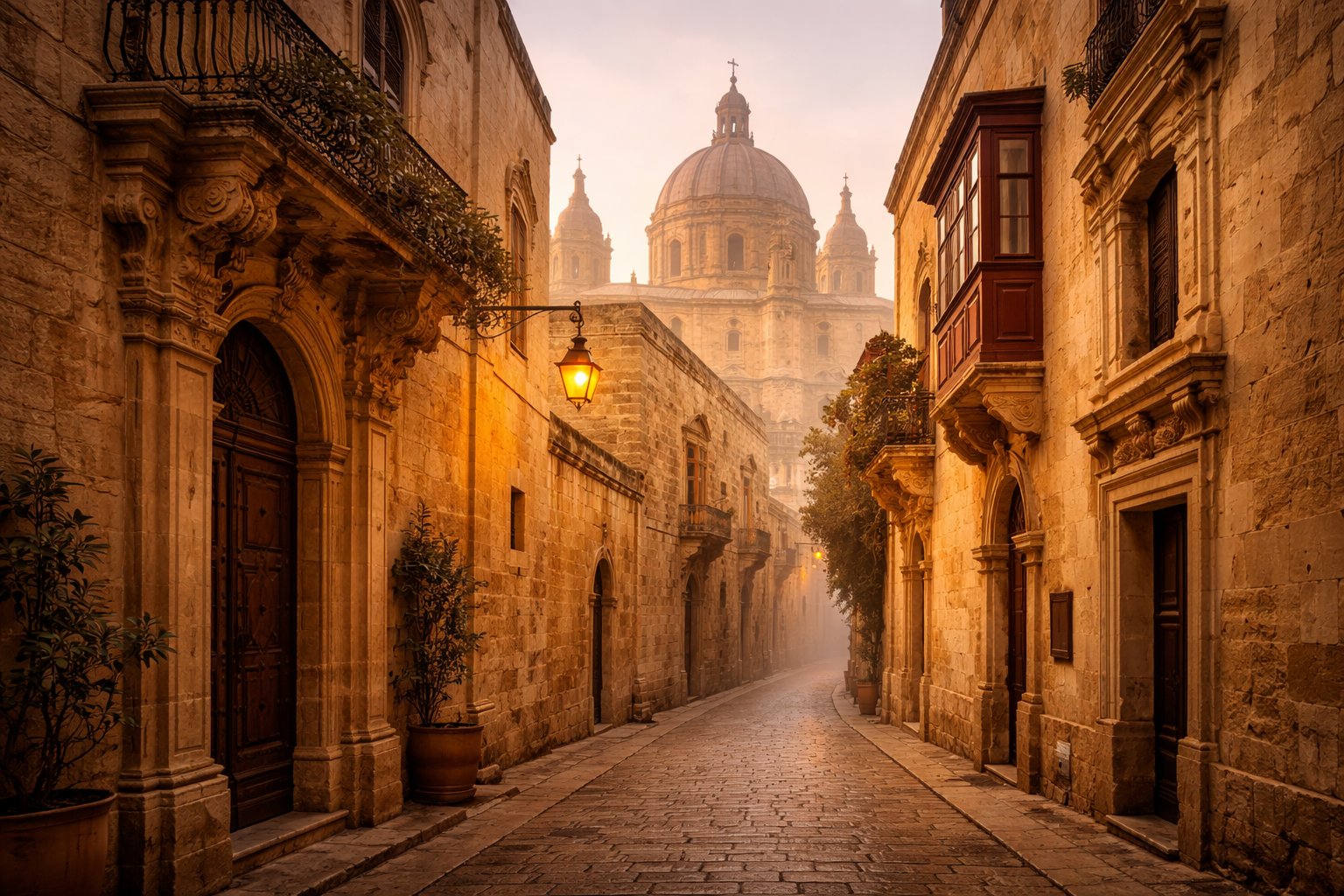
Malta's old capital sits on a hill in the centre of the island, walled, and until the Knights arrived it was the seat of the Maltese nobility and the church. It has about 250 residents, virtually no cars, and a rule of quiet that gives it its nickname. Rabat, the town outside the walls, is where the rest of Mdina's population went when the walls became a limit rather than a defence.
Layers of wall
Phoenician, Roman, Arab and Norman fortifications on the same line — the Arabs gave it its name (medina) and cut the ditch that separated it from Rabat. The Baroque main gate is from 1724, and is instantly recognisable to anyone who has watched the first season of Game of Thrones, where it played the gate of King's Landing.
St Paul's Cathedral
Rebuilt by Lorenzo Gafà after the 1693 Sicilian earthquake flattened the medieval church, and one of the finest Baroque buildings in the Mediterranean. The floor is again a carpet of inlaid marble tombstones. The adjoining museum holds a remarkable set of Dürer woodcuts.
Palazzo Falson and Palazzo Vilhena
Falson is a medieval townhouse kept as its last owner left it, with his collections — one of the most likeable small museums anywhere. Vilhena, the Baroque magistral palace inside the gate, houses the Natural History Museum, which is charmingly out of date and worth twenty minutes.
The catacombs at Rabat
St Paul's and St Agatha's catacombs are extensive early Christian burial complexes cut into the rock, with agape tables carved for funerary meals. They are among the earliest evidence of Christianity in Malta and are much less visited than they deserve.
When to go
Early morning or after about 18:00. Mdina takes coach parties all day and is genuinely silent outside those hours — walk the walls at dusk when the lamps come on and the honey stone goes orange. The bastion viewpoint takes in roughly half the island and, on a clear day, Sicily.
The horse cabs
The karozzin, Malta's Victorian horse-drawn cab, still operates at Mdina and in Valletta. Animal-welfare rules now suspend the trade above 35 °C, which in a Maltese August means often. Judge for yourself; a good number of Maltese have stopped using them.
🐐 Gozo and Comino
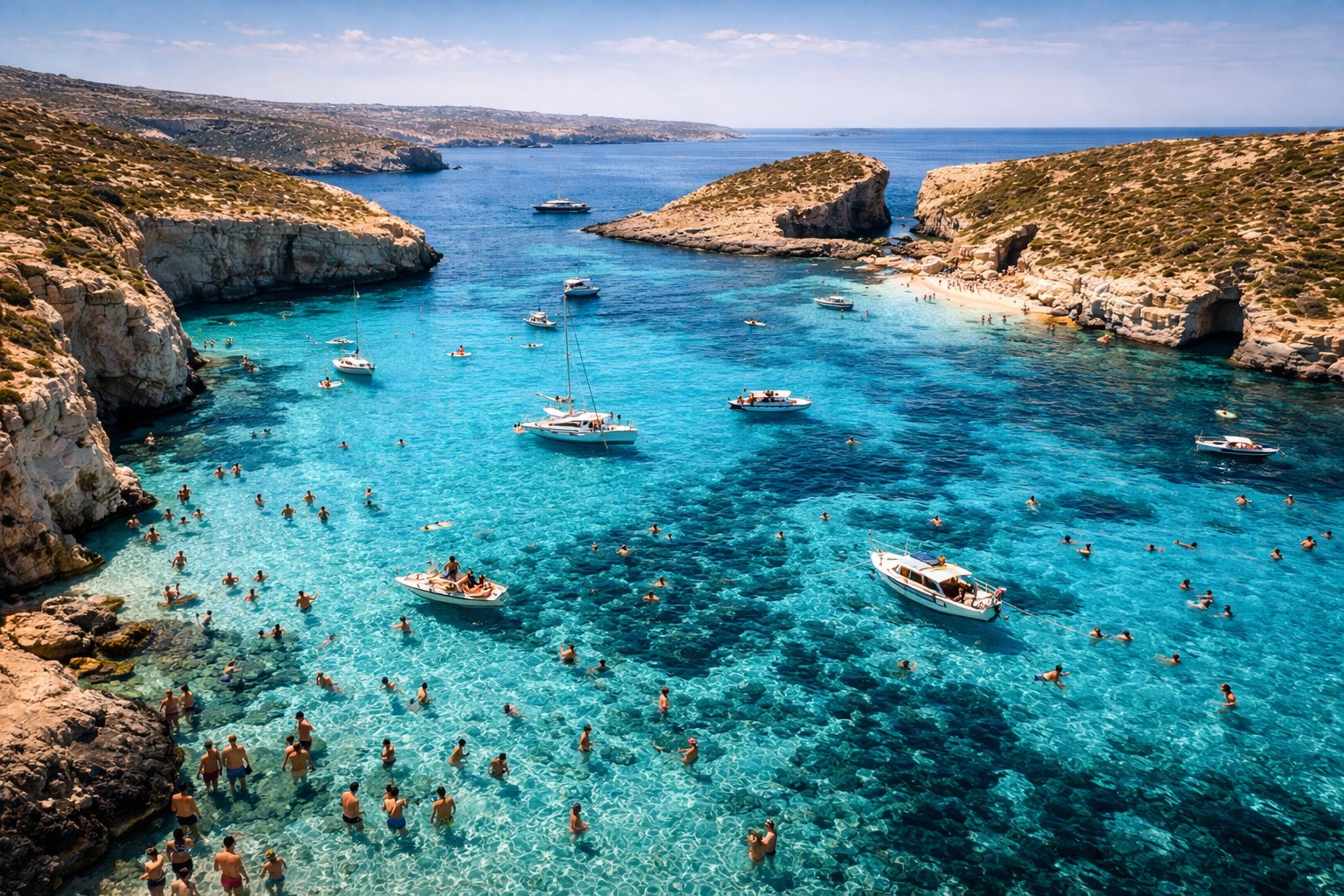
Gozo is a third the size of Malta, greener, slower and defensively proud of not being Malta. It has its own bishop, its own dialect, its own football league and a firm view that Gozitans work harder. About 33,000 people live there. Comino, between the two, is 3.5 km² and has a permanent population you can count on one hand — plus, in summer, several thousand day-trippers.
The Cittadella
The walled citadel above Victoria (Rabat to Gozitans), inhabited since the Bronze Age and fortified continuously since. Until 1637 the entire population of Gozo was required to sleep inside it every night because of the corsair raids — a rule with cause: in 1551 Dragut carried off almost the whole population of the island, some 5,000 people, into slavery.
Ġgantija and Xagħra
The oldest temples in the archipelago sit above the village of Xagħra, with the excellent Ta' Kola windmill next door. Also in Xagħra: Xerri's Grotto and Ninu's Cave, two stalactite caves reached through the front rooms of ordinary family houses, which is exactly as strange and as good as it sounds.
The Azure Window, gone
The rock arch at Dwejra collapsed into the sea in a storm on 8 March 2017. It was Gozo's most photographed feature and its loss is still felt. The site remains worth visiting: the Inland Sea, the Blue Hole and the collapsed arch make Dwejra one of the best shore-dive sites in the Mediterranean.
Ramla l-Ħamra and the coast
Gozo's red-sand beach, backed by dunes and terraces, with Calypso's Cave above it — Homer's Ogygia, by long local tradition. The coastal walk from Ramla to San Blas and the salt pans at Xwejni, cut into the rock and still worked by hand, are the two best walks on the island.
Comino and the Blue Lagoon
The channel between Comino and Cominotto is startlingly turquoise over white sand, and it is one of the most crowded square hundred metres in the Mediterranean between June and September. Go in May, October, or on the first boat of the day. Off-season Comino is nearly empty and the walk round it takes two hours.
Getting there, and the tunnel that isn't
The Gozo Channel ferry runs from Ċirkewwa to Mġarr about every 45 minutes, takes 25 minutes, and you pay only on the way back. A fast passenger ferry runs to Valletta. The long-promised Malta–Gozo road tunnel was shelved in 2022 and the prime minister has since said neither it nor the proposed metro is a priority. Gozitans have opinions about this.
🐟 Marsaxlokk, the South, and the Boats with Eyes
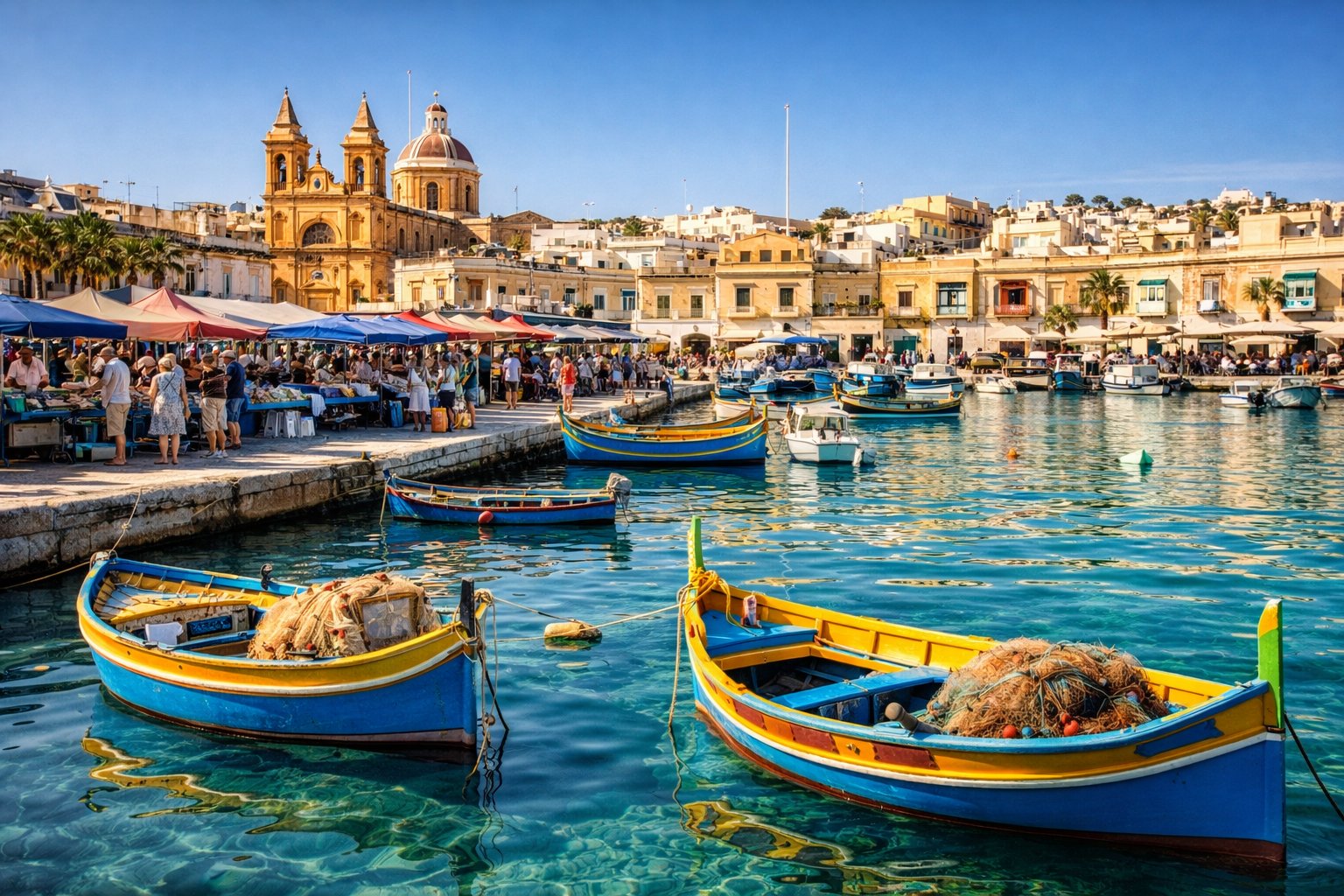
The south and east of Malta are where the island is least manicured: the fishing harbour at Marsaxlokk, the cliffs and temples above Filfla, the salt pans, the Blue Grotto, and the freeport that handles a remarkable share of Mediterranean container transhipment. It is also where the 1989 Malta Summit was held, which ended the Cold War in a harbour full of fishing boats.
The Sunday market
Marsaxlokk's quayside market is genuinely a fish market on Sundays and a general tourist market the rest of the week. Go on Sunday morning, early, and eat lunch at one of the quayside restaurants afterwards — this is where Maltese families come for fish, which is the reliable sign.
The luzzu
The Maltese fishing boat: broad-beamed, double-ended, painted in bands of yellow, red, green and blue, with an Eye of Osiris painted on each side of the prow to ward off harm. The eye is Phoenician in origin and has been on boats in this sea for close to three thousand years. Fewer than a thousand luzzijiet remain registered and the number falls each year.
The Blue Grotto
A sea cave complex under the cliffs at Wied iż-Żurrieq, reached by small boat from the inlet. Go before 11:00 when the sun is still hitting the water and the blue is at its most improbable. The boats do not run in a swell, so check before making the trip.
The Malta Summit, 1989
On 2–3 December 1989, George H. W. Bush and Mikhail Gorbachev met in Marsaxlokk Bay, largely aboard the Soviet liner Maxim Gorkiy because a storm made ship-to-ship transfers impossible. It is widely taken as the meeting at which the Cold War was declared over. It happened two weeks after the Velvet Revolution began in Prague.
The freeport, and the power station
Malta Freeport at Birżebbuġa is one of the Mediterranean's busiest transhipment hubs, and it sits directly beside a residential town, as does the Delimara power station. The environmental cost of that arrangement is a permanent local grievance and the reason air quality in the south is measurably worse than the rest of the island.
Marsaskala, Delimara, St Peter's Pool
The east coast has the best swimming that is not on a postcard: St Peter's Pool is a natural limestone swimming hole below Delimara with no sand and no facilities, and it is the best place on Malta to swim if you can handle a ladder into deep water.
👥 A Society Changing Faster Than Almost Any in Europe
Malta's population passed 588,254 at the end of 2025, up 2.4% in a single year. Essentially all of that growth was migration: net migration added 13,906 people, while natural increase — births minus deaths — was 98. For a country of this size, absorbing the equivalent of a new town every year is a structural transformation, and it is happening in a place with no room.
Nearly a third foreign
31.1% of residents are non-Maltese citizens. Around 78% of net migration is now from outside the EU, with Indian, Nepali and Filipino communities each above 10,000 people. They staff the hotels, the care homes, the construction sites, the delivery apps and the hospitals. Malta's growth model does not work without them, and the public conversation about that has become noticeably sharper.
The Church, still and less
Roman Catholicism is the state religion under the constitution and the Church retains real institutional weight — it runs a large share of the schools. But practice has collapsed: Sunday mass attendance has fallen from over 80% in the 1960s to under 20%. The festa, however, is as strong as ever, which tells you something about what the religion actually is here.
Social law, fast then stuck
Malta legalised divorce only in 2011, by referendum, as the last country in the EU to do so. It then moved rapidly: civil unions in 2014, same-sex marriage in 2017, a gender-identity law regarded as among the most progressive in the world, and cannabis for personal use in 2021, the first EU state to do it.
Abortion, the exception
Malta had a total ban until 2023, when a narrow amendment permitted termination where the mother's life is at immediate risk or her health in grave jeopardy. The amendment was watered down substantially during passage after heavy opposition. It remains the most restrictive abortion law in the European Union, and Maltese women who need a termination still travel.
Housing and the cost of it
Property prices roughly doubled in a decade. Maltese in their twenties increasingly cannot buy in the towns they grew up in, and rents in Sliema and St Julian's are set by what a foreign gaming salary will bear. This, more than any abstract argument about identity, is what drives the domestic debate about population.
Traffic
There are more licensed vehicles than adults. The bus network is free for residents (since October 2022) and genuinely useful, but the roads it runs on are full. Peak-hour traffic on an island 27 km long is an absurdity Maltese people discuss constantly and no government has solved.
🎆 The Festa — Malta's Real National Institution
Every town and village on the islands has a patron saint and a festa, and between June and September there is one somewhere almost every weekend. It is the most important thing in the Maltese calendar and it is not primarily religious: it is a competition between neighbourhoods, run by band clubs, financed by subscription, and expressed through fireworks.
How it works
A week of build-up: the church hung with damask and lit inside and out, statues brought out, streets lined with painted wooden pavaljuni and coloured lights, a brass band marching each evening. On the feast day itself the titular statue is carried through the streets on the shoulders of the parish men, at a pace and with a swaying that takes practice.
The band clubs
Every parish has at least one, most have two, and the rivalry between them is the actual engine. Larger towns have a festa l-kbira (the big feast) and a festa ż-żgħira run by the second club for a secondary saint, and the two clubs will not, under any circumstances, be seen to be outdone.
Fireworks
Malta manufactures its own, in licensed factories run by volunteer kaxxa infernali societies, and takes it extremely seriously — Maltese teams regularly win international pyrotechnic competitions. The daytime murtali tal-bomba are pure noise; the ground displays with rotating mechanical set pieces are a distinct Maltese art form. There have been fatal accidents in the factories, which is part of the story too.
Which ones to see
St Paul's Shipwreck in Valletta (10 February, winter, indoor and beautiful); Imnarja at Buskett on 28–29 June, the harvest and folk-song festival, which is the oldest and least commercial; Santa Marija on 15 August, which is a national holiday and marks the Ohio's arrival; and the Mqabba and Lija feasts for fireworks.
Carnival
February in Valletta and Floriana, with grotesque floats and dance companies. On Gozo, Nadur's carnival is entirely different: spontaneous, unofficial, deliberately ugly rather than pretty, and conducted largely in silence by masked figures who will not speak to you. It is genuinely unsettling and much more interesting than the official one.
Good Friday and Easter
Good Friday processions with life-sized statues carried through the towns are among the most serious events of the year — Żejtun, Qormi and Naxxar do them well. On Easter Sunday the risen Christ statue is run through the streets at a sprint, which is as much fun as Good Friday is solemn.
🍽️ Rabbit, Bread, and a Bitter Orange Soft Drink
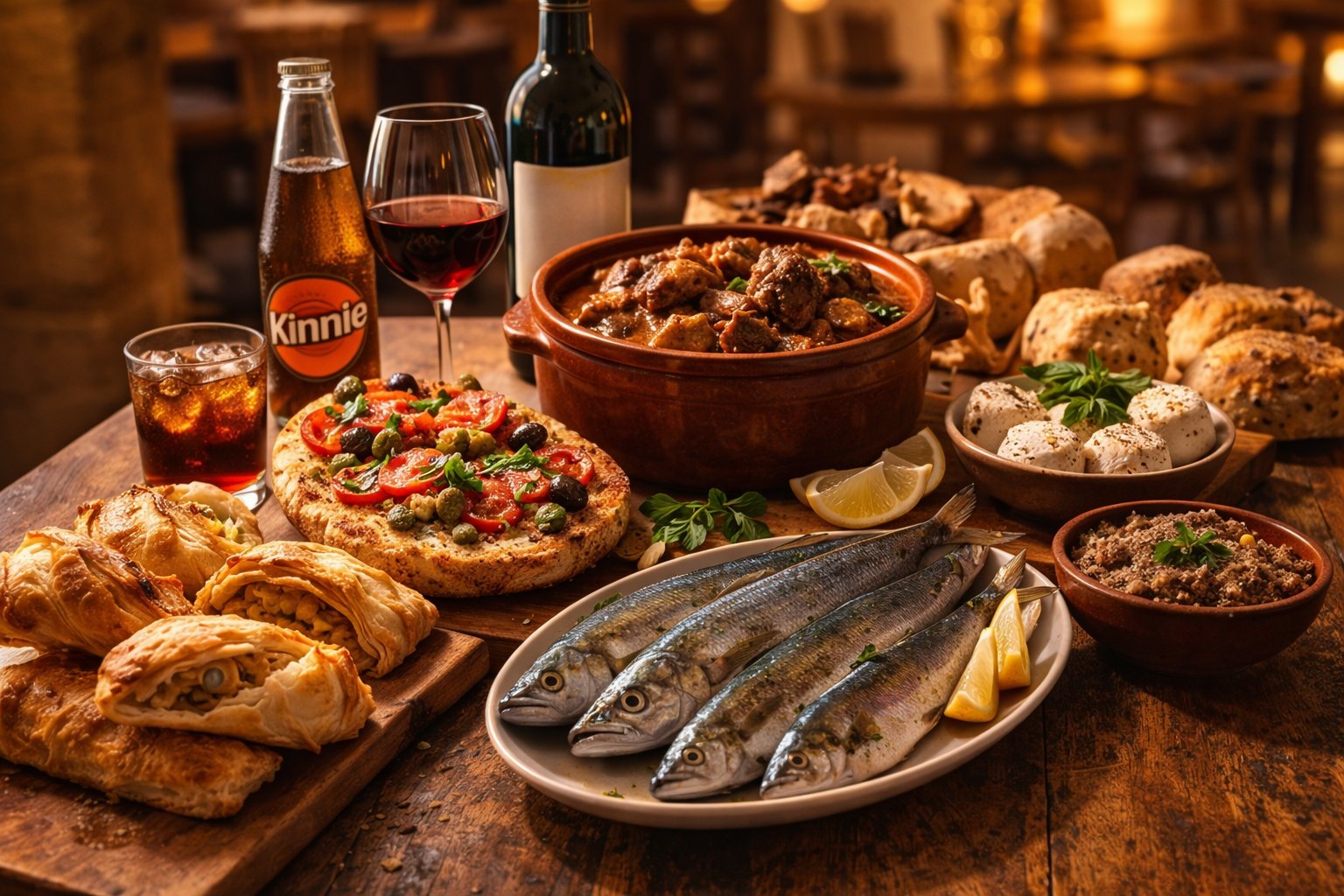
Maltese food is Sicilian at the base with North African seasoning, British habits and a genuine local core. It is not refined and does not pretend to be: it is the cooking of a poor, crowded island with no grazing land, where the meat was rabbit because rabbits could be kept in a yard, and where bread was the centre of the meal because it was the meal.
Pastizzi
The national snack: diamond-shaped puff pastry filled with either rikotta or piżelli (a curried mushy-pea filling). Bought hot from a pastizzerija, eaten from paper, and costing about €0.40–0.60, which makes them one of the last genuinely cheap things in the eurozone. Serkin (the Crystal Palace) in Rabat is the pilgrimage site.
Ftira and ħobż biż-żejt
Ftira is the flat ringed sourdough loaf, split and filled with tuna, capers, olives, tomato paste (kunserva), butter beans and oil — a sandwich that requires both hands and a plan. Its making was added to the UNESCO intangible heritage list in 2020. Ħobż biż-żejt is the same idea on a slice.
Fenkata
Rabbit, and the closest thing Malta has to a national ritual meal. Traditionally a two-course affair: first spaghetti dressed with the rabbit's cooking gravy, then the rabbit itself, stewed slowly in red wine with garlic and bay. It is eaten in company, at length, and preferably at Mġarr on Malta or Nadur on Gozo.
Fish, and lampuki
The lampuka (dorado, mahi-mahi) runs from late August to November and is the fish Malta waits for; torta tal-lampuki is a pie of it baked with cauliflower, spinach, olives and walnuts and is one of the great oddities of Mediterranean cooking. Aljotta is the garlicky fish broth. Swordfish, dentex and octopus (stuffat tal-qarnit) are everywhere.
Ġbejniet
Small round sheep's or goat's milk cheeselets from Gozo, eaten fresh, dried, or rolled in cracked black pepper and steeped in vinegar. They turn up in soup, in ftira, on their own with bread, and in the widow's soup below. If you take one thing home from Gozo, take these.
Sweets
Imqaret — date-filled pastry lozenges, deep-fried, sold from vans outside the Valletta bus terminus. Kannoli, Sicilian by descent and taken seriously. Figolli, almond-filled Easter biscuits cut in shapes. Qagħaq tal-għasel, treacle rings, at Christmas. And Helwa tat-Tork, a crumbly sesame halva that came in with the Ottoman trade.
👨🍳 Two Recipes That Actually Work
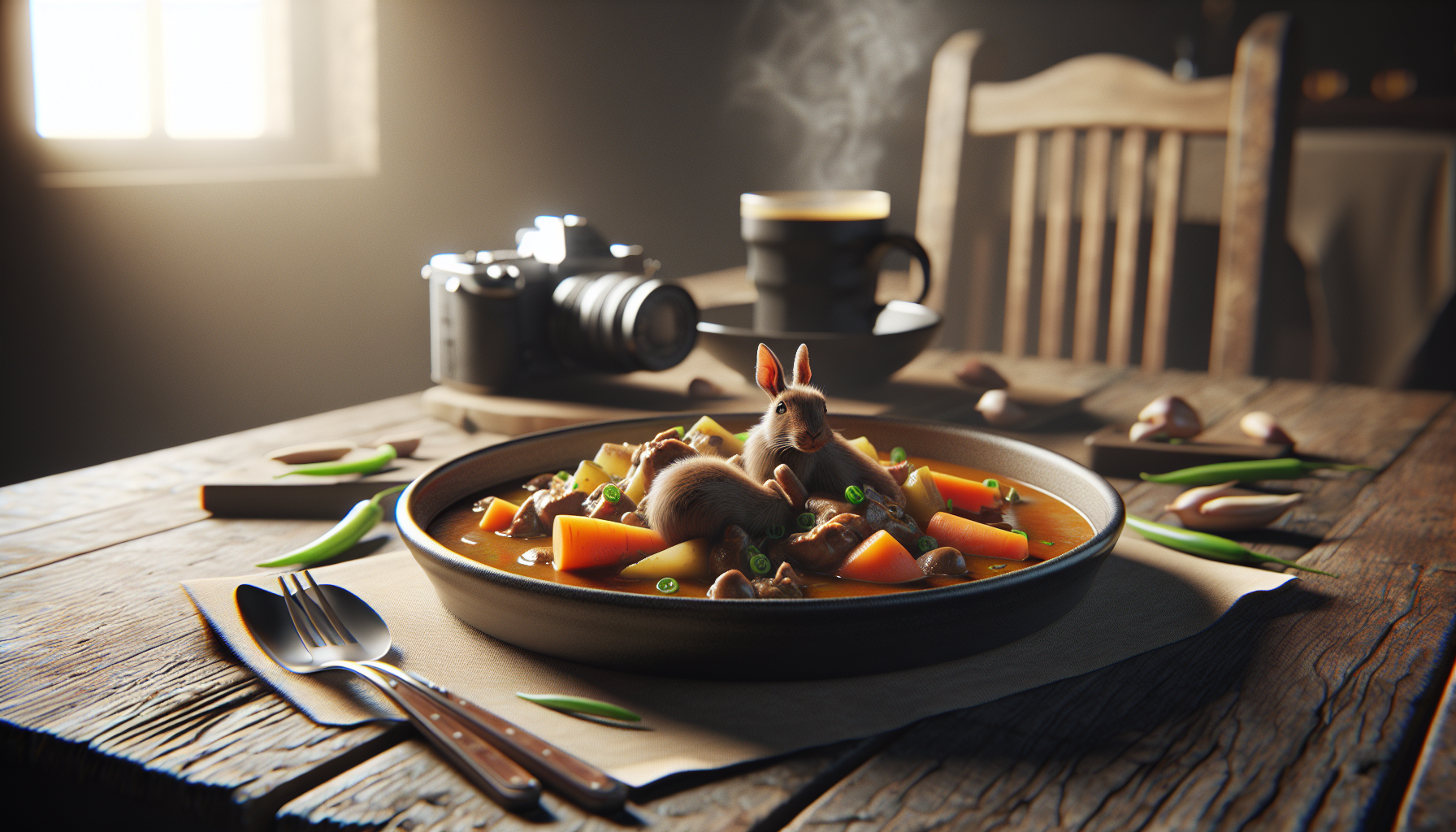
Stuffat tal-Fenek — Maltese Rabbit Stew
Serves 4 · about 30 min prep · 2 h cooking · the national dish
Ingredients: 1 rabbit (about 1.5 kg), jointed into 8 pieces; 2 whole heads of garlic, cloves peeled but left whole; 1 large onion, chopped; 2 carrots; 300 ml dry red wine; 2 tbsp tomato paste (kunserva); 400 g tinned chopped tomatoes; 3 bay leaves; 1 tsp dried marjoram; 250 g peas (frozen is fine); 2 potatoes, cut in chunks; olive oil; salt and plenty of black pepper. Optional but traditional: 400 g spaghetti.
Method: Marinate the rabbit overnight in the red wine with the bay and marjoram — this is not optional if you want it tender. Lift the pieces out, pat dry, and keep the marinade. Brown the rabbit hard in oil in a heavy casserole, in batches, and set aside. Soften the onion and carrot in the same pot, add all the garlic cloves whole and let them colour. Return the rabbit, pour in the reserved marinade and let it bubble down by half. Add the tomato paste, the tinned tomatoes and enough water to almost cover. Cover and cook very gently for 1½ hours, until the meat pulls from the bone. Add the potatoes for the last 30 minutes and the peas for the last 8.
💡 Serve it the Maltese way, in two courses: first drain some of the sauce over spaghetti and eat that as a starter, then bring the rabbit itself to the table with bread. Doing it in one course is faster and gets you looked at.
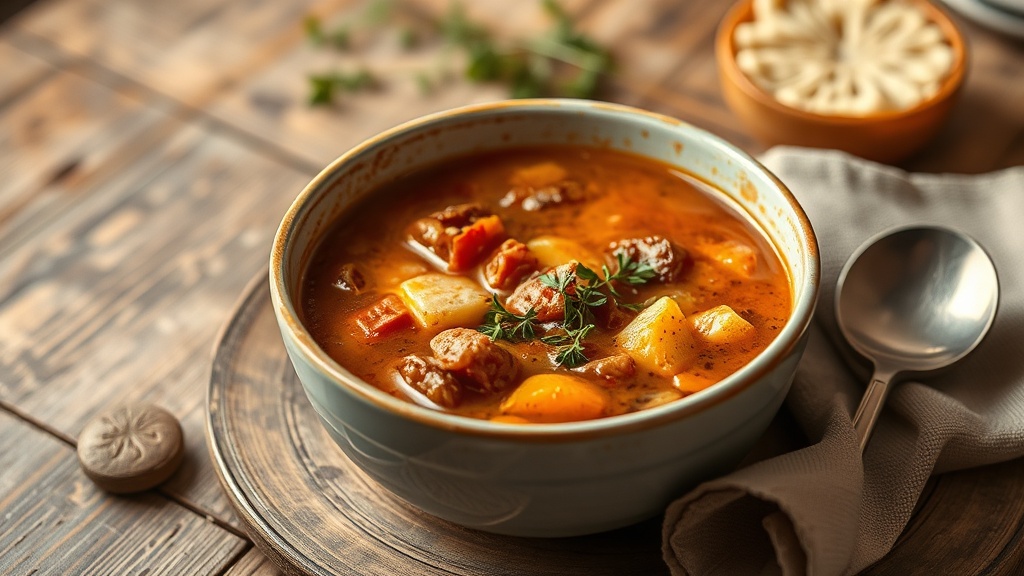
Soppa tal-Armla — Widow's Soup
Serves 4 · 15 min prep · 45 min cooking · meatless by definition
Ingredients: 1 onion, chopped; 2 carrots, diced; 2 potatoes, diced; 1 small cauliflower, broken into florets; 200 g fresh peas or broad beans; 2 courgettes; 2 tomatoes, chopped; 1 tbsp tomato paste; 1.2 l vegetable stock or water; olive oil; salt and pepper. To finish: 4 fresh ġbejniet (small sheep's cheeselets — ricotta or a soft goat's cheese is the nearest substitute) and 4 eggs.
Method: Soften the onion in olive oil. Add the carrots, potatoes and tomato paste and stir for two minutes. Add the tomatoes and the stock, bring to a simmer and cook 15 minutes. Add the cauliflower and courgettes and cook another 15, until everything is soft but not collapsed — this is a soup that wants to be chunky. Season well. Then, off the heat but still hot, lower one cheeselet into each bowl. If you want it as it is traditionally finished, poach an egg directly in the soup for each person before serving.
💡 The name means widow's soup, and the point of it is that a widow could not afford meat. There is no meat in it and there should not be. What makes it substantial is the cheeselet and the egg.
🥤 Kinnie, Cisk, and Wine From a Rock
Kinnie
Malta's own soft drink, launched in 1952 by Simonds Farsons Cisk: bitter orange and aromatic herbs, amber-brown, and genuinely bitter in a way no other mass-market soft drink is. Maltese people abroad have it shipped to them. First reactions from visitors are usually negative and usually reverse by day four. Try it with a slice of orange, or as a mixer with gin.
Cisk
The national lager, brewed since 1929, sold in a distinctive squat bottle, and perfectly decent. The name comes from the nickname of the founder's father, a bank cashier — cisk being how Maltese renders "cheque". Farsons also brews Blue Label ale and Hopleaf, and Malta now has a genuine craft-brewing scene, Lord Chambray on Gozo being the pioneer.
Wine
Malta makes wine on terraces with almost no soil, and it is much better than it has any right to be. Two indigenous grapes matter: Ġellewża (red, light, often made as a rosé) and Girgentina (white, crisp, low-acid). Marsovin, Delicata and Meridiana are the established producers; Meridiana's Isis and Melqart are the ones to look for.
Bajtra
Prickly pear liqueur, made from the fruit of the opuntia that covers the islands. Sweet, vivid pink, and sold in every souvenir shop. It is better chilled than warm and better in small quantities than large. There is also a prickly pear wine, which is an acquired taste that most people do not acquire.
Coffee and tea
Coffee is Italian in style and taken standing at the bar. Tea is British in style and taken with milk, and Maltese tea is often brewed with the milk and the sugar in the pot together — tè fit-tazza, tea in the glass, is the working-man's version and is very sweet. Both traditions coexist without anyone finding it odd.
Water
Tap water is safe and comes largely from desalination; it tastes of the process and almost nobody drinks it. Bottled water is cheap. In summer heat you will need considerably more than you expect — Malta in August is a place where people are hospitalised for dehydration every year.
🎬 Film Sets, Eurovision, and Għana
The back lot of the ancient world
Malta has doubled for Rome, Jerusalem, Greece, the Ottoman Empire and Westeros. Gladiator, Troy, Munich, World War Z, Assassin's Creed and the first season of Game of Thrones all shot here, and the Mediterranean Film Studios at Kalkara have the largest outdoor water tanks in the world with a horizon backdrop. The tax rebate is generous and the sunlight is reliable.
Popeye Village
The set built at Anchor Bay for Robert Altman's Popeye (1980), with Robin Williams — a whole ramshackle wooden village constructed by hand on the shore. The film flopped; the set was never dismantled and is now a small theme park. It is more charming than it sounds and the bay is beautiful.
Għana
Maltese folk song: a strained, high, nasal vocal over guitar, often improvised and often competitive — two singers trading verses (spirtu pront) in front of an audience that keeps score. It is North African in feel and confuses first-time listeners. The place to hear it is Imnarja at Buskett on 29 June, all night.
Eurovision
Malta has entered nearly every year since 1971 and has never won, twice finishing second. The national selection is broadcast as a major event and taken with an earnestness that visitors find remarkable. Do not make jokes about this in a bar.
Literature and the arts
Dun Karm Psaila wrote the national anthem and is the national poet. Modern Maltese literature — Immanuel Mifsud, Clare Azzopardi — has been translated into a dozen languages. The Malta Philharmonic plays at the Mediterranean Conference Centre, the Knights' old Sacra Infermeria, which is itself worth the ticket.
Sport
Football is followed with intensity mostly directed at Italian and English clubs. The genuinely Maltese sport is water polo, played in seawater pitches in the summer league, where the club rivalries map exactly onto the festa rivalries and the atmosphere is correspondingly heated. Malta also runs a well-regarded February marathon, downhill from Mdina to Sliema.
🏛️ Three UNESCO Sites on 316 km²
Malta has three World Heritage sites, all inscribed in 1980, which for a country of this size is close to the highest concentration anywhere. None of them is on the Danger List and all three are actively conserved — a pleasant contrast with most of the countries covered in this project.
City of Valletta
Inscribed 1980. The whole city, not a monument within it: 320 registered monuments in 55 hectares, one of the most concentrated historic urban areas in the world. The listing covers the fortifications as well as the buildings, and the bastion restoration programme of the last fifteen years has been substantial and well done.
Ħal Saflieni Hypogeum
Inscribed 1980, and the only prehistoric underground temple in the world. Access is limited to 80 people a day in groups of ten, with controlled humidity and temperature, because visitor breath was destroying the red ochre paintings. Book months in advance through Heritage Malta.
Megalithic Temples of Malta
Inscribed 1980 as Ġgantija and extended in 1992 to cover six temple complexes: Ġgantija (Gozo), Ħaġar Qim, Mnajdra, Ta' Ħaġrat, Skorba and Tarxien. Four are under protective canopies. Tarxien, in a suburb of Paola, has the finest carved decoration and is the easiest to reach.
On the tentative list
Malta's tentative list includes the Knights' fortifications across the harbours, the catacomb complexes of Rabat, Mdina, the Victoria Lines — a British-built defensive wall across the whole width of the island — and Cittadella on Gozo. Any of them would be a credible inscription.
Heritage Malta
The state agency running the sites, and the multi-site pass it sells is the single best value in Maltese tourism: around €50 for a year's access to some twenty sites including all the temples, the Hypogeum excluded. If you are seeing more than four things, buy it.
The intangible list
The making of ftira was inscribed on the UNESCO intangible cultural heritage list in 2020 — the flat ringed sourdough loaf, its dough, its shaping and the sharing of it. Malta is also part of the multinational inscriptions for falconry and for dry-stone walling, both of which it does seriously.
🗣️ Getting By, and a Few Words Worth Having
You do not need Maltese. English is an official language, universally used in business and tourism, and spoken by around 88% of residents — a legacy of British rule and of an education system that teaches in both. But learning half a dozen words of Maltese produces a reaction out of all proportion to the effort, because almost no visitor ever tries.
Pronunciation, quickly
ħ is a strong breathy H. ġ is the J in "jam"; ċ is the CH in "church"; ż is a buzzing Z and plain z is TS. x is SH — which is why Marsaxlokk is "marsa-shlock". q is a glottal stop, so qattus (cat) begins with a catch in the throat. għ is usually silent and just lengthens the vowel.
The essentials
Bonġu — good morning. Bonswa — good evening. Grazzi — thank you. Jekk jogħġbok — please. Iva — yes. Le — no. Skużi — excuse me. Saħħa — bye, and also cheers. Kif inti? — how are you? Kollox sew — all is well.
Place names decoded
Marsa is a harbour (Marsaxlokk = the south-east harbour; Marsaskala = the harbour of the Sicilians). Wied is a valley. Ras is a headland. Ħal and Ħaż are village prefixes. Bir is a well, Għar a cave, Mdina the city and Rabat the suburb outside it — which is why Malta and Gozo each have both.
The names that defeat visitors
Mġarr (im-JAR), Xagħra (SHA-ra), Żebbuġ (ZEB-booj), Birżebbuġa (bir-ze-BOO-ja), Għajnsielem (ayn-SEE-lem), Ħaġar Qim (HA-jar EEM). Bus drivers are entirely used to being asked and will say them for you.
Signage and paperwork
Road signs, menus and official forms are usually bilingual or English-only. Court proceedings are in Maltese. Parliament is in Maltese. Most private conversation between Maltese people is in Maltese, and it is worth remembering that the English you hear addressed to you is a courtesy, not the default.
Italian
Around two thirds of Maltese understand Italian, learned mostly from watching RAI. If you speak Italian and no Maltese, you will be understood almost everywhere by anyone over forty — less reliably by the under-thirties, who grew up on English-language streaming instead.
📅 When to Go, and When Not To
April–May — the best
18–25 °C, the countryside briefly green and covered in wildflowers, the sea warm enough by late May, and the crowds not yet arrived. Easter falls here, which adds the processions. This is the answer for most people and the only reason not to come is that the swimming is better later.
June–August — hot and full
30–35 °C routinely, 40 °C in a heatwave, humid, and night temperatures that often stay near 28. Every beach is full, Comino is a car park, hotel prices peak and the festas are in full flow. Come in this window only if you specifically want the festa season or you have children in school holidays — and then plan around the middle of the day.
September–October — the other best
The sea is at its warmest of the whole year in September (26–27 °C), the crowds thin from mid-September, the light improves and the lampuki season starts. October is warm, sometimes wet in the second half, and cheap. Many people who know Malta consider late September the correct answer.
November–March — the quiet island
14–17 °C by day, the rain arrives, some hotels and beach restaurants close, and the sea is too cold for most people. But the archaeology, the churches and the museums are all better without crowds, the light is superb, walking is a pleasure and prices halve. Carnival is in February and the almond blossom in January.
Events worth timing
Carnival (February), Malta Marathon (February), Good Friday processions, Imnarja (28–29 June), Isle of MTV (summer, free, enormous), Santa Marija (15 August), Victory Day (8 September), Birgufest (October), and the Valletta Baroque Festival in January, which is very good and almost unknown abroad.
The wind
Malta is windier than its latitude suggests. The majjistral can cancel the Comino boats and make the Gozo crossing unpleasant for days at a stretch, mostly in winter and spring. If a specific boat trip is the point of your visit, leave slack in the schedule.
✈️ Getting There from Central Europe
Malta International Airport
MLA, at Luqa, 8 km from Valletta and about 20 minutes by road from almost anywhere. One terminal, easy, and the arrival hall is small enough that you cannot get lost. The X-line express buses go to Valletta, Sliema, St Julian's, Ċirkewwa and the airport-to-Gozo route; the Valletta bus (X4) takes 25 minutes.
From Prague
Ryanair flies Prague–Malta seasonally, typically several times a week from spring to autumn, in about 2 h 45 m. Wizz Air has served the route at various points. Out of season the reliable options are one stop via Vienna, Munich, Rome, Milan, Frankfurt or Warsaw — Lufthansa, Austrian, ITA and LOT all connect, usually adding two to four hours.
KM Malta Airlines
The national carrier since 31 March 2024, when the loss-making Air Malta was closed and replaced with a new, smaller, EU-approved airline. It flies to about seventeen European cities — no direct Prague route, but Vienna, Munich, Rome, Milan, Zurich and Paris all work as connections.
By sea
Virtu Ferries runs a fast catamaran from Pozzallo in south-east Sicily to Valletta in about 1 h 45 m, and a slower service from Catania. This is the good option if you are combining Malta with Sicily, and you can take a car. Grimaldi runs a Genoa–Malta–Tunis freight-and-passenger line for the patient.
Entry
Malta is in the EU and in Schengen. Czech citizens travel on an ID card; no visa, no stamp, no minimum passport validity. EHIC is accepted at Mater Dei, the main public hospital, which is modern and good. Take travel insurance anyway for the repatriation cover.
Once you are there
Buses are cheap, extensive and slow — free for residents with a Tallinja card, about €2 for a two-hour visitor ticket in summer and €1.50 in winter. Bolt and eCabs work everywhere and are inexpensive. Renting a car gives you the countryside but hands you the traffic, the parking and driving on the left.
📋 Practical Details
Driving on the left
A British legacy, kept after independence. Roads are narrow, signposting is patchy, roundabout discipline is theoretical and the accident rate is high. Malta is small enough that buses and Bolt cover almost everything; hire a car for a day or two on Gozo, where it genuinely helps, rather than for the whole trip.
Plugs and power
Type G, the British three-pin, at 230 V — so Czech and other continental plugs need an adapter. Buy it before you go; the ones sold at the airport cost triple. The grid is reliable; summer demand peaks have caused localised outages in recent years.
Money
Euro. Cards are accepted almost everywhere, including buses and most kiosks, though the smallest pastizzeriji are cash-only and proud of it. ATMs are plentiful. Tipping is modest: round up a taxi, leave 5–10% in a restaurant if service is not included.
Safety
Malta is one of the safest countries in Europe: violent crime against visitors is rare and walking anywhere at night is normal. The real risks are the traffic, the sun and the sea — every summer brings drownings at unsupervised rocky swimming spots, usually in a swell. Respect the red flags; there are strong currents on the north and west coasts.
Heat
This matters more than visitors expect. July and August afternoons are genuinely dangerous for the unacclimatised, there is almost no shade at the archaeological sites, and the limestone reflects heat upward. Do the sites before 10:00 or after 17:00, carry more water than you think, and take the middle of the day off the way the Maltese do.
Connectivity and the basics
EU roaming applies, so a Czech SIM works at domestic rates. Free wifi is widespread including a public network in Valletta. Country code +356; emergency number 112. Tap water is safe but tastes of desalination. Pharmacies are good and pharmacists competent; many close on Sunday, with a published rota.
💰 What It Costs
Malta used to be the cheap Mediterranean and is not any more, though it remains below Italy and well below France. Accommodation is where the money goes; food and transport are still reasonable. Approximate 2026 prices, with Czech crowns at roughly 25 Kč to the euro.
Small change
Pastizz €0.40–0.60 (10–15 Kč) — still the best value in the eurozone. Espresso €1.50–2.20 (about 40–55 Kč). Cappuccino €2.50–3.50. Bottle of water €0.50 from a shop, €2 on a terrace. Cisk in a bar €2.50–4 (65–100 Kč).
Eating
Ftira or a filled sandwich €4–7. Lunch at a village bar €10–15. Dinner main course in an ordinary restaurant €15–25 (375–625 Kč); on the Sliema and St Julian's waterfront, half again. A good fish dinner at Marsaxlokk €30–45 a head with wine. A bottle of decent Maltese wine in a shop €8–14.
Sleeping
Hostel dorm €20–30. A three-star double in Sliema €70–110 in shoulder season, €120–180 in August. Boutique guesthouse in Valletta or Birgu €110–200. Gozo farmhouse with a pool, sleeping six, €150–300 a night — which is the best-value accommodation in the country if you are a group.
Getting around
Visitor bus ticket €2 summer / €1.50 winter, valid two hours; a 12-journey Explore card is €21. Gozo ferry €4.65 return per foot passenger, paid only on the way back. Bolt across town €5–10. Car hire from €25 a day off season, €45–60 in August, plus the fuel and the parking argument.
Sites
Most Heritage Malta sites €6–12. St John's Co-Cathedral €15 including the audio guide, and worth it. The Hypogeum €35, if you can get a ticket. The multi-site annual pass around €50 pays for itself in four visits. Comino boat from Ċirkewwa €10–20 return depending on operator and season.
A week, roughly
Frugal — hostel, buses, pastizzi and self-catering: €450–600 (11–15 000 Kč) excluding flights. Comfortable — three-star hotel, restaurants, sites, a Gozo day: €900–1,300 (22–33 000 Kč). Ryanair from Prague booked early adds €80–160 return; in August it adds a great deal more.
🇨🇿 For Czech Readers
MZV ČR
Malta carries no travel warning — it is a normal EU member state and one of the safest countries in Europe. The Czech Foreign Ministry's advice is the routine kind: watch the traffic, watch the sea, register in DROZD if you like, and carry the EHIC. This is a rare and welcome entry in this series.
Embassy in Rome
There is no Czech embassy in Malta. The country falls under the Czech Embassy in Rome, with an honorary consulate on the island. For a lost passport, an emergency travel document is arranged through the honorary consul and Rome — inconvenient rather than serious, and a good reason to photograph your documents before you fly.
Documents
Malta is in Schengen. A Czech ID card is enough; there is no border check on arrival from another Schengen state and no minimum passport validity. The EHIC is accepted at Mater Dei Hospital, which is modern and good. Take insurance for the repatriation cover, not for the treatment.
The English schools
This is Malta's real Czech connection. Malta has a large English-language teaching industry — dozens of accredited schools — and it has for decades been one of the most popular destinations for Czech students and teenagers going abroad to learn English: EU, cheap, warm, safe, and English as an official language. If a Czech under forty has been to Malta, this is usually why.
The 1989 connection
On 2–3 December 1989, Bush and Gorbachev met in Marsaxlokk Bay in a storm violent enough that most of the talks happened aboard a Soviet ship, and the meeting is widely taken as the point at which the Cold War was formally declared over. It fell exactly between the general strike in Prague on 27 November and Havel's election on 29 December. Malta has a small but real part in the Czech story.
Scale, for a Czech reader
Malta is 316 km² — smaller than the city of Prague (496 km²) — with 588,254 people on it. Density is about 1,860 people per km², roughly fourteen times the Czech average of 136, and Malta as a whole is more crowded than most Czech cities. The highest point, at 253 m, is lower than Petřín is above sea level.
🎲 Things That Are True About Malta
The rent was one falcon
Charles V's 1530 grant required the Order of St John to pay, annually on All Souls' Day, a single Maltese falcon to the Viceroy of Sicily. It was a real bird and a real payment. Dashiell Hammett borrowed it for a novel in 1930, John Huston filmed it in 1941, and the phrase now belongs to Humphrey Bogart rather than to Malta.
A medal for a country
The George Cross awarded to Malta on 15 April 1942 is the only time a decoration has been given to an entire nation rather than a person or a unit. It has been in the canton of the flag ever since — through independence and through the republic — which makes Malta one of very few countries flying a foreign decoration on its own flag by choice.
Caravaggio signed exactly one painting
And it is in Valletta. In The Beheading of Saint John the Baptist, he wrote f. Michelang.o in the blood spreading from the Baptist's throat — the only surviving signature on any of his works, on the largest canvas he ever painted, made while he was a fugitive from a murder charge and about to become one again.
The Sleeping Lady
A 12 cm terracotta figure of a woman asleep on a couch, made around 3000 BC and found in the Hypogeum. It is five thousand years old, it is unmistakably a person having a nap, and it is one of the most immediately likeable objects in any European museum. National Museum of Archaeology, Valletta.
Divorce arrived in 2011
Malta was the last country in the European Union, and the second-last state in the world after the Philippines, to legalise divorce — by referendum, against the opposition of the Church and of the governing party's own leader, in May 2011. Six years later it legalised same-sex marriage. That is a remarkable amount of social change in six years.
Never won Eurovision
Malta has entered almost every year since 1971, has come second twice, has treated the national selection as a major broadcast event for half a century, and has never won. For a country that wins international fireworks competitions and produced a world water-polo tradition, this is a genuine national sore point.
🔭 What Happens Next
The population question
Growth of 2.4% a year, essentially all of it migration, on 316 km² of rock. Malta's economic model requires the workers and its physical infrastructure cannot absorb them at this rate. Either the growth model changes or the roads, schools, hospitals, water and power do — and there is currently no plan that says which.
Tourism at four million
Four million arrivals against 588,000 residents is roughly seven tourists per resident a year, and the first half of 2026 was up another 18%. Fifty-nine per cent of people polled near the main hotspots say arrivals are too high. The government talks about quality over quantity while permits for new hotels continue to be issued. Something gives in this decade.
Rule of law
The Caruana Galizia acquittal on 2 September 2026 leaves the murder with five men convicted of carrying it out and nobody convicted of ordering it. The prosecution intends to appeal. The 2021 public inquiry's institutional recommendations remain only partly implemented. This will define Malta's standing in Europe more than any economic number.
The revenue hole
The golden-passport programme is gone, closed by the Court of Justice in 2025, and it had been generating well over €100 million a year. Gaming growth has flattened as other EU states build their own licensing regimes. Malta has to replace regulatory-arbitrage income with something else, and "AI and esports" is a slogan rather than a plan.
Climate and water
Malta sits in a Mediterranean basin warming faster than the global average, with no natural fresh water and 60% of its supply already coming from energy-intensive desalination. Hotter summers mean more desalination, more air conditioning, more electricity through one interconnector. Sea-level rise threatens the harbour infrastructure that the whole economy sits on.
What is genuinely secure
The temples have stood for five and a half thousand years and are properly conserved. Valletta has been restored to a standard most European cities cannot match. The language survived Latin, Italian, English and now mass migration. Malta has been conquered by everyone who ever mattered in this sea and has ended up more itself than most places twenty times its size.
🧭 How to Actually Visit
How long
Four days does Valletta, the Three Cities, Mdina and one archaeological day. A week adds Gozo properly and the south coast. Ten days lets you slow down, which is the correct way to see a country you can drive across in forty minutes. Do not try to do Malta and Gozo from a single base if you can avoid it — sleep two or three nights on Gozo.
Where to stay
Valletta for atmosphere and evenings without crowds. Birgu or Senglea for the same thing cheaper and quieter. Sliema and St Julian's for the hotels, the seafront walk and the nightlife, and for a wall of modern blocks. Marsaxlokk for the fishing-village version. Gozo for a converted farmhouse with a pool, which is the single best-value thing on the islands.
Beat the crowds
Do the Blue Lagoon on the first boat or not at all. Do Mdina before 09:00 or after 18:00. Do the temples early — there is no shade. Cruise-ship days fill Valletta between about 10:00 and 16:00 and empty it completely afterwards; the schedule is published, so check it and invert your day.
Under the water
Malta is one of Europe's best dive destinations: warm, clear, sheltered, with wrecks deliberately scuttled for divers (the Um El Faroud, the P29, the Rozi) plus caves, arches and the Blue Hole at Dwejra. Visibility of 30 m is normal. Shore diving means you do not need a boat, which keeps it cheap.
Walking
Underrated. The Dingli Cliffs, the Victoria Lines across the island's waist, the Gozo coastal circuit, and the walk from Ramla to San Blas. Do it between November and April — in summer it is not a good idea and the countryside is brown anyway. There is almost no shade anywhere on either island.
The thing most visitors miss
The Three Cities. They are eight minutes across the water from Valletta by a boat that costs about two euros, they are where the history everyone comes for actually happened, and they are half empty. If you only take one piece of advice from this page, take that one.
📸 Gallery — Nine Images, One Fine Set with Three Precise Errors
Malta's image set is materially the best encountered in this project so far: nine files, all of them genuinely of Malta, all of them recognisable as the specific places their filenames claim. There is no misfiled Abkhazian set and none of the bare-name stock substitutions found under Mali. What there is instead is a set of small, precise factual errors inside otherwise excellent pictures — the harder kind to catch, and worth naming exactly.
What is not here, for once
No Abkhazian set. The thirteen misfiled Abkhazia files that turned up under Lebanon, Lesotho, Lithuania and Luxembourg were tested for by name and came back empty for Malta. No bare-name stock substitutions of the kind found under Mali either — malta.jpg, valletta.jpg, gozo.jpg and a dozen similar names do not exist in the folder. That is worth recording as a clean result.
Used with corrections: the recipes
malta-fenkata.jpg is very good — terracotta pot, whole garlic, bay, dark wine sauce — but the spaghetti beside it is plain; in a real fenkata the pasta is dressed with the rabbit's own gravy and eaten as a first course. malta-soppa-tal-armla.jpg has meat in it, which contradicts the name: widow's soup is meatless by definition.
Rejected as instruction, kept as warning: the pastizzi
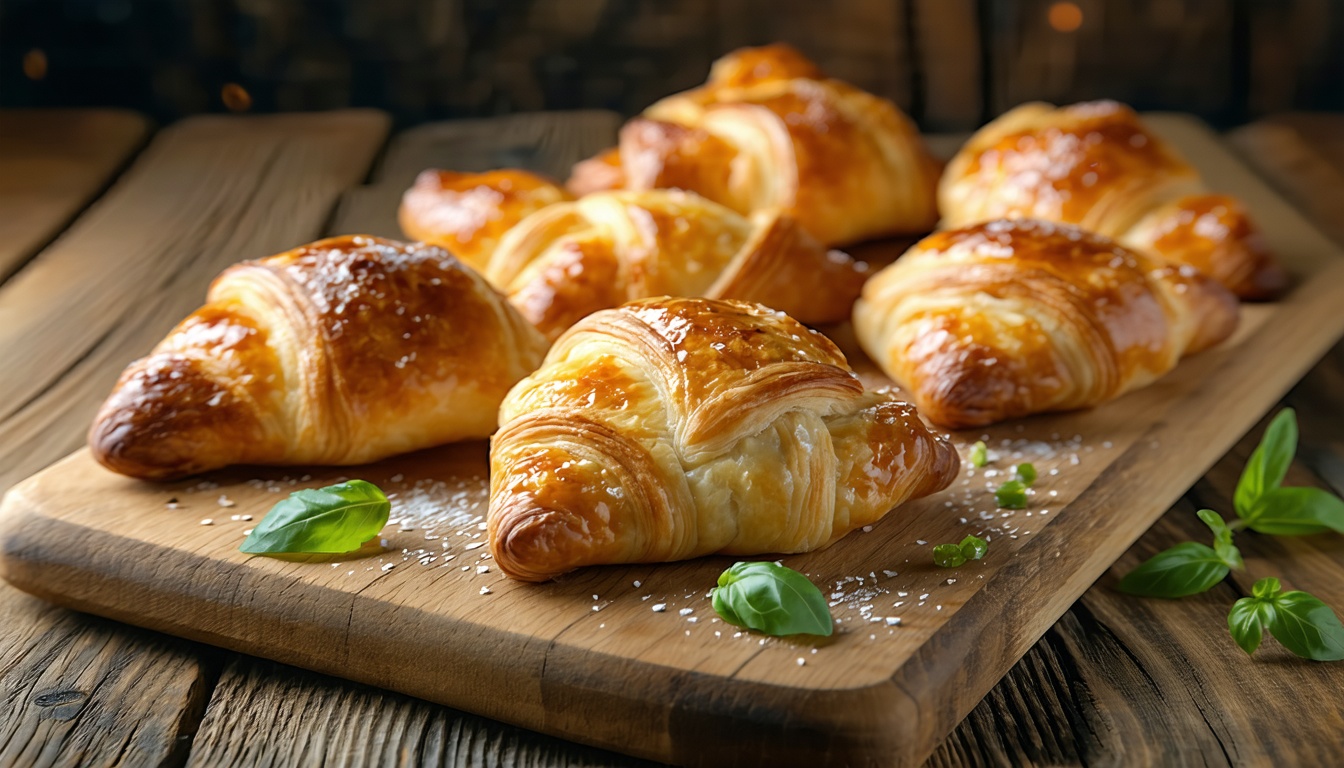
malta-pastizzi.jpg shows glazed crescent pastries garnished with basil and salt flakes on a rustic board. A pastizz is a flattened diamond, ridged along its long axis, filling visible at the open ends, sold from a paper bag for under a euro. The image is included in the recipe section only so the correction can be printed beside it, because it would otherwise teach every reader the wrong shape for the national snack.
Missing slots
The numbered series runs 02- to 10- with 01 missing. Around forty plausible names for a slot-01 hero were tested and none exists. The old live page referenced eight images; probing found a ninth (08-maltese-balconies) that the old page never used, which is a reminder that the old pages are not a reliable index of what is in the bucket.
How this list was made
By systematic HTTPS probing, because the AWS connection has been unavailable for three consecutive countries now. Every filename pattern seen across this project was tested, including the Abkhazian set by name and every bare place-name that Malta might plausibly use. Treat this list as a minimum. A proper bucket listing is still owed for Luxembourg, Mali and Malta alike.
The verdict
Nine of nine usable, which is the first clean sweep in this remaster — and the errors that remain are of a different and more interesting class than usual. They are not wrong countries or wrong continents. They are a dome on a domeless cathedral, a canopy removed, raw fish on a plate, a fabricated drinks label, and a heap of megaliths inside a Baroque church. Precise mistakes inside accurate pictures, and each one is named above.
Support This Project 🌍
This World Travel Factbook is a labor of love – free to use for all travelers. If you find it helpful, consider supporting its continued development.