
🇲🇭 Marshall Islands at a Glance
🌍 Overview — A Country That Is Almost Entirely Ocean
The Republic of the Marshall Islands consists of 29 coral atolls and five isolated islands, made up of roughly 1,225 individual islets, scattered across about 1.9 million km² of the central Pacific. Add all the land together and you get 181 km² — less than half the area of Prague, spread across an ocean territory the size of Mexico. About 54,000 people live on it.
Almost nothing here rises more than a couple of metres. The highest natural point in the entire country is around 10 metres, and the average elevation is about two. There is no hill anywhere, no river, no stream, no spring — atoll islets are rings of coral sand on a drowned volcano, and the only fresh water is what falls from the sky and floats in a thin lens on top of the salt.
Two things then happened to this country in the twentieth century, and both were done to it rather than by it. Between 1946 and 1958 the United States detonated 67 nuclear weapons here, with a combined yield of about 108 megatons. And in the twenty-first century, the sea started rising.
Where it is
North of the equator, west of the International Date Line, about 3,900 km south-west of Honolulu and 3,200 km east of Manila. The two parallel chains that make up the country are the Ratak (sunrise) chain in the east and the Ralik (sunset) chain in the west, running roughly north-west to south-east about 200 km apart.
How the numbers work
181 km² of land, an exclusive economic zone of about 2.1 million km². The ratio of sea to land is roughly 11,000 to one. That single figure explains the fishing licences, the ship registry, the navigation tradition, the missile range and most of the country's foreign policy.
Where everyone lives
About three quarters of the population is in two places: Majuro, the capital, and Ebeye in Kwajalein Atoll. Both are crowded strips of coral a few hundred metres wide. The other 27 atolls hold a scattered, shrinking rural population, several of them with fewer than a hundred people and some now empty.
Independent, but not entirely
Sovereign since the Compact of Free Association took effect on 21 October 1986, and a UN member since 1991. Under the Compact the United States runs defence and has a veto on foreign military access; in exchange it provides funding and — unusually — the right for Marshallese citizens to live and work in the US without a visa. The currency is the US dollar.
Not a holiday destination
There is essentially no tourism industry: a few hundred leisure visitors a year, one or two hotels of international standard, and a diving scene that runs when it runs. This is not a warning, it is a description. People who come here come for the wrecks, the atolls, the anthropology or the work.
2026 in one line
President Hilda Heine opened parliament in August with an agenda of climate adaptation, maritime security, health reform and — still, seventy years on — documenting the nuclear legacy. The renewed Compact money is flowing, the Runit Dome is still there, and the sea is still rising. All of it is below.
🏷️ The Name Belongs to Somebody Else
The country is named after John Marshall, a British captain who sailed through in 1788 carrying convicts to Australia, glanced at the atolls, and moved on. The Marshallese had been living here for roughly three thousand years at that point and had their own name for the place: Aolepān Aorōkin M̧ajeļ, which is what the country calls itself in Marshallese and which translates roughly as "all of the Marshall Islands" — M̧ajeļ itself deriving from the imported name.
The language
Marshallese (Kajin M̧ajeļ) is Micronesian, part of the Austronesian family, and is spoken by essentially the entire population — one of the healthier indigenous language situations in the Pacific. It has an unusual vowel system that gives written Marshallese its distinctive look: ā, ļ, m̧, ņ, ō, ū and a spelling that was standardised only in 1976 and is still not universally used.
Two chains, two dialects
Rālik and Ratak differ enough in vocabulary and pronunciation that Marshallese people can place each other by ear. Ratak means sunrise and Rālik sunset — the chains are named for where the sun is relative to the other one, which is the sort of naming a seafaring people does.
English, and where it sits
English is the second official language, universal in government, and the language of most schooling after the early grades. It arrived with American administration after 1944 and was reinforced by the Compact and by the enormous diaspora in the United States. Almost everyone under fifty in Majuro is functionally bilingual.
Iroij, alap, rijerbal
Marshallese society is organised around land, and land around three ranks: the iroij (paramount chiefs), the alap (lineage heads) and the rijerbal (workers on the land). Rights descend matrilineally — through the mother's line — and land cannot be bought by foreigners at all, only leased. This system predates every foreign administration and outlasted all of them.
Bwebwenato and the chiefs
The Council of Iroij, twelve traditional chiefs, sits alongside the elected parliament with an advisory role on custom and land. It has no veto, but on land questions its view is decisive in practice, because nobody else can settle them.
A country of relatives
With 54,000 people, dispersed lineages and a strong tradition of adoption and fosterage, kinship networks reach everywhere — including across the Pacific to Arkansas, Hawaii and Oregon. Marshallese public life is conducted between people who are related to each other, which shapes everything from politics to how a dispute gets settled.
🗺️ How an Atoll Works, and Why It Matters Here
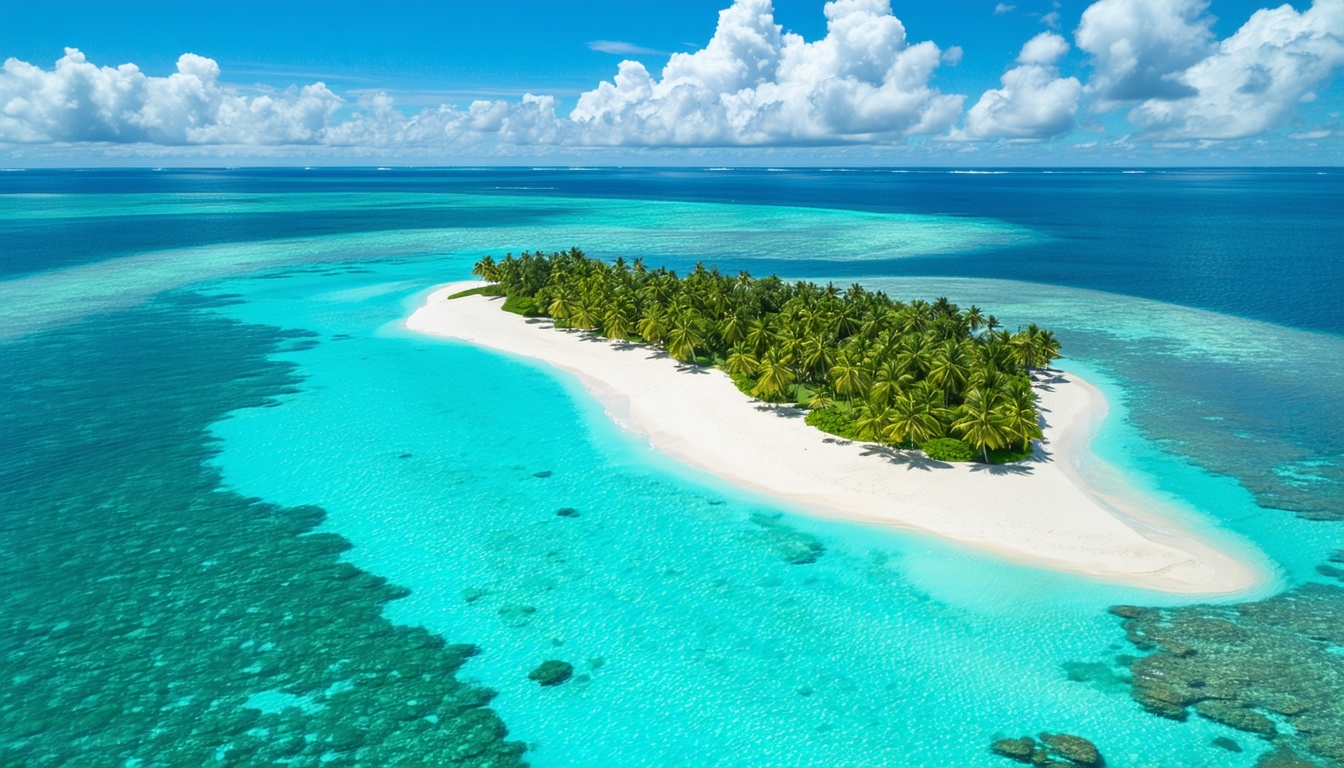
An atoll is what is left when a volcanic island sinks. The volcano subsides over millions of years; the coral reef that grew around its shore keeps growing upward to stay in the light; and eventually the mountain is gone and only the ring of reef remains, with a lagoon where the peak used to be. Sand and rubble pile on top of the reef to make low islets. That is the entire land area of this country — coral sand on a submerged mountain, held together by vegetation.
The dimensions
Kwajalein has the largest lagoon of any atoll in the world — about 2,170 km² of enclosed water, ringed by 97 islets whose total land area is 16 km². The ratio of lagoon to land is 135 to one. Majuro's lagoon is 295 km²; the islets around it are in places under 200 metres wide, with ocean on one side and lagoon on the other.
The water
There are no rivers, streams, springs or lakes. Fresh water comes from rainwater catchment — roofs, tanks, and the airport runway at Majuro, which is one of the country's principal reservoirs — and from a thin freshwater lens floating on salt water inside the coral. Drought is a national emergency, and the northern atolls get badly less rain than the southern.
The soil, or lack of it
Coral sand holds no nutrients and no water. The plants that grow are the ones adapted to it: coconut, pandanus, breadfruit, a few bananas, and swamp taro grown in dug pits enriched by hand over generations. That is the entire indigenous agricultural repertoire, and it is why everything else in a Marshallese shop arrives by ship.
The climate
Tropical, warm, humid, 27–29 °C essentially all year with almost no seasonal variation. Rainfall runs from over 4,000 mm a year in the south to under 1,000 mm in the far north. The wet season is roughly May to November. The islands sit at the southern edge of the typhoon belt — direct hits are rare but not unknown, and a tropical storm on a two-metre island is a very serious event.
King tides
The specific mechanism by which sea-level rise arrives here is not a slow creep but the king tide: the highest spring tides of the year, which now regularly push seawater across roads, into houses and into the taro pits in Majuro. Salt intrusion kills the taro and contaminates the water lens. This has already happened, repeatedly, and is the single most important physical fact about the country.
The reef
The reefs are in relatively good condition by global standards — remote, lightly fished by industrial measures, and away from river runoff. They are also the country's coastal defence: a healthy reef breaks the wave energy before it reaches the islet. Coral bleaching from warming water is therefore not only an environmental problem here but a structural one.
🧭 Reading the Ocean with Your Body
The Marshallese developed a navigation system that has no close parallel anywhere else in the world. Polynesian navigators across the Pacific read stars, birds, clouds and swells. Marshallese navigators built an entire practice around one of those things — the swell — and worked out, in detail and without writing, how ocean waves refract around and interfere between low islands you cannot see.
The physics they solved
Ocean swells travelling across open water bend around an island and re-form behind it, and where two bent swell trains meet they produce a distinctive interference pattern — a node — that points back at the land. A skilled navigator could detect land 30 km away, well over the horizon, by the pattern of the sea. Some accounts describe navigators lying in the bottom of the hull to feel the swells through the boat with their bodies.
The stick charts
Three kinds, made of palm ribs or pandanus root lashed together with coconut fibre, with cowrie shells for islands. The mattang is abstract and square — a teaching device showing how swells behave around a single island. The meddo maps a section of a chain. The rebbelib covers a whole chain or the entire archipelago.
What they are not
They are not maps in the European sense and they are not to scale. The curved ribs represent wave patterns, not coastlines or routes. And they were not carried on voyages: they were memorised on land and left behind. Each chart was personal to its maker, and the knowledge was transmitted within families under strict secrecy.
The canoes
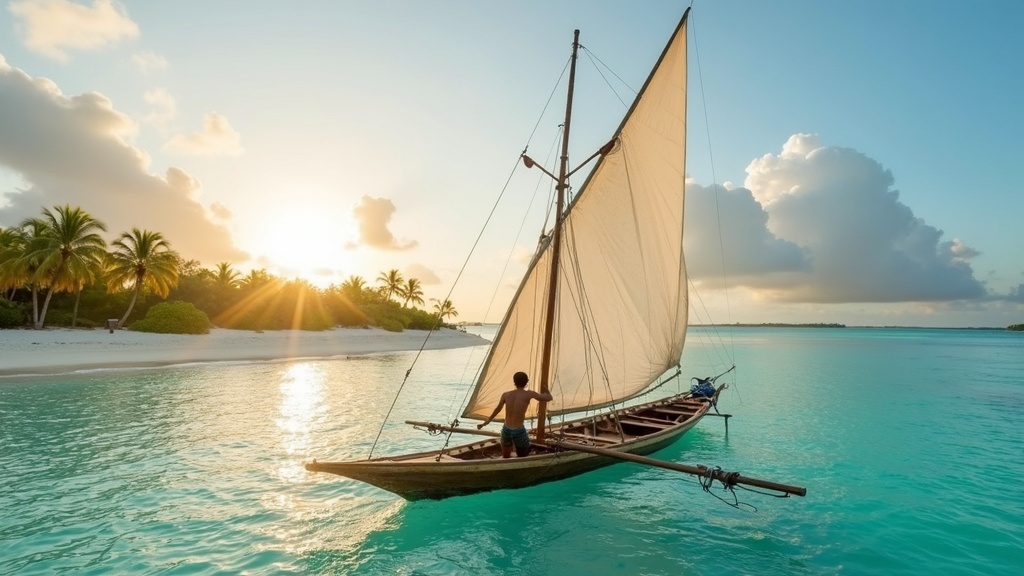
Three sizes: the korkor (small, one or two people), the tipñōl (mid-sized), and the walap (large voyaging canoe, up to 30 m). The hull is asymmetric — flat on the lee side, curved on the windward — which generates lift against leeway. Anthropologists have called the Marshallese design the most hydrodynamically sophisticated in Oceania.
Shunting, not tacking
Marshallese canoes carry a crab-claw sail set between two spars, and they do not turn around. To change direction the crew moves the sail from one end to the other, and the bow becomes the stern — the outrigger stays on the windward side at all times. Bow and stern are interchangeable by design. It is a completely different sailing logic from the European one.
Alive, just
The knowledge nearly died. Waan Aelōñ in Majel ("Canoes of the Marshall Islands") in Majuro teaches canoe building and sailing to young people as a vocational and cultural programme, and a small number of navigators still hold wave-piloting knowledge. There is also serious scientific interest: oceanographers have gone out with Marshallese navigators specifically to work out what it is they are detecting.
🚢 Three Thousand Years, Then Four Flags in Sixty
The settlement
Austronesian voyagers reached these atolls around 2000 BC, arriving from the west across open ocean in sailing canoes. To settle a coral atoll you have to bring your entire food system with you — coconut, breadfruit, pandanus, taro, pigs, chickens — and then make it work on sand. That they did this, three thousand years before Europeans could reliably cross the Atlantic, is the founding fact of the country.
Spanish sightings
Spanish ships passed in 1526 and 1529, and Spain maintained a paper claim to the archipelago for three and a half centuries without ever administering it. The islands appeared on charts and were otherwise left alone, which was the best outcome available at the time.
Germany, 1885
Germany declared a protectorate in 1885, bought out the Spanish claim after the Spanish-American War of 1898, and ran the islands from Jaluit as a copra business. German rule was thin, commercial and mostly indirect — the trading firms mattered more than the flag, and the iroij were left in place because it was cheaper.
Japan, 1914–1944
Japan seized the islands at the start of the First World War and held them under a League of Nations mandate, then in defiance of it. Japanese administration was far more intensive: schools, roads, ports, and by the 1930s substantial Japanese settlement and secret military construction. Jaluit, Kwajalein, Wotje, Maloelap and Mili became bases. Marshallese were increasingly conscripted into labour.
America, 1944 onward
The United States took the islands in 1944, administered them from 1947 as part of the UN Trust Territory of the Pacific Islands — a trusteeship whose explicit obligation was to protect the inhabitants' health, wealth and land — and used them as a nuclear test site. The contradiction between those two facts is the central issue in the country's relationship with the United States and is not resolved.
Self-government and the Compact
A constitutional government took office in 1979, and the Compact of Free Association came into force on 21 October 1986, ending the trusteeship. Amata Kabua, an iroij and the country's dominant political figure, was president from 1979 until his death in 1996. The RMI joined the United Nations in 1991.
💣 The Pacific War Came Through Here
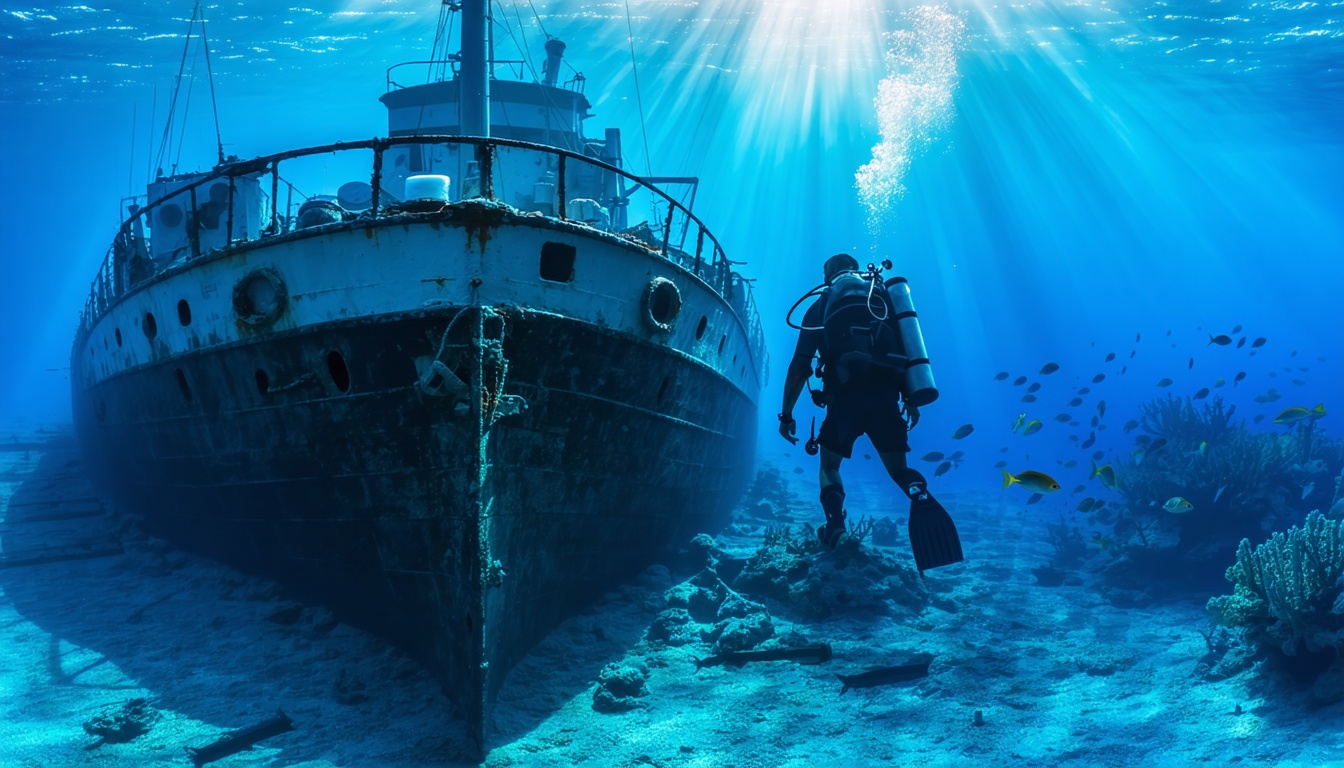
The Marshalls were the first pre-war Japanese territory the Americans took, and the campaign was short, enormously violent, and a rehearsal for everything that followed. It also left the lagoons full of steel, which is now the main reason anyone dives here.
Kwajalein, February 1944
Operation Flintlock. The US Navy fired a preliminary bombardment described by participants as the heaviest of the war to that point — Kwajalein islet was later said to look as though it had been picked up and dropped. Of a Japanese garrison of about 8,000, roughly 250 were taken alive. American losses were around 370 dead. The lessons learned here shaped the assaults on Saipan and Iwo Jima.
Enewetak, February 1944
Taken three weeks later in a five-day battle. Again the Japanese garrison was almost entirely killed. Enewetak's lagoon then became a vast US fleet anchorage — and, four years later, a nuclear test site, which meant the same population was displaced twice in a decade for two different American purposes.
The bypassed garrisons
The Americans did not take Mili, Maloelap, Wotje and Jaluit. They cut them off and bombed them for eighteen months instead. The Japanese garrisons — and the Marshallese living among them — starved. Mili's garrison of around 5,000 lost most of its strength to hunger and disease. This part of the war is barely known outside the islands and is remembered vividly inside them.
What is on the bottom
Wrecked ships and aircraft in the lagoons at Kwajalein, Mili, Jaluit, Maloelap and Wotje: Japanese transports, freighters, submarines, Zeros, Betty bombers, plus American aircraft. Kwajalein's wrecks are accessible but the atoll is a US Army installation with restricted access. Mili and Maloelap have wrecks in shallow water and almost no visitors at all.
The Marshallese in it
Islanders were conscripted as labour by the Japanese, bombed by the Americans, and starved by the blockade. A number acted as coastwatchers and guides for US forces at considerable risk. Several hundred Marshallese civilians died. The war is a living memory in families, and the physical debris — bunkers, guns, concrete — is on almost every atoll that had a garrison.
Amelia Earhart
There is a persistent local and conspiratorial tradition that Earhart and Fred Noonan came down at Mili in 1937 and were taken by the Japanese to Saipan. Marshallese elders have given consistent accounts for decades, and a 1937 Marshall Islands postage stamp commemorates the story. No physical evidence has ever confirmed it, and the mainstream view remains that they were lost at sea near Howland.
☢️ Sixty-Seven Bombs
Between 1946 and 1958 the United States detonated 67 nuclear weapons at Bikini and Enewetak atolls, with a combined explosive yield of approximately 108 megatons. Spread evenly across the twelve years of testing, that is the equivalent of about 1.6 Hiroshima-sized bombs every single day, for twelve years, in a country whose entire land area is 181 km² and whose population at the time was around 11,000.
This is not background history. It determines the country's politics, its health statistics, its relationship with the United States, which atolls are inhabited, and what is in the water. Everything else on this page sits on top of it.
The Bikini removal, 1946
In February 1946 Commodore Ben Wyatt, the US military governor, asked the 167 people of Bikini to leave so that the United States could test bombs "for the good of mankind and to end all world wars". King Juda replied that if the United States and God wished it, they would go. They were moved to Rongerik, an atoll with a smaller lagoon and fish that made them ill, where they began to starve. They were moved again, then again, and finally in 1948 to Kili — a single island with no lagoon and no safe anchorage, which for a seafaring people is close to the worst place imaginable.
Castle Bravo, 1 March 1954
The largest weapon the United States has ever detonated: 15 megatons, at Bikini. It was expected to yield 6. The scientists had miscalculated the reactivity of lithium-7, and the fireball was two and a half times the predicted size. The wind was blowing east, toward inhabited atolls, and the shot was fired anyway.
Rongelap and Utrik
Fallout — white ash that children on Rongelap played in, thinking it was snow — fell on inhabited atolls downwind. Rongelap's 64 people were not evacuated for two days; Utrik's for three. Acute radiation sickness followed within hours: burns, hair loss, vomiting. Thyroid disease, thyroid cancers, leukaemia, miscarriages and severe birth defects followed over the decades.
Project 4.1
Within days of Bravo, the exposed Rongelap population was enrolled in a US medical study, Project 4.1, formally titled a study of the response of human beings exposed to significant beta and gamma radiation. Marshallese have argued ever since that they were treated as research subjects rather than as patients. The programme's own documents make the study framing explicit, and the resulting mistrust of American medicine in the islands is profound and rational.
Rongelap, twice abandoned
The islanders were returned to Rongelap in 1957 and told it was safe. It was not: caesium-137 in the soil entered the food chain through coconuts and pandanus. In 1985, no longer believing American assurances, the entire community asked Greenpeace to evacuate them, and the Rainbow Warrior moved 300 people and their houses to Mejatto. Three months later French agents sank that ship in Auckland harbour, for unrelated reasons.
The Lucky Dragon
The Japanese tuna boat Daigo Fukuryū Maru was 130 km from Bikini when Bravo fired and was covered in fallout. Its radio operator, Aikichi Kuboyama, died six months later. The incident caused a diplomatic crisis, launched the global anti-nuclear movement, and directly inspired Godzilla, released later that same year.
🪦 The Dome With No Floor
On Runit Island at Enewetak Atoll there is a shallow concrete dome about 115 metres across, sitting in a crater made by a nuclear test. Under it are roughly 85,000 cubic metres of radioactive soil and debris, scraped up from six islands during a clean-up between 1977 and 1980. Marshallese call it the Tomb. It is possibly the most consequential structure in the Pacific and one of the least visited.
How it was built
US servicemen — around 4,000 of them, largely without protective equipment, and many of whom have since fought their own battle for recognition — bulldozed contaminated topsoil into the Cactus crater, mixed it with cement, and capped it with a concrete shell about 45 cm thick. The work was budgeted at a fraction of what a proper containment would have cost, and it shows.
What is wrong with it
The crater was never lined. The dome sits directly on porous coral rubble, below the water table, with seawater moving freely through the bottom of it. It was designed as an interim measure with an expected life measured in decades, and it is now over forty-five years old, cracked, and surrounded by a sea that is rising.
The Nevada shipment
Enewetak did not only receive Enewetak's waste. In 1979, 130 tonnes of plutonium-contaminated soil from the Nevada Test Site was shipped across the Pacific and put in the dome. The Marshallese government was not told at the time. It found out decades later, from declassified documents.
The uncomfortable complication
Department of Energy monitoring reports make an awkward point: the lagoon sediment around Runit already contains far more plutonium than the dome does — some estimates put it at a hundred times more — deposited directly by the tests themselves. That is not an argument that the dome is fine. It is an argument that the contamination problem is much larger than the dome, and that fixating on the concrete misses the scale.
Who is responsible
This is the live dispute. The United States maintains that the 1986 Compact settled all nuclear claims and that the dome, once handed over, became the RMI's property and problem. The RMI maintains that a country of 54,000 people cannot possibly be responsible for containing American plutonium, that the settlement was made without full disclosure of what had been done, and that the Nevada shipment alone proves the point.
Where it stands in 2026
The renewed Compact preserves the RMI's right to bring a Changed Circumstances Petition — a formal mechanism for reopening nuclear claims in light of information not available in 1986 — and obliges the US to discuss nuclear claims when the RMI asks. Sector grants now include funds for Enewetak's development. Nobody has committed to rebuilding the dome. Documenting the nuclear legacy was one of the four priorities President Heine set out to parliament in August 2026.
🤝 The Compact, and What It Buys Both Sides
The Compact of Free Association is the treaty that defines this country's existence. Signed in 1982, in force from 1986, amended in 2003 and renewed again in 2023 — signed into US law in March 2024 — it is a genuinely unusual arrangement that gives each side something it could not get otherwise.
What the RMI gets
Direct budget and sector grants plus trust-fund contributions totalling roughly $2.3 billion over 2024–2043 (part of about $7.1 billion across the three Freely Associated States). Access to a range of US federal programmes. Postal, weather and aviation services. And the right for Marshallese citizens to live, work and study in the United States indefinitely without a visa — the provision that matters most to ordinary people.
What the US gets
Exclusive military access to the entire country and its 2.1 million km² of ocean, and a defence veto: the RMI cannot grant military access to any third country without American consent. In a Pacific where China is signing security agreements, that clause is the reason the renewal passed Congress. It also gets the Reagan Test Site at Kwajalein, for which there is no substitute anywhere.
The dependency problem
Compact transfers are the largest single component of the economy, and a large share of formal employment is either government or Compact-funded. This is a structural dependence that every RMI government has said it wants to reduce and none has reduced. The trust fund is meant to eventually replace the grants; whether it will be large enough is genuinely uncertain.
The Medicaid gap, closed
For twenty-two years, from the 1996 US welfare reform until 2020, Marshallese living legally in the United States under the Compact were excluded from Medicaid — a population with among the highest diabetes rates in the world, legally resident, working and paying taxes, with no health coverage. Eligibility was restored in December 2020, and the damage done in those two decades is measurable in amputations and deaths.
The nuclear provisions
The 1986 Compact's Section 177 established a Nuclear Claims Tribunal and a $150 million settlement fund, and declared it the "full settlement" of all nuclear claims. The Tribunal went on to award more than $2.3 billion in personal-injury and land-damage claims. The fund ran out. Less than 4% of the awards were ever paid.
What renewal did not settle
The renewed Compact provides money and preserves the petition mechanism but does not reopen the Section 177 settlement, does not accept US responsibility for Runit, and does not fund the tribunal awards. From the Marshallese side the nuclear question remains open. From the American side it was closed in 1986. That gap is the whole relationship.
🏛️ How the Country Is Governed, and 2026
A parliamentary republic with a president who is head of both state and government, elected by parliament from among its own members. Parliament — the Nitijeļā — has 33 members from 24 electoral districts, elected for four-year terms. There is a separate Council of Iroij, twelve traditional chiefs, with an advisory role on custom and land.
Politics without parties
There are no political parties in the European sense. Loose groupings — Aelōñ Kein Ad and Kien Eo Am among them — form and dissolve around individuals and issues, and governments are assembled by negotiation after the election rather than declared before it. Votes of no confidence are a live feature of Marshallese politics rather than a theoretical one.
Hilda Heine
President since January 2024, and previously from 2016 to 2020 — the first woman to lead any Pacific island nation. A former teacher and educator with a doctorate in education, she survived a no-confidence vote in her first term and returned to office after the 2023 election. She is one of the most recognisable Pacific voices in international climate negotiations.
The August 2026 agenda
Opening parliament, Heine set out four priorities: climate adaptation and resilient infrastructure; maritime surveillance and security, including drug-trafficking interdiction; health and education reform; and renewed effort to document the legacy of US nuclear testing. She also asked the country to prepare for shifting El Niño conditions — possible drought in the northern atolls, heavier rain in Majuro and the south.
RMIS Jelmae
A patrol vessel donated by Australia under the Pacific Maritime Security Program, now operating for fisheries enforcement and surveillance across an ocean territory larger than most countries. For a state with 54,000 people policing 2.1 million km² of sea, a single hull is a meaningful increase in capability, which tells you the baseline.
Foreign policy that punches up
The RMI recognises Taiwan, one of a shrinking number of states that do, and has held that position through considerable pressure. It led the High Ambition Coalition at the 2015 Paris talks — foreign minister Tony de Brum, a Marshallese who watched Castle Bravo from a fishing canoe at the age of nine, was central to getting the 1.5 °C target into the agreement. He died in 2017. In 2014 the RMI sued nine nuclear-armed states at the International Court of Justice over their disarmament obligations; the cases were dismissed on jurisdiction in 2016.
Governance problems
Small-state problems, honestly stated: a very thin civil service, heavy donor dependence, difficulty retaining trained staff who can simply move to the United States, and recurring audit findings on the management of grant funds. Public-sector reform was on Heine's 2026 list for a reason.
🏙️ Majuro — A Capital City 200 Metres Wide
Majuro Atoll is a ring of 64 islets around a 295 km² lagoon, and the capital occupies the eastern end of it: three formerly separate islets — Delap, Uliga and Djarrit, universally known as DUD — now joined into one continuous urban strip by causeway and landfill. About 28,000 people live along it. In places you can stand on the single road and see ocean on one side and lagoon on the other without turning your head far.
The one road
A single main road runs about 50 km around the eastern arc of the atoll, from Rita at the north-eastern tip through DUD, past the airport, out to Laura at the western end. There is one road because there is only room for one road. Shared taxis run up and down it constantly for a dollar or two; you flag one and get in with whoever is already there.
Laura
The western end of the atoll, about 45 minutes from town: wider, greener, with actual soil, real breadfruit and taro cultivation, the country's best swimming beach and the closest thing to a rural landscape on the atoll. It is where Majuro people go at the weekend, and it is genuinely lovely.
The Alele Museum
The national museum and archive in Uliga: stick charts, canoe models, shell and fibre work, historical photographs, and the country's documentary record. It is small, under-resourced, and by a distance the most important cultural institution in the country. Go early in your stay — everything else makes more sense afterwards.
The airport runway
Amata Kabua International Airport's runway is not only an airstrip: it is one of Majuro's largest rainwater catchments, draining into reservoirs that supply the town. It is a neat and slightly alarming illustration of what it means to have no natural fresh water at all.
Living there
Costs are high because everything arrives by ship. Power is diesel. Internet arrived by submarine cable and is decent in town. There is a hospital, a college, a handful of hotels and restaurants, and a working port. There is also visible poverty, crowded housing, and a waste problem that a coral islet cannot solve by burying.
The sea, in town
King tides push water across the road, into the graveyards along the ocean shore, and into ground-floor rooms. Majuro has flooded repeatedly in the last fifteen years. This is not projected; it is the recent past, and it happens on a strip of land with nowhere to retreat to.
🎯 Kwajalein and Ebeye — Five Kilometres and Another World
Kwajalein Atoll encloses the largest lagoon of any atoll on earth. The United States Army runs the southern end of it as US Army Garrison–Kwajalein Atoll and the Ronald Reagan Ballistic Missile Defense Test Site. Five kilometres north, on an islet of 0.36 km², is Ebeye, where the Marshallese workforce lives. The contrast between the two is the sharpest thing in the country and it is not subtle.
What the test site does
Intercontinental ballistic missiles are launched from Vandenberg in California and fly 7,500 km to splash down in Kwajalein lagoon, where an extraordinary array of radars and optical instruments measures them. The site also does space-object tracking and deep-space surveillance, and it is a launch site in its own right — SpaceX flew its first successful Falcon 1 from Omelek islet in the atoll in 2008.
Kwajalein islet
American, and comfortable: lawns, a golf course, a cinema, a school, bicycles instead of cars, and a standard of living roughly that of a small American town. Access is by military authorisation only. Non-residents cannot simply visit, and Marshallese workers who commute in are subject to controls that many of them find humiliating.
Ebeye
Between 9,000 and 15,000 people live on 0.36 km² — a density that at times exceeds 25,000 per square kilometre, among the highest anywhere in the world. It exists because the Army needed a labour force nearby but not on the base, and because people displaced from the northern atolls by the nuclear tests had nowhere else to go. It has been called "the slum of the Pacific", and the phrase originated with people who worked there rather than with critics from far away.
Water, power, health
Ebeye's infrastructure has repeatedly failed: water and power outages, a major cholera outbreak in 2000, high tuberculosis rates, and a hospital that struggles. There has been substantial investment since — Compact funds, an Asian Development Bank water project — and conditions have improved from a very low base. Nobody involved describes the situation as solved.
The rent
The United States pays for the Kwajalein land lease, and the money goes to the landowners — the iroij and the lineages holding rights in those islets — under Marshallese custom. The distribution of that money between chiefs and ordinary residents has been contested for decades and produced the Operation Homecoming sail-ins of the early 1980s, when landowners occupied their own islets in protest. Some of the underlying arguments have never been settled.
Why it stays
Because the geometry cannot be replicated. A 2,170 km² lagoon at exactly the right range from California, in a country bound by treaty to allow it, is not something the United States can build elsewhere. This is the single largest reason the Compact was renewed, and both sides know it.
🏝️ Bikini — The Most Famous Empty Place in the Pacific
Bikini Atoll is a UNESCO World Heritage Site, inscribed in 2010, and essentially nobody lives there. Its people were removed in 1946, moved four times, and have not been able to return. The atoll is inscribed not for its beauty but as evidence — UNESCO's citation describes it as symbolising the dawn of the nuclear age and bearing direct testimony to a power of enormous destructive force.
What is in the lagoon
The target fleet from Operation Crossroads (1946) and the later tests, sunk where they were moored: the aircraft carrier USS Saratoga, upright with her flight deck at about 40 m and aircraft still in the hangar; the Japanese battleship HIJMS Nagato, flagship at Pearl Harbor, lying inverted at 52 m; the battleship USS Arkansas; the submarine USS Apogon. It is arguably the greatest wreck-diving site in the world.
And why almost nobody dives it
Depth. These are 45–55 metre technical dives requiring mixed gas, staged decompression and formal training, on an atoll with no recompression chamber and no rapid evacuation. Diving operations restarted in 1996, halted in 2008 when the air service failed, and have run only sporadically since. Check before making any plan that depends on it.
The radiation, honestly
Walking on Bikini for a short visit delivers a modest external dose — comparable to background elsewhere. The problem is food: caesium-137 in the soil is taken up by coconut and pandanus, so anything grown there is unsafe to eat over the long term. That is precisely why resettlement has failed: you can visit Bikini, but you cannot live off it.
The Bikinians now
Scattered — on Kili, on Ejit in Majuro, and increasingly in the United States. Kili has no lagoon and no anchorage, so for months of the year rough seas cut it off entirely, and it now floods. The Bikini community's resettlement trust fund has been drawn down and disputed. Eighty years after being asked to leave "for the good of mankind", they have not gone home.
The swimsuit
Four days after the first Crossroads test, in July 1946, the French designer Louis Réard named his new two-piece the bikini, wanting a word for something explosive and much talked about. The garment is now considerably better known worldwide than the atoll, the tests or the people who were removed. Marshallese views on this range from weary to unprintable.
Enewetak, the other one
Less famous, more tested: 43 of the 67 detonations happened at Enewetak, including Ivy Mike in 1952, the first true hydrogen bomb, which removed the islet of Elugelab from the map entirely. Some Enewetak people have returned to the southern islets, living with restrictions on what they may grow and eat, and with Runit a few kilometres away.
⛵ The Other Twenty-Seven
Beyond Majuro and Kwajalein lies the rest of the country: atolls reached by a government field-trip ship that runs on a schedule best described as intentional, or by Air Marshall Islands when its aircraft are serviceable. Populations range from a few hundred down to a dozen. This is where Marshallese life is least changed and hardest to reach.
Arno
The closest, and the easiest: a boat ride of about an hour from Majuro across open water. Arno has a reputation across the Pacific for its historical schooling of young women in sexual technique — a genuine ethnographic record that has been retold abroad with a great deal of embellishment. It also has excellent fishing, good beaches and no infrastructure at all.
Jaluit
The old capital under both Germany and Japan, and the most historically layered atoll in the country: colonial-era ruins, a Japanese seaplane base, sunken vessels, and the wreckage of the administrative centre that Typhoon Ophelia flattened in 1958. It has a UNESCO-designated conservation area and a small population.
Mili and Maloelap
The bypassed Japanese garrison atolls. Both have airfields, bunkers, coastal guns, and aircraft and ship wrecks in shallow, divable water — a Betty bomber at Maloelap sits in a few metres. There is essentially no tourism infrastructure on either. If you get there, you will be one of very few people who has.
Likiep
The atoll with the country's highest natural point (about 10 m) and an unusual history: in the 1870s two traders, the Portuguese José deBrum and the German Adolph Capelle, bought the whole atoll from its iroij — the only atoll in the country in private hands. The deBrum copra plantation house and its collection of nineteenth-century photographic plates survive as one of the Pacific's more remarkable historical sites.
Bikar, Bokak and Rongerik
Uninhabited and effectively pristine: some of the least disturbed coral atoll ecosystems left anywhere, with enormous seabird colonies and green turtle nesting. Bokak in particular has been proposed repeatedly for the highest levels of protection. Getting there requires a boat, permission and a purpose.
Getting to any of them
Air Marshall Islands flies to a number of outer atolls when its aircraft are flying, which is not always. The government field-trip ships carry cargo and passengers on circuits of several weeks. Either way you need permission from the local council and, in practice, an invitation. Turning up unannounced on an outer atoll is not how this works.
🌊 A Two-Metre Country in a Rising Sea
This is the part of the Marshall Islands story that will decide whether there is a Marshall Islands. The average elevation is about two metres. There is no higher ground to move to, because there is no higher ground. Under mid-range scenarios much of the country becomes uninhabitable during this century — and crucially, not because it is underwater, but for two reasons that arrive considerably sooner.
Fresh water goes first
The freshwater lens inside a coral islet is thin and sits on salt water. Higher sea levels and wave overwash push salt into it. A 2018 US Geological Survey study concluded that many atoll islands will become uninhabitable within decades — by the 2030s to 2060s depending on emissions — because the drinking water fails, long before the land itself disappears. The islet is still there; you just cannot live on it.
Then the food
Salt intrusion kills the taro pits, which take generations of hand-enrichment to build. Breadfruit and pandanus suffer. What replaces them is imported rice, tinned meat and instant noodles, which is both a food-security problem and a public-health catastrophe already in progress.
The waves, not the level
The damage arrives as wave overwash during king tides and storms, not as a gradual submergence. Majuro has flooded repeatedly. This is why sea-level graphs understate the problem: a 30 cm rise on a two-metre island with 1.5-metre waves is not a 30 cm problem.
Raising the land
The RMI's National Adaptation Plan, adopted in 2023, is unusually blunt: it explicitly contemplates elevating and reclaiming land to keep parts of the country habitable, alongside coastal protection and, if necessary, planned relocation. It is one of the very few national adaptation plans that openly discusses building a country higher, and it costs money the RMI does not have.
The moral position
The Marshall Islands emits a rounding error of global greenhouse gases and stands to lose everything. That asymmetry is the basis of its diplomacy: it led the High Ambition Coalition that put 1.5 °C into the Paris Agreement, and it has pressed hard on loss and damage. It argues, correctly, that 1.5 and 2 degrees are not two similar targets but the difference between a country existing and not.
The statehood question
If a country's territory becomes uninhabitable, does it remain a state? Does it keep its 2.1 million km² exclusive economic zone — worth real money in fishing licences — and its UN seat? The RMI and other Pacific states have pushed the position that maritime baselines, once established, should be fixed regardless of what the coastline does. This is now a live question in international law, and the Marshall Islands is one of the reasons it is being asked.
👥 A Nation Half Abroad
Roughly 54,000 people live in the Marshall Islands, and the number is falling — not because of deaths but because of departures. The Compact allows Marshallese to move to the United States freely, and tens of thousands have. Estimates of the US-resident Marshallese population run to 30,000 or more, which means a very large share of the nation now lives somewhere else.
Springdale, Arkansas
The largest Marshallese community outside the islands — over 15,000 people in north-west Arkansas, mostly working in poultry processing. It began with one man, John Moody, who arrived in the 1980s; the rest followed through family networks. Springdale has a Marshallese consulate, Marshallese churches, Marshallese radio and a Marshallese-language section in the public schools.
Why people go
Wages, healthcare and education, in that order. Average income in the RMI is under $10,000 a year against a high cost of living, formal jobs are scarce, and secondary and tertiary education is limited. Emigration is a rational individual decision that adds up to a national problem: the country loses its trained nurses, teachers and administrators to a labour market it cannot compete with.
Religion
Overwhelmingly Christian, and the church is the central social institution — the United Church of Christ descends from the American Board missionaries who arrived in 1857, alongside Assemblies of God, Catholics, Latter-day Saints and others. Church choirs are extraordinary; Marshallese four-part harmony singing is one of the best things in the country and is genuinely worth arranging your Sunday around.
Family and adoption
Kōkajriri — the customary fostering and adoption of children between relatives — is normal, widespread and not regarded as remarkable. Extended households are the norm and obligations to relatives are extensive. This is also the mechanism by which the diaspora and the islands stay connected: money, goods and children move both ways.
Health, plainly
Among the world's highest rates of type 2 diabetes, with adult prevalence estimated around 30% and in some surveys higher; the highest tuberculosis incidence in the Pacific; high rates of obesity, hypertension and rheumatic heart disease. The causes are a dietary shift to imported processed food, limited healthcare capacity, and — for the exposed populations — the radiological legacy on top.
Women
Land rights descend through the female line and senior women hold real authority in lineage matters, which coexists with a modern gender gap in formal politics and with high rates of domestic violence recorded in national surveys. Both things are true at once. Hilda Heine's presidency was a genuine landmark in a Pacific region that had never had a woman head of state.
🪢 Weaving, Singing and the Stick Dance
Weaving
Marshallese fibre work — from pandanus leaf and coconut fibre — is among the finest in the Pacific: sleeping mats, fans, baskets, the jaki-ed (a finely woven mat historically worn as clothing, revived in recent decades after nearly disappearing), and the ubiquitous amimono shellwork sold in Majuro. Buying directly from the women's handicraft co-operatives puts the money where it belongs.
The stick dance
Jebwa, danced by men with sticks in interlocking rhythmic patterns, is the best-known Marshallese dance and is genuinely striking to watch. It was suppressed by missionaries as pagan and survived in part in secret. It is now performed at national occasions and taught deliberately to young people.
Singing
The single most impressive living art form in the country. Marshallese church choirs sing in dense four-part harmony with a vocal power that startles visitors, and there is a competitive tradition between congregations. Kūrijmōj, the Christmas season, runs for weeks and is organised around jepta — song groups that rehearse for months and then perform in a marathon of singing and dancing that is the biggest event of the Marshallese year.
Tattoo
Traditional Marshallese tattooing was extensive, hierarchical and executed with bone combs — the designs encoded rank and lineage. It was effectively extinguished by missionaries in the nineteenth century, and what exists now is a revival based on museum drawings, photographs and elders' descriptions rather than an unbroken tradition. It is being taken seriously as cultural recovery work.
Bwebwenato
Storytelling, and the vehicle for history in a society that had no writing until the missionaries brought it. Origin stories, navigational knowledge, genealogies and land claims are all held in narrative, and the ownership of a story is itself a form of property. A great deal of what the Alele Museum holds is recorded oral material.
Handicraft as economy
Amimono is one of the very few things the country exports that is made by hand at home rather than extracted from the sea. Shell necklaces, woven fans, model canoes and jaki-ed mats are sold in Majuro, through the diaspora and online. It is small money, and it is money that reaches households directly.
🍽️ Coconut, Breadfruit, Pandanus, Fish — and a Great Deal of Tinned Meat
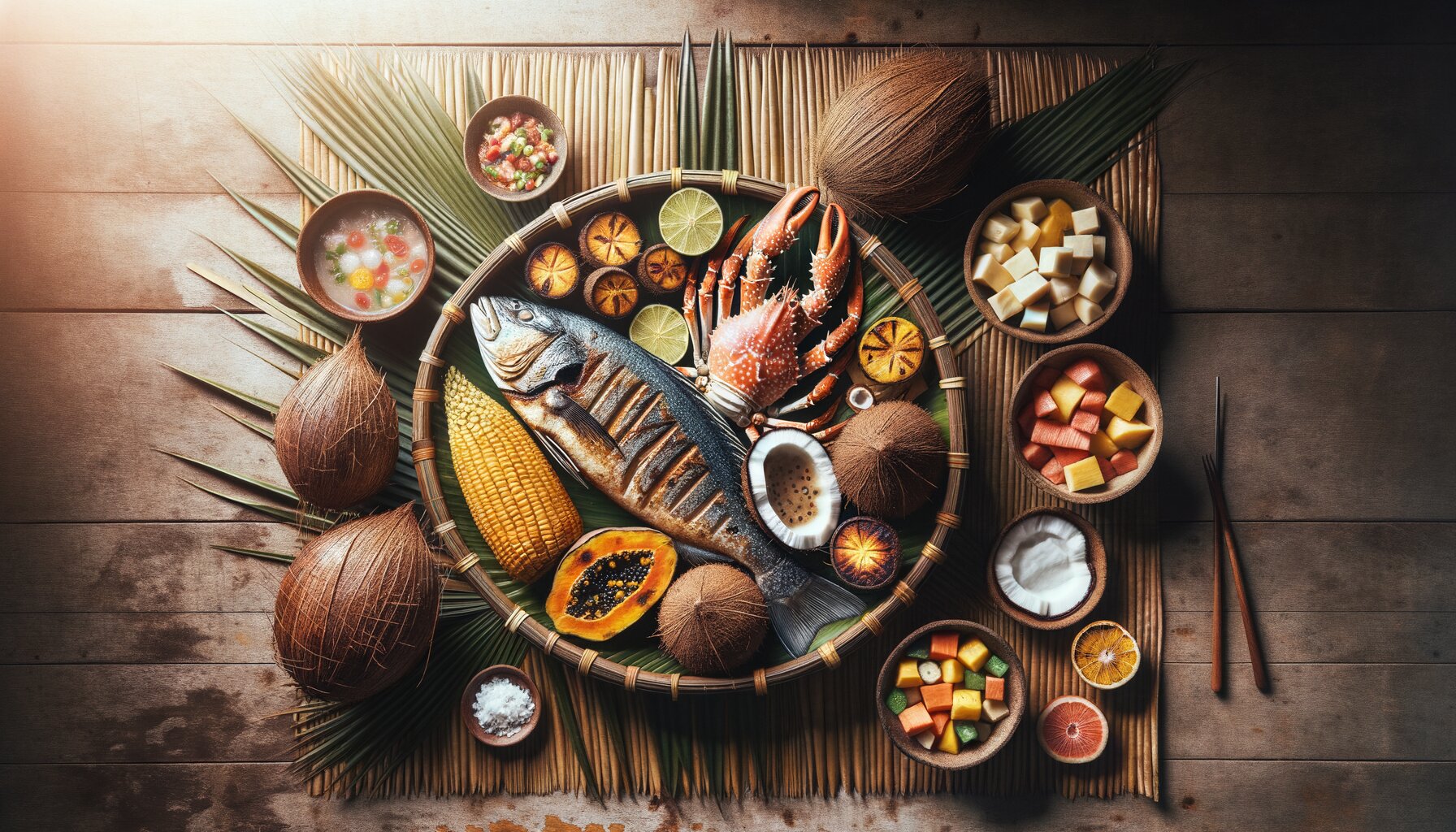
Traditional Marshallese food is one of the most constrained cuisines in the world, because the ingredients available on a coral atoll are almost nil: coconut, breadfruit, pandanus, arrowroot, swamp taro, banana, and whatever the reef and the ocean give up. What Marshallese cooks did with that is genuinely inventive, and it revolves around preserving food for months on an island where nothing keeps.
The modern reality is different and has to be stated: most calories in Majuro and Ebeye today come from imported white rice, tinned fish and meat, instant noodles, flour and sugar. This is the direct cause of the diabetes emergency, and it is not a matter of taste but of what a ship brings and what people can afford.
Bwiro
The centrepiece of the traditional system. Very ripe breadfruit is peeled, cored, pounded to a paste, wrapped tightly in banana or breadfruit leaves and buried or stored to ferment for weeks or months. It keeps a breadfruit harvest through the lean season, and it is then baked, often with coconut cream. It is sour, dense and an acquired taste that Marshallese acquire in childhood.
Jāānkun
Ripe pandanus keys are crushed and squeezed for their vivid orange juice, which is simmered down to concentrate the sugars, thickened with arrowroot or tapioca starch, enriched with coconut cream and set into a soft paste, sometimes moulded and cut into bars. Honeyed, slightly tangy, and one of the few genuinely distinctive tastes of the country.
Chukuchuk
Balls of cooked rice rolled in freshly grated coconut. Simple, ubiquitous, and served at every celebration — weddings, birthdays, first-birthday kemem parties, funerals. If you are offered food anywhere in the Marshall Islands, there is a good chance this is it.
Fish, and how it is cooked
Reef fish, tuna, jacks, and the excellent lagoon crab and lobster. The characteristic preparation is wrapped in leaves and baked, in an earth oven or over coals, or simmered in coconut cream. Raw fish in coconut and lime exists here as everywhere in the Pacific. Seasoning is minimal: coconut, salt, sometimes seawater. There is no chilli tradition and essentially no herb tradition.
Iu and makmōk
Iu is the sprouted coconut — when a nut germinates, the interior fills with a spongy, sweet, faintly fizzy mass that is eaten with a spoon and is one of the great snacks of the Pacific. Makmōk is arrowroot starch, laboriously grated, washed and settled out, used as a thickener and made into a pudding.
Macadamia nut pie
A modern outlier and genuinely the national dessert: a coconut pastry shell filled with macadamias in a sugar-and-syrup custard. The macadamias are imported; the coconut is not. It turns up at every official function and is very good.
👨🍳 Two Recipes You Can Actually Make
Both of these are real Marshallese dishes, chosen because they can be made outside the Pacific. Anything built on fresh breadfruit or ripe pandanus keys is, realistically, not reproducible in Central Europe.
Chukuchuk — Coconut Rice Balls
Makes about 20 · 30 min · the celebration food of the Marshall Islands
Ingredients: 500 g short-grain or medium-grain white rice; 700 ml water; ½ tsp salt; 1 whole fresh coconut, or 200 g unsweetened desiccated coconut; optionally 2 tbsp sugar if you want the sweet version.
Method: Cook the rice with the water and salt until it is soft and distinctly sticky — you want it wetter than you would serve as a side dish, because it has to hold together. Let it cool until you can handle it. Meanwhile crack the coconut, prise out the flesh, peel off the brown skin and grate it finely; if you are using desiccated coconut, sprinkle it with 3–4 tablespoons of warm water and let it stand ten minutes so it softens and stops being dusty. Wet your hands, take a heaped tablespoon of rice, roll it into a firm ball about the size of a golf ball, then roll it in the grated coconut until completely coated. Set them on a leaf or a plate. Eat within a few hours; they do not keep.
💡 Do not skip wetting your hands between balls — it is the difference between twenty neat chukuchuk and one large sticky problem. Serve alongside grilled or baked fish, which is how they are actually eaten.
marshall-islands-jadrik, but the dish shown is a chilli-spiced fried rice of the jollof or nasi-goreng family, and it does not correspond to any documented Marshallese preparation — the name does not appear in the standard accounts of the cuisine either. Rice is genuinely central to modern Marshallese eating, but it appears as plain white rice alongside fish and coconut, or rolled into chukuchuk. Chilli and heavy spicing are not part of this food culture.Ek im Waini — Fish Baked in Coconut Cream
Serves 4 · 15 min prep · 30 min cooking · the everyday Marshallese way with fish
Ingredients: 4 whole reef-type fish of about 300 g each (snapper, sea bream or similar), scaled and gutted — or 700 g of firm white fillets; 400 ml thick coconut cream (the first pressing, or good tinned cream rather than thin milk); 1 onion, sliced; 1 lime; salt; banana leaves if you can get them, otherwise baking parchment and foil.
Method: Score the fish two or three times on each side and salt them inside and out. Lay each one on a banana leaf (or a doubled sheet of parchment), scatter over some onion, pour on a generous few tablespoons of coconut cream, and squeeze on a little lime. Fold the leaf into a tight parcel and tie it, or fold the parchment and wrap the whole thing in foil. Bake at 190 °C for about 25–30 minutes, or cook the parcels over coals, turning once. Open a parcel to check: the flesh should come cleanly away from the bone. Serve with plain rice or chukuchuk and spoon the coconut cream from the parcel over everything.
💡 The point is the parcel. It keeps every drop of moisture and coconut fat with the fish and makes the flesh silky rather than dry — the same principle as the earth oven, scaled down to a kitchen.
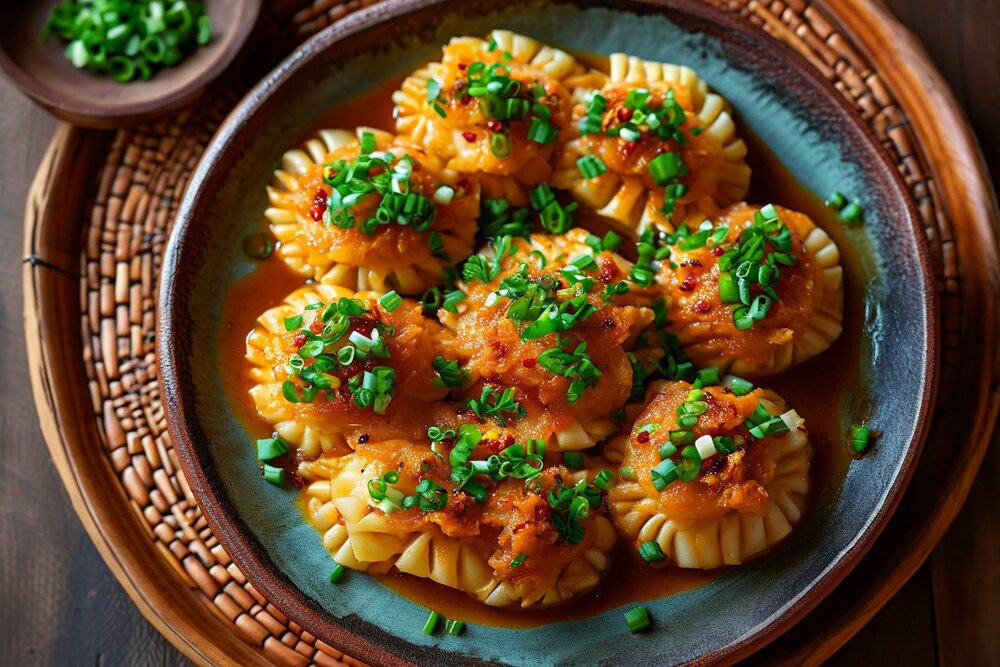
pinikei does not appear in any standard account of the cuisine. Whatever this file is, it is not Marshallese food, and it is shown here only so the record is explicit.🏥 The Health Emergency, Stated Plainly
It would be dishonest to write a guide to this country that skipped past its health situation, because it is severe, it is largely externally caused, and it shapes daily life. Two of the three causes are directly traceable to decisions made elsewhere.
Diabetes
Adult prevalence of type 2 diabetes is estimated at around 30% and in some surveys higher — placing the Marshall Islands consistently among the two or three worst-affected countries on earth. Complications are common and often advanced at diagnosis: amputations, blindness, renal failure. The immediate cause is a diet shifted almost entirely to imported refined carbohydrate and fat within two generations.
Tuberculosis
The highest incidence in the Pacific and among the highest outside sub-Saharan Africa and South-East Asia — driven by crowded housing, especially on Ebeye, and by diabetes, which substantially raises TB risk. The two epidemics feed each other. Screening campaigns have found large numbers of previously undiagnosed cases.
The radiological burden
Thyroid nodules and cancers, leukaemias and other malignancies at elevated rates among the exposed populations of Rongelap, Utrik and their descendants. The US Department of Energy runs a long-standing medical monitoring programme for a defined set of affected communities, which many Marshallese regard with justified suspicion given how such programmes began.
The system
One referral hospital in Majuro, one on Ebeye, dispensaries on the outer atolls staffed by health assistants, and referral abroad — to the Philippines, Hawaii or Guam — for anything serious, at a cost that consumes a large share of the health budget. Retaining trained Marshallese staff is very hard when every nurse can move to the United States without a visa.
The Medicaid decades
From 1996 to 2020, Marshallese lawfully resident in the United States under the Compact were ineligible for Medicaid. A population with world-leading diabetes rates, legally present and working, spent twenty-four years without health coverage. Springdale's clinics and churches carried what they could. Eligibility was restored in December 2020; the excess mortality from that period is not recoverable.
What is being done
Health reform was one of the four priorities President Heine set out to parliament in August 2026. There are diabetes screening and outer-atoll outreach programmes, a national NCD strategy, and food-policy discussion around import duties on sugary drinks. None of it changes the fundamental problem, which is that a country with no arable soil cannot feed itself and imported food is what it can buy.
💵 Fish, Flags, Rent and Remittances
The Marshall Islands has a nominal GDP of roughly $300 million, an average income under $10,000, and a high cost of living because everything arrives by ship. There is essentially no manufacturing, no mineral extraction and no agriculture beyond subsistence and a small amount of copra. What the country actually sells is access: to its ocean, to its flag, and to its territory.
Fishing licences
The single largest indigenous revenue source. The RMI's EEZ sits in the richest tuna grounds on earth, and the country sells fishing days to foreign fleets — mainly through the Parties to the Nauru Agreement and its Vessel Day Scheme, a cartel of Pacific states that has substantially raised the price of a fishing day. It is the most successful thing small Pacific states have collectively done.
The ship registry
The RMI operates one of the largest open registries in the world, consistently among the top three with Panama and Liberia, with thousands of vessels flying the Marshallese flag. It is administered from Reston, Virginia by a private company, International Registries, and the overwhelming majority of those ships will never come within a thousand miles of the country. It brings in real fee income and periodic reputational trouble when a flagged vessel turns up in a sanctions story.
Compact transfers and Kwajalein rent
Direct budget support and sector grants are the largest single element of government revenue, alongside the lease payments for the Kwajalein missile range. Both are treaty income rather than earned income, which is the structural weakness every RMI government identifies and none has solved.
Remittances
Money flowing back from the 30,000-plus Marshallese in the United States is a substantial and under-measured part of household income, particularly on the outer atolls. It moves through family networks rather than through banks, so the official figures understate it.
Copra, still
Coconut is the only commodity the land produces in quantity, and copra remains the outer atolls' cash crop — supported by a government subsidy that is essentially a rural income transfer dressed as an agricultural policy. Coconut oil is also used to displace some diesel in power generation, which is a genuinely sensible small-island idea.
The SOV
In 2018 the RMI legislated for a national digital currency, the Sovereign (SOV), intended as legal tender alongside the US dollar. The IMF advised against it in unusually direct terms, warning about correspondent banking relationships and money-laundering risk. It has never launched in any meaningful sense. It remains a good illustration of the pressure on very small states to monetise sovereignty itself.
🏛️ One World Heritage Site, and It Is a Warning
Bikini Atoll Nuclear Test Site
Inscribed in 2010, and unusual in what it is for. UNESCO's citation says the atoll bears direct tangible evidence of a power of enormous destructive force, and that it symbolises the dawn of the nuclear age — while noting the paradox that the site is of great natural beauty and appears idyllic. It is a World Heritage Site listed essentially as evidence.
What is protected
The sunken fleet of Operation Crossroads on the lagoon floor, the concrete bunkers and instrument installations built for the tests, and the crater of the Bravo shot itself — a hole roughly 2 km across and 76 m deep blown out of the reef. The absence of the population is part of what the listing records.
The tentative list
The RMI's tentative list includes Likiep Atoll and its nineteenth-century deBrum plantation complex, Jaluit Atoll with its German and Japanese colonial layers, Mili Atoll for its Second World War remains, and the Bokak and Bikar atolls as near-pristine coral ecosystems. Any of them would be a defensible inscription; the constraint is the capacity to prepare a nomination.
Wave-piloting as heritage
Marshallese navigation by ocean swell is exactly the sort of knowledge UNESCO's intangible heritage list exists for — highly specialised, transmitted orally, held now by very few people, and irreplaceable if lost. It has not been inscribed. Documentation work is ongoing with a handful of surviving navigators and with visiting oceanographers, and it is a race against actuarial reality.
The Alele
The Alele Museum and Public Library in Majuro holds the stick charts, the canoe models, the photographic archive and the recorded oral history. It is the institutional memory of the nation, it is chronically underfunded, and it sits about two metres above sea level. That last fact is not a rhetorical flourish.
The record in Washington
A great deal of the documentary history of what was done here is in American archives, much of it declassified only in the 1990s and later. The renewed effort to document the nuclear legacy that President Heine announced in 2026 is in large part an archival project: establishing, from records held elsewhere, what was known, when, and by whom.
🗣️ Marshallese, and a Few Words
English will get you everywhere you are likely to go, and everyone in Majuro who deals with visitors speaks it. But Marshallese is the language of daily life, and the effort of learning even a handful of words registers strongly — this is not a country where foreigners routinely try.
The essentials
Iọkwe (yo-KWAY) — hello, goodbye, love, and the single most important word in the language; it is said constantly and means something closer to "you are a rainbow" in its literal roots. Iọkwe eok — hello to you. Kommool tata — thank you very much. Aet — yes. Jaab — no. Ejet am mour? — how are you? Emman — good.
Spelling and sound
The 1976 orthography uses ā, ļ, m̧, ņ, ō, ū with diacritics that mark a distinction between light and heavy consonants, which is central to the language and largely invisible to English speakers. Older spellings without diacritics remain in wide use, which is why the same place can appear as Majuro, Mājro or Mājuro.
Place names
Aelōñ is an atoll or island. Wa is a canoe or vessel. Ļo̧mļo̧m… you will not need that one. Worth knowing: Kwajalein is Kuwajleen, Enewetak is Ānewetak, Rongelap is Ron̄ļap, and Bikini is Pikinni — from pik (surface) and ni (coconut), which is to say "coconut place".
The numbers
Juon, ruo, jilu, emān, ļalem — one to five. Marshallese also has an elaborate system of numeral classifiers that change according to what is being counted, which is a normal feature of Micronesian languages and an unpleasant surprise for learners.
Where to learn
The Marshallese-English Dictionary by Abo, Bender, Capelle and DeBrum is the standard reference and is available online free through the University of Hawaii. The Peace Corps produced teaching materials that circulate widely. The College of the Marshall Islands in Majuro is the institutional home of the language.
A note on iọkwe
It carries more weight than "hello". It is used on meeting and parting, in condolence, and in affection, and it appears in the national context as an expression of what Marshallese consider their defining value — an obligation of care toward others. Using it correctly and often is the single most effective thing a visitor can do.
📅 When to Go
The short version
December to April is the dry season and the best time — less rain, steadier trade winds, better visibility for diving. May to November is wetter and more humid. But the temperature is 27–29 °C every day of the year, so this is a choice between degrees of wet rather than between seasons.
Rain, by latitude
The gradient is dramatic: over 4,000 mm a year in the southern atolls, under 1,000 mm in the far north. Majuro is wet; Wotje and the northern Ratak atolls are semi-arid and periodically in drought. If you are going north, water is a planning consideration, not a detail.
Storms
The Marshalls sit at the southern edge of the western Pacific typhoon region. Direct hits are uncommon but the historical record includes devastating ones — Typhoon Ophelia flattened Jaluit in January 1958. The risk period is roughly July to November. On a two-metre island the storm surge is the danger, not the wind.
Events
Nuclear Victims Remembrance Day on 1 March — the Bravo anniversary, a national holiday, and the most significant day in the Marshallese calendar. Constitution Day, 1 May, with parades and canoe races. Kūrijmōj, the Christmas season, which runs for weeks of competitive choir performance and is the best time to be in the country if you want to see Marshallese culture at full volume.
Diving conditions
Water is 28–29 °C year-round, so a 3 mm suit or a skin is enough. Visibility is best in the dry season. Any plan involving Bikini must be checked directly with operators well ahead — the service has started and stopped several times since 1996 and depends on both air access and a boat being available.
How long to allow
Longer than you think, and with slack. Flights are infrequent, the Island Hopper runs three times a week, outer-atoll flights and ships are unreliable, and there is no way to speed any of it up. Anyone travelling beyond Majuro should build in several spare days, and treat a fixed onward international connection as a risk.
✈️ Getting There Is the Hard Part
The Island Hopper
The main way in, and one of the world's genuinely great scheduled flights: United Airlines flies Honolulu–Majuro–Kwajalein–Kosrae–Pohnpei–Chuuk–Guam and back, three times a week, in a 737 that lands and takes off five times across the Pacific. Each hop is short, each runway is a strip of coral, and the aircraft descends over open ocean toward something that is barely there.
The other routes
Nauru Airlines runs a service linking Brisbane, Nauru, Tarawa and Majuro, which is the practical option from Australia and the only realistic way to combine the Marshalls with Kiribati. Air Marshall Islands handles domestic outer-atoll flights when serviceable, which is not a given.
From Prague, realistically
There is no good way. Count on 35 to 45 hours with two or three connections: Prague to a US hub (Frankfurt or Munich to Chicago, Houston, San Francisco or Los Angeles), then to Honolulu, then the Island Hopper to Majuro — and the Hopper only flies certain days, so an overnight in Honolulu is usually unavoidable and is no hardship. Budget 40,000–70,000 Kč return, more in peak season.
Entry
Czech and other EU citizens receive a visa on arrival for tourism, typically 30 days, extendable. You need a passport valid six months beyond arrival, an onward or return ticket, and proof of sufficient funds. Rules for small states change more often than the guidebooks — confirm with the RMI Immigration Division before booking.
The Kwajalein problem
The Island Hopper stops at Kwajalein, but it is a US Army installation: you cannot get off without prior authorisation, and transit passengers are typically kept aboard or in a controlled area. Do not plan a stopover there. Ebeye is reached by ferry from Kwajalein and needs its own arrangements.
Getting around Majuro
Shared taxis run the length of the main road all day for a dollar or two — you flag one down and share it with whoever is already inside. There are a few rental cars. Nothing is far; the island is 50 km long and a few hundred metres wide, and there is exactly one road, so navigation is not a skill you will need.
📋 Practical Details
Money
The US dollar. There are ATMs in Majuro and on Ebeye and essentially nowhere else — the outer atolls are cash only, and you must bring what you will need. Cards are accepted at the larger Majuro hotels and shops and nowhere beyond them. Bank of Marshall Islands and Bank of Guam are the two banks.
Power and connectivity
110–120 V, 60 Hz, US type A/B plugs — the same as North America, so continental European devices need an adapter and, for anything without a universal power supply, a converter. Mobile coverage is good on Majuro and Ebeye and patchy to absent elsewhere. Majuro has submarine-cable internet and it is reasonable; outer atolls are satellite and slow. Country code +692.
Health preparation
No malaria. Dengue occurs and there have been outbreaks — mosquito precautions are the main daily health measure. Ciguatera poisoning from certain large reef fish is a real risk in some lagoons; eat what locals eat and take advice. Bring any prescription medicines in sufficient quantity, because the pharmacy will not have them.
Medical evacuation — read this one
Serious illness or injury means evacuation to Honolulu, Guam or Manila, at a cost that can run well past $50,000. There is no recompression chamber in the country, which for divers is the single most important sentence on this page. Comprehensive insurance with explicit medical-evacuation cover — and, for divers, DAN or equivalent — is not optional here.
Etiquette
Dress modestly: women's thighs are the sensitive area, so shorts above the knee are inappropriate for women away from a hotel beach, while bare shoulders matter less. Ask before photographing people. Sunday is genuinely observed — much of the country stops. Accept food when it is offered. Land belongs to lineages, so ask before walking across it.
Safety
Crime against visitors is rare and violent crime is very rare. The realistic risks are the sea — strong currents through the passes, and boats that are small for the water they cross — the sun, dehydration, and the sheer distance from medical help. Alcohol-related trouble exists in Majuro at night, as it does everywhere. Nuclear-legacy radiation is not a hazard for ordinary visitors on inhabited atolls.
💰 What It Costs
More than you expect, because everything except fish and coconut arrives on a ship. There is no budget-traveller infrastructure, no hostel scene and no competition. Approximate 2026 prices in US dollars, with the crown at roughly 23 Kč to the dollar.
Sleeping
Majuro's few hotels run $100–180 a night for a decent double (2,300–4,100 Kč) — the Marshall Islands Resort and the Robert Reimers hotel are the established options. Simpler guesthouses $50–90. On the outer atolls there are essentially no hotels: you stay with a family or in a council guesthouse, by arrangement, and you contribute in cash and in goods brought with you.
Eating
A plate lunch of rice, chicken and something $8–12. A restaurant main in Majuro $15–28 (350–650 Kč). Imported groceries are expensive and sometimes tired — a box of cereal can be $9. Local fish, when you can buy it directly, is excellent and cheap. Beer $3–5 a can.
Getting around
Shared taxi along the Majuro road $1–3. Car hire $60–80 a day. The Arno boat, chartered, $150–250 for the day. Air Marshall Islands outer-atoll return fares $150–400 depending on distance. Government field-trip ships are cheap but run on multi-week circuits.
Diving
A two-tank day from Majuro $150–200. Equipment hire on top. Bikini, when it operates at all, is a liveaboard technical expedition costing on the order of $6,000–8,000 per person for a week or more, excluding flights — and it requires prior technical certification and considerable logged experience.
The unavoidable
The flights. Prague to Majuro return is realistically 40,000–70,000 Kč, and there is no cheap season and no low-cost carrier. Comprehensive insurance with medical evacuation is a genuine additional cost and should be treated as compulsory.
A week, roughly
Majuro only, modest hotel, eating locally, one boat day and one dive day: $1,200–1,800 (28–41,000 Kč) on the ground, plus flights. Add an outer atoll and allow another $500–900 and several spare days. A Bikini expedition is a different category of trip entirely and costs more than everything else combined.
🇨🇿 For Czech Readers
MZV ČR
There is no travel warning for the Marshall Islands — it is a peaceful country with very little crime. The ministry's standard advice applies, and the parts that genuinely matter here are comprehensive insurance with medical evacuation cover and registration in DROZD, which is normally a formality and here is not: you would be several thousand kilometres from any Czech official.
No embassy, and what to do instead
The Czech Republic has no embassy in the Marshall Islands and no honorary consul there; the country is covered from a mission elsewhere in the region, and the arrangement is worth confirming on mzv.cz before you travel. The practical answer for an emergency is different and more useful: as an EU citizen in a third country where your own member state is not represented, you are entitled under Article 20(2)(c) TFEU to consular protection from any other EU member state's diplomatic mission. In this region that means, in practice, asking the nearest represented EU state — and the US authorities, who are present at Kwajalein and under the Compact handle a good deal of practical business.
Entry
Czech citizens get a visa on arrival for tourism, normally 30 days. Passport valid six months beyond arrival, onward ticket, proof of funds. Because rules for very small states change without much announcement, verify directly with RMI Immigration before you book anything expensive.
The Czechoslovak nuclear connection
There is a real one, and it is not flattering to anyone. Czechoslovakia's Jáchymov mines supplied the uranium for the earliest Soviet weapons programme, mined in substantial part by political prisoners in appalling conditions. The Marshall Islands received the American side of the same arms race. Two small countries at opposite ends of the Cold War, both of which paid in the health of their own people — Jáchymov's miners and Rongelap's children — for weapons neither of them controlled.
Scale, for a Czech reader
The country's 181 km² of land is about a third of the area of Prague, scattered across an ocean territory the size of Mexico. The population of 54,000 is roughly that of Chomutov. The highest point in the entire republic, about 10 metres, is lower than a three-storey building — Petřín is 327 m, which is more than thirty times higher than anything in the Marshall Islands.
Is it worth going?
For most travellers, honestly, no — the cost and the distance are enormous and there is no tourism product waiting at the end. For divers with technical training, for people who care about the nuclear era, for anyone interested in Oceanic navigation, and for those who want to see what climate change means somewhere it is already happening rather than projected: yes, and few places will repay the effort as directly.
🎲 Things That Are True About the Marshall Islands
They mapped waves
Every other great navigational tradition maps places. The Marshallese mapped the behaviour of water — how swells bend around islands and interfere behind them — in charts of palm rib and shell that were memorised and then left at home. It is a genuinely unique intellectual achievement and it was worked out without instruments, writing or mathematics as anyone else would recognise them.
The swimsuit is named after the bomb
Louis Réard launched his two-piece in Paris on 5 July 1946, four days after the first nuclear test at Bikini, and named it after the atoll because he wanted a word for something explosive. The word is now known to billions of people who could not place the atoll on a map or say what happened to the people who lived there.
Nevada's waste is here
In 1979 the United States shipped 130 tonnes of plutonium-contaminated soil from the Nevada Test Site across the Pacific and buried it in a crater at Enewetak. The Marshallese government was not told. It learned about it decades later from declassified documents.
Its lagoon is a missile target
Intercontinental ballistic missiles launched from California fly 7,500 km and splash down in Kwajalein lagoon, several times a year, watched by radars that can track a golf ball at extraordinary range. It is one of the few places on earth where nuclear-delivery systems are routinely tested over a functioning civilian community.
More ships than people, by a lot
The Marshallese flag flies on thousands of merchant vessels — one of the two or three largest ship registries in the world — administered from an office in Virginia. The great majority of ships registered here will never come near the Marshall Islands, and the registry's tonnage vastly exceeds anything the country itself owns.
The airport is a reservoir
Majuro's international runway doubles as one of the capital's principal rainwater catchments, draining into the town's water supply. When a country has no rivers, no springs and no lakes, the largest flat impermeable surface available becomes municipal infrastructure.
🔭 What Happens Next
The water clock
The binding constraint is not the sea covering the land — it is salt reaching the freshwater lens. USGS modelling puts that failure point for many atoll islands somewhere between the 2030s and the 2060s depending on emissions. That is the timescale on which decisions about this country actually have to be made, and it is much shorter than the one most people assume.
Raise, or leave
The 2023 National Adaptation Plan sets out the options without euphemism: elevate and reclaim land to keep the main population centres viable, protect coasts, or relocate. Raising Majuro is technically possible and would cost sums that dwarf the entire national budget. Nobody has committed the money and the plan says so.
The migration already under way
The Compact means Marshallese do not have to wait for a climate-displacement treaty — they can simply go, and tens of thousands have. The likeliest future is not a dramatic evacuation but the one already happening: a steady drain to Arkansas, Hawaii, Oregon and Washington, until the question becomes whether a nation can persist when most of it lives abroad.
The legal frontier
Does a state survive the loss of habitable territory? Does it keep its 2.1 million km² EEZ and its UN seat? Pacific states including the RMI have pushed hard for the principle that maritime baselines are fixed once declared, and the argument has moved from the fringe to the mainstream of international law in about a decade. The Marshall Islands is a principal reason for that.
The nuclear file, still open
Documenting the nuclear legacy was on the president's 2026 agenda because it is not finished: the Changed Circumstances Petition remains live, less than 4% of the tribunal awards were paid, and the Runit Dome sits unlined in a rising sea with no agreement about who is responsible for it. This will outlast several more US administrations.
What is genuinely durable
The language is healthy. The navigation knowledge is being documented and taught. Kūrijmōj fills the churches every December, in Majuro and in Springdale alike. The diaspora sends money and children home. Whatever happens to the land, the strongest argument that this nation continues is that it has already proved it can carry itself across an ocean — which is, after all, how it got here in the first place.
🧭 If You Actually Go
Be honest about why
There is no resort, no old town, no restaurant scene and no sights in the conventional sense. People who enjoy the Marshall Islands come for a specific reason: technical wreck diving, the nuclear history, Oceanic navigation, or work. People who come expecting a Pacific holiday are disappointed, and it is not the country's fault.
Start at the Alele
Half a day at the museum in Uliga before anything else. The stick charts, the canoe models and the photographs make the rest of the trip legible, and there is no substitute for seeing a rebbelib in person and realising you are looking at a map of waves.
The realistic itinerary
Three or four days on Majuro — the museum, the DUD strip, a day at Laura, a Sunday church service for the singing. Then a day trip by boat to Arno. If you have more time and the flights cooperate, an outer atoll such as Jaluit or Mili, arranged in advance and with several spare days in hand.
Diving
Majuro operators run reef and wreck dives in the lagoon and outside it, and the reefs are in good condition. Bikini is a separate proposition entirely: technical certification, mixed gas, a liveaboard, thousands of dollars, and a service that has repeatedly stopped and started since 1996. Verify it is running before you build a trip around it, and remember there is no recompression chamber in the country.
Go with someone
This is a place where an introduction changes everything. Outer-atoll visits need permission from the local council and effectively need an invitation; the Marshallese response to a guest who has been properly introduced is extraordinarily generous, and the response to someone who has just turned up is polite bafflement. Arrange it beforehand.
Bring things, and bring cash
Outer atolls run on cash and on goods that do not arrive often. Bringing rice, tinned goods, batteries, fishing line and reading material for your hosts is normal, expected and appreciated far more than money offered awkwardly. And take every dollar you will need — beyond Majuro and Ebeye there is no ATM anywhere.
📸 Gallery — Four Images, and What Each One Does Not Show
This is the smallest image set encountered anywhere in this project: four files for the country and three for the recipes. There is no misfiled Abkhazian set and none of the bare-name stock substitutions found under Mali — around forty candidate filenames were tested and nothing else exists. What the four files have in common is a different problem: they are generic tropical stock rather than photographs of this country, and in three of the four cases the gap between the generic version and the real thing is exactly the thing worth knowing.
What is missing, and it matters
There is no image in this set of a stick chart, of Majuro, of Ebeye, of the Runit Dome, or of a nuclear test. Those five subjects are the Marshall Islands — the intellectual achievement, the two places nearly everyone lives, and the thing that was done to the country. The image set covers none of them. That is the single largest gap found in any country in this remaster.
Used with corrections: ik ko
marshall-islands-ik-ko.jpg has the right structure — whole fish in a coconut-based liquid is genuinely the Marshallese method — but the fish are temperate mackerel rather than reef fish or tuna, and the coriander and red chilli garnish is Southeast Asian. Marshallese cooking seasons with coconut, salt and sometimes seawater, and uses neither herbs nor chilli.
Flagged, not followed: jadrik
marshall-islands-jadrik.jpg shows a chilli-spiced fried rice of the jollof or nasi-goreng family. It does not correspond to any documented Marshallese preparation, and the name does not appear in standard accounts of the cuisine. Rice is central to modern Marshallese eating, but as plain white rice beside fish and coconut, or rolled into chukuchuk.
Rejected: pinikei
marshall-islands-pinikei.jpg shows East Asian pleated dumplings in chilli oil. There is no dumpling in the Marshallese repertoire — no wheat-flour tradition, no wrapper, no steamer — and the name appears in no standard source on the cuisine. Whatever this file is, it is not Marshallese food.
How this list was made
By systematic HTTPS probing, because the AWS connection has now been unavailable for four consecutive countries. Every filename pattern used anywhere in this project was tested, including the Abkhazian set by name, every numbered slot from 01 to 15, and every plausible bare place name. Only 02 through 05 exist — slot 01 is missing here too. Treat this list as a minimum; a proper bucket listing is owed for Luxembourg, Mali, Malta and the Marshall Islands alike.
The verdict
Four of four used, but with the lowest confidence of any set so far — not because anything is from the wrong country, but because nothing here is identifiably from this one. There are no landmarks to check against, so the errors are subtler: a sail rigged the wrong way, a wreck at the wrong depth, corn on a coral atoll. Every one of them is corrected in the caption beside it, which is the most this page can honestly do.
Support This Project 🌍
This World Travel Factbook is a labor of love – free to use for all travelers. If you find it helpful, consider supporting its continued development.