
⚡ Macau — Where Portugal Meets China at a Glance
🌟 Overview
Macau is one of those places that should not exist but does — a 32.9 km² peninsula and two reclaimed islands on the Pearl River Delta where Portuguese colonialism and Cantonese culture spent 442 years in close quarters and produced something that neither parent civilization could have imagined alone. The cobbled squares lined with baroque churches, the Moorish barracks that somehow ended up in China, the egg tarts that became a Cantonese obsession, the baroque-fronted cathedral whose interior burned away 200 years ago leaving just the stone façade standing — all of it is thoroughly improbable and completely real.
Then there are the casinos. Since the gaming industry was liberalized in 2002 and American operators (Las Vegas Sands, Wynn, MGM) entered alongside local incumbents, Macau has become the world’s largest gambling hub by revenue — at its 2013–2014 peak generating seven times the revenue of the Las Vegas Strip. The crash came: China’s crackdown on VIP junket operators from 2021 onward, combined with three years of COVID-era border closures, devastated the market. Recovery has been underway since 2023, but the old VIP-driven model is gone. What replaced it — mass-market gaming, integrated resorts, non-gaming entertainment — is in some ways more sustainable, and in terms of the visitor experience, significantly more interesting.
For American travelers, Macau sits 60 kilometers from Hong Kong across the Pearl River estuary — reachable by high-speed ferry in under an hour, or over the spectacular 55-kilometer Hong Kong–Zhuhai–Macau Bridge (HZMB), the world’s longest sea-crossing bridge. US citizens enter visa-free for 30 days. The combination of world-class UNESCO heritage, extraordinary Macanese cuisine, Portuguese wine culture transplanted to China, and the spectacle of the casinos makes it one of the most concentrated “everything in one place” travel destinations in Asia.
📚 History
The Portuguese arrived in the Pearl River Delta in 1513 and established permanent settlement in Macau in 1557 — making it the oldest European settlement in East Asia. For two centuries, Macau was the only port through which China conducted trade with the rest of the world, and the revenues made it one of the wealthiest cities on Earth. Portuguese merchants, Jesuit missionaries, African slaves, Indian traders from Goa, Japanese Christians fleeing persecution — all passed through or settled in Macau, creating a cultural amalgam that would eventually become Macanese identity.
The decline came gradually as other ports opened: Canton (Guangzhou) in 1757, then Hong Kong in 1841 after the First Opium War. Macau slid from global trade hub to backwater, surviving on fishing, incense manufacture, and from the late 19th century, gambling — which the Portuguese colonial government legalized and taxed. Stanley Ho’s STDM monopoly, granted in 1962, ran the casinos until 2002 when Macau reverted to Chinese sovereignty under the “One Country, Two Systems” framework (signed 1987, transfer 1999) and liberalized gaming. The rest is contemporary history: a casino boom of staggering proportions, a VIP crash, COVID, recovery.
Today Macau is a Special Administrative Region of China, retaining its own legal system (based on Portuguese civil law), currency, customs territory, and considerable autonomy under the Basic Law — a framework scheduled to remain in place until 2049.
🗺️ Geography & Districts
Macau occupies a small peninsula attached to Guangdong province by a narrow land bridge, plus two islands (Taipa and Coloane) connected by reclaimed land that created the Cotai Strip between them. Total area has grown from 13.5 km² at the time of the 1999 handover to 32.9 km² through aggressive land reclamation. Despite the small size, the territory divides into quite distinct zones.
🗺️ Map
👥 People & Culture
Macau’s population of 682,000 is overwhelmingly Cantonese Chinese (approximately 85%), with Macanese (people of mixed Portuguese-Asian heritage — the original definition of Macanese) now numbering only in the thousands. The Macanese community — a genuinely unique ethnic group born from four centuries of Portuguese-Asian intermarriage — is one of the world’s smallest and most endangered cultures, and arguably its most culinarily significant: Macanese cuisine is their primary surviving cultural expression.
Portuguese remains an official language but fewer than 3% of the population use it as a primary language. Cantonese dominates; Mandarin is increasingly prevalent as mainland Chinese make up the majority of casino visitors and a growing share of residents. English is widely spoken in hotels, casinos, and tourist areas. The cultural identity of the territory is contested: the Chinese mainland government emphasizes the “return to the motherland,” while older Macanese families preserve a distinctly Portuguese-inflected identity. For the visitor, what this means in practice is that Macau feels genuinely different from anywhere else in China — or indeed anywhere else on Earth.
🏛️ Historic Macau — The Old City
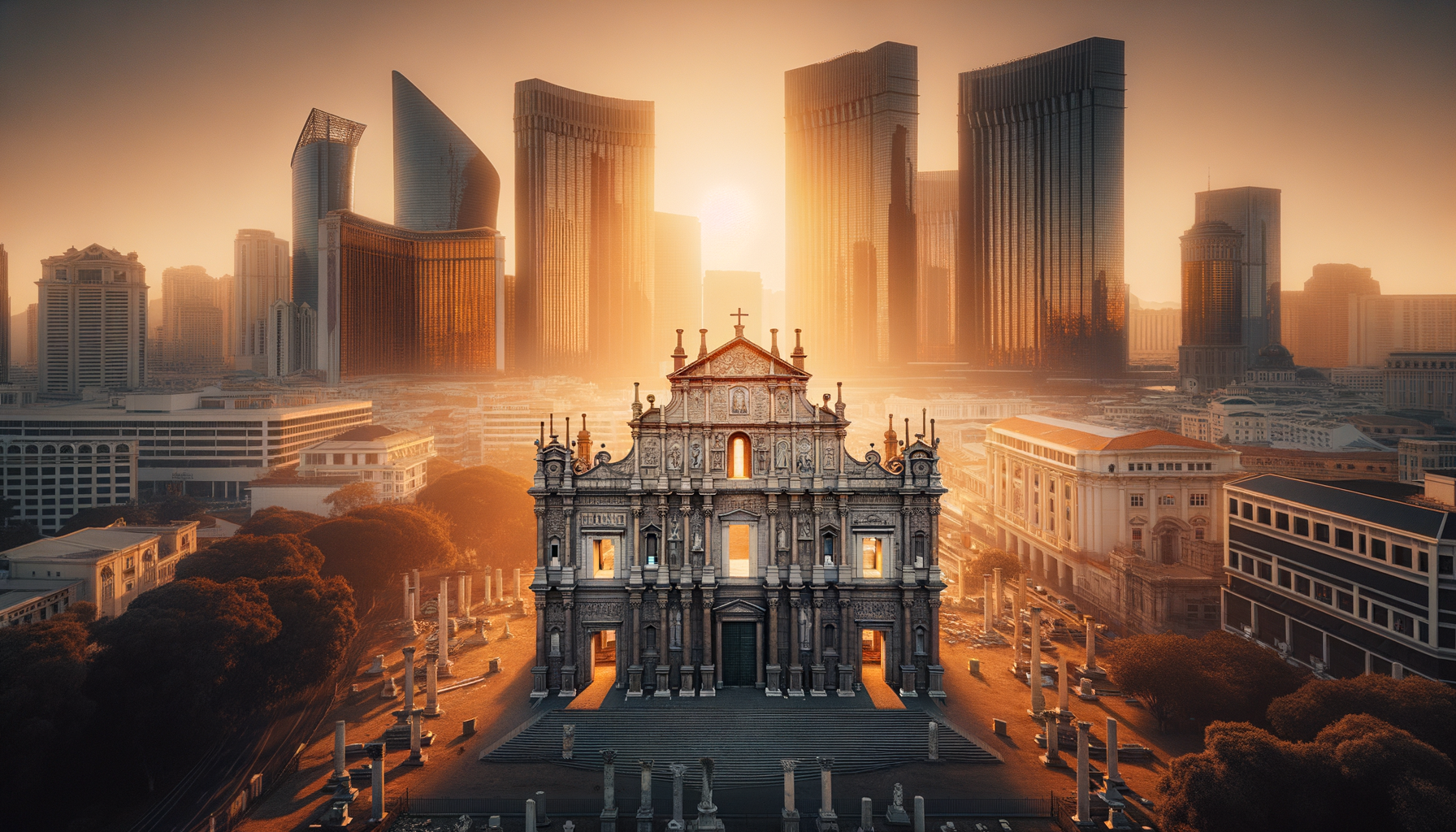
The peninsular old city is Macau’s greatest asset for non-gambling visitors. The Ruins of St Paul’s Cathedral — properly the Cathedral of the Mother of God, built by Jesuit missionaries between 1602 and 1640, gutted by fire in 1835 — is Macau’s most iconic image: a baroque stone facade standing alone above a grand staircase, the interior open to the sky. Behind it, the Mount Fortress (Fortaleza do Monte) offers panoramic views over the peninsula. Together they form the spiritual heart of the UNESCO Historic Centre.
Senado Square (Largo do Senado) is Macau’s civic heart: a wave-patterned black-and-white mosaic piazza (made using Portuguese calçada stones) surrounded by colonial buildings in faded pastel yellows and greens. In the mornings before the crowds arrive, it is extraordinarily beautiful — a street scene that could be Lisbon except for the Chinese shop signs and the Pearl River Delta humidity. The A-Ma Temple at the southern tip of the peninsula is Macau’s oldest surviving structure, a Taoist complex dating from before the Portuguese arrival — the name Macau itself derives from “A-Ma-Gao” (Bay of A-Ma). The Guia Fortress and Lighthouse (1638) is the oldest lighthouse on the China coast, reachable by cable car and offering the best views in Macau.
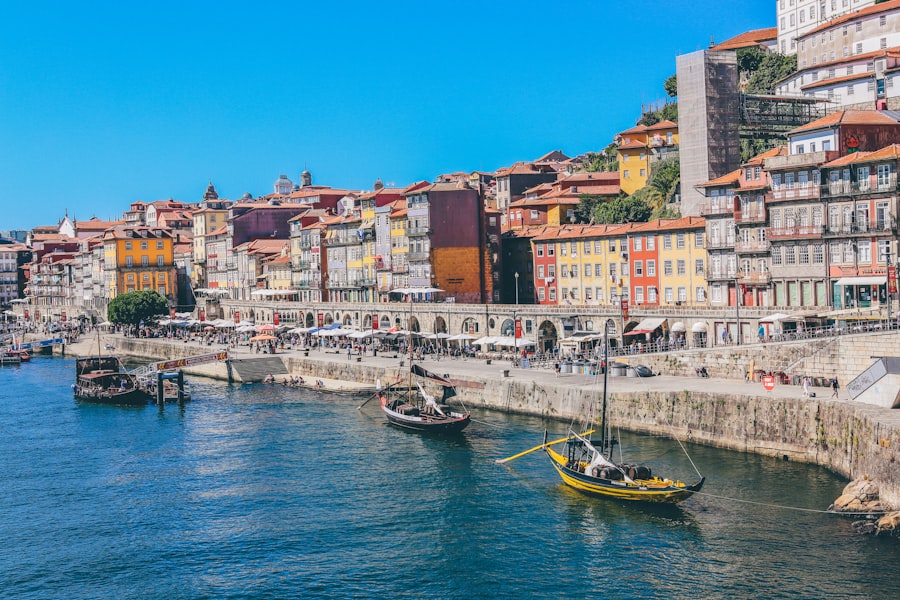
Ruins of St Paul’s — Baroque Facade Since 1640
Built by Jesuit missionaries, gutted by fire in 1835, the stone facade remains one of the most photogenic UNESCO World Heritage monuments in Asia. The Grand Staircase fills with visitors from 10 AM; come at 8 AM for the experience it deserves.
🎲 The Cotai Strip — Asia’s Las Vegas
The Cotai Strip — built on reclaimed land between Taipa and Coloane since 2007 — is one of the most extraordinary built environments in the world. In less than two decades, a series of artificial islands became home to mega-resorts of a scale that makes the Las Vegas Strip look modest: the Venetian Macao (containing a full-scale reproduction of Venice’s Grand Canal and Rialto Bridge, indoors, air-conditioned), the Parisian Macao (with a half-scale Eiffel Tower), City of Dreams, Studio City (with a figure-eight Ferris wheel), and MGM Cotai (a transparent dome structure housing a giant indoor natural landscape). These are not subtle buildings.
The post-2021 regulatory reform has pushed all six casino operators to invest in non-gaming amenities: concert venues (Las Vegas-caliber performers play Cotai regularly), luxury retail, Michelin-starred restaurants, and family entertainment. For the visitor who does not gamble, the Cotai Strip is worth experiencing purely as an architectural spectacle — a unique expression of what happens when Las Vegas money meets Chinese ambition on reclaimed South China Sea.
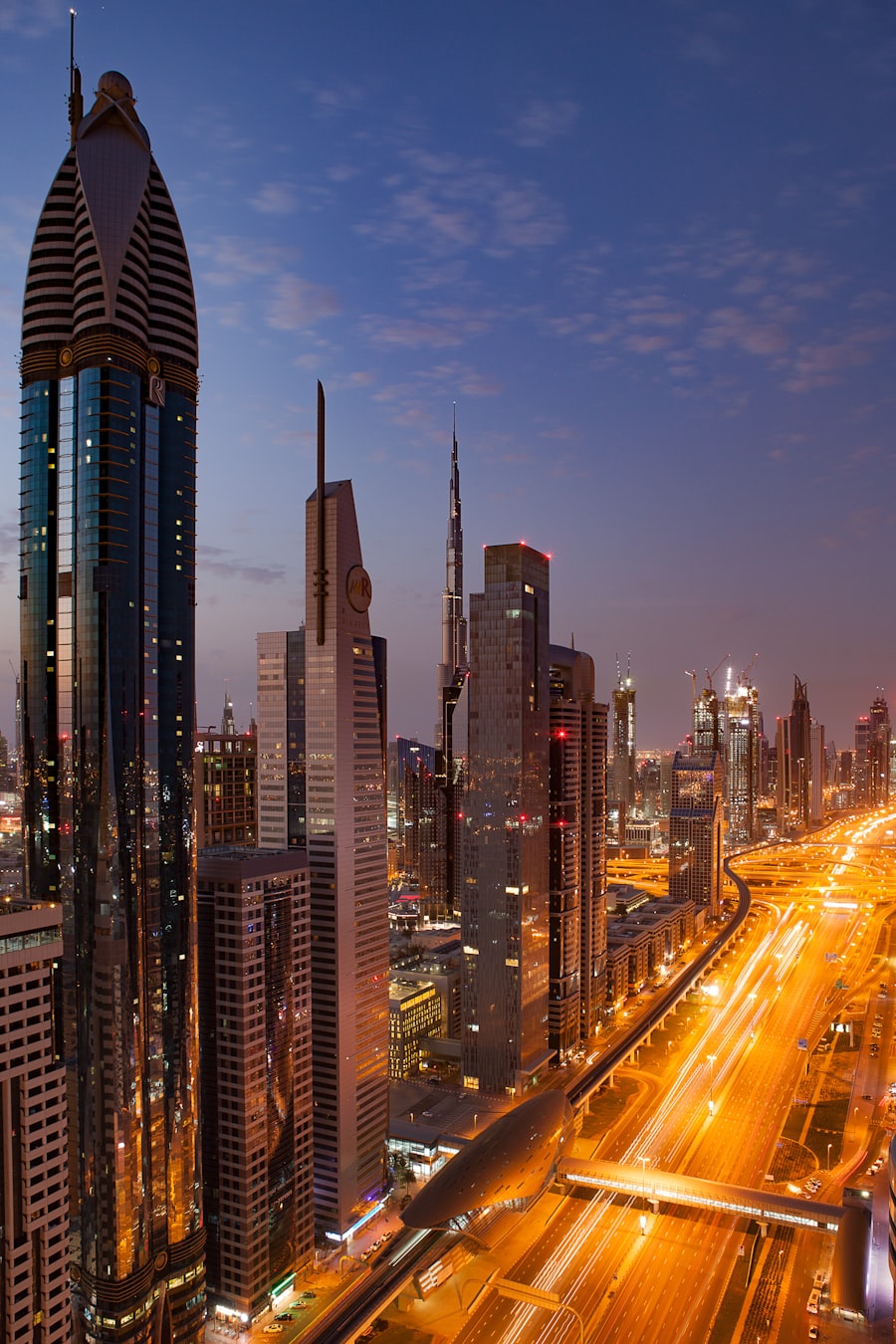
The Cotai Strip — Built on Reclaimed Sea, 2007–Present
At peak (2013), Macau’s gaming revenue was seven times the Las Vegas Strip’s. The VIP model has collapsed; integrated resorts, concerts, and mass-market gaming define the new era.
🏘️ Taipa Village & Coloane
Taipa Village — the original fishing and oyster-farming settlement on Taipa Island, now surrounded by the development of Cotai on three sides — is the antidote to the mega-resorts. Its narrow lanes are lined with colonial mansions converted to restaurants and boutiques, the Taipa Houses-Museum preserves five pastel-painted Macanese colonial homes, and the Church of Our Lady of Carmel watches from a small hill. It is quiet in the morning and lively in the evening when locals and expats come for dinner. The Rua do Cunha is Taipa’s food street, famous for pork chop buns, egg tarts, and almond cookies sold from storefronts that have operated for decades.
Coloane Village, at the southern end of the territory, is the most preserved and least visited of Macau’s old villages: a genuine fishing community that survived the casino boom largely intact. The whitewashed Chapel of St Francis Xavier, a small square with a small fountain, elderly men playing chess, fishing boats moored in the harbour. Hac Sa Beach (Black Sand Beach) — Macau’s largest — is on Coloane’s east coast, dark volcanic sand in a sheltered bay. And in Coloane Village, the original Lord Stow’s Bakery still sells the egg tarts that became globally famous — the Macau version is distinct from its Lisbon cousin, richer and creamier. The queue on weekends is worth it.
🍜 Cuisine
Macanese cuisine is one of the rarest culinary traditions on Earth — a Sino-Portuguese fusion born from four centuries of cohabitation. Minchi (ground pork with soy sauce and fried egg), African Chicken (galinha à africana, from the Portuguese colonies), bacalhau in a dozen forms, Lord Stow’s egg tarts, and pork chop buns eaten standing at a street stall. The full guide covers every dish and where to find it.
🍺 Drinks
Portugal brought its wine culture to Macau, and the city has maintained it for 400 years. Port wine is served at historic bars; Vinho Verde and Douro reds appear on every serious restaurant list. Local Macau Beer has been brewed since 1952. Casino cocktail culture is elaborate and expensive. The full drinks guide covers everything from the 1947 Port Wine Bar to where to find a cold Tsingtao after a long day on Cotai.
🏛️ UNESCO World Heritage
The Historic Centre of Macao was inscribed in 2005 — 22 individual buildings and public spaces forming one of the world’s most coherent surviving examples of early modern Portuguese colonial urban planning. The Ruins of St Paul’s, Senado Square, A-Ma Temple, Guia Fortress: each tells a different chapter of the story. The full UNESCO guide covers every monument and how to plan a half-day heritage circuit.
🌡️ Climate & Best Time to Visit
Macau has a humid subtropical climate (Köppen Cwa/Cfa). Summers (June–September) are very hot and humid, frequently affected by tropical storms and typhoons; temperatures regularly exceed 33°C with high humidity. Winters (December–February) are mild and pleasant, with temperatures rarely dropping below 10°C. Spring is warm but misty and rainy.
✈️ Getting There from the US
By air to Macau International Airport (MFM): No direct flights from the US to Macau. The airport has regional connections to mainland Chinese cities, Taipei, Singapore, and nearby Asian hubs, but all US travelers connect through a major hub. Best options: fly to Hong Kong (HKG) on any carrier serving HKG from the US (Cathay Pacific from JFK, LAX, SFO, ORD, BOS; United from SFO; Delta from SEA), then take the TurboJET or Cotai Water Jet ferry (55–65 minutes, HKD$195–$350 depending on time of day) directly from the Hong Kong Macau Ferry Terminal or the Airport Ferry Terminal. Alternatively, cross the HZMB bridge by shuttle bus.
Best hub connections: Cathay Pacific via Hong Kong is the gold standard for comfort and schedule. Singapore Airlines via Singapore offers excellent connections. Alternatively, fly directly to Macau via Guangzhou (CAN) on Cathay, China Southern, or other carriers, then take local transport. Total travel time from East Coast US: 18–22 hours; West Coast: 15–18 hours.
📋 Practical Information for US Travelers
Americans enter Macau visa-free for 30 days. No advance application needed — just show your US passport at the border. This is separate from mainland China (which requires a visa) and from Hong Kong (also visa-free 90 days). If combining Macau with mainland China, arrange your China visa before departure.
Currency: Macanese Pataca (MOP). Hong Kong Dollars (HKD) are accepted everywhere at a near 1:1 rate (1 HKD = 1.03 MOP). USD not widely accepted outside casinos. ATMs available everywhere. Credit cards accepted at hotels, casinos, and large restaurants. Casino chips function as currency within casino complexes.
Excellent mobile coverage. SIM cards available at airport. Major carriers: CTM and 3 Macau. Good 5G coverage across most of the territory. Wi-Fi in all hotels and casino resorts (usually excellent). No VPN restrictions in Macau (unlike mainland China) — Google, WhatsApp, etc. work freely. Power: 220V, UK-style Type G plugs (different from mainland China’s Type A/C).
Macau is small — the peninsula is walkable. Free shuttle buses run from most casino resorts to the ferry terminals, border crossings, and airport. Public buses are cheap and cover the whole territory. Taxis are plentiful and inexpensive by international standards. The HZMB shuttle bus connects to Zhuhai and Hong Kong. No subway system, but none needed given the scale.
Macau is extremely safe — one of the lowest crime rates in Asia. No vaccinations required beyond standard travel precautions. Medical facilities are excellent (Hospital Conde S. Janúario and private Kiang Wu Hospital). Water is safe to drink. Typhoon warnings: be aware of the T-3/T-8/T-10 warning system — a T-8 signal means casinos close and transport stops.
There is no US Embassy or Consulate in Macau. Americans are served by the US Consulate General Hong Kong & Macau, 26 Garden Road, Central, Hong Kong. Emergency assistance: +852 2523-9011. Register at step.state.gov before travel.
🏷️ Name & Identity
“Macau” derives from “A-Ma-Gao” — Bay of A-Ma (the Cantonese sea goddess Mazu) — which is what the Portuguese understood the locals to call the area in 1513. The official Portuguese name was Cidade do Nome de Deus de Macau (City of the Name of God of Macau). The official English rendering is “Macao” (as used by the SAR government and internationally), though “Macau” remains the more common spelling in English. Both are correct. In Chinese: 澳门 (Àomén), meaning “gateway door” — a reference to the natural harbour’s resemblance to a doorway.
💰 Cost of Living
Macau is expensive by regional standards but cheaper than Hong Kong for accommodation, and casino competition has driven down prices for food and entertainment within the integrated resorts. Budget travelers can survive on $80–$130/day; mid-range $200–$400/day; staying in a casino resort and eating well $400–$800+/day.
🏠 Accommodation
Macau’s hotel market is dominated by casino integrated resorts, many of which offer surprisingly competitive room rates during weekdays (the casino model subsidizes rooms to fill the floor). The Venetian Macao has over 3,000 suites — all suites, no standard rooms — and is consistently among the best-value luxury stays in Asia. Wynn Macau and Wynn Palace (Cotai) are the quality leaders; expect $350–$800/night. MGM Cotai (the dome resort) offers strong value for its category. On the peninsula, the Pousada de São Tiago — a boutique hotel built within the 17th-century Barra Fortress — is Macau’s most atmospheric accommodation option, ideal for those more interested in heritage than gaming.
🎭 Festivals & Events
Chinese New Year (January/February): Macau’s biggest celebration — lion dances, fireworks over the harbour, packed casinos. Book months ahead. Macau Grand Prix (November): The legendary Guia Street Circuit is one of the most demanding in motorsport — Formula 3 and touring car races run on public streets through the old city. Macau International Music Festival (October): One of Asia’s most respected classical music festivals. Dragon Boat Festival (June): Racing in the inner harbour with dragon boats; a genuine local celebration rather than a tourist spectacle. Macau Food Festival (November): Outdoor festival on the waterfront showcasing Macanese, Portuguese, and Asian food.
💼 Gaming & Business
Macau’s entire economy pivots on gaming — six licensed operators (SJM, Galaxy, Sands China, Wynn, MGM, Melco), $24B peak revenue, a VIP-junket collapse in 2021, COVID, and a recovery built on new 10-year concessions requiring $5.5B in non-gaming investment. Company formation, the absence of a genuine local stock exchange, and the defining companies of the Macau economy are all covered in the full business guide.
🎠 Packing Tips
- Umbrella/rain jacket: Macau receives 1,500mm+ of rain annually, much of it in sudden heavy showers. A compact umbrella is essential any time of year.
- Cash (HKD): More versatile than Patacas and accepted everywhere. Most ATMs dispense HKD.
- UK-style power adapter: Macau uses Type G (British) sockets, unlike mainland China (Types A and C).
- Comfortable walking shoes: The UNESCO heritage area involves cobblestones and hills. The casinos require significant walking.
- Lightweight layers: Air conditioning in casino resorts is extreme — bring a layer regardless of outside temperature.
- Sunscreen: The subtropical sun combined with reclaimed-land lack of shade makes sun protection essential.
- SIM card: Buy at the airport. A Macau SIM means free internet; VPN not needed (unlike mainland China).
- China visa (if continuing to mainland): Arrange before arrival — cannot be obtained on arrival in Macau.
🌐 Useful Resources
- US Consulate HK & Macau: hk.usconsulate.gov — Emergency: +852 2523-9011
- STEP enrollment: step.state.gov
- Macau Tourism (MGTO): macaotourism.gov.mo
- TurboJET (HK–Macau ferry): turbojet.com.hk
- Cotai Water Jet: cotaiwaterjet.com
- HZMB shuttle bus: Book via hzmbus.com
📚 Recommended Reading
A Dream of Red Mansions — Cao Xueqin (18th c., various translations): Not about Macau, but the novel that best conveys the world of Chinese imperial gentry life that Portuguese Macau sat alongside — essential context for understanding the cultural universe that surrounded the colonial enclave.
Macau — Austin Coates (1966): The classic English-language social history of Macau, written by a former magistrate. Immensely readable and affectionate, covering everything from the original Portuguese settlement to mid-20th-century gambling culture.
East of Eden-era casino era: For the contemporary casino boom, investigative journalism from Bloomberg, the Financial Times, and the Wall Street Journal is the best source — particularly coverage of the junket operator collapse and the post-2021 regulatory reset.
🎥 Videos
Search YouTube for: “Macau travel guide 4K” (multiple excellent walking tours of the old city and Cotai); “Mark Wiens Macau food” (the best English-language Macanese food coverage on the platform); “Macau Grand Prix onboard” (the Guia Street Circuit from a driver’s perspective is extraordinary); “Macau UNESCO heritage” for individual monument deep-dives.
🔬 Fascinating Facts
- At its 2013 peak, Macau’s gaming revenue was USD 45 billion — 7x the Las Vegas Strip. It collapsed to USD 2.7 billion in 2022 (COVID + VIP crackdown) and is recovering toward $20B+ as of 2025.
- The HZMB bridge is 55 kilometers long — the world’s longest sea-crossing bridge and link structure. Built at a cost of approximately USD 18 billion over 9 years.
- Lord Stow’s egg tart — created by British pharmacist Andrew Stow in Coloane in 1989 — is now one of the most replicated pastries in the world, with offshoots in Hong Kong, mainland China, and across the Chinese diaspora.
- The Macanese people — of mixed Portuguese-Asian heritage — may number fewer than 25,000 worldwide. Their language, Patuá (a Portuguese creole incorporating Cantonese, Malay, and other languages), is classified by UNESCO as critically endangered.
- Macau’s population density (approximately 21,000 people per km²) makes it the most densely populated territory on Earth, surpassing Monaco and Singapore.
- The Guia Lighthouse (1638) is the oldest lighthouse on the China coast — it was in continuous operation for over 350 years. The fort it sits on predates it by at least a decade.
⭐ Notable People
Luis de Camões (1524–1580): Whether the great Portuguese poet actually lived in Macau is disputed by historians, but tradition insists he wrote part of Os Lusíadas (the national epic of Portugal) in the grotto that bears his name in the Jardim Luis de Camões. The garden remains one of Macau’s most pleasant urban spaces.
Stanley Ho (1921–2020): The man who ran Macau’s gaming monopoly for 40 years (1962–2002) and built a business empire that touched every sector of the territory’s economy. One of Asia’s wealthiest people for decades; his family (including daughter Pansy Ho) remains central to Macau’s casino industry.
Andrew Stow (1956–2006): The British pharmacist who invented the Macau-style egg tart in 1989 and in doing so created one of the most influential pastries of the late 20th century. His original bakery in Coloane Village still operates.
⚽️ Sports
Macau Grand Prix: Held annually since 1954, the Guia Street Circuit is one of the most technically demanding racing circuits in the world — narrow streets, concrete barriers, very little run-off — and has been a launching pad for generations of Formula 1 drivers. Michael Schumacher, Mika Häkkinen, David Coulthard, and Ayrton Senna all raced here. The November event draws huge crowds from across Asia. Greyhound racing operated at the Canidrome until 2018 (it was Asia’s last operational greyhound track); the facility has since been converted to an entertainment complex. Football (soccer): The Macau national team competes in Asian qualifying competitions but has never qualified for a major tournament; the local league is semi-professional.
📰 Media & Press Freedom
Macau’s media environment is more constrained than Hong Kong’s and considerably less free than pre-handover levels. Most mainstream outlets receive government advertising and exercise self-censorship on political matters. The RSF World Press Freedom Index 2025 ranks Macau below Hong Kong (which has declined sharply since the 2020 National Security Law) but above mainland China. The Portuguese-language press (Jornal Tribuna de Macau, Ponto Final) has historically been more willing to cover sensitive topics than Chinese-language outlets. English-language news for residents and expats is largely served by Hong Kong media and international platforms.
📷 Photo Gallery
Baroque facade since 1640
The civic heart of Old Macau
World’s largest gaming hub
Peninsula and islands
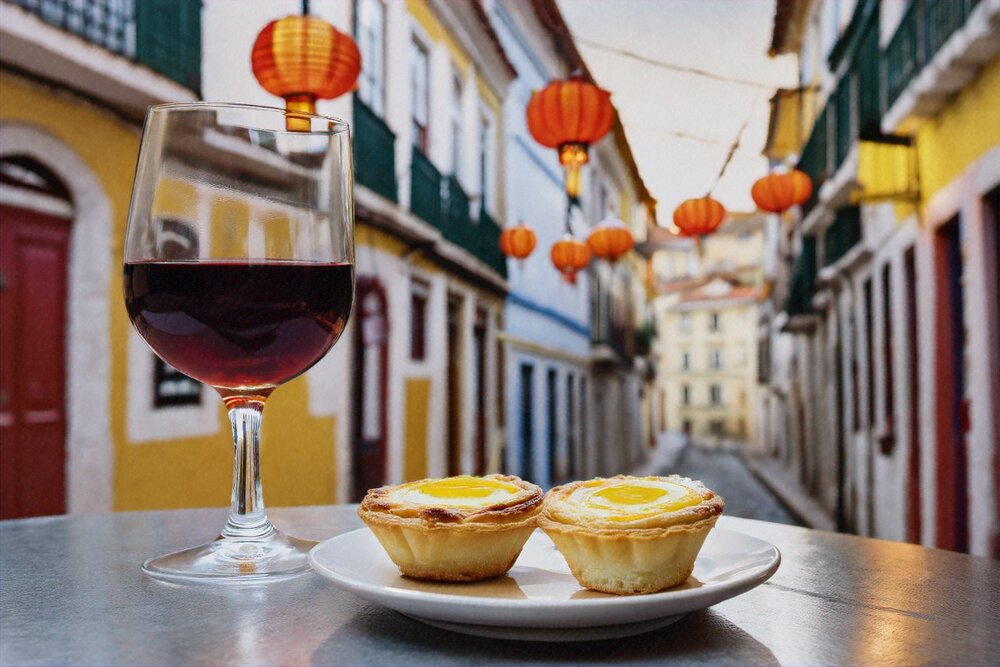
The pastry that conquered the world
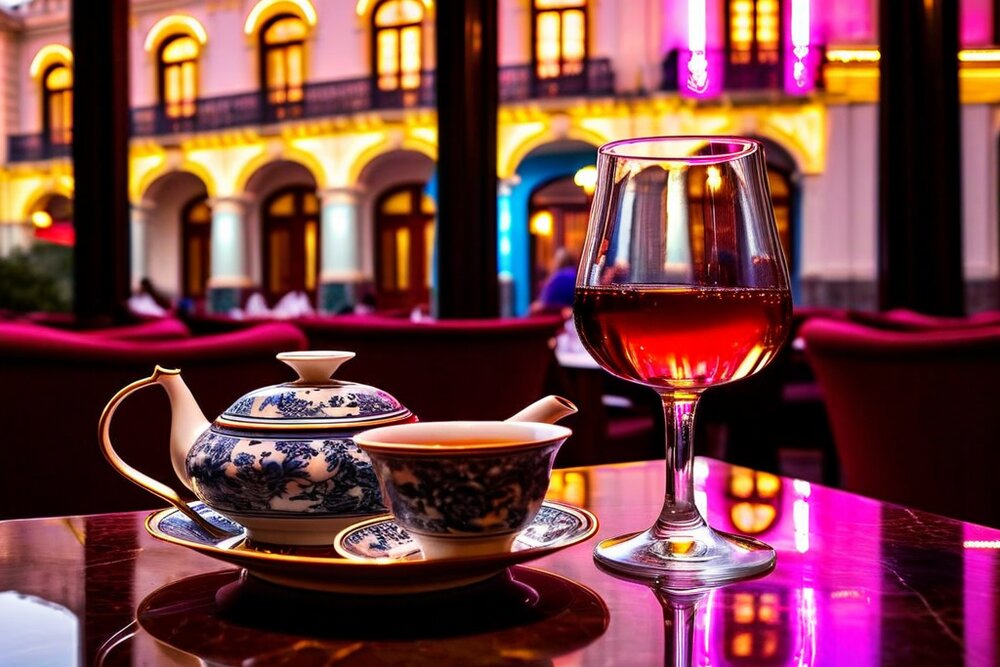
Portuguese wine meets Cantonese taste
✍️ Author’s Note
Macau does something I find rare in travel: it makes you simultaneously feel you understand exactly where you are and have absolutely no idea. The baroque church facades, the Portuguese wine lists, the cobbled squares — you think: Portugal. Then you step inside a side street and the air smells of jasmine incense and dried seafood and there are caged birds hanging above a tea house. Then you round a corner and the casino towers are visible, forty floors of glass and gold reaching into haze. No single city should contain all this, and yet Macau does, in 32.9 square kilometers.
Go for the UNESCO heritage. Stay for the egg tarts. Wonder, as I did, at the particular improbability of it all.
