
🇱🇺 Luxembourg at a Glance
🌍 Overview
Luxembourg is 2,586 km² — about a third the size of the Moravian-Silesian Region, smaller than many European cities' metropolitan areas — with around 680,000 people. It is the last Grand Duchy left in the world, a founding member of the European Union, and by most measures the richest country on earth per head of population.
It is also one of the strangest places in Europe demographically. Nearly half the residents are foreign nationals, over 170 nationalities are represented, and every working morning roughly 228,000 cross-border commuters — about 47% of the entire workforce — drive or take the train in from France, Belgium and Germany, because they cannot afford to live in the country they work in.
The state
A constitutional monarchy. Grand Duke Guillaume V has been head of state since 3 October 2025, when his father Henri abdicated after a 25-year reign — Guillaume, then 43, became the seventh sovereign of the House of Nassau-Weilburg, which has reigned since 1890. The prime minister is Luc Frieden of the Christian Social People’s Party, in office since November 2023, in coalition with the Democratic Party.
The economy
Extraordinary and narrow. Luxembourg has the highest GDP per capita in the world — a figure inflated by the commuters who produce it but do not live here — built on finance (the second-largest investment fund centre on earth after the United States), EU institutions, satellites and steel. Unemployment reached 6.4% in June 2026, which is high by Luxembourg’s own historical standards.
The problem everyone talks about
Housing. Prices are among the highest in Europe and an analysis published in March 2026 called it, bluntly, “the permanent housing crisis, or the unacceptable as the norm”. Prices resumed rising in the first quarter of 2026 (+1.7% year on year) after a correction, and the shortage is what pushes half the workforce over the borders every morning — and gentrifies the French and Belgian towns they move to instead.
What visiting is like
Easy, expensive, and much better than its reputation. Luxembourg City is genuinely spectacular — a fortress capital built on and into cliffs above a gorge, UNESCO-listed since 1994 — and outside it there is a real wine region, a sandstone hiking landscape called Little Switzerland, castles, and the best-value fact in European travel: all public transport in the country is free, for everybody, including visitors.
🏷️ The Little Castle That Became a Country
In 963, Count Siegfried of the Ardennes acquired a rocky promontory above the Alzette with a small ruined Roman-era fort on it, called Lucilinburhuc — Old High German for "little castle". A town grew around it, then a county, then a duchy, then a Grand Duchy. The country is named after the castle, and the castle rock is still there in the middle of the capital.
Three names, three languages
Lëtzebuerg in Luxembourgish, Luxembourg in French, Luxemburg in German — all three are official and all three appear on official documents, road signs and stamps. The country has three official languages for a population smaller than Brno’s, and manages it without much fuss.
The last Grand Duchy
There were once many — Baden, Tuscany, Hesse, Oldenburg, Finland under the Tsars. Luxembourg is the only sovereign grand duchy left in the world. The title dates from the Congress of Vienna in 1815, which raised the territory from a duchy and handed it in personal union to the King of the Netherlands, an arrangement that lasted until 1890.
The flag problem
Red, white and light blue horizontally — and near-identical to the flag of the Netherlands, which is not a coincidence given the nineteenth-century personal union. Luxembourg’s blue is lighter and its proportions differ, and that is all. The country also has a second, unofficial but very widely flown banner: the Roude Léiw, a red lion rampant on white-and-blue stripes, which most Luxembourgers prefer and which parliament has repeatedly declined to make official.
The national motto
Mir wëlle bleiwe wat mir sinn — “We want to remain what we are.” It is carved on buildings, printed on souvenirs and taken seriously. For a country repeatedly partitioned, annexed, occupied and nearly traded away by larger neighbours, it is less a slogan than a summary of the entire national project.
🗺️ Five Regions in an Hour's Drive
Luxembourg is 82 km north to south and 57 km east to west. You can drive across it in about an hour. Within that it manages five genuinely distinct landscapes, and the transitions are abrupt enough to notice from the car.
Éislek — the Ardennes
The northern third: a plateau of schist cut by deep wooded valleys, part of the Belgian Ardennes massif. This is the highest, emptiest and coldest part of the country, holding Kneiff at 560 m — the summit, and a field with a stone marker in it. Castles at Vianden, Bourscheid and Clervaux, and the Upper Sûre lake.
Guttland — the good land
The central belt of rolling farmland and beech woods around the capital, on softer sandstone and marl. Most of the population and almost all the towns are here, and the name means exactly what it sounds like: this is where the farming is.
Mullerthal — Little Switzerland
In the east, a small area of Luxembourg sandstone weathered into a maze of ravines, chimneys, overhangs and mossy blocks, with beech forest growing over the whole thing. It looks nothing like Switzerland and everything like the Bohemian Paradise or Saxon Switzerland, which is exactly what it is geologically — and it holds the country’s best walking.
The Moselle
The south-eastern border with Germany: 42 km of river with south- and east-facing slopes terraced in vines. This is the wine country, it has been planted since Roman times, and it is the warmest, gentlest part of the country. The village of Schengen is at its southern end.
Minett — the red rocks
The industrial south, named for the iron-bearing minette ore that made the country rich before finance did. Red earth, spoil heaps now colonised by rare orchids and reed beds, the giant blast-furnace site at Belval converted into a university campus, and the towns of Esch-sur-Alzette and Differdange. It is the least pretty and most interesting part of Luxembourg.
Climate and water
Temperate oceanic: mild, wet, grey more often than not, with summers around 20–24 °C and winters hovering near freezing. The Ardennes north is noticeably colder and snowier than the Moselle south. The Sûre is the main river, joined by the Alzette which carved the gorge the capital sits on.
📜 Partitioned Three Times and Still Here
The medieval county
From Siegfried’s castle of 963, the House of Luxembourg grew into one of the great dynasties of Europe — and for Czech readers this is the important part. John the Blind, Count of Luxembourg, became King of Bohemia in 1310; his son Charles IV was King of Bohemia and Holy Roman Emperor, founded Prague’s New Town and the Charles University, and built the bridge. Four Holy Roman Emperors came from this small county.
Burgundian, Spanish, Austrian, French
After 1443 Luxembourg passed through the hands of nearly everyone: the Dukes of Burgundy, the Spanish Habsburgs, France under Louis XIV, the Austrian Habsburgs, revolutionary France again. Each occupier added to the fortress. Between 1815 and 1867 it was garrisoned by Prussia while nominally belonging to the Dutch king, which is exactly the kind of arrangement that produces a crisis.
Three partitions
Luxembourg was cut down three times. In 1659 France took the southern districts, including Thionville and Montmédy. In 1815 the Congress of Vienna gave the eastern parts, including Bitburg and Sankt Vith, to Prussia. In 1839, at the end of the Belgian revolution, the larger, French-speaking western half became the Belgian province of Luxembourg. What was left — the German-dialect-speaking part — is the country today.
1867: the Luxembourg Crisis
Napoleon III tried to buy the Grand Duchy from the Dutch king. Prussia objected and Europe came close to war. The Treaty of London (1867) settled it: Luxembourg was declared perpetually neutral, the Prussian garrison withdrew, and the great fortress was ordered demolished — a process that took sixteen years, cost a fortune, and created the parks and boulevards the capital now has.
1890: a dynasty of its own
When the Dutch King William III died leaving only a daughter, Luxembourg’s male-only succession law separated the crowns. The Grand Duchy passed to Adolphe of Nassau-Weilburg, and Luxembourg had its own resident dynasty for the first time. That house still reigns, and in a neat historical rhyme, the succession was changed to equal primogeniture in 2011.
Occupied twice
Neutrality did not help. Germany invaded in 1914 and again in 1940. The second occupation was far worse: Luxembourg was annexed outright into the Reich, Luxembourgish was banned, and young men were conscripted into the Wehrmacht — some 10,000 of them, of whom around 3,000 died. A general strike against conscription in 1942 was crushed with executions and mass deportations.
🏰 The Gibraltar of the North
For three centuries Luxembourg City was one of the strongest fortresses in Europe, so formidable that Vauban worked on it and later engineers called it the Gibraltar of the North. Most of it was blown up in the 1870s. What survives is still enough to make the capital extraordinary.
The site
The old town sits on a sandstone plateau with the Alzette gorge wrapped around two sides, 60 metres straight down. You do not need to build much of a wall on a cliff, and successive rulers built one anyway. The result is a city where the defences are the landscape, and where a lift and a series of stairways connect an upper town of banks and palaces with a lower town of stone houses along a stream.
The casemates
Twenty-three kilometres of tunnels blasted through the rock from 1644 onwards, on several levels, holding cannon, workshops, bakeries and barracks. About 17 km survive and two sections — the Bock and the Pétrusse casemates — are open to visitors. They sheltered 35,000 people during the Second World War and are the single best thing to do in the city.
The Bock
The rock where Siegfried built in 963 and where the fortress began. The ruins on top, the tunnel galleries inside and the view down into the Grund and across to the Rham plateau are the classic Luxembourg image — and are what the UNESCO inscription of 1994 is for: “the City of Luxembourg: its Old Quarters and Fortifications”.
The Chemin de la Corniche
A promenade along the top of the seventeenth-century ramparts above the Alzette, described by the Luxembourgish writer Batty Weber as “the most beautiful balcony in Europe”. It is a five-minute walk and the claim is not ridiculous.
The Wenzel Circular Walk
A signposted 5.5 km route that descends from the upper town through the fortifications into the valley and back, covering a thousand years of construction. It is free, takes about two hours, and is the most efficient history lesson available anywhere in the country.
What the demolition left
The 1867 treaty required the fortress gone, and 24 forts and 16 km of defences were removed over sixteen years. The city filled the space with parks, the ring boulevards and the grand nineteenth-century avenues. Luxembourg lost its walls and got its shape.
🎖️ 1940–1945, and the American Cemetery
Luxembourg's Second World War is not a footnote and it is very visible on the ground. The country was annexed rather than merely occupied, its young men were forced into a foreign army, and its northern half was fought over twice in six weeks during the Ardennes offensive.
Annexation and Germanisation
From 1940 Luxembourg was administered as part of the German Gau Moselland. Luxembourgish and French were banned in public, French first names were Germanised by decree, and the population was pressed to register as ethnic Germans. In the census of 10 October 1941, asked their nationality, mother tongue and ethnicity, Luxembourgers answered “Lëtzebuergesch” to all three questions in such numbers that the Germans cancelled the count.
The forced conscripts
From August 1942 Luxembourgish men born between 1920 and 1927 were conscripted into the Wehrmacht — about 10,000 in total, of whom roughly 3,000 died, mostly on the Eastern Front, and several thousand deserted at enormous risk to their families. The general strike that followed the conscription decree was answered with 21 executions and the deportation of hundreds of families.
The Jewish community
Around 3,900 Jews lived in Luxembourg in 1940, many of them refugees who had already fled Germany. Most were expelled or deported; of those deported to the camps, very few returned. The synagogue in Luxembourg City was demolished in 1943. The Kaddish memorial near the station and the restored cemetery at Clausen mark what happened.
The Battle of the Bulge
The German offensive of 16 December 1944 hit northern Luxembourg directly. Wiltz, Clervaux, Diekirch and Vianden were fought through, in some cases twice; Clervaux castle was burned out and Vianden was held by a few dozen Luxembourg resistance fighters against a far larger force. The excellent National Museum of Military History at Diekirch tells this properly.
Hamm
The Luxembourg American Cemetery at Hamm, on the edge of the capital, holds 5,070 American war dead from the Ardennes campaign in a landscape of white marble crosses. Among them, by his own wish to lie with his men, is General George S. Patton. It is quiet, immaculate, free to enter, and one of the most affecting places in the country. The German war cemetery at Sandweiler, with over 10,000 graves, is two kilometres away.
Why it shaped the country
Luxembourg abandoned neutrality immediately after the war. It joined the UN in 1945, NATO in 1949 as a founding member, and the European Coal and Steel Community in 1951. A country that had been perpetually neutral and twice invaded concluded that neutrality had failed and that European integration was a security policy. That conclusion still governs its foreign policy.
👑 A New Grand Duke, October 2025
Luxembourg changed head of state recently enough that most reference works have not caught up, and it is the first thing to know about the country in 2026.
The abdication
On 3 October 2025, at the Grand Ducal Palace in Luxembourg City, Grand Duke Henri signed an instrument of abdication ending a reign of twenty-five years, and his eldest son was sworn in before parliament the same day as Grand Duke Guillaume V. Guillaume was 43. He is the seventh sovereign of the House of Nassau-Weilburg, which has held the throne since 1890.
Why it was not a surprise
Luxembourg telegraphs its successions. Henri announced the plan in his Christmas address in 2024, Guillaume was appointed Lieutenant-Représentant — effectively deputy head of state, a formal apprenticeship — in October 2024, and the handover a year later ran to schedule. Henri’s own accession in 2000 followed exactly the same pattern from his father Jean.
What the Grand Duke does
Less than he used to. A constitutional revision that came into force in 2023 tidied up the monarchy’s powers, removing the formula that the Grand Duke “sanctions” laws — he now only promulgates them. That change traces directly to 2008, when Henri said he could not in conscience sign the euthanasia bill; parliament amended the constitution rather than accept a royal veto, and the monarchy has been strictly ceremonial since.
Grand Duchess and family
Guillaume married Stéphanie de Lannoy, a Belgian countess, in 2012; she is now Grand Duchess. Their elder son Prince Charles, born 2020, is heir apparent. Succession has been by equal primogeniture since 2011, so a first-born daughter would inherit — a change Luxembourg made fifteen years before Liechtenstein got round to it.
How Luxembourgers feel about it
Warmly and without much drama. The monarchy polls well, the family is visible without being intrusive, and National Day on 23 June — which is nobody’s actual birthday, a convention dating from 1961 to get a summer date — is a genuine national party with fireworks over the Adolphe Bridge and a torchlight parade the night before.
The house's other business
Unlike the Liechtenstein princes, the Luxembourg grand ducal family is funded by the state, through a civil list fixed by parliament. There have been periodic rows about the accounting — a critical report in 2020 on the running of the Court led to reforms and a new marshal — and they were conducted publicly, which is roughly how a modern constitutional monarchy is supposed to work.
🏛️ Luxembourg in 2026
The government
Luc Frieden (CSV, Christian Social People’s Party) has been prime minister since November 2023, leading a coalition with the liberal Democratic Party. His deputy prime minister and foreign minister is Xavier Bettel, who was himself prime minister for the previous decade — an unusually amicable arrangement by European standards.
The 2023 turn
The October 2023 election ended ten years of a three-party liberal-socialist-green coalition and returned the CSV, historically the dominant party of Luxembourg politics, to the premiership. The Greens lost badly. The new government’s programme was built around housing, tax cuts and administrative simplification.
The Chamber
A single chamber of 60 deputies elected for five years by proportional representation in four constituencies, with a distinctive system: voters get as many votes as there are seats in their district and may spread them across parties or give two to one candidate. Voting is compulsory for resident citizens. There is also a Council of State of 21 appointed members that reviews legislation.
The democratic deficit
The central political oddity of Luxembourg: nearly half the population cannot vote, because they are foreign nationals, and a 2015 referendum on extending the national franchise to long-resident foreigners was rejected by 78%. Foreign residents can vote in local and European elections. It is the most-discussed structural problem in Luxembourgish democracy and nobody has a comfortable answer.
Housing, the dominant issue
Every government since 2013 has been judged on it and none has solved it. Prices rose for two decades, corrected sharply in 2023–24 as interest rates bit, and resumed rising in early 2026 (+1.7% year on year) while new-build sales stayed far below pre-crisis levels. An analysis in March 2026 argued the crisis has become structural rather than cyclical: supply has never caught demand, ownership has professionalised, and a growing share of people are simply priced out.
Politics without drama
Luxembourg’s politics are consensual to a degree that visitors find eerie. Coalitions are formed quickly, governments last full terms, the far right is marginal, and the tripartite system — government, employers and unions negotiating wage indexation together — absorbs most conflict before it becomes political.
💶 Richest in the World, and What That Actually Means
Luxembourg's GDP per capita is the highest of any country on earth, and the figure is genuinely misleading. It is calculated by dividing national output by residents, while nearly half of the people producing that output are commuters who live and are counted in France, Belgium and Germany. Luxembourgers are very rich; they are not as rich as the headline number says.
Finance
The core of it. Luxembourg is the second-largest investment fund domicile in the world after the United States, holding trillions of euros in UCITS and alternative funds, plus a large private banking and insurance sector. This is not the old bank-secrecy business: secrecy for EU residents ended with automatic information exchange in 2015, and the sector rebuilt around fund administration, regulatory expertise and euro-area passporting.
The reputational history
It should be stated plainly. LuxLeaks in 2014 revealed hundreds of advance tax rulings that let multinationals route profits through Luxembourg at very low effective rates, and the whistleblowers were prosecuted before being partly vindicated on appeal. OpenLux in 2021 examined the beneficial-ownership register. Luxembourg has since accepted OECD minimum taxation and tightened its rules, and the argument about how much has actually changed continues.
Steel
The original wealth. The minette iron ore of the south built ARBED, which became Arcelor and then, after a hostile takeover in 2006, ArcelorMittal — the world’s largest steelmaker, still headquartered in Luxembourg City. Production in the country is a shadow of what it was, but the Minett landscape and the Belval blast furnaces remain.
Satellites and space
SES, founded in 1985, operates one of the world’s largest satellite fleets from Betzdorf and is why Luxembourg has an outsized voice in global broadcasting. In 2017 the country passed a law granting private companies ownership of resources extracted from space bodies — only the second country in the world to do so — and built a space agency and a fund around asteroid mining. The ambition has outrun the industry so far.
Broadcasting
Radio Luxembourg and then RTL made this small country a media power: from the 1930s, powerful transmitters aimed at Britain, France and Germany broadcast commercial radio into markets where their own states forbade it. RTL Group is still one of Europe’s largest broadcasters, and the reason is a licensing regime rather than an audience.
The commuters
Roughly 228,000 people — about 47% of the workforce — cross a border to work here every day. In early 2026 the French contingent grew about 3.5% year on year while German numbers fell slightly. The system works and it exports Luxembourg’s housing crisis into Lorraine and the Belgian Ardennes, where prices have risen sharply because Luxembourg salaries are bidding for local houses.
🇪🇺 A Capital of Europe
Founding member of everything
Benelux (1944), the UN (1945), NATO (1949), the European Coal and Steel Community (1951), the EEC (1957). Luxembourg has been in the room for every stage of European integration, and for a country of this size that is a deliberate and sustained strategic choice rather than an accident of geography.
What is actually here
Luxembourg is one of the EU’s three official seats, along with Brussels and Strasbourg. On the Kirchberg plateau above the capital sit the Court of Justice of the European Union, the European Court of Auditors, the European Investment Bank, the secretariat of the European Parliament, Eurostat and large parts of the Commission — some 14,000 EU staff in all.
Schengen
The agreement was signed on 14 June 1985 on a boat moored on the Moselle at the Luxembourgish village of Schengen, chosen precisely because it sits where Luxembourg, France and Germany meet. The village has about 500 inhabitants, a European Museum, and its name in every passport-control conversation in Europe.
The Luxembourgers who ran Europe
Robert Schuman, whose 1950 declaration launched the whole project, was born in Clausen in Luxembourg City. Pierre Werner designed the plan for monetary union in 1970 that became the euro. Jacques Santer and Jean-Claude Juncker both went from the Luxembourg premiership to the presidency of the European Commission. No country has supplied so much European leadership per head.
Benelux and the neighbours
Relations with Belgium, the Netherlands, France and Germany are close to the point of invisibility — shared labour markets, shared infrastructure, cross-border health and transport agreements. The one recurring friction is fiscal: Luxembourg’s low fuel and tobacco duties draw cross-border shopping, and its tax arrangements draw complaints from Paris and Berlin.
Ukraine and defence
Luxembourg has no army worth the name — around 900 soldiers, no air force beyond a single NATO-registered aircraft, and no navy for obvious reasons. It compensates with money: it has been among the largest donors to Ukraine relative to GDP in Europe, and hosts NATO’s AWACS fleet under a Luxembourg civil registration.
🏙️ Luxembourg City: A Capital Built on a Cliff
The capital has about 135,000 inhabitants and around 200,000 in the wider urban area — small for a capital, and it does not feel small, because it is built vertically. The old town sits on a plateau; the Alzette runs 60 metres below it in a gorge; and the two are linked by lifts, staircases, and bridges that are among the most dramatic urban structures in Europe.
The Ville Haute
The upper town: the Grand Ducal Palace (a Flemish Renaissance building of 1573, open for guided tours in summer only), the Chamber of Deputies next door, the Place d’Armes with its cafés, the Place Guillaume II market on Wednesdays and Saturdays, and the Notre-Dame Cathedral with its distinctive black spires.
The Grund
The lower town in the valley: stone houses along the Alzette, the Neumünster Abbey converted into a cultural centre, small bridges, and the best evening drinking in the country. A free public lift drops 71 metres from the Plateau du Saint-Esprit straight down into it, which is worth doing purely for the view on the way.
Kirchberg
Across the Red Bridge, a plateau of glass and steel: the EU institutions, the banks, the Philharmonie concert hall with its colonnade of 823 steel columns, and the Mudam — the modern art museum by I. M. Pei, built into the remains of Fort Thüngen. The contrast with the old town, ten minutes away, is the point of the city.
The Gëlle Fra
The Golden Lady on the Place de la Constitution: a gilded Nike on an obelisk, raised in 1923 for the Luxembourgers who volunteered for the Allies in the First World War, torn down by the Nazis in 1940, rediscovered in pieces under the football stadium in 1981 and re-erected in 1985. It is the national memorial and the story is the reason.
Museums
The Luxembourg City History Museum is excellent and has a glass lift running through the rock. The National Museum of History and Art covers everything from Roman mosaics to Luxembourgish painting. The Villa Vauban holds Dutch and French old masters. Most are cheap and several are free on certain evenings.
Getting around
On foot, mostly, plus the free tram along the Kirchberg–station axis and the free funicular. The city is compact and the walking is vertical rather than long. The main station is a fifteen-minute walk or three tram stops from the old town.
🍇 The Moselle: Forty-Two Kilometres of Vines
Luxembourg has made wine on the Moselle since Roman times, produces about 10,000 hectolitres a year from roughly 1,250 hectares, and exports very little of it — which is why almost nobody outside the region has drunk any.
Crémant de Luxembourg
The country’s flagship and its best product. A protected appellation since 1991, made by the traditional bottle-fermented method, and accounting for a very large share of production. It is genuinely good, it is a fraction of Champagne prices, and Luxembourgers drink it as an ordinary aperitif rather than as a celebration wine.
The grapes
Whites, overwhelmingly. Rivaner (Müller-Thurgau) is the workhorse; Auxerrois is the local speciality and does better here than almost anywhere; Pinot Gris and Pinot Blanc are the serious wines; Riesling from the steep shell-limestone slopes around Wormeldange and the Koeppchen is the finest thing the region makes. Elbling, an ancient Roman-era variety, survives here as almost nowhere else.
The towns
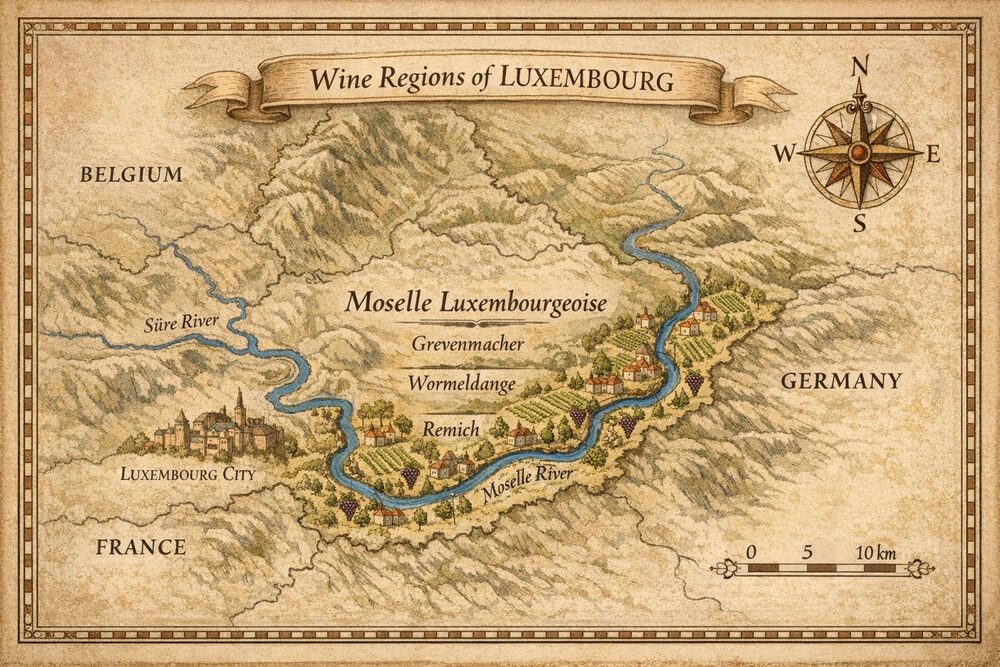
Remich, the busiest, with a riverside promenade and boat trips; Wormeldange, the Riesling capital, under the Koeppchen slope; Grevenmacher, the largest, with the cooperative cellars; and Ehnen, a tiny village with a round church and the wine museum. The Route du Vin runs the whole 42 km and is flat, easy cycling.
Schengen
At the southern end, where Luxembourg, France and Germany meet on the river. The agreement of 14 June 1985 was signed on a boat here because the location was symbolically perfect and diplomatically neutral. There is a European Museum, a monument of steel columns, and about five hundred residents who have got used to it.
Visiting the cellars
Easy and cheap. The cooperative Domaines Vinsmoselle and a long list of independent growers run tastings, many with no appointment needed. Bernard-Massard in Grevenmacher does the best-known cellar tour. Expect to pay a few euros for a tasting and around €10–18 for a good bottle of Crémant at the door.
The German bank
Look across the river and you are in Germany, where the same slopes produce Mosel Riesling at a considerably higher international profile. The two sides share geology, grape varieties and a history, and the border in the middle of the water is the only thing that separates a famous wine region from an obscure one.
🥾 Little Switzerland and the Éislek
The best walking country in the Benelux, and the reason to stay more than two days.
The Mullerthal Trail
112 km in three loops through the sandstone landscape around Echternach and Berdorf, and it is genuinely one of the finest waymarked walks in Western Europe. It threads between rock walls, through slot-like passages such as the Wolfsschlucht, past waterfalls (Schiessentümpel is the photographed one) and over mossy beech-forest floors. It carries the Leading Quality Trails certification, which is the German-speaking world’s hiking gold standard.
The rock
Luxembourg Sandstone, laid down in the Jurassic, weathered along vertical joints into a labyrinth of blocks, chimneys and overhangs. Geologically it is close kin to the sandstone towns of Bohemian Paradise and Saxon Switzerland — which is why the “Little Switzerland” name, coined in the nineteenth century, misleads. It is small, intimate and green, not alpine.
Echternach
The oldest town in Luxembourg, founded around the abbey of St Willibrord in 698. Its basilica holds the saint’s tomb, its scriptorium produced illuminated manuscripts of European importance, and on Whit Tuesday it holds the hopping procession — thousands of pilgrims dancing through the streets in a step that goes forward and back, inscribed on the UNESCO intangible heritage list in 2010. It is not a tourist reconstruction; it has been happening since the Middle Ages.
Vianden
The castle everyone photographs: a huge restored Hohenstaufen fortress on a spur above a bend of the Our, with a chairlift up the opposite hillside for the view. It was a ruin for a century until a restoration completed in the 1980s. Victor Hugo stayed in the town during his exile and his house is a small museum.
The Éislek
The Ardennes north: deep wooded valleys, the Upper Sûre lake for swimming and kayaking, castles at Bourscheid (the largest ruin in the country, on a spur with a 360-degree view) and Clervaux — where the castle holds Edward Steichen’s “The Family of Man”, the 1955 photography exhibition now on the UNESCO Memory of the World register, permanently installed in the country of Steichen’s birth.
Walking practicalities
Everything is waymarked to a high standard, distances are short, and villages with a café are rarely more than two hours apart. There are no mountains and no exposure — the Mullerthal is scrambling over roots and squeezing between rocks, not climbing. Boots with grip matter because the sandstone and moss are slick after rain, which is most of the time.
👥 Nearly Half the Country Is Foreign
The numbers
Around 680,000 residents, of whom roughly 47% are foreign nationals — a proportion unmatched by any other EU country. The largest groups are Portuguese (by a distance, around 15% of the total population), French, Italians, Belgians and Germans, with over 170 nationalities present. Add the 228,000 daily commuters and the working population is majority non-Luxembourgish.
The Portuguese
The defining migration story. Recruitment agreements from the 1960s brought Portuguese workers for construction and services; they stayed, brought families, and built a community that is now three generations deep, with its own shops, cafés, football clubs, media and a substantial presence in politics. Portuguese is, in practice, the country’s fourth language.
Living together, mostly
Luxembourg manages this genuinely well by international standards — low crime, no significant far-right party, high inter-ethnic trust — and it manages it with a real gap: the 2015 referendum on giving long-resident foreigners the national vote lost by 78–22. Luxembourgish nationals are protective of a national identity they see as small and easily diluted, and are aware how that looks.
Schools
The most demanding school system in Europe, and the biggest source of social inequality. Children learn to read in German, switch to French as the language of instruction around age seven, use Luxembourgish in the playground and add English later. Children from Luxembourgish homes cope; children from Portuguese-speaking homes disproportionately do not, and the resulting gap in results is the subject of permanent reform.
Religion
Historically and culturally Roman Catholic, and formally disestablished in 2015, when the state ended the automatic funding of clergy and removed religious instruction from schools in favour of a shared ethics course. Practice has fallen sharply. There is a small Muslim community and a growing non-religious majority among the young.
What Luxembourgers are like
Discreet, multilingual almost without noticing, unshowy about money, and considerably funnier in private than the national reputation suggests. The prevailing style is understatement — a country that is the richest in the world and does not mention it. Punctuality matters, formality in address matters, and the first thing anyone asks a stranger is which language they would like to use.
🗣️ Three Official Languages, and a Fourth in the Street
Luxembourg's language arrangement is the single most interesting thing about its daily life. Luxembourgish is the national language, French is the language of legislation, and German is the third official language — and all three are used simultaneously, in different registers, often in the same conversation.
Lëtzebuergesch
A Moselle Franconian dialect that became a language by decision. It was made the national language in 1984 and has since acquired a standardised orthography, a dictionary, a spelling council, literature and Duolingo. Roughly 400,000 people speak it. A German speaker can follow perhaps half of it; a Czech speaker with school German will catch place names and little else.
Who uses what, when
The rule of thumb: Luxembourgish for speech, especially among nationals, in parliament and on local radio; French for laws, courts, restaurant menus, official letters and most shop conversations; German for newspapers, primary-school literacy and the Church. Switching mid-sentence is normal and nobody comments on it.
The French tilt
Because so much of the workforce is French-speaking — French and Belgian commuters, Portuguese residents, EU staff — French has become the default language of service. You can live in Luxembourg City in French alone. Many Luxembourgers find this quietly irritating and it is a live political theme, with periodic pushes to strengthen Luxembourgish in public life.
English
Widely and well spoken, especially in the capital, in finance and among the EU and international population. A visitor with English will have no difficulty anywhere. A visitor who opens in French will be met more warmly, and one who manages Moien will be met with visible surprise.
A few words
Moien — hello (all day, not just morning). Äddi — goodbye. Merci — thank you. Wéi geet et? — how are you? Prost — cheers. Gudde Owend — good evening. Mir wëlle bleiwe wat mir sinn — the national motto, and if you can say it you have made a friend.
Reading the country
Street signs are usually in French with Luxembourgish underneath; official forms come in French and German; the free newspapers are in German; RTL broadcasts in Luxembourgish. Place names have two or three forms — Ettelbruck / Ettelbréck, Diekirch / Dikrech, Luxembourg / Lëtzebuerg / Luxemburg — and timetables use whichever they feel like.
🏭 The Minett: Red Earth and Blast Furnaces
The southern strip along the French border is where Luxembourg's money came from before the banks, and it is the part of the country that visitors never see. It is also, since 2020, a UNESCO Biosphere Reserve — the first industrial landscape in the region to get that designation.
Minette
The ore that made the country. A low-grade, phosphorus-rich iron ore that was almost useless until the Thomas process of 1878 made it smeltable — at which point the poorest corner of a poor agricultural duchy became an industrial powerhouse within thirty years. The ore stained the soil red, which is why the region is also called the Terres Rouges.
Esch-sur-Alzette
The second city, about 36,000 people, and completely unlike the capital: a working town built fast in the 1900s with Art Nouveau and Art Deco terraces, a large Portuguese and Italian population, and a young, scruffy, genuinely lived-in feel. It was European Capital of Culture in 2022, jointly with the surrounding region and eleven French communes across the border.
Belval
The single most striking place in Luxembourg. Two blast furnaces of the former steelworks stand preserved, rusted and floodlit, in the middle of a brand-new district of glass buildings that houses the University of Luxembourg, a concert hall and a shopping centre. You can climb one of the furnaces. The juxtaposition of 1960s heavy industry and a 2010s campus is unlike anything else in Europe.
The pits that became nature reserves
The open-cast workings were abandoned and left alone, and the bare rock, ponds and thin soil turned into some of the most biodiverse ground in the country: orchids, yellow-bellied toads, natterjack toads and rare butterflies. Ellergronn and the Prënzebierg reserves are freely walkable and have visitor centres.
Fond-de-Gras
A preserved industrial site with a working heritage railway — steam and old diesel railcars — running through the mining landscape to a reconstructed miners’ village and into an underground gallery. It runs summer Sundays, it is inexpensive and it is aimed at people who like machinery rather than at children.
Why it matters
Luxembourg’s steel money paid for the state, and the steel was worked by immigrants — Italians first, then Portuguese — whose descendants are a large share of the population. The Minett is where modern Luxembourg was actually made, and it explains more about the country than the Kirchberg towers do.
🍲 French Quality, German Quantity
The Luxembourgish description of their own cooking is "French quality in German quantity", and it is accurate. The base is Ardennes-Moselle peasant food — pork, potatoes, beans, freshwater fish, plums — cooked with French technique and served in portions that assume you have been working outdoors.
Judd mat Gaardebounen
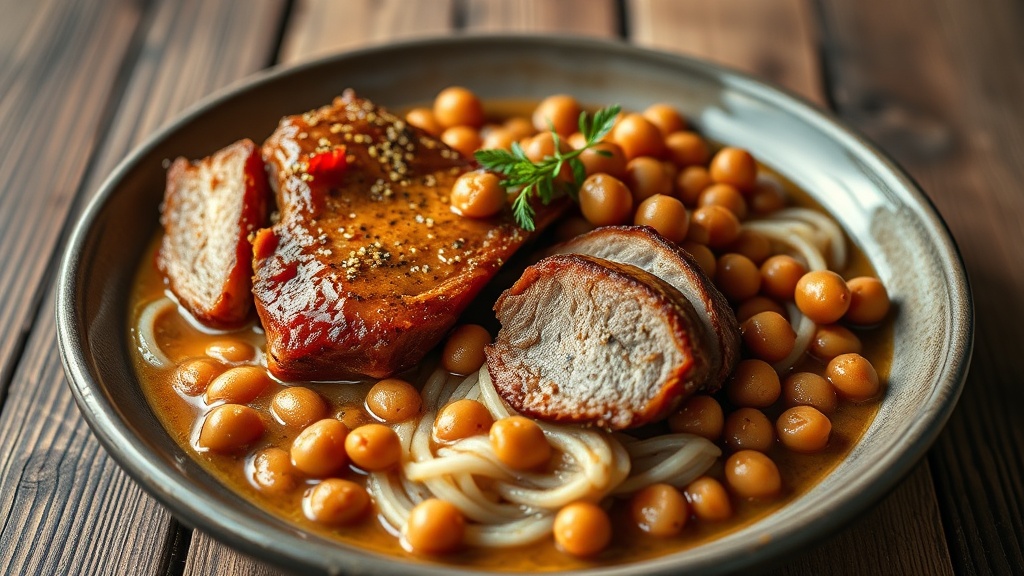
The national dish. Smoked pork collar (Judd) soaked overnight, simmered slowly, and served in thick slices with broad beans (Gaardebounen) in a creamy roux with bacon and savory, plus boiled potatoes. The beans are the point — large, flat, green and slightly bitter — and the dish is heavy, salty and very good in November.
Bouneschlupp
Green bean soup, and the everyday national dish rather than the ceremonial one: French beans cut short, potatoes, onion, bacon or smoked sausage, thickened with a little roux and finished with cream and savory. Every family makes it and every family’s is different.
Gromperekichelcher
Potato fritters — grated potato, onion, parsley, egg and flour, fried flat and crisp in deep fat, eaten from a paper cone with apple sauce. They are the smell of every Luxembourgish market and Christmas fair, and they are the single best cheap food in the country.
The river fish
The Moselle and the Sûre gave Luxembourg a freshwater fish tradition that survives in the riverside restaurants: Fritür, small fried fish eaten whole; trout à la luxembourgeoise; and pike, all classically served with a Riesling.
Kachkéis and Träipen
Kachkéis is a cooked, spreadable, pungent soft cheese eaten on rye bread with mustard — an acquired taste that Luxembourgers acquire early. Träipen is black pudding, eaten at Christmas with apple sauce and mashed potato. Rieslingspaschtéit is pork and veal in a pastry crust with Riesling jelly, and is the best thing at any village festival.
Quetschentaart
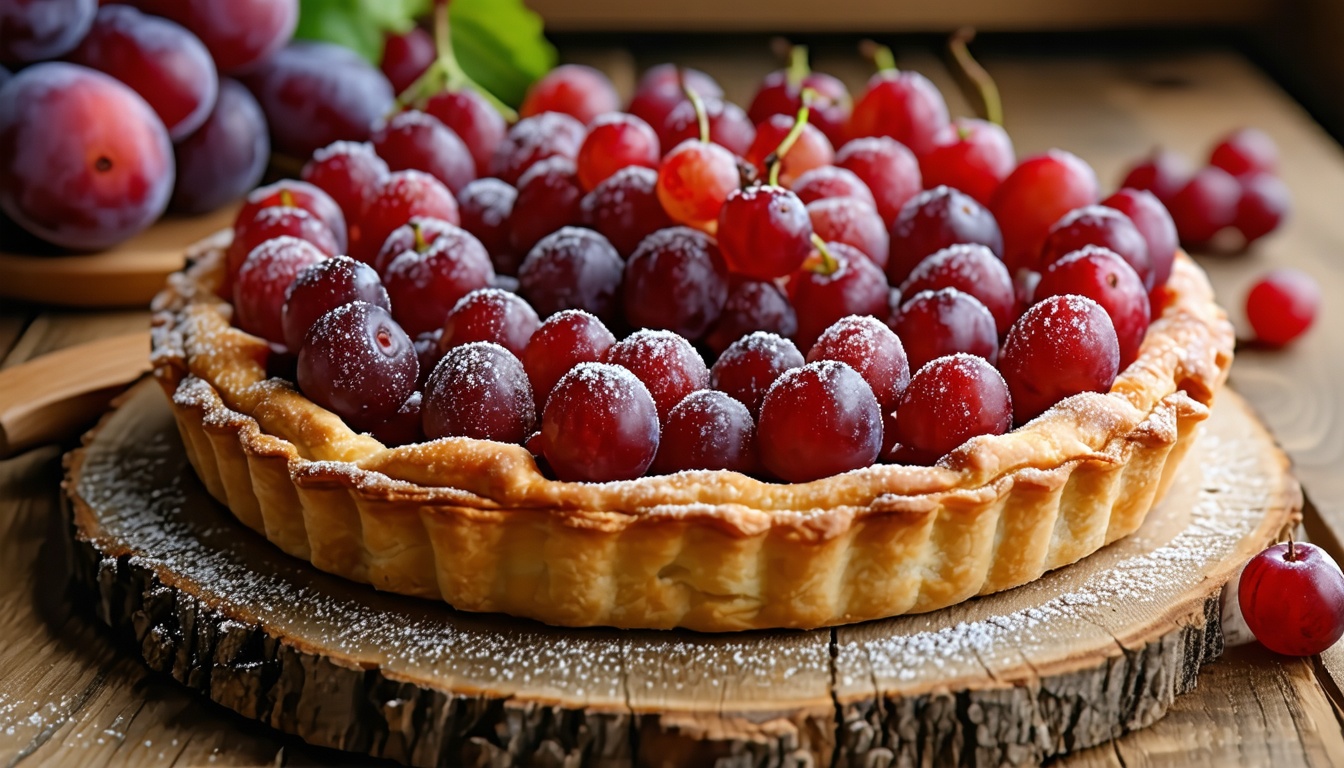
The damson tart: an open tart of shortcrust or yeast dough with halved Quetschen plums laid in tight overlapping rows, cut side up, baked until the fruit collapses and caramelises, dusted with sugar. It appears in late August and disappears in October, and it is the taste of the Luxembourgish autumn.
👨🍳 Two Luxembourgish Recipes
The national dish and the everyday soup. Both are cheap and both are far easier than they look. Quantities serve four.
Judd mat Gaardebounen — smoked pork collar with broad beans
Main course · overnight soak plus about 2 hours · the Luxembourgish national dish
Ingredients: 1.2 kg smoked pork collar (Judd; a smoked pork neck or a lightly smoked gammon joint works); 1 onion, 1 carrot, 2 bay leaves, 6 peppercorns, 2 cloves for the stock. For the beans: 800 g broad beans, podded (frozen is fine — 600 g); 100 g smoked streaky bacon, diced; 1 onion, finely chopped; 30 g butter; 30 g plain flour; 250 ml of the pork cooking liquid; 100 ml cream; 1 tbsp fresh summer savory (or thyme); salt, pepper. To serve: 1 kg boiled potatoes.
Method: Soak the smoked collar in cold water overnight, changing the water once — this draws out enough salt to make the dish edible rather than punishing. Next day drain it, cover with fresh cold water, add the onion, carrot, bay, peppercorns and cloves and simmer very gently, uncovered, for about 90 minutes until a skewer goes in easily. Do not let it boil hard or the meat toughens. Meanwhile cook the broad beans in salted water for 5–8 minutes and, if you have the patience, slip them out of their grey skins — it doubles the work and transforms the dish. Fry the bacon and onion in the butter until golden, stir in the flour and cook for a minute, then whisk in 250 ml of the strained pork liquid to make a smooth sauce. Add the cream, the savory and the beans and warm through without boiling. Slice the pork thickly, lay it over the beans and serve with plenty of boiled potatoes.
💡 The overnight soak is not optional and the summer savory is not a garnish — Bounekraut, "bean herb", is what makes the sauce taste Luxembourgish rather than generically creamy.
Bouneschlupp — green bean soup
Soup · about 45 minutes · what Luxembourgers actually eat on a Tuesday
Ingredients: 500 g green beans, topped and cut into 2 cm lengths; 500 g potatoes, peeled and diced; 1 large onion, chopped; 1 leek, sliced; 150 g smoked bacon lardons, or 2 smoked sausages sliced; 30 g butter; 20 g plain flour; 1.5 l chicken or vegetable stock; 100 ml cream; 1 tbsp summer savory; salt, black pepper; a little vinegar.
Method: Fry the bacon in the butter until the fat runs, add the onion and leek and soften without colouring. Stir in the flour and cook it for a minute — this light roux is what gives the soup its characteristic body. Pour in the stock, whisking, then add the potatoes and simmer 10 minutes. Add the beans and the savory and cook a further 10–15 minutes, until the potatoes are starting to fall apart and thicken the soup and the beans are soft rather than squeaky — this is not a soup that wants crisp vegetables. Stir in the cream, season generously, and finish with a small splash of vinegar to lift it.
💡 Cook the beans past the point a French cook would stop. Bouneschlupp is meant to be soft, thick and comforting, and undercooked beans make it taste like a diet dish, which it emphatically is not.
🍷 Crémant, Riesling and a Beer Culture Nobody Mentions
Crémant, first
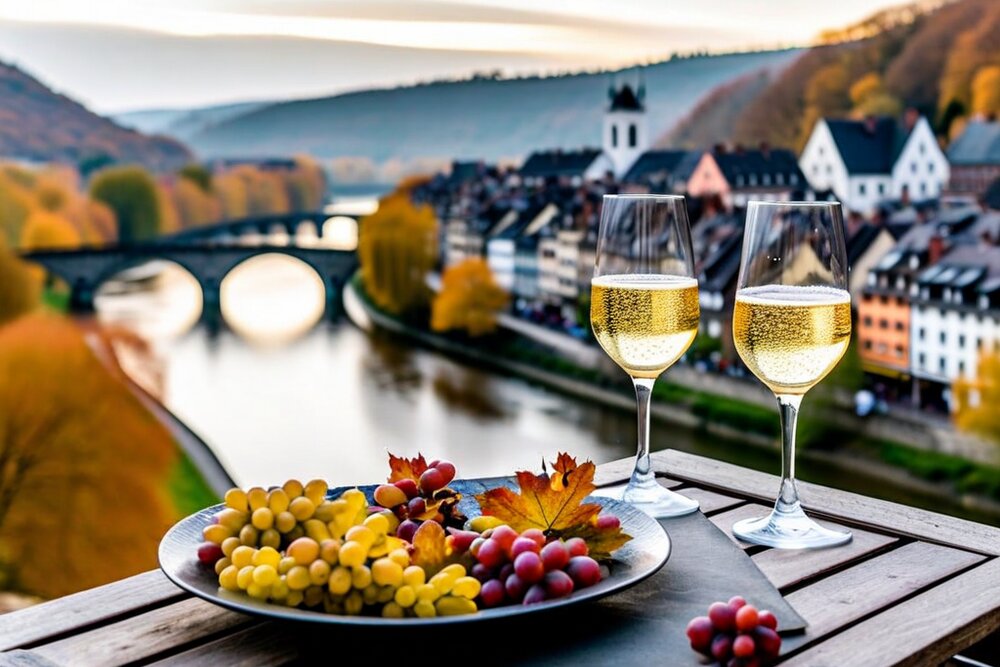
If you try one thing, make it this. Crémant de Luxembourg has been a protected appellation since 1991, is made by the same bottle-fermentation method as Champagne, usually from Pinot Blanc, Auxerrois, Riesling or Chardonnay, and costs a third of the price. It is dry, precise and unfussy, and Luxembourgers open it on Tuesdays.
The still whites
Riesling from the Wormeldange Koeppchen is the region’s finest expression — steely, mineral, capable of ageing. Auxerrois is the local hero grape and rounder. Pinot Gris is richer and often the best value. Rivaner is the light everyday white. Reds are a small and improving minority, mostly Pinot Noir.
Elbling
Worth ordering purely as a historical curiosity: an ancient white variety, probably Roman, that has vanished nearly everywhere else and survives on the Luxembourg and German Moselle. It makes a sharp, low-alcohol, faintly sour wine, mostly used for base sparkling — and drinking it is the closest you will get to a Roman table wine.
Beer
Underrated. Bofferding, Diekirch, Battin and Simon are the historic breweries, making clean Pilsner-style lagers, and there is a growing craft scene. Luxembourg drinks more beer per head than wine, which surprises people who have only heard about the Moselle.
Eaux-de-vie
The Moselle and the Ardennes both distil. Quetsch (damson), Mirabelle, pear and apple spirits are made commercially and on farms, and are served ice-cold in tiny glasses after a heavy meal — which, given the national cuisine, is most meals.
Practical
Drinking age 16 for beer and wine, 16 for spirits as well in law but 18 in practice in most bars. Drink-drive limit is 0.5‰ and 0.2‰ for drivers with under two years’ experience. Alcohol and fuel are cheap by regional standards, which is why the border petrol stations are the busiest buildings in the country.
🎭 Steichen, RTL and the Family of Man
Edward Steichen
Born in Bivange in 1879, emigrated to Michigan as a child, and became one of the most important photographers of the twentieth century — Pictorialist, then modernist, then director of photography at MoMA. In 1955 he assembled “The Family of Man”, 503 photographs from 68 countries, which toured the world and was seen by nine million people. He left it to Luxembourg, and it is permanently installed at Clervaux Castle, on the UNESCO Memory of the World register.
Radio Luxembourg
For fifty years the most listened-to station in Europe. From 1933, powerful transmitters broadcast commercial radio in English, French and German into countries whose own broadcasters were state monopolies. “208 metres medium wave” introduced British teenagers to rock and roll under the bedclothes, and the whole thing existed because Luxembourg would license what Britain, France and Germany would not.
Literature and language
A small literature written in three languages, which is its defining problem and its interest. Michel Rodange’s Renert (1872), a satirical fox epic in Luxembourgish, is the national literary monument. Contemporary authors like Anise Koltz (in French) and Guy Rewenig (in Luxembourgish) work in a market of a few thousand readers.
Music and the Philharmonie
The Philharmonie Luxembourg on the Kirchberg, ringed by 823 slender white steel columns, is acoustically among the best halls in Europe and programmes far above the country’s weight. The Rockhal at Belval takes the touring rock and pop circuit. There is also a serious brass band and folk tradition in the villages.
Festivals
The Schueberfouer in the capital, running since 1340, is one of the oldest and largest funfairs in Europe — three weeks from late August, with a fried-fish-and-Gromperekichelcher food culture all its own. Éimaischen on Easter Monday sells whistling clay birds called Péckvillercher. And the Echternach hopping procession on Whit Tuesday is the one that is UNESCO-listed.
Film
A real industry built on tax incentives: Luxembourg co-produces a startling number of European features and animations, and the animation studios in particular have credits far out of proportion to the country. A great deal of what looks like Belgian or French cinema has Luxembourgish money and post-production in it.
🚌 The First Country to Make Transport Free
On 29 February 2020, Luxembourg abolished fares on all public transport nationwide — train, tram and bus — for everyone, resident or visitor. It was the first country in the world to do it, and six years on it is still the only one.
How it works
You board and you travel. No ticket, no validation, no zones, no app. It applies to second class on trains, all buses and the Luxembourg City tram, across the whole country. First class on the railways still costs money, and cross-border journeys are only free up to the frontier — a ticket from Luxembourg to Trier or Metz is charged for the foreign portion.
Why they did it
Less to cut car use than to remove an administrative cost and make a social point: fares covered only about 8% of the network’s running costs, and collecting them consumed much of that. The government framed it as a measure for low earners, and there is a serious argument that it is a cheaper subsidy than the machinery of collecting from them.
Did it reduce traffic?
Honestly, not much on its own. The country still has 228,000 cross-border commuters, most of whom drive at least part of the way, and car ownership remains among the highest in Europe. What free transport did do is raise ridership substantially and buy political room for the far more consequential investment: the tram, the new stations, and the doubling of the rail corridor to the French border.
The tram
Luxembourg City had trams until 1964 and brought them back in 2017. The line now runs from Findel airport through Kirchberg, across the Red Bridge, past the station and on towards the south of the city, and it is the spine that makes the capital work without a car.
The trains
A small, dense, punctual network radiating from Luxembourg City to Troisvierges in the north, Wasserbillig on the German border, Kleinbettingen towards Belgium, and Bettembourg and Esch to the south, with direct services to Brussels, Trier, Metz, Koblenz and a TGV to Paris in about 2 hours 10 minutes.
What it means for a visitor
This is genuinely one of the best travel facts in Europe: your transport budget in Luxembourg is zero. You can land at the airport, take a bus to the city, spend the week riding trains to Vianden, Echternach, Remich and Esch, and pay nothing at all. Very few visitors realise it before they arrive.
📸 What to Actually See
The casemates and the Corniche
Start here. The Bock casemates, the Chemin de la Corniche along the ramparts, and the free lift down into the Grund give you the whole logic of the city in about two hours. The Wenzel Walk extends it to a proper half-day with a thousand years of fortification.
Vianden Castle
The photogenic one: a restored Hohenstaufen fortress on a spur above the Our, with a chairlift opposite for the classic view. Forty minutes by bus from Ettelbruck station, and free to reach because all transport is.
The Mullerthal
A day’s walking around Berdorf and Echternach through the sandstone: the Wolfsschlucht passage, the Schiessentümpel waterfall, the Perekop chimney. Echternach itself has the basilica and the abbey museum.
Clervaux and the Family of Man
Steichen’s 1955 exhibition, permanently installed in a small Ardennes castle. It takes an hour and it is one of the genuinely important cultural holdings in this part of Europe, sitting almost unvisited in a town of 1,300 people.
Hamm and Sandweiler
The Luxembourg American Cemetery with Patton’s grave and 5,070 others, and the German cemetery two kilometres away with over 10,000. Both free, both immaculate, and visiting them in the same morning is a different experience from visiting either alone.
Belval and the Moselle
The two ends of the economy. The preserved blast furnaces at Belval in the industrial south, and a day on the Route du Vin from Remich to Grevenmacher with a cellar visit. Both are twenty to forty minutes from the capital and cost nothing to reach.
📅 When to Go
May to September
The reliable window. Warm without being hot (20–25 °C), long evenings, the Moselle boats running, the outdoor terraces open and the walking country at its best. June and September are the sweet spots — July and August bring the crowds and the Schueberfouer.
23 June — National Day
The best single date. Fireworks over the Adolphe Bridge and the Pétrusse valley on the evening of the 22nd, a torchlight procession, then the military parade, the Te Deum and a city-wide party on the 23rd. It is not the Grand Duke’s birthday — the date was fixed in 1961 simply to get a summer celebration — and nobody minds.
Late August to mid-September
Two reasons. The Schueberfouer, the funfair running since 1340, takes over the Glacis field in the capital for three weeks. And it is the start of the grape harvest and the beginning of Quetschentaart season, which are the two best food arguments the country has.
Autumn on the Moselle
October on the vineyard slopes is the country at its most attractive: gold and red terraces above the river, the Federweisser (new, still-fermenting wine) in the riverside cafés with onion tart, and hardly anyone about.
Winter
Grey, wet and dark rather than crisp and snowy — the Ardennes north gets snow, the rest mostly does not. The compensation is the Wanterlicher Christmas markets in the capital, which are small, well done and take over four squares, and the fact that museums and restaurants are empty.
What to avoid
Sunday, if you need to buy anything — almost all shops close. And be aware that Luxembourg City largely empties at weekends and in August, when the commuting workforce goes home and the EU staff go on holiday; the old town stays lively but the business districts become quite eerie.
✈️ Getting There
From Prague
There are usually direct flights Prague–Luxembourg of about 1 hour 40 minutes, operated by Luxair — check current schedules, as frequency varies by season. Otherwise connect through Frankfurt, Munich, Vienna or Amsterdam. Fares on the direct route are business-oriented and can be steep; flying to Frankfurt-Hahn, Trier or Saarbrücken and continuing overland is often cheaper.
The airport
Findel (LUX) is 6 km from the city centre, small, efficient, and connected by the tram and by bus — both free. It is Luxair’s base and a very large cargo hub (Cargolux is one of the biggest freight airlines in the world), which is why the runway is bigger than the passenger terminal suggests.
By train
Luxembourg is well connected: Paris by TGV in about 2 h 10, Brussels in about 3 h, Trier in 50 minutes, Koblenz and Metz directly. From Prague the realistic rail route is via Frankfurt or Nuremberg–Mannheim, around 10–12 hours with two changes.
By car
About 800 km from Prague via Nuremberg, Frankfurt and Trier — eight to nine hours. German motorways are toll-free for cars and Luxembourg has no vignette. Note that fuel in Luxembourg is significantly cheaper than in Germany, France and Belgium, which is why the border stations are jammed; fill up on the way out, not on the way in.
Getting around, once there
Free. All public transport, nationwide, for everyone. Trains from the central station reach the north, the Moselle and the south; buses reach every village. The one thing worth knowing is that rural bus frequencies drop sharply at weekends, so check the mobiliteit.lu planner before setting out for a small place on a Sunday.
Cycling
Excellent and underrated. A national network of PC routes on old railway alignments and river banks, largely flat along the Moselle, Sûre and Alzette. Bikes go free on trains outside peak hours. The Route du Vin and the Vennbahn towards Belgium are the standout rides.
📋 Practical Information
Entry and money
EU, Schengen and eurozone founding member. Czech citizens need only an ID card and the currency is the euro. Cards are universal, contactless everywhere, and cash is rarely necessary.
Health
Your Czech EHIC card is valid and Luxembourg’s healthcare is among the best-funded in the world. The emergency number is 112. Pharmacies operate a rota system for out-of-hours; the duty pharmacy is posted in every pharmacy window and online.
Safety
Extremely safe. Luxembourg consistently records some of the lowest crime rates in Europe. The area immediately around the railway station has a visible drug scene and a poor local reputation, and is worth ordinary urban caution at night; everywhere else, including walking the Grund at midnight, is fine.
Costs, expectations
This is one of the most expensive countries in Europe for accommodation and eating out, and among the cheapest for two specific things: public transport (free) and fuel, tobacco and alcohol (low excise duties). Budget accordingly — the savings do not offset the hotel bill.
Language etiquette
Open in French or English rather than German — German is official and widely understood, but French is the working language of service and German carries a little historical weight. Moien as a greeting will be appreciated out of all proportion to the effort.
Sundays and hours
Shops close on Sunday almost without exception and many close on Monday mornings. Restaurants often close between lunch and 18:30. Banks and offices keep short hours. Museums are generally open Tuesday to Sunday, with several offering free entry on Thursday evenings.
💰 What It Costs
Luxembourg is expensive, and the shape of the expense is unusual: sleeping and eating cost a great deal, moving around costs nothing at all. Figures are indicative for 2026, converting at roughly 1 EUR ≈ 24.5 CZK.
Accommodation
The main cost, and inflated by business travel. A three-star double in the capital runs €120–180 (2,900–4,400 CZK) midweek, often less at weekends when the business travellers leave — a genuine trick worth exploiting. Four-star €180–260. Outside the capital, and especially in the Ardennes and on the Moselle, expect €70–110, and there is a good network of youth hostels (Vianden, Echternach, Beaufort, Luxembourg City) at €25–40.
Eating
A main course in an ordinary restaurant €18–28; the lunchtime plat du jour €12–18 and it is much the best value in the country; a coffee €3–4; a beer €4–6; a glass of Crémant €5–8. A good dinner with wine, €55–80 a head. Supermarket prices are close to German ones, which is to say reasonable.
Transport
Zero. All trains (second class), all buses and the tram, nationwide, for everybody. This is not a discount card or a tourist pass — there is simply no fare. Budget nothing, and check whether your cross-border legs are chargeable.
Museums and sights
Modest. The Bock casemates around €8, Vianden castle about €10, Mudam €8, the City History Museum €5, and the American Cemetery, the Wenzel Walk, the Corniche and all the hiking are free. A Luxembourg Card covers most attractions for €13–28 depending on duration and is worth it if you plan three or more paid sites.
A realistic day
Budget, in a hostel with lunch specials: €60–80 (1,500–2,000 CZK) per person per day. Comfortable mid-range in the capital with two meals out: €180–240. Staying in the Moselle or the Ardennes and travelling in daily: €110–150, and the free transport makes that entirely practical.
The fuel and tobacco point
Excise duties are markedly lower than in the neighbouring countries, which is why every border road has a petrol station the size of a supermarket. If you are driving through, fill the tank here. It is a legitimate and substantial saving and it is a real, if slightly embarrassing, pillar of the national economy.
🇨🇿 For Czech Readers
Charles IV was a Luxembourger
The connection that surprises Czech visitors, and it is the largest one either country has. The House of Luxembourg ruled Bohemia for over a century: John the Blind (Jan Lucemburský) became King of Bohemia in 1310, died at Crécy in 1346, and is buried in Luxembourg Cathedral. His son Charles IV — Karel IV. — was born in Prague, was Holy Roman Emperor, founded Charles University and the New Town, and built the bridge. Prague’s greatest ruler came from this dynasty.
Where to see it
In the crypt of the Notre-Dame Cathedral in Luxembourg City lies John the Blind, whose remains travelled a long way before coming home in 1946. The National Museum of History and Art covers the dynasty. For Czech readers this is a short walk that closes a loop most Czechs did not know was open.
MZV ČR
No warnings whatsoever — Luxembourg is among the safest countries in the world. The Czech Republic has an embassy in Luxembourg City. Registration in DROZD is optional and sensible for longer stays. Emergency number 112.
Money and health
The euro, and your EHIC card works. Nothing about a Luxembourg trip is administratively complicated for a Czech traveller.
Getting there
Direct Luxair flights from Prague take about 1 h 40 when scheduled; otherwise connect via Frankfurt or Munich. By car it is roughly 800 km and 8–9 hours via Nuremberg and Trier, entirely on toll-free German motorway.
Scale, for a Czech reader
Luxembourg is 2,586 km² — about 3% of Czechia, roughly half the size of the Karlovy Vary Region, and smaller than the district of Šumperk. Its whole population of 680,000 is a little more than Brno plus Ostrava. And its highest point, Kneiff at 560 m, is lower than Klínovec, Lysá hora or Praděd.
🎲 Things That Are True About Luxembourg
The only Grand Duchy left
There were once a dozen — Baden, Tuscany, Hesse, Oldenburg, Finland under the Tsars. Luxembourg is the last sovereign grand duchy in the world, and has been since 1918.
Free transport, first on earth
On 29 February 2020 Luxembourg abolished all public transport fares nationwide, for residents and visitors alike. Six years later it is still the only country in the world to have done it.
Four Holy Roman Emperors
From a county the size of a Czech okres: Henry VII, Charles IV, Wenceslaus and Sigismund all came from the House of Luxembourg, and three of them were also Kings of Bohemia. It is difficult to think of a comparable output per square kilometre anywhere.
The census they cancelled
On 10 October 1941 the German occupiers polled Luxembourgers on their nationality, mother tongue and ethnicity, expecting them to declare themselves German. So many wrote Lëtzebuergesch to all three questions that the count was abandoned. It is remembered as the Doppelte Nee — the triple no — and it is the founding act of the modern national identity.
A funfair from 1340
The Schueberfouer, founded by John the Blind in 1340 as a sheep market, still runs for three weeks every August and is one of the largest funfairs in Europe. The sheep have gone; the fried fish and the Ferris wheel have not.
Space mining law
In 2017 Luxembourg became the second country in the world, after the United States, to pass a law granting private companies ownership of resources they extract from asteroids — and set up a space agency and an investment fund to go with it. The legal framework has so far outrun the industry by some distance.
🚴 A Cycling Country of 680,000
Luxembourg's sporting record is absurd for its size, and it is almost entirely on two wheels.
Five Tours de France
Luxembourgers have won the Tour de France five times. François Faber in 1909 (the first non-Frenchman ever to win it), Nicolas Frantz in 1927 and 1928 — in 1928 he led from the first day to the last, one of only a handful of riders ever to do it — and Charly Gaul, the “Angel of the Mountains”, in 1958. For a country with fewer people than Brno, that is a remarkable count.
The Schleck brothers
Andy and Fränk Schleck from Mondorf were among the best climbers of their generation. Andy was awarded the 2010 Tour de France after Alberto Contador’s result was annulled — a title he has said he takes no pleasure in, having not been able to celebrate it on the Champs-Élysées. Their father Johny rode the Tour too.
Why cycling
The Ardennes. The north of the country is exactly the terrain that makes climbers — short, steep, relentless hills in wet weather — and it sits inside the same cycling culture as Belgium and northern France. The country has a dense club network and closes roads for races without much fuss.
Ni Xia Lian
The most extraordinary Luxembourgish athlete. Born in Shanghai in 1963, a world champion for China in the 1980s, she moved to Luxembourg in 1991 and has represented it ever since. She competed at the Paris 2024 Olympics aged 61, one of the oldest Olympians in any sport in the modern era, and reached the last sixteen in Tokyo at 58.
Football and the rest
The national football team spent decades as a byword for defeat and has become genuinely competitive in the last ten years, taking points off serious opposition. Gilles Muller reached the Wimbledon quarter-finals and beat Rafael Nadal there in 2017. Beyond that: strong participation sport, an excellent national stadium opened in 2021, and a country where sport is a club activity rather than an industry.
The Games of the Small States
Luxembourg co-founded and regularly hosts the Games of the Small States of Europe, a biennial multi-sport event for the nine European countries with under a million people — Andorra, Cyprus, Iceland, Liechtenstein, Malta, Monaco, Montenegro, San Marino and Luxembourg. It is where a country this size can plausibly win things, and it does.
🔭 The Country People Drive Through
The numbers
Luxembourg receives on the order of 1.2 to 1.5 million overnight visitors a year, a very large share of them business travellers and EU visitors, plus a substantial flow of day-trippers and coach tours passing between Belgium, France and Germany. Leisure tourism is a small industry in a rich country that does not need it.
The image problem
Luxembourg is known abroad as a tax jurisdiction, a European institution and a place on a motorway sign. Very few people outside the region know that the capital is a UNESCO fortress city, that the country has a wine region, or that it contains the best waymarked walking in the Benelux. The tourist board knows this and has spent years on it.
Who does come
Germans and Dutch for the Ardennes, the Mullerthal and the campsites — Luxembourg has a large and long-established camping culture aimed squarely at them. Belgians and French for weekends and shopping. British and American visitors overwhelmingly for the American Cemetery and the Battle of the Bulge sites. Asian coach groups for a two-hour stop on a multi-country tour.
What works
The Mullerthal Trail has been a genuine success and draws walkers from across Germany. The Luxembourg Card makes a museum-heavy trip cheap. And the free public transport is a marketing asset the country has been surprisingly slow to shout about — it removes the single biggest friction in visiting a small country by public transport.
The Esch 2022 effect
The European Capital of Culture year, shared between Esch-sur-Alzette and eleven French communes across the border, put the Minett on the map for the first time and left behind a functioning cultural infrastructure in the south. It is the most interesting thing to have happened to Luxembourgish tourism in twenty years.
The recommendation
Three or four days. Two in the capital — the casemates, the Corniche, the Grund, the Mudam; one walking in the Mullerthal from Echternach; one on the Moselle with a cellar visit, or in the north for Vianden and Clervaux. It costs nothing to move between any of them, and almost nobody does it.
🌅 What Comes Next
Housing, still
The defining domestic problem and the one that shapes everything else. An analysis in March 2026 argued the crisis is now structural: supply has never matched demand, ownership has professionalised, prices resumed rising in early 2026 after a brief correction, and each year more people are pushed across the borders. Every government promises to fix it and the arithmetic of land supply in a country this small is unforgiving.
Dependence on commuters
A workforce that is 47% cross-border is efficient and fragile. It depends on open frontiers, on French and Belgian housing staying cheaper, and on the motorway and rail links not seizing up — and it exports Luxembourg’s social costs into regions that get none of the tax revenue. Cross-border tax and social-security arrangements are a permanent negotiation.
The financial centre
Bank secrecy is gone, the LuxLeaks era is over and OECD minimum taxation is in force. The fund industry remains enormous and genuinely competitive on expertise rather than opacity, but it is exposed to European tax harmonisation and to competition from Dublin. Diversification into space, ICT and logistics is real but small.
Demography and identity
Native Luxembourgish speakers are a shrinking share of the resident population, which raises a question the country debates constantly: what does it mean to be Luxembourgish when half your neighbours are not, and cannot vote? The answers so far — language promotion, easier naturalisation, local voting rights — have not settled it.
Climate and land
A small, densely built country with heavy car dependence and one of Europe’s highest per-capita carbon footprints, inflated by fuel sold to passing traffic. The response has been the free transport, the tram, large rail investment and aggressive renewables targets. The fuel-tourism revenue is an awkward thing to give up and the government knows it.
What it will stay
A country that has been partitioned three times, annexed twice and repeatedly nearly traded away, and that responded by making itself indispensable to everyone around it — as a founding member of every European institution, a fund domicile, a satellite operator and a place where three languages and 170 nationalities work out how to share a space smaller than a Czech region. Mir wëlle bleiwe wat mir sinn has been the plan for a very long time, and it is working.
📸 Gallery — and Fifteen Files That Belong to Another Country
Read this section. Of the image files found for Luxembourg, fifteen are photographs of Abkhazia — a disputed territory in the Caucasus, 2,500 km away — and they carry Abkhazian place names in their own filenames. This is the same misfiled set that has now turned up under Lebanon, Lesotho, Lithuania and here. Only five files could be used on this page.
The old live page that this one replaces did not display any of them. It did, however, carry the flag 🇦🇼 — Aruba instead of Luxembourg's, and it linked to two recipe images that do not exist and were rendering as broken: luxembourg-bouneschlupp.jpg and luxembourg-gromperekichelcher.jpg, both returning HTTP 404. All three defects are fixed here.
Used: the hero, with a caveat
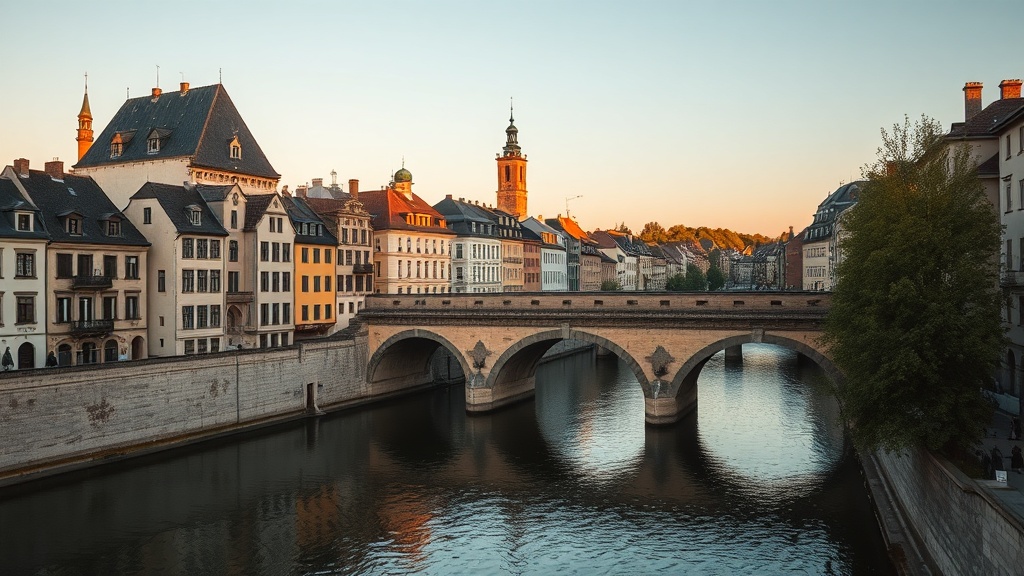
01-hero.jpg is a handsome European river town at dusk — stone arch bridge, gabled quay houses, a church tower. It is not Luxembourg City, and the giveaway is topography: the real Alzette runs in a gorge sixty metres below the old town between cliffs carrying seventeenth-century ramparts, and there is no cliff anywhere in this frame. Used at the top of the page and captioned as atmosphere, not as this city.
Used: the wine map, and it is correct
luxembourg-wine-regions-map.jpg is the best decorative map found anywhere in this project. “Moselle Luxembourgeoise” is the correct name of the region; Grevenmacher, Wormeldange and Remich are all real wine towns placed in the right north-to-south order; the vineyards are on the correct Luxembourg bank; Belgium, Germany and France are in the right directions; and the scale bar is legible and plausible. The only flaw is spelling the Sûre as “Süre”. Compare the Liechtenstein equivalent, which invented a town and misplaced another.
Used: the Crémant
luxembourg-drink.jpg shows two glasses of sparkling white above autumn vineyard slopes and a river village. It is appropriate — Crémant de Luxembourg is genuinely the country’s flagship product and the Moselle genuinely looks like this in October — and, decisively, the bottles and glasses carry no labels, so no real producer’s name has been forged onto an invented design.
Used with a correction: Judd mat Gaardebounen
luxembourg-judd-mat-gaardebounen.jpg gets the smoked pork and the sauce roughly right and the beans completely wrong. Gaardebounen are broad beans — large, flat and green, and the dish is named after them; the plate shows small round chickpeas. The boiled potatoes that always accompany it are missing too. The correction is printed under the picture on the page.
Used with a correction: Quetschentaart
luxembourg-quetschentaart.jpg shows a baked tart shell heaped with whole round red fruits with their stalks still on — cherries or grapes to look at. A real Quetschentaart uses Quetschen: oval blue-purple damsons, halved and laid cut-side up in tight overlapping rows, baked until they collapse. The real plums are visible in the background of the photograph, which makes the contrast with what is on the tart quite stark.
The fifteen Abkhazian files
04-stalin-dacha.jpg, 05-gagra-colonnade.jpg, 06-new-athos-monastery.jpg, 07-new-athos-lake-view.jpg, 08-new-athos-interior.jpg, 09-pitsunda-cathedral.jpg, 13-cuisine-feast.jpg, 15-voronya-cave.jpg, 16-tkvarcheli-ghost-town.jpg, 17-lykhny-village.jpg and five gallery-* files. Stalin’s dacha, Gagra, New Athos, Pitsunda, the Voronya Cave, Tkvarcheli and Lykhny are all in Abkhazia. None has any connection to Luxembourg. This is now the fourth country in this remaster carrying the same set.
A note on how this list was made
The AWS connection was unavailable when this page was built, so the file list comes from systematic HTTPS probing rather than a bucket listing — testing every filename pattern seen across the project, including the Abkhazian set by name, which is how fifteen of them were found. Probing has missed files in every country where it has been used, so this list should be treated as a minimum: there may be genuinely Luxembourgish images in the bucket that were not guessed. A proper listing is on the record as still owed.
What is missing
No photograph of the casemates, the Corniche, the Grund, Vianden, the Mullerthal, Echternach, Belval or the American Cemetery — every single thing that would make someone want to come. Five usable files for a UNESCO capital. The text is written to work without them.
Support This Project 🌍
This World Travel Factbook is a labor of love – free to use for all travelers. If you find it helpful, consider supporting its continued development.