
🇬🇳 Guinea at a Glance
🌍 Overview
Guinea is 245,857 km² — three times Czechia — with around fourteen and a half million people, on the Atlantic coast of West Africa between Guinea-Bissau, Senegal, Mali, Côte d'Ivoire, Liberia and Sierra Leone. Six neighbours, 320 km of coast, and a highland core that supplies water to a large part of the region.
Two facts define it, and they sit uncomfortably together. First, Guinea is the water tower of West Africa: the Niger, the Senegal and the Gambia all rise inside its borders, which means a country of fourteen million effectively holds the tap for something like a hundred and fifty million people downstream. Second, Guinea sits on roughly a quarter of the world's known bauxite — the largest reserves on the planet — and is among the world's biggest exporters of it, while remaining one of the poorest countries on Earth by income per head.
The third defining fact is political. In 1958 Guinea was the one French African colony to vote NON in de Gaulle's referendum, and it took independence immediately and alone. France's retaliation was total and the country spent the next twenty-six years under Ahmed Sékou Touré, whose one-party state killed thousands at Camp Boiro and drove more than a million Guineans into exile. Since 1984 there have been two long presidencies and, in 2008 and 2021, two coups. Nothing about Guinea's politics is settled, and a visitor needs to check the current position before booking.
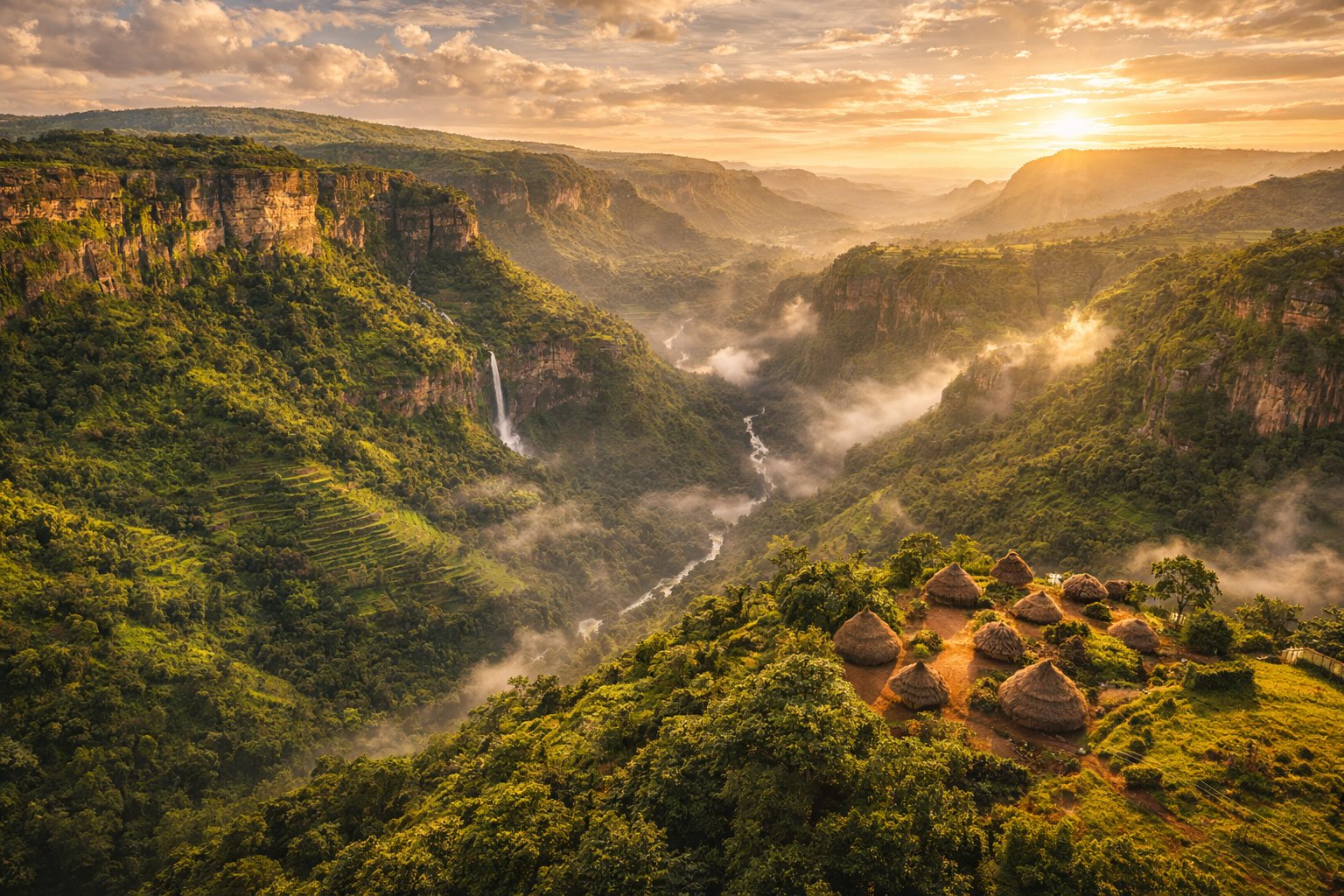
And yet: this is one of the most beautiful and least visited countries in West Africa. The Fouta Djallon is a genuine highland trekking region with hundreds of waterfalls and almost no tourists. Guinea is the homeland of the djembe and of the griot tradition that gave the world the Sunjata epic. It is not an easy place to travel — the roads, the paperwork, the malaria and the heat are all real — but it rewards effort in a way that few places still do.
🏷️ Which Guinea? The Name and the Franc
There are four countries and one region with Guinea in the name, and confusing them is the single most common error about this country. This one — the Republic of Guinea, capital Conakry — is often called Guinea-Conakry precisely to keep it apart from Guinea-Bissau (the former Portuguese colony to the north-west), Equatorial Guinea (a Spanish-speaking oil state two thousand kilometres away on the other side of the Gulf of Guinea), and Papua New Guinea, which is in the Pacific and has nothing whatever to do with any of them.
The word itself is old and disputed. It reached Europe through Portuguese navigators of the 15th century and probably derives from a Berber or Songhay term for the lands south of the Sahara — one common suggestion is aguinaw, "black people", another traces it to the town of Djenné. What is certain is that no Guinean named the country: it is a European geographical label that was inherited at independence and kept.
The franc, not the CFA
Guinea is the only former French colony in West Africa that is not in the CFA franc zone. Sékou Touré pulled out in 1960 and created the Guinean franc — a deliberate break with Paris and one of the most consequential decisions of the independence era. It has cost the country monetary stability ever since and it is defended, to this day, as a matter of sovereignty.
What money looks like
The Guinean franc (GNF) runs at roughly 8,500–8,800 to the US dollar, which puts about 370–400 GNF to the Czech crown. The largest note is 20,000 GNF — worth roughly 50 CZK — so any real transaction involves a brick of paper. Locals quote prices in thousands and drop the zeros; learn to do the same.
The flag
Red, yellow and green vertical bands — the Pan-African colours, adopted at independence in 1958 from Ghana's, which had them first. Red for the blood of the martyrs and of labour, yellow for the sun and the gold, green for the vegetation. Mali's flag is the same three colours in the same order; Guinea's is the mirror image.
Syli
The national symbol is the elephant — syli in Susu — and the football team is the Syli National. Between 1971 and 1985 the currency was actually called the syli. The elephant is nearly gone from Guinea itself, which is a fair summary of the relationship between the country's symbols and its conservation record.
🗺️ Geography: The Four Guineas
Guineans divide their country into four régions naturelles, and this is not an administrative abstraction — it is how everyone here describes where they are from, what language they speak, what they eat and how they vote. Learn the four and the country becomes legible.
Basse-Guinée
The coast, also called Guinée maritime: 320 km of mangrove, tidal creeks, rice paddy and laterite, holding Conakry, Boké, Kindia, Forécariah and Boffa. Hot, humid, extremely wet in season, and the historic homeland of the Susu. This is where the bauxite ports are and where two-thirds of the country's economic activity happens.
Moyenne-Guinée
The Fouta Djallon: a sandstone massif rising to 1,500 m, cut into blocks by deep valleys, cool at night, green in the rains and severely eroded in places. Labé, Pita, Dalaba, Mamou, Mali-ville. Overwhelmingly Fulani (Peul), overwhelmingly Muslim, and the region every visitor should aim for.
Haute-Guinée
The savanna east: hot, flat-ish, drained by the Niger and its tributaries, thinning into Sahel as you go north. Kankan, Siguiri, Kouroussa, Faranah, Dinguiraye. Malinké country, the western edge of the old Mali Empire, and the heartland of the griot families and the gold trade.
Guinée forestière
The south-east: rainforest, hills, the highest mountains in the country, and the wettest, most ethnically complex corner. N'Zérékoré, Macenta, Guéckédou, Lola, Beyla. Kissi, Kpelle (Guerzé), Toma (Loma) and others, with a large Christian and traditionalist minority. Also the region with the most conflict and the fewest roads.
Physically the country is a tilted platform. The Fouta Djallon and the Guinea Highlands form a raised interior of ancient sandstone and greenstone that catches the Atlantic monsoon; from that high ground, rivers run out in every direction. The north-west lowlands are laterite and mangrove; the north-east falls away into the Niger basin; the south-east rises again to the Nimba and Simandou ranges on the Liberian and Ivorian borders.
Mount Nimba, on the triple border with Côte d'Ivoire and Liberia, reaches 1,752 m at Mont Richard-Molard and is the highest point in Guinea and Côte d'Ivoire alike. Mount Loura near Mali-ville, at about 1,515 m, is the high point of the Fouta Djallon, with the eroded rock profile known as La Dame de Mali beside it.
💧 The Water Tower of West Africa
This is the fact about Guinea that should be better known than any other. Three of West Africa's great rivers rise inside this one country, all of them in the highlands, all within a few hundred kilometres of each other:
The Niger
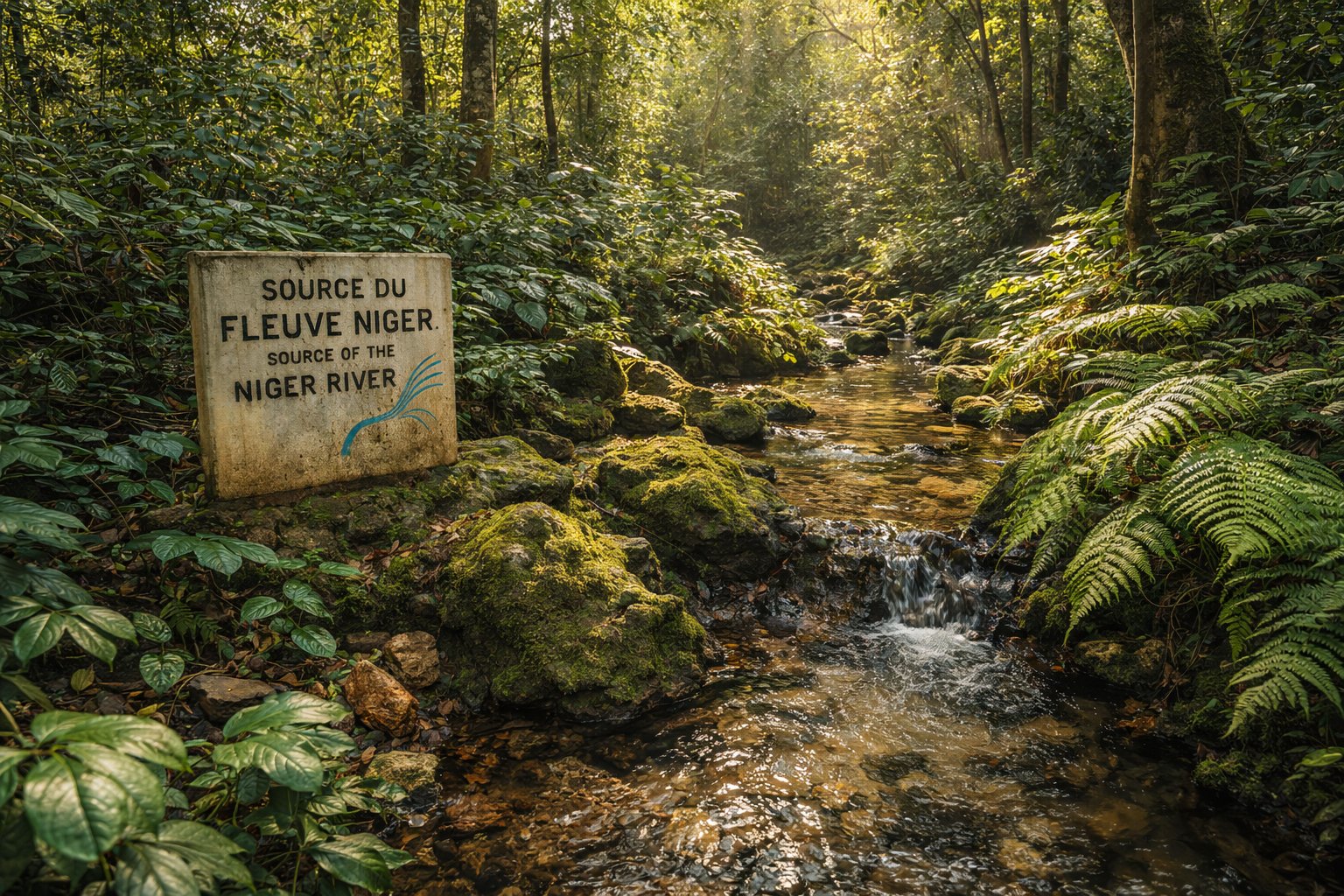
West Africa's greatest river, 4,200 km long, rises in the Guinea Highlands near Faranah about 240 km from the sea — and then runs the wrong way, north-east into the Sahara, before curving south through Mali, Niger, Benin and Nigeria to reach the Atlantic. Its inland delta in Mali and its floodplain in Nigeria feed tens of millions of people.
The Senegal
Formed where the Bafing, which rises in the Fouta Djallon near Mamou, meets the Bakoye in Mali. The Bafing is the dominant contributor — most of the Senegal river's water is Guinean rain — and it feeds the Manantali dam and the irrigation of the Senegal valley 1,600 km downstream.
The Gambia
Rises in the Fouta Djallon near Labé and runs west across Senegal to make the entire country of The Gambia, which is essentially a river with banks. Add the Koliba, the Kolenté, the Kogon, the Konkouré, the Mongo, the Tinkisso and the Milo and you have well over twenty rivers of consequence with Guinean sources.
What it is worth
Guinea has around 6,000 MW of hydroelectric potential and has begun to use it: the Kaleta dam (2015) and the much larger Souapiti dam (2021) on the Konkouré transformed Conakry's electricity supply and let Guinea start exporting power to Mali, Senegal and Guinea-Bissau. It also displaced thousands of people, which is the other half of that story.
The strategic weight of this is easy to miss. Guinea's highland forests and their rainfall are the physical basis of agriculture from Bamako to Banjul, and deforestation on the Fouta Djallon plateau — for charcoal, cattle and cropland — is a regional problem, not a national one. Successive Guinean governments have used the phrase château d'eau de l'Afrique de l'Ouest as both a boast and a bargaining chip, and both uses are legitimate.
🌡️ Climate and When to Go
Guinea is tropical, and the year has two seasons rather than four. The dry season runs roughly November to April and the rains from May to October, peaking with real violence in July and August. Temperatures on the coast sit between 24 and 33 °C almost all year; the Fouta Djallon is several degrees cooler and can drop below 10 °C at night in December and January, which surprises everybody.
Conakry is one of the wettest capital cities in the world. It receives on the order of 3,800 mm of rain a year — five times Prague — and the great majority of it falls in July and August, when the city floods, roads dissolve and flights get interesting. This is not exaggeration for effect: the wet season on the Guinean coast is among the heaviest anywhere outside the monsoon belt of Asia.
November–February
The season to travel. Dry, relatively cool, roads passable, waterfalls still running from the rains, and the harmattan bringing haze off the Sahara from December. Nights in the Fouta Djallon are genuinely cold — take a fleece, which no packing list will tell you.
March–May
Getting very hot, especially in Upper Guinea, where 40 °C is routine before the rains break. Mango season, which is a real compensation, and the last dry roads. The first storms arrive on the coast in May.
June–October
The rains. The landscape is spectacular and the waterfalls are at full power, and much of the country becomes very hard to move around: unpaved roads turn to laterite soup, river crossings wash out, and the forest region can be cut off for days. Only go with time to spare and a 4×4 with a driver who knows the route.
The waterfall trade-off
The falls are biggest in September and October and most accessible from December to February, and you cannot have both. The usual compromise is late November to early January, when the rains have just finished, the water is still high and the tracks have dried out.
🗺️ Map
Guinea sits between about 7° and 12° north, curving around the top of Sierra Leone and Liberia. Conakry is on the tip of the Kaloum peninsula on the Atlantic; Labé, the Fouta Djallon's capital, is 450 km inland by road; Kankan is 650 km east; N'Zérékoré, in the forest region, is close to 1,000 km from Conakry and effectively a separate country in terms of travel time.
Plan by time, not by distance. Conakry to Labé is a full day on a road that alternates between decent tarmac and craters. Conakry to N'Zérékoré is two days by road in the dry season and a bad idea in the wet, which is why the internal flights that do exist matter. Nothing in Guinea takes as long as the map suggests — it takes longer.
👑 Mali, Sundiata and the Mandé World
Upper Guinea is part of the Mandé heartland — the cultural region straddling today's Guinea, Mali, Senegal, Gambia and Côte d'Ivoire that produced the Mali Empire and, with it, one of the great political traditions of the medieval world. This is not local colour. It is the reason Guinean music, social structure and oral history look the way they do.
The empire's founding story is the epic of Sunjata Keita, who around 1235 defeated Sumanguru Kanté at Kirina and united the Mandé chiefdoms. What followed, according to tradition, was the Kurukan Fuga — an assembly at which a charter was proclaimed setting out the division of clans, the rights of women, rules of war, the protection of strangers and the prohibition of unnecessary cruelty. It is transmitted orally by the griots, it was inscribed by UNESCO on the intangible heritage list in 2009, and Guineans, Malians and Senegalese all argue about where exactly it happened.
Niani, on the Sankarani river near Siguiri in Upper Guinea, is traditionally identified as a capital of the Mali Empire and has been excavated since the 1960s. The identification is contested by some archaeologists and defended fiercely in Guinea, and there is not much to see on the ground — but the fact that Guinea claims one of the capitals of medieval West Africa's greatest state is a live part of its self-image.
The griots
The jeli (griot) families — Kouyaté, Diabaté, Kanté, Camara — are hereditary historians, praise singers and mediators whose job is to hold the genealogies and the epic in memory and to speak where a nobleman cannot. Guinea is one of the core jeli countries, and this is the direct ancestry of everything on the music page below.
The epic in print
In 1960 the Guinean historian Djibril Tamsir Niane published Soundjata ou l'épopée mandingue, taken down from the griot Mamadou Kouyaté of Siguiri. It became the standard written version of the epic worldwide and is on school syllabuses across francophone Africa. Read it before you come; it is short.
Islam and the Mandé
Islam reached Upper Guinea with the trans-Saharan trade from around the 11th century and spread through merchant networks rather than conquest. It layered onto Mandé practice rather than replacing it, which is why Guinean Islam has the texture it does — Sufi, tolerant of local custom, and organised around families as much as around mosques.
Gold
The gold that made the Mali Empire famous — and paid for Mansa Musa's pilgrimage of 1324 — came substantially from the Bambouk and Bouré fields, and Bouré is in Guinea, around Siguiri. Artisanal gold mining is still going on in exactly the same places, by hand, today.
🕌 The Imamate of Fouta Djallon
From 1725 to 1896 the Fouta Djallon highlands were an independent Islamic state — one of the earliest and most durable of the West African jihad states, and a polity that produced its own literature, its own constitutional arrangements and its own contradictions.
Fulani pastoralists had been moving into the highlands for centuries, herding cattle among a largely non-Muslim Jalonke population. In 1725 a coalition of Muslim Fulani scholars under Karamokho Alfa declared jihad; his successor Ibrahima Sori completed the military work. The result was a federation of nine provinces (diwe) under an almamy ruling from Timbo, with a council of elders and a remarkable rule: the office alternated between the two founding lineages, the Alfaya and the Soriya, every two years.
That rotation is genuinely unusual — a deliberate constitutional device to stop either family monopolising power — and it worked, more or less, for a century and a half, though the handovers were often violent. The state was literate in Arabic and in Ajami Pular, Fula written in Arabic script, and produced a body of religious poetry that is still recited. It was also built on slave labour: the runde, servile villages, farmed for the free Fulani, and the Fouta Djallon was a significant supplier to the Atlantic trade.
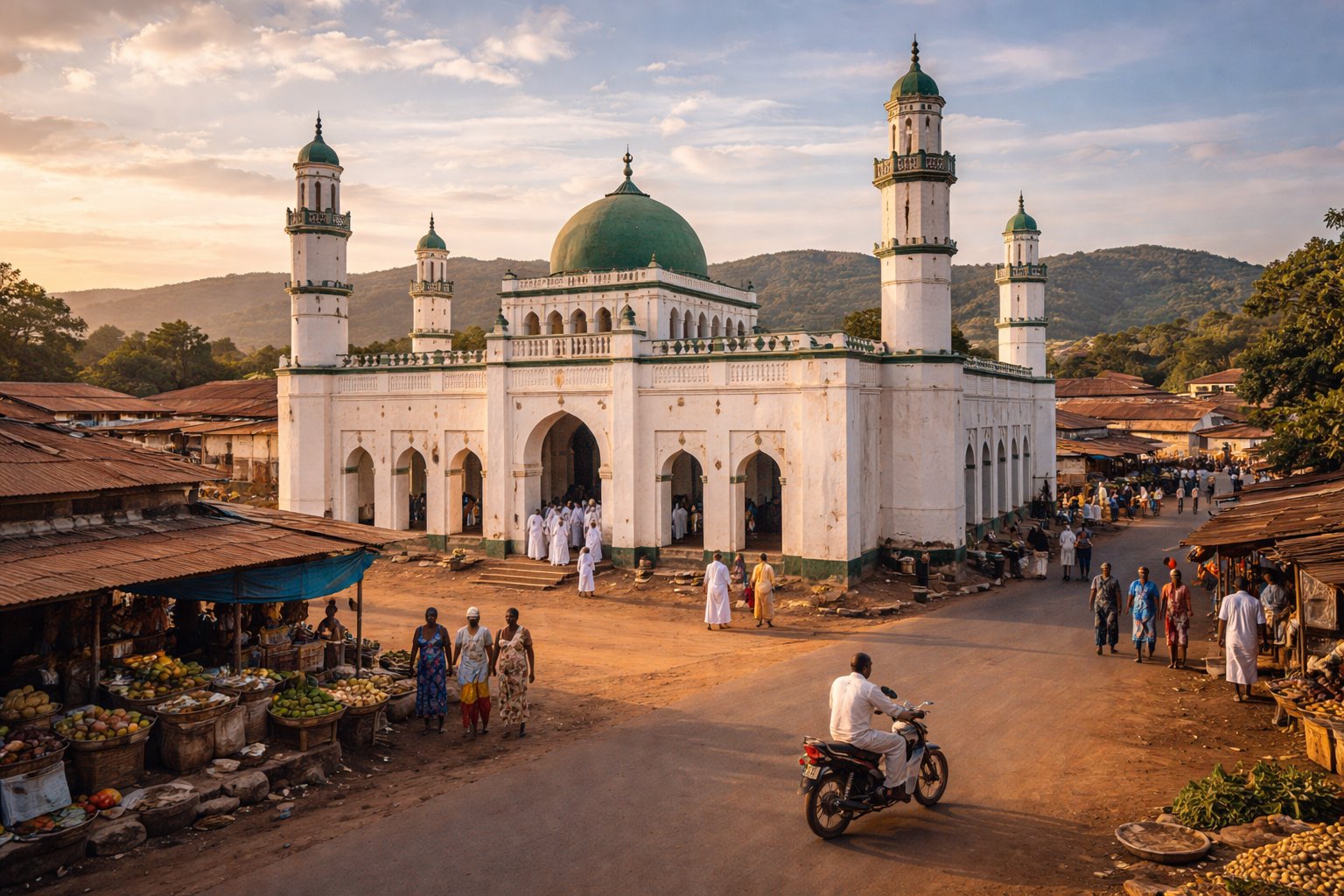
The French took the Fouta piece by piece and finished the imamate at the battle of Porédaka in 1896, where the almamy Bocar Biro's army was destroyed by machine guns. The Fouta remains the most self-consciously distinct part of Guinea, the base of the country's largest ethnic group, and — since the almamys' descendants were on the wrong side of Sékou Touré — the region with the longest record of political grievance.
⚔️ Samori Touré and the French Conquest
Samori Touré (c. 1830–1900) is the reason Guinean children still learn that resistance was possible. A Malinké trader turned soldier from Sanankoro in Upper Guinea, he built the Wassoulou Empire across what is now eastern Guinea, southern Mali and northern Côte d'Ivoire, and then held off the French army for sixteen years, from 1882 to 1898.
What made him formidable was organisation rather than numbers. He created a standing professional army of infantry (sofa) and cavalry, drilled in European-style formations; he bought breech-loading rifles through Sierra Leone; and — the detail that impresses military historians — he set up workshops that repaired and eventually manufactured copies of French rifles, in a state with no industrial base whatever. When the French pressed him, he executed a scorched-earth withdrawal of his entire empire hundreds of kilometres east, moving the population with it.
He was captured on 29 September 1898 in the forest of Guélémou, deported to Ndjolé in Gabon, and died there in 1900. His resistance is claimed across three countries; in Guinea it is national scripture, not least because Ahmed Sékou Touré, the country's first president, was his descendant and made the connection central to his own legitimacy.
The uncomfortable part
Samori's state was also a slave-raiding and slave-trading power, and his scorched-earth campaigns caused famine and mass death among the populations he moved. Guinean historians say this; nationalist rhetoric tends not to. Holding both facts at once is the honest position and it is how the better Guinean textbooks now handle him.
Alfa Yaya
Alfa Yaya Diallo, the ruler of Labé, initially allied with the French against the almamy and was rewarded, then deposed and deported to Dahomey and Mauritania, where he died in 1912. He became the Fouta's own martyr-figure and his remains were returned to Conakry in 1968; the airport road and a district are named for him.
The colony
French Guinea was formally established in 1891 and became part of French West Africa (AOF) in 1895, governed from Dakar. Its economic purpose was bananas, rubber, palm oil and, from the 1950s, bauxite and iron ore. Investment in schools and roads was minimal even by the standards of the AOF.
Forced labour
The indigénat code and forced labour requisitions shaped Guinean politics more than any ideology. The abolition of forced labour in 1946 and the rise of the trade unions — where a young post office clerk named Sékou Touré made his name — is the direct road to 1958.
✊ 1958: The Country That Said No
In September 1958 Charles de Gaulle put a new French constitution to a referendum across the empire. African territories were offered membership of a Franco-African Communauté — internal autonomy inside a French-run bloc — with a NO vote meaning immediate independence and, de Gaulle made clear in Conakry on 25 August, immediate withdrawal of French support.
On 28 September 1958, Guinea voted NON, by around 95%. It was the only territory in French Africa to do so. Ahmed Sékou Touré's formulation — "Nous préférons la pauvreté dans la liberté à la richesse dans l'esclavage", we prefer poverty in freedom to riches in slavery — became one of the defining sentences of African decolonisation. Independence was declared on 2 October 1958.
France's response was immediate and comprehensive. Within two months essentially all French administrators, teachers, doctors and technicians were withdrawn. Accounts by Guinean and French sources describe files burned, telephone wiring pulled out, medicines destroyed, equipment removed or smashed, and the new state cut off from the franc zone and from French aid. Whether every widely repeated anecdote is accurate is debated by historians; that the withdrawal was punitive, rapid and designed as a warning to other territories is not.
What it cost
Guinea entered independence with a handful of university graduates, no functioning administration and no currency of its own. It created the Guinean franc in 1960 and turned to the Soviet Union, Czechoslovakia, East Germany and China for the technicians France had taken away — which is why a surprising number of older Guinean engineers speak Russian and why Czech names appear in the archives of the period.
The Czechoslovak thread
Czechoslovakia was an early partner: it supplied arms, aircraft, technical advisers and scholarships, and Guinean students came to Prague, Brno and Bratislava through the 1960s. A number of Guinean professionals of that generation still speak Czech. It is a small, real and almost entirely forgotten link between the two countries.
Why it mattered elsewhere
Guinea's NO forced the pace. Within two years every other French African territory had taken independence too, on terms far softer than the ones Guinea got. Kwame Nkrumah's Ghana lent Guinea £10 million within weeks and the two states announced a nominal union — the first concrete act of pan-Africanism as state policy.
2 October
Independence Day, and the country's national holiday. It is celebrated seriously. The date and the sentence about poverty and freedom are on posters, banknotes and school walls, and every subsequent Guinean government — including the ones that overthrew the previous ones — has claimed the inheritance.
⛓️ Sékou Touré and Camp Boiro
Ahmed Sékou Touré ruled Guinea from 1958 until his death in 1984, and the honest account has to hold two things at once. He was a genuine figure of African liberation, a gifted orator and organiser who gave Guinea a place in world politics far beyond its size, championed pan-Africanism and Négritude, and protected exiled liberation movements from across the continent. He also built one of the most brutal police states in post-colonial Africa.
The mechanism was the permanent plot. From 1960 onwards the ruling PDG uncovered conspiracy after conspiracy — the teachers' plot, the traders' plot, the "fifth column", the Fulani plot — each followed by mass arrests, televised confessions extracted under torture, and executions. The Portuguese-backed seaborne raid on Conakry in November 1970, which was real, was used to justify the largest purge of all.
The instrument was Camp Boiro, a detention centre in central Conakry. Estimates of those who passed through it run to tens of thousands, with credible figures of at least 5,000 killed there and at other camps. The signature method was the diète noire, the black diet: prisoners were sealed in a cell and given neither food nor water until they died. Diallo Telli, the first Secretary-General of the Organisation of African Unity and a Guinean, died that way in 1977.
The exodus
Something between one and two million Guineans left the country during the Touré years — a fifth to a quarter of the population — mostly to Senegal, Côte d'Ivoire, Sierra Leone and France. The Fulani of the Fouta Djallon were disproportionately targeted, especially after Touré's 1976 speech effectively accusing the whole community of treason, and Fulani exile communities across West Africa date from this.
Authenticité
The cultural policy was called authenticité and it had two faces. It banned foreign repertoire and forced Guinean orchestras to work from Mandé and Fulani material — which produced, entirely by accident, one of the great periods in African music. It also policed dress, names and religious practice, and the same state that funded Bembeya Jazz was killing people a kilometre away.
Memory today
Camp Boiro was demolished; part of the site is now a market and a barracks. There is no national museum of the period and no truth commission has ever reported. Survivors' associations and the Association des Victimes du Camp Boiro have documented thousands of names, and the argument about how the Touré era should be taught is one of the sharpest in Guinean public life.
The end
Touré died on 26 March 1984 after heart surgery in Cleveland. A week later, on 3 April, the army under Colonel Lansana Conté took power without resistance, released the political prisoners and denounced the "bloody and pitiless dictatorship". Crowds celebrated. The PDG was dissolved and has never returned.
🏛️ Conté, the Stadium, Condé and the Colonels
Lansana Conté ruled from 1984 to 2008 — twenty-four years of gradual economic liberalisation, deepening corruption and, in his last decade, a president too ill to govern. A general strike in January and February 2007 brought the country close to collapse; security forces killed at least 130 demonstrators. Conté died in December 2008.
Within hours a group of junior officers seized power under Captain Moussa Dadis Camara. On 28 September 2009 — the fifty-first anniversary of the referendum — the opposition held a rally in Conakry's main stadium. Security forces sealed the exits and opened fire. The UN commission of inquiry documented at least 156 people killed and more than 100 women raped, many in public, and concluded the events constituted crimes against humanity. Camara was shot in the head by his own aide-de-camp that December and left the country.
The stadium case then did something rare in West Africa: it came to trial. Proceedings opened in Conakry on the thirteenth anniversary in September 2022, and in July 2024 a Guinean court convicted Dadis Camara and seven co-defendants of crimes against humanity, sentencing Camara to twenty years. It was one of the few domestic prosecutions of a former head of state for atrocity crimes anywhere in Africa. In March 2025 the transitional authorities issued him a presidential pardon on health grounds, which victims' groups condemned and which is now part of the same argument.
Alpha Condé
Elected in 2010 in Guinea's first genuinely competitive presidential election — a real milestone — and re-elected in 2015. In 2020 he pushed through a new constitution that reset the term limits and let him run again; the protests against it were met with lethal force and dozens died. He won the resulting election and lost the argument.
5 September 2021
Colonel Mamadi Doumbouya, commander of the special forces, overthrew Condé in a morning, suspended the constitution and installed the CNRD junta. Guinea was suspended from ECOWAS and the AU. Doumbouya declared that nobody should die for a mandate — and then extended the transition repeatedly.
Where it stands
A new constitution was approved by referendum in September 2025, clearing the way for the transitional leader to stand for election, with a presidential vote scheduled for the end of that year. Guinean politics moves faster than any travel page can — check the current position with your ministry of foreign affairs before you book, and expect the answer to have changed since you last looked.
What it means for a visitor
In practice, Guinea has been calm for most of the period since 2021, and ordinary travel has continued throughout. What changes is the risk of sudden disruption: demonstrations, road closures, internet restrictions and occasional curfews, usually announced with little notice and concentrated in Conakry. Build slack into your itinerary and stay away from crowds and political gatherings.
🦠 Ebola Started Here — and Ended
The West African Ebola epidemic of 2013–2016 — by far the largest in the disease's history — began in Guinea, in a village called Meliandou near Guéckédou in the forest region. The index case is believed to have been a two-year-old boy, Emile Ouamouno, who fell ill in December 2013 and died within days; the likely source was contact with insectivorous bats roosting in a hollow tree the village children played in.
The disease was not identified as Ebola until March 2014, by which time it had crossed into Liberia and Sierra Leone through the dense cross-border trade and family networks of that corner of the map. The epidemic killed more than 11,300 people across the three countries, of whom around 2,500 were Guineans, and it wrecked already fragile health systems. Guinea was declared free of transmission in June 2016; a small flare-up in 2021 was contained in four months.
Two things are worth saying plainly. First, Ebola is not a current risk to visitors to Guinea, and has not been for years; the country's routine health risks are malaria, road accidents and food-borne illness, in that order. Second, the epidemic left a real legacy: a much better network of treatment centres and laboratories, a trained epidemiological corps, and a population with hard-won experience of outbreak response — which is why Guinea contained a first-ever West African case of Marburg virus in 2021 within weeks.
⛏️ Bauxite, Simandou and the Resource Question
Guinea holds the largest bauxite reserves on Earth — on the order of 7.4 billion tonnes, roughly a quarter of the world total — and is among the top two producers, sending well over a hundred million tonnes a year, overwhelmingly to China's aluminium smelters. Bauxite is the ore from which alumina and then aluminium are made: without Guinea, a substantial fraction of the world's aluminium does not exist.
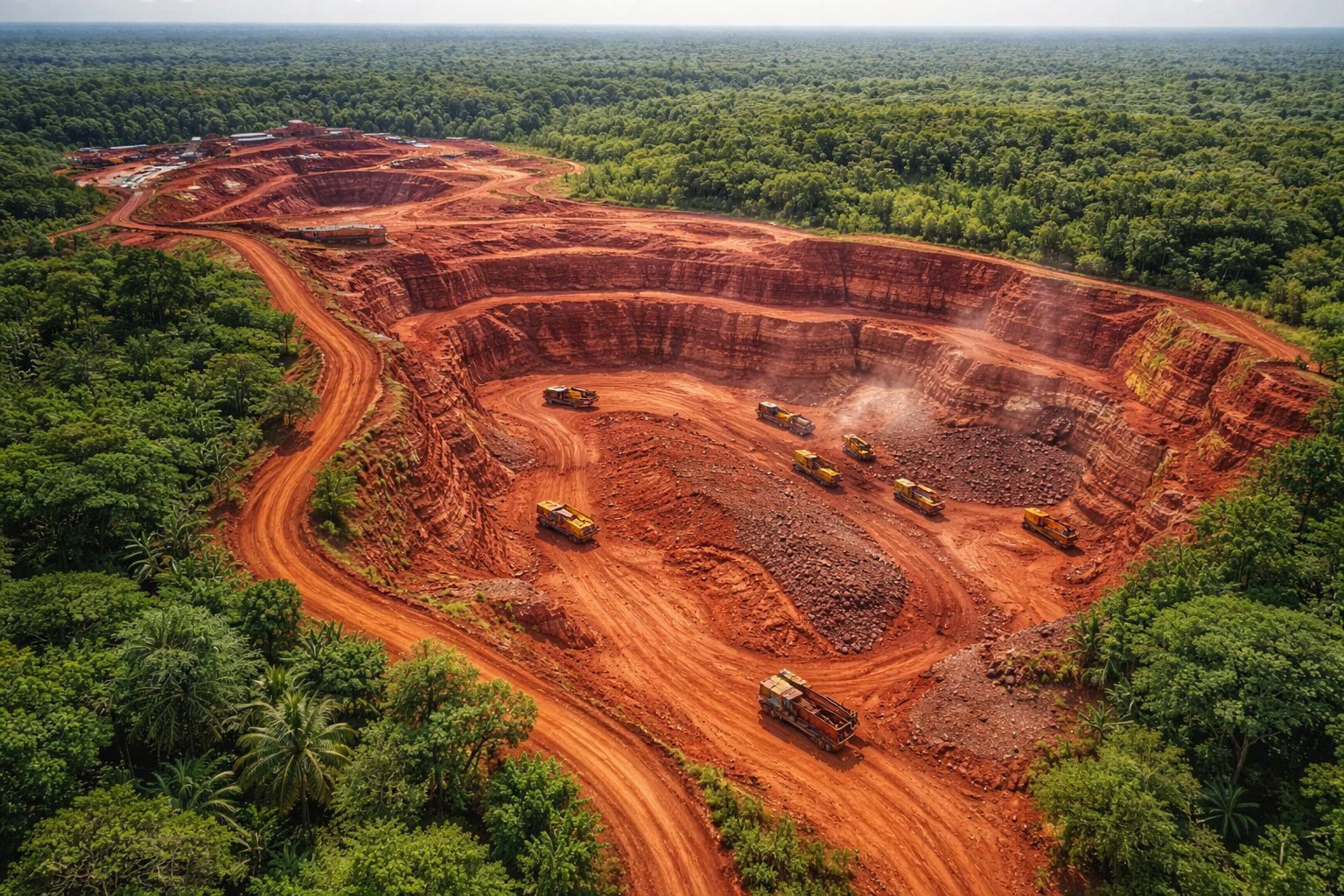
The economics are the country's oldest grievance. Guinea exports the raw ore. The value is added elsewhere — alumina refining and smelting happen in China, the Gulf and Europe — so the country captures a small fraction of what its own rock is ultimately worth. Every government since 1958 has promised domestic refining; a handful of projects have been announced and few have been built. Meanwhile the mines in the Boké region have displaced villages, dried up wells and coated farmland in red dust, and the resulting protests have been a recurring cause of unrest.
The companies
CBG — the Compagnie des Bauxites de Guinée, a state-and-Halco joint venture — has mined at Sangarédi since 1973 and built the railway to Kamsar. SMB, the Société Minière de Boké, a Chinese-Singaporean-Guinean consortium, arrived in 2015 and expanded output faster than almost any mining operation anywhere, using river barges instead of railways. Rusal, Alcoa and others hold further concessions.
Simandou
In the south-eastern hills lies what is generally described as the largest untapped high-grade iron ore deposit in the world — around two billion tonnes at over 65% iron. It has been fought over for two decades in a saga involving Rio Tinto, the Israeli-French businessman Beny Steinmetz, a bribery conviction in Switzerland, and a Guinean government that stripped and reallocated the licences twice.
The railway
Simandou finally moved because the developers agreed to build what Guinea always wanted: a 650 km heavy-haul railway across the country to a new deepwater port at Morébaya, south of Conakry. Whatever happens to the iron price, that railway is the largest piece of infrastructure ever built in Guinea and it crosses regions that have never had a made road.
Gold and diamonds
Guinea mines gold industrially at Siguiri and Kouroussa and artisanally almost everywhere in the east, in the same Bouré field that funded the Mali Empire. Diamonds come from Banankoro in the Kérouané area. Both sectors are heavily informal, environmentally destructive, and a significant part of the rural economy.
The question underneath all of it is the one every resource-rich poor country faces: whether the rents can be turned into schools, clinics and roads before they are turned into villas and Swiss accounts. Guinea's record so far is bad. The Souapiti and Kaleta dams are a genuine counter-example — mining revenue that became electricity — and are cited by every Guinean who wants to argue that the pattern can be broken.
🗣️ Peoples and Languages
Around fourteen and a half million people, more than forty ethnic groups, and a rough correspondence between people and natural region that is the first thing to learn about Guinean society — and the first thing that Guinean politicians exploit.
Fulani (Peul)
The largest group, roughly a third of the population, concentrated in the Fouta Djallon and present everywhere as traders. Their language is Pular (Fula), spoken from Senegal to Sudan in a chain of related varieties. Historically pastoralists, in Guinea long since settled, literate in Ajami, and politically the group most consistently excluded from power since 1958.
Malinké (Maninka)
Around 30%, in Upper Guinea, and part of the wider Mandinka/Bambara continuum stretching across Mali, Senegal and the Gambia. Their language, Maninka, is the language of the Sunjata epic and of most Guinean popular music. Sékou Touré and Alpha Condé both came from this community.
Susu (Soso)
Around 20%, the people of the coast and of Conakry, whose language is the practical lingua franca of the capital and the coastal towns. A Mandé language, historically the intermediary between the interior and the Atlantic trade, and the one you will actually hear in a Conakry taxi.
The forest peoples
Kissi, Kpelle (Guerzé), Toma (Loma), Konianké, Manon and others in the south-east, together perhaps 10–15%. Their languages belong to a different family (Mel and South Mande), their religious landscape includes a large Christian minority and living initiation societies, and their historical relationship with the rest of Guinea has been the most difficult.
French is the sole official language and the language of the state, the courts and secondary education, but real fluency is much less universal than the official status implies — perhaps a quarter to a third of adults are comfortable in it, with a strong urban and male skew. In practice you will get much further in Conakry with a few words of Susu, in the Fouta with Pular, and in the east with Maninka. Guineans are generous about attempts and will teach you.
Guinea also does a version of something distinctly West African: the joking relationship (sanankuya / cousinage à plaisanterie), a formalised licence between certain clans and ethnic groups to insult each other freely and to be obliged to reconcile. A Diallo and a Keïta who have never met will trade fluent abuse about who eats beans and who steals cattle, then help each other. It is a real conflict-management institution, and being taken into it is a compliment.
☪️ Islam in Guinea
Guinea is around 85–90% Muslim, overwhelmingly Sunni of the Maliki school, with a strong Sufi inheritance — the Tijaniyya and Qadiriyya brotherhoods, whose networks run across the Sahel. Christians are perhaps 7–8%, mostly Catholic and concentrated in Conakry and the forest region, and traditional practice persists everywhere, often alongside rather than instead of the other two.
Islam arrived by trade rather than conquest, and its Guinean form reflects that. The Fouta Djallon imamate produced a literate religious culture with its own poetry in Ajami Pular; the Mandé east absorbed Islam into an existing social order held together by the griots and the age grades. What you get is a Muslim country that is markedly relaxed by regional standards: alcohol is sold openly in Conakry, women's dress varies enormously, and inter-religious marriage and mixed families are ordinary.
Ramadan
Observed seriously. During the fasting month, restaurants outside Conakry's hotels may be shut in daylight, work slows dramatically, and the roads are dangerous around sunset when everyone is hurrying home to break the fast. It is a genuinely lovely time to be here if you plan around it, and a frustrating one if you do not.
Mosques
The whitewashed, green-domed mosques of Conakry and Labé are 20th-century; the older Fouta Djallon tradition was mud brick with a conical thatched roof and a wooden framework, and a handful of these survive in villages — Dinguiraye's is the best known. Ask before entering any mosque; non-Muslims are usually welcome outside prayer times, women should cover their hair, and everyone removes shoes.
The forest region
Religiously the most complex part of the country: substantial Catholic and Protestant communities, active Muslim minorities, and initiation societies — the poro for men, sande for women — whose sacred forests and masked ceremonies remain genuinely closed to outsiders. Photographing a mask or a sacred grove without explicit permission is a serious offence against your hosts and sometimes against the law.
Christianity and Ramadan together
Guinea's public holidays include Eid al-Fitr and Eid al-Adha (Tabaski) alongside Christmas, Easter Monday and Assumption. Mixed families celebrating both is common enough to be unremarkable, and the sharpness of religious politics elsewhere in the Sahel is, so far, largely absent here.
🥁 The Djembe, the Griots and Bembeya Jazz
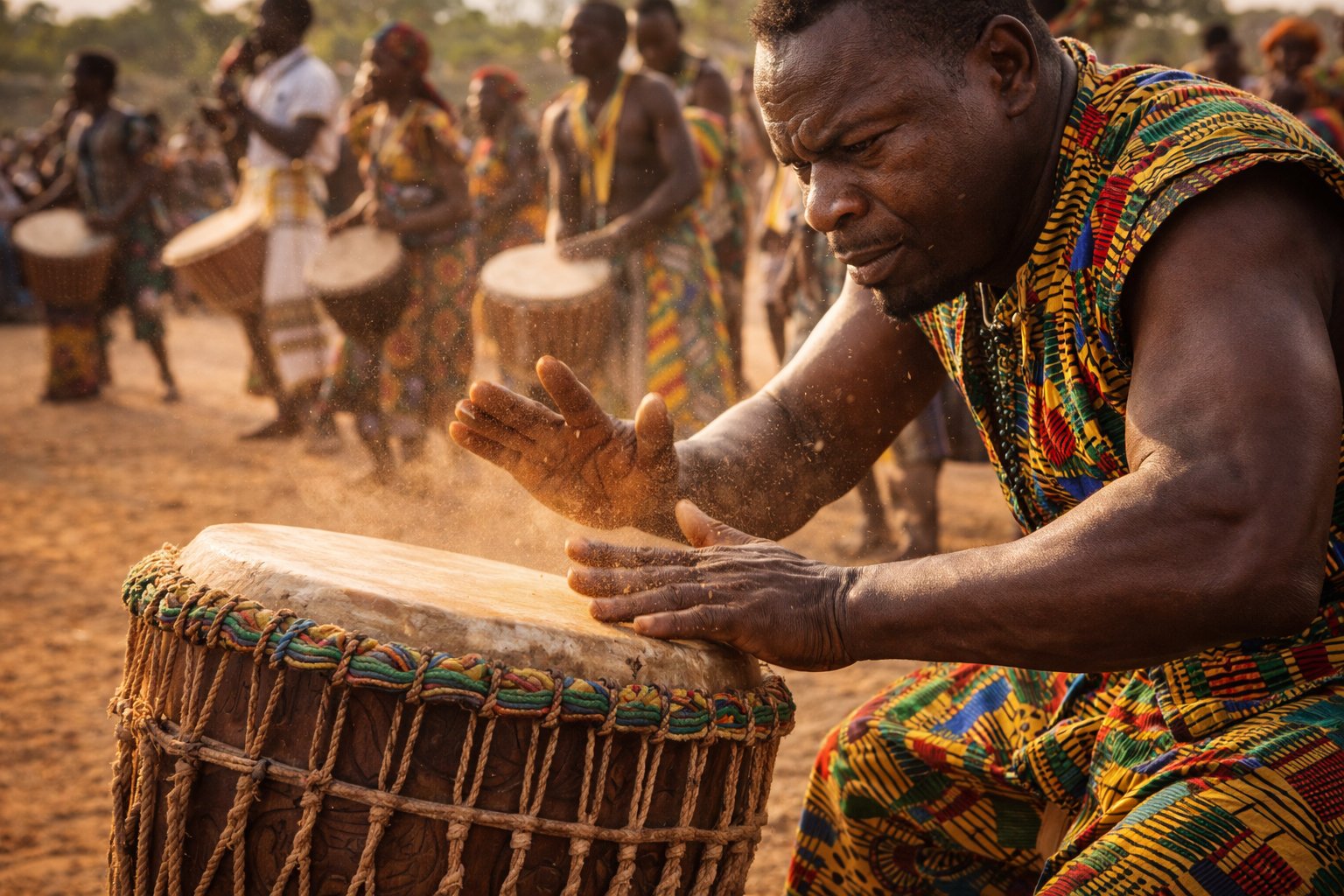
If Guinea has one global export that is not a rock, it is music. The djembe — the goblet-shaped, rope-tuned, bare-hand drum now found in every drum circle from Berlin to Berkeley — is a Mandé instrument from the Guinea–Mali borderlands, and the great majority of the teachers who took it to the world were Guinean.
The other half of Guinean music is what happened after independence. Sékou Touré's authenticité policy banned imported repertoire and instructed the state-funded orchestras to build modern dance music out of Mandé and Fulani material instead. The results were released on the state label Syliphone between 1967 and the early 1980s and are, by wide agreement, among the finest African recordings ever made — a very rare case of a dictatorship's cultural policy producing something magnificent.
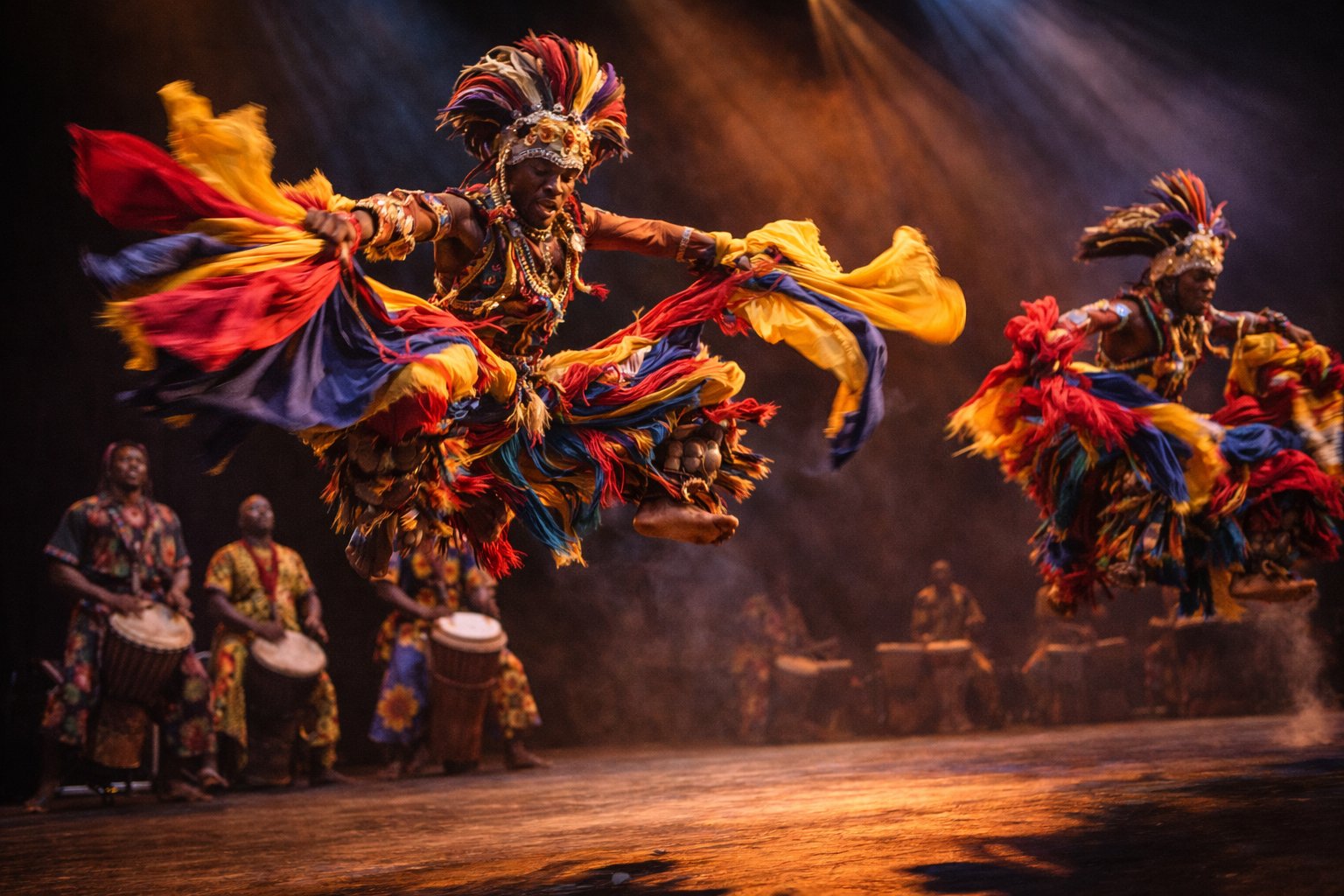
Bembeya Jazz National
The greatest of the state orchestras, from Beyla, with Sékou "Diamond Fingers" Diabaté on guitar and Aboubacar Demba Camara singing until his death in 1973. Their 1969 Regard sur le passé, an album-length telling of Samori Touré's story, is the single record to start with.
Mory Kanté
Kora player from a griot family in Kissidougou (1950–2020). His 1987 Yéké Yéké was the first African single to sell a million copies in Europe and reached number one in several countries — the moment West African music properly crossed over. His acoustic work is better than the hit and worth seeking out.
Mamady Keïta
Born in Balandugu in 1950, joined the national ensemble at fourteen, and became the person most responsible for teaching the djembe outside Africa, through his Tam Tam Mandingue schools. He died in 2021. If you have ever taken a djembe class anywhere in Europe, the lineage almost certainly runs back to him.
Hearing it now
Live music in Conakry happens in the maquis bars of Kaloum and Ratoma, at the Centre Culturel Franco-Guinéen, and at private ceremonies — a naming, a wedding — which is where the real playing is. Ask, and be prepared to be adopted for the evening. Guinean audiences dance; standing at the back with a beer is not really an option.
🐒 Nimba, Bossou and What Survives
Guinea's biodiversity is concentrated at the two ends of the country: the montane grasslands and forests of the south-east, and the mangroves of the coast. Between them the savanna and the Fouta Djallon have been heavily worked for centuries and the large mammals are largely gone — elephants are down to a handful, lions are functionally extinct here.
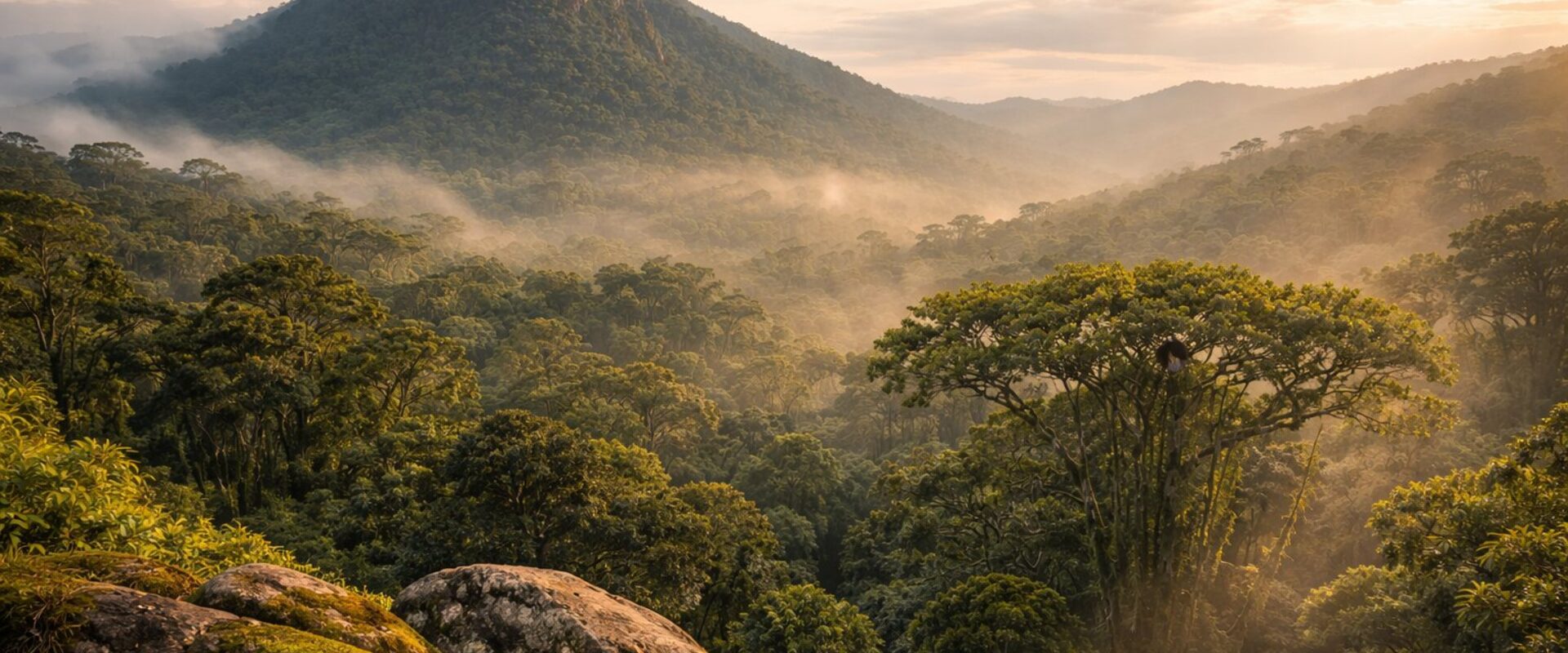
Mount Nimba Strict Nature Reserve is Guinea's only UNESCO World Heritage Site — inscribed in 1981, extended into Côte d'Ivoire in 1982, and on the List of World Heritage in Danger since 1992 because of mining pressure and the arrival of refugees from the Liberian war. It holds species found nowhere else, including the viviparous toad Nimbaphrynoides occidentalis, one of very few amphibians in the world that gives birth to live young rather than laying eggs, and a distinctive population of horseshoe bats and micro-endemic plants on the summit grassland.
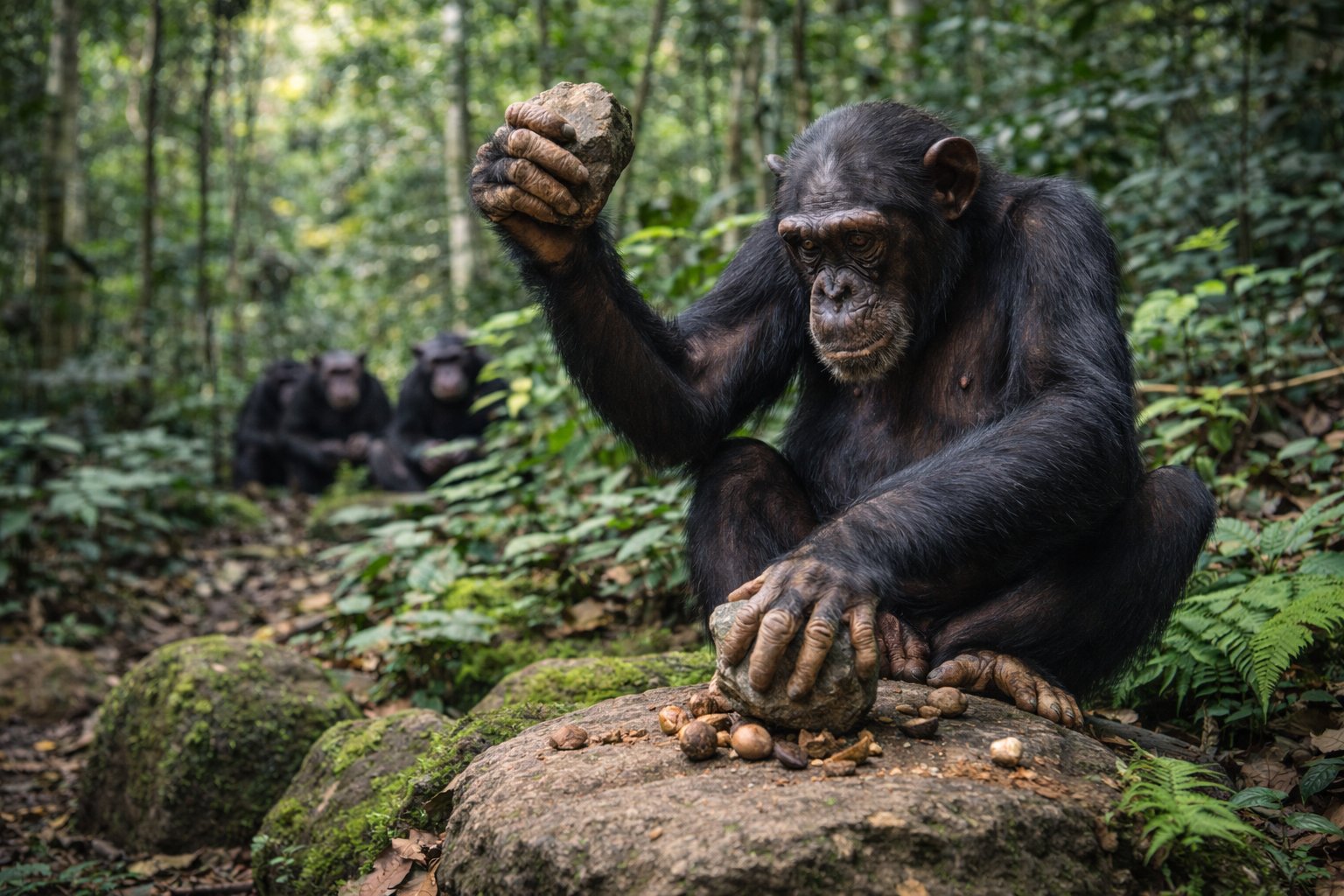
The Bossou chimpanzees
A small, isolated community in a sacred forest that the Manon people have protected for generations because they regard the chimpanzees as ancestors. That protection is why the research was possible — and the group has nevertheless declined sharply, from around twenty individuals to single figures, which is one of the sadder conservation stories in West Africa.
Elsewhere
The Ziama and Diécké forest reserves in the south-east are biosphere reserves holding forest elephants, pygmy hippopotamus and bongo, in small and threatened numbers. The Haut Niger National Park near Faranah protects savanna woodland and a chimpanzee population. The Rio Kapatchez and Konkouré mangroves on the coast are Ramsar wetlands and important for shorebirds and manatee.
Birds
Around 700 species recorded, and largely unwatched — Guinea is one of the great blank spaces in African birding. The Fouta Djallon has specialities of its own, the coastal mudflats hold enormous wader numbers on the East Atlantic flyway, and the forest region shares the Upper Guinean endemics with Liberia and Sierra Leone.
Practicalities
Nimba requires permits and a guide from the reserve authority and is not a casual visit; Bossou can be visited from Lola with prior arrangement, though access to the chimpanzees themselves is restricted and rightly so. Nowhere in Guinea has anything resembling East African safari infrastructure, and anyone promising you one is lying.
🍽️ Food
Guinean cooking is rice and a sauce, and the sauce is where all the interest lives. The base grammar is West African — rice, palm oil, smoked fish, chilli, groundnut, leaf — but Guinea has its own dialect of it, and two things in particular that you will not find done the same way anywhere else: sauce feuille, and the vast smoked-catfish trade that flavours half the country's cooking.
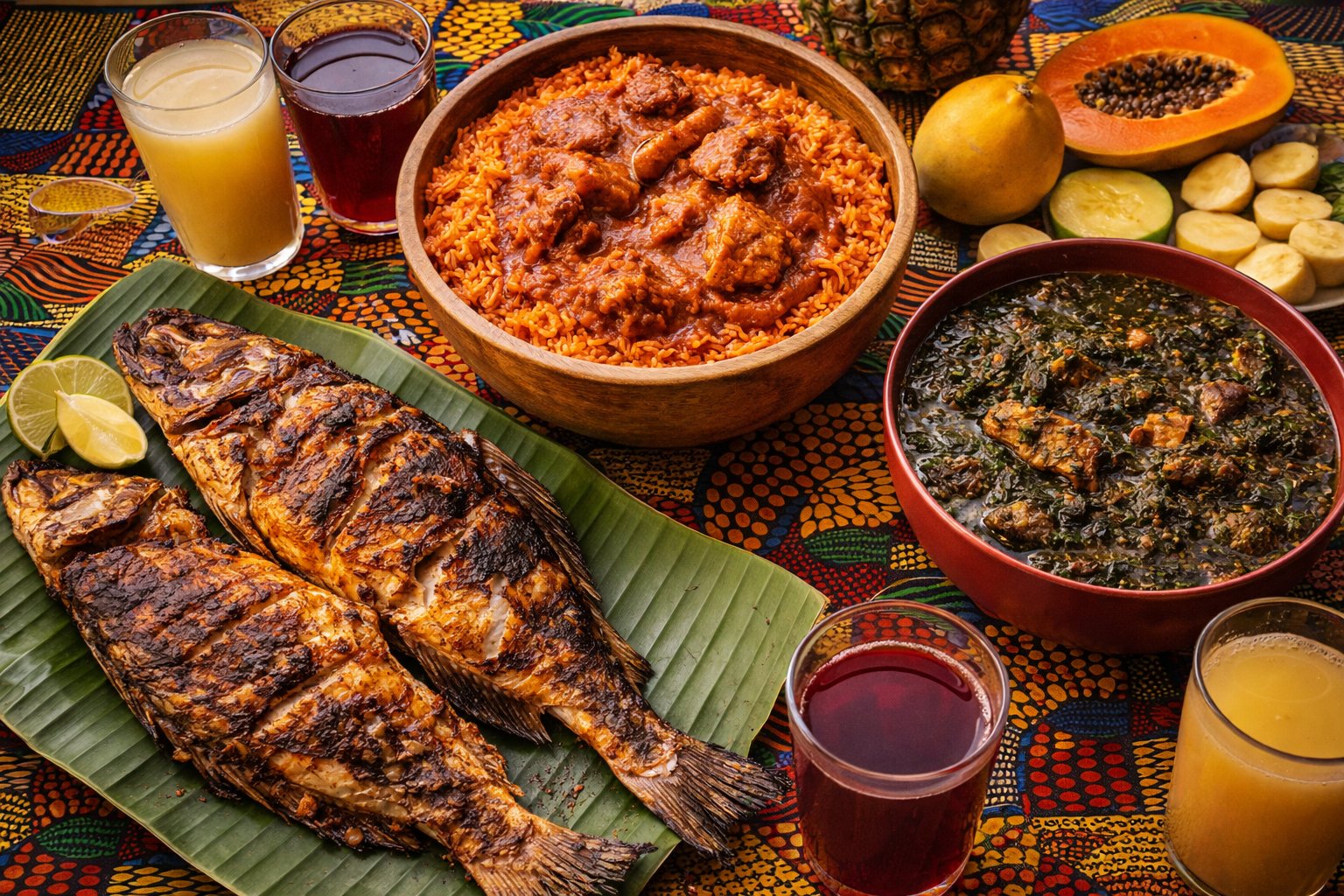
Sauce feuille
Pounded cassava leaves cooked down for hours with red palm oil, smoked fish, groundnut paste and chilli into something dark, dense and unlike anything European. It is the dish Guineans abroad miss. Eaten with rice, and it improves for the first two days.
Riz gras
Rice cooked in the stew rather than beside it — the Guinean member of the jollof family, made with tomato, onion, oil and whatever meat or fish is going. Sold everywhere at lunchtime out of enormous pots, and the standard cheap meal in any town.
Konkoé
Smoked catfish, split, dried hard over a fire and used as a seasoning as much as a protein. Sauce konkoé is a Guinean speciality and the smell of the smoking racks is one of the things you will remember about the coast. Vegetarians should know that almost every savoury dish contains it.
Fouti and to
Pounded starch — cassava, plantain, yam or a mixture — served as a dense ball to be torn and dipped. In the forest region it is the everyday staple; in Conakry it is more of a weekend dish. Eat with the right hand, and do not chew the ball, swallow it.
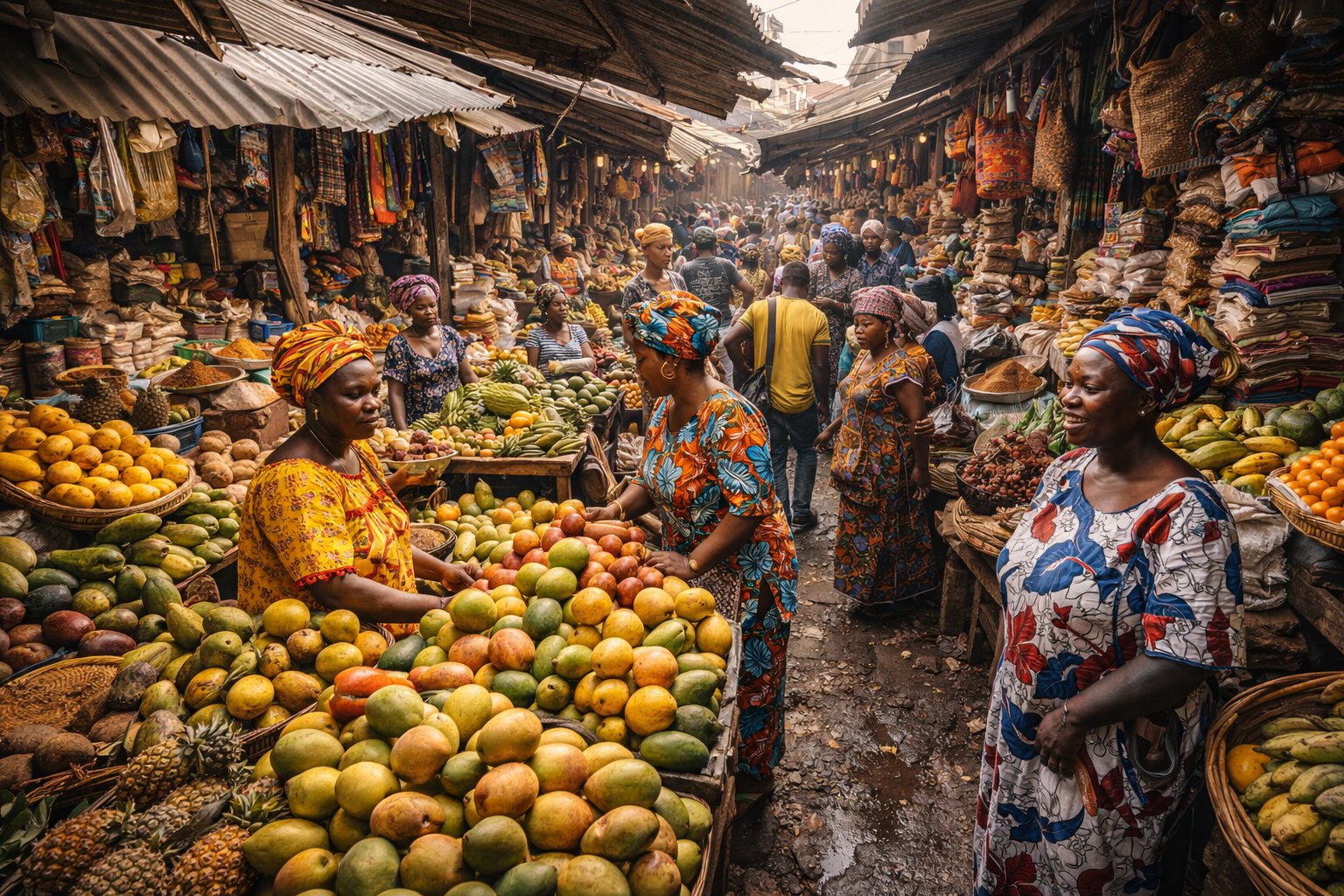
Beyond that: maffé or tigadèguèna, the groundnut stew of the Mandé world; poulet yassa, onion and mustard and lemon, borrowed from Senegal and improved on locally; grilled brochettes from street braziers everywhere; and, in the Fouta Djallon, latchiri — steamed millet or fonio couscous eaten with kossam, soured milk, which is the classic Fulani breakfast and unexpectedly refreshing at six in the morning.
🍲 Sauce Feuille
The real thing uses fresh cassava leaves pounded in a mortar for the better part of an hour, which is not going to happen in a Prague kitchen. Frozen pounded cassava leaf is sold in African and Asian grocers under the names saka-saka, pondu or feuilles de manioc pilées, and it is what most Guinean cooks in Europe use. Sweet potato leaves are the closest fresh substitute; spinach is not, and produces a different and much duller dish.
Sauce Feuille (Guinean cassava-leaf sauce)
Serves 4–6 · 20 minutes' work · 2 hours' simmering
Ingredients: 500 g frozen pounded cassava leaves (saka-saka), thawed; 400 g beef shin or smoked turkey, in chunks; 1 large smoked or dried fish (or 150 g smoked mackerel), skin and bones removed, flaked; 150 ml red palm oil; 2 onions, finely chopped; 4 cloves garlic; 100 g smooth peanut butter, unsweetened; 2 Scotch bonnet or habanero chillies; 1 stock cube; 1 litre water; salt.
Method: Put the thawed leaves in a heavy pot with the water and bring to a simmer; cook uncovered for about 45 minutes, stirring now and then, until the raw green smell has gone. Cassava leaves must be cooked thoroughly — this is not optional, it removes the cyanogenic compounds — so do not shorten this stage. Meanwhile brown the meat with the onion and garlic in a little of the palm oil. Add the meat, onion, flaked smoked fish, the rest of the palm oil, the stock cube and the whole chillies to the leaves. Simmer, half-covered, for another 45 minutes. Loosen the peanut butter with a ladle of the cooking liquid, stir it in, and cook a final 20–30 minutes until the sauce is thick, glossy and deep green-brown and the oil has risen to the surface. Fish out the chillies unless you want it fierce, check the salt, and serve with plain white rice.
💡 Red palm oil is the flavour, not just the fat — the orange, unrefined kind sold in African grocers, not refined palm oil, and not a substitute. Two hours is the minimum; Guinean cooks routinely go to three.
🌾 Fonio, the Oldest Grain
Fonio (Digitaria exilis) is a millet-like grain with seeds the size of a grain of sand, cultivated in West Africa for perhaps five thousand years — quite possibly the oldest cultivated cereal in Africa. Guinea is one of the world's largest producers, and in the Fouta Djallon and Upper Guinea it is not a health-food curiosity but ordinary food.
It deserves the attention it has started to get. Fonio grows in ninety days on poor, dry soil that will support nothing else, needs no fertiliser, is drought-tolerant to a degree that matters enormously in a warming Sahel, and is gluten-free with a good amino acid profile. It cooks in five minutes, tastes faintly of couscous and hazelnut, and takes sauce beautifully.
Why it nearly died out
Processing. Fonio grains are minute and tightly husked, and cleaning them traditionally meant hours of pounding and winnowing per kilo — women's work, unpaid, and the reason the crop was called "the hungry rice" and abandoned wherever rice was available. Mechanical huskers developed since the 1990s changed the arithmetic completely.
How it is eaten here
Steamed like couscous and served under a sauce; as latchiri with soured milk for breakfast; in a sweet porridge; and, increasingly, in Conakry restaurants as a deliberately upmarket alternative to imported rice. Guinea imports enormous quantities of Asian rice; every kilo of fonio eaten instead is a small political act and Guineans say so.
Getting some
Sold in every market in the Fouta and in Conakry, cheap, and one of the easiest and lightest things to bring home. Cook it like couscous: equal volumes of fonio and boiling salted water, cover, stand five minutes, fork through with butter or oil. It is now sold in Europe too, at roughly ten times the price.
The other neglected crops
Guinea also grows African rice (Oryza glaberrima), domesticated independently in the inland Niger delta about three thousand years ago and quite distinct from Asian rice, plus bambara groundnut and a long list of leafy greens with no English names. The forest region's rice varieties are a genuine genetic resource.
🥤 What to Drink
Guinea is hot, and the drinking culture is built around it. The non-alcoholic side is excellent and ubiquitous; the alcoholic side exists, is legal, and is discreet outside Conakry and the forest region.
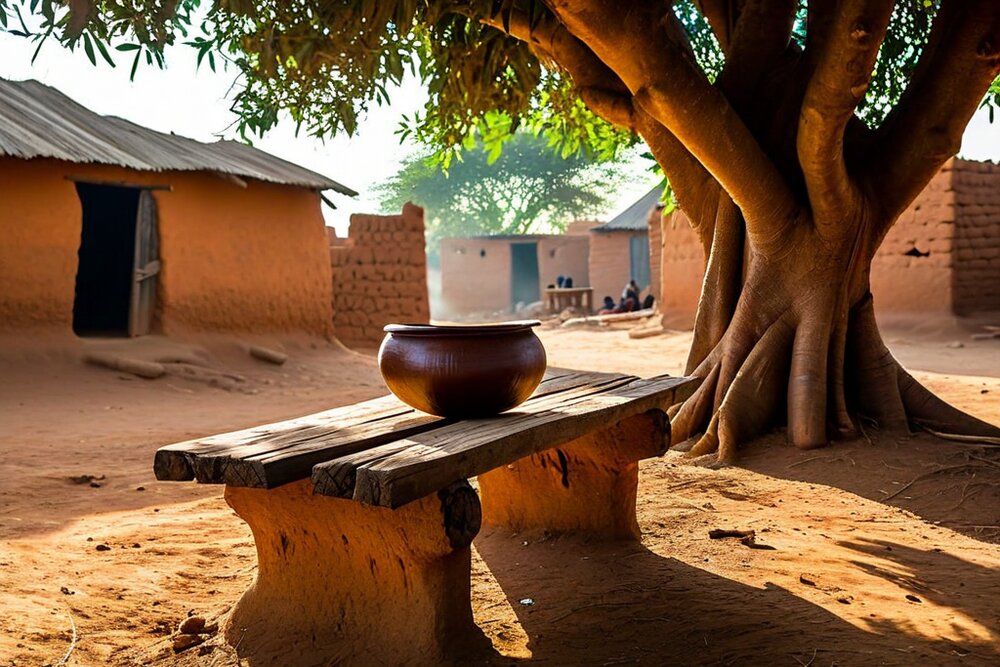
Bissap and gingembre
Bissap — dried hibiscus calyces steeped with sugar, sometimes mint or vanilla — is deep red, tart and sold frozen in small plastic sachets on every street. Jus de gingembre is raw ginger juice, sweetened, and startlingly fierce; a small one will clear your head. Both are made at home, which raises the water question — buy the industrially bottled versions if your stomach is uncertain.
Bouye and tamarin
Bouye is baobab fruit — the chalky white pulp soaked and blended into a milky drink, high in vitamin C and tasting a little of sherbet. Jus de tamarin is sour, dark and excellent. Both are Sahelian staples and both are better than any of it sounds.
Attaya
Green gunpowder tea brewed strong in a tiny pot over coals, poured from a height to make a head of foam, and served in three rounds — the first bitter, the second balanced, the third sweet, with a proverb attached about life. Being invited to sit through all three rounds takes an hour and is how conversations actually happen here.
Beer, palm wine and prices
Skol and Guiluxe are brewed in Conakry and are the standard beers; a large bottle in a maquis runs 15,000–25,000 GNF, roughly 40–65 CZK. Palm wine (bangui) is tapped in the forest region and on the coast, drunk fresh and cloudy, and gets alcoholic and then vinegary within a day. In much of the Fouta Djallon alcohol is simply not sold; do not go looking for it.
The water itself: do not drink from the tap, anywhere, including Conakry. Bottled water is sold everywhere, as are the small sealed plastic sachets that most Guineans drink from — cheap, generally from treated supplies, and a serious plastic problem. Ice in a hotel or a proper restaurant in Conakry is usually fine; ice from a street stall is a gamble.
🌟 Guineans Worth Knowing
Samori Touré (c. 1830–1900)
The founder of the Wassoulou Empire, who held the French army at bay for sixteen years with a professionally drilled force and workshops that copied European rifles. Captured in 1898 and deported to Gabon, where he died. A national hero in Guinea, Mali and Côte d'Ivoire simultaneously, and — as the better Guinean historians insist — also a slave-raider whose campaigns caused mass suffering.
Ahmed Sékou Touré (1922–1984)
Trade unionist, orator, first president, and the man who said no to de Gaulle in 1958. He gave Guinea a voice in world politics out of all proportion to its size and then built a state that killed thousands of its own citizens at Camp Boiro. Guinea has still not decided how to teach him, which tells you how large he remains.
Camara Laye (1928–1980)
Novelist from Kouroussa whose L'Enfant noir (1953) — a luminous, unpolitical account of a Malinké childhood around his father's forge — is one of the founding works of francophone African literature and is taught across the French-speaking world. He fell out with Sékou Touré, went into exile in Senegal, and died there. Available in Czech as Černé dítě.
Djibril Tamsir Niane (1932–2021)
The historian who took down the Sunjata epic from the griot Mamadou Kouyaté and published it in 1960, giving the Mandé world its canonical written text and the rest of the world its way in. He also edited a volume of the UNESCO General History of Africa. He died of Covid-19 in Dakar.
Mory Kanté (1950–2020)
Kora player and singer from a griot family, whose Yéké Yéké in 1987 became the first African single to sell a million copies in Europe. He came up through Bembeya Jazz and the Rail Band in Bamako, and his later acoustic albums are better than the hit that made him famous.
Naby Keïta (b. 1995)
Midfielder from Conakry, Bundesliga champion prospect at RB Leipzig, Champions League and Premier League winner with Liverpool in 2019 and 2020, and long the captain of the Syli National. The most successful Guinean footballer of the modern era, ahead of a strong field that now includes Serhou Guirassy.
🏙️ Conakry
Conakry is a city of roughly two million people crammed onto the Kaloum peninsula — a finger of land 36 km long and in places barely a kilometre wide, sticking into the Atlantic. Everything in Guinea passes through it, and there is essentially one road down the middle. The traffic is not an inconvenience; it is a structural condition of the city.
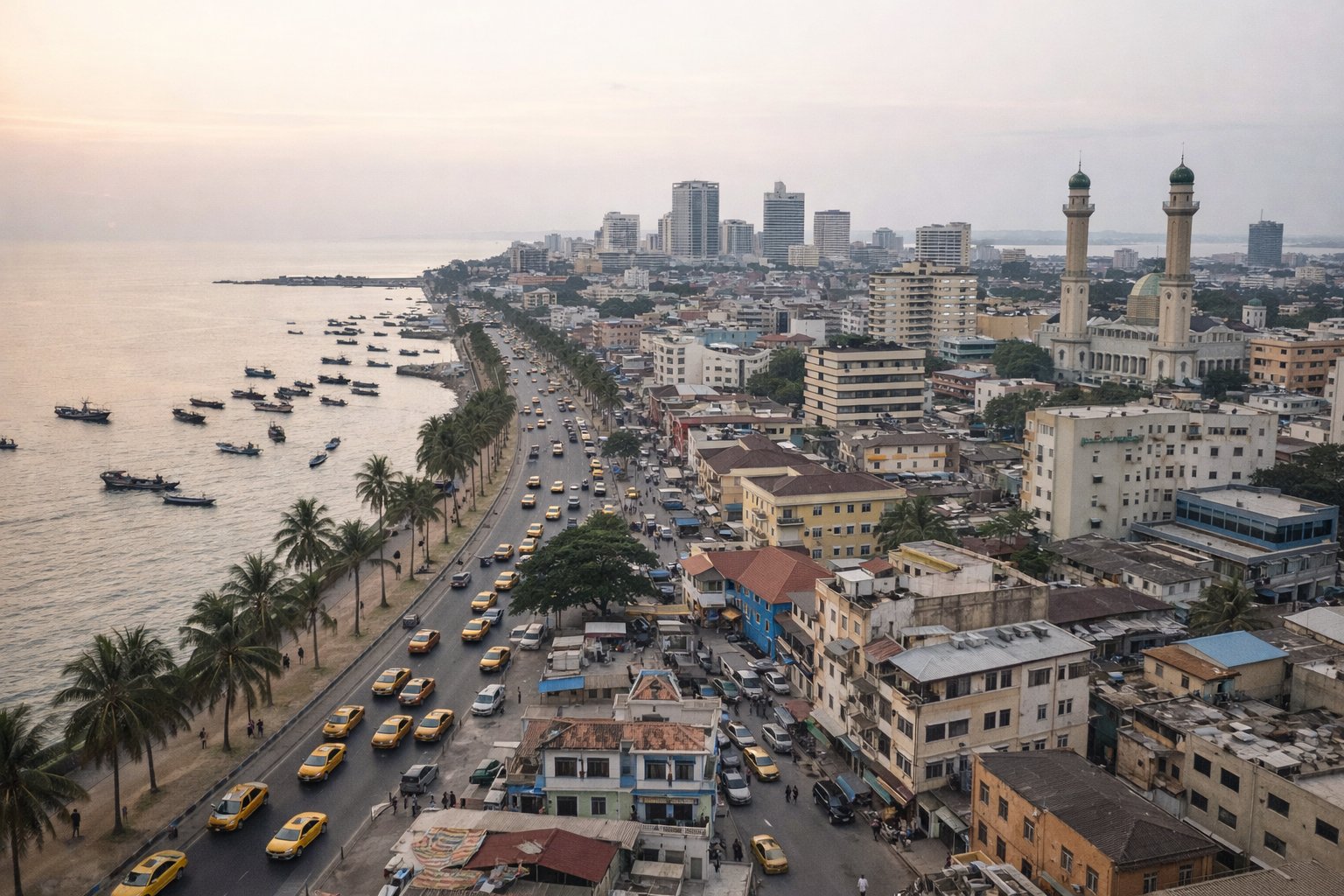
It divides into three. Kaloum, at the tip, is the old colonial centre and the administrative heart: ministries, the port, the Grande Mosquée, the national museum, the Palais du Peuple, and the fuel depot whose catastrophic fire in December 2023 left the whole country short of petrol for weeks. Ratoma, further out, holds the embassies, the better hotels, the restaurants and the nightlife. Matoto and the eastern communes hold the airport, the industry and most of the population.
Marché Madina
One of the largest markets in West Africa, in the Matam commune — a genuinely enormous, dense, roofed and unroofed sprawl selling everything from mangoes to motorcycle parts. It is overwhelming, it floods in the rains, and it is the single most alive place in the country. Go with someone, take almost nothing with you, and do not photograph people without asking.
Musée National
Small, underfunded and worth an hour: masks and statuary from the forest region, Fulani and Mandé material culture, and the objects that survived the authenticité years. In Sandervalia, Kaloum. Ask about opening hours before you go — they move.
The Corniche and Boulbinet
The seafront road along the western side and the fishing harbour at Boulbinet, where the pirogues land at the end of the afternoon and the fish is grilled fifty metres from the boat. The best cheap meal in the city and the best hour of the day to be outside.
Practicalities
Traffic is severe from roughly 07:00 to 10:00 inbound and 16:00 to 20:00 outbound, and getting from Ratoma to Kaloum can take two hours. Yellow shared taxis run fixed routes for a few thousand francs; motorbike taxis (taxi-motos) are faster and considerably more dangerous. Ride-hailing apps operate but coverage is patchy.
⛰️ The Fouta Djallon
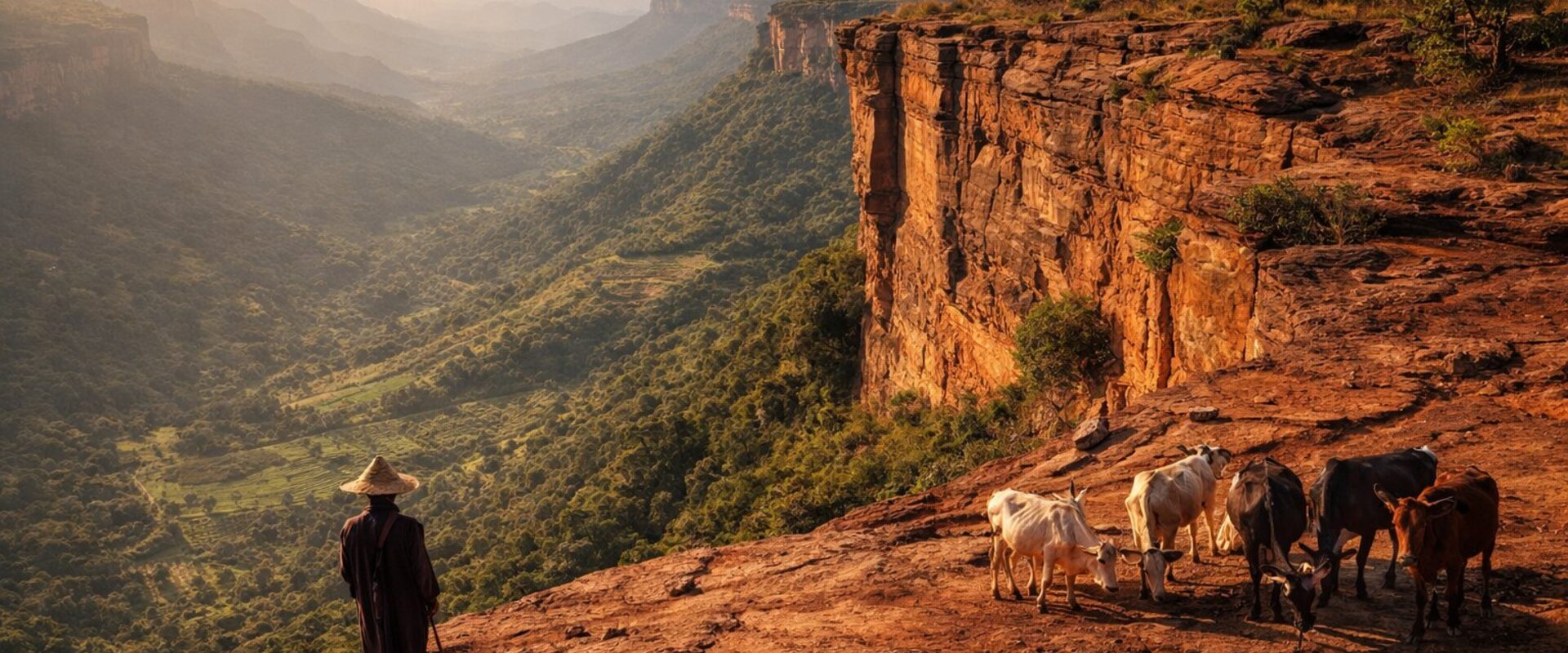
This is why you come. The Fouta Djallon is a sandstone massif the size of Bohemia, rising between 700 and 1,500 m, cut by rivers into a landscape of flat-topped blocks, sheer red cliffs, hanging valleys and — because it catches the full Atlantic monsoon — several hundred waterfalls. It is cool, it is green for most of the year, and it has almost no tourists.
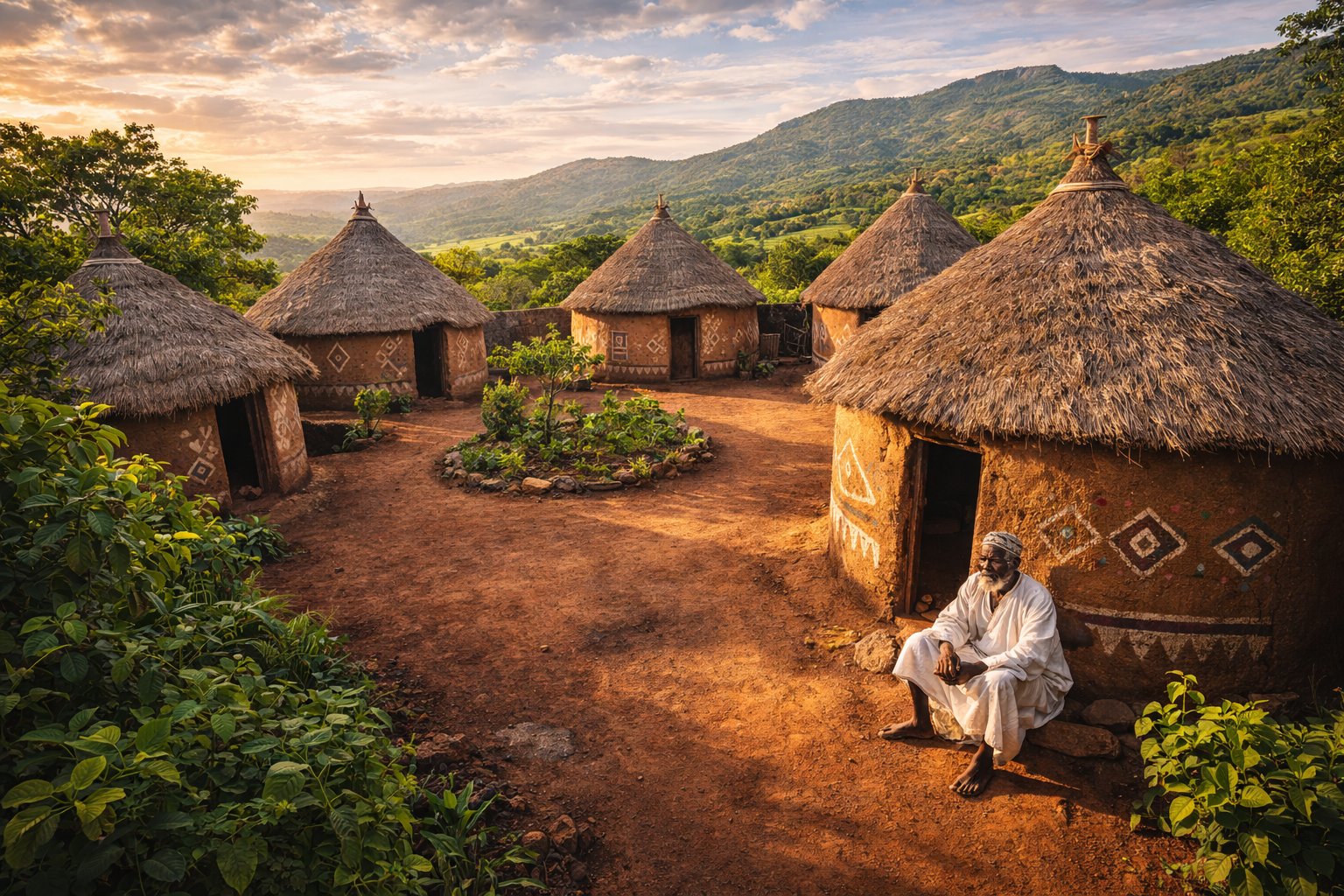
The social unit is the tapade — a compound enclosed by a dense hedge, holding the houses and the intensively manured kitchen gardens that feed the family. It is a genuinely sophisticated smallholding system, worked mostly by women, and it is why the Fouta supports a far denser population than its thin soils should allow. Terracing, hedging and dry-stone bunding are everywhere once you know to look for them.
Labé
The capital of the Fouta and Guinea's fourth city, at about 1,000 m, with a big market, the Grande Mosquée, and the best transport connections in the region. The base for everything north — Mali-ville, the Dame de Mali, the Doucki area — and the place to hire a guide.
Doucki
A hamlet on the escarpment north of Pita that has become, almost by accident, Guinea's trekking centre. The local guide Hassan Bah spent decades cutting routes down into the canyons — the "Indiana Jones", the "Hollywood", the "Chutes de la Mariée" — and staying in a hut and walking for three days is about as good as West African hiking gets. Basic conditions, spectacular country.
Dalaba and Mamou
Dalaba at 1,200 m was the French colonial hill station, with a decaying villa or two, cool nights and the Chutes de Ditinn within reach. Mamou is the road junction where the country's two great routes cross and mostly a place you pass through, though the market is good.
Mali-ville and Mount Loura
The far north, near the Senegalese border: Guinea's highest town, the 1,515 m Mount Loura, and the eroded rock profile called La Dame de Mali — a woman's face in the cliff, visible for kilometres. Cold at night, hard to reach, and worth it.
💦 The Waterfalls
Guinea has more waterfalls than any country in West Africa and almost no infrastructure for visiting them, which is either the problem or the point depending on your temperament. Most require a 4×4, a local guide and a walk; almost none have a ticket office, a handrail or a café. Go in the two months after the rains, when the water is high and the tracks have dried.
Ditinn
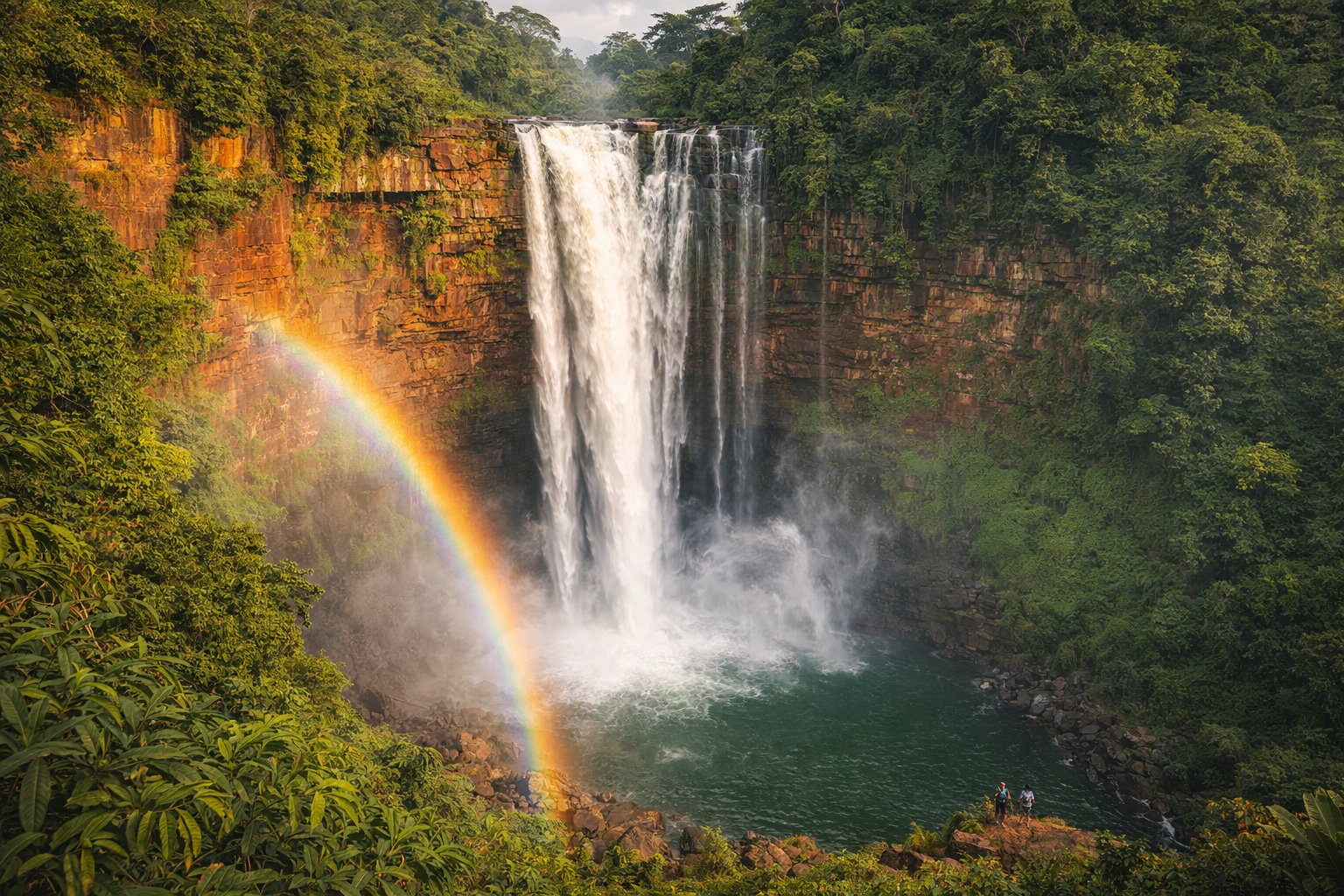
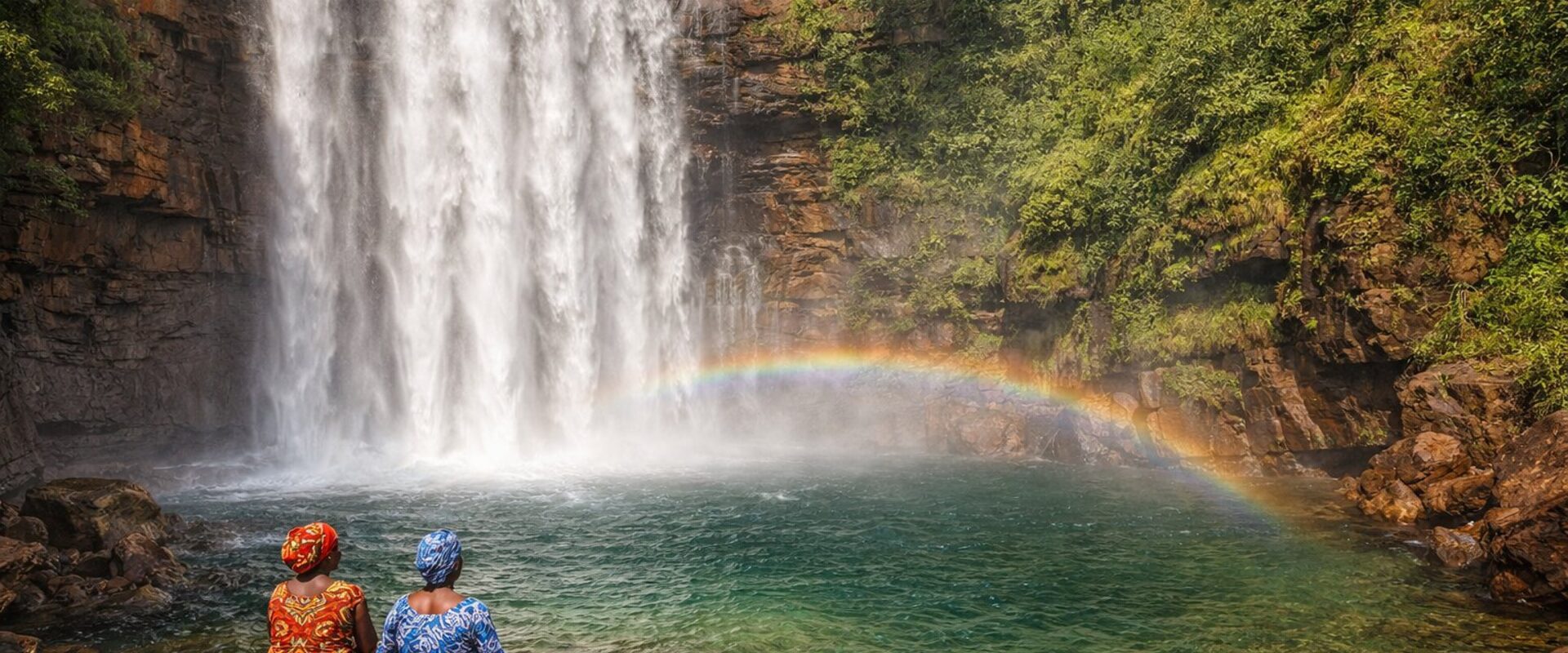
The classic: roughly 115 m in one unbroken drop over a dark cliff into a swimmable pool, about 50 km from Dalaba down a rough track. It is Guinea's postcard waterfall and it is still perfectly possible to have it entirely to yourself.
Kambadaga
Three drops on the Kokoulo river near Pita, around 75 m in total, with a hydroelectric intake above that reduces the flow in the dry months — so this is one to see in November or December rather than March. Camping is possible at the top.
Kinkon and Saala
Kinkon, also near Pita, is a big fall on the Kokoulo with a dam and power station and requires permission to approach; Saala, further out, is quieter and often better. Both are day trips from Pita with a motorbike or a hired car.
Voile de la Mariée
The Bridal Veil, near Kindia only 130 km from Conakry, is the most accessible major fall in the country and therefore the busiest at weekends — which in Guinean terms means several dozen people. The Chutes de la Soumba nearby have a small resort and are the standard Conakry day out.
🏞️ Upper Guinea and the Niger
East of Mamou the highlands fall away and the country opens into savanna — hot, dry from November to May, and drained by the young Niger and its tributaries. This is Malinké Guinea, the western edge of the Mandé world, and the part of the country with the deepest historical layer and the least to look at.
Kankan is the second city and the intellectual capital of Muslim Guinea, with a university, a large Friday mosque and a strong Tijaniyya tradition; it sits on the Milo river, a Niger tributary. Kouroussa, where Camara Laye grew up, is on the Niger itself and is where the river first becomes navigable. Siguiri is the gold town, surrounded by industrial and artisanal workings, and the closest point to the ruins at Niani. Faranah is the gateway to the Niger source and to the Haut Niger National Park.
The source of the Niger
About 50 km south of Faranah, near the village of Tembakounda in the hills towards the Sierra Leonean border. There is a marker, a stream you can step across, and forest. Getting there needs a 4×4, a guide from Faranah and a few hours; it is a pilgrimage rather than a spectacle, and it is entirely worth doing.
Haut Niger National Park
Around 6,000 km² of savanna woodland and gallery forest north of Faranah, with chimpanzees, hippos, buffalo and antelope in small numbers, and a research station at Somoria. Guinea's best-organised protected area, which is a low bar; go with a park guide and low expectations of large mammals.
Niani
The traditionally identified capital of the Mali Empire, on the Sankarani near Siguiri, excavated from the 1960s. The identification is disputed by some archaeologists and there is very little standing to see. It matters as an idea more than as a site, and Guineans will be pleased that you know the name.
Dinguiraye
North of Kankan, the capital founded in 1850 by El Hadj Umar Tall, the Toucouleur conqueror, and site of one of West Africa's most striking surviving mud-brick mosques — a large conical thatched structure over a mud core, of a type that has almost vanished elsewhere. On Guinea's UNESCO tentative list and much the best building in the country.
🌳 The Forest Region
Guinée forestière is the far south-east: a thousand kilometres from Conakry, wetter than anywhere else, hilly, forested where the forest survives, and culturally a different country. This is where Ebola began, where the Liberian and Sierra Leonean wars spilled over in the 1990s and 2000s, and where Guinea's iron ore and much of its remaining biodiversity are.
N'Zérékoré is the regional capital and the second- or third-largest city in the country, a lively market town with a hot, wet climate and a genuine frontier feeling — Liberia and Côte d'Ivoire are both an hour away. Macenta and Guéckédou are the other centres; Lola and Beyla sit under the Nimba range; Kissidougou is the gateway from the north.
Getting there
Two days by road from Conakry in the dry season via Mamou, Faranah and Kissidougou, and considerably worse in the wet. There are usually domestic flights to N'Zérékoré, operated intermittently by whichever carrier currently exists — check locally rather than online, and do not build a tight itinerary around them.
Masks and sacred forests
The initiation societies of the Kissi, Toma and Kpelle are living institutions with sacred groves that outsiders do not enter and masked performances that are not shows. Some ceremonies are open, most are not, and the difference is not always obvious to a visitor. Ask, accept a no, and never photograph a mask without explicit permission.
Ziama and Diécké
Two forest reserves that hold what is left of Guinea's Upper Guinean rainforest — forest elephants, pygmy hippopotamus, bongo, and a bird list that has barely been worked. Ziama is a UNESCO biosphere reserve near Macenta. Access is difficult, guides are essential and the logging pressure is severe.
Simandou
The iron ore range south of Beyla, and the reason a 650 km railway is being driven across the country. Whatever else it does, it will transform access to this region within a decade — for better, in terms of roads and jobs, and almost certainly for worse in terms of forest.
🏝️ The Coast and the Îles de Los
Guinea's 320 km of coast is mangrove and estuary rather than beach — a low, muddy, tidal margin cut by a dozen river mouths, extremely productive for fish and rice, and hard to travel along. The beaches that exist are mostly on the islands and on a few stretches north and south of Conakry.
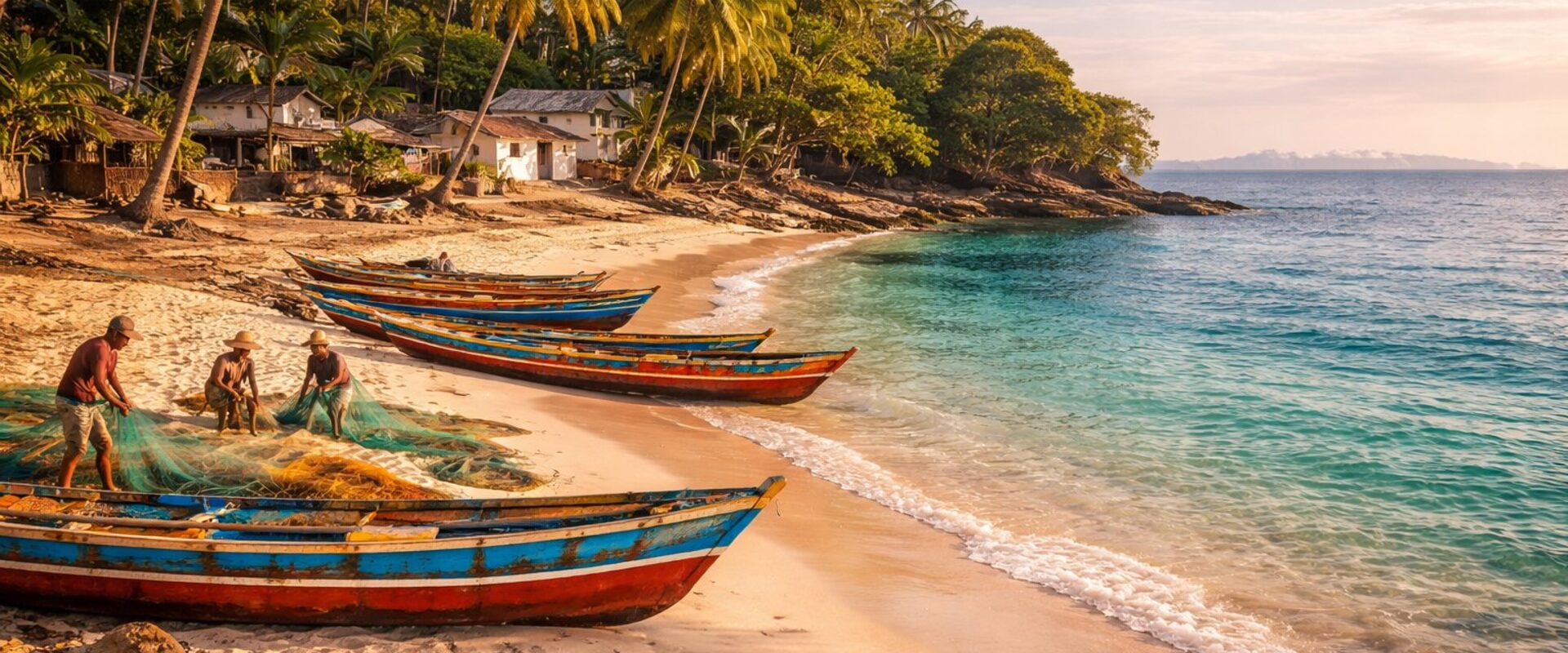
The Îles de Los — Kassa, Roume and Tamara — lie a short boat ride off Conakry and are the standard weekend escape: beaches, palms, fish grilled on the sand, and a handful of simple places to stay. They were British until the Anglo-French convention of 1904 traded them to France; Tamara held a French penal colony, and the ruins are still there. The claim that they inspired Robert Louis Stevenson's Treasure Island is a persistent local story with no documentary basis, which does not stop it being told to every visitor.
Getting out there
Boats leave from the Port de Boulbinet in Kaloum, more or less on demand at weekends and less reliably midweek; the crossing to Kassa or Roume takes 20–40 minutes in an open boat. Agree the price and the return time before you get in, and do not go if the sea looks bad — these are not seaworthy craft in a swell.
Bel Air and Sobané
North of Conakry towards Boffa, Bel Air is the mainland beach Guineans actually go to — long, palm-backed, and a two-to-three-hour drive on a decent road. There are basic bungalows. It is the most straightforward beach day in the country.
Mangroves and the Rio Pongo
The estuaries north of Conakry — the Rio Pongo, the Rio Kapatchez, the Konkouré — are extensive mangrove systems, Ramsar-listed in part, important for shorebirds and West African manatee, and the basis of the coastal rice and oyster economies. Pirogue trips can be arranged from Boffa and Dubréka with local help.
Swimming and safety
The Atlantic here has serious rip currents and no lifeguards anywhere. The tidal range is large, the water is warm, and the sea off Conakry itself is polluted — swim off the islands or well away from the city, ask locally about currents, and treat any advice to stay out of the water as accurate.
✈️ Getting There
There are no direct flights from Prague and there will not be. Conakry's Ahmed Sékou Touré International Airport (CKY), rebuilt and expanded in recent years, is served by a handful of European, North African and West African carriers, and every route from Czechia involves exactly one connection. Total journey time is 10 to 16 hours depending on the layover.
Via Paris
Air France flies Paris CDG–Conakry daily, about six hours, and it is the most reliable route and usually the most expensive. Prague–Paris on Air France, Ryanair, easyJet or Transavia, then the connection. If you book the whole thing on one Air France ticket you get protection when the first leg is late, which is worth the premium here.
Via Brussels or Istanbul
Brussels Airlines serves Conakry several times a week, often continuing to or from another West African capital. Turkish Airlines flies from Istanbul and is frequently the cheapest option from Prague, with the trade-off of a long night connection. Both are dependable.
Via Casablanca or Addis
Royal Air Maroc from Casablanca and Ethiopian Airlines from Addis Ababa both serve Conakry and both connect from Prague with one change. Royal Air Maroc is often the cheapest of all; Ethiopian's routing is longer but useful if you are combining Guinea with anywhere else in Africa.
Regionally
Air Côte d'Ivoire, ASKY and Air Sénégal connect Conakry with Abidjan, Lomé, Dakar, Bamako and Freetown, which makes a multi-country West African trip practical. Overland border crossings to Senegal, Mali, Sierra Leone and Côte d'Ivoire exist and are used, but they are slow, bureaucratic and periodically closed.
Expect 16,000–28,000 CZK for a return from Prague, more in December and around the Eid holidays. Book the whole itinerary on one ticket if you can: Conakry departures are not frequent, and a missed connection can cost you two days.
On arrival: the airport is small and the process is slow. Have your yellow fever certificate in hand — it is checked before immigration and there is no negotiating it — plus your visa or e-visa approval letter printed, and the address of your first night's accommodation. Arrange your pickup in advance through your hotel; the arrivals hall is chaotic and unmetered taxis at 2 a.m. are not the way to start.
🚐 Getting Around
Guinea's roads are the single biggest constraint on any itinerary. The main paved axes — Conakry–Kindia–Mamou, Mamou–Labé, Mamou–Faranah–Kankan — range from good new tarmac to sections that have essentially reverted to laterite, and the condition changes from year to year and season to season. Everything off those axes needs a 4×4.
Bush taxis
The taxi-brousse — a battered Peugeot estate or a minibus — leaves from the gare voiture in each town when it is full, which may be in twenty minutes or four hours. Cheap, sociable, extremely uncomfortable, and how the country actually moves. Buy two seats if you value your ribs; everyone will understand.
Hiring a car and driver
For anything beyond the main road, this is the sensible option: a 4×4 with a driver who knows the routes runs roughly 500,000–900,000 GNF a day plus fuel — about 1,300–2,400 CZK. Arrange through your hotel or a Conakry agency, meet the driver first, and agree in writing what happens if the vehicle breaks down.
Domestic flights
Intermittent services to N'Zérékoré, Kankan and Labé have come and gone with a succession of small carriers. When one exists it turns a two-day drive into ninety minutes and is worth taking. Check locally, in person, rather than trusting any website.
Motorbike taxis
Taxi-motos are the fastest way around any Guinean town and are involved in a very large share of the country's road casualties. If you use them, insist on a helmet — bring your own if you are staying a while — and never at night. Road accidents are the most likely serious risk to a visitor here, ahead of crime and ahead of disease.
A realistic first itinerary is Conakry – Kindia – Mamou – Dalaba – Pita/Doucki – Labé and back, which is about ten days at a civilised pace and covers the best of the Fouta Djallon. Adding Upper Guinea and the Niger source needs another week; adding the forest region needs two, and a very flexible attitude.
💰 What It Costs
Guinea is inexpensive if you travel the way Guineans travel and moderately expensive if you do not, because the small tourist-grade supply — decent hotels, hired 4×4s, guides — is priced for mining consultants and NGO staff rather than backpackers. Budget for a middle course.
Accommodation
A basic guesthouse room in a provincial town 150,000–350,000 GNF (400–900 CZK); a decent mid-range hotel in Conakry 500,000–1,200,000 GNF (1,300–3,200 CZK); the international-standard hotels in Ratoma considerably more. Hut accommodation at Doucki and similar places is minimal and cheap.
Eating
A plate of rice and sauce at a street kitchen 15,000–30,000 GNF (40–80 CZK); a proper meal in a Conakry maquis 60,000–150,000 GNF (160–400 CZK); a European-style restaurant in Ratoma 200,000 GNF and up. Grilled fish at Boulbinet is the best value in the country.
Transport
Shared taxi within Conakry a few thousand francs a hop; a bush taxi Conakry–Labé around 150,000–250,000 GNF; a hired 4×4 with driver 500,000–900,000 GNF a day. Fuel prices are set by the state and are a live political issue — the 2023 depot fire showed how fast supply can vanish.
Guides and entry
A local guide is 100,000–250,000 GNF a day and is not optional in the Fouta Djallon, where routes are unmarked and permission to cross land is a social matter. Most waterfalls have an informal village fee of 20,000–50,000 GNF. Pay it; it is how the community gets anything from your visit.
A realistic figure for a Czech traveller is 1,500–3,000 CZK a day per person on a mid-range trip with a shared hired vehicle, guesthouses and local food, excluding flights. Doing it on bush taxis and street food brings that under 900 CZK; hiring a 4×4 to yourself and staying in Conakry's better hotels pushes it past 5,000.
Cash is the system. Cards work at a small number of Conakry hotels and essentially nowhere else; ATMs exist in Conakry and a few regional capitals and are unreliable. Bring euros or US dollars in clean, recent, large-denomination notes and change them at a bank or a licensed bureau — street changers give better rates and are how people lose money. Orange Money is used by everybody for everything and is worth setting up with a local SIM if you are staying more than a week.
📋 Practical Information, Health and Safety
Visa — plan ahead
Czech citizens need a visa. There is no Guinean embassy in Prague; the accrediting missions are in Paris, Berlin, Brussels and Rome. In practice most travellers use the e-visa system, which issues an approval letter online for collection of the actual visa on arrival at Conakry. Apply several weeks ahead, print everything, and verify the current official portal before paying anyone — fake Guinean visa sites are numerous.
Yellow fever — mandatory
A yellow fever vaccination certificate is a legal condition of entry and is checked at the airport. Get it at a Czech travel clinic at least ten days before departure; the certificate is valid for life. Without it you will not be admitted, and there is no way around this.
Malaria — the real risk
Guinea is high-risk for falciparum malaria year-round and everywhere, including central Conakry. Chemoprophylaxis is essential — atovaquone/proguanil or doxycycline, prescribed at a Czech travel clinic — together with a repellent containing 30–50% DEET, long sleeves after dusk and a treated net. Any fever within three months of returning is malaria until a blood test says otherwise; tell the doctor where you have been.
Other vaccinations
Beyond yellow fever: hepatitis A and B, typhoid, tetanus-diphtheria-polio, and meningococcal ACWY. Rabies pre-exposure for longer or rural stays — post-exposure immunoglobulin is not reliably available in Guinea. Cholera outbreaks occur in the rains. Discuss the whole list at a Czech centrum očkování at least six weeks ahead.
Consular cover for Czechs
The Czech Republic has no embassy in Conakry; Guinea is covered from a Czech mission elsewhere in the region — check the current covering post on mzv.cz before you travel and save its number. As an EU citizen you can also seek help from any other EU member state's embassy in Conakry under Article 20 TFEU, and France, Germany and others are represented. Register your trip in DROZD; in a country where a border can close overnight, this is the one piece of admin that actually earns its keep.
Advisories
Both the Czech MZV and the major Western foreign ministries maintain travel advice for Guinea and have generally advised increased caution, with stronger warnings for the border areas with Mali, Côte d'Ivoire and Liberia and for periods of political tension in Conakry. Read the current advisory rather than this paragraph — it changes, and travel insurance can be void if you ignore it.
Photography
Do not photograph the airport, the port, bridges, military or police installations, government buildings, the presidential palace or anyone in uniform. This is enforced, foreigners are detained for it, and "I did not know" is not a defence. For people, always ask first; in the forest region, never photograph masks or sacred sites without explicit permission.
Day to day
Electricity is 220 V with French type C/E sockets — Czech plugs fit. Time is GMT, one hour behind Prague in winter and two in summer. Mobile coverage (Orange, MTN) is good in towns and patchy in the highlands; buy a local SIM at the airport with your passport. Tap water is not drinkable anywhere. Homosexuality is criminalised in Guinea, and LGBT travellers should be aware of that before booking.
On safety, in order of actual risk: road traffic, by a wide margin; then illness, mostly malaria and stomach; then petty theft and street crime in Conakry, which is real but ordinary and manageable with normal precautions; then the political risk of demonstrations, roadblocks and occasional curfews. Violent crime against foreigners is not common. Avoid crowds and political gatherings entirely, do not travel between towns after dark, and treat any instruction from a soldier at a checkpoint as one to be followed politely and immediately.
❓ Common Misconceptions
"Guinea, Guinea-Bissau, Equatorial Guinea — same thing"
Three different countries, three colonisers, three languages, no shared border in two of the three cases. This one is the Republic of Guinea, capital Conakry, French-speaking, and it is by far the largest of them. Papua New Guinea and Guyana are two more places entirely.
"West Africa means desert"
Not here. Conakry gets around 3,800 mm of rain a year — five times Prague, and among the wettest capitals in the world. Guinea is one of the greenest countries in Africa and its defining feature is water, not sand.
"Ebola"
The 2013–16 epidemic began in Guinea and ended in Guinea, in 2016. A small flare-up in 2021 was contained in four months. There is no current Ebola risk to visitors and there has not been for years — the disease that will actually threaten you here is malaria.
"There must be several UNESCO sites"
There is exactly one: the Mount Nimba Strict Nature Reserve, shared with Côte d'Ivoire, inscribed in 1981 — and it has been on the List of World Heritage in Danger since 1992. Everything else, including the Dinguiraye mosque, is on the tentative list only.
"It uses the CFA franc"
It does not, and this is the point. Guinea left the franc zone in 1960 and is the only former French West African colony outside it. The Guinean franc is its own currency, it is weak, and its independence is defended as a matter of principle.
"A poor country with no resources"
Guinea has the largest bauxite reserves on Earth, one of the world's biggest untapped iron ore deposits at Simandou, substantial gold and diamonds, and 6,000 MW of hydro potential. The poverty is not an absence of wealth; it is a question of who gets it, and Guineans discuss it in exactly those terms.
"The djembe is generic African music"
The djembe is a specific instrument from a specific place — the Mandé world of Guinea and Mali — with a repertoire tied to particular rhythms, occasions and families. Guinea is where most of the world's djembe teachers learned. Saying so to a Guinean drummer will improve your evening considerably.
"Nobody speaks anything but French"
French is official and is the language of the state, but fluency is far from universal. Susu on the coast, Pular in the Fouta and Maninka in the east are the languages of daily life, and a dozen words of the right one will change how you are treated more than fluent French will.
✍️ Author's Note
Guinea is a hard country to travel and an easy one to like. Nothing works on schedule, the roads punish the vehicle and the passenger equally, the paperwork is genuinely tiresome, and the heat on the coast in April is a physical fact you cannot argue with. In exchange you get a highland region as beautiful as anywhere in Africa with essentially no other visitors in it, and a level of ordinary human welcome that is difficult to describe without sounding sentimental.
The Fouta Djallon is the reason to go. Walking down into one of those canyons in the early morning, past the hedged compounds and the terraces and the women carrying water, with the cliffs going up red on both sides and a waterfall audible somewhere below — that is the thing this country has, and it has hundreds of them, and almost nobody goes.
The history is not optional and should not be skipped for comfort. The 1958 NON is one of the great moments of decolonisation and Guinea paid a price for it that is still being paid. Camp Boiro happened a kilometre from where you will be having dinner in Kaloum, and it has never been properly reckoned with. The 2009 stadium massacre produced, fourteen years later, a genuine trial and a genuine conviction — one of the very few anywhere on the continent — and then a pardon. All of this is discussed openly by Guineans and you will learn more by listening than by reading.
Practical closing advice, in order: get the yellow fever certificate and the malaria tablets before anything else; apply for the visa far earlier than you think you need to; bring cash in euros; hire a local guide in the Fouta and pay him properly; check the political situation the week before you fly; and give the country twice as long as your itinerary says it needs.
Support This Project 🌍
This World Travel Factbook is a labor of love – free to use for all travelers. If you find it helpful, consider supporting its continued development.