

🇬🇼 Guinea-Bissau at a Glance
🌍 Overview
Guinea-Bissau is 36,125 km² — a little smaller than Moravia, under half of Czechia — with around 2.2 million people, squeezed between Senegal to the north and Guinea to the south and east. It is one of the smallest countries in mainland Africa and, by almost every economic measure, one of the poorest.
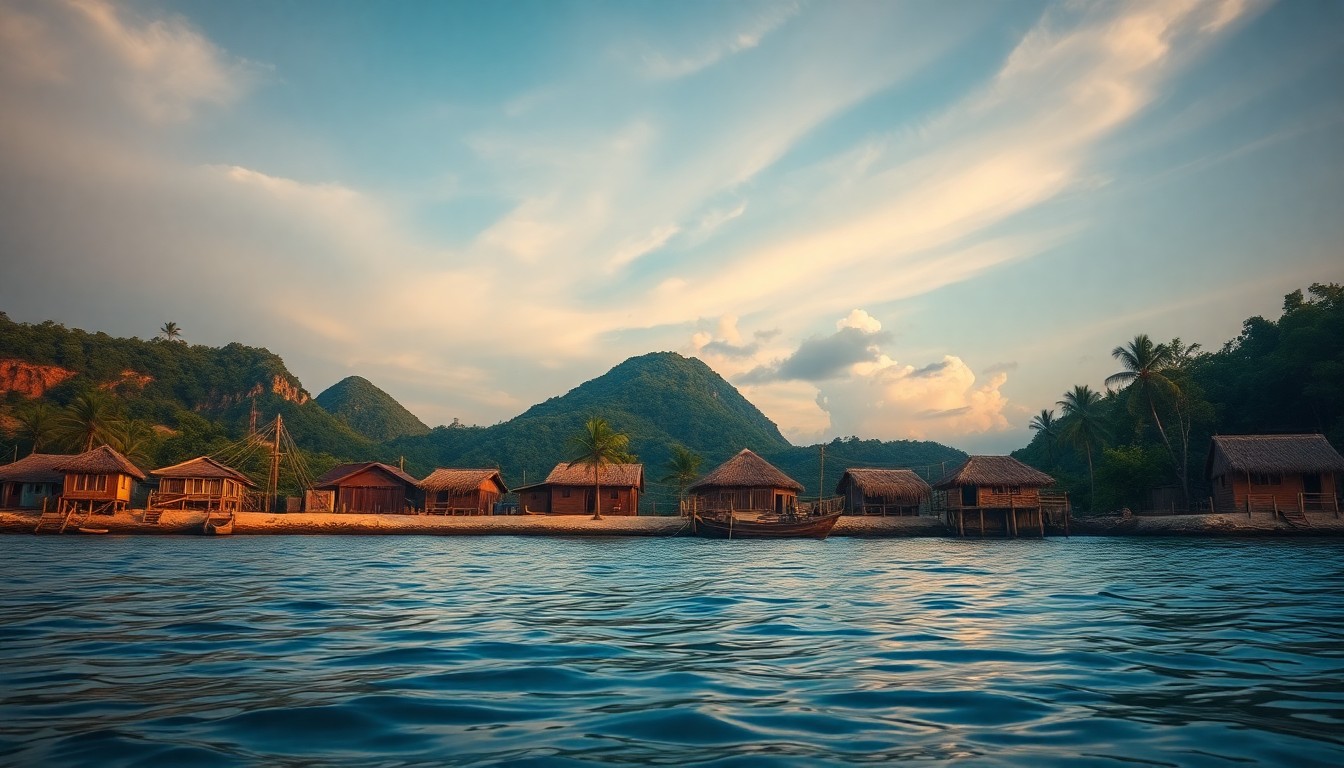
It is also a country made mostly of water. The coast is not a line but a maze: five great tidal rivers — the Cacheu, Mansôa, Geba, Corubal and Rio Grande de Buba — open into estuaries kilometres wide, the tide runs up to five metres and pushes fifty kilometres inland, and the whole shore dissolves into mangrove. Offshore lie the Bijagós, an archipelago of eighty-eight islands and islets of which about twenty are inhabited. Nothing in the country rises much above 300 metres.
Three things make Guinea-Bissau matter out of proportion to its size. The Bijagós hold a matrilineal society that was never conquered until 1936, hippopotamuses that swim in the sea, and one of the largest green turtle colonies in Africa — and became the country's first UNESCO World Heritage Site in 2024. Amílcar Cabral, born here, ran the most effective liberation war in Portuguese Africa and is generally credited with helping to bring down the dictatorship in Lisbon itself. And cashew nuts account for something like nine-tenths of the country's exports, which makes this the most single-crop economy on the continent.
The fourth thing is the instability, and there is no honest way to leave it out. Since independence in 1973 Guinea-Bissau has had coups or attempted coups in 1980, 1998, 1999, 2003, 2010, 2012 and later; a president was shot dead by soldiers in 2009; and no elected president has ever completed a full term. For most of that time ordinary life has gone on regardless — the instability is an elite phenomenon and rarely touches visitors — but it means anyone travelling here has to check the current position rather than trust a page written months ago.
🏷️ Which Guinea? Portuguese, Kriol and the CFA
The country added -Bissau to its name at independence in 1973, after its capital, specifically to distinguish itself from the Republic of Guinea next door. The two are different countries with different colonisers, different languages and different currencies, and they are both distinct again from Equatorial Guinea, a Spanish-speaking oil state on the far side of the Gulf of Guinea, and from Papua New Guinea, which is in the Pacific.
Portuguese, officially
Portuguese is the sole official language — Guinea-Bissau is one of five African members of the CPLP, the Portuguese-speaking community — but genuine fluency is limited, on most estimates to somewhere between a sixth and a quarter of the population, heavily urban and educated. Government, courts and schools run in it; daily life does not.
Kriol, actually
Guinea-Bissau Creole — Kriol or Kiriol — is the language of the country. Portuguese-lexified, with grammar from the coastal African languages, it grew out of the trading settlements from the 16th century and is now spoken by the large majority as a first or second language. It is closely related to Cape Verdean Creole and mutually intelligible with it in part. Learn ten words of Kriol, not Portuguese.
The CFA franc
Guinea-Bissau joined the West African CFA franc zone in 1997 — the only lusophone country in it — abandoning the peso. The CFA is pegged to the euro at a fixed 655.957 XOF to €1, so it is stable, convertible and roughly 26 XOF to the Czech crown. This is the single most convenient thing about travelling here and the most controversial thing about the country's economics.
The flag
Red vertical band at the hoist with a black star, yellow and green horizontal bands — the PAIGC party flag adopted as the state flag in 1973, and closely modelled on Ghana's. Cape Verde used a near-identical flag until 1992, when it changed to mark the definitive end of the union between the two countries.
That union is worth knowing about. The liberation movement was the PAIGC — the African Party for the Independence of Guinea and Cape Verde — and a single state spanning both was the explicit goal of Amílcar Cabral and of the first decade of independence. The 1980 coup in Bissau, which removed Cape Verdean-descended Luís Cabral, ended it. The two countries remain unusually close and their creoles still talk to each other.
🗺️ Geography: Water Everywhere
Guinea-Bissau is one of the flattest countries in Africa. The whole west is a coastal plain barely above sea level, cut by estuaries and covered in mangrove; the land rises gently eastwards through savanna to the Boé plateau on the Guinean border, where the country's high point sits at a little under 300 m. There is no mountain, no waterfall of consequence and no dramatic relief anywhere — the drama here is horizontal.
What that means in practice is that the sea comes a long way inland. The tidal range on this coast runs to four or five metres, and the tide pushes salt water up the Geba and the Cacheu for tens of kilometres, which is why the country's rice is grown in reclaimed mangrove polders rather than freshwater paddies, and why a river journey is often faster than a road one. Roughly an eighth of the national territory is mangrove — one of the largest and best-preserved mangrove systems in West Africa.
The rivers
The Geba is the great one — its estuary at Bissau is over ten kilometres across — fed by the Corubal, which drains the Guinean highlands. The Cacheu runs along the north and gives its name to the mangrove park; the Rio Grande de Buba in the south is a deep, sheltered inlet that has been proposed as a port for a century.
The regions
Eight regions plus the autonomous sector of Bissau. Broadly: the north-west (Cacheu, Biombo) is Manjaco and Papel country; the east (Bafatá, Gabú) is Fula and Mandinka savanna; the south (Quinara, Tombali) is Balanta and Nalu, wet and forested; and the Bijagós are their own world.
Protected areas
Unusually for the region, a genuinely large share of the country is protected — around a quarter, on paper. Orango, João Vieira–Poilão, the Cacheu Mangroves, Cufada Lagoons (Ramsar), Cantanhez Forest and Dulombi-Boé. Enforcement is thin and funding depends heavily on foreign NGOs, but the areas exist and matter.
What is not here
No desert, no Sahel proper, no highlands, no big-game savanna in the East African sense. Guinea-Bissau's wildlife is coastal, riverine and forest — birds in astonishing numbers, hippos, chimpanzees, manatees, turtles — and it is watched from a boat far more often than from a vehicle.
🏝️ The Bijagós Archipelago
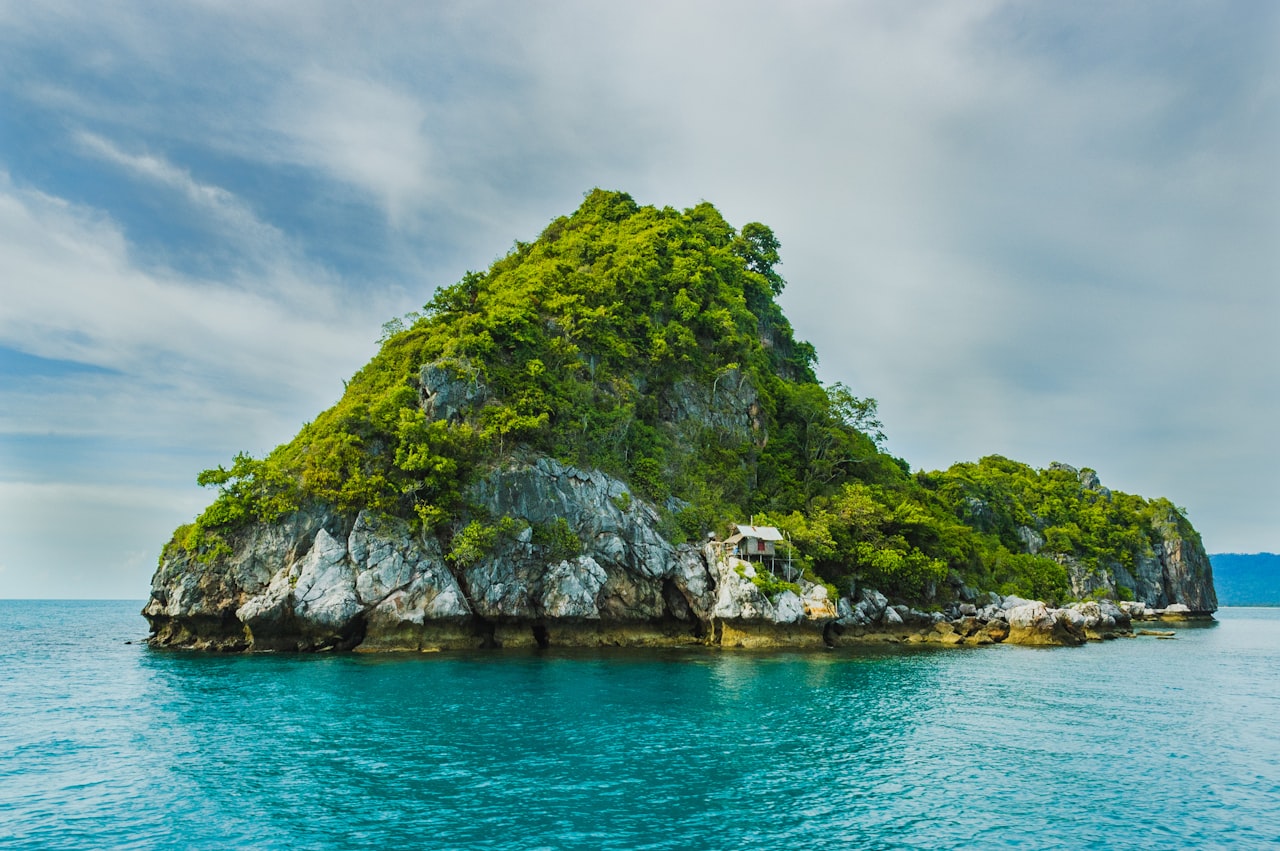
Eighty-eight islands and islets scattered across some ten thousand square kilometres of shallow sea and tidal flat, about twenty of them permanently inhabited, and the reason most visitors come. The Bijagós have been a UNESCO Biosphere Reserve since 1996 and were inscribed in 2024 as the country's first World Heritage Site — a natural inscription recognising the archipelago's mangroves, intertidal flats and the way the Bijagó people have managed them.
Ecologically this is one of the most important coastal systems on the eastern Atlantic. The intertidal flats hold vast numbers of migratory shorebirds on the East Atlantic flyway; the channels hold manatee, dolphins and sharks; Poilão is among the largest green turtle nesting sites in Africa; and Orango has a population of hippopotamus that moves between islands through salt water — which is not something hippos are supposed to do.
Bubaque
The archipelago's main island and the only one with anything resembling infrastructure: a small town, a handful of guesthouses and lodges, a market, and the ferry link to Bissau. Everything else is reached from here by pirogue. It is also where you buy your park permits and find a guide.
Orango
The largest island, and a national park since 2000. The saltwater hippos are the draw and seeing them takes patience, a guide and a walk to the freshwater lagoons where they spend the day. Orango is also the seat of one of the archipelago's most important female priesthoods.
Poilão and João Vieira
A marine national park in the south-east of the archipelago. Poilão is uninhabited, sacred to the Bijagó of Canhabaque, and a green turtle rookery of continental importance — thousands of nests in a season on a beach two kilometres long. Access is restricted, seasonal and requires permits; that restriction is the reason the turtles are still there.
The others
Rubane and Kere have the comfortable lodges; Canhabaque is the most traditional and the last island the Portuguese subdued; Caravela, Uno, Formosa and Maio are the northern group, with the strongest surviving ceremonial calendar. Most islands have no electricity, no road and no shop.
🌡️ Climate and When to Go
Tropical, with one dry season and one very wet one. The dry season runs November to May, the rains from June to October, and Guinea-Bissau gets a lot of them — between 1,500 mm on the eastern savanna and well over 2,000 mm on the southern coast, most of it in July, August and September. Temperatures sit between about 24 and 34 °C the whole year; the harmattan brings dust and cooler nights in December and January.
November–February
The season. Dry, less humid, roads passable, boats running, and the birds at their peak as the northern migrants pile onto the mudflats. Carnival in Bissau falls in February and is worth planning a trip around. Book accommodation on Bubaque ahead — there is very little of it.
March–May
Hot and increasingly heavy, especially inland, where 38–40 °C is normal in April. This is the cashew campaign, when the whole country is buying, selling and arguing about the price of nuts, which is a fascinating thing to witness and makes transport and accommodation harder to find.
June–October
The rains, and largely a write-off for travel. Unpaved roads become impassable, the southern regions can be cut off, boats to the islands are cancelled in bad weather, and mosquito numbers and malaria transmission peak. Some island lodges simply close.
The turtle timing
Green turtle nesting at Poilão peaks roughly July to October — which is precisely the season when getting there is hardest. If turtles are the point of the trip, plan for the shoulder in late June or early November and accept that you may see nothing.
🗺️ Map
Guinea-Bissau lies between about 11° and 12.7° north, on the westernmost bulge of Africa. Bissau is on the north bank of the Geba estuary; Bubaque, the Bijagós hub, is about 60 km south-west by sea; Gabú, the eastern town, is 200 km inland; and the Senegalese border at São Domingos is a two-and-a-half-hour drive north.
The country is small enough to cross by road in a day, but the map hides the water. Anywhere in the Bijagós is a boat journey measured in hours and dependent on tide, weather and whether a boat is going; the southern regions are separated from Bissau by the Geba and by ferries that keep their own counsel. Allow far more time than the distances suggest.
👑 Kaabu and the Peoples of the Coast
The interior of what is now Guinea-Bissau was the western march of the Mali Empire, and when Mali receded the Mandinka province there became an independent state in its own right: Kaabu (Gabu), which ruled the savanna from roughly the 13th century to 1867. It was a confederation of provinces under a mansaba, matrilineal in its royal succession, and rich on the trade in slaves, kola and iron between the interior and the Atlantic.
Kaabu ended dramatically. Fula armies from the Imamate of Futa Jallon besieged the capital at Kansala in 1867, and when the walls were about to fall the defenders fired the powder magazine, killing themselves and much of the attacking force. The event is remembered across the region in griot repertoire as Turban Kelo, the war of Kansala, and it is the founding tragedy of Mandinka Guinea-Bissau. The modern town of Gabú carries the name.
The coast was a different world entirely, and this is the key to the country. The Balanta, Papel, Manjaco, Felupe, Nalu and Bijagó lived in decentralised, largely stateless societies with no kings for an outsider to negotiate with, no tribute to extract, and a well-earned reputation for violent resistance. They were never incorporated into Kaabu, they were not converted by the Fula jihads, and the Portuguese did not control them either — which is why the colonial power spent four centuries on the coast and only established real authority in the 1930s.
The Balanta
The largest group in the country, about a third of the population, in the south and centre. Famously acephalous — no chiefs, decisions by age-grade assembly — and famously difficult to govern, which is why the Portuguese used the term gentio for them and why the PAIGC recruited so heavily among them. The army has been disproportionately Balanta ever since, which is one of the country's political fault lines.
The Bijagó
The islanders: matrilineal, seafaring, and the only people on this coast who raided rather than being raided. Their war canoes attacked mainland villages and Portuguese shipping into the 19th century. Canhabaque island was not subdued until 1936, which makes the Bijagós one of the last places in Africa to be brought under colonial control.
The Fula and Mandinka
The eastern half: Muslim, hierarchical, historically tied to Futa Jallon and the Mali world, and the group with the deepest Islamic scholarship in the country. Together roughly a third of the population, and the demographic base of much of the country's modern politics.
Why it matters now
The stateless-versus-hierarchical split is not academic. It shapes who joined the liberation war and who did not, which regions vote which way, who is in the army and who is in the ministries, and why Guinea-Bissau has been so hard to hold together. Everyone here can explain it to you and most people will.
⛓️ Cacheu, the Lançados and the Slave Trade
The Portuguese reached this coast in 1446, when Nuno Tristão sailed into one of the rivers and was killed there by arrows along with most of his crew — an opening that set the pattern. For the next four centuries Portugal held trading posts on the rivers and almost nothing else: Cacheu from 1588, Bissau from 1687, plus Farim, Geba and Ziguinchor, each a fort with a few dozen people and a stockade.
What made the region matter to Europe was the slave trade. The Rivers of Guinea supplied captives to Cape Verde, to Brazil and to Spanish America across three centuries, and Cacheu was one of its principal ports. The trade was not run by garrisons but by lançados and tangomãos — Portuguese and Cape Verdean traders who left the forts, married into African societies, adopted local languages and religion, and became a distinct Luso-African class. Their descendants created the Kriol language, and it is a hard, exact fact that the country's lingua franca is a product of the slave trade.
The nharas
The Luso-African trading women of the rivers — nharas or signares — who married European traders, controlled the local end of the business and often outlived and outmanoeuvred their husbands. Some were among the wealthiest people on the coast. They are a substantial part of the region's history and are almost entirely absent from its monuments.
Cacheu today
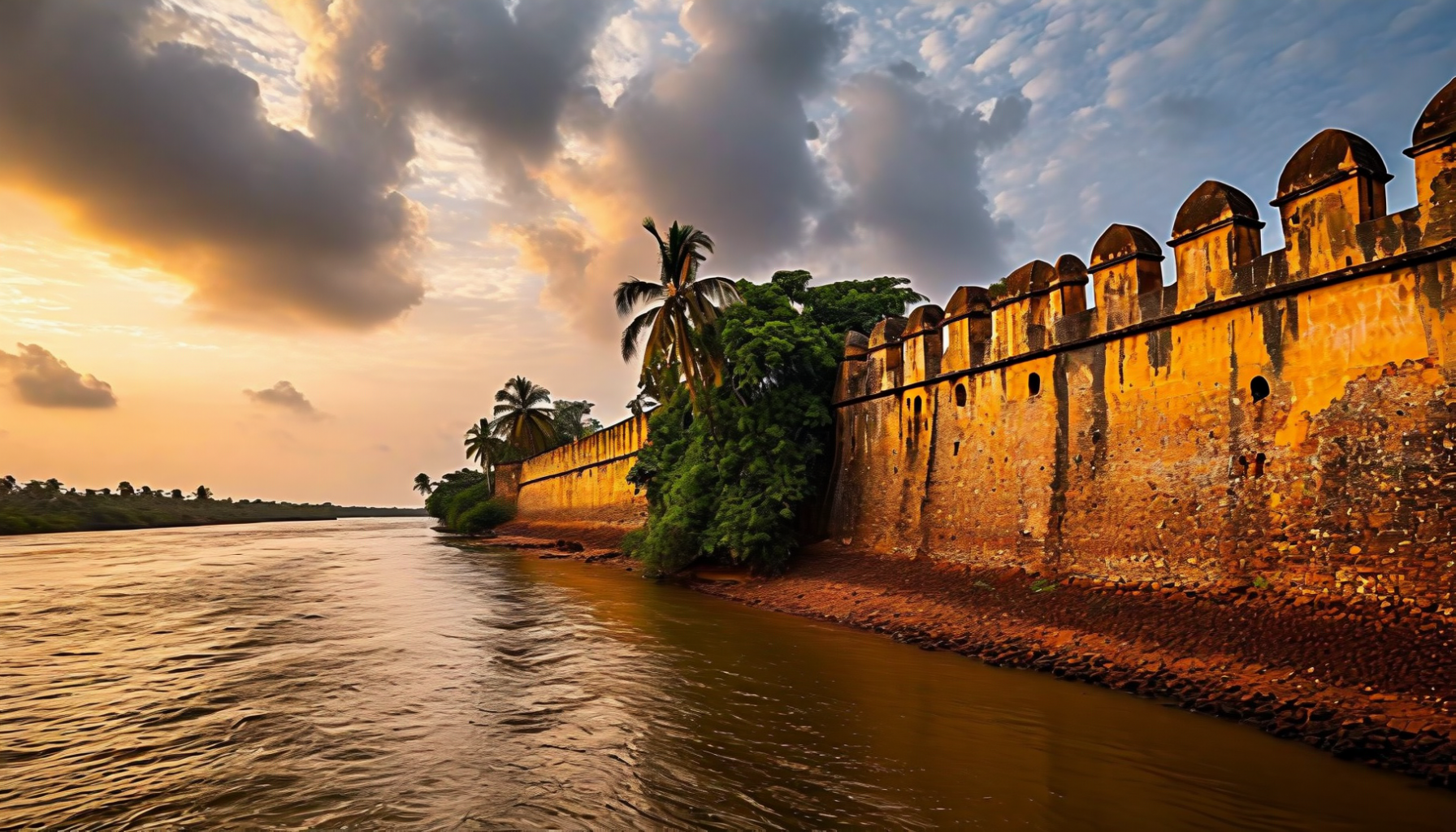
A small, quiet town on the north bank of its river with a well-preserved fort, a memorial to the slave trade in the square and a set of colonial cannon. It is two hours from Bissau and by far the best single day trip for anyone interested in the history. There is a modest museum; ask in the town for the key.
Administered from Cape Verde
Portuguese Guinea was a dependency of Cape Verde until 1879, when it became a separate colony. That long administrative link is why the two territories' elites were entwined, why the PAIGC was founded for both, and why Cape Verdeans held so many colonial posts here — a resentment that the 1980 coup drew on.
Conquest, late
The Portuguese fought "pacification" campaigns against the coastal peoples from the 1880s into the 1930s, with the Bijagós island of Canhabaque holding out until 1936. Effective colonial rule over the whole territory therefore lasted well under forty years — shorter than the lifetime of many people who were alive at independence.
🏛️ Bolama, the Capital That Was Abandoned
Between 1871 and 1941 the capital of Portuguese Guinea was not Bissau but Bolama, an island town at the mouth of the Geba, and its story is the strangest thing in the country.
Britain and Portugal both claimed the island in the 1860s, and rather than fight they submitted the dispute to arbitration by the President of the United States. Ulysses S. Grant awarded Bolama to Portugal in 1870, a decision commemorated by a monument in the town and by a great many Bissau-Guineans who know the name of an American president for that reason alone. Portugal promptly made it the capital and built accordingly: a grid of avenues, an arcaded governor's palace, a hospital, a cinema, a printing works, mansions.
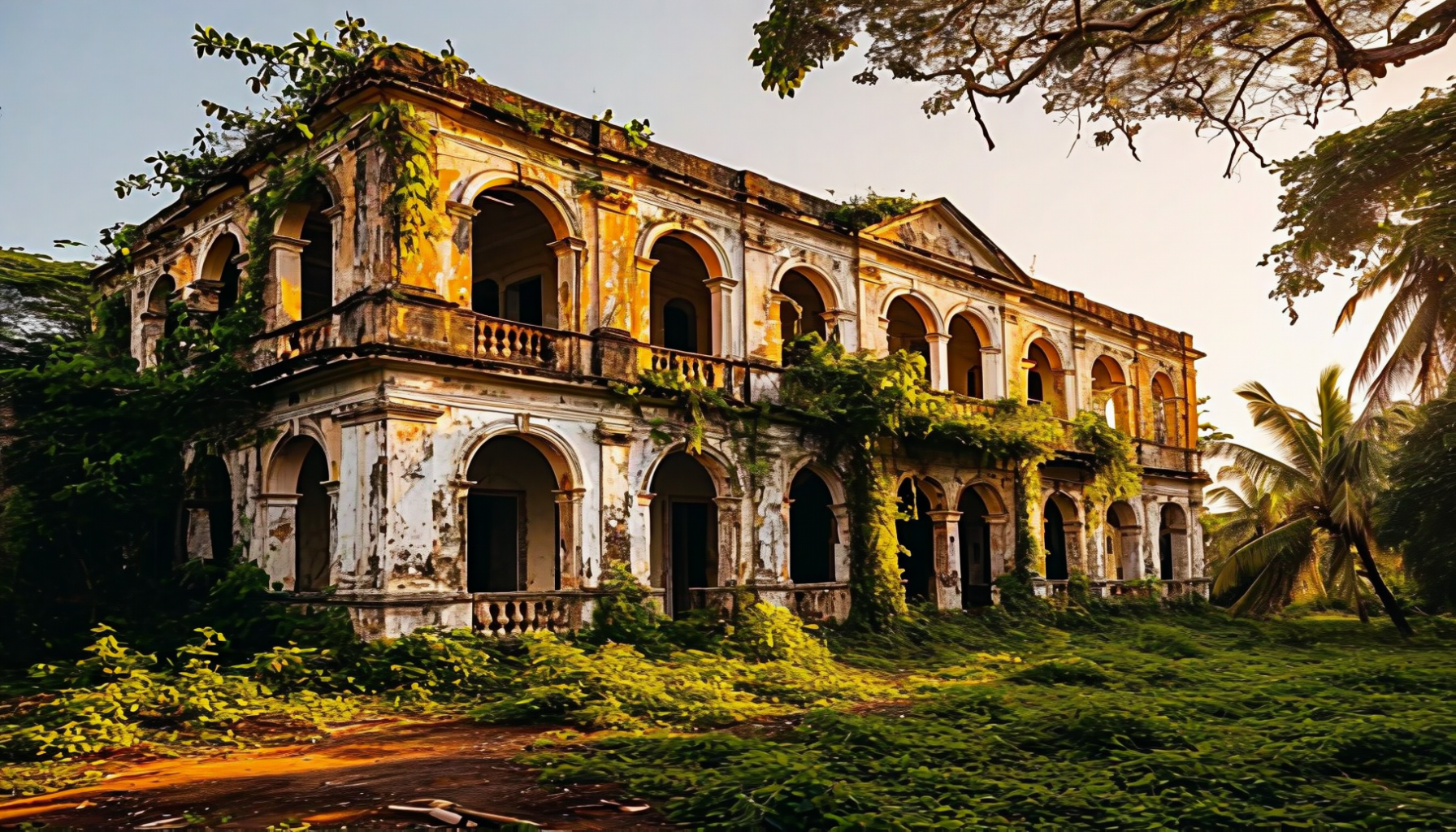
The capital moved to Bissau in 1941, for the entirely practical reason that Bissau is on the mainland and Bolama is not. Almost everyone left. What remains is one of the most extraordinary architectural ruins in Africa: a complete small colonial city, still laid out, still roofed in places, being pulled apart by trees. There is a hotel of sorts, a ferry from Bissau and almost no visitors, and going there is the single most atmospheric thing you can do in Guinea-Bissau.
✊ Amílcar Cabral
Amílcar Cabral (1924–1973) is the reason this country has a place in twentieth-century history, and he was a genuinely unusual figure: an agronomist who became a guerrilla leader, and a guerrilla leader who is read today mainly as a political theorist.
He was born in Bafatá to Cape Verdean parents, studied agronomy in Lisbon — where he met Agostinho Neto of Angola and Mário de Andrade and helped found the student circles from which every lusophone liberation movement came — and returned as the colony's only African agricultural engineer. The agricultural census he conducted in 1953 took him to essentially every village in the territory, and it is not an accident that the man who later organised the countryside had personally surveyed it.
He founded the PAIGC in 1956. After Portuguese police killed around fifty striking dockers at Pidjiguiti in Bissau in 1959, the party abandoned urban agitation and went to the countryside, and from 1963 fought a war that within a decade controlled most of the territory. Cabral was assassinated in Conakry on 20 January 1973, shot by dissidents inside his own party, with the Portuguese secret police involved in the plot. He was 48. Independence was declared eight months later.
The theory
Cabral's writing — Unity and Struggle, Return to the Source, the Havana speech of 1966 — argues that liberation is above all a cultural act, that the petty bourgeoisie leading a revolution must "commit class suicide" to be of use, and that theory must come from the specific conditions of a place rather than from a textbook. He also insisted, famously, on telling no easy lies: "Claim no easy victories."
The liberated zones
By 1970 the PAIGC ran schools, clinics, people's stores and courts across large parts of the interior, with a hospital network and its own currency-free trade system. Foreign journalists were taken in to see it. That state-behind-the-lines is what made the independence declaration credible and is why some eighty countries recognised Guinea-Bissau before Portugal did.
Cabral and the women
The PAIGC required that women hold a share of positions on the village committees, ran literacy programmes aimed at them, and campaigned against forced marriage and female genital cutting. Implementation was patchy and the post-independence record was worse — but the commitment was written down in the 1960s, which was early.
Where to see him
His mausoleum is inside the Fortaleza de São José da Amura in Bissau, which is an army barracks, so access needs permission and is not guaranteed. The Pidjiguiti memorial — a black fist rising from the quay where the dockers were shot in 1959 — is on the waterfront and is open to anyone. Bafatá has his birthplace and a statue.
🔫 The War That Ended a Dictatorship
The Guinea-Bissau war of 1963–1974 is not well known outside the lusophone world, and it should be. Of Portugal's three colonial wars it was the one the army could not win, and it is widely regarded as the proximate cause of the Carnation Revolution that ended the Estado Novo in Lisbon on 25 April 1974.
The reasons were geography and Cabral. The territory is small, flat, wet and impossible to seal; it borders two friendly states, Senegal and Sékou Touré's Guinea, which gave the PAIGC sanctuary and supply; and the population in the countryside was, after the first years, largely with the guerrillas. By 1968 the Portuguese commander António de Spínola was fighting a hearts-and-minds campaign — Por uma Guiné melhor, schools and wells and promotion of Africans — because the military option had failed.
Two things finished it. In 1973 the PAIGC received Soviet Strela-2 shoulder-launched missiles and began shooting down Portuguese aircraft, ending the air superiority the whole counter-insurgency depended on. And Spínola, sent home, wrote Portugal e o Futuro — published in February 1974 — arguing that the wars could not be won militarily and that a political solution was needed. The book was a sensation, the regime tried to suppress it, and two months later the Movement of the Armed Forces overthrew the government in Lisbon.
24 September 1973
The PAIGC declared independence unilaterally at Madina do Boé, in the liberated east, eight months after Cabral's murder. The UN General Assembly welcomed it in November by 93 votes to 7. Portugal recognised the new state on 10 September 1974, after the revolution — so Guinea-Bissau's independence day precedes its recognition by nearly a year, and 24 September is the date that is celebrated.
Casualties
Perhaps 2,000 Portuguese soldiers and several thousand PAIGC fighters died, along with a much larger and never properly counted number of civilians. Portugal deployed around 30,000 troops in a territory of half a million people. Villages were bombed with napalm; the PAIGC executed suspected collaborators. Neither side's record is clean and Bissau-Guinean historians say so.
The other legacy
The war made Guinea-Bissau's army politically central and left it far larger than a country of two million can pay for. Every subsequent coup traces back to that: a heavily armed institution with a liberation-era claim to be the real guardian of the state, and a treasury that cannot fund it.
Cape Verde
The PAIGC won independence for both territories and intended a single country. Cape Verde took independence separately in July 1975 with the union still formally alive; the 1980 coup in Bissau, aimed partly at Cape Verdean influence, killed it. The Cape Verdean wing became the PAICV and the two states went their own ways, amicably enough.
🏛️ Coups, Cocaine and the Unfinished State
The post-independence record is grim and there is no point dressing it up. Luís Cabral, Amílcar's half-brother, was president from 1974 until a 1980 coup by João Bernardo "Nino" Vieira, who then ruled for nineteen years. Multi-party elections arrived in 1994. In 1998 Vieira sacked his army chief over arms smuggling to Senegal's Casamance rebels and triggered an eleven-month civil war that wrecked Bissau and removed him.
Since then: a coup in 1999, a coup in 2003, an assassinated army chief and an assassinated president in 2009 — Nino Vieira was killed by soldiers on 2 March 2009, hours after a bomb killed the chief of staff — a coup in 2010, and a coup in April 2012 in which the army seized power between the two rounds of a presidential election. Guinea-Bissau has the unhappy distinction that no elected president has ever served out a full term.
From around 2005 a second problem arrived. Guinea-Bissau's unpatrolled archipelago, disused airstrips and unpaid, well-armed officers made it an ideal transshipment point for South American cocaine heading to Europe, and the UN and the United States began describing it as Africa's first "narco-state". Senior officers were named; in 2013 the former navy chief of staff was arrested by American agents in a sting in international waters and later convicted in New York. Seizures have continued, including 1.8 tonnes in 2019, the largest ever made in West Africa.
Where it stands
President Umaro Sissoco Embaló, elected at the end of 2019, dissolved parliament in 2022 and again in December 2023, and the dispute over when his mandate ended dominated 2024 and 2025. A presidential election was held on 23 November 2025; before results were declared the military announced it had taken control and installed a transitional leadership. Verify the current situation before you travel — this is exactly the kind of thing that changes between the writing of a page and the reading of it.
What it means for visitors
Remarkably little, most of the time. Guinea-Bissau's coups have generally been short, contained in Bissau, and directed at people in government rather than at the public; the 1998–99 civil war is the exception. Ordinary crime is low by regional standards. The practical risk is disruption — closed airport, curfew, no flights for a week — rather than danger.
The cocaine and you
It is a state-capture problem, not a street problem: there is no visible drug scene and no reason for a traveller to encounter it. What it does mean is that some parts of the state are compromised, that policing is unpredictable, and that you should be scrupulous about your own paperwork and never carry anything for anyone.
The other side of it
For all this, Guinea-Bissau has held genuinely competitive elections, has an unusually free press for the region, has never had a mass-casualty ethnic conflict, and remains a place where a Muslim, a Catholic and an animist family routinely attend each other's ceremonies. The dysfunction is at the top. It is worth keeping both facts in view.
🥜 The Cashew Republic
Guinea-Bissau is the most single-crop economy in Africa. Raw cashew nuts account for something like 85 to 90 per cent of export earnings and the livelihood of most rural households, and the country is among the world's largest exporters of them — almost entirely unprocessed, to India and Vietnam, where the shelling and roasting happen and where the value is added.
The campanha de caju — the cashew campaign, roughly April to June — is the country's real annual event. The government sets a reference price, traders fan out, and the entire economy takes its cue: school fees, weddings, roof repairs, motorbike purchases and the government's own revenue all wait on what a kilo of raw nuts fetches. A bad price is a national emergency. A good one is visible in the number of new tin roofs.
How it happened
Cashew is not native — it came from Brazil with the Portuguese — and it became dominant only after independence, when structural adjustment pushed the country towards a cash crop and cashew was what would grow on poor soil with no inputs. Trees now cover a large share of the arable land, including land that used to grow rice.
The rice trap
Guinea-Bissau grew its own rice for centuries and now imports most of what it eats, having planted the fields with cashew and then bought rice with the proceeds. When the cashew price falls and the rice price rises in the same year — as has happened repeatedly — the country has a food crisis with no policy lever to pull.
Processing, always promised
Every government has promised domestic shelling, and a handful of small factories exist. The obstacles are electricity, credit and the fact that Indian processors buy the whole crop forward. The share processed locally has been in the low single digits for twenty years and the argument about it is the single most consequential economic debate in the country.
What else there is
Fisheries — the waters are extremely rich and are worked largely by foreign fleets under access agreements, which is a significant slice of government revenue. Timber, including illegal rosewood cut for China. Undeveloped bauxite at Boé and phosphate at Farim. Almost no manufacturing and almost no tourism.
🗣️ Peoples, Kriol and Coexistence
Around 2.2 million people and more than twenty ethnic groups in a country the size of a Czech region — and, unusually for West Africa, no history of large-scale ethnic violence between them. The composition runs roughly: Balanta about 30%, Fula about 20%, Mandinka and Manjaco around 14% each, Papel about 7%, then Bijagó, Felupe, Beafada, Nalu and others.
Religion divides differently again, and this is the country's quiet achievement. Roughly 45% Muslim, concentrated among the Fula and Mandinka of the east; roughly 30% adherents of traditional religion, a far higher share than in any neighbouring state; and roughly 20% Christian, mostly Catholic. Mixed families are common, people attend each other's ceremonies as a matter of course, and the sectarian politics that has torn up the Sahel is essentially absent here.
Kriol
The glue. Kriol has Portuguese vocabulary on an African grammatical frame, emerged in the trading settlements from the 1500s, and is now the everyday language of the majority — the only thing spoken by Balanta, Fula and Bijagó alike. Try: kuma di korpu? (how are you, literally how's the body), na bai (I'm going), obrigadu, i bon (it's good), ka tene (there isn't any).
Portuguese
Official, but a minority language in practice — most estimates put real competence somewhere between a sixth and a quarter of the population. It is the language of the state and of the CPLP relationship, and Brazilian television has done more for its spread in the last twenty years than the school system has.
French and the neighbours
Guinea-Bissau is surrounded by francophone states, uses the CFA franc, and belongs to UEMOA and ECOWAS, so French is widely useful in trade and in the border regions. A traveller with French and a little Kriol will manage everywhere; a traveller with only Portuguese will manage in Bissau.
Diaspora
Very large relative to the population — several hundred thousand Bissau-Guineans and their children live in Portugal, Senegal, France and Spain, and remittances are a major part of household income. Almost every family you meet has someone in Lisbon, and almost everyone will ask you about visas.
👑 The Bijagós: Matrilineal, Masked, Unconquered
The Bijagó are perhaps thirty thousand people across twenty inhabited islands, and their society is genuinely unlike its neighbours'. It is matrilineal: descent, land and houses pass through women. Women choose their husbands rather than the reverse, and in the classic account a woman signals her choice by preparing a dish and setting it before the man, who is not really expected to refuse. Women build and own the houses. The okinka, senior priestesses, hold the highest religious authority and adjudicate disputes.
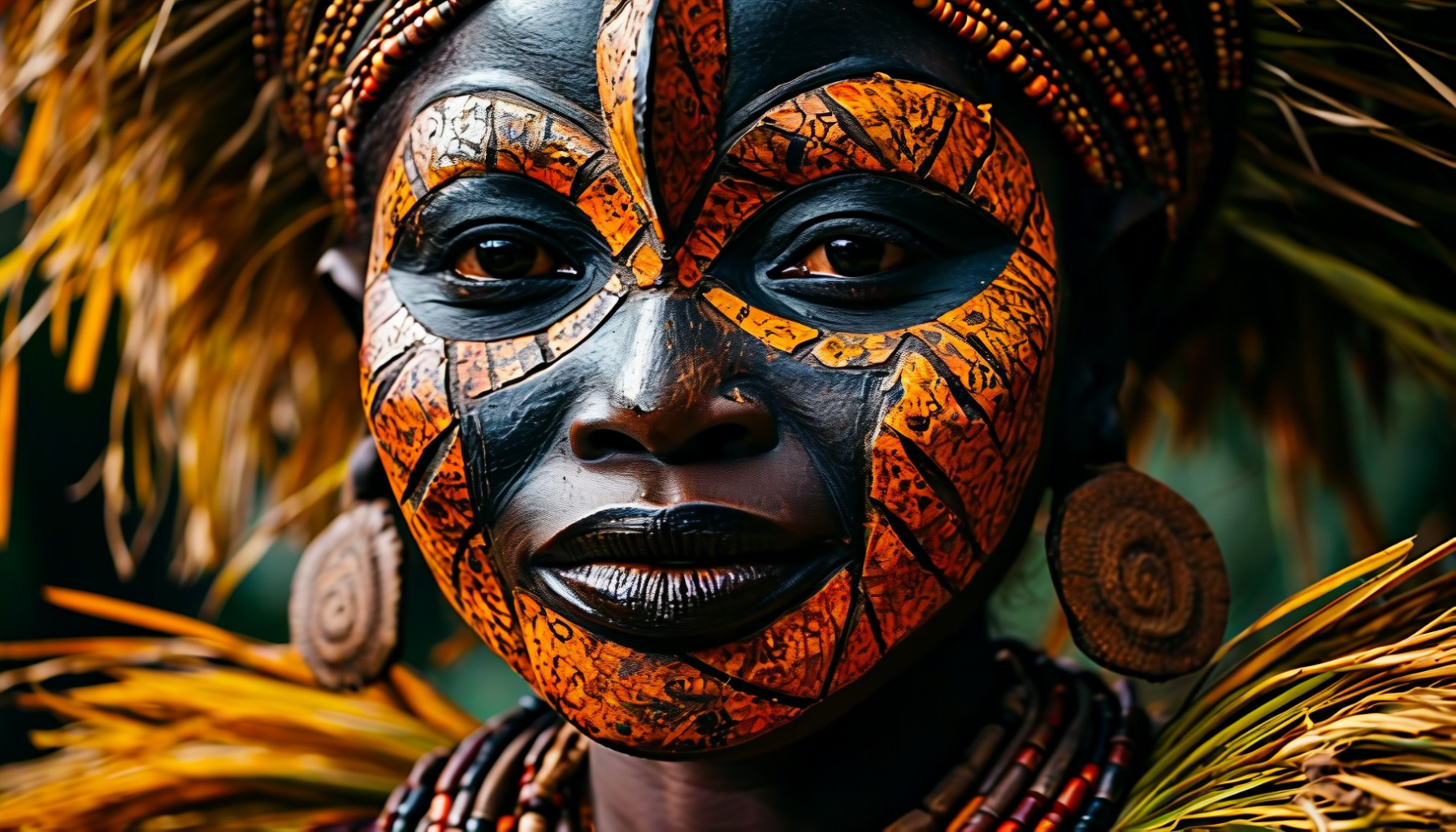
Men's status is organised by a long initiation cycle, the fanado, which can take decades to complete and which every man must finish — if necessary posthumously, by proxy, since an uninitiated man cannot properly join the ancestors. The bull masks belong to one of its grades: young men dance the dugn'be, charging and stamping like a herd bull, and are judged on it. Bijagó sculpture — the masks and the iran figures — sits in the ethnographic collections of every major museum in Europe.
Never conquered
The Bijagó raided the mainland in large war canoes for centuries and successfully resisted the Portuguese longer than almost anyone in Africa. Canhabaque was subdued only in 1936, after several failed campaigns. That history is present in how the islands deal with outsiders today: politely, on their own terms, and with the assumption that they decide.
Sacred islands
Several islands, Poilão above all, are ceremonial sites where access, fishing and cutting are restricted by island authority rather than by the state. This traditional management is a substantial part of why the archipelago's ecology survives, and UNESCO's 2024 inscription explicitly recognises it. Respect it: if you are told an island or a grove is closed, it is closed.
Visiting properly
Arrange visits through Bubaque with a guide who is known in the village you are going to, greet the head of the village before anything else, and ask before every photograph. A small gift — rice, sugar, batteries — is normal and welcome. Ceremonies are not performances; some are open to visitors and many are not.
Under pressure
Young Bijagó leave for Bissau and Portugal, the initiation cycle is harder to complete, fishing is being taken by industrial fleets and the islands are among the most exposed places in Africa to sea-level rise. The society described here is real and it is also thinner every decade.
🎶 Gumbé, Super Mama Djombo and Carnival
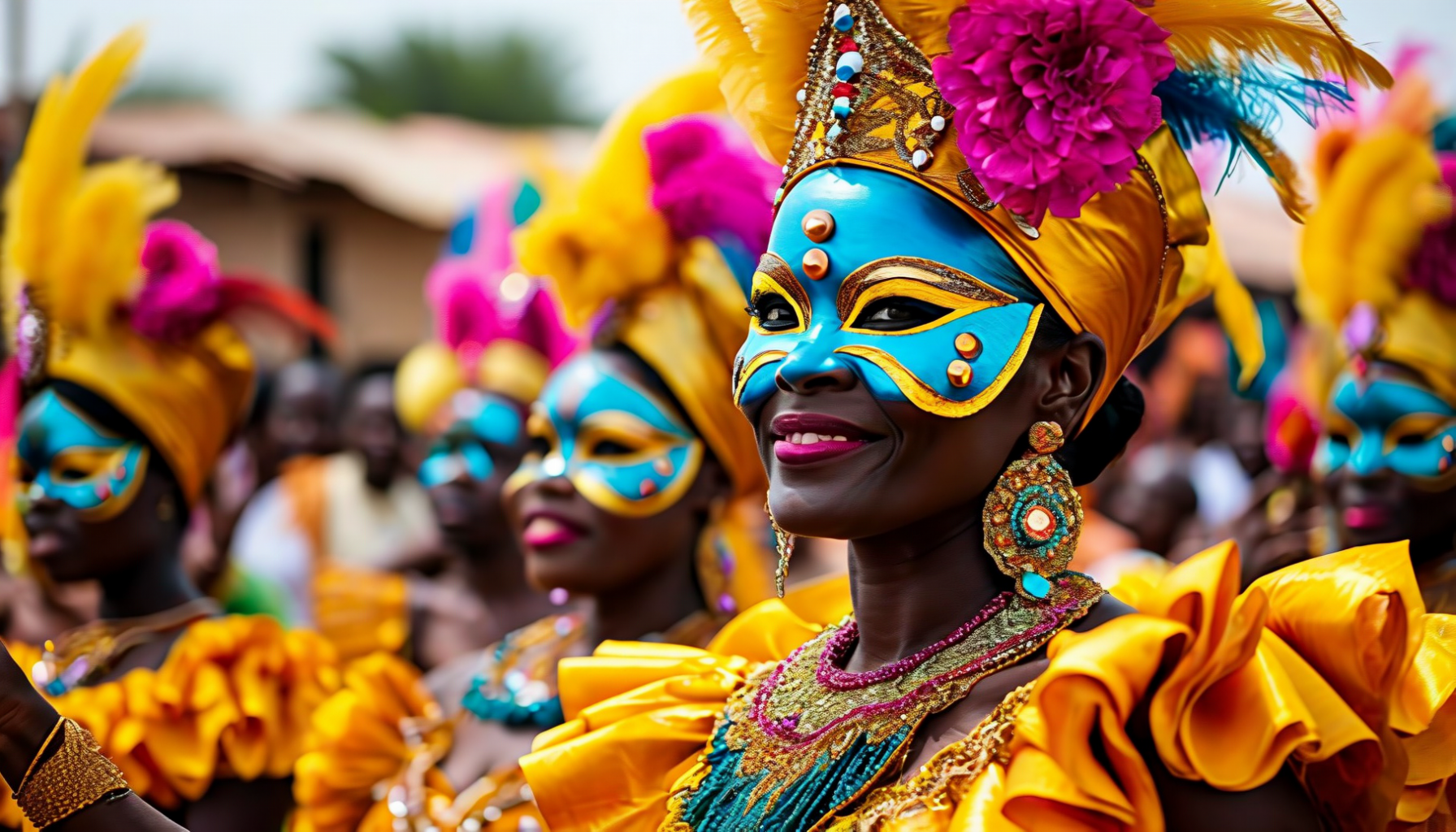
Gumbé is the national music: a hybrid built deliberately out of the rhythms of the country's different peoples over a Kriol lyric, played on guitars, calabash and hand drums. It was the sound of the liberation years and it remains the sound of the country, and it is the best reason to be in Bissau on a Friday night.
Super Mama Djombo
The great band of the independence era, formed among PAIGC pioneers and named after a spirit that fighters believed protected them. They were effectively the state orchestra of the 1970s, they are extraordinary, and their records have been reissued in Europe. Start with Na Cambança.
José Carlos Schwarz
Poet and singer, the country's most beloved artist, who wrote in Kriol about liberation and about ordinary life with equal force. He was imprisoned by the Portuguese, became a diplomat after independence, and died in a plane crash in Cuba in 1977 at 28. His songs are still sung at every gathering.
Now
Manecas Costa is the international name — a superb guitarist whose Paraiso di Gumbe was made in London and is the easiest entry point for a European listener. Eneida Marta, Tabanka Djaz, Karyna Gomes and a lively Bissau hip-hop scene in Kriol carry it on.
Flora Gomes
Not music, but the country's other great cultural export: one of Africa's most respected film directors, who trained in Cuba and whose Mortu Nega (1988) — about a woman searching for her husband at the end of the liberation war — and Udju Azul di Yonta (1992) were the first Bissau-Guinean features and are in the canon of African cinema.
🐘 Hippos in the Sea, Chimps in the Forest
Guinea-Bissau's wildlife is the country's most under-appreciated asset. It is not a safari destination and never will be — the megafauna is thin and the infrastructure is minimal — but it holds several things that exist nowhere else in the same form.
The saltwater hippos
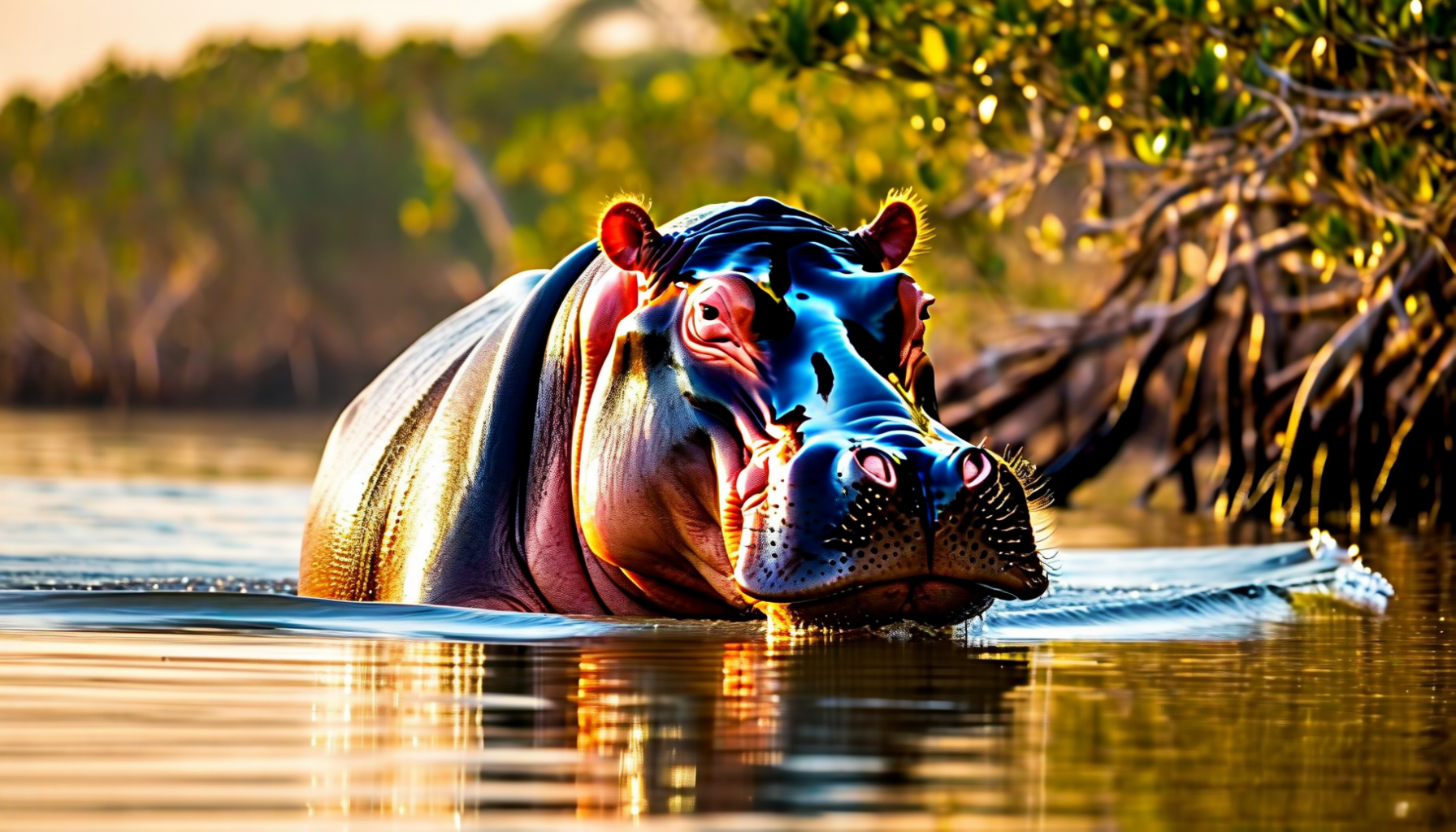
Orango National Park holds the archipelago's hippos, and they cross open salt water between islands. Seeing them means a guide, an early start and a walk to the interior lagoons; the park has a small community-run lodge. Do not approach them — hippos kill more people in Africa than any large mammal, and these are not habituated.
Chimpanzees at Cantanhez
The Cantanhez Forest National Park in the far south holds the north-westernmost population of the western chimpanzee, plus red colobus, buffalo and, occasionally, forest elephant crossing from Guinea. Community-run camps at Iemberem organise tracking; the chimps are not habituated to the degree they are in East Africa, so sightings are earned.
Birds
This is the serious one. The Bijagós intertidal flats and the Cacheu and Cufada wetlands hold enormous concentrations of Palearctic waders on the East Atlantic flyway — flamingo, spoonbill, godwit, whimbrel, tern in tens of thousands — along with African fish eagle, palm-nut vulture and a long list of West African forest species. Guinea-Bissau is one of the best and least-watched birding countries in Africa.
The turtles
Poilão, in the João Vieira–Poilão Marine National Park, is one of the largest green turtle rookeries in Africa, with thousands of nests in a season on a very small island. Access is restricted by both the park and the Bijagó authorities who hold the island sacred; there are also nesting olive ridley, hawksbill and leatherback elsewhere in the archipelago.
🌾 The Balanta and the Mangrove Rice
One of the more remarkable pieces of indigenous engineering in West Africa is invisible unless someone points it out to you: the bolanha, the mangrove-rice polder, built and worked mostly by the Balanta along the tidal rivers.
The technique is to cut a dyke across a mangrove creek, install a wooden sluice, and then flush the enclosed ground with fresh rainwater season after season until the salt is leached out of it and rice will grow. Building one takes years of collective labour; maintaining the dykes against a five-metre tide is a permanent obligation; and the fields have to be kept under freshwater management or the sea takes them straight back. Some bolanhas have been worked continuously for generations.
It is also a technology with an ugly history attached. The Balanta and their neighbours' expertise in tidal rice was one reason planters in South Carolina and Georgia paid a premium for captives from the Rice Coast in the 18th century, and the Gullah-Geechee rice culture of the Carolina lowcountry descends in part from exactly these fields. Bissau-Guinean and American historians have documented the link in detail; it is one of the most direct threads between West Africa and the American South.
Why it is failing
Salinity is rising as sea level rises and rainfall becomes less reliable; young people are leaving for the towns and the labour to maintain the dykes is not there; and cashew has been more profitable than rice for thirty years. Abandoned bolanhas revert to mangrove within a few seasons — which is good for carbon and birds and bad for the household that lost a field.
Upland and freshwater rice
Beside the polders there is pampam rain-fed upland rice on cleared bush and freshwater rice in inland valleys. Together they still cover a large part of household consumption in the south; the deficit is filled by imported Asian broken rice, which is what you will eat in Bissau.
Seeing it
Drive the roads south of Bissau towards Buba and Catió, or north towards Cacheu, in the wet season and the dykes and sluices are obvious once you know what they are. Any Balanta farmer will explain the system, at length, and will be pleased that a foreigner asked.
African rice
The region is also within the domestication range of Oryza glaberrima, African rice, domesticated in the inland Niger delta some three thousand years ago and quite distinct from the Asian species. Traditional varieties persist in the south and are of real interest to plant breeders working on salt and drought tolerance.
🍽️ Food
Bissau-Guinean cooking is rice and a sauce, and the sauce that defines it is chabéu — red palm oil, thickened and deepened with fish or meat, chilli and onion, cooked until the oil separates and floats. It is the national dish in everything but name and it is the first thing anyone will feed you.

Caldo de chabéu
The one to eat. Palm fruit is pounded and strained to a thick orange liquid, then simmered with fish — often a whole bica or barracuda — or with goat, plus onion, chilli and okra, until the oil rises. Served over white rice. Rich, faintly smoky, and utterly unlike anything European.
Caldo de mancarra
Groundnut stew: peanut paste cooked down with meat, tomato and chilli into something thick and brick-coloured, the same family as Senegalese mafé and Malian tigadèguèna but usually hotter here. The everyday alternative to chabéu.
Cafriela
Chicken marinated in lemon, garlic and chilli, grilled over charcoal and finished with raw onion. It is Portuguese-influenced, it is everywhere, and a whole grilled chicken with rice and a chilli sauce is the standard Bissau restaurant meal.
Sigá and jagacida
Sigá is rice cooked with fish, palm oil and greens in one pot; jagacida (also jagacido) is rice and beans cooked together with onion and oil, shared with Cape Verde and eaten at every large gathering. Both are cheap, filling and better than the descriptions suggest.
Beyond that, the constants are bianda — the general Kriol word for the starch, whether rice, cassava, yam or plantain — fish, in enormous quantity and variety, and chilli, used liberally. Bread is Portuguese in shape and excellent, coffee is served as a bica, and the mangoes in season are among the best in West Africa. Vegetarians will find this a hard country: dried fish is in nearly everything, including things that look like vegetables.
🍲 Caldo de Chabéu
The authentic version starts by boiling and pounding fresh palm fruit and straining the pulp, which is not going to happen outside West Africa. Tinned or jarred palm fruit pulp — sold as sauce graine, noix de palme, banga soup base or polpa de dendê in African grocers — is what Bissau-Guinean cooks in Europe use, and it works. Do not substitute plain red palm oil: it is the fruit pulp, not the oil, that makes this dish.
Caldo de Chabéu (palm-fruit stew with fish)
Serves 4 · 20 minutes' work · about 1 hour
Ingredients: 800 g firm white fish on the bone — sea bream, snapper, barracuda or grouper — in thick steaks; 800 g tinned palm fruit pulp (sauce graine); 2 onions, chopped; 4 cloves garlic; 1 thumb of ginger; 2 tomatoes; 2 Scotch bonnet chillies; 8 okra, topped; 1 small dried or smoked fish, flaked (optional but traditional); 1 stock cube; 1 tbsp red palm oil; juice of 1 lime; salt; white rice to serve.
Method: Season the fish steaks with salt, lime juice, crushed garlic and ginger and leave them for twenty minutes. Fry one chopped onion in the palm oil in a wide pot until soft, add the tomatoes and cook down to a paste. Stir in the palm fruit pulp with about 500 ml water and bring to a simmer. Add the second onion, the flaked dried fish, the whole chillies, the stock cube and the okra, and simmer uncovered for 30–40 minutes, stirring occasionally, until the sauce has thickened and a layer of orange oil has risen clearly to the surface — that separation is the sign it is done, and rushing it is the commonest mistake. Slide in the fish steaks, cover, and cook for a final 10–12 minutes without stirring, so they hold together. Remove the chillies unless you want it fierce, check the salt, and serve over plain white rice with lime.
💡 The oil rising is the point. If the sauce is still homogeneous and dull orange after forty minutes, keep going — it wants to break, and when it does the flavour changes completely.
🦐 Oysters, Prawns and the Rivers
The waters off Guinea-Bissau are among the most productive in West Africa — a wide continental shelf, huge nutrient input from the estuaries, and mangrove nurseries feeding the whole system. For a visitor this translates into some of the cheapest and best seafood on the continent; for the country it translates into a fisheries sector largely worked by foreign fleets.
Mangrove oysters
Crassostrea tulipa, the West African mangrove oyster, grows on the aerial roots of the mangroves and is harvested by women, usually by cutting the roots — which is a genuine conservation problem and the subject of several projects promoting rope culture instead. Grilled over charcoal with lime and chilli, sold by the basket, and superb.
Prawns and lobster
Estuarine prawns of a size that surprises Europeans, and spiny lobster from the reefs off the Bijagós, both remarkably cheap in Bissau and on Bubaque. Ask what came in that day and expect the answer to determine the menu.
Sport fishing
The main organised tourism the country has: French- and Portuguese-run lodges in the Bijagós target tarpon, barracuda, jack and captain, mostly catch-and-release, and they are the reason there are any comfortable beds on the outer islands at all. They are expensive and they book out.
The uncomfortable part
Guinea-Bissau sells fishing access to EU and Chinese fleets because it needs the revenue, and the licence money is a meaningful share of the budget. Industrial trawling has cut the catches available to the artisanal fishermen whose families you will eat with, and illegal fishing in the archipelago's protected waters is chronic. Buying your fish from the beach rather than the freezer is a small thing, and it is the right one.
🥤 What to Drink
Guinea-Bissau is only partly Muslim and not at all austere about it: alcohol is sold openly everywhere including the east, and the drinking culture is closer to Cape Verde's than to Senegal's.
Cana and cashew wine
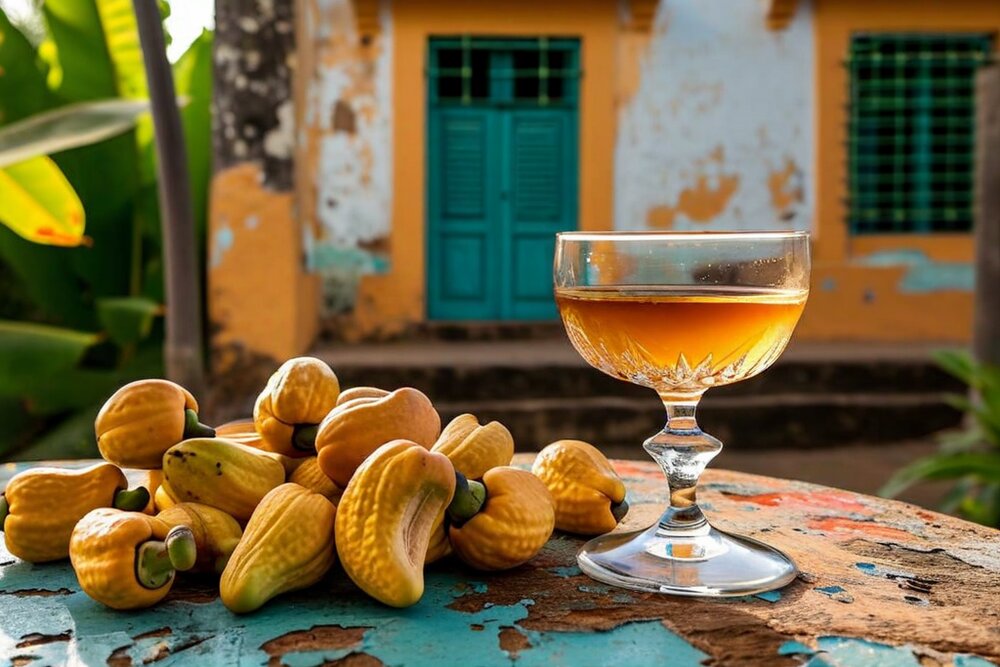
The cashew apple cannot be transported, so it is drunk where it grows. Fresh, it makes an astringent juice; after a day or two it becomes vinho de caju, sweet and cloudy and mildly alcoholic; distilled, it becomes cana de caju or aguardente, which is strong, rough and very cheap. Home distillation is universal and quality varies enormously.
Palm wine
Vinho de palma, tapped from the palm and drunk the same day, sweet in the morning and sour by evening. In the south and the islands it is a ceremonial as much as a social drink, poured for ancestors before people. Offered to a guest, it should be accepted.
Beer and Portuguese habits
Portuguese and Senegalese beers dominate — Sagres, Super Bock, Gazelle — and Portuguese wine is available and reasonably priced in Bissau. The colonial legacy also left proper coffee: a bica at a Bissau counter is a genuine espresso and costs a few hundred francs.
Non-alcoholic
Bissap (hibiscus), ginger juice, tamarind, baobab and cashew juice, sold frozen in sachets on every corner. All are made at home, so buy the bottled versions if your stomach is uncertain. And do not drink the tap water anywhere, including Bissau.
🌟 Bissau-Guineans Worth Knowing
Amílcar Cabral (1924–1973)
Agronomist, founder of the PAIGC, and one of the most original political thinkers of the anti-colonial era — his argument that liberation is fundamentally a cultural act is still taught in universities worldwide. He ran a war that helped topple the dictatorship in Lisbon and was murdered by his own comrades eight months before independence was declared.
Flora Gomes (b. 1949)
Film director, trained in Cuba under the Cuban documentary school, whose Mortu Nega (1988) was the country's first feature and remains one of the outstanding films of African cinema. Udju Azul di Yonta and Nha Fala followed. He is the reason Guinea-Bissau appears at Cannes and Venice.
José Carlos Schwarz (1949–1977)
Singer and poet in Kriol, imprisoned by the Portuguese for his songs, a diplomat after independence, and dead in a plane crash in Havana at 28. He is to Bissau-Guinean music what Cabral is to its politics, and his lyrics are quoted in ordinary conversation half a century later.
Abdulai Silá (b. 1958)
Engineer and novelist, author of Eterna Paixão (1994) — generally counted as the first Bissau-Guinean novel — and of a trilogy that made a modern literature in Portuguese out of Bissau-Guinean material. He also runs the publishing house that prints most of the country's books.
Éder (b. 1987)
Born Éderzito Lopes in Bissau, raised in Portugal, and the substitute who scored the winning goal in the 109th minute of the Euro 2016 final to make Portugal European champions. A generation of players with Bissau-Guinean roots — Danilo Pereira, Bruma, Ansu Fati, who was also born in Bissau — has followed him.
Carmen Pereira (1937–2016)
PAIGC commissar, one of the very few women in the movement's senior leadership, and briefly in 1984 acting head of state — which made her, for three days, the first woman to lead a country in continental Africa. She spent decades afterwards working on women's rights and is much less famous than she should be.
🏙️ Bissau
Bissau is a low, hot, green city of perhaps half a million people on the north bank of the Geba estuary, and it is one of the most under-visited capitals in Africa. Portuguese colonial masonry going soft in the salt air, enormous mango and kapok trees over the streets, no building of consequence taller than about six storeys, and a pace that is slower than any of its neighbours.
The centre is the Praça dos Heróis Nacionais and the avenue running down to the port. Around it lies the Bissau Velho, the old Portuguese quarter — a grid of arcaded, shuttered, peeling two-storey buildings, some restored, many not, and easily the best-looking part of the city. Beyond that the town is low-rise, unplanned and defined by the Bandim market, which sprawls along the main road and functions as the country's commercial nervous system.
Pidjiguiti
The memorial at the port: a black clenched fist rising from the quay where Portuguese police killed around fifty striking dock workers on 3 August 1959. It is the event that turned the PAIGC from a party of petitions into a party of guerrillas, and the monument is the one piece of public history in Bissau that everyone knows.
Fortaleza de São José da Amura
The 17th-century fort at the heart of the city, still an army barracks, containing Amílcar Cabral's mausoleum. Access depends on permission and on who is on the gate; ask at your hotel and expect a possible no. It is a working military installation, so do not photograph it from outside either.
Bandim
Enormous, chaotic, and the real sight of the city — food, cloth, hardware, medicine, live poultry, phone repairs, all of it along and across a busy road. Go early, go with someone, take a small amount of cash and nothing else, and ask before photographing anyone.
Eating and going out
The Portuguese and Lebanese restaurants around the centre are good and reasonable; the grilled fish and chicken places are better. Live gumbé happens on Friday and Saturday nights and the way to find it is to ask, since nothing is advertised. Bissau's nightlife starts late and is friendly.
⛵ Getting Into the Bijagós
The archipelago is the reason to come, and getting into it is the first real logistical problem of the trip. There is no scheduled fast service that can be relied on, no flight, and no bridge.
The public ferry
A boat runs between Bissau's port and Bubaque, in principle a few times a week, taking four to five hours and costing a few thousand francs. It is crowded, it is slow, it does not always run, and the schedule is not published anywhere useful. Ask at the port the day before, not online.
The pirogue
Large open canoes with outboards run the same route more frequently and take three to four hours in open sea. They are cheap, they are how most people travel, and they are genuinely unsafe in bad weather with no life jackets and no radio. In flat conditions in the dry season, fine; if the sea is up, wait.
Chartering
The reliable option and not outrageous if shared: a speedboat charter from Bissau to Bubaque is on the order of several hundred euros for the boat, so a group of four or five makes it sensible. The island lodges will organise transfers for their guests, which is usually the simplest arrangement of all.
Onward
From Bubaque everything else is by pirogue, arranged locally and priced by the day, and the tide governs when you can leave and land. Orango, Rubane, Kere, Canhabaque and the northern islands are all a few hours away. Budget a whole day for each move and do not plan a tight return to catch a flight.
Once you are there the archipelago is exactly what it is supposed to be: empty white beaches, mangrove channels, villages of thatch and palm, pirogues, and silence. There is very little to buy, no reliable electricity outside the lodges, and no medical facility beyond a rural health post. Bring cash in small notes, a torch, a mosquito net if you are not in a lodge, and any medication you might need.
🐢 Orango and Poilão
Orango National Park, established in 2000, covers the southern group of islands and is the archipelago's flagship. Its hippos are the draw, but the park also protects mangrove, palm savanna, dolphins, manatee and a very large bird list, and there is a small community-run lodge at Eticoga that is the practical base.
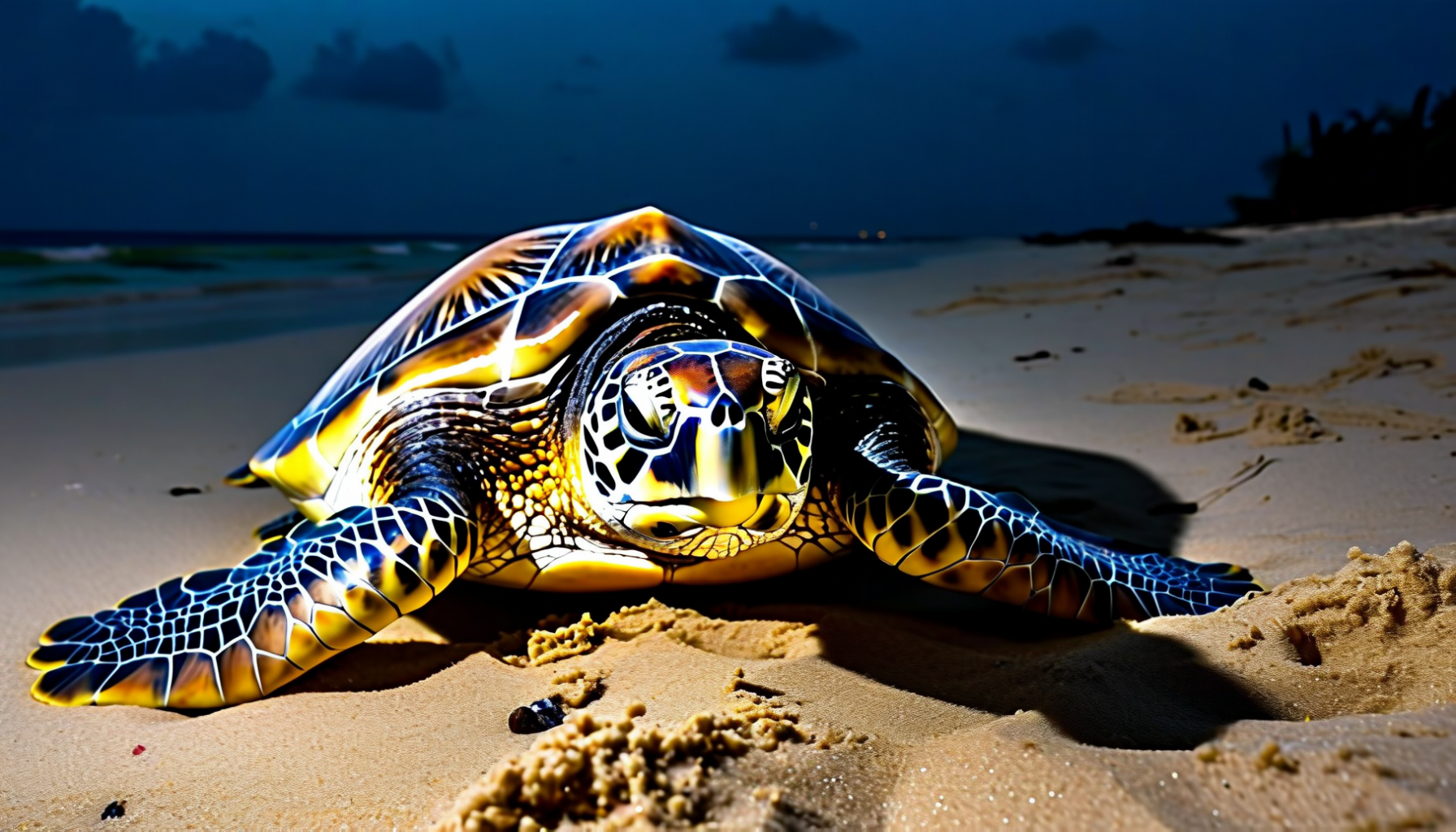
Poilão, in the João Vieira–Poilão Marine National Park, is a small uninhabited island in the south-east of the archipelago and one of the largest green turtle rookeries in Africa — thousands of nests in a season on a beach barely two kilometres long. It is also sacred to the Bijagó of Canhabaque, who have restricted access to it for generations, and that traditional protection is a large part of why it survived. Visits require permits from both the park and the island authorities, are limited in number and season, and are arranged from Bubaque well in advance.
Seeing hippos
Guide from Eticoga, a 6 a.m. start and a walk of an hour or two inland to the freshwater lagoons where they lie up. Sightings are likely but not certain. Keep the distance your guide sets and do not get between a hippo and water — the local reputation for danger is entirely deserved.
Turtle etiquette
If you get to a nesting beach: no white light, no flash, no torches on the water, stay behind the turtle, do not touch, and do not sit in the path she will take back to the sea. Follow the ranger's instructions exactly. A disturbed female will abort the nesting and return to the water without laying.
Permits and money
Park fees are modest and are paid in CFA cash on the spot; guides and boatmen are paid separately and the rates are worth agreeing in writing beforehand through the lodge. The money genuinely matters — these parks are co-managed with the island communities and the fees are a large part of what makes the arrangement work.
When
Turtle nesting peaks roughly July to October, in the middle of the rains, which is also when boats are least reliable. Hippos and birds are better in the dry season, November to April. If you want everything, come in early November and accept the compromise.
🌊 Cacheu, Varela and the North
The north-west, between the Cacheu river and the Senegalese border, is the most easily visited part of the mainland and holds two things worth the drive: the country's oldest colonial site and its only real beach resort.
Cacheu
Founded in 1588 and for two centuries the principal Portuguese port on the coast. The compact riverside fort survives with its bastions, sentry boxes and cannon, and there is a memorial to the victims of the slave trade in the square. Two hours from Bissau by road; go with someone who can find the key to the small museum.
Cacheu Mangroves Natural Park
Nearly 900 km² of mangrove along the river — one of the largest protected mangrove blocks in West Africa, full of birds, manatee and, in the channels, the occasional crocodile. Pirogue trips are arranged from Cacheu or from the park office; go on a rising tide.
Varela
The country's beach: a long stretch of clean Atlantic sand near the Senegalese border, about 50 km from São Domingos down a road that is dreadful in the wet season and merely bad in the dry. There are a couple of simple guesthouses. It is the closest thing Guinea-Bissau has to a resort and it is very quiet.
Crossing to Senegal
São Domingos is the main border post, about two and a half hours from Bissau, and connects to Ziguinchor in Casamance in another hour. It is a straightforward crossing with the right paperwork. Note that Casamance has its own long-running low-level separatist conflict; check current advice before routing through it.
🌾 Bafatá, Gabú and the East
East of the Geba the mangrove gives way to savanna, the population becomes Fula and Mandinka and predominantly Muslim, and the country starts to feel like the Sahel. It is the least visited half of a barely visited country, and the drive is easy — the Bissau–Bafatá–Gabú road is the best in the country.
Bafatá, the second town, sits above the Geba with a decaying colonial centre of arcaded streets and a genuinely handsome riverfront. It is Amílcar Cabral's birthplace, and there is a statue and a house to see. Gabú, further east, is the commercial hub of the interior — a busy Fula market town on the Guinea road, and the name carries the memory of the Kaabu empire whose capital at Kansala was near here.
Kansala
The site of the Kaabu capital, destroyed in the siege of 1867 when the defenders blew up the magazine. There is very little to see and it needs a local guide from Gabú to find, but it is one of the most historically significant places in the country and it is on the UNESCO tentative list.
Saltinho and the Corubal
The Corubal river at Saltinho, on the road south from Bafatá, drops over a rock bar in a set of rapids that pass for Guinea-Bissau's waterfall. There is a bridge, a good view and a decent riverside spot to stop. It is the closest thing to relief in a very flat country.
Dulombi-Boé
A large protected complex in the far east on the Guinean border — savanna woodland, the country's only elevation worth the name, and a corridor for elephants and chimpanzees moving between Guinea and Guinea-Bissau. Almost no infrastructure; for the genuinely determined only.
Madina do Boé
In the far south-east, where the PAIGC declared independence on 24 September 1973. There is a monument. Reaching it is a serious expedition on poor roads and it matters far more to Bissau-Guineans than it will look to a visitor, which is a reason to go rather than not.
🌳 Cantanhez and the South
The southern regions of Quinara and Tombali, below the Geba and the Rio Grande de Buba, are the wettest, greenest and hardest-to-reach part of the mainland — and the most rewarding for anyone interested in forest and wildlife.
Cantanhez Forest National Park covers around a thousand square kilometres of the last significant sub-humid forest in the country, in a mosaic with villages and cashew and rice fields rather than as an untouched block. It holds the north-westernmost western chimpanzees in Africa, plus red and black-and-white colobus, buffalo, several duiker species and — very occasionally — forest elephants crossing from Guinea. Community-run camps at Iemberem and nearby villages arrange guided tracking.
Getting there
Bissau to Buba is three to four hours on reasonable road; Buba to Iemberem is another two to three, worse, and includes a ferry or two depending on route and season. In the rains parts of it are impassable. Arrange the visit before you set out — turning up unannounced does not work.
The chimpanzees
Not habituated to East African standards, so tracking means walking, listening and often not seeing them. What you will see is nests, feeding sites and, if you are lucky, chimpanzees using stone and wooden tools — the Cantanhez population has been the subject of serious primatological work for two decades.
Buba and the Rio Grande
The Rio Grande de Buba is a deep sheltered inlet with a small town at its head, a fishing camp or two and an old plan — revived every decade or so — to build a deepwater port here for the Boé bauxite. For now it is quiet, birdy and a good base for the south.
Cufada Lagoons
A Ramsar wetland near Buba: freshwater lagoons, gallery forest and a very large bird list, with hippos, crocodile and manatee. It is the most accessible protected area on the mainland and one of the best places in the country for a morning with binoculars.
✈️ Getting There
Bissau's Osvaldo Vieira International Airport (OXB) is small, handles a handful of flights a day, and is served by a short list of carriers. There are no direct flights from Prague and one connection is the minimum from anywhere in Central Europe. Total journey time runs from about ten hours to a full day depending on the routing.
Via Lisbon
The obvious route. TAP Air Portugal flies Lisbon–Bissau several times a week in about five and a half hours, and it is the most reliable connection into the country. Prague–Lisbon on TAP, Ryanair or easyJet, then the onward leg. Booking the whole thing on one TAP ticket buys you protection when the first leg slips, which is worth it here.
Via Casablanca
Royal Air Maroc serves Bissau from Casablanca and connects from Prague with one change. Often the cheapest option and usually a reasonable connection time. Casablanca's transfer process is slow — leave three hours.
Via Dakar or Lomé
Air Sénégal from Dakar and ASKY from Lomé link Bissau into the West African network, which is how to combine Guinea-Bissau with Senegal, Cape Verde or anywhere along the coast. Both are short hops; both are subject to schedule changes.
Overland
The road from Ziguinchor in Senegalese Casamance via São Domingos is straightforward and takes about four hours from Ziguinchor to Bissau, and bush taxis run it daily. The Guinean border in the south-east is open but the roads are poor. Check the security position in Casamance before routing that way.
Expect 15,000–25,000 CZK for a return from Prague. Book early: Bissau's flights are few, they fill, and there is very little redundancy — if you miss a connection you may wait two or three days for the next one, which is a good argument for a single through ticket and for a day of slack at each end.
🚐 Getting Around
The country is small — Bissau to Gabú is about 200 km — and the main road east is genuinely good. Everything else is a mixture of adequate tarmac, laterite and, in the wet season, mud. There are no internal flights and no railways at all.
Bush taxis and toca-tocas
Shared Peugeots and minibuses leave from the paragem in each town when full, cost very little, and are how the country moves. Bissau's own minibuses, the toca-tocas, run fixed routes for a few hundred francs. Slow, crowded and entirely usable.
Hiring a car
A 4×4 with driver runs roughly 40,000–70,000 XOF a day plus fuel — about 1,500–2,700 CZK — and is the sensible choice for the south or for anything off the Bafatá road. Self-drive is possible in the dry season on the main axes and inadvisable elsewhere; the hazards are potholes, unlit vehicles and livestock.
Ferries
The southern regions are reached by ferries across the Geba and the Rio Grande, which run to their own logic and stop for weather, tide and mechanical reasons. Ask locally the day before, allow a whole morning, and never assume the last crossing will run.
Boats
For the Bijagós, see the section above: public ferry, pirogue or charter, all weather- and tide-dependent. Elsewhere, pirogues are the normal way to cross an estuary and are usually the quickest route between two coastal points. Life jackets are essentially never provided.
A workable first itinerary is Bissau – Bubaque – one outer island – Bissau – Cacheu – Bissau in about ten days, or Bissau – Bafatá – Gabú – Buba – Cantanhez – Bissau in a similar time for the mainland. Trying to do both properly needs three weeks, and any plan that depends on a boat running on a particular day will fail.
💰 What It Costs
Guinea-Bissau is cheap on the ground and expensive to reach, and the small supply of visitor-grade accommodation and boats means the middle of the market is thin: you can travel very cheaply or fairly expensively, with not much in between.
Accommodation
A basic room in a provincial town 10,000–20,000 XOF (400–800 CZK); a decent mid-range hotel in Bissau 30,000–60,000 XOF (1,150–2,300 CZK); an island lodge in the Bijagós, usually full board because there is nowhere else to eat, 50,000–120,000 XOF a night and up. Bubaque guesthouses are far cheaper.
Eating
A plate of rice and sauce at a street kitchen 1,000–2,000 XOF (40–80 CZK); a proper meal in a Bissau restaurant 5,000–12,000 XOF (190–460 CZK); grilled fish or oysters from a beach grill, very little. A bica is 300–500 XOF. Bissau's Portuguese and Lebanese places are the expensive end and still not expensive.
Transport
Bush taxi Bissau–Gabú around 5,000 XOF; a toca-toca in Bissau a few hundred; the Bubaque ferry a few thousand; a pirogue to the outer islands from Bubaque 30,000–100,000 XOF for the boat depending on distance; a chartered speedboat from Bissau several hundred euros. Boats are what will blow your budget.
Fees and guides
National park entry is modest — a few thousand francs — and guides run 10,000–25,000 XOF a day. Pay properly and pay in cash: these fees are shared with the communities that co-manage the parks and are a substantial part of why the parks function.
A realistic figure is 1,200–2,500 CZK a day per person on the mainland with guesthouses, shared transport and local food, rising sharply — 4,000–8,000 CZK a day — for anything involving island lodges and chartered boats. Flights from Prague run 15,000–25,000 CZK return.
Bring cash. Guinea-Bissau uses the CFA franc (XOF), pegged to the euro, so euros are the currency to carry and are changed easily and at a fair rate. ATMs exist in Bissau — BAO and Ecobank — and are frequently out of money or offline; outside Bissau there are effectively none. Cards work at two or three hotels and nowhere else. Take more euros than you think you need, in clean notes, and keep small denominations for the islands.
📋 Practical Information, Health and Safety
Visa
Czech citizens need a visa. Guinea-Bissau operates an e-visa issued online, which is the recommended route; a visa on arrival at Bissau airport has generally also been available but should not be relied on. There is no Guinea-Bissau embassy in Prague — the accrediting missions are in Lisbon, Paris and Brussels. Apply weeks ahead, print everything, and use only the official government portal.
Yellow fever — mandatory
A yellow fever certificate is a condition of entry and is checked on arrival. Get the vaccination at a Czech travel clinic at least ten days before departure; the certificate is valid for life. There is no way around this requirement.
Malaria — high risk
Guinea-Bissau is high-risk for falciparum malaria year-round and everywhere, including Bissau, with transmission peaking in and after the rains. Chemoprophylaxis is essential — atovaquone/proguanil or doxycycline from a Czech travel clinic — plus 30–50% DEET, covered arms and legs after dusk and a treated net. Any fever within three months of returning is malaria until proven otherwise.
Other health
Hepatitis A and B, typhoid, tetanus-diphtheria-polio and meningococcal ACWY; rabies pre-exposure for rural or longer stays, since post-exposure immunoglobulin is not reliably available here. Cholera outbreaks occur in the rains. Medical facilities are very limited — the referral point for anything serious is Dakar, and insurance with medical evacuation cover is not optional.
Consular cover for Czechs
The Czech Republic has no embassy in Bissau; the country is covered from a Czech mission elsewhere — check the current covering post on mzv.cz and save the number before you go. Portugal has a full embassy in Bissau and, as an EU citizen, you can seek consular help there under Article 20 TFEU; in a lusophone country with few EU missions this is a genuinely useful fact. Register the trip in DROZD.
Advisories and political risk
The Czech MZV and the major Western foreign ministries maintain advice for Guinea-Bissau and have generally counselled increased caution, with sharper warnings during political crises. Given the events of November 2025, check the current advisory and the airport's status before booking anything. Coups here are typically short and confined to Bissau, but they close the airport.
Photography and officials
Do not photograph the airport, the port, the Fortaleza de Amura, government buildings, bridges, police or soldiers. Checkpoints on the roads are routine; be polite, hand over documents, keep a photocopy of your passport and visa, and expect occasional requests for a "contribution" — a friendly, unhurried refusal usually works. Carry your papers at all times.
Day to day
Electricity 220 V with European type C/F sockets — Czech plugs fit — but the supply is unreliable and much of the country runs on generators, so bring a power bank. Time is GMT, one hour behind Prague in winter and two in summer. Mobile coverage (MTN, Orange) is decent in towns and absent on many islands. Tap water is not drinkable. Homosexuality is not criminalised in Guinea-Bissau, unusually for the region, though social attitudes remain conservative.
On safety in order of real risk: road traffic and boats first — the pirogues have no life jackets and the roads have no lighting; then malaria and stomach illness; then political disruption, which is a nuisance rather than a danger; and only then crime, which by regional standards is low. Bissau is a notably relaxed city to walk around by day. Do not swim off the mainland coast without local advice, and do not travel between towns after dark.
❓ Common Misconceptions
"Guinea and Guinea-Bissau are the same place"
Different countries, different colonisers, different languages, different currencies. Guinea-Bissau is Portuguese-speaking, uses the CFA franc and is about a seventh the size of its neighbour. It added "-Bissau" to its name in 1973 specifically to end the confusion, and it has not worked.
"They speak Portuguese"
Officially, yes; in practice most people speak Kriol, and real Portuguese fluency is a minority accomplishment. If you arrive with Brazilian Portuguese you will be understood in Bissau and less so in a village. Ten words of Kriol will take you further than a hundred of Portuguese.
"There are no UNESCO sites"
There is one now. The Bijagós Archipelago was inscribed as a natural World Heritage Site in 2024 — the country's first — on top of its Biosphere Reserve status since 1996. Older guidebooks and databases say zero; they are simply out of date.
"It's a narco-state, so it must be dangerous"
The cocaine transit problem is real and it has corrupted parts of the state. It is not a street-level phenomenon and it does not touch visitors. Guinea-Bissau's violent crime rate is low, and the practical dangers here are roads, boats and mosquitoes.
"Constant coups means constant chaos"
The coups are real — no elected president has ever finished a term — but they are contained, usually bloodless and directed at people in government. The 1998–99 civil war was the exception. Ordinary life in Guinea-Bissau is calm to the point of being slow, and that surprises almost every first-time visitor.
"It's a Muslim country like its neighbours"
Roughly 45% Muslim, 30% traditional religion and 20% Christian, with a degree of mutual ease that is genuinely unusual in West Africa. Alcohol is sold everywhere, mixed families are ordinary, and traditional religion is practised openly rather than as a survival.
"Portugal just gave it independence"
Portugal fought here for eleven years and lost. Guinea-Bissau declared independence unilaterally in September 1973 and was recognised by some eighty states before Lisbon accepted it — and the war's political cost inside Portugal is generally counted among the direct causes of the Carnation Revolution of April 1974.
"Nothing Bissau-Guinean is famous"
Éder, who scored Portugal's winning goal in the Euro 2016 final, was born in Bissau. So was Ansu Fati. Amílcar Cabral is on university syllabuses worldwide. Bijagós masks are in the Quai Branly and the British Museum. The country's problem is not a shortage of achievement; it is a shortage of attention.
✍️ Author's Note
Guinea-Bissau is one of the least visited countries in Africa and one of the most rewarding, and the two facts are connected. There is no tourism industry to smooth anything over: no chain hotels, almost no signage, no ticket offices, no ATM you can count on. What there is instead is a country that has not been arranged for anybody's benefit, and people who are genuinely curious about why you came.
The Bijagós are the reason to make the effort. An archipelago of eighty-eight islands where the women choose the husbands, the young men dance as bulls, the hippos swim between islands in salt water and the turtles come ashore in thousands — and where you can spend three days without seeing another visitor — is not a thing that exists in many places any more. Getting there is slow and tide-dependent and occasionally alarming, and that is precisely why it is still like that.
The history deserves more attention than it gets in Europe. Amílcar Cabral is one of the most serious political thinkers the twentieth century produced in Africa and the war he built helped end a European dictatorship — a sequence with very few parallels. Bolama is an entire abandoned colonial capital being eaten by trees. Cacheu is a slave port with the fort still standing. None of it is interpreted, most of it is unprotected, and all of it is open.
Practical closing advice, in order: sort the yellow fever certificate and the malaria tablets first; apply for the e-visa earlier than feels necessary; bring euros in cash and more of them than you planned; take insurance that includes medical evacuation; check the political and airport situation the week you fly; and treat every boat schedule as a suggestion.
Support This Project 🌍
This World Travel Factbook is a labor of love – free to use for all travelers. If you find it helpful, consider supporting its continued development.