

🇬🇬 Guernsey at a Glance
🌍 Overview
Guernsey is a granite island of 65 km² lying 45 km off the coast of Normandy and 120 km from England, and it is the main island of a small archipelago — the Bailiwick of Guernsey — that also takes in Alderney, Sark, Herm, Jethou, Brecqhou, Lihou and a scatter of uninhabited rocks. Together they come to roughly 78 km² and about 64,000 people, which is to say the whole bailiwick is about a sixth the size of Prague and holds fewer people than Kolín and Kutná Hora combined.
The important thing to get straight before anything else: Guernsey is not part of the United Kingdom, and it never was in the European Union. It is a Crown Dependency — a possession of the Crown that governs itself, makes its own laws, levies its own taxes, prints its own money and runs its own courts, while the UK looks after its defence and, by convention, its international representation. It is not a sovereign state either; it sits in a constitutional category that has essentially one other occupant, Jersey, plus the Isle of Man.
What that means on the ground is more practical than it sounds. There is no VAT here and no capital gains tax. Your EU health card is worthless. Your mobile phone will not roam at EU rates, or at UK rates either. The banknotes in your pocket at the end of the trip cannot be spent in London. And the island is administered by 38 deputies who mostly do not belong to any political party.
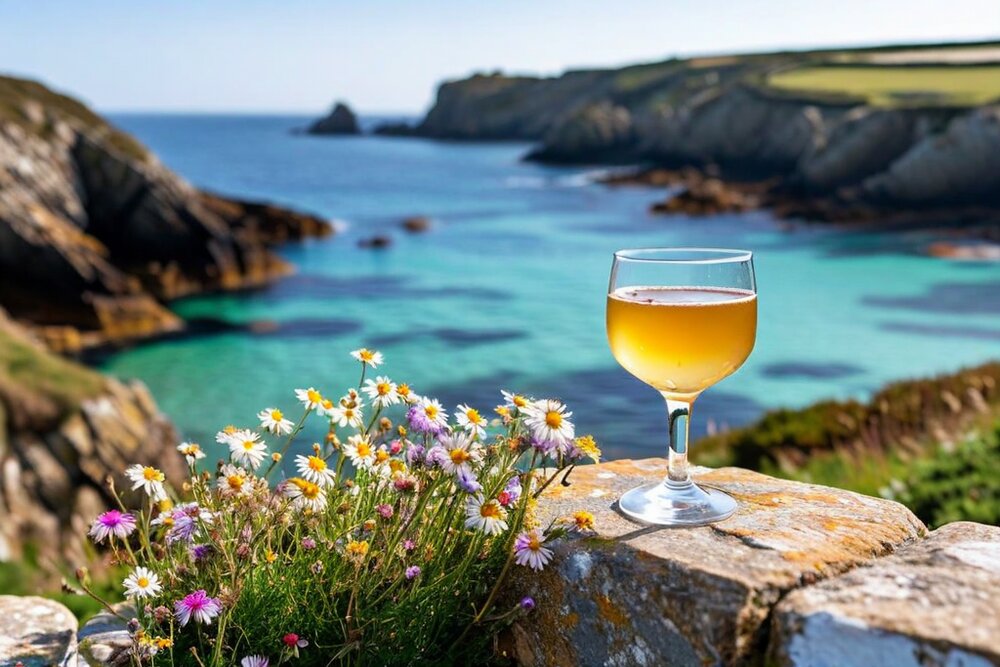
For a visitor, Guernsey resolves into four things: about 45 km of coastal cliff path along a south coast that rises to 110 m; a north end of wide, flat, cold-water beaches; a Regency harbour town, St Peter Port, that is one of the better-looking small ports in Europe; and a wartime landscape of German concrete that the island has spent eighty years deciding how to talk about. Add three offshore islands you can reach in under an hour — one of which had a functioning feudal government until 2008 — and you have far more than the map's size suggests.
🏷️ Sarnia, the Donkeys and the Duke
The name is Norse. Guernsey is generally read as an Old Norse coinage in -ey, "island", attached to a personal name or a descriptive first element — the same formation that gives Jersey, Alderney and Chausey. The Vikings named these islands, the Normans inherited them, and the naming has stuck for a thousand years while the languages around it changed twice.
The older name is Sarnia, the Latin form used in the Antonine Itinerary and revived by the island's 19th-century antiquarians. It is not a fossil: the island anthem is Sarnia Cherie ("Dear Guernsey"), written in 1911, and it is sung at Liberation Day with the kind of feeling that makes visitors go quiet. If you want a single object that tells you how the island sees itself, it is that song and the fact that it is sung in English by people whose grandparents sang in Norman French.
Les ânes
Guernsey people are the donkeys and Jersey people are the toads — crapauds — and both sides use the insults with affection and neither will let the other forget them. A bronze donkey stands in the Old Quarter of St Peter Port. Explanations range from stubbornness to the beasts that once hauled loads up the steep town streets; nobody agrees and nobody minds.
Dgèrnésiais
The island's own Norman language, also written Guernésiais, is a direct descendant of the Norman French spoken here since the 10th century — closer to the speech of the Cotentin than to Parisian French. Fewer than 300 people speak it fluently and almost all are elderly. There is a language commission, school taster sessions and a small revival, and it is still very likely to die.
The loyal toast
At formal dinners islanders drink to "The King, our Duke". Strictly, the Crown's title of Duke of Normandy ended in 1204 and no British monarch has legally held it since; the islands' constitutional link runs through the Crown, not through a surviving dukedom. Say so to an islander and you will get a shrug: the toast is the point, not the paperwork.
The flag
A red St George's cross on white, with a gold Norman cross laid inside it — adopted only in 1985, precisely to stop Guernsey's team being confused with England's at international events. The gold cross is said to derive from the banner William carried at Hastings.
🗺️ Geography
Guernsey is a wedge. The island is tilted, geologically and visibly: the south is a plateau of hard gneiss and granite ending in cliffs of 60 to 110 m, and it slopes steadily down to the north, where the land flattens into a low sandy apron barely above the sea. Walk from Icart Point to L'Ancresse and you go from clifftop gorse and 100-metre drops to dune, common and shallow bay without ever climbing anything.
The island is divided into ten parishes, which are still real administrative and social units: St Peter Port, St Sampson, Vale, Câtel (Castel), St Saviour, St Pierre du Bois, Torteval, Forest, St Martin and St Andrew. Almost all of them have Norman French names and almost none of them are pronounced the way a French speaker would expect. The parish system predates the States and still runs the douzaines, the rates and, in the older sense, the sense of where you are from.
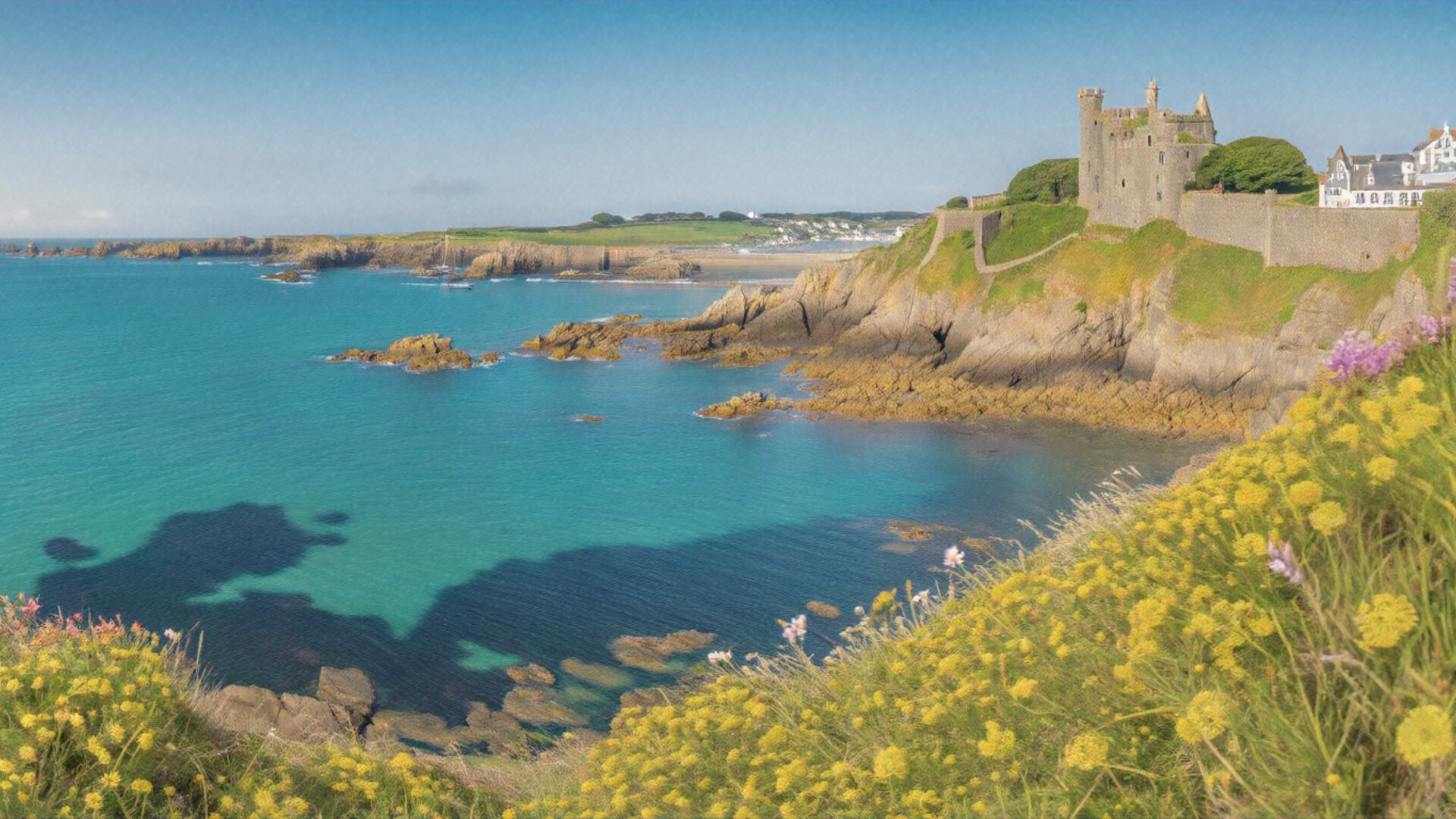
Two features shape everything. First, the reefs: Guernsey does not stop at its shoreline. It is surrounded by miles of drying rock — the Hanois, the Grandes Rocques, the Ferrières — and the surrounding sea bed is so shallow and so cluttered that at low water the island grows by nearly half. Second, the wind: the west coast is fully exposed to the Atlantic, which is why nothing grows tall there, why the surfing is at Vazon, and why the whole western skyline is low, wind-shaved and treeless while the sheltered valleys of the south are almost subtropical.
The Bailiwick's other islands lie to the north and east. Alderney is 32 km north, close enough to Cap de la Hague to see French cars; Sark and Brecqhou are 12 km east; Herm and Jethou are 5 km east and visible from St Peter Port; and Lihou is joined to Guernsey's west coast by a causeway that appears twice a day.
🌊 The Tides
This is the thing that actually distinguishes Guernsey from every other small island holiday, and it is not on the postcards. The Channel Islands sit in one of the largest tidal ranges on Earth — St Peter Port sees a spring range of about ten metres, exceeded regularly only in the Bay of Fundy, the Severn Estuary and a handful of other places. That is a three-storey building of water, twice a day, every day.
The practical consequences run through everything. A bay you swam in at noon is a plain of rock, weed and standing pools by six. Harbours dry out and boats sit on their keels in mud. The island's low-water area is roughly half again its high-water area, which is why islanders talk about a "big tide" the way skiers talk about fresh snow: on the biggest springs, people walk out onto reefs that are underwater 350 days a year to gather ormers, dig for razor clams or simply look at somewhere that is almost never dry land.
Read the tide table
Get one free at the airport, the harbour office or any tourist point, and look at it before you plan a beach day, a cliff-path walk with a beach section, or any low-water crossing. On the wrong tide, a photogenic bay is a car park's worth of seaweed. On the right one, you can walk a kilometre out.
Lihou
A tiny island off the west coast joined to Guernsey by a stone causeway that is covered by the sea most of the time. Crossing dates are published by the States and posted at L'Erée; the causeway is slippery, the timing is not negotiable, and people do get cut off. The ruined priory and the enormous rock pool called the Venus Pool are worth the planning.
Swimming
Water temperature runs roughly 9 °C in March to 17–18 °C in late August — cold by Mediterranean standards, normal by British ones, and the reason wetsuits outnumber swimsuits. Bathing pools at La Vallette below St Peter Port are Victorian, tidal and free.
The Race
Between Alderney and Cap de la Hague runs the Alderney Race, where the tide funnels through at up to twelve knots — among the strongest tidal streams in Europe. It is a genuine hazard, it powers the ferry timetables, and there are serious proposals to put tidal turbines in it.
🌡️ Climate and When to Go
Guernsey has a mild oceanic climate, warmed by the sea and, with Jersey, regularly recorded as one of the sunniest places in the British Isles — around 1,800–1,900 hours a year, comfortably more than London and roughly on a par with Prague, but spread differently: less summer thunder, more low winter light. Frost is rare, snow is an event, and there are palms and echiums growing outdoors in valley gardens.
The other side of the maritime climate is fog. Sea fog forms readily in spring and early summer when warm air moves over cold water, and Guernsey Airport's short runway and hilly approach make it unusually fog-sensitive. Flights are cancelled or diverted to Jersey several times each spring. If your onward connection is tight, or if the trip depends on flying out on an exact morning, build a day of slack into it — this is the single most common way a Guernsey trip goes wrong.
May–June
The best of it. Wildflowers on the cliff paths, sea pinks and bluebells, long light, tolerable crowds, and Liberation Day on 9 May, which is the island at its most itself. Water still cold. Fog risk highest in this window — the trade-off is real.
July–August
Warmest (around 20–21 °C by day, occasionally 26–27 °C), busiest, and the only time the water is genuinely pleasant. Accommodation is tight and priced accordingly; book the ferry car deck months ahead. Herm and Sark day boats run full.
September–October
Quietly the best value. The sea is at its warmest in early September, the light is superb, the cliff path is empty and prices ease. Weather turns unreliable from mid-October and some attractions close.
November–March
Mild (7–10 °C) rather than cold, but wet, dark and windy, with reduced ferry sailings, many hotels and restaurants shut and the island boats to Herm and Sark on a skeleton timetable. Go only if you want St Peter Port to yourself in the rain, which is a legitimate thing to want.
🗺️ Map
Guernsey lies at roughly 49.45° N, 2.58° W — south of Plymouth, west of Cherbourg, and considerably closer to France than to anywhere in Britain. St Peter Port is on the east coast facing Herm and Sark; the airport is in the middle of the south plateau, about 6 km from town.
Distances are small and misleading. Nowhere on Guernsey is more than about 6 km from anywhere else, but the lanes are narrow, walled and slow, the speed limit tops out at 35 mph, and a 4 km journey can take twenty minutes. Plan by time, not by kilometres — and consider not hiring a car at all.
🗿 Dolmens and La Gran'mère
People have been on Guernsey since the island was not an island. Sea levels rose after the last glaciation and cut the Channel Islands off from the Cotentin peninsula somewhere around 6000 BC, and the Neolithic farmers who arrived afterwards left an extraordinary density of stone monuments for a place this small — well over a dozen surviving passage graves, cists and menhirs, most of them free to visit and unfenced.
Les Fouaillages, on L'Ancresse Common, is the one archaeologists care most about: excavated in the late 1970s, it produced dates around 4500 BC, making it one of the earliest built funerary monuments in Europe — older than Stonehenge by two thousand years, older than the pyramids. It is a low triangular cairn on a golf course and it looks like nothing at all, which is somehow the point.
Le Déhus
The best passage grave in the islands, at Bordeaux in the Vale. Roofed, enterable, and carrying Le Gardien du Tombeau — a bearded figure with arms, hands and a bow carved into the underside of a capstone, invisible until the lighting cycles round to reveal it. Free, and genuinely eerie.
La Varde
The largest dolmen on the island, on the dunes at L'Ancresse, with a chamber 10 m long. Excavated in the 1830s and found full of Neolithic and Bronze Age burials. It sits on a golf course too; the golfers are used to it.
La Gran'mère du Chimquière
A statue-menhir standing at the gate of St Martin's parish church — a female figure with a face, breasts and a necklace, perhaps 4,000 years old, recut in the Gallo-Roman period. A churchwarden once broke her in half in disgust; she was cemented back together and the crack still shows. Islanders leave coins and flowers on her head for luck, and brides still do.
The Roman wreck
A 3rd-century Gallo-Roman trading ship, now called Asterix, was found in 1982 in St Peter Port harbour and is conserved at Mary Rose in Portsmouth with material displayed in Guernsey. It is one of the most important Roman-period wrecks in northern Europe and proves the harbour was a working port 1,700 years ago.
⚜️ 933, 1204 and the Last of Normandy
In 933 William Longsword, ruler of the young Norman state, annexed the Channel Islands from Brittany, and from that date they were part of the Duchy of Normandy. In 1066 the Duke of Normandy conquered England, so for the next century and a half the islands were an unremarkable corner of a cross-Channel realm — the same lord ruled Caen, Winchester and St Peter Port.
The hinge is 1204. King John lost mainland Normandy to Philip Augustus of France, and the islands, sitting in the water between the two, had to choose. They chose the English king — partly loyalty, largely commerce and a well-founded fear of French tax collectors — and in exchange they were granted, and have defended ever since, a set of privileges: their own courts, their own law in the Norman customary tradition, freedom from English taxation, and government by their own institutions.
This is why islanders will tell you, correctly enough as a matter of history, that Guernsey did not join England — England's king joined Guernsey. The Bailiwick is the residue of the Duchy, still governed under a body of customary Norman law, and legal arguments here can still turn on the Coutume de Normandie and on charters granted in the 1300s. The constitutional relationship with the UK has never been written down in one document, which suits both sides.
The Bailiff
Head of the judiciary and president of the parliament at the same time — an arrangement that would horrify a constitutional lawyer and has been challenged at the European Court of Human Rights. Appointed by the Crown. The office is medieval and continuous.
The Royal Court
Guernsey's own court, sitting with the Bailiff and Jurats — twelve lay judges elected for life by an electoral college, deciding facts and sentence. It is one of the last places in Europe where lay judges of this specific Norman kind survive.
Clameur de haro
A living piece of Norman law: to stop an unlawful act on your land you drop to one knee before witnesses and cry "Haro! Haro! Haro! À l'aide, mon Prince, on me fait tort!", then recite the Lord's Prayer in French. Work must stop until the court rules. It is invoked perhaps once or twice a decade, and it works.
Not the UK, not the EU
Guernsey has never been a member state of anything. Before Brexit it had a narrow relationship with the EEC under Protocol 3, covering trade in goods only — no free movement of people, no common agricultural policy, no membership. Brexit changed less here than almost anywhere in the British Isles.
🏰 Castle Cornet and the Privateers
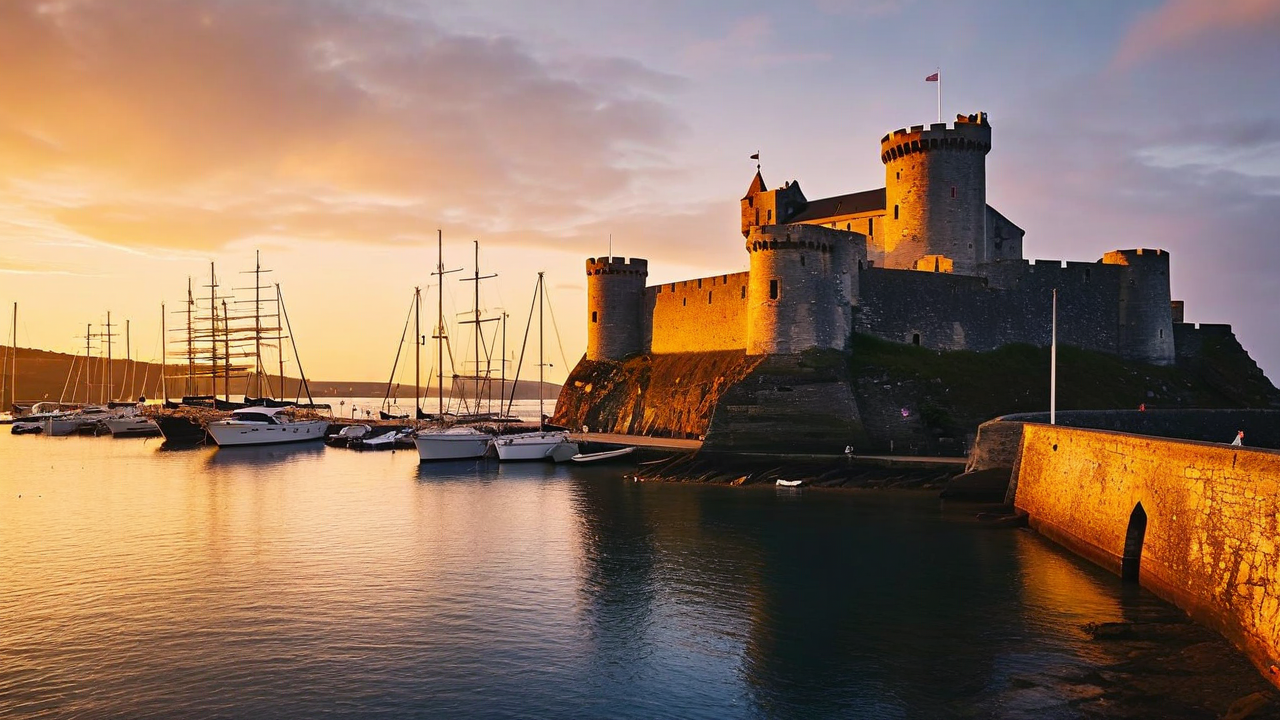
Castle Cornet was begun soon after 1204 on a tidal islet guarding St Peter Port's roadstead, and for six and a half centuries it was an island — you reached it by boat or across the sand, until the breakwater built in the 1860s tied it to the town for good. It is the single monument you should not miss, and it holds five museums, a garrison, four gardens and the best view of the harbour from anywhere at sea level.
Its strangest episode came in the English Civil War. Guernsey declared for Parliament; the castle's governor, Sir Peter Osborne, held it for the King. So from 1643 to 1651 the castle bombarded the town and the town bombarded the castle, across 500 m of water, for eight years — the town and its own fortress at war while the island's other institutions carried on. Castle Cornet surrendered in December 1651, one of the very last royalist positions in the British Isles to fall.
In 1672 lightning struck the powder magazine in the medieval keep. The explosion destroyed the tower, killed the Governor's wife and mother and several others, and the keep was never rebuilt — which is why the castle today reads as a broad low fortress rather than the tall silhouette you might expect. Every day at noon, gunners in 19th-century uniform fire the Noon Day Gun; it is loud, it is announced, and everyone still jumps.
What's inside
The Story of Castle Cornet, the Maritime Museum, the Royal Guernsey Militia Museum, the 201 Squadron RAF museum and the Guernsey Police museum, plus four period gardens. Budget three hours; most people budget one and regret it.
Privateering
From the 1690s to 1815, Guernsey licensed privateers — legalised commerce raiders — against French and later American shipping, and got very rich. Prize money built the Regency terraces of St Peter Port, the merchant houses and the wine trade. It was a hair's breadth from piracy and everybody knew it.
Smuggling
The other half of the same economy. Guernsey's freedom from British duty made it the natural warehouse for brandy, tobacco and tea heading illegally into England and Ireland. Whole quarters of the town were built as bonded stores. Low duty is still a feature of the island; the smuggling is not.
The towers
Fifteen squat round loophole towers were thrown up around the coast in 1778–79 against French invasion, and most still stand — Guernsey's own design, unrelated to the later Martello towers, and one of the most distinctive things about the shoreline. Fort Grey at Rocquaine, the white "Cup and Saucer", is a Martello of 1804 and now the shipwreck museum.
✒️ Victor Hugo in Exile
Victor Hugo arrived in the Channel Islands in 1852 as a political exile — he had called Louis-Napoléon a traitor in print and could not go home — spent three years in Jersey, was expelled for a newspaper attack on Queen Victoria, and landed in Guernsey in 1855. He stayed fifteen years, and they were the most productive of his life.
He bought Hauteville House in St Peter Port in 1856 with the royalties from Les Contemplations — the purchase mattered, because owning property made him a resident the British could not easily expel — and then spent years turning the interior into something no one has adequately described. Hugo designed it himself, out of dismantled antique furniture, carved chests, tapestry, Delft tiles and mirrors, in a rising sequence of dark rooms that ends in a glass belvedere on the roof where he wrote standing up, facing the sea and, beyond it, France.
There he finished Les Misérables (1862), and wrote Les Chansons des rues et des bois, L'Homme qui rit and Les Travailleurs de la mer (1866) — Toilers of the Sea, a novel of Guernsey fishermen, reefs and a giant octopus, dedicated "to the rock of hospitality and liberty, to that corner of old Norman land where the noble little people of the sea live". The book made pieuvre the standard French word for octopus and, incidentally, put Guernsey into European literature.
Visiting
Hauteville House belongs to the City of Paris, which was left it by Hugo's heirs, and reopened in 2019 after a full restoration funded by François Pinault. Guided tours only, small groups, book ahead in season. It is one of the strangest and best house museums in Europe.
The dinners
Hugo funded a weekly dinner for poor children of the island, seating them at his own table — forty children a week by the end. It was widely remarked on at the time and is still remembered locally, and it is a useful corrective to the image of the exile as purely a literary tourist.
Renoir
In September 1883 Pierre-Auguste Renoir spent a month at Moulin Huet on the south coast and painted around fifteen canvases of the bay, the rocks and the bathers. The Renoir Walk from Saints Bay marks the viewpoints; the bay is essentially unchanged, which is rare enough to be worth the walk.
The other writers
Guernsey collects them. Mary Ann Shaffer's The Guernsey Literary and Potato Peel Pie Society (2008) sold millions and is set here; G. B. Edwards's The Book of Ebenezer Le Page (1981), written in Guernsey English and published after its author's death, is the far better book and the one islanders press on you.
🪖 The Occupation, 1940–1945
The Channel Islands were the only British territory occupied by Nazi Germany, and Guernsey's five years under occupation are not a background detail here — they are the organising fact of the island's modern memory, argued about in the letters pages to this day.
In June 1940, with France falling, London concluded the islands were indefensible and demilitarised them — but did not tell the Germans clearly enough. On 28 June 1940 the Luftwaffe bombed and strafed St Peter Port harbour, where lorries queuing to load tomatoes were mistaken for troop transport. Thirty-four people were killed. German troops landed on 30 June and stayed until May 1945.
Before that, about 17,000 people — roughly a quarter of the island — evacuated to England in a chaotic week, including around 5,000 schoolchildren sent with their teachers and without their parents. Families were split for five years; some children came home unable to recognise their mothers, and a number never came back at all. Almost the entire population of Alderney left. Sark's Dame, Sibyl Hathaway, told her islanders to stay, and stayed herself.
Living under it
Around 27,000 German personnel eventually garrisoned a bailiwick of some 40,000 remaining civilians — roughly one soldier for every one and a half islanders. Curfew, censorship, requisitioned houses, confiscated radios, no news. The States continued to administer the island under German authority, which is precisely the arrangement that later became controversial.
The deportations
In 1942–43, on Hitler's direct order and as a reprisal for British internment of Germans in Iran, over 2,000 islanders — English-born residents and their families, and later men considered troublesome — were deported to internment camps at Biberach, Laufen and Bad Wurzach. Most survived; the community never quite got over it.
The three women
Therese Steiner, Auguste Spitz and Marianne Grunfeld were Jewish refugees living in Guernsey. The island's own authorities registered them under German anti-Jewish orders and handed them over. All three died at Auschwitz. Guernsey did not formally confront this until the 1990s; there is now a memorial in St Peter Port, and the argument about official complicity is not settled.
The starving winter
After D-Day the islands were cut off behind German lines and both garrison and civilians ran out of food. By December 1944 people were near starvation, boiling parsnips for tea and burning furniture. The Red Cross ship SS Vega reached St Peter Port on 27 December 1944 with parcels, and made five more trips. It is remembered here the way a rescue at sea is remembered.
The concrete is everywhere and it is the other legacy. The Organisation Todt turned the islands into part of the Atlantic Wall, out of all proportion to their value: coastal batteries, anti-tank walls, hundreds of bunkers, the naval direction-finding towers at Pleinmont and Fort Hommet that still dominate the west coast, and a vast complex of tunnels dug into the hill at St Andrew's, the German Military Underground Hospital — the largest structure in the Channel Islands, cold, dripping and profoundly unpleasant, and open to visitors.
🕯️ Alderney and the Camps
The hardest part of the Occupation story happened on Alderney, and Guernsey has spent decades deciding how loudly to tell it. When almost the whole population of about 1,500 evacuated in June 1940, the Germans inherited an empty island, and they used it as a labour site — building fortifications with imported forced labour, out of sight of any civilian witnesses.
Four camps were built, named after Frisian islands: Norderney, Borkum, Helgoland and Sylt. In March 1943 Lager Sylt was transferred to the SS, which makes it the only SS concentration camp ever established on British soil, a satellite of Neuengamme. Its prisoners included Soviet and Eastern European forced labourers, Spanish republicans, French Jews and German political prisoners.
How many died has been argued about for eighty years, with claims running from a few hundred into the thousands. A UK expert review published in 2024, led by Lord Pickles's panel with a team of historians and archaeologists, concluded that the documented death toll among forced labourers on Alderney was in the range of 641 to 1,027, out of somewhere around 7,600 people brought there. It also concluded that no evidence supports the highest claims, and that the true figure is unlikely to be established more precisely.
What survives
The gateposts of Lager Sylt still stand in the gorse at the south of the island, with a memorial. Longis Common holds the graves. The tunnel that ran from the SS commandant's house to the camp is still there. There is no visitor centre; you find it by walking, which is arguably the right way.
Why it was hidden
There were no islanders left to witness it, the perpetrators were tried — if at all — in the Soviet Union rather than Britain, and post-war Britain had no appetite for the story. The 2024 review is the first authoritative public accounting, and it exists because campaigners refused to let the question drop.
Homecoming Day
Alderney's people began returning on 15 December 1945, to houses stripped and fields mined. Homecoming Day is Alderney's own national day, and it is separate from Guernsey's Liberation Day for reasons the islanders will explain at length.
Going there
Alderney is a fifteen-minute flight from Guernsey. It is a lovely, windswept, faintly eccentric island with Victorian forts, a working railway and gannets, and the camps are one part of it, not the whole. Both things are true at once, and visitors are expected to manage that.
🎉 Liberation Day and Memory
Guernsey was liberated on 9 May 1945 — the day after VE Day, because the German garrison in the islands did not surrender until then. HMS Bulldog took the surrender off St Peter Port and a small British force came ashore to a crowd that had not seen a Union flag in five years. Sark was liberated on 10 May by a party of about twenty men; Alderney, empty of civilians, not until 16 May.
Liberation Day is the island's national day and it is not a formality. St Peter Port closes to traffic, there is a cavalcade of period vehicles, a service, a flypast when the weather allows, the Noon Day Gun, and thousands of people in the street; the older generation cries, and everyone sings Sarnia Cherie. If you can arrange your visit around 9 May, do it — you will see the island as it sees itself, once a year.
The memory is not uncomplicated, and Guernsey has become notably better at saying so. The questions — what the civil administration should have refused, what registering the island's Jews meant, what "jerrybags" and informers and black marketeers did — were suppressed for decades and are now argued about openly in the island's own museums and press. The Occupation is remembered here as endurance, but no longer only as endurance.
Where to see it
The German Occupation Museum at Les Houards, Forest — privately assembled over a lifetime by Richard Heaume, and one of the densest collections of its kind anywhere, from a reconstructed occupation street to an original Enigma machine and the daily bread ration.
The Underground Hospital
La Vassalerie, St Andrew's. 7,000 m² of tunnel dug by forced labour, used briefly as a hospital, and left almost exactly as abandoned. Take a jumper — it is 12 °C in August — and expect it to affect you more than you planned.
Pleinmont
The MP3 naval observation tower on the south-west cliffs, restored and open on some days, is the most photographed piece of German architecture in the islands: five slit windows stacked in raw concrete on the edge of a 100 m drop, built to range guns onto Allied shipping.
The film
The Guernsey Literary and Potato Peel Pie Society (2018) was shot almost entirely in Devon, Cornwall and Bristol, not on Guernsey. Islanders mention this quickly, and with feeling, and they are right to.
🏛️ How Guernsey Is Governed
Guernsey's parliament is the States of Deliberation: 38 People's Deputies, plus two representatives sent by the States of Alderney, presided over by the Bailiff. The Lieutenant Governor represents the Crown and has no political power. Laws passed here are submitted for Royal Assent by the Privy Council, which in practice does not refuse.
There are, by tradition, no political parties. Deputies stand as individuals, on their own platforms, and government is by committee: a Policy & Resources Committee and a set of principal committees, each elected by the States, with no prime minister and no cabinet in the British sense. It produces consensus, it produces gridlock, and islanders complain about it in roughly equal measure.
In 2020 Guernsey abolished electoral districts and moved to island-wide voting: every voter now elects all 38 deputies from a single ballot. The first such election offered 119 candidates and asked voters to mark up to 38 names, which produced the longest ballot paper in the island's history and a national debate about whether anyone could possibly make an informed choice. A party — the Guernsey Party — appeared for that election; the independent tradition survived it.
The parishes
Beneath the States sit ten parishes, each with a Douzaine of elected douzeniers, two Constables and a Procureur of the Poor. They handle rates, roads, cemeteries and the parish hall, and it is the oldest layer of government on the island — older than the States themselves.
Alderney
Runs its own States of ten members and its own affairs, but delegates health, education, policing, immigration and social security to Guernsey under the 1948 Agreement, and sends two members to Guernsey's parliament. The relationship is periodically renegotiated and periodically resented.
Sark
Governed by Chief Pleas, historically a feudal assembly of the island's 40 tenement holders. The Reform (Sark) Law 2008 replaced it with a wholly elected chamber of 28 (now 18) conseillers — the moment usually described as the end of feudalism in Europe. The Seigneur remains, with residual rights and no legislative veto.
Defence and abroad
The UK is responsible for defence and, formally, for international relations, but Guernsey now negotiates and signs its own agreements in a growing list of areas — tax information exchange, fisheries, air services — under letters of entrustment. There is no army; the Royal Guernsey Militia was stood down in 1946 after some seven centuries.
💷 The Pound, the Tax and the Finance Island
Guernsey issues its own currency, the Guernsey pound, at parity with sterling and in the same denominations. UK notes and coins circulate freely and are accepted everywhere; Guernsey and Jersey notes are not legal tender in the United Kingdom, and while some UK banks will exchange them, many shops will not take them. Spend your Guernsey change before you leave or keep it as a souvenir — those are the two realistic options.
There is no VAT in Guernsey, and no capital gains tax, no inheritance tax and no general sales tax at all. Income tax is a flat 20% with generous allowances, and there is a cap on the total income tax any individual can pay in a year, currently in the low hundreds of thousands of pounds. Corporate tax runs on the "zero-ten" model: 0% for most companies, 10% for banking, insurance and some regulated activity, 20% for utilities, property income and large retail.
The island's economy is finance — roughly 40% of GDP — and specifically fund administration, private wealth structuring, fiduciary services and insurance, where Guernsey is a genuine world leader in captive insurance. That reputation has two sides, and both are worth stating: Guernsey is not on the EU's list of non-cooperative jurisdictions, complies with OECD transparency standards and exchanges tax information automatically; and it also exists, commercially, because being outside the UK and EU tax systems is worth money to people who are not Guernsey residents.
What it means for you
No VAT does not mean cheap. Everything is imported, freight is expensive and the local market is tiny, so groceries and restaurants generally run above mainland UK prices. The genuine savings are on alcohol, tobacco, fuel and perfume, where duty is far lower.
Cards and cash
Contactless is universal, sterling accounts work exactly as at home, and there is no foreign-exchange cost for anyone spending pounds. Czech cardholders should expect a normal GBP conversion. ATMs dispense a mixture of Guernsey and UK notes and you cannot choose.
The LVCR years
Until 2012, low-value consignment relief let goods under about £15 be posted from Guernsey to the UK VAT-free, and the island ran a large mail-order trade in CDs, DVDs and contact lenses. The UK closed the loophole and the business vanished within a year — a reminder of how exposed a micro-economy is to one policy change.
Housing
Guernsey's property market is split into Local Market and Open Market: only people with residential qualifications may occupy Local Market housing, while anyone may buy on the much smaller and much more expensive Open Market. It is the mechanism that stops 64,000 people being priced out entirely, and it shapes island life more than the tax rate does.
🗣️ The People and Guernésiais
About 64,000 people live in the Bailiwick: some 63,000 on Guernsey, around 2,000 on Alderney, 500 on Sark and 60 on Herm. Roughly two-thirds were born in the islands; most of the rest come from the UK, Portugal — there is a long-established Madeiran community dating from the 1960s glasshouse labour years — Latvia, Poland and, more recently, the Philippines and South Africa.
Everyone speaks English, in a local accent that visitors from England find hard to place and Czechs find easy to follow. The old language is Guernésiais or Dgèrnésiais, a Norman variety that has been spoken here continuously since the 10th century. It is not a French dialect in any useful sense — Norman split from the language that became Parisian French a very long time ago, and a French visitor understands little of it.
It is critically endangered. The 2001 census found around 1,300 people with some fluency, almost all over 60; realistic current estimates put fluent speakers in the low hundreds. There is now a States language officer, a Guernsey Language Commission, evening classes, road signs, an annual Eisteddfod section and taster lessons in primary schools. Whether that is a revival or a well-documented decline is a fair question and islanders answer it both ways.
A few words
Bônjour — hello. Coume tchi qu'tu-és? — how are you? À la perchoine — until next time, which is the one everybody knows. Une pouque — a bag. Un vier — an old man. Using any of them will be received warmly and probably corrected.
The other Norman
Sark has Sercquiais, descended from the 16th-century Jersey Norman brought by the settlers of 1565, with a handful of elderly speakers left. Alderney's Auregnais is extinct — the last known speakers died in the 1960s, the Occupation evacuation having scattered the community that carried it.
Guernsey English
The English spoken here carries Norman substrate — sentence-final eh, distinctive intonation, and vocabulary like vraic (seaweed gathered as fertiliser), hedge veg (roadside honesty stalls) and the good living. G. B. Edwards wrote a whole novel in it.
Faith and the Methodists
Guernsey was heavily Methodist from John Wesley's visit in 1787, and the island still has an unusual density of chapels, many now houses. The parish churches are Anglican and medieval; St Peter Port's Town Church has been on its site since the 12th century.
🐄 Cows, Tomatoes and the Guernsey Jumper
Three products carried this island's name around the world, and two of them are more or less gone.
The Guernsey cow is not gone. A fawn-and-white breed developed here over centuries, it produces milk with an exceptionally high beta-carotene content — which is why Guernsey milk is visibly golden — and is naturally high in A2 beta-casein. To protect it, the island banned the importation of live cattle in 1789, a prohibition that stood for nearly two hundred years, and the herd book has been kept since 1842. Guernsey milk sold on the island still comes only from Guernsey cows via the States-owned Dairy; imported fresh milk is not permitted, and cream at 5% butterfat is why the butter and the ice cream taste as they do.
The tomatoes are gone. From the 1880s the island covered itself in glass — thousands of heated greenhouses, or vineries — and by the 1950s the Guernsey Tom, shipped to Britain in slatted wooden chip baskets, was the island's economy: over 40,000 tonnes a year at the peak. Then the 1970s oil shocks made heating ruinous, the Dutch industrialised faster, and Britain joined the EEC. The trade collapsed within a decade. Drive any inland lane and you will pass rows of derelict greenhouses with the glass gone and brambles inside; it is the island's most visible ruin after the German concrete.
The jumper
The guernsey — or gansey — is the navy worsted fisherman's sweater knitted in one piece in the round, with underarm gussets, a shoulder ridge and a plain body, designed to be hard-wearing and to be repaired at the cuff. It was British naval issue in the 19th century. Guernsey Woollens and Le Tricoteur still make them on the island; a real one is around £100–150 and will outlive you.
The other jersey
Yes, the two islands each gave their name to a garment, and no, they are not the same thing: a jersey is a knitted fabric and a soft pullover; a guernsey is a specific dense worsted design. In Australia a football shirt is still called a guernsey. Getting this right will earn you goodwill locally that is out of all proportion to its usefulness.
Freesias and flowers
When the tomatoes went, some growers switched to flowers, and Guernsey freesias were posted to Britain by the millions in the 1980s. That trade has shrunk too, but a few nurseries survive and the postal flower box remains a genuine island export.
Hedge veg
The most charming thing on the island. Growers and householders leave produce, eggs, flowers and jam on roadside stalls with an honesty box and no supervision, all over the island, all year. It works, it has always worked, and it tells you something real about the place.
🦭 Wildlife and the Cliff Paths
The cliff path runs almost unbroken from Fort Doyle in the north-east, round the whole south coast, to Grandes Rocques in the west — about 45 km in total, of which the 27 km of south cliffs from St Peter Port to Pleinmont is one of the best coastal walks in the British Isles. It is properly maintained, well signed, and steep: it drops to sea level at every bay and climbs back out again, so the ascent totals are far higher than the distances suggest.
Spring is the reason to walk it. From April the cliffs carry bluebells, thrift, kidney vetch, sea campion and gorse in unbroken succession, and Guernsey's mild winters mean the flowering starts weeks before mainland Britain. The island has its own rarities — the loose-flowered orchid at Les Vicheries, the dwarf pansy on the dunes, the Guernsey lily (which is actually South African, arrived by shipwreck legend and naturalised anyway).
Seabirds
Puffins breed on Burhou off Alderney and there is a live burrow camera in season; the gannetries on Les Etacs and Ortac, also off Alderney, hold in the region of 8,000 pairs of northern gannets, one of the significant colonies of the species and visible from boats. Guillemots, razorbills, fulmars and shags on the Guernsey cliffs.
Mammals in the water
Bottlenose dolphins are seen regularly and grey seals haul out on outlying rocks. Basking sharks appear in early summer some years. Boat trips run from St Peter Port and Herm; there is no guarantee, and operators who promise one should be avoided.
The blonde hedgehogs
Alderney's hedgehogs are famously pale — a leucistic population descended, the story goes, from a pair released in the 1960s. They are cream-coloured, common, and entirely real, and they are the only wildlife on these islands with a genuine cult following.
What is not here
No snakes, no deer, no foxes, no badgers, no squirrels. The islands were cut off before most of them arrived. There are, however, green lizards on Jersey and not on Guernsey, and slow-worms on both — and a persistent local belief that Guernsey has no moles, which is correct.
For protected status, be precise about what Guernsey does and does not have. The island's Lihou Island and L'Erée Headland is a designated Ramsar wetland of international importance. There are local nature reserves at La Claire Mare, Silbe and Talbot Valley, and Sark is a Dark Sky Island. What Guernsey does not have is a UNESCO World Heritage Site — not one, anywhere in the Bailiwick — and pages that claim otherwise are wrong.
🍽️ Food
Guernsey food is Norman peasant cooking that spent three hundred years in the English orbit and then got very good seafood. The two dishes that are unmistakably the island's own are bean jar and Guernsey gâche, and both are built on the same principle: cheap ingredients, a very long time, and the island's absurdly rich dairy.
Bean jar — fais bianne jarre — is the national dish. Haricot and butter beans, a pig's trotter, a piece of shin of beef, onion, carrot and herbs, put in an earthenware jar and cooked overnight. Traditionally it went into the baker's oven on a Saturday night to come out on Sunday morning, because the domestic fire was out on the Sabbath and the baker's was not. It is served in mugs at parish teas and the Viaër Marchi festival, and it is exactly as good as a properly-made cassoulet, which is what it essentially is.
Gâche — pronounced "gosh", from the Norman for cake — is a rich yeasted fruit bread heavy with sultanas, currants, mixed peel and a great deal of Guernsey butter. It is eaten sliced and buttered again, which is the correct amount of butter. Its cousin gâche mêlaïe is an apple cake, denser and darker, made with the island's cooking apples. Every bakery has both; they vary enormously and arguing about whose is best is a legitimate island pastime.
Ormers
The island's obsession. Ormeaux, Haliotis tuberculata — a small European abalone, gathered from the shore on the biggest low tides. Beaten flat, floured, browned and then braised for hours with belly pork and onions until they give up. Rare, seasonal and, in a good year, on a few restaurant menus in spring.
Chancre and spider crab
The brown crab is the chancre here, and the local spider crab is sweeter and criminally cheap. Buy dressed crab from a fish shop or a hedge-veg-style honesty stall on the west coast, get bread and butter, and stop worrying about restaurants.
Lobster and scallops
Guernsey lobster and hand-dived scallops from the surrounding reefs are the reason people book the seafood restaurants at Cobo, Perelle and along the Bordeaux coast. Both are landed locally and both are seasonal; ask what came in that day rather than reading the menu.
Guernsey Gâteau Vert
A green-tinted spinach-and-sugar layered pastry sold at Christmas and Easter, more historical curiosity than delicacy, and a good example of a food tradition surviving because people are stubborn about it. Try it once.
🍲 Guernsey Bean Jar
The bean jar is a low-effort, long-time dish and it does not reward hurrying. The traditional vessel is a lidded earthenware jar; a heavy casserole with a tight lid is fine. What matters is the trotter — it is what makes the liquid set to a light jelly when cold, and without it you have bean soup.
Bean Jar (fais bianne jarre)
Serves 6 · 30 minutes' work · 5–8 hours in a low oven, or overnight
Ingredients: 400 g dried haricot beans and 150 g dried butter beans, soaked overnight; 1 pig's trotter, split; 600 g shin of beef or a pork hock, in large pieces; 2 onions, sliced; 2 carrots, thickly cut; 1 leek; 2 bay leaves, a sprig of thyme, a few peppercorns; salt.
Method: Drain the soaked beans and put them in the bottom of a deep casserole. Bury the trotter and the meat among them, add the vegetables and the herbs, and pour in cold water to cover by about 3 cm. Bring slowly to the boil on the hob, skim the grey foam once, then put the lid on and move it to the oven at 130 °C for at least five hours, or overnight at 110 °C. Do not stir and do not salt until the beans are soft, which takes at least four hours; salt earlier and they stay hard. When it is done the beans should be collapsing, the meat falling off the trotter bone, and the liquid thick and slightly sticky. Lift out the trotter, strip anything edible from it, return that to the pot and discard the bones. Check the salt, add plenty of black pepper, and serve in deep bowls or, in the proper Guernsey manner, in mugs — with buttered gâche on the side.
💡 It is better the next day and better again the day after. Made properly it sets solid in the fridge; that jelly is the trotter doing its job and it should reassure you, not alarm you.
🥖 Gâche and the Dairy
Guernsey butter is the reason the baking here is worth crossing water for. The milk is 5% butterfat and heavy with beta-carotene, so the butter is deep yellow and tastes of it, and the island's dairy is a States-owned monopoly that takes every drop from Guernsey herds. Fresh milk cannot be imported. That is a piece of agricultural protectionism, and it is also why the cream on your scone is a different substance from the one at home.
Guernsey Gâche
Makes one large loaf · about 30 minutes' work · 3 hours rising
Ingredients: 500 g strong white flour; 175 g Guernsey butter, softened and cut small; 7 g instant yeast; 60 g caster sugar; 1 tsp salt; 250 g sultanas and currants mixed; 60 g mixed candied peel; 1 egg; about 200 ml warm milk; a little nutmeg.
Method: Rub or beat the butter into the flour until it disappears — this is a very high butter ratio and the dough will feel more like a brioche than a bread. Mix in the yeast, sugar, salt and nutmeg, then the dried fruit and peel. Add the egg and enough warm milk to bring it together into a soft, sticky dough, and knead for eight to ten minutes; it will stay tacky. Cover and leave to rise until doubled, around 90 minutes in a warm kitchen. Knock back gently, shape into a fat oval or drop into a large loaf tin, and prove again for about an hour until springy. Bake at 190 °C for 40–45 minutes, covering the top with foil once it is brown; it is done when the base sounds hollow. Cool completely on a rack.
💡 Eat it in thick slices with more butter than seems reasonable, and toast it once it is a day or two old. It keeps for four days wrapped in a cloth and freezes perfectly.
The rest of the island's sweet baking runs to the same territory: Guernsey biscuits (a plain enriched bap, despite the name, split and buttered), rock buns, and the ice cream — which, made with Guernsey cream, is genuinely among the best in Europe and available from vans at every bay in the summer. The queue at Fort Grey or Portelet on a warm afternoon is not a tourist queue.
🍺 What to Drink
Duty on alcohol in Guernsey is a fraction of the UK's, which means a bottle of spirits in the supermarket costs roughly what it costs in a Prague supermarket rather than a London one, and a pint in a pub is cheaper than the same pint in England. This is one of the very few things on the island that is not expensive.
Beer
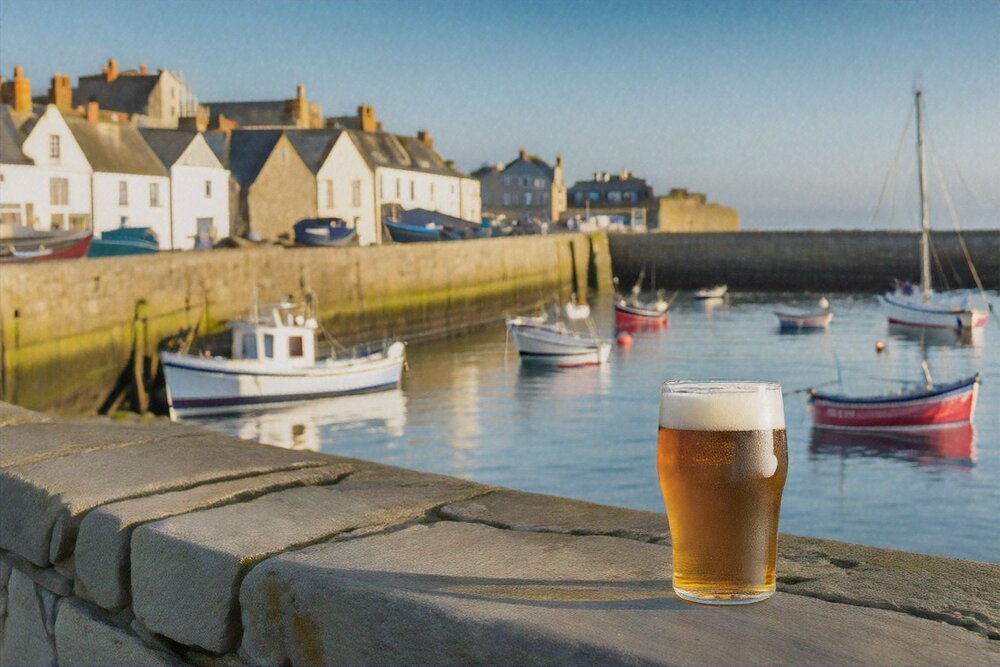
Randalls has brewed in St Peter Port since 1868 and its Patois range is the island's own; the Liberation Group brews across the water in Jersey and its Liberation Ale is everywhere. Look also for the small Guernsey brewers that have appeared in the last decade. The pubs of the Old Quarter and the coastal locals at Cobo and Rocquaine are the places to drink it.
Cider
Rocquette Cider at St Andrew's presses Guernsey apples in a genuine revival of an old island industry — Guernsey had cider orchards and its own apple varieties long before it had greenhouses. Farm shop, tours in season, and the cider is dry, real and worth taking home.
Gin
Wheadon's Gin, distilled at Rocquette in tiny batches with foraged island botanicals — rock samphire, gorse flower, sea aster — is the serious one and has won things. Blue Bottle and a handful of others make up a small but real distilling scene.
Prices
Pint in a pub roughly £4.50–5.50; a glass of wine £6–8; a bottle of gin in a supermarket around £18–22. That is 130–160 CZK for a pint and well under 600 CZK for the gin — cheaper than the UK by a wide margin and comparable to a Prague off-licence.
Two more things to know. Guernsey has no licensing hours culture of the English kind but pubs do close earlier than a continental visitor expects, and Sunday trading is quiet. And there is a genuine local tea ritual: a Guernsey cream tea, with a Guernsey biscuit or a slice of gâche and clotted-thick island cream, is a serious institution and not a marketing invention.
🌟 People from Guernsey Worth Knowing
Sir Isaac Brock (1769–1812)
Born in St Peter Port, and a national hero in a country he never lived in. As commander in Upper Canada he took Detroit in 1812 with a force a fraction of the American garrison's size, and died leading a charge at Queenston Heights that October. Canadians call him the Saviour of Upper Canada; Brock University and a 56 m monument are named for him. His birthplace in the Old Quarter is marked with a plaque.
Thomas de la Rue (1793–1866)
A Guernsey printer's apprentice who moved to London and founded what became De La Rue — still, nearly two centuries later, one of the world's principal printers of banknotes, passports and security documents for dozens of countries. He started with straw hats and a newspaper in Guernsey and ended up printing the money.
Admiral James Saumarez (1757–1836)
One of the most capable British naval commanders of the Napoleonic wars, born in St Peter Port. He fought at the Nile under Nelson and won the second Battle of Algeciras in 1801 against a much stronger Franco-Spanish force; later he commanded the Baltic fleet with a diplomatic restraint that kept Sweden out of Napoleon's camp. Raised to the peerage as Baron de Saumarez.
Andy Priaulx (b. 1974)
The island's most successful sportsman: World Touring Car champion three years running, 2005, 2006 and 2007, after starting out in hill climbing on Guernsey's own lanes. He raced for BMW and later Ford at Le Mans, and he still holds hill-climb records at home.
Heather Watson (b. 1992)
Born in Guernsey, British number one in her time, and Wimbledon mixed doubles champion in 2016 with Henri Kontinen. She reached the third round of Wimbledon repeatedly and, in 2015, came within two points of beating Serena Williams on Centre Court — a match islanders will describe to you shot by shot.
G. B. Edwards (1899–1976)
Guernsey's own novelist, who wrote one book, showed it to almost nobody and died in a bedsit in Weymouth before it was published. The Book of Ebenezer Le Page appeared in 1981, written in the voice of an old Guernseyman across the whole 20th century, and it is the single best thing ever written about the island. Read it before you come.
⚓ St Peter Port
St Peter Port is a Regency harbour town built on a hillside, and it is unreasonably good-looking. The privateering and merchant money of the 18th and early 19th centuries paid for terraces of painted stucco and granite climbing the slope in steps, connected by stairways and narrow lanes, all of it looking down on a harbour full of masts with Herm and Sark on the horizon. Around 18,000 people live here, which makes it the largest town in the Bailiwick by a wide margin and still smaller than Beroun.
The town works on two levels. The seafront and the Old Quarter — High Street, the Pollet, Mill Street, Mansell Street — hold the shops, the pubs and the cobbles, and are largely pedestrian. Above them, Hauteville and the streets climbing to Candie hold the merchant houses, the museum and the gardens, and the views. The steps between them are the reason people underestimate how tiring a day here is.
Castle Cornet
At the end of the breakwater, and the anchor of the whole town. Five museums, four gardens, the Noon Day Gun, and the best place to understand the harbour. Allow three hours.
Hauteville House
Victor Hugo's extraordinary self-designed interior, up the hill on Hauteville. Booked guided tours only. If you see one thing in Guernsey that is not outdoors, see this.
Candie Gardens & museum
Victorian public gardens with sub-tropical planting, a Hugo statue and a wide view over the harbour, plus Guernsey Museum at Candie — small, well-made, and the right place to start if you want the island's story in an hour.
Victoria Tower & the Town Church
The 30 m Victoria Tower of 1848 commemorates a royal visit and gives a rooftop view; the key is at the museum. The Town Church at the harbour's edge has been on its site since the 12th century and is worth ten minutes.
The market quarter has been rebuilt and rebuilt again and now houses food halls and independents; Les Cotils and the La Vallette bathing pools — Victorian tidal pools cut into the rock below the aquarium, free and still used daily — are the two things visitors most often miss. And the harbourfront is genuinely alive: fishing boats, the Herm ferry, the Condor from Poole, and, on the right day, sail training ships alongside.
🥾 The South Cliffs and Moulin Huet
The 27 km of cliff path from St Peter Port west to Pleinmont is the best thing on Guernsey and the reason to bring boots. It runs along the top of a granite plateau that falls 60 to 110 m into the sea, dipping into a series of deep wooded valleys — water lanes — that each end in a small stony bay, then climbing straight back out. Doing the whole thing is a long day; doing sections with the bus back is what most people sensibly do.
Fermain Bay
The first bay south of town, a 40-minute walk or a summer ferry from the harbour, with a loophole tower on the point and a beach café. The easiest possible introduction to the cliff path.
Moulin Huet
Renoir's bay. He painted around fifteen canvases here in September 1883 and the view is unchanged — the Cradle Rock, the sand at low water, the wooded valley behind. The Renoir Walk from Saints Bay marks the exact viewpoints with reproductions. Tea garden at the top of the valley.
Petit Bôt & Le Gouffre
Petit Bôt is a sheltered south-facing bay at the foot of two valleys with a Martello tower and a café, and the most swimmable of the south beaches. Le Gouffre, further west, is a spectacular cleft with a restaurant on the clifftop and one of the finest views on the island.
Icart & Jerbourg
Icart Point is the highest cliff on Guernsey and the classic postcard view east along the whole south coast. Jerbourg, the island's south-eastern tip, looks out to the Pea Stacks — a line of granite pinnacles, one of which is known as Le Petit Bonhomme Andriou and was once given offerings by fishermen.
At the far west end, Pleinmont is where the cliffs meet the German concrete: the restored MP3 observation tower on the headland, the Table des Pions or "Fairy Ring" nearby, and a long view over Rocquaine Bay to the Hanois lighthouse. The sunsets here are the island's best and the car park fills accordingly.
🏖️ The North: Cobo, Vazon and L'Ancresse
Everything north and west of the airport is a different island: flat, sandy, low, open to the Atlantic and full of beaches. This is where Guernsey people actually go, and where the sunsets are, and it is a short bus ride or a slow drive from town.
Cobo Bay
The west-coast institution: pink granite rocks, wide sand, a hotel and two cafés, and the best sunset on the island bar Pleinmont. Busy on a summer evening in the way a village green is busy.
Vazon Bay
A vast flat surf beach, the island's surfing centre with a school and board hire, and — on a handful of days a year when the tide allows — the venue for beach motorcycle and car racing run on the sand since the 1940s, which is exactly as strange and wonderful as it sounds.
L'Ancresse & Pembroke
The north end: a huge shallow bay with the warmest, calmest water on the island, backed by common land grazed by cattle, a golf course and half the island's dolmens. Best for families and for a swim that does not require courage.
Rocquaine & Fort Grey
The south-west sweep, with the white Martello tower known as the Cup and Saucer standing on its own islet as the Shipwreck Museum — a very good small museum about the reefs that surround this island and what they have done to shipping. The Hanois lighthouse is on the horizon.
St Sampson and Bordeaux on the north-east coast are the working side of the island — the commercial harbour, the quarry landscape, the small tidal creeks with boats on the mud — and considerably less pretty and more interesting than the guidebooks allow. Bordeaux at low water, with the whole harbour dry and Herm across the sound, is one of the most Guernsey views there is.
⛪ The Little Chapel and the Concrete
The Little Chapel at Les Vauxbelets is the island's most photographed building and it is roughly 5 m long. Brother Déodat, a French Christian Brother at the college here, began building a miniature version of the grotto at Lourdes in 1914; he demolished his first attempt after criticism, demolished the second when the visiting Bishop of Portsmouth could not fit through the door, and the third — begun in 1923 — is what stands.
It is covered, inside and out, in broken china, seashells and pebbles, contributed by islanders who sent Déodat their smashed crockery for decades. It holds perhaps half a dozen people at a squeeze and is claimed, plausibly, as one of the smallest chapels in the world. A major structural restoration was completed in 2017 and it is free to enter; go early, because the coach parties arrive at ten.
German Occupation Museum
At Les Houards near the Forest church, a privately built collection of astonishing depth — a reconstructed occupation street, an Enigma machine, ration books, the lot. Two hours minimum, and the single best place to understand what the five years were actually like day to day.
German Military Underground Hospital
La Vassalerie, St Andrew's. 7,000 m² of tunnels hacked out by forced labourers, damp, echoing and left largely bare. It is the largest structure in the islands and by some distance the most sobering thing on this list. Closed in winter.
Sausmarez Manor
St Martin. A Queen Anne house still in the family, with a subtropical garden, a large outdoor sculpture park, a pitch-and-putt and, in season, an artisan market. Genuinely good, and a useful wet-afternoon option.
Guernsey Tapestry & Victoria Tower
The Guernsey Tapestry in St Peter Port tells the island's millennium in ten embroidered panels made by the ten parishes, one per century. Small, unexpectedly moving, and half an hour well spent.
🌌 Sark
Sark is 45 minutes by boat from St Peter Port and about two centuries from anywhere. It is 5.5 km² of plateau at 100 m, 500 people, and no cars — the only motor vehicles permitted are tractors, and everything else moves by bicycle, on foot, or in a horse-drawn carriage. The ambulance is a trailer behind a tractor. You land at Maseline, are hauled up Harbour Hill by a tractor bus, and then you walk.
It was also, until very recently, the last feudal jurisdiction in Europe. Queen Elizabeth I granted the fief to Helier de Carteret in 1565 on condition that he settle forty men; those forty tenements and their holders formed Chief Pleas, the island's parliament, and they governed Sark essentially unchanged for 443 years. The Reform (Sark) Law 2008 replaced them with a fully elected chamber after a legal challenge brought by the Barclay brothers, owners of neighbouring Brecqhou; when the first election returned a chamber the brothers disliked, they closed their Sark businesses and put a large part of the island out of work overnight. Relations have improved since, slowly.
La Coupée
The reason to come. A natural isthmus 100 m long joining Sark to Little Sark, three metres wide, with a drop of about 80 m on both sides. The roadway was concreted by German prisoners of war under Royal Engineers direction in 1945; the handrails went up in 1900, before which children crawled across in high wind. It is genuinely vertiginous and completely safe.
Dark Sky Island
In 2011 Sark became the world's first designated Dark Sky Island. There is no public street lighting at all, and on a clear moonless night the sky over the plateau is as good as anywhere in western Europe. Stay the night — this is the one thing a day trip cannot give you.
The Seigneur
Sark still has one, holding the fief from the Crown. His remaining privileges are largely symbolic and delightfully specific: he alone may keep pigeons, and he alone may keep an unspayed female dog. The Seigneurie gardens are open and are among the best in the islands.
Day trip or stay
Ferries run several times a day in summer, far less in winter. A day gives you La Coupée, the Seigneurie, lunch and a swim at Dixcart or Venus Pool. A night gives you the stars and the island after the boats leave, which is a different place entirely. Book accommodation early — there is not much of it.
🏝️ Herm, Lihou and Alderney
Herm is twenty minutes from St Peter Port and 2.5 km long, and it is the easiest good decision you will make on this trip. No cars, no bicycles either, about sixty residents, one hotel, one pub and a walk round the whole island in two hours. Shell Beach on the north-east side is made of broken shell fragments carried up by the Gulf Stream rather than sand, and on a clear day the water over it is a colour that photographs badly because nobody believes it. Belvoir Bay next door is smaller and better for swimming.
Lihou is not a day trip so much as a tide-dependent expedition: a 20-hectare island off Guernsey's west coast, reached by a stone causeway that is under water most of the time. Crossing dates are published in advance; go across, look at the ruined Benedictine priory, find the Venus Pool — a large natural rock pool at the far end that is a genuinely superb swim on a warm day — and be back before the tide. People are cut off every year and the RNLI has views about it.
Alderney deserves more than an afternoon. Fifteen minutes by air from Guernsey, or a longer trip by sea, it is 8 km² with about 2,000 people, a small Georgian capital at St Anne with cobbled streets, an enormous ring of Victorian forts built against Napoleon III, the gannet colonies at Les Etacs, the blonde hedgehogs, and the Alderney Railway — the only railway in the Channel Islands, opened in 1847, ridden by Queen Victoria, and now running London Underground carriages along the harbour on summer weekends. It also holds the camps, which are dealt with above and which visitors should read about before arriving rather than after.
Getting to Herm
Travel Trident boats from St Peter Port, roughly hourly in summer, much reduced in winter and cancelled in bad weather. Day return around £15–17. Take a picnic or book the Mermaid Tavern; there is no shop worth the name.
Getting to Sark
Isle of Sark Shipping from St Peter Port, 45–55 minutes, several sailings daily in summer. Around £35–40 return. The crossing can be rough; the boats go anyway.
Getting to Alderney
Aurigny flies from Guernsey several times daily in a Dornier 228 — a fifteen-minute hop in a nineteen-seat aircraft, low enough to see the reefs, and one of the more entertaining scheduled flights in Europe. Book early; it is small and it fills.
Jethou and Brecqhou
Both are private and neither can be visited. Jethou is leased from the Crown; Brecqhou is owned by the Barclay family and carries a large mock-Gothic castle visible from Sark's west coast, which islanders will point out to you within about four minutes of your arrival.
✈️ Getting There
There are no direct flights from Prague, and there never have been. Guernsey Airport (GCI) has a 1,463 m runway, which rules out most jets, so the island is served by turboprops and small regional aircraft from a handful of British airports and, seasonally, from France. Every route from Czechia therefore involves one connection, and the sensible ones go through London.
Via London Gatwick
The main route. Aurigny, the States-owned island airline, flies Gatwick–Guernsey several times a day, about 55 minutes in an ATR 72. Prague to Gatwick with Ryanair, easyJet, Wizz or BA, then the connection. Total travel time 6–8 hours with a sane layover. Aurigny is a separate ticket from your Prague flight — leave three hours between them, not one.
Via Southampton or Manchester
Aurigny and Blue Islands fly from Southampton (40 minutes) and Aurigny from Manchester; Southampton is a good option if you are coming via a different UK entry point. Exeter, Birmingham, Bristol, East Midlands and Norwich appear seasonally.
Via Jersey
Blue Islands and Aurigny hop between the islands in 15 minutes, so Jersey — which has more and cheaper connections, including some direct from continental Europe — can be a cheaper way in. Also the standard fallback when Guernsey is fogged in.
From France
Seasonal Condor ferries run from St Malo to Guernsey via Jersey, and there are small-boat services from Dielette and Carteret in the Cotentin to Jersey and Sark in summer. A Paris–St Malo train plus the ferry is a genuinely pleasant way to arrive and is worth pricing against the London route.
The ferry from Britain is Condor Ferries, from Poole and Portsmouth to Guernsey and Jersey. It is the only way to bring a car, it takes around three hours from Poole on the fast craft, and it is expensive with a vehicle. Consider carefully whether you need a car at all on an island 10 km across.
Fog is the real risk. Guernsey's airport closes to arriving traffic in poor visibility more often than almost any other in the British Isles, most commonly in spring. Aircraft divert to Jersey and passengers are bussed and boated across, which costs hours. Never book a same-day onward connection out of a UK airport after a Guernsey flight, and if you must, insure it.
🚌 Getting Around
The island is 10 km by 6 km and the maximum speed limit is 35 mph (56 km/h), dropping to 25 in most places and 15 in the Ruettes Tranquilles. A hire car is convenient and entirely unnecessary for most visitors; the bus network is cheap, frequent enough and reaches everything.
The bus
The island bus service runs a flat fare of £1 per journey regardless of distance, paid in cash or by puffin card. Routes 91 and 92 circle the whole coast in opposite directions and are effectively a sightseeing tour for a pound. Buses are less frequent on Sundays and in winter. This is the correct way to see Guernsey.
Driving
On the left. Junctions use filter in turn — marked with a yellow arrow, meaning vehicles take it in strict rotation, one from each approach, with no priority road. It works beautifully once you understand it and is deeply confusing for about ten minutes. Lanes are single-track with granite walls; expect to reverse.
Green lanes
Ruettes Tranquilles are lanes where the limit is 15 mph and pedestrians, cyclists and horses have priority over cars. They cover a large part of the inland network and they are the best cycling in the islands.
Bikes and walking
Bike hire is widely available and the island is small enough to cross in an hour, though the south is properly hilly. The cliff path plus the bus back is the standard combination and it works. Taxis exist, must generally be booked, and are not cheap.
Parking in St Peter Port uses a clock system, not meters: you display a cardboard clock disc set to your arrival time in zones marked for one, two, three or ten hours, and the parking is free. Hire cars come with a disc; if yours does not, get one free from the tourist office or a petrol station. Overstaying is enforced.
💰 What It Costs
Guernsey is not cheap, and the absence of VAT does not change that: everything is shipped in, the market is small, and wages and property costs are high. Budget roughly at the level of southern England, with alcohol, fuel and tobacco as the exceptions and accommodation as the worst offender in high summer.
Accommodation
Hostel or guesthouse single £55–80; a decent three-star double £110–170; the good hotels in St Peter Port £180–300. Self-catering is often better value for two or more. July and August are booked out months ahead, and the price gap between August and October is large.
Eating
Café lunch £10–15; a pub main £15–20; a good seafood dinner £35–55 a head before wine. A dressed crab from a fish shop with bread makes a £10 lunch that beats most of the £30 ones. Supermarkets are Waitrose and the Channel Islands Co-op and prices run 10–20% above UK levels.
Getting about
Bus £1 flat per journey; bike hire £15–20 a day; small hire car from £40 a day. Herm return £15–17, Sark return £35–40, Alderney flights from about £70 return if booked early.
Sights
Castle Cornet around £15, Hauteville House about £15, the Occupation Museum around £8, the Underground Hospital about £6, the Little Chapel free. A States museums pass covering Castle Cornet, Candie and Fort Grey is worth it if you plan to see two or more.
For a Czech visitor, a realistic figure is 2,500–3,500 CZK a day per person on a mid-range trip staying in a guesthouse, using buses, cooking some meals and eating out once a day, excluding flights. Doing it on hostel and self-catering with the bus and the cliff path gets you to about 1,600–2,000 CZK. Flights from Prague via London run 4,000–9,000 CZK return depending on how far ahead you book the Aurigny leg, which is the expensive part.
📋 Practical Information and Health
Guernsey is one of the safest places you can travel. Violent crime is close to non-existent, the honesty boxes on the roadside are not a stunt, and the practical risks are the sea and the roads. What catches visitors out here is not danger but administration — because Guernsey is outside the UK, outside the EU and outside most of the arrangements you take for granted.
Health cover — read this
Guernsey has no reciprocal health agreement with the UK: the previous one was terminated in 2009 and has never been reinstated, unlike Jersey's. EU cards (EHIC/EKUZ) are worthless — Guernsey is not in the EU. A GP appointment costs a resident around £50–75 and a visitor the same or more; emergency treatment and repatriation are charged. Travel insurance is not optional here, for anybody.
Mobile roaming
Guernsey is neither in the UK nor the EU for roaming purposes, so "roam like at home" does not apply and neither do UK inclusive allowances. Czech and EU SIMs can incur substantial charges. Check with your operator before you fly, turn data roaming off on arrival, and use the very good public and hotel wi-fi instead. Local networks are Sure and Airtel-Vodafone.
Entry and visas
Guernsey is in the Common Travel Area with the UK and Ireland and operates immigration rules aligned to the UK's. Czech citizens need a valid passport — an ID card is not sufficient — and, since 2025, an ETA (Electronic Travel Authorisation) applies to visa-exempt visitors on the same basis as for the UK. Check the current position before booking; this rule changed recently and is still bedding in.
Money and duty
Sterling and Guernsey pounds circulate at par. Cards everywhere. On leaving for the UK or the EU you are travelling from outside their VAT territory, so duty-free allowances apply — which, with the island's low duty, is why everyone leaves with gin.
Emergencies
999 or 112. The Princess Elizabeth Hospital at St Andrew's has an emergency department. The RNLI covers the islands and the ambulance service is run by St John. Serious cases are flown to Southampton.
The sea
The tide is the hazard, not the water. Check tables before any low-water walk or causeway crossing, never cross to Lihou outside the published window, and treat the incoming tide on a flat beach with respect — it comes in fast over a huge area. Rip currents at Vazon and the west-coast surf beaches are real; swim where the surf school is.
Electricity and time
UK three-pin plugs, 230 V — bring an adapter. Time is GMT in winter and BST in summer, so one hour behind Prague all year.
Practicalities
English is universal. Tap water is safe and good. Tipping is British — 10% in restaurants if service is not included, nothing in pubs. Shops shut early and Sunday is quiet. Smoking is banned indoors in public places.
❓ Common Misconceptions
"Guernsey is part of the UK"
It is not, in any sense. It is a Crown Dependency: it makes its own laws, sets its own taxes, runs its own courts and immigration, prints its own money and is not represented in the Westminster parliament. British citizenship, yes; British territory in the constitutional sense, no.
"So it left the EU with Brexit"
It was never in it. Before Brexit the islands had a narrow relationship under Protocol 3 covering trade in goods only — no free movement of people, no EU citizenship rights, no membership. The 2016 referendum was not held here and the islands had no vote.
"There must be a UNESCO site"
There is not one anywhere in the Bailiwick. Guernsey has a Ramsar wetland at Lihou and L'Erée, local nature reserves and Sark's Dark Sky designation — no World Heritage Site. Pages that list one are simply wrong.
"The King is the Duke of Normandy"
A loyal toast, not a legal title. The Crown's dukedom of Normandy ended in 1204 and was formally renounced in 1259; the islands' link runs through the Crown itself. Islanders drink the toast anyway and are entitled to.
"My EHIC will cover me"
It will not, and neither will a UK NHS entitlement. Guernsey is outside the EU and has no reciprocal agreement with Britain. Uninsured medical treatment here is charged in full. This is the single most expensive mistake visitors make.
"It's a tax haven so it must be shady"
Guernsey is not on the EU's list of non-cooperative jurisdictions, applies OECD standards and exchanges tax information automatically. It is also, plainly, a low-tax financial centre that exists because being outside two large tax systems is worth money. Both statements are true and the island argues about them itself.
"Guernsey pounds spend in London"
They do not — Guernsey and Jersey notes are not legal tender in the UK and many shops refuse them. Some banks will exchange them; do it before you leave or keep them as souvenirs.
"The Potato Peel Pie film was shot there"
It was filmed in Devon, Cornwall and Bristol. Almost none of it is Guernsey. Mention this to an islander only if you have time for the full response.
✍️ Author's Note
Guernsey is an easy place to underestimate and a hard place to summarise. It looks, on arrival, like an English seaside county that got detached — the same buses, the same pubs, the same accents at first hearing. Give it two days and the differences start showing through everywhere: the Norman place names nobody translates, the filter-in-turn junctions, the parish douzaines, the fact that nobody can quite tell you what the constitution says because it has never been written down.
The thing that stayed with me is the tide. Ten metres, twice a day, rearranges the island — a bay that was a swimming beach at lunchtime is a rock plain by evening, and the whole rhythm of the place, the boats, the ormering, the crossings to Lihou, runs on a timetable that has nothing to do with the clock. It is genuinely disorienting for a Central European who has only ever seen the Adriatic, and it is the best argument for coming.
And the Occupation is not something you can visit around. It is in the concrete on every headland, in the museums, in the names on the memorial to three women who were handed over, and in the fact that the island is still, eighty years on, working out what it wants to say about all of it. Guernsey has got noticeably braver about that in the last twenty years. Go to the Occupation Museum and to the underground hospital and give them the time they deserve.
Practical closing advice, in order: take insurance, take a tide table, take boots, do not take a car, and if you can possibly arrange it, be here on 9 May.
Support This Project 🌍
This World Travel Factbook is a labor of love – free to use for all travelers. If you find it helpful, consider supporting its continued development.