

🇬🇩 Grenada at a Glance
🌍 Overview
Grenada is a three-island country at the southern end of the Windward chain: the main island of Grenada, plus Carriacou and Petite Martinique in the Grenadines to the north. Together they cover about 344 km² — smaller than the Prague metropolitan area — and hold roughly 117,000 people. The whole country is volcanic, steeply green, and small enough to drive around in a long day if the road allows, which it sometimes does not.
It is known as the Isle of Spice, and unusually for a tourist-board nickname that one is earned. Nutmeg grows here in commercial quantity, along with mace, cinnamon, clove, ginger, turmeric and cocoa; the nutmeg pod is on the national flag, which makes Grenada one of the very few countries to put a crop on its flag and mean it.
What sets Grenada apart from the rest of the Caribbean beach circuit is the density of things that are not beach. In a country this size you have a working rainforest with a crater lake in it, a submarine volcano eight kilometres offshore that is still active, the world's first underwater sculpture park, one of the largest diveable wrecks in the Caribbean, a water-wheel rum distillery running essentially as it did in the eighteenth century, and a bean-to-bar chocolate industry that grows its own cocoa.
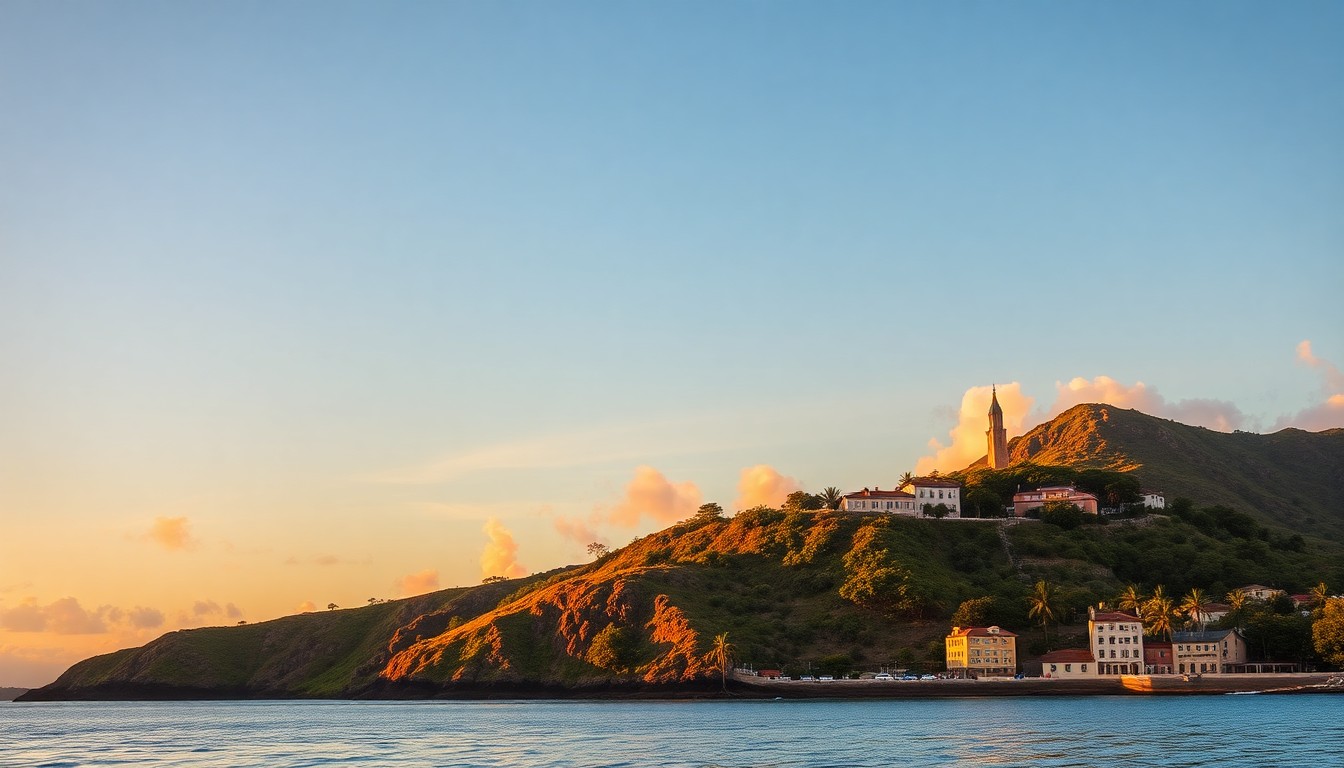
And it has recent history that most visitors know nothing about until they arrive. Between 1979 and 1983 Grenada had a socialist revolution, a four-year revolutionary government, the killing of its own prime minister by his own party, and a full American military invasion — inside a period shorter than a single school stage. People here remember all of it personally, opinions differ sharply, and the subject is not off limits. It is just worth approaching with some care, which this page tries to do.
🏷️ The Name, the Flag and the Nutmeg
The Spanish called it Granada, after the city, and the French turned that into La Grenade, from which the English took Grenada. The local pronunciation is gruh-NAY-duh, with a long A — not gruh-NAH-duh, which is the Spanish city, and not the fruit. Getting it right takes ten seconds and is noticed.
Before Europeans it was Camerhogne to the Kalinago who lived here. That name survives in local usage — the university, businesses and cultural organisations use it — and it is worth knowing that the island had a name and a population for centuries before anyone sailed past it in 1498.
The flag
Red border with six yellow stars for the six parishes and a seventh in a red disc for St George's; green and yellow triangles; and on the hoist-side green triangle, a nutmeg pod split to show the mace inside. Very few flags depict a crop; almost none depict one that actually built the national economy.
Isle of Spice
Not marketing. Grenada was for decades one of the world's largest nutmeg producers, and nutmeg and mace were the country's principal export before tourism. Hurricane Ivan in 2004 destroyed the great majority of the trees, and the industry is still rebuilding — nutmeg takes some seven to nine years from planting to first useful crop.
The three islands
Grenada, Carriacou and Petite Martinique are a single state, and Carriacouans will tell you the relationship is not always easy — decisions are made in St George's, and after Hurricane Beryl in 2024 the question of how much attention the smaller islands get became a live political issue.
A Commonwealth realm
Independent since 7 February 1974, with King Charles III as head of state represented by a Governor-General, an elected House of Representatives and an appointed Senate. Referendums on becoming a republic and on other constitutional changes have been held and defeated.
🗺️ Geography
Grenada is the top of a volcano. The main island runs about 34 km north to south and 19 km across, with a mountainous spine reaching 840 m at Mount St Catherine, and rainforest across the interior ridges. Rainfall is heavily uneven: the wet interior gets several times what the dry south-western coast around Point Salines gets, which is why the beaches and the hotels are in the south-west and the spice estates are in the north and east.
The country sits at roughly 12° north, at the southern end of the Lesser Antilles and about 160 km north of Venezuela — south of most of the hurricane belt, which historically gave Grenada a reputation for being relatively safe from storms. That reputation was destroyed in 2004 and is dealt with in its own section below.
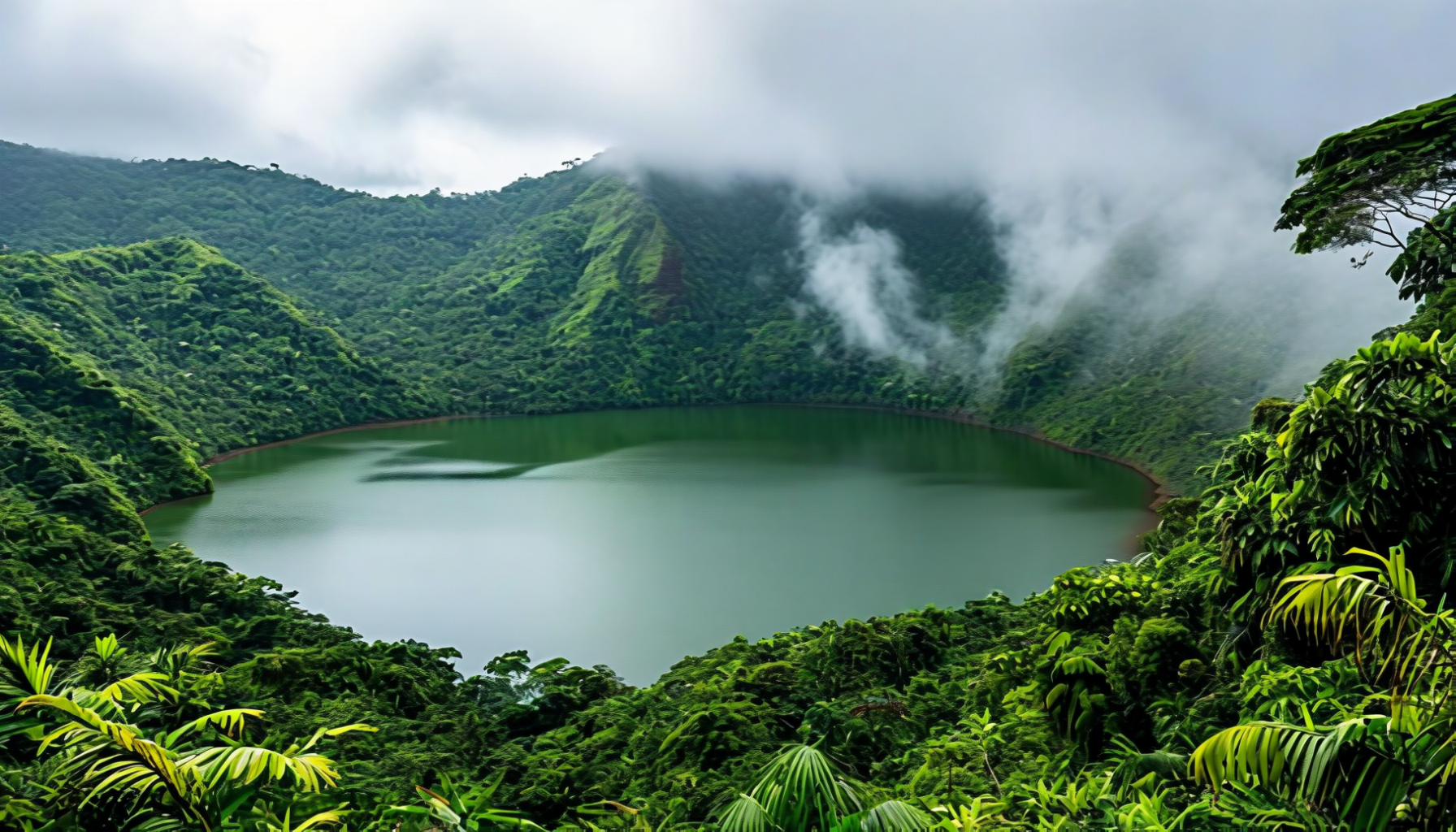
Offshore to the north lies Kick 'em Jenny, an active submarine volcano about 8 km off the coast whose summit is a few hundred metres below the surface. It has erupted more than a dozen times since it was discovered in 1939, and a maritime exclusion zone around it is enforced with the radius adjusted according to the current alert level. Boats going north to Carriacou route around it; this is normal and not a cause for alarm, but it is a genuinely live volcano and worth knowing about.
Carriacou, 34 km², is drier, flatter and quieter, with the country's boatbuilding tradition and its best beaches. Petite Martinique, barely 2.4 km² and about 900 people, is smaller still and famous for seafaring, boatbuilding and a long, cheerfully acknowledged history of moving goods around the Grenadines without troubling the customs authorities.
🌡️ Climate and When to Go
Tropical, with two seasons rather than four. The dry season runs roughly January to May: less rain, steadier trade winds, temperatures around 28–30 °C by day and low 20s at night. The wet season runs June to December, with short heavy afternoon downpours rather than all-day rain, higher humidity, and the hurricane risk that goes with it.
Sea temperature is 27–29 °C all year, so diving and swimming have no closed season. What changes is visibility and surface conditions, both of which are usually better in the dry months.
January–April
The peak season and the best weather: dry, breezy, and the sailing season. Also the most expensive, and Carriacou Carnival with its Shakespeare Mas falls in February. Book ahead.
May–June
The shoulder. Prices fall, the rain starts, and the island is green and quiet. Good value, and the hurricane risk in these months is still low.
July–August
Wet and hot, but this is Spicemas — the carnival, with J'ouvert and the Jab Jab, and the biggest event of the Grenadian year. If carnival is why you are coming, come now and accept the weather.
September–October
Peak hurricane season, lowest prices, some hotels and restaurants closed. Anyone travelling in these months should have insurance that covers weather disruption and should follow the forecasts.
The short answer: February to April for weather, May or June for value, August for carnival. Whenever you come, remember that Grenada is 12° from the equator — the sun is close to vertical at midday and burns much faster than a Czech summer prepares you for.
🗺️ Map
Grenada lies in the southern Caribbean between Saint Vincent and the Grenadines to the north and Trinidad and Tobago to the south, about 160 km off the Venezuelan coast. St George's is on the sheltered south-west shore; the international airport is at Point Salines on the island's south-western tip, about twenty minutes from town.
Orientation: St George's and the harbour in the south-west, Grand Anse immediately south of it, Point Salines and the airport at the southern tip. Up the west coast lie Molinere (the sculpture park), Gouyave (nutmeg and Fish Friday) and Victoria; the north end is Sauteurs; the east coast has Grenville, the second town, and the cocoa country around Belmont. Grand Etang sits in the middle, on the road that crosses the island's spine.
🌀 Ivan, Beryl and What a Hurricane Actually Does
For most of the twentieth century Grenada considered itself south of the hurricane belt. Insurance was cheap, roofs were built accordingly, and the last serious storm before living memory was Janet in 1955. That confidence ended on 7 September 2004, when Hurricane Ivan passed directly over the island as a major hurricane.
Ivan damaged or destroyed something close to 90% of the buildings in the country, killed 39 people, took the roof off the prison and the Governor-General's residence, and flattened the nutmeg groves. The economic damage was estimated at roughly twice Grenada's annual GDP. The nutmeg industry — trees that take the better part of a decade to bear — was set back by a generation, and the island's export economy has never fully returned to where it was. Hurricane Emily followed ten months later.
On 1 July 2024 Hurricane Beryl hit again, this time to the north: it passed directly over Carriacou and Petite Martinique as a Category 4 storm, the earliest storm of that intensity ever recorded in the Atlantic. Carriacou lost the overwhelming majority of its buildings in a few hours. The main island of Grenada was spared the worst; the two small islands were not, and their recovery is ongoing at the time of writing.
What this means for a visitor is practical and worth stating plainly. Check the current state of Carriacou and Petite Martinique before planning a trip there rather than assuming the guidebook picture still holds; travel in the June-to-November window with insurance that actually covers hurricane disruption; and understand that when Grenadians talk about the weather, they are not making conversation. Recovery here is a live, expensive, political subject, and tourism money spent on the smaller islands lands where it is most needed.
📜 Camerhogne and the Leap
The island was settled from South America in stages, first by Arawakan-speaking peoples and later by the Kalinago — the people Europeans called Caribs, and after whom the whole sea is named. They called the island Camerhogne. Columbus sighted it in 1498 and named it Concepción; nobody acted on the sighting for a century and a half, largely because the Kalinago of the Windward Islands successfully resisted settlement in a way that the peoples of the larger islands to the north-west had not been able to.
In 1649 or 1650 a French expedition from Martinique under Jacques Dyel du Parquet bought — or claimed to buy — the island from the Kalinago in exchange for knives, hatchets, glass beads and two bottles of brandy. What followed was not a purchase but a war, and it ran for several years.
It ended in 1651 at the northern tip of the island, at the place now called Sauteurs — "the leapers". Rather than surrender to the French force that had cornered them, the last Kalinago fighters, and by most accounts women and children with them, went over the cliff into the sea. The site is Leapers' Hill, Le Morne des Sauteurs, and it is marked and visitable. The number who died is not reliably known and the accounts come from the winning side, which is worth saying out loud; what is certain is that organised Kalinago presence on the island ended there.
Grenada today has no recognised Kalinago community, unlike Dominica where the Kalinago Territory survives. The name Camerhogne, the place name Sauteurs and a scatter of petroglyphs — including the carved rocks at Duquesne Bay — are what remains in plain sight.
⚔️ French, British, French, British
The French held Grenada from 1650, established sugar and indigo estates, and imported enslaved Africans in numbers to work them. In 1763 the island passed to Britain under the Treaty of Paris that ended the Seven Years' War. In 1779 the French took it back by force. In 1783, under the Treaty of Versailles, Britain got it back again. It stayed British until independence in 1974.
Those swaps left a layer of French that never washed out. Place names are French — Sauteurs, Grand Anse, Petit Etang, Morne Rouge, L'Anse aux Épines — and a French-based Creole was widely spoken into the twentieth century, surviving now mostly in older speakers, in agricultural and cooking vocabulary, and in the names of things. Grenada's English-speaking population uses French words for its own landscape without particularly noticing.
Sugar dominated the economy until the nineteenth century, and sugar meant slavery. Emancipation came in 1834 with a four-year "apprenticeship" that was slavery under another name until 1838. What followed was the pattern common across the eastern Caribbean: indentured labourers brought from India in the 1850s and after, freed people moving to small holdings in the hills, and estates shifting to crops that suited the terrain better than cane did.
That shift is why Grenada is the Isle of Spice. Nutmeg arrived from the East Indies in the 1840s, cocoa expanded alongside it, and by the twentieth century Grenada was a significant world supplier of both — a small-farmer economy of spice and cocoa rather than a plantation economy of sugar. The estates that visitors tour today are the ones that made that transition.
🔥 Fédon's Rebellion
In March 1795, two years after the French Revolution reached the Caribbean and abolished slavery in the French colonies, a free man of colour and estate owner named Julien Fédon led an uprising against British rule in Grenada. It was not a small affair: at its height Fédon's forces controlled most of the island, held the Lieutenant-Governor and dozens of British hostages, and flew the French republican flag from a camp in the mountains at Belvidere.
The rebellion drew together free people of colour who resented British legal discrimination, enslaved people who had heard what France had just done, and French republican agents happy to encourage all of it. It lasted fifteen months. When British reinforcements finally broke the mountain camps in June 1796, the hostages had been executed, and the reprisals that followed were severe.
Fédon himself was never captured. He disappeared — drowned trying to reach Trinidad, killed in the hills, or escaped, depending on which account you prefer — and a reward for him went uncollected. He is a national hero in Grenada now, with his name on schools and roads, and Fédon's Camp is a hiking destination in the interior for those with a guide and a reasonable tolerance for mud.
It is worth putting the scale in European terms: this was a fifteen-month revolutionary war on an island of 344 km², contemporaneous with the Haitian Revolution and driven by the same current of ideas, and it very nearly succeeded.
✊ Gairy, Bishop and the Revolution
Grenada became independent on 7 February 1974 under Eric Gairy, a trade unionist turned politician who had led the labour movement of the 1950s and who by the 1970s ran the country through a mixture of patronage, mysticism and the intimidation of a paramilitary group known as the Mongoose Gang. Gairy is also, genuinely, the man who used his 1977 address to the United Nations General Assembly to propose that the UN establish an agency to study unidentified flying objects. Both facts are true and both are remembered.
On 13 March 1979, while Gairy was abroad, the New Jewel Movement took power in an almost bloodless coup and installed a People's Revolutionary Government under Maurice Bishop, a charismatic 34-year-old lawyer. The revolution suspended the constitution, aligned Grenada with Cuba and the Soviet bloc, and set about literacy campaigns, free secondary education, health programmes and a new international airport at Point Salines built with Cuban assistance.
It also never held an election, jailed political opponents without trial and closed independent newspapers. Grenadians who lived through it will describe both halves of that sentence, often in the same breath, and the balance they strike depends on who they are. Four decades on, the revolution's social achievements are widely acknowledged and its authoritarianism is widely acknowledged, and outsiders arriving with a settled opinion tend to find the conversation more complicated than expected.
In 1983 the party split, essentially over whether to move to a joint leadership with the more doctrinaire Bernard Coard. Bishop was placed under house arrest. On 19 October 1983 a crowd freed him and carried him to Fort Rupert — today Fort George — where soldiers of the People's Revolutionary Army opened fire. Bishop and seven others, including three cabinet ministers, were executed by firing squad inside the fort. His body has never been found. A Revolutionary Military Council under General Hudson Austin took over and imposed a shoot-on-sight curfew.
🪖 Urgent Fury, 25 October 1983
Six days after Bishop's killing, the United States invaded. Operation Urgent Fury put roughly seven thousand American troops, with a token force from Jamaica, Barbados and other eastern Caribbean states, ashore on an island of ninety thousand people. The stated reasons were the safety of some six hundred American medical students at St George's University, a request from the Organisation of Eastern Caribbean States, and the restoration of order.
Fighting lasted a few days. The defenders were the Grenadian army and several hundred armed Cuban construction workers at the airport site. Around 19 Americans, 25 Cubans and 45 Grenadian soldiers were killed, along with at least 24 civilians — 18 of them in the accidental bombing of a mental hospital in St George's. The Revolutionary Military Council collapsed, Coard, Austin and others were arrested, and constitutional government was restored under the Governor-General.
Internationally the invasion was condemned. The UN General Assembly voted overwhelmingly that it "deeply deplores the armed intervention" as a flagrant violation of international law; Margaret Thatcher, whose Queen was Grenada's head of state and who had not been consulted, objected privately and forcefully. In Grenada itself opinion was and remains different: many Grenadians, having just watched their prime minister shot by their own army, welcomed the troops, and 25 October is a public holiday — Thanksgiving Day.
The airport the Americans said was a Soviet military project opened as a civilian airport and is now Maurice Bishop International Airport, renamed in 2009 after the man whose government built it. The seventeen convicted of the 1983 killings, the "Grenada 17", served long sentences, had their death sentences commuted after international campaigning, and were released between 2007 and 2009. They live in Grenada. So do relatives of the people they killed. The country has not held a truth commission, and the argument continues at kitchen tables rather than in courtrooms.
🏛️ Grenada Today
Modern Grenada is a parliamentary democracy that has changed governments peacefully at elections since 1984, most recently in 2022 when the National Democratic Congress under Dickon Mitchell ended fourteen years of New National Party rule. Politics is small-scale and personal — fifteen constituencies, candidates known individually — and turnout is high.
The economy
Tourism first, then agriculture — nutmeg, mace, cocoa, and increasingly value-added chocolate and rum. Construction, and remittances. Grenada went through a hard debt restructuring after 2013 and has since run notably disciplined public finances.
St George's University
The single largest private employer and a substantial share of GDP: an American-facing medical and veterinary school on the southern peninsula with thousands of students, most of them North American. It is the reason there are more sports bars and sushi restaurants on this island than the population would suggest.
Citizenship by investment
Grenada sells citizenship in return for investment, and its passport carries a rare advantage — Grenada holds an E-2 investor treaty with the United States. The programme is a real revenue line and a real source of international scrutiny.
Regional ties
Member of CARICOM, the OECS and the Eastern Caribbean Currency Union — which is why the currency is shared with seven neighbours and monetary policy is made in St Kitts rather than St George's.
Two structural facts shape everything. The first is size: a country of 117,000 people has to import most of what it consumes and has very little margin for error in a bad year. The second is exposure: a single hurricane can, and in 2004 did, erase more than a year's national output in six hours. Grenadian public policy — building codes, debt targets, disaster funds — is visibly organised around that second fact in a way that visitors from temperate countries rarely notice.
👥 The People
About 117,000 people live in Grenada, the overwhelming majority of African descent, with smaller populations of mixed and Indian descent — the latter descended from indentured labourers brought after emancipation — and a small European and Middle Eastern commercial community of long standing. Roughly a third of the population lives in and around St George's; Grenville on the east coast is the second town; the rest live in villages strung along the coast roads and up the valleys.
There is also a very large Grenadian diaspora — plausibly as many Grenadians live abroad as at home, mainly in the United States, Britain, Canada and Trinidad — and remittances matter to household budgets across the island. Families are transnational as a matter of course, and the August carnival is when a lot of them come home.
Religion is prominent and mostly Christian: Roman Catholic first, a legacy of the French period, then Anglican, Seventh-day Adventist, Pentecostal and others. Sunday is quiet, church clothes are formal, and a casual visitor should be aware that beachwear away from the beach is regarded as poor manners rather than as an amusing foreign habit — this is a conservative society under the tourist surface.
Social manners are warm and formal at the same time. Greetings come first, always: good morning, good afternoon, before any question, in a shop, on a bus, at a counter. Skipping straight to your request reads as rudeness in a way it does not in Prague. Get the greeting right and everything else on the island becomes easier.
🗣️ English, Creole and the French Underneath
English is the official language and universally spoken, so a visitor has no language problem at all. What people speak among themselves is Grenadian Creole English, which sounds like English at speed with a different grammar underneath: no verb to be before adjectives, aspect marked with particles rather than tense endings, and a rhythm that will lose you for the first day and then start to resolve.
Beneath that lies Grenadian Creole French — patois — which was the majority language of the island into the twentieth century and is now spoken fluently by very few, mostly older people in the north. It survives in vocabulary everywhere: food names, plant names, fishing terms, the word lambie for conch, and the names of the carnival characters.
Liming
The core social activity across the eastern Caribbean: hanging out, without a plan or an agenda, usually with a drink and other people, for as long as it takes. An invitation to lime is a genuine invitation and the correct response is to go.
Jab
From French diable, devil — the Jab Jab of carnival. French words hiding in English sentences are the normal condition of Grenadian speech.
Cocoa tea
Not tea. A hot drink of grated local cocoa boiled with spices and milk, drunk at breakfast. Ask for it in a village and you will get something considerably better than the words suggest.
Manners
"Good morning" and "good afternoon" open every interaction, including entering a shop or boarding a minibus, where greeting the whole vehicle is normal. This is the single most useful thing on this page.
🌰 Nutmeg and the Spice Estates
Nutmeg is a tropical tree that produces a fruit like an apricot; split it and you find a dark seed wrapped in a bright red lace-like aril. The seed dried is nutmeg; the aril dried is mace, a separate and more expensive spice. One tree gives both, takes seven to nine years to come into bearing, and then produces for decades. That timescale is why Hurricane Ivan's destruction of the groves in 2004 was an economic catastrophe rather than a bad year.
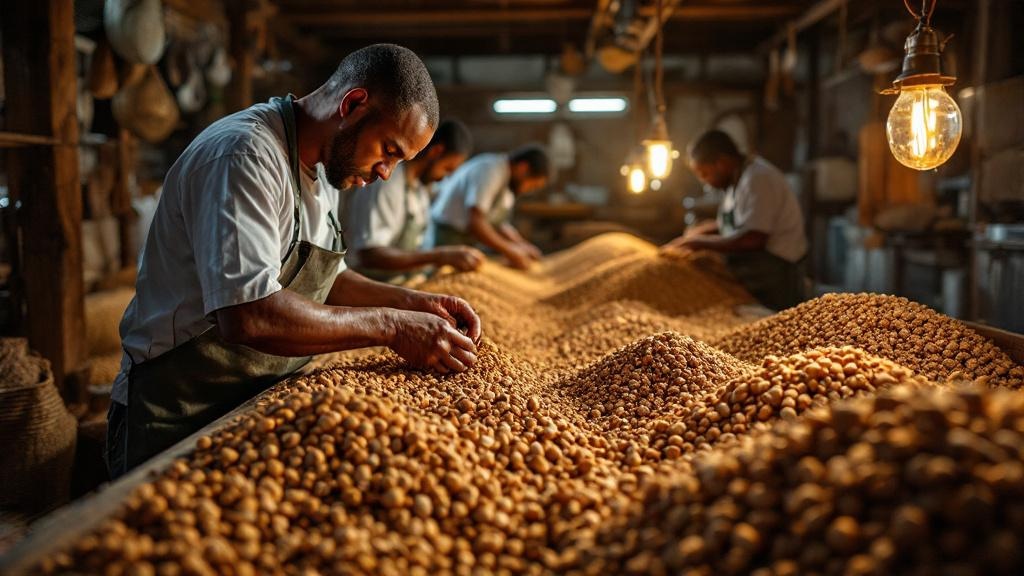
The Gouyave Nutmeg Processing Station on the west coast is the classic visit, and it is a working factory rather than a museum — nutmegs drying in vast wooden trays, the sorting by hand, the grading by whether a nutmeg sinks or floats, and the smell, which gets into your clothes and stays there. Tours are short, cheap and run by people who have done the job.
Grenada also grows mace, cinnamon (the bark of a related tree), clove, allspice, ginger, turmeric, bay leaf and vanilla, mostly on small holdings rather than plantations. Roadside stalls sell mixed spice baskets everywhere, and the price at a stall in the country is a fraction of the price at the cruise terminal. Buy loose whole spices rather than ground — they keep far better on the flight home and they are demonstrably what they claim to be.
One practical note: check your own country's import rules on plant material. Dried spices and nutmegs are generally fine into the EU in personal quantities, but fresh fruit, plants and seeds for planting are not, and the difference matters at Prague.
🍫 Cocoa, and Chocolate Made Where It Grows
Almost all of the world's cocoa is grown in poor countries and made into chocolate in rich ones. Grenada is one of the few places that broke that pattern deliberately. The Grenada Chocolate Company, founded in 1999 at Hermitage in the northern hills by Mott Green with a cooperative of local growers, made organic dark chocolate from Grenadian beans on the island itself, in a small factory partly run on solar power, and shipped some of it to Europe by sailing boat rather than container ship. Green died in 2013; the company continues.
The model spread. Belmont Estate in the north-east is a working cocoa plantation with a fermentary, a chocolate factory, a restaurant and a proper tour that walks you from pod to bar in a couple of hours. Jouvay, Diamond and Crayfish Bay are other Grenadian makers. The beans are fine-flavour Trinitario, and the chocolate is genuinely good — this is not a souvenir with a flag on it.
The tour to do
Belmont Estate, in St Patrick's, if you only do one. Pod to bar, an estate lunch of local food, and cocoa growing in front of you rather than in a display case. Half a day including the drive.
Cocoa dancing
Traditional processing has workers treading the dried beans by foot to polish them — the "cocoa dance". You will be shown it, and on some estates invited to join, and it is a real technique rather than a performance invented for visitors.
What to buy
Bars in the 60–100% range from any of the local makers, cocoa balls (grated cocoa rolled with spices, for making cocoa tea), and nutmeg-infused chocolate. It travels well if you keep it out of the sun.
The economics
A bar of Grenadian chocolate made in Grenada returns several times more to the island than the same beans exported raw. That is the entire point of the industry and it is worth supporting with your wallet rather than your sympathy.
🥃 River Antoine and Grenadian Rum
River Antoine Estate, on the north-east coast, has been making rum since 1785 and still does it the same way: cane crushed by a mill driven by a water wheel, juice boiled in a row of open copper coppers over a cane-trash fire, fermented in open stone vats with wild yeast, and distilled in a pot still. It is generally described as the oldest functioning water-propelled distillery in the Caribbean, and walking through it is closer to industrial archaeology than to a distillery tour.
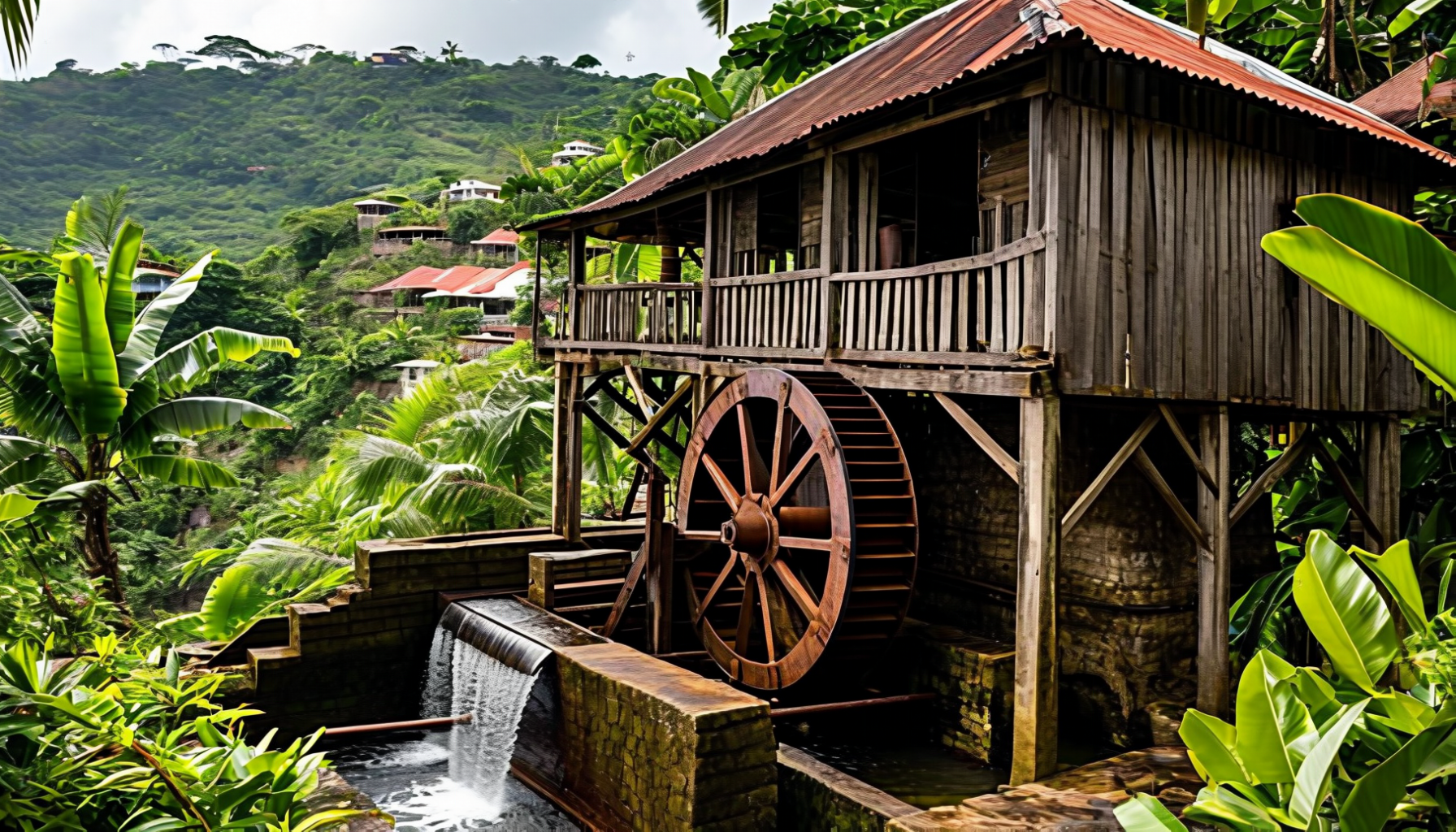
The rum it produces, Rivers Royale Grenadian Rum, comes off at around 75% alcohol by volume. That is above the limit airlines will carry, so the estate also bottles a 69% version specifically so that visitors can legally fly home with it. This detail tells you most of what you need to know about the product. Drunk on the spot, in the tiny amounts served, it is startlingly clean and grassy.
The other distilleries are more conventional and worth visiting on their own terms: Clarke's Court, the largest, in the south; Westerhall Estate, with aged rums and a good tour; and a growing number of small producers. Spiced rum here means rum actually spiced with local nutmeg, clove and cinnamon rather than flavoured syrup.
And then there is rum punch, made across the eastern Caribbean to the rhyme one of sour, two of sweet, three of strong, four of weak — lime, syrup, rum, water or juice — with grated nutmeg on top. The nutmeg is not optional in Grenada and a punch served without it will be sent back.
🎭 Spicemas, the Jab Jab and the Big Drum
Grenada's carnival, Spicemas, runs in August rather than before Lent — moved there in 1984 partly to avoid competing with Trinidad's — and it culminates in Carnival Monday and Tuesday in the second week. It is a full-scale eastern Caribbean carnival with calypso and soca competitions, steel pan, mas bands and a parade through St George's.
What makes it Grenadian is J'ouvert and the Jab Jab. Before dawn on Carnival Monday, revellers cover themselves head to foot in used engine oil, molasses, tar or paint, put on horns and chains, drag chains through the streets and dance to a specific heavy chant. The figure is the Jab Molassie, the molasses devil, and it descends directly from the enslaved: a deliberate, aggressive, blackened parody of the plantation's fear of its own workers. It is loud, filthy, and the single most powerful thing you can witness on this island. Wear clothes you will throw away, and if you do not want to be covered in oil, do not stand at the front.
Shakespeare Mas
Carriacou's carnival in February, and unlike anything else in the Caribbean: masqueraders in mirrored hats challenge each other to recite passages from Julius Caesar from memory, and whoever falters is struck with a whip. Real whips, real Shakespeare, genuine local passion for both.
Big Drum
The Carriacou Big Drum or Nation Dance: drumming and dance cycles that name specific African nations of origin — Cromanti, Igbo, Manding, Temne — preserved as a ritual for ancestors, weddings, boat launches and tombstone feasts. One of the most direct African survivals in the Caribbean.
Fisherman's Birthday
29 June, St Peter's day, in Gouyave and other fishing villages: boats blessed, decorated and raced, and a village-wide party. Smaller than carnival and easier to attend as a stranger.
Music
Soca and calypso above all, plus jab jab music with its iron and chant, steel pan, and a strong local dancehall and reggae audience. Grenadian soca artists tour the region's carnival circuit all summer.
🍽️ Food
Grenadian cooking is Creole: African technique, French and British inheritance, Indian additions, and local ingredients that are mostly grown within sight of the kitchen. It is heavier on ground provisions — breadfruit, dasheen, yam, sweet potato, green banana — than on rice, and it uses the spice cupboard the island exports.
The things to look for: callaloo soup, made from the leaves of the dasheen plant with coconut milk and crab or salt meat, thick and dark green; lambie, conch, stewed or curried or in a roti; saltfish in every form, a legacy of the cod trade that fed the enslaved; fresh fish, especially tuna, mahi-mahi and the local snapper; goat and chicken curries with the Indian-descended seasoning of the eastern Caribbean; and bakes — fried dough — with anything.
The fruit deserves its own sentence. Soursop, guava, golden apple, sapodilla, sugar apple, five-finger, mango in half a dozen varieties, and passionfruit that tastes of something. Fresh juices are made from all of them and cost almost nothing at a market. Nutmeg turns up in ice cream, in jam, in syrup, in punch, and in nutmeg pesto sold at the market, which sounds ridiculous and is not.
Where to eat cheaply
Roadside and market stalls, the food vans in St George's at lunchtime, and the villages on a Friday night. A plate of local food costs a fraction of what a hotel charges and is usually better.
Where to eat well
The south-west, around Grand Anse, Morne Rouge and L'Anse aux Épines, has genuinely good restaurants — several of them run by chefs cooking Grenadian ingredients seriously. Book at weekends in season.
Oildown
The national dish, cooked in one pot, usually for a crowd, often outdoors. Any invitation to one is an invitation to a social occasion first and a meal second.
What to avoid
Nothing dietary, but note that lionfish appears on menus as an invasive species being eaten deliberately — order it with a clear conscience, it is excellent and every one eaten is a small favour to the reef.
🥘 Oil Down — the National Dish
Oil down is Grenada's national dish and it is a one-pot method rather than a recipe: breadfruit, salted meat, callaloo, dumplings, turmeric and coconut milk, layered in a big pot and cooked until the liquid has gone and the coconut oil has separated out at the bottom. That last stage gives it the name — the pot "oils down".
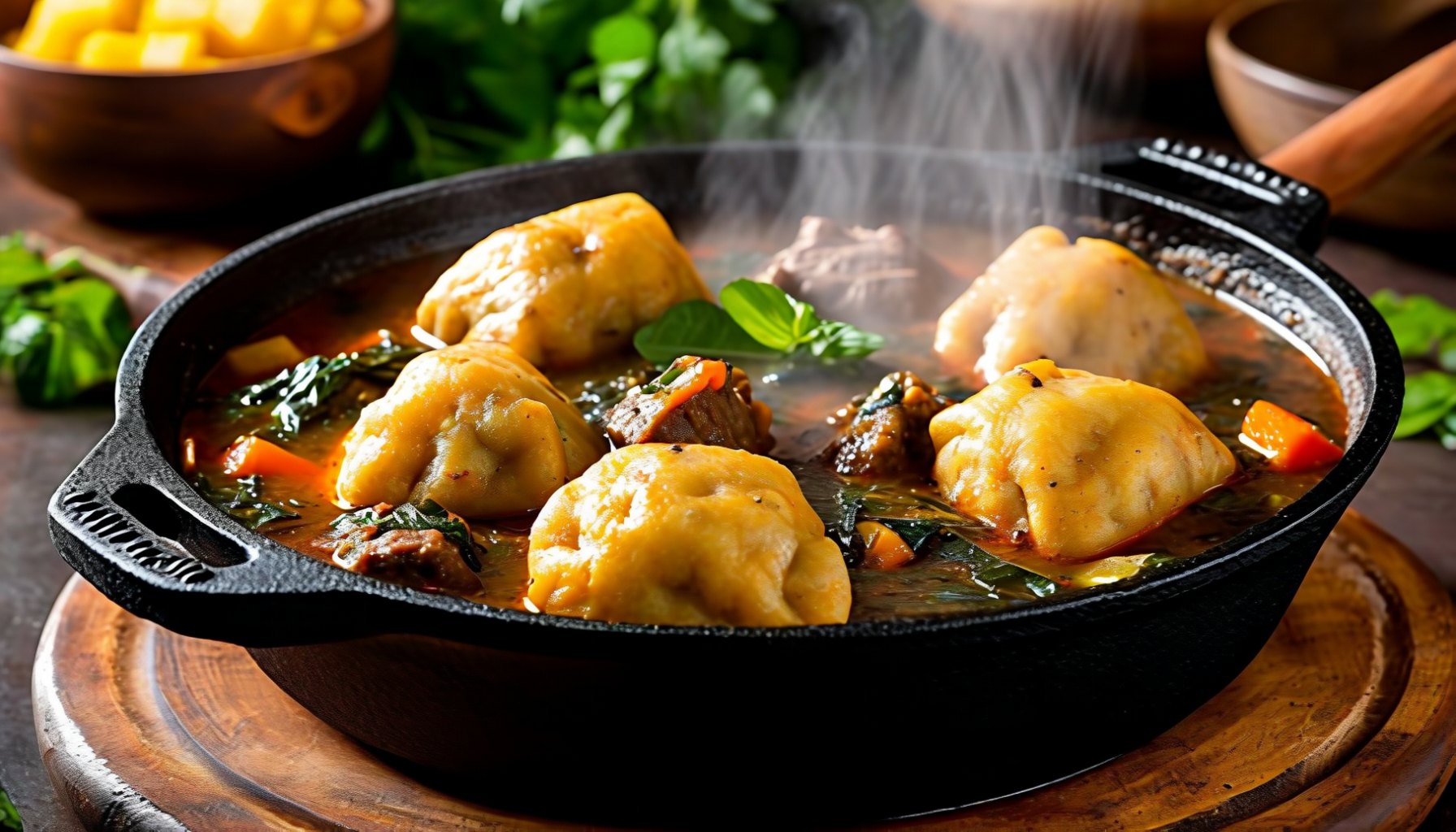
Oil down (Grenadian one-pot)
Serves 6 · about 1 hour 15 minutes · one large heavy pot with a lid
Ingredients: 1 breadfruit, peeled, cored and cut in wedges (green cooking banana or a mix of potato and green banana is the workable substitute in Czech shops); 500 g salted pigtail or salt beef, soaked overnight and boiled once to remove excess salt, or smoked pork ribs; 400 g callaloo or dasheen leaves (spinach or chard at a pinch); 2 tins (800 ml) coconut milk; 2 onions sliced; 4 cloves garlic; 1 tsp turmeric; a whole scotch bonnet or habanero, left uncut; thyme, chive, celery leaf; salt and pepper. For the dumplings: 250 g plain flour, water, pinch of salt.
Method: Make a stiff dough for the dumplings and roll it into small fat cylinders. Lay the meat in the bottom of the pot, then the onion, garlic and herbs, then the breadfruit wedges, then the dumplings and the greens on top. Whisk the turmeric into the coconut milk and pour it over — it should come about two-thirds up, not cover everything. Lay the whole chilli on top, unbroken. Cover, bring to a boil, then turn to the lowest heat and leave it for 45–60 minutes without stirring, until a skewer goes through the breadfruit easily and the liquid is gone. Remove the chilli before it bursts. Serve straight from the pot.
💡 The chilli goes in whole and comes out whole. Burst it and the dish becomes something only one person at the table can eat — which, in a dish designed to feed a crowd, is the one unforgivable mistake.
🥣 Callaloo Soup
If oil down is the national occasion, callaloo soup is the national Sunday. It is made from the young leaves of the dasheen — taro — plant, which must be cooked properly, and it appears in some form across the whole eastern Caribbean with each island insisting its own version is correct.
Grenadian callaloo soup
Serves 4 · 45 minutes
Ingredients: 400 g dasheen/callaloo leaves, or spinach with a handful of chard (see note); 1 tin (400 ml) coconut milk; 750 ml stock or water; 200 g salt beef or smoked pork, or 200 g white crab meat, or neither for a vegetarian version; 1 onion; 3 cloves garlic; 2 stalks celery with leaves; sprigs of thyme; 6 okra, sliced; 1 whole scotch bonnet; salt, black pepper and a good grating of fresh nutmeg.
Method: Strip the leaves from the stalks and chop roughly. Soften the onion, garlic and celery in a little oil, add the meat if you are using it, then the leaves, okra, thyme, stock and the whole chilli. Simmer covered for 25–30 minutes until everything has collapsed. Fish out the chilli, then blend the soup smooth — a stick blender in the pot is traditional enough. Return to the heat, stir in the coconut milk and the crab if using, warm through without boiling hard, and finish with salt, pepper and nutmeg grated over each bowl.
💡 Real dasheen leaves contain calcium oxalate and must be cooked through — never taste the soup before the leaves have had their full simmer, or your mouth will tell you about it for an hour. Spinach has no such problem and no such flavour; if you can find taro leaves in an Asian shop in Prague, use them.
The nutmeg at the end is the Grenadian signature and it is the difference between this and a Trinidadian or Jamaican callaloo. Grate it fresh at the table; pre-ground nutmeg loses most of what makes it worth having within weeks.
🐟 Fish Friday in Gouyave
Every Friday evening the fishing town of Gouyave on the west coast closes two streets and becomes an open-air fish market and kitchen. Stalls grill and fry whatever came in that day — tuna, mahi-mahi, marlin, lobster in season, conch, jacks — with bakes, plantain, breadfruit chips and rum punch, and the whole thing runs from about six in the evening until late, with music and a crowd of locals, students from the university and visitors in roughly that order of numbers.
It started in 1999 as a community initiative to give the town's fishing economy a retail outlet and is now one of the fixed points of the Grenadian week. Prices are low, the food is cooked in front of you, and it is the easiest place on the island for a stranger to end up in conversation with people who live there.
Getting there
Gouyave is about 45 minutes up the west coast from St George's. Minibuses run in the evening but thin out late; most visitors share a taxi or drive. Agree the return before you go — this is the one part of the evening that goes wrong for people.
What to order
Whatever is grilling. Tuna steak, fish cakes, lambie in a roti, lobster if it is in season (closed May to August), and a bake with saltfish. Take cash in small notes.
Saturday alternative
Seafood Friday at Woburn / Clarke's Court Bay in the south is the smaller southern cousin, closer to the hotels and a shorter drive.
Manners
It is a village street, not a festival site. Greet people, ask before photographing anyone, and buy from several stalls rather than one — the whole point is that the money spreads.
🍹 Drinking
Rum, beer and juice, in that order. The local beer is Carib, brewed in Grenada as well as elsewhere in the region, plus Stag; both are light lagers designed for the climate and both are fine cold. Rum is covered above; a rum shop — the small bar attached to a shop in every village — is the basic social institution of the island, and drinking a beer standing in one is the cheapest and most reliable way to meet Grenadians.
Rum punch
One of sour, two of sweet, three of strong, four of weak, nutmeg on top. Every bar makes it and they are not equally strong — treat an unfamiliar one with respect.
Local non-alcoholic
Mauby, from tree bark, bitter and an acquired taste worth acquiring; sorrel, from hibiscus, at Christmas; ginger beer with real ginger; sea moss, thick and sweet and considered a tonic; and fresh juices of everything.
Prices
A local beer in a rum shop runs around EC$5–8, in a hotel bar several times that. Roughly, EC$1 has been in the region of 8 CZK in recent years — the East Caribbean dollar is pegged to the US dollar, so the crown rate moves with the dollar; check before you travel.
Rules
The drinking age is 18 and enforcement is relaxed, but drink-driving is not treated lightly and the roads here punish inattention severely. If you are drinking, do not drive on Grenadian roads at night — this is worth more than any other safety advice on this page.
🌟 Grenadians Worth Knowing
Maurice Bishop (1944–1983)
Lawyer, leader of the New Jewel Movement, Prime Minister of the People's Revolutionary Government from 1979 until his execution at Fort George in October 1983. The international airport carries his name. His body was never recovered and the circumstances remain the central unresolved question of modern Grenadian history.
Julien Fédon (c. 1750–?)
Free man of colour, estate owner, and leader of the 1795–96 rebellion that took control of most of the island in the name of revolutionary France. Never captured, never accounted for, and a national hero two centuries later.
Eric Gairy (1922–1997)
Trade union leader, first Prime Minister after independence in 1974, and the man whose 1977 speech to the UN General Assembly called for an international agency to study UFOs. Both the labour organising and the eccentricity are real; so was the Mongoose Gang.
Kirani James (b. 1992)
Won the 400 metres at the London Olympics in 2012 — Grenada's first Olympic medal of any colour, and gold at nineteen. Later diagnosed with Graves' disease, and back on the podium at Tokyo. In a country of 117,000 people, a national figure in a way no athlete from a large country can be.
Mott Green (1966–2013)
American-born founder of the Grenada Chocolate Company, who built a solar-powered cocoa cooperative in the hills at Hermitage and shipped chocolate to Europe by sailing boat. Not Grenadian by birth, and included here because what he built is.
Jason deCaires Taylor (b. 1974)
British sculptor who created the Molinere underwater sculpture park in 2006 — the first of its kind anywhere — using casts of local people and pH-neutral concrete designed to grow coral. Not Grenadian either, but the reason a great many divers come here.
🏛️ St George's
St George's is widely called the prettiest capital in the Caribbean and for once the cliché survives arrival. The town wraps around a flooded volcanic crater — the Carenage, a near-perfect horseshoe harbour — with warehouses and shophouses in ochre, pink and blue climbing the slopes behind, all under the red barrel tiles that arrived as ship's ballast from Europe and became the town's signature.
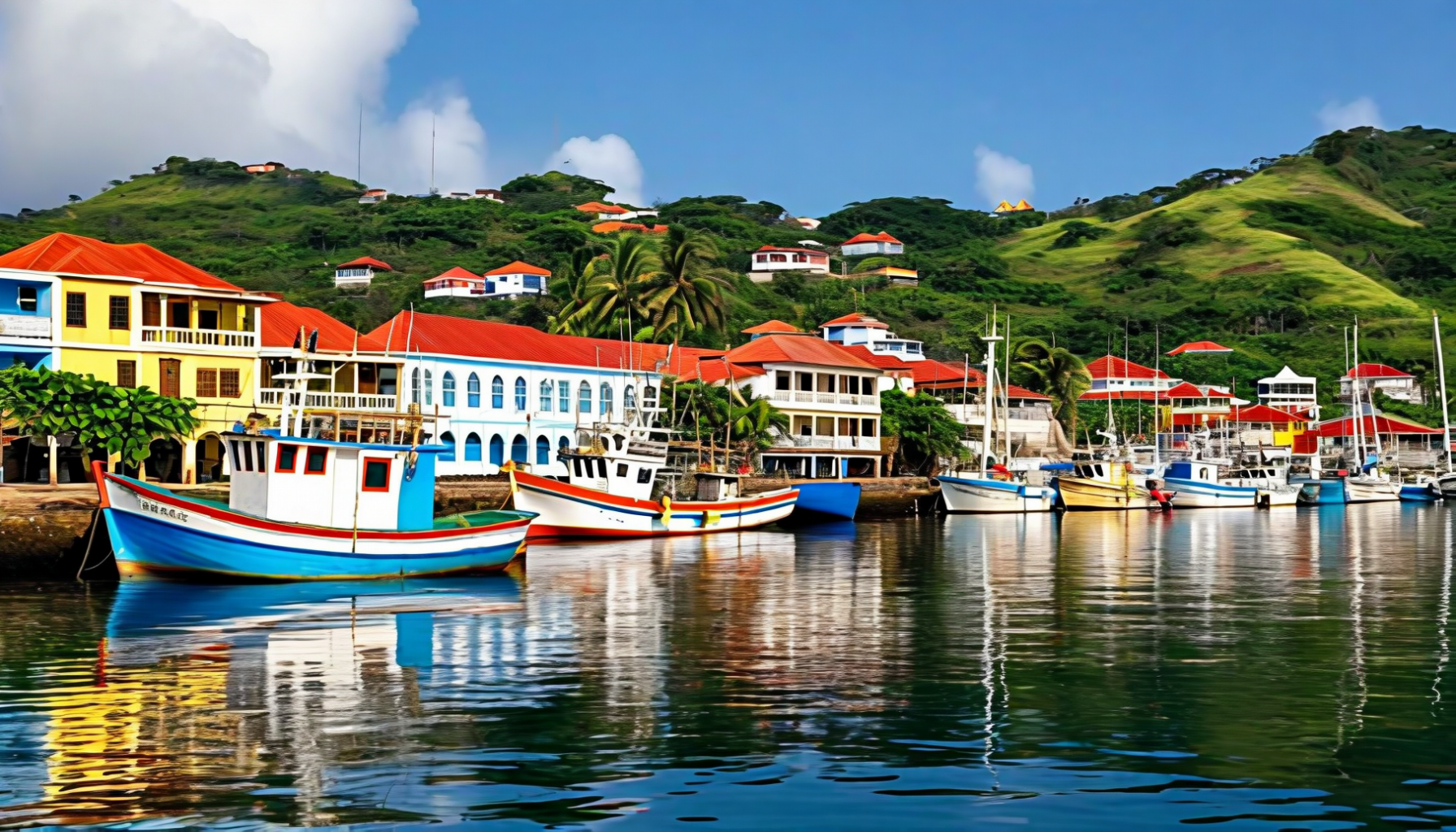
The town divides in two around a ridge, connected by the Sendall Tunnel of 1895 — single-lane, dripping, and considerably more alarming on foot than it looks. On one side the Carenage and the commercial waterfront; on the other the Esplanade and the cruise terminal. Above both sits Fort George, built by the French in 1705 as Fort Royal, with the best view over the harbour and a courtyard that is also the place where Maurice Bishop and seven others were shot in 1983. There is a plaque. Visitors regularly walk over it without knowing.
Market Square
Saturday morning is the real market: spices, ground provisions, fruit, hot sauce and a great deal of conversation. Go early, take small notes, and buy your spices here rather than at the cruise pier.
Grenada National Museum
Small, in an eighteenth-century building that has been a French barracks, a prison and a hotel. Kalinago artefacts, sugar and slavery, the 1795 rebellion and the revolution. An hour, and the right hour to spend first.
Fort Frederick
Above the town at Richmond Hill, built by the French with its guns facing inland — the "backwards fort", designed on the correct assumption that the real threat came overland. The best panorama on the island.
The Carenage walk
Half an hour around the horseshoe past the fish market, the schooners and the Christ of the Deep statue — given by the owners of the liner Bianca C in thanks for the rescue of her passengers when she burned and sank in 1961.
🏖️ Grand Anse and the Beaches
Grand Anse is three kilometres of white sand in a shallow curve south of St George's, and it is the reason most package visitors come. It is genuinely good — calm water, gentle shelving, the town visible across the bay at one end — and it has the island's cluster of resorts, restaurants and the craft market behind it. It also, unusually for the Caribbean, remains legally and practically public along its whole length: every beach in Grenada is public to the high-water mark and there is no hotel stretch you cannot walk.
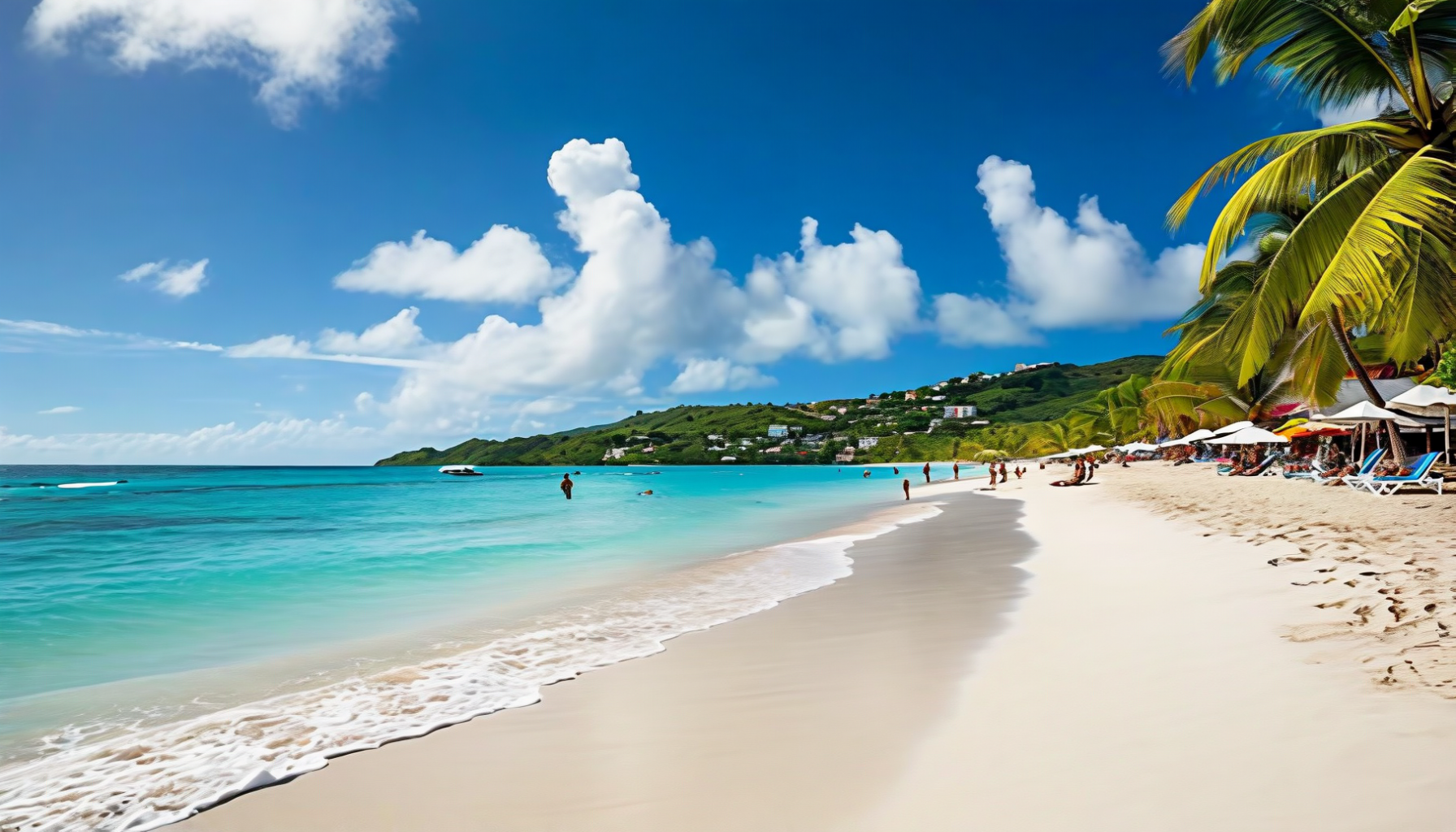
South of Grand Anse the coast breaks into a series of smaller bays — Morne Rouge (BBC Beach), quieter and even calmer; Magazine Beach below the airport; La Sagesse on the south-east coast, wilder, with a mangrove and a salt pond behind it; and Bathway in the far north, where a natural reef makes a swimming pool and beyond which the Atlantic is emphatically not for swimming.
The important safety point on this island is not crime, it is water. The west and south coasts are sheltered; the east coast is Atlantic, with surf, undertow and rip currents, and there are no lifeguards anywhere. Grenadians drown less often than visitors do, because they know which bays are which. Ask locally before swimming anywhere on the windward side, and take the answer seriously.
🌿 Grand Etang and the Interior
The road from St George's over the spine to Grenville climbs into cloud forest and reaches Grand Etang Lake at about 530 m — a crater lake with a visitor centre, a scatter of short trails and a persistent damp chill that comes as a shock after the coast. The Grand Etang National Park around it protects most of what is left of the island's interior forest.
Walks range from the fifteen-minute shoreline trail to the Mount Qua Qua ridge (about 90 minutes each way, muddy, with the best views on the island) and the long crossing to Concord Falls, which needs a guide. Trails are not always well marked and the mud after rain is comprehensive; boots, not sandals.
Mona monkeys
Introduced from West Africa in the eighteenth century — brought on slave ships — and now common around the Grand Etang car park, where they have learned exactly what a tourist with a snack looks like. Do not feed them; they bite, and habituated monkeys become a problem for the people who live nearby.
Waterfalls
Annandale, ten minutes from town and very easy; Concord, three falls with the upper two needing a walk; Seven Sisters (St Margaret's), the best of them, about 30–40 minutes in on a slippery trail, with pools you can swim in. Local guides wait at the trailheads and are worth the fee.
Birds
The Grenada dove, the national bird, is one of the rarest doves in the world — a few hundred at most, in dry forest in the south-west, and a serious conservation concern. Also broad-winged hawk, hook-billed kite, hummingbirds and the mangrove cuckoo.
What to bring
Rain shell, boots with grip, insect repellent, and more water than you think. It is cooler up here but the humidity is total and the descent is harder on the knees than the climb is on the lungs.
🗿 The Underwater Sculpture Park
In 2006 the British sculptor Jason deCaires Taylor sank a series of concrete figures onto the sandy seabed of Molinere Bay, just north of St George's, in five to eight metres of water. It was the first underwater sculpture park anywhere in the world, and it has since been copied from Mexico to the Mediterranean. National Geographic listed it among its wonders of the world, which for a country of this size is not a small thing.
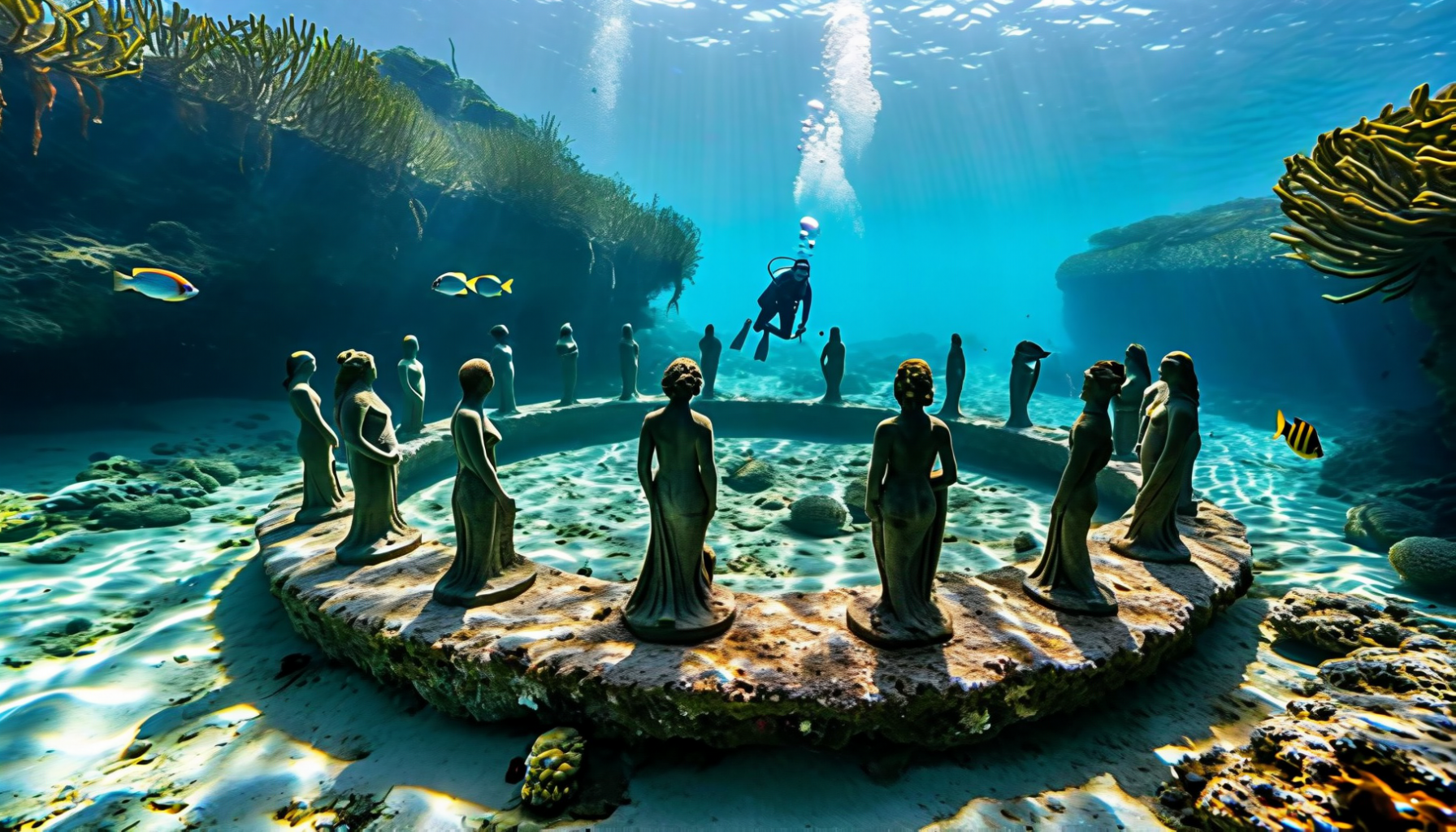
The intent was never only artistic. The sculptures are cast in pH-neutral marine concrete with textured surfaces designed for coral larvae to settle on, and they were placed on bare sand to create a new reef and to draw divers and snorkellers away from the natural reefs that Hurricane Ivan had already damaged. Two decades on they are substantially overgrown, which is the point — the works are meant to change and eventually to disappear into what grows on them.
Vicissitudes
The signature piece: a ring of children holding hands, facing outward. Widely and wrongly described online as a memorial to enslaved people thrown overboard during the Middle Passage; the artist has said it is about children and change rather than a slavery memorial. Both readings circulate in Grenada.
How to see it
Snorkelling from a boat is enough — the pieces are shallow and the water is clear. Diving gets you closer and to the deeper works. Half-day trips run daily from St George's and Grand Anse; glass-bottom boats also go.
Marine park
Molinere–Beauséjour is a designated marine protected area with a small user fee. Do not touch, stand on or rearrange anything, and do not wear chemical sunscreen — it damages exactly what the project is trying to grow.
Newer works
Taylor and others have added pieces over the years, and there is a second group of works further along the coast. Ask the operator which sites they visit; not all trips cover all of them.
🤿 Diving and the Bianca C
Grenada calls itself the wreck-diving capital of the Caribbean and has a strong claim, because of one ship. The Bianca C was a 180-metre Italian liner that caught fire in the harbour at St George's in October 1961. Grenadian fishermen and boat owners went out and took off almost everyone aboard — a rescue the island is rightly proud of and which the Christ of the Deep statue on the Carenage commemorates. The ship was towed clear and sank in about 50 metres of water off Point Salines.
She is one of the largest diveable wrecks in the Caribbean and is emphatically not a beginner's dive: 30 m to the deck, 50 m to the sand, in current, with visibility that varies. Advanced certification and a local operator are the minimum. The reward is a liner lying on her side with a swimming pool still recognisable, and eagle rays and barracuda over her.
For everyone else
Shallow reef and wreck diving all along the sheltered west coast — Flamingo Bay, Dragon Bay, the Boss and the Veronica L, plus the sculpture park. Water 27–29 °C year-round, so a 3 mm suit or a shorty is plenty.
Carriacou
Better visibility and healthier reef than the main island, with Sisters Rocks and the drop-offs off Sandy Island. Several operators run out of Hillsborough and Tyrrel Bay.
Lionfish
An invasive Indo-Pacific species that arrived in the 2000s and is culled by divers across the region. If a dive operator is spearing them, that is conservation work; if a restaurant is serving them, eat it.
Sailing
Grenada is the southern anchor of the Windward sailing circuit and the traditional hurricane-season hole for yachts — Prickly Bay, Mount Hartman and Clarke's Court Bay fill up from June. Yacht charter and crewed day sails are easy to arrange.
⛵ Carriacou and Petite Martinique
Carriacou is thirty-four square kilometres of dry hills, white beaches and about six thousand people, an hour and a half north of Grenada by fast ferry or twenty minutes by air. It is the quiet half of the country: no resorts to speak of, one small town at Hillsborough, a yacht anchorage at Tyrrel Bay, and the best swimming in the country at Anse La Roche and on the uninhabited sandbar of Sandy Island offshore.
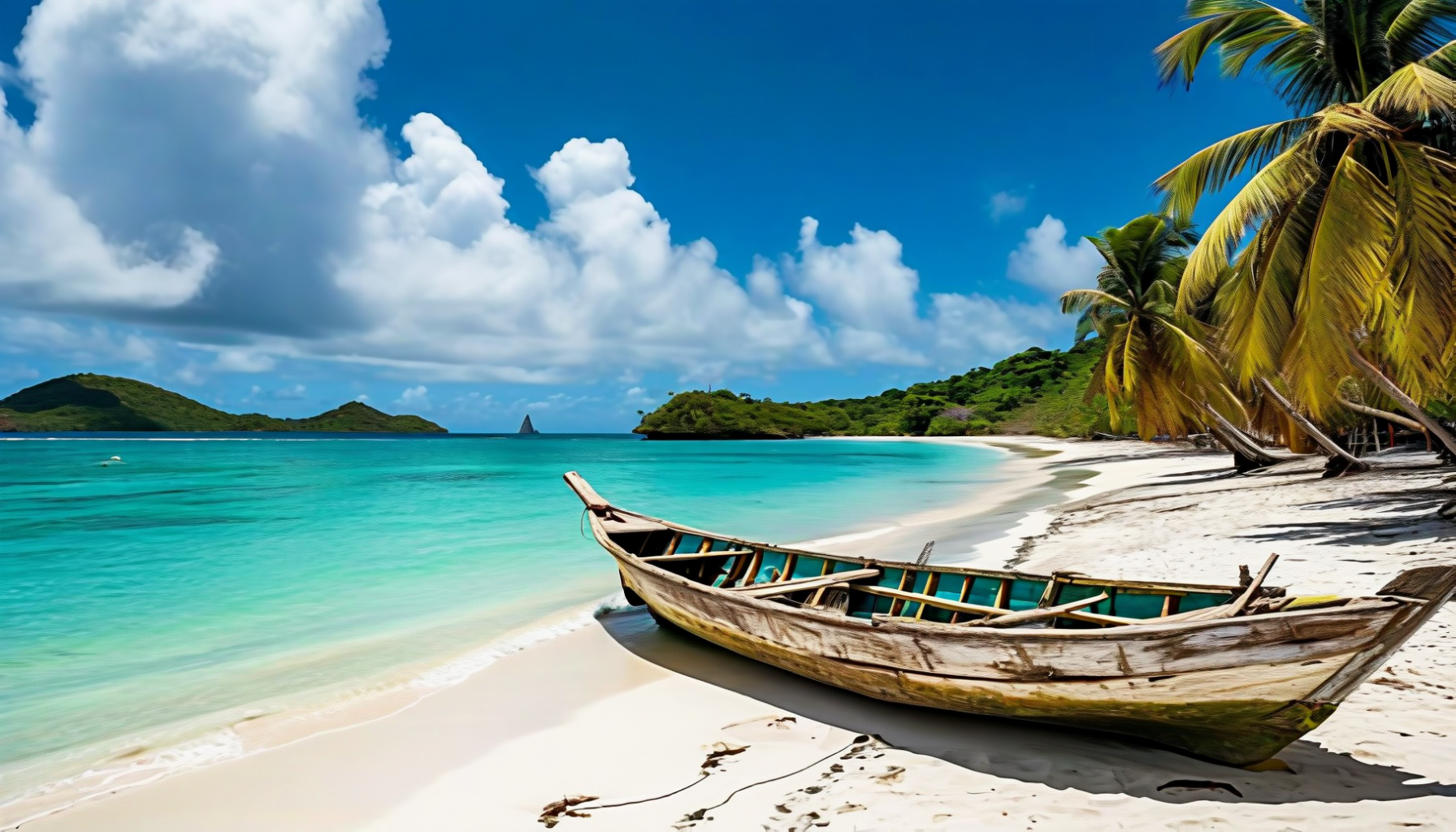
The island's culture is distinct enough to feel like a different country: the Big Drum ancestral dances, the February Shakespeare Mas, the wooden boatbuilding at Windward, the Regatta in early August that began in 1965 as a working-boat race and is now the island's biggest event, and a strong sense that Carriacou's interests and St George's interests are not the same thing.
Petite Martinique, a further short boat ride, is 2.4 km² and about 900 people, nearly all of them related and nearly all of them seafarers. It has one road, no hotels to speak of, and a formidable reputation across the Grenadines for boat handling and for a relaxed historical attitude to import duties.
The essential current note: Hurricane Beryl struck both islands directly on 1 July 2024 as a Category 4 and destroyed the overwhelming majority of buildings on Carriacou. Reconstruction is under way but incomplete, accommodation and services are reduced, and anything written before mid-2024 about where to stay and eat should be treated as historical. Check current conditions with operators before booking — and if you can go, go, because tourist spending is a large part of how these islands rebuild.
✈️ Getting There
Grenada's Maurice Bishop International Airport (GND) sits at Point Salines on the south-western tip, about twenty minutes from St George's and ten from Grand Anse. There are no direct flights from continental Europe and none at all from Central Europe, so every trip from Prague involves at least one change and usually two.
Via London
The most straightforward routing: Prague to London, then a direct flight to Grenada with British Airways or Virgin Atlantic from Gatwick or Heathrow. Roughly nine hours on the transatlantic leg. Note the London airport change if your first flight lands somewhere else — allow properly for it.
Via North America
Prague to New York, Miami, Charlotte or Toronto, then a connection south with American, JetBlue, Caribbean Airlines or Air Canada. Often cheaper, always longer, and it means clearing US or Canadian entry rules in transit — check whether you need an ESTA or eTA.
Via Barbados or Trinidad
Barbados (BGI) is the regional hub, with onward hops to Grenada in about 45 minutes. Useful if you are combining islands; the regional carriers change name and ownership frequently, so book the last leg with a little slack.
Cruise
St George's is a regular cruise call and the ships dock at the Esplanade terminal in the middle of town. A cruise day gives you the capital and one excursion; it does not give you Grenada.
Budget, honestly: a return from Prague usually falls somewhere in the 25,000–40,000 CZK range depending on season and how far ahead you book, with January to March the most expensive. The flying time door to door is 16–22 hours with connections, so plan the first day as a write-off.
🚗 Getting Around
Grenada has a functioning road network, which puts it well ahead of many small islands, but the roads are narrow, steep, winding and shared with pedestrians, dogs and stopped buses. Driving is on the left.
Minibuses
The real public transport: numbered private minibuses running fixed routes from the Esplanade terminal in St George's, leaving when full, loud, cheap (a few EC dollars) and efficient. Flag one down anywhere on the route, greet the bus when you board, and tap the roof or say "bus stop" when you want off. Service thins out after dark and on Sundays.
Taxis
Unmetered, with government-set fares between fixed points; agree the price before you get in and confirm whether it is quoted in EC or US dollars. The airport run to Grand Anse or St George's is a fixed rate posted at the airport.
Car hire
Available and useful for the north and east of the island. You need a local temporary driving permit — the hire company arranges it against your national or international licence for a modest fee. Drive on the left, use the horn as a greeting and a warning as everyone else does, and do not drive the mountain roads at night if you can avoid it.
To Carriacou
The Osprey fast ferry from St George's takes about 90 minutes to Hillsborough and continues to Petite Martinique; SVG Air and Air Grenada fly the hop in about twenty minutes. Sea conditions in the channel can be rough — take something for it if you are prone.
Distances are short and times are long: St George's to Grenville across the mountains is 25 km and takes about an hour; the full circuit of the island is a comfortable day with stops and a punishing one without. Fuel is sold in imperial gallons, which surprises people, and petrol stations close early outside the south-west.
💰 What It Costs
Grenada is a mid-priced Caribbean destination: much cheaper than Barbados or St Barts, more expensive than Central America, and with a very wide gap between the resort economy and the local one. A visitor who eats where Grenadians eat and takes minibuses can spend a fraction of what a visitor who stays inside a resort spends.
Currency
The East Caribbean dollar (XCD, EC$), shared with seven neighbours and pegged to the US dollar at EC$2.70 = US$1. That peg means the crown rate moves with the dollar; in recent years EC$1 has been in the region of 8 CZK. US dollars are accepted almost everywhere but you will usually get change in EC and a poor implicit rate — pay in EC where you can.
Accommodation
Guesthouses and small apartments from about EC$150–250 a night (roughly 1,200–2,000 CZK); mid-range hotels EC$400–700; the Grand Anse resorts considerably more. Villa rental split between several people is often the best value on this island.
Eating
A plate of local food at a stall or a village shop EC$20–35; a restaurant main course EC$50–90; a resort dinner far more. Note that VAT is 15% and a 10% service charge is usually added on top of restaurant prices — read the bottom of the menu before you do arithmetic.
Activities
A day tour of the island EC$200–300; a two-tank dive around EC$300; a snorkel trip to the sculpture park EC$120–180; entry to a spice or chocolate estate EC$15–40. Tipping is not obligatory where service is already charged, and 10% is generous where it is not.
A reasonable working figure for an independent traveller staying in guesthouses, eating local and using buses is around EC$250–400 per person per day — roughly 2,000–3,200 CZK — with a resort holiday costing several times that. The flights, as usual for the Caribbean, are the dominant cost of the whole trip.
📋 Practical Information
Entry. Czech citizens do not need a visa for a tourist stay in Grenada; you will need a passport valid well beyond the trip, an onward or return ticket, and an address for the immigration form. Immigration usually stamps a stay of up to three months. A yellow fever vaccination certificate is required only if you are arriving from a country where the disease is endemic — relevant if you are routing through parts of South America or Africa, not if you are coming from Europe.
Health cover. Grenada is far outside the EU, so the European Health Insurance Card is meaningless here and Czech public insurance will not pay. Take commercial travel insurance that covers medical treatment and medical repatriation, and if you plan to dive, make sure diving is covered by name and check where the nearest recompression chamber is — the local operators will tell you. Grenada has a general hospital in St George's and private clinics; anything serious means evacuation to Barbados, Trinidad or Miami, which is exactly what the insurance is for.
Czech consular help
There is no Czech embassy or consulate in Grenada. Consular matters are handled by the Czech mission accredited for the region — check the current accreditation and contact details on the MZV ČR website before you travel, and register the trip in DROZD (drozd.mzv.gov.cz). In hurricane season that registration is not a formality.
Health risks
Dengue and chikungunya are present and mosquito-borne; use repellent, especially at dawn and dusk. Tap water in the main areas is treated and generally safe, but bottled or filtered is the cautious choice outside the south-west. The sun at 12° north burns far faster than a Czech summer — high factor, hat, and reef-safe sunscreen near the marine park.
Practicalities
Electricity is 230 V at 50 Hz with British type G three-pin sockets — bring an adapter, a Czech plug will not fit. Mobile coverage is good; Digicel and Flow sell prepaid SIMs cheaply at the airport and in town. EU roaming rules do not apply and roaming from a Czech contract is expensive.
Safety
Grenada is one of the safer Caribbean countries and violent crime against visitors is rare; opportunistic theft from beaches and cars is the realistic risk, so do not leave anything on the sand or visible in a parked car. The genuine dangers are the sea on the Atlantic coast, the roads at night, and the sun.
Etiquette in short. Greet before you ask, always. Cover up away from the beach — no swimwear in shops, buses or town. Ask before photographing people. Dress properly for church if you go, and expect to be welcomed if you do. Camouflage clothing is prohibited for civilians in Grenada as in several Caribbean countries — leave it at home, including children's clothes. And be careful how confidently you offer opinions about 1979–1983 to people who lived through it.
❓ Common Misconceptions
"Grenada has a UNESCO World Heritage Site."
It does not. Grenada has entries on the UNESCO tentative list — the sites a country proposes for future consideration — but no inscribed World Heritage Site. Several travel pages, including an older version of this one, have said otherwise. The tentative status is real; the inscription is not.
"It's Granada, like in Spain."
Different place, different pronunciation. Grenada is gruh-NAY-duh. Airlines, hotel booking sites and postal systems confuse the two constantly, and so does the Spanish city's tourist board.
"The 1983 invasion was welcomed by everyone / by no one."
Neither. The UN General Assembly deplored it as a violation of international law, and a great many Grenadians welcomed the troops after watching their own army execute their prime minister. Both facts are true simultaneously and any account that gives only one is selling something.
"South of the hurricane belt, so it's safe."
Statistically less exposed than the northern islands, not exempt. Ivan in 2004 damaged around 90% of the buildings on the main island; Beryl in 2024 destroyed most of Carriacou. Travel in season with insurance that covers it.
"Nutmeg is Grenada's biggest export because it always was."
Nutmeg only arrived in the 1840s. Before that this was a sugar island worked by enslaved people, and the spice economy is a post-emancipation development by small farmers. The Isle of Spice is younger than the United States.
"The underwater sculptures are a slavery memorial."
The most-repeated claim about Vicissitudes, and the artist has said it is not — it is about children and change. The reading persists locally and online; you can hold it as an interpretation, but not as a fact about the work's intent.
✍️ Author's Note
Grenada is a small country that has been through very large events, and the temptation when writing about it is to pick one: the beaches, or the revolution, or the spice. All three are true at once, on an island you can drive around in a day, among people who will discuss any of them with you if you ask properly.
This page tries to be accurate about the awkward parts. The 1983 killings and the American invasion are given the space they take up in Grenadian life rather than the space a beach guide would give them. The hurricanes are treated as economics rather than weather. And a claim that appeared on the previous version of this page — that Grenada has a UNESCO World Heritage Site — has been removed, because it does not.
On the pictures: every image was opened and checked against what it claimed to show before it was used. The two that needed qualifying say so in their captions — the underwater sculpture photograph shows a ring of figures that is not the actual Vicissitudes piece, and the oil down photograph catches the dish mid-cook, still swimming in liquid, which is not how it looks in the bowl. Prices are approximate and pegged to a currency that follows the US dollar, so check the rate rather than trusting the crown figures here.
Further reading. Hugh O'Shaughnessy's Grenada: Revolution, Invasion and Aftermath for the contemporary account; Merle Collins's novel Angel for what the revolution felt like from inside a Grenadian family; Jacobs and Jacobs, Grenada: The Route to Revolution, for the political background. And if you read only one thing, read Maurice Bishop's own speeches — they explain the appeal better than any commentary does.
If you go: greet everyone, take the minibus at least once, get to Gouyave on a Friday, and put some of your money on Carriacou. It needs it more than Grand Anse does.
Support This Project 🌍
This World Travel Factbook is a labor of love – free to use for all travelers. If you find it helpful, consider supporting its continued development.