

🇬🇵 Guadeloupe at a Glance
🌍 Overview
Guadeloupe is an archipelago of about 1,628 km² and some 378,000 people in the eastern Caribbean, and it is not a country. It is a French overseas department and region — a département et région d'outre-mer — which means it is France in the same way that Normandy is France: same currency, same laws, same prefecture, same social security, same European Union, same emergency number.
The main island is really two islands, joined by a bridge over a narrow salt-water channel and shaped, unmistakably on any map, like a butterfly. The western wing, Basse-Terre, is a young volcanic island of rainforest, waterfalls and a live volcano rising to 1,467 m. The eastern wing, Grande-Terre, is flat raised limestone: sugar cane, dry scrub and the white-sand beaches that fill the brochures. They look nothing like each other and they are twenty minutes apart.
Then there are the outer islands, each of which feels like a different holiday: Les Saintes, a miniature archipelago around one of the most admired bays in the world; Marie-Galante, flat, agricultural and full of rum; La Désirade, arid, austere and geologically the oldest rock in the Lesser Antilles; and Petite-Terre, a nature reserve with more iguanas than people.
What makes Guadeloupe genuinely different from the rest of the Caribbean is this doubleness. It has French infrastructure, French bureaucracy and French supermarket prices with a Caribbean surcharge, alongside a Creole language, a drum tradition on the UNESCO intangible heritage list, and a political culture shaped by four hundred years of slavery, an unresolved pesticide catastrophe and a cost of living that has produced some of the longest general strikes in French history. Visitors who arrive expecting only beaches are not wrong about the beaches. They are missing most of the island.
🏷️ Karukera and Guadeloupe
The Kalinago who lived here called it Karukera — usually translated as "the island of beautiful waters", and the name is everywhere in modern Guadeloupe: on rum bottles, football clubs, radio stations and tourist boards. Columbus arrived in November 1493 and named it Santa María de Guadalupe de Extremadura, after a Spanish monastery he had promised to honour. The Spanish never settled; the French did, in 1635; the name stuck and shortened.
Guadeloupeans call themselves Gwadloupéyen in Creole and are French citizens in law, and the relationship between those two facts is the central question of local politics. Some describe themselves as French first, some as Guadeloupean first, and a smaller current is openly independentist. Nobody appreciates being told which they should be by a visitor.
What flag?
Guadeloupe has no official flag of its own — the French tricolour is the flag of the department. What you will see everywhere is an unofficial local emblem, a black or red field with a stylised sun and sugar cane, and a separate blue-bordered variant. Both are widely used and neither is official.
Not a country
Guadeloupe is in the European Union as an outermost region, uses the euro, and its residents vote in French and European elections. It has four deputies in the National Assembly and three senators. This has real practical consequences for visitors, covered in the practical section.
Saint-Martin and Saint-Barthélemy
Both were part of Guadeloupe until 2007, when they voted to become separate French overseas collectivities. Older maps, guidebooks and statistics still bundle them in — check the date before trusting a number about "Guadeloupe".
The butterfly
Papillon is what locals call the shape and the island. Basse-Terre is the left wing, Grande-Terre the right, and the Rivière Salée between them is not a river at all but a salt channel through mangrove.
🗺️ Geography
The naming is the first thing that confuses everyone, so take it slowly. Basse-Terre is the name of the western, mountainous island and of the town that is the administrative capital of the whole department. Grande-Terre is the eastern, flat island. And Pointe-à-Pitre, on Grande-Terre, is not the capital but is the economic centre, the port, the airport's town and — with neighbouring Les Abymes and Baie-Mahault — where most people actually live and work.
The two wings could hardly be more different. Basse-Terre is geologically young, built by volcanism, and rises steeply to La Soufrière at 1,467 m, the highest point in the Lesser Antilles. It gets several metres of rain a year on the heights, which is why it holds the rainforest, the rivers and the waterfalls, and why the national park covers most of its interior. Grande-Terre is old coral limestone lifted out of the sea, almost flat, with a low ridge of hills called the Grands Fonds, dry scrub, sugar cane and windward cliffs.
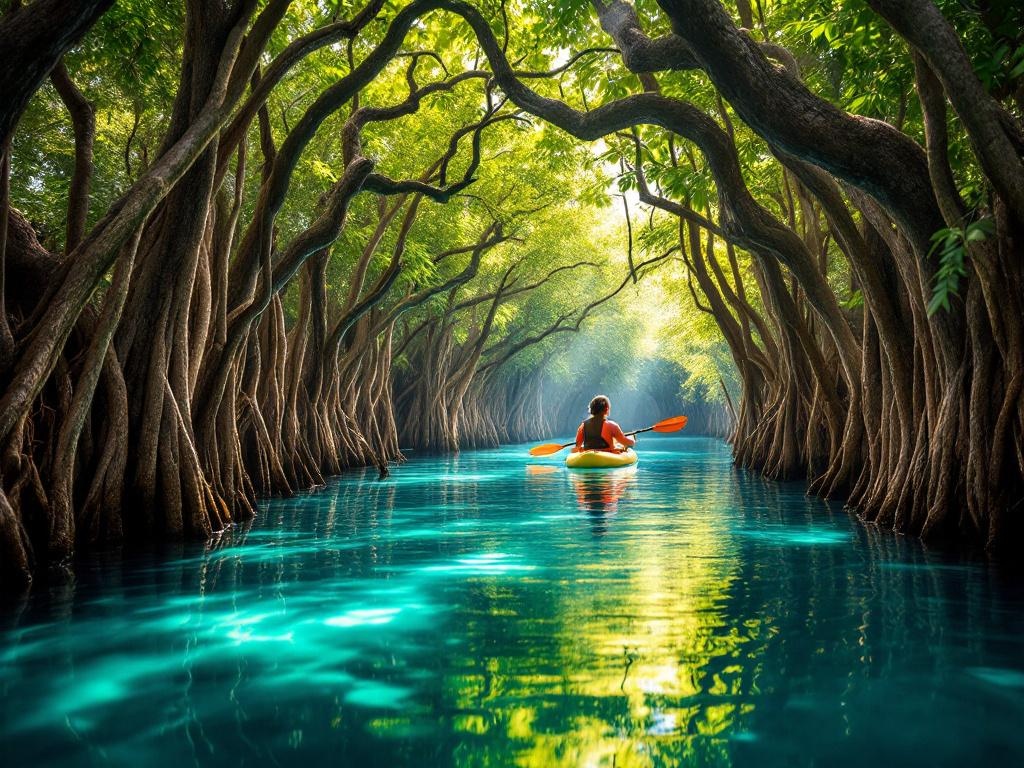
Between them lies the Rivière Salée, a mangrove channel a few metres deep, and to the north of it the Grand Cul-de-Sac Marin, a huge shallow bay closed by one of the longest coral reefs in the Lesser Antilles, with the largest mangrove forest in the region behind it. It is a UNESCO Biosphere Reserve and a Ramsar wetland, and it is the single most underrated thing on the island.
The archipelago's coasts divide the same way the wings do: the leeward Caribbean side is calm and good for swimming and diving, the windward Atlantic side has surf, current and, in recent years, sargassum. Distances are small — the whole main island is about 60 km across — but the mountain roads on Basse-Terre and the traffic around Pointe-à-Pitre mean nothing takes as little time as it should.
🌋 La Soufrière
La Soufrière — La Vieille Dame, the old lady — is an active volcano and the highest point in the Lesser Antilles at 1,467 m. It is not a symmetrical cone. It is a blunt, steep-sided lava dome, a mass of grey andesite pushed up in 1530, cracked by fissures, streaked yellow with sulphur, wrapped in cloud most days and audibly venting steam from fumaroles all over its summit and flanks. The name means the sulphur place, and you will smell it before you see anything.
It has not erupted magma since 1530. What it does instead is phreatic eruptions — steam explosions driven by groundwater hitting hot rock, which throw out old rock and ash without new lava. The last serious episode ran through 1976 and 1977 and produced the defining event in modern Guadeloupean memory: on the advice of volcanologists, the authorities evacuated about 73,000 people from the whole southern part of Basse-Terre, including the town of Basse-Terre, for several months.
No eruption of the feared kind followed, and the affair became a bitter public quarrel between scientists — Haroun Tazieff, who argued the evacuation was unnecessary, against Claude Allègre and the official assessment. It cost the local economy enormously and it damaged trust in expert advice for a generation. It is also, in hindsight, a reasonable decision made under genuine uncertainty about a volcano that had killed 30,000 people on Martinique seventy years earlier.
Climbing it
From the car park at Bains Jaunes, the path to the summit takes about 1.5–2 hours up. It is steep, permanently wet, and the summit is in cloud most of the time — go early, and accept that the view is a lottery you will probably lose. The volcano is monitored continuously by the IPGP observatory and access is closed when the alert level requires it.
What you actually see
Steaming fissures, sulphur crusts, dwarf cloud-forest vegetation, and the dome's cracked grey mass at close range. On a clear morning, the whole southern half of the island and Les Saintes. In cloud, about ten metres.
Alert level
The volcano has been on yellow alert for years, which is normal for an active dome and does not mean an eruption is expected. Check the observatory's current bulletin before climbing rather than a guidebook.
Bains Jaunes
Warm sulphurous pools in the forest on the way up, built as a bath in the 1880s. Free, easy to reach, and the best consolation prize when the summit is closed or clouded.
🌡️ Climate and When to Go
Tropical, with two seasons. Carême, the dry season, runs roughly December to April: less rain, steady trade winds, temperatures 25–30 °C and lower humidity. Hivernage, the wet season, runs June to November, hotter and much more humid, with heavy afternoon showers and the hurricane risk. May and November are transitional.
Rainfall is wildly uneven across a small island: the heights of Basse-Terre get up to about 10 metres a year, while the eastern tip of Grande-Terre at Pointe des Châteaux gets barely one. You can drive from rainforest to semi-desert in forty-five minutes, and it is worth planning around — if it is raining on the volcano, go east.
December–April
High season, best weather, highest prices. Carnival runs from Epiphany through to Ash Wednesday and beyond, which is a reason to come rather than a reason to avoid. Book accommodation and car hire months ahead — cars in particular sell out.
May–June
The best value window. Warm, greener, prices down, and the hurricane risk still low. Note that sargassum on the Atlantic coasts is often at its worst in spring and early summer.
July–August
French school holidays, so flights and hotels fill with visitors from the mainland. Hot, humid, and the start of hurricane season. Local festivals, including the Fête des Cuisinières in August, are excellent.
September–October
Peak hurricane season and the quietest, cheapest months. Some businesses close. Anyone travelling now needs insurance that covers weather disruption and should watch the forecasts — Hugo in 1989 remains the reference storm here.
The short answer: February to April for the weather and the carnival, May or June for value. And the practical warning that no brochure prints: sargassum, the floating brown seaweed that has affected the eastern Caribbean since 2011, can foul the Atlantic-facing beaches for weeks at a time and smells strongly as it rots. It is monitored and forecast publicly — check before booking a place on the windward coast.
🗺️ Map
Guadeloupe sits in the middle of the Lesser Antilles, between Antigua to the north and Dominica to the south, about 6,800 km from Paris and roughly 7,600 km from Prague. Pointe-à-Pitre's airport is on Grande-Terre, close to the bridge that joins the two wings.
Orientation: Pointe-à-Pitre, Les Abymes and the airport in the middle where the wings meet; Le Gosier, Sainte-Anne and Saint-François along the south coast of Grande-Terre with the beaches, ending at Pointe des Châteaux. On Basse-Terre, Deshaies in the north-west, Malendure and the Cousteau Reserve on the west coast, the town of Basse-Terre and the volcano in the south, and the national park across the middle. Ferries to Les Saintes, Marie-Galante and La Désirade leave from Pointe-à-Pitre, Trois-Rivières and Saint-François.
📜 Karukera Before 1635
The archipelago was settled from South America over several waves, first by Arawakan-speaking peoples from around 300 BC and later by the Kalinago, who were established here when Europeans arrived. Their name for the island, Karukera, is the one Guadeloupe uses for itself today when it wants to speak in its own voice.
Columbus landed in November 1493 on his second voyage, at what is now Sainte-Marie on Basse-Terre, and named the island after a Spanish monastery. Spain made repeated attempts at settlement over the following century and gave up each time: the Kalinago of the Windward Islands were organised, seaborne and effective at resisting, and Guadeloupe had no gold to justify the cost.
The French arrived in 1635, sent by the Compagnie des Îles d'Amérique under Charles Liénard de L'Olive and Jean du Plessis d'Ossonville. What followed was not settlement alongside the Kalinago but a war of extermination over roughly a decade, ending with the survivors killed, enslaved or driven to Dominica and Saint Vincent. By the 1650s there was no Kalinago community left in Guadeloupe.
What survives is in the landscape and the language: petroglyphs at the Parc archéologique des Roches Gravées at Trois-Rivières, carved between roughly AD 300 and 700 and among the best-preserved in the Caribbean; a scatter of Kalinago words in Creole, including for canoe, hammock and hurricane; and the name Karukera itself.
⛓️ Sugar and Slavery
Guadeloupe under France became what every Lesser Antillean island became: a sugar colony worked by enslaved Africans. The plantation system arrived in the 1640s, and by the eighteenth century the island's economy, society and law were organised entirely around it, under the Code Noir of 1685, which regulated the treatment of enslaved people as property.
The scale matters. Over the course of the trade, several hundred thousand Africans were landed in the French Antilles; on the eve of abolition Guadeloupe's enslaved population was around 90,000 against a few thousand free colonists. Sugar made Guadeloupe so valuable that in 1763, at the Treaty of Paris, France chose to keep it and Martinique and hand Britain the whole of Canada — a trade that made economic sense at the time and is still taught in Guadeloupean schools as a measure of what the island was worth.
Britain occupied the island several times, most consequentially in 1794, when a French republican expedition under Victor Hugues retook it, brought with him the National Convention's decree abolishing slavery, and freed the enslaved population — arming many of them. What followed under Hugues was liberation and terror at the same time: the guillotine was set up in Pointe-à-Pitre and used extensively against royalists and the planter class.
The freedom lasted eight years. In 1802 Napoleon sent an expedition under General Richepanse to restore slavery in the French Antilles, and Guadeloupe was the place where that restoration was resisted by force.
🔥 Delgrès at Matouba
Louis Delgrès was a free man of colour from Martinique, a career officer in the French republican army, and by 1802 a colonel commanding troops in Guadeloupe. When Richepanse's expedition arrived in May 1802 with orders that everyone understood would mean the return of slavery, Delgrès refused to submit and issued a proclamation from Basse-Terre — À l'univers entier, le dernier cri de l'innocence et du désespoir, "to the whole universe, the last cry of innocence and despair" — which is one of the founding texts of Caribbean anti-slavery.
He was outnumbered and outgunned. After holding the fort at Basse-Terre and then retreating up the volcano's flank, Delgrès and around three hundred of his fighters made a stand at the Danglemont estate at Matouba. On 28 May 1802, with the position about to fall, they blew up their own powder magazine, killing themselves and a large number of the attacking troops. The slogan attributed to them, Vivre libre ou mourir — live free or die — is on monuments across the island.
Slavery was restored and lasted another forty-six years, and Delgrès was written out of official French history for most of that time. He was rehabilitated slowly through the twentieth century and given a plaque in the Panthéon in Paris in 1998. In Guadeloupe he never needed rehabilitating.
Final abolition came on 27 May 1848 — the date is a public holiday here, distinct from the French mainland's commemorations — driven in Paris by Victor Schœlcher and on the ground by enslaved people who had already stopped waiting. After abolition the planters recruited indentured labour from India: some 40,000 arrived between 1854 and 1889, and their descendants are a visible and self-conscious part of Guadeloupean society, with Hindu temples still active in the north-east.
🇫🇷 1946 and What It Meant
On 19 March 1946 a law made Guadeloupe, Martinique, French Guiana and Réunion full French departments, with the same legal status as any department in mainland France. The rapporteur of the bill was Aimé Césaire, the Martinican poet and deputy, and the demand came from the colonies themselves: equality of rights, equality of pay, equality of social protection.
What was delivered was slower and more partial than what was promised. Wage and benefit parity with the mainland took decades and in some respects arrived only in the 1990s. Meanwhile the local economy was restructured around imports from France and public employment, the sugar industry declined, and a state agency organised the emigration of tens of thousands of young Guadeloupeans to work in the mainland public sector — a programme called BUMIDOM that ran from 1963 to 1981 and is remembered here with considerable bitterness.
What it gave
French passports and EU citizenship, the euro, motorway-standard roads, a modern hospital system, universal schooling, French social security and family benefits, and the right to vote in elections that decide who governs France.
What it cost
An economy that imports most of what it eats from 6,800 km away, an unemployment rate persistently around twice the mainland's, high youth emigration, and prices that are far above mainland levels for the same goods.
Status debate
Independence has never had majority support. In 2003 Guadeloupe voted against a proposal to merge its regional and departmental councils, unlike Martinique and French Guiana, which later became single territorial collectivities. Autonomy within France, rather than departure from it, is where most of the argument sits.
Political weight
Four deputies and three senators in Paris, a regional council and a departmental council in Guadeloupe, and a prefect appointed by the French state. Local politics is intensely competitive and Guadeloupean politicians are regular figures in French national debate.
🕯️ May 1967 and the 2009 Strike
In May 1967 a strike by construction workers in Pointe-à-Pitre, over a 2% pay rise, ended with French security forces firing on demonstrators over two days. The official death toll given at the time was eight. Local accounts, and subsequent research, have argued for figures many times higher, and the events were effectively absent from French official history for decades. In 2016 a commission set up by the French state, chaired by the historian Benjamin Stora, examined the archives and concluded that the state bore responsibility; a memorial commission and further declassification followed. The number of dead is still contested and the case is still raw.
Forty-two years later, in January 2009, Guadeloupe stopped completely. A coalition of unions and associations called LKP — Liyannaj Kont Pwofitasyon, roughly "alliance against profiteering" — led a general strike over the cost of living that lasted 44 days, shut the island down, spread to Martinique, and ended with agreements including a monthly rise for the lowest-paid. Its leader, Élie Domota, became a national figure in France.
The word pwofitasyon is the key to understanding modern Guadeloupe. It means exploitation of a specific kind: the structure by which a small number of import and distribution groups, several of them descended from the old planter families known as békés, control what the island buys and at what price. Food in Guadeloupe costs on the order of a third more than the same goods in mainland France, in a place where incomes are lower. Every few years the question returns to the streets, most recently in the movements of 2021 and after.
For a visitor this matters in two ways. It explains supermarket prices that will surprise you if you have shopped in France. And it means that a strike or a roadblock is a normal, legitimate and occasionally trip-disrupting part of Guadeloupean political life — check local news before travel days rather than being surprised.
☠️ Chlordécone
From 1972 to 1993, an organochlorine pesticide called chlordécone (kepone) was sprayed on banana plantations in Guadeloupe and Martinique to control the banana weevil. It was banned in the United States in 1976 after a poisoning disaster at the plant that made it. France banned it in 1990. Guadeloupe and Martinique were granted exemptions to keep using it until 1993.
Chlordécone does not break down. It is expected to remain in the soil for several centuries. It has contaminated agricultural land, rivers, groundwater and coastal waters across large parts of both islands, and through them the food chain. A 2018 study by Santé publique France found the molecule in the blood of over 90% of the adult population of Guadeloupe and Martinique. Guadeloupe and Martinique have among the highest recorded incidences of prostate cancer in the world, and French research bodies have recognised the link between chlordécone exposure and that risk; it has been recognised as an occupational disease for agricultural workers since 2021.
The legal reckoning has not come. A criminal investigation opened in 2006 ran for seventeen years and was dismissed in January 2023 on the ground that the offences were time-barred — a non-lieu that produced protests across both islands and was widely experienced as a second injury. The French President has described the contamination as an environmental scandal for which the state bears its share of responsibility, and compensation and monitoring programmes exist. The court case is over; the anger is not.
For a visitor the practical points are narrow and worth knowing. Commercially sold produce is monitored and controlled, and eating in restaurants and buying in shops carries no meaningful additional risk. Fishing is prohibited in defined contaminated zones, and root vegetables from unregulated informal sources in affected areas are the specific thing local health advice warns about. Do not lecture anyone about it; do understand why the subject is not small talk.
👥 The People
About 378,000 people live in Guadeloupe, and the population is falling — it has lost tens of thousands since its peak around 2010, almost entirely through the emigration of people in their twenties to mainland France for study and work. The result is one of the fastest-ageing societies in France, with all the consequences for schools, health care and the labour market that implies.
The population is overwhelmingly of African and mixed descent, with a substantial Indian-descended community from the indenture period, a small and economically significant white Creole minority — the békés — descended from the planter families, mainland French residents (métropolitains, colloquially zoreilles), Haitians, Dominicans and Syro-Lebanese traders. It is a stratified society and the stratification maps uncomfortably well onto the colonial past, which is a large part of what the word pwofitasyon is about.
Most people live on the flat: the urban belt of Pointe-à-Pitre, Les Abymes and Baie-Mahault holds well over a third of the population, with Le Gosier and the Grande-Terre south coast attached to it. Basse-Terre island, despite being larger, is much emptier away from its western coast road.
Manners are French with a Caribbean layer. You say bonjour on entering any shop, bakery or waiting room, and not doing so registers as rudeness exactly as it does in France; you shake hands or, among people who know each other, exchange cheek kisses. Beyond that, the pace is slower than Paris and the tolerance for being late is much higher — the local phrase for it is l'heure créole, and it applies to social occasions rather than to ferries.
🗣️ French and Kréyòl
French is the official language, the language of school, administration, media and every sign you will read, and everyone speaks it. What people speak among themselves is Guadeloupean Creole — kréyòl gwadloupéyen — a French-lexifier creole with West African grammatical structure, spoken by the large majority of the population and shared, with differences, with Martinique, Dominica and Saint Lucia.
Creole is not broken French and Guadeloupeans are firm about that. It has its own orthography, its own grammar, its own literature and a place in the school system that was fought for and won: it can be taken as a subject at the baccalauréat, and there is a CAPES teaching qualification in Creole. The historical stigma has not entirely gone, and older speakers may still tell you they do not speak it well, which is usually untrue.
English
Much less useful here than elsewhere in the Caribbean. In hotels, dive centres and the airport, fine; in a village bakery or at a roadside stall, plan on French. Any French at all is warmly received.
Useful Creole
Bonjou — good morning. Ka ou fè? — how are you? An byen — I'm fine. Mèsi — thank you. Sé bon — that's good. Doudou — darling, and the word every visitor hears first.
Creole in print
Guadeloupean literature is substantial and mostly written in French with Creole running through it — Maryse Condé above all, plus Simone Schwarz-Bart, Ernest Pépin and Gisèle Pineau. Condé's Segu and I, Tituba are the usual entry points and both exist in Czech translation.
Place names
Read them as French and you will be understood: Deshaies is "day-ay", Le Moule is "luh mool", Anse is a cove, Morne is a hill, Trace is a forest path, Souffleur is a blowhole. Half the map is a description of the terrain.
🥁 Gwoka
Gwoka is the music, dance and social practice built around the ka, a barrel drum traditionally made from a salted-meat cask with a goatskin head. The drummer sits astride the drum and plays it with bare hands — no sticks — using the heel of the foot on the skin to bend the pitch. It descends directly from the music of the enslaved, and it was for a long time despised by respectable colonial society for exactly that reason.
There are seven fundamental rhythms — among them léwòz, the warlike one associated with resistance, kaladja, toumblak, graj and woulé — and each carries its own dance and its own occasion. The classic form is the léwòz, a night gathering where a circle forms, a lead singer calls, the circle answers, and dancers take turns in the middle facing the lead drum in a dialogue that is improvised and competitive.
Gwoka was inscribed on the UNESCO Representative List of the Intangible Cultural Heritage of Humanity in 2014, which is the only UNESCO listing Guadeloupe has — the archipelago has no World Heritage Site, a point worth remembering when you read otherwise. The inscription was itself controversial locally, with some practitioners arguing that a French state application for a music of resistance missed the point.
You can hear it. The Festival de Gwoka at Sainte-Anne in July is the big one; léwòz nights happen year-round in villages across Basse-Terre and are advertised locally rather than internationally; and the modern gwoka moderne current, from the Marcel Lollia (Vélo) tradition through musicians like Gérard Lockel and the Sonny Troupé generation, is on record and worth hearing before you arrive.
🎭 Carnival
Guadeloupe's carnival is longer than almost anyone else's. It opens on Epiphany, 6 January, and runs every weekend for two months, building through the great days of Carnival Sunday and Monday to Mardi Gras — and then, unlike almost everywhere else, it does not stop. Ash Wednesday here is a carnival day in its own right, when everyone dresses in black and white and the effigy of Vaval, the carnival king, is burned amid ritual mourning. Mi-Carême, in the middle of Lent, brings a final devils' day.
It is a participatory carnival rather than a spectator one. The groupes à peau — skin groups — parade with ka drums, conch shells and chac-chacs rather than trucks and sound systems, and the sound of a hundred drums coming down a street is the thing people come back for. The groupes à caisse claire with brass and snare are the other tradition, and the two coexist with occasional friction.
Mas a Kongo
Bodies covered in a mixture of oil and soot, chains, and a deliberate assault on the crowd's cleanliness — the Guadeloupean cousin of Trinidad's Jab Molassie and the same historical statement. Do not wear anything you want to keep.
Mas a Lanmò
The death mask: white or skeleton costume, slow movement, silence in a loud parade. One of the oldest and least touristic elements.
Where to be
Pointe-à-Pitre and Basse-Terre for the biggest parades, but the village carnivals on Basse-Terre and on Marie-Galante are where the drums are closest and the crowd is local. The Sunday before Mardi Gras is the peak.
Practicalities
Accommodation and car hire for the carnival weeks need booking months ahead. Roads close without much notice, and the parade route is not the place to have a schedule.
🍽️ Food
Guadeloupean cooking is Creole: African technique and French method, with Indian spice from the indenture period and Caribbean ingredients throughout. It is one of the best-eating islands in the Caribbean and it takes food seriously in a way that is recognisably French — there are cuisinières who are locally famous, an August festival in their honour, and strong opinions about everyone else's colombo.
The core dishes: colombo, the Antillean curry, of chicken, goat or pork, whose spice mix came with Tamil indentured workers and is named after the Sri Lankan capital; accras de morue, salt-cod fritters, eaten everywhere as an aperitif; boudin créole, a spiced blood sausage; court-bouillon, fish poached in a tomato and lime sauce; bébélé from Marie-Galante, a tripe and breadfruit stew that takes a day; and matoutou or matété de crabes, the land-crab dish eaten at Easter, for which crabs are fattened for weeks beforehand.
Bokit
The national street food: dough fried until it puffs, split, and filled with saltfish, chicken, cheese or anything else. Sold from vans and shacks everywhere, cheap, and the correct lunch after a morning in the water.
Sauce chien
The universal Antillean condiment — chopped onion, garlic, parsley, lime, chilli and hot water — served with grilled fish and meat. The name means "dog sauce" and nobody agrees why.
Sweet things
Blanc-manger coco, a set coconut cream; tourment d'amour, the coconut-jam tart of Les Saintes sold warm at the ferry; sorbet coco, churned by hand in a wooden bucket at the roadside; and French bakery, which is exactly as good as it is in France.
Where to eat
The lolos — small family restaurants and beach shacks — serve the best food on the island at a fraction of restaurant prices. Sunday lunch is the main meal of the week and places fill; book or arrive early.
🍛 Colombo de Poulet
Colombo is the dish that shows Guadeloupe's Indian layer most clearly. The poudre de colombo spice mix — coriander, turmeric, cumin, mustard seed, fenugreek, black pepper, sometimes clove and rice toasted with it — arrived with Tamil indentured labourers in the nineteenth century and became Antillean. It is milder and more aromatic than most Indian curry powders and the aubergine and squash in the pot are the Caribbean contribution.
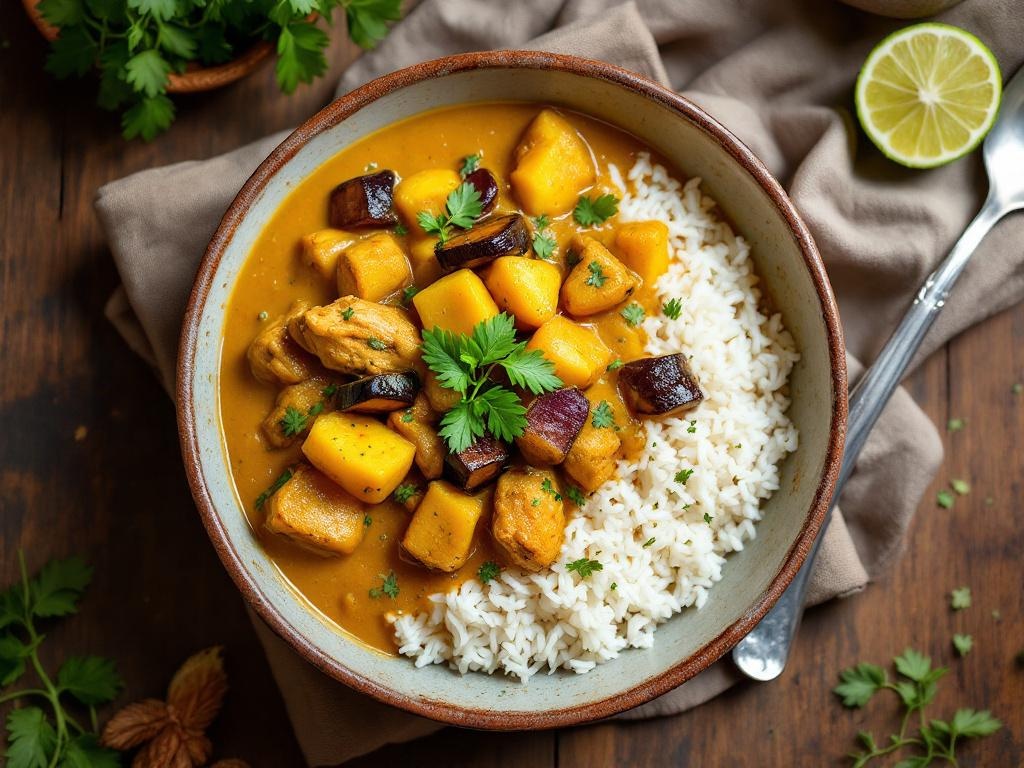
Colombo de poulet
Serves 4 · 1 hour 15 minutes
Ingredients: 1 kg chicken thighs and drumsticks, bone in; 3 tbsp poudre de colombo (or a mild curry powder plus a pinch of fenugreek and mustard powder); 2 onions; 4 cloves garlic; a thumb of ginger; 2 aubergines in chunks; 300 g squash or sweet potato in chunks; 2 courgettes; 3 tbsp oil; 2 tbsp tamarind paste or the juice of 1 lime; a bouquet of thyme and parsley; 1 whole scotch bonnet, unbroken; 500 ml water or stock; salt.
Method: Marinate the chicken for at least an hour with half the colombo powder, the crushed garlic, grated ginger, lime juice and salt. Brown the pieces hard in the oil in a heavy pot and set aside. Soften the onions in the same pot, add the rest of the colombo powder and cook it 30 seconds until it smells. Return the chicken, add the water, the herbs and the whole chilli, cover and simmer 30 minutes. Add the aubergine and squash, simmer 20 more minutes, then the courgette for the last 10. Fish out the chilli, stir in the tamarind, check the salt, and serve with plain white rice and red beans.
💡 The chilli goes in whole and must come out whole — a burst scotch bonnet turns a family dish into a dare. Heat is added at the table with sauce chien, never in the pot.
🐟 Accras de Morue
Accras are the fritter that opens every Guadeloupean meal, every aperitif and every party. The base is salt cod — morue, the preserved Atlantic cod that reached the Caribbean through the triangular trade and stayed in the cooking long after the trade ended — pounded into a spiced batter and dropped into hot oil by the spoonful.
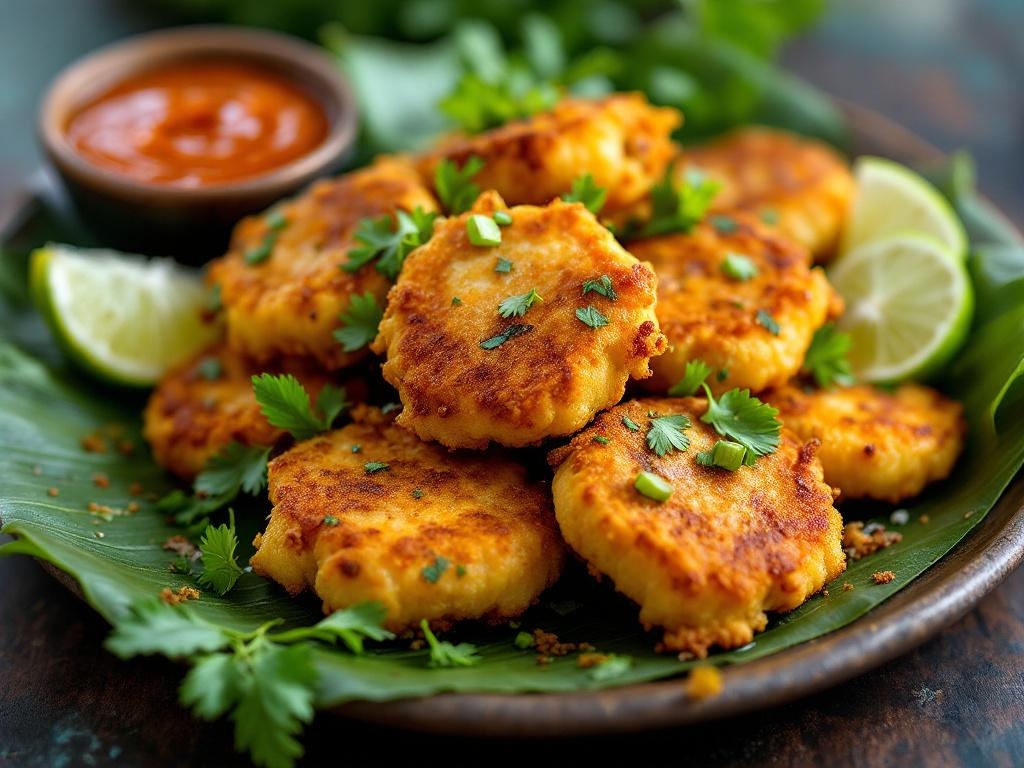
Accras de morue
Makes about 30 · 30 minutes plus overnight soaking
Ingredients: 300 g salt cod; 250 g plain flour; 1 sachet (7 g) baking powder; 1 egg; about 200 ml water; 4 spring onions; 3 cloves garlic; a small bunch of parsley and chives; 1 sprig thyme; ½ scotch bonnet, seeded and very finely chopped (or less); black pepper; oil for deep frying.
Method: Soak the salt cod for 24 hours in cold water, changing the water three or four times. Poach it 10 minutes, drain, cool, then remove all skin and bone and shred it finely with your fingers — this step decides the texture and cannot be done in a processor. Chop the aromatics very fine. Mix the flour and baking powder, beat in the egg and enough water to make a thick batter that just falls from a spoon, then fold in the fish, aromatics and chilli. Rest 30 minutes. Heat oil to 170–180 °C and drop the batter in by teaspoonfuls, a few at a time; they will puff and turn. Fry 3–4 minutes to deep gold, drain on paper, salt lightly, and eat within ten minutes.
💡 Do not salt the batter before tasting it — the cod carries its own salt and the amount left after soaking varies enormously. Fry one test accra first and season the rest from what it tells you.
🥃 Rhum Agricole
Most rum in the world is made from molasses, the by-product of sugar refining. Rhum agricole is made from fresh sugar-cane juice pressed within hours of cutting, fermented and distilled straight — a completely different drink, grassy, vegetal and sharp where molasses rum is sweet and round. It is the French Antillean style, and Guadeloupe makes a great deal of it.
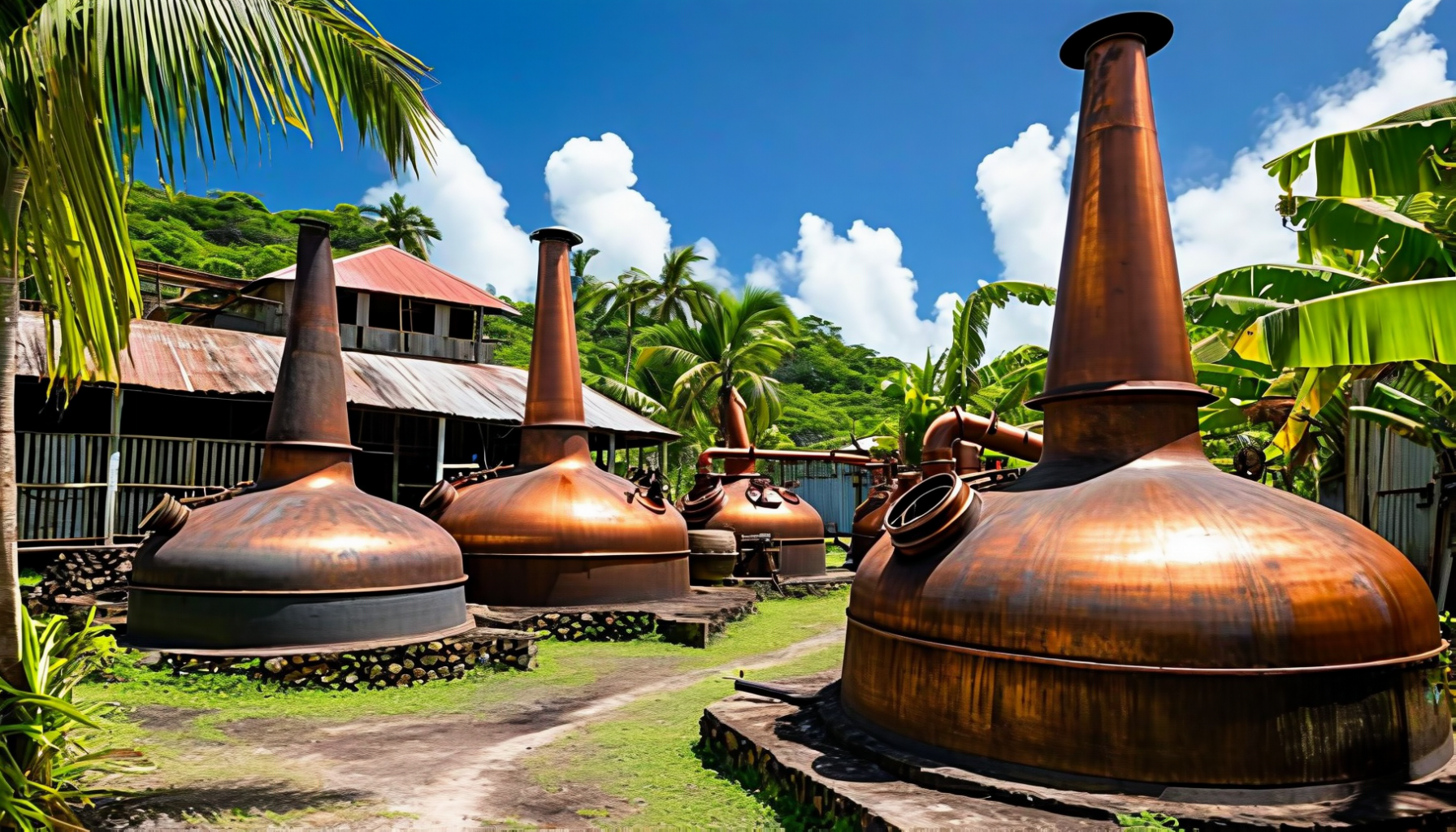
A precision that guidebooks routinely get wrong: the protected AOC for agricultural rum belongs to Martinique, not Guadeloupe. Guadeloupe's rums carry a protected geographical indication (IGP Rhum de Guadeloupe, with separate indications for Marie-Galante and Basse-Terre), which is a real quality scheme with real rules, just a different and slightly looser one. In practice this gives Guadeloupean distillers more freedom, and several of them use it.
On the main island
Damoiseau at Le Moule, the biggest; Longueteau and Karukera at Sainte-Marie, single-estate; Bologne at Basse-Terre, one of the oldest sites in the Antilles; Reimonenq and Montebello, both with visitable operations.
Marie-Galante
Three distilleries on an island of 11,000 people: Bielle, Bellevue and Poisson, whose Père Labat is bottled at 59% and is the island's calling card. Marie-Galante rums have their own IGP and a local reputation for being the strongest thing on the shelf.
How to taste it
White rhum at 50–59% is the everyday product and the base of ti-punch; ambré is briefly barrelled; vieux (VO, VSOP, XO) has spent years in oak and is drunk neat like a spirit. Start at the top of a distillery tasting and work down, not the reverse.
Taking it home
You are inside the EU, so there are no customs formalities flying to France or Czechia — only the airline's rules, which cap you at 70% ABV and at 5 litres per person of spirits above 24%. The 59% bottles are legal to carry; anything above 70% is not.
🍹 Ti-Punch
The Antillean drink, and one that visitors almost always get wrong because bars outside the Caribbean serve something else under the name. A real ti-punch is small, served in a squat glass, and contains three things: white rhum agricole, a spoonful of cane syrup, and a sliver of lime peel with a little flesh. No ice, or at most one cube added afterwards. No mint. No fruit juice. No salt on the rim. Nothing yellow about it.
It is also, by custom, mixed by the person drinking it. The bottle, the syrup and a saucer of cut lime arrive on the table and everyone builds their own — the phrase for this is chacun prépare sa propre mort, each prepares his own death, which tells you the expected strength. The formula usually quoted is one part syrup, two parts rum, the lime squeezed and dropped in, stirred with a wooden bois lélé.
Ti-punch
One glass · 2 minutes
Ingredients: 5 cl white rhum agricole (50–55%); 1 barspoon cane syrup (sirop de canne, not sugar syrup made from beet); a coin of lime peel with a thin layer of flesh still attached.
Method: Put the syrup in the bottom of a small heavy glass. Squeeze the lime coin over it and drop it in. Add the rum. Stir gently until the syrup has dissolved. Drink it in two or three mouthfuls, not sipped over an hour — it will separate and warm.
💡 The lime is peel, not a wedge of pulp: you want the oil from the zest and a suggestion of juice, not a squeezed lime. And use cane syrup — beet sugar syrup makes a technically similar and noticeably duller drink.
The other drinks worth knowing: planteur, rum with fruit juice and nutmeg, which is what most tourists actually want when they ask for ti-punch; rhum arrangé, white rum steeped for weeks with fruit, vanilla or spice, sold at every roadside and given as a gift; and Corsaire and Bière Lorraine for beer, though French and Dutch imports dominate the fridge.
🧺 Markets and What to Bring Home
The covered market at Pointe-à-Pitre — the Marché Saint-Antoine, universally called the spice market — is the standard visit and is a genuine working market wrapped in a fair amount of tourist trade. Sainte-Anne's market on the seafront, Saint-François, and the Saturday markets in the Basse-Terre villages are less pressured and cheaper.
Spices
Vanilla pods, nutmeg and mace, cinnamon bark, colombo powder, bois d'Inde (West Indian bay), and the ubiquitous packaged "rhum arrangé kits". Buy colombo powder from a market stall rather than a souvenir shop; the difference in freshness is obvious.
Rum
Cheaper at a supermarket than at the airport and cheapest at the distillery. Bear in mind the airline limits noted above, and pack bottles in checked luggage wrapped in clothes — glass and baggage handlers do not mix.
Madras
The bright checked cotton used for the traditional dress and the headwrap. Sold by the metre and made up into everything. The number of points tied into a headwrap traditionally signalled marital availability, which is now a joke people make rather than a code anyone reads.
Food to carry
Vacuum-packed coffee from the Basse-Terre plantations, cocoa sticks for making cocoa tea, tinned chatrou (octopus), and vanilla. All fine within the EU; note that fresh fruit and plants are not, even inside the EU, because of plant-health rules for the outermost regions.
One warning that applies across the Antilles: haggling is not the local custom in a French market and attempts at it land badly. Prices at market stalls are prices. The exception is craft goods aimed squarely at cruise passengers, where a polite question about a better price for two items is normal.
🌋 Basse-Terre Island
The western wing is the green one, and most of its interior is the Parc national de la Guadeloupe, created in 1989 and covering some 17,000 hectares of rainforest plus a large marine area. A single road, the Route de la Traversée, crosses the middle through the forest; everything else goes around the coast.
Down the west coast: Deshaies in the north, a fishing village that became internationally familiar as the location for the television series Death in Paradise and has the excellent botanical garden above it; Pointe-Noire and the coffee and cocoa country; Malendure, the black-sand beach opposite Pigeon Island and the base for the Cousteau Reserve; then Bouillante, where Guadeloupe's geothermal power station uses the same heat as the volcano.
In the south, the town of Basse-Terre is the administrative capital and one of the least touristed places on the island — an eighteenth-century grid under the volcano, with Fort Delgrès above it, worth an afternoon precisely because nobody else is there. Beyond it, Trois-Rivières has the Kalinago petroglyph park and the ferry to Les Saintes, and the road east runs along a wild coast to Capesterre-Belle-Eau, the banana country, and the famous avenue of royal palms at Allée Dumanoir.
The east coast of Basse-Terre is the wettest, least visited and in some ways most interesting part of the island: waterfalls off the road, the Grand Étang crater lake, rivers you can swim in, and villages where tourism has barely arrived.
🏝️ Grande-Terre
Flat, dry, limestone and populous. The south coast from Le Gosier through Sainte-Anne to Saint-François is the tourist coast — the calm-water beaches, the hotels, the marinas and the golf course — and it is genuinely lovely, if busy on Sundays when everyone from Pointe-à-Pitre comes to the same beaches.
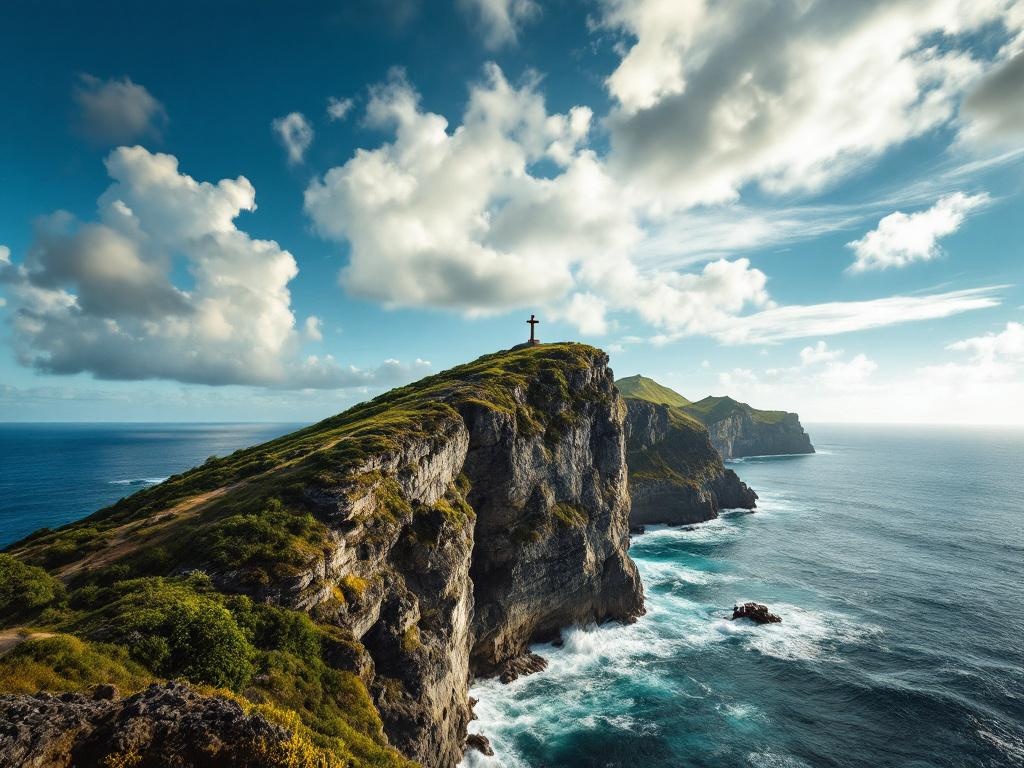
Past Saint-François the land runs out at Pointe des Châteaux, a spine of limestone reaching into the Atlantic with a cross on the hill above it, the sea breaking on both sides and Désirade on the horizon. It is a twenty-minute walk up, it is on every postcard, and it is still worth doing at either end of the day.
Pointe-à-Pitre
The economic capital, a working port city with fine nineteenth-century ironwork, a good market, the Musée Schœlcher and the Mémorial ACTe — the Caribbean Centre for the Expression and Memory of the Slave Trade and Slavery, opened in 2015 on the site of the old Darboussier sugar factory. A long black granite box wrapped in a silver root lattice, and the most serious museum of slavery anywhere in the region. Allow three hours.
The north coast
Wilder and emptier: Le Moule with its surf beach and the Damoiseau distillery, the cliffs at Porte d'Enfer and Pointe de la Grande Vigie at the northern tip, and the blowhole at Anse Bertrand. This is the windward side — spectacular, and not for casual swimming.
Grands Fonds
The low humid hills in the middle of Grande-Terre, a maze of small valleys settled after abolition by people who wanted to be away from the plantations, including the community historically known as blancs-matignon. Almost no tourism, which is the appeal.
Sugar
Grande-Terre still grows cane, and the Gardel factory at Le Moule is the last operating sugar mill in Guadeloupe. The Musée du Rhum at Sainte-Rose and the ruined windmills across the island are what is left of the rest.
⛵ Les Saintes
Les Saintes are a cluster of small islands 10 km south of Basse-Terre, of which two are inhabited: Terre-de-Haut, with about 1,500 people, and the quieter Terre-de-Bas. The Baie des Saintes is routinely listed among the most beautiful bays in the world, and for once the list is defensible — a deep blue bay ringed by green hills and small islets, with a village of red-roofed white houses along one shore.
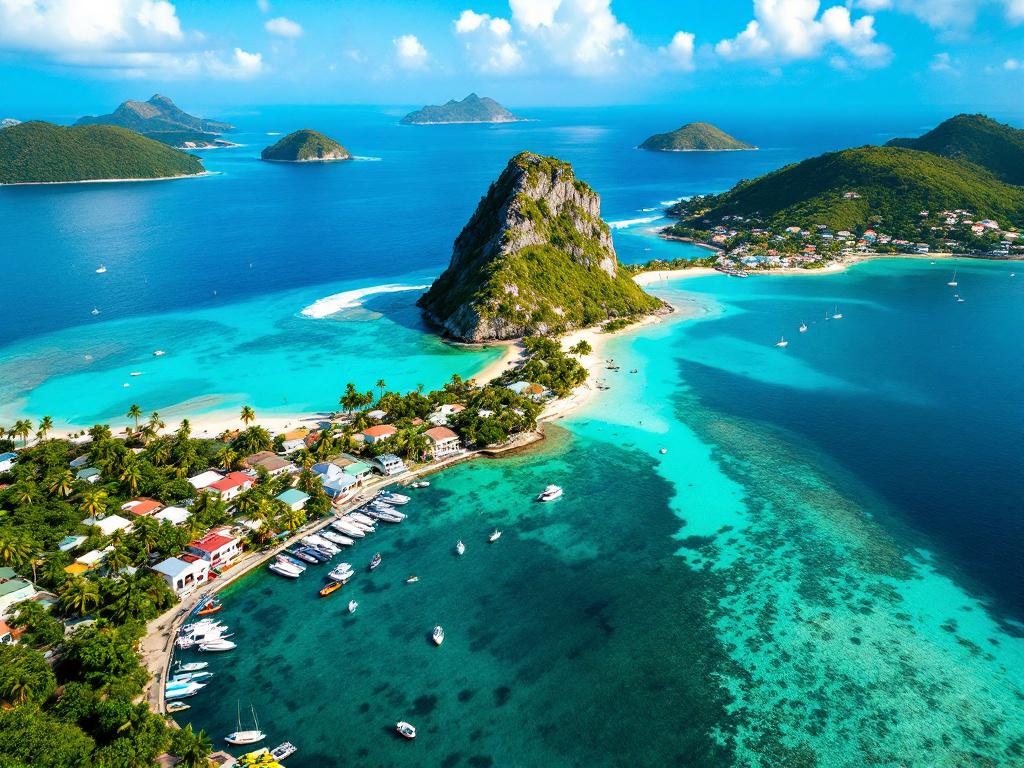
The islands were too dry and too steep for sugar, so they were never plantation islands and never had a significant enslaved population. They were settled instead by Breton and Norman fishing families, and the result is a place that looks and sounds different from the rest of Guadeloupe: a fishing culture, a distinctive local boat called the saintoise now used across the Antilles, and the wide-brimmed hat called the salako, brought back from Indochina in the nineteenth century.
Fort Napoléon
On the hill above the village, built in the 1860s, never fired a shot, now a museum with a cactus garden, iguanas and the best view of the bay. The naval history it covers includes the 1782 Battle of the Saintes, in which Rodney's British fleet broke the French line and ended French naval hopes in the Caribbean.
Le Pain de Sucre
The rounded headland on the west of the bay, with a small beach on either side and good snorkelling straight off the rocks. A short walk or a five-minute boat ride from the village.
Getting there
Ferries from Trois-Rivières (about 20 minutes, the shortest and cheapest), Pointe-à-Pitre and Basse-Terre. Day trips are easy; staying a night is much better, because the island empties in the late afternoon when the boats go.
Tourment d'amour
The coconut-jam tart sold warm at the ferry landing by women who have been making it for decades. Buy one for the boat. It is not optional.
Getting around Terre-de-Haut is on foot, by scooter or in a golf-cart taxi; cars are heavily restricted and visitors cannot bring them. The island is 6 km² and the walk over the ridge to the wild Atlantic beach at Grande Anse takes half an hour — swimming there is dangerous and signposted as such, and people ignore the signs every year.
🌾 Marie-Galante
Marie-Galante lies 30 km south-east of Grande-Terre: 158 km², about 11,000 people, almost perfectly circular, almost entirely flat, and known locally as l'île aux cent moulins — the island of a hundred windmills. There were once well over a hundred; some seventy stone towers survive in the cane fields, and one, the Moulin de Bézard, has been restored with its sails.
This is the Guadeloupe that agriculture never left. Cane still runs to the Grande Anse sugar factory, ox carts are still used on some smallholdings, and three distilleries operate on an island the size of a Prague district. The pace is different from the main island in a way that visitors notice within an hour of getting off the ferry.
The beaches
Plage de la Feuillère at Capesterre is a long protected white beach with a reef offshore and shallow warm water — probably the best swimming beach in the whole of Guadeloupe. Anse Canot and Moustique in the north-west are quieter.
Gueule Grand Gouffre
A collapsed sea cave on the north coast — an arch and a roaring hole in the cliff where the Atlantic comes in. Nearby, the Caye Plate and the Trou à Diable cave. The whole north coast is limestone theatre.
The distilleries
Bielle, Bellevue and Poisson (Père Labat), all visitable, all pouring, none of them far apart, and a designated driver strongly recommended. Marie-Galante rum has its own IGP and a fearsome local reputation.
Bébélé
The island's own dish — a long-cooked stew of tripe, breadfruit, green banana and dumplings, made for family occasions. If a restaurant offers it, order it; if someone invites you to one, cancel your plans.
Ferries run from Pointe-à-Pitre in about an hour, and from Saint-François and Les Saintes seasonally. It is easily a day trip and much better as two or three days; the island has small hotels and gîtes and very little else, which is the point.
🏜️ La Désirade and Petite-Terre
La Désirade is a long, dry limestone plateau 10 km east of Grande-Terre, about 1,500 people, one road, one bus, and a rock formation that is the oldest in the Lesser Antilles — the basement here is around 145 million years old, which is why geologists come. Columbus named it Desiderada, the desired one, because after a long Atlantic crossing it was the first land his second voyage saw.
Its history is bleaker than its beauty suggests. For much of the eighteenth and nineteenth centuries the island held a leper colony and, before that, a place of exile for people the French authorities and their own families wanted removed. The remains of both are on the plateau, along with a nineteenth-century meteorological station and a great deal of cactus.
It is the least visited inhabited island in the archipelago and the one to choose if what you want is emptiness: an unbroken beach at Baie-Mahault or Souffleur, goats, iguanas, a handful of restaurants, and no organised anything. The ferry runs from Saint-François in about 45 minutes.
Petite-Terre is different again — two uninhabited islets south of La Désirade, a national nature reserve since 1998, with a lighthouse, a lagoon, sea turtles, and one of the densest populations of the endangered Lesser Antillean iguana anywhere. Access is by licensed day-boat from Saint-François only, numbers are capped, and the rules — no touching, no feeding, no leaving the marked areas — are enforced by a warden who lives there. It is the single best wildlife day in Guadeloupe.
🏖️ Beaches
Guadeloupe's beaches vary more than most islands' because its two halves are geologically different. Grande-Terre's are white coral sand on calm leeward water; Basse-Terre's western coast is volcanic black and grey sand, which is dramatic, gets extremely hot underfoot, and photographs badly and swims well.
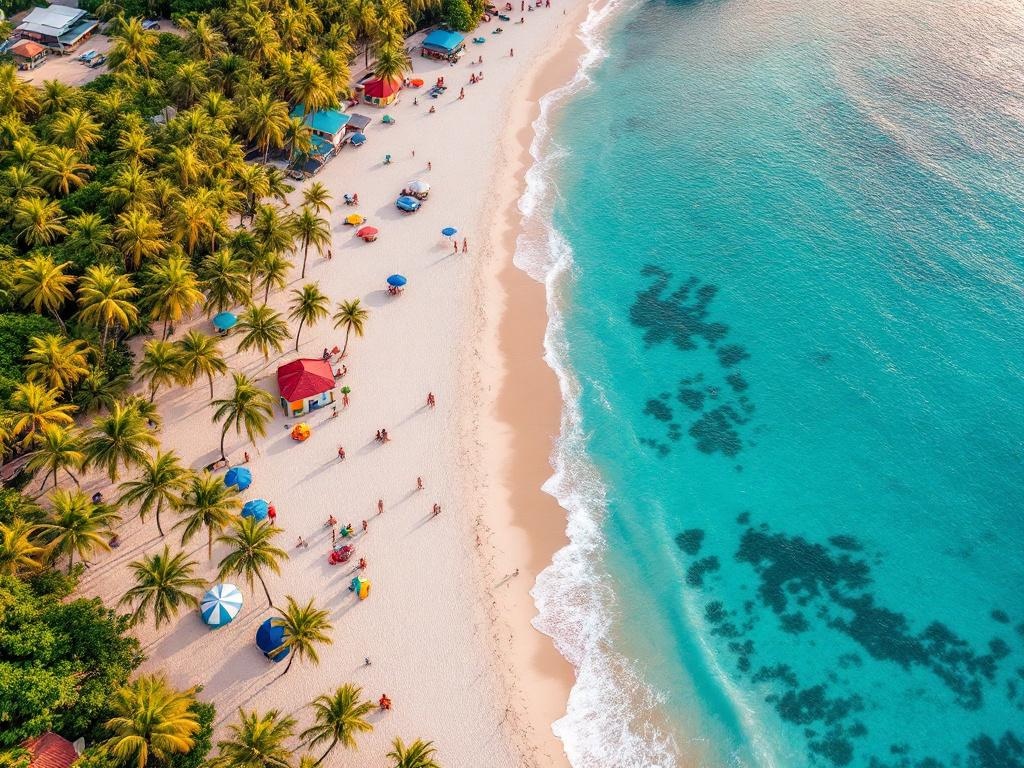
Plage de la Caravelle
At Sainte-Anne: a long protected white crescent with a reef offshore, calm shallow water and a Club Med at one end. The busiest good beach on the island and deservedly so.
Plage de Bois Jolan
Also at Sainte-Anne, and quieter: a huge shallow lagoon where you can wade a long way out over white sand. The best beach on the island for small children.
Grande Anse, Deshaies
The great beach of Basse-Terre — a wide golden arc backed by palms and a lagoon, on the north-west coast. There is a current at the northern end and it deserves respect.
Malendure
Black volcanic sand opposite Pigeon Island, with the dive boats leaving from it. Not a sunbathing beach; the best snorkelling entry point on the main island.
Two practical points. Every beach in Guadeloupe is public and free, including in front of hotels — this is French law and it is not negotiable. And break-ins to parked cars at beach and trailhead car parks are the single most common crime against visitors: leave nothing in the vehicle, leave it unlocked and empty if local practice suggests it, and never take a passport or a laptop to the beach.
🤿 The Cousteau Reserve and Diving
The Réserve Cousteau, around Pigeon Island off Malendure on the west coast of Basse-Terre, is Guadeloupe's best-known dive site and one of the most-dived pieces of water in the Caribbean. Jacques Cousteau surveyed and filmed here in the 1950s and 1960s and campaigned for its protection; a bronze bust of him sits on the seabed at about 12 m, which is either a pilgrimage or a cliché depending on how many times you have seen the photograph.
The diving is easy, warm and busy: shallow reef in 5–20 m, good visibility, turtles almost guaranteed, plenty of colourful reef fish, and boat trips leaving Malendure every hour or two. It is also excellent snorkelling — the shallow side of Pigeon Island is reachable on a snorkel trip and is one of the few places where a non-diver gets a genuinely good reef.
Beyond Pigeon
The Grand Cul-de-Sac Marin for reef and mangrove diving, the wrecks off Pointe-à-Pitre, the drop-offs off Les Saintes (better viz, fewer people), and the reserve around Petite-Terre. Marie-Galante has quiet reef diving with almost no traffic.
Whales and dolphins
The channel between Guadeloupe and Dominica is part of a marine mammal sanctuary and holds resident sperm whales and several dolphin species year-round, with humpbacks passing between January and April. Operators sail from Basse-Terre; choose one that follows the approach-distance code.
Kayaking the mangrove
The mangrove channels of the Grand Cul-de-Sac Marin are best seen from a kayak or a small boat, and this is the quietest and strangest half-day on the island — see the nature section for what lives in there.
Conditions
Water 26–29 °C all year, so a shorty is plenty. Currents in the channels between islands are real. As everywhere in the French system, dive centres are regulated and will want to see your certification and, for deeper dives, a medical certificate.
🌿 The National Park, Waterfalls and Mangrove
The Parc national de la Guadeloupe covers the mountainous spine of Basse-Terre and, with the Grand Cul-de-Sac Marin, forms a UNESCO Biosphere Reserve designated in 1992. It protects genuine primary rainforest — some 300 species of tree, tree ferns, epiphytes, and a permanent wetness that visitors from a temperate climate consistently underestimate.
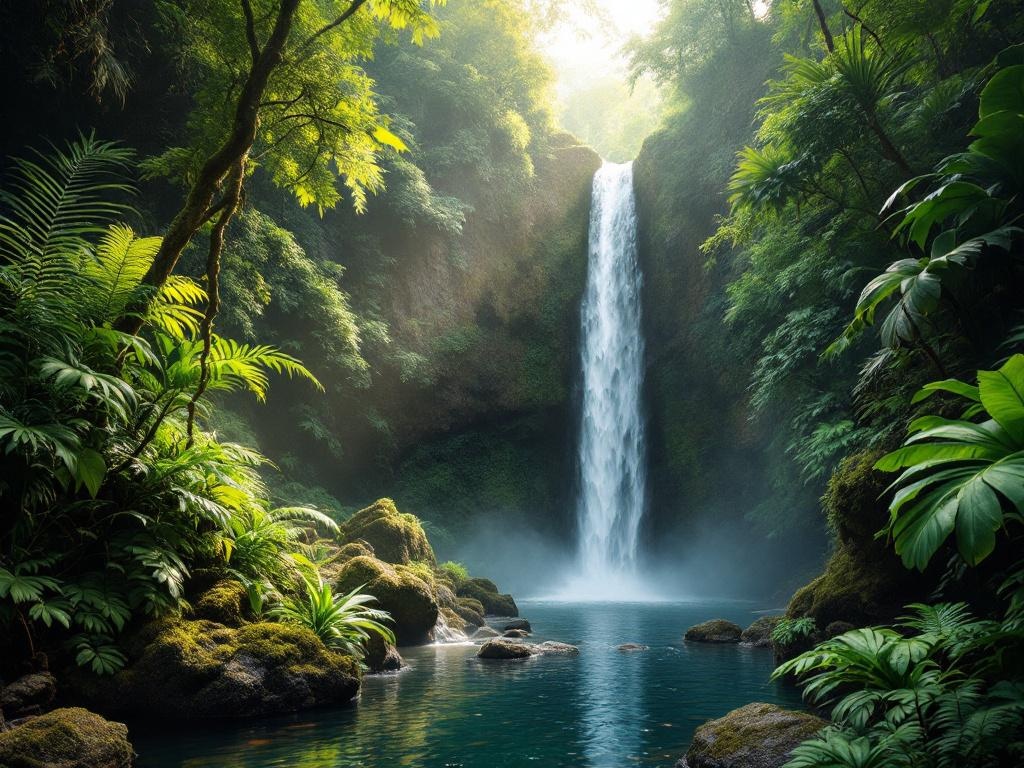
Chutes du Carbet
Three waterfalls on the Grand Carbet river. The second is the easy and famous one; the first is a harder hour-plus walk; the third is short and busy. Access can close after heavy rain or seismic activity and the closures are enforced.
La Traversée
The road across the park, with short trails off it: the Cascade aux Écrevisses (five minutes from the road, and the reason it is always crowded), the Maison de la Forêt, and the Mamelles peaks, two steep 30–45-minute climbs with real views.
The mangrove
The largest mangrove forest in the Lesser Antilles, in the Grand Cul-de-Sac Marin: red mangrove on stilt roots at the water, then black and white mangrove behind. It is a nursery for the reef fish, a filter for the lagoon, and a storm buffer for the coast.
What lives there
The raccoon on the park's emblem, once thought endemic and now understood to be an introduced North American raccoon; the introduced agouti; hummingbirds; the Guadeloupe woodpecker, the archipelago's only endemic bird; and no venomous snakes at all — unlike Martinique, Guadeloupe never had the fer-de-lance.
✈️ Getting There
Pointe-à-Pitre – Le Raizet (PTP), officially Guadeloupe Pôle Caraïbes, is the archipelago's airport, on Grande-Terre a few kilometres from the city. It is a busy airport by Caribbean standards because it is a domestic French route: the Paris flights are the equivalent of a long internal flight, and they run several times a day in high season.
Via Paris
The standard route from Prague. Paris (Orly, mostly) to Pointe-à-Pitre is about 8.5 hours nonstop with Air France, Air Caraïbes, Corsair and French Bee. Prague to Paris adds two hours plus the connection. Because the second leg is a domestic French flight, your bags check through and there is no separate immigration on arrival — but see the note below about Schengen.
Other European gateways
Seasonal or charter services run from Brussels, Amsterdam, Frankfurt and Zurich in winter, mostly aimed at package travellers. Worth checking against the Paris routing, which is usually cheaper and always more frequent.
Within the Caribbean
Air Antilles and Air Caraïbes link Guadeloupe with Martinique, Saint Martin, Saint Barthélemy, Dominica, Santo Domingo and beyond, and there is a fast ferry (L'Express des Îles, Val'Ferry) to Dominica, Martinique and Saint Lucia. Island-hopping from here is realistic in a way it is not from most Caribbean islands.
Cruise
Pointe-à-Pitre has a cruise terminal and takes a substantial number of calls. As usual, a cruise day gives you the Mémorial ACTe and one excursion.
Budget, honestly: a return Prague–Pointe-à-Pitre via Paris typically lands between 15,000 and 30,000 CZK depending on season and booking horizon, with February, Easter and the French summer holidays at the top of that range. Total door-to-door time is 14–18 hours.
🚗 Getting Around
You need a car. This is the single most useful sentence in this section. Public transport exists but is thin, slow and not designed for visitors; the sights are spread over two islands and a national park; and taxis are expensive by any standard. Hire cars are cheap by comparison and abundant — except in February and at Easter, when the island genuinely runs out and people who did not book in advance do not get one.
Driving
On the right, French rules, French signage, Czech licence valid without any additional permit. The roads are good; the driving is fast, close and impatient, and the mountain roads on Basse-Terre are narrow with blind bends. Rush hour around Pointe-à-Pitre and the Jarry industrial zone is severe — avoid crossing between the wings at 7–8:30 and 16:00–18:00.
Buses
Local networks run on the main corridors, cash fares, no useful timetable in practice. Usable for a short hop between Le Gosier and Pointe-à-Pitre; not usable for a day out.
Ferries
The way to the outer islands, and reliable. Les Saintes from Trois-Rivières (20 min) or Pointe-à-Pitre; Marie-Galante from Pointe-à-Pitre (about 1 h); La Désirade from Saint-François (45 min). Book ahead in high season and note that schedules thin out on Sundays and change between seasons.
Fuel and parking
Fuel is priced by administrative decision and is uniform across the island. Parking is free almost everywhere outside Pointe-à-Pitre, and car break-ins at beach and trail car parks are the main crime risk on the island — leave nothing visible, ever.
💰 What It Costs
Guadeloupe uses the euro and runs on French prices with a Caribbean surcharge. The rough rule is that food costs on the order of a third more than the same items in mainland France, and imported goods often considerably more; restaurant and hotel prices are broadly comparable with the French Riviera in season. This is the pwofitasyon question described earlier, and it is a live political grievance rather than a quirk.
Accommodation
Gîtes and studios from about €60–90 a night (roughly 1,500–2,300 CZK); mid-range hotels €120–200; the beach resorts on Grande-Terre a good deal more. Self-catering gîtes are the local norm and the best value by a distance.
Eating
A lolo or a bokit van will feed you for €8–14; a restaurant main course runs €18–30; a full menu at a good Creole restaurant €35–50. A supermarket shop is the shock — budget noticeably more than you would in France for the same basket.
Car hire
From about €30–45 a day booked ahead, considerably more if you turn up in February without a reservation. Fuel is comparable to mainland France.
Activities
A two-tank dive €90–110; a snorkel trip to the Cousteau reserve €30–40; the Petite-Terre day boat around €90 with lunch; a ferry to Les Saintes €25–35 return; Mémorial ACTe entry about €15.
A working figure for two people self-catering in a gîte with a hire car, eating out most evenings, is around €120–180 per day for the pair — roughly 3,000–4,500 CZK — excluding flights. Cooking a few meals from the market rather than the supermarket makes a real difference, both to the budget and to the food.
📋 Practical Information
Entry. Guadeloupe is France and part of the European Union, so as a Czech citizen you travel here on freedom-of-movement rules with a valid identity card or passport. But note the exception that catches people out: the French overseas departments are in the EU and outside the Schengen Area, so there is a border check on arrival even on a Paris flight. Carry the document in your hand luggage rather than the hold, and note that if a non-EU family member is travelling with you, their Schengen visa is not valid here and a separate DOM visa may be required.
Health cover works, for once. Unlike most of the Caribbean, Guadeloupe is covered by EU social-security coordination: your European Health Insurance Card (EHIC / Evropský průkaz zdravotního pojištění) is valid, and the French public system will treat you on the same terms as a French resident. The hospitals are French hospitals. Commercial travel insurance is still worth having for repatriation, cancellation and diving cover, but you are not in the position you would be in Grenada or Greenland.
Roaming and plugs
EU roaming rules apply here — your Czech mobile plan works at domestic rates, no special SIM needed. Electricity is 230 V at 50 Hz with French type E sockets, which take a Czech plug directly. No adapter required, which is unusual for the Caribbean and worth knowing before you buy one.
Czech consular help
There is no Czech representation in Guadeloupe. As French territory, consular matters go through the Embassy of the Czech Republic in Paris; as an EU citizen you may also approach the consulate of any other EU member state. Register the trip in DROZD (drozd.mzv.gov.cz) — it costs nothing and matters in hurricane season.
Health risks
Dengue, chikungunya and Zika are all present and mosquito-borne — repellent, especially at dawn and dusk. No malaria. No venomous snakes. Tap water is treated and drinkable across the island, though supply interruptions are a chronic and much-complained-about problem in parts of Basse-Terre and Grande-Terre. Sun at 16° north is fierce; the manchineel tree (mancenillier), marked with a red band on the trunk, is genuinely dangerous — do not shelter under it in rain and do not touch the fruit.
Safety
Crime rates are higher than mainland France, concentrated in the Pointe-à-Pitre and Les Abymes area and largely not directed at tourists. The realistic risks are car break-ins at beaches and trailheads, and the sea: strong currents on the Atlantic coasts, and no lifeguards outside a few supervised beaches. Rip currents kill visitors here every year.
Etiquette in short. Say bonjour before anything else, every time. Cover up away from the beach; topless sunbathing is normal on beaches and swimwear in a shop is not. Ask before photographing people, especially at carnival, where the drums are not a backdrop. Learn the difference between the two islands' names before you ask directions. And do not describe Guadeloupe as a country, or as "like the rest of the Caribbean" — it is neither, and people notice.
❓ Common Misconceptions
"Guadeloupe has a UNESCO World Heritage Site."
It does not. What it has is a Biosphere Reserve (the national park and the Grand Cul-de-Sac Marin, 1992), a Ramsar wetland, and gwoka on the Intangible Cultural Heritage list since 2014. All three are real; none of them is a World Heritage Site, and pages that say otherwise — including an older version of this one — are wrong.
"It's outside the EU, so my EHIC won't work."
The opposite. Guadeloupe is an EU outermost region: the euro, EU citizenship rules, EU roaming and the European Health Insurance Card all apply. What does not apply is Schengen — there is a passport check on arrival even from Paris.
"Basse-Terre is the low island."
The names are counter-intuitive: Basse-Terre is the mountainous volcanic island, Grande-Terre is the small flat one. The usual explanation is nautical: for a sailing ship, basse terre meant the land under the lee, sheltered from the trade wind, rather than land that is low.
"Ti-punch is a fruity cocktail with ice."
It is white rhum agricole, cane syrup and a twist of lime peel, in a small glass, with no ice and no fruit. What most bars abroad serve under the name is a planteur.
"Rhum agricole is AOC."
In Martinique, yes. Guadeloupe's rums carry a protected geographical indication (IGP), not the AOC. A different scheme with different rules, and worth knowing if a shop assistant tells you otherwise.
"French island, so it's like the Riviera with palm trees."
French administration, yes. But the Creole language, gwoka, a carnival that runs past Ash Wednesday, and a politics shaped by slavery, the 1967 killings and the chlordécone scandal are not decorative differences. The France here is a specific one and it has its own arguments.
✍️ Author's Note
Guadeloupe is easy to visit and easy to misunderstand. It has EU infrastructure, a supermarket that takes your Czech bank card, no visa, no vaccination requirement and no adapter needed — and then it has a language most visitors never hear a word of, a music that is on a UNESCO list because it survived being outlawed, and a pesticide in the soil for the next several hundred years.
So this page spends space on the parts a beach guide would skip: Delgrès at Matouba, May 1967, the 44-day strike of 2009 and the word pwofitasyon, and chlordécone. None of that is an argument against going. It is the difference between visiting a place and looking at it.
On the pictures: every image was opened and checked before use, and five were rejected outright. The supplied hero showed a Pacific-style high island ringed by a barrier-reef lagoon, which is not what a butterfly of two contrasting islands looks like. A "Soufrière" image showed a symmetrical stratovolcano cone; the real Soufrière is a blunt lava dome. A "Mémorial ACTe" image got the building's form wrong. A "gwoka" image showed drummers standing and using sticks, when the ka is played seated astride with bare hands. And a "ti-punch" image showed a tall iced yellow drink with mint and a salted rim, which is a different drink entirely. Two of the images that were kept carry correcting captions, for the same reason.
Further reading. Maryse Condé for the fiction — Traversée de la Mangrove is set in a Basse-Terre village and is the one to start with; several of her novels exist in Czech. Simone Schwarz-Bart's Pluie et vent sur Télumée Miracle for the older Guadeloupe. For chlordécone, the reporting of Le Monde and the 2019 French parliamentary commission report. And Delgrès's proclamation of May 1802, which is two pages long and worth the ten minutes.
If you go: hire the car, cross to Basse-Terre, eat at a lolo, get to a léwòz if you possibly can, and give Marie-Galante two days rather than one.
Support This Project 🌍
This World Travel Factbook is a labor of love – free to use for all travelers. If you find it helpful, consider supporting its continued development.