


🇬🇪 Georgia at a Glance
🌍 Overview
Georgia is a country of 3.7 million people wedged between the Greater Caucasus and the Black Sea, and it has an unusually strong claim to two things that most countries would settle for one of. Wine was invented here — the archaeological evidence for deliberate grape fermentation at Gadachrili Gora, south of Tbilisi, dates to around 6000 BCE, which is roughly two thousand years before anyone in the Mediterranean got round to it. And the Georgian alphabet is one of only fourteen scripts in current use worldwide that is not derived from another; nobody imported it, and nobody else uses it.
Both facts point at the same underlying thing. Georgia is a small nation that has spent two and a half millennia between much larger neighbours — Rome and Persia, Byzantium and the Arabs, the Ottomans and the Safavids, then Russia in three separate incarnations — and has come out of it with a language, a script, a church, a cuisine and a musical tradition that belong to nobody else. Whatever else you conclude about the place, it is not a bit of somewhere else.
The geography is dramatic and small at the same time. The country is the size of Ireland, but it runs from Black Sea subtropics — tea, citrus, palm trees, three metres of rain a year — through the vine country of the eastern lowlands to a wall of glaciated five-thousand-metre peaks along the Russian border. You can eat breakfast in a subtropical botanical garden and be standing under a glacier by dinner.
It is also, at the time of writing, a country in political difficulty, and this guide does not skirt it. Twenty per cent of the internationally recognised territory — Abkhazia and South Ossetia — has been outside Tbilisi's control since the 1990s and is garrisoned by Russian troops since 2008. Domestic politics since the disputed 2024 parliamentary election has been contentious, with sustained street protests and a stalled EU accession process. None of this makes the country dangerous for visitors; it makes it worth understanding before you go, and it is covered below.
🏷️ Sakartvelo, Not Georgia
Georgians call their country Sakartvelo — literally "the place of the Kartvelians", from Kartli, the central province that became the nucleus of the medieval state. Nobody in the country calls it Georgia when speaking Georgian, and there is a live campaign, partly successful, to get other countries to use Sakartvelo instead. Israel and Lithuania have switched; South Korea and Japan changed their renderings; most of the world has not.
Where does "Georgia" come from? Two theories compete and both are probably partly right. One traces it to Persian gurğān, "land of wolves", via Arabic and then the crusader Latin Georgiani. The other credits St George, whose cult in Georgia is genuinely enormous — there are said to be 365 churches dedicated to him, one for every day of the year, and the national flag carries five crosses associated with him. The country is emphatically not named after the American state, though the number of people who assume it is remains a source of national irritation.
The flag
Five red crosses on white: one large St George's cross and four small Jerusalem crosses. Adopted in 2004 after the Rose Revolution, but based on a medieval banner — it is not a new design, it is a restored one.
The alphabet
Three historical scripts — asomtavruli, nuskhuri and mkhedruli — of which mkhedruli is in daily use. All three are jointly on the UNESCO Intangible Cultural Heritage list. There are no capital letters and 33 letters, each mapping to exactly one sound.
The language
Georgian belongs to the Kartvelian family, which has four members (Georgian, Mingrelian, Svan, Laz) and no demonstrated relation to any other language family on earth. It is not Indo-European, not Turkic and not Semitic.
The self-image
Georgians place themselves in Europe, firmly and often. The Council of Europe agrees; the geography is arguable; the point is that the question is a live political one, not an academic one.
🗺️ Geography
Georgia covers 69,700 km² — a little smaller than Czechia — and packs into that an implausible range. The Greater Caucasus runs along the entire northern border with Russia, a genuine mountain wall: Shkhara, the highest point in the country, is 5,193 m, and there is no easy crossing along the whole length of it except the single defile at Darial that carries the Georgian Military Highway.
The Lesser Caucasus runs along the south, lower but still substantial, taking in the volcanic Javakheti plateau — high, cold, treeless, and dotted with lakes — before the border with Armenia and Turkey. Between the two ranges lies the country's spine: the Kolkheti lowland draining west to the Black Sea, and the Kura (Mtkvari) valley draining east through Tbilisi towards the Caspian.
That west–east split is the country's fundamental division and it is climatic. Western Georgia is humid subtropical: Batumi gets 2,500 mm of rain a year, tea and citrus grow, and the Colchic rainforests — Ice Age refugia listed by UNESCO in 2021 — hold relict tree species that vanished from the rest of Europe. Eastern Georgia is drier and more continental, which is why the vines are there.
Kakheti
The eastern lowlands and the Alazani valley: the wine country, producing perhaps two-thirds of the national crop, with the Caucasus as a backdrop.
Kartli
The centre, around Tbilisi and Mtskheta. Historically the political core; agriculturally the fruit belt.
Imereti, Racha, Guria
Western uplands and valleys. Kutaisi, Gelati, a distinct and greener cuisine, and its own wine tradition.
Adjara
The south-west corner on the Turkish border: Batumi, the beach coast, and a mountainous hinterland. An autonomous republic, historically the most Muslim part of Georgia.
Samegrelo and Svaneti
The north-west. Mingrelian-speaking lowlands, then up into Svaneti — the highest permanently inhabited region in Europe, with its own language and its tower houses.
Khevsureti, Tusheti, Kazbegi
The north-eastern high valleys against the Russian border. Roads open only in summer, some of them among the more alarming drives anywhere.
🌡️ Climate and When to Go
There is no single Georgian climate. The Black Sea coast is humid subtropical with mild wet winters; Tbilisi is continental with hot dry summers touching 35 °C and mild winters; the high Caucasus is alpine with snow from October to May and passes that close for half the year. Plan the season around what you actually want to do, because they do not overlap much.
May–June
The best all-round window. Wildflowers in the mountains, comfortable in Tbilisi, everything green in the west. Mestia is accessible; Ushguli and the high passes may still be closed early in May. Rain is likely but brief.
July–August
The only reliable window for the high mountains — Tusheti's Abano Pass, the Ushguli road, the Mestia trekking routes. Tbilisi is 33–38 °C and unpleasant; the coast is crowded and humid. Georgians themselves leave the city.
September–October
Arguably the best time overall. Rtveli, the grape harvest, runs through September in Kakheti; the mountains are still open into early October; Tbilisi is warm without being punishing; the light is extraordinary.
November–April
Wet, grey and cheap in the lowlands; genuinely excellent for skiing at Gudauri and Bakuriani, which are inexpensive by European standards and get reliable snow. Most high-mountain villages are inaccessible or all but empty.
The short answer: late May to mid-June, or all of September into early October. If Svaneti or Tusheti is the point of the trip, July and August. If you are going for wine, September for the harvest.
🗺️ Map
Georgia occupies the central South Caucasus between Russia to the north, Turkey and Armenia to the south, and Azerbaijan to the east, with a Black Sea coastline in the west. Tbilisi sits in the Mtkvari valley in the east; Kakheti's wine country is an hour beyond it; the Georgian Military Highway runs north from Tbilisi to Kazbegi; Svaneti is reached from Zugdidi in the north-west.
Distances from Tbilisi: Mtskheta 20 km; Sighnaghi 110 km; Telavi 90 km; Gudauri 120 km; Stepantsminda (Kazbegi) 155 km; Gori 85 km; Vardzia 260 km; Kutaisi 230 km; Zugdidi 320 km; Mestia 450 km; Batumi 370 km. The main east–west highway is decent; everything into the mountains is not, and journey times are longer than the kilometres suggest.
📜 Colchis, Iberia, and the Second Christian State
Western Georgia was Colchis, and the Greeks knew it well enough to set the Golden Fleece there — Jason sailed to the far end of the Black Sea to fetch it from Aeëtes, and Medea, who betrayed her father to help him, was a Colchian princess. The myth is doing what myths do: gold was genuinely panned from Svan rivers using sheepskins to trap the grains, and the technique was still in use in the twentieth century. Colchis was a real kingdom with real Greek trading colonies from the sixth century BCE.
Eastern Georgia was Iberia (Kartli), no relation to Spain, a kingdom founded around the fourth century BCE with its capital at Mtskheta. It spent its existence being fought over by Rome and Parthia, then Byzantium and Sasanian Persia, generally by being nominally loyal to whichever was closer at the time.
The decisive event came around 337 CE, when King Mirian III converted to Christianity after the preaching of a woman known as St Nino — traditionally a Cappadocian captive who carried a cross made of grapevine branches bound with her own hair. That cross is still the emblem of the Georgian church. Georgia thereby became one of the earliest Christian states in the world, after Armenia and roughly contemporary with Rome's own adoption, and the church has been the primary carrier of national identity through every subsequent occupation.
The alphabet followed — asomtavruli is attested from the fifth century, at Bolnisi Sioni and in Georgian inscriptions in Palestine — and with it a literature. The Martyrdom of Shushanik, written around 480, is the oldest surviving work of Georgian literature and is, characteristically, an account of a queen who was tortured to death for refusing to convert to Zoroastrianism.
👑 The Golden Age
Georgia's high point ran for roughly a century and a half and is still, nine hundred years later, the reference point for everything. It begins with David IV, called Aghmashenebeli — the Builder — who took a fragmented kingdom under Seljuk domination in 1089 at the age of sixteen and, over thirty-six years, unified it, reformed the church, imported a Kipchak army from the steppe, and in 1121 destroyed a far larger Seljuk coalition at Didgori, west of Tbilisi. Georgians call Didgori dzleva sakvirveli, the miraculous victory. He took Tbilisi back the following year after four centuries of Arab and Seljuk rule.
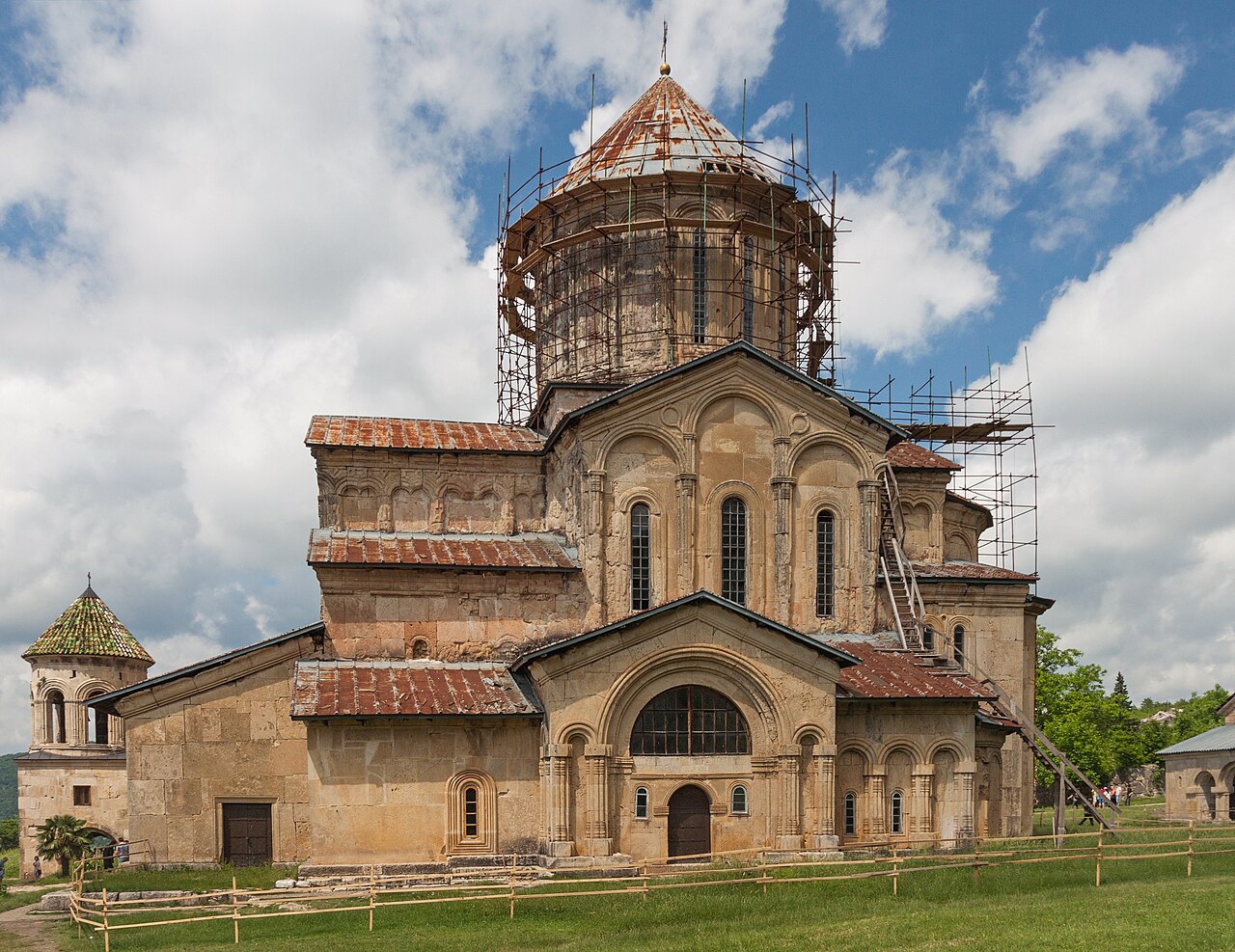
David founded the monastery and academy at Gelati, near Kutaisi, as a deliberate centre of Neoplatonist learning, and asked to be buried under the gate so that everyone entering would step on him. The stone is still there.
His great-granddaughter Tamar ruled from 1184 to 1213 and is called mepe — king, not queen, and Georgians will correct you. Under her the kingdom reached its largest extent, from the Black Sea to the Caspian, dominating its neighbours and installing a client empire at Trebizond. It was in her reign that Shota Rustaveli wrote The Knight in the Panther's Skin, a 1,600-stanza epic that is to Georgian what Dante is to Italian, and which was traditionally part of a bride's dowry.
Then the Mongols. Georgia was invaded in the 1220s, subjugated by the 1240s, and split. Timur invaded eight times between 1386 and 1403. By 1490 the kingdom had formally divided into Kartli, Kakheti and Imereti plus a set of principalities, and the following three centuries were spent as a contested march between the Ottoman and Persian empires — punctuated by episodes such as Shah Abbas's 1616 campaign in Kakheti, which killed or deported a large share of the region's population.
🦅 Annexation
In 1783, King Erekle II of Kartli-Kakheti signed the Treaty of Georgievsk, placing his kingdom under Russian protection in exchange for a guarantee of its territorial integrity and internal autonomy. Twelve years later, when Agha Mohammad Khan of Persia sacked Tbilisi and burned it to the ground, Russia did not come. In 1801, Tsar Alexander I abolished the kingdom outright and annexed it. The other Georgian states followed over the next sixty years.
Russian rule dismantled the specifically Georgian institutions with some determination. The Georgian Orthodox Church lost the autocephaly it had held since the fifth century and was absorbed into the Russian church in 1811, with Russian exarchs, Russian liturgy and whitewashed medieval frescoes. Georgian was pushed out of schools and administration. Nobility that cooperated was absorbed into the imperial system; nobility that did not, mostly wasn't.
Nineteenth-century Georgia produced, in reaction, the national revival: Ilia Chavchavadze and the Tergdaleulni — "those who drank the Terek", meaning those who had crossed the river to study in Russia and come back — who rebuilt Georgian as a modern literary language, founded newspapers and banks, and constructed the national idea that survives today. Chavchavadze was assassinated in 1907 and later canonised by the church.
It also produced a very strong socialist movement. Georgia's Mensheviks were the dominant political force by 1917, and when the empire collapsed the Democratic Republic of Georgia was declared on 26 May 1918: multiparty, with women's suffrage from the start, a serious land reform, and recognition from the Allied powers. It lasted thirty-three months. The Red Army invaded in February 1921 and the government sailed from Batumi into a Paris exile that lasted seventy years.
☭ Soviet Georgia
Georgia's relationship with the Soviet Union is complicated by the obvious fact: Stalin was a Georgian, from Gori, and so was Lavrentiy Beria. This did nothing whatsoever for Georgia. The 1924 August Uprising was crushed with several thousand executions; the purges of 1937–38 hit the Georgian intelligentsia, church and party hard; and Stalin's nationalities policy is the direct origin of two of the country's present problems, having created the Abkhaz ASSR and the South Ossetian Autonomous Oblast as administrative units inside Georgia.
In 1956, protests in Tbilisi against Khrushchev's denunciation of Stalin were fired on by troops, killing dozens — an episode that began as pro-Stalin and ended, in the memory of the participants, as the first modern Georgian national protest. In 1978, when Moscow proposed removing Georgian's status as the state language of the republic, tens of thousands demonstrated in Tbilisi and Moscow backed down. That is a very unusual thing to have happened in the Brezhnev-era USSR, and Georgians remember 14 April as a date.
Late Soviet Georgia also had one of the largest shadow economies in the union, a reputation for entrepreneurial corruption, and a standard of living noticeably above the Soviet average — subtropical agriculture, tourism, wine, and a great many people who knew how to arrange things.
On 9 April 1989 Soviet troops broke up a peaceful independence demonstration outside the parliament in Tbilisi with sharpened entrenching tools and toxic gas, killing twenty-one people, most of them young women. It ended any remaining Georgian attachment to the union. Independence was declared on 9 April 1991, on the anniversary.
🌹 Independence, Civil War, and the Rose Revolution
The 1990s were, by any measure, catastrophic. The first president, Zviad Gamsakhurdia, was overthrown in a civil war fought in the streets of Tbilisi over the winter of 1991–92; wars in South Ossetia (1991–92) and Abkhazia (1992–93) were lost, producing roughly 250,000 internally displaced Georgians; and the economy contracted by something like three-quarters. There was no reliable electricity in Tbilisi for years. Eduard Shevardnadze — Gorbachev's foreign minister — returned to run the country, stabilised it, and presided over a decade of comprehensive corruption.
In November 2003, after a rigged parliamentary election, Mikheil Saakashvili led protesters carrying roses into the parliament building mid-session. Shevardnadze resigned the next day without violence. The Rose Revolution made Georgia a template that was cited across the post-Soviet space for a decade.
What followed was genuinely radical and genuinely mixed. The entire traffic police — 30,000 officers, universally understood to be a bribe-collection system — was dismissed in one day and rebuilt from scratch, and petty corruption in Georgia collapsed to among the lowest levels in the region, which is still true and is immediately obvious to a visitor. Business registration went from weeks to minutes. Tourism was rebuilt from nothing. Against that: a heavily centralised presidency, pressure on media and courts, a prison system whose abuses were exposed by leaked video in 2012, and a foreign policy that ended in war.
🚧 Abkhazia and South Ossetia
Roughly twenty per cent of Georgia's internationally recognised territory is not administered by Georgia. Abkhazia, on the Black Sea north-west of Zugdidi, and South Ossetia, north of Gori, are both recognised as independent by Russia, Nicaragua, Venezuela, Nauru and Syria; by essentially everyone else, and by international organisations, they are Georgian territory under Russian occupation.
Abkhazia. A Soviet-era autonomous republic with a distinct language and people who were a minority — about 18% — within its own territory by 1989. The 1992–93 war ended with a Georgian defeat and the flight or expulsion of the great majority of the Georgian population, roughly 200,000 people, an event that the OSCE has described in terms of ethnic cleansing. Most have never returned. It is now a Russian-garrisoned territory with a Russian-funded budget and a Russian border regime.
South Ossetia. Smaller, poorer, and the flashpoint of August 2008. The sequence is contested and the EU-commissioned Tagliavini report found fault on multiple sides: Georgian forces shelled Tskhinvali on the night of 7–8 August, which the report judged not justified under international law, in a context of sustained provocation and a Russian military build-up that the report also criticised. Russia responded with a full invasion, occupied territory well beyond South Ossetia, and recognised both entities as independent within weeks.
Since 2011 the Russian and de facto forces have been steadily moving the administrative boundary fences southward — "borderisation" — into land that was never claimed, cutting villages, orchards and in one case a stretch of the main east–west highway from Georgian control. People have been detained for crossing lines that appeared in their fields overnight.
Can you visit Abkhazia?
Entry from Russia is illegal under Georgian law and will get you barred from Georgia and possibly prosecuted. Entry from the Georgian side at Enguri is legally possible with prior clearance from the Georgian foreign ministry and de facto authorisation, but is bureaucratic and offers no consular protection. Most Western advisories say do not go.
South Ossetia
Effectively closed. There is no lawful route from Georgia and no reason to attempt one.
The boundary lines
Do not walk near them. They are unmarked in places, patrolled, and detentions of hikers and farmers happen several times a year. Roads near Gori pass within a few kilometres — that is fine; wandering off them is not.
Talking about it
Georgians will discuss this readily and with feeling. Listen more than you talk. Referring to the territories as separate countries in conversation will not go well.
⚖️ Georgia Now
Since 2012 the governing party has been Georgian Dream, founded by Bidzina Ivanishvili, a billionaire who made his money in Russia in the 1990s and who has been the country's dominant political figure whether or not he holds office. Georgia was granted EU candidate status in December 2023 — a genuine milestone, with EU membership written into the constitution and consistently supported by around 80% of the population in polling.
It has been contentious since. In 2024 parliament passed a "transparency of foreign influence" law requiring organisations receiving over 20% foreign funding to register — widely compared to Russian legislation, condemned by the EU and the Venice Commission, and the trigger for weeks of very large protests. The October 2024 parliamentary election was disputed by the opposition and criticised by OSCE/ODIHR observers; in November the government announced it was suspending EU accession talks until 2028, and protests resumed on a nightly basis in central Tbilisi and have continued in some form since. The EU has effectively frozen the accession process.
Meanwhile the relationship with Russia is a study in contradiction. There are no diplomatic relations — Georgia broke them in 2008 — yet Russians can enter visa-free, direct flights resumed in 2023, tens of thousands of Russians moved to Georgia after the 2022 invasion of Ukraine, and Russia is a major trading partner. Georgian public opinion is strongly pro-Ukraine and strongly anti-Kremlin; you will see Ukrainian flags on balconies across Tbilisi.
What this means for a visitor: very little, practically. Tourism has continued throughout; the protests are peaceful, confined to a few streets in central Tbilisi, and not directed at foreigners. Check your ministry's advisory before you go, avoid demonstrations as you would anywhere, and understand that the person pouring your wine may have strong views and be glad to be asked.
🏛️ Tbilisi
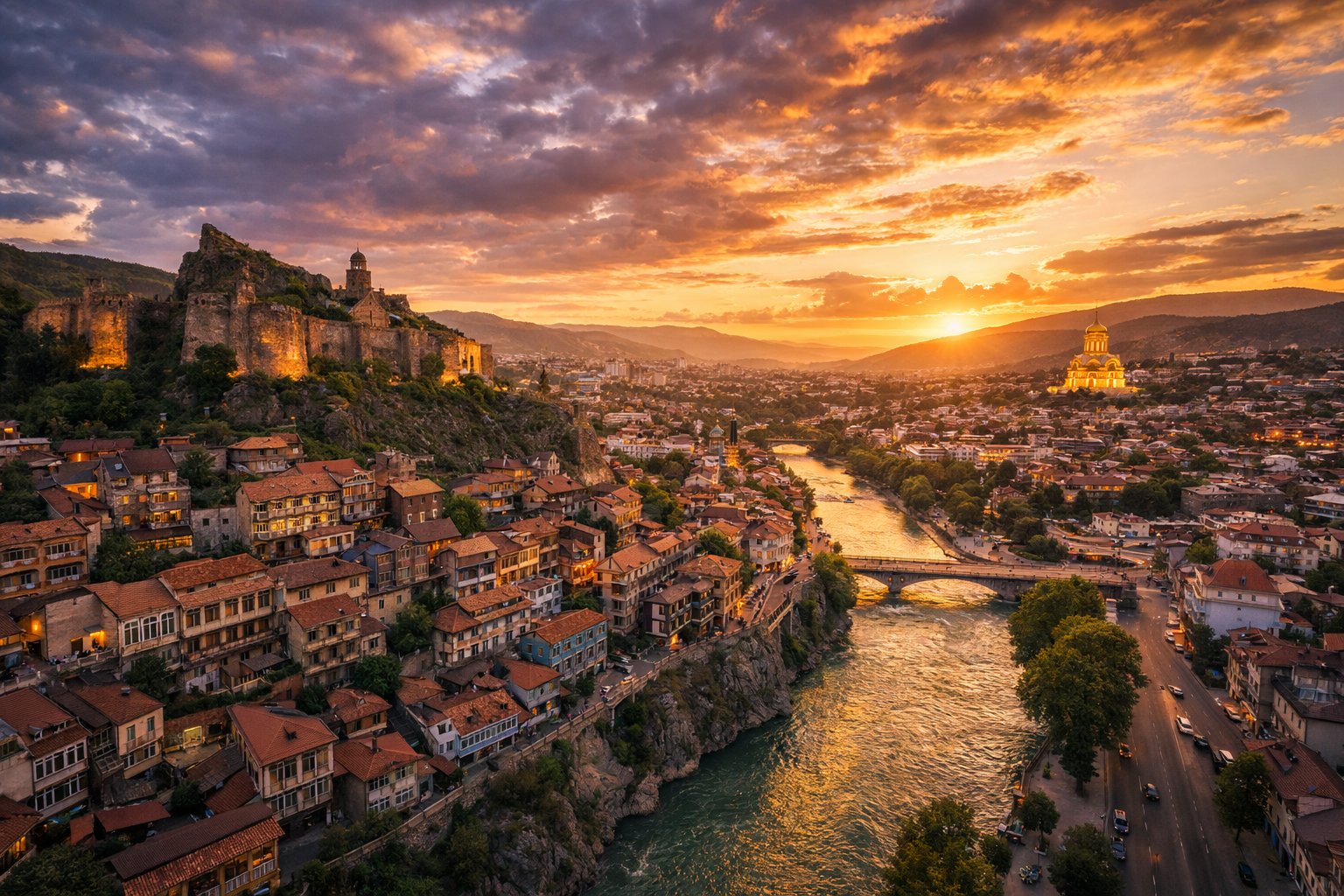
Tbilisi is built in a gorge, which is the first thing you notice and the thing that explains it. The Mtkvari runs through a narrow valley with ridges either side, so the city climbs: balconied wooden houses stacked on slopes, staircases instead of streets, and the Narikala fortress on the ridge above it all. King Vakhtang Gorgasali is said to have founded it in the fifth century after a hunting falcon fell into a hot spring — tbili means warm, and the sulphur springs that give the city its name are still running under the old town.
It has been destroyed roughly thirty times, most comprehensively by the Persians in 1795, so almost nothing above ground is older than the nineteenth century except the churches. What that produced is a nineteenth-century town of Persian-influenced balconied courtyard houses, Art Nouveau facades, Soviet blocks, and a series of aggressively contemporary buildings put up in the Saakashvili years — the Bridge of Peace, the Rike concert hall — that Georgians argue about constantly.
Abanotubani
The sulphur bath district: low brick domes half-buried in the ground, with the bathhouses beneath them. Book a private room, take a kisa scrub from an attendant, and understand that the smell is the point. Pushkin wrote that he had never encountered anything more luxurious.
Narikala and the ridge
Cable car up from Rike Park, then walk the ridge past the Mother Georgia statue — sword in one hand for enemies, wine bowl in the other for guests — and down through the botanical garden into the old town.
Old town and Betlemi
The lanes below Narikala: carved balconies in varying states of collapse, the Jumah mosque, the Armenian and Georgian churches, and the Betlemi steps.
Rustaveli Avenue
The nineteenth-century spine — parliament, opera, the National Museum with its Soviet occupation exhibition and its extraordinary Colchian goldwork. The protests happen here.
Fabrika and Marjanishvili
A Soviet sewing factory turned hostel and courtyard on the left bank, and the district around it: the best bars, the young Tbilisi, and where a lot of Russian émigrés landed after 2022.
Dezerter Bazaar
The main market by the station. Cheese by the wheel, churchkhela hanging in ranks, spice sellers, tklapi fruit leather, and the best cheap food in the city on the streets around it.
⛪ Mtskheta
Twenty kilometres from Tbilisi, at the confluence of the Mtkvari and Aragvi, sits the town that was the capital of Iberia for eight hundred years and is the spiritual centre of the country. The whole historical ensemble is UNESCO-listed.
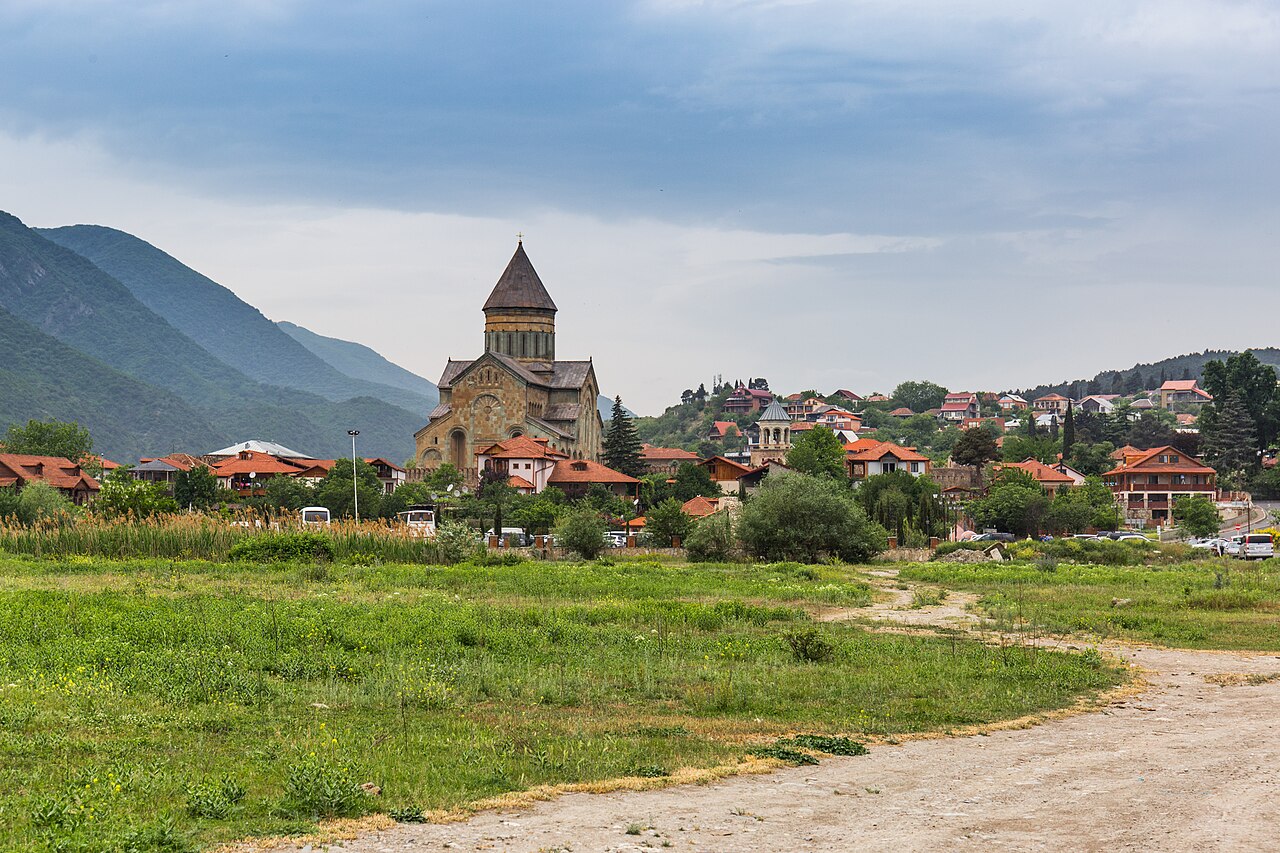
Svetitskhoveli — "the life-giving pillar" — was built between 1010 and 1029 on the site of the country's first church. The tradition is that a Jew from Mtskheta named Elias brought Christ's robe back from Jerusalem, and his sister Sidonia died clutching it and could not be parted from it, so she was buried with it, and a cedar grew from the grave. It is a serious building: cruciform, enormous for its date, and covered in the carved ornament that is the signature of Georgian medieval architecture.
Jvari, the Church of the Cross, stands on the bluff above the confluence and is the more important building architecturally. Built between 586 and 605, it is the prototype of the tetraconch domed church that the whole subsequent Georgian and Armenian tradition works from. It is small, austere, and sited with an arrogance that a thousand four hundred years has not diminished. Rustaveli's contemporaries wrote about the view; Lermontov set a poem here.
Samtavro, in the town, holds the graves of King Mirian and Queen Nana, the monarchs who converted in the 330s. Also here, and easy to miss, is the modest grave of Gabriel Urgebadze, a Soviet-era monk who set fire to a Lenin portrait at a 1965 May Day parade, was beaten and confined to a psychiatric hospital, and is now the most venerated modern saint in Georgia; the queue at his grave on a Sunday can be an hour long.
🍇 Kakheti
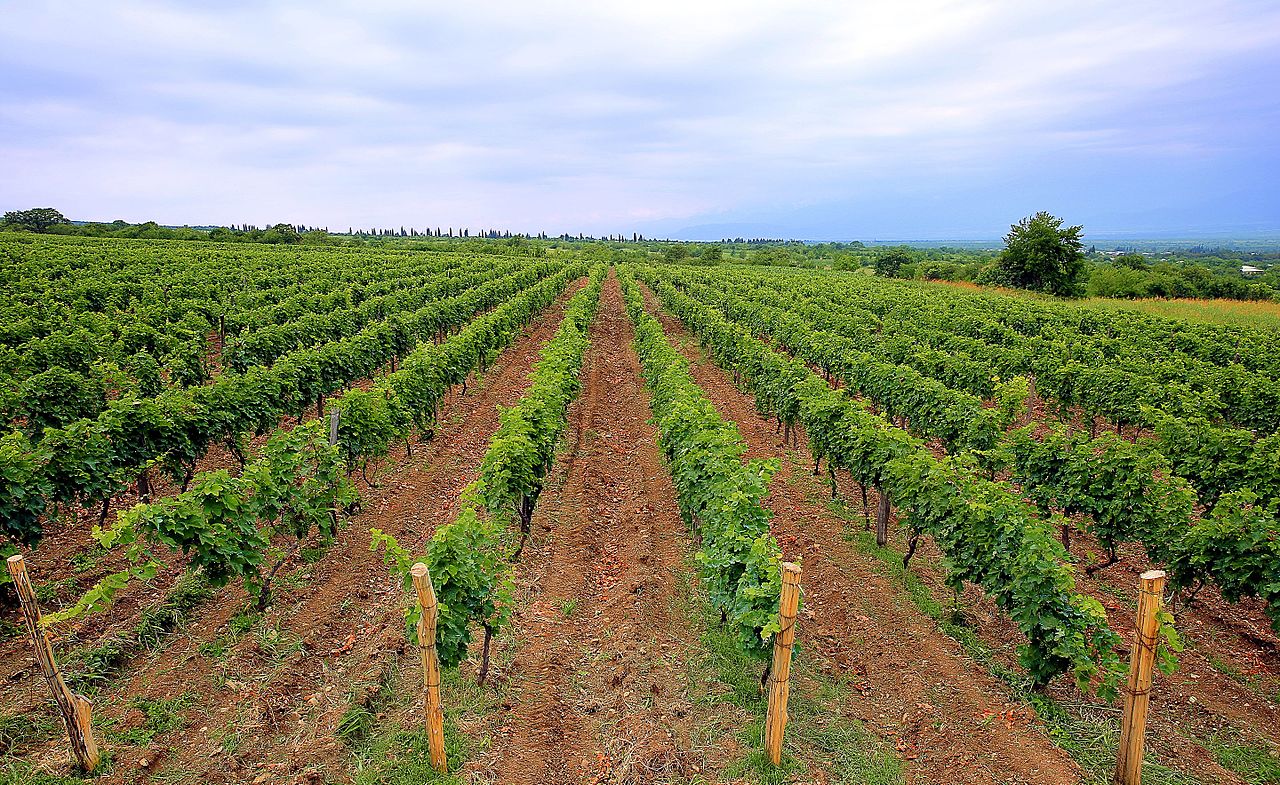
The Alazani valley east of Tbilisi produces perhaps two-thirds of Georgian wine and is the easiest good trip in the country: two hours from the capital, and you are in vineyards with the Greater Caucasus standing up behind them.
Sighnaghi
A small walled hill town above the valley, restored — some say over-restored — in the 2000s into the country's prettiest place. Four kilometres of eighteenth-century wall, a 24-hour marriage registry that earned it the "city of love" tag, and views across to the mountains.
Telavi
The working capital of the region: a market, a fortress, Erekle II's palace, and the base most wine tours actually operate from.
Bodbe
The monastery holding the grave of St Nino, on the ridge below Sighnaghi. A working convent, a serious pilgrimage site, and a spring in the gorge below that people walk down to.
Alaverdi
An eleventh-century cathedral standing 50 m high on the plain — for centuries the tallest building in Georgia — with a monastery that has been making wine in qvevri since the eleventh century and started again commercially in 2006.
Gremi and Nekresi
A sixteenth-century royal citadel and a fourth-century monastery in the hills respectively, both far less visited than the headline sites.
David Gareja
A cave monastery complex on the semi-desert Azerbaijani border, sixth century, with frescoes and an active border dispute over part of it. Check access before going; it has closed at times.
Doing it properly: two nights minimum, based in Telavi or Sighnaghi, with a driver. Small family marani cellars will pour you six wines and feed you for the price of a bad lunch in Prague. The large modern wineries (Schuchmann, Twins, Shumi) do polished tastings with English and are a reasonable introduction; the small ones are the reason to come.
🗼 Svaneti
In the north-west, up against the highest part of the Caucasus, Svaneti is the highest permanently inhabited region in Europe and was for most of its history effectively unreachable. That produced a place with its own unwritten language, its own legal code of blood feud and mediation, and the towers.
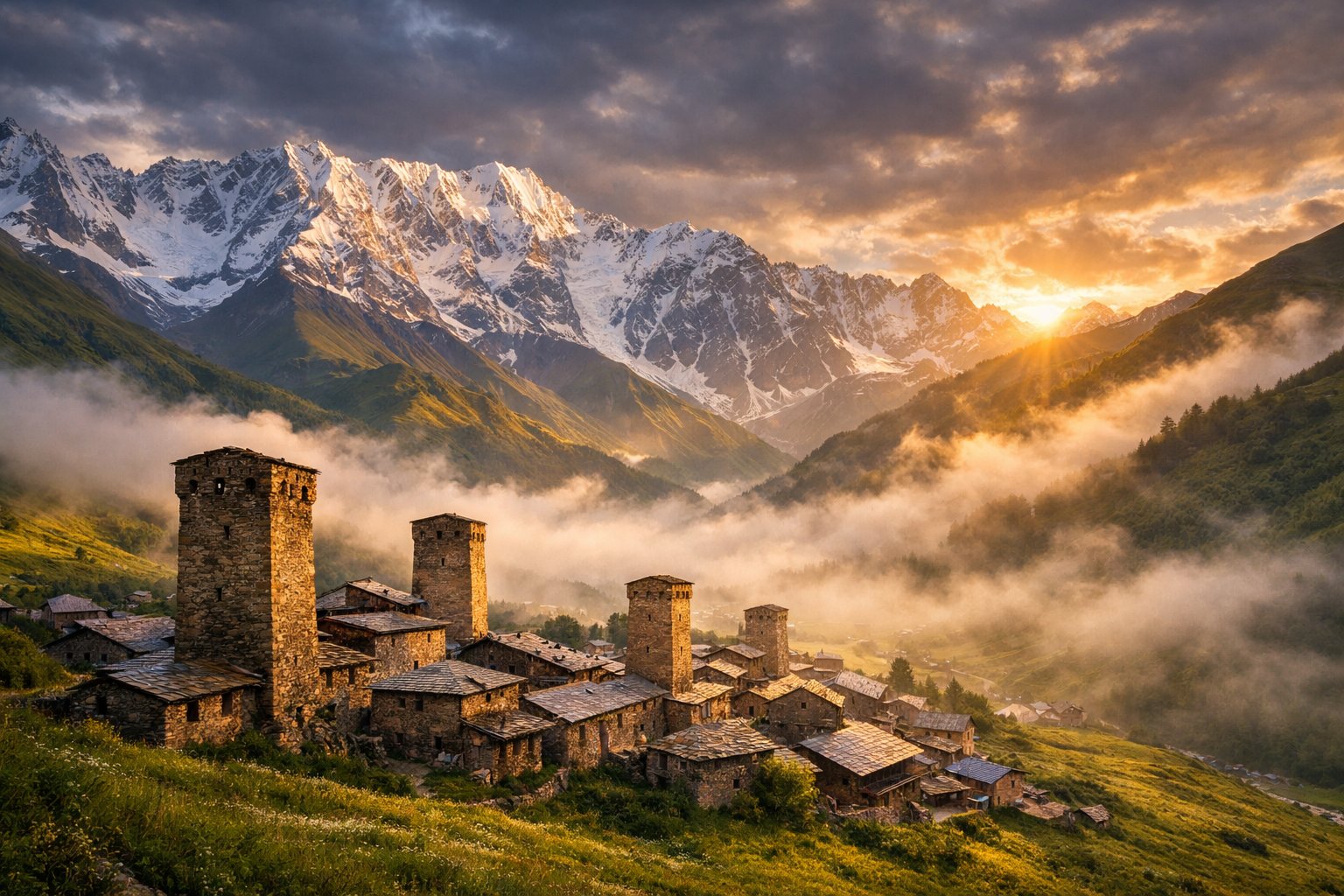
The koshki are three to five storeys of dry-laid stone, built from around the ninth century, entered at first-floor level and used as a last redoubt by a single family. Ushguli, at 2,100 m, has the densest concentration and claims to be the highest continuously inhabited settlement in Europe; it is UNESCO-listed and now reachable by a rough road from Mestia that takes two hours to cover 45 kilometres.
Because the region was never conquered — not by the Mongols, not by the Persians — Svan churches became the safe-deposit box of the Georgian nation. Icons, crosses, illuminated gospels and reliquaries were carried up here for safekeeping over a thousand years and mostly stayed. The Svaneti Museum of History and Ethnography in Mestia holds an extraordinary collection of them, and it is the most under-rated museum in the country.
Mestia
The regional centre, at 1,500 m, with an airport, hotels, the museum and a small ski area. Transformed since 2010 from a place with no electricity into a functioning tourist town; opinions on the architecture vary.
Ushguli
Four hamlets at 2,100 m under Shkhara, the country's highest peak. Day-trippable from Mestia but far better with a night there.
The Mestia–Ushguli trek
Four days, hut to hut, through the villages, and the best-known walk in Georgia. July to September; guesthouses en route; no technical difficulty but real altitude and weather.
Chalaadi and Koruldi
Half-day walks from Mestia — a glacier snout and a set of lakes on a ridge respectively. Koruldi is a hard climb or a 4×4 ride and worth either.
Getting there
Marshrutka from Zugdidi (3–4 hours on a good road), a small plane from Tbilisi or Kutaisi to Mestia's Queen Tamar airport (weather-dependent, spectacular), or a very long drive.
Kvevri, but different
Svan food is not lowland Georgian food: kubdari (meat-filled bread), tashmijabi (potato mashed with molten cheese), and salt mixed with a wall of herbs. Try all three.
🏔️ The Georgian Military Highway and Kazbegi
The road north from Tbilisi to the Russian border is the only through route across the Greater Caucasus for hundreds of kilometres in either direction, and it has been a strategic corridor since antiquity. The Russians built the modern road between 1799 and 1817 and named it the Military Highway; Pushkin, Lermontov and Dumas all wrote about travelling it.
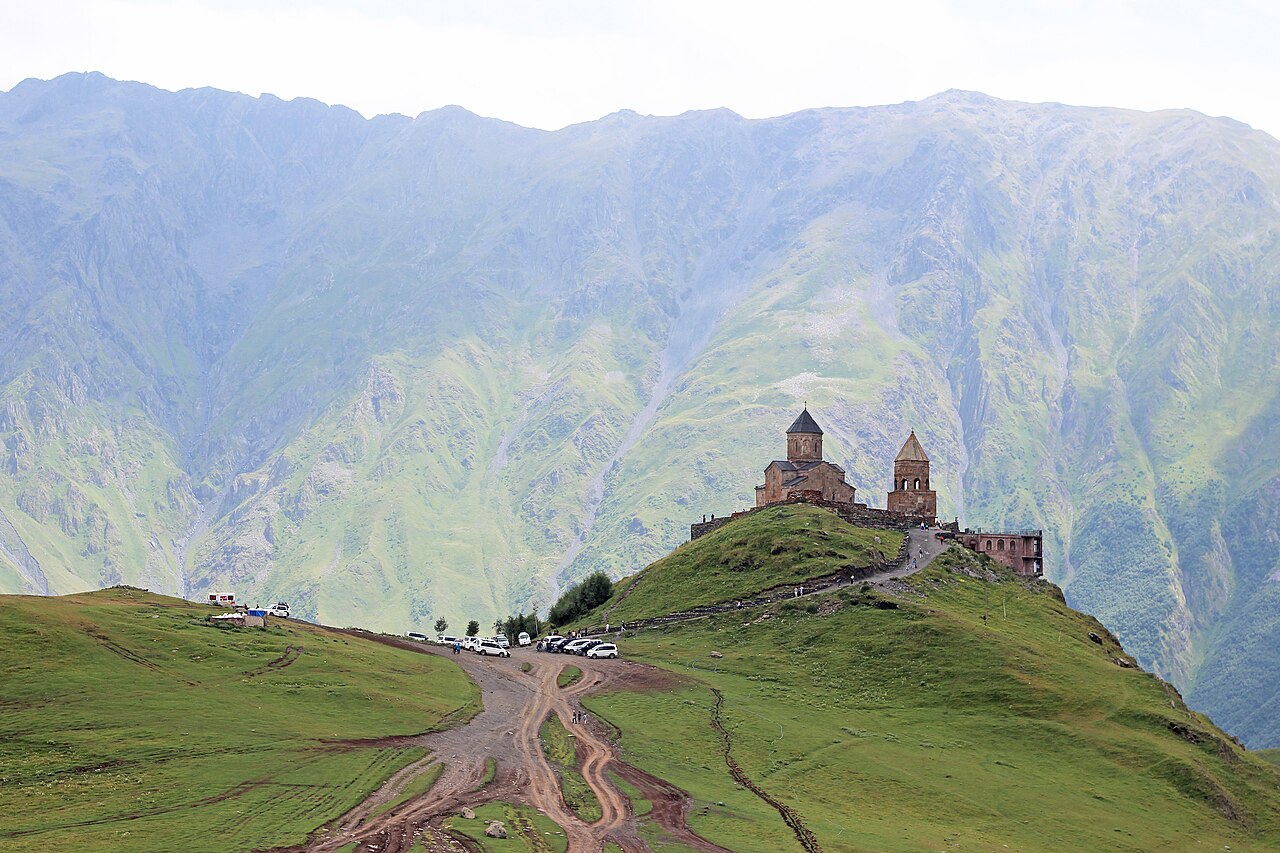
It climbs from Tbilisi past the Ananuri fortress on the Zhinvali reservoir, up to the ski resort at Gudauri, over the Jvari Pass at 2,379 m — where a Soviet-era friendship monument in brutalist concrete and mosaic sits over a thousand-metre drop — and down into the Terek valley at Stepantsminda, still widely called Kazbegi.
Above the town, on a ridge at 2,170 m, stands the fourteenth-century Gergeti Trinity Church with Mount Kazbek (5,054 m) behind it. It is the single most photographed thing in Georgia and it deserves to be. Kazbek is the mountain to which Prometheus — Amirani, in the Georgian version — was chained for stealing fire, and there is a genuine cave system high on it that housed a monastery.
Doing the drive
Three hours from Tbilisi in good conditions. Hire a driver or take a marshrutka from Didube. Winter closures happen at the pass with little warning; check before setting out.
Gudauri
Georgia's main ski resort: 2,000–3,300 m, long season, excellent off-piste, heliskiing, and prices a fraction of the Alps. Also the country's paragliding centre in summer.
Getting up to Gergeti
Two hours on foot from Stepantsminda on a decent path, or twenty minutes in a hired 4×4 for around 50–80 GEL. Walk up if you can; the church is a working monastery and shoulders and knees should be covered.
Juta and Truso
Two valleys either side of the highway. Juta for the Chaukhi massif and the Chaukhi pass trek; Truso for travertine terraces, mineral springs and abandoned villages — and a boundary line you should not approach.
Ananuri
A seventeenth-century fortified complex on the reservoir an hour from Tbilisi, with carved facades that are worth the stop even on a day when you are driving straight through.
Weather
Kazbek makes its own. The summit is clear perhaps one morning in three, and it is usually the early one. Stay overnight rather than day-tripping if the mountain matters to you.
🕳️ Vardzia and the South
Southern Georgia — Samtskhe-Javakheti, towards the Turkish and Armenian borders — is the least-visited part of the country accessible on a normal road, and it holds the strangest single site in it.
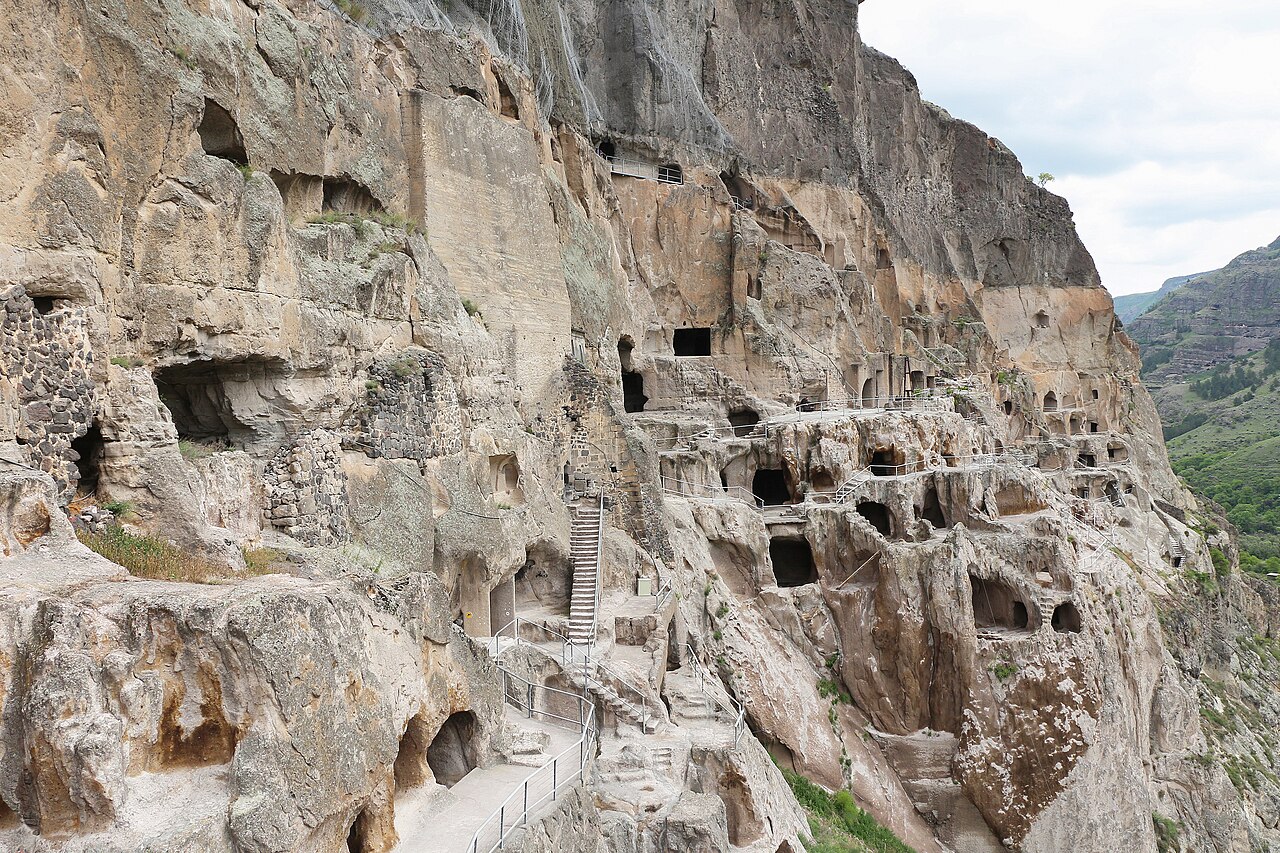
Vardzia was excavated into a cliff above the Mtkvari in the 1180s under Queen Tamar as a monastery and a fortress against Mongol invasion — thirteen levels, up to six thousand chambers, with a church, a throne room, bakeries, wine cellars and an irrigation system, all of it hidden behind the rock face with only concealed entrances. Then, in 1283, an earthquake sheared away the outer wall and exposed the entire complex like a doll's house. Perhaps a fifth of it survives, along with the frescoes in the Church of the Dormition, which include a contemporary portrait of Tamar herself.
Rabati, Akhaltsikhe
A fortress complex rebuilt in 2012 with a thoroughness that divides opinion sharply — some call it a restoration, others a theme park. It is undeniably impressive, and holds a mosque, a church and a synagogue on one site.
Borjomi
The mineral water town — the spring, the park, and the Romanov summer palace at Likani. The water tastes of salt and iron and Georgians drink it as a matter of national policy.
Borjomi-Kharagauli National Park
One of Europe's largest protected areas: 85,000 hectares of forest with a marked hut-to-hut trail network, and almost nobody on it.
Bakuriani
The second ski resort, gentler than Gudauri and more family-oriented, reached by a narrow-gauge railway from Borjomi that is worth riding for its own sake.
Javakheti
A high volcanic plateau of lakes at 2,000 m, largely Armenian-speaking, bitterly cold, and one of the best birding areas in the Caucasus. Very little infrastructure.
Uplistsikhe
Another rock-cut town, near Gori, and much older — occupied from the first millennium BCE, with pagan sanctuaries cut into the stone. Half a day from Tbilisi, often combined with Gori and its Stalin Museum.
🍷 Eight Thousand Years
In 2017 a team publishing in the Proceedings of the National Academy of Sciences reported tartaric acid residues on pottery from two Neolithic sites south of Tbilisi, Gadachrili Gora and Shulaveris Gora, dated to around 6000 BCE. That is the earliest evidence anywhere for deliberate winemaking from Vitis vinifera, and it is about two thousand years earlier than the previous record from the Zagros. Georgia's claim to have invented wine is not a marketing line; it is a peer-reviewed one.
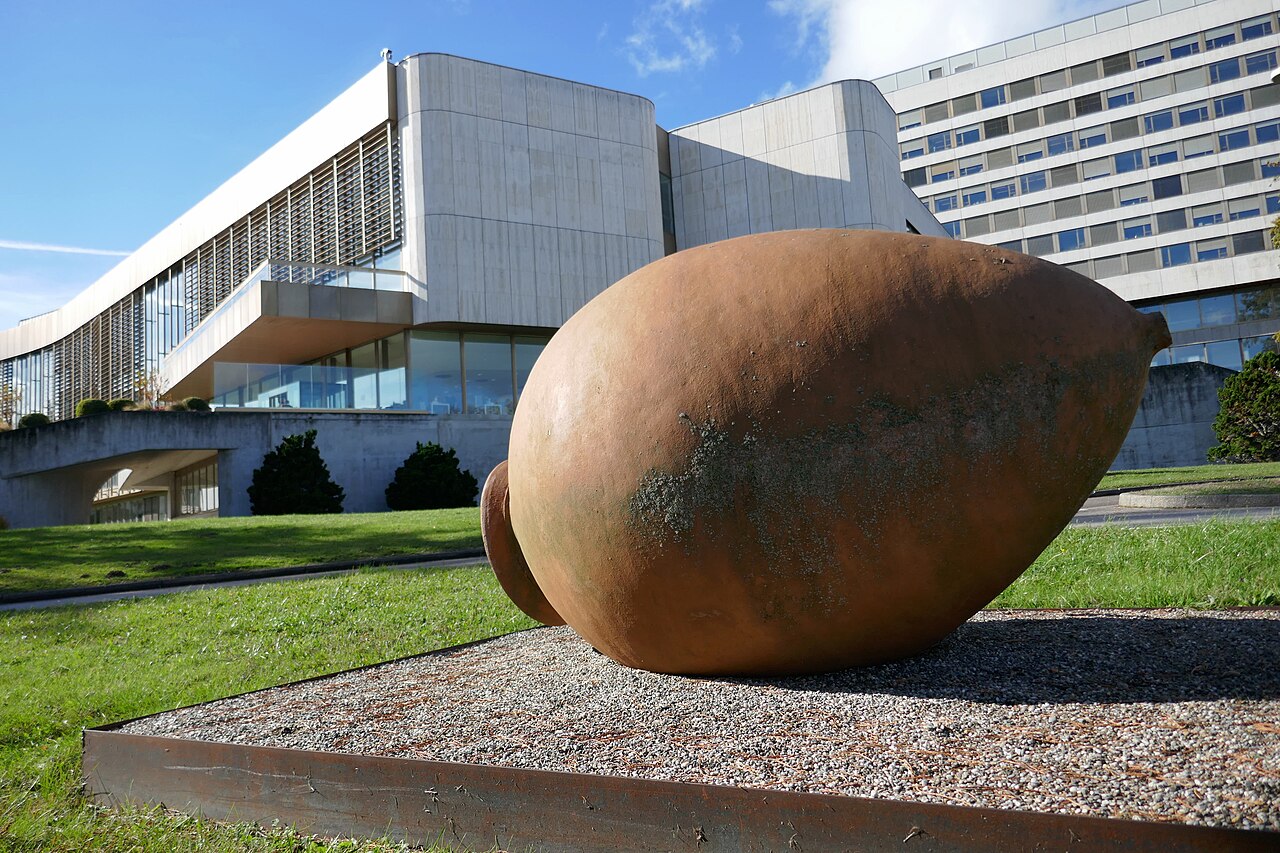
The qvevri method is what makes Georgian wine different from everything else, and it is not a revival — it never stopped. A qvevri is an egg-shaped, unglazed clay vessel, lined inside with beeswax, holding anything from 300 to 3,500 litres, buried up to its neck in the floor of the cellar. Grapes go in crushed, and depending on the tradition so do the skins, stems and pips. It is sealed and left through fermentation and maturation, and the earth does the temperature control. UNESCO listed the method as Intangible Cultural Heritage in 2013.
The famous product is amber wine — white grapes fermented on their skins for weeks or months, which is what the rest of the wine world now calls orange wine and has spent fifteen years rediscovering. It is tannic, structured, oxidative, and tastes like nothing in the European white tradition. Georgians have simply always made it that way.
Saperavi
The great red grape: teinturier, meaning the flesh is red as well as the skin, so the wine is nearly black. Dense, acidic, ageworthy. Roughly 4% of the world's teinturier grapes are Saperavi and almost all of it is here.
Rkatsiteli
The workhorse white, and the classic amber wine grape. Vinified in steel it is fresh and citric; on skins in qvevri it is an entirely different animal.
Mtsvane, Kisi, Khikhvi
The three whites that reward a serious taster. Kisi in particular, nearly extinct in the Soviet period, makes some of the best amber wine in the country.
Khvanchkara
Naturally semi-sweet red from Racha, made from Alexandrouli and Mujuretuli, whose fermentation stops in the cold cellars of the region. Stalin's favourite, which is either a recommendation or not.
The two schools
Kakhetian: full skin and stem contact, maximum tannin, uncompromising. Imeretian: partial contact, lighter, more approachable. Argue about it with anybody.
The numbers
Over 500 indigenous grape varieties are documented in Georgia — around a sixth of the world's total — of which perhaps 40 are in commercial use. The rest are being slowly brought back.
Drinking it. A family marani will pour six or eight wines and refuse payment for the tasting. Wine shops in Tbilisi (8000 Vintages, Vino Underground) will guide you properly. Avoid the sweet semi-sweet supermarket bottles aimed at the Russian market, which are what gave Georgian wine its poor reputation in the Soviet period, and ask specifically for qvevri wine — it is on the label, and it is the reason you came.
🥂 The Supra
A supra is not a dinner party. It is a formal institution with an officer, a running order and rules, and being invited to one is the single best thing that can happen to a visitor in Georgia.
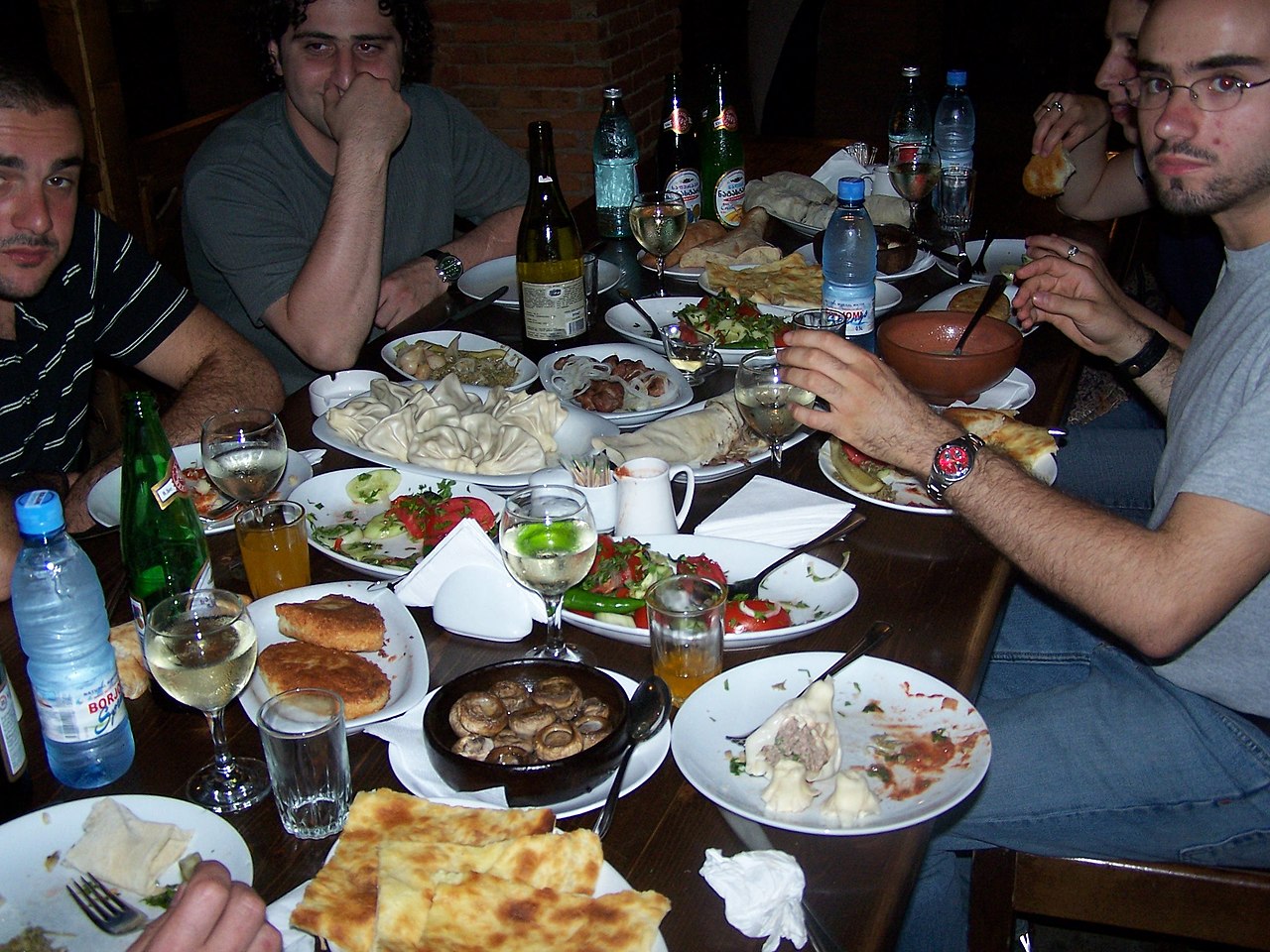
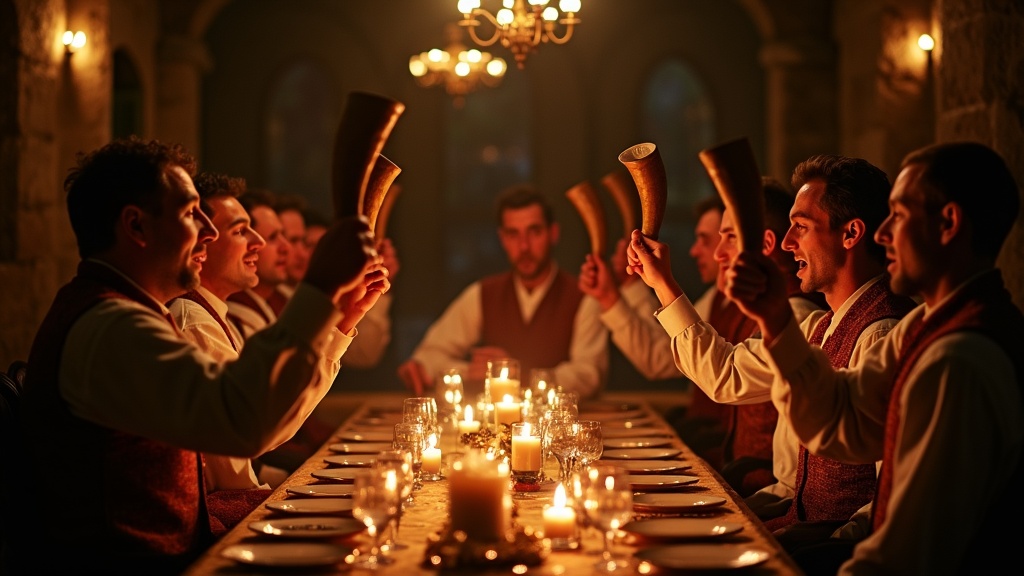
The tamada is the toastmaster, chosen by the host, and he runs the evening. He proposes each toast, everybody drinks it, and nobody drinks in between — raising your glass outside a toast is a small solecism. The toasts run in a traditional order: peace, then the reason for the gathering, then parents, then those who have died, then children, then women, then the homeland, then the guests, and so on for as long as required. A good tamada speaks well and at length; the position carries real social weight, and a poor one ruins the evening.
The word gaumarjos — victory to it — is how you toast. And there is a rule that catches out every visitor: you never toast the dead with wine glasses raised high, and you never, ever toast with beer, which is reserved for enemies. If someone hands you a horn — a kantsi — you cannot put it down until it is empty, because it does not stand up.
Behind the theatre is something that matters. The supra is the mechanism by which Georgians have maintained a shared culture through centuries in which the state, the language and the church were all under attack — a portable institution that requires nothing but a table. It is also the single most common context in which a foreign visitor gets seriously drunk in Georgia, so pace yourself, eat between toasts, and know that no one will think worse of you for taking small sips.
🍽️ Food
Georgian food is one of the world's great regional cuisines and it does not look or taste like anything either side of it. The signature is walnuts — ground into sauces where a French cook would use cream — plus a set of herbs used in quantity as vegetables rather than as seasoning: coriander, tarragon, dill, blue fenugreek, marigold petals. It is also unusually good for vegetarians, because the Orthodox fasting calendar removes meat from the table for something like two hundred days a year and the cuisine adapted accordingly.
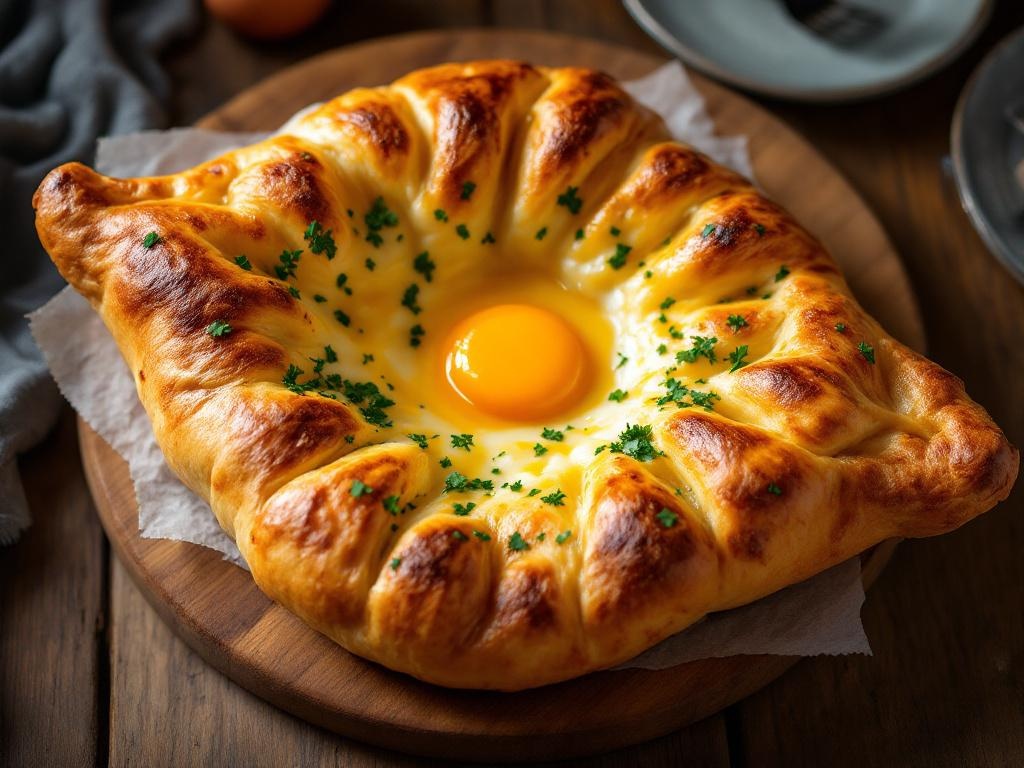
Khachapuri is cheese bread and there is a regional version of it everywhere. Imeruli is a flat round loaf with cheese through the middle. Megruli is the same with more cheese melted on top. Adjaruli is the famous one: a boat of dough filled with molten sulguni, with a raw egg yolk and a knob of butter dropped in at the table and stirred through by the eater. Penovani is puff pastry. There is a Georgian economics index — the Khachapuri Index — that tracks inflation by the cost of making one.
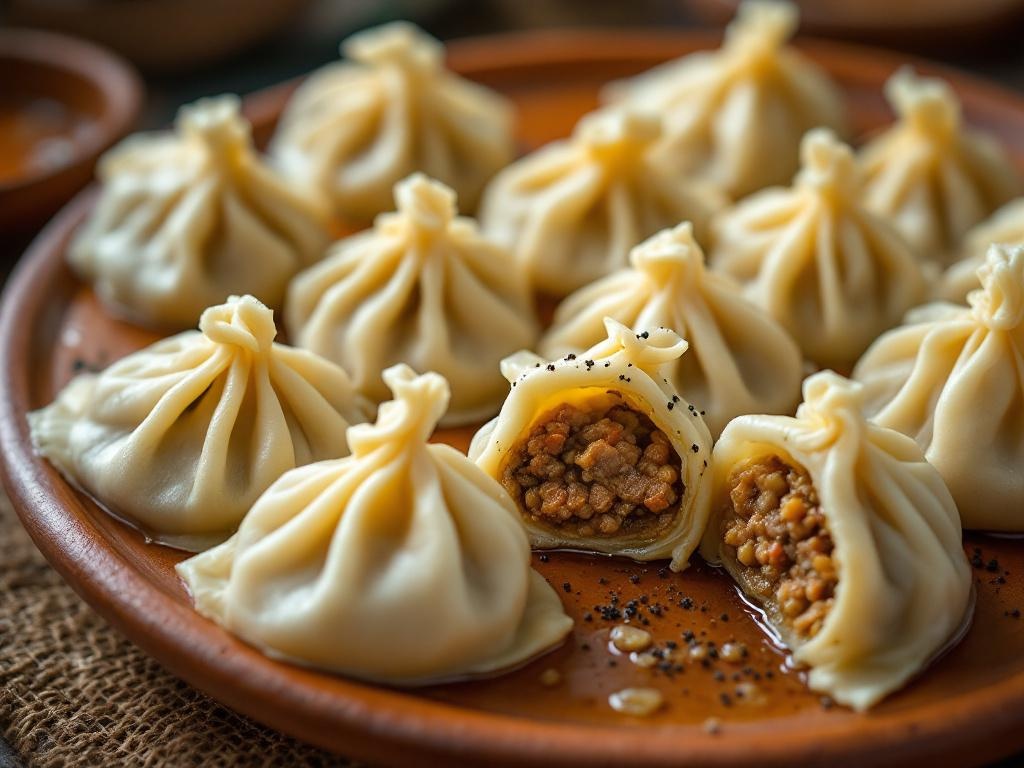
Khinkali are soup dumplings, twisted into a topknot with anything from 19 to 28 pleats, filled with spiced minced meat and enough broth that eating one incorrectly wastes it. The technique is not optional and everyone will watch you do it. You do not eat the knot. Order six to start; a Georgian orders ten.
Beyond the two icons: pkhali, vegetables (spinach, beetroot, aubergine, beans) minced with walnut, garlic and herbs and served cold as a paste; lobio, red beans stewed with coriander and served in a clay pot with cornbread; badrijani nigvzit, fried aubergine rolled around walnut paste; satsivi, cold turkey or chicken in a walnut sauce eaten at New Year; mtsvadi, skewered pork grilled over vine cuttings; chakapuli, lamb with tarragon and green plums; ajika and tkemali, the chilli paste and sour plum sauce that sit on every table; and churchkhela, walnuts threaded on string and dipped repeatedly in thickened grape must, hanging in every market like candles.
Lobio — Georgian Red Bean Stew
Serves 4 · overnight soak plus 2 hours · the everyday Georgian dish
Ingredients: 400 g dried red kidney beans · 1 large onion, finely chopped · 4 garlic cloves · 1 large bunch coriander · 1 tsp ground blue fenugreek (utskho suneli) · 1 tsp ground coriander seed · 1 tsp dried marigold (imeruli saperavi) or a pinch of turmeric · 1 tbsp red wine vinegar · 60 ml sunflower oil · 1 fresh chilli · salt · to serve: mchadi (cornbread) and pickles
Method: Soak the beans overnight, drain, cover with fresh water and simmer 1½ hours until soft, adding no salt until the end. Meanwhile soften the onion in the oil until golden. Crush the garlic with a good pinch of salt and the chopped coriander stalks. When the beans are done, mash about a third of them against the side of the pot to thicken. Stir in the onion, garlic paste, the dried spices and the vinegar, and simmer ten more minutes. Off the heat, stir through the chopped coriander leaves and the sliced chilli. Serve hot in a clay pot with mchadi and pickled vegetables.
💡 Blue fenugreek is not the same as ordinary fenugreek and is what makes it taste Georgian. Buy it from a Georgian or Middle Eastern shop; there is no good substitute.
Pkhali — Spinach and Walnut Paste
Serves 6 as a starter · 30 minutes · the standard supra opener
Ingredients: 500 g spinach · 150 g walnuts · 3 garlic cloves · ½ small onion · 1 tsp ground blue fenugreek · ½ tsp ground coriander · 1 tbsp red wine vinegar · a pinch of cayenne · salt · pomegranate seeds to finish
Method: Blanch the spinach for a minute, refresh in cold water, and squeeze it as dry as you possibly can — this is the step people skip and it is the one that matters. Grind the walnuts, garlic, onion and spices to a paste in a food processor or, better, a mortar. Chop the squeezed spinach finely and work it into the walnut paste with the vinegar and salt. Roll into small balls, flatten slightly, and press three or four pomegranate seeds into each.
💡 The same recipe works with cooked beetroot, aubergine, green beans or cabbage. Serving three colours together is the standard move.
🎶 Polyphony
Georgian traditional singing is in three independent vocal parts and it is not derived from anything else. That matters more than it sounds: Western European polyphony is documented from around the ninth century, and Georgian polyphony appears to be considerably older and to have developed separately. UNESCO put it on the very first Intangible Cultural Heritage list in 2001.
The parts are two upper voices moving in close and often startling dissonance over a sustained bass drone, and the tuning is not equal-tempered — intervals that sound wrong to a Western-trained ear are exactly right and are held with total confidence. There are distinct regional systems: Svan singing is archaic, harsh and closely spaced; Gurian singing from the west adds krimanchuli, a yodelled falsetto top line that is one of the hardest things in world vocal music; Kakhetian singing runs two elaborately ornamented solo voices over a long drone.
Chakrulo
A Kakhetian war song, and the one that was put on the Voyager Golden Record in 1977. There are two copies of it leaving the solar system.
Where to hear it
Anywhere a supra happens. Formally: the Rustavi and Basiani ensembles, the Sunday liturgy at Sioni or Sameba in Tbilisi, and the polyphony evenings some Tbilisi restaurants run — ask which ones are real.
Instruments
The panduri and chonguri (plucked lutes), the salamuri (flute), the duduki (double reed, shared with Armenia), and the doli drum. The voice is the main instrument.
Church music
The Georgian Orthodox chant tradition is a separate three-part repertoire that was nearly lost in the Soviet period and has been reconstructed from manuscripts since the 1990s. Hearing it in a stone church is the strongest argument for going to a service.
🔤 The Language and the Alphabet
Georgian is a Kartvelian language with no proven relatives outside its own family, and it does things that will be genuinely unfamiliar. Verbs are polypersonal — a single verb form encodes both subject and object, and sometimes an indirect object too. There is no grammatical gender. There is a system of "screeves" rather than straightforward tenses, and one verb can have several hundred forms. There are consonant clusters that Czech speakers will find merely interesting and English speakers will find impossible: gvprtskvni, eight consonants in a row, is a real word.
The mkhedruli alphabet has 33 letters, no capitals, and a one-to-one correspondence between letter and sound — which means that once you have learned it, and it takes an afternoon, you can read every street sign and menu in the country correctly even without knowing what the words mean. This is a better return on effort than almost anything else a traveller can learn, and it converts Georgia from illegible to navigable.
გამარჯობა · gamarjoba
Hello. Literally "victory" — the same root as the toast. The reply is gagimarjos.
მადლობა · madloba
Thank you. Didi madloba for thank you very much.
კი / ხო · ki / kho
Yes (formal / informal). No is ara.
გაუმარჯოს · gaumarjos
The toast. Follow it with what you are toasting: sakartvelos gaumarjos — to Georgia.
რა ღირს? · ra ghirs?
How much is it? Numbers in Georgian are vigesimal — counted in twenties — so 47 is "forty and seven" as two-twenties-and-seven.
Getting by
Russian is widely understood by anyone over about 40 and is decreasingly welcome as a default. English is common among the young and in tourism. Starting in Georgian, however badly, is received extremely well.
✝️ The Church
The Georgian Orthodox Apostolic Autocephalous Church claims foundation by the Apostle Andrew, dates its national conversion to the 330s, and has been the single most durable Georgian institution through every occupation since. Around 83% of the population identifies with it, and it consistently polls as the most trusted institution in the country — well ahead of the government, the courts or the media.
Its position is not uncontested. The church is socially conservative, has opposed anti-discrimination legislation, and clergy were involved in violent counter-protests against an LGBT rally in 2013 and again in 2021. Patriarch Ilia II, in office since 1977, remains extraordinarily popular — his offer to personally baptise any third or subsequent child, made in 2008, is credited with a measurable rise in the birth rate. It is impossible to understand contemporary Georgia without taking the church seriously as a political actor.
Visiting churches
Women cover their heads and wear a skirt — wraps are provided at the door of major sites. Men: long trousers, no shorts. No photography during services. Cross yourself or don't; nobody minds either way.
Other communities
Around 10% of the population is Muslim — Azeris in the south-east, and Georgian Muslims in Adjara. There are Armenian Apostolic, Catholic and Yazidi communities. Tbilisi's old town has a mosque, a synagogue and churches within a few hundred metres of each other, and the city is genuinely proud of that.
The Jewish community
One of the oldest continuous Jewish communities in the world, traditionally dating to the sixth century BCE. Most emigrated to Israel in the 1970s–90s, but the synagogues in Tbilisi and Kutaisi remain in use and the 26-centuries anniversary was marked as a national event.
Saints you will meet
St Nino, who converted the country. St George, everywhere. King Tamar and David the Builder, both canonised. And Gabriel Urgebadze, the modern one, whose grave at Samtavro draws long queues.
📋 Practical Information
Visas
Citizens of the EU, UK, US, Canada, Australia, Japan and around 95 other countries enter visa-free for one year — one of the most generous regimes anywhere, and the reason Georgia became a digital-nomad hub. Passport valid for the duration of stay. No onward-ticket requirement in practice.
Getting there
Tbilisi (TBS) and Kutaisi (KUT) are the main airports; Batumi (BUS) is seasonal. Kutaisi is Wizz Air's Caucasus base with cheap flights across central Europe, and is 3½ hours from Tbilisi by shuttle. Turkish, Georgian Airways, LOT, Ryanair and Wizz all serve Tbilisi.
Getting around
Marshrutka minibuses cover everything and leave when full from named stations (Didube, Ortachala, Samgori in Tbilisi). Trains link Tbilisi–Batumi (5 hours, comfortable, book ahead) and Tbilisi–Zugdidi (overnight). Bolt works in the cities and is very cheap. Hiring a car with a driver for a day is affordable and is how most people do Kakheti.
Driving
You can drive on an EU or international licence. Georgian driving is assertive: overtaking on blind bends is normal, lane markings are advisory, and livestock on mountain roads is constant. A 4×4 is genuinely required for Tusheti, Ushguli and Omalo. Do not drive at night in the mountains.
Money
Georgian lari (GEL/₾). ATMs everywhere and reliable; cards accepted almost universally in cities, less so in villages. Roughly ₾3 to the euro and ₾0.12–0.13 to the Czech crown at the time of writing. Tipping 10% is now standard in restaurants and often added automatically.
Connectivity
Magti, Geocell and Beeline all sell cheap tourist SIMs at the airport; data coverage is excellent even in the mountains. Free wifi is ubiquitous. Time zone GMT+4 year-round — three hours ahead of Prague in winter, two in summer. Plugs type C/F, 220 V, same as Czechia.
🇨🇿 Getting There from the Czech Republic
Georgia is one of the better-connected non-EU destinations from Prague, largely thanks to Wizz Air's base at Kutaisi. Return fares run from about 4,000 CZK on the budget carriers to 12,000–16,000 CZK on full-service routings, and the flight is four to five hours direct.
Wizz Air to Kutaisi
Direct from Prague on a seasonal or year-round basis depending on the schedule, and the cheapest way in by a wide margin. Kutaisi is 230 km from Tbilisi; a Georgian Bus shuttle meets the flights and takes 3½ hours to Tbilisi or 2 hours to Batumi.
Direct to Tbilisi
Wizz Air and Georgian Airways have both operated Prague–Tbilisi; check current schedules, as the route has come and gone. Four and a half hours.
Via Istanbul or Warsaw
Turkish Airlines via Istanbul and LOT via Warsaw both connect Prague to Tbilisi daily with a single stop, and are the reliable year-round options if the direct flights are not running.
Via Kutaisi for Svaneti
If Svaneti is the trip, flying into Kutaisi rather than Tbilisi saves a full day: Zugdidi is 2 hours from Kutaisi and Mestia 3–4 hours beyond that.
Visa. Czech citizens need no visa and may stay 365 days. That is not a typo, and it makes Georgia unusually easy for a longer trip or for remote work.
Before you go. Check the current advisory from the Czech Ministry of Foreign Affairs (MZV ČR) at mzv.cz — it carries specific warnings on the administrative boundary lines with Abkhazia and South Ossetia — and register in the DROZD system at drozd.mzv.cz. The Czech Republic has an embassy in Tbilisi (Chavchavadze Avenue), which makes consular problems a great deal easier here than in most of the region.
Health and insurance. No mandatory vaccinations. Tick-borne encephalitis and hepatitis A are worth discussing with a travel doctor if you plan to hike or spend time in villages. Tap water in Tbilisi is drinkable and mountain spring water is genuinely excellent. Standard EU travel insurance covers Georgia; check that it includes mountain rescue and altitude if you are trekking, as helicopter evacuation from Svaneti is not cheap.
💰 Costs
Georgia is one of the best-value destinations in Europe and the value is concentrated exactly where a traveller wants it: food, wine and transport are extremely cheap, and accommodation is reasonable. Two people can eat and drink very well for the price of one indifferent lunch in Prague.
Currency
Lari (GEL/₾). Roughly ₾3 to the euro, ₾0.12–0.13 to the Czech crown. Change at a bank or a licensed exchange — street rates in Tbilisi are competitive and there is no black market.
Accommodation
Hostel dorm ₾30–60 (200–450 Kč) · guesthouse double ₾70–150 (500–1 100 Kč) · good Tbilisi hotel ₾200–400 (1 500–3 000 Kč) · mountain guesthouse with half board ₾80–140 per person.
Eating
Khachapuri ₾8–15 · six khinkali ₾8–14 · full meal in a local restaurant ₾25–45 · a serious dinner in Tbilisi with wine ₾70–120 for two · street snacks and bakery bread under ₾5.
Wine
A bottle of decent qvevri wine in a shop ₾25–60 · house wine by the carafe in a restaurant ₾10–20 for half a litre · a tasting at a family marani often free with a purchase, or ₾20–40 · at a large winery ₾30–60.
Transport
Tbilisi metro or bus ₾1 · Bolt across the city ₾5–12 · marshrutka Tbilisi–Telavi ₾10 · Tbilisi–Batumi train ₾30–55 · Tbilisi–Kazbegi marshrutka ₾15 · car with driver for a day ₾200–350 · 4×4 to Ushguli ₾250–350 for the vehicle.
Daily budget
Backpacking: 900–1 400 Kč a day. Comfortable mid-range with drivers and good restaurants: 2 200–3 500 Kč. Something close to luxury, which here means a boutique hotel and private guiding: from 5 000 Kč.
🛡️ Safety
Georgia is a strikingly safe country for visitors. Violent crime is rare, petty crime is low by European standards, and the police reform of the 2000s produced a force that is not corrupt and that people call when there is a problem — which is unusual in the region and immediately noticeable. Women travelling alone generally report Georgia as comfortable, with the caveat that persistent attention from men in bars is not uncommon.
The boundary lines
The single genuine risk. The administrative lines with South Ossetia and Abkhazia are unmarked in places, patrolled, and shift. People are detained for crossing them by accident several times a year. Do not hike near them, and take local advice in the Truso valley and around Gori.
Roads
By far the most likely thing to hurt you. Georgian road fatality rates are among the highest in Europe. Wear a seatbelt in the back, decline a driver who has been drinking at a supra, and do not drive mountain roads at night.
Mountains
Real alpine terrain with limited rescue capability. Weather turns fast, rivers rise in the afternoon, and mobile coverage disappears in valleys. Register serious treks, take a guide for anything glaciated, and do not attempt Kazbek without proper equipment and acclimatisation.
Stray dogs
Tbilisi's street dogs are tagged, vaccinated and generally friendly. Packs in rural areas and around sheep flocks are a different matter — shepherd dogs take their work seriously. Walk around, do not run, and carry a stick in the mountains.
Protests
Political demonstrations in central Tbilisi, mainly on Rustaveli Avenue, have been frequent since late 2024. They have been overwhelmingly peaceful but there have been episodes of police force. Avoid them; there is nothing there for a tourist.
Earthquakes
Georgia is seismically active. The 2002 Tbilisi quake killed six people. It is a low but real background risk, not something to plan around.
🏨 Where to Stay
Tbilisi boutique
Rooms Hotel in Vera, Stamba in a former printing house, Communal Hotel and Fabrika at the cheaper end. Tbilisi's design-hotel scene is genuinely good and priced well below what the equivalent would cost in central Europe.
Old town guesthouses
Family-run places in the Sololaki and Betlemi lanes, often in nineteenth-century houses with carved balconies and a courtyard. Variable plumbing, excellent breakfasts, and the best way to stay in Tbilisi.
Kakheti
Schuchmann and Twins run hotels attached to their wineries; Sighnaghi has a dozen small guesthouses with valley views; Telavi has the practical mid-range options. Staying at a marani that also has rooms is the move.
Mountain guesthouses
In Mestia, Ushguli, Stepantsminda, Juta and Omalo: family homes with three or four rooms, half board included, a shared bathroom and enormous food. ₾80–140 a head. This is the standard and it is very good.
Ski
Gudauri has everything from hostels to the Marco Polo; Bakuriani is more family-focused and cheaper. Both are a fraction of Alpine prices and both fill at New Year and Orthodox Christmas.
Batumi
High-rise beach hotels, a large casino industry serving Turkish visitors, and old-town guesthouses that are much nicer. Prices swing hard between July–August and the rest of the year.
🗓️ Itineraries
One week · the classic
Three nights Tbilisi with a day at Mtskheta; two nights Kakheti (Sighnaghi or Telavi) with wineries; two nights Stepantsminda for Gergeti and the Military Highway. Covers the essentials without rushing.
Ten days · adding the west
The above, plus Kutaisi, Gelati and the Prometheus caves, and either Batumi and the coast or a first push into Svaneti. Fly out of Kutaisi to save a day.
Two weeks · properly
Tbilisi, Kakheti, Kazbegi, then west to Kutaisi and Gelati, up to Mestia for four nights including Ushguli and a day walk, back down via Batumi. This is the trip most people wish they had booked.
Wine-focused week
Base in Kakheti for four nights and treat it as the point rather than a day trip: small maranis in Napareuli and Kvareli, Alaverdi monastery, a qvevri workshop in Vardisubani, and Sighnaghi. Then Tbilisi wine bars for three nights. Go in September for rtveli.
Trekking · ten days
Mestia–Ushguli in four days, then transfer east for Juta–Chaukhi pass–Roshka. July to September only. Guesthouses throughout; no camping needed unless you want to.
Winter · one week
Gudauri for five days of skiing at a fraction of Alpine cost, bookended by two nights in Tbilisi. The sulphur baths after a day on the mountain are the correct order of operations.
🌴 Batumi and the Black Sea
Batumi is the strangest city in Georgia and the one that divides visitors most sharply. It is a subtropical Black Sea port on the Turkish border with palm trees, magnolias, an Ottoman and Art Nouveau old town — and, since about 2010, a skyline of casino towers and speculative high-rises that were dropped onto it with very little planning.
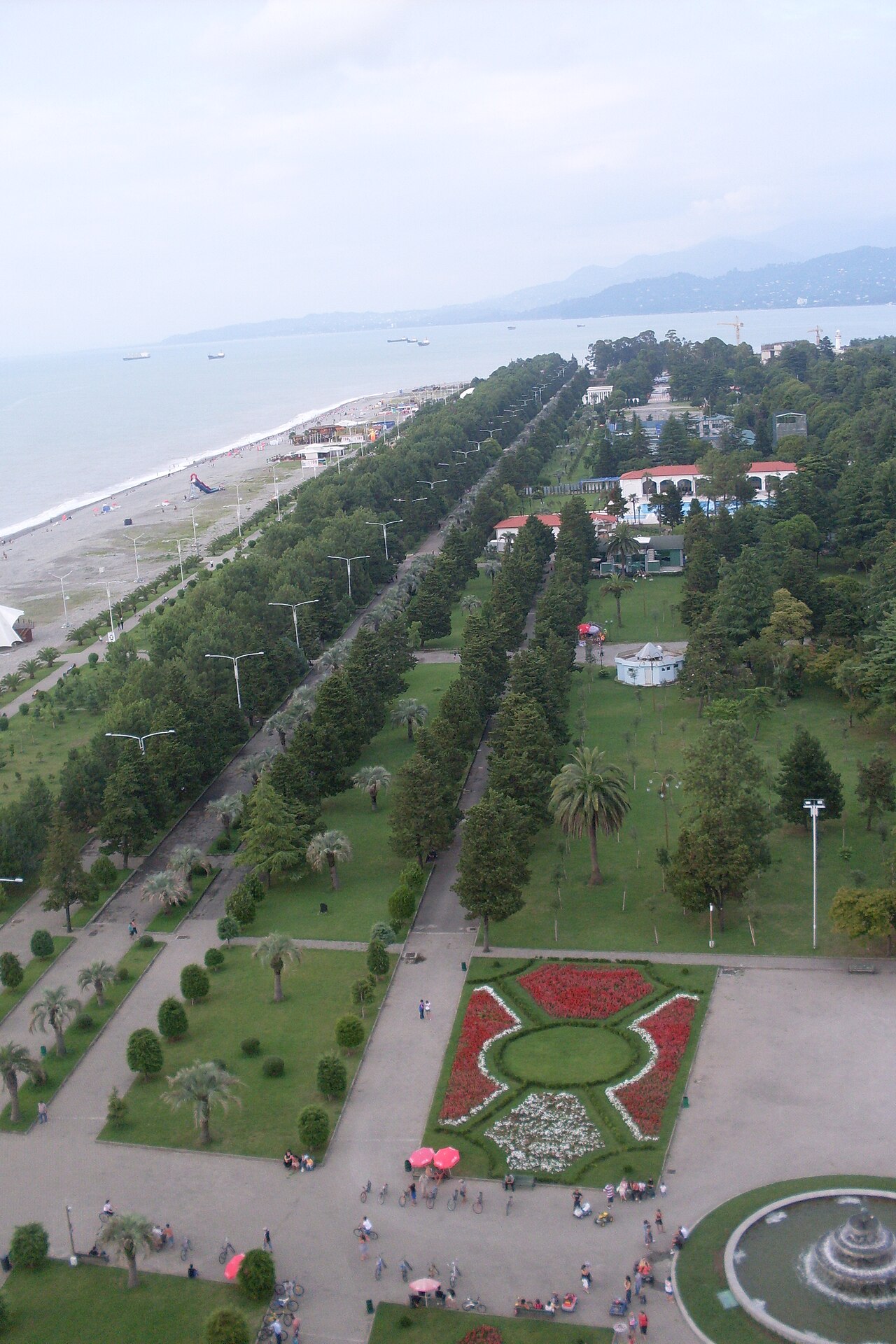
The gambling explains a lot. Casinos are illegal in Turkey, so Batumi's are effectively a Turkish leisure industry, and much of the high-rise construction is built on that plus Georgian and offshore money. The result is a place with a genuinely lovely nineteenth-century core, an excellent botanical garden, one of Europe's great seafront promenades — and a great deal of glass that will not age well.
Batumi Boulevard
Seven kilometres of seafront park with cycle hire, the Ali and Nino moving sculpture, dancing fountains and an unbroken line of cafés. Do it at dusk.
Batumi Botanical Garden
Nine kilometres north on a headland above the sea, founded 1912, with over 2,000 species arranged by world region. One of the finest botanical gardens in the former Soviet Union and worth half a day.
The old town
Around Europe Square and Piazza: Belle Époque facades, the Astronomical Clock, a mosque, a synagogue and two cathedrals within a few blocks.
The Adjara hinterland
Behind the coast: Makhuntseti waterfall, arched stone bridges attributed to Queen Tamar's era, and mountain villages where the food is different again. A day trip with a driver.
The beaches
Pebble, not sand, and the sea is warm from June to October. Gonio and Kvariati south of the city are cleaner and quieter; Ureki, further north, has the black magnetic sand that Georgians go to for their health.
Kobuleti and the Colchic wetlands
Kolkheti National Park and the Ispani peat bogs — part of the UNESCO Colchic Rainforests inscription of 2021, and a serious birding site on the migration route.
❓ Common Misconceptions
"It's basically Russia"
Georgia has its own language family, its own alphabet, its own autocephalous church since the fifth century, and a national identity built substantially in opposition to Russian rule. There are no diplomatic relations. Assuming otherwise is the fastest way to offend a host.
"It's dangerous because of the war"
The 2008 war lasted five days and the occupied territories are geographically contained. Tbilisi, Kakheti, the mountains and the coast have been safely visited by hundreds of thousands of tourists a year since. The specific risk is the boundary lines, and it is avoidable.
"Orange wine is a hipster invention"
It is the oldest continuously practised winemaking method on earth. Georgians have made skin-contact white wine in buried clay for eight thousand years. The Italians and Slovenians who popularised it in the 2000s were explicitly copying Georgia.
"You can day-trip Svaneti"
Mestia is 450 km from Tbilisi on mountain roads, or a small plane subject to weather. Ushguli is two more hours beyond that. Give it three nights or do not go.
"Georgian food is just Turkish or Russian food"
The walnut-based sauces, the herb usage, blue fenugreek, the fasting-driven vegetable repertoire and the cheese breads have no close parallel in either. Some shared dishes exist; the cuisine as a whole does not derive from them.
"Everyone speaks Russian, so use it"
Most people over 40 understand it and many will happily speak it. Younger Georgians increasingly do not, and opening in Russian rather than English or Georgian lands badly with some people. Lead with gamarjoba.
🌟 Georgians Worth Knowing
Queen Tamar (c. 1160–1213)
Ruled at the height of the Golden Age and is called mepe — king. Canonised by the church, referenced constantly in place names and toasts, and the subject of a folk belief that her burial place was deliberately hidden and has never been found.
Shota Rustaveli (12th c.)
Author of The Knight in the Panther's Skin, the national epic. Tbilisi's main avenue, the state theatre and the national prize are all named after him.
Niko Pirosmani (1862–1918)
Self-taught painter who worked for meals in Tbilisi taverns, died in poverty, and is now the most recognisable Georgian artist in the world. The song A Million Scarlet Roses is about him.
Katie Melua (b. 1984)
Born in Kutaisi, moved to Northern Ireland at eight, and became one of the UK's best-selling female artists of the 2000s. She has recorded with the Gori Women's Choir.
Nikoloz Baratashvili and Ilia Chavchavadze
The nineteenth-century Romantic poet and the writer-reformer who built modern literary Georgian. Chavchavadze was assassinated in 1907 and canonised as St Ilia the Righteous.
Khvicha Kvaratskhelia (b. 2001)
Napoli and Paris Saint-Germain winger, and the reason a great many people under 25 outside the Caucasus now know where Georgia is. Georgia reached its first-ever major tournament at Euro 2024 and beat Portugal.
📚 Reading and Watching
The Knight in the Panther's Skin · Shota Rustaveli
The twelfth-century epic. Traditionally part of a bride's dowry, still quoted from memory, and available in English verse translation. Start here if you want to understand what Georgians think of themselves.
The Eighth Life (for Brilka) · Nino Haratischwili
A 1,200-page family saga running from 1900 to the present through six generations of a Tbilisi chocolate-making family. The best single book for understanding twentieth-century Georgia and a genuinely gripping novel.
Ali and Nino · Kurban Said
Set mostly in Baku but with a large Georgian element and a good deal about Tbilisi. A love story across the Caucasus's religious fault line on the eve of Soviet rule.
Supra: A Feast of Georgian Cooking · Tiko Tuskadze
The most usable Georgian cookbook in English. For the wine, Alice Feiring's For the Love of Wine is a first-hand account of qvevri makers and small producers.
Films
Tengiz Abuladze's Repentance (1984), a surrealist allegory of Stalinism that was banned and then released as a signal of glasnost. Also The Wishing Tree, and more recently Levan Akin's And Then We Danced (2019), a queer love story set in the national dance ensemble that provoked riots at its Tbilisi screening.
Music
The Rustavi Ensemble and Basiani for polyphony, and Chakrulo specifically — it is on the Voyager Golden Record. Then the Gori Women's Choir, and anything of Georgian church chant.
✍️ Author's Note
Everyone who comes back from Georgia says the same two things, and they say them in the same order. The first is about the food and the wine, which is fair, because it is one of the great cuisines and the wine is unlike anything else on earth. The second is about being fed by strangers, which sounds like the sort of thing people say about every country until it happens to you three times in a fortnight.
It is not sentimentality and it is not a performance for tourists. Hospitality here is a structural obligation with its own vocabulary — stumari ghvtisaa, the guest is from God — and it comes out of a history in which a small nation between empires had to be able to trust the person at the door. Understand that and the supra stops being a quaint custom and starts being the load-bearing wall of the whole culture.
Two pieces of advice. First: learn the alphabet on the plane. Thirty-three letters, one sound each, no capitals; it takes an afternoon and it converts the country from illegible to readable, which changes the entire trip. Second: go up. Tbilisi and Kakheti are wonderful and they are also where everyone stops. The country that will stay with you is Svaneti in July or Tusheti over the Abano Pass — towers, glaciers, shepherds, and villages where the twentieth century arrived late and briefly.
And be honest with yourself about the politics. This is a country under partial occupation with a stalled European future and a lot of people who are angry about both, and pretending you have not noticed is not the compliment it feels like. Ask. Georgians will tell you, at length, over a table, with the wine going round — which is, in the end, how everything in Georgia gets discussed.
— Radim Kaufmann
Support This Project 🌍
This World Travel Factbook is a labor of love – free to use for all travelers. If you find it helpful, consider supporting its continued development.