🇩🇪 Germany at a Glance
🌍 Overview
Germany is the most populous country in the European Union, its largest economy, and — in its present borders and constitution — one of the youngest states in Europe. The Federal Republic in the shape a visitor encounters today has existed only since 3 October 1990. Bavaria has existed, in one form or another, since the sixth century. That gap explains a great deal about the place.
There is no single German centre, and this is the thing most first-time visitors get wrong. France has Paris and Britain has London; Germany has Berlin for politics, Frankfurt for money, Munich for industry and self-regard, Hamburg for trade and media, Cologne and the Ruhr for sheer population, and Stuttgart for engineering. Power is deliberately spread across sixteen federal states, each with its own parliament, its own school system, its own police, its own public holidays and, in several cases, its own strongly held view that it should not really be taking instructions from anywhere else.
For travellers this is good news. Germany is a country of about two dozen genuinely worthwhile cities rather than one capital with a hinterland, and the trains between them work. It is also a country of forests — a third of the land area — of a river gorge lined with castles, of the northern edge of the Alps, of a Baltic and a North Sea coast, and of an internationally underrated wine industry.
And it is the country that invented a word for confronting its own past. Vergangenheitsbewältigung — coming to terms with what happened — is not an academic term here. It is a memorial to the murdered Jews of Europe occupying prime ground beside the Brandenburg Gate, brass Stolpersteine set into pavements outside the houses of deported families in a hundred thousand places, and a school curriculum that takes every German child to a camp. Travelling in Germany means encountering this, and this guide does not treat it as an optional module.
🏷️ Deutschland, Germany, Německo
Few countries are called so many different things by their neighbours. Germans say Deutschland, from Old High German diutisc, "of the people" — the vernacular as opposed to Latin. English and the Romance languages use forms of Germania, the Roman name for the territory beyond the Rhine. The French say Allemagne after the Alemanni, one tribal confederation among many. The Finns and Baltic peoples say Saksa after the Saxons.
And Czech and the Slavic languages say Německo, from the Proto-Slavic němьcь — literally "the mute one", meaning someone who does not speak an intelligible language. It is the frankest naming of a neighbour anywhere in Europe, and it is a thousand years old.
The multiplicity is the point: there was no single German polity for most of history, so everyone named the bit they met. The Holy Roman Empire, which nominally covered the German lands from 962 to 1806, was famously described by Voltaire as neither holy, nor Roman, nor an empire — at its height it comprised something like three hundred separate territories with their own laws, coins and armies.
The flag
Black, red and gold, horizontally. The colours come from the uniforms of the Lützow Free Corps in the wars against Napoleon and were adopted by the 1848 liberal revolutionaries — so they are the colours of German democracy specifically, which is why the Nazis abolished them and why the Federal Republic restored them.
The anthem
Only the third verse of the Deutschlandlied is sung — "unity and justice and freedom". The first verse, the one starting "Deutschland über alles", is not sung and singing it is a serious social offence.
The language
German is spoken as a first language by about 95 million people in Europe. Standard German is a written norm; what people actually speak ranges from Low German in the north, which is closer to Dutch, to Bavarian and Swabian in the south, which northern Germans genuinely struggle with.
The states
Sixteen Länder, from North Rhine-Westphalia with 18 million people to Bremen with 680,000. Three are city-states: Berlin, Hamburg and Bremen. Bavaria calls itself a Freistaat, as do Saxony and Thuringia, which means nothing legally and a great deal emotionally.
🗺️ Geography
Germany runs 876 kilometres from the Danish border to the Alps and covers 357,600 km², and it is arranged in three broad bands. The North German Plain is flat, sandy, glacially scoured, and continues east into Poland and west into the Netherlands with nothing to stop it — which is why every army in European history has used it. Then the Central Uplands: a scatter of forested massifs of modest height — the Harz, the Eifel, the Rhön, the Thuringian Forest, the Black Forest, the Bavarian Forest — separated by river valleys. Then the narrow strip of Alpine foreland and Alps along the Austrian border, where the Zugspitze reaches 2,962 m.
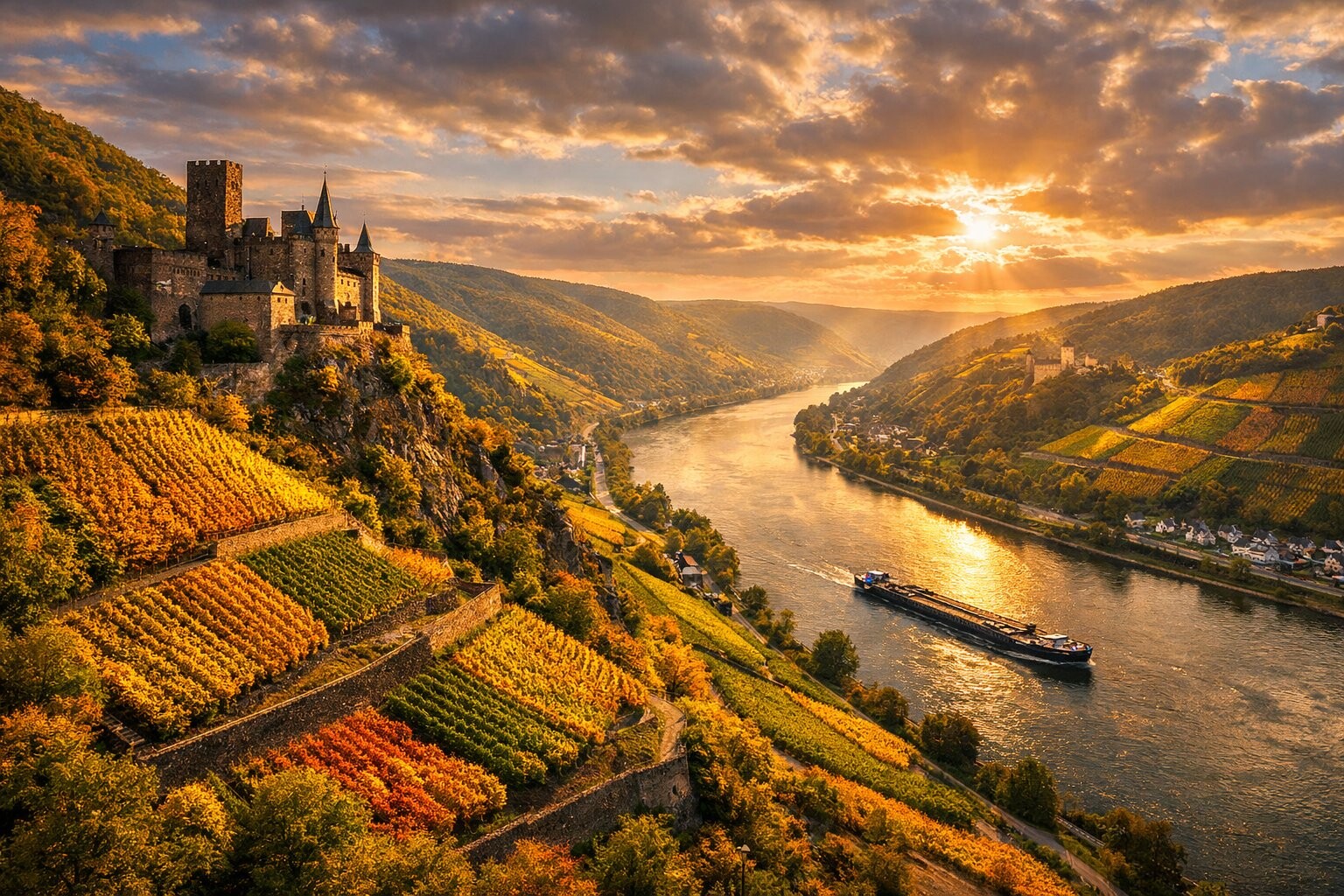
The rivers organise everything. The Rhine is the great one — it enters from Switzerland, cuts the gorge between Bingen and Koblenz, drains the industrial Ruhr and leaves for the Netherlands, and is one of the busiest inland waterways on earth. The Danube rises in the Black Forest and runs east to the Black Sea. The Elbe comes out of Czechia through Dresden to Hamburg. The Main, the Mosel, the Neckar and the Oder do the rest.
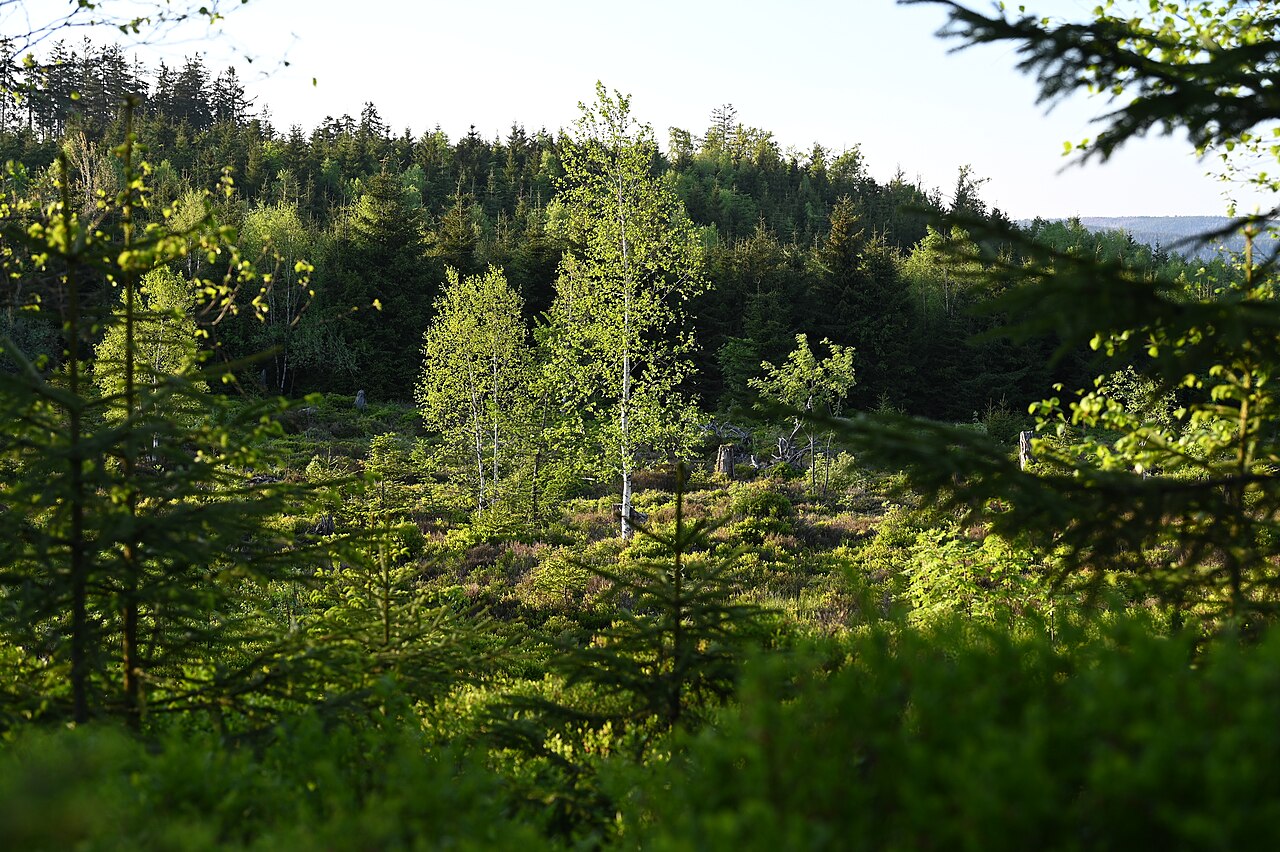
Forest covers about a third of the country — some 11.4 million hectares — and it is almost entirely managed rather than wild. The Germans have a long, complicated and occasionally mystical relationship with it, which produced both the science of sustainable forestry (Nachhaltigkeit, coined in a 1713 Saxon treatise on silviculture) and the 1980s national panic over Waldsterben, forest death from acid rain.
🌡️ Climate and When to Go
Temperate oceanic in the north-west, shading to continental in the east and south-east: milder winters and cooler summers by the North Sea, colder winters and hotter summers in Bavaria and Brandenburg. Rain falls in every month, most of it in summer. There is no dry season and no reliable one.
May–June
The best window for most purposes. Long days, everything green, café terraces open, and the summer crowds not yet arrived. Rain is likely; bring a jacket regardless of the forecast.
July–August
Warm to hot — 30 °C plus is now normal in the south and the west, and German buildings are not built for it. School holidays fill the Alps and the coasts. The best time for Baltic beaches and Alpine walking, the worst for cities.
September–October
Arguably the best month of all is September: warm, stable, the wine harvest in the Mosel and Rhine, Oktoberfest in Munich (which is mostly in September), and the crowds thinning. October brings colour to the forests.
December
Christmas market season — from late November to 23 December, in essentially every town in the country. Cold, dark, expensive and magnificent. January and February are the genuinely dead months except in the Alps.
The short answer: May, June or September. Avoid the second half of July and all of August in the cities if you can, go in December if the markets are the point, and understand that German weather forecasts are accurate and German rain is persistent rather than dramatic.
🗺️ Map
Germany borders nine countries — more than any other in Europe except Russia: Denmark, Poland, Czechia, Austria, Switzerland, France, Luxembourg, Belgium and the Netherlands. Berlin is in the north-east, Munich in the south, Hamburg on the Elbe estuary, and the Rhine-Ruhr conurbation in the west.
Fast-train times from Berlin: Hamburg 1h45; Leipzig 1h15; Dresden 1h50; Frankfurt 4h; Cologne 4h15; Munich 4h. From Munich: Nuremberg 1h05; Stuttgart 2h15; Salzburg 1h30. From Prague: Dresden 2h15 by train, Berlin 4h, Munich 5h30 by bus or 6h by train. Domestic flights within Germany are rarely worth it against the ICE network.
🏛️ How the Country Actually Works
Understanding German federalism explains more about travelling here than any list of sights. The 1949 Basic Law — written under Allied supervision by people whose explicit goal was to make another centralised dictatorship structurally impossible — distributes power downward and sideways with some determination.
The Länder run daily life
Education, police, culture and broadcasting are state matters. This is why school holidays are staggered across the country, why shop opening hours differ between states, and why a public holiday can be a working day two hundred metres away across a state line.
The Bundesrat
The upper house is made up of delegates from the state governments, not elected senators, and it can block a large share of federal legislation. Federal governments routinely lose their majority there mid-term.
No single capital function
The constitutional court is in Karlsruhe, the central bank in Frankfurt, the federal statistics office in Wiesbaden, the labour agency in Nuremberg. Several federal ministries still keep their main offices in Bonn. This is deliberate.
Chancellor, not president
The Federal President is head of state and largely ceremonial; the Chancellor runs the government and can only be removed by a constructive vote of no confidence — parliament must agree on a successor first. Another 1949 design decision aimed squarely at Weimar's failure modes.
The 5% hurdle
A party needs 5% of the vote to enter the Bundestag at all — again, a direct response to Weimar's fragmented parliaments. It shapes every German election.
Militant democracy
The Basic Law allows the constitutional court to ban parties that seek to abolish the democratic order, and it has done so twice, in 1952 and 1956. The debate over whether to attempt it again is live.
📜 Before There Was a Germany
In 9 CE, in forest somewhere near modern Kalkriese, an alliance of Germanic tribes under Arminius destroyed three Roman legions over four days. The Romans never seriously tried to hold the country east of the Rhine again, and the river became the frontier — which is why Cologne, Mainz, Trier and Regensburg have Roman remains and Berlin, Hamburg and Munich do not.
Charlemagne was crowned in 800 and his empire was divided by his grandsons in 843; the eastern portion became the kernel of the German lands. In 962 Otto I was crowned emperor in Rome, founding what became the Holy Roman Empire — an elective monarchy over a patchwork that never became a state. At its height it held some three hundred territories, from substantial kingdoms down to individual imperial cities and abbeys, each with its own law, currency and tolls.
Two things then happened that shaped everything since. In 1440s Mainz, Johannes Gutenberg assembled movable metal type, oil-based ink and the press into a working system, and the cost of a book collapsed. In 1517 in Wittenberg, Martin Luther published his objections to the sale of indulgences, and the printing press turned a theological quarrel into a continental schism within months. His German Bible then did for the language what the King James did for English: it fixed a standard.
The bill arrived in 1618. The Thirty Years' War began in Prague and was fought largely on German soil, and it is one of the worst demographic catastrophes in European history — the population of the German lands fell by perhaps a third overall and by far more than that in the worst-hit regions. The 1648 Peace of Westphalia confirmed the fragmentation and is conventionally taken as the founding moment of the modern sovereign-state system.
🦅 Unification and the First Catastrophe
Prussia rose through the eighteenth century — militarised, bureaucratic, Protestant, and under Frederick the Great a serious European power. Napoleon abolished the Holy Roman Empire in 1806 and, by wrecking the old order, made a German nation-state thinkable. The liberal revolution of 1848 tried to build one from below at the Frankfurt parliament and failed.
So it was built from above instead. Otto von Bismarck, Prussian minister-president from 1862, fought three short wars — against Denmark, Austria and France — and on 18 January 1871 had the German Empire proclaimed in the Hall of Mirrors at Versailles, a location chosen precisely to humiliate the French. It was not a merger of equals; it was Prussia with attachments.
The Empire industrialised at extraordinary speed, built the world's first modern welfare state — Bismarck introduced health insurance in 1883 and old-age pensions in 1889, largely to undercut the socialists — and produced a scientific establishment that dominated chemistry and physics until 1933. It also acquired colonies in Africa and the Pacific, where German forces carried out the Herero and Nama genocide in South West Africa between 1904 and 1908; Germany formally recognised this as genocide only in 2021.
The First World War killed about two million German soldiers, ended the monarchy, and produced the Weimar Republic: a genuinely radical constitution, extraordinary cultural output — Bauhaus, Brecht, Fritz Lang, Berlin as the most permissive city in Europe — and an economy destroyed twice, by the 1923 hyperinflation and then by the 1929 crash. By 1932 unemployment was six million and the two largest parties in parliament both wanted to abolish the republic.
🕯️ 1933–1945, and the Reckoning
Hitler was appointed Chancellor on 30 January 1933 by a conservative establishment that believed it could control him. Within six months every other party was banned, the trade unions dissolved, the first concentration camp opened at Dachau, and rule by decree established. The Nuremberg Laws of 1935 stripped German Jews of citizenship; the pogrom of 9–10 November 1938 destroyed synagogues and businesses across the country.
The Second World War, launched by Germany in September 1939, killed somewhere between 70 and 85 million people worldwide. Within it, the German state organised and carried out the industrial murder of approximately six million Jews, alongside the systematic killing of Roma and Sinti, disabled people, Soviet prisoners of war, Poles, political opponents and gay men. This was not incidental to the war; it was a policy pursued with bureaucratic thoroughness and it required the participation of an enormous number of ordinary people.
What Germany did afterwards is, by international standards, unusual. Denial of the Holocaust is a criminal offence. Nazi symbols are banned. Every German schoolchild studies the period in depth and visits a memorial site. Berlin's Memorial to the Murdered Jews of Europe — 2,711 concrete stelae — occupies two and a half acres of the most valuable land in the capital, beside the Brandenburg Gate. More than 100,000 brass Stolpersteine, each recording one deported person outside their last freely chosen home, are set into pavements across Europe in what is the largest decentralised memorial in the world.
This was not immediate or automatic. The 1950s were a decade of silence and quiet reintegration of former officials; it took the Frankfurt Auschwitz trials of 1963–65 and the generational revolt of 1968 to force the subject open. But it happened, it is ongoing, and it is visible everywhere you travel.
Sites to visit
Sachsenhausen (Berlin) and Dachau (Munich) are reachable as half-day trips and are free. Buchenwald near Weimar, Bergen-Belsen near Hanover, Nuremberg's Documentation Centre at the rally grounds, and the Wannsee villa where the deportations were coordinated.
The Topography of Terror
In central Berlin, on the site of the Gestapo and SS headquarters. Free, open-air and indoor, and the single most informative place in the country on how the apparatus actually worked.
How to behave
These are graves. No selfies, no posing, no laughing on camera. This ought not to need saying, and it does — Shahak Shapira's Yolocaust project of 2017 existed for a reason.
What to say
Nothing performative. Germans do not need a visitor's absolution and will find it embarrassing. If the subject comes up, ask rather than reassure.
🧭 Two Germanys
In 1949 the western occupation zones became the Federal Republic, with its capital at Bonn — a small university town chosen partly to signal that the arrangement was temporary — and the Soviet zone became the German Democratic Republic. Berlin, deep inside the GDR, was divided in four and became the sharpest point of the Cold War: the Soviet blockade of 1948–49 was answered by the Allied airlift, which flew in over two million tonnes of supplies in fifteen months.
West Germany's Wirtschaftswunder — the currency reform, the Marshall Plan, Ludwig Erhard's social market economy — took the country from rubble to prosperity within fifteen years, with several million Gastarbeiter, mostly from Turkey, Italy, Greece and Yugoslavia, doing a great deal of the work. Most were expected to leave, and did not. Germany's four-million-strong Turkish-origin population dates from this.
East Germany built a functioning industrial state with full female employment, universal childcare and no unemployment, and it also built the most comprehensively surveilled society in history. The Stasi employed about 91,000 full-time officers and ran perhaps 180,000 informers in a population of 16 million — roughly one watcher for every sixty citizens. The files, six hundred thousand of which survived the shredders, have been open to those they concern since 1992, and reading your own file remains one of the more devastating things a German of a certain age can do.
The GDR also killed people at its own border. The 1953 workers' uprising was put down by Soviet tanks. And by 1961 some 2.7 million people had left for the West, which is why the border was closed.
🧱 The Wall
On the night of 12–13 August 1961, East German forces sealed the border through Berlin with barbed wire and began building. Berliners woke to find streets bricked up, U-Bahn stations closed, and families separated by a line drawn through their own city. The Wall stood for 28 years, two months and 27 days.
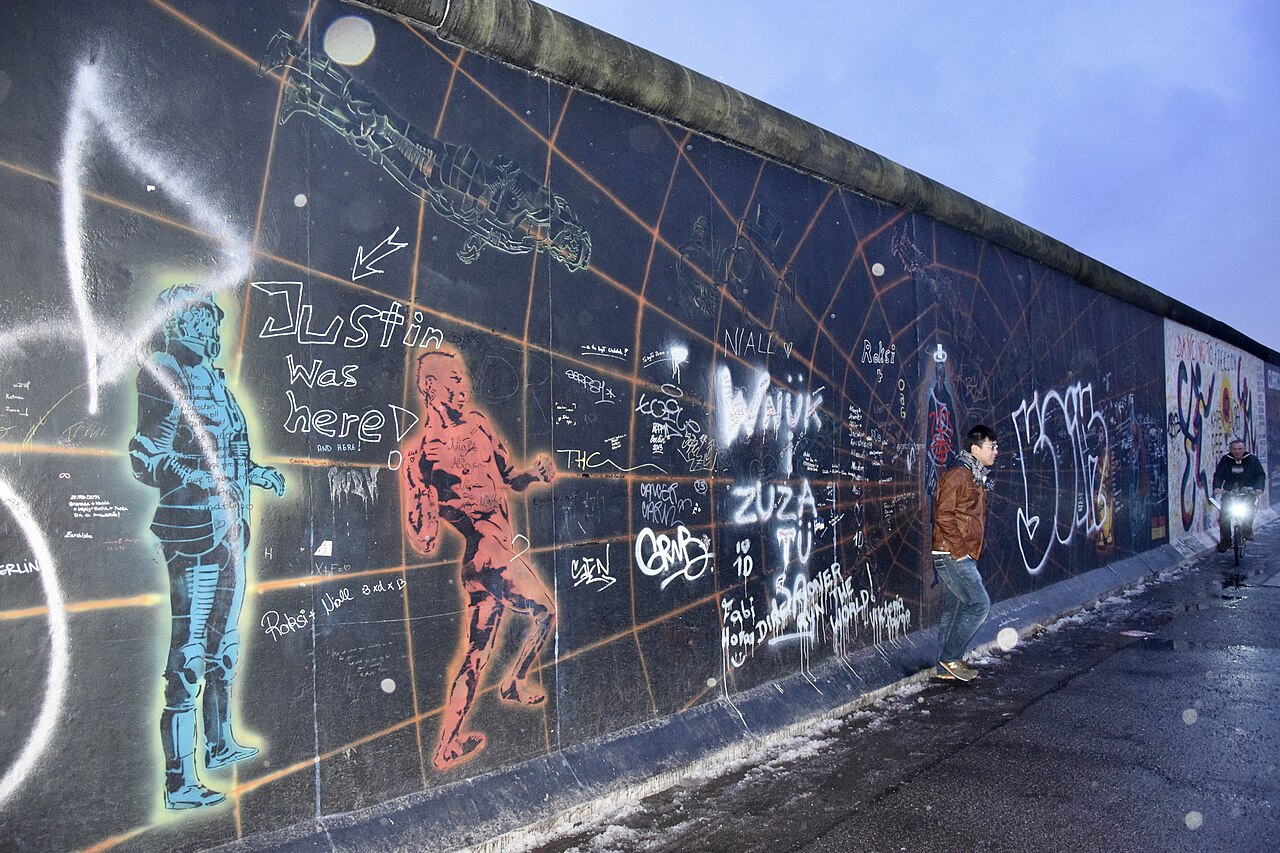
It was not a wall but a system: an outer concrete barrier, a lit death strip with raked sand, anti-vehicle obstacles, dog runs, watchtowers and an inner wall. At least 140 people were killed at the Berlin border and around 600 in total along the inner-German frontier, though the precise figures remain contested. Peter Fechter, shot in 1962 and left to bleed to death in the death strip in view of both sides, was eighteen.
It opened by accident. On the evening of 9 November 1989, at the end of a rambling press conference, Politburo member Günter Schabowski was handed a note about eased travel rules and, asked when they took effect, looked at it and said "as far as I know... immediately, without delay". It was broadcast, crowds went to the crossing points, and the overwhelmed guards eventually opened the barriers rather than shoot. Nobody had ordered it.
Bernauer Straße
The Berlin Wall Memorial: a preserved section with the death strip intact, a documentation centre, and the Chapel of Reconciliation on the site of a church demolished because it stood in the way. The one Wall site to visit if you visit only one.
East Side Gallery
The longest surviving stretch, on the Spree in Friedrichshain. Crowded, much-photographed, and worth ten minutes rather than an hour.
Checkpoint Charlie
A reconstruction with actors and a McDonald's. The nearby Mauermuseum has genuine escape vehicles and is better than its tourist-trap surroundings suggest.
The line itself
A double row of cobbles traces the Wall's course through central Berlin. Following it on foot or by bike for a few kilometres does more than any museum.
🤝 Reunification and Germany Today
Reunification took eleven months from the fall of the Wall to 3 October 1990 and was, in economic terms, a takeover. The Treuhandanstalt privatised or closed some 8,500 East German enterprises; industrial employment in the east collapsed by roughly four-fifths; and around two million people, disproportionately young and female, moved west. Well over a trillion euros has since flowed east through the solidarity surcharge and other transfers, and the infrastructure gap has largely closed. The wage and wealth gap has not, nor has the sense among many easterners that their lives were reorganised by people who did not ask.
The Federal Republic since has been defined by a series of decisions taken with characteristic deliberation and mixed results: the euro; Gerhard Schröder's Hartz labour reforms; Angela Merkel's sixteen years and her 2015 decision to admit around a million refugees; the Energiewende and the phase-out of nuclear power completed in 2023; and the Zeitenwende — the reversal of decades of defence and Russia policy after February 2022, which included abandoning Nord Stream and cutting a gas dependency that had reached 55% of imports.
The country a visitor meets in the mid-2020s is prosperous, functional in most respects and unsettled. Manufacturing is under pressure from energy costs and Chinese competition; the far-right AfD polls strongly, especially in the eastern states; and the deutsche Bürokratie, digitalisation and the state of the railways are subjects of continuous and largely justified national complaint.
None of this affects a trip. It does explain why the person you talk to may be gloomier about their country than you expect, and why complaining about Deutsche Bahn is the single most reliable conversational opener in Germany.
🏛️ Berlin
Berlin is nine times the size of Paris by area and has half its population density, which is the first thing to understand: it is a very large, very green, rather empty city built for an imperial capital, wrecked, split, and then reassembled with the seams showing. It has more bridges than Venice and about a third of its area is water, forest or park.
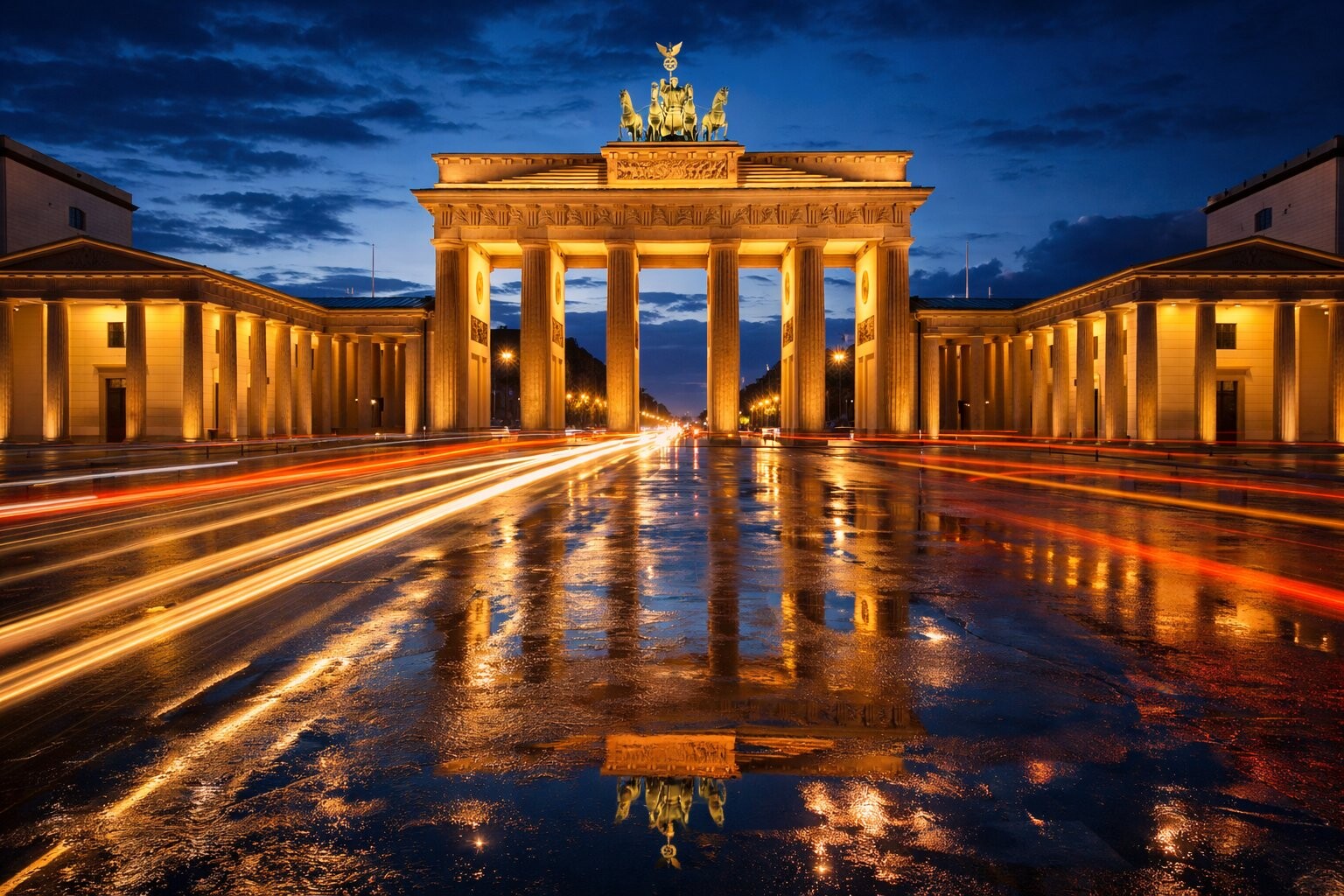
The city's character is a direct product of its history. It was cheap for thirty years after the Wall fell because half of it was a failed state's second city, and that cheapness bought the squats, the clubs, the galleries and the Berlin of international reputation. It is no longer cheap — rents have roughly doubled since 2010 and the city voted in 2021 to expropriate large corporate landlords, a referendum the state government has spent years not implementing.
Museum Island
Five museums on one island, UNESCO-listed. The Pergamon is partly closed for a long restoration; the Neues Museum holds Nefertiti; the Alte Nationalgalerie is the one people skip and shouldn't.
Reichstag
Norman Foster's glass dome over the parliamentary chamber, free to visit with advance registration. The Cyrillic graffiti left by Soviet soldiers in 1945 was deliberately preserved during the rebuild and is visible inside.
Memorial to the Murdered Jews of Europe
Peter Eisenman's field of 2,711 stelae beside the Brandenburg Gate, with the underground Place of Information beneath. Free. Give it proper time.
Kreuzberg and Neukölln
The Turkish market on the Maybachufer, Görlitzer Park, the Landwehrkanal, and the densest concentration of good cheap food in the country. Where a great deal of actual Berlin life happens.
Tempelhofer Feld
A decommissioned airport turned into the largest inner-city open space in the world — 300 hectares of runway and grass, used for cycling, kite-buggying and barbecues. Berliners voted twice against building on it.
Clubs
Berghain in a former power station is the famous one and the door is genuinely selective. The scene is much wider than that: Sisyphos, about://blank, Renate. No photography anywhere, phone cameras taped at the door.
🍺 Munich and Bavaria
Bavaria is a quarter of Germany's land area, richer than most European countries, Catholic, conservative, and thoroughly convinced of its own distinctiveness. It has its own greeting (Grüß Gott), its own party that exists nowhere else (the CSU), and a constitutional court that once ruled crucifixes must hang in classrooms. It also supplies almost everything the world pictures when it pictures Germany — the lederhosen, the beer halls, the castles, the Alps — which is a source of some irritation elsewhere in the country.
Munich is the wealthiest large city in Germany and behaves like it: expensive, orderly, handsome and slightly smug. Marienplatz with the neo-Gothic Neues Rathaus and its Glockenspiel is the centre; the Englischer Garten is bigger than Central Park and has a standing river wave that surfers ride year-round; the Deutsches Museum is one of the great science museums anywhere; and the Alte and Neue Pinakothek hold a first-rank art collection.
The city is also where the Nazi party was founded and had its headquarters, a fact Munich spent decades not discussing and now addresses directly at the NS-Dokumentationszentrum on the site of the former Brown House.
Oktoberfest
Sixteen to eighteen days from mid-September, six million visitors, fourteen enormous tents, and beer served only in one-litre Maß glasses by the six Munich breweries. Book accommodation months ahead. Tables in the tents need reservations; mornings and weekdays are the way in without one.
Neuschwanstein
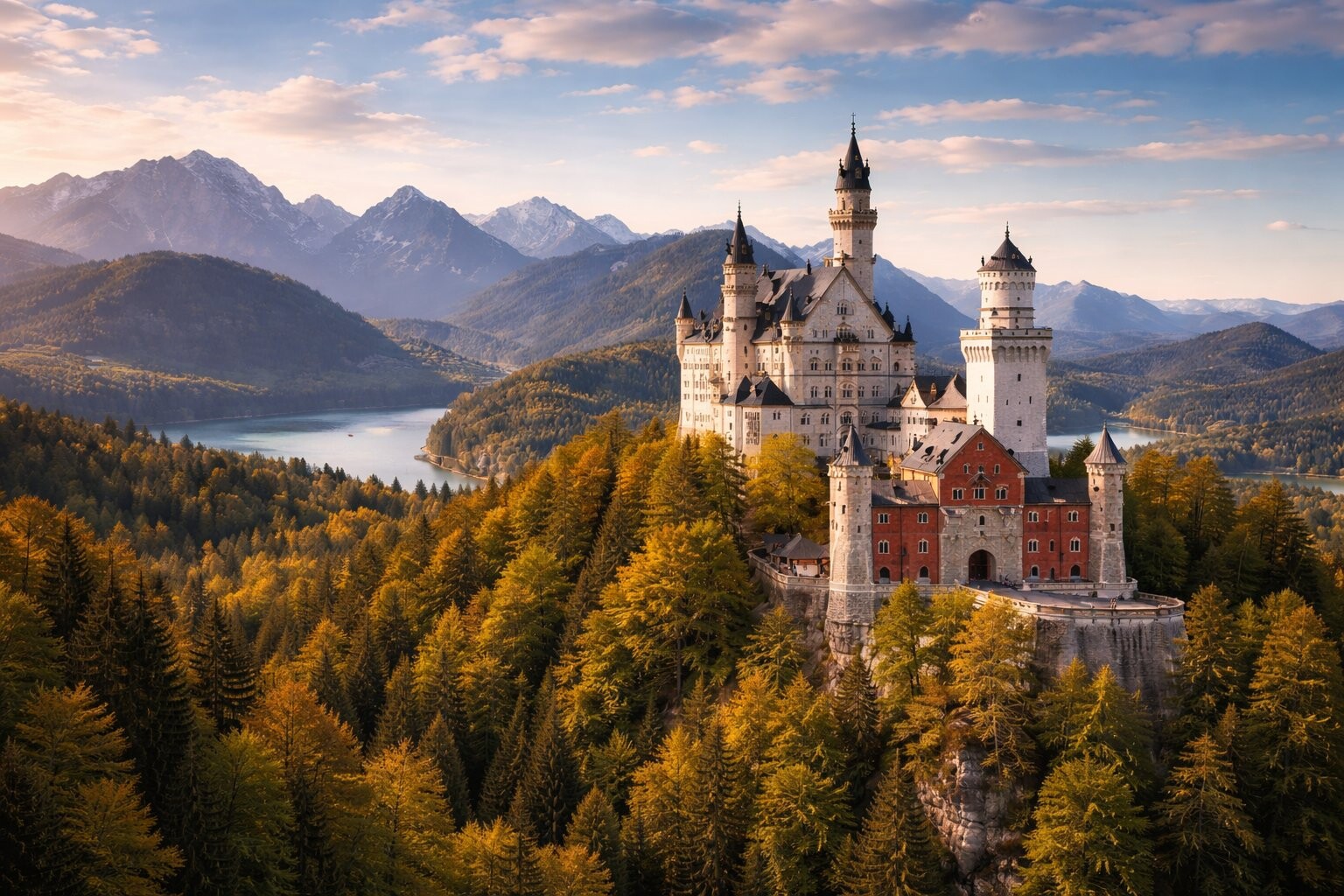
Ludwig II's unfinished nineteenth-century fantasy castle, the model for Disney's, and one of the most visited buildings in Europe — 1.4 million a year through rooms that were designed for one man. Timed tickets online, well in advance. The view from the Marienbrücke is the photograph.
The Alps
Garmisch-Partenkirchen for the Zugspitze cog railway and cable car; Berchtesgaden for the Königssee and the Eagle's Nest; the Allgäu for walking. All within two hours of Munich by train.
Nuremberg
Franconia rather than Bavaria proper and it will tell you so. The reconstructed old town, the imperial castle, the Nazi rally grounds documentation centre, the courtroom where the trials were held, and the best Christmas market in the country.
Bamberg and Regensburg
Two UNESCO-listed old towns that escaped bombing almost entirely. Bamberg for smoked beer and a cathedral with four towers; Regensburg for a twelfth-century stone bridge and the oldest sausage kitchen in Germany.
Beer gardens
The rule that matters: in a traditional Bavarian beer garden you may bring your own food and buy only the beer. This is a legally protected right dating from 1812 and Bavarians will explain it to you at length.
⚓ Hamburg and the North
Hamburg is a city-state, Germany's second largest city, and one of Europe's biggest ports despite being 100 kilometres from the sea up the Elbe. It is Hanseatic — merchant, Protestant, understated, oriented towards Britain and Scandinavia rather than southern Germany — and it has more millionaires and more bridges than any other German city.
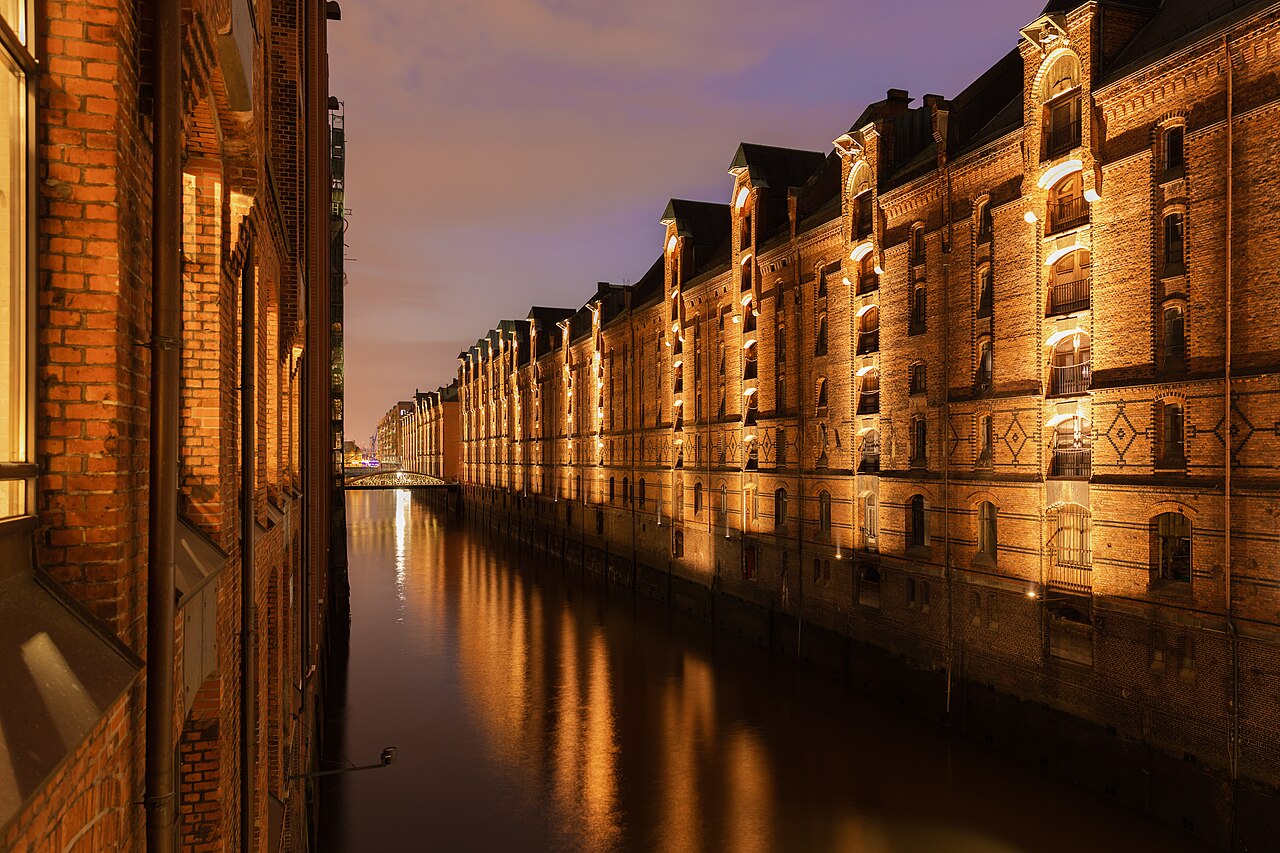
Elbphilharmonie
A glass wave on top of a 1960s cocoa warehouse, opened in 2017 at ten times its budget and seven years late — a national scandal that ended as a national landmark. The Plaza viewing level is free with a timed ticket.
The port
Take the public ferry line 62 from Landungsbrücken to Finkenwerder. It costs a normal transport fare, runs every fifteen minutes, and gives you the container terminals and the working river far better than any tour boat.
St Pauli and the Reeperbahn
The famous entertainment district, honestly seedy rather than sanitised, and the place the Beatles played 281 nights in 1960–62. The Sunday Fischmarkt at 5 a.m. is a genuine institution.
Lübeck
An hour away: a UNESCO-listed brick-Gothic Hanseatic town, the Holstentor, marzipan since 1806, and the Buddenbrook house of Thomas Mann.
Bremen and the coast
Bremen for the market square and the Roland statue; the Wadden Sea national park and the North Frisian islands — Sylt, Amrum, Föhr — for tidal flats, mudflat walking and a very particular kind of German holiday.
The Baltic
Rügen's chalk cliffs, the resort architecture of Binz and Heiligendamm, and Usedom. Cold water, long beaches, wicker Strandkörbe, and almost no foreign tourists.
⛪ Cologne, the Rhine and the Ruhr
The Rhine-Ruhr is Germany's largest urban region — over ten million people across Cologne, Düsseldorf, Dortmund, Essen and Duisburg — and it is the part of the country foreign visitors most often skip. It is post-industrial, dense, unglamorous and much more interesting than its reputation.
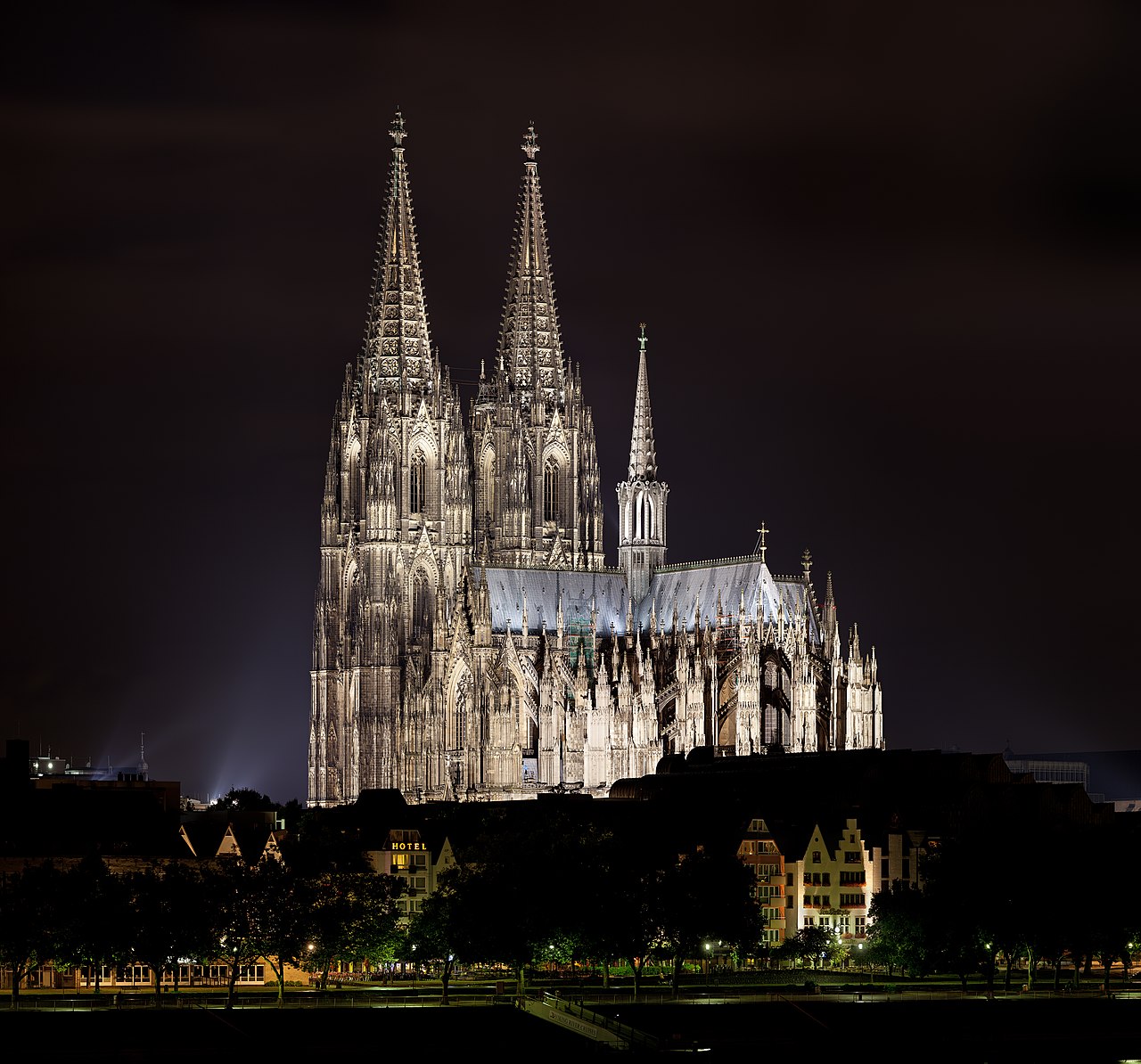
Cologne is Germany's fourth city and its least German-seeming: Catholic, Carnival-mad, talkative and comfortable with mess. Ninety per cent of the old town was destroyed in the war and the rebuilding was fast rather than careful, so the cathedral stands in a setting of 1950s concrete — but the cathedral is extraordinary, the Romanesque churches around it are a serious body of medieval architecture, and Kölsch, the local beer, is served in 200 ml glasses that waiters replace without asking until you put your beer mat on top.
The Rhine gorge
Between Bingen and Koblenz: 65 km of terraced vineyards and castles, UNESCO-listed. The Loreley rock, Bacharach, Bacharach's neighbours, and the two castles at Kaub. Take the train along the left bank or a KD boat; do not drive it.
Zollverein, Essen
A decommissioned coal mine and coking plant, Bauhaus-influenced, listed by UNESCO in 2001 and turned into a museum and cultural complex. The best single monument to what the Ruhr actually was.
Düsseldorf
Cologne's rival in everything — Altbier instead of Kölsch, fashion and Japanese business instead of carnival, and a Frank Gehry waterfront. The rivalry is real and is enjoyed by both sides.
Aachen
Charlemagne's capital and burial place, with the Palatine Chapel of 796 at the heart of the cathedral — the oldest cathedral in northern Europe and the coronation church of thirty German kings.
Trier
On the Mosel, Germany's oldest city, founded by Augustus. The Porta Nigra, an amphitheatre, imperial baths and a basilica that is still a working church — the largest surviving single-room structure from antiquity.
Carnival
The "fifth season" runs from 11 November and explodes in the week before Lent. Weiberfastnacht, Rosenmontag processions in Cologne, Düsseldorf and Mainz, and a city that stops entirely. Either commit to it or be somewhere else.
🎭 Dresden, Leipzig and the East
The eastern states are cheaper, emptier and — for a traveller coming from Prague — much closer than the west. They also contain some of the country's finest baroque, its most interesting recent urban history and its most contested politics.
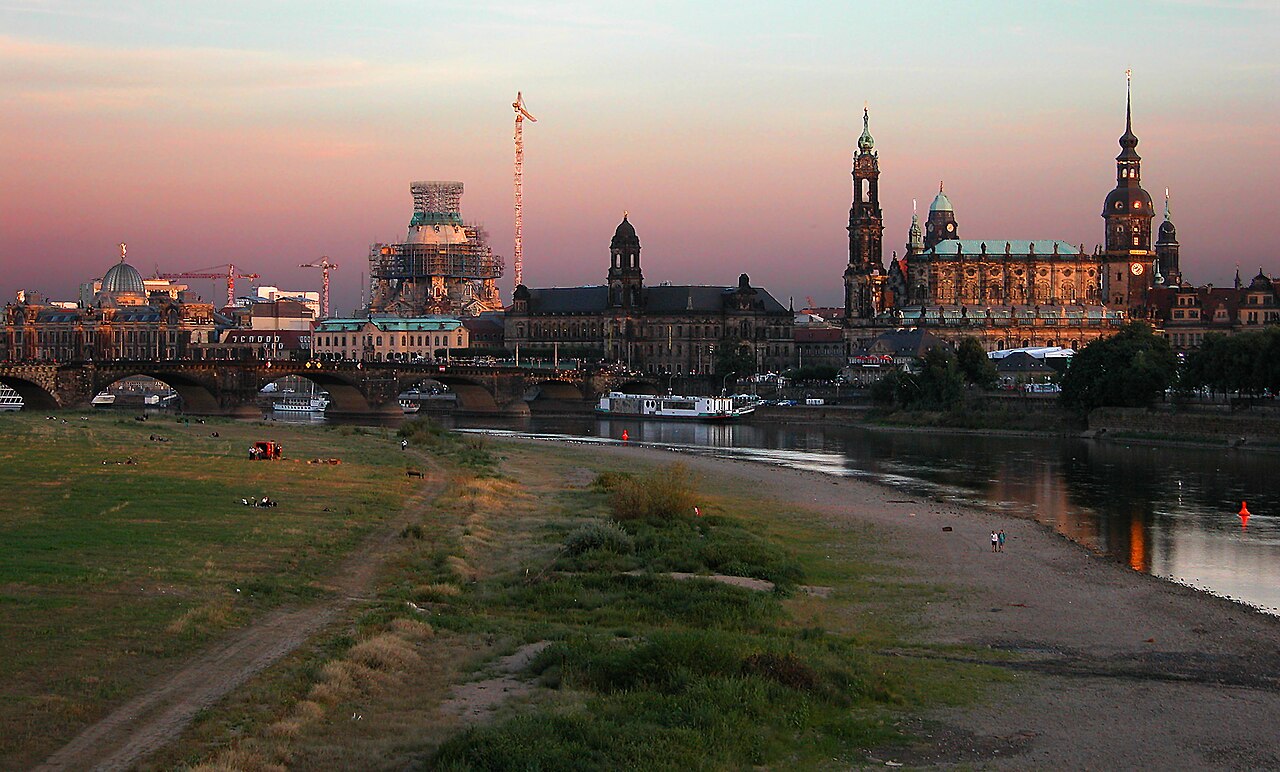
Dresden was destroyed on 13–14 February 1945 in a firestorm that killed around 25,000 people — a figure established by an independent historical commission in 2010 against decades of inflated claims used first by Goebbels and later by the far right. The rebuilt Frauenkirche, reopened in 2005 with a British-funded cross made by the son of a Lancaster bomber navigator, is the single most eloquent building in Germany about all of this.
Dresden's collections
The Grünes Gewölbe holds the Saxon treasury — a jewel room that survives largely intact — and the Zwinger holds the Old Masters, including Raphael's Sistine Madonna and the two cherubs that are on every postcard on earth.
Leipzig
The city where the 1989 revolution started, at the Monday prayers in the Nikolaikirche. Bach was cantor at the Thomaskirche for 27 years and is buried in it. Now the most dynamic city in the east, with the Spinnerei arts complex in a former cotton mill.
Weimar
Goethe, Schiller, Liszt, Nietzsche, Bauhaus, and the Weimar constitution — an astonishing concentration of German culture in a town of 65,000. Buchenwald concentration camp is eight kilometres away, and the juxtaposition is the point.
Saxon Switzerland
Sandstone towers, the Bastei bridge and 400 km of marked trails, an hour from Dresden and directly across the border from Czech Bohemian Switzerland. Best walked out of season.
Potsdam
Frederick the Great's Sanssouci, the largest World Heritage site in Germany, plus the Cecilienhof where the 1945 conference divided Europe. Forty minutes from central Berlin on the S-Bahn.
Erfurt and Quedlinburg
Erfurt for the Krämerbrücke, a medieval bridge with houses on it, and Luther's monastery. Quedlinburg for 1,300 timber-framed houses across eight centuries, all of which survived the war and the GDR.
🏰 The Romantic Road and the Small Towns
The Romantische Straße was invented in 1950 by tourism officials to sell southern Germany to American servicemen, and it worked so completely that it now defines what much of the world means by Germany. It runs 350 kilometres from Würzburg to Füssen through walled towns, vineyards and the Alpine foothills.
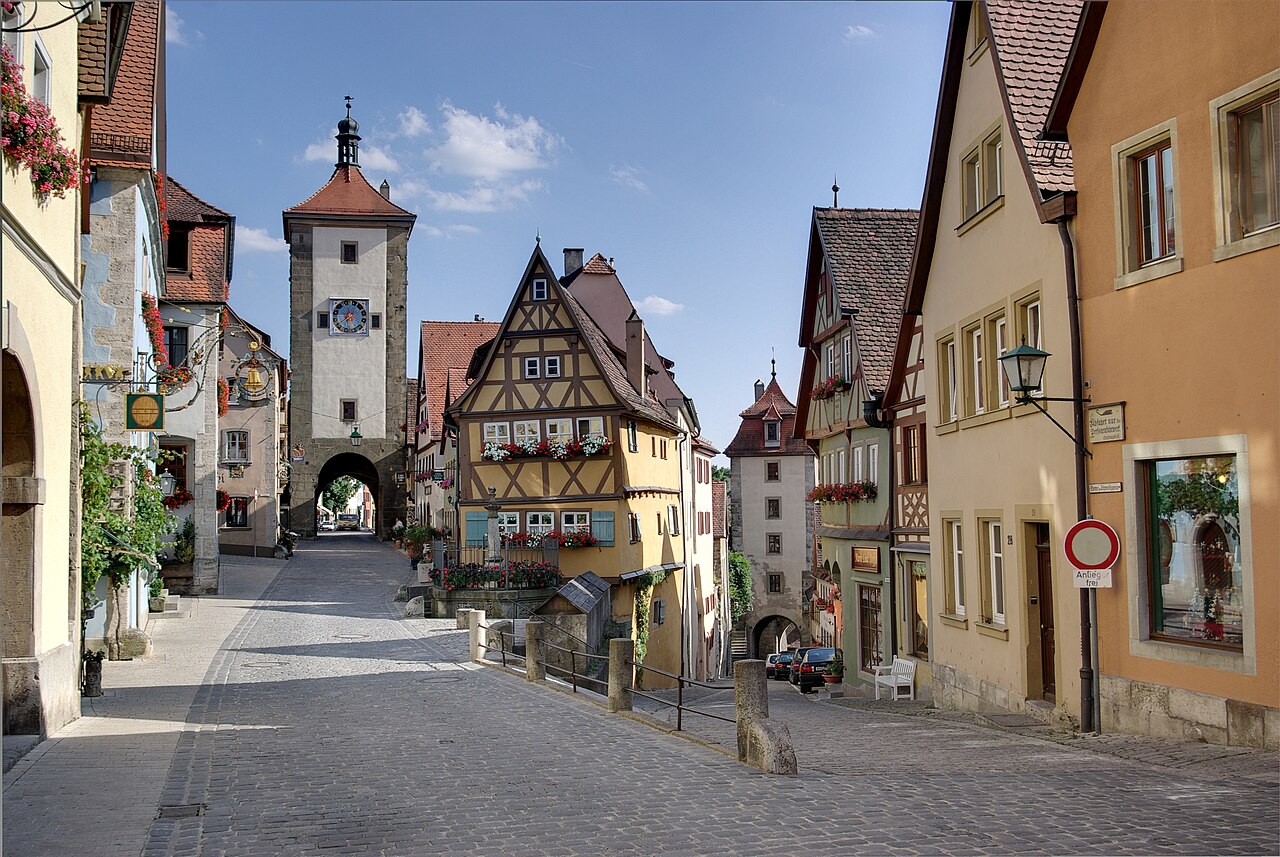
Rothenburg ob der Tauber is the centrepiece and is exactly as pretty and as busy as advertised. The trick is to stay the night: the coaches leave by five, the walls can be walked at dusk, and the Night Watchman's tour is genuinely good. Around forty per cent of the town was destroyed in March 1945 and rebuilt with international donations, a fact the town does not hide.
Würzburg
The Residenz, a Balthasar Neumann palace with the largest ceiling fresco in the world by Tiepolo, plus Franconian wine in the flat green Bocksbeutel bottles.
Dinkelsbühl and Nördlingen
Two more intact walled towns, far quieter than Rothenburg. Nördlingen is built inside a 15-million-year-old meteorite crater and its buildings contain suevite — rock created by the impact, including microscopic diamonds.
Heidelberg
Not on the Romantic Road but the same idea: a ruined red castle above a river, Germany's oldest university, and the town that survived the war intact and became the American army's European headquarters.
Bacharach and the Mosel villages
For the same picture with wine instead of coaches: Bacharach, Beilstein, Cochem, Bernkastel-Kues. Half-timbering, steep vineyards and far fewer people.
Monschau and the Eifel
In the west near the Belgian border: a slate-roofed town in a narrow valley, and a national park with reintroduced wildcats.
Getting around
The Romantic Road has a dedicated coach in summer, but the towns are better linked by regional train and bus than people assume, and the whole route is a well-signed cycle path.
🍺 Beer
Germany has around 1,500 breweries — roughly half of all the breweries in the European Union — and about half of those are in Bavaria. Franconia alone, the region around Bamberg, has the highest density of breweries per head anywhere on earth, with villages of four hundred people supporting two.
The Reinheitsgebot, the purity law, was issued in Bavaria in 1516 and restricted beer to barley, hops and water; yeast was added when its role was understood. It is often described as the world's oldest food regulation, which is roughly true, and as a guarantee of quality, which is more arguable — its original purposes included reserving wheat and rye for bakers and squeezing out competitors. It has not been binding law since 1987, when the European Court struck down its use against imports, but almost every German brewery still advertises compliance.
Helles and Pils
Helles is the Munich pale lager: soft, malty, unaggressive, the default litre in a beer garden. Pils is the northern standard, drier and much more bitter, served in 300 ml glasses over seven patient minutes.
Weissbier
Bavarian wheat beer, cloudy, banana-and-clove from the yeast, served in a half-litre vase. Order it naturtrüb. A Berliner Weisse is an entirely different, sour, low-alcohol Berlin thing served with syrup.
Kölsch and Alt
Cologne's pale Kölsch and Düsseldorf's copper Altbier — both top-fermented, both served in small glasses replaced automatically until you cover the glass with your beer mat. Ordering the wrong one in the wrong city is a joke both cities enjoy.
Rauchbier
Bamberg's smoked beer, made with malt dried over beechwood. Schlenkerla's is the benchmark and tastes emphatically of bacon. The first glass is a shock; the third is not.
Bockbier and Doppelbock
Strong seasonal lagers. Doppelbocks end in -ator (Salvator, Optimator) after the Paulaner monks' original, which was brewed to be drunk during Lenten fasting — liquid bread.
Where and how
Beer gardens (bring your own food, buy the beer), Brauereigasthöfe in Franconia, and the Kölsch houses of Cologne. Prices: €4–6 for half a litre, roughly €15 for an Oktoberfest Maß. Beer is legal to drink in public almost everywhere, including on trains.
🍷 Wine
Germany is the world's most under-rated fine-wine country, and the reason is a self-inflicted wound. In the 1970s and 80s the industry flooded export markets with cheap sweetened Liebfraumilch, and it took thirty years to undo the damage. The good stuff never stopped being made; it just stopped being noticed.
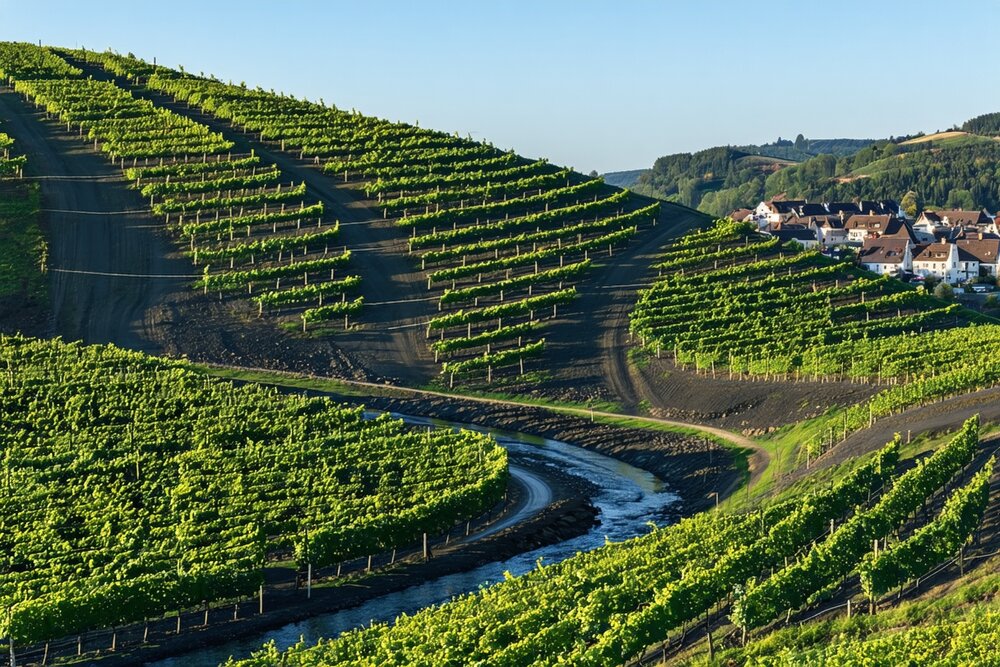
Riesling is the point. Germany has about 45% of the world's plantings, and on the slate of the Mosel and the Rhine it produces a wine of very high acidity, low alcohol — 7.5% to 9% is normal for a Kabinett — and an ability to age for decades that almost no other white grape matches. It runs from bone dry (trocken) through off-dry to the sweet late-harvest categories, and the labelling that terrifies people is actually precise: Kabinett, Spätlese, Auslese, Beerenauslese, Trockenbeerenauslese and Eiswein describe the ripeness of the grapes at picking, not necessarily the sweetness of the wine.
Mosel
Slate, extreme slopes, and the lightest and most delicate Riesling in the world. Bernkastel, Piesport, Wehlen, Ürzig. The Calmont near Bremm is the steepest vineyard in Europe at 65 degrees.
Rheingau
The Rhine turns west for 30 km and the south-facing slope produces a fuller, drier Riesling. Schloss Johannisberg, where Spätlese was discovered by accident in 1775 when the harvest permission arrived late.
Pfalz and Rheinhessen
The two largest regions and the engine of the modern German wine revival — a generation of young growers making serious dry Riesling and outstanding Pinot Noir.
Spätburgunder
German Pinot Noir. Germany is the world's third-largest producer and the top wines from Baden, the Ahr and the Pfalz now stand comparison with Burgundy at a fraction of the price. Almost none is exported.
Sekt
German sparkling wine, mostly industrial but with a rapidly improving traditional-method segment (Winzersekt). Germany drinks more sparkling wine per head than anywhere else on earth.
Drinking it
Wine taverns — Weinstuben, Straußwirtschaften, Frankfurt's apple-wine houses — and the wine festivals that run through every wine village from June to October. The Wurstmarkt at Bad Dürkheim is the largest wine festival in the world.
🍽️ Food
German food has a reputation for being heavy, brown and pork-based, which is fair about one strand of it and misses the rest. There is no national cuisine; there are regional ones, and they differ more than a visitor expects — a Rhineland kitchen and a Bavarian one have little in common beyond the pig.
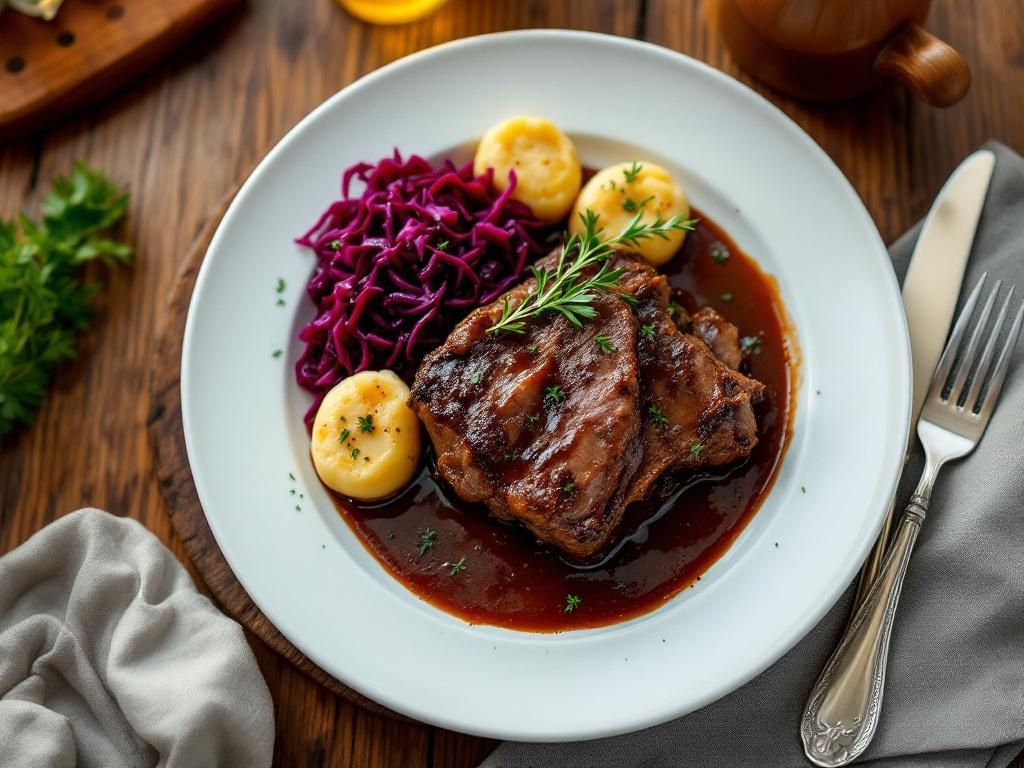
The classics. Sauerbraten, beef marinated three to five days in vinegar and spice then braised. Schweinshaxe, roast pork knuckle with crackling, Bavarian and enormous. Currywurst, a Berlin invention of 1949 — sausage, tomato sauce, curry powder — that has its own museum and sells 800 million portions a year. Döner kebab, invented in Berlin in the 1970s by Turkish migrants and now Germany's most-eaten fast food by a wide margin. Spätzle, Swabian egg noodles, and Käsespätzle, which is macaroni cheese's superior cousin. Maultaschen, Swabian ravioli, traditionally invented to hide meat from God during Lent — the nickname is Herrgottsbscheißerle, "little God-cheaters".
Bread is where Germany is genuinely world-class. Over 3,000 registered varieties, a dense sourdough rye tradition unmatched anywhere, and UNESCO Intangible Cultural Heritage status for German bread culture since 2014. Germans abroad complain about bread more than about anything else, and they are right to.
Regional. Spring means white asparagus — Spargelzeit, roughly late April to 24 June, is a genuine national event with roadside stalls and restaurant menus given over to it. Autumn means game, mushrooms and Zwiebelkuchen with new wine. The north eats fish: Matjes herring, Labskaus, and the Fischbrötchen that is the correct lunch anywhere near the coast.
Sauerbraten — Rhineland Marinated Beef
Serves 6 · 3–5 days marinating plus 3 hours · the German Sunday roast
Ingredients: 1.5 kg beef topside or silverside · 500 ml red wine vinegar · 500 ml red wine · 2 onions, 1 carrot, 1 leek, all sliced · 2 bay leaves, 8 juniper berries, 8 peppercorns, 4 cloves · 60 g raisins · 60 g Aachener Printen or dark gingerbread, crumbled · 2 tbsp lard or oil · salt
Method: Bring the vinegar, wine, vegetables and spices to the boil, cool completely, then submerge the beef and refrigerate three to five days, turning daily. Lift the meat out, dry it very thoroughly, and brown it hard in the fat in a heavy casserole. Strain the marinade, add the vegetables to the pot and colour them, then pour in the liquid to come halfway up the meat. Cover and braise at 150 °C for about 2½ hours, until a skewer slides in with no resistance. Rest the meat. Strain the sauce, add the raisins and the crumbled gingerbread, and simmer until it thickens — the gingerbread is the thickener and the sweetness, so do not add flour. Slice and serve with red cabbage and potato dumplings.
💡 Do not skip the drying step before browning. Meat straight out of a wet marinade will stew instead of searing and the sauce loses its depth.
Käsespätzle — Swabian Cheese Noodles
Serves 4 · 45 minutes · the best thing in southern German cooking
Ingredients: 400 g plain flour · 4 eggs · about 150 ml sparkling water · 1 tsp salt · a grating of nutmeg · 300 g Emmental and Bergkäse, grated · 3 large onions, sliced · 50 g butter
Method: Beat the flour, eggs, salt, nutmeg and water into a thick, sticky batter and work it with a wooden spoon until it blisters and pulls away from the bowl — five minutes, and it matters. Rest 20 minutes. Fry the onions slowly in the butter until deep brown and sweet, which takes 25 minutes and cannot be rushed. Press the batter through a Spätzle press or scrape it in thin strips off a wet board into a wide pan of boiling salted water; they are done when they float, about two minutes. Lift out and layer in a warm dish with the cheese, finishing with cheese. Cover for a few minutes to melt, then top with the onions.
💡 Sparkling water rather than still gives a lighter noodle. Use a proper mountain cheese with some age — a bland one leaves you with cheesy pasta rather than Käsespätzle.
☕ Kaffee und Kuchen
Between three and four in the afternoon, particularly on Sundays, Germany stops for coffee and cake. This is not a snack; it is a meal with its own name and its own social rules, and refusing a second slice takes some determination.
Schwarzwälder Kirschtorte
Black Forest gateau — chocolate sponge, sour cherries, whipped cream and, crucially, Kirschwasser. German law requires the alcohol; a version without it may not use the name.
Bienenstich
"Bee sting": yeast dough with a caramelised almond top and a vanilla cream filling. The best of the everyday cakes and the one to order in a village bakery.
Streuselkuchen and Pflaumenkuchen
Sheet cakes with crumble, and the plum version that appears everywhere for six weeks in late summer. Sold by the piece, eaten standing up.
Stollen
The Dresden Christmas bread — heavy with butter, marzipan, candied peel and rum, dusted white. Protected origin, and it improves over several weeks.
Baumkuchen
"Tree cake", built up in layers on a rotating spit so a cut slice shows rings. Salzwedel in Saxony-Anhalt is the traditional home.
The café
A traditional Konditorei serves its own cakes and is a different institution from a modern coffee bar. Both exist; the Konditorei is the one that will still be there on a Sunday afternoon in a small town.
🎄 Christmas Markets
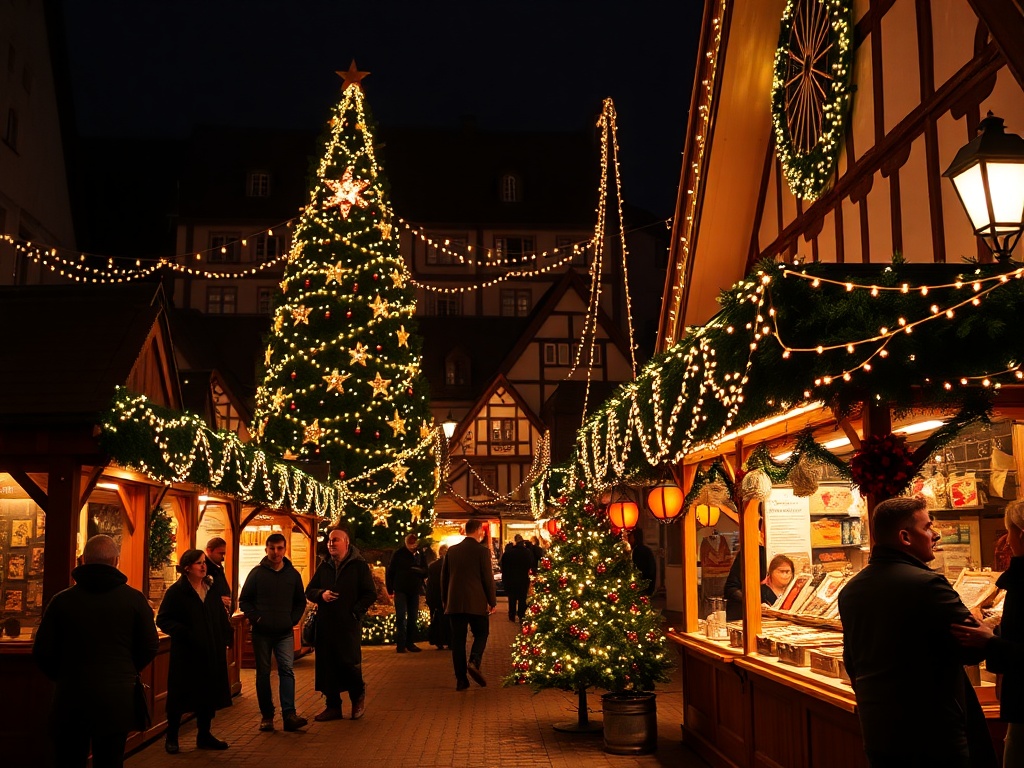
The German Weihnachtsmarkt is a medieval institution — Dresden's Striezelmarkt is documented from 1434 — and there are around 3,000 of them, in every town of any size, running from the Friday before the first Sunday of Advent to 23 December.
Glühwein and the Pfand
Mulled wine, €4–5, plus a deposit of €3–5 on the mug which you get back — or keep, since the mugs are dated and collected. Mit Schuss adds a shot of rum or amaretto. Feuerzangenbowle involves a burning rum-soaked sugarloaf.
Nuremberg
The Christkindlesmarkt, the most famous, opened by a girl playing the Christkind in a prologue from the church balcony. Strictly regulated stalls, no plastic, and the small Nuremberg sausages three to a roll.
Dresden
The Striezelmarkt, the oldest, with the Stollenfest in early December in which a several-tonne Stollen is paraded through the city and cut with an oversized knife.
Cologne, Munich, Leipzig
Cologne's under the cathedral is the busiest in the country; Munich's on Marienplatz the most traditional; Leipzig's spread across the whole old town.
What to eat
Bratwurst, Reibekuchen (potato fritters with apple sauce), roasted almonds, Lebkuchen, Baumstriezel. Buy a portion of Schmalzkuchen and share it or regret it.
The honest advice
The big-city markets are crowded to the point of unpleasantness at weekends. Go on a weekday evening, or go to a small town — the market at Michelstadt, Esslingen or Quedlinburg is what people picture and the famous ones no longer are.
⚽ Football, Music and How Germans Spend Sunday
The Bundesliga has the highest average attendance of any football league in the world — around 39,000 — and it is not close. The reason is structural: the 50+1 rule requires clubs to retain majority voting control, so they cannot be bought outright by an individual or a state. That keeps ticket prices low (standing terraces still exist, and a season ticket at a top club can cost less than a single Premier League match), keeps membership democratic, and produces the Yellow Wall at Dortmund — 25,000 people standing on one terrace.
Going to a match
Tickets are cheap and hard to get; club membership helps. Standing sections are the experience. Beer is sold in the ground and drunk on the terrace, which visitors from England find startling.
Classical music
Germany has around 130 publicly funded professional orchestras — more than any other country by a wide margin — and around 80 opera houses. A ticket in a provincial city can cost less than a cinema seat elsewhere. Bach in Leipzig, Wagner at Bayreuth, the Berlin Philharmonic.
Sunday
Shops are closed. All of them, by law, with narrow exceptions for stations, petrol stations and bakeries. Sunday is also a legal Ruhetag — no drilling, no lawnmowers, no loud noise. Plan food shopping for Saturday.
Vereine
Germany has around 600,000 registered clubs and associations, and roughly half the population belongs to at least one. Sport, choir, allotment, carnival, volunteer fire brigade. It is the load-bearing structure of German social life and it is invisible to visitors.
FKK
Nudity in designated areas of parks, lakes and beaches is normal and non-sexual, with a particularly strong tradition in the former East. The sauna is mixed and textile-free, and swimwear in a German sauna is a genuine faux pas.
Rules
Do not cross against a red pedestrian light, especially with children present — you will be told off. Separate your rubbish. Be on time; "academic quarter" aside, German punctuality is not a stereotype.
📋 Practical Information
Entry
Germany is in the EU and Schengen. EU/EEA/Swiss citizens need only an ID card. UK, US, Canadian, Australian and many other nationals enter visa-free for 90 days in any 180. The EU's EES biometric registration and the ETIAS authorisation for visa-free non-EU travellers are being phased in — check the current status before booking.
Money
Euro. Germany is far more cash-oriented than its neighbours: card acceptance has improved sharply since 2020 but bakeries, market stalls, small restaurants and some doctors still take cash only. Carry €50. Contactless is standard where cards are taken; American Express often is not.
Tipping
Round up or add 5–10% in restaurants, and say the total you want to pay as you hand over the money rather than leaving coins on the table. Service is included in the price by law; the tip is genuine extra.
Shops
Closed on Sundays and public holidays with very few exceptions. Weekday hours are typically 09:00–20:00. Station supermarkets and bakeries are the Sunday fallback.
Health
EHIC/GHIC covers EU and UK visitors for state treatment. Pharmacies (Apotheke, green cross) have an out-of-hours rota posted on the door. Emergency number 112. Tap water is excellent everywhere and asking for it in a restaurant is unusual but fine.
Practicalities
Type F/C plugs, 230 V. Free wifi is common but less universal than elsewhere in Europe; mobile coverage in rural areas and on trains is genuinely poor by west European standards. Time zone CET, same as Prague. Recycling is taken seriously and bottle deposits (Pfand) of €0.08–0.25 are returned at supermarket machines.
🇨🇿 Getting There from the Czech Republic
Germany is Czechia's largest neighbour, its biggest trading partner and, for most destinations, best reached by land. Flying from Prague to Berlin or Dresden makes no sense at all; flying to Hamburg or Cologne sometimes does.
By train
Prague–Dresden 2h15 and Prague–Berlin about 4h on the EC through the Elbe canyon, which is one of the best rail journeys in central Europe. Prague–Munich has no direct train; the Alex/express bus combination via Plzeň takes about 5h. Book EC seats ahead in summer.
By bus
RegioJet and FlixBus run frequently to Dresden, Berlin, Munich, Nuremberg and Leipzig, often for 400–900 CZK, and Prague–Munich by bus is faster than the train.
By car
Prague–Dresden 150 km on the D8/A17; Prague–Munich 380 km via Rozvadov; Prague–Berlin 350 km. No motorway toll for cars in Germany — the passenger-car toll was struck down by the European Court in 2019 and never came into force. A Czech vignette is needed for the Czech section.
By air
Prague has direct flights to Frankfurt, Munich, Düsseldorf, Hamburg, Cologne and Berlin with Lufthansa, Eurowings and Ryanair, typically 1,500–4,000 CZK return. Worth it only for the north and west.
The Deutschlandticket. €58 a month (2025 rate, reviewed annually) for unlimited travel on every regional train, U-Bahn, S-Bahn, tram and bus in Germany — not on ICE, IC or EC. It is a monthly subscription bought online and cancellable at the end of any month, and it is available to foreigners. For a trip of a week or more that stays off the fast trains it is transformative value: Berlin to Munich on regional trains is possible, slow, and costs nothing extra.
Before you go. Czech citizens need only an ID card and travel freely. The MZV ČR advisory at mzv.cz is worth a glance for current entry rules, and registering in DROZD (drozd.mzv.cz) is quick and sensible even for a neighbouring country. The Czech embassy is in Berlin, with consulates general in Munich, Dresden and Düsseldorf — an unusually dense network that reflects how many Czechs are in Germany at any time.
Health cover. Your Czech EHIC card covers state healthcare in Germany. It does not cover a private clinic, a mountain rescue or a repatriation, so commercial travel insurance is still worth having if you are going into the Alps.
💰 Costs
Germany is mid-range by western European standards — noticeably cheaper than Switzerland, Scandinavia or central Paris, noticeably more expensive than Czechia, and with a wide internal spread. Munich and Frankfurt are expensive; Leipzig, Dresden and the Ruhr are not.
Accommodation
Hostel dorm €25–45 (600–1 100 Kč) · budget hotel or pension double €60–100 · mid-range city hotel €100–180 · Munich or Frankfurt during a trade fair, double that or worse. Book around Oktoberfest and the big Messen months ahead.
Eating
Bakery breakfast €4–7 · Currywurst or döner €5–8 · Imbiss or canteen lunch €9–14 · restaurant main €15–25 · a proper dinner with wine €40–60 a head. The Mittagstisch, a fixed weekday lunch menu, is the best value in the country.
Drink
Half a litre of beer €4–6 in a bar, €1 in a supermarket · Oktoberfest Maß around €15 · a glass of decent Riesling €5–8 · coffee €3–4.
Transport
Deutschlandticket €58 a month for all regional transport · single city ticket €3–4 · ICE Berlin–Munich €40–160 depending how far ahead you book · Sparpreis fares from €17.90 booked early · petrol around €1.75/litre.
Museums
€8–20; many state museums are free or nearly so on certain days, and Berlin's Museum Island three-day pass is good value. Church entry is normally free; cathedral towers and treasuries usually are not.
Daily budget
Backpacking with a Deutschlandticket and self-catering: 1 500–2 200 Kč a day. Comfortable mid-range: 3 500–5 000 Kč. Munich in September or Berlin at Christmas: add a third.
🚆 Trains, the Autobahn and Getting Around
German rail is comprehensive, fast, and — this is the part that surprises people who have not been recently — unreliable. Long-distance punctuality has been running around 60–65%, which is to say that roughly one ICE in three arrives more than six minutes late. A ten-year, €80 billion programme of full-closure corridor rebuilds began in 2024 and will make things worse before they get better. Build slack into connections; do not book a same-day flight off a long ICE journey.
Booking
Sparpreis fares are released six months ahead from €17.90 and are train-bound; the Flexpreis is expensive but valid on any train that day. Reserve a seat for €5.50 on busy routes — it is not automatic and ICEs get full.
Your rights
25% of the fare back for a delay over 60 minutes, 50% over 120. With a delay of 20 minutes or more you may take any other train, including a faster one. Claim online; Deutsche Bahn pays.
The Deutschlandticket
€58 a month, all regional and local transport nationwide. See the previous section — for a slow trip it changes the economics entirely.
The Autobahn
About 70% has no general speed limit, but advisory 130 km/h, mandatory limits on a third of the network, and roadworks everywhere. Strict lane discipline: overtake on the left only, and undertaking is an offence. Environmental zones (Umweltzone) in most large cities require a windscreen sticker.
Cycling
Excellent long-distance route network — the Elbe, Danube, Mosel and Romantic Road routes are all well signed with baggage-transfer services. City cycling infrastructure is good in Münster, Karlsruhe and Bremen, patchy in Berlin, poor in Cologne.
Buses and cities
FlixBus covers everything cheaply and slowly. In cities, buy before boarding and validate; ticket inspectors are plain-clothed and fines are €60 with no discretion at all.
🛡️ Safety and Etiquette
Germany is a safe country by any measure, with violent crime rates well below the European average. The realistic risks to a visitor are pickpocketing in crowds, bicycle theft, and the social risk of breaking a rule you did not know existed.
Pickpockets
Cologne and Munich main stations, Berlin Alexanderplatz and Warschauer Straße, and any Christmas market at peak. Standard precautions; nothing dramatic.
Football and demonstrations
Match days bring heavy police presence and occasional trouble between ultras; avoid the away end. Demonstrations are frequent, legal and normally orderly, but the far-right and counter-protest events in eastern cities are best given a wide berth.
Rules that are enforced
Jaywalking (€5 fine and, worse, public disapproval). Cycling on the footpath. Drinking is fine in public but being drunk and loud after 22:00 in a residential street is not. Recycling wrongly will be corrected by a stranger.
Nazi symbols
Displaying them, including the Hitler salute, is a criminal offence carrying up to three years. This applies to tourists, it applies to jokes, and people have been prosecuted for it.
Photography
Germany has strong image rights. Do not photograph identifiable people without consent, and be careful with children. This is taken more seriously than in most of Europe.
Small talk
German directness is not rudeness — an unvarnished "no, that's wrong" is normal and carries no hostility. Conversely, English politeness formulas read as evasive. Use Sie with strangers until invited otherwise, and shake hands.
🏨 Where to Stay
Pensions and Gasthöfe
A family-run guesthouse with rooms over a restaurant is the classic small-town option: €60–90 a double, enormous breakfast, and a landlord who will tell you what to see. Better than any chain.
City hotels
German mid-range chains (Motel One, Premier Inn, the various Accor brands) are consistent and reasonable. Note that a German double bed is usually two mattresses in one frame with two single duvets — this is normal, not a mistake.
Hostels
DJH youth hostels are everywhere, often in castles or old buildings, and take all ages. Independent hostels in Berlin, Hamburg and Munich are of a high standard.
Ferienwohnung
The self-catering holiday flat is the standard German family holiday, especially on the coasts and in the Alps, and is often much better value than a hotel for three nights or more.
Alpine huts
The DAV hut network in the Bavarian Alps offers dormitory beds and hot food at altitude for €20–40. Members of Alpine clubs — including Czech ones with a reciprocal agreement — get substantial discounts. Book ahead in summer.
Timing
Avoid trade-fair weeks: Frankfurt in October, Hanover in April, Cologne and Munich throughout. Prices triple and rooms vanish. Check the local Messe calendar before booking.
🗓️ Itineraries
Long weekend · Berlin
Three nights and no other city. Museum Island, the Wall at Bernauer Straße, the memorial, the Topography of Terror, Tempelhofer Feld, a day in Potsdam, and one long evening in Kreuzberg. Berlin rewards depth over breadth.
One week · the classic triangle
Berlin three nights, Dresden one, Munich three, by train. Adds the baroque east and the Alpine south to the capital, and every leg is under two hours except Dresden–Munich.
Ten days · rivers and wine
Frankfurt in, then the Rhine gorge by boat and train, Cologne, up the Mosel to Trier, and south into the Pfalz. Wine villages, castles, and a part of the country most itineraries miss entirely.
Two weeks · the whole country
Hamburg, Berlin, Dresden, Leipzig, Nuremberg, Munich, with a night in Rothenburg and two in the Alps. Deutschlandticket for the local legs, Sparpreis for the long ones.
From Prague · four days
Dresden two nights (Old Masters, Grünes Gewölbe, Saxon Switzerland) then Berlin two. Both by direct train through the Elbe canyon; the total rail cost is under 2,000 CZK.
December · markets
Nuremberg, Dresden and one small town — Quedlinburg, Michelstadt or Esslingen. Weekdays only. Three nights is enough before the Glühwein stops being a novelty.
❓ Common Misconceptions
"Everyone wears lederhosen"
That is Bavaria, and even there it is festival and rural dress. Wearing it in Hamburg or Cologne would be roughly as odd as a kilt in Cornwall — the country is regionally distinct in a way the postcards flatten.
"German trains always run on time"
They have not for a decade. Long-distance punctuality hovers around 60–65% and Germans complain about it constantly. The regional network is better.
"Germans have no sense of humour"
German humour exists and is mostly wordplay, irony and a fondness for the absurd — Loriot, Otto, Die Sendung mit der Maus. What is rarer is polite social laughter to fill silence, which reads to foreigners as an absence.
"There is no speed limit on the Autobahn"
About 30% of the network has a mandatory limit, most of the rest has an advisory 130 km/h, and the practical limit on any busy stretch is the traffic. Unrestricted stretches exist and are not the norm.
"German food is just sausage and pork"
There are 1,500 registered sausage types and Germans do eat a lot of pork. There is also the world's best bread culture, world-class Riesling and Pinot Noir, an asparagus season treated as a public event, and the fact that the country's single most-eaten fast food was invented by Turkish Berliners.
"The east has caught up"
Infrastructure yes, largely. Wages, wealth, corporate headquarters and the composition of elites, no. Median household wealth in the east remains roughly half the western figure, thirty-five years on.
🌟 Germans Worth Knowing
Johannes Gutenberg (c. 1400–1468)
Assembled movable metal type, an oil-based ink and an adapted press into the first workable printing system, in Mainz in the 1440s. Arguably the single most consequential technical change of the last millennium.
Johann Sebastian Bach (1685–1750)
Cantor at the Thomaskirche in Leipzig for 27 years, largely unknown outside church-music circles when he died, and rediscovered by Mendelssohn in 1829. You can stand at his grave and hear the choir he wrote for.
Alexander von Humboldt (1769–1859)
The naturalist who spent five years in the Americas and came back with the idea that nature is a single interconnected system — effectively inventing ecology and biogeography. More things are named after him than any other person.
Käthe Kollwitz (1867–1945)
Printmaker and sculptor whose work on grief, poverty and war is the most unflinching produced by any German artist. Her Mother with her Dead Son is the central sculpture in the Neue Wache memorial in Berlin.
Willy Brandt (1913–1992)
Chancellor, resistance exile, architect of Ostpolitik, and the man who knelt unannounced at the Warsaw Ghetto memorial in 1970 — a gesture that did more for German reconciliation than any speech. Nobel Peace Prize 1971.
Angela Merkel (b. 1954)
A quantum chemist from the GDR who became Chancellor for sixteen years and the dominant European politician of her generation. Her record — the euro crisis, 2015, Russian gas, the nuclear exit — is now under sustained and unsentimental reassessment in Germany itself.
📚 Reading and Watching
Germany: Memories of a Nation · Neil MacGregor
A history told through a hundred objects, and the single best introduction to why Germany is the shape it is. Written by a British Museum director for people who know the twentieth century and nothing before it.
The Tin Drum · Günter Grass
Danzig, the war, and a boy who refuses to grow. The novel that reopened the German conversation about the Nazi period in 1959. Grass's own late admission of Waffen-SS service is part of the story now.
Berlin Alexanderplatz · Alfred Döblin
Weimar Berlin from the gutter up, in a montage technique that has no real English equivalent. Read it with Isherwood's Goodbye to Berlin for the outsider's view of the same city.
Buddenbrooks · Thomas Mann
Four generations of a Lübeck merchant family and the slow decline of the Hanseatic bourgeoisie. Mann was 26 when he wrote it and it won him the Nobel.
Films
The Lives of Others (2006) on the Stasi; Good Bye, Lenin! (2003) on the end of the GDR, funnier and sadder than its premise; Downfall (2004); Das Boot (1981); and Fritz Lang's Metropolis (1927) and M (1931) for Weimar.
Series
Babylon Berlin for 1929 Berlin at enormous expense and considerable accuracy; Deutschland 83 for the Cold War from the eastern side; Dark for a small German town and the German forest doing what it does in the imagination.
✍️ Author's Note
Germany is the country most Czechs know best and have thought about least. It is next door, half the family has worked there, everyone has driven through it — and hardly anyone treats it as a destination in its own right rather than as the thing between here and the sea.
That is a mistake, and it is a mistake with a specific shape: people go to Berlin, or they go to Munich for the beer, and they conclude they have seen Germany. They have seen two cities that are unrepresentative in opposite directions. The country is in the middle-sized places — Bamberg, Görlitz, Lübeck, Trier, Regensburg, Quedlinburg — where the old towns survived, the beer is local, the museum is free on Wednesdays and nobody is on a stag weekend.
Two pieces of advice. First: buy the Deutschlandticket. Fifty-eight euros for a month of every regional train and every city tram in the country is the best transport deal in Europe, and it turns a trip from a series of expensive point-to-point hops into something you can improvise. Second: go to the memorial sites. Not out of duty and not to feel appropriately grave — go because Germany has done something with its history that no other country has managed, and standing in the stelae field beside the Brandenburg Gate, or in the Topography of Terror on a wet Tuesday, tells you more about the country you are actually in than any castle will.
And learn twenty words. German is a hard language with a merciful phonetic spelling, and the effort is noticed. The reputation for coldness is mostly a reputation for not performing warmth at strangers; get past the first exchange, and particularly get to the second beer, and you will find the reserve was never the whole thing.
— Radim Kaufmann
Support This Project 🌍
This World Travel Factbook is a labor of love – free to use for all travelers. If you find it helpful, consider supporting its continued development.