The oldest European city in the Americas, the highest mountain in the Caribbean, the country that exports more baseball players than any other — and 1,600 km of coast that most visitors never leave.
The Dominican Republic is the Caribbean's most-visited country and its least-seen. A record 11.6 million visitors came in 2025 (about 2.8 million of them by cruise ship), the large majority of the air arrivals into Punta Cana, and a great many of them never travel further than the shuttle bus from the airport to the resort gate. That is a defensible way to take a holiday. It also means the country itself — the mountains, the colonial city, the music, the baseball, the cocoa — goes almost entirely unvisited by the people who came to it.
Some scale. The country occupies the eastern two-thirds of Hispaniola, the island it shares with Haiti: 48,671 km², about two-thirds the size of Czechia, with 11.4 million people. It contains Pico Duarte at 3,101 m — the highest mountain in the whole Caribbean — and Lago Enriquillo at 46 m below sea level, the region's lowest point, a hypersaline lake with wild American crocodiles in it. The distance between those two things is about 100 km.
And Santo Domingo is genuinely the oldest continuously inhabited European-founded city in the Americas. Its cathedral, its university and its first paved street are all firsts for the hemisphere, and the Zona Colonial has been a World Heritage site since 1990. You can walk it in a morning; it deserves two days.
What to expect honestly: a warm, loud, musical, heavily unequal country where the tourist economy and the everyday economy barely touch. Service is genuinely friendly. Roads are dangerous. The all-inclusive product is excellent value and almost entirely disconnected from the place. Prices outside the resorts are low; inside them, they are not. Go with the intention of leaving the compound at least twice and it becomes one of the more rewarding countries in the region.
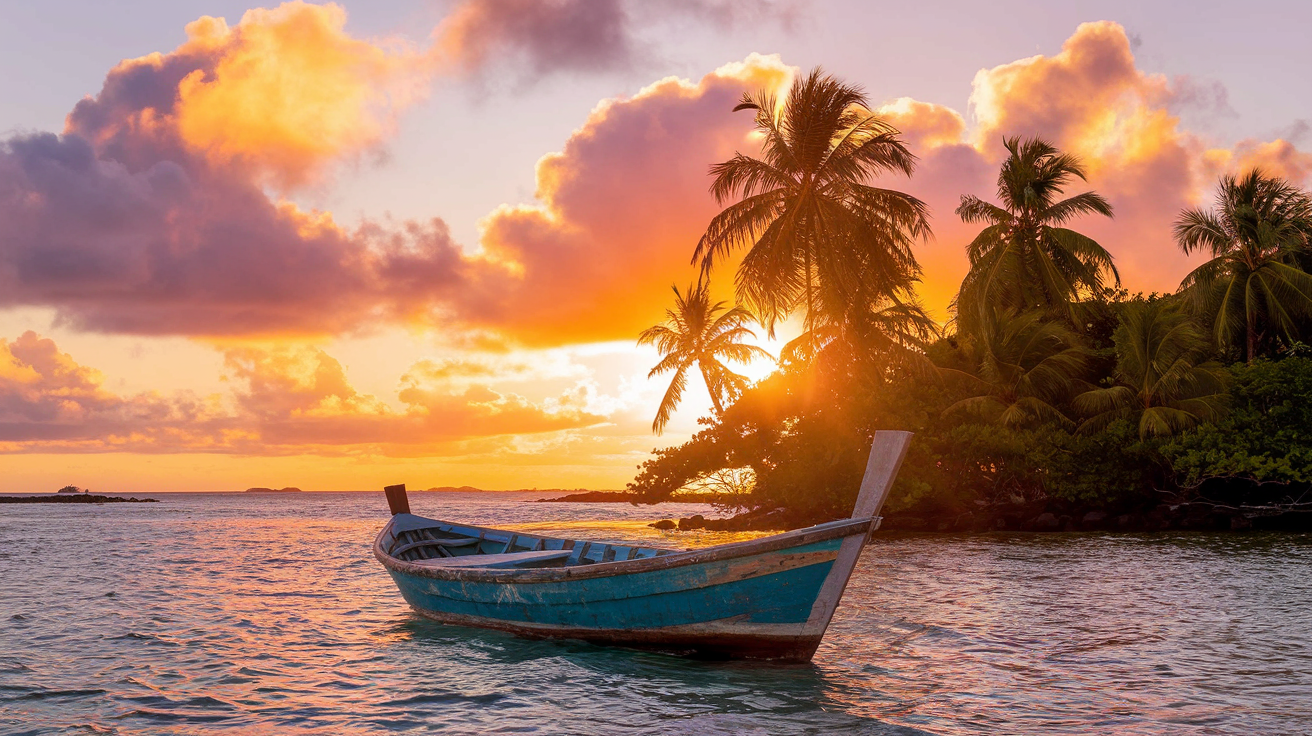
The Caribbean coast at sunset. The Dominican Republic has about 1,600 km of coastline and roughly 400 km of it is beach.
02
🏷️ Name & Identity
The name is descriptive and comparatively recent: the Dominican Republic, after the Dominican Order whose friars founded the first monastery and the first university here. Spanish speakers say República Dominicana, or more often just RD or Quisqueya — the Taíno name for the island, which survives in the national anthem and in the everyday self-description quisqueyano.
The identity that matters most, and the one visitors most often miss, is defined against Haiti rather than against Spain. Dominican independence, celebrated on 27 February 1844, was independence from Haiti, which had ruled the whole island for 22 years. Independence from Spain came later and separately — the Restauración of 1863–65, after the country had briefly voluntarily re-annexed itself. Two national holidays, two different colonisers, and a national story that is genuinely more complicated than the region's norm.
Independence
27 February 1844, from Haiti. The Restoration War against Spain ended in 1865. The founding father is Juan Pablo Duarte, whose name is on the highest mountain.
Language
Spanish, spoken in a fast, consonant-dropping Caribbean accent that swallows final s and softens r. English is widespread in resort areas and rare outside them.
Quisqueya
The Taíno name, still used with real affection. Taíno words that reached the world through here include hurricane, hammock, canoe, barbecue and tobacco.
Religion
Predominantly Catholic, with fast-growing evangelical churches and syncretic folk traditions in the countryside.
Race and identity
Dominican racial categories are their own system and do not map onto US or European ones. It is a subject with real political weight, particularly where it touches Haitian descent.
The other Dominica
Dominica is a separate country — a 72,000-person island 500 km to the south-east. Airlines and insurers confuse the two constantly; the airport codes here are SDQ, PUJ and POP.
03
🗺️ Geography & Regions
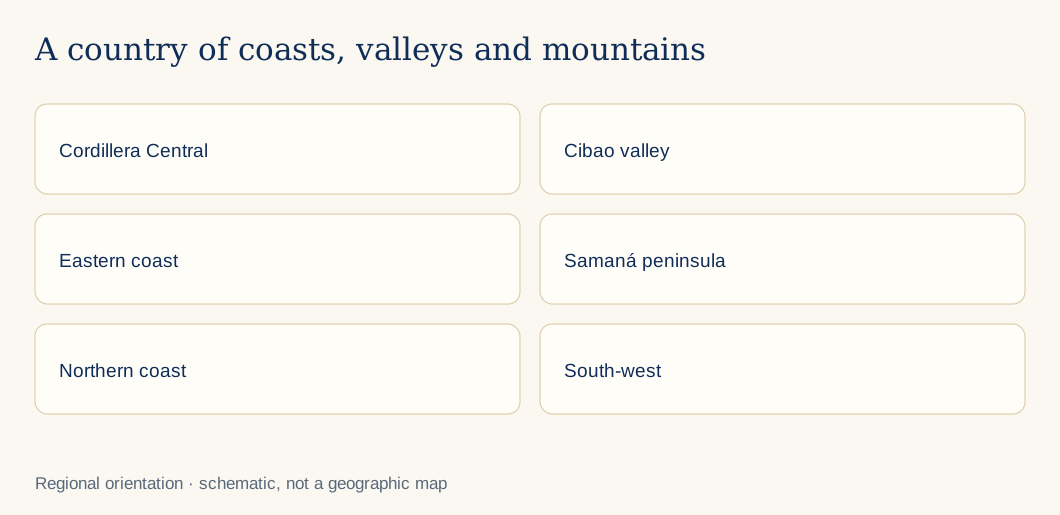
The Dominican Republic is far more mountainous than its beach reputation suggests. Four ranges run roughly north-west to south-east across it, and the central one, the Cordillera Central, carries the four highest peaks in the Caribbean. Between the ranges lie broad, extremely fertile valleys — above all the Cibao, which grows the tobacco, cocoa and coffee.
Cordillera Central
Pico Duarte (3,101 m), La Pelona, La Rucilla and Pico Yaque — pine forest, genuine cold at night, and a two- to three-day trek to the summit. Jarabacoa and Constanza are the mountain towns.
The Cibao valley
The agricultural heart, between the Central and Septentrional ranges. Santiago is its capital and the country's second city.
The east
Flat, hot, and the location of Punta Cana, Bávaro, Bayahibe and La Romana — the resort belt, plus Saona and Catalina islands.
The Samaná peninsula
A green finger in the north-east with the best beaches most visitors reach, the humpback whale bay, and Los Haitises across the water.
The north coast
Puerto Plata, Sosúa and Cabarete — older tourism, big surf, and the trade winds that made Cabarete a world kitesurfing centre.
The south-west
Barahona, Pedernales, Lago Enriquillo and Bahía de las Águilas: dry, mountainous, poor, spectacular, and the least-visited quarter of the country.
The border with Haiti crosses the shared island through mountain and lowland landscapes. Economic conditions and environmental pressures differ across Hispaniola, but a single forest/non-forest line does not explain that complexity. Border access and security need separate planning; it is not a casual crossing.
Regional orientation · schematic, not a geographic map · Original diagram
04
📍 Map of the Dominican Republic
Santo Domingo sits on the south coast, roughly in the middle. Punta Cana is at the far eastern tip, about 200 km away; Puerto Plata is on the north coast; Samaná is the peninsula in the north-east. The country is bigger than the resort brochures suggest, and the driving times are what catch people out.
Santo Domingo → Punta Cana
About 200 km, 2.5–3 hours on the Autovía del Este, a good toll road.
Santo Domingo → Santiago
155 km, about 2 hours on the Autopista Duarte.
Santo Domingo → Samaná
About 240 km, 2.5 hours via the Autopista del Nordeste and its long toll bridge.
Punta Cana → Samaná
Only ~230 km, but 4 hours or more — there is no direct coastal road. Fly or accept the day.
Santo Domingo → Barahona
200 km, 3 hours. Then everything further south-west is slower again.
Driving
On the right. Toll motorways are good; secondary roads are not, and are shared with motorbikes carrying three people and a propane tank. Do not drive at night.
05
📜 History
The Taíno had been on Hispaniola for centuries when Columbus landed in December 1492 and left the wreck of the Santa María and 39 men behind at La Navidad. They were all dead when he returned. What followed was the template for everything after it in the Americas: within about fifty years, the Taíno population had collapsed almost completely under disease, forced labour and violence.
Santo Domingo, founded 1496–98, became the first seat of Spanish power in the New World — the first cathedral (1541), the first university (1538), the first hospital, the first paved street. It was also, briefly, where the arguments about the morality of the conquest were first made out loud: the friar Antón de Montesinos preached against the treatment of the Taíno from a Santo Domingo pulpit in 1511.
Spain's attention moved on to the mainland's silver, and the colony was left poor and thinly held. France took the western third — which became Saint-Domingue, then, after the only successful large-scale slave revolt in history, Haiti. Haiti occupied the whole island from 1822 to 1844, which is what Dominican independence was declared against. The country then re-annexed itself to Spain in 1861 and fought the War of Restoration to get out again in 1863–65.
The United States occupied the country from 1916 to 1924, and the constabulary it built produced Rafael Trujillo, who ran the Dominican Republic from 1930 until his assassination in 1961 as one of the most total and most personal dictatorships of the 20th century. He renamed the capital after himself. In 1937 he ordered the massacre of Haitians living in the border region — the Parsley Massacre, in which thousands were killed. In 1960 his agents murdered the three Mirabal sisters; the date, 25 November, is now the UN's International Day for the Elimination of Violence against Women.
A civil war followed in 1965 and a second US intervention with it. Democratic politics stabilised slowly from the late 1970s, and the modern country — tourism, free-trade zones, mining, remittances and one of the fastest-growing economies in Latin America — was built from the 1990s onward. Growth has been real; its distribution has not been even.
Luis Abinader of the PRM won the presidency in 2020, ending sixteen years of PLD rule, and was re-elected in the first round on 19 May 2024 with about 57% of the vote; a constitutional reform he pushed through in October 2024 locked presidential term limits, so the 2028 election will be for his successor. His second term has been defined by two things: an ever-harder line on Haitian migration (a 160 km border wall, a stated target of 10,000 deportations a week from October 2024, and more than 370,000 expulsions in 2025), and the national tragedy of the Jet Set nightclub collapse — on the night of 8 April 2025 the roof of the Jet Set nightclub in Santo Domingo collapsed mid-concert, killing 236 people, among them the merengue star Rubby Pérez, who was on stage, former MLB pitchers Octavio Dotel and Tony Blanco, and the governor of Montecristi, Nelsy Cruz. Three days of national mourning followed, and the question of who inspected the building is still in the courts. In a lighter register, Santo Domingo hosted the centennial Central American and Caribbean Games from 24 July to 8 August 2026, opened by Abinader in the Félix Sánchez stadium.
06
🤝 Sharing an Island — the Haiti Question
You cannot understand the Dominican Republic without the border. Two countries share Hispaniola: one with a GDP per head roughly ten times the other's, one stable and one in a prolonged state collapse. The 376 km frontier between them is among the most unequal land borders anywhere, and the relationship across it shapes Dominican politics far more than anything to do with Spain or the United States.
The economics
Haitian labour underpins Dominican construction, sugar and agriculture. Estimates of the Haitian-descended population in the country run from several hundred thousand to over a million, much of it undocumented.
The 2013 ruling
Constitutional Court judgment TC 168-13 retroactively stripped Dominican nationality from people born to undocumented parents going back to 1929, rendering many thousands of Dominican-born people of Haitian descent stateless. A partial naturalisation law followed; the issue is unresolved and internationally criticised.
The wall
A fortified barrier with sensors, cameras and watchtowers has been going up since 2022 and now runs some 160 km of the frontier. A new migration law took effect in October 2024 with a stated target of 10,000 deportations a week; the government reported more than 276,000 removals in 2024 and over 370,000 in 2025, and from April 2025 immigration raids extended into public hospitals, targeting undocumented pregnant women and new mothers. UN bodies, Amnesty and the Inter-American system have all condemned the practice; domestically it is popular.
The binational markets
Twice-weekly markets at Dajabón, Elías Piña and other crossings are enormous, chaotic and one of the most instructive things in the country. They can also close at no notice.
For travellers
Crossing into Haiti is not currently advisable — check your own foreign ministry's advice, which for most European countries recommends against all travel to Haiti. Nothing in this section is a suggestion to try it.
How to talk about it
Dominicans hold a very wide range of views and the subject is charged. Listening rather than arriving with a verdict is both more polite and considerably more informative.
None of this makes the Dominican Republic a difficult or dangerous place to visit — the resort east and the tourist north are far from the border and entirely unaffected. But a guide that describes the beaches and omits the island's central political fact is not a guide, it is a brochure.
07
🎭 People & Culture
Dominican social life is loud, physical and conducted largely in public. Music plays from parked cars at volumes that would end a friendship in Central Europe. Greetings involve contact. The colmado — the corner shop that sells rum by the glass and beer by the cold bottle and has plastic chairs outside — is the actual unit of neighbourhood life, and sitting at one is the single cheapest way to understand the country.
About two million Dominicans live in the United States, mostly in New York, and the traffic in both directions is constant. Remittances are a major share of household income, and the cultural exchange runs both ways: bachata went to New York and came back changed, and dembow, the country's dominant contemporary sound, is a Dominican reworking of something that arrived from Jamaica via Panama and Puerto Rico.
The colmado
Corner shop, bar, credit union and social club. If you want one thing to do differently, buy your beer here rather than at the hotel.
Dominos
Played seriously, slammed hard, and everywhere. Losing gracefully is a social skill.
Family
Extended and central. Sunday is for family lunch and for the beach, in that order.
Formality
More formal than the volume suggests. Usted, greetings on entering a room, and dressing neatly are all noticed and appreciated.
Time
Appointments are approximate. This is not disorganisation; it is a different weighting of the schedule against the person in front of you.
Hair and appearance
Personal presentation is taken seriously across every income level. Turning up to dinner in beachwear reads as disrespect, not informality.
08
💬 Language — Dominican Spanish
Spanish, and a distinctive version of it. Dominican Spanish drops final s (¿cómo está? becomes ¿cómo etá?), softens or swaps r and l, and moves fast. Learners who did well in Madrid regularly find their first two days here humbling. It gets easier quickly.
¿Qué lo que?
"What's up?" — the national greeting, often shortened to ¿klk? in writing. Answering todo bien is enough.
Vaina
Thing, stuff, business, problem — the most useful word in the language. Mildly informal, universally understood.
Chin / un chin
A little bit. Un chin de azúcar — a little sugar. From Taíno by way of everywhere.
Guagua
Bus, of any size. The intercity coaches are excellent; the minibuses are an experience.
Concho / motoconcho
Shared car taxi / motorbike taxi. Cheap, ubiquitous, and the motorbike version is the leading way visitors get hurt here.
Colmado
The corner shop described above. Say it right and you have already passed a small test.
English is spoken fluently in Punta Cana, Bávaro, Sosúa and Cabarete and thinly everywhere else. German is surprisingly common on the north coast. A hundred words of Spanish transforms the trip; anything less and the country stays behind glass.
09
🏛️ Santo Domingo
A metropolitan area of around 3.5 million people, and a capital that most visitors to the Dominican Republic skip entirely. That is a mistake, though an understandable one: the city is hot, congested and not immediately charming. The reward is the Zona Colonial, and beyond it a real Latin American capital with a working intellectual and musical life.
Malecón
The seafront boulevard, running for kilometres along the Caribbean. Best at dusk, when the whole city comes out.
Los Tres Ojos
A limestone cave system with three (in fact four) open lagoons, inside the city. Touristy and genuinely good.
Faro a Colón
The vast cross-shaped Columbus Lighthouse in the east of the city, built for the 1992 quincentenary. Architecturally brutal, historically contested, and worth seeing precisely because of the argument it embodies.
Museo de las Casas Reales
The best of the colonial museums — the viceregal administration, the Atlantic trade, and the machinery of empire.
Memorial de la Resistencia
A museum of the Trujillo dictatorship and the resistance to it, in the building where the regime's opponents were interrogated. Difficult and essential.
Mercado Modelo
The old covered market in Villa Consuelo. Amber, larimar, herbs, santería supplies and hard bargaining.
Practical: stay in or near the Zona Colonial, use Uber rather than street taxis, and treat the city like any large Latin American capital after dark — busy streets yes, empty ones no. Two nights is the right amount; three if you are going to a baseball game.
10
🏰 The Zona Colonial — the First City
Inscribed by UNESCO in 1990 as the Colonial City of Santo Domingo, this is a compact grid of about a dozen blocks that contains an implausible density of firsts. It is a living neighbourhood rather than a preserved shell — people live here, and the bars on Calle El Conde are for locals as much as visitors.
Catedral Primada de América
Begun 1512, finished 1541. The first cathedral built in the Americas, in a Gothic-Renaissance hybrid, still the seat of the archdiocese.
Alcázar de Colón
The palace of Diego Colón, Columbus's son and viceroy, built 1510–14. The furnished interior is the best surviving picture of how the first colonial elite lived.
Calle Las Damas
The first paved street in the Americas, laid in 1502 and named for the ladies of the viceregal court who walked it in the evenings.
Monasterio de San Francisco
The first monastery in the Americas, ruined by earthquakes and hurricanes and left as a shell. On Sunday evenings it becomes an open-air venue and the ruins fill with dancers.
Fortaleza Ozama
The oldest surviving European military structure in the Americas, from 1502, guarding the river mouth. Later a prison; the view from the tower explains the city's whole layout.
Hospital San Nicolás de Bari
The first hospital in the Americas, 1503, now a fenced ruin you can see into from the street. The scale is startling.
Do it on foot and do it early — 8 to 11 in the morning, before the heat and before the cruise groups. Then retreat to a courtyard for lunch and come back at six, which is when the Zona is at its best.
11
🎶 Merengue & Bachata
The Dominican Republic gave the world two dance forms, and both are now on UNESCO's list of the Intangible Cultural Heritage of Humanity — merengue in 2016 and bachata in 2019. They are not museum pieces. They are what is playing, right now, from the colmado on the corner.
Merengue
Fast, 2/4, built on accordion, tambora drum and güira scraper. Rural in origin, then made the national music under Trujillo, who used it as a nation-building instrument. Juan Luis Guerra took it worldwide.
Bachata
Slower, guitar-led, born in the poor barrios and the countryside, and dismissed for decades as música de amargue — music of bitterness. It won. Romeo Santos and Aventura, out of New York, made it global.
Dembow
The contemporary sound: fast, minimal, aggressive and utterly dominant among under-30s. El Alfa is the biggest name.
Juan Luis Guerra
The country's most important musician: literate, jazz-trained lyrics over merengue and bachata, and songs like Ojalá que llueva café that function as national texts.
Where to dance
Any Sunday evening at the Monasterio de San Francisco ruins in Santo Domingo, or a neighbourhood colmado anywhere. Classes are widely available and worth an hour.
Etiquette
Asking someone to dance is normal and refusing is normal. Being bad at it is entirely fine; not trying is the odd choice.
12
⚾ Baseball — the National Obsession
The Dominican Republic produces more Major League Baseball players than any country except the United States, from a population of 11 million. On opening day in a typical recent season, roughly one in nine MLB players was Dominican. No other country comes close per head of population, and it is not an accident — it is an industry, with academies, scouts and a pipeline that starts when boys are twelve.
LIDOM
The winter league, October to January, six teams: Licey and Escogido (both Santo Domingo, and a genuine rivalry), Águilas Cibaeñas (Santiago), Estrellas Orientales (San Pedro), Toros del Este (La Romana), Gigantes (San Francisco de Macorís).
Going to a game
The best sporting experience in the Caribbean. Bands, dancers, whistles, an entire stadium standing for nine innings. Tickets are cheap. Licey–Escogido at Estadio Quisqueya is the one.
San Pedro de Macorís
A sugar town of 200,000 that has produced dozens of major leaguers, famously shortstops. The sugar mills ran teams; the teams outlasted the sugar.
The greats
Juan Marichal, the first Dominican in the Hall of Fame; Pedro Martínez; Vladimir Guerrero; David Ortiz; Albert Pujols; Sammy Sosa; and now Juan Soto, whose 15-year, US$765 million contract with the Mets (December 2024) is the largest in the history of professional sport.
World Baseball Classic 2026
The most feared line-up in the tournament — unbeaten through the pool, a record-tying 14 home runs, more than ten runs a game — and then out 2–1 to the United States in the semi-final on 15 March 2026. Third place; Venezuela won it. The 2013 title remains the country's only one.
Escogido's run
Leones del Escogido won the 2025 Caribbean Series in Mexicali, then defended their LIDOM crown in January 2026 (an 18th title, 4–1 over Toros del Este). Santo Domingo's Estadio Quisqueya also staged the baseball tournament of the 2026 Central American and Caribbean Games.
Jet Set, 8 April 2025
The nightclub roof collapse killed two former major-leaguers, Octavio Dotel and Tony Blanco, and injured others; the Dominican baseball community was at the centre of the mourning. If a local mentions it, that is why.
The academies
All 30 MLB clubs run academies here, mostly around Boca Chica and San Pedro. The system has produced fortunes and also a well-documented record of exploitation of teenage prospects.
Off-season
If you visit February to September there is no LIDOM. Amateur and youth games are constant, free, and often more fun.
13
🏅 Sports Beyond Baseball
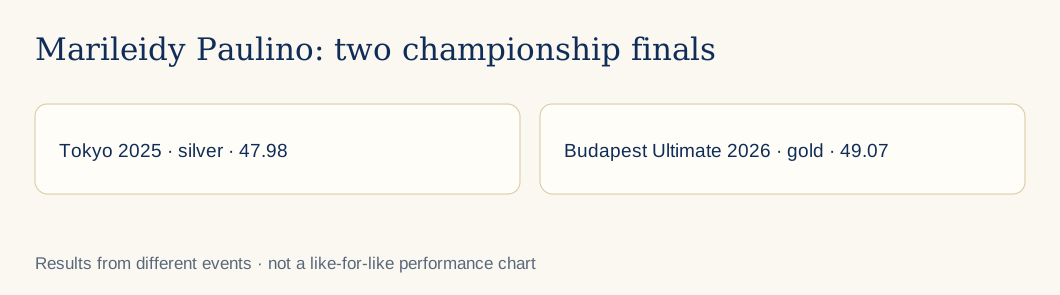
Baseball is the obsession, but the country's best athlete of the decade runs the 400 metres. Marileidy Paulino won Olympic gold in Paris in August 2024 in 48.17, an Olympic record and the first Olympic gold ever won by a Dominican woman, then silver at the Tokyo World Championships in September 2025 in a personal best of 47.98, and in 2026 went through the whole season unbeaten — a Diamond League record 48.48 in Paris, a fourth Diamond League title in Brussels and the inaugural World Athletics Ultimate Championship in Budapest in September 2026. The stadium the capital's athletics is run from is named after her predecessor, Félix Sánchez, 400 m hurdles champion in Athens 2004 and London 2012, who lit the cauldron there in July 2026.
Santo Domingo 2026
The centennial (25th) Central American and Caribbean Games, 24 July – 8 August 2026: 37 nations, 5,722 athletes, 40 sports, opened by President Abinader in the Estadio Olímpico Félix Sánchez. The hosts finished fifth with 46 gold, 37 silver and 67 bronze behind Mexico, Colombia, Cuba and Venezuela. The renovated venues — the Centro Olímpico, Arena BanReservas, the Parque del Este pavilions — are the legacy.
Olympic record
Four Olympic golds in all — Félix Sánchez twice, the boxer Félix Díaz in Beijing 2008, and Paulino in Paris. Tokyo 2020 was the first Games with real depth: five medals across athletics (Paulino and the mixed relay), weightlifting and boxing. Boxing and taekwondo supply most of the rest of the tally.
Football
A distant fourth behind baseball, basketball and volleyball, though a growing one: the men's team went out in the second round of Concacaf qualifying for the 2026 World Cup and has never reached a finals. Cibao FC and Moca hosted the Games' football tournament.
Basketball and volleyball
Al Horford and Karl-Anthony Towns are the NBA names; the women's volleyball team, the Reinas del Caribe, is the most consistently successful national team the country has, an Olympic qualifier four times since 2004 and a Pan American Games champion.
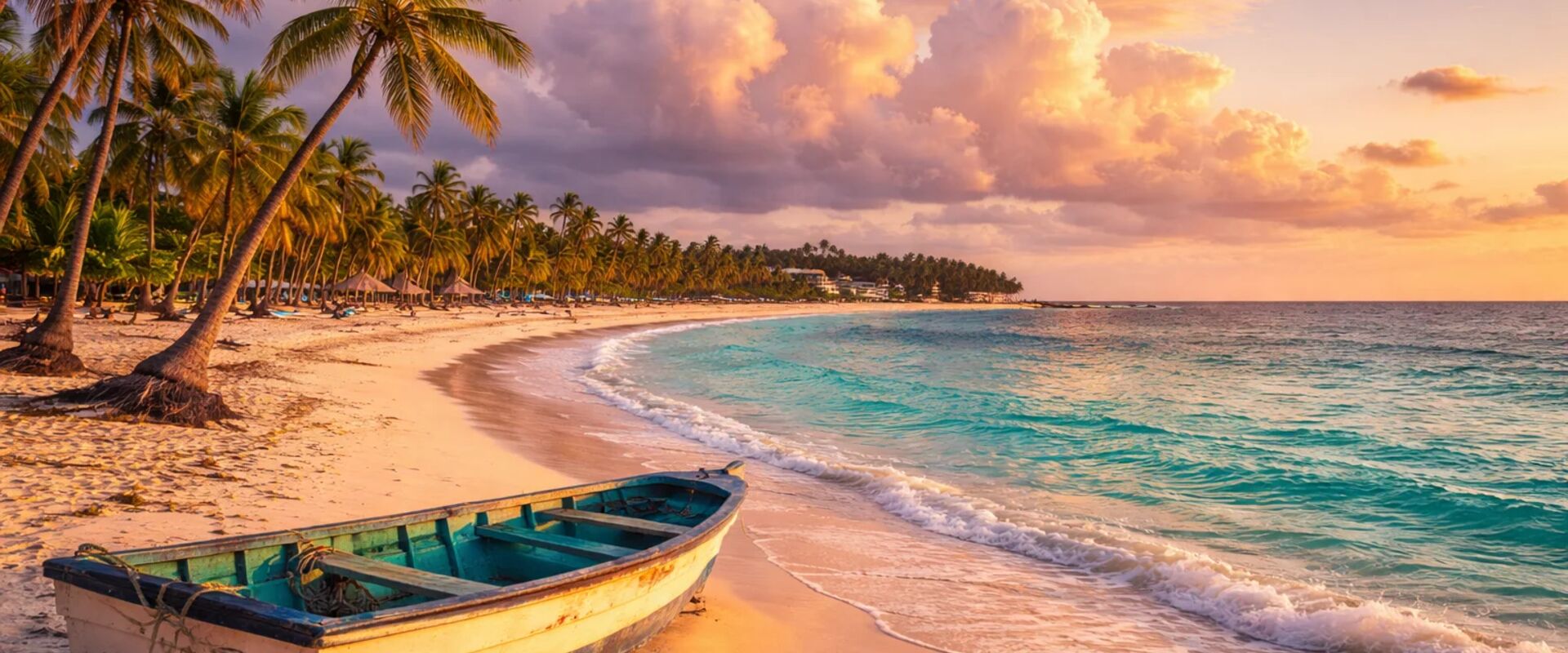
Punta Cana is not a town. It is a 50 km strip of coastline at the eastern tip of the country — Bávaro, Cabeza de Toro, Uvero Alto, Punta Cana proper — that holds the largest concentration of all-inclusive resorts anywhere in the Caribbean, served by one of the Caribbean’s major international airports. It exists because of an accident of geography: an offshore reef, white sand, reliable sun, and a coral shelf that keeps the water shallow and calm.
The eastern beaches: white coral sand, a sheltering reef, and about 30 km of near-continuous resort frontage.
Judged as what it is, it is very good. The beaches are genuinely excellent, the sea is calm and warm, the resorts are competitively priced and the standard is high. Judged as a way of seeing the Dominican Republic, it is close to useless — the strip is a sealed environment with its own economy, and the country begins about twenty minutes inland.
Bávaro
The longest and busiest stretch, and the best beach of the lot. Playa Bávaro proper is public, as all Dominican beaches legally are.
Bayahibe & La Romana
An hour west, smaller and more pleasant, with a working fishing village, better diving and the departure point for Saona.
Isla Saona
A protected island in Parque Nacional del Este. The catamaran day trip is a machine, but the island itself is beautiful — go early or go by speedboat.
Sargassum
Seaweed reaches the east coast in variable quantities, worst roughly April to August. Resorts clear their frontage daily; public beaches may not be cleared at all.
Excursions
Buggy tours, zip lines, Scape Park, Hoyo Azul. Fine, priced for the captive market, and bookable for a third of the resort rate from an operator in the village.
Getting out
Hire a car for two days, or take the Expreso Bávaro coach to Santo Domingo for a few hundred pesos. Either transforms the trip.
15
⛰️ Puerto Plata & the North Coast
The north coast was the country's first tourist region, from the 1970s, and it feels different from the east: real towns, an older resort stock, mountains coming right down to the sea, and the north-east trade winds that made it a watersports capital. Also more rain, rougher water and considerably more character.
Puerto Plata
A working city of 150,000 with a Victorian-era centre of gingerbread houses, the San Felipe fortress from 1577, and a cable car up Pico Isabel de Torres to a cloud forest and a Christ statue.
Cabarete
One of the world's top kitesurfing and windsurfing spots — the thermal wind comes up almost every afternoon like clockwork. Lessons are excellent and the beach bar scene is the country's most international.
Sosúa
A cove with superb snorkelling and a complicated town. Founded partly by Jewish refugees admitted in 1940 — a genuinely remarkable history, with a small museum — and later known for sex tourism, which the authorities have pushed back but not eliminated.
27 Charcos de Damajagua
A guided canyoning route up a river gorge, jumping and sliding back down 27 waterfalls (or 7, or 12, depending on the ticket). The best single day out on the north coast.
Amber
The Amber Museum in Puerto Plata holds the mosquito-in-amber that inspired Jurassic Park's premise. Dominican amber is exceptionally rich in inclusions.
Monte Cristi
Far north-west, dry and cactus-covered, with El Morro headland, flamingos and almost no visitors.
16
🐋 Samaná & the Humpback Whales
The Samaná peninsula is the best of both halves of the country: green mountains, palm-backed beaches that have escaped the resort wall, and — from mid-January to mid-March — one of the most important humpback whale breeding grounds on Earth. Something like a substantial fraction of the entire North Atlantic humpback population comes here to mate and calve.
Whale watching
Boats leave Samaná town daily in season. Regulated numbers, times and distances; a responsible operator will explain them. Breaching and singing males are routine rather than lucky.
Playa Rincón
Regularly called one of the best beaches in the Caribbean, and unlike most such claims this one holds up. Reachable by rough road or boat from Las Galeras.
Las Terrenas
The peninsula's social centre — French and Italian-inflected, good food, a real village, and beaches within walking distance.
Las Galeras
The road ends here. Quieter, cheaper, and the base for Playa Frontón and Madama, both reached by boat or a serious walk.
El Limón waterfall
A 40 m fall reached on foot or on horseback through farmland. The horses are the standard offer; walking is perfectly possible and kinder.
Los Haitises
Across the bay: karst hills rising out of mangrove, caves with Taíno pictographs, frigatebirds and pelicans. A boat trip from Samaná or Sabana de la Mar, and one of the country's genuine highlights.
Access improved dramatically with the Autopista del Nordeste — Santo Domingo to Samaná in about 2.5 hours — and El Catey airport (AZS) takes some international flights. It is the part of the country most worth a full week.
17
🚬 Santiago & the Cibao Valley
Santiago de los Caballeros is the country's second city, about a million people, and the capital of the Cibao — the fertile inland valley that grows the tobacco, cocoa and coffee, and that considers itself the authentic Dominican Republic as against the coastal and capital versions of it.
Cigars
The Dominican Republic is the world's largest exporter of hand-rolled cigars, and most of them come from around Santiago. Factory tours at the major houses are straightforward to arrange and genuinely interesting even for non-smokers.
Monumento a los Héroes
The 67 m tower on the hill above the city, built by Trujillo to himself and rededicated after his death to the heroes of the Restoration. The view over the valley is the point.
Centro León
An excellent private museum of Dominican art, anthropology and tobacco history — the best-curated museum in the country.
Santiago Carnival
Every Sunday in February. The lechones masks of Santiago, with their spiked horns, are the most striking carnival tradition in the Caribbean.
Cocoa
The DR is the world's largest exporter of organic cocoa. Estate visits around San Francisco de Macorís and Hato Mayor show the whole process from pod to fermentation.
Coffee
Grown at altitude in the Cordillera; the Jarabacoa and Barahona coffees are excellent and almost unknown abroad.
18
🏜️ Barahona & the South-West
The quarter of the country almost nobody visits, and the one that most rewards the effort. The south-west is dry, mountainous and poor, with a coastline of pebble beaches under cliffs, the Caribbean's lowest point, salt flats, and a beach at the end of a bad road that is genuinely the most beautiful in the country.
Bahía de las Águilas
8 km of empty white sand inside Jaragua National Park, reached by boat from Las Cuevas or a rough 4×4 track. No buildings, no vendors, no shade. Bring everything.
Lago Enriquillo
46 m below sea level, three times as salty as the sea, with wild American crocodiles, iguanas and flamingos, and Isla Cabritos in the middle. The lake's level has risen dramatically since 2004, drowning farmland — a visible climate story.
Larimar
A pale blue pectolite found in exactly one place on Earth: a hillside above Bahoruco in Barahona province. The mines can be visited; the jewellery is everywhere and the good pieces are not cheap.
Sierra de Bahoruco
Cloud forest and pine at altitude with the country's best birding — most of Hispaniola's endemic birds are here.
Polo Magnético
A stretch of road near Polo where an optical illusion makes a car appear to roll uphill. Silly, popular, and the drive there is beautiful.
Practicalities
Very little tourist infrastructure. A 4×4, Spanish, and a flexible schedule are all close to essential. Barahona town is the base.
19
🏔️ The Mountains — Jarabacoa, Constanza & Pico Duarte
The Cordillera Central is the surprise of the country: pine forest, rivers cold enough to be uncomfortable, strawberry and vegetable farms, and four peaks over 3,000 m. Constanza sits at 1,200 m and gets frost in winter. It looks nothing like the brochure, which is exactly the point.
Pico Duarte
3,101 m, the highest point in the Caribbean. A 46 km round trip from La Ciénaga, normally done in two or three days with mules and a compulsory park guide. No technical difficulty, considerable endurance, and genuinely cold nights.
Jarabacoa
The adventure-sports town: white-water rafting on the Yaque del Norte, canyoning, paragliding, and the Jimenoa and Baiguate waterfalls.
Constanza
A high valley of market gardens ringed by mountains. The Valle Nuevo national park above it is the coldest place in the country and holds sub-zero records.
Salto de Aguas Blancas
A 83 m waterfall above Constanza at around 1,700 m. The water is painfully cold and the drive is rough.
When to go
Any time; December to March is coolest and driest. Take a fleece and a proper sleeping bag for Pico Duarte — people underestimate this every single season.
Getting there
Jarabacoa is 2.5 hours from Santo Domingo, an hour from Santiago. Constanza is another hour on a much worse road.
20
🍲 Food — Rice, Beans and the Flag
Dominican cooking is Spanish, African and Taíno, built on rice, beans, root vegetables, pork and plantain, and seasoned with sazón — a base of garlic, oregano, peppers and cilantro that goes into almost everything. It is not spicy. It is filling to a degree that catches visitors out, and at its best — a good sancocho, a properly fried chicharrón — it is very good indeed.
La Bandera Dominicana
The national lunch, eaten daily · 60 minutes · serves 4
Ingredients: White rice, red kidney beans, chicken or stewing beef, onion, garlic, green pepper, oregano, tomato paste, a little vinegar, oil, and plantains for the side salad or tostones.
Method: Brown the meat hard in a little sugar and oil until it takes colour, then braise with onion, pepper, garlic, oregano and tomato paste until tender. Simmer the beans with the same aromatics until they thicken into a sauce rather than a soup. Serve rice, beans and meat side by side on one plate, with salad or tostones.
💡 The name means "the Dominican flag" — white rice, red beans, and the meat. Eaten at midday, not in the evening.
Method: Marinate the meats in sour orange, garlic and oregano. Brown them in stages, adding water as you go. Add the root vegetables in order of hardness, then the pumpkin to melt into the broth and thicken it. Finish with cilantro. Serve with white rice and avocado.
💡 Made for gatherings and rain. A one-meat sancocho is normal and a seven-meat one is an occasion.
Mangú
Mashed green plantain, eaten at breakfast under fried onions with salami, fried cheese and fried egg — los tres golpes, "the three hits".
Tostones
Twice-fried plantain discs, salted. The national side dish.
Mofongo
Mashed fried plantain with garlic and pork crackling, pressed in a mortar, often filled with shrimp or chicken.
Chicharrón
Fried pork, sold by weight from roadside stands. The good ones have a queue.
Pescado con coco
Fish in coconut sauce, the signature of the Samaná coast and its 19th-century African-American settler community.
Habichuelas con dulce
Sweet cream of red beans with coconut milk, sweet potato, cinnamon and raisins, made at Easter. Strange on paper, excellent in a cup.
21
🥃 Rum, Presidente & Mamajuana
The Dominican Republic is a serious rum country — the sugar industry that built the eastern economy left three large houses behind, known collectively as the three B's. Beer means one thing, and it is served at a temperature that has its own name.
Brugal
Founded 1888 in Puerto Plata, the everyday rum and the biggest seller. The Extra Viejo is the useful bottle.
Barceló
Founded 1930, the export flagship. Imperial and Imperial Onyx are the ones to look for.
Bermúdez
The oldest, from 1852 in Santiago, and the connoisseur's choice of the three. The Aniversario is excellent.
Presidente
The beer. Ordered bien fría and served in a green bottle in an insulated sleeve, often shared into small glasses so that nobody's drink gets warm. The label turns blue when it is cold enough.
Mamajuana
Rum, red wine and honey steeped over a jar of bark, roots and herbs. Sold as a cure-all and an aphrodisiac; drink it as a digestif and enjoy the pantomime.
Cuba libre / Santo Libre
Rum with cola, or rum with Seven-Up and a lot of lime. The default order after the beer.
22
☕ Coffee, Cacao & Cigars
Three crops define the interior, and all three are worth building a day around. The country is the world's largest exporter of organic cocoa and the largest exporter of hand-made cigars, and it grows high-altitude arabica that almost never leaves the country.
Cacao estates
Farms around Hato Mayor, San Francisco de Macorís and Altamira run visits covering pod to fermentation to drying. Much of the crop is organic and Fairtrade-certified — this is not a marketing veneer here, it is the export strategy.
Chocolate
Small Dominican makers now produce bean-to-bar chocolate on the island. Kah Kow and several estate brands are widely available and are a far better souvenir than duty-free.
Coffee
Grown in the Cordillera Central and around Barahona. Look for Café Santo Domingo for the everyday cup and estate coffee from Jarabacoa for the good one.
Cigars
Around Santiago and in the free zones. La Aurora, founded 1903, is the oldest factory and the easiest to tour.
Buying
Buy cocoa and coffee at a supermarket or an estate, not at the airport. Cigars from a licensed shop with a receipt if you intend to carry more than a few.
Customs
EU allowances for tobacco are low — 50 cigars per adult from outside the EU. Exceed it and you will be paying duty at Prague or Frankfurt.
23
🌦️ Climate & When to Go
Tropical, warm all year, and less uniform than a single national forecast suggests: the south and east are drier, the north coast is wetter, and the mountains are cold. Coastal temperatures run 26–31 °C almost regardless of month; what changes is rain, sea state and price.
Dec–Apr — high season
Driest, least humid, calmest sea. Also the most expensive and the busiest. January to March adds the humpback whales.
Mar–Apr
Arguably the best compromise — still dry, whales at the start, prices easing at the end.
May–Jun
Wetter, especially on the north coast, but hot, cheap and quiet.
Jul–Aug
Peak heat and humidity, European school holidays, and the start of the hurricane risk. Sargassum is often at its worst in the east.
Sep–Oct
Hurricane season peak, lowest prices, some smaller hotels close. Bring insurance that covers named storms.
The mountains
Constanza at 1,200 m gets frost. Pico Duarte can drop below freezing at night in any month. This is the single most underestimated fact about the country's climate.
24
✈️ Getting There & Getting Around
The Dominican Republic has more international airports than any of its neighbours, which is both convenient and a trap — arriving at the wrong one can cost a five-hour transfer. Pick the airport for the region, not the fare.
PUJ · Punta Cana
The busiest airport in the Caribbean, private, and the arrival point for most charter and package traffic. Twenty minutes to the resorts, three hours to Santo Domingo.
SDQ · Santo Domingo (Las Américas)
The capital's main airport, 30 minutes east of the city. Best for the Zona Colonial, the south and the mountains.
POP · Puerto Plata
For the north coast — Cabarete, Sosúa, Playa Dorada.
STI · Santiago and AZS · Samaná El Catey
Santiago for the Cibao and the mountains; El Catey for the Samaná peninsula, with limited international service.
Coaches
Caribe Tours and Metro run comfortable, cheap, air-conditioned intercity coaches on the main routes. Booking ahead is sensible in season and unnecessary otherwise.
Car hire and Uber
Uber works well in Santo Domingo, Santiago and Punta Cana and is far cheaper than hotel taxis. Hire cars are useful for the south-west and the mountains and mostly unnecessary elsewhere. Full insurance, always; and do not drive between cities after dark.
25
🇪🇺 Getting There from Europe & Czechia
This is one of the easiest long-haul Caribbean destinations to reach from Europe, because the package market flies it hard. In winter there are direct charters from a long list of European cities, and scheduled service from Madrid, Paris, Frankfurt and Amsterdam all year.
Direct charters
Winter charters from Prague to Punta Cana operate in most seasons, sold through Czech tour operators as part of a package. Roughly 10 hours; check whether seat-only is available, as it often is.
Via Madrid
Iberia and Air Europa fly Madrid to both SDQ and PUJ daily. The most reliable scheduled routing from Central Europe and usually the cheapest flexible one.
Via Paris or Frankfurt
Air France to PUJ and SDQ, Condor and Eurowings Discover to PUJ and POP. Good options if Madrid is expensive.
Via Amsterdam
KLM flies SDQ and PUJ, and connects well from Prague.
From Prague
Reckon on 12–16 hours with one connection, or about 10 hours direct on a charter. Return fares typically CZK 18,000–35,000 depending on season and how far ahead you book.
The E-Ticket
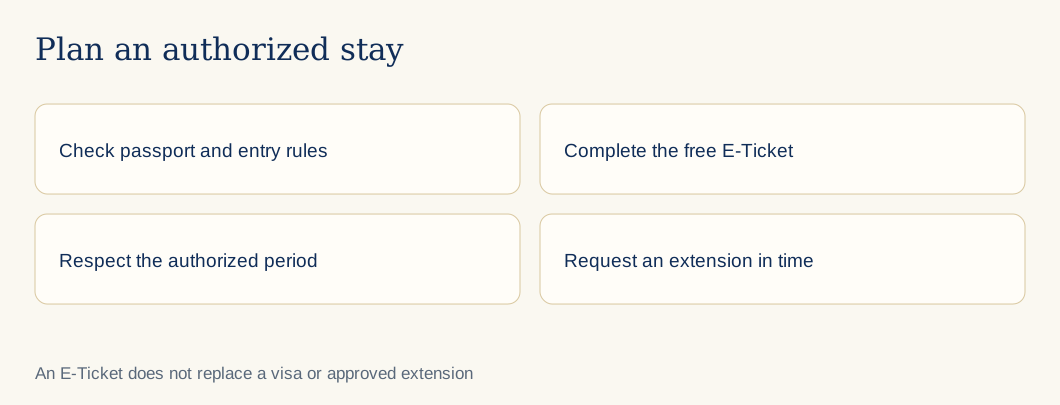
The Dominican Republic requires an online entry/exit form (the E-Ticket) completed before both arrival and departure, producing a QR code. It is free, takes ten minutes, and is checked. Fill it in on the official government site, not on one of the many paid copies.
26
📋 Practical Information
Visa
The usual tourist stay is up to 30 days, subject to the rules for your passport. Arrange a longer stay before your authorized period expires: DGM offers an extension application up to 120 days, subject to approval. An overstay charge is not permission to remain. Official source.
E-Ticket
For ordinary commercial air travel, complete the free official entry and departure form and save its QR code. This immigration and customs form does not replace a visa or permission for a longer stay. Use the government portal rather than a paid lookalike. Official source.
Money
The currency is the Dominican peso (DOP). Exchange rates and banking fees change: check the current quote before exchanging or withdrawing. Resorts may accept dollars, but compare their rate and final price with payment in pesos.
Cards and ATMs
Cards work in hotels, supermarkets and larger restaurants. ATMs are everywhere in towns; use ones inside banks or malls, and expect a withdrawal fee. Carry small notes for colmados, guaguas and tips.
Tipping
Restaurants add a 10% service charge plus 18% ITBIS tax by law — check the bill before adding more. A little extra for good service is normal. Tip hotel and resort staff directly; it matters more than it does at home.
Health
Check vaccination advice for your itinerary. Use mosquito protection and drink bottled or safely treated water; do not assume hotel tap water is potable. FCDO — health.
Electricity
110 V, 60 Hz, US-style type A/B sockets. European appliances need an adaptor and, for anything without a universal power supply, a converter. Power cuts are frequent outside resorts.
Connectivity
Claro and Altice cover the country well. eSIMs work. Free wifi is normal in hotels and cafés.
Safety
Petty theft, opportunistic robbery and scams rather than violence against tourists, but violent crime does occur. The real statistical danger is the road: traffic fatality rates here are among the highest in the Americas. Avoid motoconchos, do not drive at night between cities, and wear a seatbelt in the back.
⚠️ Travel advisories
As checked October 9, 2026, the U.S. State Department lists Level 2, with an issue date of June 12, 2025, because of crime. Read current U.S., UK or home-country advice before travel; advice for Haiti is separate. Use registered transport and protect valuables. Official source.
UTC−4 year-round, no daylight saving. Six hours behind Prague in summer, five in winter.
Hurricanes
June to November, peaking September–October. The country has a functioning civil-defence system; follow hotel instructions, and take travel insurance that names storms explicitly.
Passport-validity rules include temporary exceptions for eligible tourist visitors through December 31, 2026. Check the rule for your passport, return or onward ticket and travel date directly with the Dominican authorities. Entry requirements.
There are two price levels in the Dominican Republic and they barely overlap. Inside a resort or a tourist strip you pay international prices; twenty minutes away you pay Dominican ones, which are among the lowest in the Caribbean. Figures below are per person per day in US dollars at 2026 levels, excluding flights.
Budget · US$35–55
Guesthouse or small hotel, comedor meals, guaguas and coaches. Entirely comfortable outside the resort strips and a completely different holiday.
Mid-range · US$90–150
Three-star hotel or apartment, restaurant meals, some car hire, a couple of paid excursions.
All-inclusive
The package is the outlier: a week in Punta Cana bought as a package from Europe often costs less per day than the same week arranged independently. If a beach week is the goal, buy the package.
Typical prices
Local lunch US$4–7 · resort-area dinner US$25–40 · Presidente in a colmado US$1.50 · Uber across Santo Domingo US$3–6 · coach Santo Domingo–Santiago US$8 · whale-watching trip US$60–70.
Car hire
US$40–65 a day with full insurance, which you should not decline. Fuel is expensive by regional standards.
The 28% on the bill
18% ITBIS plus 10% service is added to restaurant and hotel bills. Menu prices are pre-tax. Factor it in from the start.
28
🏨 Where to Stay
The accommodation stock is unusually polarised: enormous all-inclusive resorts at one end, cheap local hotels and guesthouses at the other, and comparatively little in between outside a handful of towns. Choosing the region matters more than choosing the property.
Punta Cana / Bávaro
All-inclusives from three to five star, best bought as a package. Adults-only and family-focused properties are clearly segregated — read which one you are booking.
Santo Domingo
Boutique hotels in restored colonial houses in the Zona Colonial, business hotels in Piantini and Naco. Two nights minimum.
Las Terrenas / Las Galeras
Small hotels, apartments and villas. The best independent-travel base in the country.
Cabarete
Surf camps, apartments and boutique hotels, priced for a young international crowd. Long stays are cheap.
Jarabacoa / Constanza
Mountain cabins and small lodges, often with fireplaces — which tells you something about the climate.
Booking
Package deals beat independent booking on the resort coasts; independent booking wins everywhere else. Apartments are excellent value for stays over a week.
29
🏛️ UNESCO — the Colonial City and living traditions
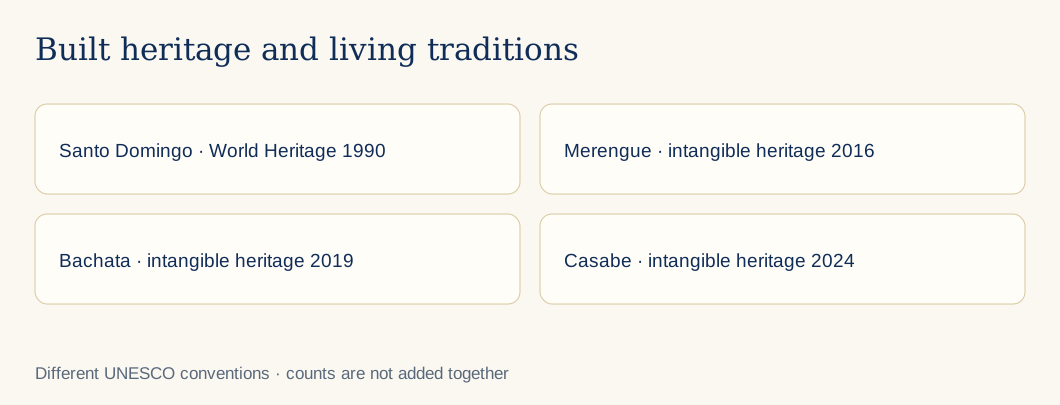
The Dominican Republic has one World Heritage property and thirteen properties on the Tentative List. Intangible heritage covers a different kind of recognition: music, dance, regional cultural traditions and the preparation of cassava bread. These lists protect different aspects of heritage, so their counts should not be added together.
Colonial City of Santo Domingo
Inscribed 1990. The first permanent European settlement in the Americas and the model on which colonial cities across the hemisphere were laid out — the grid plan itself was exported from here.
Merengue
Inscribed on the Intangible Cultural Heritage list in 2016, recognising it as a national practice rather than a stage performance.
Bachata
Inscribed in 2019. A remarkable arc for a music that was banned from state radio within living memory.
Cocolo dance drama
The Cocolo tradition of San Pedro de Macorís — brought by English-speaking Afro-Caribbean sugar workers — was proclaimed a Masterpiece in 2005 and incorporated into the Representative List in 2008; still performed at Christmas and Carnival.
Congos of Villa Mella
The cultural space of the Brotherhood of the Holy Spirit of the Congos of Villa Mella, north of Santo Domingo — Afro-Dominican drumming and song for funerals and the Espíritu Santo festival. Proclaimed 2001, listed 2008: the country's first UNESCO intangible entry and the one visitors never hear about.
Tentative list
Thirteen sites, none of them Los Haitises. The 2001–02 batch is colonial: Jacagua, Montecristi, Pueblo Viejo at La Vega, the historic centre of Puerto Plata, Azua and two sugar mills of the Ruta de los Ingenios. The 2018 batch is where the natural case sits: Parque Nacional Jaragua, Parque Nacional Cotubanamá (the Saona park), the Bancos de la Plata y Navidad whale sanctuary off Samaná, the pre-Hispanic rock art of the country's caves, La Isabela and the first colonial sugar mills of the Americas. Jaragua-Bahoruco-Enriquillo is separately a Biosphere Reserve (2002).
What is missing
There is still no World Heritage listing for any of the country's natural sites, thirty-six years after the Colonial City. Jaragua and the Silver Bank whale sanctuary are the strongest cases on the current list; Los Haitises is not even on it.
As checked October 9, 2026, the country has one inscribed World Heritage property: the Colonial City of Santo Domingo (1990). Tentative nominations and intangible heritage belong to different lists and do not increase that property count. Current UNESCO list.
Intangible heritage also includes the traditional knowledge of making and sharing cassava bread, inscribed in 2024 together with other Caribbean states. Casabe connects everyday food with a living tradition of preparing cassava and eating together. UNESCO — casabe.
Not one day but a month of Sundays, in every town, culminating around Independence Day. La Vega's is the biggest and most famous; Santiago's lechones are the most striking; Cabral's cachúas at Easter are the strangest.
La Vega Carnival
The diablos cojuelos in elaborate horned masks, and the vejiga — an inflated bladder swung at the backsides of the crowd. It stings. Wear thick trousers and take it in the spirit intended.
Independence Day · 27 February
The national day, and the climax of Carnival season.
Restoration Day · 16 August
The second independence day, marking the war against Spain. Biggest in Santiago and the Cibao.
Merengue Festival
Santo Domingo, usually late July or early August, on the Malecón. Free, enormous, and loud.
Semana Santa
Easter week: the entire country goes to the beach or the river, alcohol rules tighten, and transport is packed. Plan around it or lean into it, but do not ignore it.
31
💎 Hidden Gems
Cuevas de las Maravillas
Between Santo Domingo and La Romana: a well-managed cave with hundreds of Taíno pictographs and petroglyphs, properly lit and interpreted. The best Taíno site in the country.
Playa Frontón
Near Las Galeras — a cliff-backed beach reached by boat or a hard walk, with the best snorkelling on the peninsula and almost nobody on it.
Salto de la Jalda
The highest waterfall in the Caribbean at about 120 m, in the east near Miches. A three-hour walk each way and rarely visited.
Isla Catalinita & Bayahibe reefs
The diving off Bayahibe — walls, the St George wreck and healthy reef — is far better than the country's reputation suggests.
Dajabón market
The binational market on the Haitian border, Mondays and Fridays. Overwhelming, and the single most instructive half-day in the country. Go with a guide and check current conditions first.
Bahía de San Lorenzo
Inside Los Haitises: mangrove channels, karst towers and caves you enter by boat. Go early, before the day-trip flotilla.
32
🤯 Fascinating Facts
The first everything
Santo Domingo holds the first cathedral, first university, first hospital, first monastery and first paved street in the Americas — all within about ten blocks of each other.
Independence from Haiti, not Spain
27 February 1844 marks separation from Haiti after 22 years of Haitian rule. The war against Spain came two decades later, in 1863.
The highest and the lowest
Pico Duarte at 3,101 m and Lago Enriquillo at −46 m are the Caribbean's highest and lowest points, and they are about 100 km apart.
Larimar
The blue pectolite sold in every jewellery shop is found in commercial quantity in exactly one place on the planet: a hillside in Barahona province.
Blue amber
Dominican amber fluoresces blue under sunlight — a variety essentially unique to this island, and the country's amber is unusually rich in trapped insects.
The Jurassic Park mosquito
The amber-trapped mosquito that gave Michael Crichton his premise came from Dominican amber; the Puerto Plata museum shows the type of specimen involved.
A baseball factory
Around one in nine Major League players is Dominican, from a country of 11 million. San Pedro de Macorís alone has sent dozens to the majors.
25 November
The UN's International Day for the Elimination of Violence against Women marks the murder of the Mirabal sisters by Trujillo's agents in 1960.
Merengue by decree
Trujillo made merengue the national music partly to elevate a rural form the urban elite looked down on — one of the odder legacies of a very dark regime.
33
👤 Notable Dominicans
Juan Pablo Duarte (1813–1876)
Founder of La Trinitaria and the intellectual author of independence in 1844. Died in exile and poverty in Caracas; the highest mountain in the Caribbean carries his name.
The Mirabal sisters
Patria, Minerva and María Teresa — Las Mariposas — murdered by Trujillo's secret police on 25 November 1960. Their deaths helped end the regime and now mark a global day of remembrance.
Juan Luis Guerra (b. 1957)
Musician and the country's most significant cultural figure abroad — merengue and bachata written with the literary ambition of poetry, three Grammys and more than two dozen Latin Grammys.
Óscar de la Renta (1932–2014)
One of the defining couturiers of the late 20th century, born in Santo Domingo, and a lifelong patron of Dominican charities.
Junot Díaz (b. 1968)
Pulitzer Prize winner for The Brief Wondrous Life of Oscar Wao, a novel about the Trujillo era and the Dominican-American diaspora that is the best single book to read before coming.
Pedro Martínez (b. 1971)
Hall of Fame pitcher and, by several measures, the most dominant of his era. From Manoguayabo, outside Santo Domingo.
David Ortiz (b. 1975)
"Big Papi" — Hall of Famer, and the most recognisable Dominican in the United States for the better part of two decades.
Julia Álvarez (b. 1950)
Novelist, author of In the Time of the Butterflies about the Mirabal sisters, which did more than any history book to carry that story abroad.
Romeo Santos (b. 1981)
Front man of Aventura and the artist who made bachata a global stadium music.
Marileidy Paulino (b. 1996)
From Don Gregorio, Nizao. Olympic 400 m champion in Paris 2024 — the first Dominican woman to win Olympic gold — world 400 m champion in 2023, silver medallist at Tokyo 2025 and Ultimate 400 m champion in Budapest in September 2026.
Juan Soto (b. 1998)
Outfielder from Santo Domingo; World Series winner with Washington at 20, and since December 2024 holder of the largest contract in sport, US$765 million over fifteen years with the New York Mets.
Rubby Pérez (1956–2025)
"La voz más alta del merengue" — the singer with Wilfrido Vargas and then alone, of Volveré and Buscando tus besos. He was on stage at the Jet Set on 8 April 2025 when the roof came down, and died in the collapse.
34
🎬 The Dominican Republic on Screen & Page
The Brief Wondrous Life of Oscar Wao
Junot Díaz's novel of the Trujillo era, the diaspora and the fukú. Read it first; nothing else gets you inside the country's twentieth century so quickly.
In the Time of the Butterflies
Julia Álvarez on the Mirabal sisters, filmed in 2001. The standard entry point to the resistance story.
The Feast of the Goat
Mario Vargas Llosa's novel of Trujillo's assassination — Peruvian-written, and the most-read account of the regime's final days.
The Farming of Bones
Edwidge Danticat's novel of the 1937 Parsley Massacre, told from the Haitian side. The necessary counterweight.
Sugar (2008)
A quiet, excellent film about a Dominican pitcher recruited into the US minor leagues. The best thing made about the baseball pipeline.
Location filming
The Godfather Part II shot its Havana sequences in Santo Domingo in 1974, and the country has stood in for Cuba ever since — Sydney Pollack's Havana (1990) and De Niro's The Good Shepherd (2006) among them. (Despite what the tour guides say, Apocalypse Now was made in the Philippines and no Jurassic Park film was shot here; the amber-mine scene is set in the country, not filmed in it.)
Press freedom
RSF World Press Freedom Index 2026: 44th of 180 (score 69.73), down one place from 2025 and still among the better placings in Latin America. Press freedom is constitutional and physical attacks are rare; the worries are ownership concentration (Grupo Corripio owns most of the big titles), a 2024 intelligence law that reaches source confidentiality, and a proposed regulator, Inacom, in the draft freedom-of-expression law.
35
🎒 What to Pack
US plug adaptor
110 V and type A/B sockets — the same as the United States. European travellers need an adaptor, and a converter for anything not dual-voltage.
Insect repellent
With DEET or picaridin. Dengue is present year-round and the mosquito that carries it bites in daylight.
Reef-safe sunscreen
The sun at 18° north is stronger than European visitors expect, and it is stronger again on the water.
A fleece and long trousers
Only if you are going to the mountains — where they are not optional. Pico Duarte needs a proper sleeping bag as well.
Smart-casual clothes
For Santo Domingo evenings. Dominicans dress well and beachwear in a city restaurant reads badly.
Small US dollar and peso notes
For tips, colmados and guaguas. Large notes are hard to break outside towns.
Snorkel gear
Optional, but Bayahibe, Sosúa and Playa Frontón all reward having your own.
Anti-diarrhoeal and rehydration salts
Standard tropical precaution; changes of water and diet catch a lot of people in the first week.
Photocopy of your passport
Carry the copy, leave the passport in the safe. Police checks are occasional and routine.
36
🔗 Resources & Further Reading
Official E-Ticket portal
eticket.migracion.gob.do — the mandatory free entry and exit form. Use only this site; the paid imitations offer nothing.
GoDominicanRepublic
godominicanrepublic.com — the official tourist board, useful for festival dates and regional overviews.
Ministerio de Medio Ambiente
The authority for national park entry, Pico Duarte permits and the compulsory guide system.
Caribe Tours & Metro
The two intercity coach companies. Timetables online, tickets at the terminal.
Diario Libre / Listín Diario
The main daily papers, in Spanish, and the quickest way to know what the country is actually arguing about this week.
Books
Junot Díaz, The Brief Wondrous Life of Oscar Wao; Julia Álvarez, In the Time of the Butterflies; Michele Wucker, Why the Cocks Fight, on the Dominican-Haitian relationship.
37
✍️ Author's Note
The Dominican Republic is the destination people book without choosing it — the flight was cheap, the package was good, the beach was in the picture. That is a perfectly reasonable way to end up somewhere, and the beaches genuinely are as advertised. But an all-inclusive week here is a holiday in a country-shaped container, and the container is the only part most people ever see.
The fix is small. Two days in Santo Domingo, or a coach to Samaná, or an afternoon at a baseball game, or one meal at a comedor where the menu is a handwritten board. Any one of those turns a beach week into a trip. The country is easy to travel in, the buses are good, and people are patient with bad Spanish.
The harder thing is to see the place whole. This is a country with a genuinely brutal twentieth century, a live and painful question about the people it shares its island with, and an economy in which the visitor and the person serving the visitor live in different worlds a hundred metres apart. None of that is a reason not to come. It is a reason to arrive curious rather than merely comfortable.
— Radim Kaufmann, September 2026
Share Your Photo
Have a Dominican Republic photograph you own? Attach it to your email and include the location and the name you want credited.