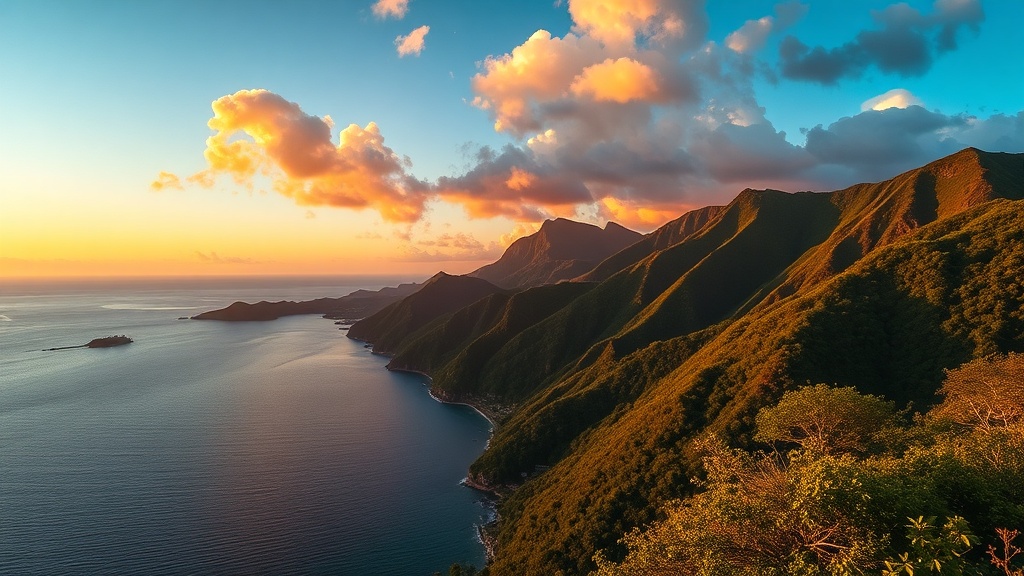
Dominica is the Caribbean island that did not build the beach resort. It has almost no white sand — the beaches are volcanic and grey — no cruise-ship mega-port, no all-inclusive strip, and consequently a fraction of the visitors of its neighbours. What it has instead is nine potentially active volcanoes, 365 rivers, the densest concentration of waterfalls in the region, and an interior of cloud forest that has been protected as a World Heritage site since 1997.
First, a clarification that matters when booking: Dominica is not the Dominican Republic. They are different countries a thousand kilometres apart — this one is a 72,000-person English- and Kwéyòl-speaking Commonwealth republic in the Lesser Antilles, and it is pronounced dom-in-EE-ka.
Three things make it worth the effort of getting here. The Boiling Lake, a flooded fumarole that genuinely boils, reached by one of the hardest and best day hikes in the Americas. The Kalinago Territory, home to some 3,000 descendants of the island's indigenous people — the largest surviving Indigenous Caribbean community, holding land they were never fully driven from. And the sperm whales, which live in the deep water off the west coast all year rather than passing through, making Dominica one of the few places on Earth where they can be seen reliably in any month.
Set expectations honestly. This is a hiking and diving island in a wet tropical climate, with steep roads, limited infrastructure and prices that are not low. Hurricane Maria in September 2017 caused damage estimated at well over twice the country's annual GDP, and the recovery — along with a national commitment to become the world's first climate-resilient nation — is visible everywhere. Come for the forest, the water and the walking; come somewhere else for a beach holiday.
The island rises straight out of the sea: 751 km², and mountains to 1,447 m within 26 km of coast to coast. · Existing project image; rights under review
02
🏷️ Name & Identity
Columbus sighted the island on Sunday 3 November 1493 and named it for the day: Dies Dominica. The Kalinago had been there for centuries and called it Wai'tu kubuli — "tall is her body" — which is both more accurate and, by a considerable margin, the better name. It is used constantly on the island today.
The flag is one of the most distinctive in the world: a green field for the forest, a cross of yellow, black and white for sunshine, soil and water, and at the centre a sisserou parrot — Amazona imperialis, found nowhere else on Earth — ringed by ten green stars for the ten parishes. It is the only national flag depicting a parrot, and the bird it shows is critically endangered.
Independence
3 November 1978, from Britain — the same date Columbus sighted the island, chosen deliberately. Dominica is a republic within the Commonwealth with a president rather than a governor-general.
Language
English is official; Kwéyòl — French-based Antillean Creole — is spoken by most Dominicans, a legacy of French rule before Britain took the island in 1763. The island sits between two French départements, Guadeloupe and Martinique.
Kalinago
Roughly 3,000 people in a 15 km² territory on the east coast, with their own chief and council. The largest Indigenous population remaining in the Eastern Caribbean.
Religion
Predominantly Catholic, again a French inheritance, with strong Methodist and Adventist minorities.
The Nature Island
Not a marketing invention but a national self-description, and the organising principle of the country's tourism policy — which explicitly rejects mass tourism.
The other Dominica
The Dominican Republic is a Spanish-speaking country of 11 million on Hispaniola. Airlines, insurers and booking systems confuse them constantly; check the airport code, which here is DOM for Douglas-Charles.
Original editorial diagram
03
🗺️ Geography & Regions
Dominica is 47 km long and 26 km wide — 751 km², about the size of Prague and its immediate surroundings — and almost all of it is mountain. Morne Diablotin reaches 1,447 m, the second-highest peak in the eastern Caribbean, and the terrain is steep enough that the road from one coast to the other crosses passes rather than plains.
Volcanic to the core
Nine potentially active volcanic centres, more per unit area than anywhere else on Earth. The last magmatic eruption was around 1300, but the fumaroles, hot springs and the Boiling Lake are the same system still venting.
365 rivers
The island's own claim — one for every day — and while nobody has counted precisely, the density of watercourses is real and is what makes the interior impassable without trails.
The leeward (west) coast
Calm Caribbean water, Roseau, Portsmouth, and almost all the diving and whale watching. Grey and black volcanic sand.
The windward (east) coast
Facing the open Atlantic: rough, spectacular, thinly populated, and the location of the Kalinago Territory.
Morne Trois Pitons National Park
The UNESCO-listed interior: cloud forest, the Boiling Lake, the Valley of Desolation, Titou Gorge and Middleham Falls, across 69 km² of the southern highlands.
Morne Diablotin National Park
The northern massif, protecting the last habitat of the sisserou and jaco parrots in the Syndicate forest.
The nearest neighbours are French: Guadeloupe 40 km north and Martinique 40 km south, both reachable by fast ferry. That proximity is why Kwéyòl survived, why the food has a French accent, and why a Dominica trip combines naturally with a French island.
04
📍 Map of Dominica
The island runs north–south, with Roseau near the southern end of the west coast and Portsmouth in the north. Douglas-Charles Airport (DOM) is on the north-east coast — about an hour and a half from Roseau on a winding road, which is the single most underestimated fact in trip planning here.
Distances look trivial and are not. Roseau to Portsmouth is about 40 km by the coast road and takes roughly an hour; Roseau to Douglas-Charles is about 45 km over the Pont Cassé pass and takes 75–90 minutes. The roads are paved, narrow, steep and full of blind bends, and driving is on the left. Budget double what a map suggests and never plan to arrive anywhere after dark on your first day.
05
📜 History
The Kalinago reached Dominica around 1400 CE, moving north through the Lesser Antilles from South America and displacing the earlier Arawak-speaking Taíno. Their reputation for effective resistance — combined with terrain that made the interior impossible to control — kept European colonisation at bay for two full centuries after Columbus, which is why an Indigenous community survives here and almost nowhere else in the Caribbean.
The French established themselves from the 17th century, bringing enslaved Africans to work coffee and sugar. Britain and France fought over the island repeatedly; Britain took permanent possession in 1763, though French cultural influence had already fixed the language and the religion. Slavery was abolished in 1834.
Dominica's mountains shaped its society. The interior was never fully plantable, so escaped enslaved people — the Maroons — established free communities in the highlands and fought a serious guerrilla war against the British in 1809–14. After emancipation, the difficulty of large estates meant land ended up in the hands of many small farmers rather than a planter elite. The country is unusually equal by Caribbean standards as a direct result.
Independence came on 3 November 1978. Dame Eugenia Charles, prime minister from 1980 to 1995, was the Caribbean's first woman head of government and one of its most formidable politicians. The island survived a bizarre 1981 coup attempt organised by American and Canadian white supremacists — Operation Red Dog — which was stopped on a dock in New Orleans.
The defining modern events are meteorological. Hurricane David flattened the island in 1979. Tropical Storm Erika killed 30 people in 2015. And Hurricane Maria, a category 5 that crossed the island directly on 18 September 2017, destroyed or damaged around 90% of buildings and caused losses estimated at more than 220% of GDP. Dominica's response was to declare the goal of becoming the world's first climate-resilient nation, and visitors will see both the scars and that programme at work.
Politically the island has been unusually stable, or unusually one-sided, depending on who you ask. Roosevelt Skerrit of the Dominica Labour Party has been prime minister since January 2004 — the longest-serving head of government in the Americas — and won a sixth term at the snap election of 6 December 2022, which the main opposition boycotted (DLP 19 of 21 seats). The next election is due by 2028. The head of state since 2 October 2023 is Sylvanie Burton, elected by parliament as the country's first woman president and, more strikingly, its first Kalinago one — she comes from Salybia in the Territory. In 2026 the government's stated preoccupation is finishing three big projects at once: the international airport at Wesley, the Roseau Valley cable car and the geothermal plant, the last of which entered commercial operation in July 2026, according to Ormat’s August 5 results announcement.
06
🏹 The Kalinago Territory
On the rugged east coast, 15 km² of land has been held collectively by the Kalinago since 1903, when the British formally recognised what was already the case. Around 3,000 people live in eight hamlets under an elected Kalinago Chief and council, and the territory is the largest surviving Indigenous community in the Eastern Caribbean — the people that the word "Carib", and by extension the Caribbean itself, is named after.
The Chief and the President
On 22 July 2024 the Territory elected Anette Thomas-Sanford of Sineku as Kalinago Chief — the first woman to hold the office in its recorded history — followed by a new Kalinago Council in August 2024. A year earlier, in October 2023, Sylvanie Burton from Salybia became President of Dominica, the first Kalinago head of state anywhere in the Caribbean.
Visiting properly
The Kalinago Barana Autê is a purpose-built cultural village near Salybia, run by the community, with guided tours explaining canoe building, cassava processing, basketry and history. Entrance fees go to the territory.
Larouma baskets
The distinctive double-woven baskets, made from larouma reed and dyed with plant extracts, are the territory's best-known craft and among the few genuinely local souvenirs in the Caribbean.
The kanawa
The dugout canoe, built from a single gommier trunk, still made and still used. The technique is the direct ancestor of the vessels that carried people across the whole island chain.
Cassava bread
Bitter cassava, which is toxic raw, processed through a woven matapi press and baked flat on a griddle. Watching it done is watching a Neolithic food technology in continuous use.
What not to do
This is a living community, not an exhibit. Do not photograph people or houses outside the cultural village without asking, and do not turn up expecting an unguided wander through the hamlets.
The honest history
Kalinago numbers collapsed from disease, war and displacement, and the community remains among the poorest on the island. Framing them as a picturesque survival misses the point; the territory exists because people fought to keep it.
07
🎭 People & Culture
Seventy-two thousand people live on Dominica, and roughly the same number of Dominicans live abroad — in Britain, the United States, Canada, Guadeloupe and Martinique. Remittances matter. So does return migration: a noticeable share of the people running guesthouses and dive shops came home after decades away.
The culture is Afro-Caribbean with a strong French Creole substrate and a Kalinago presence that no other island retains. Practically, that means a Catholic calendar, Kwéyòl spoken at home and English at the counter, and a music tradition — bouyon, invented here in the late 1980s by the band WCK — that fuses jing ping folk music with soca and dancehall and is now exported across the region.
Creole Day
The Friday before Independence: the whole country turns out in wòb dwiyèt and madras, schools and ministries included. It is not staged for visitors — it is the biggest day in the cultural year.
Jing ping
Accordion, boom-boom (a bamboo tube), shak-shak and a tambourine-like tambal. The rural dance music the whole Creole revival is built on.
Bouyon
Named after the stew. Fast, percussive, unmistakable, and Dominica's clearest cultural export.
The village
Community structure is strong and visible — koudmen, collective labour on a neighbour's house or land, was how much of the island rebuilt after Maria.
Directness
Dominicans are friendly but not performative. Greeting people before asking anything — "good morning" first, question second — is not optional politeness here, it is the basic form.
Faith
Church attendance is high and Sunday is genuinely quiet. Plan around it: many businesses close and bus services thin out drastically.
08
💬 Language — English & Kwéyòl
English is the official language and everyone you deal with will speak it. Kwéyòl — Antillean Creole, French-lexified, closely related to what is spoken in St Lucia, Martinique and Guadeloupe — is the language of home, market and song. It survived two centuries of British rule and was actively discouraged in schools until the 1970s; it is now taught and celebrated.
Bonjou
Good morning — the greeting that opens everything.
Bonswè
Good afternoon/evening, used from roughly midday onward.
Mèsi
Thank you. Mèsi anpil — thanks a lot.
Ka ou fè?
How are you? Answer: Mwen bien — I'm fine.
Sa sé sa?
What is that? Useful in a market.
Wai'tu kubuli
"Tall is her body" — the Kalinago name for the island. Knowing it, and using it, is noticed.
A caution on French: because Dominica sits between Guadeloupe and Martinique, Kwéyòl sounds French and shares much of its vocabulary. Speaking French will get you understood by some people and blank looks from others — the grammar is not French, and the island's second language in practice is not French but the Creole itself.
The government country profile lists English and French Patois, Kwéyòl. English on this page also serves a local public language; Kwéyòl is a distinct Creole and should not be confused with standard French. Government profile.
Original editorial diagram
09
🏙️ Roseau & Portsmouth
Roseau is a capital of about 15,000 people, laid out on a French grid on the west coast where the Roseau River meets the sea. It is walkable in an hour, and its appeal is architectural rather than monumental: two-storey timber and stone houses with jalousie shutters and overhanging galleries, the survivors of fires, hurricanes and neglect.
Caribbean market street. Roseau's riverside market is busiest on Saturday morning; the Old Market Plaza sells craft. · Existing project image; rights under review
Old Market Plaza
The cobbled square that was the slave market and later the town's market. Craft stalls now; the historical plaque does not soften what it was.
Saturday market
The riverside market on Saturday morning is the real one — dasheen, plantain, breadfruit, bay leaf, river crayfish, and the cocoa and coffee grown upcountry.
Botanic Gardens
40 acres established in 1891, and the site of the famous crushed school bus — a baobab felled by Hurricane David in 1979 onto an (empty) bus, left in place ever since.
Dominica Museum
One small room opposite the bayfront, but the Kalinago and slavery sections are honest and worth the half hour.
Portsmouth
The second town, in the north on Prince Rupert Bay — the Indian River boat trip, Cabrits National Park and Fort Shirley. The big campus at Picard belonged to Ross University School of Medicine, which moved to Barbados in 2019 after Maria — the town has been looking for a replacement for its students ever since.
Cruise days
Roseau takes cruise calls in winter. On a two-ship day the town is transformed and every site is busy; check the schedule and plan the interior for those days.
10
🌋 The Boiling Lake & the Valley of Desolation
The Boiling Lake is a flooded fumarole roughly 60 m across, the second-largest hot lake in the world after Frying Pan Lake in New Zealand. The grey-blue water at the centre genuinely boils — it is not a geyser or a hot spring but a crack venting into a pool, with a temperature at the edges around 82–92 °C and the middle at boiling point. The level rises and falls; it has drained entirely more than once and refilled within months.
The difficult route starts at Titou Gorge in Laudat. Forestry lists approximately three hours one way and classifies the trail as difficult; actual duration depends on weather, the group and trail conditions. It strongly recommends a certified guide. Check current access with Forestry and your guide, especially after heavy rain. Forestry guidance.
The cable car
The Roseau Valley cable car remains a project to plan around cautiously. The operator’s current timetable lists final construction, testing and commissioning in 2026, with public opening projected for 2027. This supersedes the government’s older October 2026 completion target and is not evidence of current passenger operations. Check the operator’s confirmed opening and booking conditions before relying on it. Operator project timeline.
Valley of Desolation
The middle third: a fumarole field of sulphur, boiling mud, hot streams and dead ground where the forest simply stops. Follow the guide's footsteps exactly — the crust is thin in places.
Start early
06:00–07:00 from Laudat. Afternoon cloud fills the crater and you will see nothing at the top.
Cost
Expect roughly US$100–150 per person for a guided day, plus the site pass. Prices drop with group size.
Fitness
If a six-hour hill walk with scrambling is not something you do, this is not the hike to try it on. There is no shortcut and no way out but back.
Kit
Proper boots with grip, two litres of water, food, waterproof, a change of shirt, and everything in a dry bag. You will be soaked either way — rain, sweat or the river crossings.
Titou Gorge
The trailhead is also a swimmable slot canyon leading to a waterfall. Do it afterwards; the cold water on tired legs is the best part of the day.
UWI Seismic Research Centre recommends contacting Forestry before every visit. Do not descend to the lake or swim in it; draining can change the hazard and geothermal conditions fluctuate. An older excursion description does not confirm today’s safety. UWI-SRC.
Original editorial diagram
11
🥾 Hiking & the Waitukubuli National Trail
The Waitukubuli National Trail is the Caribbean's first long-distance path: 184 km in 14 segments from Scotts Head in the far south to Cabrits in the north, opened in 2011, using old Maroon routes, farm tracks and forest paths. It was badly damaged by Hurricane Maria and has been restored in stages; check current segment status before committing to a through-hike.
Most visitors walk segments rather than the whole thing. Segment 4 (Wotten Waven to Pont Cassé) and Segment 12 (Colihaut Heights to Syndicate) are the usual recommendations for a strong single day. Through-hiking takes about two weeks and needs planning: some segments have no accommodation at either end.
Middleham Falls
About 90 minutes return from Laudat or Cochrane through mature rainforest to a 60 m fall and a cold plunge pool. The best short forest hike on the island.
Morne Diablotin
1,447 m, four to five hours return, steep and often in cloud. Named for the black-capped petrel; the Syndicate approach also holds the sisserou parrot.
Morne Trois Pitons
The 1,342 m peak that gives the national park its name. Hard, muddy, and much less walked than the Boiling Lake.
Segment 1
Scotts Head to Soufrière — short, coastal, and the easiest way to get a sense of the trail without a full day.
Site pass
A national parks pass covers the main sites: roughly US$5 per site or US$12 for a week. Buy it at the first gate; rangers do check.
Conditions
Trails are wet, rooty and slippery year-round. Ankle-supporting boots, not trainers, and expect to be in the water at some point on most routes.
12
🐋 Sperm Whales & the Sea
The west coast shelf drops off steeply into water more than a kilometre deep within sight of shore, and a resident population of sperm whales — matrilineal family groups, studied continuously since the 1980s — lives there year-round. Dominica is one of very few places on Earth where sperm whales are seen in every month rather than on migration, and the encounter rate on a half-day trip is high.
A whale sounding. Off Dominica's west coast the sperm whales are resident year-round, and boats find them by hydrophone. · Existing project image; rights under review
Season
Year-round, with November to March generally calmest and most reliable. Trips run from Roseau and Castle Comfort.
What you see
Blows, backs and — if the group is diving — the fluke going vertical. Boats use hydrophones; the codas are audible through the hull.
Rules
The reserve announcement in 2023 was followed by parliamentary passage of legislation on October 14, 2025. In March 2026 the government approved a board and reserve staffing roles. Whale watching and swim encounters are regulated activities: choose an authorized operator and verify applicable permits, not only an offer on its website. Legislative framework.
Other species
Spinner and spotted dolphins on most trips, pilot whales frequently, humpbacks in winter, and orca occasionally.
Cost
About US$65–85 for a half-day trip. Take seasickness tablets an hour before — the boats stop and drift while listening.
Ethics
Choose an operator that keeps distance and cuts engines. The population is small and well known individually; pressure on it is a genuine conservation question, not a formality.
13
🤿 Diving & Snorkelling
Dominica's diving is volcanic: walls that fall away from the shore, pinnacles, and vents that push warm gas through the sand. It is consistently rated among the best in the Caribbean, and because the island gets few visitors, sites are rarely crowded. Almost all of it is on the sheltered west coast.
Champagne Reef
Geothermal vents release streams of bubbles through the shallows south of Roseau. Snorkellers can do it from shore; the water is perceptibly warm over the vents. The island's signature site.
Soufrière–Scotts Head Marine Reserve
A drowned crater at the island's southern tip. Swiss Cheese, Dangleben's Pinnacles and the Scotts Head Drop-off are all inside it, and it is protected and patrolled.
Cabrits & the north
Toucari and Douglas Bay, gentler and better for less experienced divers, with good macro life.
What you see
Seahorses, frogfish, batfish, flying gurnards, huge barrel sponges, and — for those who look — a lot of very small things. Not a big-shark destination.
Conditions
Water 26–29 °C year-round, visibility usually 15–25 m, currents mild on most sites. A 3 mm suit is plenty.
Cost
Roughly US$80–110 for a two-tank morning, US$50–60 for a single. Marine reserve fees are extra and small.
14
💦 Waterfalls, Rivers & Hot Springs
With 365 rivers in 751 km², water is the island's defining feature. Some falls are a two-minute walk from a car park; others take two hours. The hot springs are the same volcanic system as the Boiling Lake, tapped at a comfortable temperature.
Twin cascades in Dominica's rainforest interior — the island's falls are rarely more than an hour's walk from a road. · Existing project image; rights under review
Trafalgar Falls
Two falls side by side above Trafalgar village, ten minutes from the viewing platform. Scrambling to the pools is possible but the rocks are lethal when wet — take a guide or stay on the platform.
Emerald Pool
The easiest one: fifteen minutes on a paved path to a grotto and a green pool. Popular with cruise groups, so go early or late.
Victoria Falls
The big one, in the south-east near Delices. A river-walk approach with repeated crossings; do not attempt it after heavy rain and do not attempt it without a local guide.
Wotten Waven
The hot springs village above Roseau — several small sulphur spa setups, open into the evening, and the correct thing to do after the Boiling Lake.
Ti Tou Gorge
A narrow water-filled canyon you swim up to reach a fall. Cold, dark and excellent.
Indian River
Rowed — not motored — up a mangrove-lined river at Portsmouth. Slow, quiet and good for birds.
15
🦜 Nature & the National Parks
Morne Trois Pitons National Park was inscribed as a UNESCO World Heritage site in 1997 — the first natural site in the Eastern Caribbean — for its volcanic landscape and its intact tropical forest. It covers 68 km², around 9% of the island, and contains the Boiling Lake, the Valley of Desolation, Emerald Pool, Titou Gorge and the Freshwater and Boeri lakes.
Sisserou parrot
Amazona imperialis, the national bird, endemic and critically endangered — a few hundred birds, concentrated around Morne Diablotin. Hurricane Maria cut the population hard.
Jaco parrot
Amazona arausiaca, the red-necked parrot, also endemic and more numerous. The Syndicate Nature Trail at dawn is the place for both.
Morne Diablotin National Park
Created in 2000 specifically to protect parrot habitat in the north.
Cabrits National Park
Coastal, with Fort Shirley — a restored 18th-century British garrison — and a marine section.
Forest types
From dry scrub in the south-west through rainforest to elfin woodland on the summits, all within a few kilometres. The altitudinal compression is what makes the island biologically rich.
Frogs and snakes
The mountain chicken frog, once eaten and now critically endangered, survives in tiny numbers. Snakes here are non-venomous — Dominica has no fer-de-lance, unlike St Lucia and Martinique.
16
🍲 Food — Creole Cooking on a Farming Island
Dominica grows most of what it eats, and the cooking is Creole: root vegetables, coconut milk, fresh fish and river crayfish, thyme and scotch bonnet. It is closer to Guadeloupe than to Jamaica, and the national dish — mountain chicken, a large frog — is off the menu permanently because the species nearly went extinct.
Callaloo Soup
The national soup · 45 minutes · serves 4
Ingredients: Dasheen (taro) leaves, coconut milk, onion, garlic, thyme, a whole scotch bonnet, salted pork or crab, okra, black pepper.
Method: Sweat onion, garlic and thyme. Add chopped dasheen leaves, okra and salt meat with water to cover; simmer 25 minutes. Add coconut milk and the whole chilli — unbroken — and simmer 10 more. Remove the chilli, then blend to a thick green purée.
💡 The chilli goes in whole and comes out whole: you want the perfume, not the heat. Break it and you have changed the dish.
Bouyon
Saturday stew · 90 minutes · serves 6
Ingredients: Dasheen, yam, green banana, plantain, pumpkin, carrot, salt beef or pigtail, dumplings, thyme, celery, scallion, coconut milk.
Method: Boil the salted meat and pour off the first water. Add the hardest roots first, then the softer ones in order, then dumplings. Season with thyme, celery and scallion, finish with coconut milk and simmer until the liquid thickens on its own.
💡 The order the roots go in is the whole technique — everything should finish together and nothing should be mush.
Crayfish
River crayfish, usually stewed in a red sauce. The best of them come from the east-coast rivers.
Titiwi
Tiny river fry, netted at the mouths of rivers on a few nights a month and made into accra fritters. A local delicacy with a short season.
Bakes
Fried dough, split and filled with saltfish or cheese. Breakfast.
Breadfruit
Roasted whole over coals until the skin blackens, then sliced. Better than it has any right to be.
Cocoa tea
Grated local cocoa boiled with cinnamon, bay leaf and milk. The morning drink.
Where to eat
Small local places and guesthouse kitchens beat anything aimed at visitors. Ask what is cooked today rather than reading a menu.
17
🥃 Rum, Bush Rum & Cocoa
Dominica's drinking culture centres on bush rum — overproof white rum infused in big jars with whatever the maker has decided works. Every bar and many houses have a shelf of them, and being offered one is a social act rather than a transaction.
Macoucherie
The island's own rum, distilled at a west-coast estate that still crushes its own cane with a water wheel. The white is the everyday bottle.
Bois bandé
The infusion everyone will tell you about — bark from Richeria grandis, reputed as an aphrodisiac. Bitter, and the reputation exceeds the evidence.
Other infusions
Pineapple, sorrel, lemongrass, anise, cinnamon, and the fierce herbal ones. Ask before pouring — strengths vary enormously.
Kubuli
The national lager, brewed at Loubiere. "The beer we drink" is the slogan and, essentially, the fact.
Cocoa
Dominica grows fine-flavour cacao, and small producers make chocolate on the island. Worth buying at the market rather than the airport.
Coffee
Grown in small quantities upcountry. Not a volume industry, but the estate coffee is good and rarely leaves the island.
18
🌀 Hurricanes & the Climate-Resilient Nation
On 18 September 2017, Hurricane Maria crossed Dominica as a Category 5 storm with sustained winds around 260 km/h. It stripped the island's forest to bare trunks, destroyed or damaged the great majority of buildings, and killed dozens of people directly with more deaths in the aftermath. Damage was assessed at well over twice annual GDP — one of the most severe losses relative to economy ever recorded from a single storm.
Two years earlier, Tropical Storm Erika in August 2015 had already killed around 30 people and destroyed villages in the south-east through flooding and landslides rather than wind. Dominica's steep terrain turns rain into destruction faster than almost anywhere.
The response was a national policy: Dominica declared its intention to become the world's first climate-resilient nation, with a dedicated agency, rebuilt-to-standard housing, buried power lines in places, and a push toward geothermal electricity from the same volcanic system that produces the Boiling Lake. The forest itself recovered fast — within three years the green had closed over — but the parrot populations and some trails took much longer.
It does not take a hurricane
Floods and landslides can disrupt communities, bridges and school access even when no hurricane makes landfall. A visitor should allow time for altered road conditions and take local warnings seriously rather than using a quiet recent hurricane season as reassurance. Dominica’s Meteorological Service provides current bulletins; the state of a particular road or trail still needs local confirmation.
Season
June to November, with August to October the peak. Direct hits are rare in any given year but the island is squarely in the belt.
If you travel then
Prices are low and the island is quiet. Take insurance that actually covers named storms, and watch the forecast at 48 and 72 hours out.
Landslides
The practical risk on a wet island is roads, not roofs. Heavy rain closes routes; allow slack in any tight schedule.
Geothermal
The Laudat geothermal project is no longer only a plan. In results published August 5, 2026, Ormat reports commercial operation of its 10 MW Dominica plant in July 2026. This is a significant step toward using a domestic renewable resource; plant capacity is not the same thing as its current percentage share of total electricity supply. Ormat results.
What visitors see
Rebuilt roofs, new bridges, and a lot of concrete where timber stood. Also a country that talks about climate as a present-tense problem, not a projection.
Respect it
Asking people about Maria is normal and they will talk about it. It is recent, and for many it is the dividing line in their lives.
Original editorial diagram
19
🌦️ Climate & When to Go
Tropical, wet, and much wetter in the interior than on the coast. Roseau gets around 1,900 mm of rain a year; the mountains above it get six to nine metres. Temperatures barely move — 26–32 °C on the coast all year, cooler and often in cloud above 800 m.
Dec–Apr — the dry season
Relatively speaking. Least rain, calmest sea, best whale and dive conditions, and the highest prices. Still expect showers most days.
Feb–Mar
The sweet spot: Carnival, driest trails, best visibility underwater.
Jun–Nov — hurricane season
Hot, humid, heavy rain, cheapest prices, emptiest trails. August to October is the peak risk window.
Oct–Nov
Wet, but Creole Day, the World Creole Music Festival and Independence make it the richest cultural month of the year.
Rain in practice
Showers are short and hard rather than all-day drizzle. Waterproofs are less useful than quick-drying clothes and a dry bag.
Altitude
It is genuinely cool at Freshwater Lake and on the summits, especially wet and windy. Bring one warm layer even in March.
20
✈️ Getting There
Douglas–Charles (DOM), on the northeast coast, is the main airport; Canefield (DCF), near Roseau, handles smaller aircraft. International airport construction near Wesley continues, with a government completion target of 2027. A target is not an operational opening date: make current bookings through the airports and services actually available. Road transfer times to Roseau vary with weather and traffic. Government airport update.
Regional hubs
Regional hubs provide connections from Europe and North America. Discover Dominica lists Antigua, Barbados, Martinique, St. Maarten, Puerto Rico, Guadeloupe and Trinidad, and a direct American Airlines service from Miami to Douglas–Charles. The available days and connection times must be confirmed with carriers; a route listing is not a live timetable. Official airline information.
Connection timing
Regional flights are few and late connections strand people overnight. Build in a wide buffer, and note that Douglas–Charles has limited night operations.
Ferry
L'Express des Îles runs a fast catamaran linking Guadeloupe, Dominica, Martinique and sometimes St Lucia, docking in Roseau. Two to three hours to either French island, and often cheaper and simpler than flying.
The ferry as a routing
Flying to Guadeloupe or Martinique from Paris on a long-haul and taking the boat is a common — and frequently the cheapest — way in from Europe.
Cruise
Roseau and Portsmouth take calls in winter. A cruise day gives you six hours, which is enough for Trafalgar or Emerald Pool and nothing more.
Airport transfer
Shared minibus from Douglas–Charles to Roseau runs about US$30 per person; a private taxi US$90–110. Arrange before you land.
21
🇪🇺 Getting There from Europe & Czechia
There is no way to reach Dominica from Europe in one hop, and the routing you choose makes a large difference to both cost and misery. From Prague, plan on two connections and a full travel day, sometimes two.
Via Paris
Air France and Corsair fly Paris–Pointe-à-Pitre (Guadeloupe) and Paris–Fort-de-France (Martinique) daily. Then the ferry. Usually the cheapest and most reliable route from Central Europe, and the ferry crossing is genuinely pleasant.
Via London
British Airways and Virgin serve Antigua, Barbados and St Lucia; connect onward on a regional carrier. Watch the overnight — the regional leg often departs the next morning.
Via the US
Miami or San Juan works but adds the US transit visa/ESTA question and a security re-clearance. Only worth it on a good fare.
From Prague
PRG–CDG or PRG–LHR on the first leg, then as above. Reckon on 18–26 hours door to door and CZK 25,000–40,000 return depending on season.
Baggage
Regional turboprops have low baggage allowances and hard weight limits. Check them before you pack dive gear.
The overnight problem
Plan an intentional night in Guadeloupe, Antigua or Barbados rather than gambling on a same-day connection. It costs less than a missed flight.
22
📋 Practical Information
Visa
Visa rules are not identical for every European passport. Dominica’s government list includes Czech and U.S. citizens for visa-free visits up to six months, and French and German citizens up to three months. Immigration determines the actual permission to stay. Confirm the duration, passport validity and any extension for your citizenship; FCDO requires six months of passport validity from arrival for British passports. Carry return or onward-travel evidence. Government visa list · FCDO.
Money
East Caribbean dollar (XCD), pegged at 2.70 to the US dollar. US dollars are widely accepted at a rounded rate — you will lose a little. ATMs in Roseau and Portsmouth; carry cash outside them.
Cards
Accepted at hotels, dive shops and larger restaurants. Not at markets, buses, roadside stalls or most guides. Cash is the working currency.
Driving
On the left. A local visitor's permit (about US$12) is required in addition to your licence and is issued at the airport or police stations. Roads are narrow, steep and blind — a 4×4 is worth it and honking on bends is standard. Confirm permit eligibility and rental age limits before booking; car hire companies usually help arrange the temporary local licence. Discover Dominica
Buses
Private minibuses with H-plates run fixed routes for a few EC dollars. Frequent on the west coast on weekdays, thin at weekends, essentially absent on Sunday.
Health
Dengue and other mosquito-borne infections require bite prevention and current travel-health preparation. Tap water is generally drinkable, but use safely treated or bottled water after flooding or when the supply is uncertain. Untreated river water should not be considered safe merely because it looks clear.
Electricity
Dominica uses 220/240 V electricity. Confirm socket types with your accommodation and check your appliance’s voltage rating; a plug adaptor does not convert voltage. Discover Dominica
Connectivity
Digicel and Flow cover the coasts and most of the inhabited interior. eSIMs work. The forest has no signal, which matters on long hikes.
Safety
Low crime by regional standards, and violent crime against visitors is rare. The genuine hazards are terrain and water: slippery rock, flash floods and strong sea on the Atlantic coast.
Emergency
Emergency number: 999 for police, fire and ambulance. Before hiking, keep guide and accommodation contacts available and verify that your insurance covers the planned activities. Source.
Time zone
UTC−4 year-round, no daylight saving. Five hours behind Prague in winter, six in summer.
Tipping
10% is usual where service is not included. Guides are tipped for a hard day; it is appreciated rather than expected.
Before traveling, complete the government’s electronic immigration and customs form. Its landing page specifies submission no more than three days before arrival. Save the confirmation and QR code; this is not a visa or a guarantee of entry. Official ED card.
Entry vaccination rules depend on your route: a yellow fever certificate is required for eligible travelers arriving from risk countries, including certain airport transits. Check current route-specific requirements before departure. CDC
23
💰 Costs — What It Actually Costs
Dominica is not a cheap Caribbean island, mainly because almost everything except food is imported and there is no economy of scale. It is, however, far cheaper than Barbados or St Barths, and the money goes to small operators rather than chains. Prices below are per person per day, in US dollars, as indicative planning estimates rather than live supplier quotations.
Budget · US$60–90
Guesthouse or a room in a family house, local food, buses, a site pass and self-guided hikes. Entirely feasible and how many hikers do it.
Mid-range · US$140–220
Small hotel or eco-lodge, a hire car, one guided activity every couple of days, restaurant dinners.
Comfortable · US$300+
Boutique property, private guide, daily diving or boat trips. The top end here is a handful of properties, not a strip.
Fixed activity costs
Boiling Lake guided US$100–150 · whale watching US$65–85 · two-tank dive US$80–110 · national parks week pass US$12 · Indian River boat US$25.
Car hire
US$45–70 a day plus the US$12 permit. Fuel is expensive. Worth it for three days or more; not worth it for one.
Where the money goes
Guides, boats and permits, not accommodation. Budget the activities first and the bed second — it is the opposite of most destinations.
24
🏨 Where to Stay
There are no large resorts and no all-inclusives. Accommodation is guesthouses, small hotels and a handful of eco-lodges, and the choice of where on the island matters more than usual because crossing it takes real time.
Roseau & Castle Comfort
Best base for diving, whale trips and the Boiling Lake trailhead. Dive shops and restaurants within walking distance.
Wotten Waven / Trafalgar
Up in the valley above Roseau, among the hot springs and at the door of the national park. Cool at night, and the best choice for hikers.
Portsmouth & the north
Quieter, cheaper, close to Cabrits, the Indian River and Morne Diablotin. Further from the diving.
Calibishie & the north-east
The nearest thing to a beach scene, and close to Douglas–Charles for a first or last night.
Eco-lodges
Several serious ones — off-grid, rainwater, solar, built into the forest. Expensive, and the genuine article rather than a label.
Booking
Small places often answer WhatsApp faster than booking platforms, and are cheaper direct. In festival weeks — Carnival, Independence, the Creole Music Festival — book months ahead.
25
🏛️ UNESCO — Morne Trois Pitons National Park
Dominica has one World Heritage site, inscribed in 1997: Morne Trois Pitons National Park, 68 km² of the volcanic interior south-east of Roseau. It was the first natural World Heritage site in the Eastern Caribbean, listed for its active volcanic features and for the diversity of its forest within a very small area.
Why it was listed
Criteria (viii) and (x): the geology — five volcanoes, fumaroles, the Boiling Lake — and the biodiversity of forest types compressed by altitude into a few kilometres.
What is inside
Boiling Lake, Valley of Desolation, Emerald Pool, Titou Gorge, Middleham Falls, Trafalgar Falls, Freshwater Lake and Boeri Lake.
Freshwater & Boeri
Two crater lakes at around 760 and 850 m, reachable on short walks from the Laudat road, cool and often in cloud. The easiest way to see the high interior without a full day's hiking.
Access
The national parks pass covers the sites — roughly US$5 each or US$12 for a week. Buy at the first gate you reach.
After Maria
The park was severely damaged in 2017 and the trail network reopened in stages. Canopy structure is still recovering, which is visible in the younger, denser growth at lower elevations.
Tentative list
Three sites have sat on Dominica's Tentative List since 2015 — Fort Shirley at Cabrits, Morne Diablotin National Park and the Soufrière–Scotts Head Marine Reserve — and none has yet been nominated. Dominica has no elements on UNESCO's intangible heritage lists either; a UNESCO-funded programme (2021–25) trained the country to prepare its first nomination files.
26
🎉 Festivals & the Creole Calendar
Dominica's cultural year has two poles: Carnival before Lent, and the Creole season in late October and early November. The second is the more distinctive — it is a deliberate national project of language and identity, and it is the best time to be on the island if you want to understand it.
Caribbean carnival. Dominica's own Mas Domnik leans less on feathers than its neighbours and more on sensay costume and goatskin drumming. · Existing project image; rights under review
Mas Domnik
Carnival, the Monday and Tuesday before Ash Wednesday. Calypso and bouyon monarch competitions, and lapo kabwit goatskin drumming through the streets before dawn on Monday. Smaller and rougher than Trinidad, which is the point.
Sensay
The signature Carnival costume: layer on layer of shredded cloth or rope with a horned mask. Unmistakable, and unlike anything elsewhere in the region.
World Creole Music Festival
Late October, three nights in Roseau — bouyon, zouk, cadence-lypso, soukous and kompa, with acts from across the Creole-speaking world. Book accommodation early.
Jounen Kwéyòl
Creole Day, the Friday before Independence. National dress, Kwéyòl spoken everywhere including in offices and schools, and food stalls in every village.
Independence · 3 November
Parades and ceremony, and the culmination of the Creole season.
Dive Fest
July, run by the dive operators — discounted diving, snorkelling for locals, whale trips and a canoe race. Off-season and good value.
27
💎 Hidden Gems
The famous sites are famous for good reasons, but they are also where the cruise groups go. These are the places that take a little more effort and reward it.
Chaudière Pool
A deep river pool with a natural jump above Bense in the north-east, reached on a 20-minute walk. Locals swim here; visitors mostly do not know it exists.
Batibou Bay
A genuinely beautiful undeveloped beach in the north-east, reached on a rough track. Golden sand, which is unusual here.
Bwa Nef Falls
In the far north near Penville — an approach through a river gorge to a fall in a narrow chasm. Wet feet guaranteed.
Sari Sari Falls
East coast near La Plaine, a river walk to a tall fall and a big pool. Do not go after heavy rain.
Pointe Baptiste Red Rocks
Weathered red-orange rock formations on the north-east coast, best in late light, with the Atlantic breaking below.
Syndicate Nature Trail
A gentle 45-minute loop under the flank of Morne Diablotin, and the single best chance of seeing both endemic parrots. Be there at dawn.
28
🤯 Fascinating Facts
The only parrot flag
Dominica's is the only national flag in the world depicting a parrot — and the sisserou it shows exists nowhere but this island.
Independence by design
Independence Day, 3 November 1978, was set to the date Columbus sighted the island in 1493 — reclaiming the date rather than the name.
A lake that boils
The Boiling Lake is the second-largest hot lake on Earth, after Frying Pan Lake in New Zealand, and has drained completely and refilled more than once in recorded history.
First Olympic medal
Thea LaFond won the women's triple jump at Paris 2024 — Dominica's first Olympic medal of any colour, and it was gold.
The bus under the tree
A baobab in the Roseau Botanic Gardens was felled onto a school bus by Hurricane David in 1979. The crushed bus was never moved and is now the garden's best-known exhibit.
No fer-de-lance
Unlike neighbouring St Lucia and Martinique, Dominica has no venomous snakes — one of the few genuinely reassuring facts about walking in this forest.
The Kalinago held on
The territory established in 1903 is the only substantial Indigenous Caribbean landholding remaining in the Eastern Caribbean.
Passports for sale
Dominica’s citizenship-by-investment programme is an important source of project financing and a subject of international scrutiny. The United Kingdom introduced a visa requirement for Dominican nationals on July 19, 2023; this is distinct from Dominica’s rules for tourists arriving on foreign passports. The future of visa-free arrangements depends on current law and decisions, so avoid treating an unverified political deadline as a settled change. UK explanatory memorandum.
Power from the volcano
The volcanic resource is also an electricity resource: Ormat reports commercial operation of its 10 MW Dominica geothermal plant in July 2026. A nameplate capacity describes the plant, not the percentage of national power supplied on a particular day. Ormat announcement.
A Kalinago head of state
President Sylvanie Burton, in office since October 2023, is the first woman and the first Kalinago to hold the post — and the Territory elected its first woman Chief, Anette Thomas-Sanford, in July 2024.
More rain than you think
The mountains above Roseau receive six to nine metres of rain a year — several times what falls on the coast a few kilometres away.
29
👤 Notable Dominicans
Jean Rhys (1890–1979)
Born Ella Gwendolen Rees Williams in Roseau. Author of Wide Sargasso Sea, the novel that gave Charlotte Brontë's "madwoman in the attic" a Caribbean life and voice — and one of the defining works of 20th-century Anglophone fiction.
Dame Mary Eugenia Charles (1919–2005)
Prime Minister 1980–1995 and the first woman to lead a Caribbean country. Known as the Iron Lady of the Caribbean; a central and contested figure in the 1983 Grenada intervention.
Phyllis Shand Allfrey (1908–1986)
Novelist (The Orchid House), founder of the Dominica Labour Party, and a minister in the short-lived West Indies Federation.
Thea LaFond (b. 1994)
Triple jumper: world indoor champion (Glasgow, March 2024), Olympic champion at Paris 2024 — the first Olympic medallist in the country's history — world silver at Tokyo 2025, and holder of the national record of 15.25 m set in Zagreb in June 2026. A schoolteacher by profession.
Gordon Henderson (b. 1951)
Founder of Exile One, the band credited with creating cadence-lypso in the 1970s and taking Dominican music to francophone Africa and the Antilles.
Ophelia Marie (b. 1953)
"The Lady of Song" — the voice of Dominican cadence and Creole ballad, and a national cultural figure.
Shane Shillingford (b. 1983)
Off-spinner, one of a line of Dominicans to play Test cricket for the West Indies; Alick Athanaze continues it in the current era.
Rosie Douglas (1941–2000)
Prime Minister in 2000, and before that a Black Power activist deported from Canada in the 1970s — a career that maps the Caribbean's political century.
Lennox Honychurch (b. 1952)
Historian and anthropologist, the author of the standard history of the island and the driving force behind the restoration of Fort Shirley.
Roosevelt Skerrit (b. 1972)
Prime Minister since January 2004 and leader of the Dominica Labour Party — the longest-serving head of government in the Americas, re-elected for a sixth term in December 2022. The airport, the cable car, the geothermal plant and the citizenship programme that pays for much of it are all his.
Sylvanie Burton
President since 2 October 2023 — the first woman and the first Kalinago to hold the office. A career public servant from Salybia who rose through the Ministry of Kalinago Affairs before parliament elected her head of state.
30
🎬 Dominica on Screen & Page
Press freedom
Reporters Without Borders does not rank Dominica on its own — the OECS states are scored together, and comfortably in the upper half. In practice the press is free but small: Dominica News Online, The Sun, the state DBS Radio and the independent Q95 carry the national conversation, and a government in power for two decades is the main subject of it.
Pirates of the Caribbean
Dead Man's Chest (2006) and At World's End filmed extensively here — the Indian River at Portsmouth, Hampstead Beach, the Soufrière area. The Indian River boat trip still trades on it, cheerfully.
Wide Sargasso Sea
Jean Rhys's 1966 novel draws directly on the Dominica of her childhood. Read it before you come; the landscape in it is this one.
The Orchid House
Allfrey's 1953 novel of a white Creole family's decline, filmed as a Channel 4 series in 1991 — partly shot on the island.
Honychurch, The Dominica Story
The standard single-volume history, written by a Dominican, and available on the island. The best background reading there is.
Nature documentaries
The resident sperm whale population has been filmed repeatedly for international series; the long-running research project off the west coast is unusually well documented.
Music
Exile One, Ophelia, WCK and Triple Kay are the way in. Streaming coverage is patchy — buying music locally is still the reliable route.
31
🏅 Sport
For a country of 72,000 people, Dominica's sporting record is thin in volume and startling in its peaks. Cricket is the national game, played for the West Indies rather than for Dominica; athletics is where the island competes under its own flag, and where it finally broke through in 2024.
Paris 2024
Thea LaFond won the women's triple jump on 3 August 2024 (15.02 m, a national record at the time) — Dominica's first Olympic medal in any sport, and gold at the first attempt. The island declared a public holiday. She had already won the country's first world title at the 2024 World Indoor Championships in Glasgow that March.
LaFond since Paris
Silver at the 2025 World Championships in Tokyo (14.89 m, 18 September 2025), then on 26 June 2026 in Zagreb a leap of 15.25 m — a new national record, the world lead and equal ninth on the all-time list. Her 2026 season included the inaugural World Athletics Ultimate Championship in Budapest. She is, by some distance, the most decorated athlete in the country's history.
Cricket
Windsor Park in Roseau, built with Chinese assistance and opened in 2007, hosts West Indies internationals. Shane Shillingford, Adam Sanford and more recently Alick Athanaze have all played Test cricket. Windsor Park was picked as a venue for the 2024 T20 World Cup and withdrew in January 2024 when the ground and practice pitches could not be upgraded in time — a sore point locally.
Football
Played everywhere, with a national side well outside qualification contention — Dominica went out in the second round of Concacaf qualifying for the 2026 World Cup that the region went on to host. The domestic league is small and enthusiastic.
Netball and basketball
Both strong at school and community level, netball particularly among women.
Dominica Dive Fest
July: a canoe race in traditional dugouts alongside the diving. The boats are the Kalinago design.
Trail running
The Waitukubuli Trail has produced a small ultra scene. Segment races are occasional rather than annual — check locally.
Pack for a wet mountain, not for a beach. The single most common mistake visitors make is arriving with resort clothes and trainers for an island whose best days are spent knee-deep in a river.
Boots
Ankle-supporting, with real tread, and accept they will be soaked. Some people hike the river routes in sandals with heel straps; trainers are the wrong answer either way.
Dry bags
Two — one for the camera and phone, one for a change of clothes. Non-negotiable on any river hike.
Quick-dry clothes
Synthetic or merino. Cotton stays wet all day here and chafes.
One warm layer
For Freshwater Lake, the summits, and the boat back from whale watching.
Reef-safe sunscreen and repellent
Both. Mosquitoes are constant at dusk, and the marine reserve appreciates the first.
UK plug adaptor
Type G, 230 V. An EU adaptor is useless here — this catches Czech and German visitors constantly.
Cash in small notes
EC dollars for buses, guides and markets. Card coverage outside Roseau is patchy.
Snorkel and mask
Champagne Reef is a shore entry. Bringing your own saves the rental and fits better.
A head torch
Power cuts happen, guesthouse paths are unlit, and dawn starts are standard for the good hikes.
33
📸 Gallery
The Nature Island
751 km² of mountain: peaks to 1,447 m within 26 km of coast to coast.
· Existing project image; rights under reviewFalls in the Interior
Dominica claims 365 rivers, and the waterfall density is the highest in the Eastern Caribbean.
· Existing project image; rights under reviewRiver Pools
Cold, clear and everywhere. The Emerald Pool is fifteen minutes from the road; most others are not.
· Existing project image; rights under reviewResident Whales
Sperm whales live in the deep water off the west coast in every month of the year.
· Existing project image; rights under reviewRoseau
A capital of 15,000, walkable in an hour, with the market at its centre on Saturday morning.
· Existing project image; rights under reviewThe Creole Calendar
Mas Domnik before Lent, and the Creole season around Independence on 3 November.
· Existing project image; rights under review
Photographs are illustrative. Where an image could not be verified as a specific named location, the caption describes the subject in general terms rather than naming a place.
34
🔗 Resources & Links
Discover Dominica Authority
discoverdominica.com — the official tourist board, with current site fees, trail status and operator listings.
Waitukubuli National Trail
Segment descriptions and closure notices. Check status before planning a through-hike; segments reopen and close with the weather.
Dominica Forestry, Wildlife & Parks Division
The authority for national park passes, guide requirements and the Boiling Lake route.
L'Express des Îles
express-des-iles.com — the ferry to Guadeloupe, Martinique and St Lucia. Book ahead in high season.
Dominica News Online / The Sun
Local news in English. The best way to know what is actually happening before you arrive.
Kalinago Territory
Visits are arranged through the Kalinago Barana Autê and local guides. Go with the community's own arrangements rather than around them.
35
📚 Further Reading
Lennox Honychurch — The Dominica Story
The standard history, by a Dominican historian. Kalinago resistance, Maroon wars, French and British rule, independence. Read this one if you read only one.
Jean Rhys — Wide Sargasso Sea
Not set in Dominica alone, but written out of it. The landscape and the racial politics of the white Creole world are drawn from the island of Rhys's childhood.
Jean Rhys — Smile Please
Her unfinished memoir, and the most direct account of a Roseau childhood in the 1890s.
Phyllis Shand Allfrey — The Orchid House
A 1953 novel of decline and politics on the island, by a woman who then went into politics herself.
Hal Whitehead — sperm whale research
The long-running Dominica sperm whale project has produced both scientific literature and accessible writing on the resident families.
Post-Maria reporting
The 2017–2020 coverage of the hurricane and the climate-resilience programme is the essential context for the island you will actually see.
36
✍️ Author's Note
Dominica asks more of a visitor than any of its neighbours and gives more back. It is the island you go to when you want to walk into a forest for six hours, come out filthy, and find that the best restaurant in the village is somebody's front room. It will not suit anyone whose idea of the Caribbean involves a lounger.
Two things deserve emphasis. Dominica is not the Dominican Republic: check the country name on bookings and insurance. The Boiling Lake route is harder than a brief description suggests; Forestry strongly recommends a certified guide and access needs to be checked against current conditions. Respect for local knowledge is part of attentive travel.
And go to the Kalinago Territory with the community's own guides, not around them. It is a place where people live, not a display, and the difference between visiting well and visiting badly here is entirely a matter of who you arrange it through.
— Radim Kaufmann, September 2026
Share Your Photo
Have a Dominica photograph you own? Attach it to your email and include the location and the name you want credited.