Djibouti is small, extremely hot and almost entirely unvisited, and it contains two of the strangest landscapes on the African continent. It occupies 23,200 km² — about a quarter of Czechia — at the point where the Red Sea narrows to the Bab el-Mandeb, the Gate of Tears, a 30 km strait through which a very large share of the world's seaborne trade has to pass. That single geographic fact explains the country's economy, its politics and the presence of five foreign militaries on its soil.
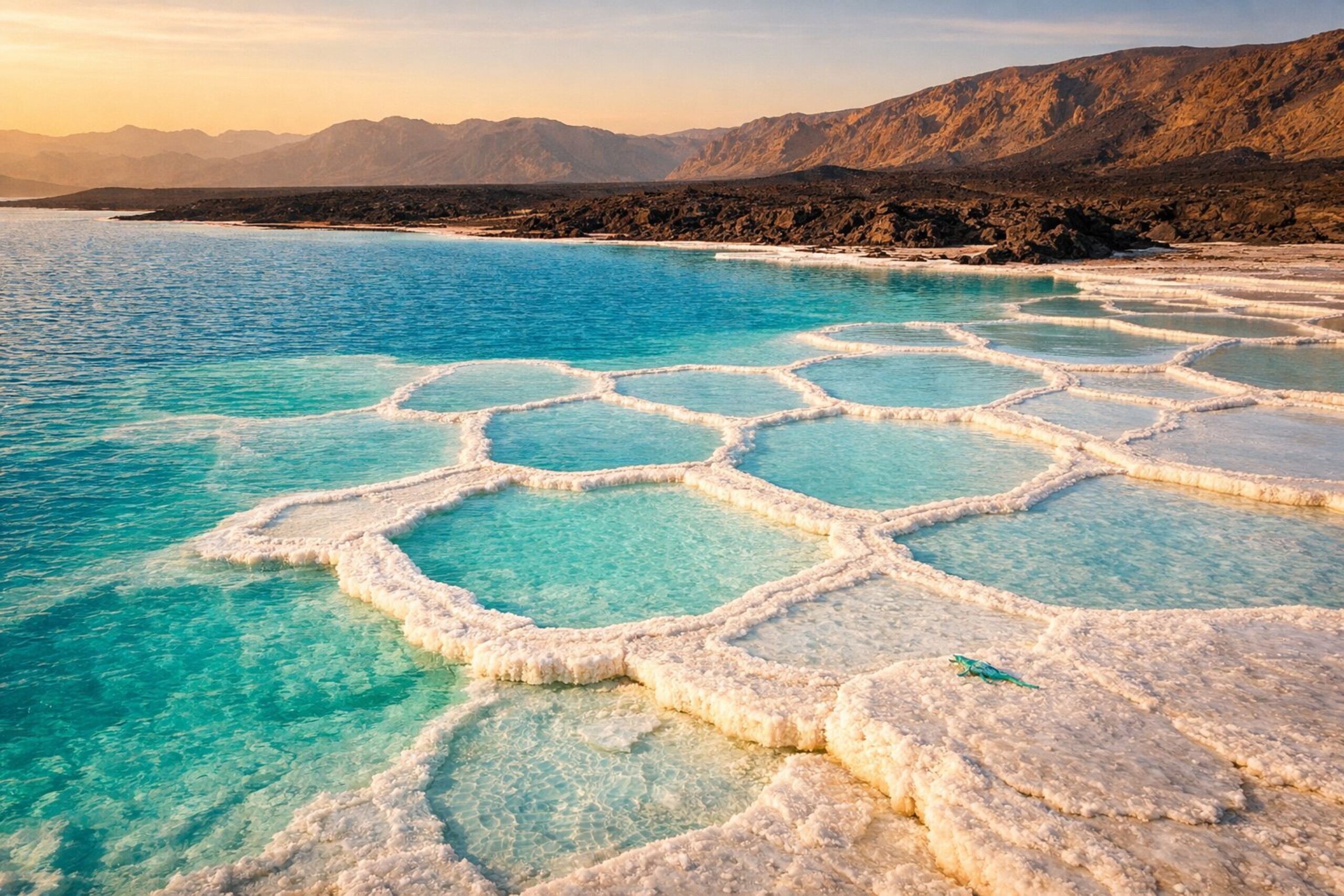
For a traveller the draw is geological. Lake Assal sits in a crater 155 metres below sea level, the lowest point in Africa, ringed by salt formations of startling whiteness against water about ten times saltier than the sea. Lake Abbé, on the Ethiopian border, is a shallow alkaline lake standing among hundreds of limestone chimneys up to fifty metres tall, venting steam at dawn while flamingos pass overhead. Both sit in the Afar Triangle, where three tectonic plates are actively pulling apart and a new ocean is, very slowly, being born.
Offshore there is a second reason to come. The Gulf of Tadjoura hosts a reliable seasonal aggregation of whale sharks from roughly November to February, in numbers that make close encounters ordinary rather than lucky, and the reefs are in good condition precisely because nobody dives them.
Be clear about what this is not. Djibouti has almost no tourism infrastructure outside the capital, prices are surprisingly high, and the heat between May and September is genuinely dangerous — inland air temperatures pass 45 °C and the ground goes far higher. This is a destination for people who want a hard, extraordinary landscape and are willing to organise around it. Everyone else should go somewhere else, and the country would rather you knew that in advance.
Lake Assal at 155 m below sea level — the lowest point in Africa, and one of the saltiest bodies of water on Earth. · Existing project image; rights under review
02
📛 Name & Identity
The origin of the name is genuinely unsettled. The most cited theory derives it from the Afar gabouti, a woven doormat or plate — a fitting image for a threshold between continents. Others trace it to Jabuti, land of the Djabarti, an early Somali group. Linguists have not settled it, and the country is comfortable with that.
The Republic of Djibouti became independent from France on 27 June 1977, after 115 years of colonial rule as French Somaliland and then the French Territory of the Afars and the Issas. The new state took the name of its capital city deliberately: it favoured neither of the two main peoples, and that neutrality was the point.
The Issa (Somali)
Around 60% of the population, dominant in the capital and the south-east. Somali-speaking, clan-organised, and closely tied to Somaliland and Somalia across the border.
The Afar
About 35%, in the north and west, and spread across Eritrea and Ethiopia as well. Their territory includes both great lakes, and the salt caravans are theirs.
The rest
Roughly 5%: Yemeni Arabs, Ethiopians, a small French community and, more recently, Chinese engineers and traders.
Two official languages
French, from the colonial period, is the language of government and schooling and functions as neutral ground between the two groups. Arabic reflects Arab League membership and centuries of Red Sea trade.
Two home languages
Somali and Afar, both Cushitic, are what people actually speak at home. Educated Djiboutians move between four languages in a single conversation.
Islam
About 94% Sunni Muslim, and it structures the day, the week and the year. Djibouti is socially conservative and religiously relaxed with foreigners in equal measure.
The Afar–Issa relationship is the axis of Djiboutian politics. A civil war between the government and the Afar FRUD movement ran from 1991 to 1994 with a final settlement in 2001, and power-sharing arrangements since then have kept the peace — in a neighbourhood where almost nobody else has managed it.
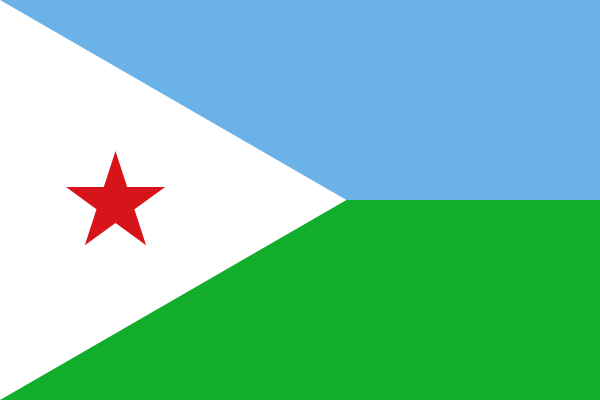
Flag of Djibouti · original vector rendering of the national symbol
03
🗺️ Geography & Regions
Djibouti sits on the Afar Triple Junction, where the African, Somali and Arabian plates meet and separate. This is one of the few places on land where a continent is visibly splitting and an ocean is beginning to form, and it accounts for everything unusual about the terrain: the depressions below sea level, the volcanic fields, the fumaroles and the salt.
The coastal plain
A narrow, scorching strip along the Gulf of Tadjoura and the Gulf of Aden holding Djibouti City and most of the population. Under 150 mm of rain a year, falling in a few violent bursts.
The Goda mountains
Rising inland behind Tadjoura to about 1,750 m, catching enough sea moisture to keep the Day Forest alive — the country's only woodland.
Moussa Ali
At 2,028 m the highest point, a volcano on the triple border with Eritrea and Ethiopia.
The western depression
Lake Assal at −155 m and Lake Abbé on the Ethiopian border, with the Grand Bara and Petit Bara gravel plains between them and the capital.
The Gulf of Tadjoura
A deep inlet that almost cuts the country in two, ending in the Ghoubbet-el-Kharab — the Bay of Demons — a near-enclosed basin of black volcanic cliffs and very deep water.
The coast
314 km along the Red Sea and Gulf of Aden, with the Sept Frères islands off the northern tip and reefs in better condition than most of the Red Sea.
Land borders run to Eritrea (125 km, and periodically tense), Ethiopia (342 km, and economically decisive) and Somalia (61 km). Landlocked Ethiopia sends the overwhelming majority of its foreign trade through Djiboutian ports, which is the single largest fact in the national economy.
Original editorial diagram
04
📍 Map of Djibouti
The country is compact enough to cross in a day and difficult enough that you should not try. The capital sits on the southern shore of the Gulf of Tadjoura; Lake Assal is 120 km west of it, Lake Abbé about 230 km south-west with the last 80 km on rough track.
Two practicalities the map does not show. Almost all travel outside the capital is by 4×4 with a driver, arranged in Djibouti City — self-drive is possible but unwise, and there is no roadside assistance in the Bara plains. And the road around the Gulf of Tadjoura to Tadjoura and Obock is long; the ferry across the gulf is slower on paper and often better in practice.
05
📜 History
The Afar Depression is one of the most important places in the study of human origins — Lucy was found just across the Ethiopian border in the same geological formation, and hominin remains have been recovered on the Djiboutian side too. The Gobaad and Handoga sites hold Neolithic and later material, and rock art in the interior records a wetter Sahara-era climate.
For millennia this coast was the western edge of the Red Sea trade — the ancient Egyptians' Land of Punt is usually placed somewhere along this shore — supplying frankincense, myrrh, ivory and slaves to Arabia and the Mediterranean. Islam arrived early, by sea, in the seventh century, and the coastal sultanates of Tadjoura and Obock traded with Yemen for centuries before any European arrived.
France bought Obock in 1862, moved its capital to the deeper harbour at Djibouti in 1888 and built the Franco-Ethiopian railway to Addis Ababa between 1897 and 1917 — the reason the country exists in its present shape. The colony became French Somaliland, then in 1967 the French Territory of the Afars and the Issas, a renaming that made the ethnic arithmetic explicit.
Independence came on June 27, 1977. Hassan Gouled Aptidon governed until 1999; his successor Ismaïl Omar Guelleh remains president. The Constitutional Council’s April 21, 2026 decision confirmed his victory in the April 10 election: after votes in several polling stations were annulled, his final share was 97.01%. This legally confirmed result differs from earlier preliminary reporting. The Afar insurgency of 1991–1994 and subsequent peace arrangements remind us that state stability does not erase older conflicts or political inequalities. Final results — Constitutional Council.
The modern chapter is bases and ports. France never fully left; the United States established Camp Lemonnier in 2002; Japan opened its first overseas base since 1945 here in 2011; Italy followed; and in 2017 China opened its first foreign military base anywhere, a few kilometres from the American one. Chinese-financed ports and a new electrified railway to Addis Ababa opened in 2018. Rent from the bases and transit fees from Ethiopian trade are, between them, most of the state's income.
Djibouti’s dependence on ports and regional transit ties its economy to events beyond its borders. Ethiopia’s search for maritime access and disruption of shipping in the Red Sea deserve continued attention, but a geographical guide should not turn an unverified battlefield claim into settled history. The FCDO regional advice, checked on October 9, 2026, warns that military activity around the Red Sea and Yemen may change at short notice. Check current diplomatic and transport information before relying on any cross-border route.
It is worth understanding why a country of 1.1 million people appears so often in the international press, because it also shapes what a visitor sees. The Bab el-Mandeb — Arabic for the Gate of Tears — is 30 km wide at its narrowest, and everything moving between Europe and Asia through the Suez Canal passes through it. Estimates of the share of global trade involved vary, but it is on the order of a tenth to a third depending on what you count, and no alternative route is short.
Five foreign militaries
France (the former colonial power, and still the largest French presence in Africa), the United States at Camp Lemonnier, Japan, Italy, and China's first overseas base, opened in 2017 — the last two within a few kilometres of each other.
What it pays for
Base rents are worth well over a hundred million dollars a year to a small state. It is the reason Djibouti can be poor and expensive at the same time.
Ethiopia's sea
Landlocked Ethiopia depends heavily on access to Djibouti’s ports. The modern railway and road corridors make that connection tangible, while discussions about other maritime access routes keep port policy central to regional diplomacy. The commercial corridor is not an invitation to cross a border without checking entry rules and security conditions.
The Red Sea, 2023–2026
Houthi attacks and military operations around the Red Sea affect maritime transport and regional relations. FCDO advice checked on October 9, 2026 warns that conditions around the Red Sea and Yemen can change rapidly. Before traveling, consult current official advice and your carrier; proximity to a conflict alone does not describe the safety of an individual excursion.
What it means for you
Photographing anything military — bases, ports, airport, personnel, checkpoints — is a serious offence. This is the single rule most likely to get a visitor into real trouble.
Stability as a product
The presence of foreign bases does not replace current travel advice or insurance.
07
👥 People & Culture
Djiboutian society is highly urbanized, and the capital concentrates much of the country’s economic activity. The national urbanization rate should not be confused with the share living in the capital itself; a metropolitan population estimate also depends on boundaries and its reference year. Camel and goat pastoralism and seasonal movement persist in the interior, while employment, education and services draw many people toward towns. These ways of life should be understood together rather than reduced to one undated population figure.
Clan
Both Somali and Afar societies organise around patrilineal clans. Elders mediate disputes under customary law — xeer among Somalis, mada among Afar — running in parallel with the French-derived state courts.
Hospitality
Obligatory and genuinely meant. A household with very little will still produce tea and insist you drink it. Refusing outright is not an option; accepting graciously is.
Poetry
Somali oral poetry is among the most developed in the world, and skill in verse carries real social weight. Political argument has historically been conducted in poems.
Pétanque
The most unexpected French legacy: every neighbourhood has a court, and the games run under streetlights well into the night.
Dress
Modest for both men and women. Visitors should cover shoulders and knees; women need no headscarf in the capital but should carry one for mosques and rural areas.
The afternoon
Between roughly 12:00 and 16:00 the country stops. It is too hot to do otherwise, and it is when khat is chewed. Plan around it rather than fighting it.
One correction to a story you may read elsewhere: Arthur Rimbaud is often described as having spent his last years in Djibouti. He did not. He was based in Aden and Harar in Ethiopia, and passed through Tadjoura and Obock on a disastrous gun-running expedition in 1885–86. He died in Marseille in 1891. The connection is real but much smaller than the legend.
08
🗣️ Language
Djibouti runs on four languages and most people you deal with will use at least three. French is the language of government, business and education, and it is the one to arrive with — English is much less useful here than in most of East Africa, though hotel and dive staff will have it. Arabic is official and widely read. Somali and Afar are what is spoken at home.
Bonjour / Salaam alaykum
French works everywhere in the capital; the Arabic greeting is universally understood and appreciated.
Iska warran (Somali)
"How are you?" — answered waan fiicanahay, I'm fine.
Mahadsanid (Somali) / Gadda ge (Afar)
Thank you. Using the right one for the right person is noticed.
Immisa? / C'est combien ?
How much? Bargaining is normal in markets and for taxis, not in shops or restaurants.
Insha'Allah
God willing — and in practice also the polite way of saying that a plan is provisional. Assume all timetables carry it.
Nagaya
Peace, in Afar — a greeting and a farewell, and the word you will hear most in the interior.
A practical note for Czech and Slovak visitors: this is one destination where rusty school French is worth reviving before you go. Twenty phrases will change the trip more than they would almost anywhere else, because the fallback of English frequently is not there.
Original editorial diagram
09
🏙️ Djibouti City
The capital is the country’s dominant urban center, and its history is closely tied to the harbor. French colonial arcades, mosques influenced by Yemeni architecture and modern logistics infrastructure form several layers of one cityscape. A figure for the country’s urban population should not be substituted for a population count of the city. For a visitor, the commercial crossing also matters through its markets, languages and ordinary streets.
Place Ménélik & the European quarter
Colonial arcades, the presidential palace and pavement cafés, named after the Ethiopian emperor who granted France the railway concession. Faded, shaded and pleasant in the early evening.
Hamoudi Mosque
Built in 1906 in Yemeni style with whitewashed walls and twin minarets, in the middle of the market district. Non-Muslims should ask before approaching.
Marché Central
The central market: fish landed that morning, Yemeni spices, frankincense and myrrh sold by weight, and bundles of khat arriving from Ethiopia at midday to a visible change in the city's rhythm.
The African quarter
Balbala is a large urban district on the capital’s outskirts, with neighborhoods facing different infrastructure and economic conditions. A useful visit requires local context and respectful arrangements rather than assuming that a loosely dated population estimate describes the whole district.
The corniche and the beaches
Plage du Héron and the hotel beaches are swimmable; the water is warm to the point of being unrefreshing from June onwards.
Where to eat
Yemeni grilled fish is the city's great cheap meal — whole fish baked against the wall of a clay oven, eaten with flatbread and hands. Ethiopian restaurants do injera and spiced stews. French bistros survive from the colonial period.
Practicalities: the city is walkable in the cool hours and not in the middle of the day. Taxis are cheap and unmetered — agree the fare. And do not photograph the port, the airport, the bases or anyone in uniform.
10
💎 Lake Assal
Lake Assal lies in a crater 155 metres below sea level — the lowest point in Africa and one of the lowest land depressions on Earth. It formed when rifting sealed off an arm of the Gulf of Tadjoura, and several thousand years of evaporation under this sun have concentrated it to roughly 350 grams of salt per litre, about ten times seawater and comparable to the Dead Sea. Nothing lives in it.
The salt crust at the shoreline: brilliant white, sharp underfoot, and thick enough to walk out on in places. · Existing project image; rights under review
The drive from Djibouti City is 120 km and takes about two hours, through the black lava fields of Ardoukoba, a volcano that erupted in November 1978 and in a few days widened the rift by more than a metre — a visible instalment of the continent tearing open. The descent to the lake is spectacular and the temperature climbs the whole way down.
Floating
The brine will hold you up effortlessly. It will also find every cut, shaving nick and eye you have. Do not put your face in it, bring fresh water to rinse with, and get out before the salt dries on you.
The salt caravans
Afar workers still cut salt blocks by hand and load them onto camels bound for the Ethiopian highlands, as their ancestors have for centuries. Ask before photographing people, and expect to pay or buy something.
Ghoubbet-el-Kharab
The Bay of Demons, next door: black cliffs into very deep water, where the lake connects to the sea underground. The viewpoint above it is the best panorama in the country.
Timing
Leave the capital by 05:30. By ten in the morning the shore is punishing and by noon it is dangerous. Winter (November–March) only, unless you have a specific reason.
What to bring
Four litres of water per person, sunglasses that seal, sandals you do not mind destroying, a hat, and a rinse bottle. The salt crust cuts bare feet.
Getting there
A 4×4 with a driver from the capital, typically as a full-day trip and often combined with Ghoubbet. Public transport does not go.
A word on a figure you will see repeated: claims that Lake Assal reaches 70 °C refer to ground and crust temperatures, not air. Summer air maxima here run above 50 °C, which is quite enough — this is one of the hottest inhabited places on the planet, and the heat is the main hazard of a Djibouti trip.
11
🌋 Lake Abbé
Lake Abbé is the reason serious travellers come to Djibouti. A shallow alkaline lake straddling the Ethiopian border, it is surrounded by hundreds of limestone chimneys — some fifty metres tall — built up over millennia by hot springs depositing calcite. Many still vent steam. At dawn, with vapour drifting between the towers and flamingos crossing overhead, it is one of the strangest landscapes accessible to an ordinary traveller anywhere.
One correction before you go: every guide, most tour drivers and several newspapers will tell you that Planet of the Apes (1968) was filmed here. It was not — the film was shot in Arizona, Utah and California and the crew never left the American West. The landscape does not need the legend.
Getting there
About 230 km from the capital, the last 80 on unmarked track across the Grand Bara and Petit Bara — gravel plains where mirages are constant. Five to six hours each way in a 4×4 with a driver who knows the route. There is no other way to arrive.
Staying
The Lake Abbé campement: Afar-style domed huts of woven mats over a wooden frame, cots, thin mattresses, no electricity, no running water. It is austere and it is the point. Bring your own water.
Dawn
This is the whole trip. Be among the chimneys before sunrise; the steam is visible only while the air is cool and the light is worth every hour of the drive.
Flamingos
Tens of thousands of lesser flamingos filter algae from water far too alkaline for anything else. Gazelles browse the margins.
The Afar
Semi-nomadic families herd goats and camels here on vegetation that looks incapable of supporting anything. Their ari huts dismantle and move. Treat encounters as encounters, not as sights.
Do not swim
The water is caustic, shallow and in places boiling. The hot springs among the chimneys reach near 100 °C and are not fenced.
Realistically this is a two-night trip: drive out, sleep, dawn among the chimneys, drive back — often combined with Lake Assal on the return. It costs more than everything else in Djibouti put together and it is what you will remember.
12
🏛️ Tadjoura, Obock & the North
Tadjoura on the northern shore of the gulf is the oldest town in the country and, for a long time, the most important — the seat of a sultanate trading with Yemen centuries before France arrived. It is known as the White City for its whitewashed coral-stone houses and its seven mosques, and it is a slower, gentler place than the capital.
Getting across
The ferry from Djibouti City takes about three hours and is the pleasant way; the road around the gulf is 180 km and rough in places. A new Chinese-built port sits just outside the old town, which tells you where the money is going.
Obock
Further north-east, France's first foothold, bought in 1862 and abandoned as a capital when the harbour at Djibouti proved better. Quiet, crumbling and historically the most interesting town in the country.
The Sept Frères
The Seven Brothers islands off the northern tip, in the Bab el-Mandeb itself. Uninhabited, with the best diving in Djibouti and access only by liveaboard.
Khor Angar
A fishing village on the far north coast, the jumping-off point for the islands and about as far from anywhere as the road goes. Everything north of Obock needs government approval and lies inside the zone foreign advisories ask you to reconsider — arrange it through your operator, not on the day.
Migration
This coast is part of a longstanding migration corridor between the Horn of Africa and Yemen, with movements in both directions. IOM’s July 2026 flow-monitoring report records departures from Yemen toward Obock; these are monitored migration flows, not a count of people fleeing a particular newly claimed battle. Dangerous sea crossings, exploitation and the need for protection are part of the region’s social reality. Respect people’s privacy rather than turning vulnerable travelers into a photographic attraction. IOM, July 2026.
Sables Blancs
A white-sand beach near Tadjoura and the best swimming on the north shore, with simple bungalows.
13
🐋 Whale Sharks & Diving
The Gulf of Tadjoura holds one of the most reliable seasonal aggregations of whale sharks in the world. From roughly November to February, juveniles gather in the shallow water at the head of the gulf to feed on plankton blooms, in numbers that make an encounter close to routine rather than a matter of luck.
How it works
Snorkelling, not diving — whale sharks feed near the surface and scuba bubbles disturb them. Boats run day trips from Djibouti City to the Arta and Ghoubbet area, or you go by liveaboard for a week.
The rules
Keep 3 m from the body and 4 m from the tail, no touching, no flash, no more than a handful of swimmers in the water at once. Djibouti's operators are generally good about this; choose one that states the code before you book.
Why juveniles
The gulf appears to be a nursery. Most animals here are 3–6 m — small for the species, which reaches 12 m — which is part of why the encounters feel manageable.
The Sept Frères
The Seven Brothers islands in the Bab el-Mandeb: strong currents, big pelagics, healthy hard coral and effectively no other divers. Liveaboard only, and the best diving in the country.
Ghoubbet-el-Kharab
The Bay of Demons is deep, dark and eerie, with a local legend of a sea monster that Jacques Cousteau went looking for. Manta rays pass through in season.
Conditions
Water 25–30 °C, visibility variable and often plankton-reduced during whale shark season — which is precisely why the sharks are there. Reefs are in noticeably better condition than most of the Red Sea because almost nobody comes.
Book through an established operator in Djibouti City or a liveaboard out of the capital. This is not a place to improvise boat hire: the gulf gets rough, the Bab el-Mandeb is a shipping lane, and the coastguard takes an interest in unregistered craft.
14
🌲 The Day Forest & the Goda Mountains
Day Forest National Park, in the Goda mountains behind Tadjoura at around 1,500 m, is the only forest in Djibouti and one of the strangest relics in Africa: a fragment of Afromontane juniper and wild olive woodland stranded by climate change since the last ice age, surviving on moisture the mountains wring out of sea air.
Why it matters
This is a genuine refugium — species left behind when the region dried out. The Djibouti francolin, a ground bird found nowhere else on Earth, lives here and is critically endangered; the forest itself has shrunk drastically and is still shrinking.
What it feels like
Ten to fifteen degrees cooler than the coast, with actual shade. After Lake Assal the effect is startling, and it is why the president has a residence up here.
Walking
Trails run through the juniper stands with guides from the villages. Half a day is enough; two days with a night at altitude is better.
Bankoualé
A village on the way up, with terraced gardens and palms in a gorge — the greenest place in the country and a common overnight stop.
Getting there
About 100 km from Tadjoura on a road that deteriorates as it climbs. 4×4 and driver.
Wildlife
Baboons, klipspringer, dik-dik, and the francolin if you are patient and lucky. Also the last Djiboutian population of several bird species with nowhere else to go.
15
🏜️ The Deserts & the Rift
Between the capital and Lake Abbé lie the Grand Bara and Petit Bara, flat gravel plains so level and so empty that the French military used the Grand Bara as an airstrip and land-speed course, and its surface shimmers with mirages for most of the day.
Ardoukoba
The volcano that erupted in November 1978 between Lake Assal and the sea, widening the rift by over a metre in a few days. The lava field is young enough to be sharp underfoot and black enough to be visible from space.
The Afar Triple Junction
Three plates pulling apart at once. Geologists come here to watch continental rifting happen at human timescales; in a few million years this will be seabed.
Fumaroles and hot springs
Steam vents across the depression, some usable as (extremely hot) baths, most not. Never approach one without a guide — crusts collapse.
Grand Bara
Crossed on the way to Lake Abbé. Utterly flat, utterly empty, and the place where the scale of the country finally registers.
Abourma rock art
In the north-west, thousands of engravings of cattle, giraffe and hunters from a period when this was savannah. Hard to reach, barely visited, and among the most significant rock art sites in the Horn.
Safety
There is no water, no shade, no signal and no traffic. Nobody should go into the Bara plains without a local driver, two vehicles on longer routes, and more water than seems necessary.
16
🍜 Cuisine
Djiboutian food is a crossroads cuisine — Somali and Afar staples, Yemeni fish, Ethiopian stews and French bread and pastry, all available within a few streets of each other in the capital. It is one of the genuine pleasures of the country and much better value than anything else in it.
Yemeni fish
The great meal: a whole fish, split, spiced and baked upright against the wall of a clay tandoor, served on a communal tray with flatbread and eaten with the right hand. Cheap, enormous and superb.
Skoudehkaris
The national dish: rice cooked with lamb or goat, tomato, cardamom, cumin and cinnamon — a Somali-Yemeni pilaf, slow and heavily spiced.
Lahoh / canjeero
A spongy fermented pancake, close cousin of Ethiopian injera but smaller and lighter, eaten at breakfast with ghee and sugar or with stew.
Sambusa
The Horn of Africa samosa, usually spiced beef or lentil, sold everywhere and the standard thing to break the Ramadan fast with.
Ethiopian food
Injera with doro wat and vegetable stews, in restaurants run by the large Ethiopian community. Ubiquitous and reliable.
The French layer
Real baguettes, croissants and pain au chocolat, baked daily, at prices that would be normal in Lyon. A colonial legacy nobody wants to give up.
Skoudehkaris
The national dish · spiced lamb and rice · serves 4
Ingredients: 600 g lamb or goat on the bone, in pieces; 400 g basmati rice; 2 onions; 3 tomatoes; 4 cloves garlic; a thumb of ginger; 1 tsp cumin, 1 tsp coriander seed, 1 tsp turmeric, 4 cardamom pods, 1 cinnamon stick, 2 cloves; 2 tbsp oil or ghee; salt; a handful of coriander leaf.
Method: Brown the meat in the oil and set aside. Soften the chopped onion, then add garlic, ginger and all the ground and whole spices and fry 30 seconds until fragrant. Add the chopped tomatoes and cook down to a paste. Return the meat with 800 ml water, cover and simmer 45–60 minutes until tender. Stir in the rinsed rice, check the salt, bring back to the boil and then cover tightly and cook on the lowest heat for 20 minutes. Rest 10 minutes off the heat before forking through, and scatter with coriander.
💡 The whole spices go in whole and stay in. Fishing a cardamom pod out of your plate is part of the experience.
Lahoh
Fermented flatbread · breakfast · makes about 8
Ingredients: 250 g plain flour; 50 g fine semolina or sorghum flour; 1 tsp dried yeast; 1/2 tsp salt; 1/2 tsp sugar; 500 ml warm water.
Method: Whisk everything into a thin, pourable batter — thinner than pancake batter — and leave covered somewhere warm for 3–4 hours, or overnight in a cool kitchen, until it is bubbling and smells sour. Heat a dry non-stick pan over medium heat. Pour a ladle in and swirl once; do not turn it. Cook only on one side until the top is set and covered in holes, about 2 minutes, then lift out. Stack them as they come.
💡 The holes are the whole point — they are what carries the stew or the ghee. If you get none, the batter is too thick or the pan too cool.
17
☕ Khat, Coffee & Drinking
Djibouti is a Muslim country where alcohol is legal but marginal, and the substance that actually organises the day is khat — Catha edulis, a mildly stimulant leaf chewed across the Horn of Africa and Yemen.
Coffee, incense and leaves: the afternoon ritual that structures the Djiboutian day. · Existing project image; rights under review
The daily rhythm
Trucks bring khat from Ethiopia every morning and it must be chewed fresh. From roughly midday the country slows sharply as men gather in mabraz rooms to chew and talk, often for hours. Understanding this explains why nothing happens in the afternoon.
Should a visitor try it
It is legal here and offering it is hospitable. It is also illegal in the Czech Republic, most of the EU, the UK and the US, so do not carry any home — not a leaf, not a stem. The effect is mild and the social experience is the interesting part.
Its cost
Khat consumes a large share of many household budgets and a large share of the working day, and Djiboutians debate that openly and critically. It is not a curiosity to them.
Coffee
The region invented it. Ethiopian beans arrive by rail, and coffee is drunk strong and often with cardamom or ginger. In some households the husk, not the bean, is brewed.
Tea
Shaah — black tea boiled with cardamom, cinnamon, clove and a great deal of sugar. It is what you will be given everywhere and refusing is not on.
Alcohol
Available in hotels, restaurants aimed at expatriates and some shops; not consumed openly and not offered in most Djiboutian homes. Drinking discreetly is expected.
18
🦩 Wildlife
Djibouti is not a safari country — the big mammals are gone or nearly so — but it has an unusual concentration of specialists surviving at the edge of what is possible, and its position on a major migration flyway makes it very good for birds.
Flamingos
Tens of thousands of lesser flamingos on Lake Abbé, filtering algae from water that would burn most animals. The single best wildlife spectacle in the country.
The Djibouti francolin
Endemic to the Day Forest and critically endangered — perhaps a few hundred birds, in a forest that has lost most of its extent in fifty years.
Migratory raptors
The Bab el-Mandeb is one of the world's great raptor bottlenecks. Hundreds of thousands of birds of prey funnel across the strait in autumn and spring.
Gazelles
Soemmerring's and Dorcas gazelles in the Bara plains and around Lake Abbé, along with the beira antelope in the mountains — one of the least-known antelopes in Africa.
Marine life
Whale sharks, manta rays, dugong in seagrass beds, four species of marine turtle, and reefs in better shape than most of the Red Sea.
What is gone
Elephant, giraffe and lion appear in the Abourma rock art and are long extinct here. The engravings are the record of a wetter country that no longer exists.
19
🌡️ Climate — the Heat Is the Trip
Djibouti has one of the hottest climates on Earth and this is not a detail to be filed under weather. It determines when you can come, what you can do each day, and in the interior it is a genuine safety matter.
November–March
The only sensible window. Coastal daytime highs of 26–32 °C, cool enough at dawn to need a layer, and the whale sharks are in the gulf. Everything in this guide assumes you come now.
April and October
Transitional and already hard: 35–40 °C. Possible if you must, and the interior is unpleasant.
May–September
Coastal highs above 40 °C with brutal humidity; inland regularly above 45 °C and at Lake Assal above 50 °C. The khamsin wind blows superheated air off the interior. Much of the expatriate community leaves. Do not plan a first visit in this window.
Rain
Under 150 mm a year, arriving as rare violent downpours that flood wadis without warning. Flash flooding is the reason not to camp in a dry riverbed.
Sea temperature
25–30 °C year-round. Refreshing in January, not in August.
The daily shape
Out at first light, back indoors by 11:00, out again after 16:00. Fighting this is how visitors get into trouble.
Heat safety, plainly: four to six litres of water per person per day in the interior, electrolytes as well as water, loose long sleeves rather than bare skin, and a hat. Heat exhaustion arrives faster here than most Europeans expect, and there is no help within hours of Lake Abbé.
20
✈️ Getting There & Around
Djibouti–Ambouli International Airport (JIB) is close to the capital. Air access generally uses regional and connecting services through major hubs, but airline names do not constitute a current timetable. Confirm operating dates, transit requirements and connection times with your carrier before booking. The small national airline should not be assumed to provide a long-haul connection from Europe; plan the itinerary around services that are actually available.
The railway to Addis
The Chinese-built electrified line to Addis Ababa reopened in 2018 and takes about twelve hours. It is cheap, air-conditioned and an experience, and the schedule is unreliable. Book locally.
Overland
Ethiopia is the only routinely usable land crossing (Galafi or Dewele). The Eritrean border is closed to tourists and the Somali border should not be attempted.
Around the country
A 4×4 with a driver, arranged in the capital, for essentially everything outside the city. Expect USD 150–250 a day including fuel. Self-drive is possible and unwise.
The gulf ferry
Djibouti City to Tadjoura, about three hours, cheap and pleasant. Schedules are approximate.
City transport
Shared minibuses on fixed routes for locals, and unmetered taxis for everyone else — agree the price before getting in. Nothing is far.
Guides
Not optional for Lake Abbé and strongly advised for Lake Assal and the Day Forest. Book through an established agency in the capital rather than at the roadside.
21
🇨🇿 Getting There from Central Europe
There is no direct flight from anywhere in central Europe. The realistic routings are via Addis Ababa with Ethiopian Airlines, via Istanbul with Turkish, or via Dubai — total travel time from Prague of 12 to 18 hours depending on the connection. Djibouti is UTC+3, two hours ahead of Prague in winter and one in summer.
Via Addis Ababa
Ethiopian flies Prague–Addis and Addis–Djibouti; usually the cheapest and the best-connected. It also makes combining Djibouti with Ethiopia straightforward, which many travellers do.
Via Istanbul or Dubai
Turkish and flydubai both work and are often more comfortable. Slightly longer overall.
Visa
Most nationalities including Czech citizens can obtain an e-visa in advance or a visa on arrival at the airport; the e-visa is cheaper and faster and should be applied for at the official government portal. Requirements change — verify before booking.
Yellow fever
Yellow fever documentation depends on the full route. CDC states that travelers aged one or older arriving from a country with yellow fever transmission risk need proof; this includes airport transits longer than twelve hours in such countries. A short airport connection in Addis Ababa is not automatically the same as a stay in Ethiopia. Check your itinerary with a travel-health professional. CDC
Health. Arrange a travel-health consultation before departure to discuss vaccination, prescribed malaria prevention and mosquito-bite protection. Check any yellow fever documentation against the exact route, including transit duration. The European Health Insurance Card does not cover Djibouti. Medical services are limited, so obtain insurance that covers the planned activities, treatment and medical evacuation, and keep the insurer’s emergency contact available. FCDO
Money and cost. The Djiboutian franc is pegged to the US dollar at about 178 DJF, so 1 DJF is roughly 0.12 Kč and it is easiest to think in dollars. Cards work in the better hotels and almost nowhere else — bring US dollars in cash. Djibouti is expensive: a week for two with flights, a driver and guided trips to both lakes runs to roughly 90–140 000 Kč, mostly because the 4×4 days cost what they cost.
Before traveling, check Czech Foreign Ministry advice and the DROZD registration service. The ministry’s directory assigns Djibouti to the Czech embassy in Addis Ababa and also lists an honorary consulate in Djibouti. Save current contact details and check the scope of assistance available. Red Sea security advice can change quickly, so review it again shortly before departure. MZV ČR — Addis Ababa.
22
ℹ️ Practical Information
⚠️ Travel Advisory — checked October 9, 2026
Checked October 9, 2026: the U.S. State Department lists Level 2 because of terrorism, with a higher-risk advisory for areas bordering Eritrea. FCDO advises against all travel to the Djibouti–Eritrea border. Respect military checkpoints and required approvals in northern areas. Review current official advice and your insurance coverage before traveling. U.S. State DepartmentFCDO
Photography
The single most important rule. Do not photograph military installations, the port, the airport, bridges, checkpoints or anyone in uniform. Cameras are confiscated and worse. Ask before photographing people anywhere.
Money
Djiboutian franc, pegged to the dollar. Bring USD cash in good condition. ATMs exist in the capital and are unreliable; cards are accepted at major hotels only.
Water
Do not drink the tap water. Bottled only, and a lot of it. Ice in cheap places is a risk.
Electricity
220 V, French type C/E sockets — a Czech plug fits directly. Power cuts happen; the capital is better than elsewhere.
Connectivity
Djibouti Telecom is the monopoly; buy a local SIM with a passport. Coverage is good in the capital and nonexistent in the Bara plains. Wi-Fi is slow and expensive.
Safety
Terrorism, road accidents, petty crime and extreme heat each require preparation. Keep contact details for your accommodation, local assistance and embassy, and plan how to obtain help if a vehicle fails or a medical problem occurs outside the capital.
Ramadan
Eating, drinking or smoking in public during daylight in Ramadan is inappropriate and in places illegal. Restaurants are shut by day and the country comes alive after sunset — a fascinating time to visit, with practical friction.
Dress and conduct
Cover shoulders and knees. Public displays of affection are not acceptable. Homosexuality is not criminalised but is socially unaccepted; LGBTQ+ visitors should be discreet.
One further note: Djibouti is a heavily securitised state with a poor human-rights and press-freedom record. Visitors are not the target of any of that, but political conversations put your Djiboutian interlocutor at risk rather than you. Let them set the limits of what is discussed.
Entry: a visa is required; FCDO describes online application or a visa on arrival and at least six months of passport validity from arrival. Confirm the rules for your citizenship and actual entry point. Carry onward-travel evidence. Official e-visa · FCDO entry requirements.
U.S. guidance says drones, Starlink and other satellite communication devices are not permitted. Photographing government or military sites or personnel can result in detention or confiscation. Official guidance.
23
💰 Costs for Travellers
Djibouti is expensive, and the reason is unusual: prices are set by a captive market of soldiers, sailors, diplomats and port workers on international salaries, not by tourism. There is very little budget infrastructure, because there is very little budget demand.
Mid-range hotel
USD 80–150 a night in the capital, and the quality does not match the price. Basic guesthouses from USD 40.
Top end
The Kempinski and its equivalents run USD 250–400 — expensive by any standard, and the only genuinely comfortable option in the country.
Yemeni fish meal
USD 8–15 for a fish the size of a forearm with bread, and it is the best value in Djibouti.
Restaurant dinner
USD 25–50 in a European or hotel restaurant.
4×4 with driver
USD 150–250 a day including fuel. This is the dominant cost of any real trip here.
Lake Abbé, two nights
USD 400–700 per person in a small group, including transport, the campement and food. Lake Assal as a day trip, USD 120–200.
Realistic budgets: USD 90–130 a day staying in the capital and eating locally; USD 250–400 a day once you are running a vehicle and guide to reach the landscapes that are the reason to come. Sharing a 4×4 with two or three others roughly halves the trip cost and is the single most effective saving available.
24
🏨 Accommodation
Djibouti City
Almost everything is here. The Kempinski at the top; a range of mid-range hotels aimed at business and military travellers in the centre; simple guesthouses in the African quarter.
Book ahead
The capital's beds are frequently full with contractors and delegations rather than tourists, and the good mid-range places sell out. This is not a walk-in destination.
Lake Abbé campement
Afar-style woven domes, cots, no power, no water. Basic in a way that surprises people and entirely appropriate to where it is.
Tadjoura & Sables Blancs
Simple bungalows and small hotels on the north shore — the pleasantest low-key stay in the country.
Day Forest
A handful of simple lodges and campements around Bankoualé and Ba, and the only place in Djibouti where you will need a blanket at night.
Liveaboards
For whale shark season and the Sept Frères, a week aboard is often the best value in the country and solves accommodation, food and transport at once.
25
🏛️ Heritage & UNESCO
Djibouti has no inscribed UNESCO World Heritage Sites, which says more about the mechanics of nomination — expensive, slow, and requiring institutional capacity a small state may not prioritise — than about what is here. It ratified the convention in 2007 and filed a Tentative List of ten sites in 2015: the Awellos tumuli, the Abourma rock engravings, the historic urban landscape of Djibouti City, Lake Assal, the Moucha and Maskali islands, the natural landscapes of the Obock region, the Day Forest National Park, the Assamo and Djalélo protected areas, and Lake Abbé with its chimneys. UNESCO has been helping the country choose which to nominate first since 2023; none has yet gone forward. Sites below marked tentative are on that list; the others are not, however much they deserve to be.
Lake Assal (tentative)
Africa's lowest point and an active rift landscape, nominated on both geological and natural criteria.
Lake Abbé (tentative)
The limestone chimney field, a geothermal landscape with few parallels anywhere.
Abourma rock art (tentative)
Thousands of engravings across a remote basalt gorge in the north-west, depicting cattle, giraffe and hunting scenes from a wetter era. Among the most significant rock art concentrations in the Horn of Africa and almost entirely unprotected.
Handoga
A medieval Islamic settlement of stone houses abandoned around the 13th century, excavated and largely unvisited.
The Gobaad basin
Palaeontological deposits in the same Afar formation that produced Lucy across the border, with hominin and early stone-tool material.
Tadjoura and Obock
Coral-stone Red Sea trading towns with an architectural tradition shared with the Yemeni coast, and both deteriorating.
There is a real conservation problem behind the list. The Day Forest has lost most of its extent within living memory to grazing and firewood cutting, and the rock art at Abourma has no fencing, no guards and no visitor management. Anyone who reaches these places should treat that as a responsibility.
Where Djibouti is on a UNESCO list is the living heritage. Three elements are inscribed: Xeedho (2023, Urgent Safeguarding List), the wedding dish of dried camel or beef in butter sealed in a carved wooden vessel, presented by the bride's family and opened by the groom's; Xeer Ciise (2024), the oral customary law of the Issa, shared with Ethiopia and Somalia; and the zaffa wedding procession (2025). The Afar equivalent of Xeer, the Madqa, is before the committee in 2026 — the same body on which Djibouti sits as a member for 2026–2030.
The national day, marking the end of French rule in 1977. Military parade, speeches and a genuinely festive city — in temperatures that make the parade an act of endurance.
Ramadan
The month reshapes everything: nothing by day, then the city comes alive after sunset with markets, food and visiting that run past midnight. Difficult logistically and the most interesting time to be here culturally.
Eid al-Fitr
The end of Ramadan: new clothes, family visits, and the only time much of the country stops entirely for several days.
Eid al-Adha
The feast of sacrifice, and the livestock market at its most extraordinary.
Mawlid
The Prophet's birthday, marked with processions and devotional singing, especially in Tadjoura.
Whale shark season (Nov–Feb)
Not a festival, but the closest thing Djibouti has to a tourist season, and the only period when the country's small dive fleet is busy.
Islamic dates follow the lunar calendar and move about eleven days earlier each year, so check before planning. Friday is the main day of prayer and much of the country closes for it; the working week runs Sunday to Thursday.
27
💎 Hidden Gems
Abourma rock art
A remote gorge in the north-west with thousands of engravings. Reaching it takes a hard day's drive and a local guide, and almost nobody does it.
Obock
France's abandoned first capital: crumbling colonial buildings, an old cemetery and a lighthouse, on a coast that has been trading for two thousand years.
Bankoualé
Terraced gardens and date palms in a gorge in the Goda mountains — running water and shade, which after a week in Djibouti feels close to miraculous.
The Sept Frères
Seven uninhabited islands in the Bab el-Mandeb, with the best coral in the country and no way to get there except by liveaboard.
Ghoubbet-el-Kharab
The Bay of Demons, with its legend of a sea monster that Cousteau came looking for and its genuinely unsettling black cliffs.
Lac du Goubet salt caravans
Meeting an Afar camel caravan loading salt at dawn on the Assal flats is the oldest continuous economic activity you will see anywhere.
The Addis railway
Twelve hours to Addis Ababa on a Chinese-built electric line across the Afar desert. Not a hidden gem so much as an underused one.
Khor Angar
The far northern fishing village at the end of the road, looking across the strait to Yemen.
28
🤓 Fascinating Facts
The lowest point in Africa
Lake Assal at 155 m below sea level, and one of the lowest land depressions on Earth after the Dead Sea.
A new ocean is forming
The Afar Triple Junction is one of the only places on land where three tectonic plates are actively separating. In several million years the Red Sea will flood in and this will be seabed.
China's first overseas base
Opened in Djibouti in 2017, a few kilometres from the largest permanent US base in Africa. No other country hosts that particular combination.
The film that was not shot here
Planet of the Apes (1968) is credited to Lake Abbé by guidebooks, drivers and newspapers alike; the film was made in Arizona, Utah and California. The myth has outlasted every correction, which is itself a fact about how few people have been here to check.
Ethiopia's harbour
A country of 130 million people depends on this one of 1.1 million for almost all its sea trade.
Ardoukoba, 1978
A volcanic eruption between Lake Assal and the sea widened the rift by more than a metre in a matter of days — continental drift at a speed humans can watch.
Hotter than almost anywhere
Djibouti City has one of the highest annual mean temperatures of any capital city in the world.
Four languages, one conversation
French, Arabic, Somali and Afar, switched between mid-sentence depending on subject and audience.
29
👤 Notable People
Ismaïl Omar Guelleh (b. 1947)
President since 1999, succeeding his uncle; term limits went in 2010, the age limit in 2025, and he won a sixth term on 10 April 2026 with 97.01% of the vote. The dominant figure in the country's modern history.
Mahamoud Ali Youssouf (b. 1965)
Foreign minister from 2005 to 2025, elected chairperson of the African Union Commission in February 2025 after seven rounds of voting against Kenya's Raila Odinga — the most senior continental post a Djiboutian has ever held.
Hassan Gouled Aptidon (1916–2006)
Independence leader and first president, 1977–1999.
Ahmed Salah (b. 1956)
Marathon runner, bronze medallist at the 1988 Olympics and world championship silver, and by some distance the country's most successful athlete.
Abdourahman Waberi (b. 1965)
The best-known Djiboutian writer internationally — novels and essays in French, including In the United States of Africa, which inverts the geography of wealth and misery.
Ayanleh Souleiman (b. 1992)
World indoor champion over 1500 m (Sopot, 2014), world championship bronze over 800 m (Moscow, 2013) and holder of the indoor 1000 m world record (2:14.20, Stockholm, 2016) — Djibouti's leading middle-distance runner.
Mouna-Hodan Ahmed (b. 1972)
The country's first woman novelist. Les enfants du khat (2002) follows a daughter of a large Djibouti City family through a household hollowed out by her father's khat habit — the frankest fictional account of the drug that shapes the national afternoon.
Arthur Rimbaud (1854–1891)
Frequently over-claimed here. He traded in Aden and Harar and ran guns through Tadjoura and Obock in 1885–86, but he did not live in what is now Djibouti and died in France.
The running tradition
Djibouti's disproportionate distance-running success comes from the same Rift Valley highlands that produced Ethiopia's and Kenya's, and from a national obsession with the sport.
30
📰 Media & Press Freedom
Djibouti has one of the most tightly controlled media environments in Africa and sits near the bottom of the Reporters Without Borders World Press Freedom Index — 167th of 180 in the 2026 edition, with a score of 25.04, alongside states with far worse international reputations.
Radiodiffusion-Télévision de Djibouti (RTD) is the state broadcaster and effectively the only domestic broadcaster, transmitting in French, Arabic, Somali and Afar. La Nation is the state newspaper. There is no independent domestic press of consequence; opposition outlets such as La Voix de Djibouti operate from exile and are blocked or jammed at home.
Foreign journalists require accreditation and are refused it routinely; several have been detained or expelled. The 2023 media law was presented as a liberalisation and is generally assessed by press-freedom organisations as tightening state control rather than loosening it.
What this means for a visitor is practical rather than abstract. You will find little critical local reporting to prepare with, so read international coverage before you come. And be aware that a Djiboutian who speaks freely to a foreigner about politics takes a risk that the foreigner does not — which is a good reason to listen rather than to probe.
Djibouti has produced internationally successful distance runners, including Ahmed Salah and Ayanleh Souleiman, despite limited sporting resources. Their careers are part of the wider East African running tradition. Individual preparation, coaching, opportunity and commitment matter; athletic achievement cannot be explained by assigning a single genetic advantage to a national population.
Distance running
Ahmed Salah's Olympic marathon bronze in 1988 remains the country's only Olympic medal, and his marathon silvers at the 1987 and 1991 World Championships its first two world-championship medals. Ayanleh Souleiman added 800 m bronze in 2013 and world indoor 1500 m gold in 2014. Since then, nothing: no medal at Paris 2024 and none from the three athletes sent to Tokyo in September 2025.
Football
Football attracts broad local participation even when international results are difficult. FIFA’s qualifying reports for the 2026 World Cup document heavy defeats, including Ethiopia’s 6–1 win over Djibouti, alongside the team’s earlier first qualifying point against the same neighbor. A country’s sporting culture cannot be measured only by its national team’s table position. FIFA qualifying results.
Pétanque
Genuinely a national sport, played every evening in every neighbourhood, and one of the more durable French legacies.
Where to watch running
The Grand Bara desert race, run over 15 km across the gravel plain and organised with the French forces, is the country's best-known event.
Watersports
Diving and snorkelling in the gulf, and kitesurfing at Khor Ambado and the beaches west of the capital when the wind is up.
The heat factor
Training happens before dawn. Any visitor thinking of running here should adopt the same rule without exception.
32
🎒 Packing for Djibouti
Water capacity
A way to carry and treat 4–6 litres a day per person. This is the first item on the list and the reason for several of the others.
Loose long sleeves
Light cotton or linen covering arms and legs beats sunscreen and bare skin in this climate, and suits local expectations at the same time.
Sunglasses that seal, and a real hat
Glare off the Assal salt crust is extreme. Cheap sunglasses are not adequate here.
Electrolytes
Carry safe drinking water and plan breaks, shade and reduced exertion. Water is generally adequate for ordinary activity; prolonged heavy sweating may require food or drinks that replace salt. Avoid forcing excessive fluid intake, which can also cause illness. Seek individual advice if a medical condition or medication affects hydration. CDC heat guidance
Sandals you can destroy
The salt crust cuts, and the brine ruins leather and glue. Take a pair you will throw away.
A serious first-aid kit
Carry essential prescribed medicines in their original packaging and a first-aid kit suited to the itinerary. Discuss malaria prevention with a qualified clinician before departure, including when to start and stop the prescribed course. Any standby medicine should follow a clinician’s individual instructions; medical supplies outside the capital can be limited.
USD cash
Clean, undamaged notes. Cards are close to useless outside the top hotels.
A torch and a power bank
No electricity at the Lake Abbé campement, and power cuts elsewhere.
Leave drones, Starlink and satellite communication equipment at home: U.S. travel guidance lists them as prohibited. Arrange sun protection, water and sufficient essential personal supplies before leaving the capital. Source.
Our Djibouti library is small — this is a country almost nobody photographs. Been there? Send your photos to photos@kaufmann.wtf to be featured here with full credit.
Lake Assal
155 m below sea level, and ten times saltier than the sea
· Existing project image; rights under reviewThe salt crust
Sharp underfoot, and thick enough to walk out on
· Existing project image; rights under reviewAssal shoreline
Where the brine meets the crust
· Existing project image; rights under reviewThe afternoon
Coffee, incense and leaves — the ritual that shapes the day
· Existing project image; rights under review
Photographs most wanted: the Lake Abbé chimneys at dawn with steam, flamingos on the alkaline flats, a salt caravan loading on the Assal shore, whale sharks in the gulf, and the Day Forest junipers. Anything from Abourma would be genuinely valuable.
34
🔗 Useful Resources
Official tourism
The national tourist office at visitdjibouti.dj — thin, but the official source for operators and permits.
E-visa
Apply through the official government portal rather than an intermediary; the fee is lower and the turnaround is a few days.
Travel clinic
Arrange travel-health advice well before departure. CDC recommends prescription malaria prevention for Djibouti and vaccination review, including hepatitis A, hepatitis B and typhoid where appropriate. Yellow fever vaccination is not routinely recommended for Djibouti itself, but proof may be required after travel or a long transit through a country with yellow fever transmission risk. Check your complete route and medical circumstances. CDC Djibouti guidance
Tour operators
A handful of established agencies in Djibouti City handle the 4×4 trips to both lakes and the Day Forest. Book before arrival in whale shark season.
Emergency numbers
Police: 17. Fire: 18. FCDO lists ambulance numbers 21 35 09 62 and 21 35 27 12. Save these contacts and your insurer’s emergency number before traveling; medical facilities and evacuation arrangements are limited. FCDO emergency contacts
MZV ČR and DROZD
Czech travelers can consult MZV ČR advice and register in DROZD. The Czech embassy responsible for Djibouti is in Addis Ababa; a Czech honorary consulate is also listed in Djibouti. Confirm available services with the supervising embassy. The MZV directory gives the consular email AddisAbeba.Consulate@mzv.gov.cz and the emergency line +420 222 420 222. MZV embassy directoryHonorary consulate
35
📚 Recommended Reading
In the United States of Africa — Abdourahman Waberi
The Djiboutian novelist inverts the world: Africa is rich and Europeans are the desperate migrants. Sharp, short and the best introduction to a Djiboutian voice.
Passage of Tears — Abdourahman Waberi
A novel set in Djibouti itself, about surveillance, return and the geopolitics of the strait.
Sweetness in the Belly — Camilla Gibb
For the wider Horn: a novel of Harar, just across the Ethiopian border, and the cultural world Djibouti belongs to.
The Scramble for Africa — Thomas Pakenham
Explains how a French coaling station on this coast turned into a country, in the context of the whole partition.
Rimbaud's letters from Aden and Harar
Not poetry — trading correspondence, complaints and gun-running logistics. Bleak, fascinating, and the actual record behind the Djibouti legend.
Blue Nile / travel writing on the Afar
Wilfred Thesiger's accounts of the Afar country from the 1930s remain the most vivid descriptions of this landscape and its people, with all the period attitudes that implies.
On screen: there is no Planet of the Apes connection, whatever you read elsewhere — the film was made in the American West. Look instead for any recent documentary on Bab el-Mandeb shipping for why the country matters far beyond its size.
36
✍️ Author's Note
Djibouti should be read as both a landscape and a crossing. The salt shores of Lake Assal and limestone chimneys of Lake Abbé tell a story of slow geological processes; its ports, railway and foreign bases tell another about the speed with which global trade is rearranged. Neither view is sufficient alone. There are also daily routines, family relationships, languages, markets and the work of people for whom this is home rather than a distant destination. This guide aims to make room for those layers and encourage an attentive, informed encounter. Preparation for safety and practical travel deserves the same care as the selection of natural sights.
— Radim Kaufmann
Share Your Photo
Have a Djibouti photograph you own? Attach it to your email and include the location and the name you want credited.