A small, flat, frequently grey country that keeps turning up near the top of every happiness index — and has the design, the food and the bicycles to explain why.
There is something faintly paradoxical about Denmark. It is small, flat and often grey, the taxes are among the highest in the world and a beer costs what a meal costs elsewhere — and yet it turns up near the top of every international ranking of life satisfaction, year after year. Six million people live on a peninsula and 406 islands, none of which rises higher than 171 metres.
The explanation Danes offer is partly institutional — a welfare state, short working hours, and a bicycle infrastructure that makes the daily commute pleasant rather than punitive — and partly cultural, in the shape of a word the country has exported with startling success. Hygge is not simply cosiness; it is the deliberate manufacture of warmth and company in a climate that supplies neither, and it explains a great deal about how Danes organise their evenings, their homes and their winter.
For a visitor the country divides cleanly. Copenhagen is one of Europe's best city breaks: more Michelin stars than any other Nordic capital, the design tradition that gave the world mid-century modern, and a harbour clean enough to swim in from the middle of town. Beyond it lies a quieter Denmark of Viking burial mounds, brick Gothic churches, thatched farmhouses and North Sea dunes, all of it within a two-hour drive.
Two practicalities frame everything. Denmark is expensive — among the priciest countries in Europe, and honest planning has to start there. And it is almost cashless: cards and the local MobilePay do everything, and a growing number of places no longer take notes at all.
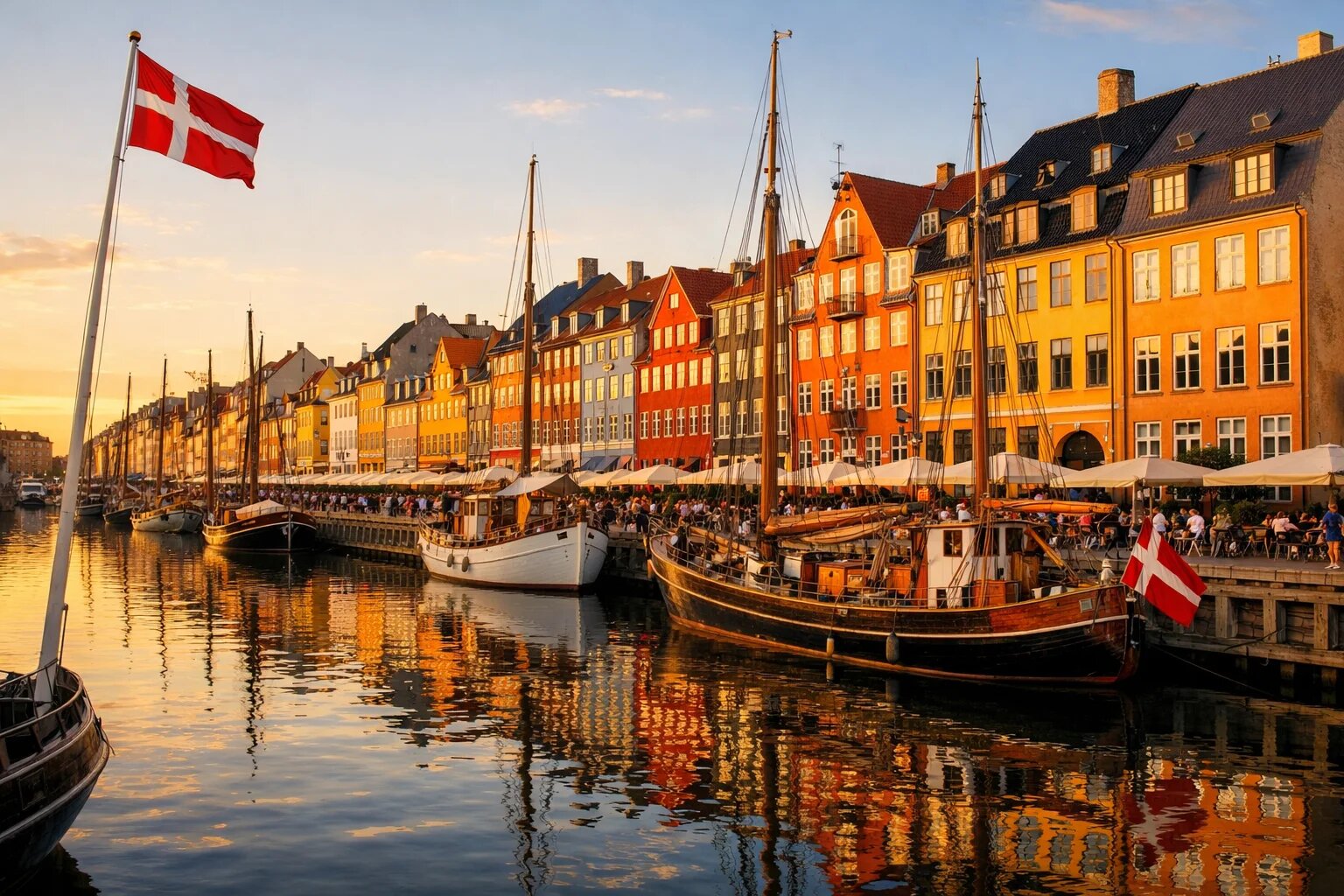
Nyhavn — a 17th-century commercial harbour turned into the most photographed street in Scandinavia.
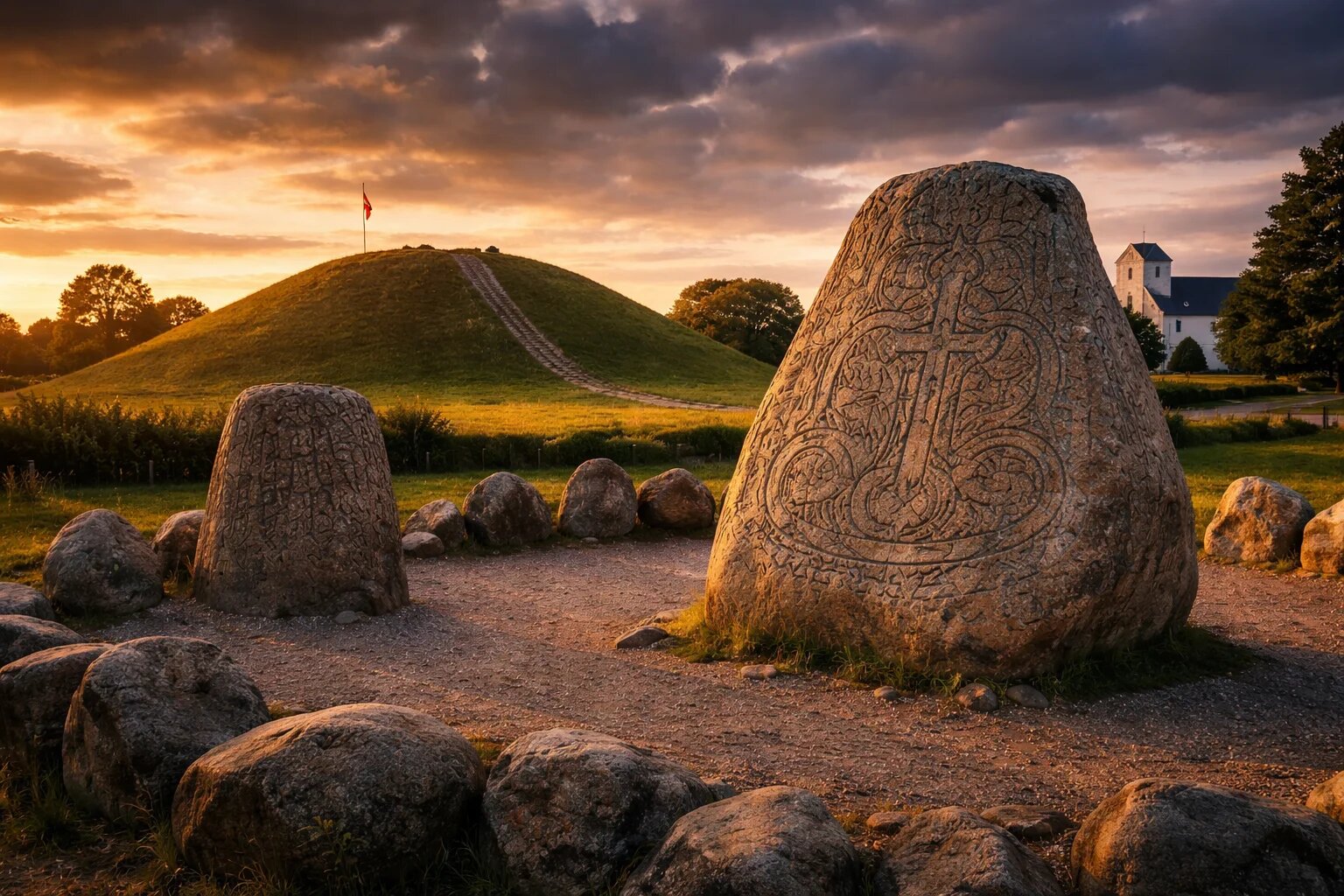
The name Danmark first appears carved on the larger of the two Jelling stones around 965 CE — which is why Danes call those stones the country's birth certificate. It is most likely Daner (the Danes) plus mark, a borderland or march. That makes Denmark's written self-identification more than a thousand years old and, on the usual reckoning, the oldest continuously existing state in Europe.
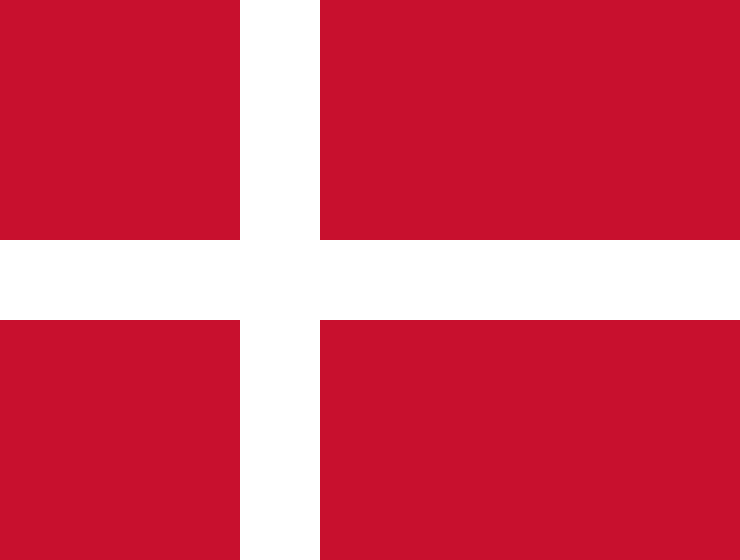
The Dannebrog is the oldest national flag still in use anywhere. Legend has it falling from the sky during a battle in Estonia in 1219 to rally a losing Danish army; the white cross on red became the template every other Nordic flag copied. Danes fly it constantly and cheerfully — on birthday cakes, on buses, on garden poles — in a way that reads as domestic rather than nationalist.
The monarchy is Europe's oldest, traceable in an unbroken line to the Viking kings on those same stones. Queen Margrethe II abdicated in January 2024 after 52 years, the first Danish monarch to abdicate in nearly 900 years, and her son reigns as King Frederik X. The Kingdom also includes Greenland and the Faroe Islands, both self-governing, both outside the EU, and both increasingly assertive about their own futures — Greenland most of all since the United States began openly demanding to buy it in 2025 (see History).
Three words do most of the work in describing how Danes see themselves. Hygge, the cultivated cosy. Fællesskab, community or togetherness, invoked in political speeches the way other countries invoke freedom. And janteloven, the Law of Jante — an unwritten social code, named after a 1933 novel, that says you should not think you are anything special. It is quoted half-ironically now, but it still shapes why Danish success is worn lightly.
03
🗺️ Geography & Regions
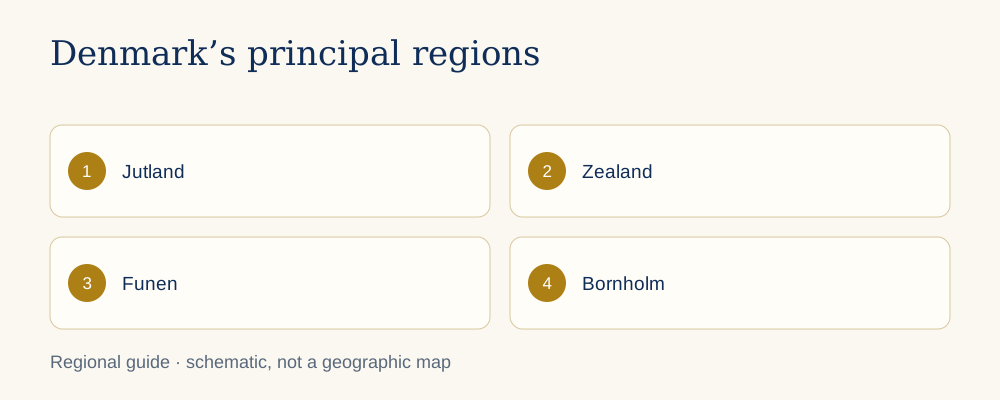
Denmark occupies the Jutland peninsula and 406 islands, of which about 70 are inhabited, across 42,924 km² — a little over half the size of Czechia. It is famously flat: the highest natural point, Møllehøj, is 170.86 metres, and three hills in the same field have argued over the title for a century. No point in the country is more than 52 km from the sea.
Zealand (Sjælland)
The largest island and where most visitors stay: Copenhagen, Roskilde, Helsingør and the North Zealand coast with its royal castles, beaches and the Louisiana museum.
Jutland (Jylland)
The mainland peninsula, from the German border to Skagen at the northern tip. Aarhus, Aalborg, the wind-scoured west coast and most of the Viking sites.
Funen (Fyn)
"The garden of Denmark" — orchards, manor houses and Hans Christian Andersen's Odense, between the two larger landmasses and linked by bridges to both.
Bornholm
The Baltic outlier 150 km east, closer to Sweden and Poland than to the rest of Denmark. Rocky, sunny, round medieval churches, and a serious artisan food scene.
Møn, Falster & Lolland
South of Zealand: the chalk cliffs of Møns Klint, dark-sky reserves and the flattest farmland in the country.
The bridges
The Great Belt (1998) links Zealand to Funen, the Øresund (2000) links Copenhagen to Sweden. Both are tolled, both are engineering landmarks, and together they turned an archipelago into a drive.
Denmark shares a land border only with Germany, 68 km long. Everything else is coast — 7,314 km of it, which is why sea and wind run through the culture, the food and, these days, the electricity supply.
Regional guide · schematic, not a geographic map · Original diagram
04
📍 Map of Denmark
The country reads as a peninsula pointing north from Germany, with the major islands strung eastward toward Sweden. Copenhagen sits on the far eastern edge of Zealand, closer to Malmö than to most of its own country.
Driving times are short: Copenhagen to Odense 1h30, to Aarhus 3h, to Skagen 5h. The train network is good and the Copenhagen–Aarhus service runs roughly hourly. Bornholm is the exception — it is a 3-hour ferry or a 35-minute flight, and cannot be reached by road without crossing Sweden.
05
📜 History
People have lived here since the ice retreated, and Denmark's bogs have preserved the evidence unusually well — the Tollund Man and Grauballe Man, Iron Age bodies with their faces intact after two thousand years, are among the most arresting objects in any European museum.
The Viking Age (roughly 793–1066) is where Denmark enters written history, and Danish Vikings were the ones who went west. The Danelaw covered eastern England for generations; the Great Heathen Army nearly finished the job; and Cnut the Great ruled England, Denmark and Norway together in the 1020s. Around 965, Harald Bluetooth raised the Jelling stone declaring that he had won all Denmark and Norway and "made the Danes Christian" — and, a millennium later, lent his name to the wireless standard.
Medieval Denmark was the Baltic's dominant power, leading the Kalmar Union that briefly joined all three Scandinavian crowns from 1397. The Reformation arrived in 1536. Then came a long contraction: three catastrophic wars with Sweden in the 17th century cost the Scanian provinces that are now southern Sweden, and the 19th century cost Norway (1814) and then, disastrously, Schleswig and Holstein to Prussia in 1864 — a defeat that reshaped Danish self-understanding into something smaller, inward and, arguably, more successful.
Denmark declared neutrality in both world wars and was occupied by Germany anyway in April 1940. The occupation was comparatively light until 1943, when the Danish government resigned rather than impose German demands; in October of that year, warned in advance, Danish citizens and fishermen ferried more than 7,000 of the country's 7,800 Jews to safety in neutral Sweden in a matter of weeks. It remains the single most extraordinary episode in modern Danish history.
Post-war Denmark built the welfare state that defines it, joined NATO in 1949 and the EEC in 1973. It has kept the krone rather than adopting the euro, holds opt-outs negotiated after voters rejected Maastricht in 1992 — and in 2022 voted to abolish its defence opt-out after the invasion of Ukraine, the first of those opt-outs to go.
The 2020s have been anything but quiet. Queen Margrethe II abdicated on 14 January 2024 and King Frederik X took the throne. Then came Greenland: Donald Trump's renewed demand to buy the island, from January 2025 onwards, became the sharpest crisis in Danish foreign policy since 1945. Greenland answered with an election on 11 March 2025 that made the pro-business, gradual-independence Demokraatit the largest party under Jens-Frederik Nielsen; Denmark answered with Arctic defence spending and, in the second half of 2025, its presidency of the EU Council. In January 2026 Washington threatened 10% tariffs on Denmark and seven other European countries from 1 February unless the "complete and total purchase" went ahead — and dropped the threat on 21 January at Davos after a "framework" with NATO's Mark Rutte whose contents nobody has published. Sovereignty, both Copenhagen and Nuuk insist, was never on the table.
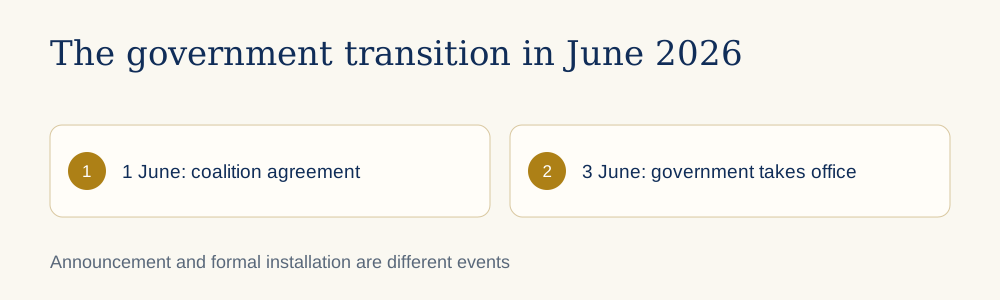
At home, Prime Minister Mette Frederiksen called a snap election for 24 March 2026 and was bruised by it: her Social Democrats fell to 21.8%, their lowest share in 120 years, and it took until 1 June 2026 and three rounds of talks to form a minority coalition with the Socialist People's Party, Radikale Venstre and the Moderates (82 of 179 seats) for a third term. The other national story is corporate: Novo Nordisk, maker of Ozempic and Wegovy, was briefly Europe's most valuable company in 2024 with a market value above Danish GDP, then lost most of it and cut 9,000 jobs in September 2025, 5,000 of them in Denmark. A country this small notices.
The coalition agreement announced on 1 June was followed by the official installation of the Frederiksen III government on 3 June 2026. Source: Danish Prime Minister’s Office.
Denmark takes its Viking past seriously and presents it well — not as horned-helmet kitsch but as archaeology, and the sites are close enough together to string into a two-day route.
Jelling: the runestone Harald Bluetooth raised around 965, and the mound behind it. This is where the word 'Denmark' first appears.
Jelling (UNESCO)
The two runestones, two enormous burial mounds and a whitewashed church, in a small Jutland town. The larger stone carries Scandinavia's oldest depiction of Christ and the first written 'Denmark'. The visitor centre opposite is excellent and free.
Viking-Age Ring Fortresses (UNESCO 2023)
Five geometrically exact circular fortresses — Trelleborg, Fyrkat, Aggersborg, Nonnebakken, Borgring — built to a single specification around 980. Trelleborg near Slagelse is the most visitable, with reconstructions and summer living history.
Roskilde Viking Ship Museum
Five ships deliberately sunk around 1070 to block the fjord, excavated in 1962 and displayed beside a working boatyard where reconstructions are still built and sailed. You can go out on one in summer.
Lindholm Høje
Above Aalborg: 700 graves marked by ship-shaped stone settings on a hillside, buried by sand and rediscovered intact. Atmospheric at dusk, with a good museum.
Ladby ship burial, Funen
A chieftain buried in his ship around 925, still in the ground where he was put, under a mound you walk into.
Moesgaard Museum, Aarhus
The best single museum of prehistoric and Viking Denmark, in a building whose grass roof is also a hill people picnic on. Grauballe Man is here.
One correction worth making while you are here: the horned helmet is a 19th-century opera costume. No Viking-age helmet with horns has ever been found, and Danish museums enjoy pointing this out.
07
👥 People & Culture
Six million Danes live in one of the most socially levelled societies in the world, and it shows in small things a visitor notices before the big ones: the prime minister cycles, nobody calls anybody sir, and the person clearing your plate is paid enough not to need your tip.
Trust
Denmark scores near the top of every international measure of interpersonal trust. The practical expression is prams left outside cafés with the baby asleep in them — startling to visitors, entirely unremarkable here.
Janteloven
The Law of Jante: don't think you're better than anyone else. Officially resented, informally obeyed, and the reason Danish success is described quietly.
Directness
Danes say what they mean with very little cushioning. It is not rudeness and it is not hostility; small talk is simply not a valued skill here.
Punctuality
Being on time is not politeness but a baseline. Ten minutes late without a message is genuinely rude.
Working hours
The office empties at 16:00 and nobody apologises. Denmark works fewer hours than almost any OECD country and is among the most productive per hour.
Sunday
Sundays can feel quieter, but many supermarkets and larger shops remain open. Check each destination’s opening hours instead of assuming a nationwide closure.
The society is more diverse than the stereotype: around 15% of residents have a foreign background, concentrated in Copenhagen, Aarhus and Odense. Immigration is also the most contested subject in Danish politics, with a policy consensus considerably more restrictive than most of western Europe — visitors who raise it will find opinions offered directly, in the Danish manner, and not all of them comfortable.
08
🕯️ Hygge — What It Actually Means
Hygge (roughly "HOO-guh") became an international publishing phenomenon around 2016 and was promptly flattened into candles and knitwear. The Danish version is more specific and more useful: it is the deliberate creation of a warm, low-stakes, unhurried togetherness, usually indoors, usually with people you already know, and usually as a defence against the weather.
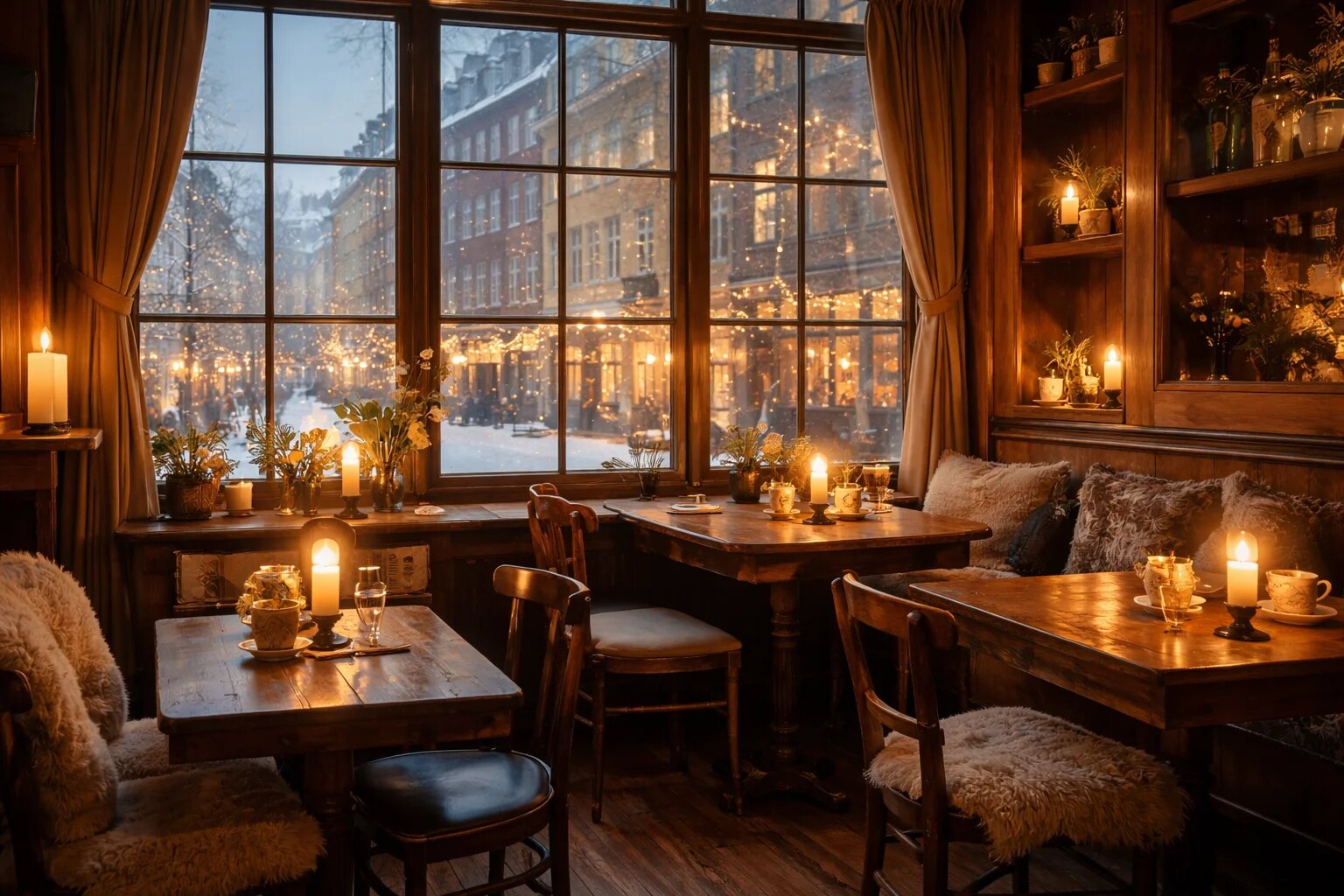
Candles are not decoration here but infrastructure: Danes burn more of them per head than anyone else in Europe.
The mechanics are worth knowing because they explain Danish interiors and Danish evenings. Light is low and warm — Danes burn more candles per capita than any other Europeans, and overhead lighting is considered close to an assault. Groups are small. Phones are down. The conversation avoids conflict and status. Something warm is being drunk, and something is usually baking.
Where to find it as a visitor
Old Copenhagen cafés in the afternoon, a Christmas market in December, a wine bar in Aarhus at nine on a Tuesday. Not in anything marketed at you with the word on the sign.
Vinterhygge
November to February is peak season: the darkness is the point. Danes talk about it as a resource rather than a problem, which is a genuinely different way to hold a northern winter.
Its opposite
Uhyggeligt means creepy or sinister. The word for cosy is the same word for safe, which tells you what it is defending against.
The critique
Danes will tell you hygge can be exclusionary — it works best among people who already know each other, which is part of why making Danish friends as a newcomer is famously slow.
09
🏛️ Copenhagen
Copenhagen has spent thirty years reinventing itself from a pleasant provincial capital into one of Europe's most interesting cities, and it has done it mostly by taking space back from cars. Roughly half of all journeys to work or study in the city are made by bicycle, the harbour was cleaned until people could swim in it, and the result is a capital that is unusually pleasant to simply be in.
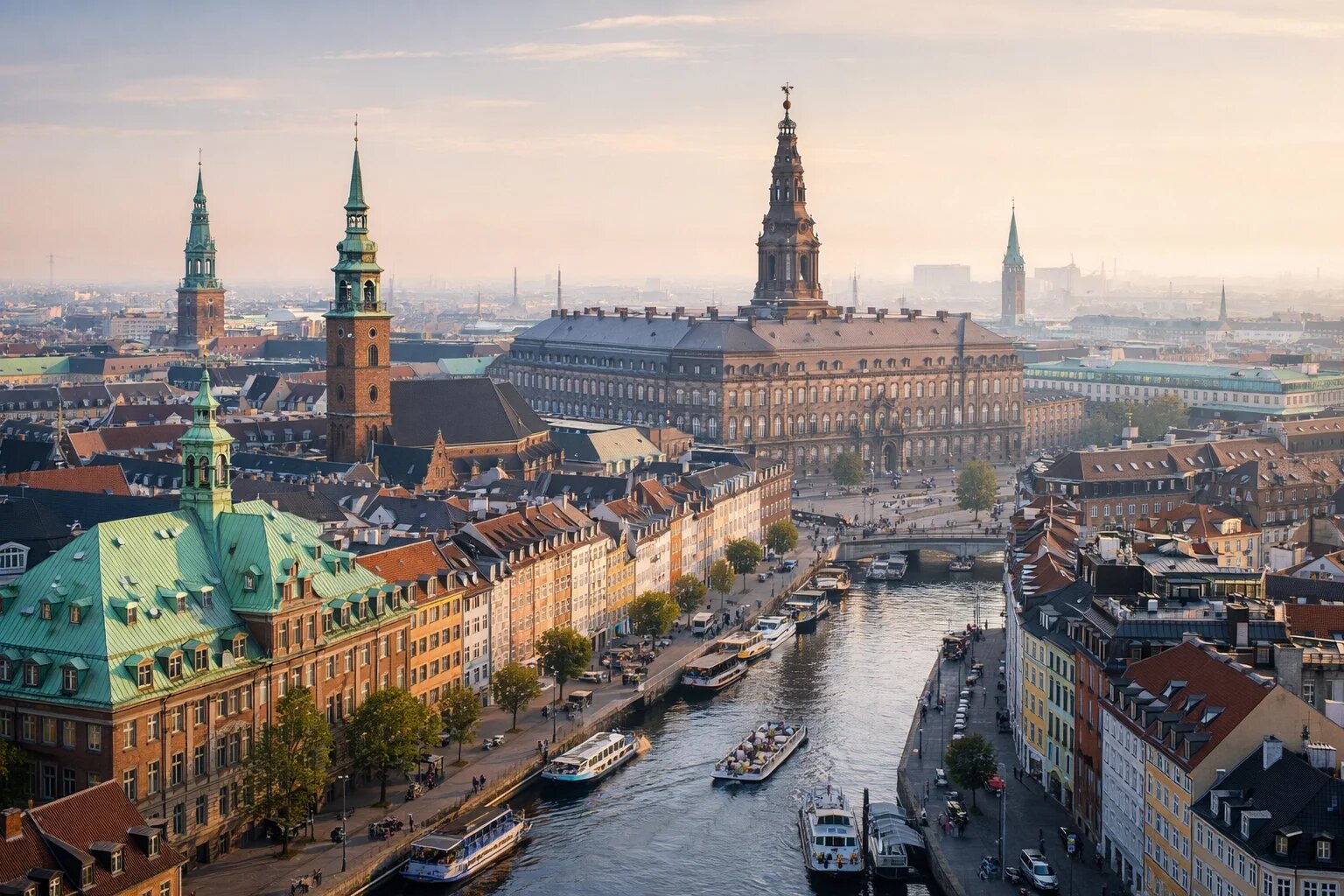
Christiansborg on Slotsholmen — parliament, supreme court and royal reception rooms in one building, on the site where the city began.
The historic core
Nyhavn is the postcard: a 1670s commercial canal lined with painted merchant houses, where Hans Christian Andersen lived for nearly twenty years. It is thoroughly touristed and still worth the twenty minutes. Behind it, Strøget runs 1.1 km as one of Europe's longest pedestrian streets, and Christiansborg occupies the islet where Bishop Absalon founded the city in 1167 — you can go down into the excavated ruins beneath it.
Royal Copenhagen
Rosenborg Castle keeps the crown jewels in a basement vault under 17th-century royal rooms. Amalienborg, four matching rococo palaces around an octagonal square, is the working royal residence, with the guard changing at noon. Frederik's Church, the Marble Church, has the largest dome in Scandinavia.
Tivoli
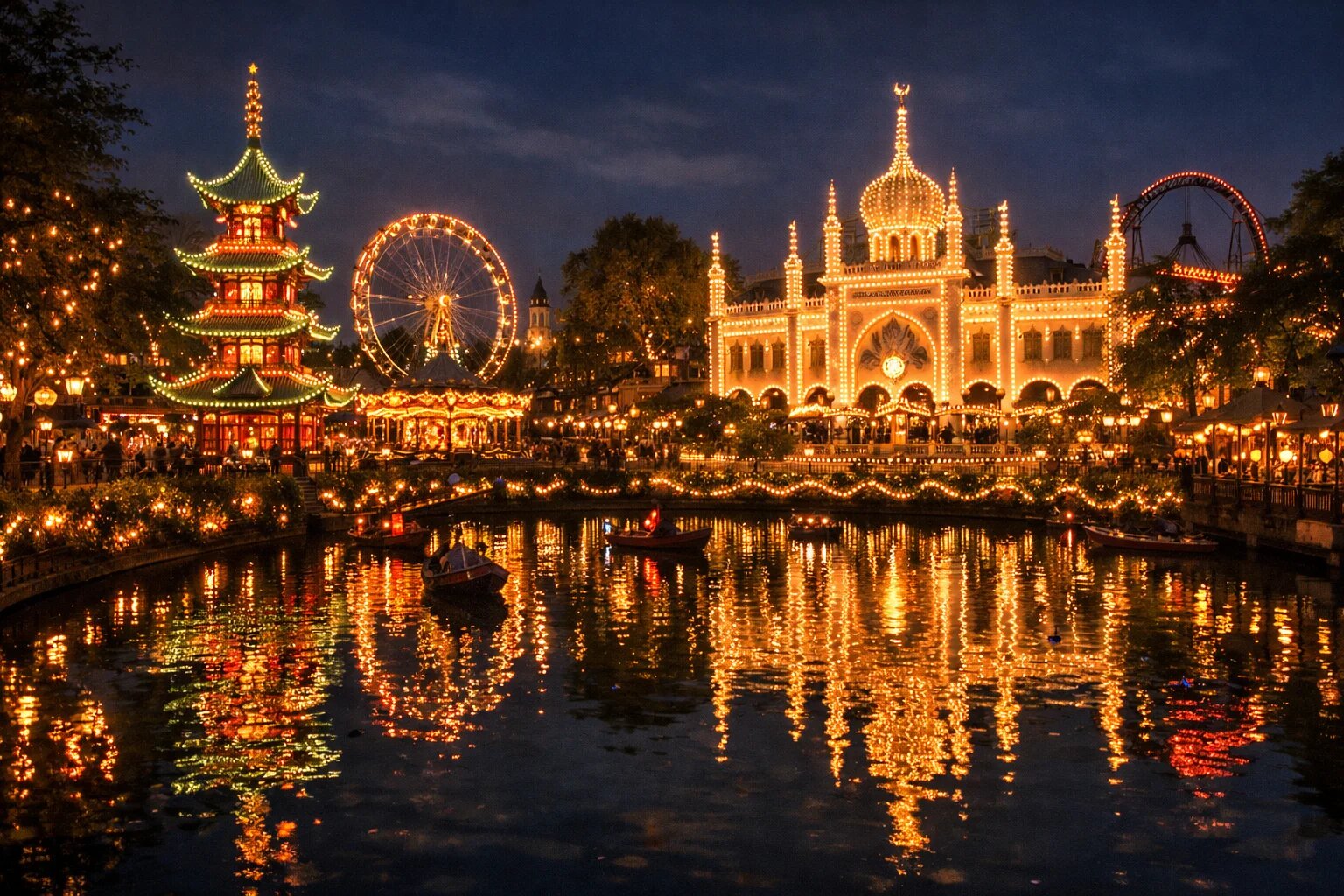
Tivoli Gardens opened in 1843 and is the third-oldest amusement park still operating in the world, after Bakken north of the city (1583) and Vienna's Prater (1766). It is much better than that description suggests: gardens, a lake, a wooden rollercoaster from 1914 with a brakeman riding it, an excellent concert programme, and after dark a hundred thousand small lights. Walt Disney visited twice and said so. It closes in the shoulder seasons and reopens spectacularly for Christmas.
Tivoli after dark — the 1843 pleasure garden that Walt Disney came to study.
The modern city
Christiania, the self-declared free town in an old barracks since 1971, is still there and still contested. Refshaleøen, a former shipyard, now holds street food, a sauna and the Alchemist restaurant. CopenHill is a waste-to-energy plant with a dry ski slope on the roof, which is the most Copenhagen sentence in this guide. And Islands Brygge harbour bath lets you swim in the middle of the city, in water that was industrial sewage forty years ago.
10
🏰 Around Copenhagen
Some of the best things in Denmark are within an hour of the capital by train, and doing two of them properly beats rushing four.
Louisiana Museum of Modern Art
Humlebæk, 35 minutes north by train. A world-class collection in low pavilions stepping down to the Øresund, with a sculpture park facing Sweden. Frequently called the most beautifully sited museum in Europe, and the claim is defensible. Half a day.
Kronborg Castle (UNESCO)
At Helsingør, where the sound narrows to 4 km. Shakespeare's Elsinore, and a genuinely impressive Renaissance fortress with damp casemates where Holger the Dane sleeps until Denmark needs him.
Roskilde
Thirty minutes west: a UNESCO cathedral holding forty Danish monarchs — the first Gothic brick cathedral in Europe — plus the Viking Ship Museum on the fjord.
Frederiksborg Castle
At Hillerød, a Dutch Renaissance palace on three islands in a lake, housing the Museum of National History. The chapel and the baroque garden are the reasons to come.
The Little Mermaid
Small, crowded, and honestly a disappointment — but the walk to her through Kastellet, a perfectly preserved star fortress with a working windmill, is not.
Dyrehaven
The old royal deer park north of the city: 2,000 free-roaming deer under 400-year-old oaks, and Bakken, the world's oldest amusement park (1583), at the gate.
11
🌆 Aarhus & the Second Cities
Aarhus has 300,000 people, the country's largest university and, since its year as European Capital of Culture in 2017, a genuine claim to be visited rather than passed through. It is a two- to three-hour train ride from Copenhagen and makes an easy second base.
ARoS
The art museum with Olafur Eliasson's Your Rainbow Panorama on the roof — a circular glass walkway through the full spectrum, with the city changing colour as you walk. Downstairs, Boy, a five-metre crouching child, is unforgettable and slightly disturbing.
Den Gamle By
An open-air museum of 75 relocated buildings recreating a Danish town — but uniquely, it does 1927, 1974 and 2014 as well as the 19th century. The 1974 street, with its record shop and period adverts, is the best thing in it.
Moesgaard
Prehistory and Vikings in a building with a sloping grass roof that doubles as a hill. Grauballe Man, a 2,300-year-old bog body, is displayed with real care.
Odense
Hans Christian Andersen's birthplace on Funen, with a striking new museum devoted to him that is more about storytelling than biography. An easy stop between Copenhagen and Jutland.
Aalborg
North Jutland's capital: a rehabilitated waterfront, the Utzon Center by the architect of the Sydney Opera House, and Lindholm Høje above the town.
Ribe
Denmark's oldest town, founded around 700. Crooked half-timbered streets, a Romanesque cathedral, storks on the roofs, and a night watchman who still does his rounds in summer.
12
🌾 Jutland & the Coasts
The mainland peninsula is where Denmark stops being a city break. It is 300 km from the German border to the northern tip, and the two coasts could not be less alike: the North Sea side is dunes, wind and enormous empty beaches; the eastern, Baltic side is sheltered, wooded and gentle.
Skagen
The northern tip, where the Skagerrak and Kattegat meet in a visible line of colliding waves at Grenen. An artists' colony from the 1870s because of the light, which is genuinely extraordinary, and the yellow-and-white houses to prove it.
Råbjerg Mile
Scandinavia's largest migrating dune, moving about 15 metres a year and heading for the road. Nearby, Den Tilsandede Kirke — a church tower emerging from the sand that buried the rest of it.
The west coast
150 km of beach from Blåvand to Thyborøn, with WWII Atlantic Wall bunkers slowly tipping into the sea and some of the best kitesurfing in Europe. Also Denmark's classic summer-house country.
The Wadden Sea (UNESCO)
The world's largest unbroken intertidal flats, shared with Germany and the Netherlands. Come at dusk in spring or autumn for sort sol — 'black sun', when a million starlings murmurate before roosting.
Legoland, Billund
Where the bricks come from. Genuinely good for children, and the neighbouring Lego House is better designed than most museums.
Møns Klint
Not Jutland but worth listing here: chalk cliffs 128 m above the Baltic on the island of Møn, with fossil hunting below and a dark-sky reserve above.
13
🏝️ The Islands
Denmark has 406 islands and about 70 with people on them, and the small ones are where the country is at its most itself. Ferries are frequent, cheap and treated as buses.
Bornholm
The Baltic outlier, 150 km east and closer to Poland than to Copenhagen. Rocky coasts rather than sand, four round fortress-churches from the 12th century, Hammershus — northern Europe's largest castle ruin — and a food scene out of all proportion to 39,000 inhabitants.
Ærø
A ferry from Funen into a 19th-century maritime town: Ærøskøbing has cobbles, hollyhocks and half-timbering, and almost no tourist infrastructure. Best done by bicycle, which takes a day end to end.
Samsø
Denmark's energy island — carbon-negative since 2007, powered by community-owned wind. Also new potatoes, which Danes treat with something close to reverence each June.
Fanø & Rømø
Wadden Sea islands off the west coast with beaches wide enough to drive on and a long tradition of sailors' houses.
Læsø
In the Kattegat, with houses roofed in seaweed — a technique revived after nearly dying out — and salt still made by boiling brine as it was in the Middle Ages.
Christiansø
The far outpost: a 17th-century naval fortress on a rock beyond Bornholm, with about 90 residents, no cars and no dogs.
A practical note: island ferries in July book out for cars weeks ahead, but foot passengers and cyclists almost always get on. Renting a bicycle on the other side is usually easier than taking a car across.
14
🎨 Danish Design
Denmark's outsized influence on how the world's furniture looks comes from a specific twenty-year window and a specific idea: that good design is a social good, not a luxury, and should be affordable, functional and made well enough to outlive its owner.
The names
Arne Jacobsen (the Egg, the Swan, the Ant), Hans Wegner (the Wishbone chair, and 500 more), Finn Juhl, Børge Mogensen, Poul Henningsen — whose PH lamps solved glare so thoroughly they are still made unchanged.
Why lamps matter here
At this latitude the winter afternoon is dark by three. Danish lighting design is not decorative fussiness; it is a national engineering response to a real problem.
Design Museum Danmark
In a rococo former hospital near Kastellet, recently reopened after a full refurbishment. The chair corridor — a century of Danish seating in one line — is the single best exhibit of its kind anywhere.
Architecture now
Bjarke Ingels Group made Danish architecture globally famous again: the 8 House, CopenHill, and a way of talking about buildings as playful problem-solving. The Danish Architecture Center at BLOX explains it well.
Where to shop
Illums Bolighus and Hay House in Copenhagen for contemporary; Royal Copenhagen and Georg Jensen for the craft tradition; and the second-hand shops in Nørrebro and Vesterbro, where genuine mid-century pieces still turn up.
Beyond furniture
Bang & Olufsen, Lego, Vipp, Muuto, Kvadrat, and the ergonomics of the Copenhagen bicycle lane — all the same instinct applied to different objects.
15
🚲 Cycling
Denmark has almost as many bicycles as people, and Copenhagen is regularly rated the best cycling city in the world. This is not an accident of culture but of forty years of deliberate infrastructure: 385 km of separated cycle track in the capital, kerb-protected, gritted before the roads in winter, with their own traffic lights and their own bridges.
Renting in Copenhagen
Donkey Republic and Swapfiets by app, or a shop rental from about DKK 100 a day. City bikes have gears and lights; you will not need more.
The rules that catch visitors out
Hand signals are compulsory and used: arm out to turn, hand up to stop. Never stop in the lane. Lights after dark are legally required and the fine is real. Overtake on the left, ring to warn.
Turning left
You do not swing across. You cross straight, stop at the far corner facing the new direction, and wait for the light. This is called the box turn and everyone does it.
The long routes
Eleven national cycle routes, all signposted. Route 1 runs the entire North Sea coast, Route 8 the southern islands. Ferries take bikes for a few kroner.
Bikes on trains
Allowed on regional and intercity trains with a cheap bike ticket, free on Copenhagen's S-trains outside rush hour. There is a carriage marked with a bicycle.
Helmets
Not legally required for adults and widely worn anyway. Danish traffic is slow and predictable, which is why the accident rate is what it is.
One tip that changes a Copenhagen visit: rent a bicycle on the first morning rather than the last. The city is scaled for it, distances that look far on the map are twelve minutes, and you will see three times as much.
16
🌿 Nature & Outdoors
Denmark is one of the most intensively farmed countries in the world — over 60% of the land surface is cultivated — so its nature is smaller-scale and more managed than Norway's or Sweden's. What it does have is coast, light and access.
Allemansret, sort of
Denmark has no unrestricted right to camp. Alongside shelters, selected forests permit fri teltning under site rules. Check the official map and conditions before choosing a place. Source: Danish Nature Agency.
Sort sol
The 'black sun' starling murmurations over the Wadden Sea marshes in March–April and September–October. Up to a million birds. Book a guide; the marshes are dangerous alone.
Harbour and sea swimming
Copenhagen has five official harbour baths and Danes swim year-round. Winter bathing clubs with saunas are a serious national pastime.
National parks
Five of them: Thy (dunes and heath), Wadden Sea, Mols Bjerge, Skjoldungernes Land and Kongernes Nordsjælland. Modest by international standards, and pleasant.
Dark skies
Møn and Nyord form an International Dark Sky Park — a rarity in densely populated northern Europe.
Wind
Denmark generates well over half its electricity from wind, and the turbines are visible everywhere on land and at sea. Whether that is scenery or not is a matter of taste, but it is unmistakably part of the landscape now.
17
🍽️ Cuisine
Danish food has had two lives. The traditional one is pork, rye, herring, potatoes and butter — food built for a cold, flat, agricultural country. The second began in 2003 when Noma opened and the New Nordic manifesto redefined what a northern kitchen could be, turning Copenhagen into a gastronomic capital with more Michelin stars than any other Nordic city.
Smørrebrød
The open sandwich, and the country's real culinary art form. Dense dark rye, generous butter, and a precisely composed topping — pickled herring, roast beef with remoulade and crispy onions, breaded plaice, or dyrlægens natmad, the vet's midnight snack. Eaten with a knife and fork, never picked up.
Stegt flæsk med persillesovs
Voted the national dish in 2014: thick slices of pork belly fried until they shatter, with parsley cream sauce and boiled potatoes. Usually served as much as you can eat.
Frikadeller
Pan-fried pork-and-veal meatballs, the taste of every Danish childhood, eaten hot with potatoes or cold on rye.
Flæskesteg
Christmas roast pork with crackling scored into strips, so that the crackling can be broken off and negotiated over.
Wienerbrød
The 'Viennese bread' the rest of the world calls a Danish, brought by Austrian bakers during an 1850 strike and improved beyond recognition. A kanelsnegl from a proper bakery is worth crossing town for.
New Nordic
Noma, Geranium, Alchemist, Kadeau, Jordnær — book months ahead. But the movement's real effect is at the mid-range, where a DKK 400 tasting menu of local, seasonal, half-foraged food is now ordinary.
Smørrebrød: three classics
The open sandwich · assembly, not cooking
Ingredients: Dense dark rye (rugbrød), softened butter. Herring: pickled herring, raw onion rings, capers, dill. Roast beef: rare roast beef, remoulade, crispy fried onions, watercress. Shrimp: small cold-water shrimp, mayonnaise, lemon, dill, half an egg.
Method: Butter the rye to the edges — this is not optional, it is what stops it going soggy and Danes will notice. Lay the main topping so it covers the bread completely and overhangs slightly. Add the garnishes for height and colour rather than volume. Serve immediately with cold beer and, if you are being traditional, a small aquavit.
💡 One or two pieces is a snack, three or four a lunch. Order herring first, then meat, then cheese — the order matters and reversing it is a minor social error.
Flæskesteg
Roast pork with crackling · Christmas dinner · serves 6
Ingredients: 2 kg pork loin or leg with the rind on; coarse salt; 10–15 bay leaves; 300 ml water; potatoes; red cabbage.
Method: Have the butcher score the rind at 5 mm intervals down to the fat but not the meat, or do it yourself with a very sharp blade. Rub coarse salt hard into every cut and push a bay leaf into every second one. Sit the joint on a rack over water in a roasting tin, rind level — pack foil underneath if it slopes, because the fat must not run off. Roast at 200 °C for 30 minutes, then 160 °C for about 90 minutes to an internal 65 °C. If the crackling has not blistered, give it 5–10 minutes under the grill and do not walk away.
💡 Level and dry are the whole technique. Any moisture on the rind steams it instead of crisping it, and a sloping joint produces one perfect end and one soft one.
18
🍺 Beer, Aquavit & Coffee
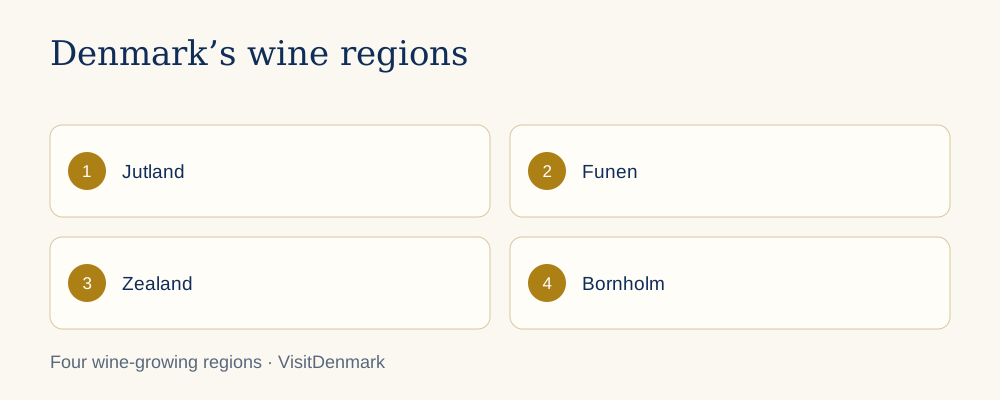
Denmark is a beer country first, but the wine footnote is real: it has been an official EU wine-producing country since 2000, roughly a hundred commercial vineyards now work hardy hybrids such as Solaris and Rondo, and Dons near Kolding became the first Danish protected designation (PDO) for sparkling wine in 2018. It is still a curiosity of the warming north rather than a wine region, and the Kaufmann Wine Score below reflects that. What Denmark does have is one of Europe's most serious brewing cultures and a very specific set of drinking rituals.
Carlsberg & Tuborg
The two mainstream lagers, both now the same company. Carlsberg's laboratory isolated the first pure lager yeast in 1883 and gave the method away rather than patenting it — a decision that shaped modern brewing worldwide. The old brewery in Copenhagen is now a visitable district.
Craft beer
Mikkeller made Danish brewing internationally famous by not owning a brewery for years; To Øl, Amager and dozens more followed. Copenhagen has as good a beer scene as any city in Europe.
Snaps / aquavit
Caraway- or dill-flavoured grain spirit, drunk ice-cold in one go with herring and with a toast. Aalborg is the classic label. It is not sipped.
Gammel Dansk
A bitter of 29 herbs, traditionally drunk at breakfast on special occasions. This is not a joke and you will be offered it.
Gløgg
The Christmas mulled wine, with almonds and raisins in the bottom of the glass that you eat with a spoon at the end. From late November it is everywhere.
Coffee
Taken seriously and drunk constantly — Danes are among the world's heaviest consumers. The third-wave scene in Copenhagen (Coffee Collective, Prolog) is genuinely world class.
Skål is the toast, and there is etiquette: you make eye contact with each person around the table, drink, and make eye contact again before setting the glass down. Skipping the eye contact is the one bit of Danish table manners visitors reliably get wrong.
🏆 Kaufmann Wine Score — Denmark
Rated on four criteria: Aroma (/25), Taste (/30), Finish (/20), Value (/25) — Total /100
Wine
🔴 Aroma
🟡 Taste
🟢 Finish
🔵 Value
Total
🍷 Frederiksdal Kirsebærvin (cherry wine, Lolland)
22
25
17
18
82
🍷 Skærsøgaard Dons Sparkling Brut (PDO Dons)
21
25
16
17
79
🍷 Dyrehøj Vingaard Solaris (Røsnæs, Zealand)
20
24
15
18
77
🍷 Vejrhøj Vingård Solaris (Odsherred, Zealand)
20
24
15
17
76
🍷 Lille Gadegård Rondo (Bornholm)
19
23
15
17
74
95–100 Legendary · 90–94 Outstanding · 85–89 Very Good · 80–84 Good · 75–79 Average · <75 Below Average — scores tentative, pending a proper Danish tasting; producers verified, vintages deliberately not stated.
Denmark's climate is temperate maritime: rarely very hot, rarely very cold, frequently grey, and windy all year. What changes dramatically is not the temperature but the light — 17 hours of daylight at midsummer against seven in December — and that difference decides what kind of trip you get.
May–June
The best window. 15–20 °C, everything green, beech woods in new leaf, and the light lasting until eleven at night. Prices below July, crowds below August.
July–August
Peak season and school holidays: 18–23 °C, warm sea by Danish standards, festivals, and summer houses booked out. Also when Danes themselves are on holiday, so cities are quieter than the coasts.
September–October
Excellent value. Still mild, autumn colour, the starling murmurations over the Wadden Sea, and Copenhagen without queues.
November–February
Dark by four, 0–5 °C, wet and windy. This is hygge season, and Tivoli's Christmas market is genuinely worth a trip in itself — but three consecutive grey days test most visitors.
March–April
Unreliable and improving. The first warm day brings the entire country outdoors simultaneously, which is a sight in itself.
The wind
Constant. Denmark is one of the windiest countries in Europe, which is why it runs on turbines. Pack a windproof layer whatever the season says.
Rain is frequent but light — about 170 rainy days a year, and roughly 600–700 mm total — more than Prague's 500-odd, but spread over more and lighter days. It is the kind of rain you cycle through rather than shelter from, which is why Danes own good jackets rather than umbrellas.
20
✈️ Getting There & Around
Copenhagen Airport (CPH) at Kastrup is Scandinavia's busiest, and it is 13 minutes from the central station by metro or train — one of the best airport connections in Europe. Billund (BLL) serves Jutland and Legoland; Aarhus and Aalborg have smaller airports.
Trains
DSB runs a good national network. Copenhagen–Aarhus is about 3 hours, Copenhagen–Odense 1h20. Buy Orange tickets in advance for large discounts; walk-up fares are steep.
The Øresund Bridge
Trains cross to Malmö in 35 minutes, every 10–20 minutes. Sweden is a legitimate day trip, and Copenhagen airport is Malmö's airport in practice. Note there are ID checks on the Swedish side.
Buses
Flixbus and Kombardo Expressen undercut the trains on the main corridors and take about an hour longer.
Driving
Excellent roads, low speeds enforced by camera, and two big tolls: the Great Belt (DKK 205–235 a car in 2026, depending on how you pay) and the Øresund. Parking in Copenhagen is expensive and largely unnecessary.
Ferries
To Norway (Oslo overnight from Copenhagen), Sweden, Germany and Poland, plus dozens of domestic island routes. Bornholm goes via Ystad in Sweden or a fast ferry from Køge.
City transport
Copenhagen's metro runs 24 hours and is driverless. One ticket covers metro, S-train, bus and harbour bus. The harbour buses are ordinary public transport that happen to be a free boat tour.
21
🇪🇺 Getting There from Central Europe
Denmark is one of the easiest Nordic countries to reach from central Europe: about 1h40 flying from Prague or Vienna, no time difference, and no border formalities inside Schengen.
Flying
Direct Prague–Copenhagen with SAS and low-cost carriers, several times a day; Vienna, Bratislava and Budapest all have direct services too. Billund is worth checking separately if Legoland or Jutland is the destination.
By train
Prague–Berlin–Hamburg–Copenhagen is about 13–14 hours with two changes, and genuinely pleasant. The Hamburg–Copenhagen leg now runs via the Great Belt rather than the old train ferry.
Driving
Roughly 900 km from Prague via Dresden, Berlin and Hamburg — a long day. Remember the Great Belt toll if you are crossing to Zealand, and that Danish speed enforcement is automated and unforgiving.
Combining
Copenhagen pairs naturally with Malmö (35 minutes) or with a Baltic ferry to Oslo. Two Nordic capitals in one trip is easy from here.
Entry and money. Denmark is in the EU and in Schengen, so Czech and Slovak citizens need only an identity card — but carry it: Denmark has run temporary checks at its land and sea border with Germany since 2016, currently extended to 11 November 2026, so you may be stopped coming in by road or train from Hamburg. It is not in the eurozone: the currency is the Danish krone (DKK), pegged to the euro at roughly 7.46, so 1 DKK is about 3.3 Kč. Do not bring cash to exchange — Denmark is close to cashless and cards are better in every situation.
Health and roaming. EU roaming applies normally. The European Health Insurance Card covers state healthcare, and Danish public healthcare is free at the point of use for EHIC holders; commercial insurance is still worth having for repatriation. Check mzv.gov.cz before travelling and consider the DROZD registry; the Czech Republic has an embassy in Copenhagen.
Budget honestly. Denmark is roughly twice Czech price levels for eating out and about 2.5 times for alcohol. A week for two with flights, a mid-range hotel and restaurant meals runs to about 45–70 000 Kč; the same week self-catering from supermarkets, cycling instead of taxis and using the free museums lands nearer 30 000 Kč. The single biggest saving is not eating dinner out every night — Danish supermarket food is very good.
22
📋 Practical Information
Money
Danish krone (DKK), pegged to the euro. Euros are not generally accepted. Cards work absolutely everywhere and many places refuse cash entirely; MobilePay is universal among Danes but needs a Danish account.
Electricity
230 V, 50 Hz. Danish sockets include type K and type E. Check the socket and appliance before use; a plug that physically fits does not necessarily provide a protective earth. Use a suitable earthed adapter for equipment that requires one.
Water
Tap water is excellent, all of it from groundwater with no chlorination. Buying bottled water here is genuinely pointless.
Language
Danish, but English is spoken to a high standard by almost everyone under sixty. German is understood in southern Jutland.
Tipping
Not expected. Service is included by law and Danish wages do not depend on tips. Round up if you were delighted; nobody will chase you.
Opening hours
Supermarkets late and on Sundays; most other shops close at 17:30–18:00 and are shut or short on Sunday. Museums often close Mondays.
Safety
Take normal urban precautions and watch valuables in busy stations, nightlife areas and on airport transport. Denmark is generally safe, but theft, traffic and weather hazards still require attention. The emergency number is 112. Official source.
Smoking and alcohol
Indoor smoking restrictions apply. Since 1 April 2025, shops may sell drinks containing more than 1.2% and up to 6% alcohol to customers aged 16 or over; drinks above 6% require age 18. Bars and restaurants apply their own legal licensing and age requirements; bring identification. Official source.
One quiet practicality: Denmark is unusually accessible for wheelchairs and prams, from station lifts to museum entrances, and staff are used to being asked. Another: public toilets are scarce and often paid, but any café will let you use theirs.
23
💰 Costs for Travellers
Denmark is one of the most expensive countries in Europe. The reason is not tourism but wages and a 25% VAT applied to everything including food, and it is easier to accept that up front than to keep being surprised by it.
Hostel bed
DKK 250–400 (roughly 850–1 350 Kč). Copenhagen hostels — Generator, Steel House, Urban House — are of unusually high quality.
Mid-range hotel
DKK 900–1 600 a night (3 000–5 300 Kč). Outside Copenhagen this drops by a third; Aarhus is notably better value.
Restaurant main course
DKK 150–250 (500–850 Kč). Lunch is much cheaper than dinner and often the same kitchen.
Beer in a bar
DKK 50–75 (170–250 Kč) for half a litre. In a supermarket, DKK 10–15.
Coffee and a pastry
DKK 70–90 (230–300 Kč), and worth it in a proper bakery.
Transport
A Copenhagen 24-hour city pass is DKK 90; a bicycle rental DKK 100–150 a day and better value.
Realistic daily budgets per person: DKK 700–900 (2 300–3 000 Kč) self-catering with a hostel or apartment and a bicycle; DKK 1 500–2 200 (5 000–7 300 Kč) with a hotel and restaurant meals. Copenhagen's museums are largely paid, but the Copenhagen Card pays for itself from about three museums a day, and a striking number of the best things — harbour swimming, Kastellet, the botanical garden, the churches, the whole city on a bicycle — cost nothing at all.
24
🏨 Accommodation
Design hotels
Denmark is very good at these. Hotel Sanders, Nobis, Villa Copenhagen and 71 Nyhavn in the capital; expect DKK 2 000–4 000 and a genuinely memorable room.
Reliable mid-range
Scandic, Wakeup and Cabinn cover the country at DKK 800–1 500. Cabinn rooms are small in a way that surprises people and are priced accordingly.
Hostels
Copenhagen's are excellent, with private rooms as well as dorms, good bars and none of the usual grimness. Danhostel covers the rest of the country and is family-friendly.
Sommerhus
The Danish summer house — a wooden cabin near a beach, rented by the week, usually Saturday to Saturday. This is how Danes holiday and it is by far the best value for a family or a group, especially in Jutland.
Kro
The traditional country inn, often centuries old, with a dining room that takes food seriously. The best way to sleep in rural Denmark.
Camping and shelters
Alongside organized campsites there is a network of wooden shelters in forests and on the coast; some require booking and others operate first come, first served. Denmark has no unrestricted right to camp. Alongside shelters, selected forests permit fri teltning under site rules. Check the official map and conditions before choosing a place. Source: Danish Nature Agency.
Booking notes: Copenhagen fills for the Jazz Festival in July and for Christmas weekends; summer houses on the west coast are gone by February for July dates. Everywhere else you can be reasonably spontaneous.
25
🏛️ UNESCO World Heritage
The Kingdom of Denmark has thirteen World Heritage Sites — ten in Denmark proper and three in Greenland (none in the Faroes). They divide neatly between Viking-age monuments, royal architecture and four pieces of world-class geology, two of them new: Møns Klint was inscribed in July 2025 and the fossil cliffs of the western Limfjord in July 2026, so most guidebooks are already two sites behind.
Jelling Mounds, Runic Stones and Church (1994)
The birth certificate of Denmark: Harald Bluetooth's stone of c. 965, two vast mounds and a whitewashed church, in a Jutland village.
Roskilde Cathedral (1995)
The first Gothic cathedral built of brick in Europe, and the burial church of forty Danish monarchs across a thousand years — each in the chapel style of their own era.
Kronborg Castle (2000)
The Renaissance fortress at the narrowest point of the Øresund, which taxed every ship passing into the Baltic for four centuries and became Shakespeare's Elsinore.
Wadden Sea (2009/2014)
The largest unbroken system of intertidal sand and mud flats on Earth, shared with Germany and the Netherlands, and one of the world's great bird migration sites.
Stevns Klint (2014)
A chalk cliff on Zealand exposing the K–Pg boundary — a thin dark line of iridium-rich clay laid down by the asteroid that ended the dinosaurs. You can touch it.
Christiansfeld — Moravian Church Settlements (2015, extended 2024)
A Moravian Church settlement planned and built from 1773, with an austere symmetry and a democratic layout that is quietly radical for its date. Since 2024 it is the Danish component of a transnational listing shared with Germany, the UK and the USA.
Par force hunting landscape (2015)
North Zealand forests laid out in geometric grids and star-shaped rides for baroque royal hunts — Cartesian geometry imposed on a forest.
Viking-Age Ring Fortresses (2023)
Five circular fortresses built to one exact specification around 980, evidence of a state with real administrative reach.
Møns Klint (2025)
The 128 m chalk cliffs of Møn, inscribed on 13 July 2025 as one of the world's most complete and accessible records of glacial tectonics — ice folding and stacking the chalk like a pack of cards. Fossils on the beach, a dark-sky park on top.
The Bony Fish Fossils of the Western Limfjord (2026)
The moler (diatomite) cliffs of Hanklit on Mors and Knudeklint on Fur, inscribed in July 2026: the world's best record of how modern bony fishes diversified after the dinosaur extinction, with 80-plus fish species, turtles, birds and insects preserved in volcanic ash layers 55 million years old.
The remaining three are outside Denmark proper: Ilulissat Icefjord, Kujataa and Aasivissuit–Nipisat, all in Greenland — a reminder that the Kingdom of Denmark extends a very long way north.
26
🎉 Festivals & Events
Roskilde Festival (late June/early July)
Northern Europe's largest music festival: 130,000 people, eight stages, and a non-profit structure that gives all proceeds away. Legendary, muddy, and sold out months ahead.
Copenhagen Jazz Festival (July)
Ten days and well over 1,000 concerts across the city, a great many of them free and outdoors. The whole capital becomes the venue.
Sankt Hans (23 June)
Midsummer: bonfires on every beach, a song everyone knows, and a straw witch on top of the fire — a tradition whose origins Danes discuss with some discomfort.
Christmas markets (mid-Nov–Dec)
Tivoli's is the famous one and deserves it; Nyhavn's is smaller and prettier. Gløgg, æbleskiver and a million lights against the dark.
Distortion (early June)
Five days of street parties moving through Copenhagen's neighbourhoods, free and enormous. Locals either love it or leave town.
Aarhus Festuge (late Aug/Sept)
Ten days of theatre, music and art across the second city — Scandinavia's largest cultural festival and much less crowded than Copenhagen's.
Fastelavn (Feb/Mar)
Danish carnival: children in costume, buns filled with cream, and 'hitting the cat out of the barrel' — which, reassuringly, has involved no actual cat for well over a century.
CPH:DOX and CPH PIX (spring)
Serious documentary and feature film festivals that have made Copenhagen a real film city in March and April.
27
💎 Hidden Gems
Ærøskøbing
A whole 18th-century maritime town on a small island, with cobbles, hollyhocks and no tour buses. Denmark at its most postcard-perfect and least performed.
Grenen, Skagen
The sandbar at the very tip where two seas meet visibly, waves colliding from opposite directions. You can stand with a foot in each.
Den Tilsandede Kirke
The Sand-Covered Church near Skagen: a whitewashed tower rising from dunes that swallowed the rest of the building in the 18th century.
Christiania
Copenhagen's autonomous free town since 1971 — self-built architecture, workshops, murals and an unresolved argument with the Danish state. Pusher Street, the open cannabis market, is gone: after a fourth killing in three years the residents themselves dug up its cobbles on 6 April 2024, the gangs left, and the police say the place is now calm. Photography is still frowned on in the residential lanes, and respect that.
Hammershus, Bornholm
Northern Europe's largest castle ruin, on a cliff above the Baltic, and usually almost empty.
Rubjerg Knude lighthouse
A lighthouse on the north Jutland coast that was moved 70 metres inland on rails in 2019 to stop it falling off the eroding cliff. It will have to move again.
Cisternerne
An underground Copenhagen reservoir turned into a dripping, pitch-dark art space with stalactites growing from the ceiling. Unlike anything else in the city.
Læsø's seaweed roofs
Houses thatched with eelgrass, a technique that nearly died out and has been revived, on a quiet island in the Kattegat.
28
🔬 Fascinating Facts
The flag fell from the sky
The Dannebrog is the oldest continuously used national flag in the world, and the legend says it dropped out of the clouds during a battle in Estonia on 15 June 1219.
Bluetooth is named after a king
Harald Bluetooth united Denmark and Norway; the wireless standard united computing and telecoms. The logo is his initials in runes, ᚼ and ᛒ, superimposed.
Lego means 'play well'
From leg godt. The company began in Billund in 1932 making wooden toys, and the modern brick was patented in 1958 — bricks from that year still snap onto bricks made today.
Denmark has no mountain
The highest natural point is Møllehøj at 170.86 m, and it beat its neighbouring hills by centimetres after a survey in 2005.
Carlsberg gave away its yeast
Having isolated the first pure lager yeast in 1883, the Carlsberg Laboratory published the method instead of patenting it. Most of the world's lager descends from that decision.
More bicycles than cars
And in Copenhagen, more bicycles than cars crossing the city centre each day — a threshold passed in 2016 for the first time since the 1970s.
The rescue of the Danish Jews
In October 1943, warned by a German diplomat, Danes ferried over 7,000 of the country's 7,800 Jews to Sweden in fishing boats within weeks.
It is not actually the happiest
Finland has topped the World Happiness Report nine years running; Denmark was second in 2024 and 2025 and slipped to third behind Iceland in the 2026 edition. Danes, being Danes, mostly find the whole exercise slightly embarrassing.
29
👥 Notable Danes
Hans Christian Andersen (1805–1875)
The Little Mermaid, The Ugly Duckling, The Emperor's New Clothes. Born poor in Odense, translated into more languages than almost any author, and far darker than the Disney versions.
Søren Kierkegaard (1813–1855)
The father of existentialism, who walked Copenhagen's streets arguing with himself in print under half a dozen pseudonyms.
Niels Bohr (1885–1962)
Nobel laureate, architect of quantum theory, and the reason the Copenhagen Interpretation is called that. His institute sheltered refugee physicists through the 1930s.
Tycho Brahe (1546–1601)
The astronomer whose observations made Kepler's laws possible, who lost his nose in a duel and wore a metal replacement.
Karen Blixen (1885–1962)
Wrote Out of Africa and Babette's Feast as Isak Dinesen. Her house at Rungsted is a museum.
Arne Jacobsen (1902–1971)
Architect and designer of the Egg, the Swan and the Ant, plus the SAS Royal Hotel — a building designed down to the cutlery.
Lars von Trier (b. 1956)
Co-founder of Dogme 95, and the most internationally argued-about Danish filmmaker.
Mads Mikkelsen (b. 1965)
Once a gymnast and dancer, now the Danish actor everyone recognises — and, in Another Round, in the best Danish film of recent years.
30
📺 Media
Denmark has one of the freest presses in the world — 4th of 180 in the 2026 Reporters Without Borders index (score 88.47), behind Norway, Estonia and the Netherlands, and consistently in the top five for a decade. DR, the public broadcaster, has been funded from general taxation since the licence fee was abolished in 2022 and dominates television and radio; TV 2 is the commercial counterweight.
The main newspapers are Politiken (centre-left), Jyllands-Posten (centre-right, and internationally known for the 2005 cartoons controversy), Berlingske — founded in 1749 and one of the oldest continuously published papers in the world — and the tabloids Ekstra Bladet and BT. The Copenhagen Post covers Denmark in English.
Danish television drama is the country's most successful cultural export since Lego. Forbrydelsen (The Killing), Borgen and Broen (The Bridge) created the international appetite for Nordic noir and, incidentally, for Faroese jumpers. All three are worth watching before a trip — Borgen in particular explains Danish coalition politics better than any guidebook could.
Free expression is close to absolute here and the limits are genuinely contested: the cartoons affair, and the blasphemy law finally repealed in 2017, are live subjects that Danes will discuss at length and with strong and differing views.
31
⚽ Sports
Football is the national passion, and the defining memory is 1992: Denmark failed to qualify for the European Championship, was called up ten days before it started because Yugoslavia was excluded, and won the whole thing. It remains one of the great sporting upsets, and every Dane over forty can tell you where they were. The recent record is thinner: a last-16 exit to Germany at Euro 2024, and no World Cup in 2026 — Denmark lost the play-off final in Prague on 31 March 2026 to Czechia, 2–2 and 3–1 on penalties, with Højlund, Dreyer and Jensen all missing from the spot.
Handball
Denmark is a genuine world power — both the men's and women's teams have won world and Olympic titles, and the men are on a run nobody has matched: four consecutive World Championships (2019–2025), the last won as co-host with the group stage in Herning, Olympic gold in Paris 2024, and the EHF Euro 2026 title won at home in Herning, 34–27 over Germany on 1 February 2026. League matches are loud and worth seeing.
Cycling
As sport as well as transport. Jonas Vingegaard won the Tour de France in 2022 and 2023 and the Vuelta in 2025, then crashed out of the 2026 Tour while lying second; Mads Pedersen took the 2026 green jersey. The 2022 Tour started in Copenhagen to enormous crowds.
Badminton
An unlikely national strength: Denmark is the only European country to seriously challenge Asian dominance, and Viktor Axelsen won back-to-back Olympic golds in Tokyo and Paris (2021, 2024).
Sailing
With 7,300 km of coastline, inevitably. Denmark punches far above its weight in Olympic sailing.
Football clubs
FC Copenhagen and Brøndby contest a derby with real edge; the atmosphere at Parken is the best in the country.
Winter bathing
Barely a sport, entirely a national pastime: thousands belong to clubs that swim in the sea all winter, usually with a sauna and always with an opinion about it.
32
🎒 Packing for Denmark
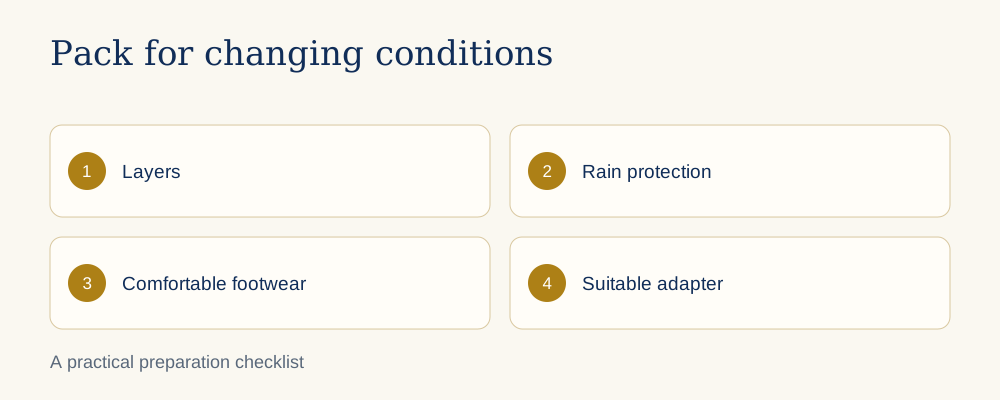
A windproof, waterproof jacket
In every season. The rain is light and the wind is not, and Danes carry jackets rather than umbrellas for exactly that reason.
Layers
Even in July an evening can drop to 12 °C, especially near water. A jumper in the day bag is standard.
Comfortable shoes
Copenhagen is a walking and cycling city with cobbles in the old quarters.
A plug adapter — maybe
Sockets are type K. A Czech or German type E/F plug fits and works; only fully earthed three-pin British or Swiss appliances need an adapter.
Swimwear
Year-round, genuinely. Harbour baths in summer, winter bathing clubs in January, hotel saunas in between.
Almost no cash
Cards everywhere and many places refuse notes. A small amount of DKK for a rural bakery or a shelter fee is enough.
Smart casual
Danes dress well but not formally, in a lot of black and grey. Almost nowhere requires a jacket; almost everywhere rewards looking like you thought about it.
A reusable bottle
Tap water is superb and free, and buying it bottled here is faintly absurd.
Click any image to enlarge. Been to Denmark? Send your photos to radimkaufmann@gmail.com to be featured here with full credit.
Nyhavn
A 1670s commercial canal, now the most photographed street in Scandinavia
Christiansborg
Parliament, supreme court and royal rooms on the islet where Copenhagen began
Tivoli after dark
The 1843 pleasure garden that Walt Disney came to study
The Jelling stones
Where the word 'Denmark' is written for the first time, c. 965
Hygge
Low warm light, small groups, nowhere else to be
Photographs most wanted: Skagen's colliding seas at Grenen, Møns Klint from the beach, a Copenhagen cycle lane in the rush hour, the Wadden Sea murmurations, and a summer house on the west coast in July.
34
📚 Useful Resources
VisitDenmark
The official tourist board, unusually well organised and honest about seasons: visitdenmark.com
DSB
National rail timetables and the cheap advance Orange tickets: dsb.dk
Rejseplanen
The journey planner that covers every train, bus, metro and ferry in the country in one search: rejseplanen.dk
Naturstyrelsen shelters
The national network of free and bookable wooden shelters for walkers and cyclists, at udinaturen.dk.
Copenhagen Card
Worth it from about three paid attractions a day, and it includes transport.
Emergencies
112 for emergencies, 1813 for out-of-hours medical advice in the capital region. EU consular protection applies.
Czech travellers should check current advice at mzv.gov.cz and may register in the DROZD system; the Czech Republic maintains an embassy in Copenhagen. The UNESCO listings are at whc.unesco.org.
35
📖 Recommended Reading
The Almost Nearly Perfect People — Michael Booth
An affectionate and sharply funny dismantling of the Nordic myth by an Englishman who lives in Denmark. The best single book to read before going.
Fairy Tales — Hans Christian Andersen
In a good modern translation, not a children's abridgement. They are stranger, sadder and better than the versions everyone half-remembers.
Miss Smilla's Feeling for Snow — Peter Høeg
A Copenhagen thriller that is also about Denmark's relationship with Greenland, which is the more interesting subject.
Out of Africa — Karen Blixen
Not about Denmark at all, and the finest prose any Dane has written.
A History of Denmark — Knud J. V. Jespersen
The straightforward single-volume history, short and clear.
The Year of Living Danishly — Helen Russell
A journalist moves to rural Jutland and investigates the happiness statistics from the inside. Light, and genuinely informative about daily life.
On screen: Borgen for how the country is actually governed, The Killing and The Bridge for the mood, Babette's Feast (1987) for the food and the austerity behind it, and Another Round (2020) for a very Danish argument about alcohol, work and middle age.
36
✍️ Author's Note
"Denmark hands the visitor a puzzle on the first afternoon. The weather is mediocre, the sky is low, the beer costs what a dinner costs at home, and the tax rate is a number you have to read twice. And the people are, by every measurement anyone has managed to devise, among the most contented on the planet. You spend the first two days looking for the catch."
"I stopped looking on a Tuesday, on a bicycle, at half past five, somewhere on Nørrebrogade in the rain. There were perhaps forty of us at the light — a man in a suit, two children on a cargo bike under a plastic cover, a woman with a Christmas tree strapped across her handlebars — and when it turned green the whole group moved off at exactly the same unhurried speed. Nobody raced. Nobody was angry. It had taken forty years of political decisions to make that ordinary moment possible, and not one person in that group was thinking about it."
"That is the thing worth taking home from Denmark, more than the design or the smørrebrød or Tivoli in the dark, all of which are wonderful. It is a country that decided a long time ago that the daily texture of ordinary life was a legitimate object of public policy — and then, being Danish, declined to boast about having got it broadly right. Man skal ikke tro man er noget. Don't think you're anything special. They rather are."
— Radim Kaufmann, September 2026
Share Your Photo
Have a Denmark photograph you own? Attach it to your email and include the location and the name you want credited.