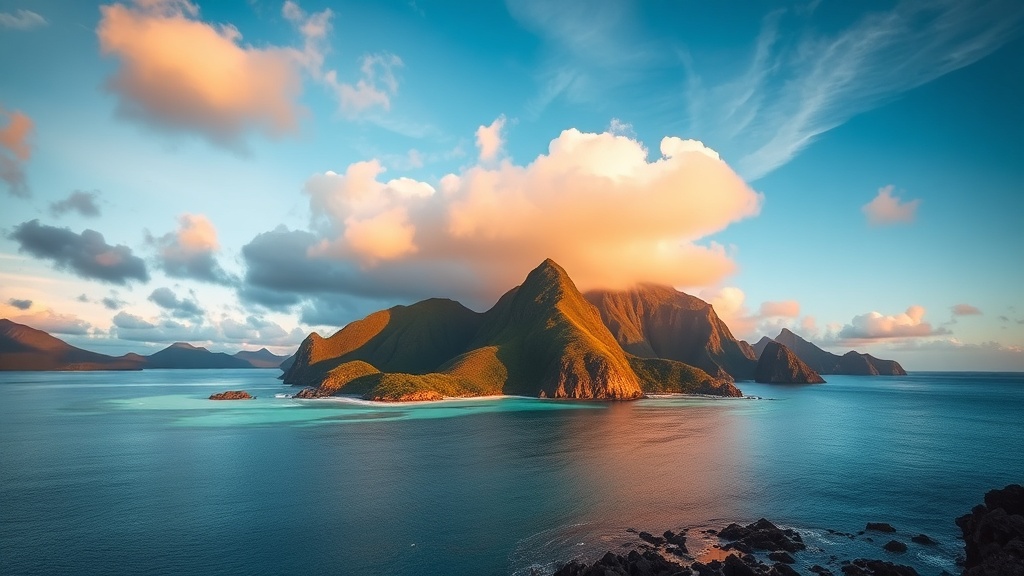


🇨🇰 Cook Islands at a Glance
🏝️ Overview — Why Visit the Cook Islands
The Cook Islands are fifteen islands scattered across roughly two million square kilometres of the South Pacific between French Polynesia and Samoa — an ocean territory larger than the land area of Mexico, holding a total of 236 km² of actual land and something like 15,000 residents. The capital, Avarua, sits on Rarotonga, the largest and most mountainous island.
What makes the country unusual among Pacific destinations is that it is genuinely easy to reach and has almost entirely resisted the development that follows. Air New Zealand flies direct from Auckland in about four hours. And yet there are no international hotel chains, no traffic lights, and — this is a real law, not a tourism slogan — no building may be taller than a coconut palm.
The two islands almost everyone visits are Rarotonga, a volcanic cone 32 kilometres around with a jungle interior and a single coastal road, and Aitutaki, whose triangular lagoon is regularly and defensibly described as the most beautiful in the world. Beyond them lie thirteen more islands that see almost no visitors at all, from Atiu's limestone caves and bush-beer circles to the northern atolls, among the most remote inhabited places on Earth.
The Cook Islands govern themselves in free association with New Zealand: their own parliament and laws, New Zealand citizenship and defence, the New Zealand dollar. It is one of the Pacific's most durable political arrangements, in place since 1965, and it has left the islands with an unusual combination — first-world safety and infrastructure alongside a culture that has not been flattened by tourism. The arrangement was tested in 2025–26, when Prime Minister Mark Brown signed a strategic partnership with China without consulting Wellington and New Zealand froze its development funding for ten months; a defence and security declaration signed on 1 April 2026 ended the standoff, and Brown's Cook Islands Party won a fifth consecutive term at the general election of 12 August 2026.
📛 Name & Identity
The islands carry the name of Captain James Cook, who sighted several of the southern group in 1773 and 1777 and called them the Hervey Islands. The name "Cook Islands" was applied later, in the 1820s, by the Russian cartographer Adam Johann von Krusenstern — so the country is named after a British explorer by a Russian mapmaker, for islands Polynesians had settled eight centuries earlier.
In Cook Islands Māori the country is Kūki 'Āirani. A national discussion about adopting an indigenous name has run since 2019, with Avaiki Nui among the proposals; it remains unresolved, and opinion on the islands is genuinely divided rather than merely undecided.
The flag, adopted in 1979, carries the Union Jack in the canton and a ring of fifteen white stars on blue — one star per island. The national anthem is Te Atua Mou E, "God is Truth", which tells you something accurate about the place.
Cook Islanders hold New Zealand citizenship, and the consequence is demographic: something in the order of 80,000 people of Cook Islands descent live in New Zealand alone (2018 census), with perhaps another 28,000 in Australia, against roughly 15,000 at home (14,987 at the 2021 census). The diaspora is around seven times the resident population, which shapes everything from family economics to who turns up for Te Maeva Nui.
🗺️ Geography & the Two Groups
The islands span from about 8°S to 23°S — some 1,400 kilometres north to south — and divide cleanly into two groups with very different characters.
Southern Group
Rarotonga, Aitutaki, Atiu, Mangaia, Mauke, Mitiaro, Manuae, Takutea and Palmerston. Mostly volcanic high islands with fertile interiors and fringing reefs. Almost all the population and all the tourism.
Northern Group
Penrhyn (Tongareva), Manihiki, Rakahanga, Pukapuka, Nassau and Suwarrow. Low coral atolls a few metres above sea level, extremely remote, reached by infrequent cargo ship or charter.
Rarotonga is a 32-kilometre-circumference volcanic cone, its interior rising to Te Manga at 652 m under dense forest, ringed by a lagoon and a single coastal road. Mangaia is the geological curiosity: estimated at around 18 million years old and often described as the oldest island in the Pacific, encircled by makatea — raised fossil coral cliffs that form a rampart around its volcanic centre.
The northern atolls sit only a few metres above the sea, and like Tuvalu and Kiribati they are acutely exposed to sea level rise, storm surge and saltwater intrusion into groundwater. This is not an abstract future problem for them; it is a current planning constraint.
The whole exclusive economic zone — nearly two million square kilometres — is designated as Marae Moana, among the largest marine protected areas on Earth, with graduated protection zones rather than a blanket ban on activity.
🗺️ Map of the Cook Islands
The nearest neighbours are French Polynesia to the east, Niue and Samoa to the west, and Kiribati far to the north. New Zealand is about 3,000 km to the south-west.
The map centres on Rarotonga, where almost every visit starts; Aitutaki lies 260 km north — a 45-minute flight — and Atiu and Mangaia sit to the east and south-east. Distances within the country are deceptive: Penrhyn, in the far north, is 1,365 km from Rarotonga, which is roughly Prague to Barcelona, and there is no scheduled flight.
📜 History
Polynesian settlement
Voyagers settled the islands from around 800–1000 CE, arriving in double-hulled ocean-going canoes from Tahiti and the Marquesas — journeys made deliberately, against prevailing winds, using stars, swell patterns and bird behaviour. Oral tradition preserves the names of the founding canoes, and several of them — Tākitumu, Tainui — appear in New Zealand Māori genealogy as well, because the Cook Islands were a staging point on the voyages that reached Aotearoa.
European contact and the missionaries
The Spanish navigator Álvaro de Mendaña sighted Pukapuka in 1595. Cook charted several southern islands in the 1770s without ever landing on Rarotonga, which was reached by Europeans only in 1813. The decisive arrival was the London Missionary Society in 1821, whose missionaries — many of them Tahitian rather than European — converted the islands within a generation and reshaped law, dress and the calendar. Gospel Day, 26 October, still marks the landing.
Protectorate, annexation, self-government
The islands became a British protectorate in 1888, largely to forestall French expansion, and were annexed to New Zealand in 1901. On 4 August 1965 the Cook Islands adopted a constitution establishing self-government in free association with New Zealand — full control of domestic affairs, with New Zealand retaining responsibility for defence and providing citizenship. Sir Albert Henry became the first premier.
The arrangement has lasted six decades and is one of the Pacific's most stable settlements. The country conducts its own foreign policy, holds treaties in its own name, and fields its own sporting teams, while its people carry New Zealand passports — a status that is easier to live with than to explain.
The 2025–26 New Zealand–China standoff and the 2026 election
The sixtieth anniversary of self-government fell on 4 August 2025, and it landed in the middle of the sharpest dispute the relationship with New Zealand has ever had. In February 2025 Prime Minister Mark Brown (Cook Islands Party, in office since October 2020) signed a five-year comprehensive strategic partnership with China in Harbin, covering seabed minerals, infrastructure and maritime cooperation, without consulting Wellington as the 1965 arrangement is understood to require. New Zealand paused NZ$18.2 million of core budget support in June 2025 and extended the freeze in October; the Cook Islands, meanwhile, signed a non-binding seabed-minerals cooperation statement with the United States on the anniversary itself. On 1 April 2026 Foreign Minister Winston Peters flew to Rarotonga and signed a Declaration on Defence and Security with Brown, committing the Cook Islands to consult New Zealand in good faith on anything touching its defence responsibilities; roughly NZ$30 million of funding was restored. Brown's line — "China is a good friend, but New Zealand is family" — summarised where it ended.
The general election of 12 August 2026 then gave the Cook Islands Party an outright majority of 13 of 24 seats, a historic fifth consecutive term; the Democratic Party, the old main opposition, lost every seat it held, and Cook Islands United (four seats) became the opposition. The King's Representative — the Crown's office in Rarotonga — is Sir Tom Marsters, in post since 2013 and reappointed in August 2025 for a fifth three-year term.
🎭 Culture & People
Cook Islands Māori culture is Polynesian, closely related to New Zealand Māori and Tahitian, and very much alive rather than performed. The language, Cook Islands Māori (often called Rarotongan), is spoken alongside English and is mutually intelligible with New Zealand Māori to a useful degree.
Dance is the flagship art form and it is not the gentle swaying of Hawaiian tourist shows — Cook Islands drum dance is fast, percussive and technically demanding, driven by wooden slit drums played at speed. The Te Maeva Nui festival each late July and early August, marking the anniversary of self-government, is a fortnight of inter-island dance and drumming competition and is the cultural event of the year by a distance.
Christianity is central. Sunday is genuinely observed: most shops and restaurants close, activity stops, and the white coral CICC churches (Cook Islands Christian Church) fill with unaccompanied four-part harmony singing that is worth arranging your week around. Visitors are welcome at services and should dress modestly — shoulders and knees covered.
Tivaevae, large hand-sewn appliqué quilts made collectively by groups of women, are the other major art form. They are not primarily commercial objects: they are made for weddings, funerals and hair-cutting ceremonies, and giving one away is the point of making it.
🗣️ Language & Useful Phrases
Both Cook Islands Māori and English are official, and English is universally spoken — you will never need the language to get by. You will, however, notice the difference it makes when you use a little of it, because the islands are small enough that effort registers.
Cook Islands Māori
Kia orana — the universal greeting; literally "may you live long". Used constantly, and returned.
Meitaki — thank you · Meitaki maata — thank you very much
Aere ra — goodbye (to someone leaving) · 'E no'o ra — goodbye (said by the one leaving)
Pe'ea koe? — how are you? · Meitaki au — I'm fine
'Ae — yes · Kare — no
Motu — islet · Marae — ceremonial ground · Umukai — earth-oven feast
Papa'a — a European/foreigner. Not an insult; simply the word.
The northern atolls have their own languages — Pukapukan in particular is distinct enough to be classed separately rather than as a dialect. Place names repay a moment's attention: Rarotonga is often read as "south" (raro) and "Tonga", Aitutaki as something like "led by god", and Marae Moana as "sacred ocean" — which is exactly what the marine park was named to mean.
🌋 Rarotonga
Rarotonga is a volcanic island 32 kilometres in circumference, ringed by reef and lagoon, with a single coastal road you can drive in about forty-five minutes. Everything happens on that ring; the interior is near-vertical jungle rising to Te Manga at 652 metres.
Avarua, the capital, is a small town rather than a city: a harbour, a handful of cafés, the government buildings and — the essential fixture — the Punanga Nui Market on Saturday mornings, which is the island's social centre as much as its produce market. Go early, eat breakfast there, and buy fruit you have never seen before.
Muri Beach on the south-east coast is where most visitors stay: a shallow, calm, extraordinarily blue lagoon with four motus offshore, good for kayaking, paddleboarding and kitesurfing. The lagoon at Muri is beautiful and shallow enough that at low tide you walk rather than swim; for actual snorkelling, Titikaveka on the south coast is the better water, with giant clams sitting a metre below the surface.
The Cross-Island Track is the island's signature walk: three to four hours from the north coast over the saddle beneath Te Rua Manga — "the Needle", a spire of rock that is the island's emblem — and down to Wigmore's Waterfall on the south side. It is steep, muddy, roped in places, and worth it. Take a guide in the wet season.
There is no public transport beyond the island bus, which circles the coast clockwise and anticlockwise all day and is charmingly cheap. Most visitors rent a scooter. A full overseas licence with a motorcycle entitlement is accepted; without one you sit a theory and a short practical test at the Avarua police station (NZ$10 each, NZ$20 for the licence, valid 30 days) — and the resulting Cook Islands licence is a souvenir in itself.
💎 Aitutaki
Aitutaki is the reason a great many people come. The island itself is a modest volcanic remnant with about 1,800 residents; the lagoon is the event. It is a vast triangular sheet of water, 45 square kilometres or so, in a range of blues that photographs cannot quite handle, enclosed by reef and dotted with uninhabited motus of white sand and coconut palms.
The lagoon cruise is the signature day: a boat working its way across the lagoon, snorkelling stops over giant clams and reef fish, a barbecue lunch on a deserted motu, and a landing at One Foot Island (Tapuaetai), whose one-room post office will stamp your passport with a foot-shaped mark. It is unabashedly a tourist ritual and it is also one of the genuinely great days out in the Pacific.
The scale of tourism here is worth stressing: nothing on the island resembles a resort in the Caribbean or Thai sense, and the largest properties run to a few dozen rooms. The pace is slower than Rarotonga's, which is saying something.
A 45-minute flight with Air Rarotonga connects the two islands several times daily. Day trips are sold and are perfectly feasible, but the lagoon deserves at least two nights — partly because the light in the early morning and late afternoon is the whole point, and a day trip gives you neither.
🏝️ The Outer Islands
Thirteen islands beyond Rarotonga and Aitutaki receive, between them, a tiny fraction of the country's visitors. Reaching them takes planning and, for the northern group, considerable determination.
Atiu
The third most accessible island. Limestone makatea caves — including Anatakitaki, home to the kopeka, a swiftlet that navigates by echolocation — coffee plantations, and the tumunu bush-beer tradition.
Mangaia
Around 18 million years old and often called the Pacific's oldest island. Dramatic raised coral cliffs, burial caves, and a landscape unlike anywhere else in the group.
Mauke & Mitiaro
Quiet makatea islands with cave pools, few visitors and accommodation that means staying with a family.
Manihiki
A northern atoll and the centre of the black pearl industry, with a lagoon full of farming lines.
Pukapuka
So remote and so linguistically distinct that it feels like a separate country. Reached by cargo ship, rarely.
Suwarrow
Uninhabited but for caretakers, a national park, and the island where Tom Neale lived alone for years — the subject of An Island to Oneself. Reachable only by yacht or charter.
Air Rarotonga serves Atiu, Mangaia, Mauke and Mitiaro on a limited schedule; the northern atolls depend on infrequent cargo ships or chartered aircraft. Accommodation on the outer islands generally means a family guesthouse, and the experience is correspondingly personal.
🍲 Cuisine
Cook Islands food is built on reef and ocean fish, taro, coconut, breadfruit and tropical fruit, and its centrepiece is the umukai — the earth oven, in which pork, chicken, fish, taro and breadfruit are wrapped in banana leaves and cooked slowly on hot stones. Sunday umukai after church is a cornerstone of family life, and being invited to one is the best thing that can happen to you here.
Ika mata
The national dish: raw reef fish — tuna or mahi-mahi — cured in lime juice and dressed with coconut cream, onion, tomato and cucumber. Cousin to Tahitian poisson cru.
Rukau
Young taro leaves simmered slowly in coconut cream until they collapse. Related to Samoan palusami and better than it sounds.
Poke
Not the Hawaiian dish. Here it is a sweet pudding of mashed banana or pawpaw with arrowroot and coconut cream, baked and sliced.
Curried eke
Octopus curry — the local answer to the question of what to do with a very good octopus and some imported spice.
Umukai
The earth oven itself, and by extension the feast. Several restaurants run "island nights" with an umukai and dance performance.
The Saturday market
Punanga Nui in Avarua: mango, pawpaw, starfruit, passionfruit, soursop, fresh coconut and cooked food from stalls. Breakfast here.
Restaurant cooking on Rarotonga is genuinely good and mixes Polynesian staples with New Zealand and Asian influence — a consequence of the New Zealand connection and of a small, competitive scene. Prices reflect that almost everything not caught or grown locally arrives by ship.
🍷 Beer, Tumunu & Drinking Culture
There is no wine production — the climate settles that — and New Zealand imports fill the lists. What the Cook Islands have instead is a small craft brewing scene and one genuinely remarkable living tradition.
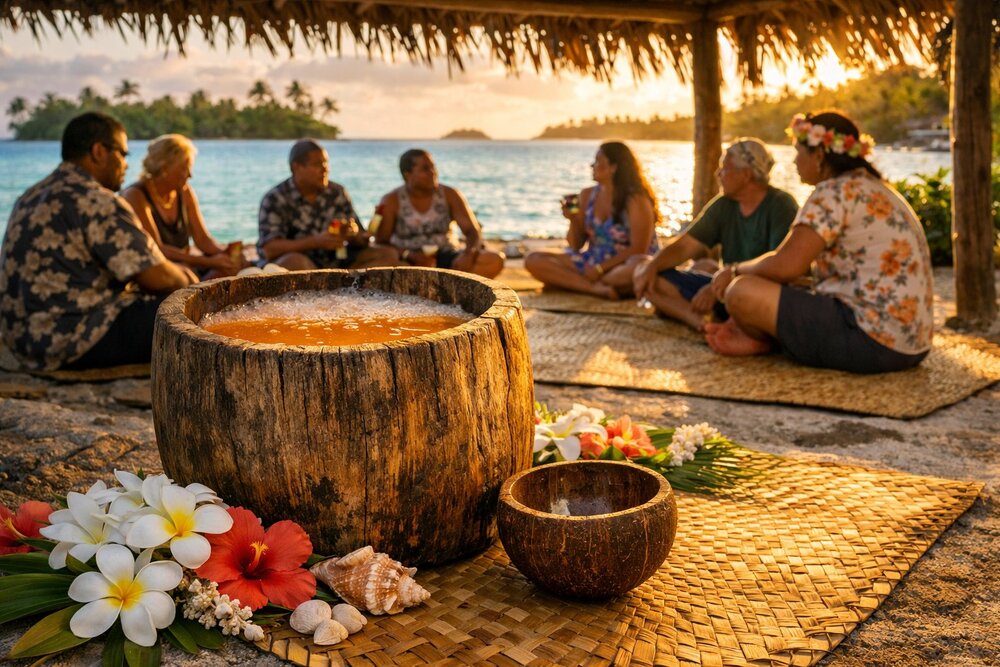
Tumunu is the tradition. The word names both the hollowed-out coconut palm stump in which an orange-based beer is fermented and the gathering that forms around it. On Atiu, participants sit in a circle in a bush-beer hall; a designated barman ladles the brew and controls the pace; there are rules about when you speak and when you drink; and the whole thing descends, in modified form, from pre-Christian Polynesian kava-drinking customs that the missionaries suppressed and that reasserted themselves in a new shape.
Visitors are welcome at a tumunu on Atiu and should go with someone who can explain the protocol, contribute to the pot, and understand that this is a social institution rather than an attraction.
Elsewhere, drinking is relaxed and beach-facing. Matutu Brewing on Rarotonga makes the local craft beer, and Cook Islands Lager is the everyday bottle. Trader Jack's on the Avarua waterfront is the long-standing institution. One thing to plan around: on Sunday most licensed premises are closed, along with everything else.
🍹 Cocktails & Mixed Drinks
Beachfront bars around Muri and Avarua run a competent tropical list built on rum, fresh coconut cream and fruit that was on a tree the same week.
Rarotonga Sunset
Dark rum, passionfruit pulp, pineapple, fresh lime and a splash of grenadine over crushed ice. The house drink of half the island.
Aitutaki Lagoon
Blue curaçao, white rum, coconut cream and pineapple — engineered to match the lagoon, and it very nearly does.
Piña colada
Made with genuinely fresh coconut cream rather than a tin, which is the entire difference and makes it worth ordering somewhere you would normally skip it.
Tumunu sour
A bar interpretation: bush beer shaken with lime, sugar syrup and bitters. Available where someone has thought about it.
Fresh coconut
Cut open at a roadside stall, drunk through a straw, then split so you can eat the flesh. The best value drink in the country.
Nu & lime
Young coconut water with lime and ice — the non-alcoholic default and better than anything with an umbrella in it.
🌤️ Climate & Best Time to Visit
The Cook Islands have a warm tropical climate with two seasons and, being in the southern hemisphere, an inverted calendar relative to Europe.
Dry season · April–November
22–28 °C, lower humidity, the least rain and the steadiest trade winds. This is the season to come. July and August are the coolest and busiest.
Wet season · December–March
Hotter, considerably more humid, more rain — often in short heavy bursts followed by sun — and the cyclone window. Prices drop and the islands are very green.
Sea temperature
25–29 °C year-round. Swimming and snorkelling are comfortable in any month, which is not true of most tropical destinations.
Cyclones
The South Pacific cyclone season runs roughly November to April. Direct hits are infrequent but real; travel insurance covering disruption is sensible for wet-season trips.
Best overall: May–June and September–October — dry-season weather without peak-season prices or crowds. If the culture matters more than the weather, come for Te Maeva Nui in late July and early August and accept that everything is fuller and dearer.
One scheduling note that catches people out: the Cook Islands sit east of the International Date Line, which puts them a day behind New Zealand despite being close to it. Flights from Auckland routinely arrive the day before they departed.
✈️ Getting There & Getting Around
Rarotonga International (RAR) is the only international gateway. Air New Zealand flies daily from Auckland — about four hours, up to three flights a day from June to October — plus a seasonal Christchurch service (May–October) and a weekly non-stop from Los Angeles. Jetstar flies from Auckland three times a week and from Sydney four times a week (with seasonal Brisbane departures), Hawaiian Airlines connects Honolulu once a week, and Air Tahiti links Papeete. Check schedules before booking: the Australian and US services have come and gone more than once.
From Prague there is no remotely direct option: the practical route is Europe to Auckland (via Dubai, Doha, Singapore or Los Angeles), then the Rarotonga flight, for a total journey of roughly 30–36 hours. The alternative is via Los Angeles and the seasonal LAX–Rarotonga service. Either way, this is a destination to combine with New Zealand or a broader Pacific trip rather than visit on its own from central Europe.
Visas: most nationalities, Czech citizens included, need no visa for stays up to 31 days; you must hold an onward ticket and confirmed accommodation. Extensions are possible on application.
Between islands: Air Rarotonga is the domestic carrier, with several daily flights to Aitutaki (45 minutes) and limited service to Atiu, Mangaia, Mauke and Mitiaro. The northern atolls have no scheduled flights and depend on occasional cargo ships or charters.
On Rarotonga: the island bus circles the coast clockwise and anticlockwise all day for a few dollars. Scooters and cars are widely rented. A full home licence covers a car, and covers a scooter only if it carries a motorcycle class; otherwise you take a theory and a practical test at the Avarua police station (NZ$10 each plus NZ$20 for a 30-day visitor licence). Helmets are compulsory. Roads are single-lane, dogs and chickens use them, and the speed limit is genuinely low.
📋 Practical Information
Electricity
240 V, 50 Hz, Type I plugs (Australian/New Zealand three-pin). Czech devices need an adapter; most chargers handle the voltage.
Money
The New Zealand dollar is legal tender, alongside distinctive local coins — including a triangular $2 — which are collectable but not accepted outside the country.
Water
Rarotonga's tap water is treated and generally safe. On outer islands, drink bottled, boiled or filtered.
Sunscreen
There is no sunscreen law here of the Hawaiian or Palauan kind, but lagoon operators ask for reef-safe products and the coral deserves it. Bring a mineral sunscreen without oxybenzone or octinoxate — it is also much cheaper than buying one on arrival.
Connectivity
Vodafone Cook Islands (the former Bluesky, rebranded in 2019) is the local operator; a prepaid SIM is the simplest option. Accommodation Wi-Fi is often slow and metered. Coverage on outer islands is patchy.
Time
UTC−10, no daylight saving — and east of the Date Line, so a day behind New Zealand. Eleven hours behind Czech winter time (CET) and twelve behind summer time (CEST).
Sunday
Genuinely observed. Shops, most restaurants and many activities close. Plan around it rather than being surprised by it.
Health & safety
No malaria (dengue does recur — Rarotonga had an outbreak from May 2025 to spring 2026), no dangerous land animals, low crime. The hospital is in Rarotonga; outer islands have clinics only. Insurance with evacuation cover is still sensible.
Two cultural points that matter practically: dress modestly away from the beach and especially at church — shoulders and knees covered — and be careful about what you photograph at ceremonies and in villages. Asking first is normal and welcome.
💰 Costs & Money
The Cook Islands are not cheap. Almost everything that is not fish, fruit or taro arrives by ship from New Zealand, and the freight shows up in every price. Budget accordingly rather than being caught out.
Budget · NZ$120–180/day
Hostel dorm or simple guesthouse, scooter rental, self-catering with market produce, the island bus, and cheap local meals. Roughly 1,700–2,600 CZK.
Mid-range · NZ$250–450/day
Beachfront self-catering bungalow, rental car or scooter, restaurant dinners, one or two paid activities. Roughly 3,600–6,400 CZK.
Upper · NZ$700–2,000+/night
The boutique resorts on Aitutaki and at Muri. Small properties, high prices, and no chains to undercut them.
Typical prices
Beer at a bar NZ$8–10 · restaurant main NZ$25–40 · Aitutaki lagoon cruise around NZ$150 · scooter hire NZ$25–35/day · island bus a few dollars.
Cards are widely accepted on Rarotonga and less so on Aitutaki; on the outer islands assume cash only and draw it before you fly. ATMs exist on Rarotonga and Aitutaki and essentially nowhere else. Tipping is not customary and is not expected — a genuine relief in a country this expensive.
🏨 Accommodation
There are no international chains, and the coconut-palm height law means everything is low-rise, small and set among trees rather than stacked above the beach. That constraint is the single biggest reason the islands look the way they do.
On Rarotonga, the range runs from backpacker hostels through self-catering beachfront bungalows to a handful of boutique properties. Muri is the main tourist strip with the best lagoon access and the most restaurants; the south and west coasts are quieter, with better swimming at Titikaveka and the sunsets on the west side at Aro'a and Black Rock.
On Aitutaki, options are fewer and pricier, from family guesthouses to small resorts with overwater or beachfront units. Book well ahead — capacity is genuinely limited.
On the outer islands, accommodation means a family-run guesthouse, often with meals included, and the experience is closer to staying with people than checking in. This is also where the invitation to a Sunday umukai is most likely to come from.
🎉 Festivals & Events
Te Maeva Nui · late July–early August
The national festival marking self-government in 1965. A fortnight of inter-island dance and drumming competition, feasting and parades in Avarua. The cultural event of the year.
Gospel Day · 26 October
Commemorates the London Missionary Society's arrival in 1821 with nuku — large open-air Biblical pageants staged by village congregations.
Vaka Eiva · November
One of the Pacific's largest outrigger canoe festivals, drawing paddlers from across the region for a week of ocean racing around Rarotonga.
Tiare Festival · November
The national flower celebrated with parades, floral displays and competitions.
Constitution Day · 4 August
The formal anniversary, sitting inside the Te Maeva Nui period.
Island nights
Not a festival but a weekly fixture: dinner-and-dance evenings at various venues on Rarotonga, and the easiest way to see drum dance done properly.
🏛️ Heritage & Marae Moana
The Cook Islands have no inscribed UNESCO World Heritage sites, and only one entry on its Tentative List — the Maungaroa Cultural Landscape on Rarotonga's western side, submitted on 17 January 2024, the country's first submission since it ratified the World Heritage Convention in 2009. Maungaroa's valley holds four clusters of pre-contact stone structures, old road systems and ancient marae — the stone ceremonial platforms that were the religious and political centres of pre-Christian Polynesian society. Several survive on Rarotonga, Aitutaki and the outer islands and are treated as living sacred sites rather than ruins; visit them with a guide and follow instructions about where to walk.
The country's flagship heritage project is environmental rather than architectural. Marae Moana — "sacred ocean" — designates the entire exclusive economic zone, nearly two million square kilometres, as a marine park, with a 50-nautical-mile no-industrial-fishing zone around every island and graduated protection elsewhere. It is one of the largest such designations on Earth.
It is also contested in a way worth knowing about: the Cook Islands have licensed exploration for deep-sea mining of polymetallic nodules within that same zone. The government presents it as a potential economic transformation for a country dependent on tourism and remittances; opponents, including within the islands, argue it is incompatible with Marae Moana and with an unknown deep-sea ecology. Three five-year exploration licences were issued in 2022 (to Cook Islands Cobalt, Moana Minerals and CIIC Seabed Resources); in November 2025 the Seabed Minerals Authority extended them for a further five years, which pushes any decision on commercial mining out to about 2032. In the meantime the question has become geopolitical: a seabed-minerals memorandum with China in February 2025, a cooperation statement with the United States on 4 August 2025, and NOAA's Okeanos Explorer mapping 24,000 km² of the zone in 2026. Nothing is settled, and it is the live political argument of the decade here.
Cultural heritage is protected more informally, through the Ministry of Cultural Development and, more effectively, through practice: tivaevae quilting, pe'e chants, drum dance and the umukai are transmitted because people still do them.
🎒 Packing Tips
Reef-safe sunscreen
Not legally required — the Cook Islands have no sunscreen ban — but lagoon-cruise operators ask for it and the reef needs it. Bring mineral sunscreen without oxybenzone or octinoxate from home; local stock is limited and expensive.
Water shoes & a rash vest
The lagoon floor is coral and the sun at 21°S is brutal. A long-sleeved rash vest beats reapplying sunscreen all day.
Your own mask and snorkel
Rentals are fine but yours fits. The snorkelling is the point of the trip and a leaking mask ruins it.
Modest clothing for Sunday
Shoulders and knees covered for church. A light shirt and a sarong or long skirt cover it.
Insect repellent
Mosquitoes are present, particularly at dusk and in the wet season. Dengue outbreaks recur: Rarotonga declared one on 22 May 2025 (more than 80 cases), and the Ministry of Health declared the country dengue-free again on 25 May 2026.
Cash for the outer islands
ATMs exist on Rarotonga and Aitutaki and nowhere else. Draw what you need before you fly.
Pack light generally: the domestic flights to Aitutaki and the outer islands have strict and low baggage allowances, and enforcing them is not negotiable on a small aircraft.
👑 Notable Cook Islanders
Sir Albert Henry (1907–1981)
First Premier of the self-governing Cook Islands from 1965, and the dominant political figure of the country's first decade.
Sir Tom Davis (1917–2007)
Premier, physician who worked on NASA space-medicine programmes, and ocean voyager who sailed a traditional vaka across the Pacific. Improbable and entirely real.
Sir Geoffrey Henry (1940–2012)
Long-serving Prime Minister through the 1990s, and a driving force behind the modern cultural festival calendar.
Kevin Iro (b. 1968)
Rugby league international and, later, a leading advocate for the Marae Moana marine park.
Mark Brown (b. 1962)
Prime Minister since October 2020 and leader of the Cook Islands Party; signed the 2025 China partnership that froze relations with New Zealand, then the April 2026 defence declaration that repaired them, and won a fifth consecutive term for his party in August 2026.
Alan Bollard (b. 1951)
New Zealand economist whose doctorate was a study of the Cook Islands — he spent a year on Atiu researching aid projects; later Secretary to the Treasury and Governor of the Reserve Bank of New Zealand 2002–2012.
Teremoana Rapley (b. 1972)
Singer and broadcaster of Cook Islands descent, a significant figure in New Zealand music.
The vaka navigators
Modern crews of Marumaru Atua and other traditional canoes who revived deep-ocean wayfinding without instruments.
The diaspora
Around 80,000 Cook Islanders live in New Zealand and perhaps 28,000 more in Australia — roughly seven times the resident population of 15,000, and a defining fact of national life.
🏉 Sports
Rugby league and rugby union are the national obsessions, and the Cook Islands punch far above a population of 15,000 — largely because the diaspora is eligible. The national league side, the Aitu (informally the Kukis), has qualified for multiple Rugby League World Cups and has repeatedly beaten much larger nations: it took the last of the ten places at the 2026 Rugby League World Cup by beating South Africa 58–6 in Sydney on 9 November 2025, and plays Australia, New Zealand and Fiji in Group A when the tournament opens in Australia and Papua New Guinea on 15 October 2026. At the Commonwealth Games in Glasgow (23 July–2 August 2026) the Cook Islands sent 15 athletes in four sports and, as usual, came home without a medal — the country's only Commonwealth medal to date is a lawn bowls bronze.
Outrigger canoe paddling (vaka) is both a traditional skill and a serious competitive sport. The Vaka Eiva festival each November is one of the Pacific's biggest paddling events, with crews arriving from Tahiti, Hawaii, New Zealand and beyond for a week of ocean racing around Rarotonga.
Netball has a strong following, as do cricket and boxing. The Cook Islands compete at the Commonwealth Games and the Pacific Games under their own flag — one of the practical expressions of a sovereignty that is otherwise shared with New Zealand.
For visitors: a Saturday league match at the ground in Avarua costs almost nothing, is loud, and is one of the better ways to spend an afternoon that has nothing to do with a lagoon.
📰 Media & Press Freedom
Press freedom in the Cook Islands is generally robust by regional and global standards. Cook Islands News, founded in 1945 and privatised in 1989, is the main daily and publishes online; Radio Cook Islands provides public broadcasting and is genuinely important on the outer islands, where it is sometimes the only reliable channel.
The Cook Islands are not among the 180 countries scored in the Reporters Without Borders index, so there is no rank to quote; qualitatively it sits among the freer media environments in the Pacific. The structural limitation is not censorship but size: in a country of 15,000 people where the journalist, the minister and the subject of the story are likely to be related, a degree of self-censorship around personal and community matters is inevitable and openly acknowledged.
For visitors this matters mainly as context — a small-community dynamic that also explains why local news is unusually detailed about things a larger country would not report, and unusually careful about things it would.
✨ Fascinating Facts
No building taller than a palm
It is literally the law on Rarotonga, and it is the reason the island looks the way it does.
The diaspora outnumbers the country
Roughly 80,000 Cook Islanders live in New Zealand and around 28,000 in Australia; 14,987 lived in the Cook Islands at the 2021 census.
A triangular two-dollar coin
The Cook Islands mint some of the world's oddest legal tender, including a triangular $2 and a scalloped $5.
An ocean the size of Mexico
Marae Moana covers nearly 2 million km² — larger than the land area of Mexico, for a country with 236 km² of land.
The Pacific's oldest island
Mangaia is estimated at around 18 million years old.
A licence in an afternoon
A Cook Islands visitor scooter licence — theory test, a lap of the police car park, NZ$40 all in — is issued at the Avarua police station, and people keep them as souvenirs.
A day behind New Zealand
East of the Date Line: you land in Rarotonga the day before you left Auckland.
Named by a Russian
Krusenstern applied "Cook Islands" in the 1820s. Cook himself called them the Herveys and never landed on Rarotonga.
📸 Photo Gallery
We have only a couple of photographs of the Cook Islands. If you have been — Aitutaki, Muri, the Cross-Island Track, a tumunu on Atiu — send yours to photos@kaufmann.wtf and we will feature them here with credit.
🔗 Useful Resources
Cook Islands Tourism
Official tourism site, with island-by-island practicalities: cookislands.travel
Air Rarotonga
The domestic carrier — schedules for Aitutaki and the outer islands: airraro.com
Cook Islands News
The daily paper, and the best way to know what is actually happening: cookislandsnews.com
MZV ČR & DROZD
Czech travel advice and voluntary pre-travel registration: mzv.gov.cz
📚 Recommended Reading & Watching
An Island to Oneself · Tom Neale
The classic: a New Zealander's account of living alone on Suwarrow for years. Still the book people take with them.
The Cook Islands 1820–1950 · Richard Gilson
The standard historical reference, and dry in the way standard references are.
Isles of the Frigate Bird · Ronald Syme
Mid-century travel writing about the group, worth reading with the period in mind.
Cook Islands Politics: The Inside Story · ed. Ron Crocombe
How self-government actually worked in practice, by the people who ran it.
Vaka Moana · ed. K. R. Howe
On Polynesian voyaging — the context that explains how anyone got here at all.
Te Maeva Nui footage
Search for recent festival performances: drum dance at competition standard is a different thing from a hotel show.
Cook Islands Tourism's films
Short cultural documentaries and lagoon drone footage on the official channel.
The Legend of Ina and the Shark
A children's retelling of a well-loved local myth — and a decent introduction to the oral tradition.
✍️ Author's Note
"I went to the Cook Islands expecting a pretty beach and found something with more weight to it. The lagoon at Aitutaki is as good as the photographs promise — better, in fact, because there is almost nobody in them and almost nobody there."
"What stayed with me was Rarotonga at dusk: circling the island on a scooter, stopping at a roadside stall for papaya, and hearing hymns coming through open church windows on a Sunday morning — unaccompanied, four parts, a whole village singing without anyone conducting it."
"On Atiu an elder ladled warm tumunu out of a hollowed log while the circle argued amiably about which reef pass held the best parrotfish, and I understood something no history book had managed to explain: island time is not a marketing line, it is a position on what a day is for. The Cook Islands are proof that paradise does not require luxury — the best of it is free, and the country has been careful enough to keep it that way."
— Radim Kaufmann, September 2026
Support This Project 🌍
This World Travel Factbook is a labor of love – free to use for all travelers. If you find it helpful, consider supporting its continued development.
