

🇨🇬 Congo at a Glance
🌏 Overview — Why Visit Congo
The Republic of the Congo — Congo-Brazzaville, as everyone calls it to keep it apart from its vastly larger neighbour across the river — is the accessible door into the Congo Basin, the second-largest rainforest on Earth after the Amazon. Around two thirds of the country is unbroken forest canopy, and unlike almost anywhere else in Central Africa, a well-organised visitor can actually get into it.
That is the whole case for coming. In Odzala-Kokoua National Park you can track habituated western lowland gorillas on foot and stand at the edge of a bai — a mineral-rich forest clearing — while forest elephants, bongo and sitatunga walk out of the treeline in the late afternoon. In Nouabalé-Ndoki, further north, the forest has never been logged and the chimpanzees have famously little idea what a human is. There is no other combination like it on the continent.
Brazzaville is the other reason. It sits on the Congo River directly opposite Kinshasa, making the two the closest pair of national capitals in the world — you can see the skyline of a different country from the riverside promenade. The city is green, low-rise and startlingly relaxed for Central Africa, and it is one of the birthplaces of Congolese rumba and the home of the Sapeurs.
Be realistic about what this costs and demands. Tourism infrastructure barely exists outside the two cities and the handful of park camps; the wildlife lodges are priced at the level of the most expensive safaris in Africa; visas take time; and the roads are what they are. Congo-Brazzaville is a destination for people who want the forest badly enough to plan around it.
📛 Name & Identity — Which Congo?
Two neighbouring countries carry the name Congo, and confusing them is the single most common mistake made about this part of Africa. Both are named after the Kongo Kingdom and the river that drains their shared basin.
Republic of the Congo
This country. Capital Brazzaville. About 6.6 million people (UN 2026), 342,000 km², former French colony, independent 1960. Usually called Congo-Brazzaville.
Democratic Republic of the Congo
The giant across the river. Capital Kinshasa. Around 100 million people, 2.34 million km², former Belgian colony. Usually called Congo-Kinshasa or DRC; was Zaire from 1971 to 1997.
The convention of naming each by its capital exists precisely because the two are otherwise indistinguishable in a headline. The river between them is the border; the ferry crossing between the two capitals takes about fifteen minutes and passes between two entirely different colonial legacies, currencies and legal systems.
The capital honours Pierre Savorgnan de Brazza, the Italian-born French explorer who negotiated the treaties that brought the north bank under French control in 1880 — one of the very few colonial figures whose reputation in the country he claimed is still, on balance, positive; his mausoleum stands in central Brazzaville. The national motto is Unité, Travail, Progrès — Unity, Work, Progress.
🗺️ Geography & Regions
Congo straddles the equator, so the country has genuinely no seasons in the temperate sense — only wetter and drier months. It covers 342,000 km², a little over four times the size of Czechia, and holds only some six and a half million people, most of them in two cities.
The northern two thirds are Congo Basin rainforest: Sangha, Likouala and Cuvette departments, a green expanse crossed by rivers rather than roads, containing both national parks and some of the least disturbed forest left on the planet. Large parts of it are reachable only by boat or light aircraft, and the Likouala swamp forest is one of the largest wetlands in the world.
The Batéké Plateaux in the centre and south are something else entirely — open savanna grassland on sandy soil, with gallery forest along the rivers, escarpments and waterfalls. The Léfini reserve here is far easier to reach from Brazzaville than the northern parks and holds reintroduced western lowland gorillas.
The south-west runs down through the Mayombe hills to a short Atlantic coastline around Pointe-Noire, the only port and the centre of the oil industry that funds the state. The Congo River and its tributary the Ubangi form the whole eastern border with the DRC; the river's Stanley Pool (Pool Malebo) widens to 20 km between the two capitals before dropping into unnavigable rapids on its way to the sea.
🗺️ Map of Congo
Congo borders Gabon and Cameroon to the west and north-west, the Central African Republic to the north-east, the Democratic Republic of the Congo along the river to the east and south, and the Angolan exclave of Cabinda in the far south-west.
The single paved artery, the RN1 between Brazzaville and Pointe-Noire, was completed in the 2010s and cut a journey of several days to roughly eight hours. The historic alternative, the Congo-Ocean Railway of 1934, is running again: after a seven-year suspension, the La Gazelle passenger service between Brazzaville and Pointe-Noire resumed on 27 April 2023 and now departs several times a week — one of the more atmospheric rail journeys in Africa, when it keeps to the timetable.
📜 History
Before the French
Bantu-speaking peoples settled the region over some two thousand years, displacing or absorbing the forest-dwelling groups whose descendants — the Aka and other peoples often lumped together as "Pygmies", a term now widely rejected in favour of their own names — still live in the northern forest. From the 14th century the Kingdom of Kongo dominated the lower river and coast, a centralised state that exchanged embassies with Portugal and converted its rulers to Christianity, before the Atlantic slave trade hollowed it out. The Teke kingdom held the plateaux inland, and it was with the Teke ruler Makoko that Brazza signed his treaty.
French Equatorial Africa (1880–1960)
Brazza's 1880 treaty put the north bank under French protection, and from 1910 the territory was administered as Moyen-Congo within French Equatorial Africa, with Brazzaville as the federal capital. The concessionary companies of the early period were brutal, and the Congo-Ocean Railway built between 1921 and 1934 killed an estimated 17,000 forced labourers — a scandal significant enough to reach the French press through André Gide's Voyage au Congo. In 1944 Brazzaville hosted De Gaulle's conference on the post-war future of the French empire, and for a period it served as the capital of Free France.
Independence and the Marxist decades
Independence came in August 1960 under Fulbert Youlou, who was overthrown three years later. The country became the People's Republic of the Congo in 1969 — the first avowedly Marxist-Leninist state in Africa — under a single party, with Marien Ngouabi as president until his assassination in 1977. Denis Sassou Nguesso took power in 1979.
Civil war and the present
Multiparty elections in 1992 brought Pascal Lissouba to office; the collapse of that experiment produced two civil wars, in 1993–94 and, far more destructively, in 1997–99, fought largely between militias attached to rival politicians and centred on Brazzaville and the Pool region. Sassou Nguesso returned to power in 1997 and has held it since, through constitutional revisions that removed term and age limits. A further insurgency in the Pool ran from 2016 until a ceasefire in December 2017. On 15 March 2026 he was declared re-elected to a fifth term with a reported 94.8% of the vote, in an election the main opposition parties boycotted, with activists detained beforehand and the internet cut on polling day; he was sworn in at Kintélé on 16 April 2026, taking his time in office past 42 years across the two spells. Prime Minister Anatole Collinet Makosso (in office since May 2021) resigned with his cabinet as the constitution requires, was reappointed on 23 April 2026 and named a 42-member government the next day, with Jean-Jacques Bouya as vice prime minister for infrastructure. Oil pays for the state — and left it heavily indebted when prices fell — while the country has increasingly positioned its intact forest as a second national asset.
👥 People & Culture
About 6.6 million people live in Congo (UN mid-2026 estimate), and it is one of the most urbanised countries in Africa: roughly two thirds are in Brazzaville, Pointe-Noire and the corridor between them, leaving the enormous northern forest almost empty.
The largest groups are the Kongo (including the Lari of the Pool region) in the south, the Teke on the plateaux, and the Mbochi and related peoples of the north — a north-south division that has mapped uncomfortably onto the country's politics for decades. The Aka and other forest peoples of the north maintain hunting and gathering traditions and a polyphonic vocal music inscribed by UNESCO as intangible heritage (on the Central African Republic's nomination; Congo's own Aka communities sing the same tradition), while facing severe discrimination and land pressure.
French is the official language and the medium of education and administration. In practice the country runs on two lingua francas: Lingala in the north and in Brazzaville, and Kituba (Munukutuba) in the south — Lingala being the same language that carries Congolese rumba across the continent. Christianity predominates, generally blended with older practice, and both Catholic and independent African churches are strong.
Family and neighbourhood obligation runs deep, greeting rituals are unhurried, and the ordinary courtesy of asking after someone's family before business is not optional. Photography is the one area where visitors get into genuine trouble: photographing anything that could be read as official — bridges, ports, uniformed people, government buildings — is a reliable way to have an expensive conversation with the police.
🗣️ Language & Useful Phrases
French will get you everywhere that matters — hotels, parks, officialdom, both cities — and English will not. A few words of Lingala, however, changes the temperature of every interaction, because it signals you have bothered.
Lingala worth knowing
Mbote — hello
Sango nini? — what's the news? (the standard greeting)
Sango te — no news, all is well (the standard reply)
Matondi / Melesi — thank you
Malamu — good, fine
Ntalo boni? — how much?
Mama / Tata — respectful address for an older woman / man
Kende malamu — go well, goodbye
In the south, Kituba replaces Lingala and mbote becomes mbote anyway — the greeting travels. French spoken in Congo is clear and unhurried, and Congolese are used to accommodating non-native speakers, so imperfect school French is perfectly serviceable.
🏙️ Brazzaville
Brazzaville holds roughly two and a half million people and does not feel like it. It is green, largely low-rise, laid out on broad tree-lined boulevards from the colonial period, and after Kinshasa's roar it can feel almost provincial — which is a large part of its charm.
The Basilique Sainte-Anne du Congo, finished in 1949, is the landmark: a parabolic concrete vault roofed in green Ivorian tiles, by the architect Roger Erell, and one of the more striking mid-century churches anywhere in Africa. The Mémorial Pierre Savorgnan de Brazza, a white marble mausoleum opened in 2006, is the other obvious monument and holds a small museum. The Poto-Poto quarter is where the painting school founded in 1951 produced the distinctive stylised figures now known as the Poto-Poto style, and the workshop still sells directly.
The corniche along the river is where Brazzaville goes in the evening, with the towers of Kinshasa on the far bank and Stanley Pool opening up downstream. The Marché Total in Bacongo is the big working market. Nightlife means live music, and it means it seriously: rumba, soukous and ndombolo, played by bands in bars that fill after eleven.
One practical note that surprises visitors: the Pool region immediately south-west of the city was the site of insurgency as recently as 2016–17 and, while quiet since the ceasefire, is not a place to wander into casually. In the city itself the ordinary rules apply — taxis rather than walking after dark, nothing valuable on display.
🏖️ Pointe-Noire & the Coast
Pointe-Noire is the economic capital: the deep-water port, the offshore oil industry, and around a million people, with a more international and business-shaped feel than Brazzaville. It has the country's best restaurants and hotels for exactly that reason, and the expatriate spending that sustains them.
The Côte Sauvage — the "wild coast" — is the long Atlantic beach the city goes to at weekends. It is genuinely wild: strong surf, a serious undertow and no lifeguards, so it is a place to walk rather than swim. Twenty-odd kilometres north, the Gorges de Diosso are a red-earth amphitheatre of eroded cliffs sometimes billed as Congo's Grand Canyon, which oversells the scale but not the colour; the nearby Diosso museum covers the Loango kingdom that ruled this coast.
North again lies Conkouati-Douli National Park, where forest, savanna, lagoon and ocean meet — chimpanzee rehabilitation, manatees, and leatherback and olive ridley turtles nesting on the beaches between November and March. It is the most reachable protected area in the country and much cheaper to visit than the northern forest parks.
Between the two cities runs the Congo-Ocean Railway through the Mayombe forest — a 510 km line whose construction cost thousands of lives and which, since passenger trains returned in April 2023, is again the most interesting way to cross the country.
🦍 Odzala-Kokoua — Gorillas in the Forest
Odzala-Kokoua National Park in the north-west is the reason most visitors come. Established in 1935, it is one of Africa's oldest protected areas, covering roughly 13,500 km² of rainforest, marshy bais and pockets of savanna, and it is managed under a long-running partnership between the Congolese state and African Parks. Its Forest Massif was inscribed on the UNESCO World Heritage List on 16 September 2023 — the country's second World Heritage site after Sangha Trinational (2012), and the only one it holds alone.
The experience is unlike an East African safari in every respect. You track western lowland gorillas on foot through dense forest with trackers who know the individual families, and habituation here has been decades of patient work. Sightings are close and quiet and there is no vehicle to sit in. The other half of the park's magic is the bai: a clearing where mineral-rich mud and water draws animals out of the canopy. From a raised platform at a bai like Lango, forest elephants, forest buffalo, sitatunga, bongo and bushpigs come out into the open in the late afternoon.
Getting there
Charter flight from Brazzaville to Mboko or a very long drive north. Access is effectively through the park's own logistics.
When
The drier windows, roughly June–August and December–February, are easiest for tracking; the forest is walkable year-round but wetter months mean mud.
Cost
This is priced with the most expensive experiences in Africa — think four figures per person per night, all-inclusive, with a multi-night minimum.
Fitness
Several hours of humid forest walking a day, no altitude but plenty of mud, roots and river crossings. Long sleeves, gaiters and a good repellent.
Nouabalé-Ndoki National Park in the far north, run with the Wildlife Conservation Society, is the harder and purer version: forest that has never been logged, the celebrated Mbeli Bai where gorillas have been studied continuously since 1995, and the Goualougo Triangle, where chimpanzees show so little fear of humans that researchers describe them as "naive". It is part of the Sangha Trinational UNESCO World Heritage site shared with Cameroon and the Central African Republic. Getting in takes days and considerable money.
🐘 Wildlife & Conservation
Congo holds one of the largest remaining populations of western lowland gorillas — a species listed as Critically Endangered, having lost roughly 60% of its numbers in twenty-five years to Ebola outbreaks and poaching. The Congolese forest, together with Gabon's, is where most of what remains lives.
The African forest elephant, recognised as a separate species only in 2021 and also Critically Endangered, is smaller than its savanna cousin, with straighter downward tusks and rounder ears, and is the animal most likely to make an unforgettable appearance at a bai. Central chimpanzees, bongo, sitatunga, giant forest hog, red river hog and forest buffalo fill out the large-mammal list, and the bird list runs past 600 species, including the elusive Congo peafowl's relatives and a strong slate of forest hornbills, greenbuls and picathartes.
Conservation here is not a background note but the country's central international story. Congo has committed a substantial share of its territory to protected areas, both the Sangha Trinational (2012) and the Forest Massif of Odzala-Kokoua (2023) carry UNESCO World Heritage listing, and the Congo Basin as a whole absorbs more carbon than it emits — one of the very few forest regions on Earth of which that is still true. The pressures are equally real: industrial logging concessions, road-building, the bushmeat trade, and since 2023 renewed licensing of oil and gas exploration blocks, some overlapping peatlands whose carbon store was only mapped in 2017.
For a visitor the practical consequence is simple: the money paid to Odzala or Conkouati is a substantial part of what keeps those parks staffed, and it is worth choosing operators that are transparent about where it goes.
That scrutiny now extends to the park's manager. After years of allegations from Survival International and a 2024 newspaper investigation, an independent review commissioned by African Parks confirmed in 2026 that rangers it employs at Odzala had beaten, tortured and raped Baka people from villages around the park. The charity has not published the findings in full; Prince Harry left its board on 24 August 2026. Odzala remains the best-run forest park in the country, but a visitor should know whose land it sits on and ask the lodge what has changed.
🚣 The Congo River
The Congo is the deepest river in the world — over 220 metres in places downstream of Kinshasa — the second longest in Africa after the Nile, and second only to the Amazon by discharge, pushing an average of some 41,000 cubic metres per second into the Atlantic. It crosses the equator twice, which is why it never has a dry season: one hemisphere's rains always feed it.
At Brazzaville the river opens into Pool Malebo (Stanley Pool), a lake-like widening about 35 km long, before dropping through the Livingstone Falls — 32 cataracts in 350 km — which is why no ship ever sailed up from the sea, and why the colonial powers built railways from the coast to the pool instead.
The ferry between Brazzaville and Kinshasa is one of the world's strangest border crossings: fifteen minutes of water between two capitals, two currencies and two languages of administration, with a full customs and immigration process at each end. Both sides require the correct visa in advance, and the crossing is bureaucratic rather than casual.
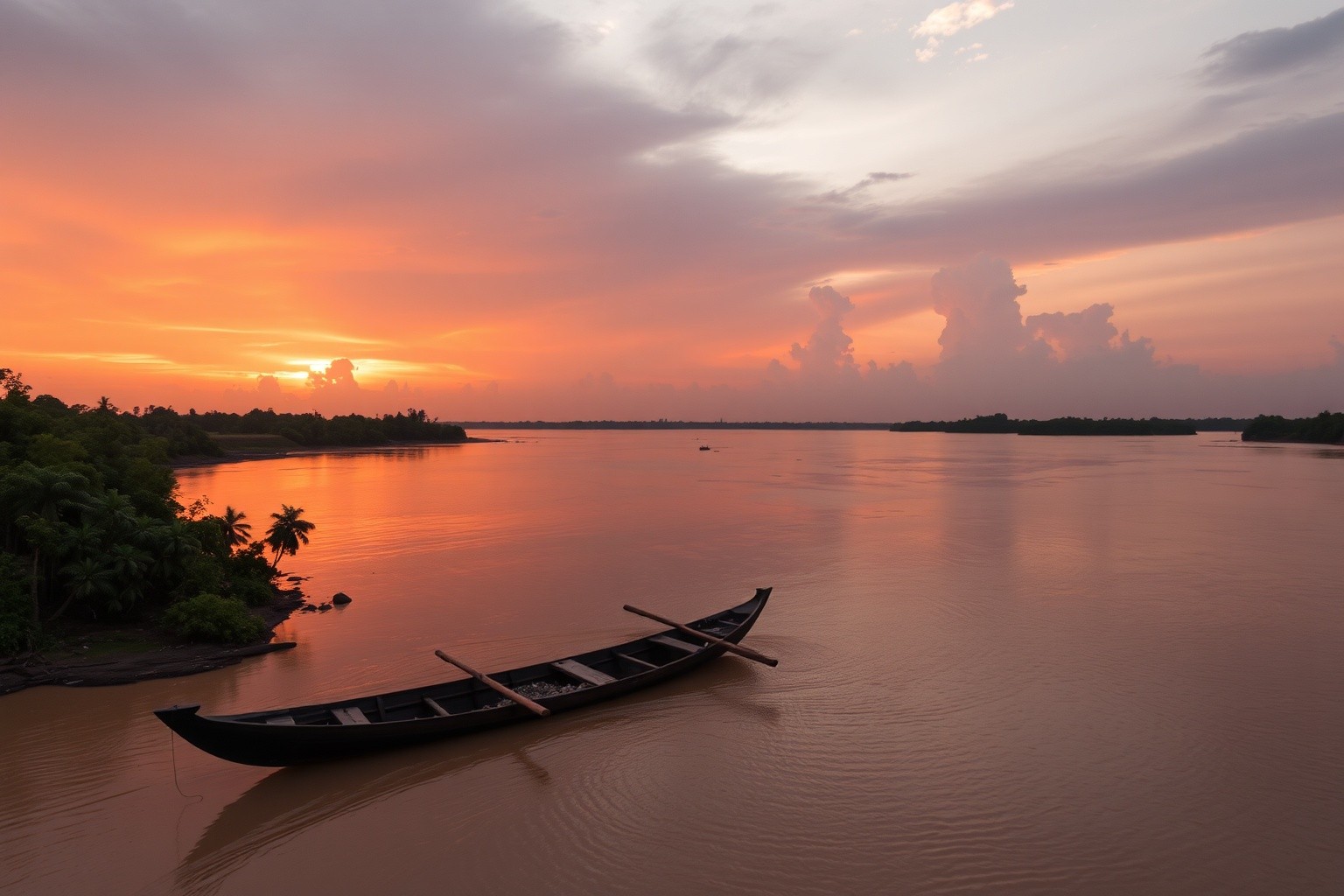
Upstream, the river and its tributaries — the Sangha, the Likouala, the Ubangi — are the actual road network of the north. Barges take days, pirogues take patience, and travelling this way is the closest a visitor gets to how the country's interior actually works: forest wall on both sides, villages appearing at the bank, and sandbanks to camp on when the water is low.
🥘 Cuisine
Congolese food comes out of the forest and the river: cassava in every form, palm oil, smoked freshwater fish, and leaves cooked long and slow. It is not a cuisine of many spices, and it is a great deal better than that description suggests once you have eaten it properly.
Saka-saka
Pounded cassava leaves stewed with palm oil, onion and smoked fish or peanut paste. The everyday national dish, eaten with rice or cassava.
Mwambé / moambe
Chicken or fish in a thick palm-nut sauce — the celebratory dish shared across the whole Congo basin.
Fufu & chikwangue
Fufu is pounded cassava dough; chikwangue is fermented cassava paste steamed in marantaceae leaves, dense and sour. Both are the starch that carries the sauce.
Liboké / maboké
Fish or meat wrapped in leaves with chilli and onion and steamed over embers — the Congolese parcel, and the best thing on most menus.
Capitaine
Nile perch from the river, grilled whole, usually with plantain. The default good meal in both cities.
Brochettes & plantain
Skewered goat or beef from a street grill, with fried plantain and pili-pili chilli sauce.
Peanut (groundnut) paste thickens a great many sauces, and pili-pili — small fierce chillies crushed with oil — sits on the table rather than in the pot. Tropical fruit is abundant and cheap: mango, papaya, pineapple, safou (the purple African plum, roasted until it softens), and the palm nut itself.
Bushmeat is culturally important and openly sold in markets, and it is also the single biggest direct threat to the wildlife people come here to see, as well as a documented route for zoonotic disease. Visitors have an easy and unambiguous choice here: don't eat it, and don't photograph it in a way that treats it as a curiosity.
French colonial habit left one durable inheritance — good bread. Fresh baguette is available in both cities every morning and is a large part of how the day starts.
🍷 Wine, Spirits & Drinking Culture
There is no wine industry here and there never will be — equatorial rainforest is the least viticultural climate on Earth. Imported French wine appears in Pointe-Noire's oil-industry restaurants at oil-industry prices. What Congo has instead is beer, palm wine and a bar culture that is a genuine social institution.
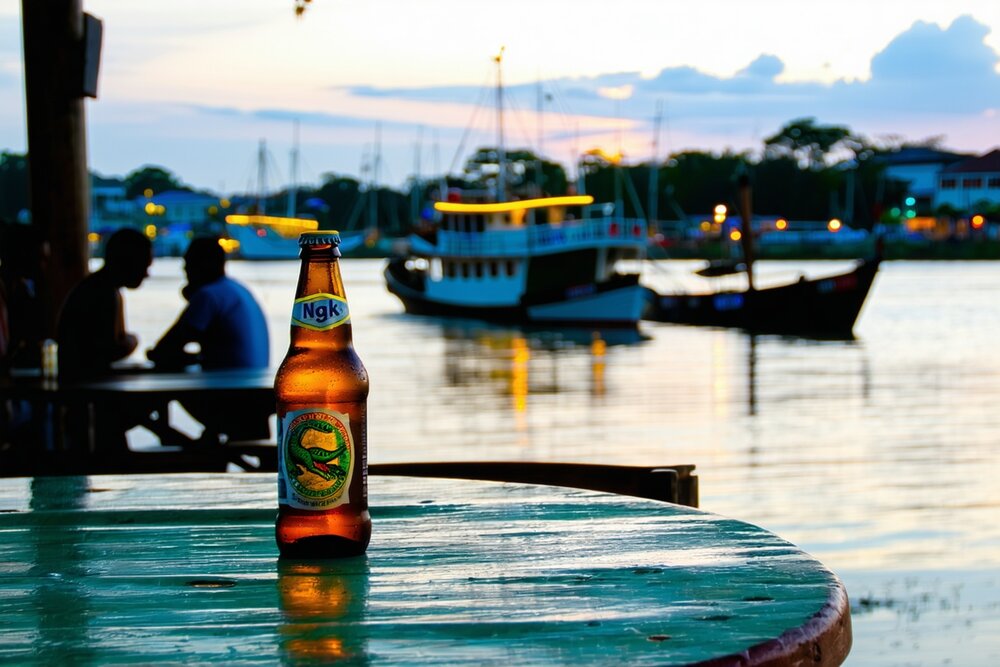
Ngok — "crocodile" in Lingala — and Primus are the national lagers, both brewed locally, and Castel is the other ubiquitous label. Beer is sold in large bottles meant to be shared, arrives with glasses for the table, and drinking alone is regarded as faintly sad.
Palm wine (nsamba) is the traditional drink and the culturally significant one: sap tapped from a felled or standing palm, fermenting naturally within hours, sweet and cloudy in the morning and sharply alcoholic by the afternoon. It is a village drink rather than a bar drink, offered as hospitality, and it does not travel or keep. Lotoko, distilled from maize or cassava, is the local spirit — potent, unregulated and highly variable.
The bar is where Congolese social life happens, and it is inseparable from music: a nganda or terrace bar with rumba on the speakers, plastic chairs on the pavement, and conversation running to two in the morning. Brazzaville after dark is one of the more enjoyable cities in Central Africa for exactly this reason.
🎵 Congolese Rumba
The two Congos together produced the most influential popular music in modern Africa. Congolese rumba came out of Kinshasa and Brazzaville in the 1940s and 50s, when Cuban son records — themselves descended from Central African rhythm carried across the Atlantic by enslaved people — came back up the river and were reworked with Lingala lyrics and electric guitars. UNESCO added Congolese rumba to its intangible heritage list in 2021, jointly for both countries.
From rumba came soukous in the 1970s, with its accelerating sebene guitar sections, and ndombolo in the 1990s. The names that carried it — Franco Luambo, Tabu Ley Rochereau, Papa Wemba, Koffi Olomide — are Kinshasa's as much as Brazzaville's, and both cities claim the tradition without much interest in dividing it. Brazzaville's own line runs through Les Bantous de la Capitale, founded in 1959 and still a reference point, and singers such as Youlou Mabiala and Zao, whose anti-war song Ancien Combattant became a continental hit in 1984.
This is living music, not heritage. Bands play in Brazzaville bars most nights of the week, the guitar interplay is astonishing at close range, and the dance floor fills late. It is the single easiest thing for a visitor to do here and the one most likely to be remembered.
👔 The Sapeurs
La SAPE — the Société des Ambianceurs et des Personnes Élégantes — is Congo's most photographed cultural export and the most misunderstood. Its members, mostly working-class men in Brazzaville's Bacongo and Kinshasa's neighbourhoods, spend a serious proportion of their income on designer tailoring and appear in public in immaculate, brilliantly coloured three-piece suits, performing a slow deliberate promenade with cane, cigar and pointed shoes.
The roots go back to the colonial period, when Congolese men working for the French adopted and then out-dressed Parisian style as a deliberate assertion of equality, and the movement crystallised in the 1970s around Papa Wemba, its most famous ambassador. Under Mobutu's authenticité campaign across the river, Western suits were banned outright — which made wearing one a political act.
It is easy to read the SAPE as vanity, and Congolese commentators argue about the money involved as much as anyone. But the members themselves describe it as a discipline: elegance maintained against circumstance, a code that includes non-violence and courtesy, and dignity claimed rather than granted. Photograph a sapeur by asking first — most will happily oblige, and many will pose properly, because being seen is the point.
🌡️ Climate & Best Time to Visit
Congo sits on the equator: hot, humid and green all year, with temperatures almost always between 24 and 33 °C and very little seasonal variation. What changes is rain, and the pattern differs between north and south.
Brazzaville & the south
Main dry season June–September, when it can be surprisingly cool and grey; rains October–May with a short drier break in January.
The northern forest
Rain in every month. Relatively drier windows roughly December–February and June–August; the wettest months are March–May and September–November.
Pointe-Noire & the coast
Similar to the south but with the cold Benguela current making the dry season cooler and often overcast. Turtle nesting November–March.
Humidity
80–90% for most of the year everywhere. Plan for wet clothes, slow drying, and a dry bag for anything electronic.
Best overall: June to September and December to February for forest tracking and river travel, when trails are least muddy and light aircraft schedules least disrupted. Wildlife viewing at the bais is good year-round because the animals come for minerals rather than water. Note that lodges in the northern parks typically close for part of the wettest season — check before you plan.
✈️ Getting There & Getting Around
Maya-Maya International Airport (BZV) in Brazzaville is the main gateway, with services from Paris, Addis Ababa, Istanbul, Casablanca and regional Central and West African capitals. Agostinho-Neto (PNR) at Pointe-Noire has a similar European and regional mix driven by the oil industry. From Europe expect one connection and 12–16 hours in total.
Visas are required by almost everyone and must be arranged before travel through an embassy or the official e-visa channel; an invitation or confirmed hotel booking is normally requested, and processing is not fast. On 25 May 2026 the government announced visa-free entry for citizens of every African state from 2027 — Europeans, Czechs included, still need the visa. A yellow fever vaccination certificate is mandatory and is genuinely checked on arrival.
Getting around: the paved RN1 links Brazzaville and Pointe-Noire in around eight hours by bus or shared vehicle, and the Congo-Ocean Railway's La Gazelle covers the same route more slowly and more memorably, with several departures a week in each direction since the 2023 relaunch (roughly 14–16 hours; book at the station a day or two ahead). Everything north of the Cuvette is domestic flight, chartered light aircraft or river — driving north is a serious expedition, not a transfer. In the cities, use hotel cars or agreed-price taxis; the green-and-white shared taxis of Brazzaville run fixed routes for a flat fare.
Roadblocks and document checks are routine. Carry your passport with the visa and yellow fever certificate, keep photocopies, stay polite, and expect the process to take longer than it should.
🏨 Accommodation
Congo has very little accommodation aimed at independent travellers, and what exists is priced for the oil industry and the diplomatic and NGO circuit. There is no hostel scene and almost no mid-budget layer.
In Brazzaville, the international-standard hotels cluster along the river and in the centre, with a handful of smaller French-run places offering better value and more character. In Pointe-Noire, the hotel stock is the best in the country precisely because of the expatriate market, and the beachfront and centre both work as bases.
In the northern parks the question does not arise: you stay in the park's own camps as part of an all-inclusive package, because there is no alternative within a day's travel. At Conkouati and Léfini, simpler ecolodge and research-station accommodation exists at a fraction of the price.
Book everything in advance and in writing. Availability is thin, walk-ins are not a strategy, and a confirmed booking is also frequently required for the visa application.
🎭 Festivals & Events
Independence Day · 15 August
The national day, marking independence from France in 1960 — parades and official ceremony in Brazzaville.
FESPAM · odd-numbered years, July
The Pan-African Music Festival, held in Brazzaville since 1996 under UNESCO patronage — the country's biggest cultural event.
Feux de Brazza
A traditional-music and dance festival in the capital, focused on Congo Basin heritage rather than the electric rumba scene.
Easter and Christmas
Both are major public occasions in a strongly Christian country; churches fill and the cities empty of business.
Sapeur gatherings
Not a scheduled festival — SAPE appearances cluster around funerals, weddings and neighbourhood occasions, especially in Bacongo.
N'Sibi and local rites
Village-level ceremonies across the plateaux and the south; attendance is by invitation and courtesy, never as a spectator activity.
Public holidays include 1 January, 1 May, 15 August (Independence), 25 December and the moveable Christian feasts, along with commemorative dates in June and November. Nothing official happens on them, including at government offices you may need.
🛢️ Oil, Forest & the Economy
Congo is one of sub-Saharan Africa's significant oil producers, and hydrocarbons have supplied the large majority of export earnings and government revenue for decades. Almost all of it comes from offshore fields near Pointe-Noire, which is why that city looks and prices the way it does, and why the rest of the country largely does not.
The consequences are the familiar ones. When prices fell after 2014 the state ran into a debt crisis serious enough to require IMF programmes and restructuring; public investment stalled; and diversification remained more discussed than achieved. The oil money also travels: in January 2026 Norwegian prosecutors charged two executives of a PetroNor subsidiary with paying some $25 million in bribes to the president and his family. Roughly a third to a half of the population lives below the national poverty line depending on the measure, in a country whose per-capita GDP suggests otherwise.
The forest is the second asset, and the more interesting one. Timber has long been the second export, with concessions covering large areas of the north, and increasing volumes now certified. More significantly, the Congo Basin's status as a net carbon sink — and the discovery in 2017 of the vast Cuvette Centrale peatlands straddling both Congos — has made the country a serious voice in international climate negotiations, arguing for payment in exchange for keeping the forest standing.
That argument sits uneasily beside the decision to open new oil and gas exploration blocks, some overlapping the peatland and protected areas. Which of the two futures Congo pursues is, genuinely, one of the more consequential open questions in global forest policy — and it is being decided here, not in the conference halls.
💰 Costs & Money
The currency is the Central African CFA franc (XAF), pegged to the euro at a fixed 655.957 XAF to €1 — which at least removes exchange-rate risk. It is not the same note as the West African CFA (XOF), despite the identical value, and the two are not interchangeable.
Congo is expensive, and visitors consistently underestimate it. Import dependence, a small market and the oil economy push hotel and restaurant prices in both cities to European levels or above, while delivering considerably less. The forest lodges are in a category of their own.
Cities, modest
€90–150/day: a mid-range hotel, local restaurants, taxis. There is very little genuine budget accommodation aimed at travellers.
Cities, comfortable
€200–350/day: an international-standard hotel in Brazzaville or Pointe-Noire, restaurant meals, a car and driver.
Northern forest parks
€800–1,500+ per person per night, all-inclusive, with multi-night minimums and charter flights on top. This is the real budget line.
Conkouati & Léfini
Far cheaper — a fraction of the northern parks — and reachable from Pointe-Noire and Brazzaville respectively.
Cash is king. ATMs exist in Brazzaville and Pointe-Noire and do sometimes work with foreign cards, but no plan should depend on them; bring euros in cash to change, and carry enough XAF before leaving the cities, because outside them there is nothing. Cards are accepted at major hotels and essentially nowhere else. Mobile money is widely used domestically.
📋 Practical Information
Electricity
230 V, 50 Hz, French type C/E sockets — the same plug as Czechia and most of continental Europe, no adapter needed. Power cuts are frequent; a power bank is not optional.
SIM & data
MTN and Airtel cover the cities and the main corridor; the northern forest has almost none. Prepaid SIM on a passport, cheap data bundles, eSIM support limited.
Water
Do not drink the tap water anywhere. Bottled or properly filtered only, including for teeth.
Health
Malaria is present year-round throughout the country — prophylaxis is essential, not optional. Yellow fever certificate mandatory. Consider typhoid, hepatitis A and B, rabies for forest stays.
Medical
Facilities are limited even in the cities and effectively absent in the forest. Travel insurance with medical evacuation cover is a genuine requirement, not a formality.
Photography
Do not photograph bridges, ports, airports, government buildings, military or police. This is enforced and produces real problems.
Time
UTC+1 — the same as Czechia in winter, one hour behind in summer. No daylight saving.
Language
French for everything official. Download an offline French dictionary; English is genuinely rare.
Entry paperwork to keep together: passport with visa, yellow fever certificate, and the address of your first night's accommodation. Registration requirements for longer stays are handled by hotels but should be confirmed on arrival.
🛡️ Safety
US State Department: Level 2 — Exercise Increased Caution for the Republic of the Congo, due to crime (reissued after periodic review, 2 October 2024). US staff must travel in two vehicles outside Brazzaville and, in Pointe-Noire, are restricted to beaches next to their hotels. Not to be confused with the DRC across the river, which carries a far higher level. Czech travellers: check the current MZV ČR advisory and register with DROZD before departure.
Congo-Brazzaville is generally stable and most visits are trouble-free, but it is not a casual destination and foreign ministries do not treat it as one.
The realistic risks are petty and opportunistic crime in Brazzaville and Pointe-Noire — bag snatching, pickpocketing, occasional armed robbery after dark — and shakedowns at checkpoints, where an incomplete document set turns into a negotiation. Keep valuables out of sight, use taxis rather than walking at night, and carry a copy of your passport with the original somewhere secure.
Two areas carry specific warnings. The Pool region south-west of Brazzaville was the theatre of an insurgency until the December 2017 ceasefire, and advisories still counsel care there. The far north near the Central African Republic border is affected by instability spilling across from CAR. The Brazzaville–Pointe-Noire corridor, the coast and the managed national parks are not in either category.
Health is the larger practical risk than crime. Malaria is the thing most likely to actually harm a visitor. Ebola outbreaks have historically occurred in the Congo Basin forest, and periodic mpox activity affects the region — check current WHO and national health advisories before travelling, and follow park protocols on distance from primates, which exist for the primates' protection as much as your own.
Czech travellers: the Czech Republic has no embassy in Brazzaville. Check the current advisory and the responsible embassy on mzv.gov.cz, register in the DROZD system before departure, and remember that any EU member state's embassy can provide consular assistance in an emergency.
🔬 Fascinating Facts
The closest capitals on Earth
Brazzaville and Kinshasa face each other across about 4 km of river — no other pair of capital cities is so close.
The deepest river in the world
The Congo exceeds 220 m in places, deep enough that separate fish species have evolved at different depths in the same stretch of water.
It crosses the equator twice
Which is why the Congo never has a low season — one hemisphere is always in its rains.
Africa's first Marxist state
The People's Republic of the Congo, declared in 1969, was the continent's first avowedly Marxist-Leninist republic.
Peatlands beneath the swamp
The Cuvette Centrale peatlands, mapped only in 2017, store carbon on the order of several years of global fossil-fuel emissions.
Forest elephants are their own species
Confirmed as distinct from savanna elephants in 2021, and Critically Endangered.
Two World Heritage forests
Sangha Trinational (2012, shared with Cameroon and the CAR) and the Forest Massif of Odzala-Kokoua (2023) — both natural, both almost roadless.
Rumba is UNESCO heritage
Congolese rumba was inscribed in 2021 — jointly for both Congos, because neither could claim it alone.
A railway that cost 17,000 lives
The Congo-Ocean Railway's construction became an international scandal after André Gide wrote about it in 1927.
⚽ Sports
Football is the national sport and the Diables Rouges own one real trophy: the 1972 Africa Cup of Nations, won in Yaoundé. The years since have been thinner. Congo has never qualified for a World Cup and has not reached the AFCON finals since 2015, when it made the quarter-finals in Equatorial Guinea. The 2026 World Cup campaign was a low point on and off the pitch: FIFA suspended the federation in February 2025 for government interference after the state seized FECOFOOT's headquarters, the March 2025 qualifiers against Zambia and Tanzania were lost by default, and although the ban was lifted in May 2025 once the building was handed back, the team finished bottom of Group E with a single point (0 wins, 1 draw, 7 defeats, 4 goals for and 24 against). The domestic league only restarted in September 2025 after a long shutdown, and on 10 March 2026 a Brazzaville court sentenced federation president Jean-Guy Blaise Mayolas in absentia to life imprisonment for embezzling FIFA development funds.
Basketball has the country's most famous athlete: Serge Ibaka, born in Brazzaville in 1989, the first Congolese player drafted into the NBA (2008), an NBA champion with the Toronto Raptors in 2019 and an Olympic silver medallist with Spain in 2012. Congo itself has never won an Olympic medal; its delegations are small and mostly athletics, judo and swimming. Handball is the other sport with real following, and the women's team has been a regular at the African championships.
Brazzaville has hosted more than its size suggests: the first-ever All-Africa Games in 1965 and the 50th-anniversary edition in 2015, for which the 60,000-seat Kintélé stadium complex was built north of the city — the same venue where the president was sworn in in April 2026.
📰 Media & Press Freedom
Reporters Without Borders ranks Congo-Brazzaville 68th of 180 in its 2026 World Press Freedom Index (score 61.21), up from 71st in 2025 — the "problematic" band, and a better rank than most of its Central African neighbours largely because journalists are rarely jailed rather than because they are free. RSF's summary is blunt: the media look diverse and censor themselves routinely, the president appoints the head of the regulator (the High Council for Freedom of Communication), and reporting on the president's family and allies draws threats, arbitrary arrest or exile.
The landscape is dense for a country of six million: around twenty private TV channels, forty radio stations and twenty newspapers, most with owners close to the governing party. Les Dépêches de Brazzaville is the only daily; the Catholic weekly La Semaine Africaine, founded in 1952, is the oldest and the most independent voice. DRTV and Vox TV are the most-watched channels, Radio Mucodec the most popular private station; several Brazzaville channels have closed for lack of advertising. The state cut internet access nationwide on election day, 15 March 2026. For a visitor: foreign news sites are reachable, VPNs are legal, and photographing police, ports or bridges is the surest route to a confiscated camera.
🌟 Notable People
For a country of six million, Congo-Brazzaville has an outsized place in francophone literature — three of the names below would sit on any shortlist of the continent's writers.
Alain Mabanckou (b. 1966)
Novelist and essayist from Pointe-Noire, professor at UCLA — Broken Glass, Black Moses, The Lights of Pointe-Noire; the country's most-read living writer.
Sony Labou Tansi (1947–1995)
Novelist and playwright, founder of the Rocado Zulu Théâtre in Brazzaville; La Vie et demie (1979) is a landmark of African fiction.
Tchicaya U Tam'si (1931–1988)
Poet from Mpili, "the Congolese Rimbaud" — Le Mauvais Sang, Feu de brousse; one of the great francophone poets of the century.
Emmanuel Dongala (b. 1941)
Chemist and novelist — Johnny Mad Dog, Little Boys Come from the Stars; left for the United States during the 1997 civil war.
Serge Ibaka (b. 1989)
Brazzaville-born forward, first Congolese NBA draft pick (2008), 2019 NBA champion with Toronto, Olympic silver with Spain in 2012.
Zao (Casimir Zoba, b. 1953)
Singer-satirist; Ancien Combattant (1984) is the country's most famous song, an anti-war lament in mock-soldier French.
Denis Sassou Nguesso (b. 1943)
President 1979–1992 and since 1997, re-elected to a fifth term in March 2026 — one of the longest-serving heads of state in the world.
Pierre Savorgnan de Brazza (1852–1905)
Italian-born French naval officer whose 1880 treaty with the Teke king Makoko created the colony; the capital still carries his name and his mausoleum.
📸 Photo Gallery
Congo is one of the least photographed countries on this site. If you have been — the river, Odzala, Brazzaville, the Sapeurs — send your photos to photos@kaufmann.wtf and we will feature them here with credit.
🌐 Useful Resources
African Parks — Odzala-Kokoua
Park management, conservation reporting and the practical basis for any visit: africanparks.org
Wildlife Conservation Society — Congo
Runs Nouabalé-Ndoki and the Mbeli Bai study: congo.wcs.org
UNESCO — Sangha Trinational
Both listings — Sangha Trinational (shared with Cameroon and the CAR) and the Forest Massif of Odzala-Kokoua (2023): whc.unesco.org
MZV ČR & DROZD
Current regional advisory and voluntary pre-travel registration: mzv.gov.cz
📚 Recommended Reading & Listening
Voyage au Congo · André Gide (1927)
The travel diary that exposed the concessionary companies and the railway's death toll to France.
Broken Glass · Alain Mabanckou
The best-known novel by Congo-Brazzaville's most celebrated living writer, set in a Pointe-Noire bar.
The Lights of Pointe-Noire · Alain Mabanckou
His memoir of returning home after twenty-three years away.
Johnny Mad Dog · Emmanuel Dongala
A novel of the civil-war years by a Congolese chemist turned writer.
Congo: The Epic History of a People · David Van Reybrouck
About the DRC rather than this country, but the indispensable book on the basin.
Les Bantous de la Capitale
Founded in Brazzaville in 1959 and still the reference point for Congolese rumba.
Zao — Ancien Combattant (1984)
Brazzaville's great anti-war song, and a continental hit.
The Congo Basin · documentary sources
Look for footage from Mbeli Bai and the Goualougo Triangle — the bais on film are the closest thing to being there.
✍️ Author's Note
"Congo-Brazzaville is not easy travel and I would not pretend otherwise. The visas take weeks, the forest costs more than almost anything else in Africa, and the bureaucracy has a talent for finding the one document you did not bring."
"What you get for it is a kind of silence I have not found anywhere else — the rainforest at midday, absolutely still, and then the crash of an elephant feeding somewhere you cannot see. You get a bai at four in the afternoon, when the treeline starts producing animals as though someone were letting them out. And you get Brazzaville in the evening, rumba coming out of a bar with plastic chairs on the pavement, and the lights of another country on the far bank."
"The Sapeurs are the image everyone knows, and they deserve better than the postcard. A man in a lime-green three-piece suit walking Bacongo at dusk is not being frivolous. He is making a point about dignity, in a place that has given him every reason not to bother. Unité, Travail, Progrès — and, one might add, elegance."
— Radim Kaufmann, September 2026
Support This Project 🌍
This World Travel Factbook is a labor of love – free to use for all travelers. If you find it helpful, consider supporting its continued development.
