🇧🇭 Bahrain at a Glance
🌏 Overview
Bahrain – "Two Seas" in Arabic – takes its name from the freshwater springs that once bubbled up through the saltwater of the surrounding Gulf. This tiny archipelago, smaller than New York City, has punched above its weight for five millennia. The ancient Sumerians called it Dilmun and believed it paradise. Later, its pearls adorned the crowns of emperors and the necks of queens. Today, oil and finance have replaced pearls, but Bahrain retains an outsized importance as the Gulf's most liberal, accessible, and historically layered kingdom.
For travelers, Bahrain offers something rare in the Gulf: genuine depth. While neighbors build from scratch, Bahrain preserves archaeological sites spanning 5,000 years. The Dilmun burial mounds — over 11,000 of them — dot the landscape like an ancient city of the dead. The Portuguese built a fort here in the 16th century. Pearl merchants' houses still stand in Muharraq, their wealth frozen in ornate plasterwork.
Modern Bahrain moves fast. It hosts the region's first Formula 1 Grand Prix, connects to Saudi Arabia via a 25-kilometer causeway, and maintains a reputation for tolerance that makes it the Gulf's gathering place for expats seeking weekend freedom. Three UNESCO World Heritage Sites in such a small space makes Bahrain one of the most heritage-dense nations on Earth.
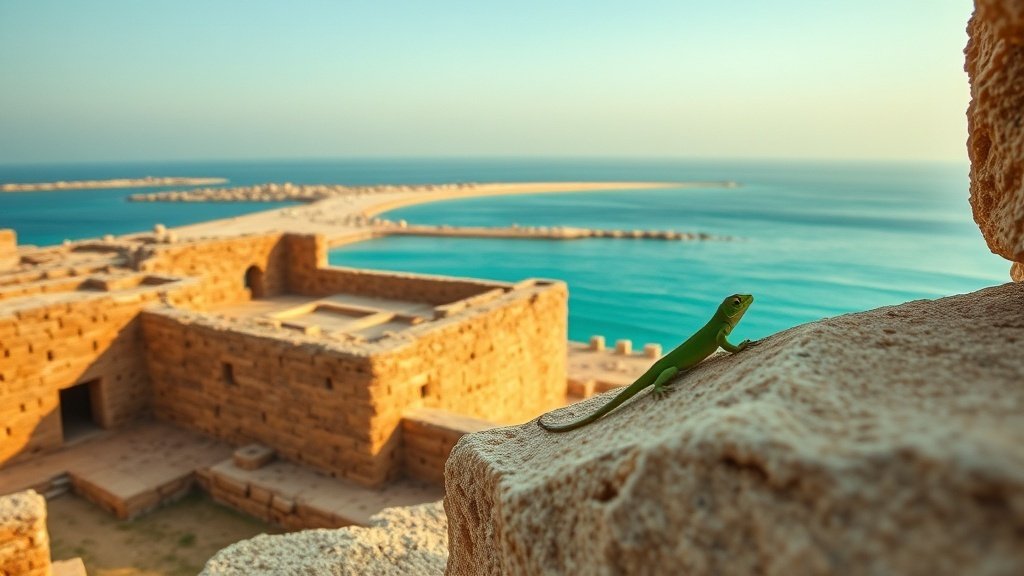
Qal'at al-Bahrain at Sunset
Portuguese fort atop 4,000 years of Dilmun civilization — UNESCO World Heritage Site since 2005
✅ Easy Access for Travelers
Visa: Bahrain offers e-visas and visa-on-arrival for most nationalities. The eVisa portal is open to more than 200 nationalities and visa on arrival covers most of them (Iran, North Korea and Kosovo are the exceptions). GCC residents can enter freely.
Getting There: Bahrain International Airport (BAH) receives flights from major hubs worldwide. Gulf Air, the national carrier, connects Bahrain to Europe, Asia, and Africa. Low-cost carriers such as Air Arabia, flydubai and Jazeera Airways also serve Bahrain (Wizz Air Abu Dhabi, once listed here, shut down on 1 September 2025).
From Saudi Arabia: The King Fahd Causeway (25 km) provides road access from Saudi Arabia's Eastern Province. Expect heavy traffic on weekends as Saudis cross for Bahrain's more relaxed atmosphere.
💡 Tip: Bahrain is one of the most accessible Gulf states. The weekend runs Friday-Saturday. Alcohol is available in hotels and licensed restaurants. Dress modestly at religious sites but beach attire is fine at resorts.
⚠️ 2026: Bahrain has been under intermittent Iranian missile and drone attack since the US–Israeli strikes on Iran of 28 February 2026 — three people killed, more than fifty injured, the Grand Prix cancelled, the US advisory at Level 3. A ceasefire has held unevenly since April and flights were largely back by August, but read the Travel Advisory section before you plan anything.
🏷️ Name & Identity
The name "Bahrain" derives from the Arabic "al-Bahrayn," meaning "Two Seas" — a reference to the freshwater springs that once bubbled beneath the salty Gulf waters surrounding the islands. In ancient times, these springs were so abundant that pearl divers could drink fresh water while submerged. The phenomenon gave Bahrain an almost mystical reputation as a place where sweet and salt waters mingled.
To the Sumerians, this was Dilmun — paradise itself. Their cuneiform tablets describe a blessed land "where the raven does not croak, where lions do not kill," a place of sweet water, abundant dates, and eternal youth. For 3,000 years, Bahrain was known by this sacred name before Arab traders brought Islam and the current Arabic designation.
Modern Bahrain's identity balances tradition with cosmopolitanism. The kingdom is a constitutional monarchy under the Al Khalifa dynasty, which has ruled since 1783. Unlike some Gulf neighbors, Bahrain's population includes a significant Shia majority (approximately 60–70%) ruled by a Sunni royal family — a dynamic that shapes domestic politics. The kingdom also hosts large expatriate communities from South Asia, the Philippines, and the West.
The national flag — white with a red serrated stripe — represents peace and the cost of blood shed in defense of the nation. The five triangular points in the serration symbolize the Five Pillars of Islam. For visitors, Bahrain's layered identity — ancient Dilmun, pearling heritage, Islamic tradition, and modern cosmopolitanism — creates a uniquely accessible Gulf experience.
🗺️ Geography & Climate
Bahrain is usually described as 33 natural islands in the Persian Gulf — reclamation has since added dozens more, and the official count now exceeds 50. Only a handful are inhabited: Bahrain Island, Muharraq, Sitra, Nabih Saleh, Umm an-Nasan, the Hawar group, and the reclaimed Amwaj, Diyar and Durrat developments. The main island of Bahrain holds most of the population and infrastructure. Muharraq, connected by causeway, contains the old capital and the international airport. The Hawar Islands, closer to Qatar than to mainland Bahrain, serve as a wildlife sanctuary for endangered species.
The terrain is largely flat and arid — a landscape of limestone and sand. Jabal ad Dukhan ("Mountain of Smoke"), at just 134 meters, represents the highest point. The famous freshwater springs that once made Bahrain a desert oasis have largely dried up due to overuse, though their legacy remains in the kingdom's name and mythology.
The King Fahd Causeway, completed in 1986, stretches 25 kilometers to connect Bahrain to Saudi Arabia's Eastern Province. It carries heavy weekend traffic as Saudis cross for Bahrain's more relaxed social environment — making the kingdom a unique "weekend escape" destination in the Gulf.
🗺️ Map
Manama, Muharraq and the three UNESCO sites on the northern coast; the King Fahd Causeway runs west to Saudi Arabia; the Hawar Islands lie off Qatar to the south-east. Scroll-zoom is off — use the +/− buttons.
📜 History
Dilmun: Paradise of the Ancients (3000–600 BC) — Long before Babylon rose, Dilmun flourished. The Sumerians described it as a blessed land of sweet water and eternal youth. Archaeological evidence confirms that Dilmun was ancient Bahrain. Its prosperity came from trade routes connecting Mesopotamia with the Indus Valley. Over 11,000 burial mounds, some 4,000 years old, cover parts of the island — cities of the dead that outnumber surviving settlements.
Pearls and Powers (600 BC–1783 AD) — After Dilmun, Bahrain passed through many hands: Assyrians, Babylonians, Persians, and Sasanids. The Greeks knew it as Tylos; Pliny the Elder wrote that the Gulf produced "the most perfect and exquisite pearls of all." Islam arrived in 629 AD, making Bahrain one of the earliest regions to convert. Portuguese explorers arrived in 1521, building Qal'at al-Bahrain. The Safavid Persians drove them out in 1602, only to be expelled by the Al Khalifa family in 1783. The Al Khalifa have ruled ever since.
The Pearl Era (1783–1932) — The 19th and early 20th centuries marked Bahrain's golden age of pearling. At its peak around 1911–1912, pearling provided three-quarters of exports. An estimated 30,000 divers worked the pearl beds. Jacques Cartier himself visited in 1912, seeking pearls for his Paris jewelers. The industry collapsed when Japanese cultured pearls flooded the market after World War I.
Oil, Independence, and the Present (1932–Today) — Oil was discovered in 1932 — the first in the Arabian Peninsula — providing a lifeline as pearling collapsed. Britain maintained a protectorate until August 15, 1971, when Bahrain gained independence. The newly independent nation developed into a regional banking hub. Tensions between the Shia majority and the Sunni ruling family, present for decades, erupted into major protests during the 2011 Arab Spring; the demonstrations were suppressed with security support from Saudi Arabia and other GCC states, and the underlying political grievances remain a live, if largely quiet, undercurrent in Bahraini public life today. Economically, Bahrain has continued diversifying into finance, tourism, and Formula 1, and King Hamad bin Isa Al Khalifa — monarch since 1999, king since the 2002 constitutional reforms — remains head of state.
Normalisation and War (2020–2026) — In September 2020 Bahrain joined the UAE in the Abraham Accords, establishing diplomatic relations with Israel. In June 2025 it was elected to the UN Security Council for 2026–27 with 186 votes, and it was chairing the Council in March 2026 when the region's worst crisis in decades arrived on its doorstep. On 28 February 2026 the United States and Israel struck Iran; Iran answered the same day with missiles and drones at the US Fifth Fleet headquarters in Juffair, and Bahrain — the smallest and closest Gulf state — has since absorbed hundreds of intercepted projectiles. Debris killed a shipyard worker at Mina Salman (2 March) and a young Bahraini woman in Seef (10 March); a Patriot interception over the Bapco refinery injured 32 (9 March); a desalination plant, a fuel depot by the airport and an Amazon data centre were all hit. The Formula 1 Grand Prix was cancelled, Gulf Air moved its fleet to Saudi Arabia, and parliament's mandate was extended to December 2027 rather than hold the November 2026 election under fire. A US–Iran ceasefire on 8 April and the Islamabad Memorandum of 17 June calmed the skies without settling anything; Bahrain's own resolution on the Strait of Hormuz was vetoed by Russia and China on 7 April.
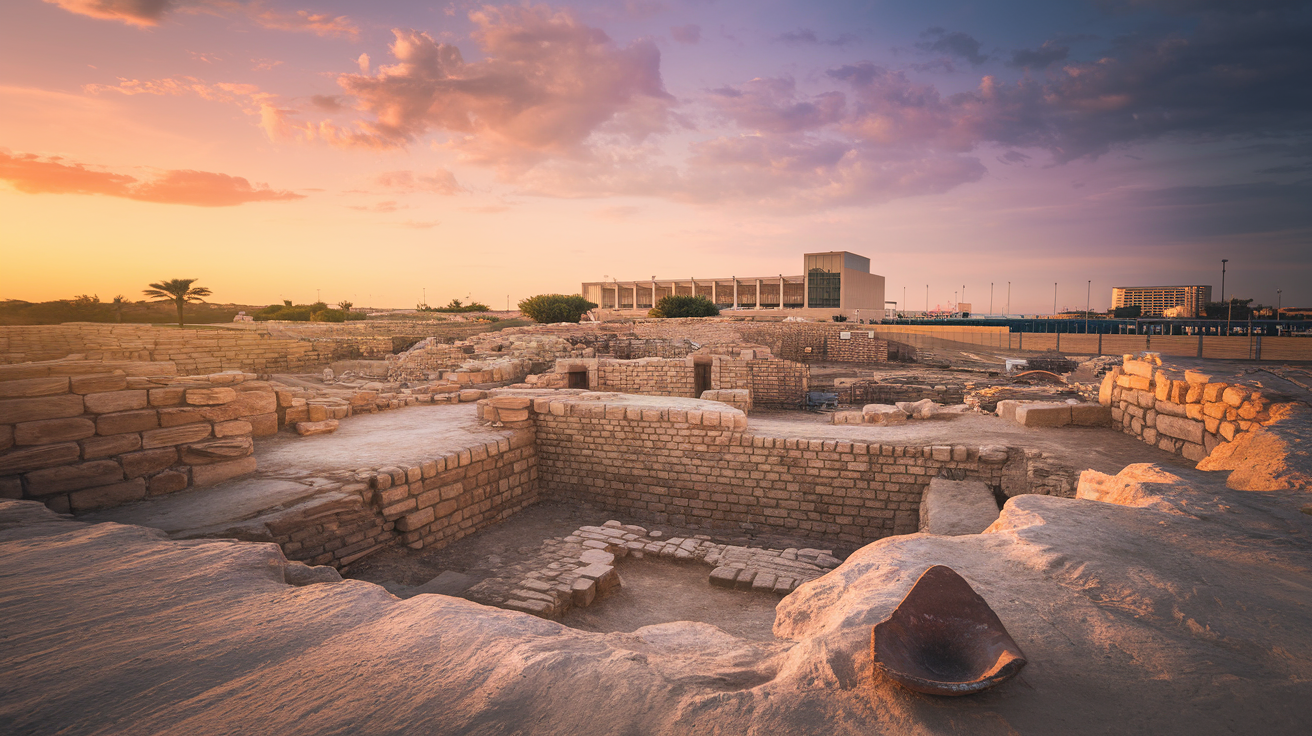
Dilmun Excavations
Ancient streets and foundations revealed — four millennia of occupation beneath the Portuguese fort
👥 People & Culture
Bahrain's population of roughly 1.6 million (2025 estimates cluster between 1.60 and 1.64 million) reflects the Gulf's cosmopolitan reality — only about half are Bahraini citizens, with the rest comprising expatriate workers from South Asia, Southeast Asia, and the Arab world. This diversity creates a unique cultural atmosphere where traditional Gulf Arab customs coexist with international influences.
Among Bahraini citizens, a complex sectarian balance shapes society. The Shia majority (60–70%) and Sunni minority (including the ruling Al Khalifa family) have historically maintained different traditions, though both share deep roots in Gulf Arab culture. Hospitality remains paramount — the Arabic concept of "diyafa" (guest-friendship) means visitors are welcomed with genuine warmth, often with dates and Arabic coffee.
Traditional Bahraini culture reflects its maritime heritage. Pearl diving shaped society for millennia, with diving songs (fidjeri) recognized by UNESCO as intangible cultural heritage. Traditional dhow boats still sail from Muharraq's historic harbor. The art of pottery in A'ali village continues traditions stretching back to Dilmun times. Traditional dress — the white thobe and checkered ghutra for men, the black abaya for women — remains common, especially among older generations.
Modern Bahrain balances tradition with Gulf progressivism. The kingdom permits alcohol in hotels and licensed venues. Women drive, work, and participate in public life more freely than in some neighboring states. The arts scene thrives in Block 338 and at venues like the Bahrain National Theatre. This relative openness makes Bahrain feel accessible to Western visitors while maintaining authentic Gulf character.
🗣️ Key Arabic Phrases
Greetings & Basics:
- Marhaba (مرحبا) — Hello [mar-HA-ba]
- As-salamu alaykum (السلام عليكم) — Peace be upon you
- Shukran (شكراً) — Thank you [SHUK-ran]
- Na'am / La (نعم / لا) — Yes / No
- Min fadlak (من فضلك) — Please
- Ma'a salama (مع السلامة) — Goodbye
Useful Words:
- Bikam? (بكم؟) — How much? [bi-KAM]
- Jameel (جميل) — Beautiful [ja-MEEL]
- Lu'lu'a (لؤلؤة) — Pearl
- Gahwa (قهوة) — Coffee [GAH-wa]
- Inshallah (إن شاء الله) — God willing
- Yalla — Let's go! (informal)
Note: English is widely spoken in business and tourism. All signs are bilingual Arabic/English. South Asian languages (Hindi, Urdu, Tagalog) are common among expatriate workers.
🏛️ Government & Politics
Bahrain is a constitutional monarchy under the Al Khalifa family, who have ruled the islands since 1783. King Hamad bin Isa Al Khalifa has been head of state since 1999 — as Emir until the National Action Charter of 2001 and the constitution of 2002 recast the emirate as a kingdom, at which point he took the title of King. He retains wide executive authority: he appoints the prime minister and cabinet, appoints the entire upper house, and may dissolve parliament.
The head of government is Crown Prince Salman bin Hamad Al Khalifa, appointed Prime Minister on 11 November 2020. He succeeded his great-uncle Khalifa bin Salman Al Khalifa, who had held the post continuously since independence in 1971 — a run of roughly fifty years that made him the longest-serving prime minister in the world. The Crown Prince is the architect of much of the kingdom's economic diversification programme, and holding both the succession and the premiership concentrates an unusual amount of policy direction in one office.
The National Assembly is bicameral and evenly split by design. The Council of Representatives (Majlis al-Nuwab) has 40 members elected for four-year terms from 40 single-member constituencies under a two-round majoritarian system; the Shura Council has 40 members appointed by the King, giving the appointed chamber equal weight to the elected one. Formal political parties are not permitted — candidates stand as independents or under licensed "political societies." The largest opposition society, Al-Wefaq, was dissolved by court order in 2016, and the constitutional reform movement that produced the 2011 unrest remains a quiet but real undercurrent in public life. A general election was due in November 2026, but on 30 April 2026 — with the country under Iranian fire — the mandates of both chambers were extended to December 2027, so the next election is now expected in late 2027. Bahrain also sits on the UN Security Council as a non-permanent member for 2026–27.
- Head of state: King Hamad bin Isa Al Khalifa (since 1999; King since 2002)
- Prime Minister: Crown Prince Salman bin Hamad Al Khalifa (since November 2020)
- Legislature: Council of Representatives (40 elected) · Shura Council (40 appointed)
- Next general election: late 2027 (November 2026 vote postponed; mandate extended 30 April 2026)
- UN Security Council: non-permanent member 2026–27 (elected June 2025, 186 votes)
- Independence: 15 August 1971, ending British protectorate status
- Capital: Manama
🏛️ Manama — The Capital
Manama, Bahrain's capital and largest city, blends old and new with distinctive Gulf flair. The Bahrain World Trade Center, with its trio of wind turbines connecting two towers, dominates the modern skyline — the world's first skyscraper to integrate wind power. Nearby, the Bahrain Financial Harbour and the emerging Bahrain Bay waterfront development showcase the kingdom's 21st-century ambitions.
Yet Manama's soul lies in its older quarters. The Bab al Bahrain Souq — the traditional market district — sprawls behind the ceremonial gate that once marked the city's entrance from the sea. Here, narrow lanes wind past gold shops displaying intricate jewelry, spice vendors with sacks of cardamom and saffron, and fabric merchants selling silk and cotton. The scent of frankincense drifts from incense sellers who've traded here for generations.
The Bahrain National Museum provides essential context for the country's 5,000-year history, with exceptional Dilmun-era artifacts and a reconstructed burial mound. The Al Fateh Grand Mosque, Bahrain's largest (room for some 7,000 worshippers), welcomes non-Muslim visitors for guided tours — its dome made from fiberglass allows natural light to illuminate the vast prayer hall. Block 338, the emerging arts district in converted warehouses, offers galleries, cafes, and boutiques with a bohemian edge rare in the Gulf.
Manama comes alive at night. The waterfront restaurants of Adliya serve everything from Lebanese mezze to Indian curries. The hotels host the Gulf's most vibrant nightlife scene. And on weekends, the King Fahd Causeway brings streams of Saudi visitors seeking Bahrain's more relaxed atmosphere.
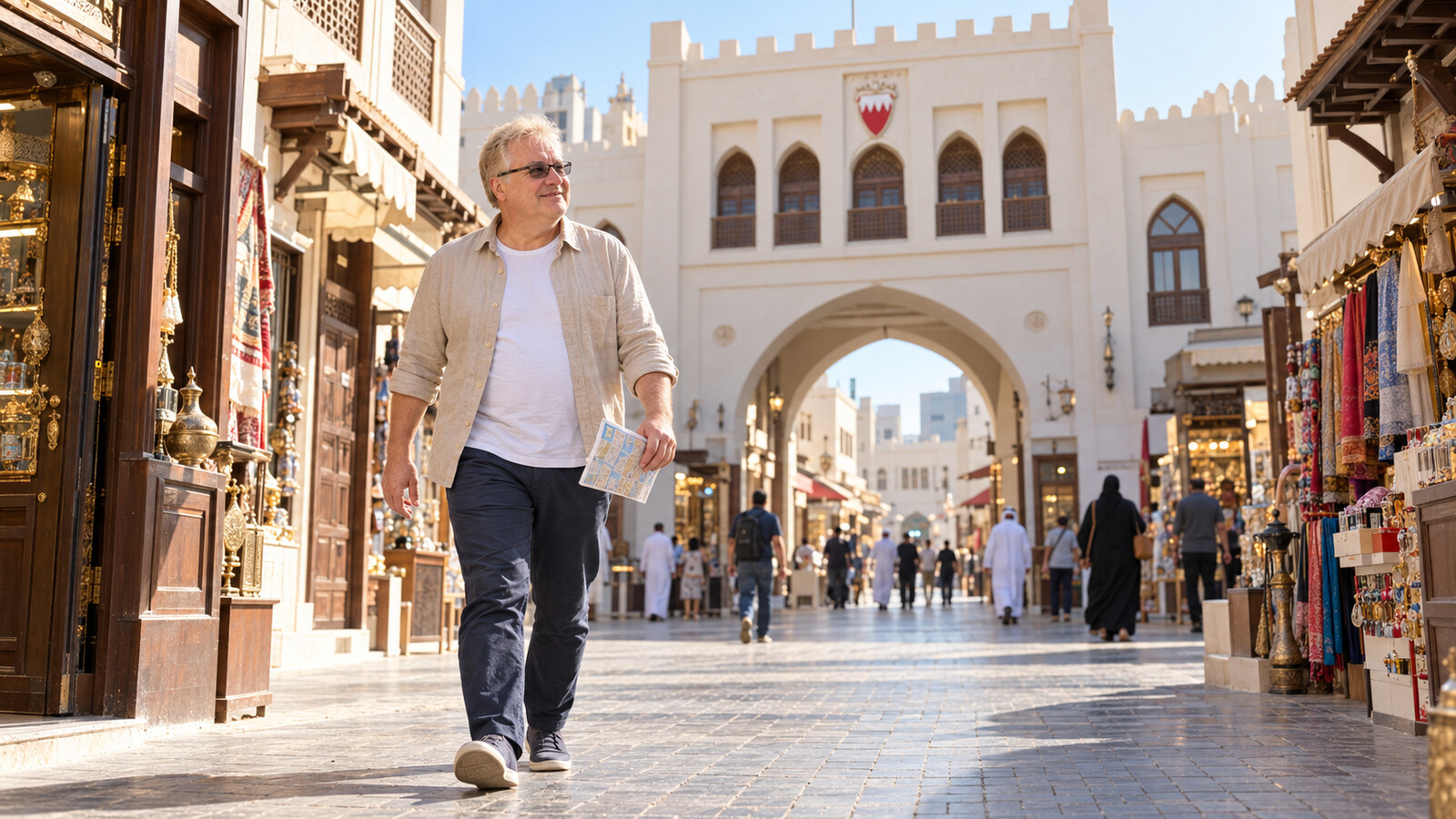
Radim at Bab Al Bahrain and Manama Souq
AI-generated editorial illustration — this is not a documentary record of an actual visit. Kaufmann Creative AI Studio©.
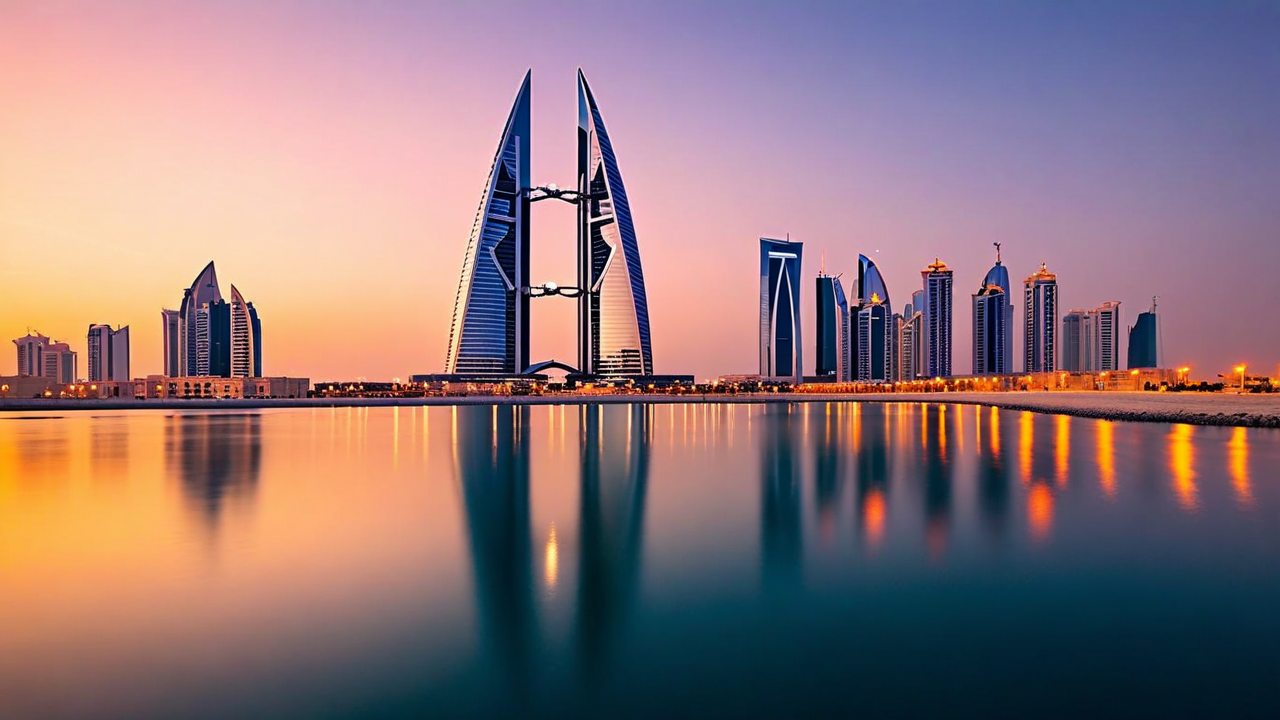
Manama Skyline at Dusk
The iconic Bahrain World Trade Center towers with integrated wind turbines dominate the capital's modern waterfront
🏛️ Muharraq — Pearling Heritage
Muharraq, Bahrain's former capital and the heart of its pearling legacy, preserves the authentic Gulf character that modern Manama has largely outgrown. Connected to the main island by causeway, this island of narrow lanes, traditional houses, and historic mosques offers the kingdom's most atmospheric walking experience.
The UNESCO-listed Pearling Path winds 3.5 kilometers through restored merchants' houses and workshops, documenting the industry that defined Bahraini identity for millennia. The Siyadi Complex showcases the wealth of pearl-trading families — the Siyadi House with its ornate plasterwork, the Siyadi Majlis (reception hall), and the Amarat Mosque built by the same family. The complex now houses exhibitions on pearl diving, including equipment from the diving era and Cartier jewelry made with Bahraini pearls.
Beit Sheikh Isa bin Ali Al Khalifa, the former ruler's residence, reveals how Gulf elite lived in the pre-oil era — four courtyards, wind towers for natural cooling, and intricately carved wooden screens. Nearby, Beit Siyadi presents another pearl merchant's mansion with remarkably preserved interiors. The Dar Al Muharraq gallery occupies a traditional courtyard house, showcasing local contemporary art.
Beyond the heritage trail, Muharraq retains working-class authenticity rare in the modern Gulf. The morning fish market bustles with activity. Traditional cafes serve karak tea. The 17th-century Arad Fort overlooks the waterfront where pearl divers once departed for months at sea. For visitors seeking the "real" Bahrain beneath the five-star veneer, Muharraq delivers.
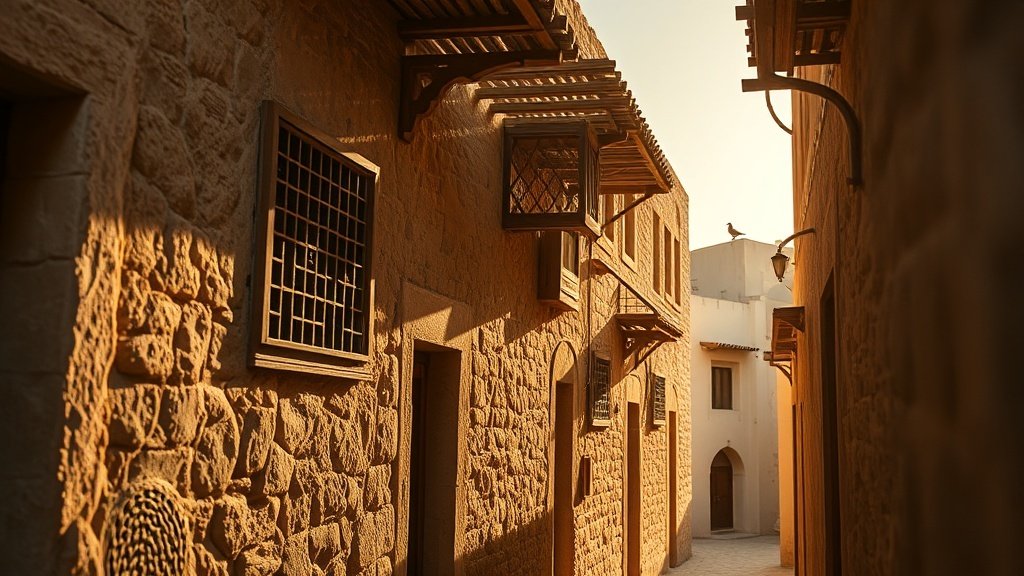
Muharraq Pearling Path
UNESCO World Heritage Site — traditional wind towers and coral stone houses of the pearl merchants
🏰 Qal'at al-Bahrain — Ancient Capital of Dilmun
Qal'at al-Bahrain, Bahrain's foremost UNESCO World Heritage Site, rises from the northern coast as a tell (artificial mound) containing 4,300 years of continuous human occupation. The Portuguese fort crowning the summit represents merely the most recent layer — beneath lie Dilmun-era cities, Islamic settlements, and the remains of what was once one of the ancient world's great trading centers.
Archaeological excavations have revealed a remarkable sequence of civilizations. The Dilmun city flourished from roughly 2300 BC, its residents trading copper from Oman, timber from India, and dates from the Gulf shores. Residential areas, public buildings, commercial districts, and religious structures have been uncovered. Later occupations by Assyrian, Greek, and Islamic cultures added successive layers to the tell.
The Portuguese fort, built around 1521, dominates the visible remains. Its massive walls and corner towers once guarded the pearl trade — Portugal controlled Gulf commerce for nearly a century before the Safavid Persians drove them out. The site museum, designed to complement the landscape, displays artifacts spanning millennia: Dilmun seals, pottery, jewelry, and objects documenting ancient trade networks.
Visit at sunset for the most dramatic experience. The golden light illuminates the excavated foundations of ancient streets, the fort walls glow against the darkening Gulf, and the scale of 4,000 years of human history becomes almost tangible. This is Bahrain's essential archaeological experience — a place where Dilmun paradise, Portuguese empire, and modern heritage preservation converge.
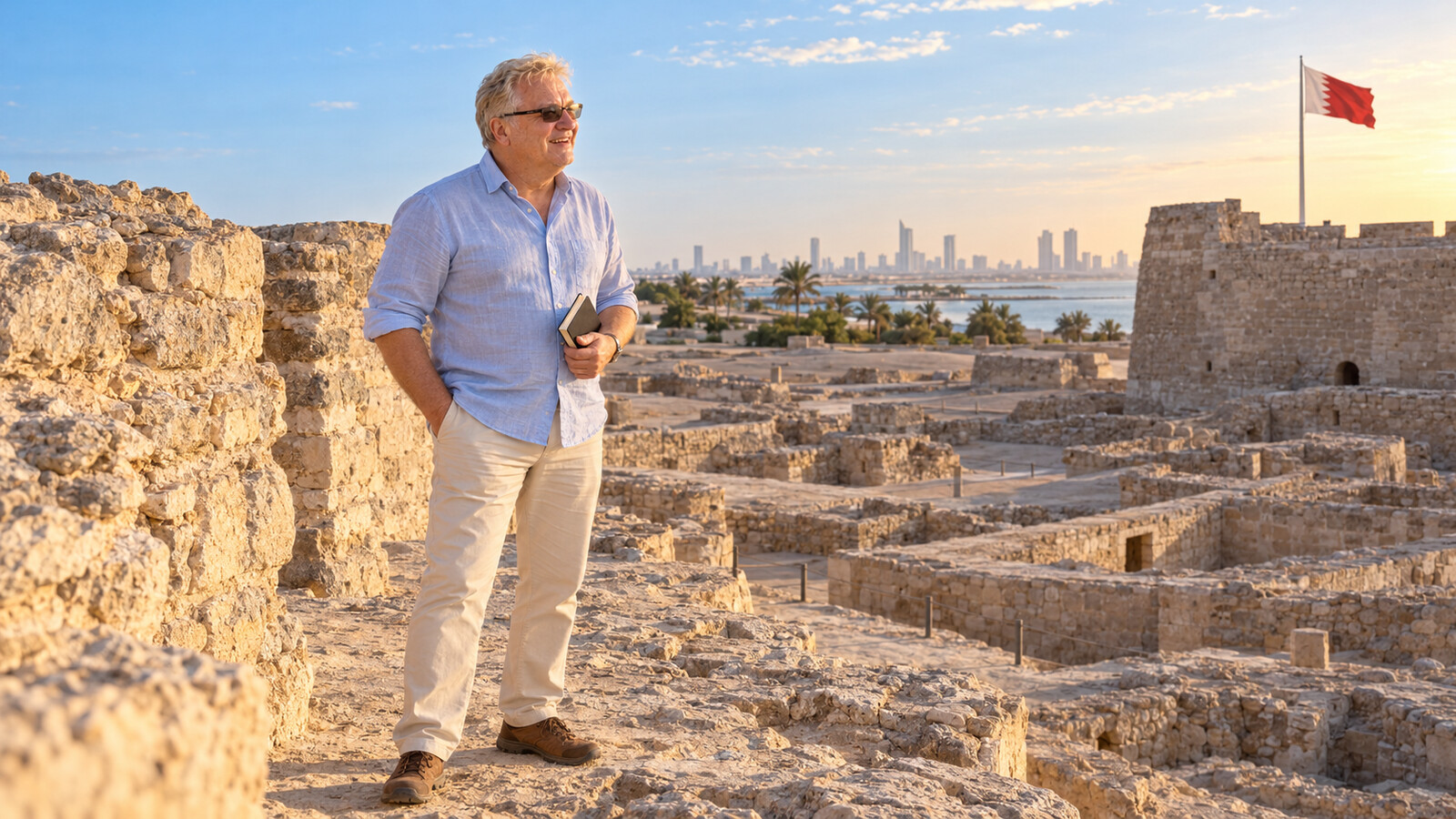
Radim at Qal'at al-Bahrain
AI-generated editorial illustration — this is not a documentary record of an actual visit. Kaufmann Creative AI Studio©.
⚱️ Dilmun Burial Mounds — Cities of the Dead
Bahrain's most haunting landscape lies not along its coast but scattered across its interior — over 11,000 burial mounds built between 2200 and 1750 BC, the largest prehistoric cemetery in the world. These grass-covered tumuli, ranging from small family graves to massive royal tombs, represent a civilization that made Bahrain a sacred burial ground when the pyramids were still new.
The UNESCO-listed property encompasses 21 archaeological sites containing 11,774 documented mounds. Six sites are burial fields with hundreds or thousands of tombs arranged in organized rows. Fifteen sites contain the dramatic royal mounds — larger, two-story sepulchral towers reserved for the Dilmun elite. The royal mounds at A'ali reach staggering dimensions: some 15 meters high and 50 meters in diameter.
A'ali village offers the best access to the royal mounds. This settlement, famous for traditional pottery that continues Dilmun-era techniques, sits amid the most impressive tombs. Walking among these ancient hills — many partially excavated to reveal stone burial chambers — creates an atmosphere of profound antiquity. The sheer number of graves suggests Bahrain may have served as a regional burial ground, drawing the dead from across the Arabian Gulf.
The Bahrain National Museum contextualizes the mounds with reconstructed burial chambers and artifacts recovered from excavations. For the deepest experience, hire a guide to explore the scattered mound fields — these landscapes of enigmatic hills, older than written history, represent perhaps Bahrain's most underappreciated wonder.
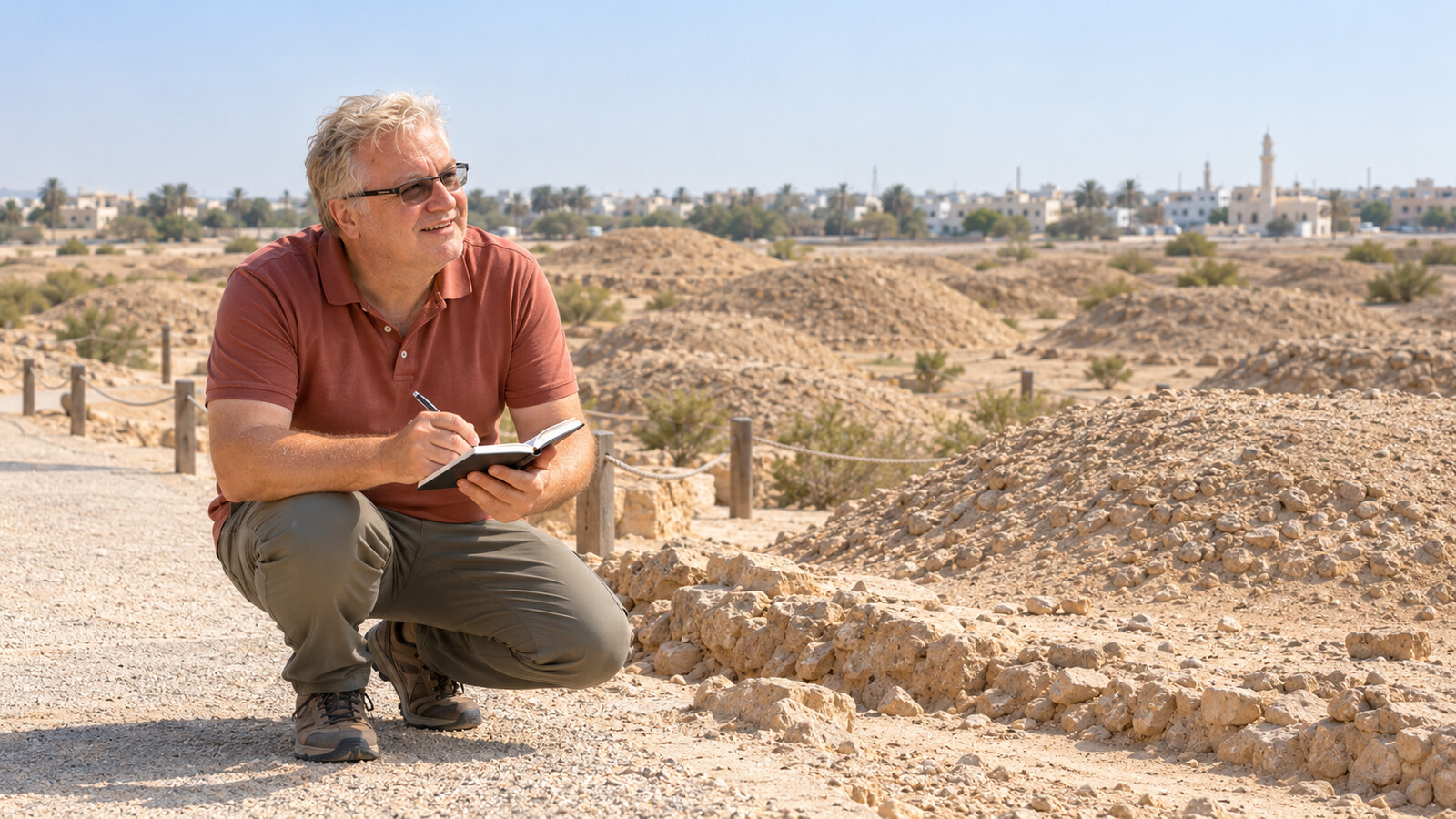
Radim at the Royal Burial Mounds of A'ali
AI-generated editorial illustration — this is not a documentary record of an actual visit. Kaufmann Creative AI Studio©.
🌳 Tree of Life — Desert Mystery
In the barren desert south of Manama, far from any obvious water source, a single 400-year-old mesquite tree flourishes against all logic. The Shajarat-al-Hayat (Tree of Life) stands alone amid sand and limestone, its green canopy providing shade in a landscape where nothing else grows. Local legend attributes its survival to divine intervention; scientists remain uncertain how the tree obtains water in this hyper-arid environment.
The tree has become one of Bahrain's most visited natural attractions — ironic given that its appeal lies precisely in its apparent impossibility. Standing beside its gnarled trunk, 10 meters tall with a canopy spreading 20 meters, the sense of mystery is palpable. How has this tree survived four centuries in the desert? Underground aquifers? Deep roots reaching water tables? Fog condensation? No definitive explanation exists.
Visitors arrive at all hours — families by day, couples at sunset, photographers seeking that perfect shot of survival against odds. The surrounding desert offers its own stark beauty: rolling limestone hills, scattered oil infrastructure, and the silence of empty space. Some link the site to the legendary Garden of Eden, which some traditions place in Bahrain.
The drive from Manama takes about 30 minutes. There are no facilities beyond a small parking area, so bring water. The best times to visit are sunrise or sunset when soft light enhances the tree's drama against the barren surroundings. The Tree of Life isn't Bahrain's most important attraction — but it may be its most enigmatic.
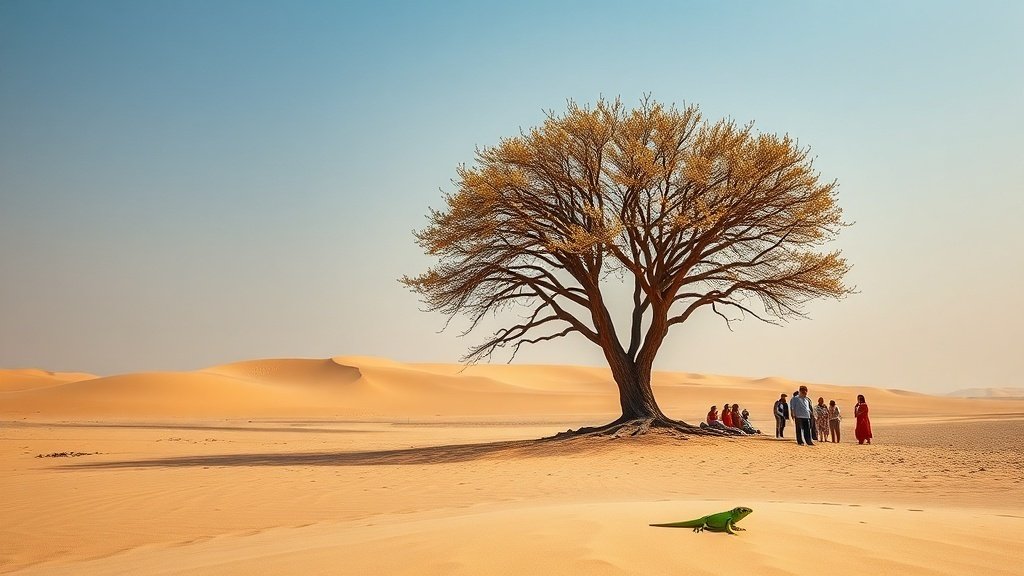
The Tree of Life
A 400-year-old mesquite thriving in the desert — one of nature's enduring mysteries
🏎️ Bahrain International Circuit — F1 Racing
The Bahrain International Circuit, opened in 2004, brought Formula 1 to the Middle East for the first time. This state-of-the-art facility in the Sakhir desert opened the F1 season from 2021 to 2024 and has held an April slot, after Ramadan, since 2025; its distinctive architecture and desert setting creating one of motorsport's most recognizable venues. The circuit symbolizes modern Bahrain's ambitions on the world stage.
The track itself stretches 5.412 kilometers with 15 turns testing drivers' skills under floodlights — the Bahrain GP runs as a night race, its lighting systems illuminating the desert track dramatically against the darkness. The paddock facilities rival any in the world, and the circuit can accommodate 70,000 spectators in grandstands offering views of key corners and the main straight.
Beyond Grand Prix weekend, the circuit operates year-round. Visitors can book driving experiences in sports cars and track-prepared vehicles. The "Drag Strip" hosts quarter-mile racing. A karting circuit offers grassroots motorsport. The circuit also hosts concerts, festivals, and corporate events, making it central to Bahrain's entertainment calendar.
The F1 weekend — March until 2024, April since 2025 — transforms Bahrain. Hotels fill months in advance. The afterparties feature international artists. And for racing fans, watching cars blast through the desert night at over 300 km/h creates memories that justify the journey alone.
2026 — the year the race left the island. The Grand Prix scheduled for 12 April 2026 was cancelled on 14 March, two weeks into the Iran war, along with the Saudi Arabian round; Pirelli had already abandoned its Sakhir tyre test. Rather than lose the date, Formula 1 and the FIA moved the "Bahrain Grand Prix" to Sepang, Malaysia, for 2–4 October 2026 — the first time the race has been run outside the kingdom. The circuit's F1 contract runs to 2036, so the paddock expects to be back in the desert once the region allows it.
🍜 Cuisine
Bahraini cuisine reflects the island's position as a Gulf trading crossroads, blending Arabian Gulf traditions with Persian, Indian, and African influences. Seafood dominates — the surrounding waters yield fish, shrimp, and the prized hammour (grouper). Rice dishes, flatbreads, and aromatic spices characterize most meals.
✍️ Cookbook Note — Radim Kaufmann
Bahrain is the Gulf's quiet epicurean. While its neighbours build towers and chase spectacle, this island kingdom perfects machboos over slow fires and argues passionately about who makes the best muhammar. In the old souq of Manama, I found a grandmother's kitchen disguised as a restaurant — no menu, just whatever she had made that morning. The machboos arrived on a tray the size of a table, the dried limes splitting the richness with their sour punch. Bahraini food is Gulf cooking at its most honest.
Machboos KCS 88
Spiced Rice with Chicken
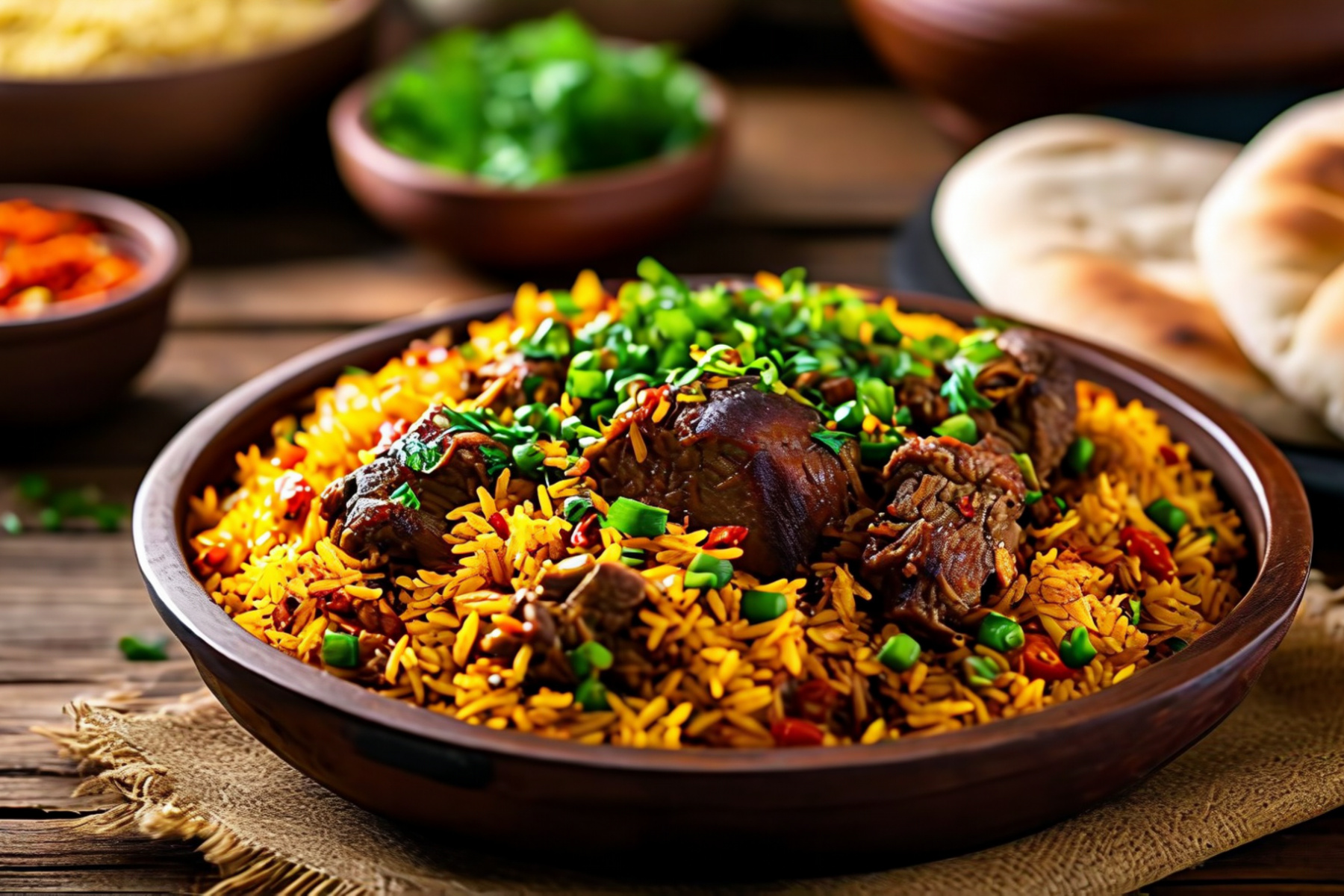
Bahrain's beloved national dish — fragrant saffron rice with tender spiced chicken, topped with crispy onions and nuts. This recipe serves two.
Ingredients: 1 whole chicken, cut into pieces · 400g basmati rice · 2 large onions (1 for cooking, 1 fried crispy) · 3 loomi (dried limes), pierced · 1g saffron in 30ml warm water · 15ml baharat spice mix · cardamom, cinnamon, cloves · toasted almonds, raisins · ghee, salt
Preparation: begin by preparing the baharat spice mix if you don't have it ready: toast and grind equal parts black pepper, coriander seeds, cumin, and cinnamon with smaller amounts of cardamom, cloves, and nutmeg. This blend is the soul of machboos. Take a whole chicken, about 1.5kg, and cut it into eight pieces. Season generously with salt, a tablespoon of baharat, half a teaspoon of turmeric, and a pinch of ground loomi (dried lime powder). Set aside for at least 30 minutes. In a large heavy pot, heat two tablespoons of ghee over medium-high heat. Brown the chicken pieces in batches until deeply golden on all sides — this Maillard reaction is crucial for flavour. Remove and set aside. In the same pot, add two large sliced onions and cook until deeply caramelised, stirring occasionally for about 15 minutes. Add four cloves of minced garlic, a tablespoon of grated fresh ginger, and two whole dried limes pierced several times with a knife. Stir in two tablespoons of tomato paste and cook for two minutes until it darkens. Add two diced tomatoes and cook until they break down. Return the chicken to the pot, pour in 800ml of hot water, and bring to a boil. Reduce heat and simmer covered for 25 minutes until the chicken is cooked through. Remove the chicken pieces and strain the broth — you need about 600ml. Rinse 400g of basmati rice that has been soaked for 30 minutes. In the same pot, heat a tablespoon of ghee and toast the drained rice for two minutes, stirring to coat every grain. Pour in the strained broth, add another tablespoon of baharat, a generous pinch of saffron dissolved in two tablespoons of rose water, and salt to taste. Bring to a boil, then reduce to the lowest heat, cover tightly, and cook for 18 minutes without lifting the lid. While the rice steams, place the chicken pieces under a hot grill or in a very hot oven for five minutes to crisp the skin. Prepare the garnish by frying a sliced onion in ghee until dark and crispy, then toasting a handful of blanched almonds and plumping some raisins in the same pan. To serve, mound the fragrant rice on a large platter — traditionally a round brass tray. Arrange the crispy chicken pieces on top and scatter generously with the fried onions, toasted almonds, and raisins. Place the dried limes alongside as both garnish and invitation to squeeze their tangy juice over the rice. Serve with a simple salad of diced cucumber, tomato, and onion dressed with lemon juice.
💡 The crispy onions (birista) are essential — cook them slowly until deep brown. Piercing the loomi releases its tangy flavor into the rice.
Muhammar KCS 76
Sweet Date Rice
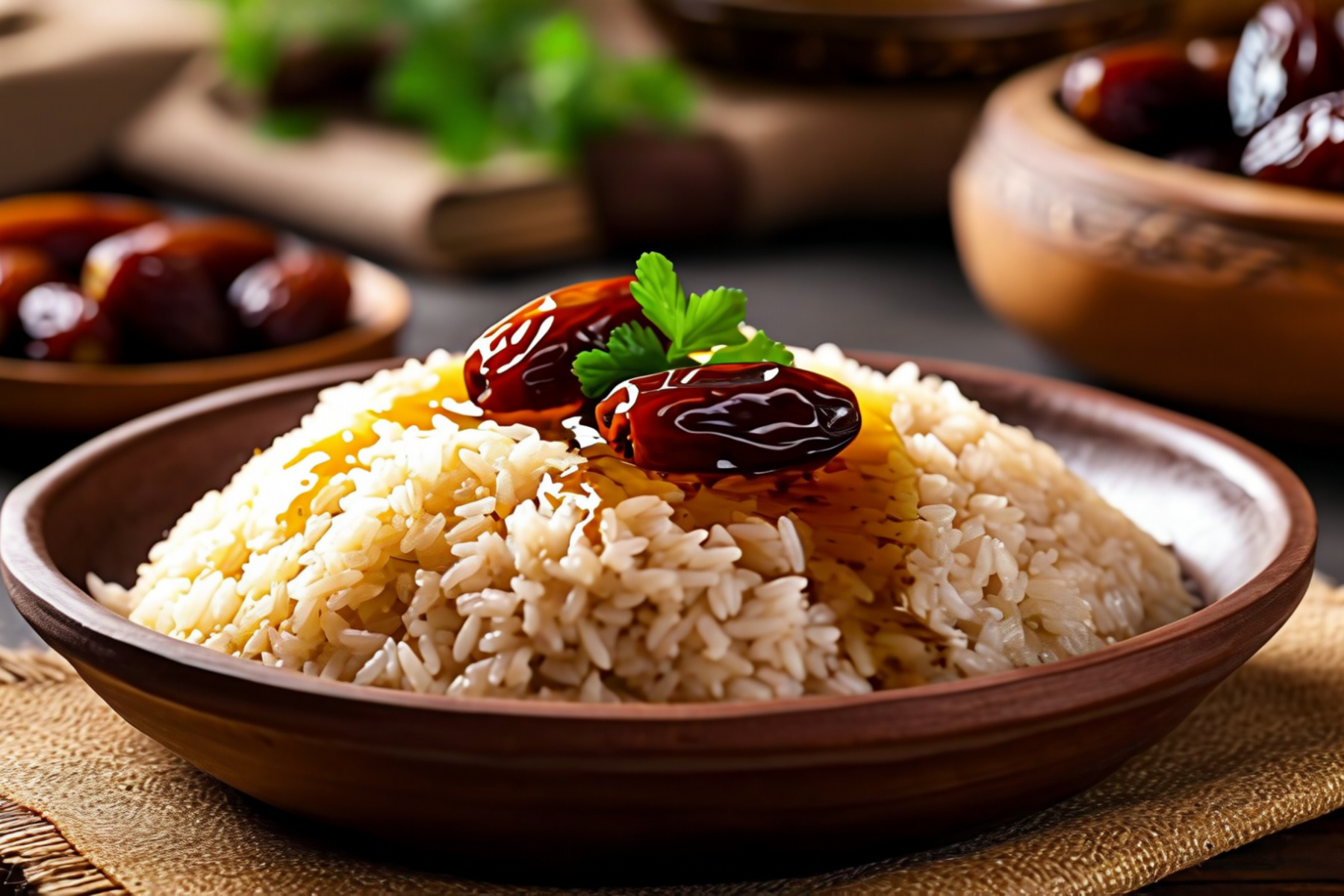
Golden rice sweetened with date syrup and aromatic spices — a Gulf classic for special occasions. This recipe serves two.
Ingredients: 400g basmati rice · 120ml date syrup (dibs) · 30g sugar · 1g saffron in 15ml rose water · 5g cardamom powder (or 5 crushed pods) · 60g ghee · whole dates for garnish · rose petals, cinnamon sticks
Preparation: wash 400g of basmati rice thoroughly under cold running water until the water runs clear, then soak in warm water for one hour. This soaking ensures the grains cook evenly and absorb the date syrup uniformly. Drain completely and set aside. In a heavy-bottomed pot, bring one litre of water to a rolling boil with a teaspoon of salt. Add the drained rice and parboil for exactly five minutes — the grains should be soft on the outside but still have a firm bite at the centre. Drain immediately in a fine sieve and spread on a tray to stop the cooking. In the same pot, melt 60g of ghee over low heat. Add 120ml of date syrup (dibs) — the thick, dark molasses made from Bahraini khalas dates — and stir until the ghee and syrup are completely combined and beginning to bubble gently. Add two tablespoons of sugar, a generous pinch of saffron threads dissolved in a tablespoon of rose water, the seeds from five crushed cardamom pods, and a pinch of ground cinnamon. Return the parboiled rice to the pot and fold it gently into the date syrup mixture, taking care not to break the grains. Every grain should be coated in the dark, glossy syrup. Create a mound shape, poke three holes through to the bottom with a wooden spoon handle for steam circulation, and drizzle a tablespoon of melted ghee over the top. Wrap the pot lid in a clean tea towel to catch condensation. Cover tightly and cook on the absolute lowest heat for 30 to 35 minutes. The bottom will develop a prized crispy crust called 'hkaka' — dark, caramelised, and intensely sweet. While the rice steams, prepare a thin omelette: whisk three eggs with a pinch of salt and saffron, then cook in a lightly buttered non-stick pan until just set, flipping once. Fold the omelette into a rectangle. To serve, invert the muhammar onto a plate to show the dark caramelised crust, or simply mound it in a copper serving bowl. Lay the folded saffron omelette across the top, scatter with cardamom pods and dried rose petals. The combination of sweet sticky rice and savoury egg is quintessentially Bahraini — a breakfast dish that doubles as comfort food at any hour.
💡 Use quality date syrup — it's the heart of this dish. The rice should be sweet but not cloying, each grain separate and glistening.
Balaleet KCS 74
Sweet Vermicelli with Omelette
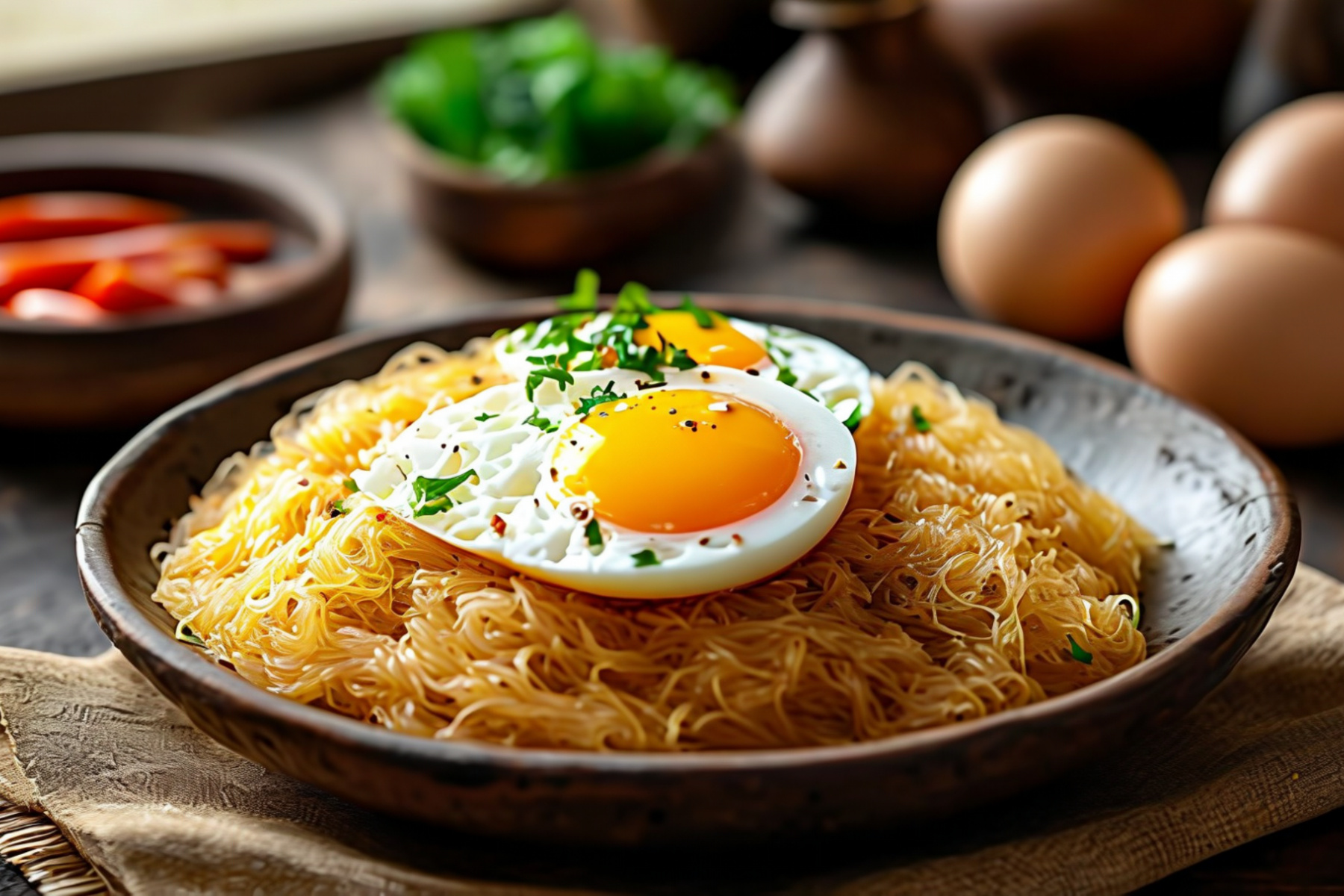
The beloved Gulf breakfast — sweet saffron vermicelli topped with a savory folded omelette. This recipe serves two.
Ingredients: 200g vermicelli noodles · 100g sugar · 1g saffron in 15ml rose water · 4 cardamom pods · 30ml ghee · 4 eggs · salt, pepper · date syrup for drizzle
Preparation: break 200g of fine vermicelli noodles into pieces about five centimetres long. Heat two tablespoons of ghee in a wide, heavy pan over medium heat and add the broken vermicelli. Toast the noodles, stirring constantly, until they turn an even golden brown — this takes about four minutes and requires patience and attention, as they can burn quickly. The toasting develops a nutty flavour that distinguishes balaleet from ordinary sweet noodles. Once golden, carefully pour in 400ml of hot water — it will sizzle and steam. Add 100g of sugar, a generous pinch of saffron threads dissolved in a tablespoon of rose water, the seeds from four crushed cardamom pods, and a small pinch of ground cinnamon. Stir well to dissolve the sugar completely. Bring the liquid to a gentle boil, then reduce heat to low. Cover and simmer for eight to ten minutes, checking occasionally and stirring gently, until the vermicelli has absorbed all the liquid and each strand is tender and glistening with the sweet saffron syrup. The noodles should be sticky but not clumped — individual strands should still be visible. If they seem dry before fully cooking, add a splash more hot water. Remove from heat and stir in a tablespoon of melted ghee to add richness and prevent sticking. Cover and let the balaleet rest for five minutes while you prepare the omelette. Whisk three eggs with a pinch of salt and a tiny pinch of saffron for colour. Heat a knob of butter in a non-stick pan over medium heat and pour in the egg mixture. Cook gently until the bottom is set and golden, then carefully flip and cook the other side for just 30 seconds — the omelette should remain soft and slightly custard-like inside. Fold it in half or roll it loosely. Mound the sweet vermicelli on an ornate plate, place the folded omelette on top, and garnish with whole cardamom pods and scattered rose petals. Serve warm with dates and a small cup of Arabic coffee on the side. Balaleet is traditionally a breakfast dish in Bahrain, but its comforting sweetness makes it welcome at any time of day — the contrast between the sugary saffron noodles and the savoury egg is addictive.
💡 The contrast of sweet noodles and savory egg is the magic. Some families prefer the omelette mixed in; traditionalists keep it on top.
🥣 Harees — Wheat Porridge
Traditional Ramadan dish, comfort food of the Gulf
- 2 cups cracked wheat (jareesh)
- 500g lamb or chicken
- 1 cinnamon stick
- Salt to taste
- Ghee for serving
- Ground cinnamon for garnish
- Soak wheat overnight
- Cook meat until tender, shred
- Combine wheat, meat, and broth
- Simmer 3-4 hours, stirring often
- Beat until smooth, serve with ghee
Signature Dishes: Machboos — the national dish, spiced rice with fish or meat, saffron, and dried lime. Muhammar — sweet rice with dates and sugar, often served with fish. Balaleet — sweetened vermicelli with eggs for breakfast. Harees — wheat porridge with meat, traditionally served during Ramadan. Ghoozi — whole roasted lamb stuffed with rice, eggs, and spices.
Beverages & Sweets: Gahwa — Arabic coffee served with dates. Karak chai — sweet spiced tea with cardamom, an Indian influence. Halwa — traditional Arabic sweet with saffron and rosewater. Luqaimat — fried dough balls drizzled with date syrup. Alcohol is available in licensed hotels and restaurants — Bahrain is the Gulf's most accessible destination for visitors seeking familiar beverages.
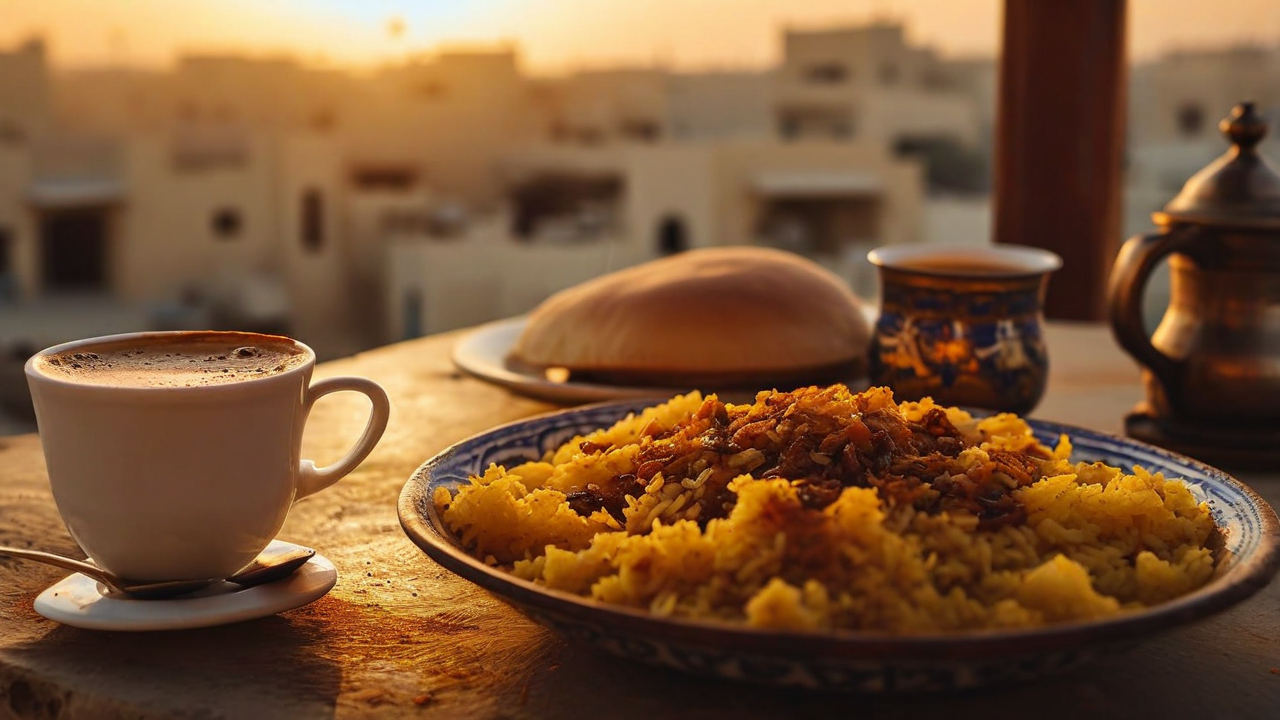
A Bahraini Table
Machboos, dates, and Arabic coffee — Gulf hospitality on a single tray
🍷 Wine, Spirits & Drinking Culture
Bahrain occupies a unique position in the Gulf — it is the most socially liberal of the Gulf states, the most relaxed of them about alcohol — licensed hotels, restaurants and bars, plus a handful of off-licences — and historically the region's unofficial watering hole. While Saudi Arabia is dry and Dubai carefully manages its alcohol licensing, Bahrain has a relaxed, almost Mediterranean approach to drinking. The 25-kilometre King Fahd Causeway connecting Bahrain to Saudi Arabia sees enormous weekend traffic — much of it Saudis crossing for a drink. This has shaped Bahrain's drinking culture into something distinctly cosmopolitan.
There are no vineyards in Bahrain — the climate (48°C summers, negligible rainfall) makes viticulture impossible. But the island's hotel bars, restaurant scene, and nightlife are the most developed in the Gulf. The Adliya district in Manama is a warren of restaurants, cocktail bars, and live music venues that would feel at home in Beirut or Istanbul. Block 338 in Adliya has become one of the Gulf's most talked-about nightlife precincts.
📜 5,000 Years of Dilmun Drinking
Bahrain's drinking history is ancient. As Dilmun — one of the oldest civilisations in the world, contemporary with Sumer and the Indus Valley — the island was famous for its sweet freshwater springs bubbling up through the seabed. The Sumerians described Dilmun as a paradise of pure water. Archaeological evidence from the Dilmun burial mounds (the largest prehistoric cemetery in the world, a UNESCO World Heritage Site) suggests that date wine (palm wine fermented from date palm sap) was consumed as early as 3000 BC. The tradition continues today — dates and date syrup remain central to Bahraini food culture, though the fermented version has been replaced by imported wine and spirits.
☕ Qahwa — The True National Drink
Arabic coffee (qahwa) and tea (chai karak) are Bahrain's authentic national beverages. Qahwa — light-roasted, cardamom-infused, served without sugar in tiny handle-less cups (finjān) — is the drink of hospitality, offered at every majlis (sitting room), business meeting, and social occasion. Refusing is impolite. Chai karak — strong tea boiled with evaporated milk, sugar, cardamom, and sometimes saffron — is the Gulf's equivalent of Indian chai, sold from roadside cafeterias for 100 fils (25 cents) and consumed in enormous quantities.
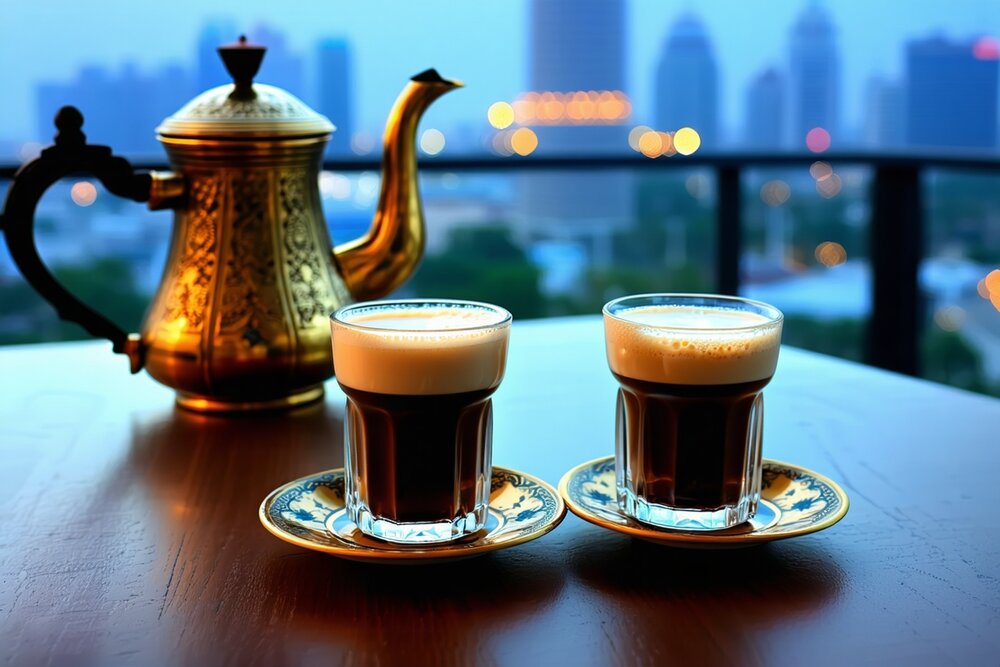
🍸 Bar Note — Radim Kaufmann
Bahrain is the Gulf's best-kept secret for anyone who appreciates a good drink. While Dubai gets the headlines, Bahrain has something more genuine — an actual social drinking culture, rooted in the island's long tradition as the Gulf's most cosmopolitan trading hub. A Friday evening at Block 338 in Adliya — cocktails at a rooftop bar, then dinner at a converted merchant's house, the muezzin calling from a nearby mosque while you sip a Negroni — captures the beautiful contradictions of modern Gulf life. And the 100-fils chai karak from a roadside cafeteria at 3am after — that's the real Bahrain.
🍸 Cocktails & Traditional Beverages
Bahrain's drinking culture balances Islamic tradition with cosmopolitan openness — the island kingdom is known for its vibrant café culture centered on Arabic coffee and tea ceremonies. Traditional jallab and tamarind drinks cool the desert heat, while Bahrain's more liberal atmosphere compared to neighboring Gulf states supports a sophisticated hospitality scene.
☕ Gahwa Arabiya
Traditional Arabic Coffee with Cardamom
The cornerstone of Bahraini hospitality — pale golden coffee infused with cardamom and sometimes saffron, served in tiny handleless cups (finjans) from a brass dallah pot. Refusing a cup is considered rude; accepting three cups signals you've had enough. Every majlis gathering begins and ends with gahwa.
Glass: Finjan (small handleless cup) · Method: Boil & infuse
Ingredients: 30g lightly roasted Arabic coffee beans (finely ground), 1L water, 10 crushed cardamom pods, pinch of saffron threads (optional), 1 tsp rosewater (optional)
Preparation: bring water to a boil in a dallah or saucepan. Add ground coffee and return to boil, then reduce heat. Add crushed cardamom pods and saffron. Simmer gently for 10–15 minutes until aromatic. Add rosewater if desired. Let grounds settle, then pour into finjans from height to create a thin layer of foam.
☕ Jallab
Date & Grape Molasses Cooler
A beloved Gulf refreshment made from date molasses, grape molasses, and rosewater poured over crushed ice and garnished with pine nuts and raisins. The deep burgundy drink appears at every Bahraini iftar table during Ramadan and at celebration feasts year-round.
Glass: Tall glass · Method: Build over ice
Ingredients: 60ml jallab syrup (date and grape molasses blend), 15ml rosewater, 250ml cold water, crushed ice, pine nuts and golden raisins for garnish
Preparation: fill a tall glass with crushed ice. Pour jallab syrup over the ice. Add rosewater and cold water. Stir gently to combine. Float pine nuts and golden raisins on top. Serve with a long spoon to scoop the garnishes.
☕ Chai Karak
Spiced Milk Tea
The Gulf's answer to Indian chai — intensely brewed black tea simmered with evaporated milk, cardamom, and saffron until thick and deeply golden. Every Bahraini café has its own karak recipe, and arguments over the best version are a national pastime. It's served blazing hot in small glass cups, sweet enough to stand a spoon in.
Glass: Small glass tea cup · Method: Simmer & strain
Ingredients: 3 bags strong black tea (or 3 tsp loose CTC tea), 200ml water, 200ml evaporated milk, 4 crushed cardamom pods, pinch of saffron, 3 tbsp sugar (adjust to taste)
Preparation: bring water to boil with cardamom and saffron. Add tea bags or loose tea and boil for 3–4 minutes until very dark. Add evaporated milk and sugar. Reduce heat and simmer for 5–7 minutes, stirring occasionally. The mixture should become thick and deeply golden. Strain into small glass cups and serve immediately.
🌡️ Climate & Best Time to Visit
| Season | Temperature | Conditions | Rating |
|---|---|---|---|
| Winter (Nov-Feb) | 15-25°C | Pleasant, ideal for sightseeing | ✅ Best Season |
| Spring (Mar-Apr) | 22-32°C | Warm, F1 Grand Prix season | ✅ Excellent |
| Summer (May-Sep) | 35-45°C | Extremely hot, high humidity | ⚠️ Avoid outdoor activities |
| Autumn (Oct) | 28-35°C | Cooling down, still warm | ✅ Good |
Best Time: November through March for comfortable temperatures. The F1 Grand Prix (an April date since 2025; the 2026 race was moved to Malaysia) is the main event. Ramadan dates vary — expect modified hours at restaurants and attractions. Summer heat (40°C+) makes outdoor sightseeing uncomfortable.
✈️ How to Get There
By Air: Bahrain International Airport (BAH) receives flights from major hubs worldwide. Gulf Air, the national carrier, connects to London, Paris, Frankfurt, Bangkok, Manila, and dozens of other destinations. Emirates, Etihad, Qatar Airways, and Turkish Airlines also serve Bahrain with excellent connections. Services were suspended or thinned during the spring 2026 hostilities — Gulf Air parked its fleet in Saudi Arabia in March — and most had resumed by August 2026 (Qatar Airways returned on 8 August), but schedules are still thinner than in 2025 and short-notice cancellations remain possible, so check before booking.
By Road: The King Fahd Causeway connects Bahrain to Saudi Arabia's Eastern Province (25 km). Expect heavy weekend traffic. You'll need a Saudi visa or GCC residency to use this crossing.
Airport to City: Bahrain International Airport is located on Muharraq Island, connected to Manama by causeway. The journey to central Manama takes 15–20 minutes. Taxis, Uber, and Careem are readily available. Many hotels offer airport transfers.
📋 Practical Information
Visa: E-visa available online for most nationalities (processing 24–48 hours). Visa on arrival for most nationalities including the USA, UK, EU and Australia (Iran, North Korea and Kosovo excepted; the eVisa portal lists 200+ eligible nationalities). GCC citizens enter freely. Visit visas run 14 or 30 days and can be extended at the NPRA; a one-year multiple-entry visa (up to 90 days per stay) is sold online.
Money: Bahraini Dinar (BHD) — one of the world's strongest currencies (~$2.65 USD). ATMs widespread, credit cards accepted everywhere. Budget hotels from $50/night, mid-range $100–150, luxury $200+.
Communications: Excellent mobile coverage (Batelco, Zain, STC). Free WiFi in malls, hotels, cafes. Time Zone: UTC+3 (Arabia Standard Time). English widely spoken in business and tourism.
Getting Around: Taxis and ride-hailing (Uber, Careem) are the main options. No metro system. Rental cars available and driving is straightforward. Driving is on the right.
Safety: Street crime is rare and Bahrain was, until 2026, one of the safest destinations in the region; the Iranian missile and drone campaign changed that calculus — see the Travel Advisory below. Women travel comfortably. Medical facilities are excellent — private hospitals meet international standards. The main safety concern is extreme summer heat.
⚠️ Travel Advisory
Status checked 18 September 2026. The UK Foreign, Commonwealth & Development Office updated its Bahrain advice on 20 August 2026 and no longer advises against all but essential travel. It nevertheless describes the regional security situation as unpredictable, notes strikes and retaliatory attacks in the region including Bahrain, and advises travelers to monitor airport and airspace updates, avoid security and military facilities, and keep departure plans under review.
The U.S. Department of State advisory issued 27 August 2026 lists Bahrain at Level 3 — Reconsider Travel, citing terrorism and armed conflict, and notes the continuing threat of drone and missile attacks and disruptions to commercial aviation. Advisory systems use different criteria, so travelers should consult the guidance relevant to their nationality and insurance.
💰 Cost of Living
| Item | Cost (USD) |
|---|---|
| Budget hotel | $50-80/night |
| Mid-range hotel | $100-150/night |
| Luxury hotel | $200-400/night |
| Local meal | $5-15 |
| Restaurant dinner | $25-50 |
| Beer (hotel bar) | $6-10 |
| Taxi across city | $5-15 |
| Museum entry | $3-8 |
Bahrain is moderately expensive. Budget travelers can manage on $80–100/day, mid-range travelers $150–200/day. The Bahraini Dinar's strength means prices feel high compared to neighboring countries.
🏨 Accommodation
Bahrain offers excellent accommodation across all price ranges. International chains cluster along the waterfront and in Seef district. Budget options exist but are less common than in other Gulf states.
Luxury: Four Seasons, Ritz-Carlton, Gulf Hotel (iconic Manama landmark). Mid-range: Movenpick, Novotel, Mercure, Wyndham. Budget: Holiday Inn Express, Premier Inn, various apartments via Airbnb.
F1 Tip: Book months in advance for Grand Prix weekend — prices triple and rooms sell out fast. Many visitors stay in Saudi Arabia and drive over the causeway.
🎭 Festivals & Events
Formula 1 Bahrain Grand Prix (April; 2026 edition cancelled and run at Sepang, Malaysia, 2–4 October) — The highlight of Bahrain's calendar. The night race under floodlights creates spectacular visuals. Book hotels and flights months ahead. Spring of Culture (March–April) — Bahrain's premier arts festival featuring international performers, exhibitions, and cultural events.
National Day (December 16) — Celebrates independence and the King's accession. Fireworks, parades, and cultural events. Bahrain International Airshow (biennial; next scheduled 18–20 November 2026 at Sakhir Air Base, subject to the security situation) — Major aviation event drawing global exhibitors. Ramadan (varies) — Holy month with iftar feasts and night markets. Non-Muslims can still find food in hotels.
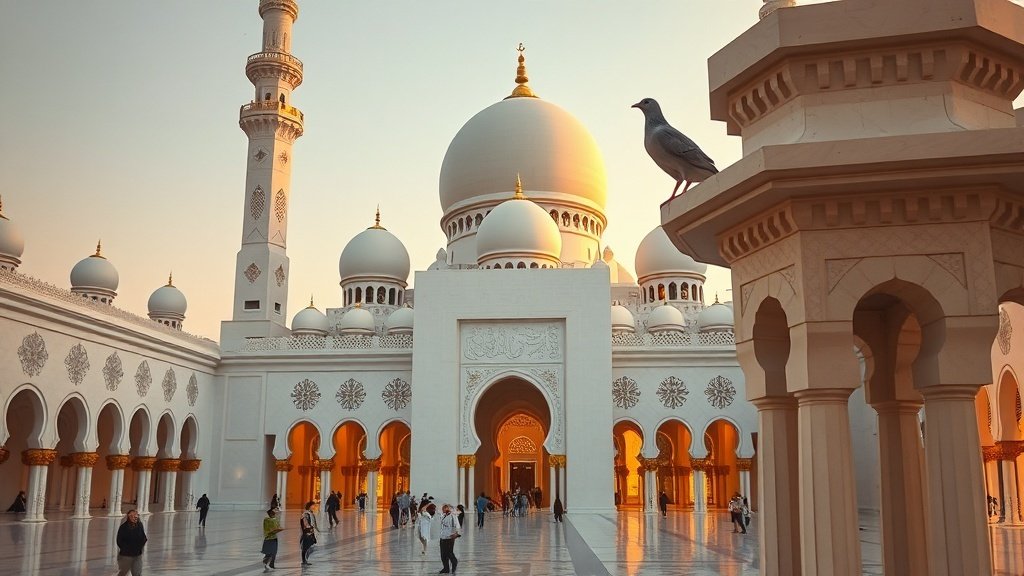
Al Fateh Grand Mosque
Bahrain's largest mosque, welcoming non-Muslim visitors for guided tours
🏛️ UNESCO World Heritage
For a country you can drive across in under an hour, Bahrain carries an outsized UNESCO portfolio: three inscribed World Heritage Sites, all cultural, plus a further six properties on the Tentative List. Together they trace a single long argument — that this small archipelago was, for five thousand years, one of the busiest crossroads in the Gulf.
| Site | Inscribed | Why it matters |
|---|---|---|
| Qal'at al-Bahrain — Ancient Harbour and Capital of Dilmun | 2005 (cultural) | An artificial tell roughly 12 m high with seven stratified layers of occupation, running from about 2300 BC to the 18th century — Dilmun, Kassite, Greek, Persian and finally the Portuguese fort that crowns it. Excavated continuously since the Danish expeditions of 1954. The capital of Dilmun sits underneath. |
| Pearling, Testimony of an Island Economy | 2012 (cultural) | Seventeen buildings in Muharraq, three offshore oyster beds, a stretch of seashore, and Qal'at Bu Mahir fortress at the southern tip of Muharraq Island, from which the diving boats set out. It is the last complete surviving example of the pearling tradition that sustained the entire Gulf until Japanese cultured pearls destroyed the trade in the 1930s. The Pearling Path links the sites on foot. |
| Dilmun Burial Mounds | 2019 (cultural) | A serial property of 21 archaeological sites across western Bahrain containing roughly 11,774 burial mounds, built between about 2200 and 1750 BC. Most are low cylindrical towers; the royal mounds at A'ali are two-storey sepulchral towers on a completely different scale. Nothing else in the world preserves a burial landscape of this density from the Early Dilmun period. |
All three are open to visitors and all three are close enough together for a single determined day: Qal'at al-Bahrain sits on the north coast about 15 minutes from Manama with an excellent site museum, the Pearling Path runs through Muharraq's old lanes a short drive from the airport, and the A'ali mounds are in the middle of a living village — houses have grown up around and between the tombs, which is either a conservation problem or the point, depending on who you ask. Go to the mounds in late afternoon; the low sun is what makes the field legible.
💼 Business & Economy
Bahrain combines Gulf energy wealth with a diversified service economy centered on banking, finance, logistics, aluminum, tourism and digital services. Manama is the country’s commercial hub, while the King Fahd Causeway links Bahrain directly with Saudi Arabia. The Bahraini dinar is pegged to the U.S. dollar, cards are widely accepted, and business hours and working patterns can shift during Ramadan and public holidays.
💡 Cultural Insights
Pearling Heritage: Though commercial pearling ended decades ago, the tradition lives in Bahraini culture. Pearl diving demonstrations occur at heritage festivals. Natural Bahraini pearls — not cultured — remain prized possessions, passed through families. The UNESCO-listed Pearling Path has revived traditional crafts that were nearly lost.
Bahraini Hospitality: Visitors may be offered Arabic coffee (gahwa) and dates as a welcome gesture. Accepting is polite; placing your palm over the cup signals you've had enough. Bahrainis take pride in hospitality — the concept of "diyafa" (guest-friendship) is deeply ingrained.
Religious Diversity: While officially Sunni-ruled, Bahrain has a significant Shia population (estimates 60–70%). Both communities have mosques with different architectural styles. Non-Muslim visitors can enter the Al Fateh Grand Mosque with appropriate dress — one of the world's most welcoming major mosques.
Social Considerations: Bahrain is the most liberal Gulf state, but it remains a Muslim monarchy. Alcohol is available in hotels, restaurants, and bars (unlike Saudi Arabia). Dress should be modest; swimwear at beaches/pools only. Ramadan means restaurants may close during daylight hours. Weekend is Friday–Saturday.
🎒 Packing Tips
Essential: Passport (with e-visa if required), lightweight modest clothing, sunscreen SPF 50+, sunglasses, comfortable walking shoes, adapter for UK-style plugs (Type G).
Clothing: Light, breathable fabrics (cotton, linen). Women should have a scarf for mosque visits. Swimwear is fine at hotel pools and private beaches. Smart casual for upscale restaurants. What NOT to bring: Heavy winter clothes (unnecessary), revealing beachwear for public areas.
Pro Tips: Everything is available in Bahrain's malls if you forget something. Air-conditioned interiors can be cold — bring a light layer. Stay hydrated — carry water at all times in summer.
🌐 Useful Resources
Official: visitbahrain.bh (tourism board), evisa.gov.bh (visa applications), bahrainairport.bh (airport info). Emergency: Police/Ambulance/Fire: 999. Tourist Police: +973 17 688 688.
Apps: Uber and Careem (taxis), Talabat (food delivery), Google Maps (works well). Currency: 1 BHD ≈ $2.65 USD. ATMs everywhere, cards widely accepted.
Time Zone: UTC+3 (Arabia Standard Time). Weekend: Friday–Saturday. Business Hours: Sunday–Thursday, typically 8am–5pm. Malls open late (10pm+).
📚 Recommended Reading
Non-Fiction: "Bahrain: Political Development in a Modernizing Society" by Emile Nakhleh — the standard academic study of Bahrain's post-independence politics, based on the author's fieldwork as the first senior Fulbright scholar in the country; banned in Bahrain for three decades before an Arabic edition was finally permitted in 2006. "Tribe and State in Bahrain" by Fuad Khuri — a classic anthropological account of how tribal and state authority intertwined. "Life and Land Use on the Bahrain Islands" by Curtis E. Larsen — the essential geoarchaeology of Dilmun and the burial mounds, for readers who want the excavation science behind what they're seeing.
Online: Bahrain National Museum virtual exhibits, UNESCO World Heritage listings for the three sites, Formula 1 official site for Grand Prix information.
🎬 Videos About Bahrain
Discover Bahrain through these selected travel videos and documentaries covering its ancient heritage, modern attractions, and F1 racing.
🔬 Fascinating Facts
🦪 Pearl Legacy
For 5,000 years, Bahrain was the world's finest source of natural pearls — the "Pearl of the Gulf." At its peak around 1911–1912, an estimated 30,000 divers worked the pearl beds. Jacques Cartier himself visited in 1912 to source gems for his Paris jewelry house. The industry collapsed when Japanese cultured pearls flooded the market after World War I.
🏝️ Island Nation
Bahrain's 33 natural islands have been joined by dozens of reclaimed ones, but the great majority of the population still lives on the main island. The kingdom is smaller than New York City yet contains three UNESCO World Heritage Sites.
🏎️ F1 Pioneer
Bahrain was the first Middle Eastern country to host Formula 1 in 2004. The circuit opened the season from 2021 to 2024 and runs the race at night under floodlights; the 2026 Grand Prix was the first ever held outside Bahrain — at Sepang, Malaysia, in October — after the spring war closed the Gulf.
💰 Valuable Currency
The Bahraini Dinar (BHD) is one of the world's most valuable currencies, worth approximately $2.65 USD. This makes Bahrain feel expensive for visitors from weaker-currency countries.
🛢️ First Oil
Bahrain was the first country on the Arab side of the Gulf to discover oil in 1932, predating Saudi Arabia's giant finds. The first well can still be visited at the Oil Museum.
🌡️ Desert Climate
Average annual rainfall is just 70mm — some years see zero rain. Summer temperatures regularly exceed 45°C with brutal humidity. Yet ancient freshwater springs once made Bahrain an oasis.
⚱️ Cities of the Dead
Over 11,000 burial mounds built between 2200–1750 BC make Bahrain home to the world's largest prehistoric cemetery — more graves than any contemporary settlement could have populated.
📊 Tourism at a Glance
Manama was designated Gulf Tourism Capital 2024 by the GCC, and 2025 was a record year — more than 15 million visitors, most of them over the causeway, with tourism at 6.9% of GDP. 2026 will not match it: the airport closed, the Grand Prix left, and the recovery only began in the summer.
⭐ Notable People
👑 King Hamad bin Isa Al Khalifa — Monarch since 1999 (king since the 2002 constitutional reforms), overseeing Bahrain's transformation from emirate to constitutional kingdom alongside continued economic and political reform.
🏎️ Crown Prince Salman bin Hamad Al Khalifa — Prime Minister since 2020 and the driving force behind the Bahrain International Circuit, which brought Formula 1 to the Middle East in 2004; Shaikh Salman bin Isa Al Khalifa has run the circuit as chief executive since 2005. ⚽ Shaikh Salman bin Ibrahim Al Khalifa — President of the Asian Football Confederation since 2013 and a FIFA senior vice-president, the most powerful Bahraini in world sport.
🏃♀️ Winfred Yavi — Kenyan-born steeplechaser who won Bahrain's Paris 2024 gold in the 3,000 m steeplechase. 🤼 Akhmed Tazhudinov — Dagestan-born wrestler whose 97 kg freestyle title at Paris 2024 was Bahrain's first men's Olympic gold.
⚽ A'ala Hubail — Joint top scorer of the 2004 Asian Cup with five goals as Bahrain reached the semi-finals, the national team's finest hour (the all-time scoring record belongs to Ismail Abdullatif, 48 goals). 🎤 Hala Al Turk — Young pop star with international following, discovered at age 11. 📚 Qassim Haddad — Acclaimed poet and cultural figure, influential in contemporary Arabic literature.
⚽ Sports
🏎️ Formula 1: The Bahrain Grand Prix — the Middle East's first, in 2004 — opened the season from 2021 to 2024 and moved to April in 2025; the 2026 race was cancelled because of the Iran war and run at Sepang, Malaysia, on 4 October instead. The night race under floodlights is one of motorsport's most iconic events. Beyond F1, the circuit hosts drag racing, karting, and driving experiences year-round.
⚽ Football: National passion with the Bahrain Premier League competitive regionally. The national team has won the Arabian Gulf Cup twice — 2019, and again on 4 January 2025 in Kuwait, beating Oman 2–1 in the final after trailing for an hour. 🥇 Olympics: Paris 2024 was Bahrain's best Games ever — four medals: Winfred Yavi's steeplechase gold, Akhmed Tazhudinov's 97 kg wrestling gold (the first for a Bahraini man), Salwa Eid Naser's 400 m silver and Gor Minasyan's weightlifting bronze. Bahrain also hosted the Asian Youth Games in October 2025. 🏇 Horse Racing: Royal tradition at Rashid Equestrian Club with regular meets. 🌊 Water Sports: Sailing, jet skiing, diving, and fishing popular given the island nation's geography. 🏌️ Golf: Royal Golf Club and other courses offer year-round play despite the heat.
📰 Media & Press Freedom
Press Freedom: Reporters Without Borders ranks Bahrain 170th of 180 in its 2026 World Press Freedom Index (score 24.84), down from 157th in 2025 — a fall driven by wartime censorship: since March 2026 the press has been permitted to relay only official statements about the Iranian strikes. Seven journalists are in prison; the last independent newspaper, Al Wasat, was closed in 2017. State Media: Bahrain TV, Radio Bahrain, the Bahrain News Agency. Private Media: Six semi-governmental dailies — Gulf Daily News and the Daily Tribune in English, Al Ayam, Akhbar Al Khaleej, Al Bilad and Al Watan in Arabic — none of which criticises the ruling family.
Internet: Generally accessible with some social media restrictions on political content. VoIP services like WhatsApp calls work normally. Self-censorship is common; political criticism of the monarchy is discouraged. Note for visitors: Normal tourism-related internet use is unaffected.
📸 Photo Gallery
Share your Bahrain photos! Send to photos@kaufmann.wtf to be featured.

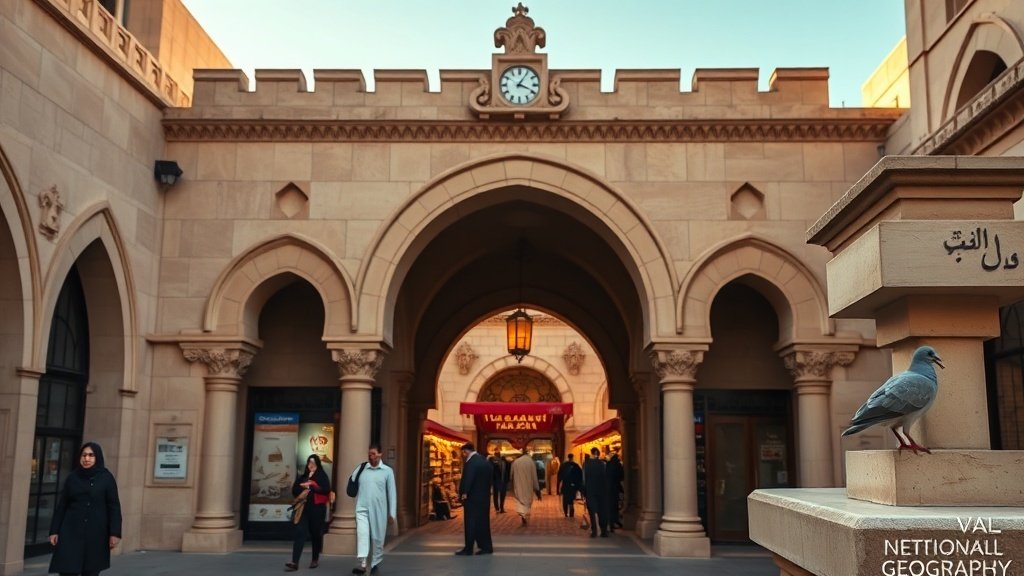
✍️ Author's Note
I have a photograph from Muharraq that I keep coming back to: a lane barely wider than my shoulders, coral-stone walls the colour of old bread, a wind tower cut against a white sky, and at the end of it a boy on a bicycle carrying a tray of karak glasses to someone's majlis. That is the Bahrain I fell for — not the World Trade Center turbines, handsome as they are, but the Pearling Path at seven in the morning when the restoration crews are still unlocking the merchant houses and the only sound is a radio in a barber's shop. Later that day I stood among the royal mounds at A'ali with a potter who told me his family had been throwing clay there since before anyone had a word for Dilmun, and I believed him, because the tombs around his kiln are four thousand years old and nobody has ever moved them.
I rewrote this page in a year when the sirens went off over Seef and Juffair, when the Grand Prix decamped to Malaysia and the parliament postponed its own election. It would be dishonest to pretend the kingdom is the carefree weekend escape it was in 2025, and I have said so in the advisory above. But the thing about a place that has been a crossroads for five millennia is that it has absorbed Assyrians, Portuguese, Persians, oil and the collapse of the pearl trade, and each time the springs kept running and the divers kept singing. When the Gulf settles — and it will — go early, go to Muharraq first, drink the hundred-fils karak, and let a stranger pour you three cups of gahwa before you have even said your name.
—Radim Kaufmann, September 2026
Support This Project 🌍
This World Travel Factbook is a labor of love – free to use for all travelers. If you find it helpful, consider supporting its continued development.
Keep exploring
Read another country, send a correction or support the project.
