Armenia is where mountains carry memory. A small, landlocked country in the South Caucasus, it sits between Turkey, Georgia, Azerbaijan, and Iran — a crossroads of empires and fault lines. Yet for the traveler, Armenia feels less like a typical nation-state and more like a village stretched over mountains.
This is the first state in the world to adopt Christianity (301 AD). Faith is carved into rock: monasteries cling to cliffs, khachkars (stone crosses) stand in fields like silent guardians, and churches glow under the silhouette of Mount Ararat — the biblical mountain that rises majestically just across the Turkish border, forever visible yet unreachable.
For American, British, Canadian, and Australian travelers, Armenia offers real, affordable, uncrowded experiences: ancient monasteries, Soviet-era history, and modern café culture side by side; wine regions older than many civilizations; hiking through canyons and high plateaus; and a complicated, living history that locals are remarkably willing to discuss. You don't just "see" Armenia — you end up at someone's kitchen table, drinking homemade wine, with a plate of dolma and three new cousins.
Armenians call their country Hayastan (Հայաստան) and themselves Hay (հայ) — names with no etymological link to the English "Armenia." Hayastan honors Hayk, the legendary patriarch said to have defeated the tyrant Bel and founded the nation beneath Ararat around 2492 BCE, a date still used as the start of the traditional Armenian calendar era. "Armenia" itself likely descends from Armina, a name used for the region in the 6th-century BCE Behistun Inscription of the Persian king Darius I.
The Armenian alphabet, invented by the monk Mesrop Mashtots around 405 AD specifically to translate the Bible into Armenian, remains unique to the language and central to national identity. Mashtots’s original alphabet had 36 letters; three more entered use during the medieval period, bringing the modern total to 39. Its distinctive letters appear everywhere from monastery inscriptions to street signs — unreadable to any neighboring nation, and a quiet daily marker of one of the world's oldest continuously used alphabets.
Urartu & Ancient Kingdoms: Armenia's story begins with the Kingdom of Urartu (9th–6th century BCE), centered around Lake Van. The Armenians emerged as a distinct people around the 6th century BCE, in one of the world's oldest continuously inhabited regions.
Christianity (c. 301–314 AD): Armenian tradition dates the kingdom's conversion under King Tiridates III and Gregory the Illuminator to 301 AD; many modern historians place it closer to 314. Either way, Armenia is traditionally regarded as the first kingdom to adopt Christianity at the state level — decades before Rome made Nicene Christianity its own official religion in 380. Medieval Golden Age: between the 9th–13th centuries, Armenia flourished with illuminated manuscripts, scientific academies, and extraordinary architecture, including Ani, the "City of 1001 Churches," now in ruins across the Turkish border.
The Armenian Genocide (1915–1923): an estimated 1.5 million Armenians were killed under Ottoman rule — an event central to Armenian identity, documented extensively by contemporary witnesses and historians, and today formally recognized as genocide by more than 30 countries. Israel came close in 2026: its cabinet unanimously approved recognition on 28 June 2026, but the Knesset vote needed to make it official was pulled from the agenda in July under pressure from Azerbaijan — a cabinet resolution, not a recognition. Turkey and Azerbaijan dispute the characterization, maintaining the deaths occurred amid the general chaos and mass displacement of World War I rather than a coordinated campaign. Yerevan's Tsitsernakaberd memorial, discussed below, is essential to understanding how central this history remains to Armenian identity today.
Soviet Era (1922–1991): modernization came with restricted religious expression, but Armenian culture survived. Independence (1991) brought a rebirth of national culture, language, and spiritual heritage — alongside a war with Azerbaijan over the ethnic-Armenian enclave of Nagorno-Karabakh that would shadow the next three decades.
Nagorno-Karabakh, resolved by force: after a 1994 ceasefire left the territory under de facto Armenian control for nearly thirty years, a 2020 war shifted the balance decisively toward Azerbaijan, and in September 2023 an Azerbaijani military offensive completed the takeover. Within two weeks, more than 100,000 ethnic Armenians — nearly the entire population of Nagorno-Karabakh — fled to Armenia, and the self-declared leadership issued a decree ordering the dissolution of Artsakh’s institutions by January 1, 2024 — though former Artsakh officials later disputed the decree’s validity. Whatever that dispute’s outcome, Azerbaijan has exercised full territorial control since September 2023 and no Armenian administration operates there today. The displaced remain a visible presence in Armenia today, one in roughly every thirty residents, and integrating them remains an active national challenge. On 8 August 2025 Pashinyan and Azerbaijan’s President Aliyev signed a Joint Declaration at the White House, initialling the text of a peace agreement and launching the Trump Route for International Peace and Prosperity (TRIPP) — a transit link across Armenia’s Syunik province connecting mainland Azerbaijan to its Nakhchivan exclave, with Armenian sovereignty retained. A year on, the treaty has been initialled but not signed: Azerbaijan ties signature to amending Armenia’s constitution, which would require a referendum. A US–Armenia implementation framework published in January 2026 established the TRIPP Development Company, and engineering surveys are underway; Pashinyan has said construction should begin in the second half of 2026 — implementation is running well ahead of the still-unsigned peace treaty it’s meant to serve.
For much of antiquity, Armenian history is largely the history of being squeezed between empires. Under Tigranes II "the Great" (r. c. 95–55 BC), it briefly went the other way: allied by marriage to Mithridates VI of Pontus, Tigranes carved out an empire stretching toward the Mediterranean, founded a new capital at Tigranocerta, and claimed the old title "King of Kings" — until an alarmed Rome sent first Lucullus, then Pompey, to cut Armenia back down to a buffer kingdom between Rome and Parthia, a role it would play for the next four centuries.
That buffer position shaped what followed, including Armenia's Christian identity. When Armenia was formally partitioned between Roman/Byzantine and Sasanian Persian spheres around 387 AD, the larger, Persian-ruled portion faced periodic pressure to adopt Zoroastrianism. In 451 AD an outnumbered Armenian force under Vardan Mamikonian was defeated resisting this at the Battle of Avarayr — but Sasanian losses were heavy enough that further forced conversion was quietly abandoned. Armenians still mark Avarayr as a victory: not of arms, but of the principle that faith wasn't negotiable. Vardan is venerated as a saint for it.
For much of the 16th–18th centuries, Armenia's story is largely Persia's story. Ottoman–Safavid wars repeatedly split and devastated the Armenian highlands, and in 1604 Shah Abbas I forcibly relocated the entire population of Julfa — one of Armenia's wealthiest merchant towns — to Isfahan, where the deportees built New Julfa and ran a trading network stretching from Amsterdam to Manila. Yerevan itself spent this era as the seat of a Persian-administered Erivan Khanate; the city's restored 1760s Blue Mosque is a surviving trace of that Persian-Muslim layer beneath the Christian city most visitors expect.
The modern border traces to 1828, when a defeated Qajar Persia signed the Treaty of Turkmenchay ending the Russo-Persian War, ceding the Erivan and Nakhchivan khanates to the Russian Empire. That single treaty did as much to shape the modern Armenian state as anything in the 20th century — it's the moment Eastern Armenia left the Persian world for the Russian one, setting up everything that followed.
The Armenian Genocide is not a detached historical footnote but a central element of modern Armenian identity. Beginning in 1915, the Ottoman authorities deported, dispossessed and killed Armenians across Anatolia; historians widely recognize that about 1.5 million people perished. Survivors created new communities from Beirut and Marseille to Los Angeles, carrying language, recipes, liturgy and family memory with them.
In Yerevan, the Tsitsernakaberd memorial and museum provide a sober place to understand the events through documents and personal testimony. Visit quietly, allow time, and remember that this history still shapes diplomacy, diaspora life and private conversations. The annual commemoration on 24 April brings thousands of people to the eternal flame.
Armenian Genocide & Memory
Context→Place→Experience
07
Soviet Armenia
Armenia became a Soviet republic in 1920 and remained within the USSR for seven decades. The period brought mass literacy, industrialisation, scientific institutes and the transformation of Yerevan into a planned capital built from warm pink tuff. It also brought political repression, censorship, collectivisation and the loss of churches, neighbourhoods and individual freedoms.
The Soviet legacy remains visible in monumental architecture, factory towns, mosaics, sanatoriums and the metro. Rather than treating it as a single story, look for contrasts: modernist cultural buildings beside abandoned plants, cherished public education beside memories of surveillance, and local Armenian forms adapted to a centralised Soviet system.
Armenia restored independence in 1991 as the Soviet Union dissolved. The early years were marked by war, energy shortages and economic upheaval, yet they also produced new institutions, private enterprise and stronger links with the global diaspora. A peaceful protest movement in 2018, known as the Velvet Revolution, demonstrated the importance many Armenians place on accountable government.
Today the country is balancing security pressures, democratic reform, relations with neighbouring states and a rapidly changing economy. Visitors encounter both deep continuity and visible change: traditional family networks coexist with technology firms, contemporary galleries and an outward-looking generation that speaks several languages.
Armenia is a parliamentary republic. Real executive power sits with the prime minister; the president — Vahagn Khachaturyan, in office since March 2022 — holds a largely ceremonial role. Nikol Pashinyan has led the country since the peaceful 2018 Velvet Revolution, when weeks of street protests toppled the old Karabakh-war-generation elite without a shot fired.
The parliamentary election of 7 June 2026 was widely framed as a referendum on the loss of Nagorno-Karabakh and on the peace process with Azerbaijan. Pashinyan’s Civil Contract won 49.75% (726,819 votes), well ahead of the Strong Armenia Alliance of businessman Samvel Karapetyan on 23.27%, with former president Robert Kocharyan’s Armenia bloc taking 9.92% and Prosperous Armenia falling just below the 4% threshold. Turnout was 58.9% — 1,476,769 of 2,503,976 registered voters. Under the CEC's final results (14 June) the 105-seat National Assembly split 64 Civil Contract / 29 Strong Armenia / 12 Armenia Alliance; the new parliament convened on 2 August 2026, elected Ruben Rubinyan speaker, and Khachaturyan signed the decree reappointing Pashinyan prime minister the same week. A month before the vote, on 4 May 2026, Yerevan hosted the 8th European Political Community summit (48 delegations, Macron, Starmer, Zelensky and NATO's Rutte among them), followed the next day by the first-ever EU–Armenia summit — the clearest signal yet of the country's westward tilt away from Moscow.
For a visitor, transfers of power here happen at the ballot box and protests are common but overwhelmingly peaceful — Armenians will talk politics with a stranger over coffee more readily than almost anywhere in the region. Domestically, though, the post-election climate is highly polarized: the government has moved against its main opponents in ways it describes as legitimate law enforcement and critics call a politically motivated crackdown. Former president Robert Kocharyan, leader of the Armenia Alliance, was detained with his son on 25 August 2026 on abuse-of-office, bribery and money-laundering charges (ex-president Serzh Sargsyan is charged in the same case); Strong Armenia's billionaire founder Samvel Karapetyan has been held since June 2025 — in pre-trial detention, then house arrest from January 2026 — on charges of calling for the seizure of power; Prosperous Armenia's Gagik Tsarukyan is in pre-trial detention; and Catholicos Karekin II himself went on trial in August 2026 (see the Church section above). The other live variable is the constitutional referendum that Azerbaijan wants as a precondition for signing the peace treaty — an issue capable of filling Republic Square at short notice.
🏛️ Government & Politics Today
Context→Place→Experience
10
🗺️ Geography
Armenia is a landlocked country of dramatic contrasts — high plateaus, deep gorges, alpine meadows, and semi-desert valleys. The average elevation exceeds 1,800 meters, making it one of the world's most mountainous nations. Mount Aragats (4,090m) is the highest peak entirely within Armenia's borders.
The landscape is dominated by the Armenian Highlands — the same volcanic terrain overlooked by Mount Ararat — traditionally identified since the medieval period with the "mountains of Ararat" where Genesis says Noah’s Ark came to rest. The peak rises just across the Turkish border and dominates the horizon from Yerevan. Lake Sevan, at 1,900 meters elevation, is one of the largest high-altitude lakes in the world. The climate is continental, with hot summers in the Ararat Valley and cold, snowy winters in the mountains — extreme variation that produces world-class apricots, pomegranates, and grapes for wine and brandy.
Yerevan sits at 40.2° N, 44.5° E; Khor Virap is 40 km south, Lake Sevan 65 km north-east and Tatev 250 km south-east by road. Scroll-zoom is disabled; use the +/− buttons.
🗺️ Map of Armenia
Context→Place→Experience
12
🎭 People & Culture
Armenians are deeply proud of their faith, language, family, hospitality, and resilience. The Armenian alphabet, created by Mesrop Mashtots in 405 AD, is one of the world's oldest writing systems still in daily use — and a source of enormous cultural pride, since it allowed scripture, and everything else, to exist in Armenian rather than a borrowed tongue.
Music: the haunting duduk (double-reed woodwind) is Armenia's national instrument, its mournful sound recognized by UNESCO as intangible heritage. Sacred chants, the compositions of Komitas, and modern jazz flourish side by side. Hospitality: Armenians take it seriously — expect to be invited for coffee, homemade wine, or a full meal by strangers; refusing feels almost impossible. Festivals: Vardavar (a joyful, no-rules water festival each summer, when the entire country is fair game for a soaking), Wine Days in Areni, and the Apricot Festival mark the rhythms of Armenian life.
One more thing worth understanding before you arrive: this is a diaspora nation as much as a homeland. Millions more ethnic Armenians live abroad — in Russia, France, the United States, Lebanon, and elsewhere — than in Armenia itself, largely as a legacy of the Genocide. Almost every Armenian you meet has family scattered across several continents, and the emotional pull of "returning," even for those born abroad, runs deep.
Armenian culture moves easily between ancient forms and bold experimentation. The duduk, a double-reed instrument traditionally made from apricot wood, produces a warm, breathy sound recognised by UNESCO. Sacred chant, ashugh troubadour songs, folk dance and classical composition remain active traditions rather than museum pieces.
Modern Armenian artists and filmmakers often explore memory, migration and belonging. Spend time at the Cafesjian Center for the Arts, the National Gallery, independent spaces and small music clubs in Yerevan. Internationally known figures such as composer Aram Khachaturian, filmmaker Sergei Parajanov and singer Charles Aznavour reveal the extraordinary reach of Armenian creative life.
Arts, Music & Film
Context→Place→Experience
14
✝️ The Armenian Apostolic Church
Armenia's church is often lumped in with "Orthodox Christianity," but it belongs to a distinct family: the Oriental Orthodox communion, alongside the Coptic, Syriac, and Ethiopian churches — separate from both the Eastern Orthodox world of Greece and Russia and from Rome. The split traces to the Council of Chalcedon in 451 AD, whose formula on the nature of Christ the Armenian church never ratified; Armenia's bishops were fighting for their religious survival against Persia that same year and were unable to attend.
At its head sits the Catholicos of All Armenians — since 1999 Karekin II — based at the Mother See of Etchmiadzin in an unbroken line traced to Gregory the Illuminator. The liturgy is still sung in Classical Armenian, largely unchanged since the 5th century. More than an institution, the church has often served as a portable homeland — holding Armenian identity together across empires, genocide, and diaspora long after political Armenia vanished from the map for centuries at a time.
That institution is now in open conflict with the state. Since mid-2025 Prime Minister Pashinyan has demanded Karekin II's resignation, accusing him of breaking his vow of celibacy and of serving Russian interests (no evidence has been made public; the Church denies both), and two archbishops were arrested in 2025 over an alleged coup plot. On 7 August 2026 Karekin II and six clerics went on trial at the Armavir Regional Court in Vagharshapat for refusing to reinstate a pro-government bishop the Church had defrocked in January — a charge carrying up to two years in prison. A visitor will notice none of this at Etchmiadzin's Sunday liturgy, but it explains why the Church is on the front page of every Armenian newspaper.
A khachkar is not simply a "stone cross." Each is an individually carved memorial slab, typically waist-to-head high, centered on a cross that seems to float above a base of rosettes, vines, and interlaced knotwork carved in relief — no two are alike, and master carvers were remembered by name for centuries. They mark graves, commemorate battles or building projects, or simply stand as prayers in stone.
The form peaked between the 9th and 13th centuries and never really stopped — new khachkars are still carved today. UNESCO inscribed "the symbolism and craftsmanship of khachkars" as Intangible Cultural Heritage in 2010. The largest surviving concentration stands at Noratus, by Lake Sevan: a hillside of hundreds of cross-stones spanning a thousand years, which matters all the more because a comparable, larger field at Old Djulfa, across the border in Nakhchivan, was documented by international observers being systematically destroyed in the 2000s — an act Armenia calls deliberate cultural erasure and Azerbaijan denies.
After Mashtots gave Armenia its alphabet, the immediate task was translating scripture — but what followed over the next centuries was a full manuscript civilization. Armenian scribes translated and preserved theology, history, medicine, and Greek philosophy, some works surviving today only in Armenian after their Greek originals were lost, alongside illuminated gospels ranked among the finest in Christian art.
That heritage survived war and genocide largely because manuscripts were treated as more precious than gold — carried over mountains by refugees, buried, smuggled, ransomed back from raiders. Yerevan's Matenadaran ("manuscript repository") now holds tens of thousands of manuscripts and hundreds of thousands of archival documents. It functions less like a library than a monument to a nation that repeatedly decided its books were worth dying for.
🖋️ Matenadaran — A Nation's Books
Context→Place→Experience
17
The Armenian Alphabet
The Armenian alphabet was created in the early fifth century by the scholar and cleric Mesrop Mashtots. Its original thirty-six letters gave Armenian literature a durable written form and supported translations of scripture, philosophy and science. Two additional letters were adopted later. The script is still one of the clearest symbols of cultural continuity.
You will see its distinctive rounded and angular forms on road signs, menus, khachkars and manuscripts. Learning a few characters makes travel more rewarding: Հայաստան means Armenia, Երևան is Yerevan, and շնորհակալություն means thank you. At the Alphabet Monument near Mount Aragats, giant stone letters turn the writing system into a playful outdoor landmark.
The Armenian Alphabet
Context→Place→Experience
18
🌏 Armenia Beyond Armenia
Armenia's diaspora didn't start with the genocide, though 1915 is what turned it into a defining feature of national identity. Merchant communities — New Julfa's Isfahan network among the most striking — had already spread across Persia, the Ottoman Empire, and Eastern Europe for centuries before the genocide scattered Ottoman Armenians across Syria, Lebanon, France, and eventually the Americas.
Estimates commonly place the global Armenian diaspora at several million people against roughly 3.1 million residents of Armenia itself — a homeland-to-diaspora ratio matched by almost no other nation. Major communities in Los Angeles, Moscow, Paris, Beirut, and Buenos Aires maintain their own churches and schools, and much of the Western diaspora speaks a distinct Western Armenian dialect that has diverged from the Eastern Armenian spoken in the Republic. Remittances, tourism, and philanthropy from abroad remain economically significant, and partial repatriation has been a recurring, contested theme since Soviet times — a homeland that is, in a real sense, larger outside its own borders than within them.
🌏 Armenia Beyond Armenia
Context→Place→Experience
19
🏙️ Yerevan — The Pink City
Founded in 782 BCE, Yerevan is one of the world's oldest continuously inhabited capitals — older than Rome. The city glows with rose-colored volcanic tuff stone, earning its nickname "The Pink City."
Republic Square anchors the city with musical fountains and Soviet-era architecture. The Cascade Complex — a giant limestone staircase filled with contemporary art — offers the best city views, with Mount Ararat as backdrop. Vernissage Market overflows with handmade crafts, Soviet memorabilia, and Armenian textiles every weekend.
Don't miss Tsitsernakaberd, the Armenian Genocide Memorial: a moving hilltop monument and museum essential for understanding the Armenian soul, and a place most Armenians will quietly encourage you to visit before anything else in the city. At night, Yerevan transforms with jazz clubs, elegant wine bars, and sidewalk cafés along Northern Avenue.
Armenia's second city has worn three names in under a century — Alexandropol under the Russian Empire, Leninakan in Soviet times, Gyumri since independence — and each layer is still visible in its 19th-century core of dark volcanic tuff, laid out in a dense, arcaded grid unlike anywhere else in the country. Gyumri is Armenia's self-declared capital of humor and craft; its blacksmithing tradition joined UNESCO's Intangible Cultural Heritage list in 2023.
At 11:41 a.m. on 7 December 1988, a magnitude-6.8 earthquake centered near Spitak devastated the region, killing an estimated 25,000–50,000 people — exact figures are still disputed. Leninakan/Gyumri, the largest city near the epicenter, suffered enormously as Soviet-era prefabricated apartment blocks collapsed in seconds while much of the old stone city held. Gorbachev cut short a US visit to tour the ruins, and international aid arrived despite Cold War tensions. Reconstruction dragged on for decades — some families lived in metal "domik" container housing into the 2000s — and both the scars and the resilience remain part of how Gyumri sees itself today.
🧱 Gyumri — City of Black Tuff
Context→Place→Experience
21
⛪ Khor Virap
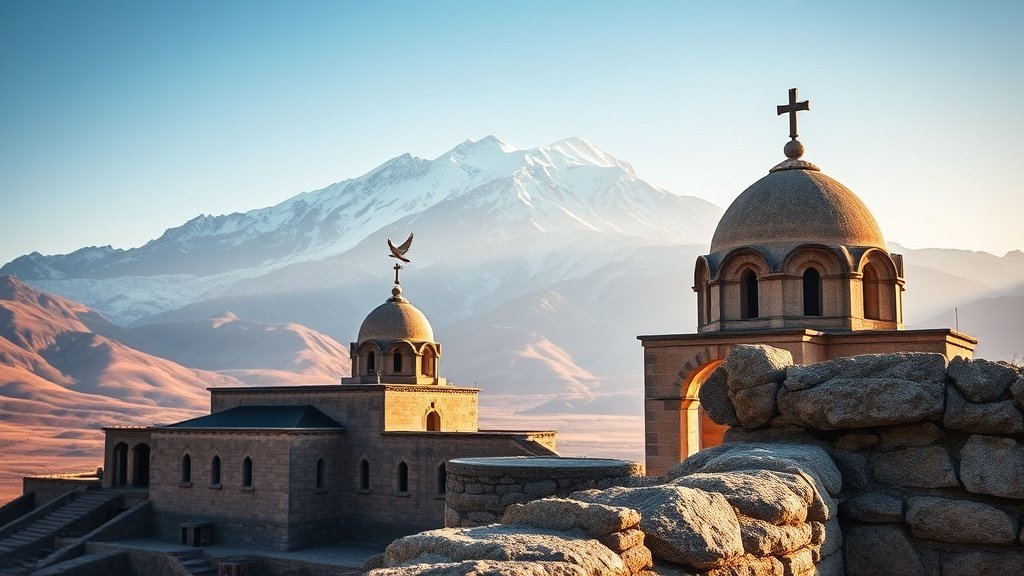
No image captures Armenia's soul better than Khor Virap Monastery rising against the snow-capped massif of Mount Ararat. This is where Gregory the Illuminator was imprisoned for 13 years in a pit before converting King Tiridates III and establishing Christianity as the state religion in 301 AD. The deep pit where Gregory was held can still be descended via a narrow ladder.
Arrive at sunrise, when the mountain emerges from morning mist and the monastery glows golden against the volcanic peak — it's one of the most photographed scenes in the Caucasus, and one of the strangest: one of the most revered pilgrimage sites in Armenian Christianity stands in full, permanent view of a mountain that is not, and cannot be, Armenian territory — the Mother See at Etchmiadzin, not Khor Virap, is the church’s actual spiritual headquarters, but few sights capture Armenia’s bond with Ararat as viscerally as this one.
The Mother See of Holy Etchmiadzin, a short drive from Yerevan, is Armenia's Vatican — spiritual headquarters of the Armenian Apostolic Church and seat of the Catholicos of All Armenians. Tradition holds that Gregory the Illuminator saw Christ descend here in a vision, striking the earth with a golden hammer to mark where the first cathedral should rise; "Etchmiadzin" translates roughly as "the place where the Only-Begotten descended."
Continuously active since the early 4th century and rebuilt in stone in the 5th, the cathedral complex is a UNESCO World Heritage Site whose treasury holds relics said to include a fragment of Noah's Ark and the Holy Lance. Paired with the nearby ruins of Zvartnots Cathedral, also UNESCO-listed, Etchmiadzin forms the ceremonial heart of Armenian Christianity — quieter and less photographed than Khor Virap, but more central to how Armenians understand their own faith.
Perched on a cliff above the Vorotan River gorge, Tatev Monastery is reached via the "Wings of Tatev" — a Guinness World Record holder for longest non-stop double-track cable car, a 5,752-metre reversible tramway. The 12-minute ride offers breathtaking views of the canyon 320 meters below.
The 9th-century monastery was once a major monastic and educational community, among medieval Armenia's most important centers of learning. The swaying pillar "Gavazan" is an ingeniously balanced stone column said to sway in response to tremors — a seismic indicator, if not quite the earthquake-predicting alarm of local legend — and it still stands after a thousand years.
Called the "Blue Pearl of Armenia," Lake Sevan holds roughly 90% of Armenia's fresh water and is one of the world's largest high-altitude lakes, at 1,900 meters elevation. The ancient Sevanavank Monastery perches on what is now a peninsula — it was a genuine island until Soviet engineering intervened.
Starting in the 1930s, Soviet planners diverted Sevan's outflow for irrigation and hydropower, deliberately lowering the lake by close to 20 meters over several decades — turning Sevanavank's island into a peninsula and exposing vast stretches of former lakebed. It worked for energy and agriculture, but the shrinking, warming lake also triggered eutrophication and collapsed the population of ishkhan, the endemic Sevan trout. Since the 1980s Armenia has run water-level restoration programs, including a tunnel bringing in water from the Arpa and Vorotan rivers, and the lake has been slowly rising again — though still well below its original level.
In summer, Armenians flock to Sevan's beaches, and lakeside restaurants serve ishkhan — mostly farmed today, as wild stocks are still recovering. The surrounding Gegharkunik province offers hiking trails and medieval churches, including the khachkar field at Noratus, rarely visited by tourists who stop only for the lake itself.
Geghard Monastery (UNESCO) is partly carved directly into the surrounding cliffs, creating an otherworldly fusion of architecture and living rock. Medieval khachkars and acoustic chambers where monks once sang create an atmosphere of profound spirituality — sing a single note inside and the whole chamber answers.
Nearby Garni Temple is the only standing Greco-Roman colonnaded building in the former Soviet Union — a 1st-century pagan temple that survived Armenia's conversion to Christianity by being repurposed rather than destroyed — only to collapse in a 1679 earthquake. What stands today is a 1969–75 reconstruction, built anastylosis-style largely from the original stones. (Scholars still debate whether it was a temple, possibly to the sun god Mihr, or a royal tomb.) Below it, the "Symphony of Stones" shows off columnar jointing — hexagonal basalt columns that form as lava cools and cracks — in the Azat Gorge; Garni and this "Basalt Organ" formation joined Armenia's UNESCO Tentative List together in 2025.
South of Yerevan, the Arpa River has carved Vayots Dzor — "the Gorge of Woes" — through red sandstone cliffs that tint the whole region wine-dark. Fittingly, this is Armenia's most important wine country, centered on the village of Areni and its indigenous Areni Noir grape, grown at some of the highest vineyard altitudes anywhere in the world.
Just outside the village, the Areni-1 cave complex has produced two separate world firsts. Excavation from 2007 onward uncovered a complete winemaking installation — press, fermentation vats, storage jars — dated to around 4000 BC, the earliest known integrated winery anywhere; a dry side chamber separately yielded a single well-preserved leather moccasin dated to roughly 3600–3500 BC, the oldest known leather shoe in the world, still stuffed with the straw used to hold its shape. Above the gorge, the 13th-century monastery of Noravank clings to a red cliff face, its facade carved by the sculptor-monk Momik and reached by a famously narrow, exposed stone staircase — reason enough on its own to make the detour south.
Known as "Little Switzerland," Dilijan is Armenia's forest resort town — lush green hills, cool mountain air, and timber houses in a restored Old Town. The surrounding national park offers excellent hiking to hidden monasteries like Haghartsin and Goshavank, tucked into forest that feels a world away from the arid Ararat Valley below.
UWC Dilijan — part of the international United World Colleges movement, open since 2014 — brings students from dozens of countries to this peaceful setting. Local mineral waters have been prized since Soviet times, and artisan workshops around town produce traditional crafts worth seeking out.
🌲 Dilijan
Context→Place→Experience
28
⛰️ Lori & the Debed Canyon
In Armenia's far north, the Debed River has cut a dramatic basalt canyon through Lori province, and on facing plateaus above it sit two of medieval Armenia's greatest monastic universities, Haghpat and Sanahin — jointly inscribed as a single UNESCO World Heritage Site. Both were founded in the 10th century under Bagratid patronage and became major centers of manuscript production and scholarship; local tradition plays on their names as a rivalry between two sister foundations barely a few kilometers apart.
The canyon floor tells a very different story: 19th-century Alaverdi became a major Russian imperial copper-smelting center, and Soviet planners later built an industrial complex that still dominates the valley, smoke and all. Medieval monastery and Soviet factory chimney sit within sight of each other — an unusually direct collision of two chapters of Armenian history, in a region most visitors otherwise skip on the way to Georgia.
⛰️ Lori & the Debed Canyon
Context→Place→Experience
29
Explore More About Armenia
Four deep-dive guides live on their own pages so this one doesn't turn into a wall of text.
Armenian cooking is seasonal, generous and deeply connected to the landscape. Lavash bread, grilled khorovats, herb-filled jingalov hats, tolma, harissa wheat porridge and spas yoghurt soup appear in homes and restaurants, while apricots, pomegranates, walnuts and mountain herbs give dishes their characteristic accents.
Meals are social occasions, and hospitality may arrive in several courses. Visit a market before choosing a restaurant: Yerevan’s GUM Market is excellent for dried fruit, sujukh sweets, cheeses and pickles. Regional cooking differs, so try fish around Lake Sevan, wine-country dishes in Vayots Dzor and the distinctive food traditions brought by families from across the historic Armenian world.
Armenia’s winemaking story reaches back thousands of years. Archaeologists at Areni-1 cave uncovered evidence of a remarkably early wine-production complex, while today’s producers are reviving indigenous grapes such as Areni Noir, Voskehat and Kangun. High-altitude vineyards, volcanic soils and large shifts between day and night temperatures create wines with bright acidity and strong regional character.
Yerevan has lively wine bars, but the most rewarding route runs through Vayots Dzor, where cellar visits can be combined with Noravank and Areni village. Armenia is also famous for barrel-aged brandy; the historic Yerevan Brandy Company offers tastings that explain its production and its place in twentieth-century culture.
Armenia has a continental climate with significant variation by altitude. Yerevan summers are hot (35°C+), while winters bring heavy snow to the mountains. Best time to visit: May–June and September–October offer ideal weather — warm days, cool nights, and spectacular autumn colors around the monasteries. July–August can be brutally hot in the Ararat Valley, though still pleasant in the highlands. Winter (December–March) is good for skiing at Tsaghkadzor.
🌡️ Climate & Best Time to Visit
Context→Place→Experience
33
✈️ Getting There
By Air: Zvartnots International Airport (EVN), 12km from Yerevan, connects to major European and Middle Eastern hubs including Vienna, Paris, Dubai, and Moscow — some 40 airlines serve 83 destinations as of August 2026, with Wizz Air adding Eindhoven (October 2026) and Charleroi (February 2027). Traffic has outgrown the terminal: a US$500 million, ten-year expansion announced in October 2025 will raise the gate count from 6 to 16. There are no direct flights from North America; connect via Europe or the Gulf.
By Land: borders with Georgia and Iran are open and commonly used overland routes. The border with Azerbaijan remains closed. The land border with Türkiye remains closed to regular passenger traffic as of August 2026 too, but an active normalization process is underway — direct Yerevan–Istanbul flights already operate, and Armenia has rebuilt the Margara checkpoint on the Araks and declared it ready for operation (August 2026). It has so far opened only for humanitarian convoys — most recently ten days in June 2026 to send aid to Lebanon through Turkish territory — and no date for a regular opening has been announced. For now, Armenia is effectively reachable overland from only two of its four neighbors.
Visa: citizens of the US, all EU states, UK, Canada, Australia, New Zealand, Japan, and South Korea (among others) can enter visa-free for up to 180 days a year — one of the more generous allowances anywhere. Armenia has also run temporary expanded visa-exemption programs for holders of qualifying US/EU/Gulf residence permits; check current dates if your own passport isn’t on the standard list.
✈️ Getting There
Context→Place→Experience
34
📋 Practical Information
Currency: Armenian Dram (AMD), a strong currency: about 364 AMD to $1 USD in early September 2026, having firmed from 375–390 through 2025 (older guides quoting 400+ are well out of date). Cards are widely accepted in Yerevan; carry cash for rural areas and small vendors. Language: Armenian, using its own unique alphabet. Russian is widely spoken across generations; English is growing among younger Yerevantsis but thins out fast in the provinces.
🟡 Travel Advisory — Level 2
The U.S. State Department rates Armenia Level 2: Exercise Increased Caution, reissued 5 September 2025, because of areas of potential armed conflict. The rating reflects geography, not the country as a whole — Yerevan, Lake Sevan’s western shore, Dilijan, the Vayots Dzor wine country and every headline monastery sit comfortably outside the flagged zones.
Carved out at Do Not Travel is the border region with Azerbaijan. U.S. Embassy staff are additionally barred from non-essential travel to Gegharkunik east of Vardenis, Syunik east of Goris, and Syunik south of Kapan — a useful proxy for where a private traveller should also not wander. If you are driving the Goris–Kapan road south toward Iran, note that short stretches historically ran close to Azerbaijani positions; check the current routing locally before setting off. Away from those margins, ordinary crime risk in Armenia is low by any European standard.
Safety: Armenia is very safe for travelers, with low crime and a strong culture of looking out for guests. Hospitality is legendary — expect to be invited for coffee, wine, or dinner by strangers, sometimes within minutes of meeting them. Getting Around: marshrutkas (shared minibuses) connect most towns cheaply. Rental cars offer freedom but mountain roads can be challenging, especially after snow. Taxi apps work well in Yerevan.
📋 Practical Information
Context→Place→Experience
35
Business & Economy
Armenia has shifted from a centrally planned Soviet economy toward a diverse system shaped by services, mining, agriculture, construction and a fast-growing technology sector. Yerevan hosts software companies, research teams, creative studios and startup communities, supported by strong mathematics and engineering education and by professional networks across the diaspora.
For business visitors, relationships and trust matter. Meetings may begin formally and continue over coffee or a meal; clear agreements and patient follow-up are useful. Opportunities coexist with structural challenges, including a small domestic market, transport constraints and regional uncertainty. Local expertise is essential when assessing regulation, taxation or investment.
Business & Economy
Context→Place→Experience
36
💰 Cost of Travel
Armenia is one of the best-value destinations in the wider region. Budget travelers can manage on $30–45/day; a comfortable mid-range trip runs $60–100/day, including a private driver for day trips to monasteries. A restaurant meal with wine runs $8–15; a bottle of genuinely excellent Areni Noir costs $10–15 in a wine shop; a driver for a full-day monastery circuit (Khor Virap, Noravank, Areni) typically costs $40–60 for the car, split however many ways you like.
💰 Cost of Travel
Context→Place→Experience
37
🏨 Accommodation
Yerevan: ranges from backpacker hostels around Republic Square to boutique hotels in restored tuff-stone buildings and international chains near the Cascade. Dilijan: forest guesthouses and a growing number of design-forward small hotels, popular for a cooler mountain break from the capital.
Homestays are Armenia's real specialty and often the best value and best experience combined — a family room, home-cooked meals, and an evening of toasts thrown in, frequently for less than a mid-range hotel. Around Lake Sevan and in Vayots Dzor wine country, small guesthouses attached to family wineries let you fall asleep among the vines you tasted that afternoon.
🏨 Accommodation
Context→Place→Experience
38
🎉 Festivals & Events
Vardavar (mid-July, 14 weeks after Easter) is Armenia's most joyful tradition — a nationwide water festival where absolutely everyone, strangers included, is fair game for a soaking with buckets, hoses, or water balloons. Commonly linked to pre-Christian Armenian water traditions and later folded into the Christian Feast of the Transfiguration, it turns Yerevan into a citywide water fight for a day. Wine Days (Yerevan, June, and a dedicated festival in Areni each October) celebrate the modern wine renaissance with tastings from dozens of small producers.
Independence Day (September 21) marks the 1991 break from the Soviet Union with concerts and fireworks in Republic Square. Armenian Genocide Remembrance Day (April 24) is solemnly observed nationwide — expect Tsitsernakaberd to be extremely crowded, and expect most Armenians to consider it the single most important date on the calendar. The Apricot Festival (August, Yerevan) celebrates Armenia's national fruit. Its Latin name, Prunus armeniaca, preserves an ancient European association with Armenia — though the fruit’s botanical origins likely lie further east in Eurasia.
Armenia’s UNESCO-listed places reveal how architecture, faith and landscape have developed together. The cathedral and churches of Echmiadzin with the archaeological site of Zvartnots, the monasteries of Haghpat and Sanahin, and the paired monasteries of Geghard and the Upper Azat Valley are inscribed as World Heritage.
Several living traditions are also internationally recognised, including lavash making, duduk music and the art of Armenian letterforms. Treat these places and practices as active cultural environments: dress respectfully in churches, avoid interrupting services, follow local guidance and support craftspeople and guides who keep knowledge within their communities.
Noravank — a 13th-century monastery set into a dramatic red-rock canyon in Vayots Dzor, with a nearly vertical stone staircase to the upper church that will test anyone's nerve. Combine with an Areni wine-cellar visit on the same day; they're minutes apart. Khndzoresk — a cliffside cave-village abandoned only in the mid-20th century, connected to the modern town by a long, wobbly swinging footbridge across the gorge.
Jermuk — a Soviet-era spa town famous for mineral springs and a dramatic waterfall, quieter and less visited than Dilijan. Yeghegis Valley — a remote cluster of medieval churches and a surprisingly well-preserved medieval Jewish cemetery, evidence of a Jewish community that thrived here centuries ago and left almost no other trace. Amberd Fortress — a 7th-century fortress on the slopes of Mount Aragats, dramatic and nearly empty of other visitors even in high season.
Essential: comfortable walking shoes for cobblestones and monastery stairs (many are steep, uneven, and unrailed), layers for big day-to-night temperature swings at altitude, and a modest outfit (shoulders and knees covered) for entering churches and monasteries — this applies to everyone, not just women, and is taken seriously.
Practical: a power adapter for European-style plugs (220V), sunscreen (the highland sun is stronger than it looks), and an appetite — homestay hosts will keep bringing food long after you think the meal is over, and declining feels genuinely rude. Cash in small denominations helps for rural monasteries, marshrutkas, and market stalls.
🎒 Packing Tips
Context→Place→Experience
42
🌐 Useful Resources
Official: armenia.travel (tourism board). Emergency: 911 (unified emergency number). Apps: GG (local ride-hailing, works well in Yerevan), Yandex Go, Maps.me for offline hiking and driving maps in areas with patchy signal. News: ArmenPress and Civilnet (English-language coverage of current events, including ongoing Karabakh-related developments).
🌐 Useful Resources
Context→Place→Experience
43
📚 Recommended Reading
"The Forty Days of Musa Dagh" by Franz Werfel (1933) — a monumental novel of Armenian resistance during the Genocide, credited with inspiring later resistance movements who read it in hiding. "Black Dog of Fate" by Peter Balakian — a memoir tracing one Armenian-American family's discovery of its own history. "The Bastard of Istanbul" by Elif Shafak — a Turkish novelist's unusually candid engagement with Armenian-Turkish memory, controversial in Turkey on publication.
"Armenia: Portraits of Survival and Hope" by Donald E. Miller and Lorna Touryan Miller — oral histories bridging the Genocide generation and today. For lighter reading, "The Crossing Place" by Philip Marsden is a well-regarded travel account of journeying through the Armenian diaspora world.
📚 Recommended Reading
Context→Place→Experience
44
🎬 Videos About Armenia
A few starting points for exploring Armenia on screen before you go.
Mount Ararat appears on Armenia's coat of arms, on the label of Ararat brandy, in the name of half the country's businesses, and in the sightline of nearly every photograph taken from Yerevan. It has lain just across the border since the early Soviet-era treaties of Moscow and Kars (1921) fixed the modern Armenia–Turkey frontier a few kilometers to its west, inside modern Turkey. Armenians can see their most sacred mountain every clear day and cannot set foot on it without a foreign visa.
Traditionally identified as the resting place of Noah's Ark, Ararat's twin peaks (Masis and Sis, 5,137m and 3,896m) remain the single most recognizable symbol of Armenian identity anywhere in the world — a national icon permanently, and pointedly, just out of reach.
📖 An Alphabet Built for One Language
Mesrop Mashtots created the original 36-letter Armenian alphabet in 405 AD to translate the Bible into Armenian. Three more letters entered use in the medieval period, bringing the modern total to 39 — still recognizably the same script sixteen centuries later, though Eastern Armenian (the Republic) and Western Armenian (much of the diaspora) have since diverged somewhat in spelling and pronunciation.
🍇 Older Than the Pyramids' Wine
The Areni-1 winery predates the Great Pyramid of Giza by well over a thousand years. Georgia has older chemical evidence of grape wine (circa 6000 BCE), but Areni-1 holds a different record: the earliest known complete, integrated winemaking installation on Earth — pressing platform, collection vessel, storage jars, and grape remains all in one place, circa 4000 BCE. In July 2026, during the 48th World Heritage Committee session in Busan, Areni-1 Cave was added to Armenia's UNESCO World Heritage Tentative List — one of eight tentative entries alongside the country’s three inscribed World Heritage properties.
🌍 A Diaspora Many Times Larger Than Home
Estimates commonly place the global Armenian diaspora at several million people — some sources put it as high as 7–10 million, though definitions of Armenian descent vary — against roughly 3.1 million residents in Armenia itself: one of the most dramatic homeland-to-diaspora ratios of any nation on Earth.
⛪ Among the World's Oldest Cathedrals
Etchmiadzin Cathedral was traditionally founded in the early 4th century (a date often given as 301 or 303 AD); the structure standing today dates largely from a major rebuilding in the 480s. It remains the seat of the Armenian Apostolic Church — widely considered the oldest cathedral still serving as the seat of a national church.
🔬 Fascinating Facts
Context→Place→Experience
46
⭐ Notable People
Mesrop Mashtots (362–440 AD) — monk, theologian, and linguist who created the Armenian alphabet, arguably the single most consequential Armenian in history for the survival of the culture. Komitas (1869–1935) — priest, musicologist, and composer who preserved thousands of Armenian folk songs; his own survival of the Genocide's early roundups, followed by lasting psychological trauma, embodies the era's cost to Armenian cultural life.
William Saroyan (1908–1981) — Pulitzer Prize-winning Armenian-American writer whose work captured diaspora identity for a global audience. Charles Aznavour (1924–2018) — French-Armenian singer and actor, one of the best-selling recording artists of the 20th century, deeply beloved in both France and Armenia. Garry Kasparov (b. 1963) — chess grandmaster and former World Champion, born in Baku to an Armenian mother and Jewish father; his own identity sits at a Soviet/Russian crossroads rather than a simple national one. For chess played under the Armenian flag itself, see Levon Aronian, who anchored Armenia's three Olympiad gold-medal teams (2006, 2008, 2012) before switching to the US federation in 2021.
⭐ Notable People
Context→Place→Experience
47
⚽ Sports
Chess is close to a national obsession and a genuine point of pride — Armenia has produced a remarkable concentration of top-level grandmasters relative to its population, and chess is taught as part of the standard school curriculum nationwide, a rare policy internationally. The Armenian men's team won the Chess Olympiad three times (2006, 2008, 2012) and, though it missed the podium at Budapest 2024, FIDE named it the Olympiad's "Team of the Century" there.
Wrestling and weightlifting have long Soviet-era roots and continue to produce Olympic medalists: at Paris 2024 Armenia won four — silvers for Greco-Roman wrestler Artur Aleksanyan (his fourth Olympic medal, 97 kg), weightlifter Varazdat Lalayan (+102 kg) and gymnast Artur Davtyan (vault), plus bronze for Greco-Roman wrestler Malkhas Amoyan (77 kg). Football is popular but the national team has yet to break through at major tournaments; club football centers on Yerevan rivals like FC Ararat and Pyunik. Hiking and mountaineering are increasingly popular with both locals and visitors, given the sheer density of accessible peaks and canyons packed into a small country.
⚽ Sports
Context→Place→Experience
48
📰 Media & Press Freedom
Armenia's media landscape is generally free and pluralistic by regional standards, with independent outlets like Civilnet and Hetq operating alongside state and party-aligned broadcasters. Reporters Without Borders ranks Armenia 50th of 180 in its 2026 index — still far ahead of Azerbaijan, Turkey, Russia and Iran, but a 16-place fall from 34th in 2025, which RSF blames on a wave of abusive defamation suits and draft laws with a chilling effect. Media ownership concentration and political polarization — intensified since the loss of Nagorno-Karabakh and, in 2026, by the government's conflict with the Church and the opposition — remain live concerns. Coverage of Karabakh-related politics is often intensely partisan, a useful thing to know before trusting any single local source at face value.
Armenia captivated me with its profound sense of history and spiritual resilience. Standing at Khor Virap with Mount Ararat looming across the Turkish border, I felt the weight of centuries — a nation that chose Christianity in 301 AD and built an entire culture around faith carved into stone. The monasteries perched on cliffsides and hidden in valleys reveal an artistic sophistication that rivals the greatest cathedrals of Europe.
What surprised me most was the warmth of the Armenian people and the sophistication of their wine tradition. Areni-1 is one of the world's oldest wineries, and modern Armenian winemakers are reclaiming their heritage with remarkable quality. The food scene — from lavash to khorovats to the delicate balance of herbs and spices — reflects a culinary philosophy that treats family gatherings as sacred.
Armenia feels timeless and urgent at the same time. Yerevan pulses with youthful energy and cosmopolitan ambition, while the countryside preserves ancient traditions tourists rarely witness, and the whole country is still absorbing the loss of Karabakh in real time. If you travel here, move slowly, listen to the stories, and understand that every stone church and mountain viewpoint carries memory — not as decoration, but as the actual substance of how Armenians understand themselves.