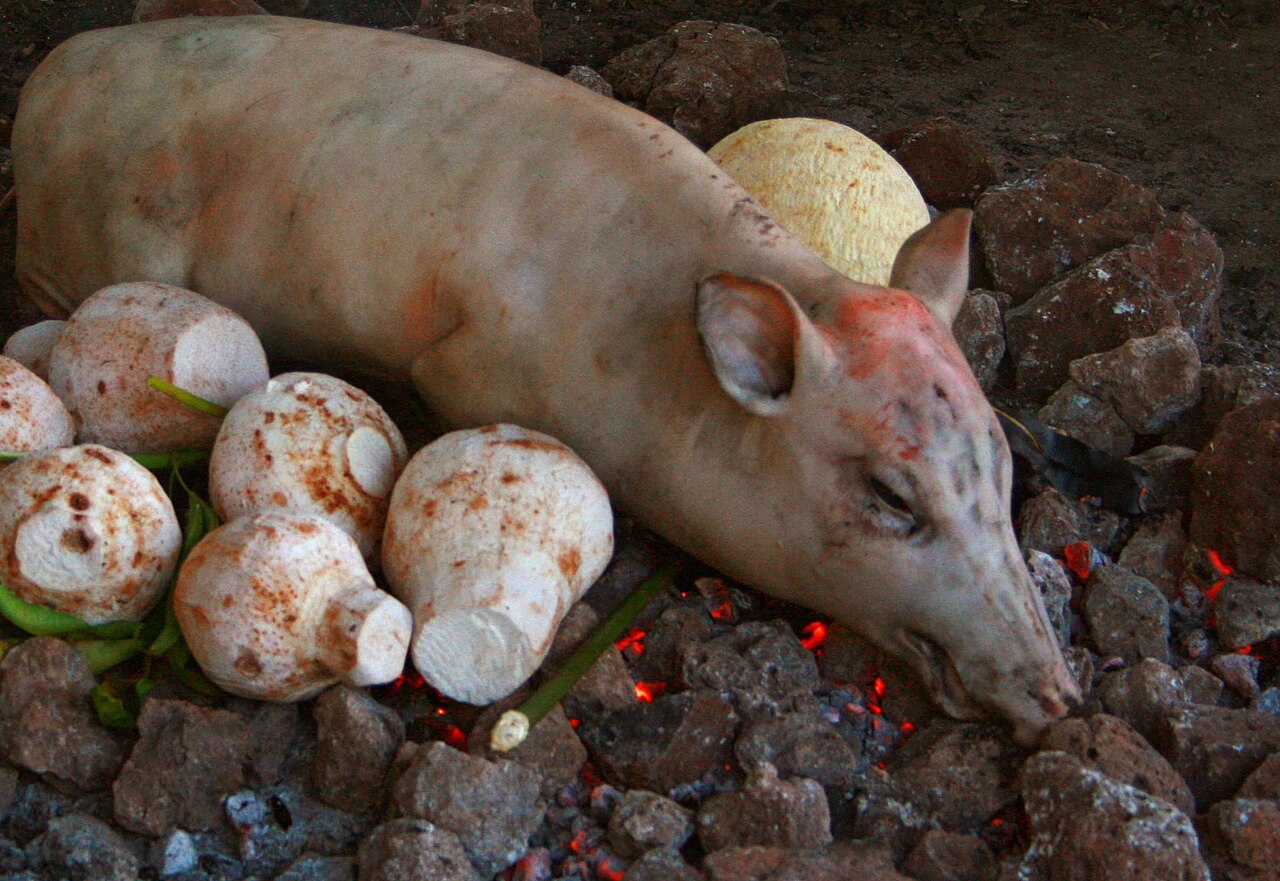
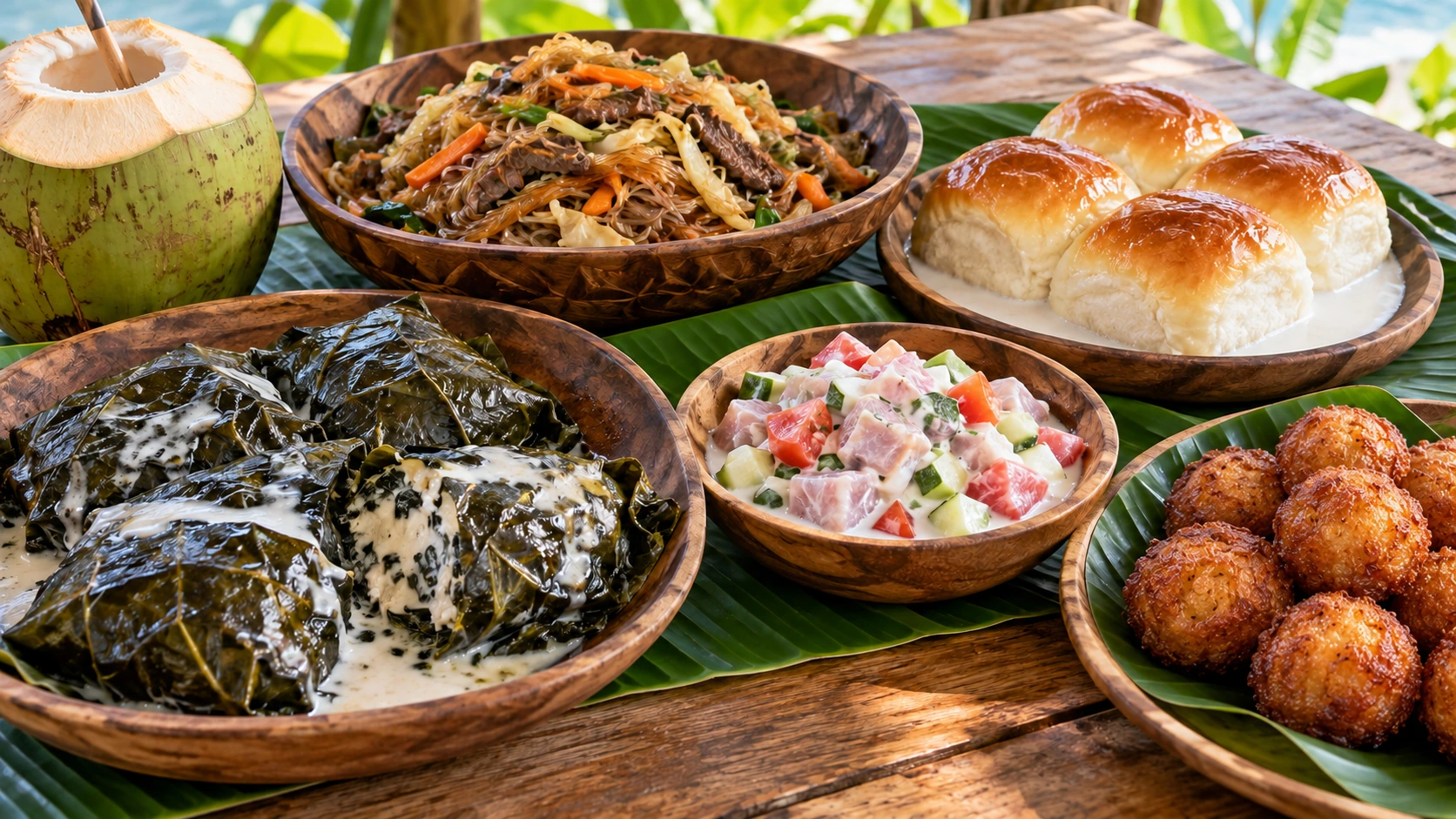
Traditional Samoan cuisine is built on a small palette of ingredients — taro, breadfruit, coconut, fish, pork — cooked with technical mastery that Westerners often underestimate. Root crops provide the starch (taro and breadfruit are eaten daily, cassava increasingly common), coconut appears in every possible form (grated flesh, thick cream, thin milk, oil, water), and the umu (above-ground earth oven of red-hot volcanic stones) does the cooking. Every Sunday, thousands of umu across the territory turn out to'ona'i — the big Sunday family feast — with baked pork, chicken, palusami, whole fish and mountains of taro.
The other side of the plate is American, on account of the flag. Canned corned beef (pisupo — a word that has entered Samoan as a generic term for "food from a tin"), Spam, saimin instant noodles, and cheap rice all became cultural staples during the mid-20th century and remain so. The average Samoan diet today is a fascinating hybrid — a Sunday umu with palusami and taro; a weekday can of tuna over white rice with soy sauce; a McDonald's on the way home.
Eating out on Tutuila is limited. Sadie's by the Sea in Utulei is the tourist-friendly hotel restaurant. Tisa's Barefoot Bar at Alega does a legendary Sunday umu feast (book ahead). Paradise Pizza in Nu'uuli is the local Sunday-night hangout. On Ofu and Ta'u, meals are effectively whatever your homestay makes — usually excellent, always plentiful.
COOKBOOK NOTE
COOKBOOK NOTE — Radim Kaufmann
An umu opened for a Sunday to'ona'i reveals the skill and patience behind Samoan slow cooking. Wet banana leaves, red volcanic rock heated for two hours, whole pork wrapped in a lattice of leaves, palusami parcels tucked in beside — the whole thing buried under more leaves and left to cook itself. Removing the covering releases the aromas of smoke, roast pork and coconut. Palusami — young taro leaves saturated with coconut cream and slow-baked — is one of the great vegetable dishes of the world. Every Samoan family makes it slightly differently, and every Samoan will tell you their mother's is the only correct version. They are all correct.
Ingredients: 20-30 young taro leaves (or spinach as a substitute); 400 ml thick coconut cream; 1 medium onion, finely chopped; 1 tsp sea salt; 1 tsp white pepper; optional 100 g corned beef or shredded chicken.
Preparation: Wash the young taro leaves thoroughly and remove any tough stems — the entire leaf must be tender because raw taro contains calcium oxalate crystals that will make your mouth burn if the leaves are not cooked through. If using spinach as a substitute (much easier to source outside Polynesia), use the largest leaves you can find and treat them the same way. Stack five to seven leaves flat on a work surface, shiny side down, in a rough overlapping pattern to form a bowl about 15 cm across. Fold the sides up to form a rough cup. Pour in about 60 ml of thick coconut cream, a pinch of finely chopped onion, a pinch of salt and white pepper. If you are adding corned beef, drop a heaping tablespoon in the center. Gather the leaf edges up and over the filling to form a neat parcel, tying with a strip of banana leaf or a bit of butcher's twine. Repeat until all the leaves and cream are used — you should have 6 to 8 parcels. Traditionally the palusami parcels are baked in an umu (earth oven) for 90 minutes to 2 hours, but a domestic oven works well: pack the parcels tightly into a deep baking dish, cover with foil, and bake at 175°C (350°F) for 90 minutes. The leaves should be completely soft, dark-green, and the coconut cream should have thickened and lightly caramelised on top. Serve hot, opening the parcel at the table — the aroma is the whole point. Eat with baked taro, breadfruit, or plain white rice. After prompt cooling and proper refrigeration, leftover palusami can be thoroughly reheated the next day.
TIP: Never eat undercooked taro leaves. Cooking time alone is not a guarantee: check that the leaves are thoroughly cooked and completely tender.
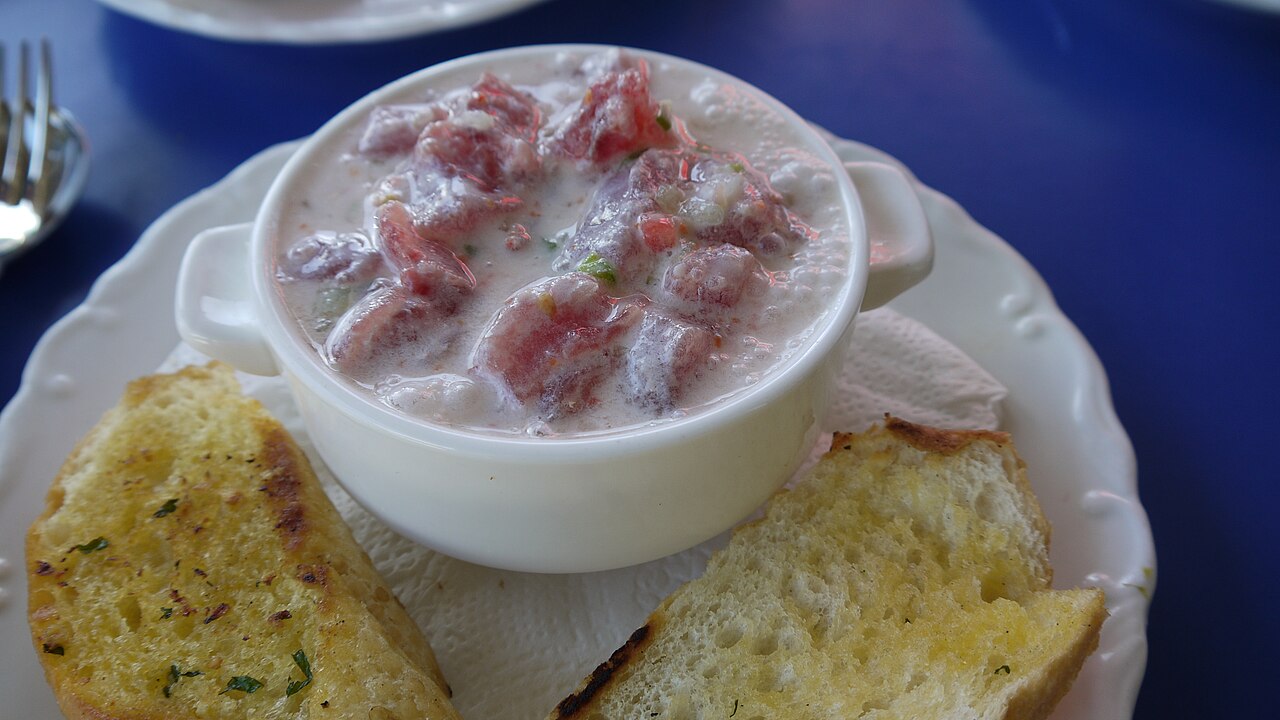
ʻOta ʻika, a regional Polynesian raw-fish dish related to Samoan oka. The photograph is not identified as a location in American Samoa. watashiwani · CC BY 2.0
Ingredients: 500 g very fresh sashimi-grade fish (yellowfin tuna, mahi-mahi, or wahoo), cubed 1 cm; juice of 4-6 limes; 200 ml thick coconut cream; 1 small red onion, diced; 1 cucumber, seeded and diced; 1 tomato, seeded and diced; 1-2 red chilies, finely chopped; sea salt to taste; fresh cilantro.
Preparation: This preparation remains raw and carries the risks described in the food-safety note below. Ask a reliable supplier about fish intended for raw consumption and appropriate parasite controls; apparent freshness alone does not establish safety. Cut the fish into neat 1 cm cubes and place in a glass or ceramic bowl. Squeeze the fresh lime juice directly over the fish, tossing gently so every piece is coated. Refrigerate for exactly 10-15 minutes, no longer — you are looking to lightly firm the outside of the fish, not to heat-cook it; citrus changes texture but does not reliably remove pathogens. The fish should still be translucent in the center. Drain off most of the lime juice, leaving just enough to keep the fish moist. Add the diced red onion, cucumber, tomato and chilies. Pour over the coconut cream and toss very gently to coat. Season with sea salt to taste — Samoan oka is meant to be quite salty, more than a Western ceviche. Chill for another 10-15 minutes to marry the flavours, but serve within an hour. Garnish with fresh cilantro and serve as a starter with taro chips or as part of a Sunday feast. On Ofu the local version often adds finely diced raw octopus (fe'e) or sea urchin roe if the diver brought some in.
FOOD SAFETY: Raw fish can carry parasites and harmful germs. FDA guidance favors previously frozen fish when eating it raw because appropriate freezing controls parasites, but freezing does not eliminate every harmful germ. Lime juice does not make raw seafood reliably safe. Thoroughly cooked fish is the safer option; people at increased risk of foodborne illness should avoid raw seafood.
04
Sapasui KCS 75
Samoan Chop Suey
Ingredients: 200 g glass noodles (bean thread / mung bean vermicelli); 500 g ground beef or shredded chicken; 1 large onion, sliced; 4 cloves garlic, minced; 2 cm fresh ginger, grated; 4 tbsp soy sauce; 2 tbsp oyster sauce; 500 ml chicken or beef stock; 4 spring onions, chopped; 1 tbsp sesame oil; vegetable oil for frying.
Preparation: This is the everyday Samoan family meal — Chinese immigrants brought the noodles and technique in the late 19th century and Samoans made it their own. Soak the glass noodles in warm water for 15-20 minutes until soft and translucent, then drain and cut roughly into 15 cm lengths with kitchen scissors. Heat 2 tablespoons of vegetable oil in a large wok or heavy skillet over high heat. Add the sliced onion and stir-fry for 2 minutes until softened. Add the garlic and ginger and stir-fry another 30 seconds. Add the ground beef, breaking it up with a wooden spoon, and cook until well-browned — Samoan sapasui likes the beef quite well-done. Pour in the soy sauce and oyster sauce, stir to coat, and add the stock. Bring to a simmer. Add the drained noodles and toss everything together for 3-4 minutes until the noodles have absorbed most of the liquid and taken on the brown colour of the sauce. The final texture should be moist but not soupy. Stir in the sesame oil and spring onions at the last minute and serve immediately over hot white rice. Some families add sliced Chinese cabbage, bean sprouts, or shredded carrot at the vegetable stage — feel free.
TIP: Sapasui can taste good the next day. Cool leftovers promptly, refrigerate them and reheat thoroughly before serving.
Ingredients: For the dough: 500 g strong bread flour; 7 g instant yeast; 60 g sugar; 1 tsp salt; 1 egg; 250 ml warm milk; 60 g softened butter. For the coconut sauce: 400 ml thick coconut cream; 100 g sugar; pinch of salt.
Preparation: Pani popo — literally "coconut bread" — is the sweet coconut-drenched dinner roll that appears at every Samoan Sunday to'ona'i and church potluck. Combine the flour, yeast, sugar and salt in the bowl of a stand mixer with a dough hook. Beat the egg into the warm milk (not hot — kill the yeast) and pour into the flour mixture. Mix on low for 2 minutes, then add the softened butter a spoonful at a time. Knead on medium for 8-10 minutes until you have a smooth, elastic, slightly sticky dough. Turn into an oiled bowl, cover, and let rise until doubled — about 1 hour in a warm kitchen. Punch down and divide into 15-18 equal balls (about 60 g each). Roll each into a smooth round. Butter a 23x33 cm baking dish and arrange the rolls in it in three rows of five or six, leaving a small gap between each — they will expand into each other. Cover and let rise 30 more minutes. Meanwhile, whisk the coconut cream with the sugar and pinch of salt until smooth. Preheat oven to 180°C (350°F). Pour the coconut sauce evenly over and between the risen rolls — it should come about halfway up their sides. Bake for 25-30 minutes until the tops are deep golden and the coconut sauce has thickened and caramelised at the edges of the dish. Serve warm, pulling each roll out gently — they will be swimming in sweet, thickened coconut cream. Delicious with the leftover Sunday roast pork or on their own with strong Samoan koko (cocoa) for breakfast.
TIP: Do not skimp on the coconut cream. Thick, canned Samoan or Thai coconut cream (not milk) is essential.
Ingredients: 3 very ripe bananas; 250 g plain flour; 100 g sugar; 1 tsp baking powder; ½ tsp baking soda; ½ tsp cinnamon; pinch of salt; 1 egg; 100 ml milk; oil for deep frying.
Preparation: A Saturday-morning market classic and every Samoan child's after-school snack. Mash the very ripe bananas in a bowl until nearly smooth. In a separate bowl, whisk together the flour, sugar, baking powder, baking soda, cinnamon and salt. Add the beaten egg and milk to the mashed banana, then fold the dry ingredients in until just combined — do not overmix, the batter should be thick enough to hold on a spoon. Heat 5 cm of neutral oil in a heavy pot or wok to 170°C (medium heat — hotter and they burn outside, raw inside). Drop heaping tablespoons of batter into the hot oil, spacing them apart. They should immediately sink then bob back up and turn themselves as they cook. Fry for 3-4 minutes, turning occasionally, until deep brown and cooked through. Drain on paper towels. Best eaten hot, though they keep a couple of hours. Excellent with strong Samoan koko or vanilla ice cream. Some families add grated coconut or a touch of nutmeg to the batter.
'Ava (kava in most of the wider Pacific) is the drink at the ceremonial center of Samoan culture. The peppery-tasting root of Piper methysticum, native to the western Pacific, is pounded to a coarse fibre, mixed with cool water, strained through the fine strands of the fau (hibiscus bark fibre), and served in a communal wooden bowl called a tanoa. The drink is mildly numbing to the mouth and mildly relaxing to the mind — the effect is nothing like alcohol, more like sitting down after a long day.
A formal 'ava ceremony marks any important Samoan gathering: welcoming a chief, opening a fono (village council), inaugurating a governor, receiving distinguished visitors. The ceremony has strict rules. The tanoa is placed at the head of the room, oriented toward the highest-ranking guest. A young man serves as the 'aumaga (cup-bearer). Cups are distributed in strict order of rank, called out in the melodic chant of the tulafale (talking chief). Each recipient pours a small drop on the mat as a libation to the ancestors before drinking, then says "manuia" (bless / cheers) before returning the cup empty.
Visitors invited to an 'ava ceremony should watch, follow, and never rush. Wear modest clothing (long lavalava or trousers, covered shoulders). Sit cross-legged on the floor. Do not stretch your legs out toward the tanoa. Accept the cup with two hands, spill a drop, drink in one go, return with two hands. Participation should be voluntary. If you prefer not to drink, explain courteously and ask your host how to take part respectfully. The mild numbing of the mouth and lips is normal.
Casual 'ava sessions among friends are far less formal — plastic cups, no chanting, just conversation and the slow drift of the evening. Both settings share the same underlying purpose: to slow down, to talk, to belong to the group.
Vailima. A familiar beer brand associated with Samoa, including a lager and an Export version. Check the label and seller for the current production location and available versions; the brand's historic connection with Apia does not necessarily describe current brewing arrangements.
Koko Samoa. Strong, thick Samoan cocoa made from locally-grown cacao beans that are roasted, ground and boiled with water into an almost-espresso-like drink. Traditionally sweetened generously with sugar. Made properly, it is arguably the best cocoa on Earth. Sold in dry blocks at the Fagatogo market.
Fresh coconut water. The liquid inside a young coconut is drunk directly from the shell. It is different from coconut milk, which is made from grated coconut flesh and water. Availability and prices vary between villages and vendors.
Fresh fruit juices. Passion fruit, guava, papaya, mango — all grown on the islands and squeezed to order at markets and juice stands. Frequently mixed with a splash of coconut cream.
American commercial drinks. Because of the flag: Coca-Cola, Pepsi, Mountain Dew, and every American beer are widely available with prices affected by shipping and local availability rather than guaranteed mainland pricing.