St. Thomas and St. John form a natural pair. St. Croix deserves time of its own. Check the route, documents, and current conditions before booking.
01
Practical information
Entry and identification. U.S. citizens traveling directly from the U.S. mainland or Puerto Rico do not need a passport for that domestic journey. Adults flying must carry identification accepted by TSA, including a REAL ID-compliant state document or another accepted form. Be ready to document citizenship when departing the islands. Non-U.S. citizens must meet the U.S. entry and immigration rules applicable to their nationality and status. A BVI side trip changes the document requirements.
Customs. The USVI lies outside the U.S. customs territory. Eligible returning U.S. residents may use the special $1,600 exemption subject to CBP conditions; it is not a promise that every purchase is duty-free for everyone. Keep receipts and declare purchases. The special alcohol allowance has age, quantity, purchase, and origin requirements. Check current CBP guidance before buying bottles or high-value goods.
Money, power, and connectivity. The currency is the U.S. dollar. U.S.-style sockets and nominal 120 V, 60 Hz power are standard. Carry a charger and a small backup battery, and confirm whether your mobile plan includes the islands. Near the BVI, a phone can connect to a foreign network: check the displayed carrier and roaming settings. Card acceptance is widespread, but keep a sensible cash reserve for transport and outages.
Water and services. Ask your accommodation about its drinking-water supply and current advisories; a cistern, utility connection, and bottled supply are not the same thing. In 2026 the territorial government has continued responding to St. Croix water-service problems. Supply and treatment can vary between properties, so do not rely on a blanket claim that every tap is safe.
Health and safety. St. Thomas and St. Croix have hospitals, but some specialist care requires transfer off-island. Check your insurance, including evacuation where appropriate, and carry prescriptions in their labeled containers. For emergencies call 911. Follow local advice about neighborhoods, roads, beaches, and conditions; leave valuables out of sight and arrange dependable transport after dark. National-park status and clear water do not remove currents, heat, or difficult terrain.
Prepare before departureEditorial diagram · Kaufmann.WTF · Schematic explanation of this chapter · Image credits↑ Back to top
02
Cost of living & travel
The USVI can be expensive because transport, imported goods, energy, and a small market shape everyday costs. A beach day can cost little, while accommodation, a rental vehicle, restaurant meals, and boat trips quickly change the total. Build a budget by island and by season; a room advertised in St. Croix is not a substitute for a St. John reservation if daily transfers consume the saving.
Compare the total stay cost, not just a nightly headline. Ask about accommodation taxes, cleaning fees, resort charges, parking, extra-driver insurance, and deposits. Check the cancellation deadline and whether a late ferry or flight affects check-in. For villas, verify the exact road, access gradient, power and water backup, and who can help after hours.
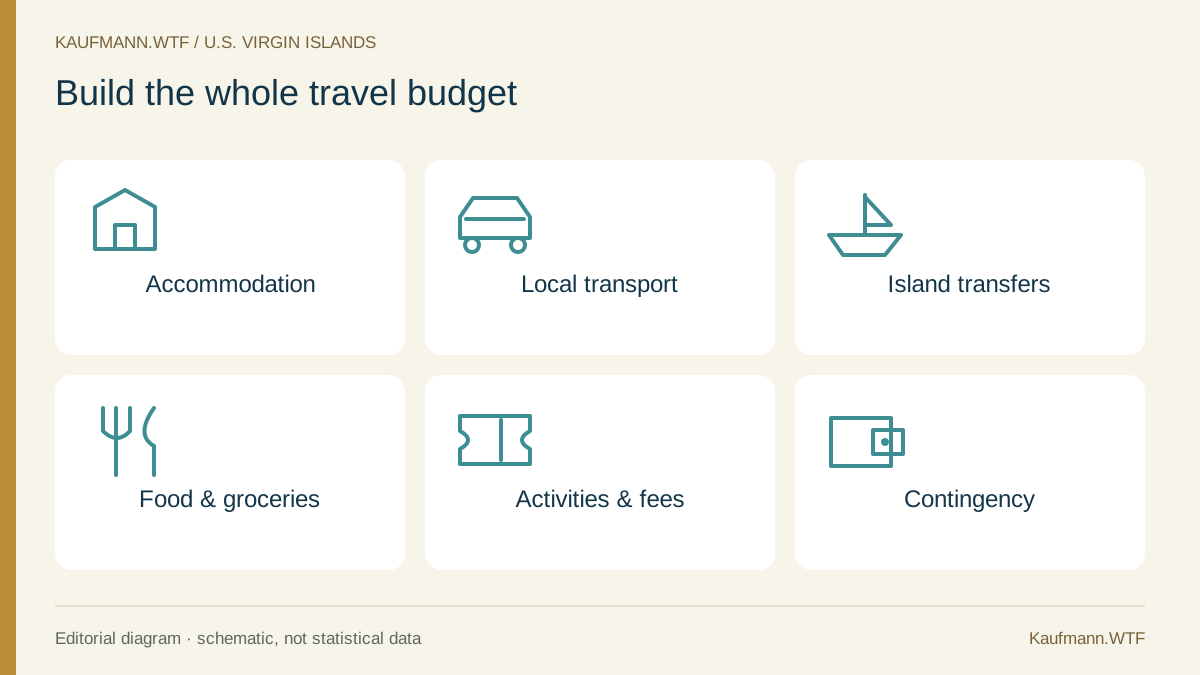
A useful budget has separate lines for lodging, airport transfer, inter-island travel, local transport, groceries, meals, park or beach fees, tours, and a contingency. Self-catering can help, although groceries are imported too. Share a car only if your plans and insurance allow it. A duty-free label does not establish that a purchase is cheaper than at home after allowances, taxes, and baggage are considered.
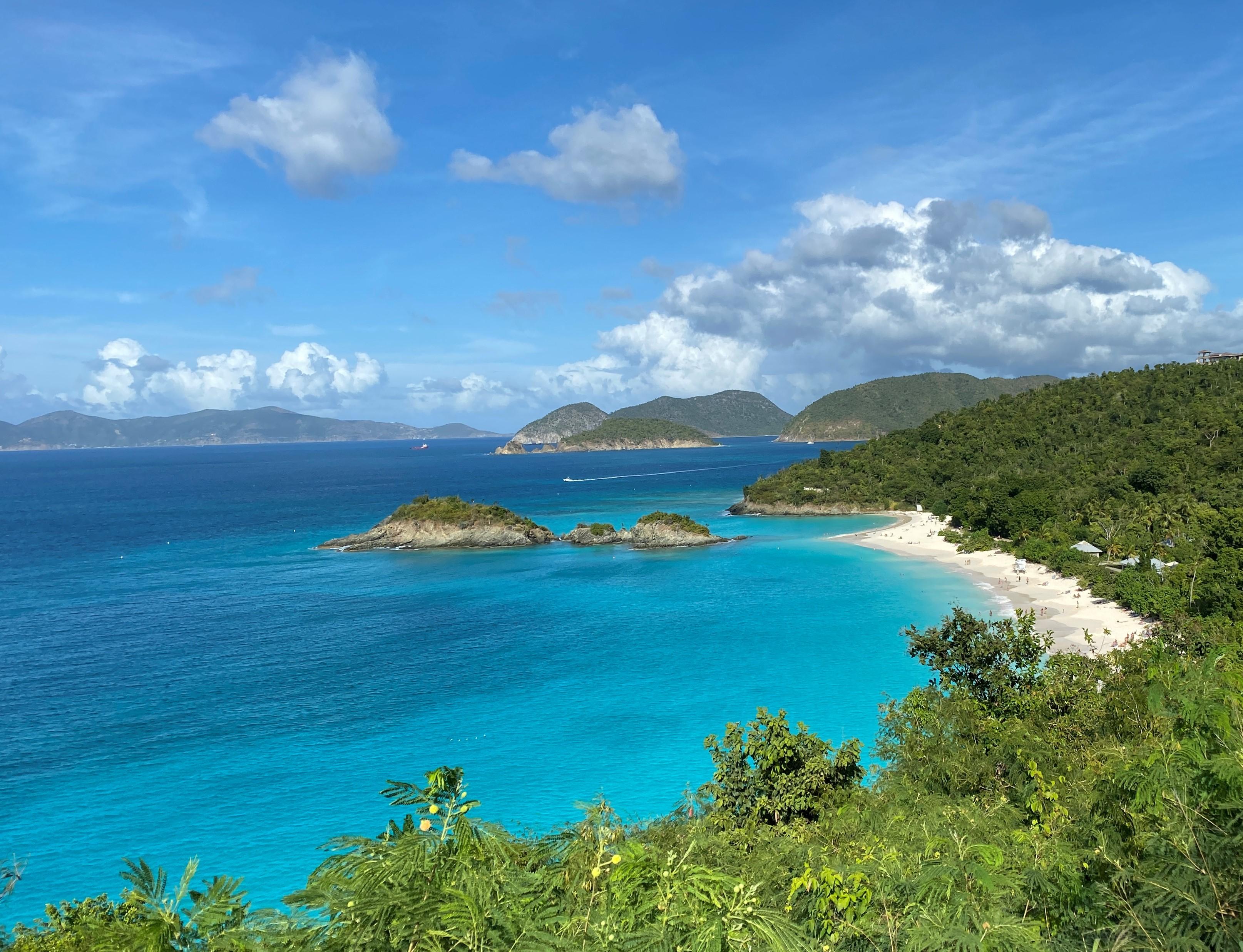
Beaches and shoreline access have specific rules. Do not assume every access road, parking lot, amenity, or guided trip is free, or that a public shoreline gives permission to cross any private parcel. Trunk Bay has an amenity fee. Check the official fee page and the current rules of the individual beach, park, or refuge before setting out.
Build the whole travel budgetEditorial diagram · Kaufmann.WTF · Schematic explanation of this chapter · Image credits↑ Back to top
03
Where to stay
St. Thomas suits travelers who want the broadest mix of airport connections, restaurants, cruise-port activity, and access to St. John. The Ritz-Carlton, the Westin Beach Resort & Spa at Frenchman’s Reef, and Morningstar Buoy Haus are established resort names to compare with smaller hotels, guesthouses, and apartments. Location matters: a beautiful hillside view can mean a steep drive and limited walkability. Confirm current availability and the full price directly.
St. Croix rewards a longer stay. Christiansted offers a walkable historic core; Frederiksted has a different west-coast atmosphere; east-end properties can be far from both. The Buccaneer and Divi Carina Bay are recognizable examples, alongside independent guesthouses. Check the distance to the airport, restaurants, and the activities you actually plan, rather than choosing from a beach photograph alone.
St. John has camp accommodation at Cinnamon Bay, small properties including Estate Lindholm, and a substantial villa market. Cruz Bay is convenient for the main passenger ferry; Coral Bay and the east end offer a different base with longer drives. Check road access, car requirements, grocery arrangements, and the accommodation’s provisions for utility interruptions.
Caneel Bay needs a separate check. The resort was devastated in 2017. NPS has pursued cleanup, phased public access, and redevelopment; a new request for redevelopment proposals was issued in 2026. Access to part of the shoreline is not evidence that the former resort has resumed ordinary hotel operations. Use the NPS Caneel Bay page for the current situation and do not book on the basis of an old guidebook entry.
For any island, ask specific accessibility questions before reserving: steps from parking, gradient, doorway widths, shower arrangement, and transport access. “Ocean view” and “near the beach” say little about whether a stay will work for someone with limited mobility. Obtain the details for the actual room or villa, not a generic property description.
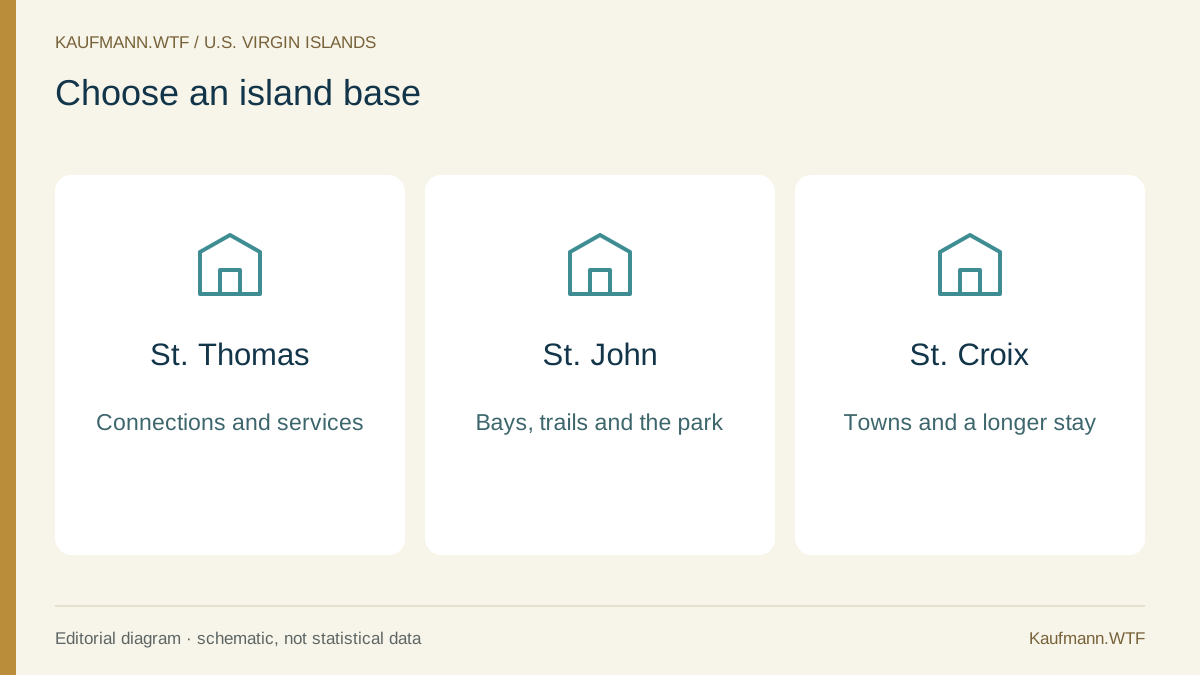
Choose an island baseEditorial diagram · Kaufmann.WTF · Schematic explanation of this chapter · Image credits↑ Back to top
04
Government & representation
The USVI is an organized, unincorporated territory of the United States. It elects a governor and a unicameral legislature of fifteen senators, while federal authority and territorial law interact under the Revised Organic Act and other statutes. The President of the United States is the federal executive; the governor leads the territorial government.
As of this editorial review on October 9, 2026, Albert Bryan Jr. is governor and Stacey Plaskett is the territory’s delegate to the U.S. House of Representatives. The territorial election authority lists the general election for November 3, 2026. Check the official government, congressional, and election pages for subsequent changes.
The House delegate does not have a final floor vote on ordinary House legislation, although delegates have roles in committees under House rules. U.S. citizenship and territorial residence do not produce the same presidential voting rights as residence in a state: residents of the USVI cannot cast a general-election vote for president from the territory.
These arrangements are debated locally and are part of the islands’ daily political life. A visitor can recognize that complexity without reducing people to a constitutional curiosity. The elected institutions, local reporting, and community organizations are useful places to start understanding the questions residents themselves consider important.
 ‹›