Uganda is a landlocked East African republic of about 241,550 km² straddling the equator, wedged between South Sudan, Kenya, Tanzania, Rwanda and the Democratic Republic of the Congo. Roughly a sixth of that surface is water: Uganda holds a large share of Lake Victoria, Africa’s largest lake, along with Lakes Kyoga, Albert, Edward and George.
Winston Churchill called it “the Pearl of Africa” in My African Journey (1908), and the phrase stuck because it is close to accurate. Across different journeys you can move from the glaciers of the Rwenzori — the Mountains of the Moon, whose Margherita Peak reaches 5,109 m — through montane rainforest holding roughly half the world’s mountain gorillas, to savanna with tree-climbing lions, to the point at Jinja where the White Nile leaves Lake Victoria.
The 2024 national census counted 45.9 million people, an increase of 11.3 million in a decade; the census remains the dated baseline used here. The median age is under 17, making Uganda one of the youngest countries on Earth. Kampala, the capital, is a city of red-clay hills, motorcycle taxis (boda-bodas) and a nightlife that outlasts most of the continent’s.
The country takes its name from Buganda, the largest of its traditional kingdoms, whose Baganda people occupy the fertile northern shore of Lake Victoria. Swahili speakers rendered Buganda as Uganda, and the British applied that form to the whole protectorate they assembled from 1894 onward. Uganda is therefore one of the few countries named after a kingdom that still exists inside it — Buganda’s kabaka, Ronald Muwenda Mutebi II, was restored in 1993 as a cultural monarch without political power.
Official languages are English and Swahili; Luganda is the most widely spoken language of Kampala and the south, while Runyankole, Acholi, Lango, Ateso and dozens of others dominate elsewhere. The flag’s black-yellow-red bands stand for the African people, sunshine and brotherhood, with the grey crowned crane — the national bird — at the centre, one leg raised.
Most of Uganda sits on a plateau that tilts gently from about 1,500 m in the south to roughly 900 m in the north. That altitude is what makes an equatorial country liveable: Kampala, only 0.3° north of the equator, rarely exceeds 30 °C.
The western frontier follows the Albertine Rift, the western arm of the Great Rift Valley, where the land drops abruptly into Lakes Albert and Edward and rises again into the Rwenzori Mountains. The Rwenzori are not volcanic but a block of ancient rock thrust upward, and they carry Africa’s last equatorial glaciers — now retreating fast. In the far south-west the Virunga volcanoes straddle the borders with Rwanda and the DRC.
Water dominates the east and centre. The Victoria Nile leaves Lake Victoria at Jinja, crosses shallow, papyrus-choked Lake Kyoga, then squeezes through a seven-metre gap at Murchison Falls before entering Lake Albert as the Albert Nile and continuing north into South Sudan.
Centralised kingdoms — Buganda, Bunyoro, Ankole, Toro and Busoga — had governed the lake region for centuries when Arab traders arrived in the 1840s and the explorer John Hanning Speke reached the Nile’s outlet at Ripon Falls in 1862. Britain declared a protectorate over Buganda in 1894 and extended it across the surrounding territories, ruling largely through Baganda intermediaries — a decision whose resentments outlived the empire.
Uganda became independent on 9 October 1962. Milton Obote abolished the kingdoms in 1966; his army commander Idi Amin seized power in January 1971 and expelled the country’s Asian population — roughly 80,000 people — in 1972, gutting the commercial economy. Amin’s rule ended in 1979 after a Tanzanian invasion; Obote returned, and the civil war that followed killed hundreds of thousands more.
Yoweri Museveni’s National Resistance Army took Kampala on January 26, 1986. Subsequent political history includes institutional change, controversy over presidential limits and restrictions on opposition activity. Read current developments through dated reporting and official records rather than treating historical stability as a promise about present conditions.
Uganda is home to more than fifty ethnic groups. Bantu-speaking peoples — Baganda, Banyankole, Basoga, Bakiga — predominate in the south and west; Nilotic peoples including the Acholi, Langi, Alur and Karamojong occupy the north and north-east. About four-fifths of Ugandans are Christian, roughly evenly split between Catholic and Anglican, with a Muslim minority near 14%.
The country also hosts one of the world’s largest refugee populations — well over a million people, mostly from South Sudan and the DRC — under a policy that grants them land, work rights and freedom of movement, unusual anywhere in the world.
Music and dance are regionally specific and taken seriously: the Baganda baakisimba, the Acholi bwola, the Bagisu imbalu circumcision ceremonies of the Mount Elgon slopes. Baganda bark-cloth making was among the first entries on UNESCO’s intangible cultural heritage lists, in 2005.
Kampala was built across a set of hills — the old count was seven, the modern city covers far more. Each hill carries an institution: Namirembe the Anglican cathedral, Rubaga the Catholic one, Kibuli the mosque, Mengo the kabaka’s palace, Makerere the university that educated much of post-colonial East Africa’s leadership.
Downtown is dense and loud. The Owino (St Balikuddembe) market handles secondhand clothing on an industrial scale; the old taxi park is a solid field of white minibuses. The Uganda Museum on Kira Road, founded in 1908, is the oldest in East Africa. The Gaddafi National Mosque on Old Kampala hill offers the best panorama in the city from its minaret.
Evening life concentrates in Kabalagala and Kololo. Nakasero market is where to buy jackfruit, passion fruit and matoke; the Ndere Cultural Centre stages the country’s regional dances several nights a week.
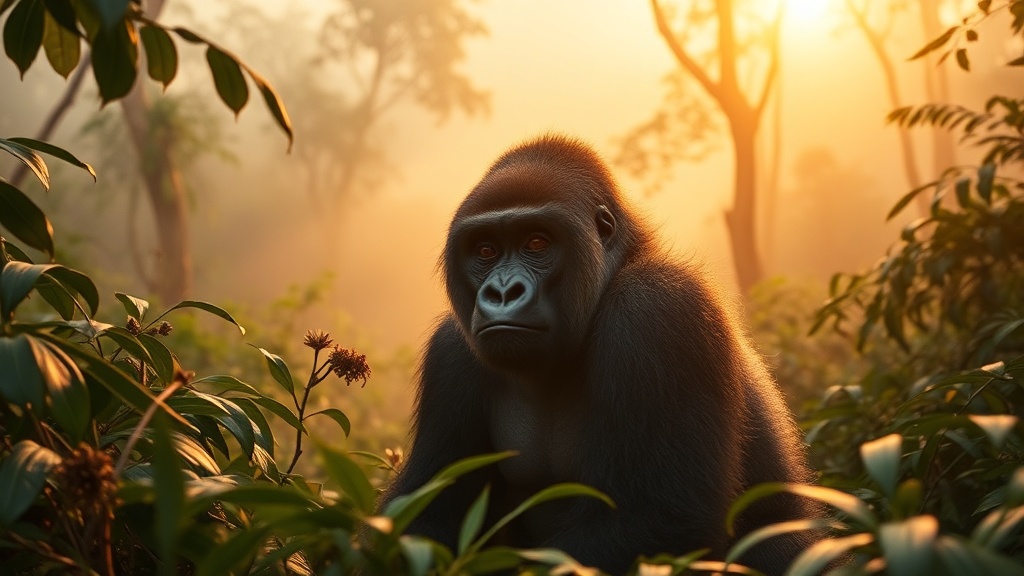
Bwindi Impenetrable National Park, in the far south-west, is 331 km² of Afromontane rainforest so dense and steep that the name is a plain description. It holds roughly half of the world’s remaining mountain gorillas — a subspecies whose total population, counted at just over a thousand, is the only great ape whose numbers are rising.
Trekking is tightly controlled by Uganda Wildlife Authority. Fees, booking arrangements and health requirements can change: consult the current tariff and an authorized operator before paying. Buhoma, Ruhija, Rushaga and Nkuringo are separate trekking sectors; the permit location should determine accommodation and transfers. Habituation and standard tracking are distinct experiences with different conditions.
The walk can take anywhere from one to seven hours over near-vertical ground at 1,500–2,500 m. Porters are available and worth hiring — the fee goes directly into surrounding villages, which is the mechanism that has kept the forest standing.
At Jinja, 80 km east of Kampala, the White Nile leaves Lake Victoria and begins its run north. Speke identified the outlet in 1862; the Ripon Falls he described were submerged when the Owen Falls (now Nalubaale) dam was built in 1954, so what visitors see today is a broad, fast, glassy channel rather than a cataract.
Jinja has become East Africa’s adventure-sport capital: grade-five white-water rafting, kayaking, bungee jumping over the river, quad biking through the sugar-cane country. It is also an architectural curiosity — a small colonial-era industrial town with Indian-influenced shopfronts along Main Street, much of it built by the Asian community expelled in 1972.
The Nile Breweries plant here draws its water from the river, and the town remains the natural base for exploring the Busoga kingdom and the Mabira Forest on the road back to Kampala.
Murchison Falls National Park, at 3,893 km² Uganda’s largest, is split by the Victoria Nile. The falls themselves are the point where the entire river is forced through a gap about seven metres wide and drops some 43 m — a compression of volume rather than a great height, and the loudest thing in the country. The boat trip to the base of the falls passes hippos, crocodiles and elephants at the waterline.
Queen Elizabeth National Park, on the Rift floor between Lakes Edward and George, is the most visited. The Kazinga Channel connecting the two lakes carries one of the highest concentrations of hippos anywhere. In the Ishasha sector in the south, lions habitually rest in fig trees — a behaviour shared with only a handful of populations worldwide.
Kidepo Valley National Park, in the far north-east against the South Sudan border, is the most remote and the most striking: semi-arid plains ringed by mountains, with cheetah and ostrich that occur nowhere else in Uganda. Kibale Forest, west of Fort Portal, has the continent’s highest density of primates and the best-established chimpanzee tracking.
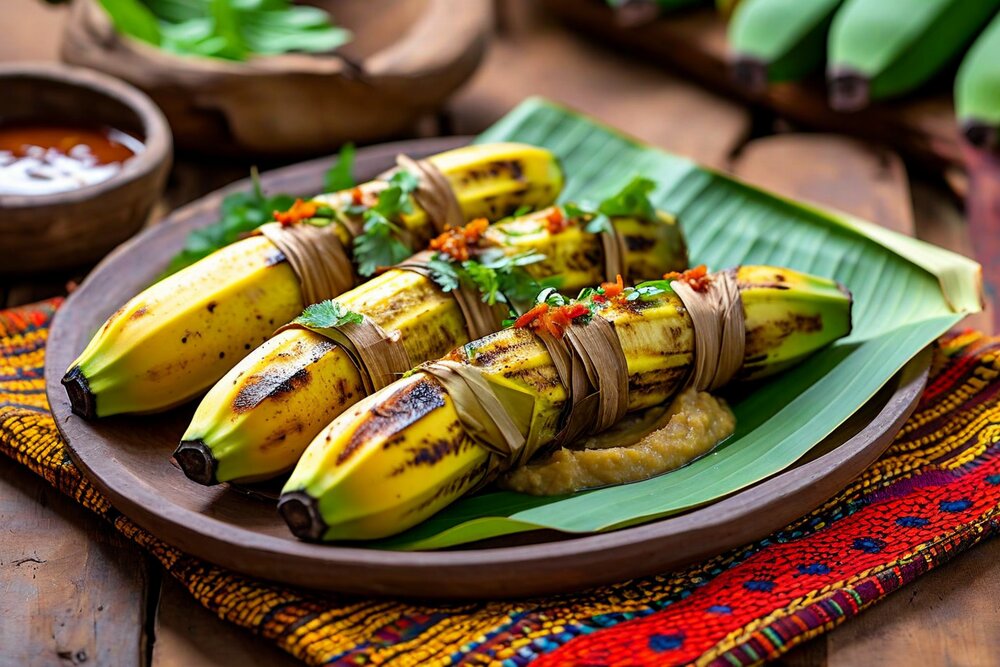
In the Pearl of Africa, cuisine revolves around the humble matoke—green cooking bananas that are steamed, mashed, and served with almost every meal. Uganda's fertile highlands produce exceptional vegetables, groundnuts, and the country's beloved Robusta coffee. Meals are communal affairs, with the luwombo (steamed banana-leaf parcels) reserved for special occasions and the famous Rolex (a rolled egg and vegetable chapati) fueling street-side breakfasts. The influence of the royal Buganda kingdom, Indian traders, and British colonialism creates a cuisine of surprising depth.
Matoke
Uganda's staple food—green cooking bananas steamed in banana leaves until tender, then mashed into a smooth, starchy mound. Matoke accompanies nearly every Ugandan meal and is the traditional base for groundnut sauce. The banana leaves impart a subtle flavor.
Ingredients: 6 green cooking bananas (matoke or plantains), Banana leaves for wrapping, 30ml vegetable oil, Salt to taste, Water for steaming.
Preparation: Peel the bananas under running water to prevent the sap from staining your hands. Cut into chunks. Pass banana leaves over a flame or dip in hot water to make them pliable. Line a steamer or large pot with banana leaves. Add the banana chunks in a single layer. Drizzle with oil and sprinkle with salt. Cover with more banana leaves. Add water to the pot (below the steamer level). Cover tightly and steam for 45 minutes to 1 hour until very soft. Remove from leaves and mash while hot using a wooden spoon until smooth. Shape into a mound and serve with groundnut sauce, meat stew, or vegetables.
💡 If banana leaves are unavailable, use aluminum foil, but the authentic flavor comes from the leaves. Find them frozen in African or Asian groceries.
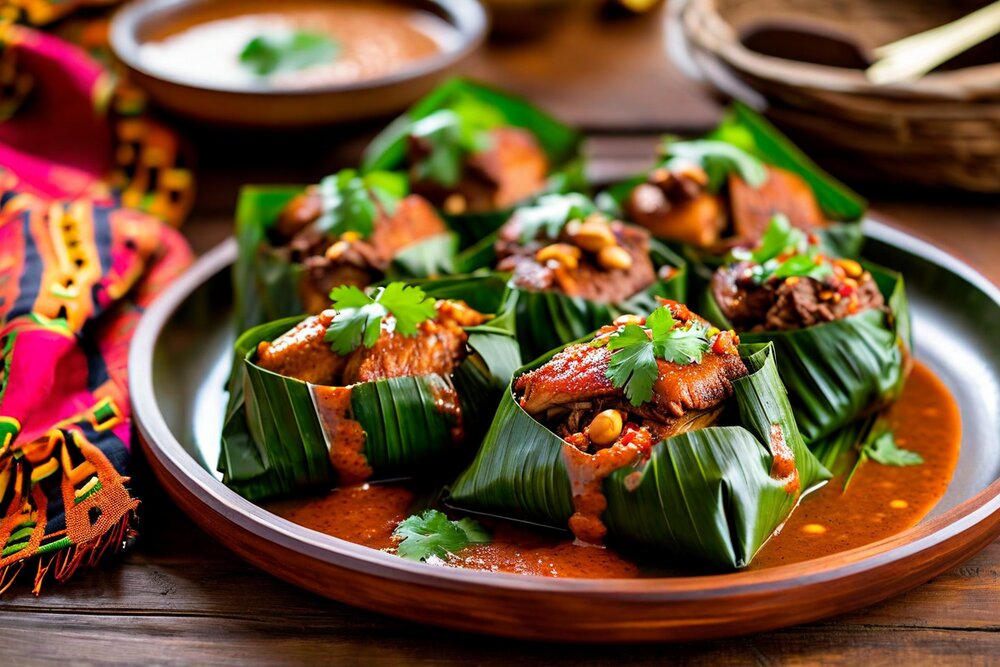
Luwombo
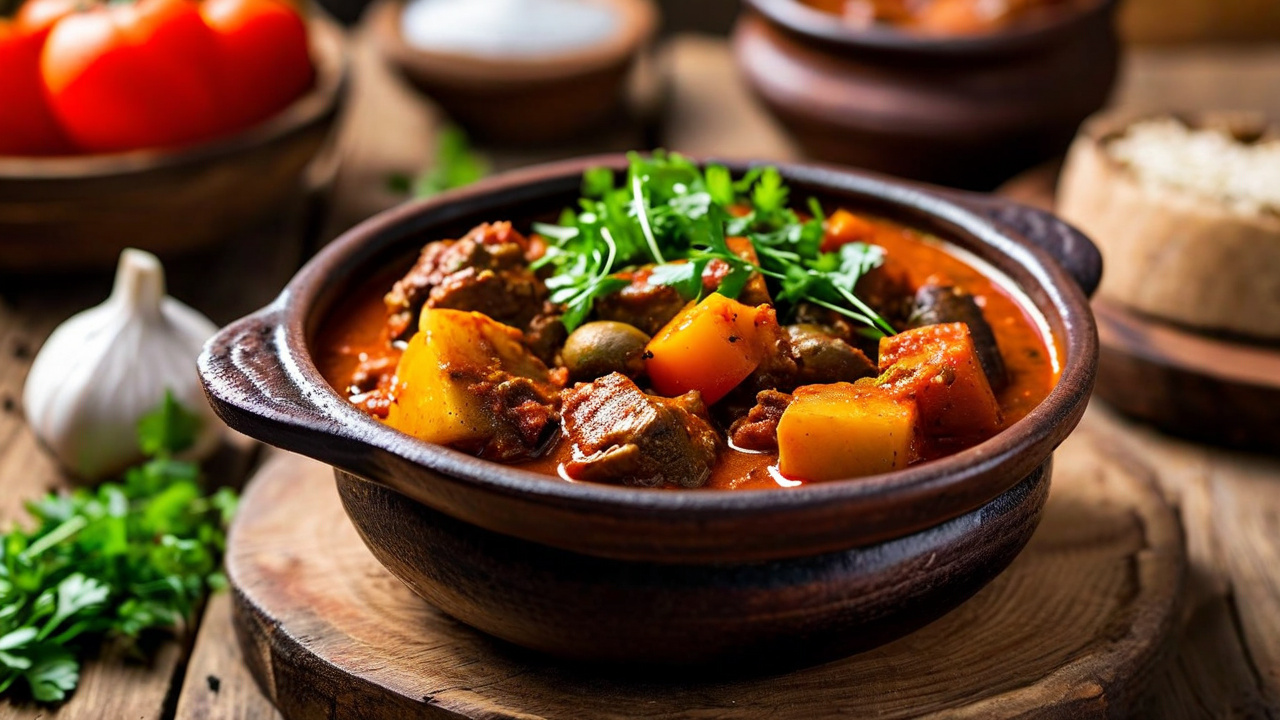
The festive dish of Uganda—chicken, beef, or goat steamed in banana-leaf parcels with groundnut sauce. This royal dish originated in the Buganda kingdom and remains essential for weddings, Christmas, and important celebrations. The banana leaves seal in flavor and moisture.
Preparation: Mix ground peanuts with chicken stock to form a smooth sauce. Combine chicken with tomatoes, onion, garlic, and the peanut sauce. Season with salt and pepper. Let marinate for 30 minutes. Soften banana leaves by passing over a flame or dipping in hot water. Place chicken mixture in the center of overlapping banana leaves. Fold and tie into a secure parcel. Steam the parcel for 1.5-2 hours until chicken is very tender and flavors have melded. Open the parcel at the table—the aroma is part of the experience. Serve with matoke or rice.
💡 The banana leaves must be tightly sealed to steam properly. Use kitchen twine or strips of banana leaf to tie the parcel securely.
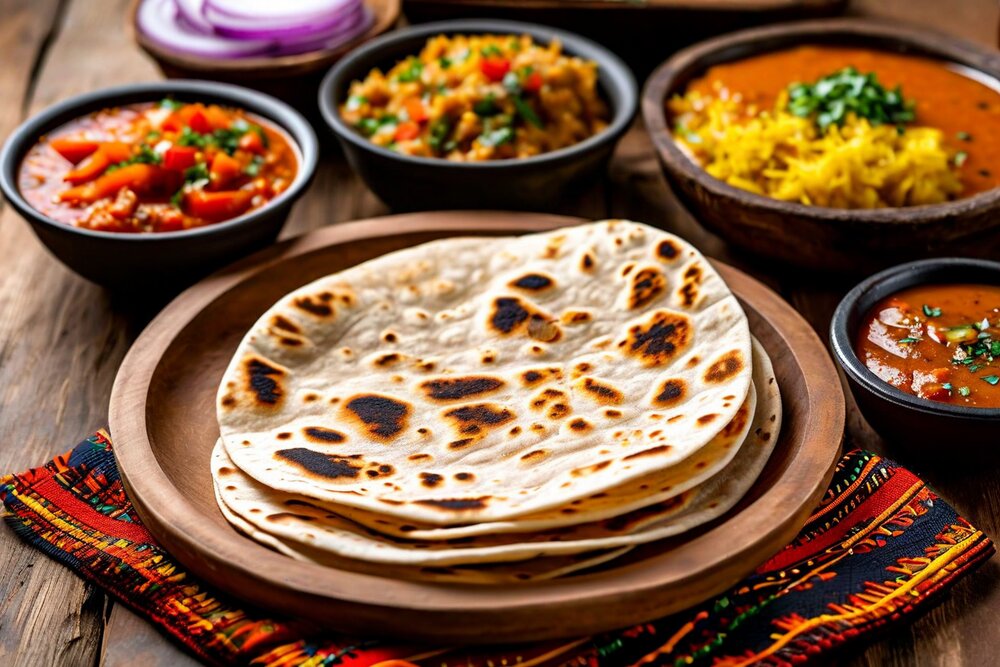
Rolex
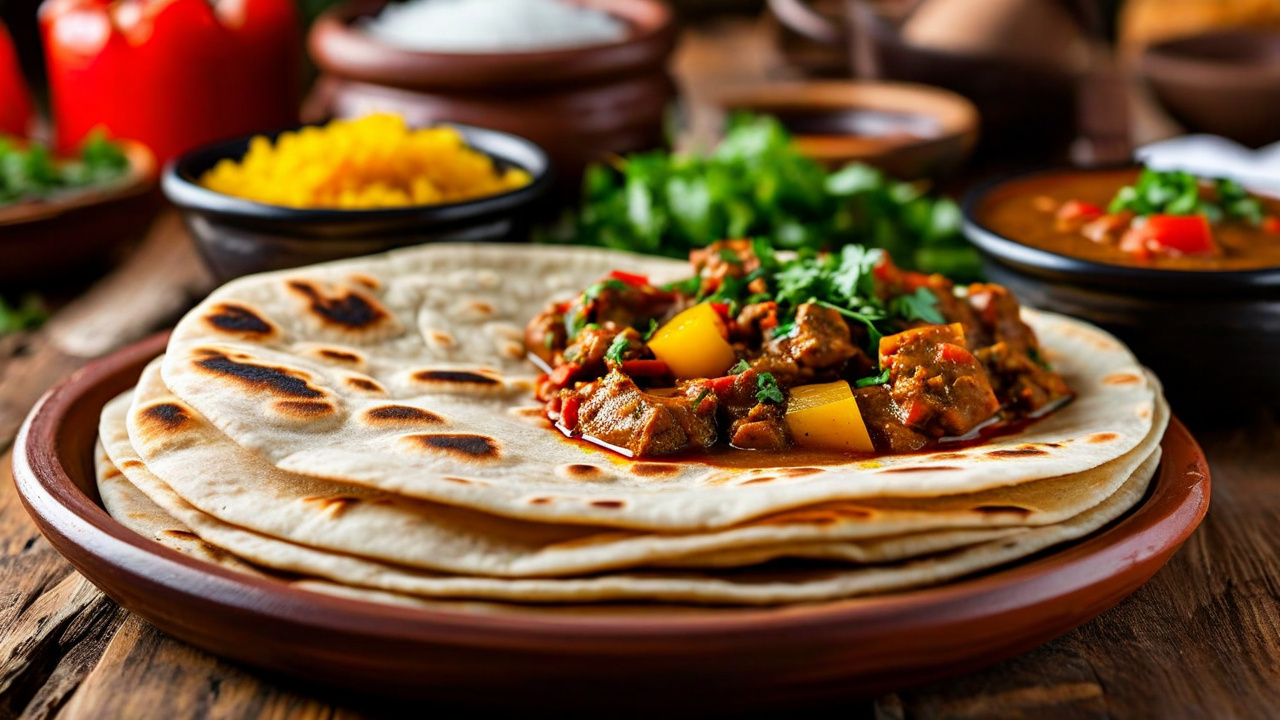
Uganda's legendary street food—not the watch, but a "rolled eggs" chapati. A fresh chapati is filled with a thin omelet, vegetables, and sometimes meat, then rolled up tight. Rolex stands serve these all day, especially loved as an on-the-go breakfast or late-night snack.
Ingredients: For chapati, 200g flour, 100ml warm water, 30ml oil, Salt, For filling, 4 eggs, 1 tomato (sliced), ½ cabbage (shredded), 1 onion (sliced), Oil for frying, Salt and pepper.
Preparation: Make chapati dough: Mix flour, salt, water, and oil. Knead until smooth. Rest for 30 minutes. Divide into 4 balls. Roll each thin, brush with oil, fold, and roll again. This creates layers. Cook chapatis on a dry griddle, brushing with oil until golden and flaky. Set aside. Beat eggs with salt and pepper. Pour a thin layer into an oiled pan over medium heat. Immediately place a chapati on top of the wet egg. Let the egg set. Flip carefully so the egg is now on top. Add tomato, cabbage, and onion. Roll up tightly. Slice in half diagonally and serve immediately.
💡 The Rolex is all about speed—street vendors make them in under two minutes. Have all ingredients ready before you start cooking.
Uganda has no meaningful grape wine industry. The country is equatorial but moderated by altitude, with much of it lying between 900 and 1,500 metres; there have been small experiments with grapes around Mbarara and in the east, and a good deal of fruit wine is made from the enormous banana and pineapple crops, but nothing at commercial scale. Ugandan wine lists run on South African, Chilean and Italian imports.
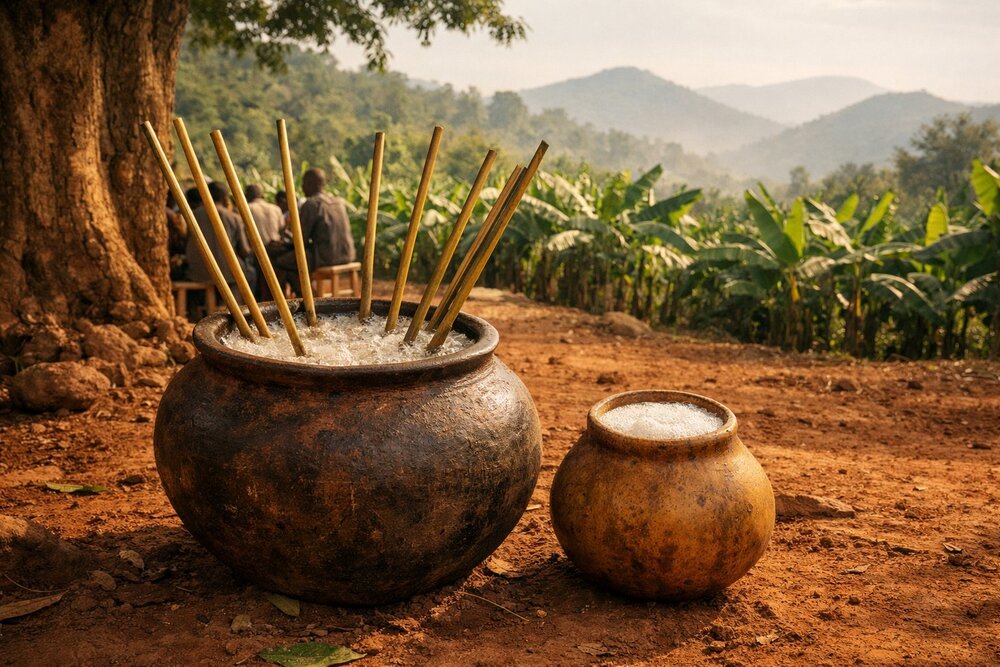
The drinking culture, by contrast, is one of the richest in Africa. Tonto is banana beer, fermented from East African highland bananas. Malwa is millet beer, drunk communally through long straws from a single shared pot — among the continent’s most distinctive drinking rituals, and still central to social life in the east and north.
Waragi is the national spirit. The name is usually traced to “war gin,” the ration issued to soldiers in the Second World War. Village waragi is distilled from bananas, cassava or millet and its strength is anybody’s guess; the bottled brand, Uganda Waragi, is a juniper-flavoured gin produced by Uganda Breweries Limited (part of East African Breweries / Diageo) at Luzira in Kampala.
Beer is a two-company war. Nile Special, Club Pilsner, Eagle Lager and Castle Lite come from Nile Breweries (AB InBev) at Jinja, drawing water from the river. Bell Lager — the country’s best-known brand — is not a Nile beer at all: it belongs to Uganda Breweries Limited, the Diageo subsidiary, and the rivalry between the two houses is a fixture of Ugandan commercial life.
Kampala’s bar scene builds almost everything on waragi and on the fruit that grows within a few kilometres of the city.
Waragi & Passion
The default Ugandan sundowner. 50 ml Uganda Waragi, 90 ml fresh passion-fruit juice, 10 ml lime, a teaspoon of sugar syrup. Shake hard with ice, strain over fresh ice in a highball, top with soda. The passion fruit is doing the work; use the real thing, seeds and all.
Pearl of Africa
50 ml waragi, 20 ml ginger syrup, 20 ml lime juice, 15 ml hibiscus (karkade) infusion. Shake, strain into a coupe, garnish with a dried hibiscus flower. Ginger and hibiscus are both market staples across East Africa; the drink lands somewhere between a gimlet and a dark-and-stormy.
Nile Special Shandy
Not sophisticated, and universal after a hot day in the Rift: half a bottle of chilled Nile Special lager topped with bitter lemon or Stoney Tangawizi ginger beer, over ice, with a wedge of lime. Ordered by the jug at every lakeside bar between Entebbe and Jinja.
Equatorial, but tempered by altitude — Kampala averages roughly 17–28 °C year-round, with little seasonal swing in temperature and a great deal in rainfall.
The south has two wet seasons: March to May (the heavier one) and September to November. The dry windows — December to February and June to August — are the standard travel seasons, and are when forest trails in Bwindi and Kibale are least punishing. The north has a single rainy season, roughly April to October, and Karamoja in the north-east is genuinely semi-arid.
Altitude matters more than latitude when packing: nights in Bwindi, Kabale or on the Rwenzori approach can drop near freezing, while the Rift floor at Murchison and Queen Elizabeth is reliably hot.
Entebbe International Airport (EBB), beside Lake Victoria, is Uganda’s main international arrival point. Kampala is the principal urban and road hub; the two should not be conflated. Flight routes, transfer times and connections change, so confirm current schedules and leave a generous traffic allowance.
Overland routes connect with neighboring countries, but border operation and the safety of an approach road must be verified separately. Check current entry rules and official travel advice rather than assuming that a crossing shown on a map is available.
Internally, light aircraft fly from Entebbe to airstrips at Kihihi and Kisoro (for Bwindi), Pakuba (Murchison) and Kasese. Otherwise it is long tarmac roads in reasonable condition, with driving standards that are the leading cause of injury to visitors.
Visas. Check eligibility, fees and regional visa conditions on Uganda’s official e-visa portal before booking. Avoid treating an old quoted fee as a current offer. The East Africa Tourist Visa has particular eligibility and travel conditions that should be checked for the planned route.
Health. On October 8, 2026, the UK travel-advice update removed the statement that a yellow fever vaccination certificate is mandatory for entry. Entry documentation and clinical recommendations are different matters: consult a travel-health professional and current official notices, including outbreak information, before departure.
Money. The Ugandan shilling (UGX). Cash is still king outside Kampala; ATMs are common in cities and scarce elsewhere. Mobile money (MTN, Airtel) is the real payment layer for most Ugandans. US dollar notes printed before 2013 are frequently refused.
Getting around. Boda-boda motorcycle taxis are ubiquitous, cheap and a leading cause of trauma admissions at Mulago hospital — if you use one, insist on a helmet, or use a ride-hailing app that supplies them.
Law and conduct. Photographing military installations, State House or police is prohibited. Plastic bags are restricted. Homosexuality is criminalised under the Anti-Homosexuality Act, 2023, and the law applies to visitors — read the advisory above carefully. Electricity is 240 V with UK-style Type G sockets.
Uganda is inexpensive by any standard except the wildlife permits, which are not. Budget travellers manage on roughly US$30–50 a day; mid-range comfort runs US$80–150; a gorilla-trekking week is priced entirely by the permit.
Legacy indicative prices — not verified for October 2026
Item
UGX (approx.)
USD (approx.)
Rolex from a street stand
3,000–5,000
0.80–1.35
Local meal, matoke and stew
8,000–15,000
2.15–4.05
Bottle of Nile Special in a bar
5,000–8,000
1.35–2.15
Boda-boda across central Kampala
3,000–10,000
0.80–2.70
Mid-range hotel, per night
180,000–400,000
48–108
National park entry, non-resident
—
40–45
Gorilla permit, non-resident
—
600–800
Shilling figures converted at roughly UGX 3,700 to the US dollar; rates move, so treat the two columns as indicative rather than exact.
These figures are retained as an undated legacy budget illustration, not current quotations. Obtain fresh operator prices and exchange rates. Permit charges in particular must be checked with Uganda Wildlife Authority.
Kampala runs the full range, from backpacker institutions in Kololo and Bukoto to the Serena and Sheraton at the top. Entebbe is the sensible base for a late arrival or early departure — lakeside guesthouses sit ten minutes from the terminal.
Around the parks, accommodation is banded sharply: UWA-run bandas and campsites inside the gates at modest prices, mid-range lodges just outside, and a handful of high-end tented camps — particularly around Bwindi and Kidepo — charging several hundred dollars a night. Book Bwindi lodging in the same sector as your assigned trekking start point; the drive between sectors can take hours on bad roads.
Martyrs’ Day (3 June) draws hundreds of thousands of pilgrims, many on foot from as far as Kenya and Tanzania, to the Namugongo shrine where 45 Christian converts were executed on the orders of Kabaka Mwanga II between 1885 and 1887. It is the largest annual gathering in the country.
Independence Day (9 October) and NRM Liberation Day (26 January) are the main national holidays. Imbalu, the Bagisu circumcision season on the slopes of Mount Elgon, runs in August of even-numbered years and is a serious cultural event rather than a spectacle for visitors.
On the cultural calendar: the Nyege Nyege electronic music festival on the banks of the Nile near Jinja, the Kampala Art Biennale, the Bayimba International Festival, and the Rolex Festival, at which the national street food is celebrated with the seriousness it deserves.
Uganda accepted the World Heritage Convention on 20 November 1987 and has three inscribed properties — two natural, one cultural.
Bwindi Impenetrable National Park — inscribed 1994 (natural)
331 km² of montane and lowland forest on the edge of the Albertine Rift, one of the most biodiverse places in East Africa and home to roughly half the world’s mountain gorillas. Inscribed under criteria (vii) and (x).
Rwenzori Mountains National Park — inscribed 1994 (natural)
Ptolemy’s “Mountains of the Moon,” rising to Margherita Peak at 5,109 m — Africa’s third-highest summit — with glaciers, alpine lakes and the giant lobelia and groundsel of the Afro-alpine zone. Inscribed under criteria (vii) and (x).
Tombs of Buganda Kings at Kasubi — inscribed 2001 (cultural)
The burial ground of four kabakas of Buganda, and a masterpiece of organic architecture in wood, thatch, reed and wattle. The main tomb building, Muzibu Azaala Mpanga, was destroyed by fire on 16 March 2010 and the site was placed on the List of World Heritage in Danger. Reconstruction was completed in the summer of 2023, and the World Heritage Committee removed Kasubi from the Danger List on 12 September 2023. Inscribed under criteria (i), (iii), (iv) and (vi).
Uganda also maintains a tentative list including Mount Elgon, the Nyero rock paintings and the Bigo bya Mugenyi earthworks, and holds intangible-heritage inscriptions for Baganda bark-cloth making (2005) and the Bigwala gourd-trumpet music of Busoga (2012).
Sipi Falls on the north-western flank of Mount Elgon — three waterfalls in sequence, with arabica coffee smallholdings you can walk through from picking to roasting.
Ssese Islands, 84 islands in Lake Victoria reached by ferry from Entebbe or Bukakata: white-sand beaches, no predators, and almost no one there midweek.
Karamoja, the semi-arid north-east, long written off as insecure and now the most culturally intact part of the country — Kidepo Valley, the Ik people of the Morungole mountains, and manyattas that have not been arranged for visitors.
Fort Portal and the crater lakes: a highland town ringed by dozens of explosion craters filled with water, with Kibale’s chimpanzees and the Amabere ga Nyina Mwiru caves within an hour.
Lake Mburo National Park, small and often skipped, is the only park where you can legally walk and cycle among zebra, impala and eland — and it is two hours from Kampala on the road to the south-west.
Gorilla trekking dictates the packing list: waterproof hiking boots with ankle support, long trousers you can tuck into socks (safari ants are the real hazard), thick gardening gloves for grabbing vegetation, and a proper rain shell. Neutral colours for game drives; bright colours are fine in the forest.
Also: a strong insect repellent with DEET, antimalarials, a yellow fever certificate in your passport wallet, a headtorch (power cuts are routine), a universal adapter for UK Type G sockets, a dry bag for camera gear, and small-denomination shillings for porters, tips and market stalls. Leave the drone at home unless you have written Civil Aviation Authority permission — they are confiscated at Entebbe.
Uganda’s median age is under 17 — among the youngest national populations in the world.
The Rwenzori glaciers are the only permanent ice in Africa outside Kilimanjaro and Mount Kenya, and are expected to disappear within decades.
The Rolex — egg omelette rolled in a chapati — takes its name from “rolled eggs,” not the watch, and now has its own annual festival.
Uganda hosts one of the world’s largest refugee populations under one of its most liberal refugee policies: land, work rights and freedom of movement.
Lions in the Ishasha sector of Queen Elizabeth National Park habitually climb and sleep in fig trees — behaviour seen in only a handful of populations worldwide.
Uganda has more than fifty languages; policy runs on English and Swahili while Luganda dominates the capital.
Idi Amin expelled roughly 80,000 Asians in 1972; a number of families returned after 1986 and recovered expropriated property.
The grey crowned crane on the flag is a protected species and is now classified as endangered.
Yoweri Kaguta Museveni (b. 1944) — President since 26 January 1986; declared winner of the January 2026 election and sworn in for a seventh term on 12 May 2026. Robinah Nabbanja has been Prime Minister since 2021 and was reappointed for the 2026–2031 term; Jessica Alupo is Vice-President.
Ronald Muwenda Mutebi II (b. 1955) — Kabaka of Buganda, restored to the throne as a cultural monarch in 1993.
Idi Amin Dada (c. 1925–2003) — military ruler 1971–1979, responsible for mass killings and the 1972 expulsion of the Asian community.
Joshua Cheptegei (b. 1996) — distance runner; world record holder at 5,000 m and 10,000 m and Olympic champion at both distances.
John Akii-Bua (1949–1997) — won Uganda’s first Olympic gold in the 400 m hurdles at Munich 1972, in a world record 47.82.
Jennifer Nansubuga Makumbi (b. 1967) — novelist, author of Kintu and The First Woman.
Bobi Wine (Robert Kyagulanyi, b. 1982) — musician turned opposition leader, Museveni’s principal challenger in 2021 and 2026.
Uganda is a distance-running nation, and specifically a nation of the Sebei highlands around Kapchorwa on the flanks of Mount Elgon, where nearly all of its champions are from.
John Akii-Bua took Uganda’s first Olympic gold in the 400 m hurdles at Munich 1972 in a world record 47.82. Stephen Kiprotich won the marathon at London 2012. At Tokyo 2020, Joshua Cheptegei won the 5,000 m and Peruth Chemutai the 3,000 m steeplechase — the first Ugandan woman ever to win an Olympic medal, and gold at that — while Jacob Kiplimo took 10,000 m bronze.
Ugandan distance runners have achieved notable international success across track, road racing and the Olympic Games. Records can change; use World Athletics and Olympic records for the latest performances rather than an undated superlative.
Beyond athletics: the Uganda Cranes football team have reached the Africa Cup of Nations seven times and were runners-up in 1978. The Rugby Cranes are among Africa’s stronger sevens sides, and Uganda qualified for the ICC Men’s T20 World Cup for the first time in 2024.
Press freedom remains an important part of understanding Uganda’s public life. The annual Reporters Without Borders index is a dated comparative measure, not a complete account of an individual journalist’s working conditions. Consult the current country assessment alongside reporting from multiple outlets.
The main outlets are the Daily Monitor (independent, Nation Media Group), New Vision (state-owned), NTV Uganda, NBS Television and the state broadcaster UBC. Journalists covering opposition politics face detention and assault, most visibly around the 2021 and 2026 elections; social media platforms have been blocked during election periods, and Facebook was restricted for years. Uganda also levies a tax on internet data that has been criticised as a de facto tax on speech.
A useful country profile gives the same attention to landscape, history and the lives of people. Uganda is neither only a forest with gorillas nor only a collection of warnings. Both nature and current conditions belong in an honest account. This editorial guide therefore invites further reading and careful verification before any concrete journey.
Local voices bring the country into focus. Markets, family histories, cultural institutions and the work of conservation all offer ways to understand the relationships behind a familiar landscape.
Entebbe sits beside Lake Victoria and deserves attention beyond its role as an international arrival point. Its lakeside setting and botanical landscapes offer a different introduction from Kampala's crowded streets. Leave room for the ordinary life of the town rather than treating the first day as a transfer to somewhere else. Airport procedures, traffic and accommodation check-in need their own allowance; a tightly scheduled arrival-day excursion can turn a calm beginning into an exhausting journey.
Uganda shares Lake Victoria with Kenya and Tanzania. Fishing, transport, water supply and weather connect its shores to the wider region, while island communities have histories and livelihoods of their own. A lake excursion is more meaningful when it includes these working relationships rather than a view alone. Check the operator, life jackets, forecast and return arrangements before boarding. Conditions can change across open water, and a calm departure does not guarantee an equally calm crossing later.
The Rwenzori rise beside the Congolese frontier, creating a sequence of forests and high-altitude vegetation very different from the lowland savanna. Their highest summits exceed five thousand meters, but the experience of the mountains begins well below the peaks. A multi-day trek demands qualified guides, suitable equipment, time for weather and an honest assessment of fitness. Changing glaciers add another layer to the landscape: these mountains carry a history of exploration, local knowledge and environmental change, rather than an unchanging postcard scene.
Mount Elgon stands on the Uganda-Kenya border, with volcanic uplands, slopes and waterfalls that reward a slower approach. Around Sipi, walking routes and coffee farming connect scenery with the work that sustains local households. Arrange access with a knowledgeable local guide, including permission when a route crosses private land. The region should not be reduced to a quick photograph of a waterfall: time spent understanding cultivation, markets and the changing elevation makes its geography far more legible.
Savanna, lakes and the Kazinga Channel create a varied protected landscape in Queen Elizabeth National Park. A boat journey and a drive can reveal different relationships between water, grazing areas and wildlife. Individual sectors are not interchangeable, so accommodation and transport should follow the intended route rather than a generic park name. Check current park guidance and travel advice, particularly because the wider region lies near the Congolese border. Wildlife sightings depend on living animals and conditions, and should never be presented as a guaranteed purchase.
Mgahinga occupies Uganda's southwestern volcanic landscape, giving it a different character from Bwindi's forest ridges. Conservation includes gorillas, other primates and mountain ecosystems, while the surrounding human history is equally important. Cultural interpretation connected with Batwa communities deserves particular care: choose programs led with local consent and fair payment. Check permits, health rules and availability before committing to a visit. A meaningful encounter should explain the landscape and its people together, rather than turning either into a performance arranged solely for visitors.
Kibale is associated with forest primates, including chimpanzees, but a visit can also reveal the quieter structure of a tropical forest. Rangers interpret tracks, calls and changes in vegetation that a hurried visitor may miss. Follow their instructions and health rules; proximity to people can expose primates to human infections. Nearby wetlands, farming settlements and community projects broaden the experience beyond a single species. A sighting cannot be promised at an exact time, and accepting that uncertainty is part of understanding a living habitat.
Kidepo Valley lies far from many familiar southern itineraries, amid open grasslands and the substantial distances of northeastern Uganda. Reaching it calls for reliable transport, extra time and a careful reading of current regional advice. The surrounding area is not empty space between wildlife sightings: local communities, pastoral livelihoods and environmental change are central to its story. Plan with operators who know the region and can explain practical limits. Remoteness can be rewarding, but it is a responsibility to prepare for rather than a promise of effortless solitude.
Uganda's wetlands link lakes and rivers with farming, fishing and settlement. Their ecological value includes water retention and habitat for birds, but their importance is also social and economic. Quiet observation with an experienced guide offers a better understanding than chasing a list of species. Boat access must respect protected areas and conditions on the water. A successful outing may include learning how reeds, seasonal flooding and local livelihoods interact, even when the hoped-for bird does not appear in front of a camera.
Uganda's coffee landscapes include lower areas associated with robusta and mountain slopes where arabica is grown. A cup connects cultivation, harvesting, drying, trading and roasting; each stage involves decisions and labor that disappear behind a simple souvenir label. A farm visit can make those relationships visible. Ask permission before entering land or photographing people, and pay for an agreed program. Coffee is both a cultural experience and an economic product, so a thoughtful visit should recognize the producer's work as well as the visitor's enjoyment.
Basketry, textiles, woodwork and other crafts begin with particular materials and local skills. Buying directly from a maker can reveal how an object is produced and what it means in its original setting. Ask about the material, workshop and origin rather than assuming every item sold in a market is locally made. Avoid products involving protected wildlife or plants and check export rules when necessary. A conversation with a craftsperson often leaves a richer memory than an anonymous purchase selected only because it looks traditional.
Uganda's historic kingdoms belong to the present as well as the past. They continue to carry cultural memory, ceremonies and identity, while their roles differ from the authority of the republic's institutions. Palaces, tombs and ritual places should be approached through those living relationships. Follow local guidance on dress, photography and access, and allow a knowledgeable interpreter to explain what is appropriate. Seeing a royal site as a museum object alone misses the communities for whom it remains a meaningful part of everyday life.
The conservation story of southwestern Uganda includes Batwa experiences of displacement and profound changes in livelihood. A cultural program should make room for people's own accounts of their history and current needs rather than casting them as timeless forest characters. Look for community leadership, consent and transparent payment. Education, land, rights and employment matter alongside knowledge of the forest. Respectful interpretation recognizes people as contemporary participants with choices and aspirations, not as an attraction added to a wildlife itinerary.
English and Kiswahili have official status, but Uganda's daily conversations reflect much wider linguistic diversity. Luganda is influential in the central region, while other languages carry local identities and knowledge elsewhere. Kiswahili is therefore a useful local-language edition of this page, without representing every community. A greeting in the host's language, learned with attention to context and pronunciation, can open a conversation. Avoid assuming that one language, accent or customary expression applies uniformly across the whole country.
Agriculture, commerce, services, manufacturing and expanding urban activity form a broader picture of Uganda than tourism alone. Markets and transport networks show how towns connect with the countryside, while individual businesses face the practical questions of contracts, skills, finance and regulation. Anyone considering commercial activity should verify partners and current requirements through appropriate professional channels. A country profile provides context rather than investment advice. Looking at the economy through ordinary work and local demand helps avoid treating the country merely as a provider of experiences for foreign visitors.
Banana plots, coffee, grains and other crops make the connection between land and livelihood visible. Farming methods differ with soil, rainfall, elevation and access to buyers, so similar-looking fields may carry very different economic conditions. Following ingredients from a farm to a market and finally to a meal is one way to understand this relationship. Remember that farmland is a workplace and often a family space. Access requires permission, and a visitor's curiosity should never interrupt work or imply entitlement to a photograph.
A young population places substantial demands on schools, employment and public services. Universities and vocational education form part of urban life and public debate, while access and opportunity vary across communities. A school should not be treated as an automatic tourist attraction: visits need institutional permission and careful protection of children's privacy. Support is best arranged through verified organizations and locally defined priorities. Understanding education means considering teachers, families and students as participants in a changing society rather than as subjects for an inspirational travel anecdote.
Protected areas are connected to the villages and farms around them. Wildlife protection, crop damage, employment and the distribution of tourism benefits influence one another. Permits and guiding services can help fund conservation, but the impact of a particular project depends on how it is managed and who participates. Responsible visiting begins with park rules and continues with attention to the surrounding communities. A forest's survival is not explained by a single ticket or donation; it rests on long-term institutions, livelihoods and negotiated relationships.
Ask before photographing people and accept a refusal without argument. Children require particular care over privacy and the consent of a responsible adult. In protected areas, follow ranger instructions; around security facilities, establish whether photography is prohibited before taking out a camera. Captions should identify place and context accurately, without inventing a person's story. An illustration or AI-created image belongs under a clear label, while a documentary photograph should have a traceable origin and permission for the intended publication.
A useful itinerary chooses a few areas and leaves time for transfers, weather and rest. Entebbe and Kampala can provide an urban frame, Jinja a river setting and the southwest a forest perspective, but connecting them must follow current conditions rather than an attractive line on a map. Read travel advice and check permits before finalizing bookings. Fewer stops can mean more understanding: markets, conversations and unhurried observation often reveal what a rushed sequence of famous sights leaves unexplained.