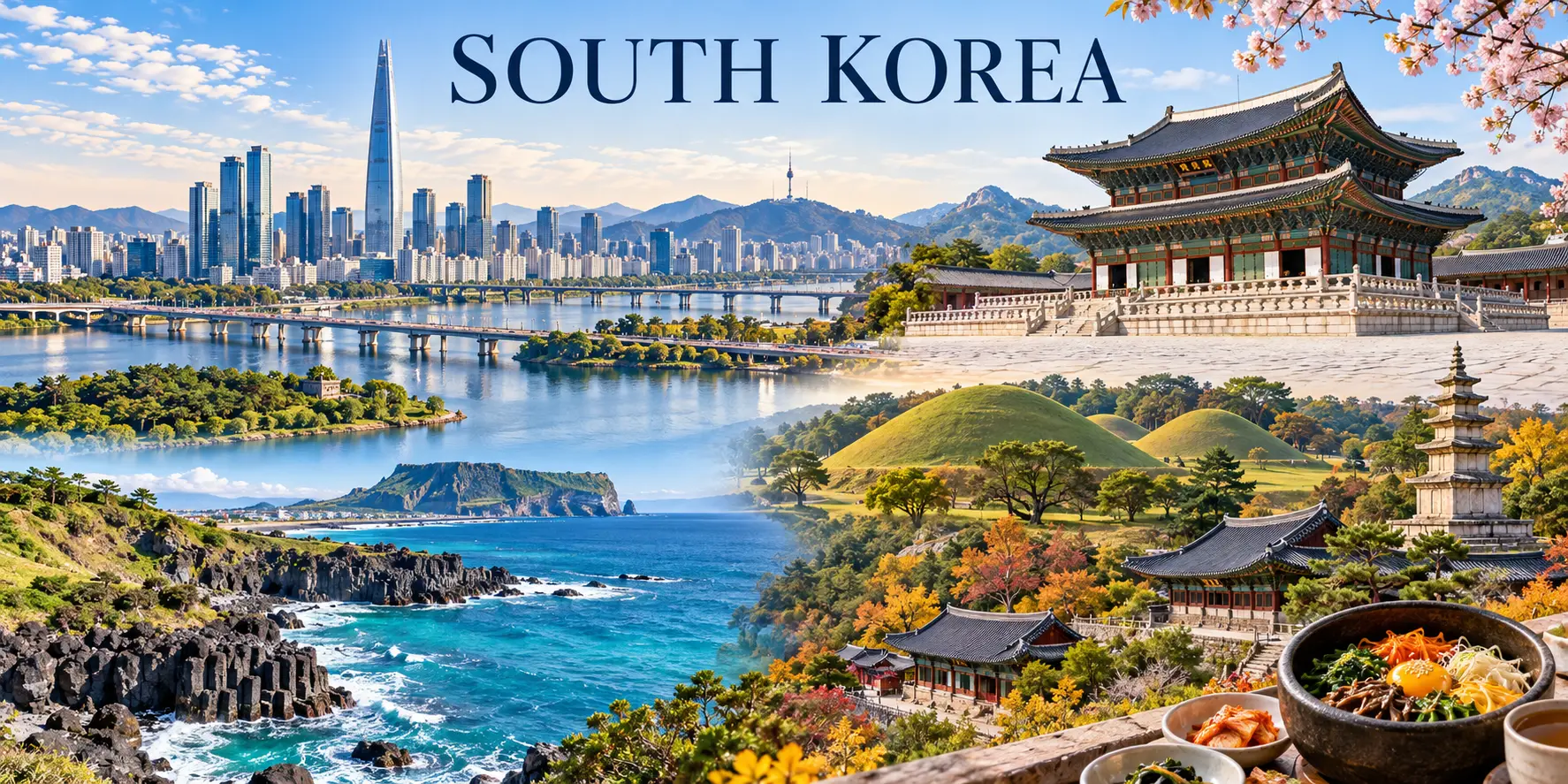
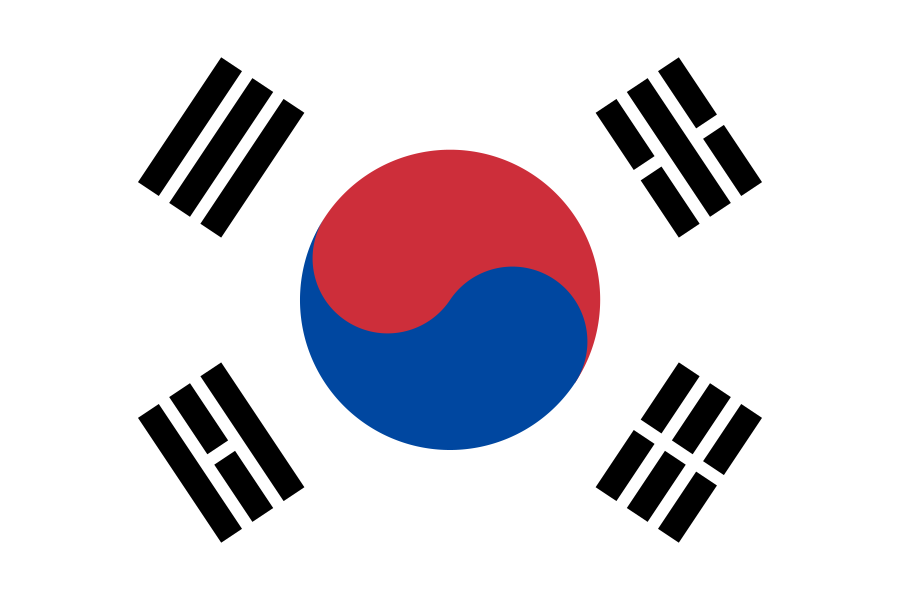
The Republic of Korea occupies the southern part of the Korean Peninsula, but it cannot be understood only through Seoul's glass towers, pop exports or fast trains. Mountain basins, fishing ports, Confucian institutions, Buddhist temples, industrial cities and an unresolved division coexist within a compact country. This guide separates verified practical facts from cultural interpretation and treats the peninsula's division as lived history, not a tourist prop.
🏷️ Name, language & identity
The constitutional name is the Republic of Korea; South Korea is the common geographic name. Korean is the official language and Hangeul is the national writing system. The alphabet is associated with King Sejong's fifteenth-century project to make literacy more accessible. Regional speech, Jeju language traditions, migration and a growing multicultural population make contemporary Korean identity broader than a single Seoul standard.
Official name
Republic of Korea
Capital
Seoul
Official language
Korean; Hangeul writing system
Population reference
51.81 million at 1 November 2024, official census release
Currency
South Korean won (KRW)
Time
Korea Standard Time · UTC+9
Driving
Right
Emergency
Police 112 · fire/ambulance 119 · travel help 1330
World Heritage
17 properties as of October 2026
KTI
Not scored
⛰️ Geography, seasons & scale
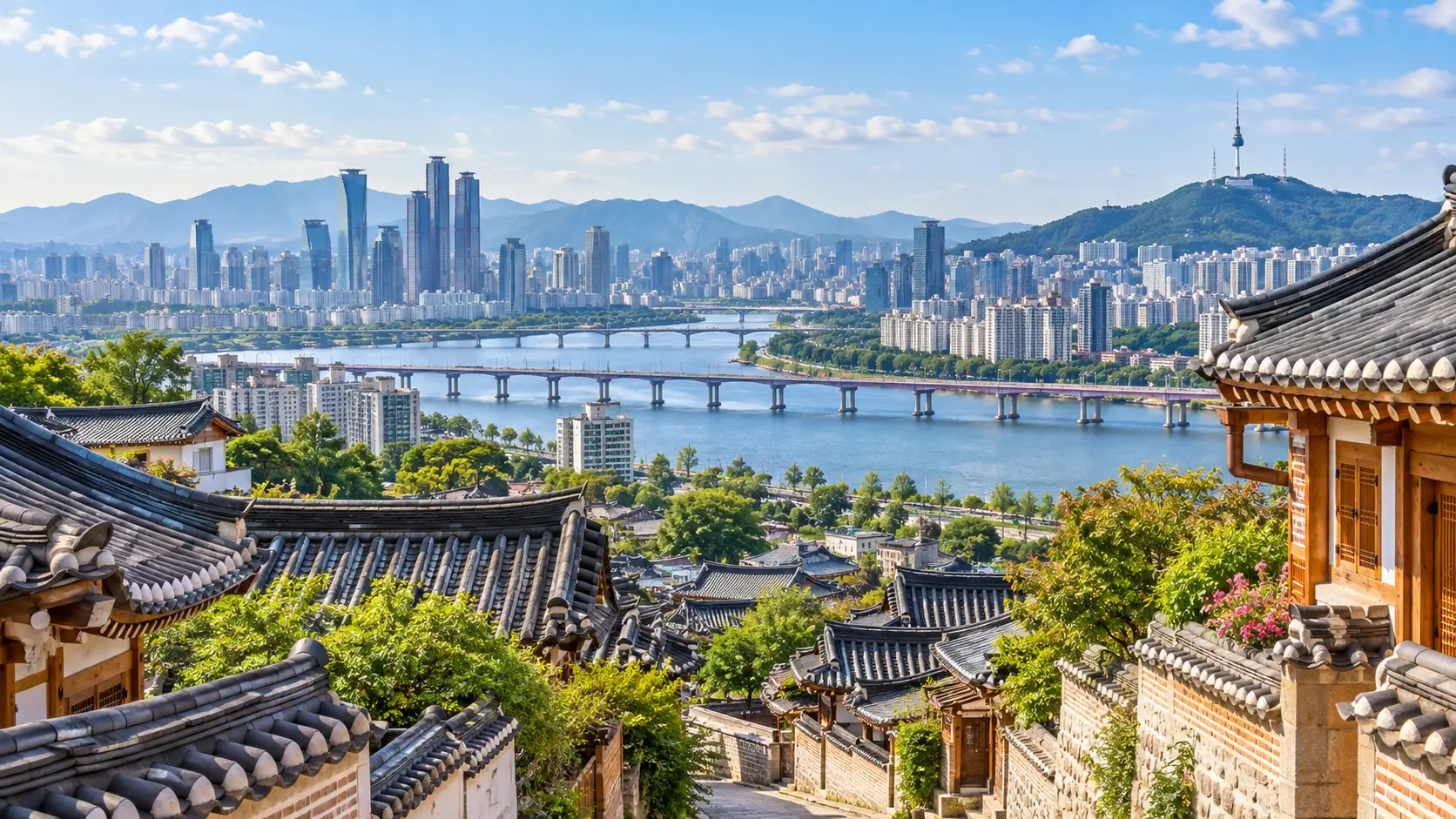
Mountains cover much of the country, compressing farms and cities into valleys and coastal plains. The Han River crosses Seoul; the Nakdong reaches the sea near Busan; volcanic Jeju rises around Hallasan. Summers are hot, humid and affected by monsoon rain and occasional typhoons. Winters are cold and dry, especially inland. Spring dust and heat alerts deserve the same attention as postcard weather.
Goguryeo, Baekje and Silla competed and exchanged ideas across the peninsula and beyond. Unified Silla made Gyeongju a political and artistic centre; later Goryeo gave the country the name known internationally as Korea. Tombs, ceramics, fortresses and Buddhist sculpture reveal networks linking the peninsula with China, Japan and wider maritime Asia rather than an isolated civilisation.
📜 Joseon, Confucian order & Hangeul
The Joseon dynasty shaped administration, education, family ritual and urban form for more than five centuries. Neo-Confucian academies and royal palaces remain visible, but their beauty should not obscure hierarchy, gender restrictions and slavery. Hangeul's creation was a linguistic turning point; literacy, scholarship and print culture continued to change long after its introduction.
🕯️ Colonial rule, division & war
Japanese colonial rule from 1910 to 1945 brought coercion, extraction and cultural suppression as well as industrial infrastructure used within an imperial system. Liberation was followed by division, rival states and the Korean War of 1950–1953. The armistice stopped large-scale fighting without a peace treaty. Families remain separated and the Demilitarized Zone is a military boundary, not a theme park.
🗳️ Industrialisation, protest & democracy
Export-led growth transformed livelihoods and built global companies, but it came with authoritarian rule, labour conflict, environmental costs and unequal sacrifice. The April Revolution, the Gwangju democratic movement of 1980 and the June Democracy Movement of 1987 are essential to the story of today's republic. Democratic institutions remain living practices sustained by journalism, courts, civic groups and peaceful protest.
🏙️ Seoul — capital in layers
Seoul combines Joseon palaces, reconstructed city gates, hillside neighbourhoods, megaprojects and ordinary markets. Gyeongbokgung and Changdeokgung reward historical context; Jongmyo requires quiet respect; the Han River parks reveal daily life better than a skyline checklist. Rush-hour distances can be deceptive. Choose one district at a time and leave room for walking, public transport and weather.
🏛️ Gyeongju — landscape as archive
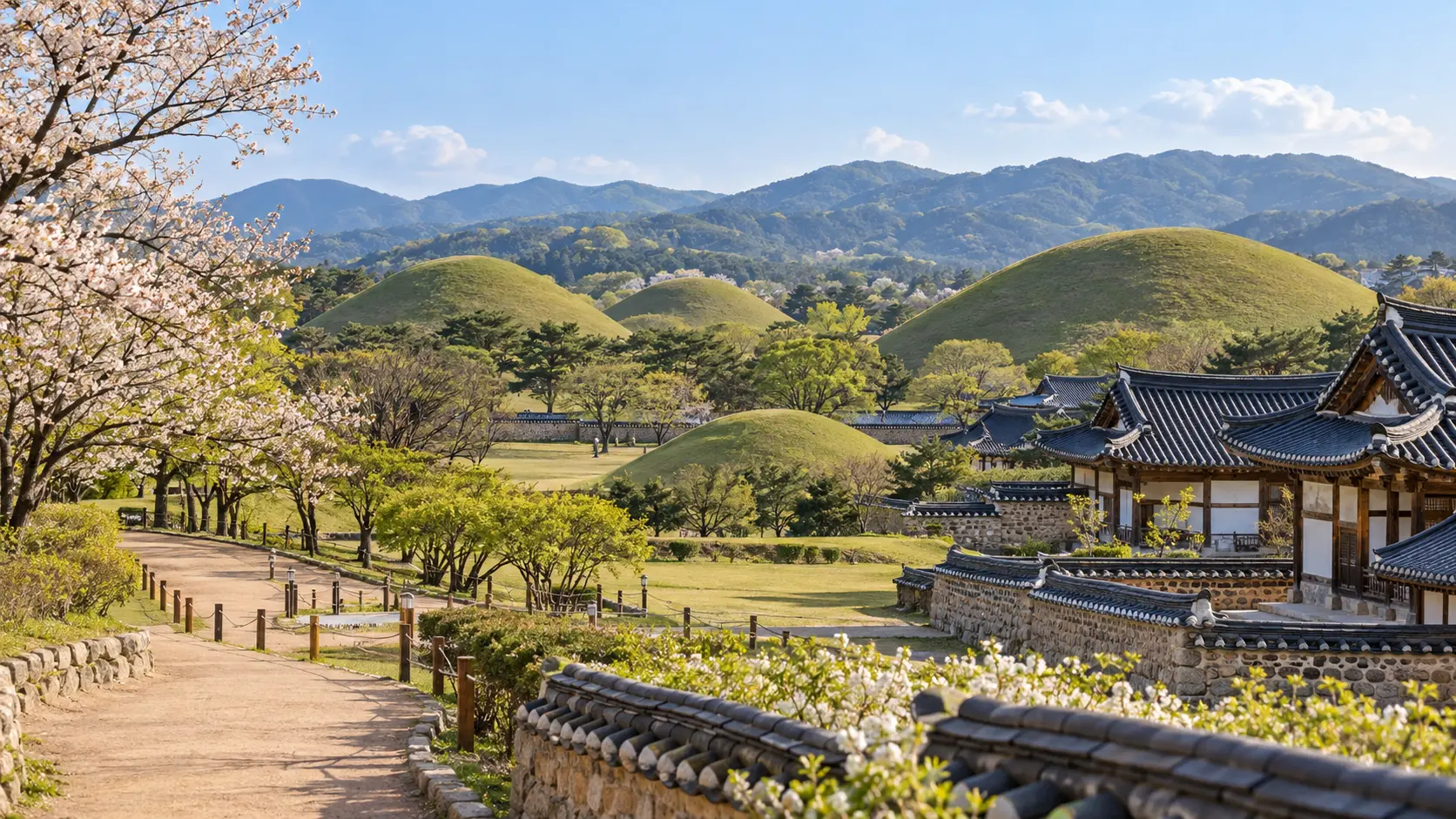
Royal tomb mounds sit among streets, parks and homes, while Bulguksa and Seokguram connect architecture, sculpture and mountain orientation. Gyeongju is not a frozen museum: residents, cafés, research and conservation share space with archaeological sites. Do not climb tumuli, touch painted surfaces or treat ritual areas as sets for costume photography.
Korea's great southern port is shaped by logistics, migration, wartime refuge and steep neighbourhoods. Jagalchi market, Yeongdo, beaches and the film festival each show a different city. Working markets require permission and care around faces. Coastal weather changes quickly, and cliff paths can close in wind or heavy rain.
🌋 Jeju — volcanic island and distinct memory
Jeju's lava tubes, tuff cones and Hallasan underpin its UNESCO natural inscription. Haenyeo diving culture records skilled women's labour and community knowledge. The island also carries the trauma of the 1948–1954 Jeju 4·3 events. A respectful itinerary makes space for geology, living communities and memorial history instead of reducing Jeju to beaches.
🙇 Daily culture, etiquette & accessibility
A small bow, two-handed exchange of important objects and removing shoes when invited into a home are useful courtesies, not rigid tests. Age and professional hierarchy may shape speech and seating, yet workplaces and families vary. Ask before photographing people, memorials or religious rites. Step-free access has improved in major stations and attractions but remains uneven in older streets and mountain sites.
🍚 Food, fermentation & regional tables
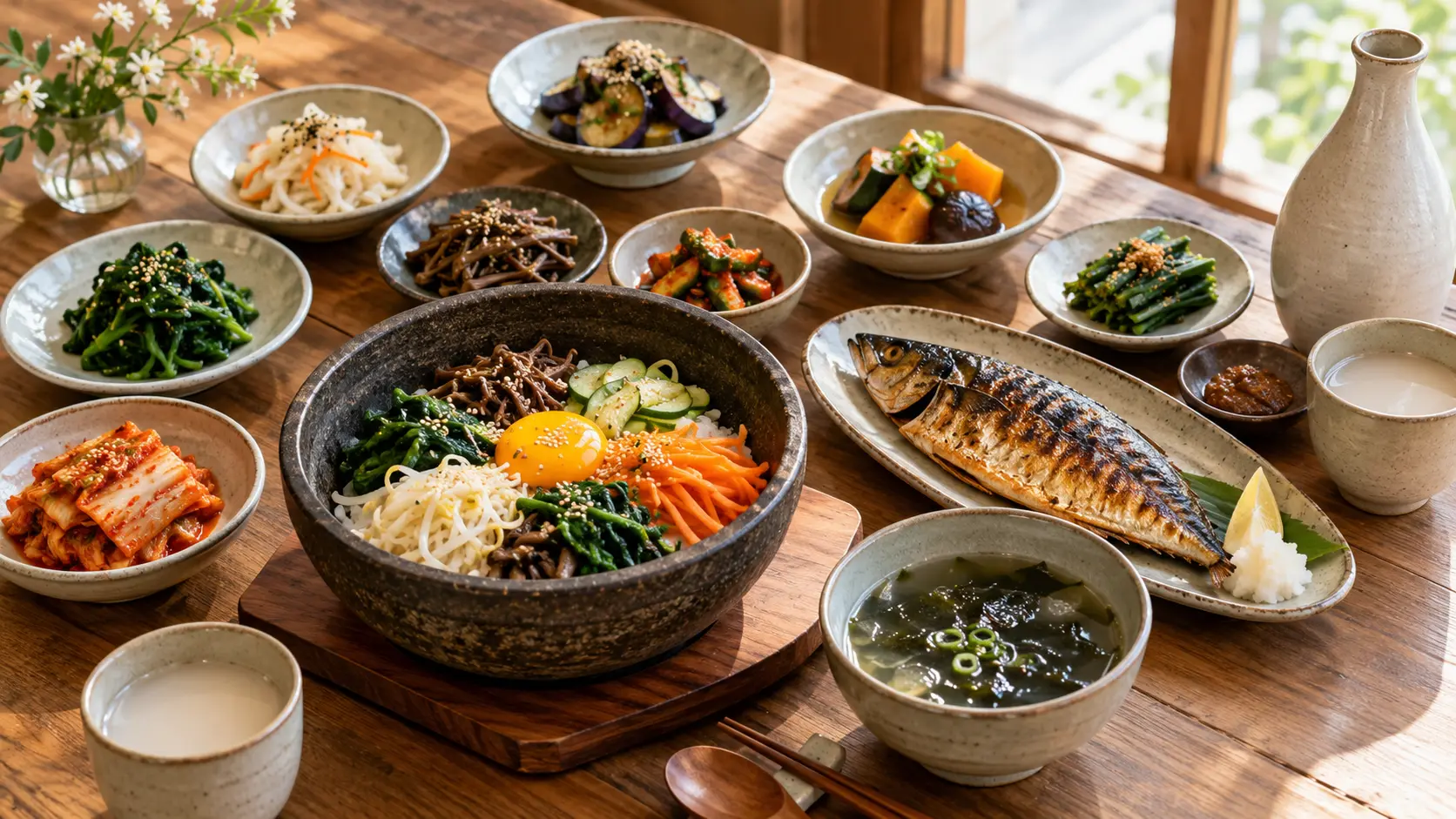
Rice, soups, grilled dishes and banchan form meals, while fermentation creates kimchi, jang sauces and deep seasonal flavours. Bibimbap, bulgogi and sundubu-jjigae are starting points rather than a complete cuisine. Temple food, Jeju seafood, Andong dishes and market snacks carry local histories. Allergies require explicit confirmation because broths, sauces and kimchi can contain seafood, soy, wheat or sesame.
Film, television, music, webtoons, games, architecture and fashion travel globally, but Hallyu is neither accidental nor the whole culture. Public investment, private studios, demanding labour systems and fan communities all matter. Traditional music, pansori, ceramics, minhwa painting and contemporary art deserve attention on their own terms rather than as colourful preludes to pop culture.
🛂 Entry formalities — verify before departure
Czech travellers should use the current Czech foreign-ministry page and Korean government portals, not paid look-alike services. The official e-Arrival Card is free and may be submitted within three days before arrival. Travellers with a valid K-ETA are exempt from the e-Arrival Card; temporary K-ETA exemption rules run through 31 December 2026 for eligible nationalities. Passport and entry rules can change, so verify the exact personal case before every trip.
🚄 Transport, payments & connectivity
Intercity rail and express buses connect major centres; local transport cards simplify urban metro and bus journeys. High-speed rail does not remove the need to reserve busy holiday routes. International cards work widely but small markets, rural buses and some machines may still require cash or a local payment method. Download Korean addresses and offline maps; a Romanised name alone may not be enough for navigation.
🧭 Safety, health & the northern boundary
Police are reached on 112 and fire or ambulance on 119; the multilingual travel helpline is 1330. Registering in DROZD is sensible for Czech travellers. Regional tensions can change quickly. Use only authorised DMZ tours, follow every military instruction and never cross barriers. Typhoons, heat, floods, winter ice, air quality and mountain rescue limits are usually more immediate travel risks than street crime.
✍️ Author's Note
South Korea invites shorthand: ancient and futuristic, disciplined and exuberant. The more honest approach is slower. Listen for the histories beneath the polished surface, give working places the dignity of work, and let regional voices complicate the capital's story. This edition does not assign a Kaufmann Travel Index score because no approved scoring rubric has been issued. — Radim Kaufmann, 2026