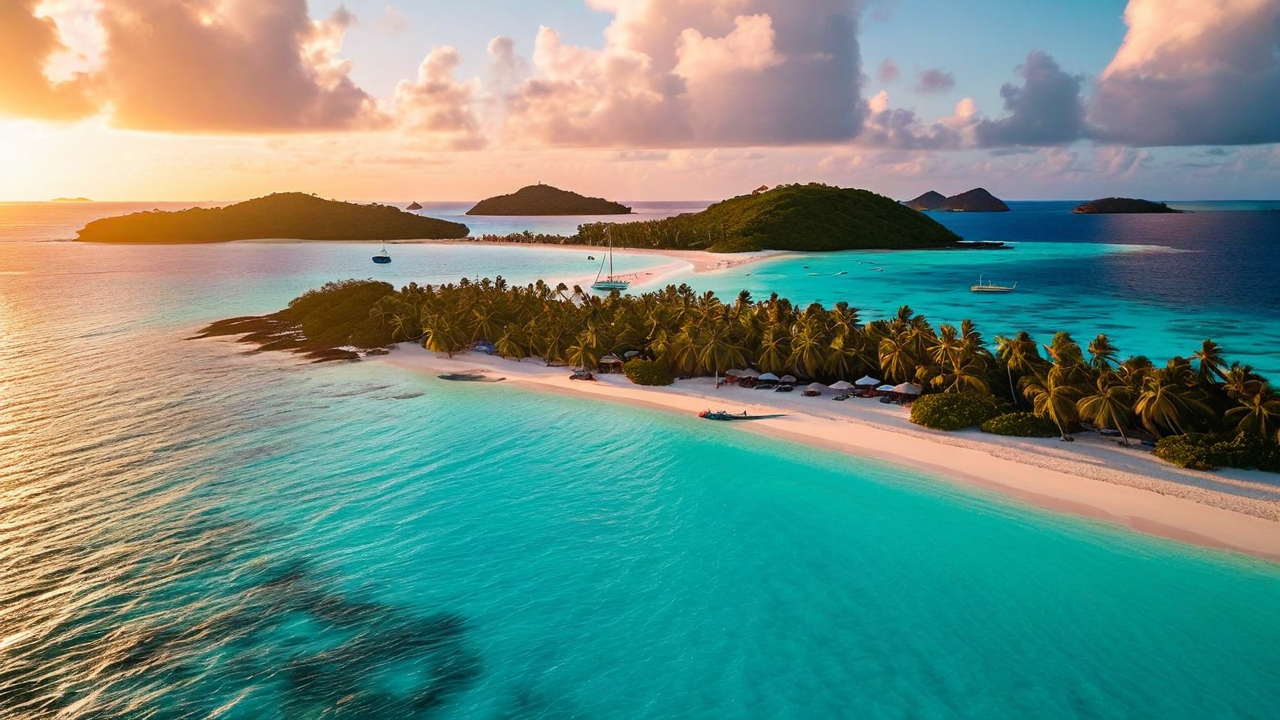
 AI illustration · KWTF Project License
Overview
Saint Vincent and the Grenadines is a chain of 32 islands and cays in the southern Lesser Antilles. Mountainous Saint Vincent holds the capital, Kingstown, and most of the population; the Grenadines step south toward Grenada through Bequia, Mustique, Canouan, Mayreau, Union Island and the protected Tobago Cays. The geography explains the country’s double character: a volcanic main island of farms, towns and rainforest, and a maritime world whose natural roads are channels, anchorages and ferry routes.
The best-known image is turquoise water around the Tobago Cays, yet the country is not one uninterrupted resort. Kingstown is a working Caribbean capital, La Soufrière is an active volcano, and the Southern Grenadines are still rebuilding after Hurricane Beryl. A responsible visit begins by checking current transport and accommodation locally rather than assuming that every pre-2024 listing remains available.
The islands
Saint Vincent
Volcanic, mountainous and green, with Kingstown, the Botanic Gardens, the Vermont Nature Trail and access toward La Soufrière.
Bequia
The most approachable Grenadine for many independent travelers: Admiralty Bay, ferry links, beaches and a strong boatbuilding identity.
Mustique & Canouan
Private-island and resort landscapes where access, prices and visitor expectations differ sharply from the main island.
Mayreau, Union & Tobago Cays
Small communities, sailing routes, reefs and the marine park—also the part of the country most severely affected by Beryl.
People, history and identity
Indigenous Caribbean history predates European colonization by centuries and survives in archaeological sites, place names and cultural memory. Colonial rivalry between Britain and France, plantation agriculture and the forced movement of Africans shaped the modern population. Independence from Britain came on October 27, 1979; the country remains a parliamentary democracy and a member of the Commonwealth.
English is the official language, while Vincentian Creole is central to everyday speech. Music, cricket, carnival and strong island and village identities connect the archipelago, but life on Saint Vincent differs materially from life on a small Grenadine island where supplies, schools and transport depend more directly on the sea.
La Soufrière and the living landscape
La Soufrière rises to 1,234 metres on northern Saint Vincent. Its explosive eruption in April 2021 forced mass evacuation and blanketed communities and farmland in ash. It is an active volcano, not a scenic prop: visitors should use current guidance from the National Emergency Management Organisation and the University of the West Indies Seismic Research Centre before considering any hike.
Below the volcano, rainfall and elevation support rainforest, rivers and agricultural valleys. Offshore, reefs, seagrass beds and small islands create habitat for turtles, rays and seabirds. Marine-park rules protect this environment; anchoring, waste disposal and wildlife encounters should follow local instructions.
Sailing and the Tobago Cays
Short passages, trade winds and a sequence of anchorages make the Grenadines one of the Caribbean’s classic sailing areas. That reputation does not remove the need for seamanship: reefs are real, weather changes, and inter-island logistics can be disrupted. Bareboat crews should verify charts, moorings, park fees and hurricane-season arrangements with current operators.
The Tobago Cays Marine Park is the emblematic stop. Visitors come for reef-protected water and turtle habitat, but its popularity makes low-impact behavior essential: use authorized moorings, keep distance from wildlife, never stand on coral and take waste away.
Kingstown and the main island
Kingstown is compact, busy and more useful than theatrical: markets, government buildings, the waterfront and services for the rest of the archipelago are concentrated here. The St Vincent Botanic Gardens, founded in the eighteenth century, provide a quiet counterpoint. Beyond the capital, the main island’s roads follow a deeply folded coast, so modest map distances can take time.
Travelers who see only a marina connection miss much of the country. Village bakeries, produce markets, black-sand beaches and the agricultural interior tell the story of Saint Vincent more clearly than luxury-island imagery alone.
Food and drink
Roasted breadfruit with saltfish is widely treated as the national dish. Callaloo, coconut, root crops, local fish, stews and arrowroot belong to a cuisine shaped by agriculture and the sea. Hairoun is the national lager, rum is the principal local spirit, and sea-moss drinks appear in both non-alcoholic and rum-based forms.
Open the full food guide or continue to the rum and wine page.
Heritage and UNESCO status
As checked on September 24, 2026, Saint Vincent and the Grenadines has no property inscribed on the UNESCO World Heritage List. Three entries have been on the national Tentative List since 2012: the Grenadines Island Group, La Soufrière National Park, and Rock Art of Saint Vincent and the Grenadines. A 2026 UNESCO workshop in Kingstown supported work toward future nominations; a Tentative List entry is not the same as inscription.
Practical travel
| Topic | What to know |
|---|---|
| Entry | Rules depend on nationality. Czech travelers should use the Czech Foreign Ministry link below; entry permission is granted by immigration on arrival. |
| Money | Eastern Caribbean dollar (XCD). Cards work in larger businesses, but cash remains useful on smaller islands. |
| Driving | Left side. Roads are steep and winding; local permits may be required. |
| Electricity | 230 V; Type G is common. Confirm with accommodation. |
| Transport | Argyle International Airport, ferries and small-aircraft links. Verify schedules directly because they change. |
| Season | Drier months are usually December–May; Atlantic hurricane season is June–November. |
Beryl recovery and responsible travel
Hurricane Beryl struck in July 2024. The World Bank reported in January 2026 that the storm affected an estimated 56% of the national population and that more than 90% of buildings in the Southern Grenadines were heavily damaged or destroyed. Recovery is visible but uneven. Travelers should verify island-specific conditions and support locally owned accommodation, guides, restaurants and shops.
Do not treat damaged communities as scenery. Ask before photographing people or reconstruction sites, conserve water and electricity, and follow local emergency instructions.
Sources and update note
- Government of Saint Vincent and the Grenadines — About SVG
- National Statistical Office — population estimates through 2022
- World Bank — population and economic indicators
- UNESCO World Heritage Centre — State Party profile
- Czech Foreign Ministry — travel information
Time-sensitive facts checked September 24, 2026. Population sources differ: the national office lists 110,872 for 2022, while the World Bank’s 2025 estimate is 99,924; the facts panel uses the newer World Bank estimate and labels its year.