

🇵🇼 Palau at a Glance
🌍 Overview — a Very Small Country With a Very Large Ocean
Palau — Belau in Palauan — is an archipelago of over 340 islands in the western Pacific, about 900 km east of the Philippines and 1 300 km south-west of Guam. Its land area is 459 km², roughly the size of a large Czech district, and its population is around 18 000. Its exclusive economic zone is about 604 000 km² — bigger than France.
Almost nobody lives on most of it. Around two thirds of the population lives in or around Koror; the capital, Ngerulmud, is a cluster of government buildings on an empty hillside and is by a wide margin the least populous national capital on earth.
⭐ Why anyone comes
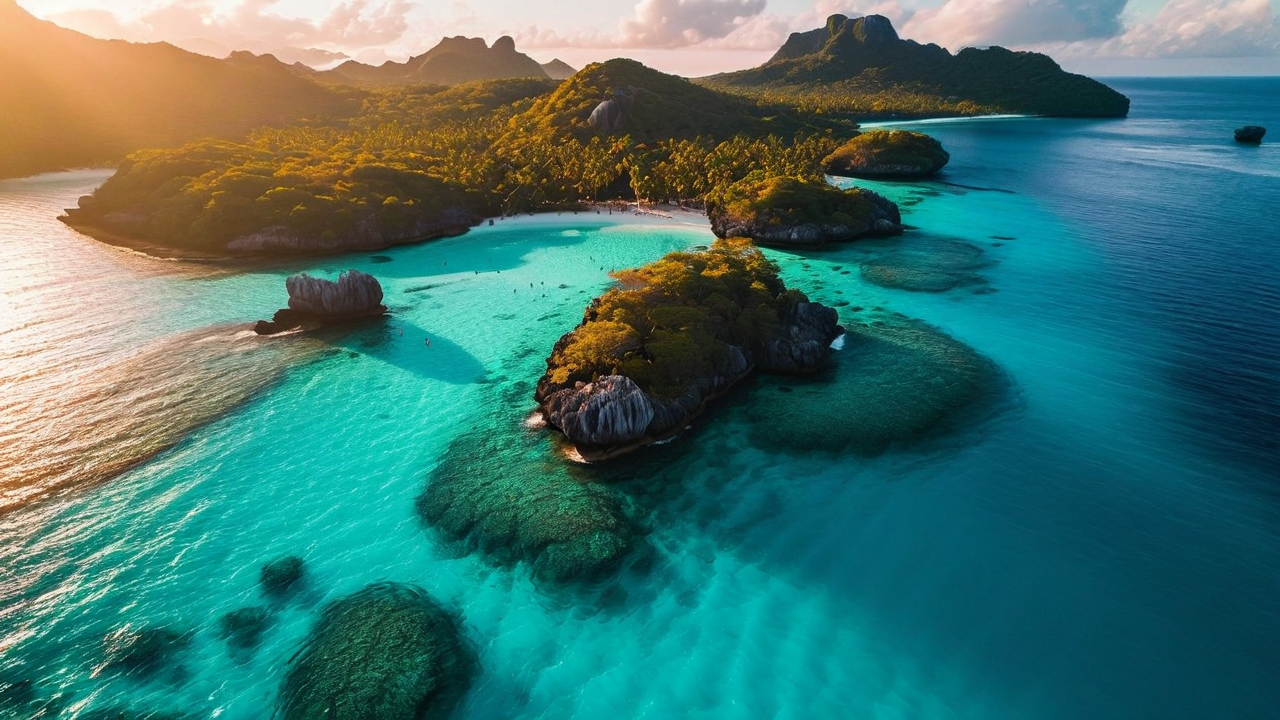
The diving, which is repeatedly rated the best in the world and is not a marketing claim. The Rock Islands, a UNESCO World Heritage site of mushroom-shaped limestone islets you paddle between. Jellyfish Lake. And a Pacific War battlefield at Peleliu that almost nobody visits.
🌊 What makes it unusual
In 2009 Palau created the world's first national shark sanctuary. In 2020 it closed 80 % of its own ocean to all extractive activity. In 2017 it began stamping a pledge written by its children into every arriving passport. In 2020 it became the first country to ban reef-toxic sunscreen. This is a country of eighteen thousand people setting global precedent repeatedly.
🛂 Practicalities in one line
Czech citizens need no visa — a free 30-day entry permit is issued on arrival. There is a US$100 green fee included in your airfare. The currency is the US dollar. See practical.
⚠️ About the page this replaces
The previous version of this page was, in substantial part, the Abkhazia page with the place names swapped. It told readers that Palau has the world's deepest cave, an underground metro, 50 000 tonnes of tangerines a year and a Soviet-era monkey research station. None of that is Palau. It is written up in the author's note, because it is the most serious defect this project has found.
🗺️ The Shape of the Archipelago
Palau runs roughly north-east to south-west for about 650 km if you count the far-flung southwest islands, but the inhabited core is compact: one big volcanic island, one main town, a scatter of limestone islets, and two war-scarred islands to the south.
Babeldaob
The big one — 331 km², over 70 % of the country's land, and the second-largest island in Micronesia after Guam. Volcanic, hilly, forested, with rivers, waterfalls, mangroves and a savanna of red laterite soil. It holds ten of the sixteen states, the capital and the airport, and perhaps six thousand people. Most visitors barely see it.
⭐ The Rock Islands
Between Koror and Peleliu: several hundred uplifted limestone islets, forested on top, undercut at the waterline, scattered across a turquoise lagoon. UNESCO World Heritage since 2012, and listed as mixed — natural and cultural — which is unusual and correct. See their own section.
Koror
The former capital and the actual centre of the country: around 11 000 people, the hotels, the dive shops, the shops, the hospital, the one road that matters. Joined to Babeldaob by the Japan–Palau Friendship Bridge — whose predecessor collapsed catastrophically in 1996, cutting the country in half.
Peleliu and Angaur
South of the Rock Islands. Peleliu was the site of one of the Pacific War's bloodiest battles in 1944 and is still full of it. Angaur was mined for phosphate under Germany and Japan, and carries a population of introduced crab-eating macaques that nobody planned.
Kayangel and the Southwest Islands
Kayangel is Palau's only true coral atoll, in the far north. The Southwest Islands — Sonsorol, Hatohobei (Tobi), Pulo Anna, Merir — lie up to 600 km south-west, hold a few dozen people between them, speak their own languages, and are reached by a government ship a handful of times a year.
The ocean
Roughly 604 000 km² of EEZ for 459 km² of land — a ratio of about 1 300 to 1. Understanding Palau means understanding that the country is, functionally, an ocean with some rocks in it, and that its politics are ocean politics. See the marine sanctuary.
🏝️ The Rock Islands
The Rock Islands Southern Lagoon was inscribed on the UNESCO World Heritage List in 2012, and unusually it is a mixed site — listed for both its natural and its cultural value. The listing covers 445 uninhabited limestone islands across about 100 000 hectares of lagoon.
Why they are shaped like that
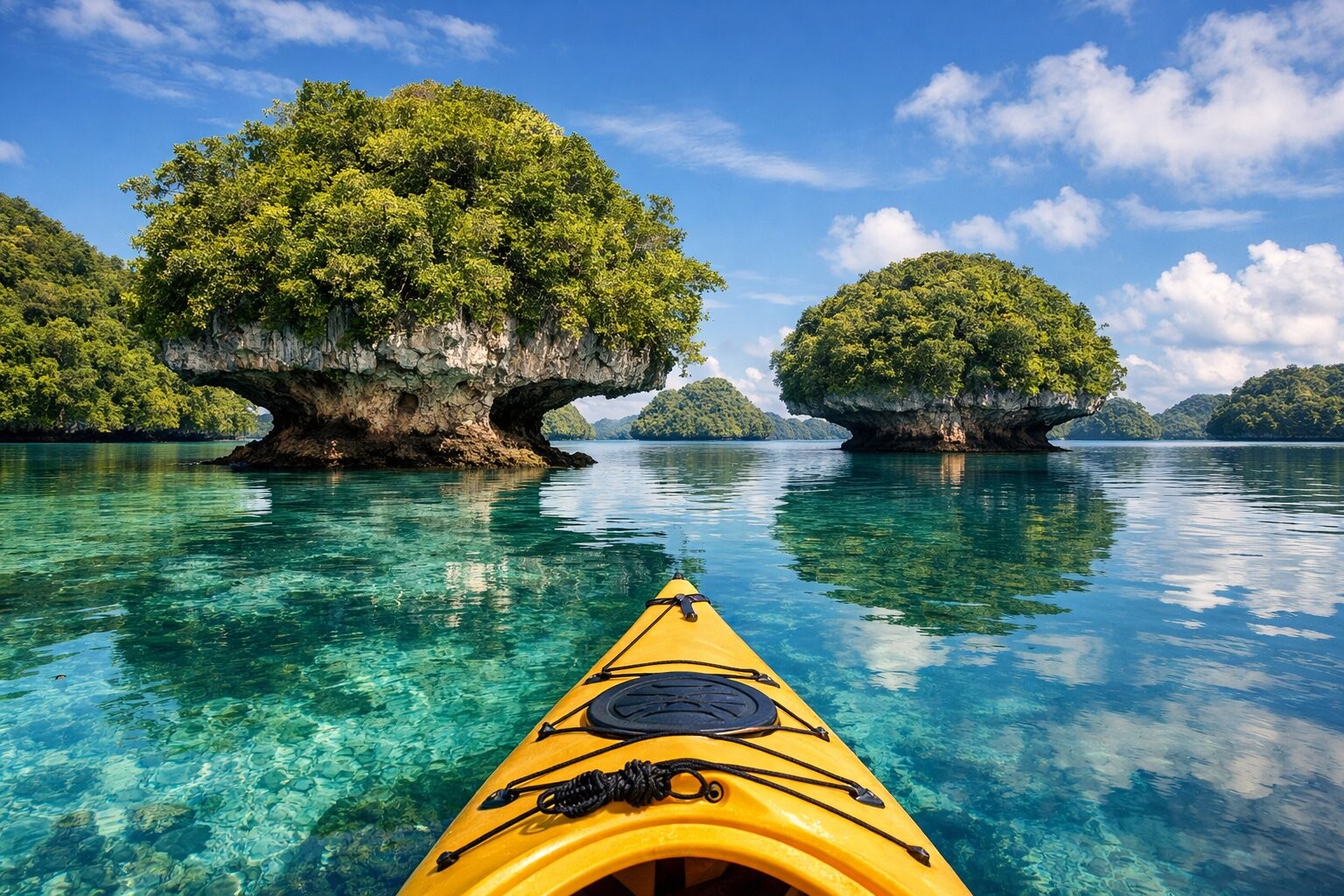
They are uplifted ancient coral reef — limestone, pushed above sea level by tectonics. The undercut notch at the waterline is not wave erosion. It is largely biological: chitons, urchins, snails and boring sponges grazing and dissolving the rock in the narrow band that is wet at every tide, over thousands of years. The result is an island standing on a stalk, which is why nothing grows at the base and why they look impossible.
The cultural half of the listing
Abandoned villages, terraces, rock art and burial caves. People lived on these islands from around 3 000 years ago until roughly the 17th–18th century, then left — probably because of climate, disease and consolidation into larger villages. What they left behind is why the site is listed as cultural as well as natural.
⭐ The Yapese stone money
One of the great facts about Palau, and one most people attach to the wrong country. The famous rai — the enormous stone discs of Yap, 400 km north — were quarried here, in the limestone of the Rock Islands, and carried home on rafts and canoes across open ocean. Quarry sites survive. The value of a stone depended partly on how many men died bringing it home.
The marine lakes
There are more than fifty of them — seawater lakes inside the islands, connected to the sea only through cracks in the limestone. Several have evolved their own endemic species in isolation. Jellyfish Lake is the famous one; most are closed to visitors precisely because they are so fragile.
Visiting
By boat or kayak from Koror, on a Rock Islands permit (see fees). Some beaches are open, most islands are not. Multi-day kayak trips with camping on permitted beaches are the best way to experience them and are the way a small number of visitors do it.
⚠️ Rules
Do not land where landing is not permitted. Do not touch or stand on coral. Do not remove anything, including shells and dead coral. Do not feed fish. Anchoring is restricted to moorings. These are enforced and fines are real — Palau is unusually serious about this and it is why the place still looks like this.
Seventy Islands
Ngerukewid, the archipelago's most photographed view and the image on the fifty-cent coin — and completely closed to visitors, as a turtle nesting sanctuary, since 1956. You can see it from the air and that is all. It is a good summary of Palauan conservation policy.
🪸 The Reefs
Palau sits where the Pacific's richest marine biodiversity converges. The reefs hold something over 400 species of hard coral and over 1 400 species of reef fish — extraordinary numbers for a country this small, and the reason the diving is what it is.
Why here
A position at the eastern edge of the Coral Triangle, deep water immediately offshore, and strong currents that sweep nutrients up the reef walls. That combination concentrates pelagic life — sharks, jacks, barracuda, mantas — against a reef edge in a way very few places manage.
⭐ Resilience
Palau's reefs have bleached repeatedly — badly in 1998 and again in 2010 — and have recovered better than most. Research at the Palau International Coral Reef Center has found corals in Palau's warm, low-pH lagoon bays that tolerate conditions predicted for the open ocean decades from now. Those bays are studied worldwide as a window on the reef future.
⚠️ And they are still in trouble
Resilience is not immunity. Warming, acidification, crown-of-thorns outbreaks, sedimentation from road building on Babeldaob and the sheer physical pressure of tourism all bite. Palau's own reef scientists are blunt about it, and the honest version is that the country is doing more than almost anyone and is still losing ground to a problem it did not cause.
Sharks
The Palau Shark Sanctuary, declared in 2009, was the first of its kind anywhere: all commercial shark fishing banned across the entire EEZ. The reasoning was partly ecological and partly arithmetic — a living reef shark is worth far more to Palau over its lifetime as a dive attraction than it is once, dead.
Mantas
German Channel, a passage the Germans blasted through the reef around 1908 to move phosphate barges, turned out to work as a manta cleaning station. Reef mantas queue there to be cleaned by wrasse. It is the single most reliable manta encounter in the Pacific and it exists by accident, because of colonial engineering.
Turtles and dugongs
Green and hawksbill turtles nest here. Palau also holds the most isolated dugong population in the world — perhaps 200 animals, genetically cut off from the nearest population by thousands of kilometres, and protected but still poached. Seeing one is a matter of luck measured in years.
🌦️ Climate and When to Go
Tropical, wet and warm all year, at 7° north. Air and water both sit around 27–30 °C permanently, which means there is no bad season for diving — only differences in visibility, rain and price.
⭐ December–April: dry season
The best months. Less rain, calmer seas, the best visibility on the outer reefs, and the peak of the Blue Corner and German Channel action. It is also high season, so book well ahead and expect the highest prices.
May–November: wet season
More rain, usually in short heavy afternoon bursts rather than all-day drizzle, and occasionally squally seas. Diving continues throughout and the sites are quieter and cheaper. Manta activity at German Channel is generally better in the wetter months, so this is not simply the worse half of the year.
Rain
Around 3 800 mm a year — Palau is genuinely wet. It rarely rains all day, and a downpour on a dive boat is less of a problem than it sounds because you are about to get wet anyway.
⚠️ Typhoons
Palau sits at the southern edge of the western Pacific typhoon belt and is usually below the main track, which is why the vegetation is so intact. Usually is not always: Typhoon Bopha in December 2012 and Super Typhoon Haiyan in November 2013 both hit, Bopha devastating Kayangel. The risk is low and it is not zero.
Water
28–30 °C all year. A 3 mm shorty is enough for most people; multiple dives a day will still make you cold, and a full 3 mm is the sensible choice. Visibility is routinely 20–40 m and often more.
Currents
The reason the diving is world class and the reason it is not for beginners. The best sites are drift dives on strong currents against a wall. A reef hook — a hook on a line clipped to your BCD, set into dead reef so you hang in the current and watch — is standard equipment here and you should know how to use one.
🦜 On Land
⭐ Endemic birds
Palau has around a dozen endemic bird species — the Palau fruit dove, the Palau bush warbler, the Palau fantail, the Palau owl, the giant white-eye, the Micronesian megapode. For a country this small that is a serious list, and Babeldaob's forests are the place to find them.
Saltwater crocodiles
Yes, really. Crocodylus porosus lives in Palau's mangroves — a small population at the eastern edge of the species' range. Attacks are essentially unknown in modern times; the last fatality was in the 1960s. They are protected. Do not swim in mangrove channels at night, which is advice nobody needed to be given.
Fruit bats
Palauan flying foxes, large and conspicuous at dusk, and traditionally eaten — fruit bat soup, served with the whole animal in the bowl, is a genuine local dish and a genuine shock to visitors. The population is under pressure from hunting and the practice is increasingly argued about locally.
⚠️ Introduced species
The crab-eating macaques of Angaur, descended from animals brought during the German phosphate era, are the country's oddest invasive population and a real agricultural nuisance. Rats, cats and the giant African snail do the ordinary island damage. The brown tree snake that destroyed Guam's birds has not established here, and keeping it out is a permanent priority.
The forest
Babeldaob carries the largest intact forest in Micronesia outside Papua New Guinea, plus extensive mangroves, and the Ngardok Nature Reserve holds the largest natural freshwater lake in the region. The compact road around Babeldaob, completed in 2007, made it accessible and also brought erosion and sediment onto the reefs.
Ngerukewid again
Closed since 1956 as a nature preserve — one of the oldest protected areas in the Pacific and older than the country. Palauan conservation did not start with the marine sanctuary; it started with bul, the traditional chiefly moratorium on fishing a reef, which is the direct ancestor of everything in the conservation section.
🛶 First Settlement
People reached Palau at least 3 000 years ago, and possibly considerably earlier — dates from cave sites in the Rock Islands have been argued back towards 4 500 years. They came from island Southeast Asia, most likely by way of the Philippines or eastern Indonesia, and their language is Austronesian, related distantly to Malay, Tagalog and Malagasy.
⭐ The Rock Islands villages
For roughly two and a half thousand years people lived on the limestone islets — terraced villages, burial caves, rock art, midden. Then, somewhere between the 12th and 18th centuries, they left, consolidating onto the larger islands. Climate stress, disease and political consolidation are the leading explanations. The abandoned villages are half the reason for the UNESCO listing.
The Babeldaob terraces
Enormous earthworks on the volcanic island — stepped hillsides, crowns, ditches — built between roughly 100 BC and 1200 AD and involving the movement of a staggering volume of earth by a population that cannot have been large. Whether they were defensive, agricultural or ceremonial is genuinely unresolved. They are visible from the road and almost never visited.
Badrulchau
In the far north of Babeldaob: rows of large basalt monoliths, some carved with faces, standing in a grassy field. Local tradition says they held up the posts of a giant bai. Archaeology is not sure. They are older than the terraces on the ridge behind them and nobody knows who raised them.
⭐ Yapese stone money
From perhaps 500 years ago, men from Yap sailed 400 km south, quarried discs of Palauan limestone with shell tools, and sailed them home on rafts to serve as money. It is one of the more remarkable economic arrangements in human history and it happened here. Quarry sites survive in the Rock Islands.
Society before contact
Matrilineal — clan membership, land rights and chiefly titles pass through women, and senior women select and can remove the male chiefs who hold the titles. A ranked system of villages and clans, two rival confederations in the north and south, and a rich material culture of bai, canoes and bead money (udoud). Almost all of that structure is still live.
First European contact
The Spanish sighted the islands in the 16th century and largely ignored them. The consequential moment came in 1783, when the English East India Company packet Antelope wrecked on a reef off Ulong. Its crew was sheltered by the Ibedul of Koror; in return they helped him in war, and his son Prince Lee Boo went back to England — where he died of smallpox within months. His grave is in Rotherhithe, London, and the story made Palau briefly famous in Georgian Britain.
⛵ Spain, Germany, Japan
Palau was claimed, sold, mandated and conquered by four foreign powers in eighty years, and each left something visible.
🇪🇸 Spain, to 1899
Nominal Spanish sovereignty from the 17th century, made real only in the 1880s with Capuchin missionaries and a token administration. The consequential legacy is Catholicism and a wave of introduced disease that, together with earlier epidemics, cut the population catastrophically — estimates suggest Palau may have fallen from tens of thousands to around 4 000 people by 1900.
🇩🇪 Germany, 1899–1914
After losing the Spanish–American War, Spain sold the Carolines, the Marianas (minus Guam) and Palau to Germany. The Germans wanted phosphate, and mined it on Angaur, importing labour and blasting German Channel through the reef to move it — the channel that is now the best manta dive in the Pacific. They also introduced the Angaur macaques.
🇯🇵 ⭐ Japan, 1914–1944
Japan seized the islands in 1914 and held them under the South Seas Mandate from 1920. And Palau was not a backwater in it — Koror was the capital of the entire Japanese Nan'yō, the administrative centre for all of Micronesia. By the late 1930s it was a city of perhaps 30 000 people with paved streets, electricity, a Shinto shrine, schools, a bank, a brewery and a bonito-drying industry. Japanese settlers outnumbered Palauans several times over.
What the Japanese era left
Concrete foundations all over Koror, the road network's original alignment, the phosphate and bauxite workings, a great many Japanese loanwords in Palauan — and Japanese as an official language of Angaur state, which is a real constitutional provision and, as far as anyone can tell, the only place outside Japan where that is true.
⚠️ And how it is remembered
Complicatedly, and more warmly than outsiders expect. Older Palauans who grew up under Japanese administration describe schooling, order and development alongside a strict racial hierarchy in which Palauans ranked below Japanese and Okinawans. Then the same administration turned the islands into a fortress and the war destroyed Koror entirely.
Militarisation
From the mid-1930s Japan fortified the mandate in breach of the League terms. By 1944 Palau held tens of thousands of troops, airfields on Peleliu, Angaur and Babeldaob, and a naval anchorage. What followed is the next section.
⚔️ The Battle of Peleliu, 1944
The American landing on Peleliu began on 15 September 1944 — eighty-two years ago today, as this page is written. The 1st Marine Division's commander, Major General William Rupertus, told his officers the island would be rough but fast and would take three days. It took two and a half months.
What changed
Peleliu was the battle where Japanese doctrine changed. Instead of contesting the beach and dying in a banzai charge, Colonel Kunio Nakagawa fortified the interior — the coral ridges of the Umurbrogol — with over 500 interconnected caves, sliding steel doors, and interlocking fire. The Americans were allowed ashore and then fought upward into a honeycomb. That template was used again at Iwo Jima and Okinawa.
⚠️ The cost
Around 2 300 Americans killed and over 8 000 wounded — the highest casualty rate of any amphibious assault in US military history. Of roughly 11 000 Japanese defenders, almost all died; a few hundred were taken prisoner. The 1st Marine Division was so badly mauled it was withdrawn from combat for months.
Bloody Nose Ridge
The Umurbrogol — sharp coral ridges, no soil, no cover, temperatures over 46 °C, no fresh water. Men were cut open by the rock itself when they threw themselves down. The fighting there is among the most-written-about small-unit combat of the war, largely because of Eugene Sledge's memoir With the Old Breed, which is one of the great books about any war and is set here.
⭐ ⚠️ Was it necessary
Probably not, and that is the argument that will not go away. Peleliu was taken to protect MacArthur's flank for the Philippines landing. By September 1944 Palau's air power had been destroyed and Admiral Halsey had recommended bypassing the islands entirely. His recommendation was partly accepted — Yap was bypassed — and Peleliu was not. The battle received almost no press coverage at the time and was largely forgotten. Its veterans have never forgotten it.
The last surrender
A group of 34 Japanese soldiers held out in the caves of Peleliu until 22 April 1947 — nearly two years after the war ended — and surrendered only when a Japanese admiral was brought to the island to confirm in person that Japan had lost.
And the Palauans
Around a thousand Palauan civilians had been evacuated from Peleliu to Babeldaob before the landing, which saved most of their lives. On Babeldaob, bypassed and blockaded, the Japanese garrison and the civilian population then starved together for a year. Palauan deaths from the war are hard to count and were substantial, and almost nobody outside Palau counts them at all.
🇺🇸 The Trust Territory, 1947–1994
After the war Palau became part of the Trust Territory of the Pacific Islands — the United Nations' only strategic trusteeship, administered by the United States, answerable to the Security Council rather than the General Assembly, and therefore effectively immune to the oversight it was supposed to have.
What the period did
Brought American schooling, English, the dollar, a wage economy and eventually a US-modelled constitution. It also produced a long period of administrative neglect — the Trust Territory was famously under-resourced — followed by a burst of spending in the 1960s when the geopolitics changed.
⭐ The nuclear clause
When Palau wrote its constitution in 1979, it included a provision requiring a 75 % popular majority to permit nuclear, chemical or biological weapons or nuclear waste on its territory. This was, deliberately, a problem for the United States, which would not confirm or deny what its ships carried.
⚠️ Fifteen years of referendums
What followed was one of the longest constitutional stand-offs in modern decolonisation: seven referendums between 1983 and 1990, each failing to reach 75 % for a Compact that would allow US nuclear-capable forces. The period was marked by real political violence — President Haruo Remeliik was assassinated in 1985, and President Lazarus Salii died by suicide in 1988 amid a corruption investigation. It was resolved in 1992 by amending the constitution to lower the threshold to a simple majority; the Compact passed in 1993.
1 October 1994
Palau became independent — the last United Nations trust territory anywhere to do so, and the event that formally ended the entire trusteeship system. It joined the UN in December 1994 as its 185th member. 1 October is Independence Day and is the national holiday.
The other three
The Trust Territory broke into four: the Marshall Islands, the Federated States of Micronesia, the Northern Mariana Islands — which chose US commonwealth status rather than independence — and Palau. The first three settled their status in the 1970s and 1980s. Palau took until 1994 because of the nuclear clause.
What survived
The American institutional frame — a presidential republic, a bicameral legislature, US-style courts — sitting on top of a matrilineal chiefly system that never went away. Both operate. See politics.
🤝 The Compact of Free Association
Palau is fully sovereign — a UN member state with its own foreign policy — and simultaneously bound to the United States by a treaty that gives Washington exclusive military access to its territory. Both halves are real and the arrangement has no close analogue outside Micronesia.
What the Compact contains
What Palau gets
US financial assistance; defence and security guaranteed by the United States; the right for Palauans to live, work and study in the US indefinitely without a visa, and to serve in the US armed forces; the US dollar; US postal, weather and aviation services.
⚠️ What the US gets
Denial rights. The United States may operate militarily in Palau and — crucially — may deny military access to any third country. For a country sitting between Guam and the Philippines, in the middle of the second island chain, that is the entire point. The arrangement runs for a defined term and has been renewed.
The 2023–24 renewal
The Compact's economic provisions were renegotiated and the Compact Review Agreement was funded by the US Congress in March 2024 — around US$889 million to Palau over twenty years, alongside similar packages for the Marshall Islands and the FSM. The delay in passing it, which ran for months, caused real anxiety in all three capitals.
⭐ Service in the US military
Palauans enlist in the US armed forces at one of the highest per-capita rates of any population on earth — higher than any American state. It is a major source of income, of veterans' benefits, and of casualties: Palau has lost people in Iraq and Afghanistan. It is also a major reason the relationship is not experienced locally as abstract.
The military build-out
Under the current security climate the US is expanding its footprint: an over-the-horizon radar installation on Palau, airfield and port improvements, and periodic exercises. President Whipps has publicly framed the US security partnership as essential. Not everyone in Palau agrees, and the debate is conducted in public.
For a visitor
Practically invisible. You will see the US dollar, US postal boxes, and occasionally a US military aircraft. The Compact is the reason your bank card works and the reason the country's politics are what they are.
🇹🇼 The Taiwan Question
Palau is one of the small number of states that maintain full diplomatic relations with the Republic of China (Taiwan) rather than with the People's Republic. It has done so since 1999, and the pressure to change has been sustained, specific and — in the government's own description — economic.
⭐ Where it stands in 2026
President Surangel Whipps Jr. has continued to affirm the relationship publicly. Taiwan's Vice President Hsiao Bi-khim visited Palau in June 2026, and Whipps said that a failure to recognise Taiwan's sovereignty would call into question the sovereignty of small countries generally — which is, for a state of eighteen thousand people, not a rhetorical point.
⚠️ Tourism as leverage
China has restricted group travel to Palau, and Whipps has described this in as many words as weaponising tourism. Chinese arrivals had been a very large share of the market before the restrictions; their removal hurt badly, and the pressure has not let up. Whipps has also said publicly that he does not want a million Chinese tourists a year, because it would destroy the thing people come for.
The Taiwan connection in practice
Four direct flights a week between Taipei and Koror, with a stated ambition of daily service; cooperation on agriculture, fisheries, medicine, health care, training and maritime security; and a visible Taiwanese presence. Taiwan is not an abstraction here — it is the airline schedule.
The Pacific Islands Forum
Palau hosted the Pacific Islands Forum in 2026, with a high-profile Taiwanese presence that drew warnings from Beijing. Hosting the Forum is a large undertaking for a country this size and the diplomatic choreography around Taiwan made it larger.
Why it matters beyond Palau
Taiwan's remaining diplomatic partners are mostly very small states, several of them Pacific. Each one that switches is a headline. Palau, Tuvalu and the Marshall Islands holding the line is a specific and much-watched piece of the wider contest — and it is inseparable from the Compact and the American security guarantee behind it.
For a visitor
Nothing you will notice, beyond Taiwanese signage, Taiwanese-funded projects with plaques, and the fact that your most likely routing into the country is through Taipei.
🗳️ How Palau Is Governed
A presidential republic on an American model, with a written constitution of 1979, running simultaneously with a matrilineal chiefly system that is older than any of it and has constitutional standing. Both are real.
The structure
A president elected directly for four years, with a two-term limit; a bicameral Olbiil Era Kelulau (National Congress) of a 13-seat Senate and a 16-seat House of Delegates — one delegate per state, so Hatohobei with a few dozen residents and Koror with eleven thousand each send one; and sixteen states each with their own constitution and governor.
⭐ No political parties
Palau has essentially no functioning political parties. Candidates run as individuals; alignments are by clan, state, family and personal relationship. This is not a deficiency in the system; it is the system, and it makes Palauan politics intensely personal in a country where everyone is related to everyone.
The president
Surangel Whipps Jr., in office since 2021 and re-elected in 2024. A businessman, educated in the US, and — in a detail that tells you a great deal about the scale of Palauan politics — the brother-in-law of his own predecessor and 2020 opponent, Tommy Remengesau Jr.
The Council of Chiefs
Constitutionally recognised: sixteen traditional chiefs, one from each state, who advise the president on matters of custom and traditional law. The two paramount chiefs — the Ibedul of Koror and the Reklai of Melekeok — head the historic southern and northern confederations. Their authority over land and custom is real, not ceremonial.
⭐ Women and title
Because descent and land are matrilineal, senior women (ourrot) select the men who hold chiefly titles, and can remove them. Palauan women hold the land and choose the chiefs. This does not translate neatly into the elected system — women are under-represented in Congress — but it means the customary power structure is not what a visitor assumes.
⚠️ The small-state problem
Eighteen thousand people running a full apparatus of state — foreign ministry, courts, aviation authority, fisheries enforcement over 604 000 km² of ocean. The capacity strain is permanent and it is the honest context for everything from delayed reports to enforcement gaps.
💹 The Economy
Three things: tourism, US money, and a small amount of fishing revenue. There is essentially no manufacturing, no significant agriculture for export, and no minerals since the phosphate ran out.
⭐ Tourism
Tourism-related activity is usually put at 20 to 40 % of the economy depending on how you count, and it is unusually volatile because it depends on a handful of air routes and on the politics behind them. Before the Chinese group-travel restrictions arrivals were far higher; the market has been rebuilt around Taiwan, Japan, Korea and the US, and has never fully recovered.
⚠️ The boom-and-bust pattern
Palau has now been through several cycles: a Japanese wave, a Taiwanese wave, a very large Chinese wave that ended abruptly, and the pandemic, which closed the country almost completely. Each cycle leaves half-built hotels. A country with one industry and no domestic market is exposed in a way that is structural, not fixable.
The Compact money
US assistance under the Compact — around US$889 million over twenty years under the 2024 agreement — plus a trust fund, plus federal programmes, plus remittances from the very large number of Palauans working and serving in the United States.
Fishing revenue
Licence fees from foreign tuna fleets, under the regional Parties to the Nauru Agreement vessel-day scheme. The marine sanctuary deliberately gave up a large share of this — that was the point of it, and the fiscal cost is the substance of the domestic argument about whether to shrink it.
Foreign workers
A very large share of the private-sector workforce is non-Palauan — predominantly Filipino, along with Bangladeshi, Chinese, Nepali and others. They build the buildings, staff the hotels and cook the food, including the food you will eat. This is the same arrangement, and the same set of questions, as in the Northern Marianas.
Cost of everything
Almost everything is imported. Food, fuel, building materials, vehicles — all shipped. That is why prices are high (see costs) and why a shipping disruption is a national event.
👥 Who Lives Here
Around 18 000 people — fewer than a medium-sized Czech town — of whom roughly two thirds are ethnic Palauan and the rest are largely Filipino, with Chinese, Bangladeshi, Japanese, Korean and American communities.
⭐ The matrilineal frame
Clan membership, land rights and titles descend through women. A Palauan belongs to their mother's clan. Senior women choose the titleholders. Land is clan land, not individual property, and foreigners cannot own land in Palau at all — only lease it, for up to 99 years. That last rule is constitutional and is the reason the islands have not been bought.
Ocheraol
The first-birth ceremony: a woman is bathed in hot herbal water, oiled with coconut and turmeric, dressed in a grass skirt and bead money, and presented to the community, and money moves between the families in a precisely structured way. It is expensive, it is taken entirely seriously, and it is alive.
Udoud
Palauan bead money — glass and ceramic beads of unknown ultimate origin, each named, each with a known history, valued by type and provenance rather than count. It still functions in customary exchange at funerals, house-raisings and first-birth ceremonies. It is not a museum piece.
The diaspora
Very large relative to the population: thousands of Palauans live in Guam, Hawaii, the US mainland and Saipan, free to do so under the Compact. Nearly every family has members abroad, remittances flow both ways, and the question of who comes home is a live one.
Religion
Predominantly Christian — Roman Catholic from the Spanish period, with substantial Protestant and Seventh-day Adventist communities. And Modekngei, an indigenous syncretic religion that emerged in the early 20th century blending Christian and traditional belief, which was suppressed by the Japanese administration and survives with a few thousand adherents and its own high school.
⚠️ Health
Palau has among the highest rates of diabetes and obesity in the world, a direct consequence of the shift from a fish-and-taro diet to imported processed food. Betel nut chewing is near-universal and drives oral cancer. These are the country's real public health problems and Palauan doctors discuss them bluntly.
🗣️ Palauan, English — and Japanese
Palauan
An Austronesian language, and an unusual one — it sits awkwardly in the family tree and its relationship to the Philippine languages is not straightforward. It has a complex system of possessive suffixes and a phonology that has drifted a long way from its relatives. Around 17 000 speakers. Official, alongside English.
English
Official and universal. Everyone in tourism, government and business speaks it fluently, education is largely in it, and you will never need anything else. The accent is American.
⭐ Japanese, in Angaur
The constitution of Angaur State makes Japanese an official language alongside Palauan and English — a survival of the Japanese mandate period and, as far as anyone has established, the only place outside Japan where Japanese has official status. In practice essentially nobody in Angaur speaks it now, which makes it a legal curiosity rather than a living fact — but the provision is real and it is not a myth.
Sonsorolese and Tobian
Official in their own states in the Southwest Islands, and quite different from Palauan — they belong to the Chuukic group and are closer to the languages of the Carolines. Both have a few hundred speakers at most and both are endangered.
Japanese loanwords
Palauan absorbed a great many during the mandate and kept them, sometimes with drifted meanings. Denki for electricity, daijob for fine or OK, skoki for aeroplane. A Japanese visitor hears fragments of their own language constantly and usually finds the semantic shifts delightful.
A few words
Alii — hello, and the word you will hear most. Sulang — thank you. Ke ua ngerang? — how are you? Mesulang — thanks (formal). Ungil tutau — good morning. Using alii and sulang costs nothing and is noticed everywhere.
🎭 Culture
⭐ Storyboards
Carved wooden panels telling Palauan legends, which began as the painted gable panels of the bai and became a portable art form in the 1930s when a Japanese anthropologist, Hisakatsu Hijikata, encouraged carvers to work them onto boards that could be sold. They are the country's signature craft and the good ones are genuinely fine work. The Koror jail has long run a carving programme and prison-carved storyboards are collected.
Dance and chant
Seated group dances with rhythmic clapping and chanted narrative, performed at ceremonies rather than for tourists, though tourist performances exist. The chants (chesols) carry genealogy and history and are the record-keeping system of a society that had no writing.
Betel nut
Areca nut with pepper leaf and lime, chewed by a very large share of the adult population, and in Palau usually with tobacco added, which makes it considerably more carcinogenic than the plain version. Red-stained pavements and red teeth. It is offered as hospitality; declining is entirely fine.
Custom and money
Palauan custom is expensive. Funerals, first-birth ceremonies and house-raisings involve large, formally structured transfers of cash and bead money between clans, and the obligation is not optional. It is one of the biggest calls on a Palauan household budget and it is a frequent subject of domestic complaint and of pride at the same time.
⚠️ Manners
Ask before photographing people. Do not enter a village or land on a beach without permission — land is owned and access is customary, not public. Dress modestly away from beaches and dive boats. Do not touch anyone's head. Remove shoes indoors. And do not ask about land disputes, which are the most sensitive subject in the country.
Where to see it
The Belau National Museum in Koror — the oldest museum in Micronesia, founded 1955 — with a full-size bai replica in its grounds. The Etpison Museum, privately run and very good on beads, canoes and photography. And any village on Babeldaob on a day when something is happening.
🏯 The Bai
The bai is the Palauan men's meeting house, and it is the most complete expression of the culture in a single object: architecture, painting, oral history, social structure and politics in one building.
What it was for
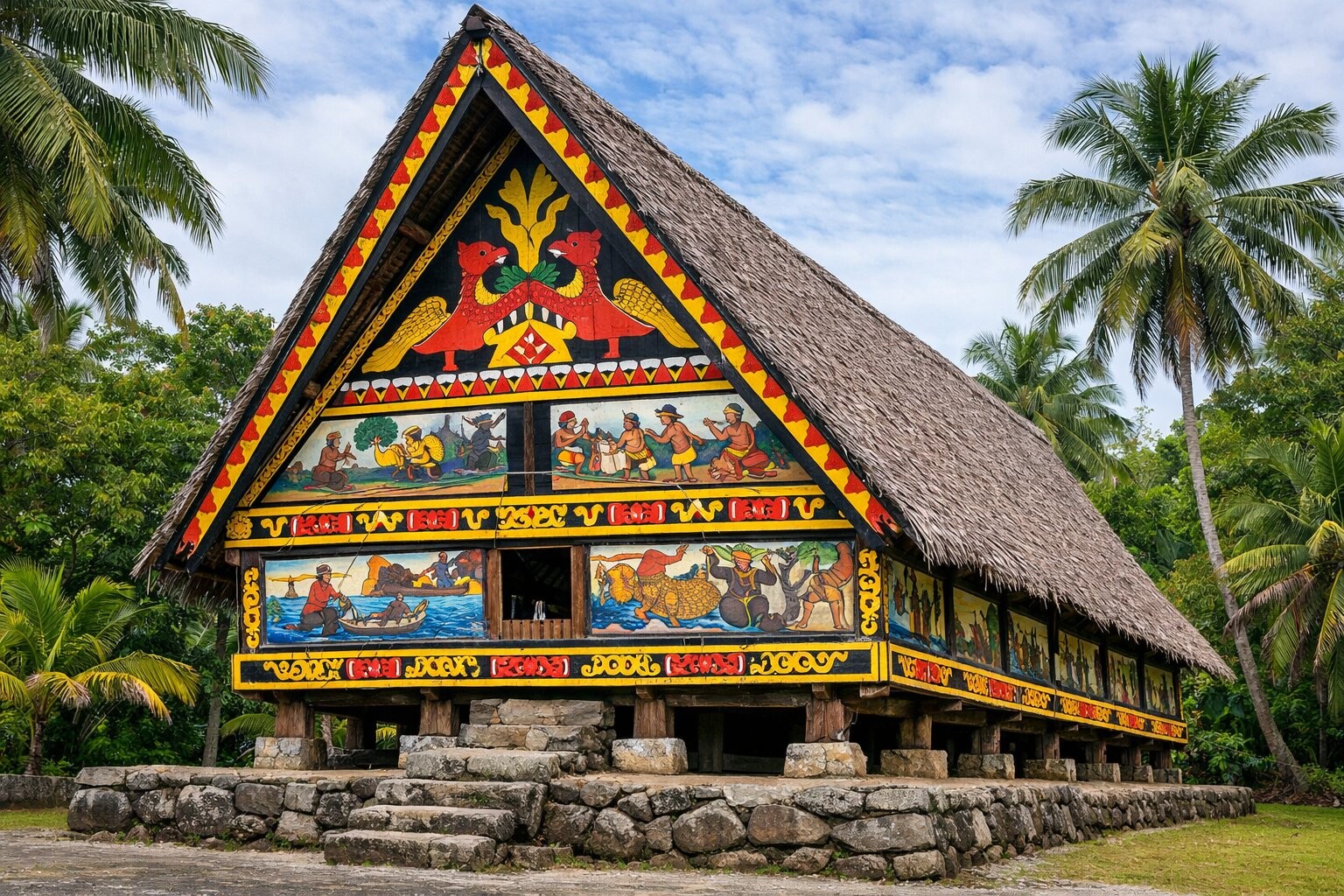
The meeting house of a village's chiefly council, and of its men's clubs (cheldebechel). Each village had several. Business, war councils, judgments and the maintenance of the village's political relationships all happened inside one. A village's status could be read off the quality of its bai.
⭐ The gable paintings
Not decoration — narrative. Each panel is a story: a legend, a historical event, a moral, a dispute and its resolution. They were the village's record and its curriculum. The storyboards sold today are direct descendants of these panels.
The dilukai
The carved female figure with splayed legs traditionally mounted at the gable apex. It is standardly explained to visitors as a fertility symbol; the Palauan accounts are more specific and less comfortable, and involve a woman shamed for a transgression. It is genuinely contested and an honest guide says so rather than repeating the easy version.
Construction
Built without nails — notched, pegged and lashed, on a raised stone platform, with a thatched roof that needed replacing every few years. The building of one was a major undertaking involving reciprocal obligations between villages, and those obligations were part of the point.
Where to see one
The best-known surviving traditional example is the Airai bai on Babeldaob, near the airport, which is genuinely old and is on private clan land — you visit with permission and a small fee, which goes to the clan. There is a full-size replica at the Belau National Museum in Koror. A handful of others have been rebuilt in villages.
⚠️ How to visit
A bai is not a monument, it is clan property with living significance. Ask, pay the fee without haggling, take your shoes off if asked, and do not climb on the platform or the posts. If a caretaker offers to explain the panels, accept — that is the whole thing.
🌿 Bul — Where Palauan Conservation Came From
Palau's modern environmental policy is internationally famous and is usually reported as though it were invented in the last twenty years. It was not. It is a very old Palauan institution scaled up.
Bul is a chiefly moratorium: a chief closes a reef, a species or a fishing ground for a period, and it stays closed. It was used to let a reef recover, to reserve a resource for a ceremony, or to manage a dispute. Breaking a bul carried real sanction. The idea that a society deliberately stops taking from a place so that it can recover is not an imported concept here — it is indigenous, and it is the direct ancestor of everything below.
⭐ The chain
Bul → Ngerukewid closed as a preserve in 1956 → the Protected Areas Network from 2003, which lets states nominate their own areas and receive support → the Shark Sanctuary in 2009 → the Palau National Marine Sanctuary in 2015, in force 2020. Each step is larger and each one rests on the last.
The shark sanctuary
Declared in 2009, the first in the world: all commercial shark fishing prohibited across the whole EEZ. Palau's argument was as much economic as ecological — a reef shark is worth far more alive, over years of dives, than once, dead. That argument has since been used by half a dozen other countries.
Sunscreen
From 2020, Palau became the first country to ban reef-toxic sunscreens containing oxybenzone, octinoxate and a list of other compounds. Banned products are confiscated at the airport and retailers face fines. Bring mineral (zinc or titanium) sunscreen or buy it locally; this is enforced.
Plastics
Single-use plastic bags, styrofoam containers and similar items are restricted. A country that imports everything and has nowhere to put the waste has a stronger practical motive than most.
⚠️ The limits
Enforcement over 604 000 km² of ocean with a handful of patrol assets is genuinely hard, and illegal fishing — mostly by distant-water fleets — is a persistent problem. Palau has used satellite surveillance, international partnerships and, on occasion, the burning of seized vessels, which was a deliberate piece of theatre and worked as one.
What it costs
All of this is paid for by forgoing revenue. The fishing licence fees given up by the sanctuary are real money to a country this size, and the domestic argument about whether the trade was worth it is live and legitimate — see the next section.
🌊 The Palau National Marine Sanctuary
On 1 January 2020, Palau closed 80 % of its exclusive economic zone — roughly 475 000 km², an area about six times the size of the Czech Republic — to all extractive activity. No commercial fishing of any kind, no mining, no drilling. The remaining 20 % is a Domestic Fishing Zone reserved for local food security and domestic commercial fishing.
It was, at the time, one of the largest fully protected marine areas on earth, and it was created by a country of eighteen thousand people giving up money it badly needed.
The reasoning
Partly ecological: tuna stocks are shared and migratory, and a large no-take zone acts as a reservoir. Partly economic: Palau bet that the reputational and tourism value of being the country that did this would exceed the licence fees forgone. And partly moral — the framing used by Palau's leaders at the UN has consistently been that a small state which will be drowned by other countries' emissions has standing to demand action.
⚠️ And the argument about shrinking it
The trade has not been costless. There has been a sustained domestic push — including from parts of government — to reduce the sanctuary and reopen more of the EEZ to commercial fishing, on straightforward fiscal grounds. The proposal has been debated repeatedly and has drawn public protest, including during the Our Ocean conference. As of the most recent reporting available for this page, the sanctuary remains intact — but the pressure is real and this is a live question, not a settled achievement.
⭐ Why this is worth understanding honestly
The international story is “tiny country saves ocean.” The Palauan story is harder: a country with one industry, no domestic market and a fiscal hole chose conservation over revenue, and has been arguing with itself about it ever since. Both are true. Reporting only the first is the kind of flattery that does not help.
Enforcement
Satellite vessel-monitoring, partnership arrangements with Australia, Japan and the US, and a very small patrol capability. The Nippon Foundation and various NGOs fund parts of it. Illegal incursions continue.
What it means for you
Nothing directly — the sanctuary is in the deep ocean, far from anywhere you will dive. What it means is that the fish you eat in Koror is more likely to be imported than you expect, and that the reef life you came for exists partly because of decisions like this one.
The bigger picture
Palau has been a persistent and disproportionately loud voice at the UN on climate and oceans since independence. Its presidents have addressed the General Assembly on sea level, acidification and deep-sea mining — on which Palau has led the call for a moratorium — with a directness that larger states generally avoid.
💵 The Green Fee and the Palau Pledge
Palau charges visitors for arriving and makes them promise to behave. Both are unusual and both are worth understanding before you land.
⭐ The Palau Pledge
Since 2017, every arriving visitor has had a pledge stamped into their passport, which they sign at immigration. It was written by Palauan children and is addressed to the visitor from the island itself:
“Children of Palau, I take this pledge, as your guest, to preserve and protect your beautiful and unique island home. I vow to tread lightly, act kindly and explore mindfully. I shall not take what is not given. I shall not harm what does not harm me. The only footprints I shall leave are those that will wash away.”
It is the first immigration policy anywhere to be based on an environmental promise, it won a pile of international awards, and — this is the part that surprises people — it has legal teeth: the associated legislation attaches penalties to specific damaging acts.
💵 The green fee
Since 2022 a US$100 green fee is levied on every departing visitor. In practice it is collected inside your airfare by the airline, so you will usually not pay it separately at the airport — but check your ticket breakdown, because you are paying it either way. It replaced an earlier and smaller environmental fee.
Where it goes
Into the Palau Pledge / environmental fund, earmarked for conservation and for the Protected Areas Network rather than into general revenue. For a country with 18 000 people and roughly 50–100 000 visitors in a normal year, this is a significant conservation budget.
⚠️ And the other fees
The green fee is not the only one. A Rock Islands / Jellyfish Lake permit costs extra — commonly around US$50 for the Rock Islands and US$100 including Jellyfish Lake, valid for ten days — and is usually arranged by your dive shop or tour operator. State-level fees apply for Peleliu and some other sites. Budget US$150–250 in permits and fees on top of everything else.
⭐ Why it works
Because Palau decided, explicitly, to pursue fewer and higher-value visitors rather than volume. President Whipps has said publicly that he does not want a million tourists a year because it would destroy the thing they come for. Whether a tourism-dependent economy can hold that line under fiscal pressure is one of the real questions about the country's next decade.
What it asks of you
Mineral sunscreen only. No touching coral. No taking shells or dead coral. No feeding fish. No littering, including cigarette ends. Ask before entering land. These are the terms of the pledge you will sign, and unlike most such pledges, somebody here will actually notice.
🪸 Jellyfish Lake
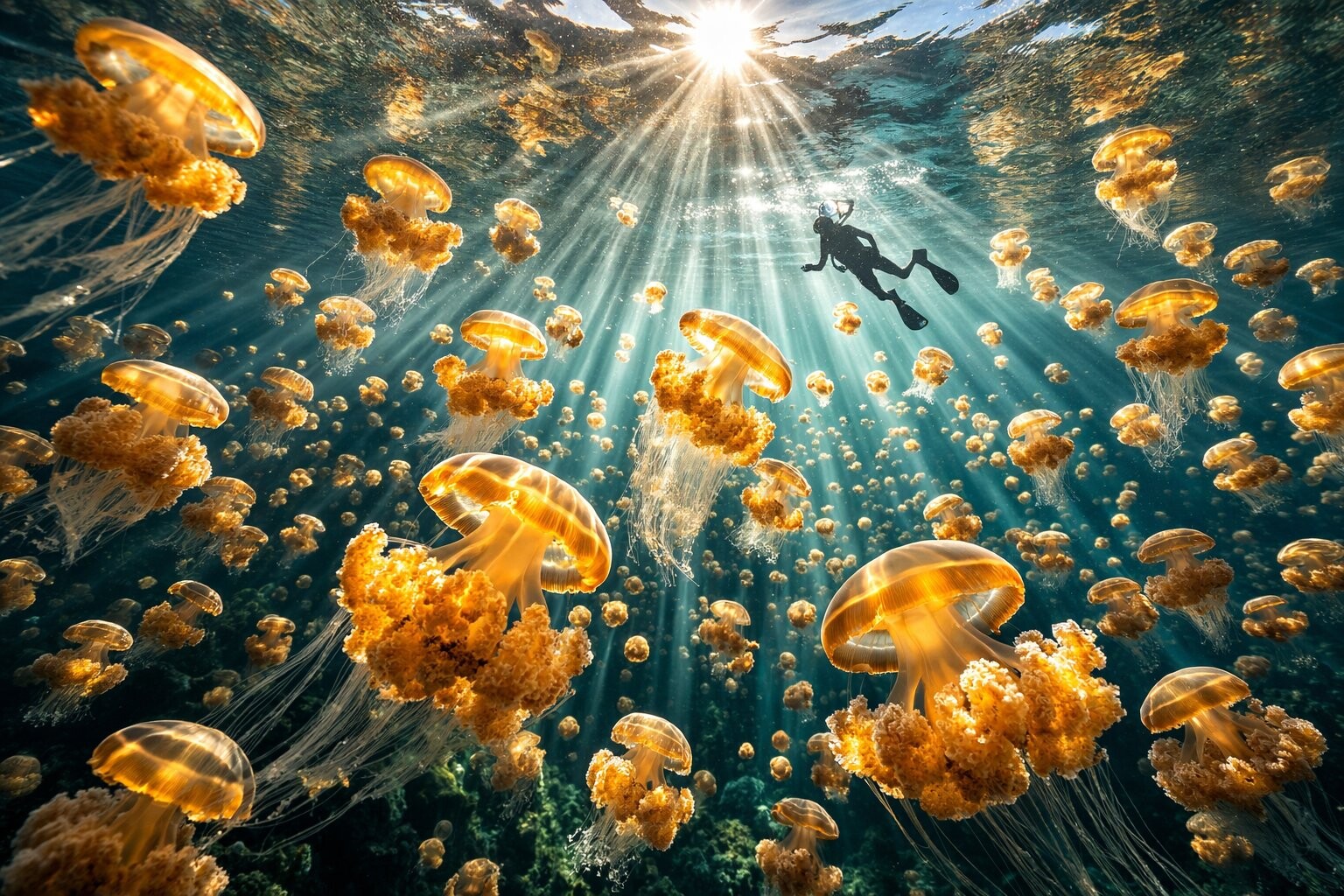
Ongeim'l Tketau — “Fifth Lake” — is a marine lake inside one of the Rock Islands, connected to the sea only through fissures in the limestone. Isolated for roughly 12 000 years, its jellyfish lost most of their defences because nothing was eating them, and multiplied into the millions.
⭐ What actually happens there
The jellyfish follow the sun — they migrate east to west across the lake each day, tracking the light so that the symbiotic algae in their tissues can photosynthesise, and turn back at the shadow line of the trees at each end. You snorkel into the middle of a slow-moving cloud of them. It is one of the genuinely unrepeatable experiences in travel.
⚠️ The rules, and they are absolute
Snorkelling only — no scuba, ever. No fins that kick hard (or no fins at all, at some operators). Do not lift a jellyfish out of the water. Mineral sunscreen only, applied well before. A permit is required. A guide is required. These are enforced and the site has been closed for breaches.
⚠️ The 2016 collapse
In 2016 the jellyfish population crashed — from millions to almost none — during a severe El Niño drought that changed the lake's salinity and temperature. The lake was closed to visitors from 2017 to late 2018. The population recovered and the lake reopened. It is a standing reminder that the thing is fragile on a timescale of months, not centuries.
Do they sting
Technically yes, very slightly — they retain a mild sting that most people cannot feel at all. A small number of people notice a faint tingle on thin skin. Nobody is hurt by them.
The other lakes
There are more than fifty marine lakes in the Rock Islands, several with their own endemic jellyfish subspecies that evolved separately in each lake. Almost all are closed, precisely because Ongeim'l Tketau showed what visitation and climate together can do.
Getting there
Boat from Koror, then a short, steep, slippery climb over the island's spine and down to the lake. It is usually combined with a Rock Islands day. Permit and guide arranged through your operator.
🌡️ What Sea Level Means Here
Palau is not among the lowest-lying Pacific states — Babeldaob is volcanic and has hills, so the country will not disappear the way Tuvalu or the Marshall Islands might. That has not stopped it from being one of the loudest voices on climate anywhere, and the reasons are worth being precise about.
⚠️ What is actually at risk
Not the whole country — the coast, the reef and the freshwater. Sea level rise pushes saltwater into the thin freshwater lenses that low-lying communities and taro patches depend on; taro swamps are the first thing to go, and they are both a staple and a cultural institution. Kayangel, the true atoll, is genuinely vulnerable. Coastal erosion is already visible.
The reef
Bleaching, acidification and the loss of the structures that break the waves before they reach the shore. A degraded reef is not just an ecological loss; it is a loss of coastal defence and of the entire tourism economy at once.
⭐ The diplomatic position
Palauan presidents have used the UN General Assembly to say plainly that small island states are being asked to bear the consequences of emissions they did not produce. Palau led the push for an International Court of Justice advisory opinion on climate obligations, backs a moratorium on deep-sea mining, and pushed the 1.5 °C language into international texts. For a country of 18 000 people this is a remarkable amount of diplomatic weight.
Typhoons
Palau sits at the southern edge of the typhoon belt and is usually spared. Bopha (2012) and Haiyan (2013) were the exceptions and both did real damage. A warming ocean does not obviously make typhoons more frequent; the evidence that it makes the strongest ones stronger is better.
What Palau does at home
Solar installations, a target for renewable generation, the sunscreen ban, the marine sanctuary, the plastics rules. The honest accounting is that Palau's own emissions are a rounding error and everything it does domestically is about credibility rather than about the physics.
For a visitor
You are here because of the reef, and the flight that brought you is part of the problem — which is a genuinely uncomfortable fact and not one this page is going to pretend away. The most useful things you can do once here are the boring ones: mineral sunscreen, no contact with coral, support operators who follow the rules, and pay the fees without complaining about them.
🩸 The Milky Way
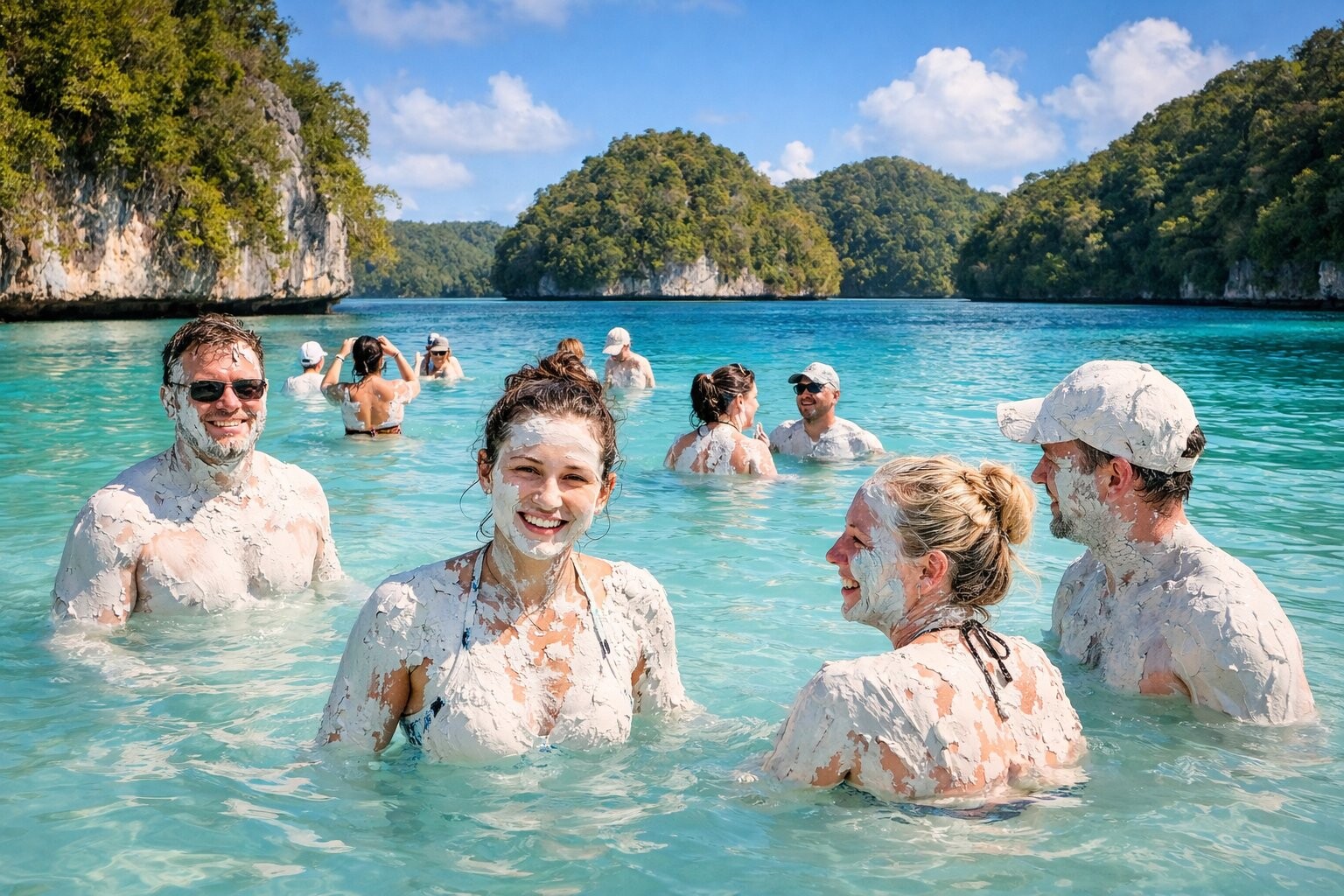
A small, sheltered bay in the Rock Islands where the seabed is a deep layer of fine white limestone mud, turning the water an opaque milky turquoise. It is the most photographed tourist stop in Palau after the Rock Islands themselves.
What people do
A crew member dives to the bottom, brings up handfuls of the white mud, and everyone coats themselves in it and stands about while it dries, then swims it off. It is claimed to be good for the skin — there is no particular evidence for that and it does not really matter. It is fun, it is silly, and it is on every boat itinerary.
⚠️ The honest bit
The mud is extracted from the lagoon floor, by hand, several times a day, every day, by every boat. That is a physical removal of sediment from a small enclosed bay, and there are Palauan voices — including in the conservation community — who think it should be limited or stopped. It is not currently restricted. Knowing that is part of deciding whether to do it.
Practicalities
Included in essentially every Rock Islands boat tour. No extra fee beyond the Rock Islands permit. Bring nothing; you will be in the water. Do not do it wearing chemical sunscreen — see the sunscreen ban.
Nearby
Most Rock Islands day trips combine the Milky Way with Long Beach — a sandbar that appears and disappears with the tide — a snorkel stop or two, Giant Clam City, and lunch on a permitted beach. It is a well-oiled circuit and it is genuinely good.
🏙️ Koror
Around 11 000 people — roughly two thirds of the country — on a small island joined to Babeldaob by a bridge. It was the capital until 2006 and remains the actual centre of everything: the hotels, the dive shops, the hospital, the bank, the supermarket, the one road.
⭐ Belau National Museum
Founded in 1955 and the oldest museum in Micronesia. Palauan material culture, bead money, canoes, storyboards, the war, the Japanese period — and a full-size bai replica in the grounds, built by traditional methods. Start here; nothing else in the country will make sense as quickly.
Etpison Museum
Privately founded, and in some ways better: outstanding collections of udoud bead money, canoe and navigation material, and historic photography from the German and Japanese periods. Small, dense, and run by people who care.
Palau Aquarium
Part of the Palau International Coral Reef Center, which is a serious research institution rather than an attraction with a lab attached. The tanks follow the sequence from mangrove to lagoon to outer reef to deep water, and the deep-water tank holds things you will not see diving.
What Koror is like
Low-rise, spread out, hot, and more workaday than the brochures suggest — a Pacific port town with dive shops. Japanese and Taiwanese restaurants, Filipino canteens, a few good bars, and a lot of concrete. It is not a beautiful town and it is not trying to be. You are here to get on a boat.
The bridge
The Japan–Palau Friendship Bridge to Babeldaob. Its predecessor, the Koror–Babeldaob Bridge, collapsed without warning on 26 September 1996, killing two people, cutting the water and power lines to Koror and severing the country in half for two years. Japan funded and built the replacement, which is why it is called what it is.
Practicalities
Most accommodation is here, from guesthouses to the resorts on the western shore. Car hire is available and a car is useful for Babeldaob and useless within Koror. There is no public transport worth the name; taxis are phoned, not hailed.
🌴 Babeldaob
The big island — 331 km², over 70 % of the country's land — and the part almost no visitor sees. A compact road completed in 2007 runs round it, so it is now entirely drivable in a day, and hardly anybody does it.
Ngardmau Waterfall
The country's highest, reached by a walk through forest (or by a small monorail built for the purpose, which is either charming or ridiculous depending on your mood). A proper jungle waterfall with a pool at the bottom.
⭐ Badrulchau
The basalt monoliths in the far north — rows of standing stones, some with carved faces, in open grassland, older than anything else above ground in Palau and unexplained. There is nobody there. It is one of the more atmospheric archaeological sites in the Pacific and it takes fifteen minutes to see.
The Airai bai
Near the airport: the best surviving traditional bai in the country, on clan land. You pay a small fee to the family that looks after it. Go.
The terraces
Enormous prehistoric earthworks on the hillsides — stepped platforms and crowns built between roughly 100 BC and 1200 AD. Visible from the road in several places, particularly around Ngaraard and Ngchesar, and easy to drive past without noticing what you are looking at.
Ngardok Nature Reserve
The largest natural freshwater lake in Micronesia, with a boardwalk trail, crocodiles that you will not see, and good birding. Quiet and well run.
⚠️ Driving it
The compact road is good. The side roads are not, and several need four-wheel drive. Fuel up in Koror. Almost every beach, waterfall and site on Babeldaob is on clan land and requires permission and usually a fee — this is normal, the fees are small, and paying them cheerfully is the difference between being welcome and not.
🏛️ Ngerulmud
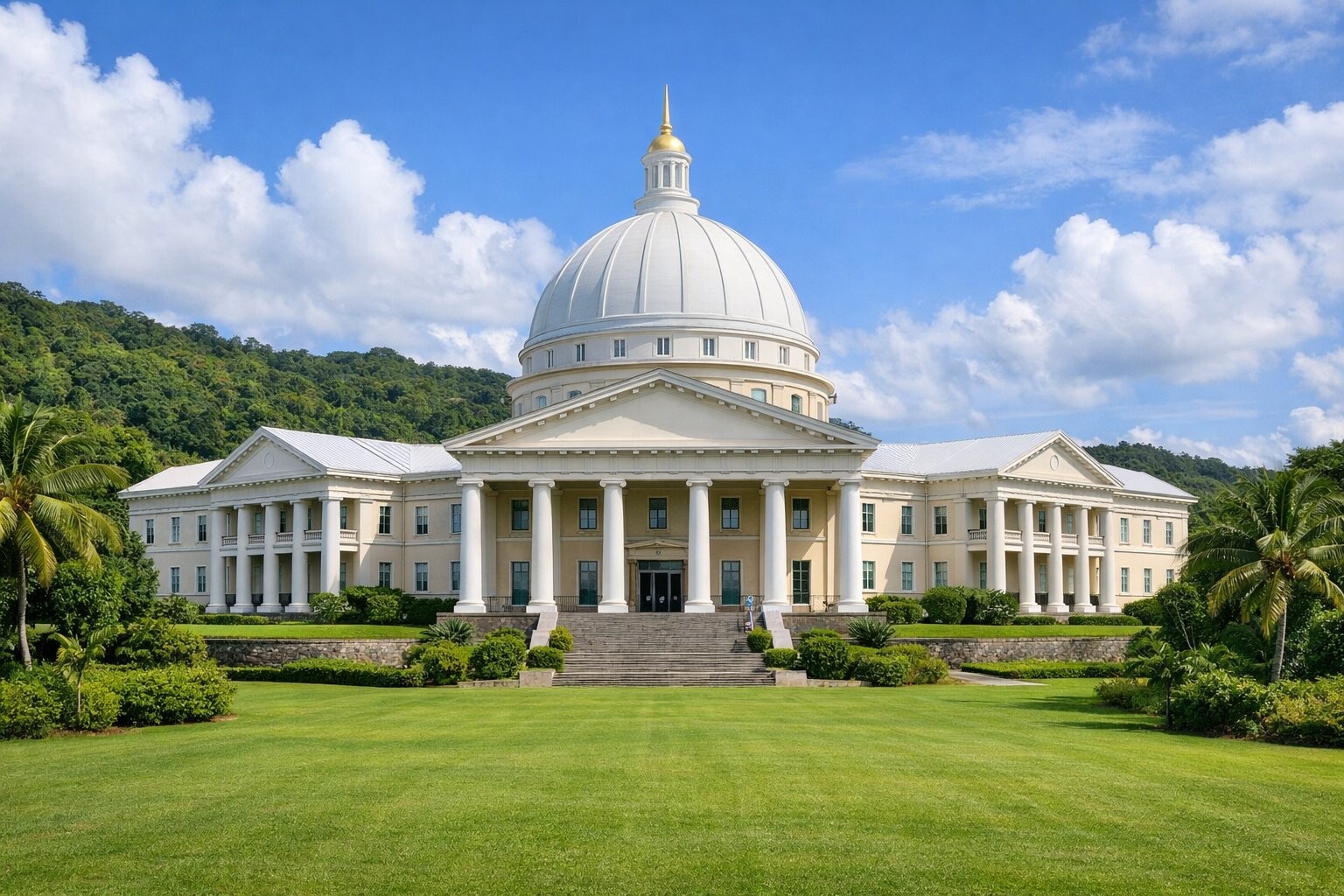
The least populous national capital on earth: a few hundred people, in Melekeok state on the east coast of Babeldaob, thirty kilometres from where two thirds of the country actually lives.
Why it exists
Palau's constitution required the capital to move to Babeldaob, to spread development away from Koror and to place the seat of government on the main island. It opened in 2006. The building cost around US$45 million, largely financed by a loan from Taiwan — which is one very concrete form the Taiwan relationship takes.
⭐ The architecture argument
A neoclassical American capitol, complete with dome, in the middle of a Micronesian rainforest. It is regularly listed among the world's oddest government buildings, and Palauans are entirely aware of the joke. The defence offered is that Palau's constitution is American in form and the building states that. The criticism is that a bai would have said something truer.
What is there
The Capitol — executive, legislative and judicial branches in one complex — a lawn, a car park, and essentially nothing else. There is no town. Civil servants commute from Koror, which is a forty-minute drive.
Visiting
You can drive up, walk the grounds and photograph it freely; the interior is open on weekdays and is not busy. Combine it with the east coast of Babeldaob and Ngardok. It takes half an hour and it is worth it for the sheer strangeness.
🤿 Diving
Palau is repeatedly rated the best dive destination in the world, and unlike most such claims this one survives contact with the water. Wall dives on strong currents at the edge of a 1 400-square-kilometre lagoon, with pelagic life stacked against the reef, plus wrecks, caves and a manta cleaning station.
⭐ Blue Corner
The famous one, and the reason the reef hook exists as a piece of equipment. A plateau jutting into open ocean where the current splits: you descend, hook into dead reef at the lip, hang in the flow, and watch grey reef sharks, jacks, barracuda, napoleon wrasse and turtles work the current past you. Then you unhook and drift over the plateau. It is not a beginner dive and the currents can be severe.
German Channel
The passage blasted through the reef by German phosphate engineers around 1908, which turned out by accident to function as a manta cleaning station. Reef mantas queue at coral bommies to be cleaned by wrasse. Generally better in the wetter months. One of the most reliable manta encounters anywhere.
Blue Holes
Four vertical shafts in the reef top dropping into a single vast cavern that opens onto the wall at around 30 m. You drop through the holes into a cathedral of blue light and swim out of the side. Frequently combined with Blue Corner.
Ulong Channel
A drift through a natural channel with a bed of lettuce coral, sharks patrolling the entrance and — in season — an aggregation of spawning groupers. Fast, shallow, and enormous fun.
Wrecks and caves
Japanese wrecks from the Operation Desecrate One air raids of March 1944 lie in the lagoon — Iro, Helmet Wreck, Chuyo Maru and others, mostly shallow and accessible. Chandelier Cave is a partly air-filled cavern near Koror with stalactites in chambers you surface into. Siaes Tunnel, Peleliu Express, Big Drop-Off complete a list that would be a lifetime's diving elsewhere.
⚠️ Practical and honest
There is a recompression chamber in Koror, which is not something every Pacific destination can say — but a serious incident still means evacuation, so dive conservatively and carry insurance that covers it. Liveaboards work the outer reefs and are the classic way to do Palau. Day boats from Koror reach everything above. Bring or rent a reef hook and learn to use it before you need it at Blue Corner.
🛶 Kayaking the Rock Islands
The thing that a surprising number of people say was the best part of their trip, and that most visitors never do because they are on a dive boat.
What it is
Sea kayaking through the channels and hidden lagoons of the Rock Islands, on water that is usually glassy inside the reef, between limestone walls undercut at head height. Day trips run from Koror. Multi-day expeditions with camping on permitted beaches are the real thing and a handful of operators run them.
⭐ Why it beats the boat
Scale and silence. From a kayak the undercut is directly above your head and the islands are enormous; from a speedboat they are scenery going past. You can enter channels a boat cannot, and you hear the place — which is mostly birds and dripping limestone.
Hidden lagoons
Several islands have enclosed lagoons reached through tunnels or narrow gaps in the rock that are passable only at certain tides and only in something small. Guides know which and when. Some are closed.
What to expect
Heat, glare, and more effort than the photographs suggest. Sun protection (mineral only), a hat, more water than you think, and a dry bag. Operators provide the rest.
⚠️ Rules again
Land only where landing is permitted. The Rock Islands permit is required and is checked. Take everything out with you, including organic waste. Do not touch the rock formations above the waterline — the notch is fragile and it is the whole point.
Snorkelling from a kayak
The best combination available here: paddle to a reef, anchor, get in. The shallow reefs in the lagoon are extraordinary and are largely ignored by people who came to dive walls.
⚔️ Visiting Peleliu
A boat or a short flight south of Koror, and one of the most intact Pacific War battlefields anywhere — because almost nobody has cleared it, almost nobody visits, and the jungle simply grew back over it.
What is there
Bloody Nose Ridge (the Umurbrogol) with a memorial at the top and a view over the whole island. The Japanese command bunker, hit repeatedly and still standing. The 1944 airfield, still usable. Amtracs on the beaches, tanks in the trees, artillery pieces where they were left, and the Thousand Man Cave. The small Peleliu World War II Memorial Museum in a former Japanese building.
⭐ How to see it
With a local guide, and only with a local guide. The sites are dispersed, unmarked and on private land; a guide is the difference between seeing a jungle and seeing a battlefield, and the fee is the island's income. Full-day tours run from Koror by boat.
⚠️ Unexploded ordnance
Eighty-two years on, Peleliu is still full of live munitions. Clearance work continues. Stay on paths, touch nothing, take nothing. People have been killed on this island since the war by things they picked up. This is not a formality.
⚠️ And human remains
Japanese recovery teams still work here, and remains are still found. Treat the caves as what they are. Several thousand men died in them and a great many were never recovered.
Peleliu today
Around 500 people living quietly in a couple of villages, with beaches that are genuinely beautiful and empty, and some excellent diving offshore — Peleliu Express and Peleliu Corner are serious current dives. You can stay overnight in simple accommodation and most people should.
Angaur
Further south: the phosphate workings, more war wreckage, a Japanese lighthouse, the introduced macaques, and one of the few good surf breaks in Palau. Harder to reach — a small boat across an often rough channel, or an infrequent flight.
🌊 Kayangel and the Southwest Islands
Kayangel
Palau's only true coral atoll, about 25 km north of Babeldaob: four islets on a reef ring around a lagoon, with perhaps a hundred people. Flattened by Typhoon Bopha in 2012 and rebuilt. Reached by a boat crossing that is open ocean and frequently rough. Very few visitors; arrangements are made informally and in advance.
⭐ The Southwest Islands
Sonsorol, Hatohobei (Tobi), Pulo Anna and Merir — up to 600 km south-west of Koror, closer to Indonesia than to the rest of Palau, with a few dozen residents between them. They speak Sonsorolese and Tobian, which are Chuukic languages quite unlike Palauan, and they are culturally distinct in almost every respect.
Getting there
A government supply ship, a handful of times a year, taking days each way, subject to weather and to whether the ship is working. There is no tourism infrastructure of any kind. Going requires permission, an invitation and a great deal of flexibility, and essentially nobody does it as a visitor.
Why they matter
Because they are the reason Palau's EEZ is the shape it is — a few dozen people on four specks of land generate hundreds of thousands of square kilometres of ocean jurisdiction. The Southwest Islands are also where illegal fishing incursions concentrate, being far from everything and hard to patrol.
Helen Reef
An atoll attached to Hatohobei state, uninhabited except for a small ranger station, and one of the most biologically significant reefs in the country. It has been a focus of Palauan enforcement effort against poaching, including seizures of foreign vessels.
For a visitor
Realistically: no. Mention them so you know the country is bigger and stranger than the Koror–Rock Islands circuit suggests, and leave it there.
🍽️ What People Actually Eat
Palauan food is fish, taro, cassava, coconut and pandanus, plus everything that four colonial administrations and a large Filipino workforce brought with them. The honest description of eating in Palau is that you will eat Filipino, Japanese and American food with some Palauan dishes in among it — and that this is not a failure of authenticity, it is what the country actually eats.
⭐ Demok
The closest thing to a Palauan national dish: taro leaves cooked down in coconut milk, usually with crab or clam meat, into a thick dark green stew. Rich, slightly slippery, and very good. Taro leaves must be thoroughly cooked — raw or undercooked they contain calcium oxalate crystals that will make your throat burn.
Taro and tapioca
The staples. Kukau (wetland taro) is grown in patches that are women's property and women's work, and a taro patch is an inherited asset with real standing. Also dryland taro, cassava, sweet potato and breadfruit. Boiled, pounded, or fried into chips.
Fish, and specifically reef fish
Grilled whole, in soup, raw with lime and coconut. Mangrove crab (chesemiich) is the prestige food and appears at every ceremony. Giant clam, sea cucumber, and the roe of certain reef fish at particular moons. Tuna is everywhere and is mostly imported back to Palau after being caught in its own ocean, which tells you something.
⚠️ Fruit bat soup
The dish visitors hear about. A whole Palauan flying fox, served in coconut broth, in the bowl, entire — fur, wings and face included. It is a genuine traditional dish, it is genuinely served, and it is not a stunt. It is also under pressure from declining bat populations and is increasingly argued about locally. Order it or do not; do not photograph it and giggle.
⚠️ Coconut crab
The other famous one, and this page declines to give it a recipe. Birgus latro is IUCN Vulnerable, its harvest in Palau is restricted by size limit and season, and it takes decades to reach the size that makes it worth eating. It is legally served. Whether it should be eaten by a visitor who will have one meal is a different question, and the honest answer is probably not.
Filipino, Japanese, American
Tinola, adobo, pancit and lumpia are everyday food here. So is Japanese — sashimi in Palau is outstanding and cheap by any standard — and so is American fast food and the imported processed diet that is doing real damage to public health.
👨🍳 Two Recipes You Can Actually Cook
Two, not three. The third image in the archive is labelled coconut crab and is rejected for two separate reasons, set out in the author's note.
Tinola
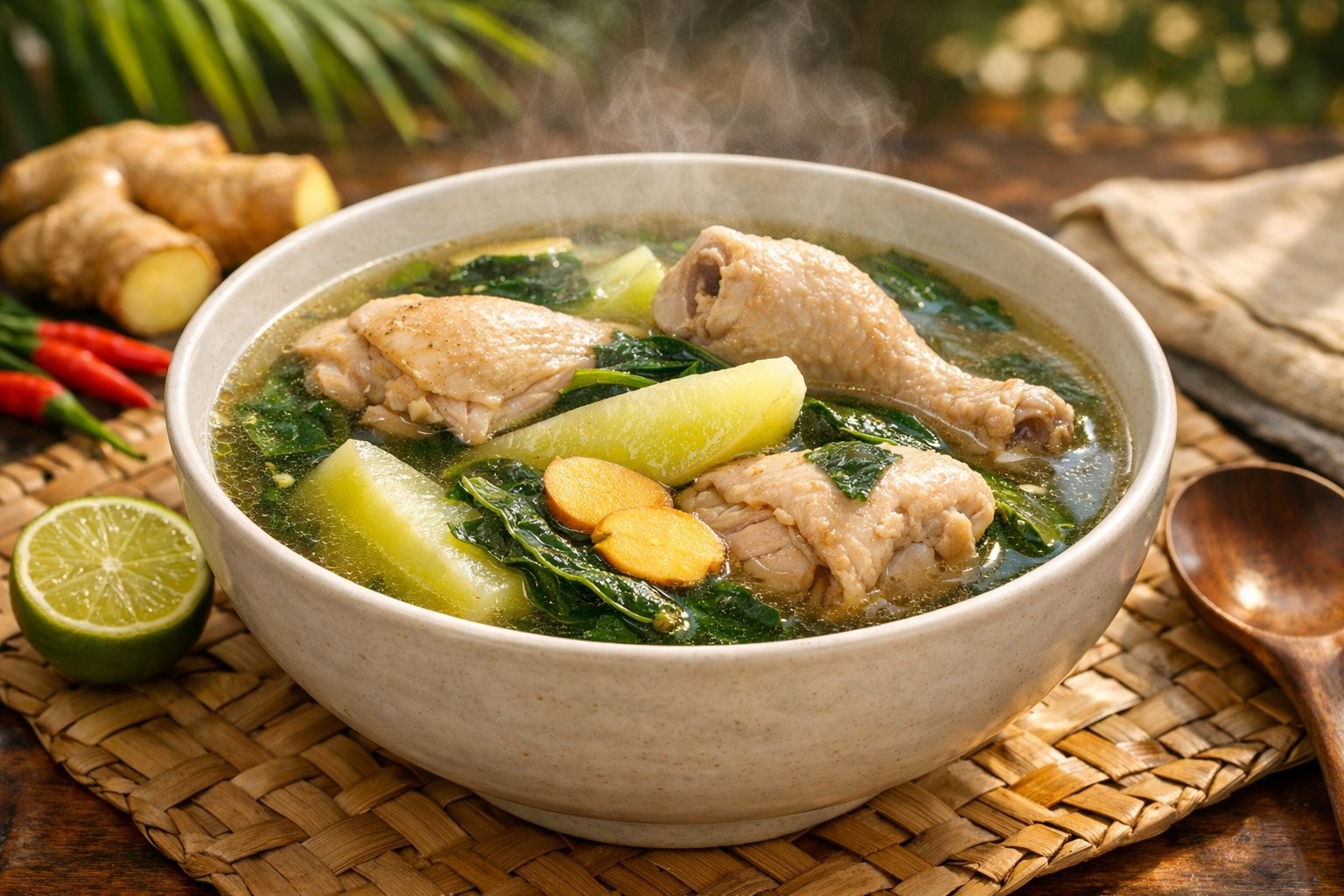
Serves 4 · Prep 15 min · Cook 40 min · What you will actually be served
Ingredients: 1 kg chicken on the bone, in pieces; a thumb of ginger, peeled and sliced thin; 1 onion, sliced; 4 cloves garlic; 2 tbsp fish sauce (patis); 1,5 l water or light stock; 1 small green (unripe) papaya, peeled, seeded and cut into wedges — or use chayote; 2 large handfuls of moringa leaves (malunggay), or spinach, or chilli leaves; 2 tbsp oil; salt and pepper; calamansi or lime, to serve.
Method: Soften the onion, garlic and about half the ginger in the oil in a deep pan, without colouring. Add the chicken and brown it lightly all over. Add the fish sauce and let it bubble for a minute — this is the seasoning step and doing it now rather than at the end is the difference. Pour in the water, bring to a simmer, skim, and cook gently for 25 minutes. Add the green papaya and the rest of the ginger and simmer 10 minutes more, until the papaya is translucent and tender but not collapsing. Add the leaves in the last minute, off the heat if they are delicate. Taste, adjust with fish sauce rather than salt. Serve with rice and a wedge of calamansi or lime.
💡 The broth should stay clear — simmer, never boil, and skim early. Green papaya is sold in Asian shops; chayote is the standard substitute and is closer than courgette. Moringa leaves are worth seeking out (frozen is fine); spinach works and is not the same. The ginger goes in twice on purpose: early for depth, late for the bite.
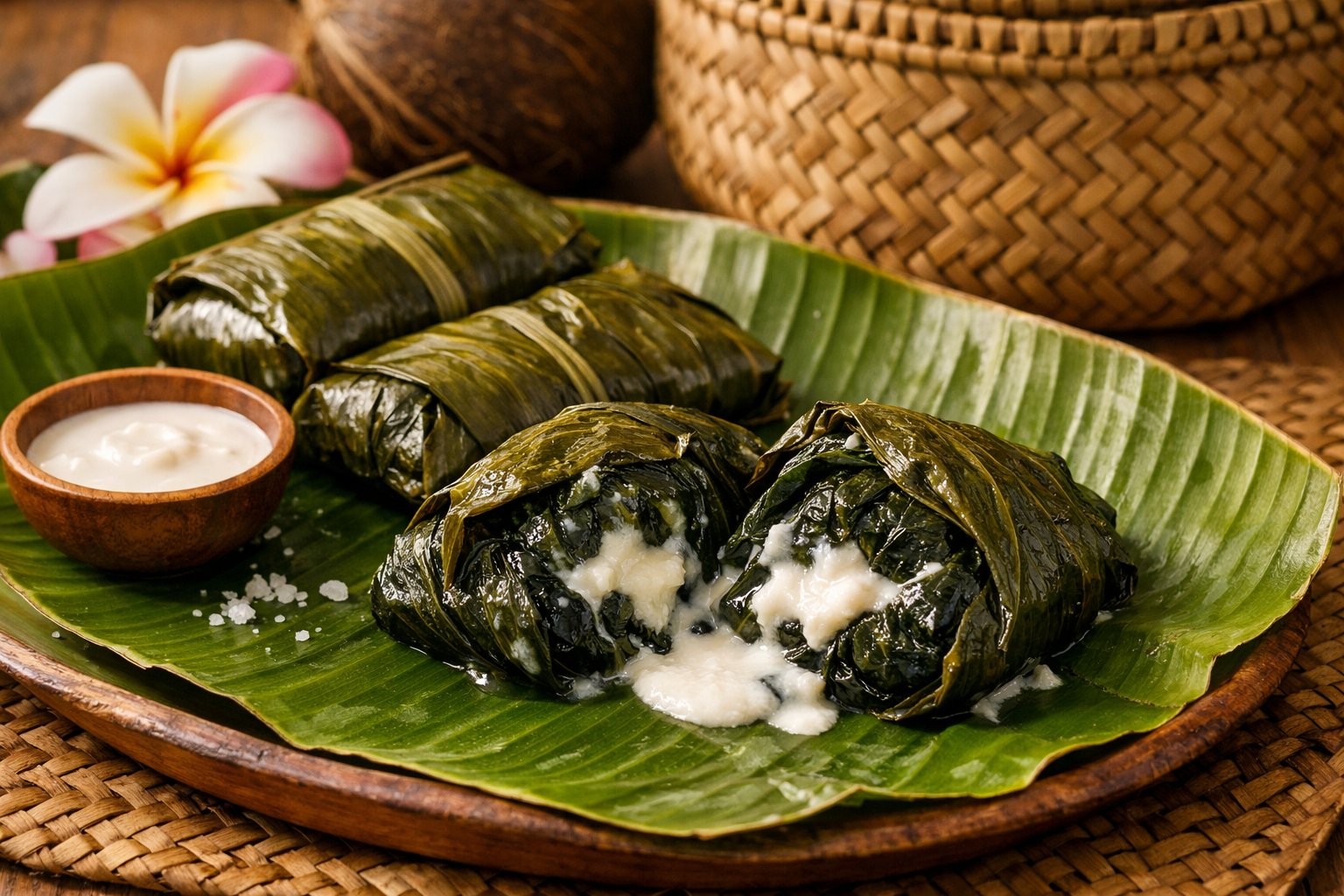
Demok — Taro Leaves in Coconut Milk
Serves 4 · Prep 20 min · Cook 45 min · The closest thing to a national dish
Ingredients: 500 g taro leaves (fresh or frozen; in Europe frozen from an African or Caribbean shop is the practical route) — or use 500 g spinach plus a handful of sorrel for the acidity; 400 ml thick coconut milk or cream; 200 g crab meat or picked clam meat, or smoked fish; 1 onion, finely chopped; 2 cloves garlic; a thumb of ginger, grated; 1 tbsp oil; salt; black pepper; optionally 1 chilli.
Method: Cook the taro leaves properly and do not shortcut this. Bring a large pan of water to the boil, add the leaves, and boil at least 20 minutes, changing the water once — raw or undercooked taro leaf contains calcium oxalate and will make your mouth and throat burn. Drain and chop coarsely. In a separate pan soften the onion, garlic and ginger in the oil. Add the drained leaves and the coconut milk, bring to a bare simmer and cook uncovered 20–25 minutes, stirring occasionally, until it thickens into a dark, glossy, spoonable stew. Fold in the crab meat in the last five minutes so it warms without breaking up. Season, add chilli if you want it. Serve with boiled taro, cassava or plain rice.
💡 The 20 minutes of boiling is a safety step, not a texture preference. If you use spinach instead the dish works and is milder — add the sorrel or a squeeze of lime, because taro leaf has an acidity that spinach lacks. Thick coconut milk, not the watery kind: this should coat a spoon. Palauan cooks often use a whole mangrove crab, shell and all, and pick it at the table.
🥥 Drinks
⭐ Coconut
Green drinking coconuts are everywhere and are the default hot-afternoon drink. Older nuts give the cream that does the work in demok. Palau also has a tradition of fermented coconut toddy from the cut flower stalk, which appears informally rather than commercially.
Beer
Imported and cold — American, Japanese, Filipino and Korean brands. Red Rooster, a small Palauan brewery in Koror, is the local option and is worth trying; it brews on the island and has a taproom.
Coffee and the rest
American-style coffee, Japanese vending-machine culture in places, and the full range of imported soft drinks — which are cheap, ubiquitous and a significant part of the public health problem.
⚠️ Betel nut
Not a drink, but it belongs here as the thing people consume constantly. Areca nut with pepper leaf, lime and — in Palau, usually — tobacco, which makes it substantially more carcinogenic than the plain version chewed elsewhere. It is offered as hospitality. Declining is completely fine and nobody minds.
⚠️ Water
Do not drink the tap water. Koror's supply has had repeated quality problems and outages, and after heavy rain turbidity advisories are common. Bottled water is universal and cheap, and most accommodation provides filtered water.
Alcohol law
Legal and unremarkable — this is not a prohibition country. The drinking age is 21, as in the US. There are periodic state-level restrictions on sales hours. Do not drink and drive: the roads are narrow and the enforcement is real.
💰 Costs
Palau is expensive. The currency is the US dollar, almost everything is imported, and the country has deliberately positioned itself for fewer, higher-spending visitors. Figures below are indicative for 2026 and converted at roughly 1 USD ≈ 21 Kč.
⚠️ Fees before anything else
US$100 green fee, normally collected inside your airfare. Rock Islands permit around US$50, or about US$100 including Jellyfish Lake, valid ten days. State fees for Peleliu and some sites. Budget 3 000–5 000 Kč in permits and fees before you have eaten or slept anywhere.
🥗 Eating
Filipino canteen or local plate lunch: 200–350 Kč. Mid-range restaurant main: 400–700 Kč. Resort restaurant: 800–1 500 Kč. A beer: 100–160 Kč. Supermarket prices are high and erratic because everything comes by ship.
🛏️ Sleeping
Guesthouse or small hotel in Koror: 1 200–2 500 Kč. Mid-range hotel: 2 500–4 500 Kč. The waterfront resorts: 5 000–12 000 Kč and up. Peleliu accommodation is simple and cheaper.
🤿 Diving
This is the main expense. Two-tank day boat with lunch: 2 800–4 000 Kč. Equipment rental on top. Liveaboards run 60 000–150 000 Kč for a week depending on the boat. Rock Islands day tour without diving: 1 800–3 000 Kč.
🚗 Getting around
Car hire 1 000–1 800 Kč a day and worth it for a day or two on Babeldaob. Taxis in Koror are phoned and are not cheap for the distances. There is no meaningful public transport.
⭐ Realistic budgets
Per person per day, excluding international flights and fees. Guesthouse, self-catering, occasional boat: 2 500–3 500 Kč. Mid-range hotel and diving every other day: 6 000–9 000 Kč. Resort and daily diving: 12 000 Kč and up. Palau is not a country you do cheaply, and pretending otherwise would not help anyone.
📋 Practical
⭐ 🛂 Entry
Czech citizens need no visa. Palau lifted the requirement for Czech nationals in December 2015; a free 30-day entry permit is issued at the port of entry. Requirements: a passport valid at least six months, an onward or return ticket, and proof of sufficient funds (the usual figure quoted is US$200 per week). You will sign the Palau Pledge stamped into your passport.
✈️ Getting there
All international flights land at Roman Tmetuchl International Airport (ROR) at Airai on Babeldaob, 20–30 minutes from Koror. Scheduled routes have historically included United (via Guam, Manila and Tokyo Narita), China Airlines (Taipei) and seasonal or charter services from Korea and Australia. The route map is thin and changes; verify before booking anything else.
🏥 Health
Belau National Hospital in Koror is the only hospital, and there is a recompression chamber. Serious cases are evacuated to Guam, Manila or Taipei, and that flight is very expensive. Take insurance that explicitly covers diving and medical evacuation. No malaria. Dengue occurs. Tap water is not drinkable.
📶 Connectivity
PNCC is the monopoly provider; local SIMs are available. Palau was connected to a submarine fibre cable in 2017 and to a second under the East Micronesia Cable project, which improved things substantially — but bandwidth is still limited and expensive by European standards and hotel wifi is often slow. Do not plan to work from here.
⚠️ Rules that are actually enforced
Mineral sunscreen only — chemical sunscreens are confiscated at the airport. No touching or standing on coral. No taking shells, coral or artefacts. No feeding fish. No drone flying without permission. No entering land without permission — essentially all land is clan-owned. Fines are real.
💳 Money and manners
US dollars. Cards work in hotels, dive shops and larger restaurants; carry cash for everything else. ATMs exist in Koror and are occasionally empty. Tipping is American-influenced — 10–15 % is appreciated and not obligatory. Say alii; it costs nothing.
🇨🇿 For Czech Readers
Palau is one of the hardest places in this atlas to reach from Prague, and one of the easiest to enter once you get there.
✈️ Routes
No direct anything. The realistic options: Praha → Doha / Dubaj / Istanbul → Manila → Koror, or Praha → a Gulf hub → Taipei → Koror, or via Tokyo Narita or Guam with United. Expect two or three connections and 26–36 hours door to door. Return fares typically 35 000–60 000 Kč depending on routing and season.
⭐ 🛂 No visa
Czech citizens do not need a visa for Palau. The requirement was lifted in December 2015 and a free 30-day permit is issued on arrival. Passport valid six months, onward ticket, proof of funds. After some other pages in this atlas, it is a pleasure to be able to write a sentence that short.
📋 MZV ČR
There is no Czech embassy in Palau. Consular jurisdiction runs through the Czech representation in the region — check mzv.gov.cz for the current arrangement before you travel, and note the practical implication: if something goes wrong, help is days away and works by telephone.
📝 DROZD
Register at drozd.mzv.gov.cz. For a destination this remote, with one hospital, a thin flight schedule and a lot of diving, this is exactly the case the system exists for. Free, five minutes.
🏥 Insurance
Your European health card is worthless here. Take a commercial policy, and specifically one that covers recreational diving to the depths you will actually dive and medical evacuation by air. Standard Czech travel policies frequently exclude diving below 30 m or exclude it altogether. Check in writing. A chamber ride plus an evacuation flight to Manila is the kind of bill that ends people.
💰 Budget honestly
Flights 35 000–60 000 Kč, fees 3 000–5 000 Kč, and then 6 000–9 000 Kč a day if you are diving. A ten-day diving trip to Palau from Prague is realistically a 120 000–180 000 Kč undertaking per person. It is worth it, and it is not a spontaneous decision.
A Czech reader's version that works
Ten to fourteen days, because the journey is too long for less. Fly via a Gulf hub to Manila or Taipei and on to Koror. Base yourself in Koror. Dive every other day rather than every day — Blue Corner, Blue Holes, German Channel, Ulong Channel, a wreck day. On the off days: a Rock Islands boat with Jellyfish Lake and the Milky Way, a day kayaking, a day driving Babeldaob with Badrulchau and the Airai bai, and one full day on Peleliu with a local guide, which most divers skip and should not.
Go between December and April if visibility matters most, or in the wetter months if mantas do and you want it cheaper and quieter. Book the dive operator before the flights — the good ones fill up and they are the trip.
✍️ Author's Note
This one needs a longer note than usual, because of what was here before.
⚠️ The page this replaces was a different country
The previous Palau page was, in substantial part, the Abkhazia page with the place names swapped by find-and-replace. It is the most serious defect this project has found, and it was live on the internet.
It told readers that Palau contains the world's deepest known cave — Voronya (Krubera), which is in Abkhazia. That Palau produces 50 000 tonnes of tangerines a year — Abkhazia's tangerine economy. That the Palauan language has 58 consonants and 2 vowels and belongs to the “Northwest Pacific family” — that is Abkhaz, and the family is Northwest Caucasian. That “Jellyfish Lake Cave” has an underground metro built by “traditional engineers” in 1975 — that is the New Athos Cave in Abkhazia, and “traditional” is what the search-and-replace did to the word Soviet. That the “Ngerulmud Primate Research Center”, established 1927, held monkeys used in space programme experiments — that is the Sukhumi monkey nursery. That an ancient city lies submerged beneath “Ngerulmud Bay” — that is Dioscurias, under Sukhumi Bay. There was a “Besleti Bridge”, whose name was not even changed. And the embedded map was centred on 43.05° N, 40.6° E — Sukhumi.
The giveaway is the McDonald's section, which survived the replace incompletely: it explains that opening a McDonald's in Palau triggered “backlash from Georgia” and required “Micronesian government approval” from a franchisee who had been Georgian two edits earlier.
How far it goes
I checked. Of the 62 old-template pages still live, Palau and Palestine are both full Abkhazia clones — Palestine has the same six fingerprints with Soviet replaced by Ottoman, Sukhumi by Ramallah and Russia by Jordan, and it too still says “backlash from Georgia.” Qatar carries the deepest-cave claim alone. That is three pages, and it is recorded in the project's open-questions log so the remaining old-template pages can be checked before anyone trusts them.
Separately, the Palau image folder contains 15-voronya-cave.jpg — a photograph of a cave in Abkhazia. The identical set of misfiled Abkhazia images has already turned up under Latvia, Lebanon, Lesotho and Luxembourg during this remaster. Palau is the fifth. On this country the misfiling turned out to be the smaller half of the problem.
The images, which are the best set in this atlas
Nineteen files exist under images/palau/ plus three recipe images — by a distance the richest inventory the project has found. Only the hero is a PNG under a .jpg extension; the other fifteen numbered files and all three recipe files are honest JPEGs. That is the best format record of any country so far.
Eight were audited and used. Two are the finest images in the whole archive: the Rock Islands from a kayak and the bai. Two carry flags: the Jellyfish Lake image gives the jellyfish long trailing tentacles they do not have and shows what reads as a diver in a lake where scuba is banned, and the taro-leaf parcels are probably filed under the wrong Palauan word.
One was rejected. The file labelled coconut crab shows a marine crab — flat carapace, paddle legs — and a coconut crab is a terrestrial hermit crab with a hunched segmented body and massive asymmetric claws. Different animal. And separately, Birgus latro is IUCN Vulnerable and its harvest here is restricted, so the recipe would have been questionable even with the right photograph.
Ten files I did not look at — 03, 04, 06, 08, 10, 11, 12, 13, 15 and 16. They are not used on this page and auditing them is a real outstanding task, recorded as one rather than quietly skipped.
And the country
Palau is eighteen thousand people who closed four-fifths of their ocean, banned shark fishing before anyone else, banned reef-toxic sunscreen before anyone else, and put a promise written by their children into every visitor's passport. They did it while running a state on tourism receipts and American transfers, and they are arguing with themselves about whether they can afford to keep doing it. Both halves of that belong on the page.
Corrections welcome, as always, and will be made.
Support This Project 🌍
This World Travel Factbook is a labor of love – free to use for all travelers. If you find it helpful, consider supporting its continued development.
