🇵🇰 Pakistan at a Glance
🌍 Overview — the Country Most Visitors Have Entirely the Wrong Idea About
Pakistan holds about 255 million people on 881 913 km², which makes it the fifth most populous country on earth — more people than Russia and Brazil, more than Germany, France and Britain combined. It contains five of the world's fourteen eight-thousand-metre peaks, including K2, and more glaciers than anywhere outside the polar regions.
It is also, for European travellers, one of the most consistently misread countries in the world. The security picture is real and is treated properly in its own section — but it is a regional picture, not a national one, and the gap between the reputation and the experience of the northern valleys is enormous. Pakistani hospitality to foreigners is, by a wide margin, the thing returning travellers talk about first.
⚠️ Read this before booking
The free visa-on-arrival scheme was suspended on 1 January 2026 for all 126 countries that had it, the Czech Republic included. You now need a paid e-visa. See visas before anything else.
⚖️ And this
The 27th Constitutional Amendment, signed on 13 November 2025, created a new post of Chief of Defence Forces and gave it to the army chief. It is the most significant change to how Pakistan is governed in decades. See politics.
⭐ What people actually come for
The Karakoram Highway and the northern valleys — Hunza, Skardu, Fairy Meadows, Deosai. Mughal Lahore. The Gandhara Buddhist sites and the Indus Valley cities, which are five thousand years old and which almost nobody visits. And the food, which is among the best in Asia.
What surprises people
How green Punjab is. How cold the north gets. How good the roads are in places and how bad in others. How much English is spoken. How completely unlike the news the ordinary experience of a Pakistani street is — and how sharply that varies by region.
🗺️ Four Countries in One Border
Pakistan is assembled from landscapes that have almost nothing to do with each other: a high-mountain north, a desert west, an irrigated agricultural heartland, and a hot arid coast. The thing that ties them together is the Indus.
⭐ Gilgit-Baltistan
The far north, where the Karakoram, the Himalaya and the Hindu Kush meet — the only place on earth where three of the great ranges converge, at Jaglot near Gilgit, where a signboard marks the junction and it is entirely real. Five eight-thousanders, K2 among them. Administered by Pakistan, claimed by India, and not formally a province.
Khyber Pakhtunkhwa
KP, in the north-west: Peshawar, the Khyber Pass, Swat, Chitral, and the former Federally Administered Tribal Areas, merged into the province in 2018. Pashtun-majority, mountainous, and the part of the country with the most serious ongoing security problem.
Punjab
The heartland — over half the population, the five rivers the name refers to (panj-ab, five waters), the irrigation canal system the British built and the world's largest contiguous irrigated area. Lahore, Faisalabad, Multan, Rawalpindi. Flat, green, hot, and where most of Pakistan actually lives.
Sindh
The lower Indus and the delta. Karachi, a city of perhaps 20 million and the country's port and economic engine; Mohenjo-daro, the Indus Valley city; Sufi shrines at Sehwan and Bhit Shah; and the Thar Desert on the Indian border.
Balochistan
Almost half of Pakistan's land area and under 6 % of its people. Desert, mountain, a long Arabian Sea coast at Gwadar, gas fields, mineral wealth, and a long-running separatist insurgency. Effectively closed to independent travel — see security.
Neighbours
India to the east across a border that is one of the world's most militarised. Afghanistan to the north-west across the Durand Line, which Afghanistan has never accepted. Iran to the west. China to the far north-east, over the Khunjerab Pass. And a 1 046 km Arabian Sea coast.
🏔️ The Mountains
This is why serious mountaineers come to Pakistan, and it is not close. In an area smaller than Switzerland the country holds five eight-thousanders, more than a hundred peaks over 7 000 m, and the largest concentration of glaciers outside the poles.
⭐ K2 — 8 611 m
The second-highest mountain on earth and, by any honest measure, far harder than Everest. Steeper on every face, no easy side, appalling weather, and a summit-to-death ratio that has historically run brutally high. First climbed by Lacedelli and Compagnoni in 1954; first winter ascent only in January 2021, by a team of ten Nepalis who waited below the summit so they could step onto it together. It has no local name; “K2” is a nineteenth-century survey label that stuck because nothing else did.
Nanga Parbat — 8 126 m
The ninth-highest, the western anchor of the Himalaya, and known as the Killer Mountain for the toll of the pre-war German expeditions. Its Rupal Face rises 4 600 m in one sweep — the highest mountain face on earth. Reinhold Messner climbed it in 1970 and lost his brother Günther on the descent.
The other three
Gasherbrum I (8 080 m), Broad Peak (8 051 m) and Gasherbrum II (8 035 m), all clustered at the head of the Baltoro Glacier around Concordia — a confluence of glaciers where four eight-thousanders are visible at once. It is routinely called the throne room of the mountain gods and it is not hyperbole.
⭐ For people who are not mountaineers
Fairy Meadows — a grass shelf facing the north face of Nanga Parbat, reached by a jeep track that is genuinely alarming and then a walk. Deosai — the “land of giants”, a plateau at around 4 100 m, one of the highest in the world, carpeted in flowers in July and home to Himalayan brown bears. Rakaposhi viewpoint on the KKH, where a 7 788 m peak rises 6 000 m straight out of the valley you are standing in.
Trekking
The Baltoro–Concordia trek to K2 base camp is the great one — roughly two weeks, needs a guide, porters and permits. Rush Lake, Snow Lake, Nanga Parbat base camp, the Rakaposhi and Patundas routes are all superb and shorter. Season is broadly June to September.
⚠️ The glaciers
Pakistan has over 7 000 glaciers and they are the water supply for a quarter of a billion people. They are also retreating, and glacial lake outburst floods are a recurring and lethal hazard in the northern valleys — roads and bridges go without warning. This is climate change with a specific, local, immediate face on it.
🌊 The Indus
Everything about Pakistan is downstream of one river. The Indus — Sindhu in Sanskrit, from which both India and Hindu derive — rises in Tibet, cuts through the Himalaya in one of the deepest gorges on earth, and runs about 3 180 km to the Arabian Sea. The country is essentially its floodplain.
What it built
The Indus Valley Civilisation, five thousand years ago. Then every empire since. And in the twentieth century the largest contiguous irrigation system in the world — a canal network begun under the British and extended since, which turned Punjab into one of the most productive agricultural regions on earth.
⚠️ The Indus Waters Treaty
Signed in 1960, brokered by the World Bank, and for six decades the most successful piece of India–Pakistan cooperation there has ever been — it survived three wars. India divides the eastern rivers, Pakistan the western. In April 2025 India placed it “in abeyance” after the Pahalgam attack, the first such disruption in its history.
⭐ September 2026
On 1 September 2026 a Court of Arbitration at The Hague ruled that India cannot unilaterally suspend the treaty, finding it remains fully in force and that India must observe its obligations. India rejected the ruling. No bilateral talks have been held. Pakistan's position is that diverting or cutting the water would be an act of war; India's is that the treaty stays suspended. As of this writing that is where it sits.
Floods
The other face of the same river. 2010 and 2022 produced catastrophic flooding — in 2022 roughly a third of the country was under water at the peak and over 30 million people were affected. Monsoon flooding in 2025 devastated farmland in Punjab and pushed up wheat, rice and vegetable prices into 2026.
The delta
Shrinking. Reduced flow and seawater intrusion have destroyed mangrove and farmland in lower Sindh and displaced fishing communities. It is one of the less-reported environmental problems in Asia and it is severe.
Indus dolphins
Platanista minor, the blind freshwater dolphin, navigating by echolocation in silt-laden water. Perhaps 2 000 survive, split into sub-populations by barrages. They can be seen on organised trips near Sukkur, and the conservation effort around them has been one of Pakistan's quiet successes.
🌦️ Climate and When to Go
Pakistan has four seasons and they are not the European ones. The country runs from sea level to 8 611 m and the correct answer to “when should I go” depends entirely on which Pakistan you mean.
⭐ The north: June–September
Gilgit-Baltistan, the KKH, Hunza, Skardu, the treks. Passes open, jeep roads passable, meadows in flower. Khunjerab Pass opens roughly April to November and closes with snow. July and August are the trekking months; they are also monsoon in the plains, which the north is largely shielded from.
⭐ The north again: late September–October
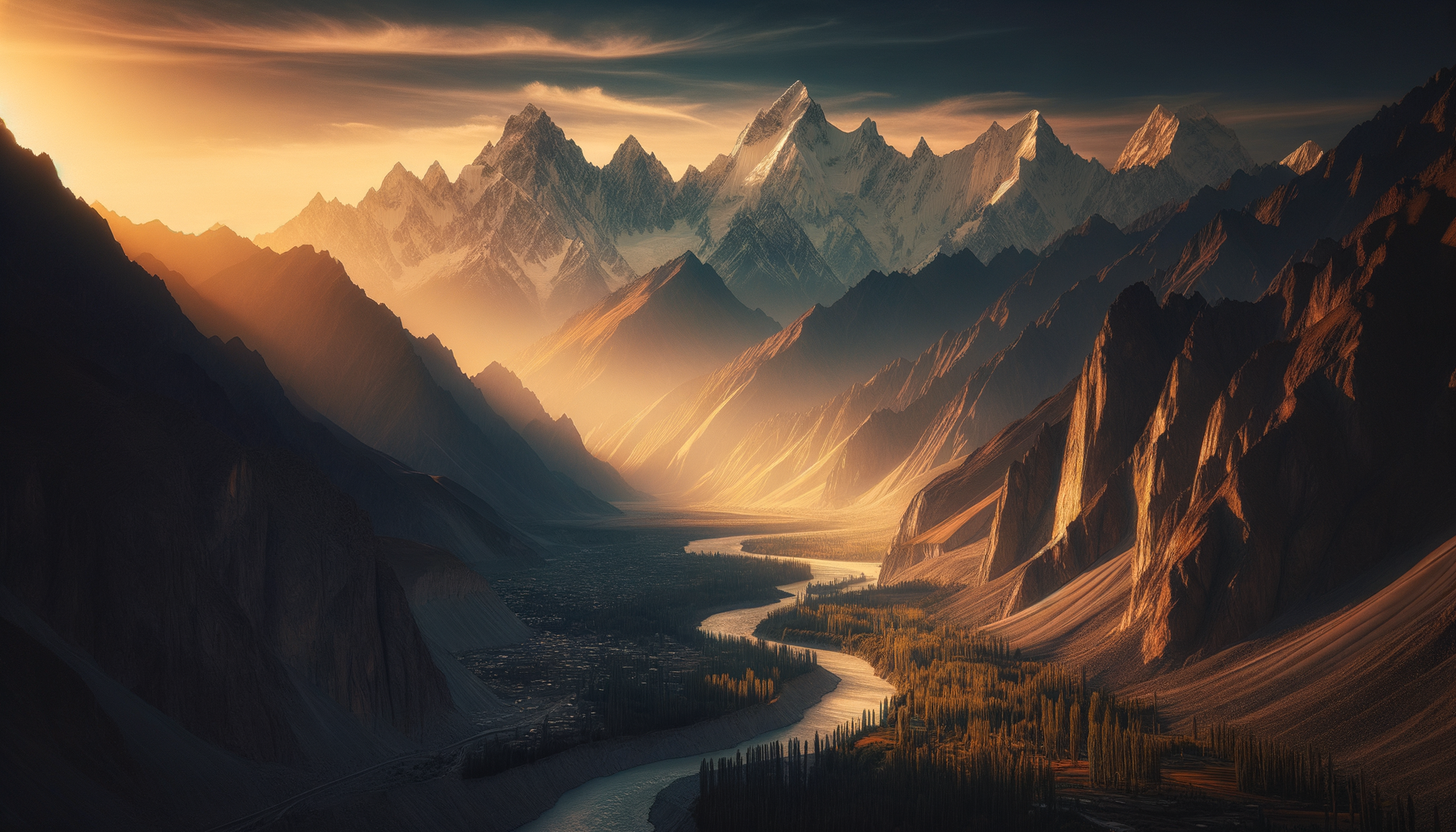
The poplars and apricot orchards of Hunza turn gold, the light is extraordinary, and the crowds have gone. This is the best fortnight of the Pakistani year and it is what the hero image at the top of this page is showing.
The plains: November–March
Lahore, Multan, Karachi and the archaeological sites are pleasant to genuinely cold in winter and unbearable in summer. Do not visit Punjab or Sindh between May and September unless you have to: 45 °C is normal and Jacobabad in Sindh regularly records among the highest temperatures on earth.
⚠️ Monsoon
July to September in the plains and the lower north. Landslides close the KKH, flash floods take out bridges in the valleys, and the 2022 and 2025 seasons were catastrophic. Build slack into any July–August itinerary and be prepared to be stuck.
⚠️ Lahore smog
November to February, Lahore and much of Punjab have some of the worst air quality on earth — AQI figures in the hundreds are routine and schools have been closed for it. If you have asthma or are travelling with children, this is a genuine reason to choose different dates.
Ramadan
Shifts each year by about eleven days. Restaurants close during daylight in much of the country, work hours change, and public eating is inappropriate and in some provinces illegal. Travel is still entirely possible and iftar — the breaking of the fast — is one of the warmest experiences available anywhere. Check the dates and plan around them.
🐯 Wildlife
⭐ Snow leopard
The Karakoram and the Hindu Kush are among the better places on earth for them, which is a low bar — they remain almost impossible to see. Khunjerab National Park and the Chitral Gol hold populations. Community conservation programmes that pay herders for livestock losses have done more for them here than any amount of protection on paper.
Markhor
The national animal: a wild goat with enormous corkscrew horns, living on cliffs that look unusable. It was heading for extinction and has recovered substantially through trophy-hunting programmes that return most of the fee to the local community — a conservation model that is genuinely controversial and has genuinely worked here.
Himalayan brown bear
On the Deosai Plains, where a dedicated national park brought the population back from a few dozen. Deosai in July, at 4 100 m and carpeted with flowers, is one of the great wildlife landscapes of Asia and almost empty of visitors.
Ibex, urial, blue sheep
All present in the northern ranges, and far more visible than the predators. The valley slopes above the KKH reliably produce ibex through binoculars.
⚠️ Indus dolphin and gharial
The dolphin survives (see the Indus); the gharial, the fish-eating crocodile, is functionally gone from Pakistan. The mugger crocodile survives, including at the extraordinary Sufi shrine of Manghopir in Karachi, where they are fed and treated as sacred.
Birds
Pakistan sits on the Indus Flyway and receives enormous numbers of migratory waterbirds — cranes, flamingos, ducks — at the Sindh wetlands and Haleji Lake from November. The hunting of houbara bustard by visiting Gulf royalty under special permit is a long-running and bitterly argued domestic scandal.
🏺 The Indus Valley Civilisation
Between roughly 2600 and 1900 BC, the Indus plain held one of the three great early civilisations of the Old World, alongside Mesopotamia and Egypt — and it was larger than either. It covered perhaps a million square kilometres, ran several cities of tens of thousands of people, and has been known to archaeology only since the 1920s.
⭐ Mohenjo-daro
In Sindh: a planned city of baked brick laid out on a grid, with a covered municipal drainage system, standardised brick dimensions, wells in most houses, a citadel with the Great Bath, and a granary. UNESCO World Heritage. It is 4 500 years old and it has better plumbing than large parts of the modern subcontinent, a comparison that Pakistani guides make themselves and do not intend kindly.
Harappa
In Punjab, the first site excavated and the one that gave the culture its other name. Substantially damaged in the nineteenth century when its bricks were quarried as ballast for the Lahore–Multan railway — an act of vandalism that destroyed a good deal of what we would now most want.
⚠️ The great unknown
Nobody can read the script. Around 4 000 inscriptions survive, almost all of them very short — the average is five signs — and there is no bilingual text. Whether it encodes a language at all is disputed. It is the most significant undeciphered writing system in the world and there is a standing prize for solving it.
What we do know
No palaces and no obvious royal burials. No temples that read unambiguously as temples. Very little in the way of weapons or fortification. Standard weights and measures across hundreds of kilometres. Trade with Mesopotamia — Indus seals have been dug up at Ur. It looks like a large, organised, literate society with no visible king, which is genuinely strange.
How it ended
Not by invasion — the old “Aryan conquest” story is not supported by the evidence. The current reading is climate: a weakening monsoon over several centuries, the drying of the Ghaggar-Hakra river system, and the gradual abandonment of the cities as agriculture moved east. Decline, not catastrophe.
⚠️ Visiting
Mohenjo-daro is reachable from Larkana or Sukkur and is a full day. It is also deteriorating — salt crystallisation from the water table is eating the brickwork, and conservation funding has been chronically short. Go while there is something to see, and do not climb on anything.
☸️ The Gandhara Centuries
For roughly a thousand years, from around 500 BC, the region around modern Peshawar, Taxila and Swat was Gandhara — a crossroads of Persian, Greek, Indian and Central Asian worlds, and the place where one of the most consequential things in the history of art happened.
⭐ The first Buddha image
For centuries after his death the Buddha was not depicted as a person — he was a footprint, an empty throne, a wheel, a tree. In Gandhara, around the first and second centuries AD, someone began carving him as a human figure, in a style unmistakably derived from Greek and Roman sculpture: the wavy hair, the heavy folded robe, the classical proportion. Every Buddha statue in Asia descends from that. It happened here.
How the Greeks got there
Alexander crossed the Indus in 326 BC and fought Porus on the Jhelum; his men then refused to go further and he turned back. The Greek kingdoms he left behind in Bactria and the north-west lasted, in one form or another, for two hundred years, and the Indo-Greek king Menander appears in a Buddhist text, the Milindapañha, debating a monk.
Taxila
UNESCO World Heritage, and a complex of sites rather than one: a Achaemenid-era mound, a Greek grid city at Sirkap, a Kushan city at Sirsukh, monasteries at Jaulian and Mohra Muradu, and an excellent museum. Under two hours from Islamabad and one of the most under-visited world-class archaeological sites anywhere.
Takht-i-Bahi
A Buddhist monastery on a hill in Mardan district, UNESCO World Heritage, first century AD, and remarkably complete — courtyards of votive stupas, monastic cells, assembly hall, the lot, laid out on terraces with a view over the plain. It survived because it was on a hilltop nobody needed.
Swat
Uddiyana in the Buddhist texts, a valley thick with rock carvings, stupas and the great seated Buddha of Jehanabad — which the Pakistani Taliban attempted to destroy with explosives in 2007 and which has since been restored with Italian help. Swat itself is green, beautiful and has recovered considerably since the militancy of 2007–09.
The Kushans
The empire that made Gandhara flourish, ruling from Peshawar under Kanishka in the second century AD and spanning from Central Asia to the Ganges. They took Buddhism north along the Silk Road into China. Most of East Asian Buddhism arrived by this route, from this place.
☪ Islam, Sufism and the Sultanates
711
Muhammad bin Qasim, an Umayyad commander of seventeen or eighteen, took Sindh — the first Muslim rule in the subcontinent, and a date Pakistani schoolbooks treat as a founding moment. Sindh stayed a distant Arab province for centuries and the real Islamisation of the region came much later and largely by a different route.
⭐ Sufism
And that route was mostly Sufi. Mystics and teachers — Data Ganj Bakhsh in Lahore, Lal Shahbaz Qalandar at Sehwan, Shah Abdul Latif at Bhit Shah, Baba Farid at Pakpattan, Bahauddin Zakariya at Multan — attracted followings across caste and religion, and their shrines became the centre of popular devotion. They still are.
The shrines today
Living, loud, crowded institutions with music, incense and the ecstatic dhamal drumming and dance at Sehwan on Thursday nights. Qawwali — the devotional singing that Nusrat Fateh Ali Khan took to the world — belongs to this tradition. So does a large part of what makes Pakistani popular culture what it is.
⚠️ And they are targets
Hardline groups regard shrine devotion as heresy, and shrines have been repeatedly bombed — Data Darbar in Lahore in 2010, Sehwan in 2017 with over 80 killed. That people go back in numbers the following week is the most eloquent thing anyone could say about where Pakistani popular religion actually sits.
The sultanates
From the thirteenth century, Turkic and Afghan dynasties ruled from Delhi and the north-west was their frontier and their corridor. Multan and Lahore became major cities of Islamic learning and architecture. The blue-tiled tomb architecture of Multan and Uch Sharif dates from this period and is unlike anything in the Mughal repertoire.
Makli
Near Thatta in Sindh: a necropolis of perhaps half a million graves spread over ten square kilometres, with monumental stone and tile tombs from the fourteenth to eighteenth centuries. UNESCO World Heritage, extraordinary, and visited by almost nobody.
🕌 The Mughals
From 1526, when Babur won at Panipat, to the effective end in the eighteenth century, the Mughal empire ruled most of the subcontinent — and Lahore was one of its capitals. The best surviving Mughal architecture outside Agra and Delhi is in Pakistan.
⭐ Badshahi Mosque, Lahore
Built by Aurangzeb in 1673, red sandstone with marble domes, and for three centuries the largest mosque in the world. The courtyard holds 100 000 people. It faces the Lahore Fort across a square, with the Samadhi of Ranjit Singh and the Roshnai Gate between them — one of the great urban compositions anywhere.
Lahore Fort
UNESCO World Heritage, largely Akbar's and Jahangir's, with the Sheesh Mahal — the mirror palace — and the Picture Wall, a 450-metre façade of glazed tilework showing elephants, camels and polo, which is unique in Mughal architecture and has been under long restoration.
Shalimar Gardens
Shah Jahan, 1641, three descending terraces with over 400 fountains, and the same World Heritage listing as the fort. The Mughal garden is a specific idea — the charbagh, four quarters divided by water, a representation of paradise — and this is one of the best survivals of it.
Wazir Khan Mosque
Inside the Walled City, 1634, and for many people the single most beautiful building in Pakistan: every surface covered in kashi-kari tile mosaic in blue, green, yellow and orange. Recently and carefully restored by the Aga Khan Trust for Culture, along with the surrounding Delhi Gate quarter.
Rohtas Fort
Not Mughal — built by Sher Shah Suri around 1541 to hold the Punjab against Humayun's return. Four kilometres of wall with twelve gates, on a hill near Jhelum. UNESCO World Heritage, enormous, and effectively deserted when you visit.
Jahangir's tomb
At Shahdara across the Ravi from Lahore, with his wife Nur Jahan buried nearby — a woman who effectively ruled the empire, issued coinage in her own name, and is one of the most remarkable figures in Mughal history. Her tomb is comparatively neglected, which says something.
🇬🇧 The Raj, 1849–1947
How it happened here
Britain annexed Sindh in 1843 and the Punjab in 1849, after two wars with the Sikh empire that Ranjit Singh had built out of Lahore. The north-west then became the frontier of British India and stayed a military problem for a century.
⭐ The canals
The single most consequential thing the British built here. From the 1880s, a vast network of canal colonies turned the dry Punjab doab into irrigated farmland and moved hundreds of thousands of settlers onto it. It made Punjab the granary of the subcontinent, it created the landholding class that still dominates Pakistani politics, and it is the physical basis of the modern country.
The railways
And the other great inheritance. Pakistan Railways still runs on the colonial network, the stations at Lahore and Karachi are Victorian-Gothic monuments, and the Lahore station was built as a fortress, with loopholes and gun positions, because it was designed after 1857.
⚠️ The Frontier
The Durand Line was drawn in 1893 by Sir Mortimer Durand, splitting the Pashtun population between British India and Afghanistan. Afghanistan has never recognised it, in any government, of any ideology, to this day. Almost every problem on Pakistan's north-west border traces back to that line, and the tribal-areas administrative system the British invented to manage it lasted until 2018.
1857
The rebellion, and its ferocious suppression. The Punjab largely stayed loyal, which is why Punjabi recruitment into the Indian Army rose so sharply afterwards — the “martial races” doctrine — and why the Pakistani army's institutional roots run so directly into the colonial one.
⭐ Iqbal
Muhammad Iqbal, poet and philosopher, wrote in Persian and Urdu and in 1930 put forward the idea of a consolidated Muslim state in the north-west of India. He is Pakistan's national poet, his tomb sits beside the Badshahi Mosque, and he died in 1938 — nine years before the country he had argued for existed.
⚠️ Partition, August 1947
Pakistan came into existence on 14 August 1947, India the following day. It was the largest and among the bloodiest mass migrations in human history, and it is not a closed subject in either country.
Jinnah
Muhammad Ali Jinnah, Quaid-e-Azam, the great leader: a Bombay barrister, once called the ambassador of Hindu–Muslim unity, who came to the conclusion that Muslims needed a separate state and carried it through against the Congress and the British. He became Pakistan's first Governor-General and died of tuberculosis on 11 September 1948, thirteen months later. What he actually intended the country to be is the most argued-over question in Pakistani public life.
⚠️ The Radcliffe Line
Drawn by Cyril Radcliffe, a British lawyer who had never been to India, in about five weeks, using outdated maps and census data, and not published until two days after independence — so people celebrated without knowing which country they were in. He burned his papers and refused his fee.
The numbers
Somewhere between 10 and 20 million people were displaced. Estimates of the dead run from several hundred thousand to two million. Punjab and Bengal, the two provinces cut in half, took the worst of it: trains arrived at Lahore and Amritsar with everybody aboard dead. Perhaps 75 000 to 100 000 women were abducted or raped, by all communities.
⭐ How to hold it
Every family in Pakistani Punjab has a Partition story, and so does every family in Indian Punjab, and they are usually mirror images. Pakistani and Indian national narratives of 1947 are irreconcilable at the level of blame and largely identical at the level of grief. If a Pakistani tells you their grandparents' story, listen; do not supply the Indian version.
Kashmir
The princely state that did not resolve. Its Hindu maharaja ruled a Muslim-majority population, hesitated, and acceded to India in October 1947 as Pashtun irregulars entered. War followed immediately. The Line of Control that resulted is still there and is treated in its own section.
Two wings
Pakistan was created in two parts separated by 1 600 km of India — West Pakistan and East Bengal — united by religion and nothing else, not language, not culture, not cuisine. That arrangement lasted twenty-four years.
🗓️ The Republic and the Army, 1947–2008
The defining pattern of Pakistani history since 1947 is the alternation between elected civilian government and direct military rule, with the army as the permanent factor and the civilians as the variable. Roughly half the country's existence has been under direct military government, and much of the other half under army supervision.
Ayub, 1958–69
The first coup, by General Ayub Khan, eleven years in. A decade of rapid growth, the building of Islamabad as a new capital, the Indus Waters Treaty — and a political settlement that excluded East Pakistan almost entirely.
Bhutto, 1971–77
Zulfikar Ali Bhutto, the first genuinely popular civilian leader: land reform, nationalisation, the 1973 constitution that is still in force, the start of the nuclear programme — and the prohibition of alcohol and the declaration of Ahmadis as non-Muslims, both concessions to religious parties that have had long consequences.
⚠️ Zia, 1977–88
General Zia-ul-Haq overthrew Bhutto and had him hanged in 1979. Eleven years of Islamisation: the Hudood Ordinances, blasphemy law amendments, a reshaped legal and educational system, and — with American and Saudi money — the arming of the Afghan mujahideen against the Soviets. The consequences of that decade structure Pakistani society to this day, and most of the country's internal problems are traceable to it. Zia died in a 1988 air crash that has never been explained.
Benazir and Nawaz, 1988–99
Four elected governments in eleven years, none finishing a term, alternating between Benazir Bhutto — the first woman to head a government in a Muslim-majority country — and Nawaz Sharif, each dismissed amid corruption allegations. Benazir was assassinated in Rawalpindi in December 2007.
Musharraf, 1999–2008
General Pervez Musharraf took power in a coup after Sharif tried to sack him mid-air. Then came 11 September 2001, and Pakistan was required to choose sides overnight against an Afghan movement its own agencies had helped build. The war that followed came home: over 70 000 Pakistanis have died in terrorist violence since 2001, a figure most Western readers have never seen.
⭐ Since 2008
Civilian government, formally continuous, with three transfers of power by election — a genuine first. Also: no elected prime minister in Pakistan's history has ever completed a full five-year term. That statistic has not changed.
✂️ 1971 — the Half That Left
East Bengal held the majority of Pakistan's population and was governed from the west as a periphery: its language rejected as a national language, its share of spending and of army and civil service posts a fraction of its weight, its cyclone relief in 1970 handled with a negligence that was itself political.
In the December 1970 election — the first on universal suffrage — the East Pakistani Awami League under Sheikh Mujibur Rahman won an outright national majority. The West Pakistani establishment refused to let him form a government.
⚠️ What followed
On 25 March 1971 the army launched Operation Searchlight in Dhaka. The nine months that followed produced mass killing, systematic rape, and around ten million refugees into India. Bangladeshi accounts put the dead at three million; Pakistani official accounts put it vastly lower; independent estimates fall between, generally in the hundreds of thousands. All three figures are used politically and the difference between them is not an academic dispute.
The war
India intervened in December 1971. The Pakistani eastern command surrendered at Dhaka on 16 December 1971 — around 90 000 prisoners, the largest surrender since the Second World War. Bangladesh became independent.
What it meant
Pakistan lost the majority of its own population in a single war. The founding proposition — that religion alone could hold a state together across language and distance — had failed in twenty-four years. The Hamoodur Rahman Commission report into the defeat was suppressed for decades and is still not fully public.
⭐ How it is taught
Barely, and not like this. Pakistani school curricula have historically treated 1971 as an Indian conspiracy and a tragedy that happened, rather than as a civil war with a specific sequence of decisions behind it. That gap between the national account and the record is something Pakistani historians write about openly, and it is worth knowing before the subject comes up in conversation — which it usually does not.
Bihari Pakistanis
Urdu-speaking Muslims who had migrated to East Bengal in 1947, sided with the west in 1971, and were then stranded — refused by Bangladesh and largely unclaimed by Pakistan. Tens of thousands of their descendants still live in camps in Dhaka fifty-five years later. It is one of the longest-running unresolved statelessness cases in the world.
☢️ The Bomb
After the 1971 defeat, Bhutto is supposed to have said Pakistanis would eat grass if necessary to get a nuclear weapon. India tested in 1974; Pakistan's programme accelerated. On 28 May 1998, seventeen days after India's tests, Pakistan detonated devices at Chagai in Balochistan. The date is a public holiday — Youm-e-Takbir.
A. Q. Khan
The metallurgist who brought centrifuge designs out of a URENCO facility in the Netherlands and built the enrichment programme at Kahuta. A national hero in Pakistan and, after his 2004 confession to running a proliferation network that supplied Libya, Iran and North Korea, one of the most consequential individuals of the late twentieth century. He was pardoned, kept under house arrest, and died in 2021.
The doctrine
Pakistan maintains no no-first-use pledge — deliberately, because its conventional forces are smaller than India's and the ambiguity is the deterrent. It has developed short-range tactical systems intended for battlefield use, which is precisely the category most arms-control specialists regard as the most dangerous thing on the subcontinent.
⚠️ Command
Under the 27th Amendment of November 2025, the new Chief of Defence Forces exercises full command over the Strategic Plans Division, which manages the arsenal. Custody of Pakistani nuclear weapons has always been military in practice; it is now explicitly so in constitutional law.
Scale
Estimates put both India and Pakistan at roughly 170–180 warheads each, with Pakistan generally assessed as expanding slightly faster. Neither is a signatory to the NPT. Neither has signed the CTBT.
⭐ What it means for the region
Every India–Pakistan crisis since 1998, including May 2025, has been fought under a nuclear ceiling — which has both restrained escalation and, in the view of many analysts, enabled sub-conventional conflict beneath it. Both propositions are probably true at once, and that is the uncomfortable part.
For a traveller
Nothing, directly. It is context. But it is why Pakistan matters to the world in a way its economy does not, and it is why every regional flare-up is front-page news globally within hours.
⚖️ The 27th Amendment, November 2025
This is the most important thing to understand about how Pakistan is governed today, and it is nine months old.
On 13 November 2025, President Asif Ali Zardari signed the 27th Constitutional Amendment. It moved through parliament in five days: cabinet approval on 8 November, introduction in the Senate on 10 November, ratification by the National Assembly with a two-thirds majority on 12 November amid protests from PTI-aligned opposition members, and assent on 13 November. There was very little public consultation.
What it does
⭐ Chief of Defence Forces
Creates a new constitutional post of Chief of Defence Forces (CDF), held concurrently by the army chief — currently Field Marshal Asim Munir, formally appointed the first CDF later in November 2025. The CDF has primacy over the air force and navy chiefs, who were previously treated as equals, and full command of the Strategic Plans Division and therefore the nuclear arsenal.
⚠️ Removal thresholds
Removing the CDF requires a two-thirds parliamentary majority. Removing an elected prime minister requires a simple majority. Stated plainly: the military commander is now constitutionally harder to remove than the head of government.
⚠️ Lifetime rank and immunity
Any officer promoted to field marshal, marshal of the air force or admiral of the fleet retains the rank and its privileges for life, remains in uniform, and enjoys immunity from criminal proceedings. The president received lifetime immunity in the same package.
Tenure
Follow-on legislation reset the army chief's tenure, giving Munir a fresh five-year term from his appointment as CDF.
How it is read
Chatham House described the amendment as moving Pakistan one step closer to authoritarian rule, and that is broadly the international assessment. The government's position is that it rationalises a command structure and reflects operational reality. Both are describable as true; the disagreement is about which fact matters.
The practical reading for anyone trying to understand Pakistani news: the army's primacy in Pakistan is no longer an informal fact requiring periodic coups. It is written into the constitution. Whether that makes coups less likely or civilian government less meaningful is exactly the argument now running in Pakistani commentary — and it is running, loudly and in public, which is itself worth noting.
Who holds office
Prime Minister Shehbaz Sharif (PML-N), in office since March 2024 and still in office in September 2026. President Asif Ali Zardari (PPP). Field Marshal Asim Munir as army chief and CDF.
⚠️ Imran Khan
Former prime minister, removed by a no-confidence vote in April 2022, and in prison since August 2023 on multiple convictions. His party, PTI, remains the largest single popular force in the country by most measures, and the dispute over the February 2024 election — in which PTI-backed independents won the most seats but did not form the government — has not gone away.
The system on paper
A federal parliamentary republic: a 336-seat National Assembly, a Senate, four provincial assemblies, and a prime minister responsible to parliament. All of that is real and functioning; the question is where the decisions are taken.
Talking about it
Pakistanis discuss their politics with a freedom and a bluntness that surprises visitors — in private, in taxis, at dinner. Public and published criticism of the military is a different matter and carries real risk for Pakistanis, not for you. Do not put anyone in a position where their answer is on record.
🇮🇳 India, and May 2025
Three full wars — 1947–48, 1965, 1971 — a limited one at Kargil in 1999, and a standing crisis. The relationship is the organising fact of Pakistani strategic thinking and a great deal of its budget.
⚠️ The 2025 crisis
On 22 April 2025 gunmen killed 26 civilians, most of them Hindu tourists, at Pahalgam in Indian-administered Kashmir. India attributed the attack to Pakistan-based groups; Pakistan denied involvement and called for an independent investigation. India suspended the Indus Waters Treaty.
India struck targets in Pakistan and Pakistani-administered Kashmir in early May 2025. Four days of exchanges followed — missiles, drones, air combat, artillery along the Line of Control — with both sides claiming aircraft downed and both sides' claims disputed. A ceasefire was announced on 10 May 2025. It has broadly held.
⭐ Where it stands now
The ceasefire holds. The Indus Waters Treaty does not. On 1 September 2026 a Court of Arbitration at The Hague ruled that India cannot unilaterally suspend the treaty, which remains fully in force; India rejected the ruling and has said the treaty stays in abeyance until Pakistan ends what it calls cross-border terrorism. No bilateral talks have taken place.
What is closed
The Attari–Wagah border has been closed to most traffic since 2025 and trade has been suspended. Direct flights do not operate. Overflight rights have been restricted by both sides. Do not plan an overland India–Pakistan crossing without checking its status within days of travel.
Wagah
The border ceremony at Wagah near Lahore — the synchronised, theatrically aggressive flag-lowering performed nightly by both sides to stadium crowds — is one of the more extraordinary things in South Asia and has been suspended and resumed repeatedly. Check before going.
The asymmetry
India has roughly six times Pakistan's population and about ten times its economy. Pakistan's answer has historically been a combination of nuclear deterrence and strategic depth in Afghanistan. Whether that has served the country is now openly argued inside Pakistan.
⚠️ For a visitor
Do not discuss Kashmir with strangers unless they raise it, and if they do, listen. The Pakistani account of 1947, 1971 and Kashmir differs from the Indian one at almost every point, and turning up with the other side's version settled in advance is both rude and pointless.
China
The counterweight. The China–Pakistan Economic Corridor (CPEC) has brought tens of billions in infrastructure — the Gwadar port, power plants, the upgrading of the Karakoram Highway — along with debt and a running argument about its terms. The relationship is the closest Pakistan has and is described domestically as higher than the mountains, deeper than the oceans.
💹 The Economy in 2026
Pakistan's economy has spent a decade oscillating between crisis and stabilisation, and 2026 is a stabilisation year — cautiously, and from a low base.
The numbers
Growth projected at around 3,5 % in 2026. Inflation, having fallen to about 4 % at the end of 2024 from a peak near 38 %, is projected back up to around 6,4 %. The State Bank policy rate has been held at 11 %. Foreign exchange reserves were rebuilt to roughly US$16–18 billion by early 2026.
The IMF
The stabilisation runs on an IMF programme and its conditions: energy tariff increases, a widened tax base, subsidy reduction and privatisation. Pakistan has entered more IMF programmes than almost any other member state. The current account posted a surplus in FY25 and primary balance targets were exceeded — genuinely better performance than the recent record.
⚠️ What could undo it
Floods. The 2025 monsoon devastated farmland in Punjab, disrupted supply chains, and pushed up wheat, rice and vegetable prices into 2026. In an economy where agriculture is roughly a fifth of output and a third of employment, a bad monsoon is a macroeconomic event.
What the economy is
Textiles above all — Pakistan is one of the world's largest cotton producers and the garment sector is the export backbone. Then agriculture, cement, and an enormous informal sector. Remittances from Pakistanis in the Gulf, Britain and the US are a huge and stabilising inflow, regularly exceeding total exports.
The structural problem
A tax-to-GDP ratio among the lowest in the world, a very small documented economy, an energy sector with chronic circular debt, and a population growing faster than the job market. None of these is new and none has been solved.
⭐ For a visitor
It means Pakistan is very cheap by European standards — see costs. It also means the rupee moves, that card acceptance is patchy outside cities, and that you should treat any price you read online as indicative only.
👥 Who Lives Here
Around 255 million people, a median age somewhere around 20, and a population that has roughly quadrupled since 1970. Pakistan is a young country in the literal demographic sense, and almost everything about it follows from that.
The peoples
Punjabis are the largest group, around 38–45 % depending on the count, concentrated in the agricultural heartland and dominant in the army and bureaucracy. Pashtuns in KP and northern Balochistan, and in very large numbers in Karachi. Sindhis. Saraikis in southern Punjab. Baloch and Brahui. Muhajirs — the Urdu-speaking descendants of 1947 migrants, mostly in Karachi and Hyderabad. And in the far north, Baltis, Shina, Wakhi and the Burusho of Hunza.
⭐ Burushaski
The language of Hunza and Yasin, spoken by perhaps 100 000 people, and a language isolate — no demonstrated relationship to any other language on earth. Like Basque. It is one of the more remarkable survivals anywhere and it is sitting at the top of the Karakoram Highway.
The Kalash
In three valleys of Chitral: a few thousand people practising a pre-Islamic polytheistic religion with its own calendar, festivals and burial customs, in a country that is 96 % Muslim. Their survival is genuinely improbable. Their festivals are open to visitors and are heavily visited, which brings its own problems — go quietly, pay for photographs only if invited to, and do not treat a religious rite as a show.
Cities
Karachi, perhaps 20 million, the port and the money. Lahore, around 13 million, the cultural capital. Faisalabad, the textile city. Rawalpindi, the army city, twinned with Islamabad. Peshawar, the Pashtun capital. Multan, the city of saints. Urbanisation is fast and the infrastructure is not keeping up.
The diaspora
Large and consequential: around 1,6 million in the United Kingdom, a similar number in Saudi Arabia and the UAE, substantial communities in the US, Canada and Norway. Remittances are one of the country's largest sources of foreign exchange — regularly more than all exports combined.
⚠️ Where it is hard
Pakistan ranks near the bottom of global gender-gap indices. Around a third of adults cannot read, with the gap between men and women and between provinces very wide. Roughly 22 million children are out of school. These are the country's real problems and Pakistani journalists write about them more sharply than foreign ones do.
🗣️ Urdu, English and Seventy Others
⭐ Urdu
The national language — and the first language of only about 7 % of the population. It was chosen in 1947 precisely because it belonged to no province and so favoured none; the decision to impose it on Bengali-speaking East Pakistan was one of the first steps towards 1971. It is spoken as a second language almost universally, written in the flowing nastaʿlīq script, and is grammatically the same language as Hindi with a different vocabulary register and a different alphabet.
English
An official language, the language of higher courts, higher education, the military above a certain level, and the elite. Newspapers like Dawn are in English and are excellent. You can travel the entire country on English, and in the north almost everyone in tourism speaks it well.
Punjabi
The most widely spoken language in the country by a distance, and — in a pattern that Punjabi writers complain about bitterly — one with almost no official status, little schooling and a dwindling literary infrastructure. It is written in the Shahmukhi script in Pakistan and in Gurmukhi in India.
The others
Pashto, Sindhi (which does have provincial status and a strong literary tradition), Saraiki, Balochi, Brahui — a Dravidian language stranded a thousand kilometres from its relatives — and dozens of smaller languages in the north: Shina, Balti, Khowar, Wakhi, Burushaski. Something over seventy living languages in total.
A few words of Urdu
Assalam-o-alaikum — the universal greeting, answered wa alaikum assalam. Shukriya — thank you. Meherbani — please/kindness. Kitne ka hai? — how much is it? Pani — water. Theek hai — OK. Inshallah, which in practice covers everything from “yes” to “almost certainly not”.
⭐ Poetry
Urdu poetry is a living popular art in a way that has no European equivalent. Ghalib, Iqbal, Faiz Ahmed Faiz — whose political verse got him imprisoned and is still recited at protests — are quoted by taxi drivers. A mushaira, a poetry recital, fills halls. If somebody recites a couplet at you, the correct response is appreciation, not translation.
☪ Religion
Around 96 % of Pakistanis are Muslim, of whom the large majority are Sunni — mostly Barelvi and Deobandi in orientation — with a Shia minority generally estimated at 10–15 %, which makes Pakistan the second-largest Shia population in the world after Iran.
What it looks like day to day
Five prayer calls, Friday as the main congregational prayer, a genuinely observant society in which religion is a normal part of public conversation rather than a private matter. It is also a society with enormous internal variation — Karachi, a Hunza village and a Peshawar bazaar are not the same place in this respect or any other.
Sufi Islam
The dominant popular form across much of the country: shrine devotion, qawwali, saints' festivals (urs), and a religious practice that is musical, ecstatic and inclusive. Treated properly in the history section, because it is history and present at once.
The minorities
Christians and Hindus, each around 1,5–2 %. Hindus are concentrated in Sindh, where the temples at Hinglaj and the Katas Raj complex in Punjab are active pilgrimage sites. There are small Sikh, Parsi and Kalash communities, and the Kartarpur Corridor — opened in 2019 to let Indian Sikh pilgrims visit Guru Nanak's shrine visa-free — is one of the few pieces of India–Pakistan cooperation that still functions.
⚠️ Ahmadis
Declared non-Muslim by constitutional amendment in 1974 and subjected to further legal restriction under Zia: they may not call their places of worship mosques, use the call to prayer, or describe themselves as Muslim, and doing so is a criminal offence. They face severe discrimination and periodic violence. This is not a marginal footnote; it is a formal feature of Pakistani law.
⚠️ Blasphemy law
Sections 295-B and 295-C of the penal code carry life imprisonment and the death penalty respectively. No one has been executed under them by the state — but accusations have repeatedly led to lynchings, mob attacks on Christian neighbourhoods, and the murder of those who questioned the law, including the governor of Punjab, Salman Taseer, killed by his own bodyguard in 2011. Do not discuss religion critically in public, ever, under any circumstances. This is the single most important behavioural rule on this page.
For a visitor
Being non-Muslim is entirely unremarkable and is usually met with curiosity and hospitality. Mosques are frequently open to visitors — Badshahi and Faisal certainly are — with shoes off, shoulders and knees covered, and a headscarf for women. Friday midday is not the time.
🎭 Culture, Manners and Truck Art
⭐ Truck art
Pakistan's great folk art form, and it is everywhere. Bedford trucks, buses and rickshaws covered inch by inch in painted flowers, peacocks, eyes, poetry couplets, film stars and mirrored panels, with hammered metalwork and hanging chains that jingle — the jingle trucks. A single truck can cost its owner a year's income to decorate. It is commissioned art made by workshops in Karachi, Rawalpindi and Peshawar, it has its own regional styles, and it is the most joyful thing on any Pakistani road.
⭐ Hospitality
The thing every returning traveller mentions first, and it is not politeness — it is an obligation with religious and Pashtunwali roots. You will be invited to tea, then to lunch, then to stay. Refusing outright is rude; a genuine apology and a specific reason is fine. You will not be allowed to pay. Fighting over the bill is a real and expected ritual and you will lose it.
Cricket
Not a sport, a shared language. Pakistan won the 1992 World Cup under Imran Khan — a fact that explains a great deal of his later political career — and the T20 World Cup in 2009. After the 2009 attack on the Sri Lankan team bus in Lahore, international cricket left Pakistan for a decade and played its home matches in the UAE; it has returned, and the return has been treated as a national vindication. Knowing one Pakistani cricketer's name will get you a long way.
Music
Qawwali, the Sufi devotional form, and Nusrat Fateh Ali Khan, who took it to a global audience and remains one of the great voices of the twentieth century in any genre. Coke Studio Pakistan — a televised session series pairing folk musicians with contemporary producers — is genuinely excellent and is the easiest way into the country's music.
Dress
Shalwar kameez, the loose trousers and long tunic, worn by men and women and entirely normal for visitors to adopt — it is comfortable, cheap, appropriate and warmly received. Men: long trousers, sleeves. Women: loose clothing covering arms and legs, a dupatta scarf for the head at shrines and mosques and useful elsewhere. Nobody expects a foreign woman to cover her hair in the street in Islamabad or Lahore; in the bazaar in Peshawar it is a different calculation.
⚠️ Manners
Right hand for eating and giving. Shoes off indoors and in mosques. Ask before photographing people, and never photograph women without explicit permission. Public affection between couples is not done. Do not photograph bridges, dams, military installations or checkpoints — this is enforced. And assume any conversation about religion or the army is a conversation you should listen to rather than contribute to.
🗺️ Kashmir
The unresolved territory at the centre of everything. The former princely state was divided in the 1947–48 war along what became, after 1972, the Line of Control. Pakistan administers Azad Jammu and Kashmir and Gilgit-Baltistan; India administers Jammu and Kashmir and Ladakh; China holds Aksai Chin.
The positions
Pakistan: a disputed territory whose status must be settled by a plebiscite under UN Security Council resolutions of 1948–49, which India accepted at the time and never held. India: an integral part of India, with the dispute confined to territory Pakistan holds illegally. Many Kashmiris: a third option, independence, which neither state entertains.
2019
India revoked Article 370, the constitutional provision granting Jammu and Kashmir special autonomous status, and split the state into two union territories under direct rule. Pakistan downgraded diplomatic relations and suspended trade. It remains the position from which the current freeze dates.
Siachen
The world's highest battlefield: a glacier at over 6 000 m where Indian and Pakistani troops have faced each other since 1984 and where far more soldiers have died of the altitude and the weather than of enemy fire. It is strategically close to pointless and neither side can withdraw first. Nothing sums the dispute up better.
⭐ Gilgit-Baltistan
Legally part of the disputed territory and therefore not a province of Pakistan — it has an assembly and a chief minister but no seats in the National Assembly, because granting them would formally annex a territory Pakistan says is disputed. It is also where you will actually be going: the Karakoram Highway, Hunza, Skardu and K2 are all in Gilgit-Baltistan.
Travel
Gilgit-Baltistan is open and is the main tourist region of Pakistan. Azad Kashmir is also open, with Neelum Valley a popular domestic destination, though areas near the Line of Control can close at short notice. Crossing the LoC is not possible for foreigners.
⚠️ Talking about it
Everyone has a position and yours is not wanted. Pakistanis will tell you theirs; the correct response is to listen. The subject is genuinely painful on both sides of the line and there is no version of you settling it over dinner.
⚠️ Security — the Honest Version
This section exists because most coverage of Pakistan gets it wrong in both directions — either treating a country of 255 million as uniformly dangerous, or waving the problem away because the northern valleys are lovely. Both are useless. The picture is regional, it is specific, and it is knowable.
Where the problem is
⚠️ Balochistan
A long-running separatist insurgency. The Balochistan Liberation Army and others attack security forces, infrastructure and Chinese nationals; the state's response includes enforced disappearances that are a major domestic human rights issue. A BLA attack on a train near Quetta in May 2026 targeted soldiers. Independent travel through most of the province is effectively impossible — the authorities impose armed escorts or refuse permission outright. The exception in practice is the Quetta–Taftan corridor to Iran, under escort.
⚠️ Khyber Pakhtunkhwa, border districts
Attacks by the TTP (Pakistani Taliban) and affiliated groups have continued with troubling regularity since 2022, concentrated in the former tribal districts along the Afghan border — North and South Waziristan, Bannu, Tank, Dera Ismail Khan. Six police officers were killed by a bomb in Tank District in January 2026. Canada and other governments advise against travel near the Afghan border.
⚠️ Sectarian violence
Periodic attacks on Shia communities, including in Parachinar and in Gilgit-Baltistan, where sectarian tension has occasionally closed the Karakoram Highway. Also attacks on Sufi shrines and on Christian and Ahmadi communities.
⚠️ Kidnapping
A real risk in Balochistan and the tribal districts, and a reason foreign nationals are escorted or refused entry there. Essentially absent as a risk in the northern tourist areas and the major cities.
⭐ Where it is not
Gilgit-Baltistan and the northern valleys — Hunza, Skardu, Gojal, the Karakoram Highway north of Chilas — have an exceptionally low crime rate and a long record of visitor safety. Hunza in particular is repeatedly described by travellers as among the safest places they have been anywhere. Islamabad is a quiet, orderly, heavily policed city. Lahore is a large South Asian city with large-city petty crime and nothing more. Karachi has real street crime — phone and bag snatching at gunpoint is common — and requires the ordinary big-city precautions, taken seriously.
What the authorities do
Foreign visitors in some areas are assigned police escorts — sometimes welcome, often not, and occasionally imposed on routes where you would rather travel quietly. Hotels register foreigners. Checkpoints are frequent, particularly in KP and on the KKH, and you will show your passport repeatedly. Carry copies.
⭐ Practical rules
Travel the northern areas freely and enjoy them. Do not go to Balochistan or the Afghan border districts independently. Move between cities by air where the alternative is a long road through a difficult district. Avoid political demonstrations entirely. Register with your embassy. And read your own government's current advisory rather than this page, which will age.
The context nobody mentions
Over 70 000 Pakistanis have died in terrorist violence since 2001. This is a country that has been the principal victim of the violence it is associated with, and Pakistanis are acutely, wearily aware of how it is reported abroad. Saying so out loud is usually met with something close to gratitude.
Women travelling
Solo female travellers do go to Pakistan and write well about it, particularly in the north. It requires conservative dress, more planning, and a higher tolerance for being an object of intense curiosity. Staring is constant and is not usually threatening. Local women's company, when available, changes the experience entirely.
🏛️ Islamabad and Rawalpindi
Pakistan built a capital from nothing in the 1960s on a site below the Margalla Hills, laid out on a grid of lettered and numbered sectors by the Greek planner Constantinos Doxiadis. It is green, quiet, orderly and — depending on who you ask — either the most pleasant city in Pakistan or the least Pakistani.
⭐ Faisal Mosque
Paid for by King Faisal of Saudi Arabia, designed by the Turkish architect Vedat Dalokay, completed 1986, and shaped like a Bedouin tent with four pencil minarets and no dome at all. It holds around 100 000 people with the surrounding grounds and it sits directly under the Margalla Hills. Visitors are welcome outside prayer times.
Margalla Hills
The forested ridge along the city's northern edge, with marked trails — Trail 5 to Pir Sohawa is the popular one — and genuinely good walking twenty minutes from the diplomatic enclave. Leopards live in it. So do wild boar, which you are considerably more likely to meet.
Pakistan Monument and museum
On Shakarparian hill: four large granite petals representing the provinces and three small ones for the territories, and a museum beneath that is the best single introduction to the country's history available anywhere in it.
⭐ Rawalpindi
The twin city, fifteen kilometres and four hundred years away. Raja Bazaar and the old quarters — Bhabra, Sarafa, Kohati — are a dense, loud, entirely unplanned South Asian city with Hindu and Sikh havelis from before 1947 still standing behind the shopfronts. Go to Rawalpindi. Islamabad is where you sleep; Pindi is where the country is.
Taxila
Under two hours west — the Gandhara sites, treated in their own section. Easily a day trip and criminally under-visited.
Practical
The airport (ISB) is the main international gateway and the easiest entry point. Islamabad has the best hotels, the embassies, and reliable transport. It is also the natural staging post for the Karakoram Highway — flights and buses to Gilgit and Skardu go from here.
🕌 Lahore
Lahore Lahore aye — Lahore is Lahore, and the rest is not. The saying is defensive, boastful and largely justified. This is the cultural capital: Mughal, Sikh, colonial and modern layers on top of each other, the best food in the country, and a population that considers Karachi a business park and Islamabad a car park.
⭐ The Walled City
Enter through Delhi Gate and walk the Shahi Guzargah, the Royal Trail, restored over the last decade by the Walled City of Lahore Authority with the Aga Khan Trust for Culture. Wazir Khan Mosque at its heart — 1634, every surface tiled — is for many people the single most beautiful building in Pakistan. The Shahi Hammam, a Mughal bathhouse, has been restored alongside it.
Badshahi Mosque and the Fort
Facing each other across the Hazuri Bagh, with the Samadhi of Ranjit Singh — the Sikh ruler of Punjab — between them, and Iqbal's tomb at the mosque steps. Aurangzeb's mosque of 1673 and Akbar's fort, including the Sheesh Mahal and the Picture Wall. Allow half a day and go at the end of the afternoon.
Shalimar Gardens
Shah Jahan's terraced garden of 1641, UNESCO World Heritage with the fort, and the best surviving Mughal charbagh in Pakistan.
⭐ Food Street and the old city rooftops
Fort Road and Gawalmandi. Rooftop restaurants looking straight at the floodlit Badshahi Mosque, serving nihari, paye, karahi, tikka and kulfi. It is touristy and it is also genuinely how Lahore eats. See food.
Data Darbar
The shrine of Data Ganj Bakhsh, the eleventh-century Sufi whose tomb is the busiest shrine in Pakistan — tens of thousands of visitors a day, free food distributed continuously, qawwali on Thursday nights. Open to non-Muslims, and an experience with no European equivalent whatsoever.
Colonial Lahore
The Mall — Lahore Museum, whose most famous object is the Fasting Buddha of Gandhara and whose curator was once Rudyard Kipling's father; the High Court; Government College; and the Zamzama gun, Kipling's Kim's Gun, outside the museum.
🏙️ Karachi
Perhaps 20 million people, the port through which most of the country's trade moves, the largest city in Pakistan by a huge margin, and the one that pays for a large share of it. It was a fishing town of 14 000 in 1947; Partition and seventy years of internal migration did the rest.
What it is
Hot, flat, loud, commercial, and ethnically the most mixed place in the country — Muhajir, Pashtun, Punjabi, Sindhi, Baloch, Hazara, Bengali, and the small but historically enormous Parsi and Goan Christian communities that built much of the colonial city.
Mazar-e-Quaid
Jinnah's mausoleum: a white marble cube under a dome on a raised platform, austere and effective, with a changing guard. The national monument, and for many Pakistanis the one that matters.
Empress Market and Saddar
The Victorian-Gothic market hall of 1889 and the colonial quarter around it — Frere Hall, the Mohatta Palace (now a good museum), the old Parsi and Hindu buildings of the Kharadar and Mithadar quarters. A walking tour of colonial Karachi is one of the more rewarding things to do in the city and almost nobody does it.
⭐ Manghopir
A Sufi shrine on the northern edge with a pool of marsh crocodiles that are fed, garlanded and treated as sacred, tended by a community of Sheedis — Pakistanis of African descent whose presence here goes back centuries. It is one of the strangest and most genuinely extraordinary places in South Asia.
Food and coast
Karachi eats well and late: Burns Road for the old-school places, Boat Basin and Do Darya for the modern ones, and the best biryani argument in the country is Karachi versus Karachi. Clifton and Hawke's Bay beaches are crowded, not clean, and culturally interesting rather than scenic — green turtles nest at Hawke's Bay.
⚠️ Practical
Street crime — phone and bag snatching, sometimes at gunpoint — is common enough that locals modify their behaviour for it. Use ride-hailing apps, keep your phone away on the street, carry little, and do not walk unfamiliar areas after dark. Beyond that, ordinary big-city sense. Political violence, which dominated the 1990s and 2000s, has receded substantially.
🏯 Peshawar and the North-West
One of the oldest continuously inhabited cities in South Asia, the Pashtun capital, the Kushan capital of Gandhara, and for two centuries the last British town before the Khyber Pass. It is also the city most shaped by forty years of Afghan war.
⭐ Qissa Khwani Bazaar
The Street of Storytellers, where caravan traders once stopped and told the news. Still a working bazaar, still lined with tea houses, and one of the great market streets of Asia. The Sethi House nearby — a nineteenth-century merchant's mansion with Bukhara-influenced woodwork and a basement built for the summer heat — is open and superb.
Peshawar Museum
The best Gandhara collection in the world, full stop: the greatest concentration of Greco-Buddhist sculpture anywhere, in a purpose-built colonial hall. If you care about the material in that section at all, this is the reason to come to Peshawar.
Mahabat Khan Mosque and the old city
A seventeenth-century Mughal mosque hidden in the bazaar, and a walled old city of narrow lanes and tall wooden-balconied houses that is being slowly lost to concrete.
⚠️ The Khyber Pass
The most famous mountain pass in the world and you almost certainly cannot go. The pass and the road to Torkham lie in the former tribal areas; foreigners need permission that is rarely given and an armed escort. Do not attempt it independently.
⭐ Swat
Three hours north and an entirely different proposition: a green Himalayan valley with rivers, forests and Buddhist rock carvings, once called the Switzerland of Pakistan by the tourist board and not absurdly. It was under Pakistani Taliban control in 2007–09 — this is where Malala Yousafzai was shot in 2012 — and has been substantially rebuilt and reopened since. It is now a major domestic holiday destination.
Chitral and Kalash
Further north-west, over the Lowari Tunnel: Chitral town under Tirich Mir (7 708 m), and the three Kalash valleys. Beautiful, remote and requiring more planning and more checkpoint patience than anywhere else in this section.
🛣️ The Karakoram Highway
The N-35, from Hasanabdal near Islamabad to the Khunjerab Pass at 4 693 m on the Chinese border — the highest paved international border crossing in the world. Around 1 300 km in Pakistan, built jointly with China between 1959 and 1979, and it cost the lives of somewhere around 1 000 workers, roughly 200 of them Chinese, most of them in landslides and blasting accidents.
It is routinely called the eighth wonder of the world, and unlike most things called that, it earns it. The road follows the Indus and then the Hunza river through gorges where three of the world's great ranges collide.
The route, in order
Hasanabdal → Abbottabad → Besham → Chilas → Gilgit → Karimabad (Hunza) → Passu → Sost → Khunjerab. The stretch from Chilas to Gilgit runs through the Indus gorge below Nanga Parbat; the stretch from Gilgit north is the one people come for.
⭐ Stops that matter
The three-ranges junction at Jaglot, where Karakoram, Himalaya and Hindu Kush meet. Rakaposhi viewpoint at Ghulmet, where 7 788 m rises 6 000 m out of the valley. Attabad Lake — turquoise, and created by a landslide in 2010 that killed twenty people, dammed the river and submerged the old road for years; the replacement tunnels are Chinese-built and excellent. Passu Cones, the serrated ridge that appears on every Pakistan poster.
Khunjerab Pass
Open roughly April to November and closed by snow outside that. A gate, a sign, a Chinese arch, yaks, marmots, and thin air. You may drive to the pass without a Chinese visa and turn round; crossing into China is a different matter and the border has been intermittently closed. Check before committing a day.
⚠️ Realities
Landslides and rockfall close the road regularly, particularly in the monsoon, and delays of hours to days are normal. Sections are single-lane with a drop. Night driving is a bad idea. Fuel up when you can. Altitude is real above Sost and the pass at 4 693 m will affect you if you drive straight up.
How to do it
Hired car with driver is the standard and is not expensive — a driver who knows the road is worth far more than the saving. Public buses (NATCO) run the route cheaply and slowly. Motorcycling it is a well-established thing. Fly Islamabad–Gilgit or Islamabad–Skardu if you can — the flight itself passes Nanga Parbat at close range and is one of the great scheduled flights in the world, though it is cancelled constantly for weather.
⭐ Skardu
The other branch, east from the KKH at Jaglot up the Indus to Baltistan: Skardu, the Shigar and Khaplu forts (both restored by the Aga Khan Trust and both now hotels you can stay in), the Deosai plateau, and the road to Askole where the K2 trek starts. Culturally Tibetan-influenced, Balti-speaking, and quite different from Hunza.
🍎 Hunza
The valley most people mean when they say they want to go to Pakistan. A former princely state ruled by the Mir of Hunza until 1974, now part of Gilgit-Baltistan, sitting at around 2 400 m with 7 000-metre peaks on both sides and apricot terraces down the middle.
Karimabad
The main town, on a terrace above the river with Rakaposhi, Ultar Sar and the Lady Finger visible from a hotel roof. Guesthouses, cafés, craft shops, and a slightly unreal concentration of good views.
⭐ Baltit and Altit Forts
Altit is around 1 100 years old, the older of the two, restored by the Aga Khan Trust for Culture along with the whole village around it — a restoration that is studied internationally as a model. Baltit, 700 years old, sits above Karimabad with Tibetan-influenced construction and a view down the whole valley. Both are open and both are superb.
Passu and Gulmit
North, in Gojal: the Passu Cones, the Passu and Batura glaciers — Batura is one of the longest outside the poles — and the two suspension bridges at Hussaini, which are plank-and-wire affairs over the river with gaps between the planks and which are, fairly, described as among the most frightening bridges in the world.
⭐ The society
This is what actually surprises people. Hunza is overwhelmingly Ismaili Muslim, following the Aga Khan, and the Aga Khan Development Network has worked here for decades. The result: literacy near universal, and for women as well as men, in a region of a country where that is not the norm; women in public life and business; village organisations running their own schools and water schemes. It is one of the most quietly impressive places in Asia.
⚠️ And one myth
You will read that Hunza people routinely live to 120 and that the apricots are the reason. There is no evidence for it. The claim came from mid-twentieth-century travel writing and a place with no birth records; the Lost Horizon Shangri-La association was attached later. Hunza is exceptional for its literacy, its community institutions and its scenery. It does not need an invented longevity story and the story crowds out the real ones.
When to go
April for the apricot and cherry blossom, which is extraordinary. June to September for trekking and open passes. Late September and October for the autumn colour — the poplars and apricot orchards turn gold, which is what the hero image on this page is showing. Winter is cold, beautiful and largely shut.
🏺 The Six World Heritage Sites
Pakistan has six, they span five thousand years, and collectively they receive a tiny fraction of the visitors they would get in almost any other country.
1. Mohenjo-daro
Sindh. The Indus Valley city, c. 2500 BC. Treated above. ⚠️ Deteriorating from salt damage.
2. Taxila
Punjab. The Gandhara complex — Achaemenid mound, Greek grid city, Kushan city, monasteries, museum. Treated above. Day trip from Islamabad.
3. Takht-i-Bahi
KP. First-century Buddhist monastery on a hill near Mardan, remarkably complete. Combine with Peshawar.
4. Lahore Fort and Shalimar Gardens
Punjab. Mughal, sixteenth to seventeenth century, a single joint listing. Treated above.
5. Rohtas Fort
Punjab. Sher Shah Suri, c. 1541, four kilometres of wall near Jhelum. Enormous, empty, and on the road between Islamabad and Lahore — which is to say, easy.
6. Makli, Thatta
Sindh. A necropolis of perhaps half a million graves over ten square kilometres, fourteenth to eighteenth century. Reachable from Karachi. Extraordinary and effectively unvisited.
On the tentative list and worth the same attention: the Hiran Minar at Sheikhupura, the blue-tiled tombs of Multan and Uch Sharif, the Katas Raj Hindu temples in the Salt Range, the Derawar Fort in the Cholistan desert, and the rock carvings and inscriptions along the Indus near Chilas — thousands of them, from the Bronze Age to the Silk Road, and many of them threatened by the Diamer-Bhasha dam, whose reservoir will drown a large part of the corpus.
🛂 The Visa — What Changed on 1 January 2026
Read this before you plan anything else. Pakistan spent several years liberalising its visa regime, and in 2026 it reversed a large part of that.
⚠️ What happened
Pakistan had a free Visa Prior to Arrival (VPA) scheme covering 126 countries and territories, the Czech Republic among them, under which tourists could obtain a visa online at no charge, quickly. That scheme was suspended on 1 January 2026.
Everyone from those 126 countries now needs a standard paid e-visa, applied for through the Pakistan Online Visa System (POVS) at visa.nadra.gov.pk. As of the most recent information available for this page there was no indication of the free scheme being reinstated.
⭐ How to apply
Online at the official POVS portal. You will need a passport scan, a photograph, and — depending on the visa type — a hotel booking or an invitation letter, and often a confirmed itinerary. Processing times vary and have been unpredictable; apply weeks ahead, not days.
⚠️ Use the official site
There are a great many commercial lookalike sites charging several times the government fee for filling in the same form. The official domain is the one run by NADRA. If a site is charging you a “service fee” of a hundred euros, it is not the government.
Tour-operator route
Pakistan issues visas readily on the sponsorship of a registered local tour operator, and for many first-time visitors — particularly anyone going trekking or into the north — going through one is simpler, faster and produces a driver and fixer at the other end. It is also the normal way in for group trekking.
NOC areas
Some regions require a No Objection Certificate from the authorities: parts of Balochistan, the former tribal districts, areas near the Line of Control, and some restricted zones in the north. Gilgit-Baltistan, Hunza, Skardu and the Karakoram Highway do not normally require one for most nationalities, but the rules change and your operator or the Gilgit-Baltistan tourism department is the authority, not a blog.
Registration
Hotels register foreign guests as a matter of routine and you will hand over your passport at check-in. Expect to show it at checkpoints repeatedly, especially in KP and on the KKH. Carry several photocopies and a photo of the data page on your phone.
⚠️ Israel stamps
Pakistan does not recognise Israel and an Israeli stamp or an Israeli passport is a problem. If this applies to you, resolve it before applying.
🍽️ Pakistani Food
Among the best food in Asia, and almost unknown in Europe except through a narrow and misleading slice of British-Pakistani restaurant cooking. The real thing is regional: Punjabi is rich and wheat-based, Sindhi is hotter and sourer, Pashtun is meat and bread and very little else, Balochi is slow-roasted, and Kashmiri and Balti cooking in the north are different again.
⭐ Nihari
The dish to eat first. Beef or mutton shank stewed overnight — the name is from Arabic nahar, morning, because it was a breakfast — in a dark, spiced, bone-marrow-rich gravy with a layer of orange fat (tarri) on top. Finished at the table with julienned ginger, chopped coriander, sliced green chilli and lemon, eaten with naan. Those four garnishes are the whole ceremony. Recipe below.
⭐ Chapli kebab
Peshawar and Mardan. A large flat round patty — 10 to 15 cm across — of coarsely minced beef with tomato, onion, crushed coriander seed, pomegranate seed (anardana), green chilli and maize flour, shallow-fried in fat on a wide flat pan, usually with a tomato slice pressed into the top. Flatness is the point; the name is from the Pashto for flat. Eaten with naan and raw onion. Nothing else in Pakistani cooking tastes like it.
Biryani
And the argument. Sindhi/Karachi biryani is the famous one: layered basmati with bone-in mutton or chicken, yoghurt, tomato, potato, dried plums (aloo bukhara), fried onion, mint and green chilli, part of the rice dyed saffron or orange. Potato in biryani is a Karachi signature and a matter of genuine regional pride. Distinguish it from pulao, where the rice cooks in the stock and there are no layers.
Karahi and tikka
Karahi — meat cooked hard and fast in a wok with tomato, ginger and green chilli and nothing else, named for the pan, served in it. Peshawari karahi is the austere version: mutton, tomato, salt, fat. Tikka and seekh kebab off a charcoal grill, with naan and raw onion, are the standard evening street meal everywhere.
Haleem, sajji, saag
Haleem — wheat, barley, lentils and meat pounded for hours into a thick porridge, a Muharram dish and a winter one. Sajji — Balochi, a whole lamb or chicken salted and slow-roasted upright around a fire. Sarson da saag te makai di roti — Punjabi winter mustard greens with maize flatbread and a lump of butter, and arguably the best thing in the entire national repertoire.
Bread and sweets
Naan, roti, paratha, and the enormous Peshawari tandoori naan. Sweets: gulab jamun, jalebi, barfi, kheer, and Multani sohan halwa. Falooda — rose syrup, vermicelli, basil seed and ice cream — is the summer drink-dessert and is very good.
🍵 And what to drink
Chai, constantly: strong black tea boiled with milk and sugar, and doodh patti, made with milk alone and no water at all. In the north, Kashmiri chai or noon chai — pink, salted, made with bicarbonate of soda and topped with crushed pistachio, and much better than it sounds. Lassi, sweet or salted, in Punjab. Sugarcane juice. Fresh pomegranate juice in the north.
⚠️ Alcohol is prohibited for Muslims — since Bhutto's ban in 1977 — and therefore effectively for 96 % of the population. Non-Muslims may obtain a permit and buy from licensed outlets, including in a few five-star hotels. Murree Brewery in Rawalpindi, founded in 1860 to supply the British garrison, is one of the oldest continuously operating breweries in Asia and sells legally only to non-Muslims. Do not drink in public, do not offer alcohol to anyone, and do not bring it in — customs is serious about this.
👨🍳 Three Recipes You Can Actually Cook
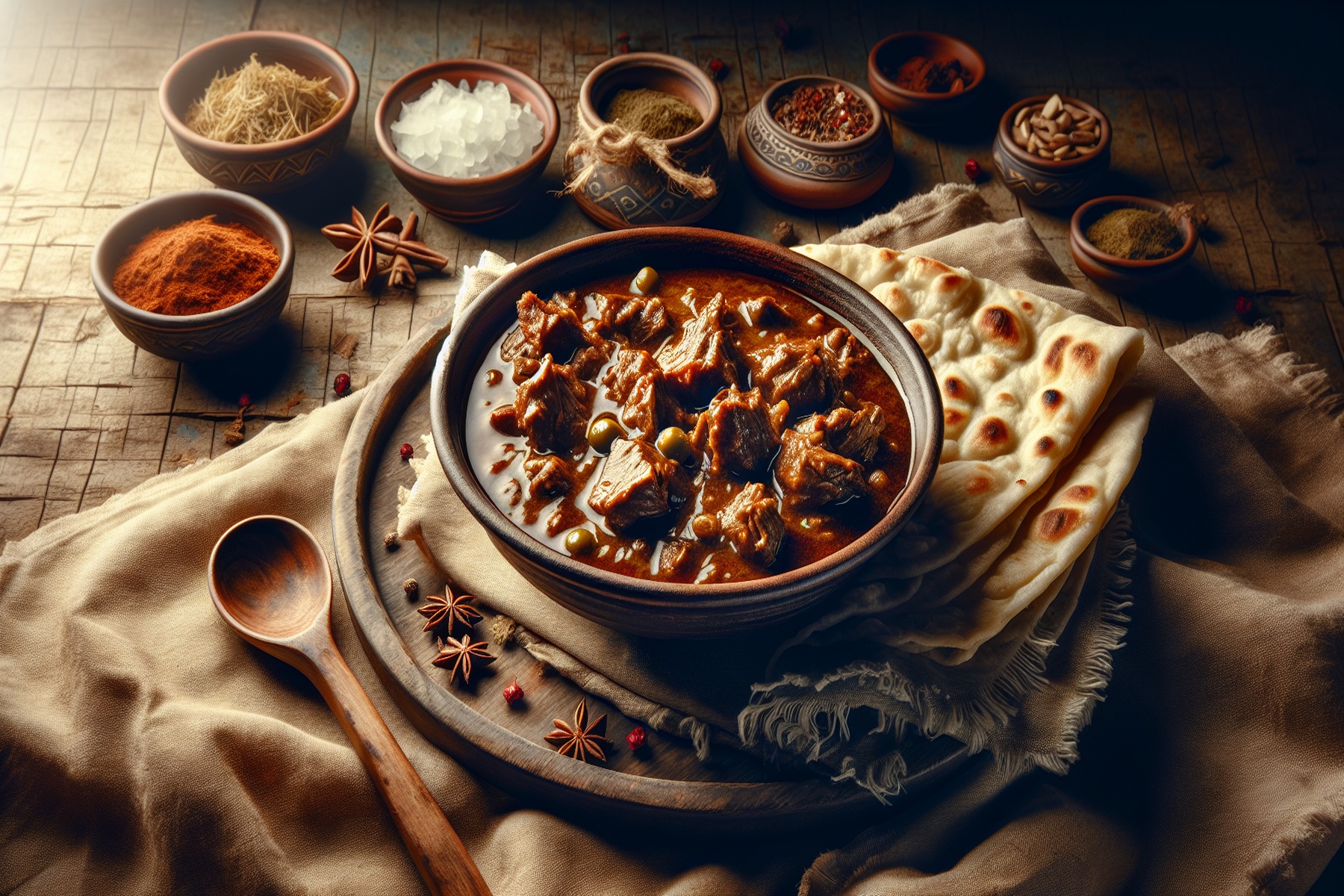
Nihari
Serves 6 · Prep 20 min · Cook 4–6 hours (or overnight) · The one to make
Ingredients: 1,5 kg beef or mutton shank on the bone, in large pieces, plus 2 marrow bones; 150 ml oil or ghee; 2 large onions, thinly sliced; 2 tbsp ginger-garlic paste; 2 tsp salt. Nihari masala: 2 tbsp fennel seed, 1 tbsp coriander seed, 2 tsp cumin, 1 tsp black peppercorns, 6 cloves, 4 green cardamom, 1 black cardamom, 1 small cinnamon stick, 2 bay leaves, 1 star anise, ½ tsp nutmeg, 1 tsp dried ginger powder, 2 tbsp Kashmiri chilli powder (for colour, not heat), 1 tsp turmeric. To thicken: 4 tbsp wholemeal flour in 200 ml cold water. To finish (NOT optional): a large knob of fresh ginger cut into fine julienne; a bunch of coriander, chopped; 3 green chillies, sliced; 2 lemons in wedges.
Method: Toast the whole spices in a dry pan until they smell, then grind with the ground spices. Fry the onions in the oil until deep brown and crisp, lift half out and set aside for the garnish. Add the ginger-garlic paste, then the masala, and fry for a minute. Add the meat and bones and brown all over. Add salt and about 2,5 litres of water, bring to the boil, then cover and cook on the lowest possible heat for four to six hours — overnight in a very low oven is traditional and better. Lift the meat out. Whisk the flour-and-water slurry into the liquid and simmer, stirring, until it thickens to a gravy that coats a spoon; return the meat. The fat will rise and separate into an orange layer — do not skim it. That is the tarri and it is the dish. Serve in bowls, and put the ginger, coriander, chilli, lemon and reserved fried onion on the table so each person finishes their own.
💡 Shank on the bone is compulsory. The collagen is what makes the gravy; a boneless stewing cut gives you a beef curry, not nihari. Kashmiri chilli gives the red without the heat — ordinary chilli powder will make it inedible at that quantity. And it is better the next day, which is why restaurants cook today's for tomorrow.
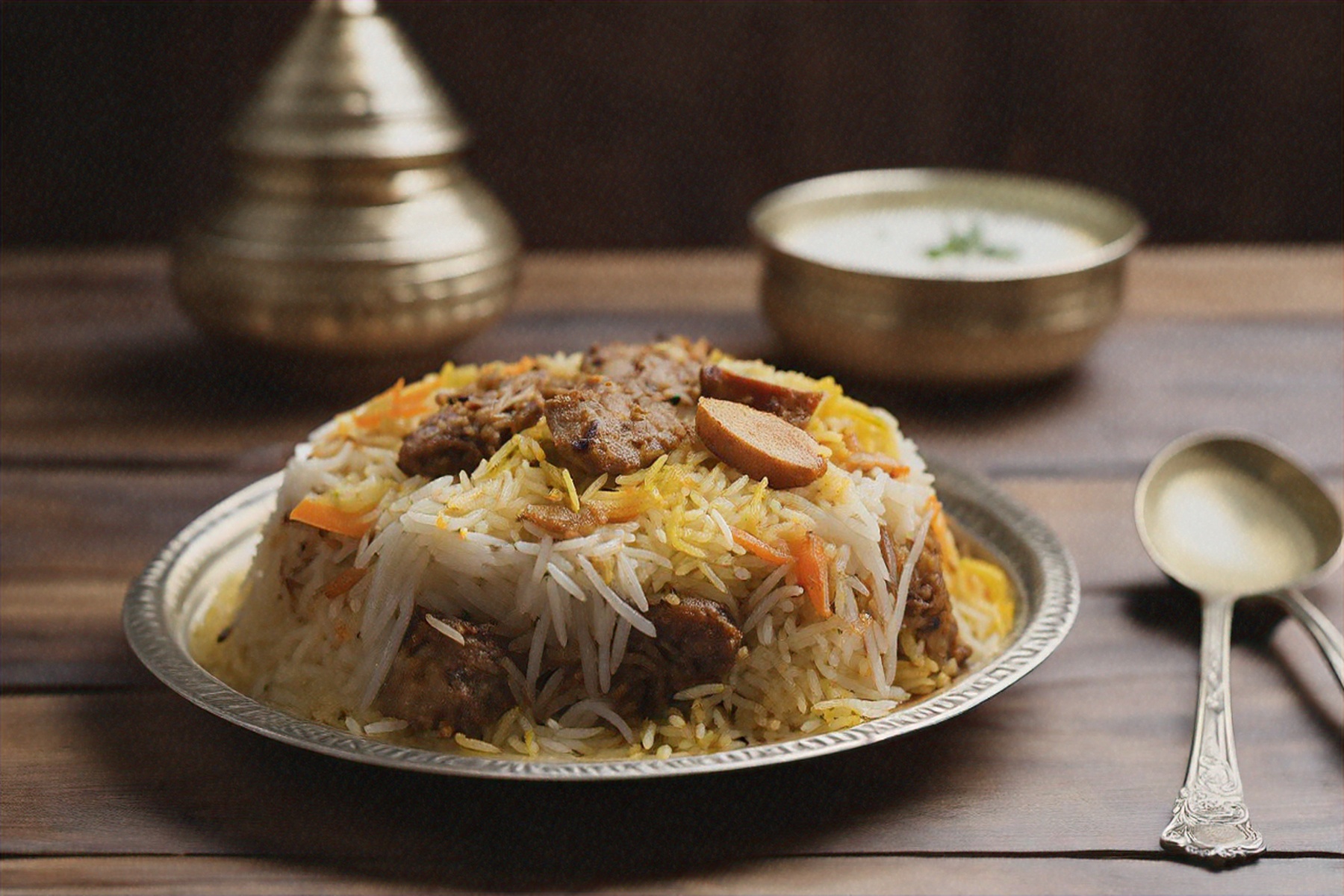
Sindhi-Style Chicken Biryani
Serves 6 · Prep 40 min + 1 hr marinating · Cook 1 hour · With the potato, because Karachi
Ingredients: Meat: 1 kg chicken on the bone, in pieces; 300 g yoghurt; 2 tbsp ginger-garlic paste; 2 tsp Kashmiri chilli powder; 1 tsp turmeric; 2 tsp garam masala; 1 tsp cumin; 2 tomatoes, chopped; 6–8 dried plums (aloo bukhara); 3 potatoes, peeled and halved; 3 green chillies, slit; a large handful each of mint and coriander; salt. Rice: 700 g basmati, soaked 30 min; 3 black cardamom, 1 cinnamon stick, 4 cloves, 2 bay leaves; salt. Layering: 3 onions, thinly sliced and fried to deep brown (birista); a good pinch of saffron in 4 tbsp warm milk; 3 tbsp ghee; a squeeze of lemon.
Method: Marinate the chicken in the yoghurt, ginger-garlic and ground spices for at least an hour. Cook it with the tomatoes, plums, potatoes, chillies and half the herbs over medium heat until the chicken is done and the sauce is thick — about 30 minutes; the potatoes must be soft. Meanwhile boil the rice in heavily salted water with the whole spices until 70 % done — still chalky at the core — and drain immediately. Now layer in a heavy pot: half the rice, all the meat and its sauce, the rest of the herbs and half the fried onion, then the rest of the rice. Drizzle the saffron milk unevenly so the rice is patched orange and white, dot with ghee, scatter the rest of the onion, squeeze over lemon. Cover with a tight lid or foil and cook on the lowest heat for 25 minutes — this is the dum. Do not open it. Fork through from the side when serving so the layers stay visible. Raita and sliced onion alongside.
💡 The potato and the dried plum are the Karachi signature and leaving them out makes it a different city's dish. Rice at 70 % is the single hardest and most important step: fully cooked rice before the dum gives you mush. And no carrot — carrot in the rice is pulao, and the difference is the entire argument in the caption above.
Chapli Kebab
Serves 4 (8 kebabs) · Prep 20 min + 30 min resting · Fry 12 min · Peshawar, and it must be flat
Ingredients: 600 g coarsely minced beef with about 20 % fat (ask the butcher for a coarse mince — fine mince gives the wrong texture); 1 large onion, finely chopped; 2 tomatoes — one chopped into the mix, one sliced for the tops; 2–3 green chillies, chopped; a handful of coriander, chopped; 1 egg; 3 tbsp maize flour (makai ka atta) or fine cornmeal; 2 tbsp coarsely crushed coriander seed; 1 tbsp crushed pomegranate seed (anardana); 1 tsp crushed cumin; 1 tsp red chilli flakes; 1 tsp salt; oil or beef dripping for frying.
Method: Mix everything except the sliced tomato and the oil, using your hands, and rest it in the fridge for thirty minutes. Divide into eight and flatten each into a thin disc 10–12 cm across and about 1 cm thick — they should look too big and too thin, and that is correct. Press a tomato slice into the top of each. Heat a wide flat pan with a generous 5 mm of oil or dripping (a tawa or the biggest frying pan you own) and shallow-fry over medium heat, five to six minutes a side, spooning hot fat over the top as they cook, until deeply browned and crisp at the edges. Serve immediately with naan, raw onion rings and a squeeze of lemon.
💡 The crushed coriander seed and the pomegranate seed are not optional — they are what makes it a chapli kebab and not a burger. Maize flour holds the very loose mixture together and crisps the outside. And they are flat: if you shape them like meatballs you have made something else, which is precisely the mistake in the photograph this page rejected.
💰 Costs
Pakistan is very cheap for a European traveller — among the cheapest countries in this atlas. Figures below are indicative for 2026 and converted at roughly 1 000 PKR ≈ 75–80 Kč. The rupee moves; check before you go.
🥗 Eating
Street food, a plate of biryani or a naan and karahi in a local place: 50–150 Kč. A full meal in a good mid-range restaurant: 200–400 Kč. A rooftop dinner opposite the Badshahi Mosque with the works: 400–800 Kč. Chai: 10–25 Kč. You will struggle to spend money on food.
🛏️ Sleeping
Budget guesthouse: 300–700 Kč. Decent mid-range hotel in Islamabad or Lahore: 1 200–2 500 Kč. A good hotel in Hunza with the Rakaposhi view: 1 000–2 500 Kč. The Serena chain and the restored forts at Shigar and Khaplu are the top end and are genuinely special: 4 000–9 000 Kč.
🚗 Transport
Car with driver, which is how most visitors do the north: 1 500–3 000 Kč a day including fuel, and worth every rupee. Domestic flight Islamabad–Gilgit or Skardu: 800–1 800 Kč. Long-distance bus (Daewoo, NATCO): 150–600 Kč. Ride-hailing in cities: a few tens of crowns per trip.
🏛️ Sites
Entry to most archaeological sites and forts: 50–200 Kč, and foreigners pay more than locals, openly and by posted tariff. Museums are cheap. Trekking permits for the big peaks are a different order entirely — a K2 climbing permit runs into thousands of dollars.
💳 Money
Cash country. Cards work in international hotels and larger city restaurants and essentially nowhere else. ATMs are reliable in cities, patchy in the north — draw enough in Gilgit or Skardu before heading up the valleys. Bring some US dollars or euros to change. Tipping (baksheesh) is expected for service and is small.
⭐ Realistic budgets
Per person per day, excluding international flights. Backpacking, local transport, simple guesthouses: 700–1 200 Kč. Mid-range with a shared car and driver in the north: 2 000–3 500 Kč. Comfortable, good hotels, private driver: 4 000–7 000 Kč. Even the top line is inexpensive by European standards for what you get.
📋 Practical
✈️ Getting there
No direct flights from central Europe. Route via Istanbul (Turkish Airlines), Doha (Qatar), Dubai or Abu Dhabi. Islamabad (ISB) is the best entry point for the north; Lahore (LHE) for Punjab; Karachi (KHI) for Sindh. ⚠️ Indian airspace restrictions since 2025 have lengthened some routings.
🚆 Getting around
Fly between distant cities — PIA and the private carriers connect the main airports cheaply, and the Islamabad–Gilgit and Islamabad–Skardu flights are spectacular when they operate, which is weather-dependent and unreliable. Daewoo runs comfortable intercity coaches on the motorways. Trains are slow, cheap and a genuine experience. In the north, hire a car with a driver.
🏥 Health
No vaccination is required for entry from Europe but hepatitis A and typhoid are strongly advised, and rabies cover is worth considering for the north. Polio is still endemic in Pakistan — check your booster, and note that an exit vaccination requirement can apply to long-stay visitors. Tap water is not drinkable anywhere; bottled water is universal and cheap. Take comprehensive travel insurance including medical evacuation, and check that it does not exclude Pakistan, because some policies do.
📶 Connectivity
Buy a local SIM (Jazz, Zong, Telenor, Ufone) — it needs passport registration and a biometric fingerprint at the shop, takes ten minutes and costs very little. Coverage is good on the plains and in the main northern valleys and absent in the mountains. ⚠️ Mobile internet is shut down locally and without warning around protests, religious processions and security operations. Expect it. Download offline maps.
⚠️ Photography
Do not photograph military installations, checkpoints, bridges, dams or airports. This is enforced and being a tourist is not a defence. Ask before photographing people, and treat photographing women without explicit permission as simply off limits.
🛑 Emergencies
15 police, 1122 ambulance and rescue in most provinces, 16 fire. Register with your embassy. Keep copies of your passport and visa separately from the originals.
⚠️ Three things people get wrong
Distances and altitude. Islamabad to Hunza is 600 km and a full day on the KKH in good conditions; in the monsoon it can be two. Khunjerab is at 4 693 m and you will feel it if you drive straight up from 2 400 m.
Treating the country as one security picture. It is not — see security. Refusing to go anywhere and going everywhere are both wrong answers.
Underestimating the hospitality. Build slack into your days. You will be invited into houses, and the correct answer is usually yes, and it will cost you the afternoon, and it will be the part of the trip you remember.
🇨🇿 For Czech Readers
✈️ Routes from Prague
No direct service. The practical options are Praha → Istanbul → Islamabad/Lahore/Karachi with Turkish Airlines, Praha → Doha → ISB with Qatar, or via Dubai or Abu Dhabi. Return fares typically 14 000–25 000 Kč. Total journey 9–13 hours with one stop.
⚠️ 🛂 The visa, in one line
The free visa-on-arrival that Czech citizens had is gone as of 1 January 2026. You need a paid e-visa from visa.nadra.gov.pk. Apply weeks ahead and use the official site. Full detail in the visa section.
📋 MZV ČR
Read the ministry's Pakistan page before you book — it is one of the more substantial ones, and it distinguishes by region, which is exactly what you need. Czech advice has historically warned against travel to Balochistan, the districts bordering Afghanistan, and areas near the Line of Control, while treating the rest of the country differently. The advisory is the authority, not this page, which will age.
🇨🇿 Embassy
The Czech Republic has an embassy in Islamabad. Note its location and contact details before travelling, particularly if you are going north where a problem takes a long time to reach anyone.
📝 DROZD
Register at drozd.mzv.gov.cz. For Pakistan this is not a formality — the combination of remote mountain travel, roads that close without warning, mobile blackouts and a genuinely regional security picture is exactly the case the system was designed for. Free, five minutes, and it tells the embassy where you are.
🏥 Insurance
Your EHIC is worthless here. Take a commercial policy, check in writing that it covers Pakistan (some Czech policies exclude it or exclude specific provinces), and if you are going above 3 000 m or trekking, check that altitude and mountain rescue are covered by name. A helicopter evacuation from the Karakoram is a very large bill.
A Czech reader's version that works
Two weeks: fly Prague–Istanbul–Islamabad. Two days in Islamabad and Rawalpindi, with Taxila as a day trip. Fly or drive to Gilgit and take a car with driver up the Karakoram Highway — Karimabad for three or four nights, Passu and Khunjerab, then back. Fly or drive south, two days in Lahore, out from there or back via Islamabad. Go in late September or early October for the autumn colour, or in April for the blossom.
Book through a registered Pakistani operator if it is your first visit — it simplifies the visa, puts a driver who knows the KKH under you, and costs a fraction of what the equivalent would in Europe. And take the hospitality seriously: budget more days than the itinerary needs, because you will lose some of them to tea you did not plan on.
✍️ Author's Note
Three things.
The page this replaces had a wine section
The old Pakistan page carried a heading reading “🍷 Wine, Spirits & Drinking Culture”. In a country where alcohol has been prohibited for Muslims since 1977, where 96 % of the population is Muslim, and where buying a drink legally requires a permit certifying that you are not one. It is the clearest example I have found of a template applied to a country without anybody reading the country. Prohibition, Murree Brewery and the permit system are covered in the food section, where they belong, in about a paragraph, which is the right amount.
The images, and one rejection
Four files exist for Pakistan — the richest inventory in several countries and the first with three food photographs. The hero is genuinely good: it reads specifically as Hunza or Gojal in autumn, and every detail that could have been wrong (the braiding of the river, the poplar avenues, the dryness of the slopes beneath the snow) is right. It is a PNG under a .jpg extension, which makes it the thirtieth such file across seventeen countries, but that is a filing problem, not a content one.
The nihari and the biryani are used with long, honest captions: the nihari has olives in it and none of its four defining garnishes, and the biryani has julienned carrot running through it, which makes it a pulao by any reading. Both are still recognisably in the right family and both captions say exactly what is wrong.
The chapli kebab was rejected outright. A chapli kebab is a large flat round patty shallow-fried on a wide pan, and the photograph shows cubed meat on wooden skewers garnished with spring onion — a tikka, or a shish kebab, or something from a different continent, but not this dish in any respect. It is the same category as the North Korean “mandu” that turned out to be a Nepali momo. Unlike Norway, where I kept a wrong photograph because the alternative was a page with one image on it, here there were three others. So it is gone, and this is where it is recorded.
And the actual point
Pakistan is the country in this atlas with the widest gap between its reputation and the experience of visiting it. That gap is not entirely unearned — the security section on this page is long, specific and not reassuring about Balochistan or the Afghan border districts, and it should not be. But Gilgit-Baltistan is one of the safest and most spectacular places in Asia, Lahore is one of the great cities of the Islamic world, the Gandhara collection in Peshawar is the best on earth, and the hospitality is of a kind that European travellers write about for years afterwards.
The honest summary is that Pakistan is a country where knowing which region you are in matters more than in almost anywhere else, and where the reward for doing that homework is unusually large. If this page does one thing, I would like it to be that.
Corrections are welcome and will be made.
Support This Project 🌍
This World Travel Factbook is a labor of love – free to use for all travelers. If you find it helpful, consider supporting its continued development.
