

🇳🇫 Norfolk Island at a Glance
🌍 Overview — a Very Small Place with a Very Long Story
Norfolk Island is 34.6 km² of eroded volcano in the South Pacific, roughly 1 400 km from the Australian coast, 1 100 km from New Zealand and 800 km from New Caledonia — which is to say, a long way from all three. It is eight kilometres by five, it has about 2 190 residents, and it carries more history per square kilometre than almost anywhere else in the Pacific.
Three things happened here that happened nowhere else. Britain used the island as a penal settlement twice, the second time deliberately as the worst place in the empire, and the Georgian town the convicts built is now a UNESCO World Heritage site. In 1856 the entire population of Pitcairn Island — 194 descendants of the Bounty mutineers and their Tahitian wives — was moved here, and their surnames and their language are still the island's core. And in 2015 Australia abolished the island's elected legislature, against the result of a referendum, which is a thing that happens to colonies rather than to parts of a federation.
Where it is
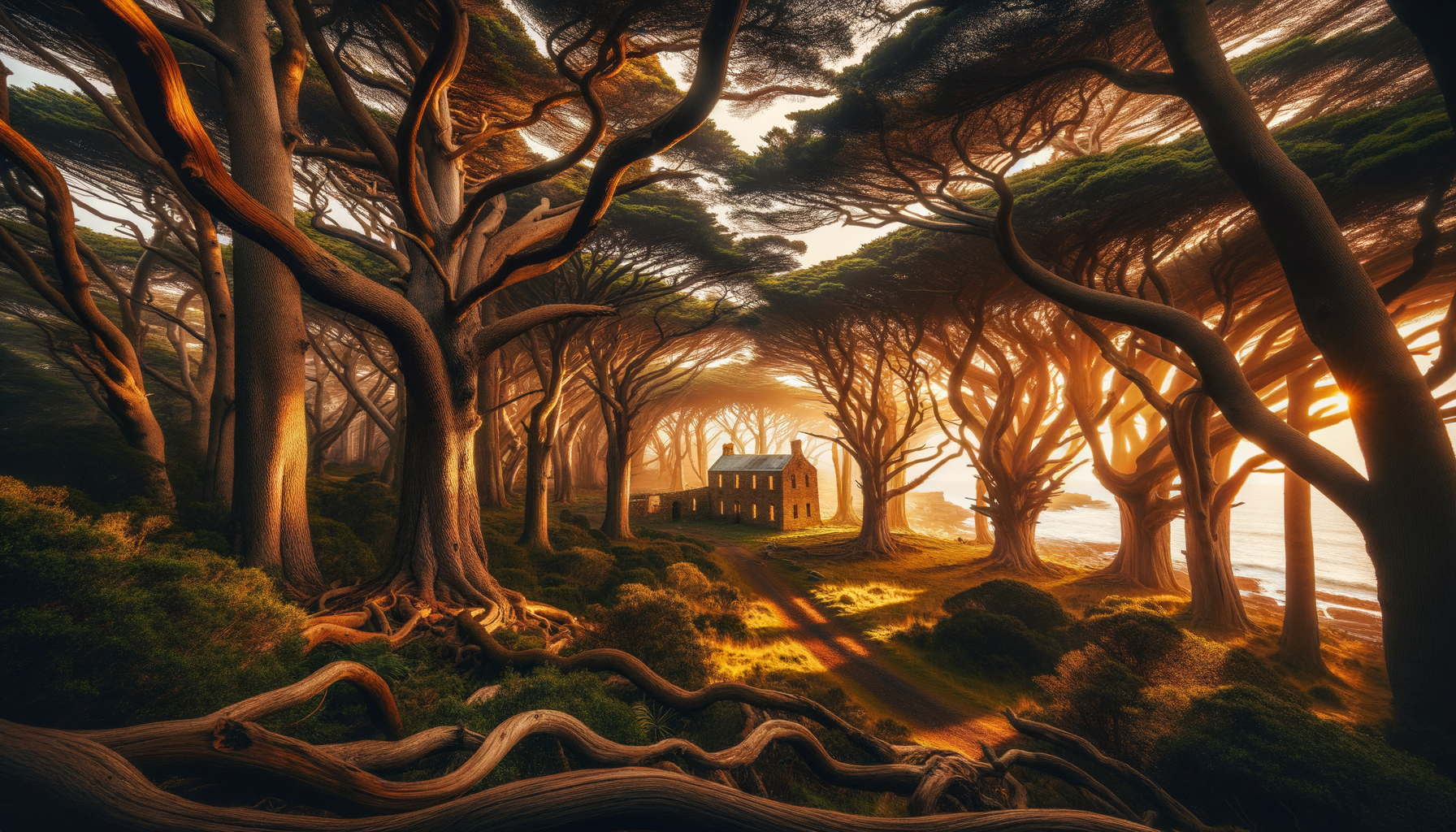
29° south, 168° east, on the Norfolk Ridge that runs from New Zealand up towards New Caledonia. It is subtropical rather than tropical — no coconut palms, no coral atoll, no cyclone belt to speak of — which surprises most first-time visitors, who arrive dressed for Fiji and find something closer to a mild Atlantic island with pines.
What it is
An external territory of Australia, not a state and not a country. Residents are Australian citizens, vote in Australian federal elections (in the ACT division of Bean), pay Australian income tax, and are covered by Medicare — all of which only became true in 2016. See the tax section for what still does not apply.
Who lives here
About 2 190 people. Roughly a third claim Pitcairn descent — the Bounty bloodline — and carry the surnames Christian, Quintal, Adams, Young, McCoy, Buffett and Evans. The rest are mainland Australians and New Zealanders, many of them retirees or people who came for a season and stayed. See the population section.
Two capitals, sort of
Kingston is the historic and administrative seat, a UNESCO-listed Georgian townscape on the south coast with almost nobody living in it. Burnt Pine, up on the plateau, is where the shops, the supermarket, the petrol station and most of the island's daily life actually are. Visitors routinely get this the wrong way round.
The language
Norf'k — a creole of eighteenth-century West Country English and Tahitian, brought from Pitcairn in 1856. It is co-official with English and it is listed by UNESCO as endangered. You will see it on road signs and hear it in shops between islanders; it is not performed for tourists. See the language section.
⚠️ No harbour
There is no port. Cargo ships anchor offshore and everything — cars, cement, frozen food, the year's beer — is transferred into lighters and rowed and motored ashore through the swell at Kingston or Cascade, whichever side is calmer that day. It is done by volunteers with a whaleboat heritage, it is the single most important fact about life here, and it is in its own section.
🏷️ Named for a Duchess Who Never Came
Norfolk
James Cook named it in October 1774 for Mary Howard, Duchess of Norfolk, a patron of his voyages. She had in fact died in 1773, more than a year before he wrote the name into his journal — news travelled slowly. She never saw the island and neither did anyone in her family. The name has no other connection to the place at all.
What islanders call it
Norfk in the creole, and among themselves simply "the island". People who belong to the Pitcairn lines are Norfolk Islanders in a specific sense that excludes recent arrivals; people who moved here are "mainlanders" or "blow-ins" for a long time, sometimes permanently. The distinction is polite but it is real, and it underlies almost every political argument on the island.
⚠️ Not that Norfolk
It has nothing to do with the English county, and nothing to do with Norfolk, Virginia. Search engines and airline booking systems routinely confuse all three. The IATA code is NLK; the ISO country code is NF, which the island has despite not being a country, because it was administratively separate long enough to earn one.
The flag
Three vertical bands — green, white, green — with a Norfolk pine in the middle. Adopted in 1979 with self-government. It is one of very few flags in the world whose central device is a specific botanical species, and it tells you exactly what the island thinks it is.
The anthem
"Come Ye Blessed", a hymn set to music by John Prindle Scott, sung as the island's anthem and inseparable from Bounty Day. Advance Australia Fair is the official national anthem; which one gets sung, and in what order, has been a quiet political statement here for decades.
Nine hundred kilometres of nothing
The nearest permanently inhabited land is New Caledonia. The nearest Australian territory is Lord Howe Island, itself tiny, about 900 km south-west. Norfolk's isolation is not the tropical-paradise kind; it is the kind where a dental emergency means waiting for Thursday's plane.
🪨 The Stump of a Volcano
Norfolk is the eroded remnant of a basaltic shield volcano that built itself up from the Norfolk Ridge between roughly 3.1 and 2.3 million years ago — geologically very recent, and long extinct. What is left is the tough core. The sea has taken the rest, which is why the island is ringed by cliffs on almost every side.
The shape of it
A rolling plateau at roughly 100–200 m above the sea, tilted gently and cut by small valleys, ending in cliffs of 60 to 100 m on the north and west. The highest point is Mount Bates at 319 m, with Mount Pitt at 318 m beside it — the two effectively share the summit ridge and the national park that covers it.
Why the soil is good
Basalt weathers into deep red-brown clay loam that holds water and feeds heavily. Norfolk grows things the surrounding latitude has no business growing: beef cattle on genuinely green pasture year-round, bananas, avocado, citrus, guava, passionfruit. The First Fleet chose the island in 1788 precisely because it looked fertile, and on that narrow point it was right.
⚠️ And why there is no water
A small volcanic island has no aquifer worth the name. There are no rivers — the two "creeks" at Kingston and Cascade run in wet weather and not otherwise. Almost every household depends on roof catchment and tanks, topped up by bores that draw on a thin lens. Droughts are a genuine crisis here, and visitors are asked — seriously, not decoratively — to take short showers.
Nepean and Phillip
Two satellites. Nepean Island is a 10-hectare limestone slab just off Kingston, quarried by the convicts for the sandstone their buildings are made of. Phillip Island, 6 km south, is a 190-hectare volcanic remnant of astonishing colour — red, ochre, purple — because goats, pigs and rabbits stripped its vegetation to bare rock. See the Phillip Island section.
The reef
A small fringing coral reef encloses Emily and Slaughter Bays at Kingston — the southernmost coral reef in this part of the Pacific, and the reason Emily Bay is the island's only genuinely calm swimming water. It is a marginal, cool-water reef at the edge of what coral can do, which makes it both fragile and scientifically interesting.
No cyclones, mostly
Norfolk sits south of the main South Pacific cyclone track. Systems do reach it — usually already weakening — but the island does not have the annual flattening that Vanuatu or Fiji live with. The real weather problem is swell, which decides whether a ship can unload and sometimes whether the plane can land.
🌲 Araucaria heterophylla — the Tree That Is the Island
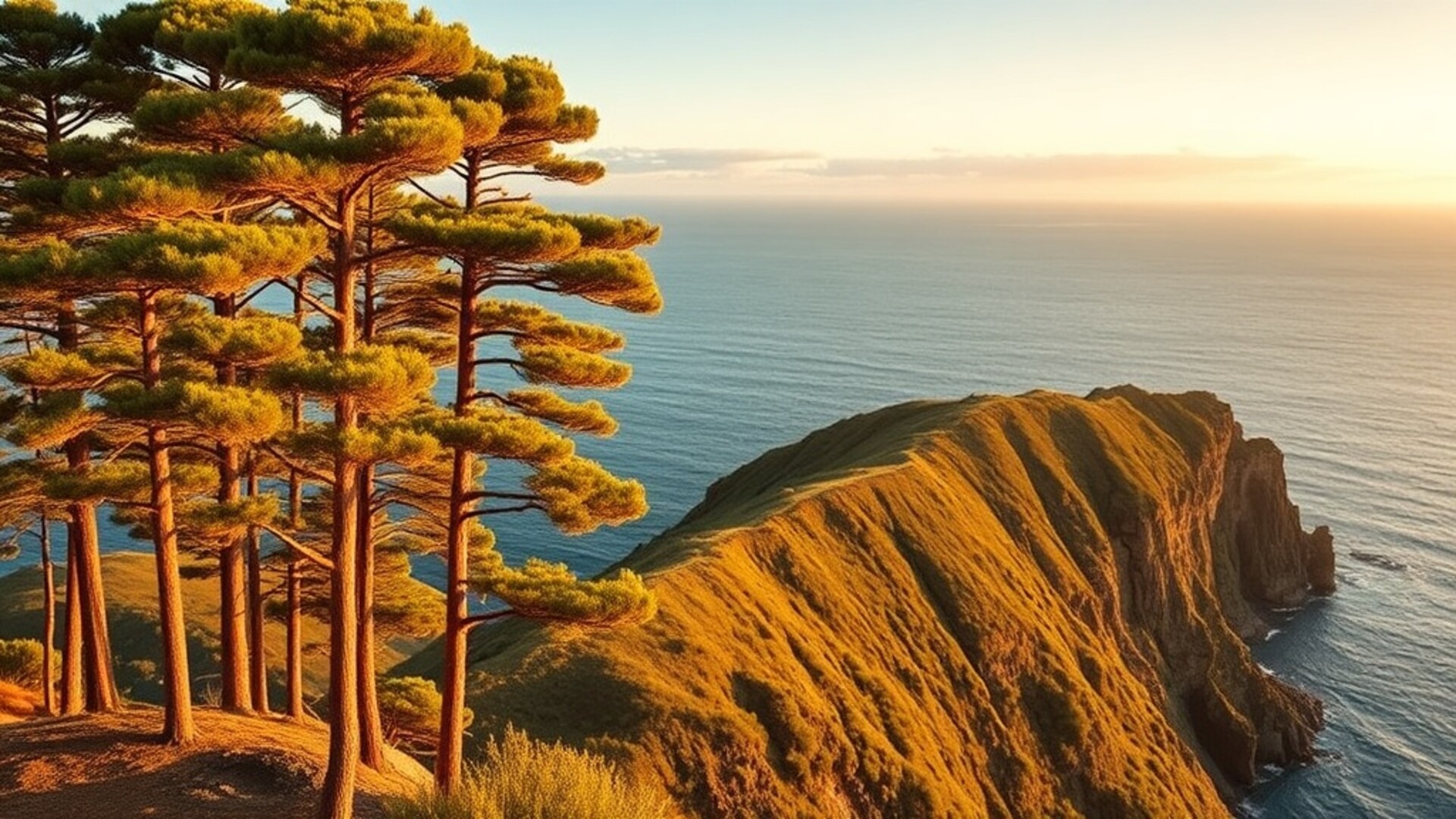
The Norfolk Island pine is not a pine. It is an araucaria, a southern-hemisphere conifer from a lineage older than flowering plants, and it grows nowhere in the wild except here. You will recognise it anywhere in the world by one feature: it is dead straight, with branches coming off the trunk in flat, evenly spaced horizontal tiers, one whorl per year, like a child's drawing of a Christmas tree. Nothing else looks like it.
The Royal Navy's disappointment
Cook saw the pines in 1774 and reported them as a potential source of ship masts and spars — and the flax growing beneath them as a source of sail canvas. This was a strategic argument for settling the island, and it was the main reason the First Fleet sent a party here within six weeks of reaching Sydney. Both ideas failed completely: Norfolk pine is brittle and knotty and snapped under load, and nobody in the settlement knew how to dress flax. See the First Settlement.
What it does instead
It has become one of the world's most widely planted ornamental trees — a seafront tree in Australia, California, South Africa and the Mediterranean, and a pot plant sold as a "baby Christmas tree" across the northern hemisphere. Almost nobody buying one knows it comes from an island of two thousand people.
Growing it
Up to 50–65 m in the wild. Tolerant of salt spray and wind — the reason it lines so many promenades. The young foliage is soft and needle-like, the mature foliage scaly, which is what heterophylla, "different-leaved", refers to.
Avenue of Pines
The most photographed stretch of road on the island: a double row planted along the Kingston approach, with the ruins framed at the end of it. There is a standing island rule that you do not cut a pine without very good reason, and proposals to remove one for a view or a driveway have started genuine public rows.
⚠️ What is killing them
Mature pines around the island have been dying back for years. The causes are argued over — soil compaction, drought stress, root damage from development, salt, and a dieback associated with root pathogens — and the honest answer is that it is probably several at once. Replanting programmes run continuously; the island is aware that its emblem is not doing well.
Not the only araucaria
Its closest relatives are the Cook pine of New Caledonia (which leans, famously, always towards the equator), the bunya and hoop pines of Queensland and the monkey puzzle of Chile. Many trees sold worldwide as "Norfolk Island pine" are in fact Cook pines — a mix-up that runs from garden centres all the way into stock photography.
🌊 The Coast, and the One Place You Can Swim
Norfolk's coastline is mostly cliff. That is the first thing to understand before you book: this is not an island of beaches. The swimming, such as it is, happens in one small protected corner, and everywhere else the sea is deep, cold-ish, powerful and worth respecting.
⭐ Emily Bay
The exception, and the reason Kingston has always been where people gathered. A fringing reef encloses a shallow lagoon of clear, calm, genuinely warm water backed by pines and the convict ruins. It is safe for children, good for snorkelling, and beautiful in a way that photographs badly because the scale is small. Almost everyone's favourite place on the island.
Slaughter Bay
Next door, inside the same reef, shallower and rockier, with more coral visible at low tide and the wreck of the HMS Sirius — flagship of the First Fleet, lost on the reef in March 1790 — lying in a few metres of water. An anchor and a cannon from her are on display ashore. The name is older than the convicts and refers to a slaughterhouse, not an event.
Anson Bay
The one sandy beach on the north coast, reached by a steep path down a gully. Beautiful, exposed, and not a safe swim in most conditions — there is no reef, and the surf and rips are serious. People go for the walk and the view, and stay out of the water.
Ball Bay and Cascade
Working coasts on the east side. Cascade Bay has the island's second landing pier and takes the freight when the southerly swell rules Kingston out. Ball Bay is a black rocky cove with a dramatic cliff backdrop, and is where the island's fuel is pumped ashore from a tanker lying offshore.
Captain Cook's Monument
A lookout on the north coast at the spot where Cook's party is believed to have come ashore — one of the best places on the island to watch weather come in off an empty ocean. Nearby Duncombe Bay has the same cliffs without the car park.
⚠️ The water rules
Swim at Emily Bay unless you know the island well. Do not swim alone anywhere else. The cliffs are undercut and crumbling in places, and the marked tracks exist for a reason. There is a small hospital on the island but serious cases are flown to Australia, which takes hours and costs a great deal if you are uninsured — see practical information.
🦜 Birds, Bees and an Ecosystem Under Repair
For an island this small and this heavily settled, Norfolk retains a startling amount of endemic life — and has lost a startling amount too. Its remaining native forest is concentrated in the Norfolk Island National Park, about 460 hectares across the Mount Pitt section and Phillip Island, and much of the conservation work here is less about protection than about active repair.
⭐ The green parrot
Cyanoramphus cookii, the Norfolk Island green parrot or Tasman parakeet, found nowhere else. It fell to about thirty birds in the 1980s — one of the tightest bottlenecks any bird has survived. Predator-proof nest boxes, rat and cat control and a translocation to Phillip Island have pulled it back into the hundreds. It is still endangered and still the conservation story that defines the island.
The boobook that ended
The Norfolk Island boobook owl went down to a single female, "Miamiti", by 1986. Two males of the closest New Zealand subspecies were introduced and she bred with one of them. Her descendants live on the island today as a hybrid population — the pure subspecies is gone, which is a genuinely uncomfortable conservation outcome and is discussed honestly on the island rather than glossed over.
What was lost
The Norfolk kākā, the Norfolk ground dove, the Norfolk starling and others are extinct, most of them within a century of European settlement. The convicts ate what they could catch, the cats and rats took the rest, and the forest that fed them was cut for timber and pasture.
Seabirds
The cliffs and Phillip Island carry big colonies: masked boobies, red-tailed tropicbirds, sooty terns, wedge-tailed shearwaters and the providence petrel, which was eaten to local extinction in the First Settlement and has since begun nesting on Phillip Island again. The white tern — Gygis alba, locally the "angel bird" — nests in the town's trees and lays its single egg on a bare branch with no nest at all.
⭐ The healthiest bees on earth
Norfolk's honeybees are, from a disease point of view, the cleanest population in the world: successive CSIRO surveys have found no varroa mite, no small hive beetle, and neither American nor European foulbrood. No other honeybee population is known to have fewer pests and pathogens. This makes the island a genetic reserve of real international value — and it makes its biosecurity rules, which look absurdly strict at the airport, entirely rational.
⚠️ What you must not bring
No honey, no bee products, no fresh fruit, vegetables, seeds, plants or soil. Declare everything; the inspection on arrival is thorough and the fines are real. It is not theatre — one contaminated jar could end the bee population's clean status permanently.
🏝️ The Polynesians Who Came, and Went
Norfolk was not uninhabited when Cook found it — it was abandoned. That distinction matters, and it took archaeology two centuries to establish it.
⭐ Emily Bay
Excavations behind Emily Bay from the 1990s onwards found a Polynesian settlement: a stone marae platform, adzes, fishhooks, rat bones and banana phytoliths. Radiocarbon dating puts occupation somewhere in the 13th to 15th centuries, most likely by people from the Kermadecs or New Zealand — the East Polynesian voyaging world at its furthest western reach.
How long they stayed
Probably a few generations, possibly longer. The site is small and the material is limited, and the honest reading is that a modest community lived here and then either left or died out. There is no evidence of violence and no evidence of a catastrophe.
Why they left
Nobody knows. The plausible readings: the island is genuinely small and marginal, with no lagoon fishery worth the name and no reliable fresh water; a voyaging network that could resupply it collapsed; or a bad run of years simply ended it. All three may be true at once.
What they left behind
Besides the marae: the Polynesian rat, bananas and probably the ti plant. Cook's party found bananas growing and assumed them native. The island Europeans arrived at in 1774 was a recovering ecosystem carrying the marks of an earlier human episode, not a pristine one.
Why it matters now
It matters politically. The current population's claim to the island rests on the 1856 resettlement, not on continuous indigenous occupation — but Norfolk sits inside the Polynesian world by prehistory as well as by the Tahitian half of the Pitcairn line. The islanders' case for self-determination leans on both.
Nepean and the dating
Some of the sharpest evidence comes from excavations around Nepean Island and the Kingston flats, where convict-era construction had already disturbed the ground. Norfolk archaeology is unusually difficult: two convict settlements bulldozed, quarried and built over exactly the coastal flat where the earlier people had lived.
⛵ Cook, 10 October 1774
The landfall
Cook sighted the island on his second voyage, on 10 October 1774, in Resolution, on the run between New Caledonia and New Zealand. He landed the following day at what is now Duncombe Bay on the north coast, spent a matter of hours ashore, and left. It was, by his standards, a trivial stop.
What he reported
Two resources. The pines, which he thought would make masts and spars for the Navy, and the flax (Phormium tenax), which he thought would make canvas and cordage. Both mattered enormously to an empire whose naval stores came from the Baltic and could be cut off by war.
⚠️ Why he was wrong
Norfolk pine has a brittle, knotty grain and splits under the loads a mast carries; the trials at Kingston failed. And nobody in the colony knew how to process flax — the technique was a closely held Māori skill. Two Māori men were eventually brought to the island to teach it, found the work was women's work in their own society, and could not help. The entire strategic case for settling Norfolk Island collapsed within a few years of settling it.
The naming
He named it for Mary Howard, Duchess of Norfolk — who, unknown to him, had died the previous year. See the name section.
Between Cook and the convicts
Fourteen years of nothing. The island sat empty and unvisited from 1774 to 1788, its only role a line in the instructions Arthur Phillip carried to Botany Bay.
The instruction
Phillip's orders explicitly told him to secure Norfolk Island "as soon as circumstances admit" — partly for the pines and flax, and partly to keep the French from taking it. He acted on it almost at once: the party sailed from Sydney on 14 February 1788, barely three weeks after the First Fleet landed.
⚓ The First Settlement, 1788–1814
Norfolk Island is the second-oldest European settlement in the South Pacific after Sydney, founded within weeks of it. Its first life lasted twenty-six years and ended with the government demolishing everything it had built.
⭐ 6 March 1788
Lieutenant Philip Gidley King landed at Kingston with fifteen convicts and seven free men. There was no harbour then either — getting ashore through the reef took several days and nearly killed the attempt. King was twenty-nine, competent, and would later be Governor of New South Wales.
HMS Sirius
The First Fleet's flagship was wrecked on the Slaughter Bay reef on 19 March 1790 while landing supplies. Everyone survived; the stores did not, and the island — then holding more than 500 people, many sent from a starving Sydney — came close to famine. The wreck lies in shallow water and is one of Australia's most significant maritime archaeological sites.
Mount Pitt bird
What saved them was the providence petrel, which nested on Mount Pitt in enormous numbers and could be taken by hand at night. The settlement ate an estimated 170 000 birds in a few months. It saved the colony and exterminated the species on Norfolk Island — one of the starkest small-scale illustrations of what European settlement did to Pacific ecosystems anywhere.
What it became
By 1792 over a thousand people lived here — for a while, a third of the entire European population of Australia. It was not a punishment station in this period so much as a farm colony: convicts, marines, and emancipated settlers on land grants, growing grain for Sydney.
The Irish rising, 1800
A planned rebellion by Irish convicts was betrayed and put down. Two men were hanged without trial on the word of the acting commandant; the episode is remembered on the island and was condemned in Sydney at the time.
⚠️ Demolished on purpose
From 1805 London decided the island cost more than it returned, and ordered it abandoned. Everyone was removed, mostly to Van Diemen's Land, over almost a decade. The last settlers left in February 1814 — and before they went, the buildings were deliberately destroyed, so that no other power could use them. For eleven years the island was empty again.
⛓️ The Second Settlement, 1825–1855 — "the Extremest Punishment Short of Death"
The island's second life was designed, explicitly and in writing, to be the worst place in the British Empire. Governor Sir Ralph Darling's instruction was that Norfolk Island should be a place where "the felon who is sent there is forever excluded from all hope of return", and where the punishment fell just short of death. It was reopened in 1825 for convicts who had reoffended after transportation — the secondary punishment of the secondary punishment.
The regime
Chains, the lash, the treadmill, the gaol gang, solitary cells built to hold a man without light. Floggings of a hundred lashes or more were routine and were administered on a triangle that stood in public. Men worked quarrying stone, burning lime and building the very town whose ruins tourists now walk through.
⚠️ The 1834 mutiny
A rising was crushed and thirteen men were hanged. Father William Ullathorne, the Catholic vicar-general who came to tell the condemned men their fate, recorded what is probably the single most quoted sentence about the place: the men who learned they were to die "dropped on their knees and thanked God", while those reprieved "wept bitterly". Ullathorne went home and campaigned against transportation itself, and his testimony helped end it.
Alexander Maconochie, 1840–1844
The exception, and an important one. Maconochie ran the island for four years on a "marks system" — prisoners earned credits towards release through work and good conduct rather than serving a fixed sentence under fixed brutality. Reoffending among the men he released was remarkably low. He was recalled for being soft, the old regime returned, and his ideas went on to become the basis of parole and indeterminate sentencing worldwide. The modern penal system's founding experiment happened on this island.
What they built
The Georgian town at Kingston: the Commissariat Store, the New Gaol, the crescent of officers' houses along Quality Row, the Pier Store, the Royal Engineers' Office, the salt house, the windmill, the cemetery. It is handsome, well-proportioned colonial architecture built by men being destroyed, and the dissonance is the point.
The end
Public opinion in Britain, Ullathorne's evidence and the sheer cost closed it. Transportation to eastern Australia wound down, the convicts were moved to Port Arthur in Van Diemen's Land, and the last of them left in May 1855. The island was empty for a second time — but this time the buildings were left standing, because a use had already been found for them.
The cemetery
The convict cemetery below Quality Row is the most affecting thing at Kingston and takes twenty minutes to read properly. Headstones for soldiers, for children, for men killed "by the hand of a fellow prisoner", and for the executed. Names, ages, and in a few cases sentences. Nobody leaves it cheerful.
🏛️ KAVHA — Why Kingston Is on the World Heritage List
The Kingston and Arthur's Vale Historic Area — KAVHA — was inscribed on the UNESCO World Heritage List in 2010 as one of the eleven Australian Convict Sites, alongside Port Arthur, Hyde Park Barracks, Fremantle Prison and the rest. It is the only World Heritage property in the South Pacific outside the major landmasses, and it is a living town rather than a museum.
What is listed
Roughly 225 hectares of the Kingston flat and Arthur's Vale behind it: the standing Georgian buildings, the ruins, the cemetery, the archaeological deposits of both convict settlements, the Polynesian site at Emily Bay, and the landscape that connects them. The listing is for the whole ensemble, not for individual buildings.
Quality Row
A street of officers' and officials' houses from the 1830s–40s, several still lived in, several open as museums. No. 9 Quality Row is furnished as a commandant's household; No. 10 houses the Pier Store collections. Walking a street where the buildings are simultaneously World Heritage, a museum and somebody's home is the particular Norfolk experience.
The four museums
The Commissariat Store (the Sirius collection, including the anchor and cannon), the Pier Store, No. 9 Quality Row and the Norfolk Island Museum archaeology displays. One ticket covers all of them and it is easily the best value on the island. Allow most of a day.
⭐ What it is for
The Australian Convict Sites were listed for what they show about forced migration and the punishment of crime in the modern age — the global system that moved 166 000 people to the far side of the world. Norfolk's specific contribution is the extreme end of that system, and, through Maconochie, the beginning of the idea that punishment might be designed to reform.
⚠️ The tension
KAVHA is managed jointly by the Commonwealth and the island, and the relationship is not always easy. Residents live inside a World Heritage buffer zone with real constraints on what they can build and change, and there is a persistent local view that heritage management is another way Canberra runs the island. Conservation funding also competes with roads, the hospital and the pier.
How to see it
Walk it, early, before the tour buses. The Sound and Light show at the ruins runs in the evening and is genuinely good; the convict settlement walking tour with a local guide is better than reading the plaques, because most guides are descended from someone in the story.
✝️ The Melanesian Mission, 1866–1920
Between the convicts and the modern island there was a third Norfolk, and it is the one most visitors never hear about. For fifty-four years the island was the headquarters of the Anglican Melanesian Mission, which trained young men from across the Solomons, Vanuatu and the Banks Islands and sent them home as teachers and clergy.
Why here
Bishop John Coleridge Patteson moved the mission's base from New Zealand to Norfolk in 1866, partly for the climate — students from the tropics were dying of cold in Auckland — and partly because Norfolk sat conveniently between Melanesia and the colonial world. The Pitcairners, ten years settled, gave up land for it.
⭐ St Barnabas Chapel
The mission's chapel, completed in 1880 as a memorial to Patteson, is the finest building on the island and one of the finest in the Pacific: designed in the Gothic Revival by Robert Henry Codrington's circle, with stained glass by William Morris's firm to designs by Edward Burne-Jones, an inlaid Melanesian shell-work rose window, and a roof shaped like an upturned boat. It is still in use. Go in.
⚠️ Patteson's death
Patteson was killed on Nukapu in the Solomons in September 1871, almost certainly in reprisal for a blackbirding raid — labour traders had kidnapped islanders shortly before, and the bishop paid for it. His death caused an outcry in Britain that led directly to legislation against the Pacific labour trade. The chapel is his memorial.
What the mission did
It taught in Mota, a Banks Islands language, as a lingua franca, trained hundreds of Melanesian clergy and teachers, and ran a printing press. Its approach — training local people to evangelise their own islands rather than sending Europeans — was unusual for its time and is still cited in mission history.
Why it left
The mission moved to Siota in the Solomons in 1920, to be among the people it served. It left behind the chapel, a cluster of mission buildings now used by the island, and a set of graves.
What remains
St Barnabas, the mission cemetery, and a real connection between Norfolk and Melanesia that shows up in unexpected places — in the shell inlay in the chapel, in island surnames, and in the fact that Norfolk's Anglican parish still sits in the Diocese of Melanesia rather than an Australian one.
⚓ 8 June 1856 — the Whole of Pitcairn Moves In
This is the event the island's identity is built on. On 8 June 1856 the chartered ship Morayshire landed at Kingston with 194 people — every single inhabitant of Pitcairn Island, the great-grandchildren of the Bounty mutineers and the Tahitian women who sailed with them. Queen Victoria had granted them Norfolk Island, empty since the convicts left the year before, because Pitcairn at two square kilometres could no longer feed them.
The backstory in one card
28 April 1789: Fletcher Christian seizes HMS Bounty from William Bligh in Tongan waters and sets Bligh adrift with eighteen loyal men — who then sail an open launch 6 700 km to Timor, one of the great feats of seamanship. 1790: nine mutineers, six Tahitian men and twelve Tahitian women settle uncharted Pitcairn and burn the ship. Within a decade almost all the men have killed one another. 1808: an American sealer finds the colony — one surviving mutineer, John Adams, and a community of women and children.
⚠️ Why they left Pitcairn
Not romance — arithmetic. Pitcairn is 4.6 km², has no harbour and almost no flat land, and the population had grown past what it could feed. An earlier attempt to move everyone to Tahiti in 1831 had been a disaster: a dozen died of disease within months and the survivors went home. Norfolk was the second try, and the islanders accepted it knowing what the first had cost.
What they found
A furnished, emptied prison town. They moved into the officers' houses on Quality Row, took over the farms and the convict-built infrastructure, and had to be talked out of some of their initial horror at the place. They also brought Pitcairn's land-sharing customs, which fit awkwardly onto a landscape laid out by the Royal Engineers.
Not everyone stayed
Sixteen people returned to Pitcairn in 1859 and another twenty-seven in 1864 — homesick, or unhappy with Norfolk, or unwilling to share the island with the newly arrived Melanesian Mission. Their descendants are the present population of Pitcairn, which is why the two communities are, quite literally, cousins.
⭐ The surnames
Christian, Quintal, Adams, Young, McCoy, Buffett, Evans, Nobbs. Roughly a third of Norfolk's present residents descend from the 1856 arrivals, and in the 2021 census over a thousand people reported Pitcairn ancestry. A local joke holds that every fifth person in the phone book is a Christian, and it is not far off.
What was promised
The islanders' consistent position for 170 years has been that the grant of 1856 was made to them as a people, in perpetuity, and carried a measure of self-rule that no later Australian statute could simply take away. Canberra's position is that Norfolk Island became a territory of the Commonwealth in 1914 and that Parliament may legislate for it as it pleases. That disagreement is the whole of modern Norfolk politics — see the self-determination section.
✈️ The Airfield That Changed Everything, 1942
Norfolk had been a quiet backwater for eighty years when the Pacific War arrived. What it left behind — an airfield — did more to change the island than any political decision before or since.
Why it mattered
Norfolk sat on the air ferry route between New Zealand, New Caledonia and the Solomons. An aircraft could not make the leg without a refuelling stop, and Norfolk was the only land available. That single geographic fact turned a farming island into a strategic asset overnight.
The build
New Zealand engineers and the 2nd New Zealand Expeditionary Force arrived in 1942 and cut an airstrip across the plateau. Building it meant felling a great many Norfolk pines and taking over a large slice of the island's best farmland — both of which were resented at the time and are still mentioned.
N Force
A garrison of around 1 500 New Zealand troops was stationed here, on an island whose civilian population was well under a thousand. Radar stations, gun emplacements and a hospital went up. The island saw no combat: a Japanese submarine was reported offshore and that was the extent of it.
⭐ What it left
The runway. Everything about modern Norfolk — tourism, freight of anything perishable, medical evacuation, the ability to leave in a hurry — depends on an airstrip built for a war the island had no part in. Without it Norfolk would be a two-day sail from anywhere and would probably have a few hundred residents.
The other legacy
A generation of islanders worked alongside New Zealanders and Americans, saw money and outside life, and did not simply go back to subsistence farming afterwards. The post-war drift towards a cash economy, and towards tourism, starts here.
⚠️ And the weeds
Wartime construction brought in soil, machinery and fodder, and with them the invasive plants that the national park is still fighting — African olive, red guava, hawaiian holly and lantana among them. Norfolk's ecological crisis has a datable beginning, and a good part of it is 1942.
🗳️ Self-Government, 1979–2015
For thirty-six years Norfolk Island governed itself. It is important to be precise about how much: this was never independence, and it was always exercised under an Australian Act that could be amended. But it was real, it was elected, and the islanders regarded it as the modern form of what was promised in 1856.
The road to it
Australia took over administration in 1914 under the Norfolk Island Act 1913. Discontent ran through the 1960s and 70s and produced the Nimmo Royal Commission (1976), which recommended full integration with Australia. The islanders rejected that comprehensively, and the Fraser government came back with the opposite: the Norfolk Island Act 1979.
What it created
A Legislative Assembly of nine members, elected by a system where each voter had nine votes and could give up to four to any one candidate — an unusual weighted plurality designed for an electorate with no parties. From it came an executive of ministers and a Chief Minister. The Assembly legislated on almost everything domestic; Canberra kept defence, foreign affairs and a reserve power to disallow.
The financial deal
Norfolk ran its own economy, raised its own revenue, and received no Australian income support. In exchange islanders paid no Australian income tax and got no Medicare, no pension and no unemployment benefit. Health cover was a compulsory local scheme; if you could not work you were supported by family or you left. It was, for those years, a small self-funding welfare-free society — and it worked while the tourists came.
⚠️ Why it stopped working
Tourism carried it, and tourism collapsed. The 1990s Asian financial crisis, the end of cheap package deals, the failure and repeated relaunch of the island's airline, competition from Fiji and Bali, and finally the 2008 global crisis — visitor numbers fell by well over half from their peak. Revenue went with them. By 2010 the Norfolk Island government could not pay for its own hospital and was going to Canberra for money.
The Road Map
In 2011 the island signed a "Road Map" with the Commonwealth: Australian taxes and Australian services in exchange for funding, phased in. Many islanders voted for it as a rescue. What they did not expect was that the political half — the Assembly — would be abolished on the way through. See the next section.
What the period built
A functioning small government: its own immigration control, its own GST, its own courts and registry, a telecom, a public service and a genuinely distinct legal code. Much of it has since been repealed or absorbed — but the institutional memory is still on the island, in people who used to run it and are now in their sixties and seventies.
⚠️ 2015 — the Year the Parliament Was Switched Off
In March 2015 the Australian Parliament passed the Norfolk Island Legislation Amendment Act. It abolished the Legislative Assembly, ended self-government, and extended Commonwealth law, taxation and services to the island in full. The Assembly's last sitting was in June 2015. This is the single most contested event in modern Norfolk history and it is impossible to write about the island honestly without setting out both cases.
⚠️ The referendum
In May 2015, with the legislation already before Parliament, the island held its own referendum. On a turnout of about two-thirds, 68 % voted that Norfolk Islanders should freely determine their political status and their economic, social and cultural development, and that they should be consulted about any change. Canberra proceeded anyway. The referendum was non-binding; that it happened at all, and what happened next, is why the word colony gets used here.
The Commonwealth's case
The island was insolvent. It could not fund a hospital, an ageing population had no pension, the infrastructure was decaying and the government of 1 800 people was running a parliament, a cabinet and a public service it could not pay for. Extending Australian tax and services meant Medicare, the PBS, the age pension, unemployment benefit and Commonwealth capital funding — in hard terms, most residents were financially better off afterwards.
The islanders' case
Nobody disputed the money. What was disputed was the trade. A community with its own language, its own descent line and a 1856 grant it regards as constitutional had its elected legislature removed by a parliament it has five hundred votes in, after a vote telling that parliament not to. Australian citizens elsewhere were not asked to give up a legislature to receive Medicare. The word used on the island is annexation.
What replaced it
A Norfolk Island Regional Council — an ordinary Australian local council, operating under New South Wales law applied to the territory, with the powers of a shire: roads, waste, planning. It was elected in 2016. Everything above that level moved to a Commonwealth Administrator and the federal department.
And then that went too
The Council was suspended in 2020 and dissolved in 2021, on grounds of financial management and governance, and replaced by appointed Administrators. From 2021 Norfolk Island had no elected body of any kind — not a parliament, not even a council. For a community of Australian citizens that is an extraordinary position, and it lasted years.
The health of the argument
Two federal parliamentary inquiries, a NSW-model council, a dissolved council, a governance committee, a promised new Assembly and repeated delays. Whatever one thinks of 2015, the decade since has not produced a settled arrangement, and that failure is now part of the islanders' argument rather than Canberra's.
🏛️ How Norfolk Island Is Actually Run, 2026
As of September 2026 the island is in the middle of a transition that has already slipped more than once. Here is the position as it stands, stated plainly, because almost everything written about Norfolk governance online is out of date.
Who is in charge now
Two Commonwealth-appointed Administrators of the Norfolk Island Regional Council, whose appointments have been extended to 31 December 2026 to carry the island through to the new arrangement. Above them sits the federal Administrator of Norfolk Island and the Department of Infrastructure, Transport, Regional Development, Communications, Sport and the Arts.
⭐ The new Assembly
The Commonwealth has committed to a bespoke Norfolk Island Assembly: five elected members including a full-time presiding officer, on four-year terms, empowered to make local laws supporting local service delivery. It is a considerably smaller body than the nine-member Assembly of 1979 and its powers are local-government-plus rather than a restored legislature.
⚠️ When
The inaugural elections have been pushed back more than once, most recently to allow further community consultation, which is why the Administrators' terms were extended to the end of 2026. Anyone planning around a specific election date should check the Department's own page rather than trusting any secondary source, this one included.
The federal vote
Norfolk Islanders vote in Australian federal elections in the ACT division of Bean for the House and in the Australian Capital Territory for the Senate — an arrangement dating from 2016 that islanders find absurd, since the ACT is 1 600 km away and shares nothing with them. Before 2016 voting was optional and in the Northern Territory.
Courts and law
The Supreme Court of Norfolk Island survives, with judges who fly in. Most applied law is now New South Wales law as a Commonwealth applied-law scheme, administered under service delivery agreements with NSW and Queensland — which is why an island 1 400 km from Sydney has NSW road rules and a Queensland health arrangement.
The other government
A separate body styling itself the Government of Norfolk Island operates from the self-determination movement and has held its own assemblies — most recently in May 2026 — pursuing constitutional recognition. It is not recognised by Australia and has no administrative power, and it should not be confused with the Commonwealth arrangements above. It is, however, a real expression of local opinion and is treated seriously on the island.
🇺🇳 The Case at the United Nations
Norfolk Island is the only part of Australia with an active campaign to be listed by the United Nations as a non-self-governing territory — that is, formally, as a colony awaiting decolonisation. Whatever one makes of the merits, it is a serious, documented campaign and it is not going away.
Who is running it
Norfolk Island People for Democracy, which reports around 1 300 registered supporters on an island of 2 190 people — a proportion no mainland campaign group would recognise. It has filed two petitions: one to the UN Special Committee on Decolonisation (the C24), and one to the Human Rights Council.
The legal argument
That under UN General Assembly Resolution 1514 (XV) of 14 December 1960 and the Charter's Chapter XI, Australia was obliged to list Norfolk Island as a non-self-governing territory and has never done so; that the 1856 grant created a distinct people with a right to self-determination; and that abolishing an elected legislature against a referendum is precisely the conduct the decolonisation framework exists to address.
Australia's position
That Norfolk Island is an integral part of Australia, that its residents are Australian citizens with the full rights of citizens including the federal franchise, that the 2015 reforms increased their entitlements, and that the question of listing is settled. Australia has not listed the territory and shows no sign of doing so.
⚠️ What it would take
Listing is a decision of the General Assembly, in practice on the C24's recommendation, and it is not something a petition alone achieves. Territories have been added — but rarely, slowly, and usually with the support of regional blocs. Readers should treat claims that listing is imminent, from any direction, with caution.
The wider echo
The campaign has attracted attention in New Zealand and the Pacific, and an Early Day Motion on Norfolk Island self-determination has been tabled in the UK House of Commons — a procedural device with no legislative force, but a marker of the argument that the island's original grant came from the Crown rather than from Canberra.
How it feels on the island
Not uniformly. Plenty of residents — particularly mainland arrivals and younger people — regard the campaign as backward-looking and would rather argue about the hospital, the pier and the cost of freight. Others, particularly in the Pitcairn-descended families, regard it as the central unfinished business of their community. Both views are held sincerely and both turn up in the same conversation.
👥 Who Lives Here — 2 190 People and Two Kinds of Belonging
The 2021 census counted 2 188 residents, up from 1 748 in 2016 — though the jump is partly a change in how the count was done, since Norfolk was enumerated as part of the Australian census for the first time. The working figure today is around 2 190. It is a small number with a complicated shape.
⭐ Pitcairn descent
The 2021 census was the first to ask, and over a thousand people — close to half the resident population, and a majority of those with long family ties — reported Pitcairn Islander ancestry. That single statistic is why the island's politics is not an ordinary local-government argument.
The other half
Mainland Australians and New Zealanders: retirees drawn by the climate and, before 2016, the tax; people who came to work a season in tourism or trades and stayed; a small professional cohort on contract in health, education and administration. Turnover among the last group is high.
⚠️ Immigration, before and after
Until 2016 Norfolk ran its own immigration system and controlled who could settle. That power is gone: any Australian citizen may now move to Norfolk Island as of right. To islanders this is the deepest of the 2015 changes — the end of a community's ability to decide who joins it — and it is felt far more than the tax change.
Ageing
The island skews distinctly old. Young people leave for education and work in Australia and New Zealand, many do not return, and the retiree inflow pushes the median up further. School enrolment at Norfolk Island Central School (the island's only school, K–12, running the NSW curriculum) is the number locals watch to judge whether the community is holding.
Religion
Historically split between the Church of England — via the Melanesian Mission, and still in the Diocese of Melanesia — and the Seventh-day Adventists, who have been on the island since the 1890s and are a notably large minority for a place this size. The Adventist presence is one reason the island's food culture includes more vegetarian cooking than you would expect.
Everybody knows everybody
There are no street addresses in the mainland sense for much of the island, mail goes to a post office box, and the phone book is thin enough to read. This has the obvious upsides and the obvious downsides: crime is close to nonexistent, and privacy is close to nonexistent too.
🗣️ Norf'k — Eighteenth-Century English Meets Tahitian
Norf'k (also written Norfuk) is what happens when nine English sailors and a dozen Tahitian women are marooned together for eighteen years with no one to talk to but each other. It is a creole built from late-eighteenth-century English — much of it West Country and nautical — and Tahitian, carried to Norfolk from Pitcairn in 1856 and spoken here ever since.
Status
Co-official with English on Norfolk Island since the Norfolk Island Language (Norf'k) Act 2004. You will see it on road signs, on shop fronts and in the names of places. UNESCO listed it as endangered in 2008, and that listing was not alarmist.
⚠️ How endangered
Estimates of fully competent traditional speakers run as low as a few per cent of the population, concentrated among older islanders. Most younger speakers use a variety heavily levelled towards English. The language is being taught in the school, dictionaries have been published and signage has been rewritten — but the honest picture is a language being consciously maintained rather than one being naturally transmitted.
What it sounds like
Watawieh yorlyi? — "how are you all?" Whutta way ye? — "how are you?" Kushu — good, fine. Gwen — going. Yorlye — you (plural), from "you all". Sullun — person, from "soul". Dem tull — "they tell", used the way English uses "apparently".
Tahitian in the grammar
The Tahitian layer is thickest in words for food, plants, family and the sea: plun (banana), hihi (periwinkle), miti (a coconut sauce), uwa (rain). The pronoun system and some verb marking also show Polynesian influence rather than English.
Its nearest relative
Pitkern, spoken on Pitcairn Island, from which it separated in 1856. Linguists usually treat them as one language, Pitkern-Norf'k, with two varieties — one of the very few languages in the world whose date and circumstances of birth are known exactly.
How to behave about it
Learn watawieh, use it, and do not push further. Norf'k is spoken between islanders and switching to English when a visitor joins a conversation is normal politeness, not exclusion. Asking someone to "say something in Norfolk" lands about as well as it would anywhere else.
💹 An Economy Built on Visitors and Held Up by Canberra
Norfolk Island's economy is tiny, narrow and fragile in a way that a mainland reader has to work to imagine. There is essentially one export industry — tourism — and when it falters there is nothing to take up the slack.
⭐ Tourism
The overwhelming employer, directly and indirectly. The visitor profile is distinctive: predominantly Australian, older, repeat, and staying a week or more rather than a weekend. It is a market with real loyalty and a real demographic problem, since it is ageing alongside the island. Attempts to broaden it — history, birdwatching, walking, food — are the island's main marketing project.
What else there is
Cattle on that good volcanic pasture, supplying the island with beef; small-scale horticulture; Norfolk pine seed, once a genuine export to the world's nurseries; the Norfolk Island Liqueur Company, which makes fruit liqueurs; honey, whose value is as much genetic as culinary; and a modest amount of public-sector and construction work.
⚠️ Why everything costs so much
Freight. Nothing arrives except by a ship that anchors offshore roughly monthly, or in an aircraft hold. Every item you buy in the supermarket has crossed 1 400 km of ocean and then been lifted into a small boat and rowed through surf. Budget on paying a third to a half more than mainland Australia for groceries, and considerably more for anything bulky.
The airline problem
The island's connection has been repeatedly reinvented and repeatedly failed — Norfolk Air in its various forms, then Air New Zealand on the trans-Tasman leg, now Qantas on the Australian routes. Each failure took a chunk out of visitor numbers, and the island's economic history since 1990 can be read almost entirely off its flight schedule.
The Commonwealth's share
Since 2016 Canberra funds the hospital, the school, much of the infrastructure and the social security payments that did not previously exist. Norfolk is now a net recipient of Australian public money, which is the Commonwealth's strongest argument and, simultaneously, precisely what islanders who wanted to stay self-funding feared.
Land and housing
Land is tightly held, much of it in long-established families, and housing costs have risen sharply since the mainland-residency rules were lifted. Building materials arrive by lighter, so construction is slow and expensive. The result is the familiar small-island squeeze: local wages, semi-mainland property prices.
💵 The Tax Position — and Why the Shops Are Still Duty-Free
Norfolk Island's fiscal position is genuinely unusual and is frequently reported wrongly, so it is worth being exact. Since 1 July 2016 residents pay Australian income tax and receive Medicare, the PBS and the full range of Australian social security. But the indirect tax system was not extended.
⭐ No GST
The Norfolk Island GST of 12 % ceased on 1 July 2016, and Australian GST does not apply on Norfolk Island. Nor do customs duty, excise, the luxury car tax or the wine equalisation tax. The island sits outside Australia's indirect tax and customs territory.
What that means in a shop
Norfolk remains a genuine duty-free destination for perfume, spirits, cosmetics, watches and cameras — a large part of the traditional Australian visitor's shopping ritual. The saving is real, though freight eats into it on bulky goods and the range is limited by what a small island can stock.
⚠️ Going the other way
Goods you send or carry from Norfolk Island to mainland Australia are treated as imports, which means Australian GST and duty can apply at the border and there is a duty-free allowance to observe. Buying a case of spirits on the island and flying it to Sydney is not a loophole; it is an import.
The local levies
The island raises revenue through its own import levies under the Norfolk Island Customs arrangements, plus fuel and other charges. This is why a bottle in the supermarket can be cheaper than Sydney and a litre of fuel considerably dearer.
Businesses
Norfolk businesses deal with the ATO like any other Australian business for income tax, but their GST position with the mainland has its own rules — the ATO publishes a dedicated Norfolk Island section. Anyone trading across the boundary should read it rather than assume.
For a visitor
In practice: bring an Australian card, prices are in Australian dollars, there is no tax refund scheme to chase because there is no tax to refund, and the duty-free shops are just ordinary shops. Card acceptance is good but not universal — carry some cash for markets and small operators.
🚢 No Harbour: How Everything Gets Ashore
Norfolk Island has no port, no wharf that a ship can come alongside, and no sheltered anchorage. This is not a quaint detail. It is the single hardest constraint on life here, it has been unchanged since 1788, and watching it happen is the most extraordinary thing a visitor can see on the island.
How it works
A cargo ship arrives roughly monthly and anchors offshore. Crews take out flat-bottomed lighters, the ship's derricks swing containers and pallets down into them, and the lighters run in through the surf to the ramp at Kingston or, if the southerly swell is up, at Cascade on the other side. Everything comes ashore this way: cars, cattle feed, timber, frozen food, fuel drums, a year's beer.
⭐ Who does it
Largely volunteers, working in crews that descend directly from the island's whaleboat tradition — the Pitcairn families were boat handlers before they were anything else, and the skills came with them in 1856. When the ship is in, the island's working population goes to the pier and the shops empty out. It is treated as a community obligation rather than a job.
⚠️ When it fails
If the swell is wrong on both coasts, the ship waits, or leaves. A missed ship means weeks without fresh stock — supermarket shelves visibly thin, building projects stop, and anything perishable has to come by air at air-freight prices. Residents keep deep pantries as a matter of routine, and visitors should not be surprised to find a restaurant out of something.
Fuel
Petrol and diesel arrive by tanker standing off Ball Bay and are pumped ashore through a floating line. Same constraint, same weather dependency, and it is why fuel on the island costs what it does.
Why there is no pier
Every serious study says the same thing: the geology and the swell make a deep-water harbour extraordinarily expensive for a population of two thousand, and the cost has never cleared the bar in Canberra. Upgrading the Cascade and Kingston piers has been on and off the federal agenda for decades and remains the island's number-one infrastructure ask.
Go and watch
If a ship comes in while you are there, drop what you are doing. There is no equivalent spectacle anywhere else in the developed world: a twenty-first-century supply chain ending in an open boat and a line of people on a stone ramp.
📡 Phones, Internet and the .nf Domain
Getting online
Norfolk was on satellite for years, with the latency and the price that implies. Low-earth-orbit satellite service has changed things substantially since the early 2020s and the island is now far better connected than its size suggests — but it is still not mainland broadband, and public wifi in accommodation ranges from good to notional. Check before you book if you need to work.
Mobile
The island runs its own network, Norfolk Telecom. Australian mobile plans do not simply work here — Norfolk is outside the mainland carriers' domestic footprint and roaming arrangements are limited and can be expensive. Most visitors buy a local prepaid SIM on arrival, and most accommodation will tell you to.
The .nf domain
Norfolk Island has its own country-code top-level domain, .nf, allocated because ISO gave it the country code NF. It is little used compared with the money-spinners other micro-territories have made of theirs — .tv, .nu, .io — and Norfolk has never monetised it at that scale.
Post
Norfolk Island issues its own postage stamps, which is both a real service and a small revenue stream, and a card posted from Kingston with a Norfolk stamp is the island's most reliable souvenir. Mail goes by air and is not fast.
Media
Norfolk Island Radio (VL2NI) broadcasts locally, and The Norfolk Islander and Norfolk Online News cover island affairs. For anyone following the governance argument, the local outlets carry material — submissions, transcripts, open letters — that never reaches the mainland press, and they are the best single source on what islanders actually think.
⚠️ Emergencies
Emergency number is 000. The island has a small hospital with limited surgical capacity; anything serious means an aeromedical evacuation to Australia, which depends on weather and aircraft availability and can take many hours. This is the single most important line in the practical section — see below.
🏛️ Kingston — the Town Nobody Lives In
Kingston is the capital, the World Heritage site, the landing place and the historic heart, and its permanent population is in the low dozens. It occupies the one flat piece of coast on the island, between the reef and a green amphitheatre of hills, and it is the reason most people come.
⭐ Quality Row
The Georgian street, built in the 1830s–40s for officers and officials: white stone, shuttered windows, verandahs, a row of them facing the sea. Several are museums, several are private homes, and the effect of the whole terrace at low sun is the single best sight on the island.
The ruins
The New Gaol, the Prisoners' Barracks, the Crank Mill — powered by convicts on a treadmill — the salt house, the Royal Engineers' Office, the Pier Store, the Commissariat Store. Some roofed and in use, most open to the sky, all of it walkable in an afternoon and none of it fenced off in the way a mainland site would be.
The cemetery
Down by the sea, and the place that stays with people. Convicts, soldiers, settlers, Pitcairners and children, in rows, with inscriptions that do not spare the reader. Take your time and read them; the island expects visitors to, and there is no better short course in what happened here.
Government House
Built in 1829 and one of the oldest continuously occupied houses in Australia, still the Administrator's residence. It opens to the public on limited days. The setting — lawn, pines, a view down to the reef — explains a good deal about how the commandants saw themselves.
Emily Bay
At the end of the flat: the reef-enclosed lagoon that is the island's only proper swimming water, backed by pines, with the ruins a few hundred metres behind you. Described in the coast section. The combination — World Heritage convict town and a beach for the children — is unrepeatable.
⚠️ Two notes
The Kingston flat floods in heavy rain, which is one reason so little of it is lived in. And the whole area is a live archaeological deposit: stay on paths, do not move stones, and do not take anything off the ground, including a piece of convict brick. People do, and the island notices.
🌲 The National Park, Mount Pitt and the Walks
Norfolk Island National Park covers about 460 hectares — the Mount Pitt section in the island's north plus all of Phillip Island — and it protects the last substantial remnant of the subtropical rainforest that once covered everything. It is small enough to walk across in a morning and rich enough to be worth several.
The summits
Mount Bates (319 m) is the true high point; Mount Pitt (318 m) next to it has the road, the car park and the view, and is what everyone means when they say they went up the mountain. On a clear day you see the whole island at once, Phillip and Nepean offshore, and nothing else in any direction.
What grows there
Genuine subtropical rainforest with a high proportion of endemics: the Norfolk pine above the canopy, and beneath it the Norfolk Island palm (Rhopalostylis baueri), the smooth tree fern (Cyathea brownii, the tallest tree fern in the world), bloodwood (Baloghia inophylla), ironwood (Nestegis apetala) and the endangered Phillip Island hibiscus. Something like forty-plus plant species grow nowhere else.
The walks
A well-signed network: the Palm Glen loop through palm forest, Red Road, the Bridle Track, Captain Cook's Monument on the north coast, and the summit tracks. Most are an hour or less. This is walking rather than trekking — but it rains, the clay turns greasy, and proper shoes matter.
⭐ Birdwatching
The park is where you see the green parrot, the Norfolk Island golden whistler, the slender-billed white-eye and the Norfolk gerygone. Early morning, quietly, on the Palm Glen or Bridle tracks. A guide is worth it for the endemics; on your own you will still hear plenty.
⚠️ What the rangers are fighting
Weeds and rats. African olive, red guava, hawaiian holly, lantana and cherry guava crowd out regeneration, and rats and cats take eggs and chicks. The park runs continuous control and replanting, and much of what looks like intact forest is actively maintained ground rather than wilderness.
Practicalities
Park entry is included in the same pass as the Kingston museums. There is a picnic area near the Mount Pitt road. Do not expect phone coverage in the valleys, and tell someone where you are going if you are walking alone.
🏝️ Phillip Island — the Red Rock Coming Back to Life
Six kilometres south of Norfolk, and visible from almost everywhere on the south coast, is a 190-hectare lump of volcanic rock in colours no landscape should be: red, ochre, purple and orange, banded and gullied like something out of the American southwest. It is the most spectacular view on the island and it is a scar.
⚠️ What happened to it
Pigs, goats and rabbits were put ashore in the convict era as a meat reserve. With no predators they stripped the island to bare rock — vegetation gone, topsoil gone, the underlying volcanic strata exposed. The colours everyone photographs are the colours of catastrophic erosion. It is one of the clearest before-and-after demonstrations of introduced grazers anywhere in the Pacific.
The eradication
Goats went in 1908, pigs by the early twentieth century, and the rabbits were finally eradicated in 1988 after a long and difficult campaign. Since then Phillip Island has had no introduced mammals at all — which makes it one of the very few predator-free islands in this part of the Pacific.
⭐ The comeback
Vegetation is returning, slowly, with heavy replanting help. The Phillip Island hibiscus (Hibiscus insularis) — down at one point to two wild clumps and among the rarest plants on earth — survives there. Seabirds have come back in force: masked boobies, red-tailed tropicbirds, wedge-tailed shearwaters, and the providence petrel, eaten to extinction on Norfolk in 1790, now nesting again on Phillip.
The parrots
Because it has no cats and no rats, Phillip Island was chosen as the insurance site for the green parrot. Birds translocated there have bred, which means the species is no longer one bad year on one island away from extinction. It is the conservation decision the island is proudest of.
Getting there
By boat, weather permitting, with a licensed operator, and landing is steep, exposed and not casual — it involves a chain-assisted climb from the rocks. Trips are limited and cancelled often. Most visitors see Phillip Island from the Kingston side or from the boat, and that is no disgrace.
Nepean
The third island, 10 hectares of limestone just off Emily Bay, quarried by the convicts for the calcarenite that Kingston is built from. Seabirds nest there; landing is restricted. On a still day it is an easy paddle away and it looks it — which is exactly how people get into trouble.
⚓ Bounty Day, 8 June
The island's national day, and the best single reason to plan a trip around a date. On 8 June Norfolk Island commemorates the 1856 landing of the Pitcairners, and it does so not with a parade for tourists but with a re-enactment that the descendant families take entirely seriously.
What happens
The descendants gather at the Kingston pier in period dress — the women in long dresses and bonnets, the men in white shirts and straw hats — and come ashore as their great-great-grandparents did. They march up to the cenotaph, lay a wreath, then to the cemetery to lay flowers on the graves of the original arrivals.
⭐ The picnic
Then the whole island sits down on the grass at Kingston to a communal lunch of island food — the traditional dishes, in quantity, shared out — followed by speeches, the singing of "Come Ye Blessed" and the Pitcairn anthem, and dancing. It runs all afternoon.
Who takes part
Formally, the descendants of the 1856 arrivals. In practice the whole island turns out and visitors are welcome to watch and, generally, to be fed. The distinction between participating and attending is real and worth respecting: this is a family occasion that happens in public, not a show.
What to do if you are there
Go early, dress tidily, be quiet during the wreath-laying and the cemetery, and ask before photographing individuals. Accommodation books out for the week around it — plan months ahead, not weeks.
The other days
Anniversary Day (6 March) marks the 1788 landing; Thanksgiving, on the last Wednesday in November, is a genuinely unusual survival brought by American whalers in the nineteenth century and still kept, with churches decorated in produce; Foundation Day, Show Day and the agricultural show fill the rest of the calendar.
⚠️ The tension inside it
Bounty Day celebrates a grant from the Crown to a people. Since 2015 it has also, unavoidably, become an assertion — the day the island states in public who it thinks it is. Nobody says so from the podium, and everybody hears it.
🎶 How the Island Behaves
⭐ The Norfolk wave
You wave at every car you pass. Every one. It is a lift of the index finger off the steering wheel, and failing to do it marks you out within a day. Visitors who pick it up are forgiven a great deal else.
⭐ Cows have right of way — legally
Cattle roam free across the island's roads and commons, tagged and owned but essentially at large, and they have right of way in law: the Traffic Regulation provides that no one shall negligently or wilfully prevent, hinder or interrupt the free passage of any person, vehicle or cattle on the road. You stop. They do not. The speed limit is 50 km/h, and 40 in town, and the cows are the reason.
Nobody locks anything
Cars are left with the keys in them at the shops; front doors stay open. This is real, not a brochure line, and it rests on everyone knowing everyone. It also means that the island's rare crimes are felt very personally.
Music and church
Singing is central and is done well — hymn singing in particular, with the four-part harmony the Pitcairn tradition carried from Pitcairn. St Barnabas on a Sunday is worth attending whatever you believe; so is the smaller All Saints at Kingston.
Weaving and craft
Hat and basket weaving from Norfolk pine needles, palm and banana leaf is a living craft with a Tahitian pedigree, taught and sold on the island. Buy from the makers at the markets rather than from the airport.
⚠️ What not to say
Do not call it part of New South Wales. Do not describe the 2015 changes as "joining Australia" in front of someone whose family has been here since 1856, and do not assume which side of the argument the person in front of you is on — the island is genuinely split and the split runs through families. Listen first; you will get the whole story unprompted within a day.
🍽️ Eating on Norfolk — Tahiti by Way of Eighteenth-Century England
Norfolk food is one of the world's genuinely small cuisines, and it comes from one of the world's strangest recipes: Tahitian ingredients and technique, handled by people speaking sailors' English, on a subtropical island where the growing season never really stops. The green banana does most of the work. The sea does the rest.
⭐ Mudda
The island's signature. Green bananas — plun in Norf'k — grated raw, bound with flour and salt, rolled into dumplings and simmered, usually in coconut milk. Starchy, dense, faintly sour from the unripe fruit, and completely unlike any banana dish a visitor is expecting. It exists because unripe bananas were what there was.
⭐ Pilhi
The baked sibling. Grated banana (green or ripe) or sweet potato, mixed with flour, sugar and coconut, pressed into a dish and baked into a solid, sliceable pudding. Pilhi plun is the banana version, pilhi kumara the sweet potato one. Served in squares, warm or cold, sweet or savoury depending on the household.
⭐ Hihi pie
Hihi are the small black periwinkles prised off the rocks at low tide, and gathering them is part of gwen rumma — going foraging — which is a genuine island pastime rather than a heritage exercise. The winkles are boiled, picked out with a pin, and baked into a pie. It takes a very long time to fill one pie, which is why it appears at feasts and why islanders are slightly smug about it.
Tahitian fish
Raw fish — usually trevally, kingfish or whatever came off the boat — cubed and marinated in lemon juice until it firms, then dressed with coconut cream, onion and tomato. The direct Polynesian inheritance, cousin to Tahitian poisson cru, Samoan oka and Niuean ota ika. The fish must be fresh; on Norfolk it generally is.
The rest of the table
Island beef from the roaming cattle, and it is good — grass-fed, and the animal has had a better life than most. Fish of every kind. Kumara, taro, avocado by the crate in season, guava, passionfruit, lemons that fall off the tree. And honey from the healthiest bees in the world, which tastes of whatever flowered that month.
⚠️ Where to eat it
Not, mostly, in restaurants. The traditional dishes appear at island feasts, progressive dinners, fish fries and the Bounty Day picnic, and a visitor who only eats in cafés will go home having had a competent steak and no Norfolk food at all. Book a island-food dinner or a progressive dinner early in your stay — it is the best-value thing you will do.
📖 Three Recipes You Can Actually Cook
Adapted for a kitchen a long way from Norfolk Island. The green bananas are the hard part and everything else is easy; plantains from any Asian or African grocer will do, and so will the greenest, hardest ordinary bananas you can find.
Mudda — green banana dumplings in coconut milk
Serves 4 · 20 min prep · 25 min cooking · the island's defining dish
Ingredients: 6 green bananas or 4 green plantains · 120 g plain flour · 1 tsp salt · 400 ml coconut milk · 250 ml water · 1 small onion, finely chopped · optional: 200 g diced beef or smoked fish
Method: Peel the green bananas under running water or with oiled hands — the sap stains and sticks. Grate them coarsely into a bowl; they will be wet and will darken quickly, which is fine. Work in the flour and salt until you have a stiff, sticky dough, adding a little more flour if it will not hold. Roll into dumplings the size of a walnut. Bring the coconut milk, water and onion (and the meat or fish, if using) to a bare simmer in a wide pan — do not let coconut milk boil hard or it splits. Drop the dumplings in, cover, and simmer very gently for 20–25 minutes until they are firm through and the liquid has thickened. Serve in bowls with the sauce.
💡 Unripe is the whole point. A yellow banana gives you sweet mush, not mudda.
Pilhi plun — baked banana slice
Serves 8 · 15 min prep · 50–60 min baking · the Bounty Day tray bake
Ingredients: 8 ripe bananas (or 6 ripe + 2 green, for texture) · 150 g plain flour · 100 g sugar · 200 ml coconut cream · 60 g butter, melted · 1 tsp baking powder · pinch of salt · optional: 50 g desiccated coconut
Method: Heat the oven to 180 °C. Grease a 20 × 30 cm tin. Grate or mash the bananas — grated gives the traditional slightly fibrous texture, mashed gives a smoother slice. Beat in the sugar, coconut cream and melted butter. Fold in the flour, baking powder, salt and coconut; the batter should be thick enough to hold a spoon mark. Spread into the tin and level it. Bake 50–60 minutes until the top is deep gold and a skewer comes out clean. Cool in the tin — it firms as it cools and cuts badly warm. Cut into squares.
💡 For the savoury version, swap the bananas for grated sweet potato, drop the sugar to a tablespoon and add salt and pepper — that is pilhi kumara, and it goes with the beef.
Tahitian fish — the island's raw fish
Serves 4 · 20 min plus 30 min marinating · no cooking
Ingredients: 600 g very fresh firm white or oily fish (kingfish, trevally, snapper, tuna) · juice of 6–8 lemons · 200 ml coconut cream · 1 small red onion, very finely sliced · 2 tomatoes, seeded and diced · 1 cucumber, diced · salt · optional: chilli
Method: Cut the fish into 1.5 cm cubes, discarding any bloodline. Put it in a glass or steel bowl, pour over enough lemon juice to cover, and refrigerate 20–30 minutes — until the outside has turned opaque and the inside is still translucent. Drain thoroughly and discard the juice; this step is what makes or breaks the dish. Return the fish to a clean bowl, fold in the coconut cream, onion, tomato and cucumber, and season. Serve within the hour, cold, with bread or on its own.
💡 Over-marinate and you get rubber. Thirty minutes is a maximum, not a minimum, and if the fish is not good enough to eat raw it is not good enough for this.
🍹 What There Is to Drink
There is no wine industry on Norfolk Island, and no beer brewed here at scale either. What the island does make is liqueur, and what it does very well is sit outside at the end of an afternoon with something cold and an uninterrupted horizon.
⭐ Norfolk Island liqueurs
The Norfolk Island Liqueur Company makes small-batch fruit liqueurs from what grows here — passionfruit, guava, lemon, coffee and, inevitably, a Norfolk pine one made with the tree's resinous foliage. The passionfruit is the one to buy; the pine is the one to try once, and it tastes exactly like the tree smells.
Duty-free spirits
Because Norfolk is outside Australia's excise and customs territory, spirits are genuinely cheap by Australian standards — one of the traditional reasons Australians came. See the tax section, and note the allowance going home.
Beer and wine
Imported: Australian and New Zealand beer, Australian wine, at prices that reflect a monthly ship and a rowed landing. Expect to pay more than Sydney for the same bottle, and expect the range to be whatever came on the last lighter.
Coffee
There are a few small coffee plantings on the island and some local roasting, and the cafés in Burnt Pine take it seriously enough. Do not arrive expecting a Melbourne scene; do expect a decent flat white and someone who will talk to you for twenty minutes.
Honey and mead
Norfolk's disease-free bees make honey worth carrying home, and it is one of the few island products where the story is as good as the product. Note that you cannot bring honey in — biosecurity runs one way.
⚠️ Where and when
A handful of licensed clubs, hotels and restaurants, and they close early. Many kitchens stop at 8 pm and some close entirely on Sundays or on the day a ship is in. Book dinner in the morning if you care where you eat, and do not plan a late night — the island's evening entertainment is the stars, which, with almost no light pollution, are genuinely worth it.
💸 What It Actually Costs
Norfolk is not a budget destination and it is not a luxury one. It is a mid-priced island with high freight costs and a small supply of everything, and the two expensive parts are getting there and eating.
Getting there
Sydney or Brisbane return, roughly A$700–1 300 depending on season and how far ahead you book. There is one carrier, so there is no price competition and the fare does not fall at the last minute — it rises. Book months out.
Accommodation
Self-contained apartments and cottages dominate, which is the sensible way to stay. Budget roughly A$140–220 a night for a decent two-person unit, more for the handful of upmarket places, less for basic ones and for longer stays. Most packages bundle flights, a unit and a car, and the bundles are usually genuinely cheaper than booking separately.
⚠️ Groceries
Plan on a third to a half above mainland Australian prices, and considerably more for anything fresh that has flown in. Fresh produce is best right after a ship, and thin before one. Self-catering still works out far cheaper than eating out, and most visitors do a mix.
Eating out
Café lunch A$18–28. A main at a decent restaurant A$35–48. A bottle of wine in a restaurant A$45+. An island-feast or progressive dinner, which is the thing actually worth paying for, runs around A$95–130 including transport and is worth every cent.
Getting around
A hire car is effectively compulsory — there is no public transport — and is cheap: A$35–55 a day, often included in a package, frequently a slightly elderly vehicle with no air conditioning and an honesty-box attitude to paperwork. Fuel is expensive, but the island is 8 km across so you will use very little.
The museums pass
One combined ticket covers the four KAVHA museums and is around A$45–55. It is the single best-value purchase on the island. The Sound and Light show, the national park walks and most of the scenery cost nothing.
✈️ Getting There — Six Flights a Week, One Airline
Norfolk Island has one airport (NLK), one runway that matters, and at present one airline. Everything about a trip here is shaped by that.
⭐ The schedule
Qantas flies Brisbane–Norfolk on Tuesdays, Thursdays and Saturdays and Sydney–Norfolk on Wednesdays, Fridays and Sundays — six services a week in total, using a Boeing 737. Sydney is about 2 h 30 m; Brisbane is slightly less.
⚠️ From New Zealand
There is currently no scheduled service from Auckland. Air New Zealand's trans-Tasman leg ended and has not been replaced, which means New Zealanders reach Norfolk Island — 1 100 km away — via Australia, with an Australian transit to arrange. Check current schedules before assuming otherwise; this route has come and gone several times.
The weather problem
Norfolk has no alternate airport within range that a 737 can divert to and return from easily, so flights carry heavy fuel reserves and are cancelled or turned back more often than mainland services. A cancellation means waiting for the next scheduled service, which may be two or three days. Never book a tight onward connection out of Sydney or Brisbane on the day you fly out.
Passports and visas
Norfolk Island is Australian territory, but arriving there from outside Australia is an arrival in Australia. Non-Australians need whatever Australian visa they would need for the mainland, and in practice almost everyone connects through Sydney or Brisbane anyway. Carry your passport even on a domestic-looking flight from Sydney.
⚠️ Biosecurity
Strict, and enforced. No fresh fruit or vegetables, no seeds, no plants or soil, no honey or bee products, no untreated timber or feathers. Clean your walking boots before you pack them. Declare anything you are unsure about — declaring is free, not declaring is expensive, and the bee population is the reason.
Cruise ships
A handful call each year and tender passengers ashore — when the swell allows, which is often enough that landings get cancelled. A cruise call gives you five or six hours, which is enough for Kingston and nothing else.
📋 Practical Information
Money
Australian dollars. ATMs exist but are few and occasionally empty; cards are widely accepted but not universally, and some small operators and market stalls are cash-only. Bring some cash and do not rely on tapping.
Time
UTC+11, and Norfolk Island observes daylight saving (UTC+12) roughly in line with New South Wales. That puts it half an hour to an hour and a half ahead of eastern Australia depending on the season — check before you call home, and check before you book a connection.
Power and water
230 V, Australian type I plugs. Electricity is diesel-generated and expensive, and water comes off the roof. Short showers and turning things off are not eco-branding here; they are how the island gets through a dry spring.
Driving
Drive on the left. 50 km/h island-wide, 40 in Burnt Pine. No traffic lights. Cattle have right of way and roam at night, when they are close to invisible — driving after dark deserves real care. An Australian or international licence is fine. And wave at everyone.
⚠️ Health and insurance
The hospital is small. Serious cases are evacuated by air to Australia, weather permitting, and that is not a fast process. Australian visitors have Medicare; everyone else must have travel insurance that explicitly covers medical evacuation, and should check that Norfolk Island is named in the policy rather than assumed under "Australia". Bring prescription medicines with you — the pharmacy is small and restocks by ship.
Best time to go
It is a year-round destination with a narrow temperature range — roughly 19–26 °C in summer and 13–19 °C in winter. October to April is warmer and better for swimming; May to September is cooler, greener, quieter and cheaper, and perfectly pleasant for walking and history. The 8th of June is Bounty Day and books out. Rain falls year-round, a little more in winter.
🇨🇿 For Czech Readers
A Czech traveller reaching Norfolk Island faces a longer chain than almost any other destination in this atlas, and two specific administrative points that catch people out.
Getting there from Prague
There is no way to Norfolk Island that does not go through Sydney or Brisbane. Realistically: Prague → a Gulf or Asian hub (Doha, Dubai, Singapore, Bangkok) → Sydney or Brisbane, then the Qantas service. Total travel time 30–36 hours each way, and you must overnight in Australia because the Norfolk flight leaves in the morning and runs only three days a week from each city.
⚠️ The Australian visa
Czech citizens need an Australian eVisitor (subclass 651), which is free and applied for online. It is required for Norfolk Island itself, not merely for the transit — Norfolk is Australian territory, arriving there is arriving in Australia, and the immigration clearance happens on the mainland leg. Apply well in advance and carry the confirmation.
Prices in crowns
Return airfare Prague–Sydney 28 000–45 000 Kč; the Sydney/Brisbane–Norfolk return 11 000–21 000 Kč on top. Accommodation 2 200–3 500 Kč a night for a two-person unit. Café lunch 280–440 Kč, restaurant main 550–760 Kč, hire car 550–870 Kč a day, the museums pass around 700–870 Kč. Reckon on 65 000–95 000 Kč per person for ten days including flights, which is a real number and not a pessimistic one.
MZV ČR
The Czech Ministry of Foreign Affairs treats Norfolk Island under Australia, for which it issues no travel warning — Australia is among the safest destinations it lists. Consular protection is provided by the Czech Embassy in Canberra, with the Consulate General in Sydney closer to hand; on Norfolk Island itself there is no Czech representation of any kind, and the nearest consular help is a flight away.
DROZD
Register the trip in DROZD (drozd.mzv.cz). For most Australian travel this is a formality; for Norfolk Island it is not. You will be on an island of two thousand people with six flights a week, a small hospital and weather that cancels aircraft, and if something goes wrong the embassy being able to find you quickly matters more than usual.
⚠️ Insurance, specifically
Take out travel insurance that names medical evacuation by air and check that the policy's territorial scope covers Norfolk Island and not just "Australia" — some Czech policies define the covered area by country lists that predate 2016 and treat Norfolk as separate. Czechs have no Medicare entitlement, and an aeromedical evacuation from Norfolk to Sydney is a six-figure bill in crowns.
✍️ Author's Note — a Tree, a Photograph, and What the Old Page Got Wrong
Every page in this atlas is rebuilt from the ground up, and every rebuild starts by reading what was there before and checking it. Norfolk Island's old page was short, warm and largely accurate, and it contained one contradiction and one line that had quietly gone out of date.
⚠️ Two populations
The old page gave the population as ~2 200 in its facts panel and as 1 700 three paragraphs later. Both numbers had been true at some point — 1 748 was the 2016 count, 2 188 the 2021 one — but they cannot both be true on the same page. The figure used here is ~2 190, from the 2021 census, and it appears once.
⚠️ The flights
The old page said "Air New Zealand and Norfolk Airlines operate routes" from Sydney, Brisbane and Auckland. Neither carrier flies the route now: it is Qantas, six times a week from Sydney and Brisbane only, and there is no Auckland service. A visitor planning a New Zealand approach on the strength of that sentence would have had a bad surprise.
⭐ The tree
The image the bank supplies as this island's hero shows a beautiful stand of gnarled, spreading, wind-thrown coastal conifers — the silhouette of a Monterey cypress. Araucaria heterophylla is the opposite of that: ramrod straight, with branches in flat horizontal tiers like the rungs of a ladder. On an island named for its tree, whose flag is its tree, that is not a small miss. It is used at the top of this page because the setting is right, and the error is named in its caption rather than hidden.
What was better before
Unusually, the older header image — tall tiered conifers on a green clifftop above the sea — is the more accurate of the two, and it has been kept and moved down into the section on the pines. It is the first time in this rebuild series that the image being replaced was the better photograph.
What the old page got right
The bones of it: Bounty descent, Norf'k, Kingston's World Heritage listing, the 1856 landing, the 2015 loss of self-government and the sting that still carries. It was a good short page. It was simply a short page about a place that needs a long one.
The politics, deliberately
This rebuild gives the 2015 abolition and the self-determination campaign several sections rather than a sentence, and sets out both cases. Norfolk Island is the only place in Australia with a live petition to be listed by the UN as a colony. A travel guide that mentions the convicts and skips that is not describing the island; it is describing the postcard.
Support This Project 🌍
This World Travel Factbook is a labor of love – free to use for all travelers. If you find it helpful, consider supporting its continued development.
